Reviews by Scott Blair

Exodus

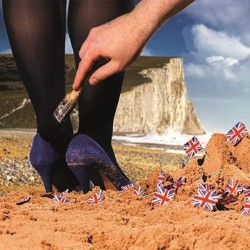
As we come into nearly eight years of rule of the UK Government by the Conservative Party – or 12 Years depending on your feelings for the Liberal Democrats – we have seen a rise in discussion and discourse on asylum seekers. We have seen this amplified with plans such as the current government’s Rwanda Policy and all the way being led by Tory Home Secretaries from Theresa May to Priti Patel who have worked tirelessley to secure British borders even if causes harms those seeking asylum and protection from persecution and war. Exodus takes these events and themes, putting a theatrical and darkly comical lens to them in this National Theatre of Scotland production at the Traverse Theatre.This is a show with an incredibly strong and powerful message and it hits very well. The story itself is a twisted mix between the political performances before such as The Thick of It and BBC’s House of Cards with the dark humour of It's Always Sunny in Philadelphia, sprinkled with plenty of satirical takes of our modern-day politics which, as much as it can be funny, is frightfully real. Though, like a roller-coaster the writing has its ups and downs, it overall does a spectacular job and strikes well. And the performances are brilliant. Aryana Ramkhalawon, Habiba Saleh, Sophie Steer and especially Anna Russell-Martin as Tobi Tucker really bring their all to this. All portraying such amazing energy, great comedic timing and really powerful moments.The staging itself also brings some interesting observation, both positive and negative. The stage, split between a tall projection screen, a moving wall which uses both large and small projections to mimic aspects of the train and other locations. The movement and the interactivity between the cast and staging was brilliant. So much motion and chaos which really added to the performances and story. However, the projections, though used well in depicting the train-based location, didn’t really work well on the larger scale with the staging at the Traverse.Overall, this is a really intriguing, chaotic but overall superb show. A gripping message, topical humour and satirical punches along with fantastic performances and overall energy, you are in for a very stunning show.

Traverse Theatre • 6 Aug 2022 - 28 Aug 2022

Sofie Hagen: Fat Jokes

From dealing with video testimonies of love from superfans to the vilest of far-right vitriol that can be spat in 280 characters and all whilst dealing with the life of a comedian, body positivity and a new dog... life ain't too easy for quick-witted and hilarious Sofie Hagen. From comedy to writing to TikTok, she's certainly been keeping busy and in her new show, Fat Jokes, really shines through as a highlight of this year's festival.Sofie is a master of the awkward situation. Taking any relatable, cringeworthy occasion of life that may affect any normal, queer person who questions their life choices and making it into quality and hysterical material which really resonates with the crowd. And that material certainly hit well. From pronouns and relationships to international disputes which might shock some Brits, there was a constant buzz of laughter from the crowd. Not everything hit but even then, that was funny in itself and worked in the end. Another stand-out was her physical humour. The show is critical of how the common comedians does fat jokes and Sofie really plays on this, spinning that physical humour to her own advantage and the audiences enjoyment. From how other comedians impersonate fat people to her own insightful, accurate and golden impressions of these types of comedians and others.If you've never seen Sofie Hagen before, you will really enjoy this. If you're a fan of Sofie Hagen, you will love this! To note any fault, time went by too fast, especially for a one hour timeslot. You will be left with an appetite for more. Previously winning the Edinburgh Comedy Award for Best Newcomer in 2015, Sofie Hagen has truly solidified herself as a must-see each year at the Edinburgh Fringe. Fat Jokes is clever, high-energy and overall, really fun.

Monkey Barrel Comedy • 4 Aug 2022 - 28 Aug 2022

Something in The Water

With a plastic fork in hand (not a preference, all part of the show), the Crains Lecture Hall of Summerhall, a former home of learning for the students of the University of Edinburgh, is a fitting place for an aquatic exploration into gender identity and queerness. This is what will certainly await you when you find Something in The Water. A mesmerising, darkly comical, one person show from the mind of queer trans writer, actor and puppeteer S.E. Grummett of Saskatoon, Canada who brings the award-winning show to the Edinburgh for their spectacular Festival Fringe debut.In the titular role of Grumms, a person gendered as a girl transformed into a non-binary squid person, Grummett brings an unmatched, otherworldly, ecstatic energy from their first breath to their final bow. With use of a projector, sketchbook, dolls and a trusty squid, they weave a tale of curiosity, experimentation, transformation and understanding. The whole journey is so life-affirming, it's relatable, thoughtful and certainly leave you feeling good. The use of projection especially, encompassing the smallest of details and creative art within Grumms Storytelling Sketchbook to the wider oceanic moments faced by Grumms, works so well and really helps add to the stellar performance by Grummett. This is a very interactive show with entertaining, playful, fun and thought-provoking moments of participation. Even those who despise the very minimal notion of participation will find these engagements with the naïve and comical Grumms well worth it. Additionally, I feel this show should be commended for its accessibility with a number of signed, captioned and relaxed performances available during their Fringe run along with supporting Relaxed Performance Guide which is available via the Summerhall Website. The Festival Fringe has always been a bastion for understanding, creativity, humour and most of all, a place to embrace that which is different. This show is pure Fringe, utterly spectacular! A celebration of those who don’t always fit, those who often feel ostracised and those who are trying to find themselves. A heart pouring journey of discovery and queer self-love which would move the coldest of souls and make the hardest of audiences cry. Haste ye back to Edinburgh Fringe!

Summerhall Place • 3 Aug 2022 - 28 Aug 2022

Yuriko Kotani: Kaiju About

Like Edinburgh, London is not an easy city to live in. It’s expensive, people can be rude and it can really drag you down. This very much describes the relatable experiences faced by Londoner and Japanese comedian Yuriko Kotani in her full post-pandemic return to the Edinburgh Festival Fringe. Her perspectives on the pandemic, daily life, hobbies and self-care in her own charming, cheerful and comical way really make for a phenomenally feel-good show. In a move from the Pleasance Courtyard to the Pleasance Dome, Yuriko continues to bring a positive and funny in her new, energetic show, Kaiju About.One of the noticeable changes from her previous Fringe run, perhaps supported by a bigger performing space, is a more physicality to her humour. She made full use of the space from moving around, using props and releasing her inner Kaiju, becoming far more expressive and furthering the positive and feel-good emotional impact of her performance. This also really falls into her material which continues to shine through in its relatability and hilarity with awkward moments, real world issues and overall feel-good positivity. In her performance also, she really does incredibly well with connecting with her audience. Rather than awkward and harsh like many comics have made audience interactions, Yuiko seeks to get to know you more and keeping everyone involved in conversations about evil landlords and becoming a vengeful ghosts. Yuriko Kotani is becoming a fringe favourite. Every return she comes back bigger and better with her great perspectives and good jokes. She continues to grow and evolve as a comic, becoming funnier with each time you are able to see her.

Pleasance Dome • 3 Aug 2022 - 29 Aug 2022

The Queen's Cartoonists

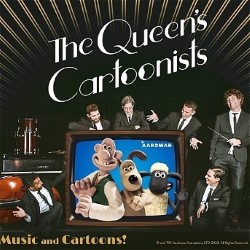
Six Players. A menagerie of instruments. And one massive projector set up, jam packed with cartoons. This is the set-up of The Queen's Cartoonists Fringe debut at the prestigious Assembly Roxy. A musical cavalcade of animated shorts and scenes to live jazz music - but is this a snappy, electric animated masterclass in music or does it just fall flat in cartoon motion?For an animation and/or jazz fan, this show is a must. A collection of iconic characters from Popeye to Wallace and Gromit and Porky Pig to Shaun the Sheep grace the screen of the Central Hall of the Roxy. Their voices and (some) sound effects remaining the same but their old and sometimes iconic scores birthed anew by smooth, quick, toe-tapping jazz. Especially with the additions of more contemporary animation put to their own compositions, these moments were really special. Additionally, with their partnership with Aardman Animation, the masters of stop-motion animation, there are more characters which are perhaps more familiar to the UK audience. But I wouldn't say the show is without its flaws.Mainly, this boils down to who is this show aimed that. Who are the audience for this show? Some aspects such as the international animation and attempts at humour feel for a more mature viewer, an unpleasant disruption for younger audiences as was the case in this performance but something appreciated by those older. But the long focuses on characters such as Shaun the Sheep, though appreciated, felt far more like content for a young audience. This didn't feel like an all ages show but more a jarring and uncomfortable seesaw of entertainment.Overall, especially for a debut, this is a good one. It's entertainingly good fun. But if, hopefully, The Queen's Cartoonists are able to return next year with two shows for younger and older audiences in a similar vain to John Robertson's The Dark Room or Basil Brush's Fringe performances.

Assembly Roxy • 3 Aug 2022 - 28 Aug 2022

Sooz Kempner – Mega Drive

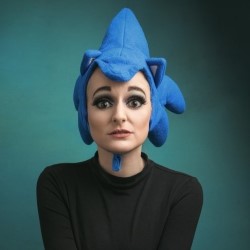
Sonic might not be the best video game character in the world but moving around at the speed of sound, he has touched many hearts and none more so than Sooz Kempner who brings her love for the mascot, Sega and growing up in the 90s to the forefront in a terrific hour of stand-up comedy.Back at the Edinburgh Fringe after her hit show in 2018, Kempner returns to bestow some video game knowledge, sing a few songs and reminisce about growing up in the 90s with the Sega Mega Drive (Genesis for the Americans). Her incredible energy and quirky humour have you laughing hard as you hear about stories of growing up as well as dealing with mansplaining on Twitter. With use of a projector also, she’s able to visualise some of the gaming history she reviews as well as perform some hilarious sketches which help to pace the show and tie together the many issues and topics she covers so well. One of the stand-out moments is her singing. With a background in performing on the West End, Kempner performs some nostalgic classics especially for anyone who went to a British Primary School.From classic Sega titles, childhood and Fraser, Kempner covers it all and takes you on a hilarious journey through her rollercoaster of a life. Sooz Kempner: Mega Drive is not to be missed. Its almost as good as plugging Sonic 3 into Sonic & Knuckles for the Mega Drive.

PBH's Free Fringe @ Globe Bar • 3 Aug 2019 - 25 Aug 2019

Colt Cabana and John Hastings Do Comedy and Commentary to Bad Wrestling Matches

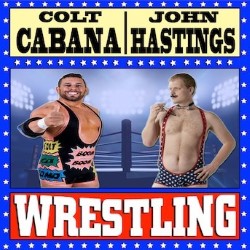
Colt Cabana Is a world-famous wrestler who has wrestled around the world from Dundee to Japan and back including a short, not so successful, run in the WWE as Scotty Goldman. John Hastings is… not a world-famous wrestler but enjoys talking about the sport on his Podcast as well as being a comedian. Together in the depths of Monkey Barrel Comedy Club and along with a comedy guest, they do comedy and commentary to the weirdest and craziest moments in professional wresting in this outstanding, laugh a minute show! The show is introduced in quite an awkward video introduction by Oli Davis of the show’s sponsor Wrestletalk, a daily wrestling YouTube channel. But immediately after, Colt and John spring into life and begin to perform some sets and poke fun of eachother in what could be described as a comedy version of duelling banjos. This slightly scripted but very hilarious banter is followed by the introduction of their guest. For this night it was Tom Walker who is performing his show at the Assembly Roxy. He was incredible and played along well with Colt and John as they began to look at different clips from the world of wrestling. From awkward interviews, strange personalities, weird matches and horrific botches, the craziest moments of wrestling are looked at as the trio picks away at every detail. Clips are different every night and it is amazing to see Colt and John’s wrestling knowledge as well as their ability, along with Tom, to make the strangest moments incredibly funny. The finale is always the same but always a treat and its sheer ridiculousness. To give a little bit of criticism, the projection of the clip wasn’t so good and sometimes it was difficult to view the clips depending where you sit though this isn’t the biggest issue and the show is great overall.If you’re are a wrestling fan, this show is for you. A deep dive and funny look at the amazing world of professional wrestling. If you’re not a fan of wrestling, even the most uneducated in the sport will find this a good laugh with the joke a minute humour and sheer ridiculousness of the clips. Colt and John have produced a truly amazing show this year. Colt Cabana and John Hastings Do Comedy and Commentary to Bad Wrestling Matches is an amazing hour of comedy that will have you pinned with laughter.

Monkey Barrel Comedy • 2 Aug 2019 - 25 Aug 2019

STYX

A mixture of mythology, memory and music. STYX – fresh from its award-winning run at the Perth Fringe – is gig-theatre which explores the memories of writer Max Barton’s grandmother Flora who has just been diagnosed with Alzheimer’s though a mixture of recordings, indie music, science of the mind, storytelling and Greek mythology with a large focus on the myth of Orpheus and Eurydice. Produced by new company Second Body, STYX is a moving and outstanding experience unlike anything I have seen at the Edinburgh Fringe.The show is performed by Max Barton and an ensemble of alt-rock musicians from Australia who really shine throughout with beautiful musical performances, interesting scientific messages and touching, realist moments of humour, passion and pain. Barton – who wrote the show and music – leads well in a relatable and powerful performance. Barton’s writing and ability to combine so many parts are also something to be commended. This could have easily been incredibly messy with so much happening but the show is paced well, keeping you entirely engaged with the emotions and music that pours from the stage.The lighting and sound design, done by Jethro Cooke, is incredible. The set is decorated by a mixture of hanging bulbs which react to different moments within the show, really adding to the atmosphere. This is also supported by excellent sound design which ties together the music, audio recordings, spoken word and moments of pure, disorientating mythos like a fine tapestry which is a feast for the scenes.STYX is an emotional storytelling experience of life, death and memories which truly shows the power of music and the complexity of our memories. The whole cast, especially the work of Max and Jethro, has done an excellent job in combining aspects of storytelling, music and science into incredibly beautiful and emotional theatre.

Zoo Southside • 2 Aug 2019 - 17 Aug 2019

Right in the Eye – Live Movie-Concert of Georges Méliès' Films

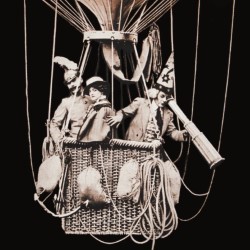
Georges Méliès is often described as the inventor of cinema. Originally working in theatre and with experience in magic and special effects, he was one of the first to make use of the Lumière Brothers' invention to create narrative movies which took fantastical stories and ideas as well as develop many types of special effects in filmmaking.Some of Méliès' most popular films include A Trip to the Moon (1902), The Impossible Voyage (1904) and A Nightmare (1896). Jean-François Alcoléa is an accomplished musician, stage designer and performer who, with his company, has taken the magical worlds and great fantasies produced by Méliès to create a movie-concert that is truly enchanting.The performance takes you through 12 films by George Méliès accompanied by the unique music of Jean-François Alcoléa along with a short documentary introduction highlighting Méliès and his accomplishments. The show begins as soon as you enter the auditorium; entering the main hall of the French Institute, Alcoléa and his team have designed a staging of instruments, lamps and objects which feels as if you are in Méliès' workshop or studio.This also changes throughout the show to fit the atmosphere of each film and is something to behold. From pianos, guitars and chimes to crystal glasses and spoons, Alcoléa use everything at their disposal to create music that sounds outstanding and fits well with the world of Georges Méliès and the actions taking place within it. The trio of musicians are easily able to match their music to the actions, emotions, moods and wonder of each film shown.Right in the Eye is a magical adventure of film and music, unlike any movie-concert I have ever seen before. Alcoléa and his team of musicians and creatives have taken the excitement and spirit of Méliès’ work and made the perfect musical accompaniment.

French Institute • 2 Aug 2019 - 25 Aug 2019

Fulfilment

In our modern world, convenience is king and Amazon wears the crown. One of the world’s largest companies, Amazon has taken over the world of e-commerce to become one of the big four technology companies along with Google, Facebook and Apple. But has this success benefited everyone? Fulfilment seeks to highlight the true and rather frightening stories of workers within an Amazon Warehouse or, as they call it, their fulfilment centre. These stories are then contrasted with moments of interactive puppetry in the form of Roblox, a robot personal fulfilment device, representing the convenience and positivity of Amazon’s brand. SharkLegs Theatre Company seeks to highlight a massive issue in our current dystopian reality and though they accomplish some aspects well and others definatly have potential, they somewhat fall short overall.The themes of humanisation and dehumanization prevalent within the story are presented well in the contrasts between Roblox and Amazon Workers scenes and this is especially supported by the passionate and powerful performances by the small cast who are brutal and beautiful in their performances. However, the overall narrative, the constant and often unrelated changes happening throughout the show become incredibly messy and difficult to keep track on. Moments can go from calm and cheerful to intense and uncomfortable in seconds and though this can be done effectively, it wasn’t prevalent here.Roblox, the puppet used though the performance, is very simple in its design. A simple and incredibly flexible cardboard exterior with white plastic eyes and a small, Amazon-style smile. This is incredibly effective and is a real stand-out aspect of the show especially with how the three performers work together with ease in the manning of the puppet. Roblox is performed as an incredibly charismatic, constantly interacting and learning from the audience, which is a pleasure to watch. However, the unraised thrust staging of the performance, really hindered the performance making it incredibly difficult to watch moments of the performance especially with Roblox. I do understand that often a company has no choice in the venue they receive, often being allocated it by the venue provider but nothing was adapted to accommodate to the space or view of all the audience which really hinders the experience.Fulfilment definatly achieves what it sets out to do, acting as a guild-enduring view of the ugly truth of Amazon which will make you question your choice next Cyber Monday. At time being deep and powerful, it is ashame that it is often undermined by its messiness and creative choices. Hopefully with some creative changes and perhaps a new venue, this could become a really impressive show.

Underbelly, Cowgate • 1 Aug 2019 - 25 Aug 2019

Do Our Best

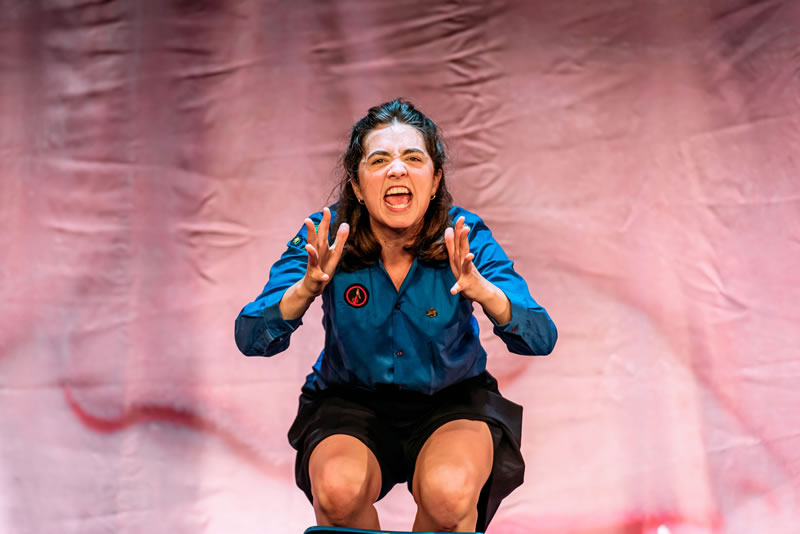
The Girl Guide Promise, an oath taken by all Guides and Brownies, highlights how a girl guide member must always do their best, be true to themselves and develop their beliefs. In Do Our Best, these beliefs and more are achieved!A phenomenal hour of emotional, immersive, funny and gut-wrenching theatre. Written and performed by the outstanding Remy Beasley, Do Our Best follows 30-year-old Welsh Girl Guide Sephie as she attempts to achieve her entertainer badge for the fourth time in the wake of her mother's death. Somewhat egotistical and hyperactive, she recollects her life and her previous badge attempts in this rollercoaster show of emotions.One of the biggest stand-out aspects of this show was the amazing writing and electric performance from Remy Beasley. From the moment you enter the small theatre within the Underbelly, Beasley prances around the auditorium and prepares for the show. She is an outstanding character actor who, with great ease, is able to encapsulate the audience and bring them into Sephie’s world. With interactive moments that fit the theme of the show, it is incredibly immersive as you begin to piece together Sephie’s life and the issue she struggles with. Beasley has written a show which will make you laugh as much as it will move you; a truly heartfelt masterpiece.She is additionally joined by stage manager Caitlin, who adds to some of the moments as she controls the lights and sound from the side of the stage. This was another great aspect which was well done as the choreography, sound, light and set design (consisting of a large blow up of Sephie’s face) really add to the emotional moments of the show. The show is also paced well, no moment feels dull as it keeps you constantly engaged.Do Our Best is a masterpiece, a powerful and passionate story of a girl’s life long quest to find herself and deal with her demons. It is one of the stand out shows of the festival. Remy Beasley, both in her writing and performance, has very much proven herself as an up and coming star, and I look forward to seeing her future work.

Underbelly, Cowgate • 1 Aug 2019 - 25 Aug 2019

John Robertson: The Dark Room

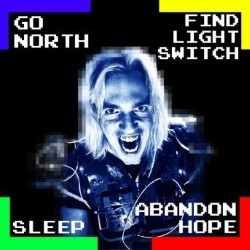
John Robertson first premiered his maniacal game show The Dark Room back in 2012. Beginning in the dark abyss of Hive Nightclub with a £50 prize and only a two star review from Broadway Baby, it's amazing to see how far it’s come. Progressing from venue to venue, this now cult-classic resides in the grand dining room of Gilded Balloon Teviot Row – and it is truly a comedy feast. High energy, physical and witty John Robertson: The Dark Room sees random contestants (strangely all named Darren) selected from the audience play a texted based adventure game as they seek to find the light switch; find their family and escape the dark room with a chance of winning £1000.The show is hosted by Robertson wearing what resembles a leftover costume from the set of Mad Max. From the moment the lights go out and he springs onto the stage, you can clearly see his passion and pure enjoyment for hosting and tormenting the souls who are selected to play. His ability to respond with the funniest remarks and pick up on the smallest details is masterful. He is the perfect hype man, keeping everyone engaged and interested in what's happening as well as doing the strangest things to engage with people such as climbing seating scaffolding to reach a contestant or running to the top of the stairs to throw a prize of beans to a contestant. As not many people have won the dark room, every contestant wins something smaller. In the case of this show, it was baked beans in a bag, a box and some random piece of metal. The sheer randomness of these prizes really adds to the crazy and hilarious antics of the show.Robertson’s dark humour and interactive demeanour is disturbingly entertaining in this addictive and hilarious show and it really is something to behold! The Dark Room is one of the best game shows at the Fringe if not the world. It has cemented itself as a cult classic of the Fringe.

Gilded Balloon Teviot • 31 Jul 2019 - 24 Aug 2019

Yuriko Kotani: Somosomo

It is common to see stand-up comedians at the Edinburgh Fringe be either unnecessarily controversial or unimaginatively bland. Luckily however, Yuriko Kotani is neither. She returns for her 3rd Edinburgh Fringe to bring her creative perspective on Japanese and British life along with some amazingly good vibes and a sprinkle of feminism which makes to be one amazing hour of comedy in Yuriko Kotani: Somosomo.The first thing that will grasp you is how engaging and interactive she is, asking the audiance questions and chatting with them throughout the show on the most interesting of subjects which often leads to interesting and hilarious answers. And just as she is engaging with the audiance, the audiance are absolutely engaged with her. Non-stop laughter is inevitable as she talks about her love life, living in the UK, life in Japan and the issues she often faces for being a woman. Throughout she is incredibly relatable and down to earth, making the funniest jokes out of the most ordinary parts of life. Her ability as well to connect her stories and experiences, referring back to multiple moments throughout the show is really incredible and makes for great pacing with lines hitting well and often.Some of the highlights of the show is the comparisons she makes between British and Japanese life, taking racist or sexist comments in her stride as well as the many interesting cultural aspects of Asian life. She is an amazing storyteller who, even when complaining about her English and use of Puns, is able to convey herself in the most amazing manner. Stand-up Comedy definatly suits a confident and loud Yuriko who stands proud and lives up to the hype. Yuriko Kotani: Somosomo is a must-see full of heart, passion and laughs.

Pleasance Courtyard • 31 Jul 2019 - 26 Aug 2019

Isa Bonachera: The Great Emptiness

One day the earth might be so devastated that we might need to leave for a distant planet. If that ever happened and I got a choice of who joined me in my shuttle, after seeing her hour of stand-up, my first pick would be Isa Bonachera.With a degree in physics and a lot of worldwide work experience to do with space, Isa has now turned to comedy and is out of this world with her fantastic stories, excellent delivery and a ton of facts about space and science.Dressed comically as an astronaut, Bonachera talks about her dreams of being an astronaut to a background projection which appears as if we’re together in a shuttle hurtling in to space. This projection also helps with many of the impressive audio and visual moments of the show which help to show parts of her life and specific pictures to do with space.The show is also incredibly well-rounded with the different subjects she covers like her catholic upbringing in Spain, jobs and academic roles she has had over the years as well as all the different ideas she has about science, space and life in general. Her overall delivery and pacing were well done also; she was able to deliver jokes and punchlines which really hit you with laughter.The stand-out moments of the show were all the science and space knowledge she dispense throughout the show. From the lives of science's greatest minds to describing blackholes, she is incredibly interesting and passionate. The jokes she made around these concepts also were amazing, some so cleverly done and delivered that they’re as smart as the scientific knowledge she dispels.Isa Bonachera: The Great Emptiness is out of this world. With great use of sound and visuals as well as some amazing jokes and stories, you'll be laughing and learning at the same time from the wit and amazing talent of Isa Bonachera.

Gilded Balloon at Old Tolbooth Market • 31 Jul 2019 - 25 Aug 2019

Confirmation

Part-biographical, part-political, part-musical, part-magical. Xnthony (Aka Anthony Keigher) brings his popular Dublin Fringe show Confirmation to this year's Edinburgh Festival. Xnthony shines throughout with his incredible charisma but the music, composed by Saly ó Dúnlaing, as well as other aspects of the show are extremely hit or miss.Confirmation focuses on the life of Anthony Keigher as performed by himself and focused through the different ideas and belief aspects of a Confirmation, a traditional ceremony within the Catholic Church which he took part in at a younger age. Though this might be seen as egotistical, he is able to provide the emotion and passion required to talk (and sing) about his life growing up as a gay man in Roscommon eventually moving away to London as well as giving a strong focus on the recent same-sex marriage referendum which recently took place in the Republic of Ireland where his home county of Roscommon voted against his right to marry. Xnthony gives this show his all, coming over as incredibly engaging and charismatic. This is also supported by the choreography by Yvan Karlsson which adds to Xnthony’s performance even in such a limited theatre space within the Pleasance Dome. Xnthony comes over well in expressing himself and his story, especially in expressing his feelings about his identity, upbringing and LGBT+ issues. Often this is expressed though different musical numbers performed well by Xnthony’s incredible vocal talent. However, the songs the performers are a very much mixed bag and one of the issues the show has.The music was one of the biggest issues the show had, being a very much mixed in levels of quality. Somewhere powerful ballads that expressed deep emotional feelings about identity and childhood which came over well and added somewhat to the performance whoever most where very 80s style pop music which, though nostalgic, didn’t come over as well and often felt incredibly awkward to watch. This is additionally made more awkward by the poor set design and constant smoke pouring onto the stage which, par some moments of clever lighting, failed to add anything of value to the performance. The framework of the confirmation, though appropriate in the ideas covered, fails to give the show the right pacing and it often struggles to move between moments of dialogue and song. With these issues combined, the overall mood and quality of the production is quite undermined. Confirmation has potential but still needs more work. Xnthony’s ability as a performer and creator is clearly visible and he works well in expressing ideas, stories and his passion within this project. I believe with more work and some fixes; Confirmation has great potential and I genuinely do look forward to Xnthony’s future work.

Pleasance Dome • 31 Jul 2019 - 26 Aug 2019

It'll Be Alt-Right on the Night

In the past 20 to 30 years, our world has drastically changed, especially within the realm of politics and culture. Wound Up Theatre’s It’ll Be Alt-Right on the Night is able to capture this vast change, frames it in punk rock and shows its effects on a personal level that succeeds phenomenally in presenting an electric and immersive experience.It'll Be Alt-Right on the Night focuses on the lives of Greeny and Stevo covering their rough childhoods, their rebellious, punk adolescence and finally their modern day, vastly different lives as written and performed in different fragments by Matthew Greenhough with musical accompaniment of punk rock and jazz covers on trumpet by Steven Wright. Best friends in youth, Greenhough slowly piece together the lives of Greeny and Stevo who, united by punk rock, become distant and resentful due to their political leanings. One who believes in politically correct, liberal values which vastly differ from his Northern Family whilst the other begins to support the alt-right of new conservatism and personalities such as Donald Trump and Stephen Yaxley-Lennon (Tommy Robinson).One of the massive strengths of the show is the writing and performance of Matthew Greenhough. He has written a one-man performance that feels genuine and real and as if these characters exist within the real world rather than within the realm of theatre. In his performance, his ability to change his stage persona and personality at the flip of a switch, portraying the vastly different perspectives of Greeny and Stevo, is outstanding. The staging was simple and covered in different records as well as a single record player with Wright, performing on the trumpet sitting in the corner of the stage. This felt perfect for the performance, providing a simple canvas for these characters to be projected onto, as well as the addition to good use of lighting to create different moods throughout. The interlude trumpet performances by Steven Wright should also be commended for adding to the mood and atmosphere.It'll Be Alt-Right on the Night is a powerful and passionately-produced performance about friendship, relationship and the change. It’s powerful use of imagery and use of punk culture and music as well as natural and interesting perspective on modern politics and its effects really combine into something that is truly electric.

Pleasance Courtyard • 31 Jul 2019 - 26 Aug 2019

Beach Body Ready

In our current day and age with consuming media in whatever shape it may take, it’s not difficult to find an advert, article or commentary about the body and how we should look in society. May it be an advert or article on a diet, health supplement, app, make-up, clothes or really anything, it is usually making a statement on how we should look and how we should feel about ourselves, regardless of the negative results this can have on our mental health or body image. Beach Body Ready, from the Hull-based theatre company The Roaring Girls, takes these ideas and smashes them up in their phenomenal debut Edinburgh Fringe Show.The show focuses around Rachel Abbey, Josie Marley and Sarah Penney, three of the members of the company who perform as well as being writers and devisers for the performance. Each deals with their own body image issues as well as mental health and overcoming the harshness of others. In a mixture of casual conversations, heartfelt speeches, filmed content and dance routines; they overcome the insecurities and negativity of the world. The trio were absolutely phenomenal throughout, going from causal conversations on body image to moments of deep emotion and passion. It’s clear that they love what they do and it really adds to the show. Moments were so heartfelt and real. At times, it felt more like a chat show a play, adding to how grounded and honesty they were. Body image and mental health are not new topics to theatre, especially at the Edinburgh Fringe, but The Roaring Girls down to earth nature and heart really gives a fresh perspective on these issues especially with each giving their own perspective.Beach Body Ready is an upbeat, feel-good show that will make you laugh. Full of high energy and powerful statements, it’s an amazing hour of body positivity that couldn’t be more needed in our current society.

Pleasance Courtyard • 31 Jul 2019 - 26 Aug 2019

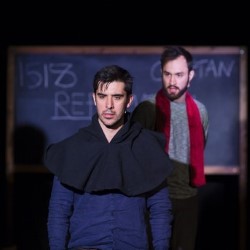
Shakespeare Catalysts

Before I begin this review, I would like to clarify, as James Beagon (co-director and actor) did at the start of the show, that Aulos Productions’ Shakespeare Catalysts is a work in progress. Beagon describes the show as ‘one big experiment’ and one the company welcomes audience feedback from after the show; the show we saw today is slightly different from the one they performed yesterday due to discussions they had with the audience afterwards, and tomorrow’s show will be different again. The play is not a series of scenes from Shakespeare’s lesser-known works, as I expected, but in fact takes some of these works to create a new narrative, and repurposes some more famous passages so they’re seen in a new light. The narrative begins with Juliet (Sophie Harris) and her son, as she reminisces about when she was married and tries to fix her tape player. When it is fixed we are taken back in time to when she first met Romeo (Daniel Orejon) and when their relationship began, but this is not the Shakespeare play as we know it. Set in our world, in the 1980s onwards as shown through the use of songs and news reports during the change of scenes, Romeo and Juliet take part in political rallies, using Henry V’s St Crispin’s Day speech, and eventually Juliet emerges as a Thatcher-esque female Tory, with scenes from Coriolanus, Julius Caesar and others making very apt political commentary. The narrative is not all politics, however, and remains focussed on the relationship between the couple as it deteriorates. Harris and Orejon have excellent onstage chemistry and play off of each other well, as well as, in Orejon’s case, portraying Romeo’s physical deterioration through illness. Beagon should also be commended for his versatility, taking on roles as the son, the Speaker of the House, and Eros, the doctor. The three have worked well together, not just onstage but in jointly devising and directing the piece.The use of a wide variety of Shakespeare’s plays, from Antony and Cleopatra to Cymbeline, helps to elevate the narrative from a simple reworking of just Romeo and Juliet, and the use of familiar pieces in a new context, such as lines from the balcony scene when Juliet leaves Romeo – ‘O, wilt thou leave me so unsatisfied?’ – show not only the versatility of the scenes but also how cleverly the cast have worked together in creating a new narrative. For the most part the scenes flow together well, although it was a little uncertain when the first narrative of Juliet and her son ended and the second, with her past relationship with Romeo, began. I look forward to seeing how the team will further develop this piece in future; thus far, I would consider their experiment to be a success.

Laughing Horse @ Espionage • 20 Aug 2018 - 26 Aug 2018

1984

It is frightening how Orwell’s nightmarish dystopia continues to ring true, year after year. From Winston’s colleague Syme (Liam McKinnes) exclaiming delightedly ‘It’s a beautiful thing, the destruction of words’, to the proletariat being described as subhuman, those who go against the Party as a stain to be wiped out, even Winston’s desire to sexually violate Julia before murdering her... 1984 is still horribly relevant in 2018. Max Thomas and Rebecca Vines have written a chilling adaptation of Orwell’s novel that is brilliantly brought to life by a talented cast; there is a reason Close Up Theatre have had sell out shows at the Fringe since 2004. From the acting to the set to the tech, every element of the production came together to form a powerful piece of political theatre.As in the original novel, we begin on a bright, cold day in April, with the clocks striking thirteen. We are not initially addressed by Winston (Orlando Giannini), however, but by George Orwell himself (Joshua Brooks), who sometimes speaks in unison with his protagonist, establishing the world as Winston secretly writes in his diary. As Winston’s story unfolds projections establish our location, as well as showing Party broadcasts, and the screen where Winston works to correct the facts at the Ministry of Truth. Credit must be given here to Oscar Richardson for brilliantly evoking the bleak, controlled world of the piece with the use of projections as well as the deep red lighting for the Two Minute Hate, and the continued updates from the telescreen (Olivia Attwood). The minimal set design, though with brilliantly detailed props such as a bottle of Victory Gin, meant that the space was used excellently, from Party members emerging from all sides to join in the Two Minute Hate, or when the cast move their chairs in unison for scenes in the Ministry of Truth’s canteen. It is in these scenes in particular that Syme, Parsons (Jack Coombs) and Ampleforth (Benjamin Crossley) shine, as they express triumph at public hangings, and Parsons’ daughter’s willingness to denounce people to the Thought Police for wearing the wrong kind of shoes. The conflict of Julia (Maddie Dunn) is also shown in these scenes, where she mocks the proles along with her fellow workers, yet eagerly denounces the Party when she and Winston are alone and, they think, in private. The relationship between Winston and Julia is an unsettling and all-consuming one, and Giannini and Dunn did well in capturing this, especially when the Thought Police catch up to them.In the scenes that follow, with Max Thomas’ O’Brien torturing Winston and trying to ‘cure’ him of his hatred for Big Brother, both Thomas and Giannini delivered truly chilling performances. Thomas portrays O’Brien’s fanatical dedication with frightening ease and calm, especially when trying to get Winston to admit that two plus two doesn’t always equal four, while Giannini’s screams of fear and pain, and his pleading with O’Brien, perfectly captured his character’s desperation. 1984 is a bleak and frightening piece not just for these scenes, but it is a piece that is well worth watching - just as relevant today as it was when the novel was first published.

Greenside @ Nicolson Square • 20 Aug 2018 - 25 Aug 2018

Holy Sh*t

Hearing a couple of priests swearing will always be amusing. Hearing a couple of priests swearing whilst digging up the body of a dead parishioner so they can sell the corpse to raise money for the church takes the humour to a whole new level. Rafael Aptroot and Jack Read play priests George and Charlie with a great deal of charm and humour. There is a contrast between their characters, as well as a running gag about taking the Lord’s name in vain, which provides consistent laughter throughout. The play follows their life of crime as told through a series of flashbacks, as the sergeant (Rebecca Emerson-Gold) explains to her colleague (Sahnun Omar) how she came to catch the pair. Although some of these interview scenes seemed a little short, especially considering the transitions before and after them, the decision to tell the story in this way meant that while we sympathised with our reluctant, awkward anti-heroes, we were also eager to find out exactly how the police caught up with their scheme. Subsequent to digging up a body and a debate aabout predestination and what happens after we die, we then see when the two priests first met - introduced to each other at a funeral by Father Victor (Jack Elmore). Elmore also plays the hapless Neil, a student of the professor to whom the priests sell the corpses, and his physicality in his portrayal of each character is particularly impressive. Sophie Welbourne and Sahnun Omar also play two roles, and should be commended for their versatility. This being said, Elmore’s portrayal of Father Victor was the first indication I had of the play’s increasingly farcical nature. Although the script overall was entertaining with continued twists and turns that led to unexpected places – a mob boss in Wigan, anyone? – the initial clever back and forth between George and Charlie gradually gave way to more slapstick moments. This was a little disappointing considering the play’s unusual premise and the witty back and forth that had been built up thus far. Events take a suitably dark and unexpected turn as the play reaches its denouement, and the case of the body-snatching priests is resolved. Jack Fairhurst should be commended for a clever premise and a fun script, and the cast and crew of Brick Fox should be proud to have brought such an innovative piece to the Fringe for their first original show. I look forward to seeing more of their work in future.

Paradise in The Vault • 20 Aug 2018 - 24 Aug 2018

Legacy: The Story of Martin Luther

In the beginning was the Word, but I honestly don’t know which word to begin with when trying to describe this production. It is epic in scope, travelling from Germany to Rome and covering the sixty two years from Martin Luther’s birth to his death, yet intimate at the same time, with a cast of five taking on roles from Pope Leo X to the Devil himself. It is performed inside an actual church, and yet the lighting and sound are done so incredibly by designer Jacob Burns, that we feel transported from a quiet grove to a fiery peasant’s revolt, from the Vatican to the centre of a storm. I realise this is not particularly eloquent explanation thus far, so in the beginning, then, I will say this; Saltmine Theatre Company’s production of Legacy: The Story of Martin Luther is not to be missed. Their final performance is at 2:30pm today. Be there.The production begins in the midst of a storm, with Luther (Freddy Goymer) being looked after by his friend, Phillip (Ben Kessell). Luther fears he is hallucinating as he sees his parents, and himself as a baby, and so the narrative of his life begins. The action is episodic in nature, a series of scenes from Luther’s life, woven together by Goymer’s powerful performance both as narrator and as part of the action, as well as through beautiful moments of song from the entire cast. They work together flawlessly as an ensemble, with quick changes of costume, such as a scarf or a waistcoat, clearly establishing their different characters. I feel special mention must be made of Marcel White’s fiery, intense portrayal of John Tetzel selling indulgences, and Alys Williams’ subtle and chilling portrayal of the Devil. Credit must also go to the entire cast in their ensemble roles, along with Bethany Orrell’s set design and Burns’ lighting, in their use of silhouettes and shadows, from the moment where Luther nails his theses to the church door, to the moment where they all pose as statues on the streets of Rome, where Luther travels as a young man. This use of the set and the lighting helped to give the production its epic scale, with those casting shadows managing to convey an angry crowd, backed by flames, to monks at prayer in cloisters. Despite its heavy subject matter, and the aforementioned storm and flames, the production does have many moments of levity, and moments of reflection and quiet amidst the action. Richard Hasnip has written a script that is clever, biting, and often poetic, with the Devil warning Luther that he will ‘shed more blood with [his writing] than all the swords in Christendom’, and Luther saying in prayer that God is ‘the only Father left to [him] now’. The production as a whole explores a complicated period of history and the life of a figure key to the Reformation with great skill, making both easy to understand while telling Luther’s story beautifully. I urge you not to see their final performance tomorrow; I am just sorry that I am busy and will be unable to see it again. A captivating piece of historical drama it would be a sin to miss.

Palmerston Place Church • 14 Aug 2018 - 18 Aug 2018

Grace

Nigel (Jonny Davidson) and his wife Sarah (Ella Dorman-Gajic) are sitting down to a dinner of soup and parsnip wine when they are interrupted by a knock on the door. The couple are initially hesitant about answering in the midst of a storm, with Nigel worried that the stranger may be a robber or a "loony". He was right to be worried, as Sarah opens the door to a muddy, bruised man who is only wearing boxer shorts. While Nigel is now even more reluctant, Sarah believes he may have been sent to them as a test from God, and this suspicion seems confirmed when they learn that the mysterious stranger is a priest, Father Samuels (David McCabe). What follows is an eye-opening evening for the young couple, as Father Samuels proposes to give them his own brand of ‘spiritual guidance’.The simpering, sickly sweet relationship between Nigel and Sarah shows an excellent chemistry between Davidson and Dorman-Gajic, as they play off of each other with ease, while the contrast between them and the worldly-wise Father Samuels proves especially amusing in their different styles of delivery, with Samuels’ despairing reactions to the couple from their demonstration of how they ‘make love’ to their parsnip wine. Unfortunately, this initially amusing rapport began to wear thin as the play continued, as it became clear just how naive the couple were and how Samuels could exploit them at every turn. His explanation of how he came to be in the forest, and the initially quirky set-up of the isolated couple, proved more intriguing than the actual situation at hand, and the concept of the devious, sexually experienced priest contrasted with an innocent couple felt a little tired. Even an awkward, if comical, sequence with a dish of sponge pudding could not change this impression, despite the trio’s excellent use of physical comedy.Late in the play Sarah tells Father Samuels "You’re a very good priest", to which Samuels replies "I don’t know about that." I would have to agree with him; although the cast worked well together, the material did not show their abilities as fully as it perhaps could have. That being said, the production may not have been a blessing, but it was an amusing way to spend an hour.

theSpace on the Mile • 13 Aug 2018 - 25 Aug 2018

Romeo and/or Juliet

Ryan North’s hilarious choose-your-own-adventure-style version of Hamlet, To Be Or Not To Be, first published in 2013, proved so successful that in 2016 Romeo and/or Juliet followed. Beaumont Composite High School takes North’s work as inspiration for their interactive play, and the result is an entertaining hour of Shakespearean silliness. Written by the cast and crew, the play is overseen by two narrators who invite us, at certain moments in the show, to applaud for the choice we want, whether that’s which actor should play Romeo or which balcony he should climb. The different choices mean we can either follow Shakespeare’s plot or go down a path where there could be anything from zombies to an attempt to steal a jewellery box, backed by the Mission Impossible theme. The simple stylistic choices of the performance, from a set comprised of black boxes used to create everything from a balcony to Friar Lawrence’s altar, to red shirts for the Capulets and blue shirts for the Montagues, mean that the story and the interactions between the ensemble are the main focus of the piece. The fourteen-strong entourage work well together; even when the focus is on certain characters, the actors in the background are always engaged, whether partying at the Capulet mansion or as a congregation in the Friar’s church. Every member of the ensemble was given a chance to shine, from Nyasha Chingono as Benvolio telling an aggressively flirtatious Tybalt (Jonah Palamattam) ‘time’s up’, to Liam Shute as the original Romeo complaining, "I don’t like being sad, it makes me sad". I mention the original Romeo, because one of the first choices we are asked to make was which actor we would rather have as Romeo, from the nerdy and awkward, played by Jeremiah Phillips, to the self-proclaimed walking stereotype of a lesbian, played by Ajax Elder. The prospective Romeos were asked to describe themselves in three words, what their perfect first date would be, and why Juliet should choose them. This section, while amusing, felt a bit overlong, as one after another the Romeos were rejected by Hannah Carr’s confident and self-assured Juliet, but when a Romeo was chosen and the play continued, the pacing improved. Although events did come to an abrupt halt when Romeo was killed during the balcony scene, it was here the concept of three lives was introduced; the main characters each have three lives, and so we should make our choices in future carefully or it would be Game Over and the show would end.Although most of the show’s humour derived from the outcome of such poor choices, like Romeo having to try and convince Lord and Lady Capulet that he was actually his own twin, Romaine Lettuce, the ensemble also had fun in using lines from Shakespeare’s text in a new context, or referring to other plays. Although this did sometimes result in obvious jokes, the charm of the performers and the clear enjoyment they were having meant that, for the most part, they pulled them off. If you like your comedies more than your tragedies, and you want some audience interaction that is fun rather than intimidating, I would highly recommend this show.

Central Hall • 3 Aug 2018 - 8 Aug 2018

Greyhounds

Set in the small village of Shuttlefield, Greyhounds sees the local amateur dramatic society attempt to raise money for a Spitfire fighter aircraft by putting on a production of Shakespeare’s Henry V. Cleverly contrasting the 15th century war with that of the 20th century, playwright Laura Crow gives us a nuanced and naturalistic portrayal of a group banding together to do their bit for the war effort, exploring their dynamics as well as their individual stories with humour and pathos. While one of the characters declares she finds Shakespeare ‘a terrible drag’, this production is anything but. Even before we enter the theatre, we are immersed in the world of wartime Britain. Having been welcomed to 1941 by a smiling woman who exchanges our tickets for programmes in the form of identity cards, and who cheerfully instructs us about what to do in the event of the air raid sirens going off, we enter to the sound of Glenn Miller’s ‘In the Mood’. The attention to detail in this production from the costumes and set, to the music during scene changes is fantastic, and I have yet to speak about the cleverly crafted characters. Laura Crow plays Katherine Winters, a serious woman who doesn’t see the point in putting on the play, as they’ll only raise enough money for a third of a propeller. Most of the humour of the piece comes from her taking everything literally and her dry wit, in contrast with her sister Ruby, played by Catherine Cowdrey, who tries desperately to pull the production together. Their barbed comments and shared moments give a true sense of a sisterly bond. Nancy Wilde (Fiona Primrose) is the endearing newcomer from London who dreams of an acting career, and her budding relationship with injured serviceman Edward Holmes (Tim Cooper), is contrasted well with that of Katherine and farm-hand Will Croft (Jacob Taylor). As the rehearsals get underway, the dynamics of the group are thrown into sharp relief, from their differing attitudes to the war and varied experiences, while the characters as individuals are also given their moment to shine, whether in monologues from Henry V which are interspersed with the main action to highlight their state of mind, or when their secrets and histories are brought to light. Although this was done well for the most part, sometimes these individual plot threads felt a bit lost within the main narrative, although the overall pacing of the show never dragged.As opening night approaches there is more drama offstage than on, as relationships and built up and break down and secrets are revealed. While exploring differing ideas of heroism and cowardice Crow gives us a real slice of life from the time, whose characters examine issues still relevant today, from the yearning for new and better experiences to the trauma of war. Henry V states that ‘gentlemen in England now a-bed/Shall think themselves accurs'd they were not here’, and you should think yourself accurs’d if you miss this clever and charming production.

theSpace on the Mile • 3 Aug 2018 - 18 Aug 2018

I, Sniper

I Sniper, appropriately enough, starts with a bang. A group of Red Army soldiers march on stage as commands are barked at them in Russian, culminating in a chorus of ‘The Red Army is the Strongest’. A medal is pinned to one of the soldiers' chests and Lyudmila Pavlichenko steps forward - a sniper with 309 kills to her name, hero of the Soviet Union. She addresses us in Russian and another soldier translates her words. She is thought of as a legend or a ghost, but she was real and this is her story. The cast of nine from Acting Coach Scotland bring Pavlichenko’s story vividly to life, from her schooldays to her time teaching at the Red Army sniper school. With different actors taking on the central role throughout, distinguishing themselves by the medal on their chest, the ensemble works tirelessly and efficiently together to tell the story of this Soviet sniper.The beauty of this premise is in its simplicity. A change of epaulettes or coat, a different hat, or even a cigarette all serve to distinguish different characters. The set is comprised of wooden chests, and is used to transport us from the university’s sniper school to an army barracks, and later to the deck of a ship. The smooth transitions in time and place are helped by the cast, who easily assume different roles as the scenes demand it. Special mention must be made of Daniel Jones, who plays a variety of roles including training officer at the sniper school, a sailor, a commander and even a general, performing each role uniquely. Despite the show’s fast pacing and the quick succession of scenes with a lot of information to take in, I never felt overwhelmed. Conversely, I learned a great deal about Pavlichenko’s life and the times in which she lived, and it's left me wanting to learn more. The action and movement of the piece was interspersed with moments of reflection from the actors playing Pavlichenko, elevating the play from a staged reading from a history book to a reflection on the human cost of war. She sheds a tear for the girl she has been, and for Maria, a girl who had been violated by the Nazis. War is not just soldiers and tanks; it is the civilians who suffer most. As Pavlichenko explains ‘This was not war, this was extermination’.So many aspects of this story - from the atrocities of war, to the men’s doubts about a female sniper and commanding officer - are still relevant today. Carrie Dodds delivers the play’s powerful final monologue with tears in her eyes, and in the eyes of several other actors. Tears for why a nation felt ashamed it had to turn to women for help, tears for the women who would not, and could not, return to the roles they had played before the war. The story of Lyudmila Pavlichenko is one that needs to be told, as do more stories like hers - just as well, as this company has told hers. She states, ‘I was a sniper and I am proud’ - the cast and crew of Acting Coach Scotland should be proud of such a powerful and cleverly executed production.

theSpace on North Bridge • 3 Aug 2018 - 25 Aug 2018

Marie

With the aid of a tea towel, a glass, and a stool, Sarah MacGillivray skilfully portrays a wide variety of characters in a modern re-telling of the story of Mary, Queen of Scots – sort of. Although this is initially a fairly straightforward reinvention of Mary’s story, with Elizabeth I as a pub landlady Liz, and Mary as a naive aspiring actress, Marie, who is new to London, it soon takes a darker turn. We first meet Liz, who has been trying to revitalise the pub she and her husband Barry have been running for thirty years with various themed evenings, from darts to their most popular offering, historical figure tribute nights. This is not only a clever way of incorporating the historical story the play echoes, but also proves a very entertaining premise, with a flirtatious John Lennon at one moment and Ghandi unable to perform due to a hip replacement the next. Into this world steps Marie, newly arrived in London, who is mugged and ends up at the pub through sheer luck. After Liz jokingly suggests she work there and Marie takes her up on the offer, Marie also becomes involved in the pub’s history nights, all the while trying to pursue her acting destiny. She chooses to portray Mary, Queen of Scots, and as she becomes more invested in her character, and the history of her life and times, the events of the play take a darker turn. That isn’t to say the piece is without comedy, on the contrary, I found myself laughing throughout, even as things took a turn for the worse. This is not simply due to the clever nature of the script, or its comedy, but it is also due to MacGillivray’s delivery. This is an incredible one-woman performance, as MacGillivray portrays not only Liz and Marie, but the gruff Barry, unruly pub customers and a variety of other roles with ease, seamlessly switching between them with a change of accent or pose. Through her engaging portrayals we are able to see both sides of the story, Liz’s stresses and Marie’s frustrations, feeling sympathy for them both while also laughing at the situations they find themselves in, making the final twist all the more shocking.This is a very clever reworking of a familiar story, though you don’t need to know your history to appreciate MacGillivray’s talent. A brilliant one-woman show in an intimate setting that I would highly recommend.
Assembly Rooms • 2 Aug 2018 - 25 Aug 2018

Hotter

Hotter is a stellar exploration of the body, intimacy and what makes all of us feel hot. Ell Potter and Mary Higgins, a genius duo, have devised a hilarious and heartbreaking production that isn’t afraid to tackle subjects considered taboo in some circles.The show opens with Potter and Higgins lounging leisurely against a pole center stage in a sunglass’d tableau. Both are still, covered in flouncy, fluffy and dance-ready apparel. The first row of seats is a bunch of comfy pillows on the stage, letting the audience know early on that they are a part of this. Because the show isn’t just about the actors on the stage – it’s about all of us, and what we have in common, and what makes us different.The backbone of the piece is a number of audio recordings of Potter and Higgins interviewing people about what “hot” means. The subjects come from a variety of backgrounds, from old to young and trans to cis. Because we only hear these people’s voices, we begin to understand their identities as their answers to questions get more complex and tangled in their own experiences. Their voices are played over the speaker system, as Potter and Higgins mime the various interview questions for us to watch. They quite literally give voice to marginalized peoples. And by using the exact recordings from each interview, there isn’t a fear of co-option or editing. In a touching scene near the end of the show, the performers spin in identical circles, naming each of the people that they interviewed, chanting like a prayer, and then the performers respond to some of the interviewees with their own personal stories.Throughout the performance, the actors used dance to amplify the moods and tones of different recordings. It was at these moments that the play became a beautiful and earnest celebration of the performers themselves and the friendship between them. They licked each other’s sweat, danced in sync and masturbated over their own sweatpants, forgetting the audience for a moment. These fun moments were beautifully woven between the sometimes somber recordings, creating an overall tone of empowerment.Without giving anything away, the show ends with a cathartic exercise that leaves the room both breathless and reflective, but also excited for what’s ahead, not just for themselves, but for Potter and Higgins as well.
Paradise in Augustines • 5 Aug 2017 - 27 Aug 2017

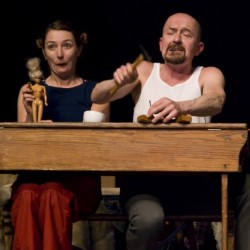
Arm – Mireille & Mathieu

Arm is the spooky exploration of junkyard puppetry you never thought you wanted. The stage is a landfill of dirty dolls, lumpy blankets, moth eaten chairs and a rack of flea-market clothing. This is the imaginative playground of Mireille and Mathieu, two members of one of Belgium’s oldest and legendary absurdist companies, Big in Belgium.This show is completely and utterly strange, and yet completely intuitive. Of course, the objects found in a junkyard could make an excellent set for an inspired puppet show. Every object in this landfill has a story to tell, and Mireille and Mathieu are there to bring them to life. And it is pretty hilarious. Mireille and Mathieu deftly use junk to create a hilariously dark and sometimes vulgar puppetry. The piece, happy and surrealist, steps through various associative scenes that feel as if they come from the objects themselves. The tumbling and spontaneous narrative is an inspiring act of theatre.In Arm, they move seamlessly from baby dolls wrestling in a crib, to a gnome coming to knock on the baby dolls’ front door. One particularly hysterical moment is when Mireille and Mathieu use blankets to make their whole bodies become talking puppets. But just after this, they use the blanket as a skirt as Mathieu lifts Mireille up and she becomes a giant. It is this tumbling sort of inventive work that makes this piece quite special.While I thoroughly enjoy each individual vignette Mireille and Mathieu offered the audience, I do miss an overarching narrative that would have brought me closer to the puppeteers. Because I could see the puppeteers for the entire duration of the show, I wanted to know about their relationship to each other. I did not feel for them much and I wish they had connected with the audience more.Mireille and Mathieu as performers, are always trying to have fun, they often turn to the audience to making sure everyone is enjoying themselves. They ask whether or not we would like to see something again, if yes, they are likely to do it three more times.

Summerhall • 4 Aug 2017 - 27 Aug 2017

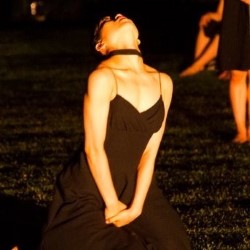
Shoko Seki: Deadline

Shoko Seki: Deadline is a part-choreographed, part-improvised solo dance piece that explores the Japanese phenomenon of Karuoshi; Seki stressfully dances through the various stages of what is literally translated to “overwork death.” Her story is one of a doctor who works herself to death. Throughout this piece, Shoko Seki often wears a labcoat and a medical mask as she writhes at her desk between sequences.It cannot be denied that Seki is a wonderful dancer, moving gracefully between jarring and fluid movement, telling her devastating tale. However, what is missing in this piece is narrative shifting. She dances in and out of sharp red pools of light, her eyes rolling into the back of her head. She is justifiably intense in her glances towards the audiences. She is about to die after all. This is a stressful piece to sit through, and there is no relief. The red lighting, jarring dancing and aggressive music are intense throughout, making it feel as if there are not many narrative shifts. The audience was tense and devastated throughout, knowing what was to come.One wonderful moment during the piece is when Shoko Seki gives the audience small, childlike instruments. She then proceeds to move to the rhythms the audience creat. Here, she amplifies not only the pressure others can put on you to work harder and faster, but also, what control the audience has over live theatre. It was a moment that shows us why live theatre is a good medium for discussing Karuoshi. The last dance sequence was the performances only relief present. Shoko Seki comes back onstage wearing a flowing white dress and is clearly happy. This after death scene, while quite literally interpreted, was soft and beautiful. She is an intensely present artist. Overall, Shoko Seki: Deadline is a grand and terrifying experience. 

Zoo • 4 Aug 2017 - 28 Aug 2017

Laugh Train Home Comedy Showcase

Looking past the sweltering hot and humid room that the Laugh Train Comedy Showcase takes place in, this show is enjoyable enough for a night out. It’s hard to distinguish it from any other comedy showcase show but like most it can be fun at times when you’re enjoying the performer on stage or annoying when a performer goes on for a bit about what it’s like to date in 2017 and you feel like you’ve heard that joke once a day since the Fringe started.That being said, it’s a free show with enough variety to keep you decently entertained for an hour and sometimes you almost forget that you’re in a room that’s close to one million degrees. The acts did tend to blend together at times but as it’s a showcase that can differ from night to night, you never really know what you’re going to get. Seeing as the show is free, it’s fun and low risk.The night I attended was hosted by Robyn Perkins, an American whose strong suit was crowd work. She was a generous host with more time upfront and only doing more material every now and then after. The standout act was a woman with cerebral palsy named Spring Day who weaved mentions of her disability in and out of her act to catch the audience off-guard and inspired fresh material that I had never heard anything like before. Other performers that night included Will Duggan, Dave Channer and Aidan Jones. Where the crowd really went crazy was for the closing act, Christian Reilly, who performed a number of parody covers of pop songs with his guitar, with material ranging from domestic life to politics. It’s free and it’s fun – what else can a comedy showcase need? 

Laughing Horse @ Espionage • 3 Aug 2017 - 27 Aug 2017

No Show

No Show is perhaps the perfect show: one that claims to be nothing at all.It opens with a feminine, smiling, lyrical, tumbling dance number that feels a bit off and out of sync. All the gymnastics the women perform are, of course, very impressive, but something about this opening number makes you feel as if the performers are holding back, making you wait and trying to tell you something.It turns out they don’t really enjoy this type of fluffy performance. They are tired of making the work they do look easy. They are powerful athletes, which is what they prove over and over again in the piece. These women and their work deserves to be taken seriously. They are putting life and limb at risk every day they put on their circus outfits to hang by their hair and flip across stages.There is another element of their performance, which is absolutely heartbreaking. Alice, an acrobat, tries to speak throughout the performance, but she is stopped every time and forced to show her talent and smile to the audience. You can hear the audience sniffling in tears. All she is trying to do is to welcome and thank everyone for being there, yet she is told again and again nobody is interested in hearing her speak.Another performer, Kate, tells a story about how she is not allowed to power tumble, but that she is asked again and again for smiles and splits: the male tumblers tell her that she “is good… for a girl.”This performance truly highlights the danger of circus performance. It is truly terrifying to watch after the tricks were explained. Additionally, I am almost positive one of the performers was actually kicked in the face during a struggle. The name, No Show, says it all. These women do not want to just put on a pretty show for you; they want to change the way you look at circus. This show is thoughtful, empowering and awe-inspiring. It cannot be missed. 

Summerhall • 2 Aug 2017 - 27 Aug 2017

Dates

A decidedly younger and ‘hipper’ crowd gathered around a small table at the centre of The C Royale stage. The room was intimate, and at times claustrophobic – easily interpreted as a metaphor for the current dating climate that Dates aimed to portray.While it is certainly a topic that one could make the case is far overdone, Dates had enough small pleasant laughs sprinkled throughout to carry the piece for its hour run time. The play, marketed as a string of sketches, is more a series of small, bleak vignettes of worst scenario possible dating scenes. We see a woman who thinks her blind date is actually blind, and a granddaughter who must teach her grandmother what Tinder is. The scenes are simple, cute and easily digestible. It’s not groundbreaking work, and the nods to feminism sometimes seem a little heavy handed for an audience that surely knows a woman can pay for her meal on a date and not have it be A Thing, but Dates is a fun watch throughout. Where the piece really shines is during the scene that takes place in vaguely medieval times, except for the fact that they have Tinder. The ridiculousness of Tinder and its app peers is truly highlighted when taken out of the modern world and dropped into a time when women wed at the age of twelve, and then to their cousins. The scene works wonders to show the absurdity of apps in a light hearted manner, and is the most interesting part of a performance that explores bizarre dating scenarios. Easy going and silly, Dates plays true to the double entendre of its name – if you would rather think about what would happen if you went on a date with a date instead of the more pressing horrors of dating, this is the show for you.

C venues – C royale • 2 Aug 2017 - 19 Aug 2017

Eggsistentialism

Joanne Ryan’s ode to motherhood, Eggsistentialism, is emotionally poignant and amusingly informative. Alongside Joanne’s musings about whether or not she is ready to have a child, this show seamlessly integrates the history of Irish contraception laws.Joanne respectfully laments what women before her have gone through in Ireland, not having a choice about motherhood. The other side of social progress is her endless frustration that she now has too many choices. The choice to have a child or not, adopt or not, freeze her eggs or not, and so on. Having a child at 30 years old and not much savings has left Joanne frozen on stage, obsessing over parenting quizzes and Google searches. There is just too much information!And on top of all this, Joanne has her own mother’s choice to confront. When her mother had drunken breakup sex and Joanne was accidentally conceived, the doctors advised her to abort. Instead, Joanne’s mother decided to be a single mother.In the middle of all of this, Joanne meets a man named Rob on Tinder, and Rob says he is ready to have kids. Still undecided, Joanne asks Rob if he would have kids if the roles were reversed. What if he had to give up his job, body and social life to a child? Rob admits he would not be ready for that.This meandering one-woman show is effortlessly accented by Neil O'Driscoll’s comical projections. The projections swiftly plop Joanne down in her apartment, on the street, on the internet and right smack dab in the middle of 1920s Ireland.Eggsistentialism is a truly heartbreaking performance by a woman who refuses to let others make her choice for her. To motherhood or to not motherhood?  

Summerhall • 2 Aug 2017 - 27 Aug 2017

A Gym Thing

A Gym Thing is narrated by Will, a person obsessed with his body, for whom staying in shape becomes a kind of unpaid profession. But this obsession might cost him exactly what brought him to the gym in the first place: attention in general, and Bec, specifically.The visual storytelling in A Gym Thing is intricate and engaging; through the use of simple and sharp blocking and lighting choices, Philip Scott-Wallace tightens the screws on the performances of Tom Vallen, Tarrick Benham, and Bethan James. The whole show is compact and to the point.The point of the show, its theme, so to speak, is body dysmorphic disorder – a mental condition characterized by an obsessive preoccupation with one’s appearance. From the very beginning Will shows signs of self-centrism and BDD grabs a firmer hold on him with every minute – a python-like attack of an illness on a human. The show largely is the study of symptoms of the condition, of certain behaviors, of common ways the disorder shows itself. It’s as if the narrator of the show is not Will, but the condition itself and even though such a reveal of a theme has its merits and a clear as well as understandable intention, it seems that the characters, and especially Will suffer from it, staying, so to speak, in a limbo of complex psychology. Even though Will narrates everything, we learn very little of his inner world; his descriptions are well written, but his obsessions, the thoughts he thinks and never shares are never revealed to us. As a result it becomes increasingly more difficult to sympathize with Will because we can see that he’s becoming sick but can only see the outside changes – which would probably have been fine had there been no narration. But the show is an amazing treatment of a theme – a succinct and fascinating introduction to a problem that does not receive enough attention – a comparatively new phenomenon of bigorexia. But it feels like I either came to the second act without seeing the first, or left unknowingly before the second one started. I wanted to go beyond the introduction of the topic. The show left me wanting more. That said, the show is complete – within what seem to be its ambitions everything is achieved; and well made – it is entirely engaging.

Pleasance Courtyard • 2 Aug 2017 - 28 Aug 2017

Eaten

Tucked away in a decently sized room at the beautiful venue of Summerhall, Eaten stars Mamoru Iriguchi as both Mamoru, Lionel the Lion, and, believe it or not, Dr. Poop. While the names and characters are truly silly, the show works on a multitude of levels for an audience of all ages. Anyone can take an interest in a show about eating and the responsibility of the eater, because, well, we all eat.Eaten challenges the children in the audience to learn about food, where it comes from and where it goes, and challenges the adults to listen to a character called Dr. Poop, as the children of the audience shriek with laughter.The show follows Lionel, a lion who, against the opinion of his species, just wants to be a vegetarian. However, he gets so hungry that he has to eat Mamoru, our other main character. Lionel, of course, regrets having to eat a human, and is relieved, as is the audience, to find out that Mamoru is okay. Lionel then proceeds to become friends with Mamoru, in a bizarre backwards world that highlights how bizarre it is to watch a human be eaten, when we watch humans eat all time. All of this is demonstrated through very amusing puppetry and well-designed costumes. Within Lionel, the costume, was not only Mamoru and his Dr. Poo outfit, but also digestive tract diagrams and a cow puppet. They were all wonderfully fun and cartoonish. The performers deftly used these costumes, props and puppets in amusing and hilarious ways. At one point, Dr. Poop appeared out of a zipper in Lionel the lion’s bottom. The children were hysterically laughing. This was clearly their favorite part.A few children were invited onto the stage and participated in the production by asking questions about Dr. Poop and where he came from. It was this moment that showed the show came across well to the children and they had learned something. Lionel the lion and his narrator/companion Mamoru teach children and grown-ups all about why it is important to pay attention to what you eat. They welcome you into the surprisingly charming world of food chains. The show focuses on the fact that you are not only what you eat, but also that what you eat, eats. Since Lionel has eaten Mamoru, who has eaten a cow, who has eaten a daisy, Lionel is also a daisy. Without being preachy or being too like an overly educational TV show the substitute teacher shows while the teacher is out, Eaten is both fun and conceptually thoughtful.

Summerhall • 2 Aug 2017 - 27 Aug 2017

The Silence at the Song's End

Beautiful, funny and completely moving, Really Good Stories’ production of The Silence at the Song’s End is one of the best pieces of theatre you’ll see this Fringe. After the death of her son Nicholas Heiney in 2006, Radio 4 Broadcaster Libby Purves came across poems, journals and diaries from his time at sea in his room. The play is compiled of these pieces of writing and tells the incredible story of Nicholas from his childhood, to his time at sea, to his days at Oxford. The piece is a gorgeous exploration of life and gives an incredibly moving account of “a young man who stayed as long as he could”.The role of Nicholas is shared between four cast members: Alex Pangolas, Chris Whyte, Cris Zaccarini and Olly Massey. Each of them give an equally truthful and well thought-out performance as well as adding individual and personal twists. They work incredibly well as a unit and are as engaging together as they are in their solo moments. Dannie Harris gives an admirably mature performance as Libby and has a natural presence on the stage. Holly Bowling’s Rose is honest and utterly likeable and the rare moments of interaction between her and the four Nicks are some of the most touching moments in the show.Sarah Branston’s direction is simply genius and doesn’t put a toe out of line. With so many props and bits of set, lots of scenes could easily become messy and frantic, however they all work perfectly and both her and the cast deserve a lot of credit for that. The piece flows exceptionally well and the contrasts between happy and sad moments are smooth and make perfect sense. Tom Attwood’s music is beautiful and is the cherry on top of a truly gorgeous piece of theatre.

Greenside @ Nicolson Square • 22 Aug 2016 - 27 Aug 2016

Dreaming of Leaves

Quirky, vibrant and oozing with dark imagination, Dreaming of Leaves is a daring and thought-provoking piece of theatre. Set in a dystopian future in which the earth has been flooded, the play tells the story of four people who have stayed behind on the ruined remains of Earth. Piece by piece, the audience is told about their pasts, their relationships and learns fragments of information as to how they came to be.This is an inarguably well-crafted piece of theatre. Tara Kearney’s direction has a nice flow overall and aids the story smoothly in switching from childlike, happy moments to the much darker and more emotive scenes. The element of physical theatre is particularly nice and incredibly well placed in the piece. Kearney has done well not to overuse it, meaning that the occasional moments that are more physical and stylised are stand-outs. The piece of movement between June and Otto when they have tied their shoelaces together is particularly touching.The cast are very strong as a whole. Matilda Mallinson’s June is feisty and powerful and is strongest in the more upbeat moments. June’s character is complex, and Mallinson does well to have the audience sympathise with her, even in moments when her character is cruel or angry. Aladdin, played by Johnny Ben-Shaul is possibly the most likeable character and Ben-Shaul’s performance promotes this even further. Jake Morris’ Otto is incredibly sweet but also manages to bring ann element of fire to the character.The music throughout the piece is beautiful and all performed by Margerhita Lolecci as the Piano Player. Her presence on the stage has a huge impact, which is particularly admirable considering her part is silent.Overall, the play is excellent. There are some clumsy moments here and there that distract slightly from the action, with bits of set and props getting in the way or falling. But, despite it being slightly rough around the edges, this is a truly moving piece of theatre that has been put together with some gorgeously creative touches.

theSpace on the Mile • 16 Aug 2016 - 26 Aug 2016

The Man Who Built His House to Heaven

One-man shows are no easy thing to pull off, especially when the subject matter is like something out of Wes Anderson’s daydreams, but Keenan Hurley does just that in The Man Who Built His House to Heaven. Using nothing but a ladder, a handheld microphone and a tool box, Hurley pulls the audience into the story of Bob, a man who begins to build more floors onto his house in order to provide more space for his growing family, eventually building his house up to heaven and beyond.Hurley’s performance is utterly captivating, a perfect balance of relaxed and engaging. He is a natural on the stage. He plays various roles throughout and each one is equally clear and believable. Some (like the neighbour with ‘the voice’) are utterly hilarious but none appear farcical which, again, showcases Hurley’s talent and control as an actor. Patrick Swailes Caldwell’s direction does nothing but aid this talent and the way he uses basic staging and sound to such great effect is superb. The piece is genius in its simplicity. Despite the occasional moment towards the end where the focus seemed blurred, Caldwell does exceedingly well to not only tell the story, but also engage the audience completely and allow them to dive into the deeper meaning of the piece. Overall, it’s an incredibly well-crafted show. Both men make excellent use of the space and resources they have and are able to create some truly remarkable moments of theatre out of basically nothing. By not being over-ambitious, their piece seems daring and refreshing. It is a really wonderful thing to watch.

Greenside @ Infirmary Street • 15 Aug 2016 - 27 Aug 2016

Witch

St Magnus Players return to the Edinburgh Fringe this year with a gripping tale of witchcraft, faith and fear. Based on George Mackay Brown’s story of the same name, Witch tells the story of Marian Isbister (Erika Leslie) and how she was accused of being a witch in late 1500s Orkney.You cannot fault the enthusiasm and drive of this cast and crew. It is clear when watching that every member of the company is loving being on the stage. The piece is a hard ask for the cast, as many of them play numerous roles throughout the piece, and some individual performances are strong. Erika Leslie does well to portray the beaten, betrayed Marian, drawing sympathy from the audience in her more vulnerable moments as well as giving the character some strength. Bob Ross’ Sheriff is convincing and menacing, and Ross handles an incredibly lengthy monologue very well.As well as good moments from the principals, there are times when the company perform scenes together to great effect. An example of this is the scene in which they represent Marian being moved from her village by horse and cart using ropes. This is cleverly done and really works. However, there are full company scenes that seem under rehearsed or just plainly don’t work. At times, the background acting seems farcical and silly, which despite providing some nice comic relief, don’t fit with the tone of the piece and interrupt the flow. It is unclear whether certain moments are meant to be funny or just come across that way. That being said, some of the witnesses in the court scene are truly hysterical, and if purposefully performed in that way, deserve credit for their comedic value.The set has been well designed and painted but does come across as very amateur. The use of the screen is a clever idea and a nice surprise at the play’s beginning. The use of photos from different time periods in history showing people being persecuted and tortured helped get a key message of the piece across; that the atrocities that occurred during the witch trials are still present in recent social history and still present today, but didn’t quite work on a visual level and appeared disjointed from the play itself.As a whole, Witch is a nice piece of theatre that has a lot of potential. With a slight revamp and possibly a later slot in the day, the play would be able to achieve the darkness and intensity that it lacks.

theSpace @ Venue45 • 15 Aug 2016 - 20 Aug 2016

Paul Merton's Impro Chums

Paul Merton returns to the Edinburgh Fringe this year with an improvised comedy show. Unsurprisingly, the hype and expectations of the audience were high, but Merton, along with his four guest comics, did not disappoint. You cannot help but be amazed at how quick, witty and intelligent these comics are.Moving quickly between different ‘rounds’ of improvised sketches, the show overall has a great pace. Occasionally, some of the individual sketches seem slightly drawn out and lose their spark, but on the whole the show has a really nice flow and the audience are taken from scenario to scenario quickly with great comic timing.Merton’s guests are excellent. Suki Webster is clever and keeps the audience engaged throughout. She does well to make light of her own fumbles or dodgy accents, turning what could be a weaker moment of the show into a particularly funny one. Richard Vranch’s musical accompaniments are spot-on and show his talent as a musician as well as a comedian. Lee Simpson is a clear audience favourite throughout; he is utterly hysterical. Mike McShane provides some great laughs and takes on some very funny characters and Paul Merton proves the reason he is such a household name with his quick wit and confident manner.As well as shining as individuals, the comics work incredibly well together. There are no instances of ‘one-upping’ or anything of that nature, but they are quick to jump on each other’s mistakes, either to fix it to continue a sketch or to make a joke about it. The show is extremely enjoyable from start to finish. Every game shows off the comedian’s talent and smarts and thoroughly entertains the audience. It truly deserved its sell-out status. With any luck it will return to the Fringe next year. If it does, I for one will be sure to buy my ticket early.

Pleasance Courtyard • 11 Aug 2016 - 21 Aug 2016

Burying Your Brother in the Pavement

The first thing you are met with when walking into Eagle House School’s Production of Burying Your Brother in the Pavement is approximately 20 young teenagers spaced out on the stage wearing white masks. This may sound as though it would appear comical, but it is intense and intriguing and is a clever start to what turns out to be a very clever show.The plot shows Tom (Hugo Williamson) struggling to cope with the recent death of his brother Luke (Jamie Lunnon). Williamson is very strong in the lead role. Opening the show with a very long monologue, he does well to keep up with the pace and intensity of it, and has the audience in the palm of his hand by the end of the first scene. Some other stand-out performances include Alex Nash as Tight and Lunnon as Luke. Despite coming across as slightly uncertain at first, Nash seems to ease into his character and becomes one of the most comfortable cast members on the stage. His more intense and emotional moments at the end are really moving. Lunnon is controlled and sophisticated as Luke and gives a very convincing performance.However, the real star of the piece is the ensemble. The cast work incredibly well together and perform various scenes in various styles very strongly. The direction overall is clever and works, with some moments of real magic (for example, the ‘marble’ scene is very nicely done). The use of music works well at some points but not so well at others, with the cast occasionally being drowned out but loud snippets of songs.But despite minor faults, this is a really great production. The young cast do exceedingly well to deliver a play that deals with issues like grief, suicide and sexuality in such a mature and honest way and work together to create a truly moving piece of theatre.

SpaceTriplex • 8 Aug 2016 - 13 Aug 2016

Bones

Bones is one of the most high-energy monologues you will see this Fringe. Unable to decide whether or not to kill his baby sister, that he has been left to care for, Mark (Dominic Thompson) regales the audience with stories from his past, transitioning fluently between events from his childhood and from that very night. Dark, harrowing and emotive, the piece allows no rest for actor or audience.It would be impossible to watch Bones without appreciating the talent and intensity surrounding the piece. Thompson’s performance overall is very, very strong. There are times when he gets carried away and some of the emotional changes seem too sharp and out of nowhere; a technique which is effective at points in the play, but is used too frequently. However, Thompson is utterly convincing as Mark and manages to pull off the lighter comedic moments just as well as the far more emotional ones. One of the most commendable things about Thompson’s performance is that he manages to give Mark some likeable qualities, despite him being a pretty deplorable character.Part of that is due to Jane Upton’s excellent writing. The piece is very well crafted and flows steadily and clearly to the eventual climax. Mark’s story is poignant, moving and humbling. By showing things from his perspective as a young boy, Upton taps into the sympathetic side of the audience, giving the piece a new level of engagement.Ian Robert Moule’s direction is clever and not over-ambitious. He could have benefitted from more moments of stillness and calm in order to get the full effect of the more frantic moments, but he handles the changes between Mark’s childhood and the present day extremely well and uses the lack of props and set in impressively effective ways.Bones is a testament to how much can be achieved in such a small space with such little set. In this sense, it embodies the spirit of the Fringe. When you leave the theatre, you will not really know what to say or how to respond when people ask “How was that? Did you like it?” You will not leave laughing or feeling uplifted. But you will leave knowing that you just witnessed an ambitious, impressive and gritty piece of theatre.

theSpace @ Surgeons Hall • 5 Aug 2016 - 19 Aug 2016

Every Day I Wake Up Hopeful

Filled with humour and sorrow, Every Day I Wake Up Hopeful is a play about a man who is considering throwing in the towel. Comedian Christian Talbot gives an excellent solo performance as Malachy, who has not been handed a particularly good hand in life. Talbot executes the misery of the character perfectly (his gloomy expressions are spot on), but there are occasional moments where he seems to lose focus slightly and looks uncomfortable onstage. However, the performance as a whole is really admirable; both highly emotive and very funny at parts.The piece is well-written. John Patrick Higgins does well to entwine comedy and tragedy as smoothly as he does and writes in a refreshing and clever way. It is a piece of balances and opposites: the comedy and the tragedy, the ups and the downs, the hope and the despair, and Higgins’ does well to not let this go stale throughout the piece. The show could benefit from a slightly bigger change of mood from beginning to end, as it feels rather samey. The audience sympathise and laugh with Malachy, but they are robbed of any emotional journey.Every Day I Wake Up Hopeful is an incredibly good piece of work that seems contemplative in itself and forces contemplation onto its audience. Talbot fits the role well and manages to engage the audience from start to finish. The writing and the performance flow really nicely together and manage to capture the audience despite the lack of real drama. There is a huge amount of potential in the piece and with a little tweak and a little polish, it could be a really incredible piece of theatre.

Sweet Grassmarket • 4 Aug 2016 - 28 Aug 2016

Funny for a Grrrl

Witty, fresh and clever, Funny for a Grrrl serves a refreshing line-up of stand-up in this year’s Fringe. With the show lasting just under an hour and including three acts, it would have been easy for the sets to appear rushed or for the audience to not really get into it. However, this was not a case for any of the comics on show.Sindhu Vee’s set provided a hilarious stance on family life, relationships and culture in modern Britain which appealed to parents and young people in the audience alike. Her gag at the end was slightly drawn out and it was unclear how we had got to the end of it when we did, but overall the set was excellent. A particularly great moment was her discussing an event in her family last Christmas, that left the audience laughing and sympathising at the same time.Mary Bourke took the middle slot. The Irish comic’s set perfectly joked about aspects of cultural behaviours in Britain and Ireland, highlighting various interactions she had had or seen with hecklers in Glasgow and Dublin, as well as two extremely funny and believable impressions of two American comics. Her discussion of humour itself and how it various from place to place is apt, amusing and smart.The final slot was taken by Jayde Adams. The Bristol comedian owned the stage from the offset. Her section about chavs on the Megabus was funny, but at first seemed like a fairly predictable gag that had been done before. This was until she burst into a rendition of Nessun Dorma. This was unexpected but hilarious, with the finale looking like something out of a Family Guy sketch that the audience met with cheers and applause.With various acts on throughout the rest of the Fringe, do yourself a favour and head down to St Andrew’s square to see these incredibly funny comics.  

Stand in the Square • 4 Aug 2016 - 28 Aug 2016

Baby Wants Candy: The Completely Improvised Full Band Musical

Incredible, hilarious, infectious, amazing. These are just some of the words that were uttered by audience members as they left Wednesday evening’s production of Baby Wants Candy. There were undoubtedly more compliments and statements of awe, but it was almost impossible to hear them over the continued whoops, cheers and applause that echoed on long after the cast had left the stage. This level of praise is utterly and completely deserved.Despite its solid reputation, it is easy to be sceptical before the performance starts. It is, after all, a completely improvised musical. Nothing has been rehearsed or planned, so it is inevitable that there will be moments where things are rough or where things go wrong. However, it is in these moments of imperfection that the hilariousness and sheer genius of Baby Wants Candy lie.The cast are absolutely phenomenal. It’s hard to put into words the level of talent and energy that oozes from the stage. The characters, that are created on the spot, are excellent and some of the performances are unbelievably good. Ashley Ward’s take on a former Olympic figure skater-turned-swimmer was hysterical and it beggars belief that the routine was not rehearsed. Nathan Jansen and Tim Sniffen’s ‘Rio Crime Lords’ were another highlight and the carnival-esque song and dance number that came from them was probably the best in the show. But these are just some moments from what was a completely wonderful theatrical experience. Every cast member and every song could be singled out for its brilliance.No review of the show would be complete without mentioning the band. They performed together flawlessly and created so much of the magical moments of the show. Credit should go to Dan Reitz as Musical Director and pianist. There were moments when I found myself watching him rather than the action on stage. He is truly a musical genius.Baby Wants Candy is running at Assembly George Square Studios until the 28th at 9.30pm. Get your tickets while you still can - you won’t regret it.
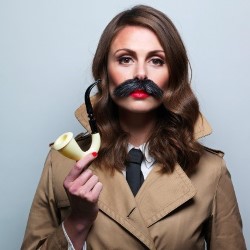
Assembly George Square Studios • 3 Aug 2016 - 28 Aug 2016

A Plague of Idiots

Utterly stupid and equally brilliant, A Plague of Idiots is the ultimate feast of physical comedy for your inner child. The cast (Damien Warren-Smith, Laurent Mallet, Fanny Duret, Giorgio Vierda and Mark Winstanley) have so much energy it’s as if they are going to explode off the stage.There is no apparent order or structure to the piece, no sign of a hidden meaning and no obvious attempts of anyone trying to be clever. It is simply funny. And that’s the beauty of it. The cast strike a perfect balance between comedy and silliness, letting the scenes run totally wild but moving on before the joke goes stale. They use repetition to great effect, reminding us of gags previously seen but not simply repeating the same material. Warren-Smith’s opening number is wittily written and he does well to establish himself as the ‘leading man’ without making it all about him. He commands the show perfectly. The scenes which are built up to be ‘dangerous’ are particularly hilarious. The entire show seems to be not very much more than the cast making fools of themselves, but it really, really works.Special mention should go to Laurent Mallet’s sketch as the violinist and over-excited audience member. He is a clear audience favourite from the start and rightly so; his comic timing is second to none. There are inevitably moments where things appear to go pear-shaped, although it is sometimes hard to tell whether things are meant to happen or not. However, if you watch it with an open mind you will enjoy it. The buzz that the cast create on stage is infectious and result in numerous giggle-fits from audience members. There is very little point trying to analyse this piece, you will be entertained if you let yourself go.

Gilded Balloon Teviot • 3 Aug 2016 - 29 Aug 2016

The Elephant Man

Devised from the diaries of Fredrick Treves, Fringe Management and Canny Creatures Scotland present The Elephant Man. The show is based on the true story of John Merrick, a man who, despite his kind nature and incredible intelligence, was exhibited in a ‘Freak Show’ in the late 1800s, due to his physical deformities caused by a genetic condition. The play’s plot follows Treves (Gerry Kielty) as he meets and rescues Merrick (Michael Roy Andrew) from the hands of the sinister showman (Nigel Miles-Thomas) and shows the developing relationship between the two men.Andrew’s performance as Merrick is particularly admirable. The consistent and believable physicality he brings to the role is one thing, but the real strength in his performance lies in the depth and emotion that he brings to the character, which is no small task in a one-act play. Kietly gives a solid performance as Treves and is particularly good at the softer moments between him and Merrick.Credit for that should also go to Nigel Miles-Thomas’ thoughtful, creative direction. There are individual moments of brilliance: the scene that shows Merrick travelling by boat and train is very cleverly done, as is a very eerie and sinister nightmare sequence. It is clear what is trying to be achieved in each scene and some are executed perfectly, whilst others are not quite so strong. It would be fair to say that the problem (for lack of a better word) with the piece is not any specific moment or performance, but rather the overall flow. The scenes are very short and run straight into each other, with some of the changeovers being clumsy and causing the play to feel quite jumpy. This is possibly not helped by the decision to have all the female roles played by just one actor (Kirsty Eila McIntyre). This is an interesting concept, but the piece would benefit from another female cast member, both to make it run smoother and make the female characters more believable. That is in no way a criticism of McIntyre’s performance, who does well to bring life into each of her five roles, (her take on Mrs Kendal, the theatre star, is especially strong), but it is difficult to get real depth into so many roles in so little time.Roi Roberston’s original score works well to create a creepy yet intriguing atmosphere as the audience enter. However, it begins to feel slightly repetitive over time and it is not until the end that there is a real change in the score. This moment works beautifully and plays a large part in creating a moving and emotive ending; it would be nice to have more changes in music throughout the piece.As a whole, the play achieves what it has set out to do; telling audiences a true story in an entertaining and touching way. Despite not being a perfectly polished production, there are some glimpses of genius in both the performances and the direction that make the piece worth going to see.

Gilded Balloon Teviot • 3 Aug 2016 - 29 Aug 2016

Cariad & Paul: A Two Player Adventure

Through their use of improvisation and mime, backed with a fantastic live band (The Glue Ensemble), Cariad and Paul bring to life a series of hilarious stories, based solely on one word from the audience. The word the pair chose from the audience’s suggestions on this day was ‘sparrow’ and their subsequent discussion of the word before their story began, touching upon A Doll’s House, where Torvald refers to Nora as ‘my little sparrow’, and Anna Karenina, inspired the dual narratives which played out before us.The first of these was in the style of a great Russian novel, concerning a man who cuts down a tree every twelve years, while the second took the idea of a doll’s house and ran with it; at the hospital Dr. Donald, played by Paul, had made a doll’s house for Katherine’s birthday, and things quickly spiralled out of control from there, with the house destroyed, a patient painfully cured of appendicitis and an affair beginning between the two doctors.A great deal of Cariad and Paul’s comedy comes from their use of mime, and the music that accompanies their actions adds greatly to this, serving as a soundtrack to the action. Without saying anything at all, the pair perfectly bring across their characters to the audience, whether they be a flustered, awkward doctor or an aged, wise grandmother. The pair also play multiple roles and, although this is to be expected when there are only two of them telling the story, the versatility of the pair in their voices, mannerisms and accents is quite something to behold, even if sometimes these don’t quite work. ‘I don’t think I can keep this voice up,’ Paul says at one point; at another point there is a mix-up with a new character’s name, but the pair’s explanations for these mistakes, their meta-theatricality and self-deprecation, adds to the charm and quirkiness of their performance. A particular highlight was when Cariad left the stage so that Paul had to play two characters at once, doctor and patient, which he managed with surprising ease. As well as portraying a variety of characters, Cariad and Paul are also able to make their dialogue fit the setting brilliantly, despite some occasional and hilarious anachronisms and topical references; one fantastic example was in the story set in Russia, where the woodcutter asks after his love interest’s mother. ‘How is your mother?’ he asks. ‘Dying,’ comes the deadpan reply. ‘As are we all,’ the woodcutter reflects, with a weary sigh. Although this story in particular indulged in stereotypes, its sending up of tropes associated with these kind of novels made for the best scenes in the show. On a number of occasions, it seemed that Cariad and Paul found it difficult to refrain from laughter themselves and, although some could say this is unprofessional, it is unsurprising considering the hilarity of the worlds they managed to create, and the raucous reaction of the audience. With a new series of stories created every night, Cariad and Paul: A Two Player Adventure is a show I would highly recommend, for an hour of laughter, versatility and possibly a forest of signpost trees.

Pleasance Courtyard • 25 Aug 2015 - 29 Aug 2015

The Amazing Sketch Show

The description of The Amazing Sketch Show states that their sketches are ‘some of the funniest, silliest and zaniest sketches’ to be found at this year’s Fringe. This is a bold claim to make, and unfortunately the show does not quite deliver on this promise, although the potential is there. The majority of the sketches were certainly zany, and some were sillier than others, but not all of them made their mark when it came to being especially funny. This being said, the group of nine performers from King’s College London– including a band comprised of two ukulele players, a drummer and a singer – have put together an entertaining show, and their enthusiasm more than makes up for some of the less amusing or overlong sketches in their set.The use of the band was one of the most innovative features of this show, used to recap the sketch that had just been performed, as well as provide music and sound effects in some of the sketches themselves. In some cases these brief musical interludes parodied popular songs, such as a song about a seal parodying the song Sexy Back (‘Take it to the beach!’), but for the most part these served as pleasant jingles, in contrast to the usual burst of pop music used in most sketch shows, and helped the disparate set of situations to flow into one another. Often actors for the next sketch would dance onstage to the music before their sketch began; a delightful and quirky touch. This quirkiness was also seen the variety of sketches the group performed, with such diverse topics as personified bacteria, a pre-natal class, how our names can affect our personalities and a description of serial killers. Despite the dark nature of this last topic, the show fulfils its aim of being family friendly, and never uses crude humour or situations in order to get laughs. This being said, on occasion the laughs the show did get were few; a couple of sketches were overlong as the punch line could be easily anticipated part way through, and notably in one sketch some props were given out to members of the audience which, though amusing at the time, played no further role in the show and left these audience members to look after them for the remainder of the hour.The Amazing Sketch Show, then, is perhaps not as amazing as the title promises, but this does not mean it isn’t entertaining. The show contains plenty of clever sketches and good ideas, some of them just need further development or, in some cases, to be scaled back in order to make for a better paced show. I look forward to seeing what this talented team bring to the Fringe next year.

C venues - C • 23 Aug 2015 - 31 Aug 2015

The Humble Quest for Universal Genius

Trying to find a new Renaissance Man (or Woman) in an hour is no easy task, but it is one that The Humble Quest for Universal Genius attempts with great enthusiasm. Over the course of the gameshow’s ten performances, host Matthew Crosby pits two comedians a day against each other to compete in a series of rounds ranging from Art to Mathematics, Wit to Hunting (yes, really), to see which of them is a ‘true genius’, showing greatness in a variety of different fields. The contestants I observed, Josh Widdecombe and Joel Dommett, were humble in their descriptions of how they would consider themselves to be a genius; Dommett can tell the time and Widdecombe always manages to choose the best cheese and tomato croissant at Pret a Manger. As the game began, however, they managed to prove their intelligence – and humour – more ably, whether through continuing a story in the style of its author or trying to define expressions from a Bulgarian phrasebook. With the rounds overseen by Crosby and the eccentric figure of Dr. Clogs, the arbitrator of genius, Widdecombe and Dommett battled it out to see who would be crowned as the show’s universal genius.Crosby has certainly crafted an interesting and varied game that ought to ensure there is never a dull moment; from the translations in the Languages round to the use of Nerf guns in the Hunting round, however, there are several occasions where there is a lull in the proceedings. This can be attributed to the fact that the game show, unlike those on television, is presented live and unedited, but it also gives an indication of its playful, loose nature. The competition is never especially serious, and it is clear that all involved are amused as much by the rounds themselves as what results from them. Although the premise is a promising one, and Widdecombe and Dommett are wonderful comedians – a particular highlight being the round in which they have to make up answers to a series of childrens’ jokes – The Humble Quest for Universal Genius is certainly an amusing show, but only up to a point.Broadway Baby Radio interview with Joel Dommett

Assembly George Square Gardens • 21 Aug 2015 - 30 Aug 2015

Edinburgh Renaissance Band at St Mark's

It isn’t just through watching the plays of the Bard that you can get a taste of culture here at the Fringe; the Edinburgh Renaissance Band are bards of a different sort. Collaborating with the Polyhymnia Dancers, this seventeen piece ensemble boasts a repertoire of songs from the thirteenth century to the early eighteenth. There are a range of genres from laments and love songs to songs from the court and even drinking songs, with tunes from Scotland, Italy, France and even the court of Henry VIII. Most members of the band play multiple instruments, and three of them sing as well, displaying a diverse range of musical and vocal talent.The free programme provided at the start of the performance proves brilliantly detailed, giving the names of the songs, their composers, approximate dates and more, as well as some lyrics. This is accentuated throughout the performance by the band’s musical director Murray Campbell; not only do we get to hear music from hundreds of years ago, but we gain a better understanding of it as well. It’s presented in lively ways, such as the humorous demonstration of the buzzing sound of the crumhorns and adds to, rather than hinders, the band’s presentation of their music. The way in which the Edinburgh Renaissance Band performs is spectacular – beginning with a rousing battle fanfare to announce their presence as they enter the church, they perform comic songs of the court, laments and stately dance tunes all with great energy and passion. Not only did the band play well but they dress the part too, as do the dancers, in full period costume; it felt as though one had travelled back in time to watch the minstrels play at court.A great number of the songs the band play are Scottish; as Campbell states, “it’s an international festival, so it ought to contain some Scottish music from hundreds of years ago!” This being said, particular highlights from the performance include the Italian song La Romana, in which the band splits into two choirs with the instruments battling or echoing each other, and the Regina Coeli; once played at St Mark’s Cathedral in Venice, Campbell explains, it is only fitting that the band perform it at St Mark’s, Castle Terrace. The final song of the evening combined vocals, dance and instruments in a culmination of the band’s talents, and with this they were urged back to the stage, having left the church, to take a bow for a second time. There are only two more days of performances for the Edinburgh Renaissance Band - don’t miss this display of beautiful music and dance. It’s not just an old concert; it’s a sixteenth century concert.

artSpace@StMarks • 19 Aug 2015 - 20 Aug 2015

The Bristol Suspensions in: A Suspension of Disbelief

A group of seventeen students from Bristol University that formed in September last year, The Bristol Suspensions are fairly new to the a cappella scene, but that does nothing to diminish their talent. They have put together an energetic and entertaining show, with alternating moments of levity and seriousness, sharing lines and verses between them that allow each performer to shine individually, as well as working together brilliantly as a group. The group’s beatboxer even has his own section of the show where he performs alone to show his skills and as well as this, the group also perform one song with just the boys and another with just the girls (and the beatboxer in a wig), to showcase their different styles and range of voices.Beginning with a blend of Counting Stars and The Bad Touch, the group segue to a Miley Cyrus medley and songs by Taylor Swift, revitalising these well-known popular songs with their variations on the original melodies, as well as their fantastic choreography. During the Miley Cyrus medley, for example, they all become the plane for Party in the USA, and the group’s choreography for Wrecking Ball makes the song more silly than serious, and far more entertaining than the original. As well as playing these popular numbers and adding to them with clever and often hilarious dance moves, The Bristol Suspensions had quieter and more reflective moments as well, such as in their renditions of Budapest and Paloma Faith’s Just Be. Here the group stand as one, with only a couple of soloists, and let their voices, rather than the combination of vocals and dance, take centre stage. These songs proved to be their strongest in terms of hearing the group’s power, range and quality; in a few of the more spirited numbers, the soloists were sometimes hard to hear over the sound of the beatboxer, accentuated by a microphone, or even the rest of the group backing them up. Although this was sometimes a problem in terms of hearing the lyrics, the group’s energy and enthusiasm never flagged, and it is very clear that they are having a blast and work well together; switching from the upbeat Uptown Funk to the building intensity of a Bastille medley. Then from the sombre Just Be to their group’s quirky mash-up of Anaconda and Moves Like Jagger, ending the show on a high note. An excellent display of vocal talent, comedic timing and brilliant dance moves, The Bristol Suspensions are a new group to listen out for.

Greenside @ Nicolson Square • 17 Aug 2015 - 22 Aug 2015

Heads

When two precocious, self-important students uncover a student-teacher relationship scandal at their private school, they plan to exploit it for their own gain and, in so doing, hope to gain places at Oxbridge by winning a prestigious journalism competition. Class privilege, education, the media, sexuality; none of these issues are spared in this biting, tightly woven dark comedy that shows, with alarming clarity, just how dangerous the competitive culture we live in can be, as the two students care more for their own gain than they do the very life of a fellow student.Tom Mackie and Ruby Ashbourne-Serkis play these two students, Andrew and Cordelia, with utter conviction and clarity. Starting from the relatable awkward nature of their small talk, their discussion escalates into a contest of one upmanship regarding who won the most votes for the positions they hold as Head Boy and Head Girl. While their awkwardness is funny and almost charming, the competition that emerges between them, and the attitudes they soon start to show, make the tension between them almost palpable. Even at this early stage we see how Cordelia, especially, is willing to put her own happiness before that of others; thinking initially to write a piece on a boy with leukaemia she says flippantly that she is “happy, but not in an insensitive way”. Her attempts to hide her ulterior motives with compassion are wonderfully, scarily shed as the play progresses, and this is brilliantly executed by Ashbourne-Serkis, whose faux-civility and belief in the righteousness of her own actions is contrasted fantastically with the slightly more moral and naive Andrew. When he uncovers the scandal and Cordelia takes the credit, he is initially indignant, but it is not long before his moral compass makes itself known. This aspect of his character is hilariously complimented by his incompetence and incredulity; his exclamation “I know!” being a particular, recurring, highlight.In stark contrast to Andrew and Cordelia’s callousness, Izzy, played brilliantly by Anoushka Kohli, is not simply their passive victim. She does her best to call them out on what they are doing and defend herself, but her trusting nature proves her undoing as Cordelia interrogates her. Even with Cordelia using such phrases as “help you, or whatever”, Izzy tries to see the best in her and this proves almost fatal, with her actions pushing Cordelia’s callousness to frightening new heights.At one point Cordelia playfully tells Andrew “Stop it, you’re so bad!”, and we too enjoy their callousness, watching them attempt to destroy Izzy and, in doing so, destroy themselves, laughing in spite of and because of, their actions. Heads paints a frightening, darkly comic picture - it is relevant, clever and poignant, and I would highly recommend it.

theSpace @ Surgeons Hall • 17 Aug 2015 - 22 Aug 2015

The Jeremy Kyle Show Does Shakespeare

A young girl swears she will kill herself if her parents won’t let her date her boyfriend. A man slept with another man’s wife. A child wants to find out who her father is. Is this an episode of The Jeremy Kyle Show, or the plot of a play by Shakespeare? This is, in fact, The Jeremy Kyle Show Does Shakespeare, in which the plots of four Shakespeare plays are cleverly adapted to fit the talk show’s format. It is worrying, actually, how well the former adapts to the latter; the Montagues and the Capulets live in rival council estates, Katherine (from The Taming of the Shrew) assaults her sister onstage and is restrained by security, and the infamous DNA and lie-detector tests are used to find out Perdita’s true parentage, and if Claudius really did kill Hamlet’s father. Not only do Shakespeare’s characters worryingly fit the dysfunctional mould of many of the types of guests on the show, from abusive families to couples with marital issues, but as they do, this company shows that the subjects of Shakespeare’s plays are just as relevant today as they were in the sixteenth century.The format is portrayed not just through these episodes but in the show’s all-encompassing nature. Queuing outside the venue, we are told by one of the cast that this will be a live television recording, and are also greeted by the show’s psychotherapist, who tells some members of the audience they’ll need to talk to him later. Once inside we are taken through our paces with cue cards, told when to gasp, boo and applaud. There are even advertisement breaks between the various episodes, with such clever nods to the Shakespeare canon as Lady Macbeth advertising a stain remover and the rather alarming Shylock’s Loans – your pound of flesh is at risk if you do not keep up repayments! Within the episodes themselves, the plots of Shakespeare’s plays are carefully crafted into attention-grabbing titles that wouldn’t be out of place on the actual show, such as the brilliant ‘My uncle killed my dad and married my mum and now I’m my own cousin!’. Video is also used here, as in the show, to show the characters backstage, talking to Graham in the Green Room, or simply storming off. As a final touch, some episodes are staged as follow-up episodes (“That was six months ago...”) and all onstage twirl to represent the passage of time; a hilarious touch.The various Shakespearean characters are brought into the present day with great enthusiasm, skill and some hilarious costumes from the cast (think Romeo in a baseball cap and tracksuit trousers), but it is Dave House as Jeremy Kyle who really stands out. Not only does House look similar to the talk-show presenter, but his accent and mannerisms, from the phrases he uses (‘There’s no excuse for abuse’, ‘That’s a happy ending...sort of’), shortening characters’ names, twisting their words and using them against them, even the way he moves about the stage, really capture the character of Kyle and bring him to life, tying the show together brilliantly. Particular highlights of House’s performance include Kyle interrupting Hamlet’s soliloquies and his uttering the brilliant line ‘You killed Polonius, you muppet!’.An absolutely hilarious take on Shakespeare and reality TV, The Jeremy Kyle Show Does Shakespeare is better than the original; you can’t look away, and for good reason. It’s ridiculous, it’s clever, and it’s free, so turn off your TV and go and see this show instead.

Chiquito (venue 294) • 16 Aug 2015 - 22 Aug 2015

Richard III

I have seen several performances of Richard III; Laurence Olivier and Ian McKellen on film, and Kevin Spacey at the Old Vic, but Emily Carding’s portrayal of the king who murders his way to the English throne is in a league of its own. Her performance is electric, perfectly capturing Richard’s manic glee as he executes foes, friends and even his own family. We are drawn into Richard’s world as soon as we enter the chapel of St John’s, as Carding greets us all individually by a character’s name and places an appropriate label around our necks. We, the audience, portray all of the other characters in Shakespeare’s drama, meaning that we do not sit idly by and watch Richard’s schemes; we are involved, his co-conspirators and, sadly for most of us, his victims. This innovative, daring re-imaging of the text means that the sense of danger as Richard’s schemes escalate, the sense of fear as we find ourselves to be pawns in his game, these feelings are physical, personal, palpable. There is no fourth wall. We are invested and involved in this performance like no other; and what a performance it is.It is clear that Carding is thoroughly enjoying herself portraying Richard, whether laughing with incredulity at the wooing of Lady Anne or calling across the room to Clarence when speaking to his murderers “I hope you aren’t listening to this!”. These occasional asides and Carding’s responses to and interaction with her audience show her skill at improvisation, further drawing us in as we laugh along with her, sharing in Richard’s amusement even though we know him to be a villain. There is a great sense of fun throughout this performance, the same joy that Richard has in his ability to “seem a saint when most I play the devil” yet, as this line would indicate, there is an ever-present danger behind this enjoyment. There’s daggers in men’s smiles. This sense of danger is heightened by Brite Theater’s adaptation of the text as a one woman show, manipulating it so that Richard can address characters as though they have spoken to him, responding to their nods and looks; a one woman show but no mere monologue, as the audience willingly works to aid Richard along his bloody path to power. Although a great deal is cut from the text, it feels as though there is nothing missing at all, so skilful is Carding in speaking Shakespeare’s language, his verse the star of the show and a testament to Richard’s complexity and malice. The story is made clear for those who do not know the play not only in this editing of the text but in Carding’s performance, gesturing or glowering at characters as she mentions them; looks made all the more terrifying for me as I was cast as one of the Woodvilles whom Richard despises, and eventually kills off. The manner of these deaths I will not disclose; suffice to say that the simplicity, and surprising humour, of these executions, as well as the minimalist set and props, only adds to the show’s strength.There is no set, as such, just a table and a swivel chair. Nothing else is needed. The contrast between Richard in suit and tie, in the office chair, surrounded by the audience as though at a board meeting, and the stained glass and stone walls of the church was an incredible fusion of the modern and medieval worlds for Carding’s Richard to bustle in, her physicality unpredictable and dangerous, as mesmerising as her speech. This proved atmospheric enough, but the echoes of Richard’s battle oratory about the chapel walls were sufficient to send chills down my spine. The props are as minimal as the set, with a paper crown heightening the sense of Richard’s play-acting, as well as the fragility of his eventual grip on power. Carding’s grip on the audience, however, is anything but fragile, and earned her a deserved standing ovation. With her powerful physicality and nuanced, mesmerising speech, it is her name, and not just Richard’s, that stands as a tower of strength.

Just Festival at St John's • 12 Aug 2015 - 31 Aug 2015

The Exeter Revue: Sketchup

Four students, a full house and a series of clever sketches make for a very enjoyable hour in The Exeter Revue: Sketchup. Using minimal props and costumes – a coffee cup here, a plastic crown there – these performers bring to life a fantastic and strange set of scenarios. There's a Prime Minister going to war with ‘the enemy’ by sending a message in Morse code; philosophical children on the playground; football commentators at the Christmas Day truce in the trenches of World War One; an incredibly embarrassing job interview. Alternating between working in pairs and as a group, the Revue prove incredibly versatile, changing from elderly people in a retirement home to small children with ease, with the strangely mature attitudes of the latter adding to the humour of that particular sketch.This versatility, however, is not so evident in the length of the sketches; only a few are based on a brief one-liner or twist at the end, such as the wedding sketch, and most last for longer, which sometimes causes the pace of the performance to slow as the inevitable twist or conclusion is reached. I found that the Deal or No Deal parody in particular is somewhat overlong, but the sketch that follows – domestic tasks being addressed as political issues – more than makes up for this. This being said, unlike many sketch comedy shows, I found the majority of the sketches to be strong, with only one or two weak links, and any laughter that is lost in one sketch is quickly recovered in the next.There's one sketch in particular in which one member of the revue acted as an auctioneer, with the others acting as bidders; what they are bidding on are emotions. Surprise, excitement, greed, a hilarious contrast between anger and patience: these and more were auctioned off. The conclusion they came to? You can’t buy love.

Ciao Roma • 8 Aug 2015 - 29 Aug 2015

The Quentin Dentin Show

The Quentin Dentin Show is an extraordinary and eccentric dark comedy rock musical, which sees main characters Nat and Keith’s relationship on the rocks and their lives in a rut. Enter Quentin Dentin, an otherworldly doctor in shades of white and gold, part David Bowie, part Christ figure, who along with his friends emerges from Keith’s broken radio with the intention of fixing their lives and making them happy again. Through the use of various ‘therapies’, music from a live band and brilliantly choreographed dance numbers, The Quentin Dentin Show explores the societal pressure to be constantly happy, how this affects us and, potentially, how we can be cured. But do we want to be?What begins as a domestic drama, albeit one that is a little stilted and takes a while to get going, swiftly takes a turn for the strange when the music begins to play. Through his various ‘therapies’, Quentin shows how we often have the wrong fantasies in trying to make ourselves “the you you always wanted to be”. Although he often speaks in gobbledegook, when he has a microphone in his hand Quentin’s lyrics really drive home his point and in many cases, reveal the darker subliminal messages of the play. The live band were fantastic, contributing to the story in their attire and the drummer’s ‘ba-dum-tsh’ after a joke, not just playing their music in the corner of the stage. The guitar solo from Nicky Boiardi was especially notable, showing his character as an aide to Quentin’s performance, as well as his musical talent. The band also provided some of the show’s sound effects and these, for the most part, worked well, although some, played over the speakers, were a little out of synch with the action. The lighting however, was excellent in conveying the different fantasy worlds and Quentin’s emerging from the radio, as was the use of the sofa to make a rocket for going to space; a minimal set, but very effective.With regards to the script, it was certainly clever but at times I felt that some of the jokes were being played for laughs that were not forthcoming; I hope this will change as the show gains a bigger audience. Although Quentin’s development and that of the musical as a whole was something I anticipated, it did not make it any less entertaining. The Quentin Dentin Show explores important issues in an eccentric and sometimes alarming manner, and you should see it for the sheer fun of such unconventionality alone - either that, or for the Brain Machine. Now that was eccentric and alarming.

theSpace on Niddry St • 7 Aug 2015 - 29 Aug 2015

Shakespeare's Avengers Assembleth: Age of Oberon

When William Shakespeare is kidnapped by Oberon, the fairy king, it is up to his team of Avengers to rescue him and keep Oberon from re-writing his plays (and the sonnets. Especially the sonnets). Sound crazy? It is. It is also ridiculously funny, from the crossovers (Brutus and Lady Macbeth comparing bloody hands, Romeo and Ophelia commiserating together over the difficulties of their relationships) to the pop culture references, as well as the myriad of references to other plays in the Shakespeare canon. Some of these were more obscure than others but they were still incredibly funny, so it won’t matter if you only know one Shakespeare play or all thirty seven; you will find something to amuse you in Drake’s Drummers Theatre Company’s original, well crafted, wonderfully silly script. Whether it’s a clever sequence in which Oberon dictates the characters’ actions in the forest, or the use of great stage business, like Brutus cleaning his nails with a dagger, there is a constant sense of energy and movement throughout the play, even in its quieter, more reflective moments.The play’s youthful cast is as much the reason for such a great feeling of energy and vivacity as the script. The Avengers, consisting of Puck, Brutus, Lady Macbeth, Hamlet, Ophelia and Romeo, work brilliantly as a team, as actors if not as characters, and are consistently grouped in ways that allow for some excellent comedic moments. Indeed, some of the lines provoked such a loud laugh from the audience that it looked as though some of the cast were about to laugh as well, but for me this only added to the humour and quirkiness of the show, which, although it is based on Shakespeare’s plays, does not take itself as seriously as academics might wish. The fact that Oberon says the RSC’s Complete Works of Shakespeare was “gobbledegook” before he translated it is testament to that. Shakespeare’s Avengers Assembleth does ask some interesting questions amidst its humour, however; Shakespeare states that theatre is not meant to be entertaining but it “makes you look at yourself and change your life”, and the notion of characters gaining self-awareness and understanding of their role as creations forms a big part of the play’s overall narrative arc. As well as this, the play does not shy away from brief instances of swearing and even a couple of topical political jokes, but these only serve to heighten the humour of the play; the very idea of Ophelia swearing, let alone seeing it happen onstage, would be enough of a cause for mirth.To see, or not to see? What a silly question.

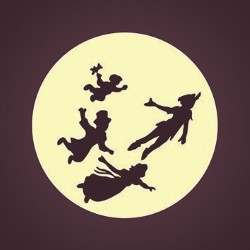

Greenside @ Royal Terrace • 7 Aug 2015 - 29 Aug 2015

Hell Hath No Fury

Offering “a modern, alternative view to the story of Lady Macbeth”, Hell Hath No Fury certainly has an intriguing premise. However, it is a premise that the show doesn’t quite manage to live up to. It presents a modern take on the character and backstory of Lady Macbeth, true, but initially the story is so far from familiarity as to prove confusing. RumDoxy Theatre’s Emma Hopkins takes the brave step of performing a solo show but although some aspects of this performance work, more do not.Beginning with a soliloquy about how “revenge is a parasite”, Hopkins goes on to play the role of Elanor Macbeth incarcerated in a mental asylum; one of the three witches; and many others – differentiating between them with a series of simple costume changes, such as a hat or a cloak and a change of accent. Although the changes between these different characters are clear, I found Hopkins’ accent for the witch to be unconvincing. Indeed, although the presence of the witch character makes sense – as this is a play inspired by Macbeth – it also jars with the clever modern world Hopkins has created. Empires are businesses and there are continued references to the city. The script does well in terms of modernising scenes from Macbeth itself, though the reason for Elanor’s manipulation of Macbeth is not what we have read. Although this play wishes to present an alternative view, I found the portrayal of Lady Macbeth as a victim implausible.The parallel revenge plots pursued by Elanor and the witch begin simply enough, but when they begin to merge together the plotlines become convoluted and at times difficult to understand. This may be due to the fact that there is only Hopkins to portray all characters, with the events described in narration or letters rather than enacted. There is a clothes line at the back of the stage where photos, articles and letters are hung, creating a timeline of events. Although Hopkins convincingly manages to portray conversations between her characters, differentiating between addressing the audience and these characters through simple but effective lighting, often the changes feel stilted, hindered by too long a pause between each scene. In contrast to these overlong pauses – in which Hopkins would stop and stare into space before moving into the next scene – several of the plot points, especially those introduced early on, are presented and dealt with too abruptly as a means to an end. The death of Duncan, for example, we know to expect from previous speeches and conversations, but the event itself occurs in a single sentence before Hopkins goes on to discuss its ramifications. Considering Macbeth shows the significance of Duncan’s death early in the play and how it affects the central couple, this plot point feels rushed. As well as this, the play’s twist in the tale is incredibly obvious, although it does make for a satisfying conclusion to the stories of Elanor and the witch with whom she deals considering their eventual fates. Hell Hath No Fury does succeed in its aim, but only to an extent. This retelling is certainly alternative, but perhaps too much so to be believed.

theSpace @ Jury's Inn • 7 Aug 2015 - 29 Aug 2015

Laughing Horse Free Pick of the Fringe

A compilation of comedic talent from across the Fringe, two shows a day, and all for free – the Laughing Horse Free Pick of the Fringe showcases some of the best comedic talent the festival has to offer. Five comedians take to the stage to promote their shows, giving audiences a taste of their style. As might be expected from a compilation show, the flavours of these comedians varied.The first comedian of the night was Steve N Allen, introducing the concept of his show (SomeNews: The Missstakes) by explaining that he used to work in commercial radio, and demonstrating his ‘radio voice’. Allen then used the audience as a jumping off point for the rest of his set, by discussing statistics such as the fact 91% of people would apparently choose their mobile phone over sex. Although this did lead to an off-colour joke about the recent Malaysian airline crash, Allen did explain that sexting gets rid of those annoying PPI texts; amusing but useful information, I’m sure.The next comedian of the evening was Jay Handley (Free Comic: Volume Two), who used the fact he looks like Western depictions of Jesus for the opening portion of his set. Not all of Handley’s humour was based on his appearance, however, as his set also discussed buses and sex – the latter was a common theme among all but one of the show’s performers. Handley’s self deprecating style was endearing, although I’m sure the Jehovah’s Witnesses he mentioned might have something to say about it.Following Handley was Aidan Killian (Holy Trinity of Whistleblowers), whose first joke involved him having a conversation with his privates, setting the tone for the rest of his set. Most of it was taken up with a long-winded explanation of a so-called Geriatric Jihad – you don’t want to blow yourself up when you’re young, but instead when you’re old and have nothing left to live for, or so his theory goes. Although this concept came as a shock, Killian’s impressions of the world leaders he would do harm to were impressive, especially the voices he used to portray a couple of Prime Ministers.Claus Reiss, billed as the Danish Bagpipe Comedian (with his show aptly titled Return of the Danish Bagpipe Comedian), was next to the stage; quite a surprise after the previous three, but a welcome one. Dressed in a kilt, Reiss not only played some 80s pop tunes but did renditions of the Star Wars theme and My Heart Will Go On to great applause, as well as explaining the reason for his taking up the instrument; he has no friends, and wanted to keep it that way. The final act of the night, Sam Gore (Sam Gore: The Cryptid Crossword), received the loudest applause, despite the fact he began with a story about how terribly he handled a heckler whose mother, unbeknownst to him, was dead. The reason for this was Gore’s reworking of The Gruffalo “for a drunk Edinburgh Fringe audience”, which was set in the Baltimore hood. It was dark and more than a little vulgar, but the contrast of the storybook rhyming couplets with the language used to write them proved incredibly amusing.Although this same line-up will not be repeated these comedians, for the most part, did well in promoting their shows and, with a different line up for every show, and two shows a day, the Laughing Horse Free Pick of the Fringe is a show I would recommend to get a taste of the variety of comedy on offer.

Laughing Horse @ The Free Sisters • 7 Aug 2015 - 29 Aug 2015

Method in Madness

New writing and Shakespeare, dance and physical theatre, all accompanied by the evocative music of Laura Marling; Method in Madness is a truly mesmerising show. Although the piece’s narrative takes place in London in 1941, concerning a young Hollywood actress struggling to play the role of Ophelia, it is so much more than a piece of contemporary writing, incorporating Shakespeare’s text, dance and music in this innovative look at one of his most beloved heroines. As the actress struggles to bring the role of Ophelia to life she turns to method acting, having been encouraged by a fellow actor to free Ophelia from her “prison in print”, but in turn it is the actress who becomes imprisoned in Ophelia’s role. Her method acting – or is it madness? - is eerily echoed not only in her changed performance in the 1941 narrative but in the incredibly choreographed dance sequences, with the simple three moving mirrors that comprise the set, as well as the ensemble, showing her grip on reality slipping, her mind disintegrating and spiralling out of control.Although the narrative concerns the Hollywood actress herself, the company works as an ensemble, not only playing their roles as director, actor or the actress’ mother but also portraying the victims of the Blitz, spirits haunting the actress as she tries to learn her lines, and ghosts from the pasts of other characters; the victim of bombing in 1915, a soldier killed in action in the trenches. The use of the set was especially effective, and affecting, here, with these figures from memory at times reaching through to those in the present, at other times remaining trapped behind the glass. Most vitally to the narrative arc, it was not long before the figure of Ophelia herself appeared behind the actress’ mirror, copying her movements before running away from her behind the moving mirrors in a beautiful and frightening sequence. Although the piece as a whole, with its stunning combination of movement, music and lighting bringing the mental states of the characters to the fore, naturally had Ophelia and her actress as its primary focus, I found the most heart-breaking sequence to be the dance of the conscientious objector. Surrounded by the mirrors and with a white feather in his hand, he grapples with himself, who he wishes to be and who he is, echoing the tortured mind of the actress he spurns, both in character as Hamlet and out of character as he blames her for the sleight of the white feather, ending his dance with Hamlet’s line “Thus conscience doth make cowards of us all”, seguing into the rehearsal scene but connecting the two scenes, as well as his character and Hamlet, in an extraordinary and haunting manner. Indeed, all of the characters of the show’s new writing echo the Shakespearean roles they portray to devastating, distressing effect, in the bombing of London and in Ophelia’s tragic end, the moving mirrors echoing the ebb and flow of the water as she drowns, the actress copying her every movement to the last – or is Ophelia copying her?Entita Theatre’s production is an extraordinary and terrifying exploration of the effects of acting, violence and madness, fusing together intelligent new writing with Shakespeare’s text, music, masks, letters and movement. During one of the rehearsal scenes the actress asks “What exactly did I do?”. To her, and to the company, I would say - you did something terrifying, something beautiful, something exceptional. To potential audience members, I say you would have to be mad yourself to miss it.

Greenside @ Nicolson Square • 7 Aug 2015 - 22 Aug 2015

Death by Shakespeare

“My conscience hath a thousand several tongues, and every tongue brings in a several tale”. This quotation from Richard III encapsulates the nature of this aesthetically powerful performance; a chorus of spirits, bruised and bloodied, gather to re-enact their deaths and, while some stand out as characters, they work as an ensemble to do so, with every member of the group a part of every tale — a murderer, a victim, or standing by, observing and mocking the action.The lines of individual characters are often delivered as a group, while lines from different plays are spoken beside each other, weaving together Shakespeare’s words from tragedy and history alike on fear, grief, damnation and death. These speeches, taken from their original context and spliced together with others, are given a new meaning and resonance in this brave new world of spirits, and Shakespeare’s words are truly the focus, made all the more beautiful and haunting in the way in which they are delivered.The events of the piece appear to be orchestrated by one spirit, who explains that one of those who enacts their death can be spared and returned to life, inviting the audience to be the judge. Although this is an interesting premise, the presentation of these different characters’ deaths is sometimes difficult to distinguish, as no announcements are made – merely a whispering of their name and change of lighting to set the scene as they emerge from their ensemble role to tell their story. The way in which these characters’ deaths are portrayed is innovative and seamless; a blend of dance and physical theatre, backed by Shakespeare’s words as well as the use of music from dulcimer, harp and drum. Some of these scenes look almost ritualistic, frenzied and wild, such as the fight between Tybalt and Mercutio, while others are comparatively calm, such as the death of Ophelia, where the ensemble contort themselves to become the water in which she drowns. A particularly frightening highlight is the death of Lady Macbeth; initially hemmed in on all sides by the chorus and desperate to escape, she then joins the entire cast in desperately trying to clean the blood from her hands, bathed in red light. In many cases the spirits address the audience directly with their lines, even going so far as to extend their hands in greeting, drawing us into their world. “What,” they ask. “Art thou afraid?”Although an abrupt change of mood comes with the appearance of the players and the comic deaths of Pyramus and Thisbe, the majority of the deaths come from Shakespeare’s tragedies, and most of them from the same few plays. This was slightly disappointing; I would love to see this company interpret Clarence’s drowning in Malmsey wine in Richard III, or the brutal murder of Julius Caesar. It is strange to ask for more death scenes, I think, but then I did “delight to view these heinous deeds”. 

theSpace on Niddry St • 7 Aug 2015 - 15 Aug 2015

Chaos Theory

Three performers and twenty five sketches, presented in a random order each night. In an ideal world Dreamgun would like to perform every variation of the show but, as they explain before the show commences by means of a complex equation, there are at least fifteen septillion variations and it would take quite some time. Having asked members of the audience to shuffle the cards, titled and illustrated with the names of their sketches, to ensure they won’t cheat in the order they perform them in, the night’s series of twenty five sketches begins.The trio are dressed in 1984-esque boiler suits – Hannah even has a red belt around her waist as Julia does in the novel – and this adds to the otherworldly feel both of the sketches’ titles, ranging from The Old Man and the CD to Robots to The Other Half, and their quirky content. However, these simple costumes are elaborated upon with the use of various props and set pieces, a particular highlight being a cardboard robot suit, which adds to the humour of the sketches. Video is also heavily involved and used to good effect, such as in the sketch Trailer and even, rather unexpectedly, in one entitled Cows. This show was not simply reliant on props and use of media to make the sketches work, however; the script was clever, with some excellent twists in the tail along the way, as well as some instances where the performers simply let the strangeness of the scenario speak for itself - the caveman whose artistic integrity is challenged springs to mind, although a particular highlight was the noir parody Detective Man.Some of the sketches were better than others, as is to be expected, but all were performed with great enthusiasm and skill by the cast; although they had no idea which sketch would come next, this never threw them off. The three worked well as a team, particularly in the Wine Reception sketch where they share a ridiculous, overblown speech, and in the Babysitter Detectives sketch; Hannah and Niall do not need to speak, their expressions say it all.The group have eighteen shows left, rather than fifteen septillion, and so the chance to see Chaos Theory is far more limited than it otherwise would be. It’s a brilliant concept, hilarious and well executed, so I would recommend that you go; the crazy concept alone is worth the price of a ticket.

Underbelly, Cowgate • 6 Aug 2015 - 30 Aug 2015

Hamlet

It wouldn’t be the Edinburgh Fringe without multiple adaptations of Hamlet all vying to make their mark, but this production by the English Repertory Theatre, directed and adapted by Gavin Davis, is certainly one of the most unusual. With a cast of only eight and a runtime of one hour and twenty minutes, this clever adaptation is fast paced and furious, eschewing Hamlet’s usual procrastination and uncertainty in order to, as Hamlet might put it, ‘pluck the heart out of my mystery’, focussing on the fundamentals of the play in its violence and revenge. Shakespeare purists beware; as the show’s tagline proclaims, ‘There is no ghost. There is no equivocation. Only revenge.’Not only is this minimal cast and breakneck run-time a change from the norm, with some unexpected cuts made and some surprising scenes unabridged, but Rachel Waring’s portrayal of Hamlet is also notable, as she is the youngest woman to ever play the role. This being said, I would note Waring’s Hamlet more for her portrayal than her gender, with her youthful appearance and aggressive glee a stark contrast to the expected melancholy and passivity of previous portrayals of the Prince of Denmark. Although this may be due to the condensed nature of the adaptation and its determined focus on Hamlet’s revenge, I feel that Waring’s was a fresh and exciting take on such a familiar character, whether in Hamlet’s apparent delight in killing Polonius, or in his evident disdain with the authority figures who surround him. Of all of these figures it was Andrew Cullum’s Polonius who stood out the most. Cullum brilliantly conveyed the humour of the character while at the same time making him much more than someone to laugh at, in his jaded conspiring with Claudius. Indeed, although I feel Cullum’s portrayal stood out, I could find no weak link in the cast. Other noteworthy performances came from Nina Bright as Ophelia, more rebellious than in other adaptations and with an air of naive adolescence, and Daniel Arbon as the calm and collected Horatio. Peter Rae’s Claudius, meanwhile, simmered with quiet intensity until he exploded with fury and fear in his confessional soliloquy, literally tearing the set apart; a fantastic re-imaging of the chapel scene.Speaking of which, the set itself, and, indeed, the concept of the production, is one of its most daring and exciting elements. Elsinore is re-imagined as a privileged boarding school, with the characters as headmaster, teachers and pupils. This leads to some clever moments, such as a biology classroom skeleton making a brief appearance as Yorick, or Hamlet’s madness being explained by Polonius through use of an equation. The Players’ scenes being performed as a Drama class was a particular highlight, with the characters enacted by Laertes, Ophelia and Polonius unknowingly foreshadowing their own ends. The actual set was minimal but effective, made up of chairs and tables that were moved by the cast throughout, with a large blackboard at the rear further establishing the setting. This leant itself to seamless scene changes, ensuring attention remained squarely on the story and aiding the adaptation’s pace and intensity.Although this production may be confusing to first time viewers, with many characters condensed or cut, some soliloquies made into performances rather than spoken alone and the plot stripped back to its bare bones, it is worth watching in order to see such a new look at a familiar text. Davis’ production is bold, innovative and energetic; though this be madness, yet there’s method in’t.

Spotlites • 6 Aug 2015 - 31 Aug 2015

Wojtek the Bear

Wojtek was an extraordinary bear, and this play that tells his story is an equally extraordinary piece of theatre. Bringing together ethereal live violin music and a script that veers between the naturalistic and the poetic, Wojtek the Bear shows the relationship between the bear who became a soldier with the Polish army(played with spectacular agility and power by James Sutherland), and the Lance Corporal who mothered him, Piotr Prendys (played by Gavin Paul). Beginning with the pair in an almost spirit like form, longing to revisit and relive their past, they then enact their first meeting, their trials and tribulations in war, and the fear they felt in peacetime - fear of Wojtek’s captivity, and of being unable to return to Poland. The story is told with only two actors, with the fiddle providing incidental music and sound effects, like that of the biting wind. The set is similarly minimal, a disc bearing the logo of Wojtek carrying an ammunition shell, but this is all that is needed. Sutherland and Paul have an incredible chemistry that brings the characters of man and bear to life; even though Sutherland is dressed simply in brown, with no makeup or mask, his movements and his voice convince us that he is the bear, from childish cub to one fully grown. Paul contrasts perfectly with Sutherland’s Wojtek as the upstanding soldier who shares the bear’s longing to return safely home. At times when they speak one after the other, as in the chilling section concerning the Katyn Forest massacre, they seem to be almost one, echoing each other and completely in sync. The pair not only bring across their characters in movement and speech but also through dance and song, and in addition they play other characters when the time calls for it, from priests to protesters, creating some of the more amusing (and saddening) scenes of the piece. Sue Muir’s music is a perfect complement to this, shifting between the upbeat tune of a ceilidh to a contrasting soldiers’ song. Wojtek the Bear takes us on an extraordinary, exciting and terrifying journey, from the Soviet Gulag to the Middle East and finally to Scotland, and these changes are wonderfully shown not just in the performance but through Scott Anderson’s incredible lighting design, showing the heat of the desert, a lush green forest and the dark, blue chill of a winter’s night. The final tableau of man and bear bathed in firelight was especially moving, and indeed the piece as a whole is poignant, thought-provoking and affecting in its portrayals of war and peace, love and forgiveness. Wojtek became a symbol of freedom and hope, and this is a performance that shows exactly why. Throughout the play Wojtek repeats “never before and never since have I blessed a human”, but Raymond Razkowski Ross has blessed us with a beautiful script, and the cast with an incredible performance. A truly incredible piece of theatre and storytelling.

Scottish Storytelling Centre • 6 Aug 2015 - 31 Aug 2015

Rik Carranza: Charming

Rik Carranza tells us he has been doing stand up comedy for five or six years and one word that has been continually used to describe him in reviews is ‘charming’. In his show, therefore, he intends to test whether this is a good or bad thing using his handmade Charm-o-meter 3000 to gauge his audience’s reaction. Is he charming in a good way, like Will Smith, or does he use his charm for evil? I won’t mention the celebrity he uses to personify that type of charm, but you may be surprised!Carranza uses a wonderful mix of jokes, a couple of games, music mostly comprised of hilarious double entendres and unexpected twists and even a few drawings. He explores a number of issues from growing up mixed-race to the state of modern music, from how certain films could be improved to attempting to learn Spanish; the latter leading to a brilliantly drawn cartoon punch-line. All of these are delivered with great warmth and excitement, and even though a couple of the jokes crossed the line, very few fell flat – and, if they did, it was because they were obvious and painful puns, yet Carranza even managed to make these amusing and bounce back, whether through his discussion of his enduring love of Star Trek or through a scientifically accurate love song.Carranza’s jokes usually hit their mark, despite the slight erratic nature of his set, moving from a discussion of racism to a discussion of modern music with alarming speed. The highlight of his show was, for this reviewer at least, his songs. From playing the guitar as a brief introduction at the start of the show, to a parodying love songs, to a song about arguments on the internet, Carranza’s clever lyrics and tunes serve as a wonderful addition to an already entertaining set, as well as helping keep the pace of the show somewhat in segueing into or connecting topics of discussion. Carranza’s comparison of music ‘then’ (which used to be poetry} and music ‘now’ (which makes no sense – Adele’s setting fire to the rain, for example), was especially amusing. One aspect of his set which was amusing and somewhat alarming was his comparison of Justin Bieber and Hitler; it was here that Carranza introduced one of his games, reading quotes from both figures and asking the audience to guess who had said what. This game could be said to encapsulate Carranza’s set as a whole; it is entertaining and clever, but also not afraid to go out on a limb or try to shock the audience. The way in which Carranza delivers this material, however, makes it all the more entertaining – he is charming, yes, in that he has succeeded, but he is sharp with it. I would happily have paid to see this show, and yet it’s part of the Free Fringe.

Laughing Horse @ The Counting House • 6 Aug 2015 - 30 Aug 2015

48 Minutes / Free Festival

I am not entirely sure why comedians Ben Shannon and Mike Reed decided their set should be forty-eight minutes long, rather than a full hour, but it actually doesn’t really matter as they deliver plenty of laughs in the twenty-four minutes they each have onstage.Ben Shannon is the first to perform; although initially distracted by how a member of the audience was sitting, and continuing to use him as a reference or jumping off point throughout his time on stage, Shannon delivers a very relatable, if not tightly woven, set. He quickly gains a rapport with the audience, using their responses to his questions as a means of structuring his material, from talking about the Fringe to relationships to his embarrassing dad. Shannon’s anecdotes are, for the most part, relatable – I won’t go into detail about the animal anatomy he’s inadvertently Googled – and, although he often comments on his own jokes, with such lines as “That didn’t sound the way I thought it would this morning”, this only adds to his charm. This being said, Shannon’s tendency to begin his series of jokes and anecdotes by speaking to the audience could be seen as his relying on them to provide material for him, rather than using material of his own but, whether this is the case or not, his set proved consistently amusing, and so this was not really a big issue. Having encouraged the audience, split into teams, to clap and cheer for the next act, Shannon left the stage to make way for Mike Reed.Although Reed’s style was much more dry than Shannon’s it proved no less entertaining, with Reed discussing life in Wales – in the town where he lives, apparently Friday counts as an upcoming event – the similarities between himself and a Henry Hoover, his difficult upbringing, train journeys and rubbish presents from relatives. As Shannon had done, Reed used the audience as his jumping off point but not to as great a degree; he also had a larger collection of one-liners as opposed to anecdotes, which provided a good contrast in tone and style to Shannon. Both Shannon and Reed provided solid, entertaining performances, worth the price of a ticket for an hour – sorry – forty-eight minutes. Oh wait, that’s right, it’s free! That’s forty-eight minutes well spent.

Laughing Horse @ Moriarty’s • 6 Aug 2015 - 30 Aug 2015

Tiff Stevenson: Mad Man

Speaking to those of us in her audience who have never seen her perform before, Tiff Stevenson says ‘You’re so lucky… I remember seeing me for the first time. I was amazing.’ Stevenson is a confident, assured performer, who is not only confident in herself – ‘I’m a sexually confident woman in my thirties!’ – but in her ability to tackle big issues.In Mad Man Stevenson discusses a range of important and divisive issues, from racism to sexism, sexuality and homophobia to ideas about body image and how we identify ourselves. This is quite a lot to fit into just an hour, but Stevenson manages to do so with both insight and great humour.Describing herself as layered, a ‘beautiful, funny onion’, Stevenson’s discussion of body image and how we dress to show who we are is both accurate and heartfelt, especially in her frustration with slogan and band t-shirts. Yes, you do need to be a fan of the band to ‘rock this tee’, she explains, otherwise you’re just being a cultural tease. Through this, and her explorations of ideas about sexuality – ‘We’re all a bit gay, and that’s fine’ – and skin colour, Stevenson shows various cultural identifiers that make us human and urges that we shouldn’t pretend to be something we aren’t. Stevenson goes so far as to demonstrate this in her imitations of Jennifer Lopez and Iggy Azalea, as well as her use of different accents in pretending to be alcoholic beverages personified in talking about advertising. Although her discussion of Jack Daniels segues into a very relevant discussion about racism and gun control in the US, this was one section of her set that feels slightly out of place, as she has dealt with the other issues she discusses on a personal level. This is not to say her discussion is not pertinent, however, and indeed, although Stevenson’s set as a whole is very funny, and she comes across and warm and personable, it is clear that there is a real anger and pain behind a lot of what she discusses. Whether this be editing rap songs to try and make them more empowering, or just less crude, or discussing oppression and privilege through the prism of her travels in the Middle East, Stevenson tackles these issues with understanding, both of the issue at hand at the fact that things need to change. Her frustration is clear, even in the jokes she makes.Despite dealing with a lot of negative issues in her set, Stevenson manages to end on a high – if slightly strange – note, talking about how all the woman in the audience are building ‘vagina houses’; all women are architects, and what have the men done today in comparison? Stevenson’s set is hard-hitting, confident, at times strange and alarming but always managing to make us laugh, as well as think. Broadway Baby Radio interview with Tiff Stevenson

The Stand Comedy Club 5 & 6 • 6 Aug 2015 - 29 Aug 2015

25 Stories

The premise of 25 Stories is simple enough; Alex Watts is bored at work and so comes up with short stories to keep himself entertained. 'Make of your brain a toy box,' he advises us, to be filled with stories and characters you can play with to keep boredom at bay. Although he ‘plays with other people’s toys’, from James Bond to Sherlock Holmes, Watts comes up with stories and situations of his own that are anything but simple; they are original, witty and often surprisingly poignant. Watts imagines Shakespeare in the afterlife, the ghost of a sign painter, a juvenile power fantasy whose name is too rude (and ridiculous) to write here, and many more, all with great eloquence and wit. From the briefest few lines about a wasp to his wonderful trilogy of tales entitled Twenty Thousand Leagues Under the Office, Watts has woven together his series of twenty-five stories into a clever and hilarious hour that is a must see for lovers of literature – indeed, for anyone who wants to see a gifted storyteller at work. I would advise against bringing your children; Watts may be charming and friendly, but some of his stories are anything but. Childhood favourites may be at risk.As well as telling us his stories, Watts also gifts his audience with tips for surviving life in the office, from rousing battle speeches to passive aggressive e-mails, reveals the conspiracy behind a popular series of children’s books and even gives us plenty of sage wisdom from his time working in bookshops. These anecdotes and titbits are every bit as clever and brilliantly crafted as Watts’ stories themselves, with his discussion of the ridiculousness of some literary criticism being a great highlight. His hypothesis regarding the last two books left in the world – one for men full of action and grit, one for women with glitter on the front – comes a close, hilarious second, with Watts’ brilliant send up of common tropes in the genres of romantic comedies and adventure novels, and his insistence that we need to burn the world and start again due to institutionalised sexism.Watts is not shy about making hard-hitting points in this arena, and this is shown most clearly in his comparison of himself – an ‘artsy fartsy flouncing woopsie’ of a man – and Ernest Hemingway, saying that one need not be as he is in order to be a great writer and performer. Watts encourages us all to believe in the power of storytelling, ‘artsy fartsy’ type or not; we live in a dark world and stories allow us to imagine a better world and, hopefully, live towards it. Words are powerful, and they can change the world. Watts paraphrases G. K. Chesterton in making this point – fairy tales do not tell children that dragons exist, but that they can be defeated. Boredom can be defeated too, as Watts defiantly and brilliantly proves. Forget what’s in the sale at Waterstones; Watts’ stories are what you should be reading – or, rather, listening to – this festival season.

Sweet Grassmarket • 6 Aug 2015 - 30 Aug 2015

Ben Russell: The Tokyo Hotel

This show begins with the sound of drums and then a dreadful storm and so gives its audience certain expectations of what is to come but, as Russell himself exclaims, “prepare yourself for the unexpected”! When he emerges through the black door that serves as his set it is not as some monster or a strange character but a seemingly ordinary, if somewhat flamboyant, man who serves as a sort of narrator for the events that take place within the hotel. I say events, for The Tokyo Hotel is not a story, as such. Rather, it consists of our guide taking us to a series of rooms and introducing us to different guests and staff members, from a piano player to a Hollywood director, writer and star, a pen and paper RPG writer to a mentalist who attempts to read the audience’s minds. The show is such that no overall narrative arc is needed; these hilarious, quirky character portraits are entertainment enough without the need to tie them all together. This is also due to the fact that Russell plays them all, changing his accent and body language with remarkable ease and fluidity – so much so that at one point he says to another imagined character that his accent started out Russian but has now become ambiguously South American, though he couldn’t say from where. Russell is not afraid to laugh at himself in character, or to admit that “this bit is going on for too long” if he gets carried away a little in his own eccentricity. He also incorporates his audience seamlessly into his sketches, from the cleaner’s commenting on a spilled beer to the mentalist asking us questions.Russell’s characters are absurd, silly and sometimes sad, not just thanks to his excellent changes of voice and physicality but his script. With lines like “It’s the elevator! Oh, imagination!” as a self-deprecating reference to his lack of a set, and the somewhat poignant but nevertheless hilarious musings of one of the elevator operators – “”Whether we go up or down we are still trapped in the futility of existence!” – Russell has a gift for writing scenes and sketches that have the remarkable ability to be both comic, often to the point of absurdity, and thought provoking all at once. Russell’s use of the set and incidental music compliment his characters perfectly, with the door being spun to represent whether we are inside or outside a room, and the music helping to increase the drama or hilarity of a scene, such as the scene in which Russell enacts a deteriorating relationship between his character and a pot plant.Towards the close of the show, Russell’s narrator has become despondent, and addresses the audience, saying “I know this isn’t what you expected. It didn’t always used to be like this.” He is not wrong there; The Tokyo Hotel was not at all what I expected, but it was all the better for it.

Pleasance Dome • 5 Aug 2015 - 29 Aug 2015

Shit-Faced Shakespeare

In Macbeth, Act II, Scene 3, the Porter states “Drink [...] is a great provoker of three things...nose painting, sleep and urine”. When it comes to Magnificent Bastard Productions, however, drink provokes a fourth thing - a fantastic night out.The premise is simple, but highly effective; there are five classically trained actors, one of whom is drunk, attempting to perform their pared-down version of a Shakespeare play; in this case, The Merchant of Venice. Some members of the audience are given instruments, which they can use during the play to tell the drunk actor to have another drink, while the member of the company who explains this and attempts to control the action wields the Horn of Last Resort; if anything illegal or dangerous happens, this will be sounded to stop the show. These frivolities aside, one unlucky audience member had the task of holding a bucket...just in case.Even if you have no idea what the play is about, there is something inherently funny about a man in velvet robes with an elaborate feathered hat stumbling about and trying to speak in iambic pentameter, albeit with a few more swear words than Shakespeare originally wrote. That being said, Antonio was good enough to address the audience and clarify plot points, explain jokes and even define complicated words or turns of phrase, prompting a great deal of confusion from his fellow actors. “Who do you speak to, my lord?” asked Bassanio. “The...pigeons?” Antonio replied, hopefully. “Yes, indeed my lord, there are a great number of pigeons in this Venetian courtyard,” came the response, to great applause. As well as this, Antonio condemned Shakespeare’s anti-Semitism, and even gave some insights into the text, saying in reference to Bassanio, “In Shakespeare’s version, we’re a bit gay”!The other actors coped admirably with their drunken cast mate’s antics, especially poor Bassanio who bore the brunt of it. From Antonio clambering on him to running onstage and telling him which casket to choose to win Portia’s hand, saying they had no time for his big speech, he rarely faltered. Shylock also had a difficult time, mostly by virtue of his character, but when Antonio encouraged the audience to give him a round of applause after his last line it was a lovely moment. The choosing of the caskets scene itself was cleverly done, with suitors being brought in from the audience – although when the first suitor chose the right casket, we were hastily and loudly informed he had, in fact, picked a different one. Speaking of yelling, the highlight of my evening had to be Antonio shouting at the fireworks from the Military Tattoo; “Shut up! I’ve got Shakespeare to deliver! It’s art!” I would have to agree with him there, Shakespeare is art; in this production, hilarious, unpredictable art, wonderfully capturing the raucous nature of the theatre of Shakespeare’s day. Iago states that “Good wine is a good familiar creature, if it be well used” (Othello, Act II, Scene 3); replace wine with several cans of Tennants and half a bottle of Jack Daniels and you could definitely say it was well used, to deliver a fantastic show.

Underbelly, George Square • 5 Aug 2015 - 31 Aug 2015

Pierre Novellie is Anxious Peter

The title of Pierre Novellie’s show is somewhat misleading. Novellie is anxious about many things – his name not suiting him, his unusual multicultural background and his insomnia, among other things – but the way in which he presents the trials and tribulations of his life is anything but uncertain. Novellie is a charismatic and friendly character, who speaks with great warmth even about his most harrowing moments, such as his face being stolen by the Chinese (that is explained in the show, I won’t spoil it for you here).Starting with the unusual nature of his name in comparison to his physical appearance, Novellie goes on to explain more about his history and that of his family. He is not at all happy, and in fact rather embarrassed, that he is South African rather than Italian American because of a trick played on his ancestors in the 19th century, and resentful of the burden he feels he has been saddled with as a white African man; quite a contradiction in terms. Novellie talks about growing up in Johannesburg, discussing the differences between South African and British humour, the security of his house and, most memorably, the dubbing of children’s TV, where he regaled us with the Spiderman theme song and some narration in comically broken English.Novellie transitions smoothly from talking about his childhood to discussing his adult life as a comedian with insomnia, exploring such topics as twenty four hour newsagents, home-made food and Tinder. Although I feel the latter section has been somewhat overdone, it was amusing nevertheless, as Novellie explains how previously he did not know photography was an art form, as well as making some amusing references for the geeks in the audience comparing the average height of women in South Africa and women in the UK. For me, however, as a student of medieval history, the highlight of Novellie’s set was the part in which he talked about his degree in Anglo-Saxon, Norse and Celtic Studies and imagined a conversation, voices and all, between a Christian missionary and a Viking called Bjorn whom the missionary wished to convert. As well as this, Novellie’s comparison of different depictions of Jesus was clever, and led later on to a brilliant, if rather strange, conversation with Chinese Jesus about the meaning of life.Novellie’s anxiety did return in the final section of his show, however, as he tried to summarise what we could take away from his show. He explains that comedy is a reflection of the society in which it is performed, so if we don’t like what we see, could we please exempt him from blame? I would do so happily; society is in need of many improvements, but Novellie’s set isn’t.

Pleasance Courtyard • 5 Aug 2015 - 30 Aug 2015

Vladimir McTavish: Scotland, 45 Events That Shaped a Nation

Vladimir McTavish’s cynical look back at Scotland’s past spans from the fourteenth century to the present day, examining the successes and failures of kings and governments, as well as such varied topics as the sinister origins of the names of Edinburgh pubs and the state of television programming past midnight. McTavish moves effortlessly along this timeline with a series of clever and sharp jokes and anecdotes; his cynicism and bite a great contrast to the warmth with which he addresses his audience. Moving through Scotland’s history at such a brisk pace may seem a challenge at first, but McTavish is able to highlight the key moments of Scotland’s history which helped to change the country, as well as focussing on 2015 and what this year will mean for the history books. A lot was made, as may be expected, of last year’s Referendum but McTavish reassures us that, no matter whether one was happy or disappointed with the result, being disappointed is just part of what it means to be Scottish, whether that be with the result of the Referendum, or living in certain parts of the country. Although the way in which McTavish describes the events of Scotland’s past is entertaining enough in and of itself, it is the way in which he often chooses to illustrate and elaborate on the points that moves his comedy to new heights. From an imagined conversation between King Robert the Bruce and a soldier if the Battle of Bannockburn was cancelled due to rain, to McTavish’s impression of a speaker at an upper class Burns’ Supper, his voice acting adds yet another layer of brilliance to an already clever set. The greatest strength of McTavish’s show, however, lies in his political satire, in which he chastises and ridicules, among others, opinion polls, the Labour Party, leaders’ debates and the Scottish Conservatives. A particular highlight of this was his hypothetical scenarios of a ‘gangster state’, with hitmen filling in risk assessments and needing to fill in a myriad of forms to get drugs from your local council. McTavish states that there are few things more depressing than a Scottish winter, apart from a Scottish summer. Do yourself a favour and avoid that inevitability, for an hour at least, by going to see his show. It may be cynical and at times verge on the despondent, but at least it’s funny, unlike the weather.

The Stand Comedy Club 5 & 6 • 5 Aug 2015 - 30 Aug 2015

Christian Talbot is Shite at Being Irish

At the Fringe last year, some members of Christian Talbot’s audience got up to leave part-way through his show, explaining that they thought he would 'be more Irish'. This year, Talbot is back to try explain what that means, how he fails to be Irish, and how he succeeds. Beginning by discussing growing up in Ireland in the late 1980s, and how his family celebrated Guy Fawkes day rather than St Patrick’s day, Talbot’s self-deprecating style and penchant for clever one-liners is established right from the start.Suddenly, Talbot launches into his PowerPoint quiz ‘How Irish Are You?’ in which a member of the audience is invited onstage to answer multiple choice questions about the country and its culture, all while wearing the so-called 'Hat of Irishness'. This allows for Talbot to make some particularly pointed jokes, as sometimes even when the answer is what one expects, he manages to twist this answer into a punch-line. He also uses media in order to manipulate a photo of his grandfather so that ‘he’ speaks to him, which creates an amusing dialogue. The highlight of Talbot’s set, however, would have to be his so called 'Anti-Craic Joke Book'; a series of jokes designed to go against what run-of-the-mill Irish comedians use as their material. A lot of these are satirical and Talbot delivers them in a dry, deadpan way, but this only adds to their humour, in stark contrast to the alter-ego Talbot is forced to adopt when performing in Ireland, where the most common punch-line seems to be: 'What are you, a Protestant?'.Covering hurling, Irish traditional music, drinking, the smoking ban (in a hilarious musical Irish-to-English translation), speaking the Irish language, morphine and more, Talbot delivers a somewhat erratic show but one that is full of heart. He is never afraid to poke fun at his native Ireland, or himself, but the message on which he ends his show is an uplifting one. Talbot may call himself 'shite at being Irish' but when it comes to putting together a good show, well, he’s great at that.Broadway Baby Radio interview with Christian Talbot

Underbelly Med Quad • 5 Aug 2015 - 31 Aug 2015

Jon Cozart – Laughter Ever After

With over two million subscribers to his YouTube channel and fifty two million views and counting for his first Disney parody video After Ever After, Jon Cozart is something of a sensation as a singer and songwriter online. His vocal talent is all the more incredible to hear in person, as he performs some of the songs which made him famous, as well as some new material, but this is not all that his first live show contains. Cozart’s performances in fact help him tell the story of how he became a YouTube sensation, with brilliant use of technology in the four screens behind him used to show some of his early videos, as well as accompany and harmonise with himself during his songs.Cozart tells his story with great warmth and humour, expressing delight with this being his first time in the UK – “You guys have castles! In Texas all we have is dirt and high rises and steel!” – and discussing the reason he wanted to become a YouTube star; they get paid money to stay inside and be introverts. I’m an introvert, he exclaims, yet I’m here on this stage. What am I doing? Cozart is self-deprecating in his jokes and storytelling but also makes some surprisingly poignant points, especially when he explains his motivation in creating the After Ever After series; having achieved his dream of becoming a YouTube star with his viral hit Harry Potter in 99 Seconds, he went on to college and had to become a grown up, supposedly leaving that dream behind. In the series, he theorises about what became of the Disney princesses after all their dreams came true, and none of their endings are happy; a fantastic blend of vocal talent and creativity.As well as performing some of his parody songs, from Disney and Harry Potter to a parody of boy bands in collaboration with Peter Hollend, Cozart also premieres some fantastic new material in his show. Here he displays his musical talent beyond singing, playing both the ukulele and the piano in a song about YouTube culture and another from his as yet unfinished musical about The Hunger Games. Cozart’s talents lie not just in parodies and poking fun at himself, and the YouTube culture he is part of, however, but in writing more serious artistic material as well, as seen in the song he wrote for his girlfriend about her break-up. The song itself is beautifully crafted and a poignant moment amidst the fun of the rest of the show but, in typical Cozart fashion, it is prefaced and followed up by amusing anecdotes.Charming and humble, thanking his audience for their applause after every song and even hosting a small Q&A session, Jon Cozart delights with his witty, heartfelt music, and a blend of light humour and storytelling that’s entertaining for everyone, YouTube savvy or otherwise. Here’s wishing him a happy ever after for the rest of his time here in Edinburgh!

Underbelly Med Quad • 5 Aug 2015 - 31 Aug 2015

Tubular Bells for Two

With over twenty different instruments played by only two men, this performance of Mike Oldfield’s masterpiece Tubular Bells is an astounding, explosive, truly incredible feat. Daniel Holdsworth and Aidan Roberts, returning for their third Edinburgh Fringe, should be commended not just for their diverse musical talents, with both often playing two or three instruments at once, but for their sheer stamina, as this expansive almost hour-long composition is not for the faint hearted, changing from soft to edgy to sinister over the course of two parts, with recurring motifs tying these very different sections together. The performance began with no preamble, as Holdsworth and Roberts let the eerie opening minor piano theme (made famous in The Exorcist in 1973) speak for itself. The transitions between the different sections of the piece felt seamless, with the musicians merely nodding to each other to signal the coming changes, which were accentuated by different lighting, with eerie sections in blue, angry ones in red and calm, folksy segments lit in green. The vibrant ensemble of instruments grew increasingly vigorous building towards the end of Part One, with Roberts introducing a number of them before his introduction “plus tubular bells!” saw Holdsworth in a spotlight playing them, taking the music to dramatic new heights towards the finale. When Part One ended there was a brief break before Part Two, during which Roberts explained that the performance is “an exercise in not giving up”. Indeed, when some of the transitions were less than perfect – whether that be Holdsworth swapping one guitar for another while managing to play a keyboard at the same time, or running across the stage to grab a different guitar from Roberts’ section – they added moments of comedy to a performance that made one laugh at their sheer daring in playing all parts of this piece, and their doing so with such enthusiasm and skill. Any mistakes that were made could only be expected, and easily excused, when both men played up to eight instruments each, and were playing the entire album from memory, and indeed most of the time these were barely noticeable. When they were, they only served to show just how momentous and immense a task Holdsworth and Roberts have undertaken, to bring such a complex and beautiful piece of music to life in this way. The pair’s enthusiasm and sheer talent, often playing eyes closed and completely immersed in the music, made this unique performance a joy to watch; a mesmerising, quirky and incredibly ambitious musical journey featuring everything from a kazoo duet to quiet, mournful guitars, with some shouting and gobbledegook somewhere in between. After the final note was played several members of the audience, myself included, were on their feet during the applause – a testament to the talent, the power and the sheer infectious fun of Tubular Bells for Two.

Pleasance Courtyard • 5 Aug 2015 - 31 Aug 2015

The Cambridge Footlights International Tour Show 2015: Love Handles

I’m not entirely sure where the title of the show came from, as love handles are never mentioned or a part of any of the sketches that The Cambridge Footlights perform but, frankly, it doesn’t matter. The show could be called practically anything and it would sell, considering the mammoth reputation of the group; a reputation which is well lived up to in this year’s series of sketches. From fantastic impressions, ranging from Brian Cox to Ed Miliband, to a short musical set in the Wild West, this talented group of performers bring to life a series of original and clever sketches with wit and warmth. Several of these are woven together into a loose plot; a meteor is about to strike Earth and end life as we know it, and this is being reported on by a radio DJ. Although this plot is brilliantly concluded at the close of the show, for the most part the sketches stand on their own, with any connection to the plot as a happy and unexpected bonus.The show as a whole strikes a good balance between longer and shorter sketches, with sketches such as the Wild West musical or the Michael Gove speech interspersed with shorter sketches with a quicker punch line, or none at all – such as the mimed shaving sketch or the sketch in which 18th century and modern styles of dance are contrasted. This is not to say that the longer sketches drag; on the contrary, the jokes come thick and fast, so much so that the punch line is more the icing on the cake than the highlight of the sketch. A notable example of this is the sketches where the performers parody figures such as Michael Gove or Brian Cox, with their impressions as hilarious, if not more so, than the sketch itself.The sketches that feature original characters are the cleverest of the lot, however, such as the dream sequence featuring the memorable Snotty Pierre, or the emperor Edgar who attempts to implement ironic punishments on criminals. In these, as in all of their sketches, the performers work fantastically well together, at one point even working out a small line mistake through a quick bit of in-character improvisation. It is clear, from the opening news reports to the final song about the awkward job interview, that this is one student sketch show you don’t want to miss.

Underbelly Med Quad • 5 Aug 2015 - 30 Aug 2015

The Potter Trail

The Potter Trail, beginning opposite the Greyfriars Bobby statue, is proud to say that it is perfectly magical, thank you very much. Joining a robed, wand-wielding guide, this tour takes us from the grave which inspired the true identity of Lord Voldemort (I’m sorry, He Who Must Not Be Named), to the street that inspired Diagon Alley, and many other locations besides. We could not begin the tour, however, without being given wands in colours corresponding to our houses, in order that we might use a spell to change the traffic lights when crossing roads; safety first, especially when magic is involved!Once inside Greyfriars Kirkyard itself, our guide, Liv, began by quoting from Harry Potter & The Goblet of Fire, as it was this graveyard that inspired the one at the end of the book. She also asked her audience to guess which book she had quoted from, meaning we could earn points for their house; this occurred several times throughout the tour, and was a great way to keep the tour active and involved, rather than our guide simply talking about each location. Liv also quoted from Scotland’s worst poet at the site of his grave, to illustrate that William McGonagall himself was not the inspiration for the Hogwarts professor who shares his name; a hilarious touch. Indeed, Liv was able to keep both the children and adults on the tour entertained, not just with comedic insights but through explaining not just about the world of Harry Potter itself in relation to the locations we visited, but about the series’ author as well (incidentally, knowing that the K in JK Rowling’s name stands for Kathleen earned me ten points for Ravenclaw!) Liv also asked for a volunteer to be sorted into their Hogwarts House outside George Heriot school, whose four houses and their corresponding colours apparently inspired those of the school of witchcraft and wizardry. She was a charismatic and very capable tour guide, able to keep the large group together as if by magic for, as she correctly pointed out, Edinburgh during the Fringe is ridiculously busy!In terms of the locations themselves, although the tour clocked in at around ninety minutes, the amount of walking between its locations was far from taxing, and this run time is also testament to just how much information Liv gave us at each site. Some of these places, it must be said, were quite unexpected; I could have seen a graveyard coming a mile off, but the underpass we visited had a surprising significance, and not for the reason one might expect, given its name! Not only was The Potter Trail informative and fun but it was also free, although donations were encouraged afterwards. The Potter Trail website explains that “we know what it’s like to be a backpacker or a student travelling on a shoestring, so we’d rather leave the pricing of the tour up to you”. With such an entertaining guide and fascinating, oft unexpected locations, this is a magical tour suitable for all ages, casual and committed fans, Muggles and magical folk alike. Wands at the ready!

Meeting Point at Greyfriars Bobby Statue • 3 Aug 2015 - 6 Sep 2015

Jacques Brel is Alive and Living in Paris

Any list of famous Belgians must include the trio Georges Simenon, Audrey Hepburn and Jacques Brel. Brel has become the epitome of the French chansonnier, intense, dramatic, black polo-neck, despite his nationality and indeed the fact that French was his second language. He was brought up speaking Dutch, although he only wrote one song in his natal tongue.Brel’s era is the 1950s and early 1960s, with its associations with Beat Poetry and a certain hipness. However, his range of characters and of tone is far wider, his sympathies far more inclusive than that glib caricature might suggest. His output was prodigious, despite a song writing career which was effectively over before he reached forty - with the exception of his last album, ‘Les Marquises’, which was recorded in the shadow of his cancerous death at 48.Brel wrote chansons; the difference between a chanson and a song is its particularity. Where a pop song will use ‘I’ or ‘you’ to mean a universal listener who can identify with it, a chanson’s ‘I’ and ‘you will be particular characters with specific relationships. The lyrics accordingly will be both concrete and dense. Brel, like Aznavour, is a singing actor, his songs dramatic monologues, delivered in his own performances with an attack, a bravura and ferocity which is totally uncompromising. Brel, unlike those influenced by him like Bowie, Leonard Cohen and Marc Almond, never tried to be liked. Paradoxically, this made him the more liked, even revered.Putting together a show from his songs for the Broadway stage, Jacques Brel is alive and well… faced a dilemma. On the one hand, these songs were written for, and depend on, one performer establishing a personal rapport with his audience; on the other a ‘show’ in this sense demanded variety, production values, ensembles as well as solos. The combination doesn’t always work.There are other compromises too, especially in the translations of the lyrics. These are by Eric Blau and Mort Shuman; Shuman was a Brill Building hack turning out bubble gum hits like ‘Sweets for my Sweet’ and ‘Viva Las Vegas’. Despite being bilingual in French and English, he inevitably compromised the uniqueness of the original. Song translation is always a tightrope walk between literal fidelity to the original and capturing the feel, the essence in a version which is a good song in English in its own right. Some of Shuman and Blau’s work falls between the two stools, and there are better translations to be had, notably by Des de Moor. This production throws in specious references to Iraq and Afghanistan, but fails to curb the homophobic references.Does it matter? It does when a translation is opaque, or bland. Take Tom Robinson’s version of ‘Les Bourgeois’. Where Blau and Shuman have “The middle class are just like pigs/The older they get, the dumber they get/The middle class are just like pigs/The fatter they get, the less they regret” , Robinson has “Yuppie scum, smug and dumb/The richer they are, the thicker they get/Yuppie scum, smug and dumb/As they get old they all forget.” Not much difference in accuracy, but for vitality, for the raw demotic language, for the clear truth of the theme of the song, Robinson wins hands down.Blau and Shuman Americanise. There’s a lot of smoothing down, and in some songs the meaning goes completely haywire compared with the original. This is not to say that there aren’t fine moments of poetry. “My death waits like an old roué/ so confident I’ll go his way”; “They’ve forgotten the tune/That their whisky voice croaks/Splitting the night/With the roar of their jokes.” This production largely uses the material of the 2006 revival, albeit changing the order somewhat. Set on a stage with fringed table lamps and red velvet table cloths, cabaret tables along the front row, the soft intimate atmosphere it evokes contrasts sharply with the harshness of some of the material. The performers have to fight a long thin tube of a theatre in which it is difficult to get close to the audience. They work best in the solo numbers which allow them to act their scenes – ‘Funeral Tango’, about a man cynically watching the mourners at his own funeral, ‘Le Moribond’, where a man committing suicide says farewell to the best friend who drove him to it by screwing his wife’. Brel’s characteristic mode is a kind of resigned bitterness; uncharacteristic then, and misleading, to top and tail the show with his “Quand on n’a que l’Amour” (“When one only has love”) which is a kind of ‘We’ll conquer everything” anthem which is out of character.Of the performers, only Eve Polycarpou really captures the intensity and anger of the original. Her gutsy, guttural mezzo attacks your ears with the proper authority. She gets to do the two numbers which are presented in the original language, Brel’s famous ‘Ne Me Quitte Pas’, and his one Dutch song, ‘Marieke’. Paradoxically, it is these two numbers in the original which have the greatest emotional impact. David Burt seizes his chance in ‘Le Moribond’ from the moment his hand emerges Dracula-like from his coffin. But, Eve excepted, it all seems too polite, too overly acted. Where rather under-rehearsed production numbers are inserted, they detract from the individual performer-audience relationship. The arrangements, and Dean Austen’s pianism, are superb. Enough of the material survives the Broadway polish to hit you between the eyes, and two hours is no time at all. With luck over a run the performers will make the material more their own, become more immersed in it. Above all, the show needs more danger.

Charing Cross Theatre • 18 Oct 2014 - 22 Nov 2014

Eye of a Needle

For traditionalists, this is a heartening time for new writing in the theatre. Suddenly there seems to a plethora of young playwrights with a proper respect for the virtues of shape, climax and release, for solid character and plotting, who are happy to provide a satisfying evening in the theatre without one eye on the future TV play or film.Newcomer Chris MacDonald is one such. Eye of a Needle is a tense, well-crafted, topical tragi-comedy, satiric in places but also humane and wise. Set in what used until recently to be the UK Border Agency building at Croydon, it portrays a system in which the guardians of the gates are as much victims as those seeking to come through.The idealistic rookie and the tough cynical veteran. In abstract it’s almost the ultimate cliché. But in MacDonald’s hands and as acted by Stephen Hudson (young Lawrence) and Nic Jackman (tough Ted) the relationship bristles with felt life. The object of contention is Natalie (Ony Uhiara), a lesbian Ugandan asylum seeker, whose fear and pain are palpable. The brutality of a system which takes people at their most vulnerable point and asks impossible questions – ‘show us the scars from your torture’, ‘prove you’re a lesbian’ - of those who have lost or left all traces of their past life in the headlong rush to escape. MacDonald takes a scalpel to this, and is particularly effective about the absurdity of trying to get witness statements about homosexuality from people in a country where even to talk about gayness is to risk death.The play’s main theme is how Lawrence grows up as Natalie’s case progresses, and he is drawn into sympathy and even affection for the pinned butterfly under his microscope. Again it is something of a cliché as an idea, the cop and the ‘criminal’ falling for each other, but here it is invested with so much more. Lawrence is at first careless, callow, more interested in texting than truth; he comes to care, but then has to learn not to care again, in order to preserve his sanity as the system buckles under the pressure of need. 250,000 cases outstanding, and rising. It would do no one any favours to say more about the plot, which has a killer twist. The fast-moving production never lets up; between the short sharp scenes, characters move quickly and geometrically between and along the battered lines of institutional chairs. Fast, seemingly purposeful and going nowhere. It’s a powerful metaphor.Performances are uniformly excellent and three-dimensional. Uhiara is a commanding presence as the asylum seeking Natalie. Her immense dignity and authority puts her interrogators on trial, reversing the situation. Stephen Hudson goes convincingly from hungover slacker to committed campaigner, in a slightly mannered performance reminiscent of James McAvoy. However, the hard-bitten Ted is perhaps the most convincing and original part, who also has the advantage of getting the best, the funniest lines. Ostensibly voicing every Daily Mail reader’s prejudice, in Nic Jackman’s hands this becomes a carapace shrouding a desperation, a tragic awareness of his own diminished humanity, and a desire to protect not only himself but the hopelessly naïve Lawrence. It is a dense, multi-layered performance.There is plenty of comedy, especially in the opening scene where a Nigerian is claiming to be gay in order to get into the UK. (“Me and my friends we are having sex all of the time. Do you know the Rusty Trombone?”) MacDonald is fair enough to admit there are liars and cheats around, which adds to the tension of the main story. But at the end of the process, as a result of decisions by people like Ted and Lawrence, others die.This is a powerful, heartfelt, necessary piece of theatre. On a human level it works utterly. However, while it clearly demonstrates a system, in the words of a previous Home Secretary, ‘not fit for purpose’, it never asks what exactly the purpose is. Why do we want to keep people out when we are crying out for someone to earn the money to pay for all our pensions? Why would anyone want to come to this pinched, puritan, mean-minded country in the first place, rather than, say, Scandinavia? Why do we fetishize nationality? We are bound on a wheel of fire courtesy of the First World War – another of the many undesirable legacies not mentioned in the current anniversary commemorations. Without wishing to turn Eye of a Needle into a different kind of play, a little more context would not have come amiss.

Southwark Playhouse - Borough • 27 Aug 2014 - 20 Sep 2014

Return of the Soldier

Rebecca West was one of the supreme journalists and travel writers of the 20th century, caustic and sharp-eyed. Her novels have lasted less well, and The Return of the Soldier, her first, is widely regarded as rather clumsy and unfocused, a case of an ambitious reach exceeding grasp. This musical adaptation, while very competent in many ways, doesn’t quite get over all the problems, and adds one or two of its own.But first, let’s hail a chamber musical of profoundly serious intent which can evoke a great depth of passion with the most scaled down of means. Whatever may be wrong with it, it’s thoughtful, subtle and adds distinction to the Fringe. It’s perfect material for a musical. (In fact, DH Lawrence reviewed the novel as ‘a drama with music’.) A love quadrille, the four sides of the square are made up of Margaret, a working class girl who works behind a bar, who is married to William, a cheerfully prosaic manual labourer; Margaret was the first love of Captain Christopher Baldry, who returns from World War I with shell shock in the form of partial amnesia, fixated on a reunion with his former sweetheart. Unfortunately he is already married to Kitty, whose memory he had wiped out. The cast is completed by a cousin, Jenny, secretly in love with Baldry, who is the narrator of the novel, but whose role here is rather vague for much of the time. The musical explores the grief this gives to all concerned. Underneath the emotion there is also a strong critique of class, and of the values where a cure, to be effected by a Freudian psychiatrist Dr Anderson, means fitting Baldry to back into his slot in society, and sending him back to the slaughter on the Western Front.So far so good; thematically coherent, well-shaped dramatically and concisely written. However, the delineation of character is patchy. Margaret doesn’t for a moment convince as a working –class girl. Granted, she is meant to be unusually sensitive and intelligent to catch the interest of Baldry, but there is nothing in her language to place her in class. Her rival, Jenny, bears the brunt of the critique of class – shrill, selfish and narrow – but the effect is to make us lose all sympathy with her, which throws the balance between the characters out of kilter and loses dramatic tension. She may be unhappy, but we don’t care. Most problematic is the psychiatrist, Dr Anderson; the authors can’t decide whether he’s a figure of fun, of horror, of authority, or as much a victim of society as everyone else. Nor can it be said be said that the songs live up to the potential of their context. Essentially they are static, explorations of mood and feeling, and don’t push the action forward; with twelve songs in Act 1, it slows the thing down considerably. Tim Sanders isn’t nearly as good a lyricist as librettist; he relies excessively on the use of half-rhymes, which in musical terms is the equivalent of a muffled punch. They lack that sense of concision and inevitability which keeps an audience hanging on them, and sometimes don’t quite make sense, even if you sort of know what he’s getting at (“Am I what you are to me?”). The music by Charles Miller is scored for cello and piano, which suggests a kind of autumnal quality – late Elgar, maybe – which is not so prominent in the score itself. The three women lack musical differentiation, in a score which is all too generic contemporary music theatre. The men come off best musically – Baldry’s nightmares are very effective, strident and discordant, and William’s sweet domesticity, “not something out of a romantic novel, more a gentle to and fro”, owes something to the parlour ballads of the time. Music director Simon Lambert needs to pull back, because he sometimes forces the cast to over-project, or be lost. Best of all are the ensemble numbers, which are by far the most musically inventive sections, and achieve the kind of operatic intensity we could do with elsewhere. The production is beautifully designed and directed. Director Charlotte Westenra knows how to make the script breathe, and the importance of subtext; two of the most telling moments, at the end of each act, are created wordlessly. She gives the cast space to breathe, and they seize it gratefully. This is a vocally formidable quintet and they all pack a punch, although Stewart Clarke is outstanding as the love object of the three women, charismatic and tortured. Michael Matus registers strongly as the long-suffering husband and comic relief, William. It could have been one of those ‘gor blimey guv’nor’ patronising parts, but it has a gentleness and reticence which is wholly convincing. This is clearly meant to be a ‘women’s musical’, in the sense that we talk of ‘women’s pictures’ of the 1950s. Baldry is something of a cypher to be fought and agonised over, and the main interest is in the feelings of the rival women. (We even get the Colin Firth/Darcy wet shirt moment.) But paradoxically, by the end, Baldry is really the only one whose fate and feelings the audience cares about. If West’s reach exceeded her grasp, so too does that of Sanders and Miller. But it is excellent, indeed vital, for the future of musical theatre that people like them are reaching out into new territories, and for that we should all applaud and support them.

Jermyn Street Theatre • 26 Aug 2014 - 20 Sep 2014

Jack Dee's Help Desk

Jack Dee's Help Desk sees Dee and a panel of surprise top comedians address problems that audience members put to them. Everyone in attendance is asked to fill out a card upon entering the show with any problem that they would like the panel to help them with. As a result, the quality of the show relies hugely on the audience's contribution.You are in for a rare treat with the calibre of comedians on the panel, and Dee is his classic self: slightly grumpy and dryly witty. Unfortunately however, on the night that I attended the audience didn't put forward many interesting queries and so the panel didn't have a lot to go on. It seemed that people had put down mundane or boring questions that they hadn't really thought through or didn't really want an answer to, which kind of defeated the point. For example, one man asked for advice as to how he could boost his energy levels because he was always tired. Another complained that their friend was buying them tickets to shows they didn't want to see. Whilst the panel worked in some high quality anecdotes and comments here and there, at times they ended up having to give mundane advice for mundane problems. Dee seemed to just be picking queries off the top of the pile - the show would perhaps be improved if he were to quickly select the best ones before the show, as many were very dry. This did, however, give the comedians room for mockery and opened their road a little for material. There were some funnier responses when it came to queries such as what to do when being mildly sexually harassed at work, or what to do about annoying children in restaurants. It really is a show that depends on the audience, and the audience that I was part of didn't have much to say. Some of them seemed to be take the call for 'problems' too literally. This is a comedy show, and it's not often that you get to sit in front of such a high quality range of comedians at once. So if you have a problem for them, make it a good one.

Assembly George Square Studios • 18 Aug 2014 - 24 Aug 2014

Alistair Williams and Daryl Perry Love You

Two comedians with quite different styles split an hour to give you a quick shot of what they are all about. They even provided snacks. The show’s material doesn’t really follow any particular theme, except for the occasional reminder that Perry and Williams love us all and want to show their gratitude.Perry welcomes the audience with open arms, engaging in humorous conversations and showing us all a little bit of what goes on inside his wacky Welsh head. He makes hilarious observations about the differences between male and female grooming, meeting people when you are single and the Swansea nightlife. He’s laid back and kooky, and responds well to his audience. He interacted with people quite a lot and asked them questions, building some good material from their responses. He’s crude at points but not too much, and tells a creative but kind of weird story he has written. He then passes you into the very different hands of Alistair Williams.Williams is much less chilled than Perry and at points feels a little like he’s rushing through a rehearsed speech, but he still fits in lots of good gags along the way. He talks of living with Australians in Croydon, the struggles of being strapped for cash and working at a bookie’s. His material strays into the controversial more than Perry’s does, but he’s careful just to dip his toe in. He also has a small rant about the confusing question of why ladies like a bad boy, which made for humorous listening. He is as strong a comedian as Perry at his high points in the set but he did have a couple of jokes which fall a bit flat- such as his final pants related gag, which was a bit of a poor one to end on.Whilst both comedians could do with a little polishing here and there, the show is the perfect length to get a feel for their styles.

St John's • 17 Aug 2014 - 24 Aug 2014

Someone's Pinched Me Yoghurt!

Adam Broomfield-Strawn has a confident and cool energy about him and when he entered the small venue I had high hopes that this good energy would be reflected in his comedy. Unfortunately it did not.Broomfield-Strawn bases his show around reminiscent anecdotes and stories about his parents, children and wife. He also attempts some observational humour about things such as play parks, the many stages of life and dating. Unfortunately however, the tales that he tells and observations he makes are a little mundane, sometimes crude and generally not very funny. There was sadly very little laughter, which is a shame because Broomfield-Strawn has the liveliness of a good comedian. He reminded me a little of Lee Evans in his demeanour but in little else. It’s Broomfield-Strawn’s material that is lacking, but unfortunately for him strong material is pretty fundamental to a good comedy show. He referenced almost every kind of human excrement possible in his stories. He also uses a lot of poorly formulated and exaggerated similes which only weakens the jokes he is trying to make further. The conversation he made with his audience was awkward and often inappropriate, such as asking a father sitting next to his children about his sex life with his wife. This doesn’t make for pleasant listening for anyone, and I cringed an awful lot.He powered energetically through the wall of silence, but things sadly didn’t look up as the hour wore on. Not only were the audience watching for the time to pass, but Broomfield-Strawn himself looked at his watch quite frequently, which is never a good sign. In addition, there was absolutely no mention of anything to do with yoghurt, which is puzzling given the name of the show and his flyers.

George Next Door • 17 Aug 2014 - 23 Aug 2014

Alex the Mind Reader

This show combines lighthearted, clean comedy with some spooky mentalism and a little bit of silliness. Alex McAleer, dressed in a slick suit and with a charismatic and welcoming air, asks his guests to fill in a short card revealing things such as what they do for a living, what their hobbies are or a fact about themselves. These cards are placed in a bowl and used as verification later on for tricks. He then eerily predicts things they have written and things they have not. He predicted the name of someone that an audience member had kissed, as well as that a little boy's favourite TV show was Dr Who. He also guessed and locations that people imagined and names of pets. He additionally predicted which audience members a few of the cards came from.His audience were willingly volunteering to have their minds read. Alex even teaches one lucky audience member how to read minds themselves. It was nice to see a magic act who didn't turn to a deck of cards at any point in his show, as so many do.There are points in the show when you think that his trick has gone wrong, such as when he was teaching a lady to read minds; however he then astounded us by showing that it had gone as intended all along.One trick which was only a little bit of a let down was the 'What's under the Hanky' section. The game was played twice with different objects, but it didn't seem to have any trick or much mentalism to it - it was basically just a guessing game. Also, the first time it appeared to go a little bit wrong; the audience member had guessed correctly what was under the hanky, however Alex seemed to gloss over this and suggest that she had said something else. The audience played along with his manoeuvre however as the rest of the show was impressive. It was just a shame that it was so short - it didn't fill the full hour slot and ended quite abruptly. Despite this it was an entertaining introduction to Alex’s abilities.

Laughing Horse @ The Counting House • 14 Aug 2014 - 22 Aug 2014

The Alleycats: Contemporary A Cappella

The Alleycats say that they love the Edinburgh Festival so much that they create an entirely new show of material just for coming here each year. This year's show combines classics and very recent pop tunes to make for a pleasant hour of listening.They all have strong voices which mesh well together, but unfortunately they weren't all very good at maintaining energy throughout the show. Mostly they were enthusiastic but at points some members even looked a little bored and expressionless. Otherwise, the choice of songs is good and there was something for everyone - Stevie Wonder, Beyoncé, Lana Del Rey and Neon Trees all feature. There weren't as many mashups as I’d hoped, but I did enjoy the mix of Young and Beautiful with Britney Spears' Everytime, with a subtle, almost drowned hint of She Will Be Loved by Maroon 5. More of these would have improved the show. I enjoyed the rendition of Signed, Sealed, Delivered, and the out of the hat selection process as to whom out of the group would sing this was a nice touch. Other songs, whilst well put together and well sung were a bit plain, such as the rendition of Moondance.The troupe commented in between songs that they have won an award for the choreography that accompanies their singing. Whilst some of their dance moves are a little corny - lots of pointing and shimmying - some are funny, such as the trumpet actions in Signed, Sealed, Delivered. It's very hard to find original choreography in an a capella group but they used a nice combination of different formations, levels and actions. Their attire wasn't very exciting - black and bowties- but seeing as how it's the singing that people go for, it was suitable.They are very thankful to their audience - and remind them of this frequently throughout the show with gushing thank yous which got a little tiresome. However applause was enthusiastic and the whole thing made for pleasant listening. Coming from a university that doesn't have a music course, it's pretty damn good.

Assembly George Square Studios • 11 Aug 2014 - 25 Aug 2014

Josh Widdicombe's XFM Show Live!

High energy, witty and often silly, Josh's weekly XFM radio programme hits the stage, bringing the humor and voices that you usually hear through speakers into the room. It puts forward the same concepts and contributors as the radio show - as well as some added guests - and the result is a high quality Fringe comedy show. It's easy to follow and just as amusing if you've never heard the radio programme before.The panel of six includes Josh Widdicombe, James Acaster, Nish Kumar, Matthew Crosby, guest Tom Craine and producer of the show, Neil. They were also later joined by poet Tim Key. The show is mainly constructed around funny anecdotes that the listeners (and in this case, the audience) and panelists provide and it often strays through an unpredictable train of topics. We were asked at the performance that I attended to provide amusing and peculiar anecdotes about times we had been dumped or that we had dumped someone, as well as whether we had ever heard something weird over a tannoy or public announcement system. Some of the hand-picked responses and resultant conversations with audience members were comedy gold and often absolutely ridiculous. The show was otherwise filled with daft anecdotes from the panelists, such as James Acaster's car crash experiences, Tim Key's interesting funfair date in Ukraine, and the ranking of Friends characters in descending order.Additionally the show's regulars engaged in their usual radio show segments and chit chat such as Nish Kumar's conspiracy theories, James Acaster's hilarious true life tales, and his head to head 'Saved By the Bell' themed quiz with an audience volunteer.Because this show is so interactive and conversational, the content is unlikely to go down the same route every time. Therefore weaker points in the show (which are inevitable considering it is so on-the-spot) such as Tim Key’s overly protracted attempt at shooting a candle with a nerf gun, are unlikely to recur. Josh himself said that this show is possibly the most fun that he has ever had in Edinburgh, and I thoroughly enjoyed it too.

Assembly George Square Studios • 9 Aug 2014 - 12 Aug 2014

Greg Proops: The Smartest Man in the World

Proops greets every guest that enters the theatre with a personal handshake, a touch that shocked and pleased the audience. He then vanishes behind the curtain before boogying out over the stage to take his seat behind a small table, to welcoming applause. His hour long conversational style show doubles as an instalment in his Podcast series so his material is very current. A master of on the spot comedy, he mostly spoke of events that happened personally to him and in the world of news within the last twenty-four hours.Proops had just arrived in Edinburgh the day before and so he began with some light hearted material about his experiences of Edinburgh and Scottish culture. He highlighted some of the subtle and silly differences between British and American customs, talking of supermarkets, his favourite chippies and tipping, to name a few topics. The audience seemed to be in awe of him.He then steadily moved on to consider some of the grittier and poignant events in current affairs and such as the recent Commemoration of the beginning of World War I and America’s gun laws. He talks with conviction and got lots of supporting applause from the audience, especially when he turned to a brief tribute to the late James Brady who had died the day before the show. The show does become a little preachy but he speaks of important truths that we all should and do consider daily. Proops himself got so into the show that he ran out of time and I was disappointed that we didn’t get to indulge in the question and answer section that he suggested we would end with. He provoked both laughter and thought. I look forward to his next podcast, because this man has got a hell of a lot of interesting things to say and he certainly wasn’t finished.

Gilded Balloon • 5 Aug 2014 - 19 Aug 2014

The Legend of the Little Mermaid

Sticking close to the original story by Hans Christian Anderson, a cast of five use dialogue and contemporary style dance to tell this dark story of the sea and love.The tale is that of a young mermaid who, when she reaches the age of 15, is allowed to swim to the surface of the ocean and see the world above the water. Whilst she is enjoying the wondrous sights she witnesses a shipwreck and saves a young prince from drowning. Desperate to see him again and experience the human world, she gives her voice to the evil sea witch in exchange for legs. She then experiences the world and is reintroduced to her prince, but his heart ultimately belongs to another in one of the darkest of fairytales.The contemporary dance sequence used in the opening scene was an effective imitation of the swells and currents of the ocean. Dance was used intermittently throughout the rest of the show, and was effective again in selective scenes such as when the prince was flung into the ocean from his ship and when the sea witch was making her potion. However, in many scenes, the movements were clumsy and stunted. Sequences also were very long and got a bit boring as a result, such as the one in which the little mermaid was watching the prince and his bride sleep. The interpretive dance was quite a complex technique to attempt for a children's show and was unfortunately left wanting holistically. It seemed a little too abstract and confusing for the kids in the audience who were fidgeting. Where dialogue was used, the lines were well scripted and well learnt, but a little devoid of believable emotion.Costumes were a strong point, especially for the mermaids. I particularly thought the way that the Little Mermaid lost her fins and revealed her legs was cleverly done. The sea witch's costume was additionally effective, making very interesting shadow shapes upon the back wall. The scenery was minimal but effective. Videos of underwater, storms and sunsets were projected onto white boards at the back of the stage which gave a very artistic vibe and changed the tone and location of scenes well. Unfortunately, the movement of scenery that occurred in the transition between scenes was badly choreographed and awkward, and there was some distracting thumping from movement in the wings during some of the dialogue.All of the concepts that the company have used were clever and interesting but despite this, when put together, the result needs a little more polish to be recommendable.

Church Hill Theatre • 4 Aug 2014 - 9 Aug 2014

Dorothy

Everyone knows the story of The Wizard of Oz, but you don't know it quite like this. A fresh take on the tale of Dorothy and friends, this play completely restructures and twists the classic. During her birthday, Dorothy is consumed by her dream world, leaving her siblings and Aunt to squabble and piece together the mysterious truth about Dorothy and her land of Oz.This play turned out to be much darker than I ever expected; it only gets darker as the truth that the characters are hiding comes out. Lots of new characters have been introduced and this makes it a little complex, but everything eventually pieces together like a mystery novel. Reality and the dream world are not as they seem.There was clever use of props throughout the show. The opening scene involves no dialogue, just the use of props such as a coat, hat and bunch of flowers, which convey the circumstances well. Additionally props, costume and lighting were subtly used to inform the audience which of the characters represented whom from the original. For example, the sassy character that represented the Lion had ‘ROAR’ written across the back of his trousers in diamante.The piece is well written and at points humorous, but unfortunately a little slow to progress. Sometimes the actors weren't very expressive or let their characters drop slightly, not entirely doing the script justice. In particular, some of the argument scenes were a little unconvincing. The cast also had an unfortunate tendency to talk too quickly or with their backs to part of the audience. Despite this, the concept and script are largely very clever and it unfolds a bit like a soap opera, filled with drama and moving towards a sensational finish.

Greenside @ Royal Terrace • 4 Aug 2014 - 9 Aug 2014

The Brendon Burns Show

Fans of Burns already know his distinctive style. The Monster-drinking Australian is gruff, loud, unbounded and uses expletives instead of punctuation. His fans love it, but unfortunately I did not. Burns generally divides a room and it seems that this year's show is no exception. There was selective material that I enjoyed but a lot of his jokes fell flat. Some wince, some laugh nervously and some purse their lips. I did not find his crude, coarse and sometimes cruel humour to be that inventive or amusing. Burns intends to cause discomfort and succeeds. He's unashamedly blunt. He loves a heckler and indeed heckles his own audience, almost goading us into striking back. It’s impressive when a comedian can build material just from talking to the members of his audience, but Burns seems to have less boundaries than most when it comes to this. He often launches an attack on his audience and looks to cause awkward situations. His comments are generally crude and would definitely insult in all other contexts. To tell a member of your audience that he looks like a prison rapist is not what many consider to be good comedy. He may not have directly insulted or offended me, but he doesn’t make for easy listening.One of the stronger parts of Burns' show is towards the end with a dissection of Arnold Schwarzenegger's career complete with a quite accurate impression. However, despite this initially working it took up a large portion of the show and lost its shine after a little while. Another topic that Burns touches upon - the differences between racial slurs in different countries - gives only a mild taste of what his coarser material entails. Whilst he sometimes picks interesting topics, his bellowing, swearing delivery brings them down.He's not afraid to open his mouth and let whatever he thinks come shouting out, no matter how controversial the issue, He likes to talk the dark, crass stuff that others shy from. However, there is a reason that comedians generally shy from such things. If you're looking for the shock factor, Burns is maybe for you. On the other hand, if you get insulted easily, he probably isn't. 

The Liquid Room • 2 Aug 2014 - 24 Aug 2014

Mark Cooper-Jones - Geography Teacher

Set in Edinburgh's Globe Bar, Mark Cooper-Jones embarks on an hour long reminder to all of us that Geography is much more than just colouring in. This is a great show for people who, like myself, are fans of Cooper-Jones' other festival appearance, WitTank, and demonstrates that he is just as credible as a solo stand up as he is in his sketch group.Cooper-Jones looks to his experiences both as a student and teacher of Geography, aided by an old school projector and a very dated primary school textbook. He has built engaging and comical material out of his observations and experiences and leaves the audience in no doubt about his enthusiasm for the subject. He fields unexpected geography related questions that we all ought to know the answers to but often embarrassingly do not and vents his comical frustration at the subject being so under-appreciated. He demonstrates that taking the register can be far from mundane in a particularly amusing run off of some peculiarly pronounced names and pokes fun at the American reputation for poor geographical knowledge.The show is strongest at the start and dips briefly in the middle, mainly due to a audience participation based section. Whilst this is weaker than his other material, the energetic and charming Cooper-Jones recaptures his audience at the end with an exploration of his own invented world. I would never have thought that there was as much comedic material within Geography but Cooper-Jones demonstrated that there most certainly is. 

Globe Bar • 2 Aug 2014 - 24 Aug 2014

Magic and Tea with an Evil Genius

John Henry Blackwood plays the Evil Genius in this show, tucked away in a cosy pub room. He mixes card tricks with conversation and because the venue is small the performance is kept quite intimate.Blackwood greets his guests in Victorian costume along with his white coated minion, who plays a small role throughout the show. As the Evil Genius, Blackwood himself, is very likeable however he is not a particularly evil character. Rather, he is excitable and chatty; more of a cartoon evil genius than a scary or intimidating one.His quirky personality is clear and he adds kooky touches to the show such as his pet wooden duck Cecil and his cat Cedric. These played a part in a couple of the tricks and whilst the magic itself was impressive, unfortunately the props would have been better suited to a younger audience. Also, the 'Tea' plays only a small role in the end of the show and seems otherwise to be mainly just for display.He uses lots of volunteers to back up his credibility and I was impressed with his predictions and persuasions. Unfortunately the show was very busy which made it a little difficult to see some of the tricks because they took place on a small table at the front. In a few cases Blackwood had his volunteers stand up and this was a much more effective arrangement.Blackwood divides his tricks with anecdotes and conversation, keeping the show very casual. Whilst this is often amusing, it often doesn't entirely relate to the magic and as a result he was a little slow to progress from trick to trick. Blackwood himself said that there wasn't enough time to do every trick and by cutting the embellishing conversation and anecdotes slightly I believe it would have been possible to complete the full showBlackwood displays great energy for his tricks and proves himself to have an interesting personality. However because the show was slow to progress sadly the magic was cut short. The tricks he did were none the less effective and without flaws. It is a shame that this show is restricted to eighteen years of age and above because I believe children would definitely enjoy Blackwood's enthusiasm.

The Street • 2 Aug 2014 - 23 Aug 2014

Chris Cook: Charlatan

Chris might be new to the Fringe but it certainly looks like he will be back again. The crowd were initially uncertain as to what was to come, however he captured their attention from the first trick. With his sleight of hand and tricks of the mind, people were twitching to know how he does it, but a magician never reveals his secrets.The show begins in the queue with guests being asked to write a movie name on a piece of paper for use later in the show. What he later does with this simple task, along with everything else, can be well described as astounding. He's very modest and charming and the whole show was a delight without a single glitch or mistake.Chris uses plenty of audience members in his tricks and I myself was one of the chosen ones when I attended the show. The trick involved nothing but a copy of 50 Shades of Grey and I was completely baffled by his mysterious predictions. Even now I don't believe it.The crowd was overspilling; he truly seemed shocked to have such an eager audience but he proved his worth. Disbelief and awe were written across the faces around me. He made what seems impossible to the rest of us look effortless and is a reminder of how cool magic is. I have no doubt that Chris will be filling much bigger venues in no time. We should all look forward to seeing more and larger scale magic from him in the future.

Voodoo Rooms • 2 Aug 2014 - 24 Aug 2014

Deborah Frances-White: Half a Can of Worms

Australian born Frances-White was adopted into a loving family as a baby. She never knew much about her birth mother - or any of her biological family- until a few years ago. With a few scraps of information, the ball suddenly began to roll and after a few twists and turns, she found out about her past piece by piece. This show is her personal journey.She looks at her relationship with her adopted family, how friends are often just as important as family for support and shows us her genetically inherited eyebrows. She tells of her encounters with a haphazard private investigator and her own private searches. She explains that once you've started you cannot stop; the can of worms is open. There is lots of suspense as you go on the search with her, wondering if these Facebook profiles and internet resources she found lead to her relatives or not. It's a story from the heart, a real life saga of discovery, and I personally was fascinated to know what Frances-White found at the other side of the curtain.She is a wonderful storyteller, very open and warm of character. Through her story she threads both silly and intelligent humour, making light of an otherwise very serious yet captivating story. She shows us the strange coincidences and the unfortunate mistakes, and conveys her emotions well.The story was enhanced by the use of photographs, so the audience could put names to faces and see what it was that Deborah found for herself. It made the story all the more poignant and often all the more hilarious. Just as Frances-White was, I was very curious to see if she had likenesses to her biological family.I could listen to Frances-White's humorous anecdotes all day, and she has a fascinating story to tell. She's effortlessly witty and your heart breaks and mends for her several times.

Pleasance Dome • 1 Aug 2014 - 25 Aug 2014

Ellie Taylor: Elliementary

Ellie's first foray into the Edinburgh Fringe Festival is certainly a treat. You may recognise this Essex girl from popular TV shows such as Snog, Marry, Avoid, but Ellie proves with this show that she is a capable stand up comedian as well as a TV host. As she mentions herself, she wasn't host of the 'Butcher's Shop of the Year Awards' for no reason, thank you very much!Her material is mostly clean, insightful and self-mocking. She's also very down to earth. Further into the show she strays into the crude, and whilst this is a weaker part of the show it is brief. She talks all things Ellie, including modelling for Matalan and Greek yoghurt companies, the effects of jäger bombs compared to vodka, female sexuality, standing behind big things and her 'arch nemesis' nephew. She showed a silly side with her drunken Kate Middleton and Keira Knightley impressions as well as her observations about engagements.The women in the audience laughed nodded their heads in assent at a lot of her jokes. Whilst this show is largely structured for a female audience, the men in the crowd seemed to enjoy her chatter too.Quick witted and bright eyed, she delivers her material with a humorous blend of attitude and drama. The hour equates to a frank and funny ride through her world and what it's like at thirty years old. Ellie is relatable, bubbly and welcoming in a way that only a practiced TV host can be. She's the kind of girl you want to be your pal. Her show may be early in the day, but Ellie has hit the festival at just the right time. 

Laughing Horse @ The Counting House • 1 Aug 2014 - 22 Aug 2014

The Seussification of A Midsummer Night's Dream

The Seussification of a Midsummer Night's Dream sees an all female cast embark on a speedy but delightful adaptation of Shakespeare's comedy. Not only have they altered the language so that it will be easier for kids to understand, they have done so in Dr Seuss style rhyming which makes for fun listening.Narration is shared between the characters throughout the play but confusion is effectively avoided with Narrator 1 and Narrator 2 badges, which were a nice reference to Seuss' famous Thing 1 and Thing 2 Characters. The costumes on the whole are very colourful and in particular the hip hop personas of the Fairy King Oberon and Queen and Titania were amusing. Bottom was portrayed as slightly dim but egotistical as usual, and the kids in particular loved his dramatic deaths and acting. There was effective use of many entrances and exits around the stage and this proved particularly amusing in the chase scenes between the lovers.Another change from the traditional Shakespearean play was that, instead of giving Bottom the head of a donkey or 'ass', he was enchanted literally with a bottom on top of his head. This was a silly and amusing addition for the children but an ass head as Shakespeare used would have been just as effective particularly because it wasn't entirely clear that it was a bottom on his head despite several puns to indicate this.The play within the play, Thisbe and Pyramus, was the best and most hilarious rendition I've seen. The Wall in particular was portrayed very comically, talking over the dramatic stage stealing Bottom as Pyramus.The audience was full of both adults and children and saw praise at the end from both, however the flat, face on set-up unfortunately meant that the children beside me had to crane their necks and stand on their toes to see over the heads.The play ended with a very satisfied round of applause. This was quickly followed by the cast surprising the audience with a few speedy slapstick sequences. These brought just as much if not more laughter than the primary rendition and ensured the show went out with a bang.A great and colourful twist on the classic, both in language and in costumes. It's a fun and silly show great for a child's introduction to Shakespeare.

theSpace on North Bridge • 1 Aug 2014 - 9 Aug 2014

Peter Pan

Porty Youth Theatre have taken on a classic tale, and have done it very well indeed. For such a young cast they are enthusiastic, well rehearsed and look like they're having great fun. They stick close to the text of the original and it was a good show for families and kids of all ages.The lost boys are mischievous and chaotic just as they should be, and the pirates are comical with just the right amount of naughty. The darling children are played very well, and the tense friendship that forms between Peter Pan, played by James Gilhooly, and Wendy, played by Megan Collins, is nicely conveyed. The mischievous and cheeky Tinker Bell, played by Hannah Low, was a favourite with the children in the audience. She gives the part attitude; her dislike of Wendy and fondness of Peter are portrayed effectively. One thing that I would say is that the cast had a slight tendency to talk quietly or too fast. Also, although the seating was tiered, they neglected to look up at their audience.There is very nice use of a projection screen above the stage. It is used to indicate a change of scene, such as during the transition from the Darlings' household to Neverland. Additionally I thought that the use of this screen and prerecorded videos in order to create the illusion that the characters were flying above the crowd was very clever. The other relatively basic but effective scenery conveyed well the changing of scenes, such as upon the pirate ship. Whilst the music played was also nice, it did drown the actors out a little.The costumes are fantastic- in particular Tinker Bell and Peter's. The children in the audience were very gleeful at the sight of Nana the Dog, who wore a full dog costume. The ticking crocodile costume was fun too.One scene that I particularly enjoyed was the fight upon the pirate ship. The use of freeze frames and choreographed sword fights was a great way to avoid a chaotic jumble. It was neat and slick.The entire cast and team of this lovely play should all be very proud of themselves and I look forward to seeing the next production from these budding actors. 

theSpace @ Symposium Hall • 1 Aug 2014 - 9 Aug 2014

Lead Pencil: In Full HB

The Lead Pencil sketch show is colourful, unabashedly silly and highly hyper. Maddie, Louise and Dave burst onto the stage with such a high level of energy that it’s doubtful the trio will be able to maintain it for a whole hour - and yet somehow they do.Their sketches are built on daft puns, gags and some inventive comedy tunes. Think singing sharks, a Facebook versus Twitter song battle, dim cowboys and dithering surgeons. They keep it light but very loud, with a few innuendos and references that are slightly below the belt . Whilst the comedians themselves have great chemistry, fun characters and comic timing, the sketches are sometimes so silly that they become a bit tiresome. Transitions involve upbeat and catchy songs from the nineties and noughties, accompanied by flamboyant dancing, which keeps the nonsense going. The entire show is a hyperactive person’s haven. The props are cleverly crafty, hand drawn and painted on cardboard. They’re reminiscent of Blue Peter/Art Attack arts and crafts and prove to be humorous aids. I particularly appreciated the animal masks. Additionally, their costumes were outlined as though they too had been drawn and coloured in. All of this added a nice quirky touch. The trio use plenty of audience participation, and some spectators get quite into the roles they are given. Certain sketches are built around comedy songs too and while some of these are humorous, they are weaker on the whole than the spoken scenes. The finale for example, consisting of a song about counting, was a little weak. Given that some of the other sketches and songs - such as the ‘Shark Life’ song - were better, it might have been stronger to finish on one of these scenes. This aside, the show is a great hit with the audience and the characters are hugely likable. In amongst heavy shows influenced by current affairs and more complex topics, Lead Pencil have used their wits and combined talent to show that the simplest and silliest concepts can be a nice break from a more tense and serious reality.

Underbelly, Cowgate • 31 Jul 2014 - 24 Aug 2014

Lockdown

In this year’s concoction, The Tealights have brewed up another fast paced set of sketches. The five funnymen mix both intelligent and more silly material, tickling the audience with a well-studied wit.Whilst at first I was a little dubious about their jokes seeming confined to a narrow student audience, they opened out a wider appeal as the show progressed. Drawing upon some of the truths of today’s generation concerning such subjects as technology and app-based culture, they also poke fun at more conventional comedic topics such as the class system in a light-hearted and relatable way. With the odd nonsensical sketch thrown in and a few unexpectedly elaborate but entertaining transitions from scene to scene, the audience are kept on their toes. In particular I enjoyed the sketch on election of a class president and the special appearance of Pippin the Dog and Aunty Mabel, familiar to a lot of the audience from childhood. These guys don’t take themselves too seriously and their modesty makes them even more likable both individually and as a group: They poke fun at each other openly within the sketches and this makes them far more believable as a team. All this, along with a little awkward but entertaining audience participation adds up to a well-rounded show that garnered impressive applause.Because the boys are confined to quite a small stage the use of more elaborate movement or choreography in both sketches and transitions is made difficult, and as a result some of the sketches using bigger props or movement were not as effective or understandable as intended. Some of the props indeed seemed unnecessary and distracted from the quality of the sketches, such as the long red ribbons repeatedly featured; whilst their use at the end of the show in a prison escape made sense, the group’s use of these same ribbons throughout earlier sketches seemed to serve no purpose. Overall, however, their use of a good blend of puns and punch lines meant I walked away feeling like I had just met a group of cool and funny people for a fun evening. These are five talented guys having a good laugh and taking the audience with them for the ride.

Just the Tonic at The Mash House • 31 Jul 2014 - 24 Aug 2014

Shakespeare in the Garden: A Midsummer Night's Dream

This production of Shakespeare’s classic and well loved comedy is set in the pretty garden of a church. Though it is on the edge of a very busy road it is a lovely and appropriately nature-filled scene for the play. Upon the entrance of their audience, the cast are already in character and greet us pleasantly. In case of Scottish weather they are well prepared with umbrellas for both their viewers and themselves but thankfully the heavens did not open during the performance I attended.The cast of twelve portrays all of the characters between them, meaning that several of the actors have two parts to play. Some are stronger than others, but all roles are filled well and are appropriately distinguished despite the overlapping cast. In particular the mischievous, flute-playing sprite, Puck, is portrayed very cheekily and likeably despite the mayhem he causes, dancing circles around his disasters and the audience. The same actor also convincingly plays the role of Snug, the Joiner – one of the performing workmen – impressively switching from the conniving and cunning Puck to this slightly dim character.Being set in the grounds of a busy church, it is important that the actors speak loudly and clearly; the characters of Helena, Puck and Bottom in particular succeed in this goal. Bottom is appropriately egotistical and demanding of attention, even once he is made an ass of. The cast also provides the music for the show with wind instruments hidden at the back of the garden, and whilst this is a nice touch, it is so intermittent that it feels a little unnecessary.There is an impressive, full use of the garden and the church grounds and the actors approach from all angles, giving the audience the impression that they are right in the thick of the story. It’s also particularly effective to have the characters sit with the audience during the Workmen’s play. This is an intimate, slick production and a very nice portrayal of some of the Bard’s best work.

C venues - C south • 31 Jul 2014 - 25 Aug 2014

Ben Hart - The Vanishing Boy

Ben Hart is the kind of magician that makes sceptics become believers. After huge success with his show at the Fringe last year, The Vanishing Boy sees him return to astonish us yet again with his unbelievable talent.Hart does things which literally seem impossible. He starts with small, yet mind boggling tricks using day to day objects like rope, ping pong balls and wine glasses. Then he starts to mingle these with bigger feats that I will never get my mind around. He made a pack of cards shrink smaller and smaller before my eyes. He made a handkerchief that another member of the audience had signed morph into a fruit stone, before proceeding to cut the same signed handkerchief out of the centre of an unmarked peach. He makes playing cards chosen by the audience jump from a pack without touching it. It sounds impossible – ludicrous even – but he did it, and everyone should see it.Using engaging storytelling and witty jokes to lead the audience from trick to trick, Hart tells his tale of the mysterious Vanishing Boy and historical magician Germain the Wizard. This ensures that the show is well structured and slick. Hart himself is charismatic, charming and strikingly good looking, with a mischievous glint and a very warm presence. Hart used random members of the audience to verify his tricks, myself included. Everything about Hart and his show makes me want to believe that he controls real life magic. At points we were stunned to complete silence, but the show ended with tremendous applause. I was so disappointed when the hour was over and he left the stage. I will remain puzzled and in awe of him and cannot wait to see what else he’s, ahem, got up his sleeve.

Underbelly, Cowgate • 31 Jul 2014 - 24 Aug 2014

Comedians' Cinema Club

This improv show sees stand up Eric Lampaert direct a series of movies with a cast of Fringe comedians that changes daily - some of whom have never even seen the movie they are performing. The results are hilarious, sometimes manic and very loud.On the day that I attended, the chosen movie was Inception. It’s a very complex film about dreams within dreams, but with a little guidance from the audience and Lampaert’s entertaining directing, the cast did very well. It was wonderfully farcical and they actually conveyed the story quite efficiently whilst adding lots of comedic twists. As the plot progressed and got more complex, mayhem broke out and Lampaert himself got involved, handing the role of director to a member of the audience. The film was maybe a bit too complex a choice, but it was still good. All of the comedians brought very different styles to the stage so there was something for everyone. I can imagine that even if you haven’t seen the chosen movie it would be amusing.Audience members are sometimes used as props and even as characters. During the performance of Inception, audience members were thrust into the roles of helicopters, aeroplanes and even main characters. Mid-air fight scenes took place, water was thrown and there was lots of falling over.The hilarity is added to by the ‘quote box’ - a box full of famous movie quotes which is turned to at random intervals throughout the performance. There are quotes from Rocky, Jaws, Dirty Dancing, The Wizard of Oz and Terminator to name a few. The comic timing of some of these was hilarious and often nonsensical. I would definitely go again and would like to see them perform something a little simpler and more familiar to the audience.

Just the Tonic at The Tron • 31 Jul 2014 - 23 Aug 2014

The Rat Pack Stand-Up Comedy

The Rat Pack Stand Up Comedy features swing hits and a changing line up of comedians from the Fringe catalogue. Host Nathan Cassidy is back in the Free Sisters with the show which has gotten better since I saw it last year at the Fringe.Nathan lines up his guests on stage at the start of the show and keeps them there for the duration of the performance, interacting with them and the audience throughout. Whilst they are in a smaller venue than they were last year, this gave it a much more intimate and conversational vibe, which the larger room last year lacked.Because the bill changes every day it is hard to guarantee that you will enjoy everything, but I certainly enjoyed a lot. All three of the comedians announced when I saw the show had very different styles and so there was something for everyone.On the day that I saw the show Phil Wang graced the stage first. With jokes that pull at his Chinese origins and personal anecdotes, he gave a strong but somewhat short snippet of his style; I wished that he could have done a slightly longer section. Laurence Owen followed with a guitar and singing based segment, and the third comedian was Trevor Lock who used a member of the audience quite impressively to build his jokes around.However, by far my favourite guest was a complete surprise; Milo McCabe’s performance was unexpected and unannounced but he had the audience in fits during his segment. He played his character, Troy Hawke and had the audience roaring at his Glaswegian impressions. The way that he was built into the show was as though it was almost accidental for him to be there, but this only made him even more hilarious.Nathan Cassidy fills the gaps between each comedian with his own chatty and casual material in line with the smooth and chilled tones of the Rat Pack hits that are the soundtrack. The introductions are a little long and the causal style means that it takes longer to get through the jokes. Because of this each of the comedians and Nathan himself don’t get through much material. However this is a good show if you fancy a nice drink and a taste of comedy of an afternoon.

Laughing Horse @ The Free Sisters • 31 Jul 2014 - 24 Aug 2014

Sy+

Sy Thomas is the usual host of this show, introducing his friends from the rest of the Fringe as well as doing a section of his own material. However, on the day I attended we were put in the capable hands of Joey Page as MC.The bill is different every day. When I attended the first comedian was Mark Smith. Smith doesn't actually have another show at the Fringe but he was amusing nonetheless. He was likeable and self deprecating, talking about his average name and his other half, keeping it pretty clean.The second comedian was Luke Benson, who does have a show up. He had a largely similar style to Smith. He too was self-deprecating, talking about his significantly higher than average height and his other half.The sections that they did were very brief, only really enough to get a quick feel for their style.Joey Page then went on to do his own brief section. He was the most distinct of the three comedians. Imaginative and eccentric, he steers clear of observational comedy and instead delves into a run down of his nonsense thoughts and ponderings. Made up facts, games of rock paper scissors and gentle mockery of others are just a few hints at his style. He would begin to tell a normal, everyday anecdotal story but then suddenly throw something fanatical or impossible into the mix without a blink, as if it were a completely truthful account of events he had experienced.None of the three acts were ground breaking, however it was a nice, mellow hour of comedy and nonsense. Shows like this are a good way of finding new comedians to see; just a taster.

Laughing Horse @ Espionage • 31 Jul 2014 - 24 Aug 2014

Shappi Khorsandi: Because I'm Shappi...

Shappi Khorsandi is set to take Edinburgh by storm at this year’s Festival with her show, Because I’m Shappi. Sorely missed at the Festival last year, she is back with a bang. Effortlessly witty and cheeky as ever, Shappi graces the stage with a new set of anecdotal, sometimes rude and always hilarious ponderings.Throughout she explores the differences between adult and childhood friendships, her interesting pregnancy cravings, eccentric family and the wonders of Twitter. She also talks about the struggles and triumphs of being a female stand up comedian, dipping in and out of anecdotes about her career, trolls, criticism and praise. She manages to be an endearing blend of both self deprecating and proud simultaneously.I believe that Shappi is so successful with her audiences because she is so relatable. She speaks truths that the rest of us aren’t funny or brave enough to put into words. Her observations are uncanny; her delivery slick and her energy high. Shappi is immensely likable and always very open, not one to shy away from voicing her opinions. Her effervescent delivery is consistently high quality and there’s no fear of the front row when it comes to her – I was sitting in it. She has a very welcoming air and is a strong comedian without having to pick on anyone. The venue was full to the brim and I have no doubt that it will be more of the same for Shappi. You can tell a lot from the applause that a comedian is given and Shappi not only gets applause at the end of her show but heartily throughout.As with so many comedians of such high calibre, unfortunately the hour feels too short. Shappi dashes off too soon, leaving her audience awestruck and pleasantly satisfied with a good evening’s laughter.

Pleasance Dome • 30 Jul 2014 - 24 Aug 2014

Andrew Ryan: The Life of Ryan

Andrew Ryan’s show this year sees him look at where he is in his life, how he got here and how he’s enjoying it - or not enjoying it, as the case may be. Andrew looks to his life that he has set up in England, his family back in Ireland and frets about his unmarried status among a rabble of married siblings. He also talks about the struggles of being a non drinker and his past jobs.Andrew’s material largely makes for easy listening and he manages not to venture into crudity for a substantial chunk of the show. His stories all had a promising beginning however the punch lines were a bit anti-climactic. Indeed the whole show started promisingly but never really built up further. It seems therefore that promising is a good word to describe Ryan. He certainly tells a good story, however these stories are currently better described as lightly humorous anecdotes than jokes. His material didn’t have an awful lot of structure either. As a stand up, his talent needs a bit of polish.He does have a sprinkling of stronger material, such as when he describes his tactics for pushy charity fundraisers on the street. His brief observational section on Scottish people also went down quite well. All this being said, he’s seems like he’d be the kind of guy that’s good at mismatched nattering and first impressions. Ryan himself was welcoming, cheerful, inoffensive and not unfunny However the whole thing felt a bit more like a chat with a comedian after the show had finished than the show itself.

Gilded Balloon • 30 Jul 2014 - 24 Aug 2014

Patrick Monahan: Adventures in Monahan Land

Before the show had even began, I overheard a young man in the front row say ‘I can’t sit here, he’ll pick me!’ Fans of Patrick Monahan know what’s coming- and to be sure, ten minutes later that same boy had been pulled up onto the stage by the loveable Irish/Iranian himself. This year, as Patrick himself admits, his show has no particular theme; it is just an adventure through the strange and hilarious products of his mind. There’s Asda, there’s trains, there’s Countryfile and there’s yoghurt. There’s all the random and wonderful material you hope for and there’s no telling where he’s going or who he’s going to chat to next.It always astounds that Monahan is able to build so much great material on the spot just by talking to his audience. As always, he pulled people up on stage, played pranks on audience members who dipped out to the toilets and shouted up to the balcony. Whilst he loves to pick people out he keeps everyone on side. The fact that the young man I overheard stayed sitting in the front row, despite his worries, exhibits just this. Monahan’s shows are more like a hilarious chat through a microphone than a formal show. The venue was quite small for a very popular comedian but this kept it nice and intimate.This show seemed to be suitable for families too, and Monahan doesn’t shy away from seeking out the kids to say hello. He proves that he can perform to a crowd of any age, cracking jokes about the recent Disney movie Frozen and asking the kids questions.I had sore cheeks from laughing by the time I left. Monahan’s now familiar, but effective and impressive, on the spot style has succeeded yet again.He departs from his show the same way he entered, with hugs and high fives. The hour was sadly over far too quickly.

Gilded Balloon • 30 Jul 2014 - 24 Aug 2014

Imran Yusuf: Roar of the Underdog

After two years away from the Fringe, Imran’s style has changed slightly, but his show The Roar of the Underdog, demonstrates that change isn’t necessarily negative. This show is poignant, interesting and makes you think, which is understandably not what I automatically expected from a stand up.Imran looks at complex and fascinating subjects such as global capitalism, conflict and religion. With such cavernous subjects, you would imagine that it would be difficult for him to construct a good comedy show without causing severe insult to someone. However, Imran pulls it off and talks with conviction and careful consideration, whilst managing to make his audience laugh along the way. He makes observations that most of us haven’t thought about, mostly because we ourselves are guilty of them, such as the self-fulfilment and praise that people seek when they raise money for charity.Imran additionally explores his own mixed origins and considers where he would best place himself in society. He tells of his love and inspirations from Jackie Chan, his travels to China and India and his experiences as a travelling comedian. He mixes anecdotes with facts and jokes in a unique way that i haven’t seen from another comedian yet at the fringe.This show is not side splittingly funny, but I don’t believe that side-splitting was ever Imran’s intention. His material is intelligent and entertaining. I walked out having learnt about the Indian class system and having reconsidered the best way to be charitable, which is more than I thought I would learn. Imran is immensely likable, chilled and open. He manages to be funny without picking on anyone at all and he emits a welcoming, warm vibe across the audience. So, whilst this isn’t the funniest comedy show at the Fringe, it’s certainly clever, relatively clean and smoothly done.

Underbelly, Bristo Square • 30 Jul 2014 - 25 Aug 2014

Bromance

Bromance sees three young guys (the Barely Methodical Troupe) hang out onstage dancing, larking around and performing a few jaw dropping stunts and acrobatic tricks. The show starts with an edgy opening sequence introducing the trio to the stage and already you can tell that there’s an interesting and dynamic team at play.The themes of male friendship, bonding and even rivalry run through the show. It’s clear that the boys (Beren D’Amico, Charlie Wheeller and Louis Gift) have a huge amount of trust in each other. Their timing was flawless and their energy high during the acrobatic and physical hand-to-hand sequences. They made it look effortless as they swung around and over each other, perfectly choreographed. In a few of the circus stunts, such as when D’Amico balanced on Gift’s head, they looked a little wobbly but all of them were completed with performers intact. My heart stopped a few times when they flung themselves from the lofty height of Gift’s shoulders, but all stunts were completed safely and impressively, performers intact. The use of the Cyr wheel by Wheeller also stood out as particularly skilful, despite being quite a commonly used circus act.They mingle their stunts with daft bravado, comedic scenes and transitions. Some of these are humorous but others were a little long or slow to progress. However, they kept the atmosphere light and let the audience and performers catch their breath. There were points when you thought something big was about to happen but then it didn’t. Though a bit of an anti climax, these moments did mean that when they hit out with something amazing it had much more of a shock factor.Bromance is this troupe’s debut show and with this in mind it is a very strong production. Their storyline ideas could do with some work but the acrobatics are highly impressive and well choreographed. I have a feeling they’ll be back with an even better, even more acrobatic show soon.

Underbelly, Bristo Square • 30 Jul 2014 - 25 Aug 2014

Rhys James: Begins

James’ appropriately named debut show at the Festival is fast paced, anecdotal and comfortably funny throughout. It begins with a short video looking at the planning and promoting processes for the show which is witty and sets up high hopes for the rest of the hour. Then James’ emerges to face these hopes and delivers a consistently good humoured set of sarcastic and self deprecating, yet slightly arrogant quips and gags.James talks about how, at the age of 23, he has finally become an adult. He’s stopped eating chicken dippers, for one and he’s got a degree in politics too. He also talks about girls, trivial pursuit tactics, the future of online dating and reviews that he has received in the past. He also said later on in the show that he was going to tell us how he got into comedy, but apart from a brief anecdote about being embarrassed in class as a teenager he didn’t really detail this thread any further.Many of James’ jokes are structured into poetry which is sharp and quite entertaining. He’s mostly witty rather than hysterically funny, and he fires his material out quite rapidly. At points the show does seem a little over rehearsed, like a long speech rather than seeming casual and conversational. James doesn’t interact with the audience or read their responses very much. He also doesn’t seem to have much on-the-spot material, but this will inevitably come with practice. He keeps his jokes pretty clean except for the odd bit of profanity and he occasionally tiptoes into slightly edgier, darker topics but this is brief and not really committed.It seems that Rhys James has the potential to become a successful comedian, once he gains a bit more knowledge about where he wants his style to go and relaxes into it. As a result this show feels like an alert to stay tuned.

Pleasance Courtyard • 30 Jul 2014 - 24 Aug 2014

The Oxford Imps: Pun and Games

You can never predict what’s going to happen next when it comes to the Oxford Imps – and that’s precisely what makes their show such a great success. This year, six young and upbeat comedians again put themselves at the crowd’s mercy with energy and zeal, introduced by a charismatic and charming host. Every sketch and game that the Imps put forward is built upon prompts from the audience, so come armed with your children and with your imagination.At the performance that I attended, some of the suggestions included telling a story in text language, a guessing game involving a lampshade attack, as well as a musical developed around the word ‘irony’. No performance will ever be the same as the last, so even if you’ve seen the Imps perform before, you can be sure that you will enjoy a completely new set of skits. They keep it clean, silly, satirical and fast-paced. Adults and kids enjoy the show as much as each other, and laugh along with the participants throughout.Each comedian displays his or her own witty style. Whilst some are stronger than others, overall the performers work well as a team. Sophie Ward in particular succeeds in having children in stitches with her funny faces and voices. Vicky Hawley and Frederick Clayton also prove to be a sturdy double act – when I saw them they enacted an artsy couple who had misplaced their child several months ago.Whilst some suggestions from the audience seemed to be bypassed or misheard, the outcome was still comical and creative. The odd sticky spot is to be expected in such genuine improvisation, but the Imps are good at jumping to each other’s aid. They aren’t afraid to laugh at each other or at themselves, which also skilfully averts any awkward pauses. The audience is encouraged to participate in good humoured call-outs when a mistake is made or games are played. The Imps are also very good at reading their audience’s reactions and cutting scenes short or flipping them into something different if they aren’t going down as well as hoped. This, along with the energetic transitions between scenes, ensured that there wasn’t a dull moment. When the host announced that it was the end of the show, there was a disappointed cry from the audience. I highly recommend the show – without a doubt the Imps will have several returning fans!

Gilded Balloon • 30 Jul 2014 - 25 Aug 2014

Minor Delays

Minor Delays can be described as simple but tremendously effective. Three fabulously talented comedians participate in a train of witty and snappy comedy sketches which equate to 45 minutes of laughter.Their style and setup catch you off guard: Every sketch unfolds with the comics entirely facing the audience, as though you are the character they are communicating with. As a result their reactions and coordination with each other is even more impressive. Transitions are smooth and the mood is set effectively by two live and talented musicians hidden in the corners of the stage.This well-written material feels completely fresh. They hit you repeatedly with clever twists and fast-paced punch lines. The show is a display of both intellect and silliness in the appropriate blend, which leaves the audience pleasantly impressed. In particular, Harry Michell proves himself to be astonishingly talented, and suggests himself as a face to remember. He flicks effortlessly between a range of diverse characters such as a pretentious primary school pupil, bemused pedestrians and an intimidating parent. Abi Tedder and Joe Barnes complete the very strong team, and develop their excellent chemistry without looking at each other once throughout the entire performance. In particular the trio shine in a sketch when the two men play Abi's imaginary friends; their dismissive exclusion of Abi from their banter and Abi’s resultant frustration makes for hilarious viewing.To be frank, this show couldn't get much better. Without using a single prop or costume they have constructed a very impressive piece and if you're looking for a fun afternoon with jokes you've never heard before, you should strongly consider seeing them. They know what they're doing and they're doing it right. The applause said it all.

Gilded Balloon • 30 Jul 2014 - 25 Aug 2014

Eric and Little Ern

The year is 1999 and Ernie Wise is in hospital, 15 years after the death of Eric Morecambe. An apparition of his late comedy partner appears at his bedside, glasses and all, and the beloved duo embark on a reminiscent jaunt through their best memories- with both new material and original favourites. Morecambe and Wise are such a beloved duo that it is brave to attempt to imitate them at all. However, Ian Ashpitel as Wise and Jonty Stephens as Morecambe have got them down to an eerily fine art. They sound almost exactly the same as the pair, and whilst they don’t look exactly the same, they are probably as close as it gets. Their mannerisms are uncanny and the patter between them is a gloriously accurate replication of the relationship the two shared on stage.Stephens reels off gag after gag just as the man himself did- twitching his glasses and nose all the while. Ashpitel has got Wise down to a tee; exasperatedly standing in Morecambe’s shadow and being the butt of his jokes, attempting to take comedy a little more seriously than Morecambe can.The fresh material is kept true to the duo’s style and could have easily have been part of their shows in the past. Favourite sketches such as Grieg’s Piano Concerto, Morecambe’s paper bag trick, and the beloved Swiss Dance and slapping routine also feature and are emulated very well, reminding the audience of just how great they are. I was only disappointed that the Breakfast time sketch didn’t feature!There’s no way they could ever be quite as good as the originals but they get very close. Closing the only way they could- with a rendition of Bring Me Sunshine- they skipped off the stage to loud, reminiscent applause. There are no comedy duos like Morecambe and Wise these days, and I’m sure that I’m not the only member of the audience that will be looking back at more of their best material this evening!

Gilded Balloon • 30 Jul 2014 - 25 Aug 2014

The Cat in the Hat

This production of The Cat in the Hat brings the beloved Dr Seuss tale to life, almost as if the characters have stepped straight out of the book.The story is of Sally and her brother who, one rainy day when their mother is out, let a talking Cat in a Hat into their home, who promises to give them a day of fun games and tricks. The play sticks almost entirely to the text of the book’s rhymin, and the set and costumes are just like the illustrations. Both the vibrant colours and the style of Dr Seuss are wonderfully evoked. I particularly liked the clever use of the puppet for the fish, who tells the cat off for the havoc he causes. The sound effects are also fabulous and very humorous.The Cat enters by peeking his tail, then his foot through the door, much to the delight of the children. He then backs onto the stage before pouncing with a loud, dramatic meow into his flamboyant role. He was played very cheekily and mischievously; the children in the audience were cheering in excitement and laughing loudly at his nonsense. He’s over the top and easily amused, but children love his cartoonish style and rhyming chatter. Thing One and Thing Two, the Cat’s mischievous friends, are also a favourite. They danced through the crowd hyperactively and wreaked havoc all over the place, teasing the children. The characters might be a little in-your-face for small children; some of the littlest ones cried in fright at their approach. Most however found them hilarious and reached for the Cat as he passed them.Lots of blow-up beach balls and footballs were thrown into the crowd as Things One and Two caused their mayhem, much to the glee of all the children. They were very effective in conveying the havoc and loss of control caused by the Cat’s friends. There is also good use of slow motion effects, such as when the Cat falls from his balancing ball and later when Thing One and Thing Two fly their kites around the house, knocking things over.They close with an upbeat dance sequence and the children around me seemed genuinely disappointed to see the Cat vanish from sight. This is a sharp, vibrant and deliciously daft story told beautifully and perfectly for children. It’s like a very classy pantomime. It’s brimming with energy and childish laughs. I can’t think of anything more that they could have done to better bring Dr Seuss’ work to life.  

Pleasance Courtyard • 30 Jul 2014 - 25 Aug 2014

Working Men's Club

The title of Luke Benson and David Hardcastle’s show can easily give rise to the fear that it will be a rather patronising pastiche of working class culture for the benefit of a middle class audience. The idea that there is something inherently funny about a Meat Raffle could only come from people who have never been out of work, never had to live on a diet in which good meat was a rarity. That aside, my fears were soon allayed.An audience of fifteen is hardly ideal for recreating the warm, rowdy atmosphere of a Northern working men’s club, but Benson and Hardcastle worked extremely hard to get us participating in bingo, the raffle, darts, singing along. It helps that Benson is a Geordie and covers the territory well. Hardcastle is a very capable comic in his own right, with a gifted turn of phrase, describing his own face during sex as being like a dog who’s just been given a toffee.Within this framework there are guest acts, in which three or four stand-ups performing in other shows do five-minute spots. Nelly White, Tim Shishodia and Mike Shepherd had a hard job getting much response but the outstanding act of this session was Ben Target. Using a large number of props (starting with a fire extinguished), he is accomplished, surreal and has a slightly sinister, dangerous edge. He is a master of the measured delivery and could teach many other comics a thing or two about the importance of the pause. ‘Hilarious’ must be one of the most overworked words on the Fringe, but his card trick fully justifies the epithet.The show’s strength is in its framework; its guest acts, which vary from show to show, are in the context of the Fringe generally more run-of-the-mill. The show could therefore improve if Benson and Hardcastle cut one of the visiting acts and put in more of the games. More meat!

Laughing Horse @ Caroline of Brunswick • 23 May 2014 - 24 May 2014

The Trial of the Jew Shylock

‘The Merchant of Venice’ has always been a problematic play, with its Elizabethan anti-Semitism rubbing shoulders with almost fairy-tale elements (the three caskets) and Shakespeare’s emerging dramatic skill infusing the racial stereotype with a kind of grudged humanity almost in spite of the playwright’s conscious intent.Eric Richard’s bare-bones adaptation will have none of the ambiguity. Stripped down to a single 80-minute act, ‘The Trial of the Jew Shylock’ lays bare the insistent, raucous, ugly racism of the play – of its world, and of all its Christian characters – in a version which does away with the business of the caskets, reduces the romantic subplot of Shylock’s daughter Jessica’s elopement with the Christian Lorenzo, till all we have is the racially motivated vendetta of Antonio and Shylock. ‘Jew! Jew! Jew!’ - the play tolls the scornful word in every scene – along with ‘Dog’, ‘Infidel’, and any number of insults which have the audience wincing in their seats. This is a play which does what it says on the packet; just as the slandered Oscar Wilde turned from prosecutor to persecuted in his subsequent trials, so Shylock prosecuting for his debt, his forfeit, his pound of flesh, turns into the victim, on trial himself. At which moment we realise that Shylock has been on trial – and pre-judged – all his life simply for being a Jew. As a script it’s an extraordinary act of reclamation.Would that the production was its equal. Director Susannah Lane Bragg comes from a predominantly filmic background, and this might account for the extremely low pitch of the performances. Maybe she is aiming for a kind documentary realism, suggesting the everyday nature of racism; maybe it stands in ironic counterpoint to the almost Gothic savagery of the denouement. Either way, moment for moment, it makes for a flat enactment, devoid of nuance and subtext. The two great speeches in the play, Shylock’s “Hath not a Jew eyes?” and Portia’s “The quality of mercy is not strained” are both polemics. They are arguments, aiming to convince antagonists of important universal truths. They need to feel desperately important to the character saying them. Otherwise, as here, nothing seems to be at stake. Joe Shefer’s Antonio, the fall guy for the debt, needs to have the energy of rabid hatred, but also the suppressed emotion of intense homoerotic love for Bassanio. The text preserves this element, in that twice the demands of male love take precedence over marital love, but bodily contact is confined to a manly hug and a pat on the back, and there is no hint of the intensity of feeling between these two. Shefer, elsewhere a good actor, here bears all the signs of an actor who hasn’t been allowed to do what he wanted to do, and has nothing else to offer.Ashley Gunstock as Shylock and Emma Lyndon-Stanford as Portia are similarly inhibited. Gunstock wears a look of perpetual injury, but it is mostly directed inward rather than outward. The one point where he catches fire is when he turns on his Christian tormentors to say, “The villainy you teach me I will execute. I am what you have made me; I am your reflection." The production lifts momentarily. Ms Lyndon-Stanford, is hampered by seeming somewhat old for the part, and ill at ease with the shape, rhythm and formality of Shakespeare’s early blank verse.Everyone is hampered by some fiddly, noisy scene changes involving a lot of moving things around on casters. A token modernisation distracts, with suitors being assessed on Facebook, smartphones providing the latest shipping news; the trouble with this is that Antonio’s merchant trading is irredeemably Elizabethan, far flung exotic argosies risking all for huge profits. Bring it into the modern world, and you can’t help asking, ‘Isn’t he insured?’For all the deficiencies of performance, the play does in the end work. The trial scene is kept virtually intact, which means proportionately it takes up a far larger piece of the action than in a conventional production. By contrast with what has gone before, it is slow, inexorable, builds up terrific tension. Gone are the mobiles, and, as Shylock sharpens his knife on the sole of his boot before claiming his pound of flesh, we move into territory which is timeless. Of course we know that Antonio is not going to die, but the delay before Portia rides to the rescue on the weasel words ‘A pound of flesh – but no blood’ is agonising.This production ends with a wordless scene showing what is only referred to in the original – Shylock’s forced conversion to Christianity. Dragged before a priest, sobbing, held down while the cross is branded on his forehead, and left broken, staring into space, this is an unforgettable image of barbarism which resonates behind the eyes long after the end; barbarism which taints the whole of Venice, for all its supposed civilisation, and all these supposedly ‘good’ characters who are nothing but arrant hypocrites. After all, as Shylock reminds them, they keep slaves. I was reminded that the fourteenth century, in which the original tale is set, was not long after the time when the ancestors of Bassanio, Antonio and Portia slaughtered women and children in the nave of the Agia Sofia in Byzantium, and, turning cannibal, ate Muslims during the Crusades. “Quality of mercy?” Pull the other one.

Rosemary Branch Theatre • 14 May 2014 - 31 May 2014

In The Heights

The Heights of the title are Washington Heights, a Dominican-American neighbourhood of New York at the top end of New York. It’s a neighbourhood familiar to composer/lyricist Lin Manuel Miranda, who is of Puerto Rican origin, and was brought up In the Hood.So there is a strong autobiographical element in ‘In The Heights’. The narrator – Usnavi, who owns a convenience store – is a rapper, as is Miranda, who introduces characters and manipulates plot in the big-boned, loose-limbed style of hip-hop. His girlfriend, Vanessa, works in a hair salon and lives with a mother who would rather buy drink than pay the rent. Vanessa in turn leads to Daniela, the outrageously camp salon owner (Victoria Hamilton-Barritt, channelling Chita Rivera for all she’s worth). Usnavi has a little brother, Sonny, who is the Mr Cheeky of the production, but also something of a social commentator. Also a substitute mother, the neighbourhood matriarch, Claudia, who has dreamed of returning ‘home’ but never raised the money.The other family nexus is provided by the Rosarios – father Kevin, struggling with his taxi business, mother Camila and daughter Nina, who has flunked her opportunity to escape from the ghetto by dropping out of university – paying her way through college with two jobs left her too exhausted to study. Nina provides the other love interest with Benny, a non-Hispanic employee of Kevin. Cue heavy father and star-crossed lovers, one of several references to ‘West Side Story’, whose giant shadow the show cannot escape.The characters are knit together in a strong and vibrant sense of community, bound together with Latin-inflected music. One of the first questions any successful musical has to ask is, “Why music?” and here it is the glue which yokes all the characters into a common set of references and sense of mutual regard; it’s what makes the community resilient. On the hottest night of the year, when for the nth time there’s a power cut and no aircon, what else can you do but hold a dance party?The dance – street dance both literally and metaphorically - is at the core of the show, and the lithe ensemble is full of fizz, backed by a funky seven-piece band (‘In the Heights’ won a 2008 Tony for both Best Musical and Best Original Score). Damian Buhagiar’s Sonny is particularly sharp.The quality of the music and the dance somewhat disguises the deficiencies of the book, which rarely rises above the cliché of soap. Everybody is good, beautiful, talented – where is the darkness to give contrast, or true drama? All offstage. Characters are mainly generic rather specific (Daniela and Sonny excepted). Deprivation in this barrio feels somewhat tokenistic, solutions are fortuitous (a lottery win), hearts and minds changed too easily. In the journey from college graduation show to massive Broadway hit, ‘In the Heights’ has obviously undergone an extensive revision which feels more like a makeover (and I don’t mean that in a good way). Edges are smoothed, poverty is given a romantic glow and the result is as romanticised and almost as unreal as the loveable Cockneys doing the Lambeth Walk in ‘Me and My Gal’. Quiara Alegria Hudes as writer of the book must bear most of the blame, but Miranda’s sententious lyrics don’t help.Of the performers, Hamilton-Barritt and Bunagiar have the strongest-drawn characters and the funniest lines, and gleefully devour them. Of the rest, the older characters have the best of it. Not only are their voices more distinctive, the song writing moves into more conventional territory for musicals, allowing space for character and true emotion. Eve Polycarpou has a terrific smoky voice as Mother Claudia, and David Bedella brings tremendous integrity and touching vulnerability to Kevin.Community spirit is a fine consolation, but it’s no solution to lack of opportunity, lack of healthcare and lack of funding. I can’t help feeling that a bit more anger and some stronger politics would have benefited ‘In the Heights’ as drama and ‘Book Musical’. But as a dance party it’s terrific.

Southwark Playhouse - Borough • 9 May 2014 - 7 Jun 2014

How To Succeed in Business Without Really Trying

‘How to Succeed in Business Without Really Trying’ is the third of Frank Loesser’s trio of Broadway masterpieces, following ‘Guys and Dolls’ and ‘The Most Happy Fella’ (someone revive, please). It’s a satire of corporate culture, at a time when the pendulum of feeling was swinging away from the wholesome Americana of Rodgers and Hart. McCarthyism was dead, and no longer was it UnAmerican to suggest that all was not well in the Land of the Free (‘Li’l Abner’, ‘Bye Bye Birdie’).For anyone fed up today with interminable moans from the Voices of Capitalism that the Public Sector is bad because it is inefficient, hidebound, bureaucratic etc etc., it comes as a pleasant surprise to find a couple of highly articulate and witty creative artists (Loesser, book writer Abe Burrows) laying exactly the same faults at the door of a giant of private enterprise, the World Wide Wicket Company. The show does what it says on the packet, charting the rise of J Pierrepont Finch from window cleaner, literally looking in from the outside, to Chairman of the Board. Guided by one of those self-help books which became so popular in post-war America, he crawls, flatters, schemes and canoodles his way to the top, aided by the equally ambitious Rosemary, his sometime fiancée, sometime secretary. “…without really trying” is somewhat ironic, in that the energy which goes into all his Machiavellian manoeuvres is probably greater than he would have had to use if he had done some real work.The culture around him seethes with envy and encourages timid corporatism, nepotism, plots and counter-plots, all lovingly articulated by Loesser in his trademark razor-sharp lyrics and angular, off-centre score. Loesser has a unique ability to musicalise jargon of all kinds (“Suddenly I’ve gone to mimeograph”), and no-one else apart from Burt Bacharach can come up with tunes which are at once so asymmetrical and so colloquially naturalistic. Several of them nail an aspect of corporate culture: ‘A Secretary Is Not a Toy’ a savage ironic exercise in executive sexism; ‘Been a Long Day’ a catalogue of the tedium of going through meaningless paces; ‘The Company Way’ a hymn to mediocrity and caution. And with what wit and style!“We know the company may like or lump any man, And if they choose to the company may dump any man; But they will never dump Frump, the company man.”While not quite up there with ‘Guys and Dolls’ for memorability, it boasts several take-home tunes of tongue-in-cheek sentimentality, the songs are all to the dramatic point, furthering plot and developing and expressing character. Not for nothing did it win the 1962 Pullitzer Prize for Drama.The key to the show is cartoonish, broad stereotypes with strong outlines. This is not just a performing style, it is built into the theme, because corporate culture forces everyone to play a part within the company, submissive or dominant. Director Dawn Kalani Cowle misses it by a mile, failing to stage the number as drama; nor did she succeed in pointing out the ironies and multiple layers within the show. “Happy to Keep his Dinner Warm” is on one level a song of wifely devotion to a workaholic husband; on another it is a song of connivance by a status-seeking and acquisitive broad. Cowle opts for simple devotion. Likewise ‘I Believe in You’, taken out of context, is an affirmative power ballad bordering on love song; except it is sung to a mirror, an orgy of self-love. Cowle fails to establish the mirror, and the point is lost. Her reductive approach to the musical particularly harms central performances of Adam Pettigrew as Finch and Alyssa Nicol as Rosemary. Both are difficult parts to pull off, because they have to be repellent and self-servingly charming simultaneously. Cowle allows them the charm and little else; the result is soft and flabby. It lacks the sense of danger and panic at the prospect of being found out constantly kept at bay. Company boss JJ Bigelow is a faffing old duffer, devoid of the megalomaniac madness which Rudy Vallee brought to the film. Just as the design has little sense of the oppressive pervasiveness of corporate values, the production has no genuine sense of power: where it lies, who has it, who wants it and how badly. And if you don’t believe in the ferocious lust for power, the central premise of the show is lost. There is however one standout performance which embodies all the qualities the show needs. Josh Wilmott as sly, worthless Boss’s nephew Bud Frump (great name!) is cartoony, borderline psychotic, and very very funny. Bearing a startling physical resemblance to Mr Burns in ‘The Simpsons’, his sense of slime is so strong that you want to wash your hands every time he’s onstage. His admirable concentration and energy levels are matched by Geraldine Allen as Smitty, Rosemary’s best friend.The show benefits from some energetic and accurate period choreography from Brendan Matthew, and Musical Director Aaron Clingham has maintained his usual high standards in the tightness of the ensemble. ‘How to Succeed…’ is by no means up to the standard of All Star Productions’ best efforts, but the quality of the show itself, and the rarity value of the revival make it worth the trip to Walthamstow.

Ye Olde Rose & Crown • 6 May 2014 - 24 May 2014

Safe Sex / On Tidy Endings

Harvey Fierstein, before he branched out into writing books for straight musicals, was a kind of theatrical barometer of gay life. His concerns as a dramatist were our concerns. In ‘Torch Song Trilogy’, it was all coming out and gay identity; in ‘La Cage Aux Folles’ it was gay marriage. Here it is aspects of the virus which did so much to shape our consciousness in the 1980s.This double bill might be described as a ‘before’ and ‘after’ of the HIV/AIDS epidemic. ‘Safe Sex’ is a comedy of frustration. When HIV first appeared, so little was known about it that it took a while to work out that it was transferred through body fluids. There were only guestimates about what was risky, and how risky ‘risky’ actually was. Safe sex advice tended to err on the side of caution. Better safe than sorry. At the same time, there was a deep reluctance among gay men to embrace a condom culture. Though the gay press tried to jolly us along with cheery articles about how much fun sex with rubbers could be, it was whistling in the dark. We all felt sex was never going to be as good, as free, again. ‘Safe Sex’ was very much of that time, a cry of frustration. Ghee (CJ de Mooi) is obsessed with what is or is not safe. His partner Mead (Cole Michaels) cannot touch him without his running to a little pamphlet to check what is or is not OK to do. There is a back story – they were in a relationship for five years, split for two, and have now been back together for all of a week. Already Mead is thinking of leaving. Fierstein’s serio-comic point is that HIV/AIDS doesn’t actually change emotional relationships, merely brings certain aspects to the fore. Ghee was always emotionally distant and evasive. Safe sex has merely given him another shield, another excuse to avoid intimacy. So far so good; however, the play treads a fine tightrope in telling uncomfortable truths through laughs. And this simply isn’t funny enough. Maybe it’s the Anglicisation, and the loss of New York comic rhythms; maybe it’s a lack of engagement between de Mooi and Michaels. The balance comes down heavily on the side of exposition and in the process Fierstein’s weaknesses are the more apparent. He simply cannot stop talking. Everything has to be stated, there is no subtext, no room for dramatic irony. Always, always the characters have to say what they’re feeling. It’s all rather wearing. Don’t tell me, Mr Fierstein, show me.At one point in ‘Safe Sex’, a character goes on about how he missed the other so much he used to sniff his clothes. At the start of ‘On Tidy Endings’ another character simply does it. Sniff. Gently, subtly and so economically. How much more emotionally telling. ‘On Tidy Endings’ is a later play and more skilled in many ways. It’s a kind of battle for validity – validity of relationship, validity of feeling – between Marion, (Deena Payne) Collin’s ex-wife who had sixteen years of marriage before her husband left her for another man, and Arthur (CJ de Mooi), the man he left her for. Arthur has nursed Collin through the last painful years of his life, and inherited his effects. Marion comes in search of personal effects to remember him by, and for the business of selling the house – the details of the practical arrangements don’t bear too close examination, and there’s some un-worked-out dramatic business about an insurance policy.What remains is the relationship between two people damaged by pain who need to journey from claiming the ‘real’ relationship with the dead man to an acknowledgement of each other’s loss. This is complicated by the fact that Arthur’s relationship with Collin is denied by society at large, and part of Collin’s family in particular. Again the characters suffer from Fierstein’s habitual over-articulacy, but more occasionally. Payne and de Mooi suffer from the same lack of connection as there was in ‘Safe Sex’, Payne in particular coming across as ‘actorish’; but here it seems more appropriate to the subject matter.And there is one astonishing speech from Arthur, deeply felt by both Fierstein and de Mooi, about the process of taking care of someone who is dying. Significantly this is delivered direct to audience, suggesting perhaps that de Mooi’s strength is really as a monologist. He moves us profoundly, reminding us, at a time when we have maybe become rather blasé about gay relationships and the pesky virus, of the devastating pain of thirty years ago, when half a gay generation was wiped out and the other left permanently scarred.

Tristan Bates Theatre • 25 Apr 2014 - 16 May 2014

Blues In The Night

“Blues in the Night” is a compilation revue, a tribute to the black performers and music of Harlem in the 1920s and 30s. Loosely strung on a plot involving three women who have all had a relationship with the same heel of a man, the dialogue-less show consists of a series of classic numbers which fall into two categories: full-on blues, mostly written and performed originally by Bessie Smith, and torch songs, anthems of female masochism, several of which share the distinction of being covered by the great Billie Holiday. Though the plot briefly resurfaces at the end of the show to provide the obligatory upbeat ‘I’m-Getting-My-Act-Together’ Broadway finale, what really matters is the string of pearls in between. And success/failure depends entirely on the quality of performance.No BS, these performances are triumphant. The greatest weight of the show is carried by Sharon D Clarke, in ‘been-there-done-that’ mode. She wryly observes the other gals making fools of themselves, with the occasional nod at nostalgia and the days when she played the ‘chitlin’ circuit’, segregated venues for black performers and audiences. Many of the songs in the show are started by a featured singer only to be carried on by ensemble harmonies; this makes it harder for individuals to register. Clarke gets more genuine solos and therefore more opportunities.Supreme among them is Smith’s ‘Wasted Life Blues’, the emotional heart of the show and a lyric of unrivalled bleakness:I've lived a life but nothin' I've gained Each day I'm full of sorrow and pain No one seems to care enough for poor me, To give me a word of sympathy Oh, me! Oh, me! Wonder what will become of poor me?In its unrelenting nihilism it rivals Schubert’s Hurdy-Gurdy Man struggling alone through the frozen landscape at the conclusion of ‘Winterreise’. Carol Woods’ performance of ‘Wasted Life Blues’ in the original British Cast Recording has become a staple of ‘show-stoppers’ mixes compiled by musicals buffs, and she casts a long shadow. Clarke’s version caps it. Not so virtuosic vocally, she is more concentrated, more focussed on an emotional journey and builds brilliantly over eight epic minutes to a distillation of anguish. There was an astonished, rapt hush in the audience, the kind of quality of attention you might witness once every ten years. A performance it was a privilege to watch.Everyone else is left somewhat in the shadows, through no fault of their own. To the only white performer, Gemma Sutton, go the more jazzy numbers, rather 1950s-inflected. She has a wondrous flexibility of timing and manages to make ‘I Want to Be Someone’s Baby’ both comic and rather frightening in its nymphomaniac desperation. Clive Rowe as the token man comes off best in the comic patter songs and long-forgotten novelty numbers which manage to turn demotic speech into a kind of poetry. Mr Rowe – how shall I put it politely? – is very much built for comfort rather than speed and it seems something of a nonsense that he should be a sex/love object for these strong, attractive gals. He responds by largely playing it for laughs in a performance owing something to Fats Waller and something to Little Joe in ‘Cabin in the Sky’. But hell, who cares about plausibility when you have one stunning musical number tumbling over another.The band is hot, though I could have done with more of the trumpet and sax; the piano accompaniment by leader Mark Dickman is sensitive and atmospheric. You can always tell a good band when the audience stay in their seats during the play-out music. Nobody left. The whole thing is a pure – and occasionally dirty – joy from start to finish.

Hackney Empire • 24 Apr 2014 - 4 May 2014

Doctor Miracle

Bizet’s one-act opera ‘Le Docteur Miracle’ is a fine and fizzy confection cooked up at the age of only eighteen as an entry to a competition for a comic opera organised by Offenbach in the 1850s. This perky little four-hander involves tyrannical fathers, thwarted lovers, schemes and disguises – in short, all the improbabilities which are the very stuff of opera.Pop-up Opera specialise in taking operas to non-theatrical venues. They tour an extensive run of one-night stands armed only with a few silly props and costumes, and an electric keyboard. Anything so lavish as a set or lighting would seem an improbable luxury. This means adapting each performance to what is usually a cramped and performance-unfriendly venue, with the occasional cock-ups that attend. No matter, it’s all part of the cheerfully improvised feel of much of it, and the singing is always first-rate.In the original, Silvio, a young soldier, is disguised at the start as Dr Miracle, drumming up trade for his quack cures as an excuse for serenading Laurette. Her father has an aversion to soldiers and has forbidden the relationship, so Silvio resorts to disguise as Pacino, a cook-cum-factotum, who cooks up an awful omelette which allegedly poisons Daddy; only Dr Miracle can save him…. Director Darren Royston wittily updates the whole thing so that email and mobile phones become central. Dr Miracle’s ads are a spam campaign, and he follows the conceit through both logically and entertainingly to the end. As in previous productions, the show is sung in the original language, although there is a helpful glossary of Useful French in the Programme (“execrable – execrable”) and a glorious series of irreverent subtitles (“Young lady, I hope you’re not sexting”). They manage to drag in some cookery show gags, and the Mayor, with all his hatreds, naturally belongs to the FrKIP Party (shouldn’t that be FrIP?).The men have the meatier parts, which is a shame, because Aurelia Jonvaux (Laurette) and Sarah Champion (Veronique, the mayor’s wife) have the more assured comic presence and Gallic charm. Robert Lomax as Silvio seems slightly stiff physically and ill at ease in the disguises – trying too hard to be funny, because it does not come naturally. He does have an excellent tenor voice, however, and like the rest of the cast scales his voice down impressively for the small venue. Elizabeth Challenger is a sensitive and discreet accompanist.There are no great solo numbers in the show, but a succession of ensembles which are both catchy and beautifully executed in terms of balance and precision. In particular the Omelette Quartet, the only number which is at all well-known, is both hilarious and vocally exhilarating. In this the French obsession with gastronomy and the mystique of the omelette is cheerfully sent up.‘Doctor Miracle’ is a charming and unassuming 50-minutes which is perfectly capable on its own of sending you home with a smile on your face. Unfortunately it is padded out here with an interval and a few excerpts from other Bizet operas, in particular an instrumental medley and a few encores from ‘Carmen’. This inflation does the work no favours – pace is lost, and Carmen’s Greatest Hits, though pleasantly recognisable, are out of place stylistically; they have too much ‘heft’, and atmosphere is lost too. It’s as if the company doesn’t trust the work, and they can. If they feel the need of a fuller evening, better to present another one-act opera in a double bill. (If they want to continue the food theme, there’s a very funny half-hour Rossini piece about a young man desperate to impress his love with a good meal, who ends up serving up her own pet parrot by mistake.)Pop-Up Opera have done better than this, but ‘Dr Miracle’ is still worth seeking out if it is anywhere in your area, and will certainly give you a few belly laughs while beguiling your ear.

Multiple Venues • 18 Apr 2014 - 3 May 2014

Archimedes' Principle

Archimedes’ Principle is a recent (2012) play from the young(ish) Catalan playwright and director Joseph Maria Miro i Coromina. The principle in question concerns displacement – a floating object displaces its own weight in water. Just how that applies here, and the reason for the title, remains opaque.We are in a municipal baths. A couple of benches, some lockers, a lifebelt, rotas on a notice board. On the soundtrack, in the blackout, someone dives or is thrown into water. Two young swimming instructors bring in the kids’ swimming equipment. The baths’ manager, Anna, arrives: ‘What happened with Andy?’ And we’re into the action.Brandon, a genial great lunkhead, is faced with a six-year-old terrified of water. Rather too neatly, it mirrors his own childhood when his father dealt with his crisis of courage by chucking him in the water. Haunted by this, he cuddles the boy and kisses him to give him reassurance. It works. The boy gets in the pool. The only problem is that he may have kissed the boy on the lips, at least this is what a small girl is prepared to swear she saw. Anna is left with the problem of finding out what really happened, and fending off a parent who has never shown much interest in his child now going frantic at the thought that a paedophile might be teaching his son. A campaign grows via the parents’ Facebook page, and we are left with the three swimming bath workers facing an apocalyptic ending at the hands of the parents.‘Inappropriate behaviour’. Weasel words. Cuddling the child is it seems entirely appropriate; so too is kissing on the cheek – there is a fleeting suggestion that it is more appropriate for a woman to kiss a male child than for a man, and we never entirely get away from the old association of homosexuality and child molestation, protests of ‘I’m not homophobic’ notwithstanding. So Brandon would have ‘got away with it’ if he had been a different sex, and puckered his lips 2 or 3 inches to the right. And if he hadn’t been so cute, maybe. There is a suggestion that he finds it difficult to cope with the older kids coming on to him, and that jealousy may be at work.Plenty of big meaty themes, then. And the play is good on the kind of chaotic panic which rises when the dread ‘P’ word rears its head. It interestingly suggests that paranoia makes parents as much victims as anyone else – never daring to relax with their child in the presence of strangers. But the play itself is chaotic. It flits from aspect to aspect without staying to tease out the implications in any intellectually satisfying way. In its dwelling on the fear of strangers and those we don’t know well, for example, it never mentions either that the majority of child abuse takes place in families, or suggests as it could so easily that our fears are creating precisely the kind of withdrawn and sociopathic children who are scared of water or any other adventure.The programme suggests that we are in some kind of trial situation. “Listen to the evidence and decide for yourself.” The evidence is thin and incoherent. Brandon doesn’t help his own case by habitually smoking in the changing room and then lying about it, but that’s a long way from saying he must be lying about the boy Andy. What the play desperately lacks is a structure. I kept thinking to myself, ‘Doesn’t this council run CRB checks? Doesn’t it have complaints procedures?’ Anna does no investigation at all, she merely clutches her arm in rather stagey angst. Lee Knight as Brandon is similarly rather actorish, and certainly too adult and considered to make a convincing overgrown puppy, difficult to engage with emotionally. Neither of them are helped by a stilted translation – “Now it’s me that doesn’t know where you want to go with this” – and a style of direction which freights every line with heavy significance by placing a thumping great pause before and after.A good play about paedophilia with a cool head and a warm heart would be very welcome at this time. This is not the play. It sits like a rabbit trapped in the headlights of the subject. Instead of daring to go anywhere near truly disconcerting and challenging its audience, it can only wring its hands and say, ‘Isn’t it awful?’ And yes, it is.

Park Theatre • 15 Apr 2014 - 11 May 2014

Joe Orton: The Musical

‘Above the Stag’ (ATS) is one of the most distinctive and necessary production houses in London. For the last four years it has been mounting in-yer-face yet populist queer theatre of a kind found hardly anywhere else. Long may it continue to do so.Feeling like that, I get no pleasure at all in saying that the latest offering, a biographical-musical about the life of playwright Joe Orton and his partner Kenneth Halliwell, is a bit of a stinker. It is competently enough performed (we’ll come to that) but almost completely intractable as far as the material is concerned. The life of Orton has been amply rehearsed in the Orton Diaries, the John Lahr biography Prick Up Your Ears and the Stephen Frears/Alan Bennett film thereof. Callow John Orton arrived in London to go to RADA, met the somewhat older and much more sophisticated Halliwell, changed his name to Joe and discovered sex in toilets. They began writing together, then Orton started to develop ideas of his own, to get an independent name for himself. Halliwell, feeling increasingly insecure and side-lined, became more and more dependent on anti-depressants and barbiturates, and while under the influence bludgeoned his partner to death on 8th August 1967. Ironically, homosexual acts between men had been partially decriminalised just 12 days before.The script by Sean Hume doesn’t add anything to the known facts. Clearly the author has done his research, but it is ill-digested. Too much of the dialogue is narration-by-stealth. “’Entertaining Mr Sloane’ has opened in London and the critics love it”; “’Entertaining Mr Sloane’ has opened in New York and the critics hate it.” This is inherently undramatic. There are also some glaring historical howlers. Jammy Dodgers in 1953? Not in my childhood. Worse, Orton makes reference to ‘gays’ and ‘gay lib’, when the Stonewall Riots were two years after he died, and the Gay Liberation Front didn’t flash across our skies until late 1970. The word Orton would have used is ‘queer’.At the core of the musical is the relationship between Orton and Halliwell, the former on his upward trajectory and the latter going down. Hume remains as baffled by it as everyone else has been, because there is something deeply mysterious about it: one can see why the desperately shy Halliwell should respond to the admiration of the cute but gauche provincial chicken Orton, but why Orton continued to return the feeling and stay with Halliwell long after the attraction died and Halliwell had made himself impossible to love remains a mystery. Did Orton depend on Halliwell for his inspiration, as Halliwell maintained? Did he feel guilty, and responsible for making Halliwell what he became, because of his sociopathic form of sexuality? Did the criminality of their relationship doom it? Did a period of imprisonment and separation warp, intensify or destroy their feelings? Any or all of these themes could have made an interesting play and indeed justified turning the story into music theatre. But the authors seem to have no awareness of the potential of their story, taking everything at its face value. Orton’s compulsive cottaging is a cue for a cheeky number, ‘Another Night, Another Man’ which does nothing more than state the obvious. The crucial question any musical has to answer is ‘Why?’ Why do characters want to burst into song? I have no idea why Silver and Hume thought the life of Orton and Halliwell worth musicalizing. If it is some great Love Story gone sour and skewed, their skills are not up to conveying this in song. The lyrics range from the awkward (of the ‘look at me/prob-ab-lee’ school) to the unsingable (‘I’ll do anything that’s reasonable to survive this dreadful game’). But most crucially they stop the action rather than further it; they describe states of feeling at much greater length than prose would. The music is entirely homogenous, with nothing to distinguish Orton from Halliwell musically. This becomes unintentionally hilarious when Halliwell has his ‘eleven o’clock’ number ‘Together in Heaven’, explaining how he will keep Orton with him always – in death. In the hands of a Sondheim this might be effective, but here it is merely bathetic. Sniggers all round.Tim McArthur has some tremendous musical successes under his belt, most notably at ‘Ye Olde Rose and Crown’ in Walthamstow; having little to work on, he moves the bodies around the stage efficiently, hampered by a rather wide, flat acting area for much of the show. A mixed chorus appears from time to time dressed in trench coats for no very good reason except Silver and Hume want harmonies. Andrew Rowney believably conveys the transition from engaging shyness to suicidal insecurity; Richard Dawes has an engaging laddishness but misses the dark and selfish qualities deep in Orton’s psyche, the bleakness in his eyes. Nor, it has to be said, is there any sexual chemistry between the two, which serves to make their bond even more mysterious.In this limp and limping concoction there are however two deeds that shine in a dreary world. Valeria Kutco’s double turn as agent Peggy Ramsey and Ortonesque neighbour Mrs Cordon seizes on some dialogue which finally has some salt, and Simon Kingsley’s Kenneth Williams is both startlingly and touchingly accurate, a shrewd and wise counsellor beneath the buffoonery. The audience’s spirits lift whenever he is on, and his Variety number, ‘Form an Orderly Line’ stops the show – albeit at a point in Act II when the show doesn’t want to be stopped.

Above the Stag Theatre • 15 Apr 2014 - 4 May 2014

Thérèse Raquin

I was worrying about the cat. In the 1869 Zola novel on which this adaptation is based, Madame Raquin, Thérèse’s aunt, has a cat. Once Thérèse and her great hulk of a lover Laurent have killed her husband, Camille, their relationship falls apart in recrimination and guilt. At one point Laurent in a rage seizes the cat and throws it out of the window with such force that it breaks its back when it hits the opposite wall. It spends the whole of the night wailing in agony as it drags its miserable carcass round the yard below. It’s a metaphor of almost unparalleled brutality for the fractured burden the two lovers drag around with them. Zola’s novel is merciless in its gaze at what he described as a study of temperaments, not characters. It manages to combine melodrama (hallucinations) with a forensic attention to detail. It remains one of the great works of world crime literature, up there with Dostoevski’s ‘Crime and Punishment.’Nono Shepphard’s musical adaptation is trailed on the script as ‘a radical adaptation’ but it is nothing of the kind. It is an admirably faithful one, true to the tone, the plot, and above all the pain of the novel. The radicalism is in the original. Oppressed by a gloomy haberdashery store in a damp and dingy Parisian arcade – a fine heavy and claustrophobic set from Laura Cordery – Thérèse sleepwalks into marriage to her feeble, mother-dominated cousin. When she is awakened it is by an uncontrollable animalism (that cat again!) that both liberates her frozen heart and condemns it to another bondage. The murder takes place offstage in the interval, leaving Act Two as a study of disintegration and terror. The drowned and bloody body of Camille appears to them in a gesture to Gothic horror which mirrors perfectly their inner state. Will Madame Raquin give them away once she realises what has happened? Despite suffering from Locked-In Syndrome following a stroke, she almost manages to, thwarted only by the invincible stupidity of her friends who come round every Thursday for games of dominoes. Through this fatuous group Zola (and Shepphard) sketch both the social prison which women found themselves in and a kind of comic counterpoint to the torment the lovers suffer in their isolation. Zola’s book is in many ways proto-feminist, and our sympathies for the unsavoury central couple are kept engaged by the perception that Thérèse is a victim of society as much as anything else.This is a musical in the finest post-Sondheim tradition: musically adventurous, penetrating in its subject matter, shaping the rules of the genre to a sure dramatic purpose. As lyricist, Shepphard knows the value of the telling word – a ‘snuggy’ life, ‘I walk through your breath’ – and the true purpose of rhyme. Here rhyme is reserved for the bourgeois, the ordered - in particular for tyrannical Madame; the language of love, of passion, and of tragedy is altogether looser, shaped by obsessive repetition. The words, which are lean and lithe, sit well on a varied score by Craig Adams, acknowledging its French origins in the numbers for the cosy little domino party but elsewhere ranging far into the jagged recesses of emotion, and never quite going where you expect. I’m usually suspicious of pieces which have the writer also directing; it’s a recipe for self-indulgence. Howvever, Shepphard brings his own economical book to life with great visual flare and a couple of nice coups de théatre. He is well served by the female members of his cast. Julie Atherton, wide-eyed and numb at the start of the play, erupts with a frightening feral quality when Therese discovers lust. It is a brave performance, which eschews all glamour and most sympathy. But it is Tara Hugo as Madame Raquin who walks off triumphantly with the singing honours. When she has her second stroke, as the numbness creeps up her body, she has a ten-minute – well, aria is the only word really – “A Snuggy Old Age” which is extremely taxing emotionally and vocally, which she brings off superbly. Physically she is not the most expressive of actors – her pain looks more like indigestion – but it’s all there in the voice.The men fare less well, with a tendency to mugging. In particular Ben Lewis as Laurent lacks the animal quality necessary for Laurent, doesn’t convince as a brute. You feel that Matt WIllman, underused in the small part of the Oarsman, would have made an earthier lover. There’s something lacking in the chemistry which Shepphard tries to cover with his direction, but only partially succeeds.And the cat? We have the cat here, in a piece of brown fun fur which works very effectively for most of the play. But as Madame is rendered mute, the cat is simply put to one side; it and we are spared its agonised dying. And I can’t help feeling this symbolises an ultimate failure of nerve on the part of the writer/director, which is also shown in ‘11 o’clock number’, ‘If I Had Known’. Lyrically this is a kind of ironic reverse of ‘What I did for love’, those affirmative ‘I-wouldn’t-change-a-thing’ apotheoses which have been sending Broadway audiences out with a warm glow for the last century. But musically it is less ironic, offering an ending which feels more upbeat than the story demands. Shepphard can’t quite go that extra inch that Zola demands in his unrelenting gaze on human stupidity and suffering. However, since reading the original is rather like scraping your nails down a blackboard, maybe in the theatre neither could we.

Finborough Theatre • 2 Apr 2014 - 18 Apr 2014

Damn Yankees

There are no three words more calculated to make a critic’s heart sink than Amateur Operatic Society. So I approached Imperial Productions' staging of ‘Damn Yankees’ with a certain amount of trepidation. I need not have worried - much. Richard Adler and Jerry Ross’s gentle satire on America’s national game comes up fresh as paint in this 1955 musical twist on the Faust legend. You don’t even need to know or care about baseball, and as someone who rarely progresses further than Scrabble, I am profoundly grateful. The plot is simple: the devil, in the shape of Mr Applegate (Paul Tate), offers to make baseball fan Joe (Liam Christopher-Lloyd) the greatest player of all time, and incidentally allow the Washington Senators to snatch the pennant - whatever that is - from the New York Yankees (whose real-life domination of the game in the 1950s was a national joke). To achieve this he’ll have to give up his wife and home, and hand over his soul on 24th September. To prevent him back-sliding Applegate brings on his demon soubrette, Lola, who has two of the best numbers in the show, ‘A Little Brains, A Little Talent’ and ‘Whatever Lola Wants’. Originally written for Gwen Verdon, the part also once had a lot of very nifty dancing; this has been rather muted since dance is not Charlotte Donald’s strongest point. Will Joe sell out for fame and fortune, or will he return to wife, hearth and home? Well, what do you think? Clue: This is the 1950s. Another clue: ‘There’s something more to life than being a hero.’Adler and Ross were discovered and promoted by that peerless Broadway craftsman Frank Loesser, whose ‘Guys and Dolls’ just precedes their work. They share his skill with the slightly off-centre, his gift for the absurd, but above all his warmth. Their musical characterisations are extremely engaging, their lyrics a model of clarity. The baseball widow of her husband: “When I’m alone with him, I’m alone”; the team, optimistically: “We’ve got to get better cos' we can’t get worse”. The one song from the show which spread all over the 50s like measles was ‘You’ve Got To Have Heart’, but the general level of tunefulness is very high. Adler and Ross, unusually for musical partnerships, each seem to have worked equally on music and lyrics. They chalked up two phenomenal hits in quick succession, ‘Pyjama Game’ and ‘Damn Yankees’, but then Jerry Ross died of a lung infection before he was thirty, and Richard Adler fell virtually silent for the next 50+ years. So much promise cut short.The production on an open apron stage is simple, but manages to be more than the sum of its parts through its ebullience and energy. It would be easy to pick holes in individual performances. Christopher-Lloyd’s Joe looks clean-cut and all-American enough, but doesn’t distinguish too well between slobbish fan and lithe sports hero. The voice strains a bit in the upper register too. Donald’s Lola is altogether too shrill and shrewish to be credible as a vamp, while Paul Tate’s Applegate seems underpowered and hesitant; his ‘Those Were the Good Old Days’, which is meant to be a showstopper, wouldn’t have stopped a milk float. Of the principals, only Jenny Delisle as the wife, Meg, fully engages us, being very simple, direct and charming. Despite this, the evening lifts in the ensemble numbers which are full-throated and enthusiastic. The engaging lunks in the baseball team are only sketched in the script, but fully characterised on stage. Best of them is Adam Samuel-Bal as Sohovick, an excellently focused dancer with elegant clean lines, who seizes his choreographic moment and his laughs when they come. Elsewhere Becky East’s choreography reads less like dance than movement for people who aren’t real dancers, but none the worse for that, because it keeps the energy levels high. Of the girls, Vicky Mason and Amber-Rose Summers score highly as a comic duo of 1950s frights in glasses.What with the Union Theatre, Southwark Playhouse, the Latchmere, the Olde Rose and Crown in Walthamstow and Jermyn St and Charing Cross Theatres in the West End, London now has a slew of producing houses dedicated to new, interesting and classic-if-neglected musicals. Between them these venues have raised the bar considerably for music theatre. ‘Damn Yankees’ really can’t keep the same company, but it’s a serviceable version of a show that deserves to be seen.

The Jack Studio Theatre • 1 Apr 2014 - 12 Apr 2014

It's A Bird! It's A Plane! It's Superman!

Charles Strouse and Lee Adams’ ‘It’s a Bird etc’ is something of an oddity. Premiered in the middle of the 1960s and inspired by the Superman comics, this is a camp confection of 50s kitsch which both sends up the original characters and situation, and yet yearns for the time when America, in the form of the Caped Crusader, had a mission to Do Good in the world – and when Evil was a simple matter of mad scientists. It appeared in 1966, at the height of Pop Art which stylistically it borrows a lot from, but also at the time when America was committing to the Vietnam War in spades, the police were about to commit horrifying violence on students at Kent State, and John Wayne and his values were suddenly lumbering dinosaurs in a more complex world. It was intended as a frothy piece of escapism from the anxieties of the period, but audiences would prefer the idealistic alternative of rock musicals such as ‘Hair’. Stranded, it sank.The British premiere here reveals it at this distance of time as a fascinating period piece, making great play with two of the obsessions of the period – psychiatry and the nuclear threat (this is a mere three years after the Cuban Missile Crisis, when we all genuinely thought the world might end at any moment.) The plot is simply told. Mad Scientist Dr Abner Sedgwick, ten times also-ran in the race for a Nobel Prize, is determined to wreak revenge on the world by destroying the figure who represents all that is good and powerful about it, Superman. When Sedgwick discovers the big S. is indestructible, impervious to nuclear melt-down, Sedgwick resorts to psychiatry to destroy Our Hero's sense of self-worth and his beliefs. In parallel is a plot in which Max Mencken (a sly dig at H.L.Mencken, America’s literary idol), columnist on the ‘Daily Planet’, tries to uncover Superman’s identity, while at the same time wooing Lois Lane. Lane, of course, only has eyes for Our Hero. Mencken has a secretary, Sydney Sharp, who is in, but then falls out of, love with him.Strouse and Adams were never quite in the first league of Broadway, and this show is not their best. That honour must be equally split between ‘Bye Bye Birdie’ and ‘Annie’. Strouse’s music is interestingly asymmetrical and jazzy at times, but doesn’t come up with anything which truly hooks in the mind. Only ‘You’ve got possibilities’ really had any life outside the show, as a short-lived cabaret stalwart. Adams’ lyrics are not exactly sharp – his half-rhymes make for slackness (‘terrible’ and ‘bearable’ – ugh!). The most memorable (‘possibilities’/’ill at ease’) is nicked from Lorenz Hart. The book is funny, but not that funny compared with the contemporary spoof ‘Little Me’ which this company revived so successfully last year. On the down side, there is an interminable brainwashing scene in Act Two and some very unfunny Chinese villains. (‘Thoroughly Modern Millie’ did much the same thing a year or two later – it seems that it was acceptable to be racist about the ‘Yellow Peril’ when it ceased to be so about Black people.)In the mixture of given and made-up characters, the authors seem far more comfortable with their own creations. Sydney in particular gets to belt two show-stoppers, “Oh do you love you?” and the bossa nova “You’ve got possibilities” and Sarah Kennedy seizes both with everything she’s got – which is a lot: looks, comic timing, and a voice that can both purr and belt. It makes you wish there was more of the character, but the size and quality of her musical contributions are out of all proportion with the plot. Matthew Ibbotson, resplendent in owl spectacles and a Harpo Marx wig, similarly has great fun with villain Sedgwick, and brings the house down with his signature number, ‘Revenge’. Paul Harwood as Mencken is all self-satisfied smarm, with a hint of razzle-dazzle when the occasion demands. Craig Berry’s Superman is a bit of an oddity - slightly older and obviously out of condition – but facially spot-on and with a fine baritone voice. It’s not his fault, nor that of Michelle LaFortune as Lois Lane, that having sent up their absurdities, the authors then can’t locate a convincing emotional heart to the show in their relationship.All Star Productions, which is one of the most talented, interesting and prolific Music Theatre companies in London, puts the best possible gloss on this flawed show. Randy Smartnick’s direction is pacey, sassy and witty, with some splendid visual gags getting the show more laughs than perhaps it deserves. Kate McPhee’s choreography is distinctive while working within the confines of a company whose dance skills are variable. Aaron Clingham, whose baby All Star is, contributes imaginative arrangements for 5-piece band, and vocally the company is well-drilled. For an undemanding and nostalgic romp, you couldn’t see a better projected production.

Ye Olde Rose & Crown • 4 Mar 2014 - 22 Mar 2014

Rachel's Café

“Everyone is Welcome – No Exceptions” is the motto of Rachel’s Café in Bloomington, Indiana, a university town with a liberal and artistic ambience and pretensions. Rachel is a transsexual, and in her rather makeshift café (chairs not matching, menu misspelt) regales us as she closes up with the story of a life which led to this moment. She is played by Graham Elwell in a one-woman show of 60 minutes or so.Rachel has only been presenting as female for a few years, and is surprisingly hesitant about it. When a couple of Texas bigots walk out Rachel deflects the hurt with a joke “He didn’t know whether to call me bitch or bastard’, but also with ‘guilt that I caused him to feel uncomfortable’. Some would say that she has a long way to go before she earns to the right to call herself a woman – she hasn’t started oestrogen and is still dubious about losing her penis. Indeed there is an argument among liberationists that transsexuals can never be women, and that the status of transsexuality is itself unique and blessed. None of this is addressed in the play, which steers clear of any kind of hard argument in favour of a kind of bland bio-play in which all the pain and conflict is leeched out by the even, honey-sweet Southern Belle tones which Elwell adopts.Solo shows for an actor playing only one character are always difficult to pull off. They can fall back on simple narrative, hoping the story is sufficiently interesting in itself, as this one does. Alternatively, in their more satisfying form, they can find the traditional and more compelling virtues of drama – progression, conflict and resolution – by locating the thesis-antithesis-synthesis in the psyche of the protagonist. There is a perfect opportunity within ‘Rachel’s Café’ to do just that, in that there is a decision point where the outcome could have much at stake for Rachel. Her son, Tom, has invited her, along with her other children and his ex-wife, to a High School event. Tom has even said that he is happy for her to turn up as a woman.  Should she go as who she is, or should she conform to what is expected? In a development drama, this would be the pivot on which the drama hung, we would care about the decision, and it would reveal some victory or defeat. As it is, the decision is thrown away, because the play lacks dramatic (as opposed to narrative) structure. There is pain and societal enmity in the play, but it doesn’t register much. Vandals smash the windows of the café – once – and though there are rifts in her family over Rachel’s coming out, they are presented so rationally, so dully, they are resolved into sweetness and light, as the ex-wife becomes the new best friend. The foundation of the café is equally easy, as a sympathetic anonymous donor stumps up the cash and says, ‘Pay me back when you can.”Maybe it depends on who you know. Author Lucy Danser is clearly in awe of Rachel.The real Rachel is described as something of a saint, and the inhibition which results from this makes for something which would make a ‘heart-warming’ (ie.twee) documentary on More4 or BBC3, for people who know nothing about the subject, but is fatal to anything dramatic. ‘Rachel’s Café’ reminds of that phase of Gay Theatre in the 1970s, when because it was so rare to see positive images of lesbians or gay men, everyone had to be relentlessly upbeat; perfection is both unbelievable and very boring to write or see. Thankfully it’s a long time since we had to write paragons, and the result is a plethora of multi-dimensional gay characters and situations , heroes, villains, and all stages in between. I’d like to believe that fictional treatment of transsexuality has also gone beyond the ‘Must be Wonderful’ stage. And when it comes to treatment of ‘real life’ good writers are ruthless rather than respectful.

Old Red Lion Theatre • 25 Feb 2014 - 15 Mar 2014

Theatre Uncut

Theatre Uncut is a shoe-string operation aiming to provide immediate dramatic response to current crises. Last year it was government cuts, this year it has gone global with the world economic crash and protest movements. There are twelve plays on offer, four each week, from writers as far afield as Syria and Iceland.The four that were given rehearsed readings in the Traverse bar this week were by Neil LaBute, Lena Kitsopoulou, Anders Lustgarten and Kieran Hurley; this is very much a writer-led project. The most recent, Hurley’s, springs out of the Olympic row over the mix-up of North and South Korean flags less than two weeks ago; it’s that fresh.As you might expect from this provenance, the results are variable. LaBute’s is a two-hander for a father and son, where the son is scrounging money from his ‘asshole’ father to go to an Occupy demonstration. It is a cynical dialogue, in which reactionary Dad has all the best lines, and there is more than a suggestion that so-called radical students are so wedded to their own comfort that they will only pitch camp if Daddy is prepared to bring them sandwiches, pay for the trip, and lend them the car to get there. The conflict is resolved with a kind of ironic sentimentality: Kid gets Dad’s Mercedes because Dad really loves him, and Dad reminds him to be home for the weekend because cousins are visiting. It’s a curiously old-fashioned little piece that might have been written by Arthur Miller.The weakest of the four, Lustgarten’s The Break Out, is another dialogue about revolt and conservatism, this time presented in a prison where the wall suddenly opens offering a prospect of escape. One prisoner wants to escape, the other fears losing the comfort and security of the prison. The symbolism is heavy-handed, the characters little more than cyphers.Kitsopolou’s The Price is set in a Greek supermarket where a childless couple are tempted to buy a baby off the shelf, except they won’t be able to eat if they do that. If they get a disabled one on special offer, they can get some food. If they buy a dead Pakistani one, Dad can have his macho dreams of paternity fulfilled and afford his Roquefort cheese as well. It is a pitch-black comedy about people who know the price of everything and the value of nothing, as society wishes them to. Totally arresting.Hurley’s hysterically funny London 2012: Glasgow is a cross between The Thick of It (in its elevation of swearing to art) and the recent BBC2’s Twenty Twelve (in its management-speak that masks chaotic incompetence). Everything is about marketing – bunting is more important than national flags. It’s all about inclusion, but inclusion as colonisation, or colon-isation (see title): ‘They are part of Us. We are telling them, You are London.’ Of course, when things go tits-up, Glasgow is cut adrift and it’s all the fault of the incompetent Scots.This is an important and timely project, thoroughly meriting support. Whatever next week’s plays are, they are likely to be sparky and thought-provoking.

Unknown • 5 Aug 2013 - 19 Aug 2013

Lightning Strikes

Tom is a modern boy living an openly gay life but unable to get it together. Jamie lives in another era, the early sixties, when homosexuality was criminalised. The fascinating premise behind Matt Ian Kelly’s play is that they both live in the same south London flat, but in different times, yet meet and fall in love. Is Tom dreaming, or is there some strange portal opening up? It scarcely matters, because one is swept along by these two parallel worlds, Jamie and his flamboyant sixties friends strikingly captured in monochrome clothes and flat grey lighting, while Tom lives a future that is bright and possibly orange.Patrick Wilde directs an excellent cast headed by Tony Higgins and David Ames, and brings out both the tragedy and the humour inherent in the situation. There are faults - the structure feels a little loose at times, and it is a shame that the most moving moment is reserved for video projection; but these are small quibbles. The play has a real heart, and when the two young lovers drift back along the passageways of their own times, I felt a fair-sized lump in my throat.

Unknown • 1 Jan 1970

Shackled

There is a moment a third a way into Fergus Ford’s play when the lights dim, the comedy darkens and the plot takes a sharp and unsettling swerve into territory already occupied by the Hostel and Saw franchises. Stu and Alex wake up in bed, chained together by the wrists, neither professing to know what happened the night before. One them does of course, and it would be unfair to give away much else. It is a bold step to try and emulate the torture theme on a stage just metres away from the audience. That it doesn’t entirely succeed is largely the fault in the premise. At close quarters, the buckling DVD player makes an unconvincing weapon (try and bend one), and the more lethal of the two, perhaps thankfully for all concerned, misses its mark. There’s no denying that the piece is visceral and makes for an uncomfortably riveting hour, but what this story of male rape and revenge really needs is make you care. Lee Hunter and James Ashton in the roles of protagonist and victim do their best with this material, but the old adage that he who seeks revenge should dig two graves never ran true here. Irony and compassion are sadly lacking and the absence of a curtain call, for understandably practical reasons, only alienated this reviewer.

Unknown • 1 Jan 1970

School for Scandal

Everyone loves a good scandal and this is probably why Sheridan’s most famous play has stood the test of the time for the last two hundred and thirty years. Here, the Red Handed Theatre Company bring a lunchtime version lasting but fifty minutes to the stage of the Bridewell Theatre, just off Fleet Street (a place where scandal once had a natural home). It is a testament to how well they have extracted the essence and soul of Sheridan’s masterpiece that one can scarcely remember what they have had to leave out. This is a gem of a production, a box of gorgeous delights which should satisfy any lunchtime playgoer, and a perfect antidote to the January blues.. From Lady Sneerwell’s majestic entrance, to the comic climax where Sir Peter’s young wife is uncovered hiding behind the screen in ‘virtuous’ Joseph Surface’s apartment, one is swept along in the intrigue. As this is so clearly an ensemble piece it would be unfair to single out any member of the cast - and difficult too. In this glittering social comedy of manners, ripostes are cast around by each member of the supremely talented company with witty abandon as though they had been doing it all their lives. The vicious back-biting world of the eighteenth century, where cheats and fraudsters abound, is not dissimilar to our own, and is captured well here.Directed with flare and style by Jessica Swale, and with nothing spared in the way of sumptuous eighteenth century costume, this version of School for Scandal is beautiful to look at, as well as being enormous fun. I can’t think of a better way of spending a lunch hour in the city.

Unknown • 1 Jan 1970

Naked Boys Singing

I didn’t know what to expect from a show with the title ‘Naked Boys Singing’. This may sound terribly naive, but be thankful there is still some innocence in the world. Would they be naked all the time? Would I be subjected to sixty-five minutes of bobbing pudenda? Well, not a bit of it. This show is as tasteful as they come, and as daring and as sexy and as fulfilling as the title suggests. You may not be able to take your granny, but she probably came the night before anyway.The songs are a delight, and there are seventeen numbers in all, linked by the thinnest of plots - well, who needs a plot anyway when naked boys sing. The setting is a rehearsal room. Naked boys are about to sing. Frankly, that’s all you need to know. They start off clothed, and as the show rolls on, the kit gradually rolls off, in the best striptease tradition - leave something to the end, but don’t disappoint. The opening number “Gratuitous Nudity” sets the stage and tells us exactly what to expect, and there is a wonderful turn by the pianist - who thankfully kept his clothes on - which is nothing less than an ode to that great Hollywood idol Robert Mitchum. What, you may ask, does Robert Mitchum have to do with naked boys singing? Quite a lot actually, if you find the artificially pumped up bodies of some gym queens less than attractive. There’s a gorgeous, fun little number “Perky Little Porn Star” sung by perky and not so little Duncan Leighton, and a great song by the entire company “Nothing But The Radio On”. I could go on and on about the songs, but that’s not what you want to hear, is it? They are all excellent and beautifully performed, and had I spent the evening with my eyes shut I would have been happy. Well, fairly happy.There was a production of this show in New York where, I believe, the clothes came off too near the beginning, leaving nothing to hit the audience with at the end. Phil Wilmott’s saucy and highly enjoyable production does not make the same mistake. The best is always yet to come, and when the last bits of kit come off, and the pudenda start bobbing - well, they don’t so much bob as snuggle during the dances - one feels it would be wonderful to join in. This is a cheeky show (and yes, I had to say that) with seven good-looking male canaries who can dance and sing their hearts out. And if that isn’t a good formula, I don’t know what it is. Don’t miss it.

Unknown • 1 Jan 1970

Amongst Friends

There is something rotten in the state of Hampstead. It comes most recently in the shape of April de Angelis’ new play, which takes us into the gated community apartment of Lara and Richard, an agoraphobic journalist and her politician husband turned writer. Enter their dinner party guests, Caitlin and Joe, she a nurse who specialises in breasts but who is also a budding writer, he a drugs counsellor with a nice turn in cynicism and laconic opposition to all and sundry. Any play featuring three middle-class writers, one of them a politician, and a drug counsellor ought to serve as a warning. But wait.Enter Shelley (Vicki Pepperdine), the uninvited guest of the piece, a mother from the nearby council estate - different class, geddit? - seemingly obsessed with her dead son Lee, blown up in Iraq for the want of a jacket. And whose fault was that? Well, Richard the politician of course. And didn’t his journalist wife Lara brand him ‘rat boy’ in her rag, and sow the seeds of his destruction by creating a self-fulfilling prophecy? And didn’t dinner party guest, breast-specialist nurse Caitlin, cause the boy psychological conflict by taking him to bed? If An Inspector Calls comes to mind, banish it immediately. This is vastly inferior stuff.The trouble with Amongst Friends is that from the very first moment you meet them, you never believe in any of the characters. They are so one-dimensional as to almost slide into oblivion through the grooves in the polished wooden flooring of the apartment. Helen Baxendale and Aden Gillett as Lara and Richard, and Emma Cunliffe and James Dreyfus as the guests, struggle with some of the worst dialogue I have heard on the stage in a long time. Baxendale, particularly, has a hard time of it, trying to make something of a journalist too terrified to leave her flat and face the outside world (would that there were more like her). When her husband gives his credit card details to their uninvited guest so her non-existent charitable organisation can extract five thousand pounds from his account, she makes no effort to stop him. And this, minutes after she has viciously tried to eject the scheming visitor. Then, incredibly, their unlikely and uninvited nemesis is allowed to sit down and stay for dinner. So much for secure, gated communities.My greatest sympathy is reserved for Vicki Pepperdine who, as Shelley, has to play one the most bizarre and unbelievable of the characters. It comes as no surprise - and frankly, it is of not much interest either - that her son never existed. In one excruciating scene, she puts up her hood and becomes his lost spirit. Oh, and there’s a change in the lighting to accentuate the mood. When, shortly after the interval, one of the characters leaps off the balcony to a certain death, one wishes the rest of the cast would follow, along with everyone else connected to this abysmal production (excepting the set designer - it is excellent).Amongst Friends was simply not ready to put on the stage. How it got past the first day of rehearsal must remain a mystery. Perhaps motivation took a back seat, perhaps no-one spotted the dire dialogue. Though I can’t believe it. The play was commissioned, perhaps for some writers a bad thing. In the programme notes, Hampstead Literary Manager Neil Grutchfield in interviewing April de Angelis asks her what she sees as the responsibility of a playwright. Her answer in part is to show ‘this feeling I have about the world that I am experiencing’.I would suggest that the next time Miss de Angelis writes a play, she uses her experiences to write about real people who have real feelings and real failings. To use cardboard characters to make a socio-political point is simply not good enough.

Unknown • 1 Jan 1970

Too Close To The Sun

The scene a producer's office in that place where men sit waiting to throw money at the moon. Enter composer and lyricist, for it is they. - Hey, we've got a great idea for a new musical, says one. - This one is going to blow your socks off, says the other. - You ready for this, says the first.Producer lights large, fat cigar, pours himself another valium solution. - Go on, he says, hit me with it. - We're going to do a musical about the last days of Ernest Hemingway! - Who? - Ernest Hemingway, you know, the guy who wrote "The Old Man and the Sea". - Never heard of it. - "Death in the Afternoon"? - Bore me like this and you will have. - It was about bullfighting. - Heard of that. Would make a great musical. We could call it Toreador. There's a song in the back of my mind somewhere - - Be serious. This is about the man. This show is about the days before he died. How he tries to protect his legacy against a shark of a film producer who wants - - Hey! Hey! Did you say shark? I just had a great idea. Jaws The Musical.Composer and lyricist look at each other in dismay. Show business is hard. - Forget Jaws The Musical. That isn't us. This is serious stuff. Hemingway is dying, you see, and is anxious to protect his legacy against a shark of a film producer who wants to make the definitive movie of his life. He's also trying to juggle relationships with his wife and his secretary with whom he's having an affair. - Where are the songs? - Well, they come out of the situation. Hemingway protecting his legacy and - - You've said that. Where's the show stopper. Where's the big number? - This isn't that kind of a musical. There are only four in the cast. Most of the numbers are solos. - Solos!Composer and lyricist are treated to sight of producer about to have apoplexy. - Won't a musical with just solos sound a bit - well, monotonous? - There's this great number. Too Close To The Sun. Hemingway sings it, it's like, well, he reflects on how he's courted death all his life. This is pathos. The really intelligent musical-goer will love this. It's different. It's all set in his ranch house and there are lots of skulls of - well, dead animals, and great views. - I'll buy it.Producer signs cheque and the moon buys a pretty frock. A few months later he sits through the opening night. Composer and lyricist are with him. Jay Benedict gives a sympathetic portrayal of the great man in his final days, worrying over his health, his libido, his legacy, and how many ducks he can shoot - not necessarily in that order. Helen Dallimore as his wife is determined to eke out every last second of his breath, denying him alcohol while scheming behind his back to deny him the pleasure of sex with his secretary by getting her out of both their lives. Tammy Joelle struggles brilliantly with an underwritten part as the secretary, and James Graeme as Ernest, the old film-producer buddy, battles with some really bad songs, notably one called Hollywood! Hollywood! which calls for dancing girls but which he has to perform with two martini glasses pretending that they are telephones. The first half has some monotonous songs, though the second act fizzes into life when Ernest takes Hemingway through the story of the never-to-be movie on a relentlessly revolving set. - Well, what do you think? - I never saw a show where I got so fed up with the set so quickly. It revolves, but it looks much the same whichever way you look at it. - Forget the set. What about the musical?Producer puts on straight-talking hat. - You know what I think? I think there are some great themes in that show. How a man, who has courted death all his life, lives out his last days. How he worries about how he is going to be remembered. How he tries to hang on to his youth by flirting with his young secretary. How his wife manages and manipulates the two of them. His love-hate relationship with his old buddy. There's a terrific drama there. - Wow!Composer and lyricist hug each other for this is praise indeed. - Just one observation. Why ruin it with lots of songs? - Theatre audiences prefer musicals. People will go to see a musical who wouldn't go to see a straight play. - That's the most sensible thing you two have said. Congratulations! Well done!Producer brings out box of cigars and passes them round. - Now, about Jaws The Musical...

Unknown • 1 Jan 1970

Mad Kings and Englishmen: History Hung Drawn and Quartered

I hated history lessons at school - all those dates and names of Kings and Queens, so long ago that they seemed totally irrelevant. If only I could have supplanted them with the Red Handed Theatre Company’s romp through the ages, two millenniums worth from Dark through Enlightenment to our own modern times. More might have stuck in my memory, and they would have been far more fun too. The six-strong ensemble, decked in variations of red, white and blue (naturally) take us on a highly irreverent ride, commencing with the Boy Kings - I had absolutely no idea there were four of them. We should have one on the throne now, it would be a hoot. All those palace orgies and cocaine parties and talentless models traipsing through the portals of Buck House. Back in the times when years were counted in three digits instead of four (behold, my ignorance of dates even now) they were probably just as monstrously juvenile. Ethelred the Unready was a gift to the players, a young man who simply failed to get the right costume on at the right time. Ah, this is history as it should be taught. There are also timely references to immigration. Nothing is new.There are some beautifully conceived set pieces. Those ridiculous movies which have Queen Elizabeth and her cousin Mary Queen of Scots meeting in the flesh (which they never did) were here topped by a sword fight between the two monarchs, as vicious a female squabble as one might find outside a night club in Kings Lynn on a Saturday night. Naturally, it ends with a full on-stage beheading, a moment when I literally spilt my red wine, so realistic did it look for just a second. But in the true magic of theatre, the headless Mary was up again and we were off running. The six wives of Henry the Eighth, played by male and female alike, were a joy to watch, as they faced the audience and confessed their sins. My favourite moment was when the Mad Kings gave way to the Revolting Peasantry. Enter Wat Tyler to advocate the destruction of the hierarchical system in 1381 - with modern rap. Yes, Tyler was a rap artist folks, and a good one at that, and he raps his way through a sizeable chunk of social history, getting rid of the poll tax and meeting government on its own terms, before being slain. I told you it was irreverent.The whole show is neatly framed within the device of Charles Dickens telling his young son Walter a bedtime story about the Kings and Queens of England. The young man must have had a very sleepless night. The company is to be congratulated on a fast, frenetic, wonderfully silly romp through history that never lets up for a minute - Queen Victoria hardly gets a look in - and which races helter-skelter right up to the present day. Okay, our monarchs may not be quite so mad now, but hey, give them time. I felt it went on a bit too long at the end, but the show is so full of humour and energy and - dare I say it - education, that you’ll come out a lot wiser than when you went in. This would be a wonderful show to tour schools. If only there had been such a marvellous piece of entertainment in my day, I might have left with more than just 1066 and the Battle of Hastings ringing in my brain.

Unknown • 1 Jan 1970

Maurice

E. M. Forster’s Maurice was the first book on a homosexual subject I ever bought. I can remember reading it under the bedcovers when I was fourteen, thinking how daring it seemed at the time. Watching this production at Above The Stag brought it all back, that repressed world where the love that dare not speak its name was only second in the catalogue of unspeakables to the real sin - that of stepping over the class barrier. It is a measure of how well this show works that one of the many things which sets it alight is the realisation that the hero Maurice, an upper middle class boy, should actually fall in love with an under-gamekeeper. This is underscored in a wonderful scene between Maurice and his one-time college lover Clive Durham when the latter - now married after a swift heterosexual enlightenment - expresses such disgust that Maurice should actually go to bed with a servant. And not just any servant, his servant. Not done, old bean. What really stands out in this production is the cast, one of the finest and most professional I have seen in a fringe production in a very long time. Adam Lilley as Maurice and Rob Stott as Clive are hypnotic, with the palm only just going to Stott whose debut performance is nothing short of captivating. He strides the small stage, a love-sick youth eternally condemned to a man’s body, every twitch in his expression an indication of how much he is wrestling with duty, fidelity, sexuality and honour. You simply don’t want to take your eyes off him. Stevie Raine as under-gamekeeper Alec Scudder doesn’t come in until the second act, but he whips away the rug with a sexually-charged performance, one male kiss leading into the inevitable steamy sex scene. There are smaller roles, too, which are equally splendid. Alec Gray’s cameo as the spluttering dean, Mr Cornwallis, is a treat but sadly he is underused by the script. Then just as one character blows you away, along comes another. Jonathan Hansler as the hypnotist to whom Maurice turns to be cured of his “congenital homosexuality” is a spectacular turn, a deeply repressed individual himself who suggests to his young patient that as part of his cure he should go out and enjoy the countryside with a gun. The line is a show stopper, delivered with consummate comic-timing. Director Tim McArthur is to be commended for bringing out the very best in his group of actors.Prav Menon-Johansson’s uncomplicated stark white set and period costumes (I just adored the blazers) hit just the right note, taking us back to a world of cricket whites, communion and lazy holidays at country estates.There are problems, chief of which is the script which could have done with some judicious trimming. It is too long, and the whole show needs more pace. The first half alone ran for ninety minutes. I also felt that some of the literariness of the novel didn’t sit too well on the stage, where one expects more drama than words. That said, this is a superb production, dreamy and quite beautiful to look at, and can only enhance the reputation of Above The Stag as one of London’s most exciting new fringe theatres. Jolly well done, old chaps.

Unknown • 1 Jan 1970

The Way of the World

Updating Shakespeare into modern dress may be de rigeur, but it takes a lot of nerve to do the same with restoration comedy, much of the appeal of which for modern audiences - and strike me down for saying this - is the frocks. To further condense a play such as William Congreve’s The Way Of The World, with its labyrinthine plotting and Machiavellian machinations, to a mere 45 minutes takes even more pluck. But this is lunchtime theatre, the place of leisurely vino and quick dramatic bites, and more pertinently it’s “a single leaf”, a company that has shown its ability in the past to do exactly that. This time round, it’s all done to a terrific soundtrack of eighties’ music, with choreography thrown in, which I suppose is the way of the world. It works and it’s immensely enjoyable, and with characters called Mirabell and Lady Wishfort and Foible, you can’t really complain about anything. The plot is simple. Or rather, it isn’t. Boiled down, it’s all about reputations and keeping up appearances, two very twenty-first century foibles. Mirabell (a man, sweeties), and Millament want to get married, but Millament’s aunt Lady Wishfort hates the young man and refuses to sanction it. In order to get hold of the £6000 dowry, a plot is resorted to in which Lady Wishfort will be forced into marriage herself with an impostor, an act which will not only result in a a bigamous union but bring disgrace upon the good lady, thus forcing her into giving the required permission. There’s more to it than that, but suffice it to say that the impostor is unmasked and everything ends happily ever after. And just to make the point, there’s some dirty dancing thrown in at the end, plus a burst of Michael Jackson’s Thriller, which again is the way of the world - or at least the way of this brand of superb lunchtime theatre.In other hands, this would be a difficult mix to bring off successfully, but the company knows exactly what it’s about, and they also know their lunchtime market. When a cast are enjoying themselves this much on stage - and at times in the audience - you can’t help going with them. Lizzy Dive is gorgeous as Lady Wishfort and inhabits the stage like a queen bee, while Tom Franck does a superb job as the cool, denim-jacketed hero Mirabell. All of the cast, however, are uniformly good and inject plenty of mischief into the play - there are contemporary allusions by the dozen. This is a bright, breezy, fun-filled production of an old classic, energetically directed by Jo Kennedy, and is well worth the price of a ticket.

Unknown • 1 Jan 1970

Polar Bears

Polar Bears are dangerous. There are some lines that are equally deadly. “This is getting boring.” is one of them. ‘I can’t believe this is really happening.” is another. When it falls on the shoulders of Richard Coyle at the end of the play to deliver a lecture to the audience on the nature of philosophy to justify all that has gone before, he ends up by asking them if they really care at all. A less polite audience than that at the Donmar might have interjected. This is a play that strays dangerously close to suicide, which is ironically part of its theme.Johdi May plays Kay, a young woman suffering from some unidentified bipolar disorder whose brother Sandy (Paul Hilton) forced her to stand on a chair with a noose round her neck when she was a little girl. The children have grown up now into a pretty dysfunctional couple and Kay has married University lecturer John (Coyle) whom she accuses of treating her more like a patient than a wife. All turn in fine performances, particularly May as the disturbed and suicidal young woman who believes she is an illustrator for childrens’ literature published by Hodder and Stoughton. There are, I imagine, more terrifying forms of schizophrenia. When the play opens, her long-suffering husband has recently strangled her and hidden her body in the cellar, and is gleefully telling his appalled brother-in-law about the smell and the flies, advising him not to go down there. For a moment it seemed that we were in for some Ortonesque black comedy. On the night I went, a woman in the audience started giggling at this, and received frowns. Some Donmar audiences apparently don’t do humour. It might have been better, however, if Polar Bears had continued in this vein and explored a serious subject in a darker way. Instead, what we get is a story of middle-class angst. Mark Haddon wrote an excellent novel, “The Curious Incident of The Dog in the Night-Time” about an autistic boy. It was rightly a best-seller. Here he attempts to do something similar with the character of Kay, who half way through the play tells the audience a childrens’ story about a beautiful woman, a monster, and a prince. It is a long story, and it belongs in a novel. That, sadly, is the problem with Polar Bears. It is a play of lectures. Theatre writing requires different skills and these are just not on show here. The characters of Sandy and mother Margaret - a tragically underused Celia Imrie - are woefully underdeveloped, and you never really care about any of them as people. In one scene, John and Kay lay back and give each other a score for their sexual performance and discuss the potential of bondage and sadomasochism, but it simply doesn’t go anywhere. Kay’s journey into and through mental illness is never really explored, and neither is the effect it has on her family. The play feels like a first draft and I couldn’t escape the thought that the Donmar had done Haddon a disservice by putting it on in this shape. It is also an untidy production full of unnecessary bursts of dramatic music, Spielbergian shafts of light shooting up through the floorboards, and props falling mysteriously from the ceiling, as though director Jamie Lloyd is trying to compensate for the lack of drama in the writing by pumping it up elsewhere. I did not know what to make of the character of Jesus (yes, really) who, in flowing robes and bare feet, drags a decomposing body on stage and gives John a talk on the final destination of human flesh. It supposedly meant something. But as John so succinctly put it at the end of his own oration on philosophy, did we really care?Polar Bears might have made a good novel wherein Haddon could have developed and honed his themes with different skills. As theatre, it simply doesn’t work.

Unknown • 1 Jan 1970

Foreign Affair

It takes some pluck to produce, write, direct and star in your own play. Brazilian Andre Bacelar has a pretty good stab at it in his debut work Foreign Affair which takes at its subject the relationship between a young Brazilian in London - cue Mr Bacelar as Marcos, naturally, and a considerably older man, Gareth, who ought to know better. I say that with good experience. I’ve known two of these relationships among my circle of friends, one involving a young Greek of dubious occupation and the other a Turkish waiter. Both went pear-shaped. But I digress. The opening is painfully funny and almost difficult to watch as a drunken Gareth brings his gorgeous young Brazilian home to bed, strips him naked, and is promptly discovered in his exhibition of lust by flatmates Darren and Becky. Three months elapse and it looks like love. Gareth would like his young friend to move in, a civil partnership is discussed, but Darren, played by Jason Carter on the night I went and by Frank Loman on others, is loudly cynical and probably jealous. Why isn’t Marcos sleeping with someone his own age? Is he looking for a renewal of his visa? What, really, is he after?The pattern was threadbare in Eden (well, almost), but here it seems genuinely as though young Marcos needs an older guiding hand and is genuinely, truly in love. Andre Bacelar has written such a humdinger of a part for himself and plays it with such wide-eyed candour that you really don’t know. Sadly, Gareth decides to put it to the test with disastrous consequences, and the final scenes between them are nothing short of riveting. I almost wanted to walk on stage and say “look, give this a chance!” when I suddenly remembered this wasn’t something being played out in a friend’s lounge. The whole relationship is beautifully observed and will be very familiar to anyone who doesn’t spend their life in a shoebox. There is a lovely subplot too, in which Becky (Hannah Purdy) fights off the imagined approaches of Pam, the Lesbian from the Black Lagoon. Antonia Oliver is simply wonderful in the part, lurching onto stage with the look of a hunter, wine bottle in her hand, but never tilting into stereotype. It is a cracker of a role, and she manages to extract a laugh even before making an entrance, quite a feat. Stephen Connery-Brown too, as Gareth, is totally believable, throwing his heart into the last chance saloon and refusing to listen to cautionary voices.Mr Bacelar wears his four hats not entirely successfully. Inevitably one had to fall off, and it is his directorial one. While the writing is crisp and the acting is fine, he fails to stand back and give it what it needs and that is pace and energy. It all picks up in the second act, but there are moments in the first which feel very leaden. This is difficult to do when you’re on stage concentrating on your own part, even for a seasoned professional. Still, it is a courageous thing to do. For a debut piece of writing it is honest, sensitive and at times agonisingly funny, and it doesn’t shirk from a downbeat ending. Go see it.

Unknown • 1 Jan 1970

Dangerous

You can almost smell the testosterone coming off the stage in this raunchy and sexy play, an all-male take on Les Liaisons Dangereuses. The original has a chequered history, starting in 1782 when Pierre Choderlos de Laclos published the novel to cries of scandal and immorality, and taking in numerous film and play adaptations on the way. Now Tom Smith has reworked it for a twenty-first century gay audience and so natural does it look that one imagines this is how it was always meant to be. We are now thankfully in an era when gay couplings do not have to be presented as politically correct, holier-than-thou relationships, and can be drawn quite fearlessly in the way they are here. The characters are all by turns lustful, indulgent, manipulative, weak-willed, selfish and cruel, and occasionally stark naked. Just like real life people, then. There are moments of compassion but the overall theme of Dangerous is power games, and pretty nasty ones at that.Presiding over the athletics is Matthew Blake as willowy Alexander Valmont, all beige suits, green socks and exposed chest, who is employed by best friend and rival Marcus (Luke Harris) to sleep with the young naive gym-trainer Jason (John R. Harrison) with whom Marcus’ boyfriend has cheated. Alexander agrees, demanding payment in sex from Marcus as a reward, but on the way he has his own challenge to mount, the merciless seduction of a young priest about to take holy orders. If the first assignment is merely mischievous, the second is barbarous beyond belief, destroying lives in its wake. Blake is magnificent as the imposing and controlling Alexander Valmont, a slime ball of a sexual conquistador, a man without conscience, scruples or any saving graces whatsoever. It is a superbly written part and he inhabits it like a snake occupies its skin. When he gets his just desserts in the penultimate scene, you want to cheer loudly, yet you do feel the tiniest measure of sympathy. He is as much a victim of his games as the master of them. Stewart Dunseith as Rosemonde imbues the character of the faded and dying owner of the Bournemouth mansion where much of the action takes place with wit, pathos and compassion. There is so much bed-hopping in Dangerous that one wishes the set had allowed for more space. Instead, half of it is rendered obsolete by a false wall decorated to look like a scrabble board, no doubt to suggest the games that are being played in front of it, but it just looks ugly and disconcerting. The costumes are colour co-ordinated to match the squares on the scrabble board, a design conceit that really does nothing for the play. I wish, too, that the scene changes could have been slicker. On a small stage, you really can’t afford the time to make beds and bring on tables and chairs unless you create a virtue out of the necessity. Here, the changes are just clumsy and time-consuming.Set and some production elements apart, Dangerous is worth seeing for its largely fine strong cast, its writhing serpentine narrative, its colourful characters, and enough male nudity to satisfy voyeuristic tastes. Don’t expect to come out with the cockles of your heart warmed. This is a wade through the depths of human treachery.

Unknown • 1 Jan 1970

Blink Twice!

It takes a lot of courage to put on a tribute composed entirely of musical numbers from shows which flopped. After all, there was probably a very good reason why they failed. Some ran a few months (and on the West End and Broadway that’s a flop, darling), some went belly-up almost immediately. That even the Gods are fallible is demonstrated by the fact that Andrew Lloyd Webber’s Jeeves closed after only 38 performances. So what’s the wonderful Above The Stag theatre doing resurrecting these forgotten masterpieces? Well, the point is it was the shows that flopped, not all of the numbers. Tim Macarthur and Peter Bull have dug deep into musical theatre history and rescued two dozen little gems, some more highly polished than others, but all of them evocative of those moments on the big stage when you thought “great song, shame about the rest of the show”. I missed the first Blink!, but if Blink Twice! is anything to go by, the third one can’t be far around the corner.Director Tim MacArthur, whom Time Out described this week as ubiquitous, keeps the company of five on their toes and these lost classics stringing along magically with his usual flare. There’s education here too. We learn just why some of these shows died, and it wasn’t just that they were all bad. Some simply didn’t travel well. The Fantasticks did phenomenally in New York, but bombed in London. Among those that crashed simply because they fell apart was Jerry Herman’s Dear World, unbelievably about drilling for oil in Paris, and a musical by Kander and Ebb about pensioners stealing fur coats. But then, who ever thought that a musical about the Parisian barricades could take off? C’est la vie. The narration that links the numbers is somewhat bland and uncomfortable and could have been wittier and cleverer. Knowing the history of these shows is a big part of enjoying the numbers which follow, and at times it felt a bit like Blue Peter. But there is plenty of fun and much campery to be had if you are a musical theatre fan, and even if you’re not. Adam Lilley, whom ATS regulars will have seen in Maurice, does drag in Take It All Off from Herman’s Jerry’s Girls, and it is a sight you will not want to miss. There is a well-judged dig at Love Never Dies which proves that paint never dries and can be scraped off and used again in a second mind-numbingly bad musical. Will Blink Twice! run and run? Well, I guarantee it will run its length until the 22nd of August at least. You could blink and miss this splendid little theatre space in the heart of Victoria, but it would be a shame. Above The Stag is rapidly carving a name for itself and is well worth a visit if you haven’t already been there.

Unknown • 1 Jan 1970

Maurice

Maurice, the play based on E. M. Forster’s seminal novel, is back at Above The Stag, and if you saw it before then take heart – it’s as good if not better than the first time round. With a few changes of cast and a reworking of the script by Roger Parsley and Andy Graham, it is a little shorter and all the more effective for it. Let me get my only gripe out of the way first, I say a little shorter with good reason – a bit more judicial cutting in the first overlong act would not go amiss. That said, this a fine, astonishing piece of fringe theatre that transports us back in time to a Merchant Ivory world of cricket whites, communion and lazy holidays at country estates.Director Tim Macarthur has assembled a simply superb cast and brought out of them the very best that a director can. Adam Lilley and Rob Stott are hypnotic as Maurice and his friend Clive Durham, the former of which is driven to the ‘black art’ of hypnotism because of his homosexuality, and the latter undergoing a swift heterosexual enlightenment while on holiday in Greece. I have been to Greece many times and fail to see how anyone could be heterosexually enlightened, but that’s me, and this is E.M. Forster. Jonathan Hansler opens the play this time round with his superb eccentric portrayal of Mr Lasker Jones, the hypnotist to whom Maurice turns in his hour of need, a man so deeply repressed himself that he has the need to wear his top hat in his consulting room. He appears quite mad until he gives Maurice the best advice in the play, to burn the incriminating letter he has in his hand, and move to a country which has adopted the Napoleonic Code. He has one of the best lines. ‘The English have never accepted human nature.’ Ah, now that’s psychiatry.Gil Sutherland as Dr Barry, the family friend and physician, reminded me of my own GP when I was a lad in short trousers – a formidable individual whose idea of ‘curing’ homosexuality was to suggest a walk in the park where one might meet nice ladies. Sutherland is utterly believable in the role, spluttering with horror when Maurice finally admits that he is an ‘unspeakable of the Oscar Wilde’ sort. Stevie Rayne too, as under-game keeper Alec Scudder, is a man of his time too. Repressed by his class and position, but not averse to getting butt-naked and bedding his master’s house guest, he demonstrates in the inevitable (and quite steamy) sex scene that all men are equal with their clothes off. Rayne is ever better this time round, looking as though he has stepped, braces and all, out of the pages of a D.H. Lawrence novel. The smaller parts are well filled too. Valerie Cutko takes over this time as Maurice’s mother, a woman who to whom one would hesitate to come out in a million years, or admit that you were not going to take communion, a sin of equal measure. And I loved Anna Gilthorpe as Clive Durham’s wife Anne. She doesn’t have much to do, but what she has she milks with aplomb. The scene where she introduces herself to her husband’s ex-male lover over the telephone is a delight. She has nothing to say to a man she has never met but she spends a great deal of time saying it. The comic timing is perfect. I’d like to have seen more of Gavin Dobson as Risley, Maurice’s university friend and ‘child of light’, but even here it is the case of a small part illuminating the whole. In short, you could search the London Fringe for a long time before finding a cast of this magnitude.Do see Maurice before it goes. The love that dare not speak its name never looked so polished and so elegant. An absolute treat.

Unknown • 1 Jan 1970

The Irish Curse

I used to know a guy with a small penis. If that seems a strange way of starting a review, stay with me, I beg you. It was like a little mushroom and I later found out he was having hormone treatment. I’d always wondered why, at twenty-two, he had such a childish voice. I have no idea what happened to him, but I thought of him again while watching Martin Casella’s The Irish Curse. The play takes place through a real-time ninety minutes in the self help group run by Father Shaunessy in the cold comfort of a Catholic Church in Brooklyn Heights. The men who come here are an eclectic bunch, but they all have one small thing in common - a very small thing, as it happens. Joseph is a lawyer whose wife has left him for that very reason, though they have successfully raised two children. He finds consolation in hard work and being invisible, a cellophane man, but desperation has finally driven him to share his torment with others. Stephen is a gay Irish-American New York cop who simply isn’t packing, and it’s eating him up from the inside. A gay NYPD cop with a tiny dick? No, it’s no laughing matter. Sporty Rick is packing, but he does it with a rolled up sock stuffed down his crotch, while he chases every girl he meets. And the newest member of the group, fresh-faced Irish Kieran, is two weeks away from his wedding and has come only after contemplating suicide on the Brooklyn Bridge where a fateful chance encounter saved his life. And, as it turns out, Father Shaunessy has his own secrets as well. This could so easily have become a succession of cheap laughs, but Casella’s tender script and David Zak’s sensitive direction give us a revealing glimpse of male dignity at its most frail. In spite of this, there is plenty of humour. I loved the moment when the members of the group unite to project their agony onto the leaders of the world and wonder if wars are not about territory and religion but what men have down their trousers. (Okay, there was Thatcher and the Falklands, but then she did have balls). There is some sharp philosophising too. The most poignant observation and lesson that comes out of this group, as each character takes centre stage, is that the real tragedy is not the size of the appendage, but the fact that each man has allowed it to define what he is. The acting is first rate, particularly that of Donal Cox as Father Shaunessy, “one of the only seven heterosexual priests” as he is jokingly referred to. He holds the group together with firmness and compassion that belies his own inner demon. When he is forced to stand up and reveal what made him start the group, you could almost hear the traffic cease outside. James Butler as Kieran, whose testimony, if you can call it that, ends the play and takes us into the real dark pit of where these men are in their everyday lives. And then, remarkably, the sun comes out and we learn that Kieran will return to the group, but as a married man. He so nearly never arrived at all. This is a drama about despair turning to hope, about men facing their gender identity. It never preaches and it’s never strident. It is also warm-hearted and completely lacking in cynicism. A taut, well-rounded and deeply satisfying portrait of five men that had me holding my breath.

Unknown • 1 Jan 1970

The Eight: Reindeer Monologues

If reindeer could really speak, what awful tales would we hear? My hackles rose in the lobby when I was confronted with early November shiny baubles and other such Christmas frippery, but then the bleak stage set with its eight chairs and numerous pairs of reindeer antlers made me feel a lot more sanguine. Any play which cleverly destroys the myth and magic of Christmas gets my vote.Santa, we quickly learn, is not the fat, jolly ho-ho-ho character we were led to believe. He’s a workplace bully, a rapist, a paedophile, and a sexual abuser of animals - well, his reindeer to be more precise. I’m not sure of the technicalities of this. Deer can kick mighty hard with their hind legs. But I digress. Mrs Claus is even worse, if that’s possible. An alcoholic harridan, she disgraces herself at the Christmas party by doing with the elves - if I heard it right - what a certain mail-order bride did with ping pong balls in Priscilla. Rudolph, he of the red-nose and happy tune, has been reduced to a catatonic state by what he witnessed in Santa’s toy shop. Stop. Enough is enough. Who will blow the whistle on this dreadful state of affairs? And will it jeopardise the Christmas sleigh run, disappointing millions of children all round the white, Western middle-class world where Santa concentrates his endeavours.Cue the reindeer monologues, testimonies by Santa’s favoured eight reindeer, the Lapland Eight as they undoubtedly deserve to be called. One by one, they make the case for or against Santa, and sometimes just for themselves. Dasher (Alex Gartshore) reveals his pride at leading the team while Comet (James McGregor) praises with evangelistic glee the man who has done more for peace and stability on earth as though he was a Fox News correspondent talking about George Bush. The real stings in the tale come when Rudolph’s father, beautifully captured by Martin Ritchie, recounts how his red-nosed son became destroyed mentally and physically, a dumb acolyte on the spurious altar of parental ambition. Then there is Vixen (Kirsty Malpass), brutally raped by the said Mr Claus, who started this whole unpleasant ball rolling at a time when people were supposed to be feeling festive. Ho-ho-ho, you might say. There’s the token gay reindeer, a reindeer with a movie career under threat (a very slick turn from Roger Rowley) and a feminist one too who fights admirably for Vixen’s corner.Funny and sad and tragic as they are, at the end of the day monologues are just that, and a terribly easy way out for a dramatist. The golden opportunity was here to create something far funnier and more interactive - with monologues there is no tension, no dramatic arc in the story. The Reindeer Monologues, for all its amusing and poignant moments, feels somewhat flat. When you see eight people on the stage, and you know each of them has a piece to say, you start counting off their turns one by one. A trial of Santa Claus, replete with forensic cut and thrust, might have been a better concept.That said, the cast are terrific and milk their parts for all they are worth. The monologues are just the right length, never outstaying their welcome as with so many plays of this sort, and director Matthew Lloyd Davies, while squeezing as much interaction as he can into the piece, gives each of the characters just the right amount of rope with which to hang Santa. There’s a moral too... Christmas must be protected at all costs, and if that means having an abusive, lecherous bearded bestialist and a sleighful of damaged reindeer, then so be it. It’s only once a year.The dull format aside, this is a wicked and clever piece of writing, well sustained by a dexterous cast. Block up your chimney: here comes Santa.

Unknown • 1 Jan 1970

All I Want For Christmas

Take a liberal helping of Ayckbourn, add a sprinkling of Sondheimesque songs, stir well with a cupful of Joe Orton, and what do you get? A unique show which pulls the rug from under anyone who still thinks that Christmas Day should be a perfect occasion.The horrors of family Christmases are all here in quantities that would fill even Santa’s boots: Mum compulsively adjusting the cushions and filling up the nut bowls, Dad entrenched in front of the television watching endless repeats, presents that haven’t been wrapped, the smell of burning from the kitchen, the son bringing his new girlfriend home for parental approval, inevitable rows and arguments... What makes this Christmas different is that their lonely, unfit and emotionally retarded banker son Anthony (Rob Hughes gives the only performance this side of the next decade which will make you feel sorry for a banker) has brought a high-class escort home to masquerade as said girlfriend. Not for sex as you might imagine, but so that Christmas Day can be that fantasy occasion he has never experienced - a real family Christmas with, for the first time in his life, a girl on his arm. “Last Christmas, they brought me Brokeback Mountain as a present” he quips. As Serbian escort Irina, Erica Guyatt is a hoot, arm-candy so hard you could break your teeth on her. As she says (and sings) “I’m good at what I do.” The only trouble is, her fee is minus expenses. When the not-so-fantasy Christmas presents emerge, Anthony realises just how much his ‘perfect’ family Christmas will cost.Jessica Martin and Andrew C. Wadsworth are pitch-perfect as the suburban parents, dancing dutiful attendance on their son and the new lady in his life. Mum isn’t so sure she is quite right for her darling boy, but Dad is too infatuated to complain. Three quarters of the way in the comedy gets shunted abruptly aside and this small scale musical takes a big, blacker and bleaker turn. It’s not just the tantrums over the burnt gingerbread, or the fact that Dad has hidden the DVD of “It’s a Wonderful Life” that bring the day to a crisis. It’s a far deeper issue. The superb twist brought gasps from the audience on the night I was there, and rightly so. This is an extremely clever piece of writing by Kate Darby, and Luke Bateman’s lovely, simple score only serves to underpin the complex tragedy beneath. It’s a wonderful life? Forget it. This is a wonderful play.

Unknown • 1 Jan 1970

Robin Hood Queen Of Thieves

They’re sold out until the end of time (well, the end of the run anyway) so it’s pretty academic if I say that this is the funniest, silliest, campest, rudest, coarsest, most preposterous and delightfully vulgar pantomime you will see this side of the Arctic circle. Having exhausted my thesaurus, which let me tell you was painful (I hear you cry “Oh no it isn’t!) let me apprise you of the plot. Did I say plot? Oh yes I did.Part-time nurse Robin Hood is in love with Dr Marion Maid, TV doctor and handsome and suave physician at Friar Tuck’s Cottage Hospital in Sherwood Forest, but the evil Sheriff of Nottingham, thirty-sixth in line to the throne of England, is determined to make Dr Maid his own civil partner and turn him into a Queen. With a Royal wedding on the cards - yes, this is topical stuff - Robin Hood gathers his band of Merry Men including a lesbian called Little Joan, a fat friar (jokes about this), a lovesick Will Scarlett who wants Robin for himself, a buxom hospital matron and an Israeli donkey with a northern accent - north of England, that is, not north of Israel - and they all set off on a mission to free Robin’s love from the clutches of the wicked royal.Oh, and there’s a butch fairy with a pouch full of magic dust which can spirit the cast from one scene to the next. Sadly, it cannot save him from the necessity of having a bollock transplant half way through, but Robin and his motley band rise to the occasion. The Stag certainly knows its audience. Jokes and satire are in abundance. Royal Princes Edward, Harry and of course Wills all get a look in (one of them has a very big closet but I’ll let you decide), and there’s an outrageously tasteless gag that gets nipped in the bud so quickly you’ll wonder if you actually heard it. Stripped to the waist and clad in green tights that appear painted on, Guy Warren-Thomas as Robin looks the best thing that ever fell out of a Greenwood tree. Sam Sadler makes a quirky, endearing Will Scarlett; Brendan Riding as the Dame is adorable and ambrosial as Matron; Adrian Quinton as Dr Marion Maid must surely be the object of many a doctor fantasy (I never had one personally but there are, I believe, those that do); and Mansel David, while everybody else is going completely over the top, gives a beautifully underplayed rendition of Friar Tuck. Jonson Wilkins as The Fairy is no Tinkerbell but earns his wings. Caroline Wagstaffe and Helen Victor as Little Joan and the flatulent donkey (which is really an Israeli Princess condemned by a curse - to be a donkey, that is, not flatulent) almost complete the cast; but the biggest thief in the forest is Matthew Baldwin as the Sheriff of Nottingham, who steals the show and runs off with it. His hissing, slimy snake-in-the-grass villain is enormous fun. The audience booed him to the end.The writers Jon Bradfield and Martin Hooper pile on the silliness and double entendres with gay abandon while director Royce Ullah keeps everything frenetic. With cast and audience clearly having so much fun, it seems almost churlish to say that the pace needs picking up and running with, which I’m sure will happen as the show beds in. On press night, the rough edges were almost as risible as the insane storyline. The songs are a hoot too, best among them a version of Goodness Gracious Me with Dr Maid and Matron playing the Peter Sellers and Sophia Loren roles.Sadly, you’ll have to turn yourself into a fairy to magic your way into the audience as all the tickets are sold.

Unknown • 1 Jan 1970

Seduction

It’s a perennial problem in plays where the actors are continually taking their clothes off: how do they get them back on, or off the stage cleanly between scenes? There’s a lot of that in Jack Heifner’s Seduction which squarely and fairly lives up to its title. Adapted from, Arthur Schnitzler’s fin-de-siècle Viennese play about a syphilis epidemic, La Ronde, this modern take on the merry-go-round of uncontrolled sex and carnal pleasure brings us bang up to date into the world of casual gay relationships. In Seduction, who comes around goes around.There’s no mention of AIDS here, and none about condoms either, but neither is there any moralising. Nevertheless the author clearly believes that we have forgotten the lessons of the eighties and are no longer practising safe sex, which may well be true in some spheres. I use the Royal ‘we’. The themes of Seduction, however, are much broader and deeper - the need for human contact and constant diversity, loneliness, faithlessness and deceit, the burning desire for affection.There’s the businessman (Simon Boughey) plying a teenager in his hotel bedroom with cream cake and white wine, while the lad reels off a list of the things he expects as presents - nothing grand, just an iPod, a Playstation and a pair of jeans.There’s the young student harmlessly seducing his college professor (Royce Ullah) in a hysterical vignette, the boy on the edge of premature ejaculation while the frightened academic fastidiously folds every item of his clothing, including his pants. This brought an unscripted ejaculation from Sue Pollard sitting in the front row.An actor (a deliciously fruity over-the-top performance from Stewart Dunseith) is having a relationship with the writer of the play he is appearing in, but is wooed by a Hollywood producer looking for a quick session on the casting couch. I would never recommend that actors do have affairs with writers or producers, or directors for that matter. The casting couch has hidden springs, and they are sharp.The casting, as is normally the case with Above The Stag productions, is first rate. Specially good here is newcomer Stanley Eldridge as the teenager, and as a rent boy who sets the play turning on its axis of sexual adventure. He exudes an air of vulnerability yet there’s a tough skin growing imperceptibly underneath. Michael Morrison has great fun with the character of the student, and of the fame-obsessed young theatre writer who thinks all should bow at his feet and be awed by his presence.The play ends, as it begins, with gentle choreography by Lee Proud which is quite seducing in its own right, the characters embarking on the dance of love and life and ultimately reflecting on loss and betrayal. Director Peter Bull whips it along and pulls the strings tight with an eye to every erotic possibility, while finding the maximum amount of tenderness and humour in every character and encounter. By the end, you care about their lives, which is surely what theatre is about. Unless you are stony-hearted or homophobic – and let’s face it you wouldn’t be above the Stag if you were - Seduction will seduce you.

Unknown • 1 Jan 1970

Troy Boy

The show begins in a Greek restaurant. Bored housewife Helen, taking a fancy to a Greek waiter, imagines herself back into Ancient and Mythological Greece...You could be forgiven for thinking you had walked into an unknown Gilbert and Sullivan opera set in, of all places, a Greek taverna. But this is La Belle Helene by Offenbach, translated into English and updated by Kit Hesketh-Harvey, performed by the aptly named Merry Opera Company whose mission in life is to make sure we don’t fall asleep in our seats. In Troy Boy they succeed admirably.Christopher Diffey is simply gorgeous as the Greek waiter who takes on the mantle of Paris in Helen’s reverie, his lyric tenor voice transporting one to the summit of Mount Olympus. Greek honey flowed in the luxurious bass voice of Marcin Gesla as Agamemnon. Rosalind Coad makes a sublime Helen, saucy and sensual, sinful and spoilt.The mixing of modern dress and traditional costume doesn’t quite work and gives the impression that the company weren’t sure how and where to set it so plumped for the best of both worlds. It’s camp and deliberately silly in places, and full of the most outrageous bad jokes. “Achilles, you’re such a heel” and an inevitable reference to “Homerphobic” are two among many. For my money, it needed to be slicker and less laboured for such jokes to work; but there’s no denying the exuberance and playfulness of the company and the singing which is sheer bliss. This was my first encounter with the Merry Opera Company and hopefully not my last. How wonderful to find singing of this calibre and a production of such ambrosial naughtiness above, of all places, a pub in North London. They’re on tour - seek them out.At the end of Act Two, the characters revert back to Greek taverna staff with kitchen implements threateningly at hand. There’s very little to fault here except for the necessity to run the first two acts together, making a rather long first half - it could lose twenty minutes or so - but by the end you’ll feel as though you’ve spent a night under the stars on Santorini.The second half works like a treat and ends with Helen sailing off in a pristine white boat with her majestic Paris. Would that all Greek holidays ended like that.

Unknown • 1 Jan 1970

Godspell

Stephen Schwartz, long before he became famous for Wicked, collaborated with fellow student John-Michael Tebelak to create a highly experimental show that combined the parables of Jesus with popular music in a way that completely by-passed any need for a belief system. Godspell first appeared in the seventies, making an indelible mark on the culture of its decade.Forty years on, upstairs at Ye Olde Rose and Crown, this great show, stunningly directed by Dawn Kalani Cowle, has had a makeover that will blow you away. The set is an amazing confection: old settees, rubber tyres, ladders, bins, trolleys, all the detritus of modern living. It works like a dream, as does the rest of the production.The singing is first-rate, and numbers like ‘Day By Day’ and ‘Prepare Ye The Way of the Lord’ will be familiar to anyone who didn’t sit out the seventies on a coral island. Particularly moving were the songs ‘By My side’ and the finale where Jesus hangs on the cross and tells his followers in song that he is bleeding, that he is dying, and finally that he is dead.Brian Elrick exudes charm and charisma as Jesus, turning up among his followers like a student on the hippy trail to Katmandu, storm lantern swinging from his canvas rucksack, his heart full of love and a pink flower in his hair. Though I am loathe to single any one performer out when a cast is this good, Ashley Hartland makes a moving professional debut as Judas. There is so much energy unleashed in this ensemble piece you’re likely to feel quite exhausted by the end.Godspell is far from religious. It is a show that leaves the Bible firmly out of sight, and so should you. Godspell is about the magic of love, of defying man-made religious dogma, and therefore makes for a timely revival.But miracles do happen. You can walk into a pub theatre in north-east London in cold, recession-hit Britain, sit down with a drink, and find yourself totally transported to a world of love and flower power. Quite simply, this is one of the most exciting, tuneful, vibrant and animated productions I have seen on the fringe in a long time. Get up to Walthamstow - it’s only at the end of the Victoria line - and catch it while you can. Theatre does not get much better than this.

Unknown • 1 Jan 1970

My Beautiful Laundrette

If you saw Stephen Frear’s movie My Beautiful Launderette, made way back in the mercifully distant days of Thatcherite Britain, or even if you’re too young to remember it (like me), it’s worth catching up with this adaptation at Above The Stag.Johnny is a National Front skinhead who searches for his next fight like others look forward to their next meal. Omar is a well-brought-up Pakistani boy doing his best for his aged and incontinent father while trying desperately to please a crooked uncle who fixes him up in a loss-making launderette. On the surface, these two have nothing in common, but this is more than about skin. It happens they went to the same school together and grew up as friends. And yes, they’re gay.The play succeeds most when it is turning conventions on their head. Homosexuality was a big issue back in 1986 when Hanif Kureishi’s screenplay hit the screen. Less so now, but it is still refreshing to see a depiction of a gay relationship where friendship and business interests in plot terms come first and sexual orientation second. As it turns out, thuggish Johnny is a bit of a pussycat really: all of the violence is inflicted on him by Omar’s white-boy-hating cousin Salim. Omar’s uncle Nasser - a show-stealing and magical performance from Royce Ullah - is the real villain and the true racist, employing Johnny to “unscrew” a few of his sitting tenants and cruelly leading on his long-suffering lover Rachel. The scene where Omar, played with glorious wide-eyed innocence by Yanick Fernandes, tries to get to grips with a sponge, a car, and a bucket of water in the yard while Nasser and Rachel try to get to grips with each other on a desk in Nasser’s office is a treat.The adaptation from the screenplay doesn’t explore the inner lives of the characters. One longs to see more of the conflict that must have been simmering beneath Omar and Johnnys’ different skins, how they reconcile their friendship with the fact that Johnny marches with his Fascist friends through Omar’s neighbourhood. While film uses a language of its own to express such things, theatre needs to use an altogether different one. Director Tim McArthur makes up for the shortcomings of the script valiantly, extracting superb performances from his talented cast, giving it a joyful Bollywood finale which more than makes up for the rather inconclusive ending.Fiona Russell’s set is a complex affair, cramming a realistic street scene, a bedroom, a sitting room and a launderette onto the same small stage. At times it seems too clever for its own good, for there were moments when I wasn’t sure which locations the characters were supposed to be in. Simplicity in fringe theatres like this one should be paramount. Less is more.That said, this is at heart a fine family drama about race, sex, duty, commitment and love which tackles issues but never confronts them, and which understates rather than overstates the tensions that exist between communities. The world this play depicts has not gone away.

Unknown • 1 Jan 1970

Shelf-Life

‘Shelf Life’ is an interactive, site-specific piece which makes use of the labyrinths of the old BBC Radio London studios in Marylebone. When we arrive we are given an Achievement Book and a balloon, which we are instructed to blow into before we start. Our journey begins down a long red corridor with numerous sperms painted on the walls, before we emerge through a foam rubber vagina into the hands of a begowned ‘surgeon’ and are told to have a drink in the bar while waiting for the other babies to emerge.And there, right away, is the first problem, which is the maintenance of situation and character. Any interactive show depends on the continuous engagement of audience and performers. We need to know who we are, where we are, what is expected of us. We’re not trained actors, we need help to sustain the conceit and play our parts. There’s not much help forthcoming here.From birth we pass through school, job-seeking, marriage, middle and old age. Each stage takes place on a different floor. And because the building is so vast, Theatre Delicatessen have had neither the time nor the resources to create a resonant ambience all along the way, or indeed within each ‘set’. The actors’ characters are sketchy at each stage, and because they do not have a strong idea of who they are and how they interact with each other through the show, we in turn don’t know how to interact with them. Other shows have followed a very similar style of journey. What they demonstrate is that either we need a complete universe to walk through and be taken over by, or that the actors need a witty and entertaining narrative in their own right, as a kind of safety net, in case we the audience do not give good performances. Both these are significantly lacking in ‘Shelf Life’. Here we did not give good performances because of our uncertainties. Indeed, audience members who did try to develop some sort of character or story were put down rather than welcomed as participants by the ‘real’ performers.It’s hard to see what the point of this show is. The title suggests that we are commodities in a supermarket, products manufactured to fulfil certain functions and as expendable as baked beans past their sell-by date. If this had been followed through it could have been a bleak and darkly funny show. But the manipulation is not there, the authority figures lack authority, and what humour there is remains distinctly sniggering and schoolboyish. The lack of structure renders the whole experience distinctly tedious, especially an interminable wedding party. Only the ending, on the roof, provides a moment of magic, but it’s too little too late.It has to be said that the actors seemed to be enjoying themselves enormously. But it was far more fun for them than for us.

Unknown • 1 Jan 1970

Endgame

Just sometimes, the best of amateur companies come up with a production which puts in the shade all those numerous Fringe productions with pretentions to ‘professionalism’ put on by out-of-work drama graduates and thespian bottom-feeders. “Endgame”, in the Tower Theatre’s blisteringly good presentation, captures every flicker, every nuance in the mysterious relationship between Hamm and Clov.Hamm is blind and cannot walk; Clov cannot sit down. Nell and Nagg, Hamm’s parents whom he summons in memory, dwell inside a couple of bespoke coalbunkers, obsessed with food as the very old often are. The whole thing – it can hardly be described as action – takes place in a claustrophic ill-lit interior which traps the protagonists as surely as they trap each other in their symbiotic games.Games are important. They’re in the title, after all. Beckett has a kind of lugubrious playfulness, as characters play jokes on each other to fill in the time while waiting for the end – mortality barely kept at bay. People tend to forget how funny Beckett can be; Ian Hoare (Hamm) and Andy Murton (Clov) are not afraid of getting the laughs – no false reverence here. But they can turn on a dime to face the abyss and plunge you into pessimistic melancholy in an instant.Beckett said of Joyce, “His writing is not about something; it is that something itself.” Director Roger Beaumont quotes this in his programme note, and has clearly taken it to heart. Wisely he gets the actors not to play the themes, or the characters, but the lines themselves, in all their rich demanding quicksilver detail. It is an exercise in the most ferocious concentration. He is well-served in particular by a barnstorming performance from Hoare, whose interrupted monologue sustains most of the play. Vocally very well-equipped and with a face on which every passing shade registers, he delivers a performance which if there was any justice would be up for awards. He is ably supported by Andy Murton who is a fine physical clown. Music hall is not far below the surface in Beckett’s work, and these two make a great double act.“Endgame” deserves a far longer run than it’s getting here, and I hope the company are looking to take it elsewhere. In case they aren’t, you have until Saturday.

Unknown • 1 Jan 1970

The Happy Prince

Sue Casson’s musical adaptation if Oscar Wilde’s short story, “The Happy Prince” is billed as a family show, but it’s difficult to see children appreciating it. It’s a dark tale, with a characteristic fin-de-siecle equation of love and death. A Prince’s statue hides the soul of the Prince, who is perpetually frozen in sorrow for his unhappy life. A swallow comes and redeems his soul by devoting himself to spreading sweetness and light and alleviating the sufferings of the poor. Exhausted by his efforts, and refusing to leave the Prince even though Summer has fled, he dies. The statue sheds tears, as the Prince unthaws, and this sanctifies the bird’s ascent to heaven. Written thus, it sounds absurdly sentimental, but Wilde gets away with it in the extravagance of his rich language and gesture. Children are equally likely to be deterred by the essentially static nature of the production. There is a lot of exposition; characters talk about what they are going to do/have done, rather than showing it. There’s also a lot of padding introducing characters and playing with the audience by the magician/narrator. A freer, more dynamic treatment would work better.Not that there aren’t good things lurking within the show. Sue Casson’s music is haunting, atmospheric and fits the scenario well, while her lyrics are serviceable. But she is not well served by the cast or director. This is a family show in the sense that all Casson’s family seem to be involved: her children Robert and Lily Blackmore play the swallow and Pandora, a girl who receives the generosity of the Prince, while her partner Tom Blackmore directs. Casson herself narrates and plays keyboards.It is perhaps unkind to base judgements on a first performance after a speedy set-up, where the cast are clearly lacking in confidence and uncertain of moves. However, even when it’s settled down, I can’t see this production acquiring the pizzazz and sense of visual style the material needs; while it would take a considerable number of singing lessons to give Robert the technical skills to sustain the notes and punch out the lyrics of his quite complex songs. Andrew Bolton as a rather mature Prince is uncomfortable as well with the tessitura of the Prince, which severely taxes his upper register. Only Casson herself seems serene and at home in the music she wrote.It all suggests to me that sometimes keeping things in the family is not such a good idea. An outside eye might bring a critical judgement to what works and what doesn’t, and liberate the rather earthbound treatment so that it can fly, which it undoubtedly could in the right hands.

Unknown • 1 Jan 1970

Boy Meets Boy

Dear Noel and Cole,Put down that celestial martini and stop fondling those cherubs. I have the most sensational news for you. You know how you’re always bitching that no-one can write musicals nowadays like you did? I know there was a time when you had high hopes for that brainy young Sondheim, but then he got all serious about Musicals as Art, so that one went out of the window. And then there was Sandy Wilson, of course, before he took to Resentment.Well, my dears, it seems that you have spawned some – or at least, an – offspring at last, after all these years! Bill Solly has whipped up a confection which could have come straight from the kitchen of either of you. ‘Boy Meets Boy’ takes that plot of finding, losing, and then re-finding a soulmate which you worked with so often, and throws in for good measure the American Abroad (shades of ‘Sail Away’ and ‘Silk Stockings’) and a comically naughty naughty interlude in Gay Paree.Gay being the operative word. As you know, darlings, this has come to mean something rather different from the ‘blithe’ you knew it as in your heydays. Here, in a parallel universe, we are in a 1936 where the society (same-sex) marriage of millionaire Clarence Cutler to scion of the aristocracy Guy Rose can carry equal weight on the tabloid front pages with the abdication of Edward VIII for the love of Mrs Simpson. I know you were never ones to rock the boat, queerly speaking, but it is rather refreshing to see this relationship, and the subsequent complications you’d expect, treated on terms of absolute parity. While you would have no problem at all with a world in which the cure for a two-day hangover is to open another bottle of champagne. And Mr Solly does have the most subtly brilliant way with words. His lyrics are wry, witty, transparent and never outstay their welcome (unlike some people I could mention – if the cap fits, darlings!). They are set too, to jaunty, catchy and occasionally melancholy tunes with tight harmonies that linger like the smell of caviar under the fingernails. Not only has Mr Solly learned from his two fairy godmothers, he has the original talent to sustain his homage, and develop it one stage further.Of course, the production is nothing like what you two would have expected. None of those rows and rows of chorines and enormous art deco sets and gauzes flown in every five minutes. Frankly, I’ve seen more space in a Portaloo than on the stage of the Jermyn Street Theatre. How they not only get a cast of thirteen onto it but actually manage to make them dance rather well, is a mystery known only to Gene David Kirk as director and Lee Proud as choreographer. But squeeze it in they do, and dress it rather prettily with a simple period backdrop and, for the most part, attractive 1930s costumes.Of course, whole thing stands or falls by the three central performances, and all three Boys here have exactly the right mix of naivety, bewilderment and fey charm to carry the evening. Ben Kavanagh as Clarence, whose good intentions are always undermined by the bitchiness which just slips out, has a touch of the Edward Everett Hortons about him which is appropriate for the Comedy Juve, but most importantly he looks the part. You know how some faces belong in certain historical periods? Kavenagh is absolute Thirties, a slight doughiness clouded in turns by incomprehension or guilt. Stephen Ashfield as ace reporter Casey O’Brien doesn’t quite have the look, but he has absolutely the right sound, as well as the best numbers. The centre of the love triangle, Craig Fletcher, not only looks and sounds right, he deftly handles what are almost dual roles, as Guy Rose the endearing shambles and Guy Rose the aristocratic Adonis of Casey’s fantasy. All that, plus the most endearing buttocks to be seen on the London Stage today. If I were at all catty (which of course you know, I am not) I would say some people are almost too talented for their own good. They are effectively supported by an eight-strong ensemble, from whom Jay Webb stands out for his concentration, and an effective little cameo as a tap-dancing bellboy.So if you have a mo to hop off your clouds, do pop in to Piccadilly. You’ll find a feather-light soufflé which is just the tonic for this family-obsessed season with its dreary oxen and asses and mangers. It’s just too, too utterly.

Unknown • 1 Jan 1970

Guys And Dolls

Frank Loesser’s 1950 musical, ‘Guys and Dolls’, dates not a day in this charming production by SEDOS, the thespian arm of the Stock Exchange (I kid you not). In addition to offering at least five numbers which have entered the Great American Songbook, it boasts a book, based on the short stories of Broadway low-life by Damon Runyan, as witty and flavoursome as any in the musical canon.At the core of the story are two couples. Chorus girl Adelaide has been engaged to Nathan Detroit for twelve years, only every time they are set to wed, Nathan slips out of it either to organise or play in a craps game. Now Nathan needs a venue for his latest, but the police are watching and he needs a Gee in advance to secure the cellar. He proposes to get it by leading his inveterate gambling chum Sky Masterson into a bet that Nathan cannot lose: that he will succeed in taking Salvation Army Sergeant Sarah Brown to the louche hotspot of Havana. This sets up the parallel trials and tribulations of the two couples, before the dolls agree to accept the guys for what they are – at least till after the wedding.It’s one of the first musicals to centre on the lower orders, and also one of the first to be driven entirely by character and situation. As such it seems far more integrated, and less corny, than the contemporary Rodgers and Hammerstein musicals usually credited with inventing integration in the Broadway show. And what characters they are! There is a great deal of affection and sympathy for these ne’er-do-wells who just occasionally find themselves doing good in spite of themselves. Burrows’ book preserves the rich mixture of street slang and formality which became known as Runyonesque, sometimes rising to surreal heights. Adelaide sighs, “I want a real home, with wallpaper and bookends.” For all their street-wise hustle, there is a fundamental innocence about them.Director Chloe Faine has stripped the stage right back, creating a glossy dancing surface almost as large as the original Bridewell swimming pool. On this a chorus of over twenty dance stylishly and with great energy. It cannot be said however that the principals all have the measure of these affectionate caricatures. The rhythm of the dialogue sometimes eludes them, so jokes are lost. Both Phillip Doyle as Sky and Natasha Cowley as Sarah could do with a stronger cutting edge, though Sarah’s drunk scene is handled well enough. John Bainton as Nicely-Nicely Johnson is a little subdued, but delivers in spades when it comes to singing, rightly earning an ovation for the show-stopper “Sit Down, You’re Rocking the Boat”. But it’s left to Gayle Bryans to get the full measure of the show in what perhaps is the richest part for an actor, Miss Adelaide. Gifted with a voice that could cut through tungsten and a fine sense of comedy, she wins hearts even as you want to slap her for being so stupid.The cast is supported by an excellent 12-piece band. This may be an amateur production, but there is little amateur about the delivery, and lovers of musicals are assured of a good night out. Runs till 15th December.

Unknown • 1 Jan 1970

Crazy for You

It is a brave company which puts on the first Fringe production of the Gershwins’ ‘Crazy for You’ so soon after the Regents Park Open Air production, which transferred successfully into the West End and only closed a few months ago. However, Ovation’s chutzpah is almost entirely justified.‘Crazy For You’ is a reworking of ‘Girl Crazy’, the 1930 musical that was a kind of breather for the Gershwins on the road to transforming the possibilities of the musical from ‘Strike Up the Band’ to ‘Porgy and Bess’. The original had much fun with the concept of the then-fashionable Dude Ranch, a kind of Cattle-Trail-lite offering easy cowboy living to rich pampered Easterners. Ken Ludwig’s completely rewritten book wisely cuts the dated satire, substituting an implausible plot about a run-down theatre in the middle of Nevada which our stage-struck hero Bobby is sent to foreclose on by his domineering hero, only to try and revive its fortunes instead. In the process, he falls in love with Polly, the only woman left in town, and foregoes the delights of wedlock with wealthy bullying Irene, to whom he has been engaged for five years. It’s as light and preposterous as a Knickerbocker Glory, and really an excuse to shoehorn in a number of songs from other Gershwin musicals, in what is one of the first jukebox musicals.‘Girl Crazy’ furnished the Great American Songbook with three great standards: Embraceable You, I Got Rhythm and But Not For Me. To these are added Someone To Watch Over Me, They Can’t Take That Away From Me, and Nice Work If You Can Get It. Pretty much every other song will have audience members of a certain age singing along under their breath. What is perhaps more interesting to the aficionado is the more obscure songs which are also imported. Five of the interpolations are from ‘A Damsel in Distress’, the least known of Fred Astaire’s 1930s movies because the only one not to feature Ginger Rogers.The core of ‘Crazy For You’ is in the dancing, much of which is carried by Jay Rincon as Bobby. He has an engaging personal style of hoofing, all angular elbows, shoulders and hips. We have seen technically better tapping on the Fringe in 2012, but none more charming. He has a gift for comedy and brings real rapport to his scenes with Polly (a feisty full-throated Ceili O’Connor). Talking of comedy, he has a wonderful ‘false mirror’ scene, a variation on the classic Marx Brothers shtick in ‘Duck Soup’, with James Doughty.Elsewhere, the chorus bring an almost exhausting energy and great close harmony work to their support. Grant Murphy’s choreography is at its most inventive when working with non-dancers, but runs out of steam a little with the more down-the-line virtuoso stuff. The production is marred by an over-literal set which involves bringing on and taking off large quantities of rather ugly MDF, but otherwise makes good use of the strip stage that runs the length of the theatre between two banks of audience.Perhaps the biggest lack in the show is moments of stillness and genuine emotion. It contains three of the most enduring ballads in the canon, which are rather pertly polished off here. It would have been good to allow the performers a little more personal space to achieve a genuinely moving rapport with the audience. Nevertheless, audiences will come out with great big grins on their faces, as ‘Crazy for You’ offers a more-than-acceptable alternative for the Panto Season.

Unknown • 1 Jan 1970

Hancock's Half Hour

The BBC has a lot to answer for, not least the wiping out of great swathes of our cultural heritage from the 50s, 60s and 70s. Peter Cooke and Dudley Moore’s seminal ‘Not Only… But Also’, large swathes of early ‘Doctor Who’, the Wednesday Play, the Apollo moon landings coverage…. Anyone putting together double bills of lost episodes of Hancock’s Half Hour from the original scripts would have enough material to fill about 25 separate evenings (26 radio episodes and 21 TV shows, all lost at the moment, though there’s still a chance that some fan is sitting on an attic full of bootleg tapes somewhere).Tony Hancock, the Lad from East Cheam, was the first great comic creation of Alan Simpson and Ray Galton, who went on to write ‘Steptoe and Son’. Though they didn’t quite invent the radio sitcom, they created the first radio character who was capable of sustaining a complete show. In this they drew a lot on Hancock’s own personality: a vainglorious parvenu with delusions of social and cultural grandeur, forever let down by his own limitations of class, education, intelligence and income. ‘Steptoe and Son’ created two characters in Albert and Harold which were roles for actors – Wilfred Bramble and Harry H Corbett were not the only ones to play them. The fictitious Hancock by contrast depended entirely on the genius and personality of Tony Hancock himself, and all efforts to recreate the scripts by others such as Paul Merton have come a cropper.The two episodes presented here are one each from the radio and television series. ‘The Winter Holiday’ (Series 3, Episode 5, Nov 1955) goes through the horrors of a fortnight’s November holiday in Brighton after Sid James has conned Hancock out of all his money in a Find the Lady game on the train down. Both the show and the character are still finding their feet; Hattie Jacques has yet to appear as Miss Pugh the secretary, and instead Hancock is lumbered with a bland and unconvincing girlfriend in Andrée Melly. There’s more emphasis on a slightly surreal plot rather than character observation, although the script does boast one excellent scene between a drowning Hancock and a ‘Stop Messin’ About’ Kenneth Williams as a lifeguard. It’s a straightforward presentation of a radio broadcast to two mikes, complete with Sound FX girl banging doors and tinkling glasses in the background. Going down this route needed more follow-through – the studio warm-up in particular – and scene-setting. More than the TV episode, it depends on knowledge of the people, and the surviving body of work.In ‘The Italian Maid’ (Series 4, Episode 7, Feb 1959), Hancock has matured and developed into the real article. He has an extended riff on housework, over a mop and bucket, at the start, which is the kind of solo turn that he did best: “This is no life for an international playboy….. Look at these hands; they’ve held their last violin.” Hancock is persuaded by Sid to hire a maid, who turns out to be an Italian hottie who has Sid and Tony stumbling over themselves and each other to impress her. Of course no housework is done. The production presents this as a complete play, complete with a wonderfully evocative and detailed 1950s set.The efforts at impersonating the original actors are only intermittently successful. Christian Darwood does a good nasal Williams as the lifeguard, and has the laugh off pat, but doesn’t bother with imitation in his other radio character. Luke Adamson as Sid doesn’t get much beyond the laugh. But the whole thing stands or falls by John Hewer’s interpretation of The Lad Himself. Vocally he is uncannily accurate in intonation and timing. Physically too he’s as near as a Fringe production has a right to expect. What he misses is the melancholy and defeat lurking behind the eyes. Hancock always knew deep inside he was a failure, and that all his bluster was whistling in the dark. Hewer smiles too much, laughs even, more Billy Bunter than anything.How dated is Hancock? For my generation, ‘Hancock’s Half Hour’ is an unforgettable part of the soundtrack of our childhoods, inseparable from the Sunday roast, and I still have friends with whom I can quote great swathes of Galton-Simpson dialogue: ‘I thought my mother’s cooking was bad but at least her gravy used to move about.’ The fan club, mainly male, is alive and well, and the White Bear audience was full of middle-aged men swapping memories of treasured episodes and Hancock trivia before the show. The younger element laughed more politely, as if they could see its quality in an abstract intellectual way but didn’t feel touched personally. The MacMillan years of aspiration – ‘You’ve never had it so good’ – seem as distant as the Middle Ages now. Nevertheless, I’m happy to report an overheard dialogue between two twenty-somethings leaving the pub at the end. “You know,” said the girl, “It was a lot funnier than I expected.”

Unknown • 1 Jan 1970

The Act

To some, history is a search for reinforcement, basically about people like ourselves: theatre as a lifestyle accessory. To others, such as LP Hartley, who famously wrote that “the past is a foreign country, they do things differently there”, it is an act of empathy and imagination, a journey into often strange mindsets. Thomas Hescott (actor) and Matthew Baldwin (director), who have devised ‘The Act’, belong emphatically to the latter school, and their work is incomparably the richer for it.‘The Act’ refers to the Sexual Offences Act of 1967, which partially decriminalised sex between men in a bastardisation of the Wolfenden Report. But it also refers to the act of buggery, the central desire of our narrator and an obsession of the opponents of law reform. (William Rees-Davis, MP: “Do we believe that we ought to change the fundamental laws of sodomy and buggery in this country? That is the real issue.”)The play is framed by the opening speech of Kenneth Robinson, the psychiatrist and Labour MP who introduced the first attempt in 1960 in Parliament to implement Wolfenden. His tone is apologetic (“this subject is one which is distasteful and even repulsive to many people.. the generally accepted view is that it is a disability”), and it’s a measure of the distance we have travelled in 53 years, that it draws sniggers from the younger members of the audience; you think, With friends like these, who needs enemies? But then you have to remember that this was a time when many people refused to even mention the subject in the presence of women.The speech is a device to give a context to the life journey of the central character, from cheerful randiness at a boarding school to an adult world of rough trade, cottages, sleazy bars and blackmail. And love. The defining event of the life, and the play, is falling in love at the age of thirteen. “My eyes were raised to a distant and beautiful horizon, and I was anointed with possibility.” Paradoxically, law reform is not about buggery after all; many boys do it and emerge into happy heterosexual adulthood. No, it is about creating the space in which to love, for those whom the emotion has branded with the self-definition, “I am a homosexual.”Clearly the creators have done their homework, and not just into Hansard. Whatever the other sources – psychiatric case studies, court cases, the film ‘Victim’ – the script and performance capture exactly the tone and language of the times, the longing for an impossibly idealised Other, the physical need to be dominated by a strong man, the self-disgust, the diffidence, the naive enthusiasm which falls into the arms of a blackmailer. Thomas Hemscott’s direct-to-audience performance is utterly charming – hesitant, almost apologetic, self-deprecating, funny – and, in the final moments, moving. What the play lacks is a denouement, a conclusion, but as a character study and a picture of the times, it is totally convincing.This is the opening play in a two-month celebratory season for the theatre’s fiftieth anniversary: ten plays on the theme of counter-culture, half of which explore the Queer half-century. If “The Act” can be taken as a benchmark, the others too will be well worth seeking out.

Unknown • 1 Jan 1970

London Wall

Gay playwright John van Druten is now almost completely forgotten except for ‘I am a Camera’, his adaptation of Isherwood’s ‘Goodbye to Berlin’, which was also the basis of the musical ‘Cabaret’. Nevertheless he was an extremely competent journeyman of the 30s and 40s, with a string of hits both sides of the Atlantic.It’s often the case with neglected playwrights that there’s good reason to neglect them. However, on the strength of ‘London Wall’, van Druten still has something to offer contemporary audiences beyond period charm. Forget stylish Agatha Christie or Downton, ‘London Wall’ breathes the same stifling air as Priestley’s ‘Angel Pavement’ or the world of Patrick Hamilton. The elephant in the corner is World War One, which decimated Britain’s eligible bachelordom. Women are left with the bleak alternatives of Marriage – Marriage to anyone they can get their hands on – or withered spinsterhood in gloomy bedsits on three pounds a week for the rest of their days. ‘London Wall’ is a proto-feminist play. Its main characters are four girls in the typing pool of a stuffy solicitor’s office. Miss Milligan, the naïve newcomer who is easy prey to the office wolf, Brewer; Miss Hooper, playing along with a married man; Miss Bufton, the ‘common’ good-time girl; and, most tellingly, Miss Janus, 35, almost on the shelf, dragging out a long engagement to a Dutchman, and jilted in the course of the play. All are defined by their relationships to men and marriage. So far, so conventional, and Druten doesn’t entirely escape the charge that he deals in types rather than characters. Nevertheless, he invests them with a great warmth and sympathy, especially in their dealings with each other – a kind of embryonic sisterhood. He also nails the underlying desperation of the situation, particularly for Miss Janus.: “I’ll make him marry me. I don’t care if he wants to or not. I’ve got to get married. What else am I to do? Stick here and go on living at home looking after father?... And then he’ll die and then what is there? Rooms, or a boarding house, or a club for women who can’t get married.” In Alix Dunmore’s blistering performance, Miss Janus is chewing on razor blades.The future for the unmarried woman is personified in Miss Willesden, the only solicitor’s client we see; a half-crazy old woman filling her time with changing her will and bringing impossible law suits: “Whenever I see a pretty young girl I always think, ‘What will she be when she’s old?’” Marty Cruickshank brings a touching wisdom and gravitas to the old bat.The men in their lives have less to play with in the script, and lack inner life. Jake Davies, as the young office clerk, Birkinshaw, is lumbered with a dreadful kind of cheery Hollywood cockney typical of the class-conscious theatre of the time. Only Timothy O’Hara as Pat Milligan’s tongue-tied would-be beau touches comedy and pathos with genuine emotion.Despite the seriousness of the themes, van Druten is a deft operator with a strong sense of what the commercial traffic of his theatre will bear. Much of the play is taken up with social comedy, especially the comedy of the office routine. Van Druten is spot on with the rituals of the post book, the kitty for the office biscuits, the etiquette of the lunch break, the dictation and the switchboard. The production supports this with a brilliant, massively-detailed set by Alex Marker. In the 1930s theatre-going was largely the activity of just such women as appear onstage. They would have identified massively with both characters and plot. However, van Druten as their faithful servant is careful not to challenge them too far, and reassuringly provides happy endings for the main characters, albeit contrived and rather improbable. This eagerness to please prevents his elevation to the pantheon of really important writers of his time. However, this revival makes the best possible case for him.

Unknown • 1 Jan 1970

A Respectable Wedding

Berthold Brecht was never averse to biting the hand that fed him, as long as it didn’t harm his career prospects. At the time he wrote ‘A Respectable Wedding’ he was 21, living off a generous parental allowance in his native Bavaria, desperately trying to get into the theatre by any means possible. He spent most of his time writing homoerotic and sadomasochistic poetry, and shagging anything he could get his hands on. It was just after the declaration of the Weimar Republic, from which Bavaria briefly seceded with a short-lived Soviet Republic. It was a time of political cabarets in beer-halls, and ‘A Respectable Wedding’ can be seen as an extended cabaret sketch. As in much of early Brecht, it is very clear what he is against, but guarded about what he is for. He was too canny to throw in his lot with any political party, since you never knew if it was going to win, or even survive.And so we have a wedding reception, with a pregnant bride, a father who puts everyone off their food with disgusting stories, an indiscreet best man, a parson’s son who brings the festivities to a standstill with an interminable hymn, bride and groom almost copping off with different partners, bitchy women and crass men. The groom’s proud boast is that he has made all the couple’s new furniture himself, and as the party disintegrates, so do the chairs.The play is a bit of a mess, lurching as it does from one set piece to another. There are nine characters, including three who have no relation to the central family and whose relationships to the others are hardly hinted at. For much of the play most of the actors have simply to stand around while one person gets their moment in the spotlight. The English adaptation by Rory Bremner contains some fine jokes (“He’s given up the guitar so he can focus on being a bore”) but can’t really surmount the basic inconsistencies and deficiencies of the script. The production, by Owen Lewis, does nothing to fill in the gaps in the text by creating believable multiple relationships or a sense of group dynamics.It also fails to create any sense of a solid society which can then break down under the pressure of events. This is, after all, a Petit Bourgeois Wedding (the German title), but there is no creation of stuffy and restrictive order; for a satire to work, it has to create its target. Even the contemporary costumes work against the play; half the players are not dressed for a wedding, and it is counter-productive for the Vicar’s Son to be a punk figure with a spider tattoo on his neck. Perhaps the Petit Bourgeois has had his day, in which case we need a solid historical period in which to see the action.What we are left with – and this rescues the show – are some fine pieces of visual and observational business. Rarely has the act of tuning a guitar got as many laughs as Maximilien Seweryn manages to squeeze from the process. And then there is the set itself, a masterpiece of conception and execution by Susannah Henry. The action is punctuated by bits of it coming away in the characters’ hands, sticking to their bottoms, chairs collapsing, door handles coming off, extendable lamps which refuse to extend. The business is beautifully orchestrated and executed, and, as an exercise in physical comedy and the use of props, perfect for these third-year drama students. The set is the star of ‘A Respectable Wedding’, and I mean that as a compliment.

Unknown • 1 Jan 1970

Gay's The Word

Ivor Novello was the Andrew Lloyd-Webber of his day. He specialised in vast lavish productions at Drury Lane, soupy, rather derivative romantic ballads, impossibly Ruritanian settings. It’s hardly surprising that he now seems impossibly dated, as ALW no doubt will become in his turn. However, his last musical, ‘Gay’s The Word’, marked something of a change of direction in response to the American invasion led by ‘Oklahoma!’: a new, sharper lyricist in Alan Melville, comparatively pared-down resources, and an acknowledgement of some contemporary reality, if only of the theatrical kind.The story is simply told. Musical comedy star Gay Daventry, having sunk all her money into a disastrous flop, is forced to open a drama school by the coast, which also fails, but leads to her making a triumphant comeback in a new revue. Between times there are two star-crossed young lovers and a couple of comic gangsters of the type popular at the time (think ‘Kiss Me Kate’. ‘One Touch of Venus’). On this wispy thread of a plot are hung excerpts from no less than three shows-within-a-show: the failed operetta ‘Ruritania’, the drama school end-of-term showcase, and the new revue. Unfortunately, it rather breaks under the strain.However, it does allow Novello to have his cake and eat it. ‘Ruritania’ is a delicious self-parody, and by far the most successful section of the show; anyone thinking ‘Spamalot’ invented the musical commentary about itself can see the rudimentary origins here. The chorus tell us that “the delights of Glamorous Nights are no longer a mania” and that “Since ‘Oklahoma!’ we’ve been in a coma”. They long for a triumphant return “Back at Drury Lane-ia”. Unfortunately, coming at the start, it makes almost everything else a bit of a let-down, and subsequently it comes only fitfully alive.That it does so at all is largely down to the high-wattage performance of Sophie-Louise Dunn. ‘Gay’s the Word’ was originally written around the talents of Dame Cicely Courtneidge, then pushing sixty and rather in the doldrums career-wise. The word most often associated with her is ‘indefatigable’, and it applies equally to Dunn. She is rarely offstage, and when she is, the soufflé usually collapses. It’s a highly mannered, knowing performance, half Geraldine McEwan and half county horsewoman. You almost expect a pack of baying hounds in her wake. Her charm bludgeons you into submission, in the same way that Ken Dodd’s 5-hour live comedy does: “Didn’t like that? Well here’s another…. And another…. And another…” If it’s possible to twinkle aggressively, Dunn does. She’s impossible to resist.The other high spot in the show is the quartet ‘Teaching’, which is sung by the quartet of elderly drama coaches that Gay employs. These include a radiant Elizabeth Seal, who was in the original 1950 production, and the formidable Gaye Brown. These four troupers punch out the material with admirable verve and timing, and rightly bring the house down. I was smitten with awestruck thought that between them they must represent something like 200 years on the stage. A very special moment, and it’s almost worth seeing the show for this alone.But despite some very heavy doctoring of the script by Richard Stirling, the book is a hopeless mess. Infuriatingly inconsistent, improbable in a heavy-handed way, fluffing its emotional climaxes and narratively incompetent, it fails to generate either interest or momentum. This problem is compounded by some of the numbers. Alan Melville was a revue writer, most notably of a trio of shows for Hermione Gingold, which means his work has a static, self-contained quality. At its best, it reminds you of Flanders and Swann, at its worst a rather mechanical trawl through a rhyming dictionary (Vitality – originality – personality – topicality etc). Either way, the show has to crank itself up all over again at the end of every number, which makes particularly the second half seem very long indeed.Students and lovers of musical theatre history will need no encouragement to get down to Jermyn Street. Others might need more persuasion.

Unknown • 1 Jan 1970

Dear World

‘Dear World’ is one of those problem musicals, beloved by its creator Jerry Herman but, like his other sickly child ‘Mack and Mabel’, never quite taking off. This despite multiple tinkerings with the book and additions and subtractions to the score. The reason is simple. Within it there is a clash between two worlds, that of the original dramatist of the source material (Jean Giraudoux’s ‘The Madwoman of Chaillot’) and that of Herman, the Broadway Boulevardier par excellence.‘Madwoman’ is the work of a dying dramatist living under a Nazi occupation which showed no sign of ever ending. As such it’s an assertion of ‘French’ values epitomised by the little corner café which is home not only to Countess Aurelia but an assortment of street people, each in his own way a misfit. These values are individualistic, idealistic, fantastic. Against them are ranged the forces of corrupt capitalism plotting to get their hands on the vast oil wealth supposedly under the café, and turn Paris into a vast oil field. Aurelia and her equally ‘mad’ friends put them to a fantasy trial in which a Sewerman stands in as the Accused and mounts a spirited defence of greed. Having been condemned, the capitalists are consigned to the Sewers of Hell and the old order is restored. The original is full of whimsical surrealism, baggy of plot but beautifully poetic and brimming with ideas about the virtues of fantasy vs reality, madness vs sanity, conformity vs individualism, modernism vs tradition. Postwar, the villains became the Americans, ubiquitous in Paris during the mid to late 40s, as France succumbed to a fear of being swamped by transatlantic values. As such it’s very much a work of its time, and finds echoes in the work of Jean Anouilh, Tati’s ‘Mon Oncle’, or the chansons of Boris Vian and Georges Brassens.This delicate fabric is ripped to shreds when Herman gets his hands on it. Silk turns to nylon. While he has always insisted that this was a chamber work wrecked by over-lavish Broadway production values, in truth the wrecking ball was just as much in his own hands. Because, however much he may want to, he can’t help being himself. ‘Dear World’ is full of standard Herman ingredients – the flagwaving march (‘One Person’), the personal manifesto (‘I Don’t Want to Know’), the aching lament for lost youth and love (‘And I Was Beautiful’), the bitchy number between old friends à la ‘Bosom Buddies’ in ‘Mame’. Aurelia isn’t a thousand miles away from Auntie Mame or Dolly – an independent eccentric woman of a certain age who is both guru and fixer. There’s even a matchmaking scene (‘Kiss Her Now’). Sublety is lost in a Broadway hymn to the individual dream: if it’s big enough, it can see off the forces of capitalism. We wish.Gillian Lynne’s production goes with Herman rather than Giraudoux. Intimacy is lost through over-miking and sending the star, Betty Buckley, down to the footlights to belt out her numbers direct to the audience. Sorry, Gillian, but the panto season is over. Choreographically it has all Lynne’s usual fingerprints – if you’ve got elbows, flaunt them. She is, however, good at creating routines for non-dancers, and the trios for the Capitalists are a highlight. Their songs are witty too: “There’s a sweet taste in the air/Of industrial waste in the air.” The audience perks up every time they appear, but the effect is misplaced, because they are far too much fun to be remotely threatening.

Unknown • 1 Jan 1970

One Touch of Venus

‘One Touch of Venus’ is Kurt Weill’s most ‘commercial’ American score, attached to a kind of variation on the Pygmalion theme, in which an ancient statue of Venus, brought to America from Anatolia by dodgy art collector Whitelaw Savory, is accidentally brought to life by a humdrum little barber, Rodney Hatch. The rest of the plot revolves around two related themes; Savory’s search for the now-missing statue, and Venus’s courtship of Rodney, since by bringing her to life he has bound her inextricably to him. Rodney is the ultimate suburbanite, a drab conformist whose one dream in life is to buy a little box in the new development of Ozone Heights, and commute daily to his barber’s shop. Venus, with, shall we say, a somewhat chequered history, has altogether earthier designs. American Puritanism versus ancient Pagan sensuality. That at least is what the dynamics of the relationship dictate, and should form the basis for a sparky character comedy of opposites. However, after a promising start the book muffs this in a maze of plot mechanics and a haze of romantic perfume. To its credit, though, this adaptation has cut the book to the bone so it zips along.The lyrics do little to rescue this confusion. Ogden Nash, great versifier though he was, is not a natural lyricist. Every lyric sounds like a Nash poem, regardless of the character who is singing it. So, for example, Venus, who at her first appearance is jumping at the never-heard sound of the telephone, is within a few hours singing of getting plumbers and having Antoine to fix your hair. Moreover his lyrics are clogged and over-wordy, running towards a succession of list songs in which the lines go straight over the audience’s head. They are also fogged by numerous period references now totally lost – how many now remember Maxwell Parish or Platinum Fur Tax? It was Kurt Weill’s tragedy that after working with Brecht he hardly ever found collaborators worthy of his talents; despite this he kept delivering music which deserved much better material. One of the great glories of Weill’s American period is his orchestration (he and Gershwin were the only two Broadway composers to do their own orchestrations in the 30s and 40s), and there are inevitable losses where ‘One Touch of Venus’ is presented, as here, with piano accompaniment only. In particular the two ballet sequences, ’40 Minutes for Lunch’ and ‘Ozone Heights’, suffer. However, what Weill’s own finger-breaking piano transcription does bring out is the harmonic adventurousness and range of the score. It is beautifully played by MD Aaron Clingham. Also intact from the original are the vocal harmonies in the chorus work. Here the Ensemble has been drilled within an inch of its life, and the result is glorious. The opening number “New Art is True Art”, and the chase sequence “Catch Hatch!” lift the show into a different dimension. Of the principals, Kendra McMillan (Venus) is very tall and statuesque, while David Jay-Douglas (Rodney) is a little butterball. Instead of playing to this mismatch for comic effect, the production seems to be trying to ignore it or apologise for it. Venus in particular suffers. It is not an easy part to play. Etherial or earthy? It was originally conceived for Marlene Dietrich, who turned it down as being too profane, and ended up with clean and chipper Mary Martin. McMillan is more Martin than Dietrich. She has a great voice and delivers her ballads movingly, but elsewhere has problems in maintaining our belief in the Goddess. She’s not helped by her costume; whatever else Venus might wear, she would emphatically not arrive in polyester, change into a rather creased M & S petticoat, or sport battered black ballet pumps. Jay-Douglas is well cast, but seems to have some problems with his lines. However, his singing voice is true, and he pulls off his big number ‘Speak Low’ well. Clingham has the tact and sense to allow the ballads room to breathe, and give the performers time to be quiet, and to establish rapport with the audience.All Star Productions have a well-established reputation for bringing neglected musicals to life, and ‘One Touch of Venus’ is a worthy addition to the roster. Forget the weaknesses, the glories of Weill’s score and the way it is sung more than justifies a trip to darkest Walthamstow.

Unknown • 1 Jan 1970

Oedipus

Sophocles’ ‘Oedipus’ is probably the oldest text in the world which still retains the power to shock, excite and move us in a thoroughly modern way. Across 2400 years it speaks to us of helplessness before events, of come-uppance and the essential unfairness and arbitrariness of life.This version by Lazarus Theatre Company is billed as ‘After Sophocles’. No translator is credited with the English text; which is a shame; if the cast and director Ricky Dukes don’t read Ancient Greek, the intermediary should be acknowledged. He or she has provided words that capture the mythic power and dignity of the characters without ever being stilted or portentous. The translation moves flexibly to encompass quatrains for the chorus, prose for the soldiers and high blank verse for the greatest moments. It is also capable of a bare simplicity, which in the right mouths (as here, in Robin Holden’s Oedipus and Samantha Andersen’s Jocasta) has a heartbreaking force: “No man can be happy until he dies”; “I do not know who I am.”The plot is almost too well known to be repeated: the city of Thebes cursed for harbouring a murderer, King Oedipus’ determination to find who it is, and the slow juggernaut that inexorably encroaches to lay the murder, and incest with his mother, at his door. (Among the play’s many virtues, it is the world’s first whodunit.) When he blinds himself and begs to be banished, he enters the realm of sacred, sacrificial kings, which stretched back thousands of years even before the Greeks, and is echoed palely in the figure of Jesus.Ricky Duke has chopped the text up, keeping most characters onstage most of the time, but this is entirely to the positive, making it more accessible, more watchable, and clarifying its themes. At the start, the air is thick with dry ice; the ruins and rubbish we glimpse hint at the destruction of war and plague. Choric singing is heard, but we see no-one in the haze, until Oedipus bursts in triumphant with his troops, all in contemporary battledress, bloated and gloating with victory. (Most of the women are dressed as nurses, the opposite side of the militaristic equation.) This is a gung-ho society, braggart and overconfident, into which the poison of doubt and guilt will be slowly dripped. Starting so high and strong, Oedipus’s tragic downfall is the more painful; it makes his journey to self-knowledge both longer and more extreme. From an arrogant assumption that the Gods ride by his side into battle, he comes to realise that they are unknowable, probably indifferent, and possibly malevolent.Duke imposes a semi-Christian veneer on this. The opening chorus, “God help us all, God save us all, God shield us all” is sung to what sounds like High Anglican cadences, and characters later cross themselves. This is a mismatch with text, and a bit mimsy. One could have wished for something more elemental. This is provided abundantly by Holden’s Oedipus, in a performance of ferocious concentration and great clarity. His realisation that he has brought this on himself – “Is there no-one I have not offended” – seems to rip him apart. He is matched by his Jocasta, although her costume of what looks like an M & S slip does her no favours. Although Duke has freed up much of the text, it still depends on long narration of off-stage events, notably by Tiresias, and the Messenger/Shepherd who finally reveals the truth. Here performances are less successful, lacking that narrative arc which both gives sense to events and creates their climax.In some productions the appearance of the blind Oedipus at the end provokes fits of giggles, with Oedipus looking like a giant panda after a night on the tiles. Here you could have heard a pin drop, and that was a measure of the distance the King had travelled, dragging us every inch of the way with him. Emotionally draining and truly cathartic, Lazarus have a fine version of a classic on their hands.

Unknown • 1 Jan 1970

Making Dickie Happy

‘Making Dickie Happy’ is set in March 1922. Arthur Conan Doyle has just published part two of ‘Thor Bridge’, one of the better late Sherlock Holmes stories, in the Strand Magazine. Three guests at a Devon hotel, avid detective story fans, devour it, but only one solves it – Agatha Christie. The other guests are Noel Coward and the eponymous Dickie Mountbatten, plus boyfriends. Agatha is there in a kind of dummy run for her famous 1926 disappearance. Coward opines that she has run away from her husband in order to decide whether to go back to him. Coward is in the tow of Dickie, a spoilt young man on the make. He is riddled with resentment at the treatment of his father, booted out of the Admiralty because of his German name at the start of World War One. The whole family was “de-Hunned” with the adoption of the name of Windsor, which also meant Dickie was deprived of the right to use the title “His Serene Highness”. Quite right too, because the one thing Dickie certainly isn’t is Serene. His obsession with his family tree and his determination to get to the top of the Naval tree are leading him towards marriage with Edwina Cassell, an heiress to the enormous fortune of Edward VII’s private banker. Cue some very bad castle/Cassel puns, and not quite enough angst to oil the wheels of the plot for the full two hours. The marriage is four months way. Christie is disturbed by it because he is obviously “not the marrying kind”, and the idea both offends her strict morality and seems a recipe for unhappiness. Dickie himself is riddled by insecurities as to whether he will actually manage to Get It Up with the formidable Edwina; or, even worse, Keep It Up: “I can do what’s necessary, but she might want more than one night. I mean, I can’t always be at sea…” Coward, a worldly, kindly and wise Dutch Uncle as he seems to have been in life, counsels strategic absences and discreet affairs on both sides. “Let he live her own life or someone else’s.” All the ingredients are there for a rich brew, so it is somewhat disappointing that the play is rather less than the sum of its parts. These three characters are all marooned in their own emotional constipation, and so nothing really ever comes to a climax. No-one is changed, no destiny altered. It’s more of a conversation piece than a full-blooded drama. The most important development occurs when the two obedient boyfriends, finally fed up with the endless posing and self-control, run off with each other. However, since this takes place offstage and the characters of Tono and J-Boy are shadowy at best, it is hard to care very much.Jeremy Kingston has been a theatre critic for long enough to know how to put a play together, and “Making Dickie Happy” is certainly well-crafted. He has also done his research – maybe too much research, since there is a slight overload of detail. But he does not push the characters to their limits, and the production doesn’t explore what sub-text there is in any detail.

Unknown • 1 Jan 1970

Mydidae

‘Mydidae’, according to Wikipedia, are a group of large flies with a short lifespan and a large sting. Having taken the trouble to look it up, I then spent much of the 75 minutes of this two-hander subconsciously trying to ferret out the significance. At the end I was none the wiser.This is only the first riddle in this intense, intimate play, set in a fully-functioning bathroom in which a long-established heterosexual couple (Marian and David) play, love, quarrel, and gradually, indirectly reveal both what unites them and divides them. Though the play is without interval, it still divides naturally into two halves, first crescendo, second diminuendo; diving them, an act of horrifying yet hypnotic violence. Difficult to say too much without giving the game away. Essentially the play works through the contrast between the ultra-realistic set, complete with running water, naked soapy bodies, peeing in the loo, and myriad bathroom props, and characters which push from sparse, naturalistic dialogue towards something more universal and ambiguous. How can two people who love each other deal with the great hurts and wrongs which each feels the partner has done to them? Dialogue is very much in Harold Pinter territory, although after the catastrophe we move more towards Samuel Beckett, as the games get more enigmatic and darker.One of the problems with writing in Pinter mode, all surface banalities and complex subtext, is that the dialogue can become merely banal, and in the first part it can’t be said that every line earns its keep. Towards the end the emotional temperature rises, the pain becomes more manifest, the acting more intense and the whole experience tauter. The text is well served by the intimate and nuanced performances of Phoebe Waller-Bridge (Marian) and Keir Charles (David). We believe utterly in their comfortable familiarity and their slightly worn love. It is the strong conviction of these established at the start which makes the cracks that appear so shocking. There is also the fun of recognising the way people behave in bathrooms – the faces they pull, the parts they wobble. We want to love these characters, and the fact that by the end we cannot is deeply disturbing.This is a play that you’ll be chewing over in the pub long after the performance, and the resonance of the images will linger too. But I still can’t see these characters as overgrown stinging flies.

Unknown • 1 Jan 1970

Darling of the Day

On paper, it looks like a dream team. Jule Styne with The Bells are Ringing, Gypsy and Funny Girl to his credit wrote the music; Yip Harburg (Wizard of Oz, Finian’s Rainbow) did the lyrics, who had penned two of the most perfect songs ever written – Over the Rainbow and Brother Can You Spare a Dime? Librettist Nunnally Johnson, though better known as a film writer/director, had at least won an Oscar for The Grapes of Wrath. But despite the pedigree, it only ran for 31 performances when it first appeared in 1968. Looking at the Union Theatre production, you can see why. It wasn’t just the troubled production history, or that it was out of tune with the hippy/rock zeitgeist. No, the basic problem is the concept of an intimate, character-driven musical which lacks convincing characters. You can see why it appealed. For Styne it offers the opportunity for a return to his English Music Hall roots, with emotional moments driven almost to operetta; for the left-wing Harburg (who was blacklisted from Hollywood in the McCarthy years) there’s the opportunity for a scathing attack on the commercialism of the art world. For all three, pushing into their 70s, there’s the chance to celebrate an autumnal romance between people “who know the grace of a warm embrace when the heart is folly-free”. The book, however, and the timorous Arnold Bennett novel on which it is based, lack the strong pegs on which to hang those enthusiasms.Priam Farll is a painter who returns to London after twenty years exile in Java, escaping the vultures who run the art world of Edwardian London. Alice Challice is a working class girl who has been corresponding with his valet, Henry Leek. When Farll finds the world on his trail again, he uses the death of the valet as an opportunity to switch identities, marry Alice and settle into domestic bliss in the then-plebeian district of Putney. But the world comes after him again, and the action climaxes in a Gilbertian trial where the real question is whether Farll is more use to the upper classes as himself, or as Leek. The axis of the action is provided by the twin worlds of the Bond Street gallery and the Putney pub. In the gallery we only see the picture frames, not the pictures – the toffs aren’t interested in what they see, only in what they can own (“Scratch a connoisseur and you’ll find an auctioneer”). We only see real pictures in Putney, where real people, though unlettered, draw real pleasure from them.Harburg fitfully shows his mettle; his patter songs of the art world are witty and intricate. He also has the great lyricist’s ability to place the significant word, as when Farll fondly recalls his jungle life with the “wholesome chimpanzees”, or, in a vision of the Empire in collapse, Nelson “tearing his marble hair”. Styne equally can pull out the stops in a good old Cockney knees-up, “Not on your Nelly”. But these gems are fitful, because of the central implausibility of the plot. The improbable, faux-droll names are a dead giveaway. Farll is a mass of contradictions – this supposed rebel against society, a wild man/Gauguin figure (who has a valet??) – comes across as utterly conventional, and any subversion is knocked on the head by the notion that all artists are really gentlemen. Any potential for cross-class tension in the Alice/Farll relationship which would make it interesting is ignored, while Alice herself is a quivering butterball of ‘heart-of-gold-I-know-my-place’ cliché. The production doesn’t help. A bare stage with fussy furniture changes, and costumes and hairstyles only approximately in period, do little to establish a society in which the action takes place. Katy Secombe gives Alice a lot of wellie, but seems more concerned with her relationship with the audience than with her partner. James Dinsmore seems to have given up on the cipher that is Farll.Ultimately this is an American, Hollywood ‘gor-blimey/I-say-old-chap’ view of England, adding an additional layer of patronage to an already deeply snobbish story. The real comparator for Darling of the Day is David Heneker’s 1963 Half a Sixpence, set in the same period and equally concerned with class divides. Listen to Heneker’s affectionate score and you realise all the felt life which Darling of the Day is missing. Against this, Harburg, Styne and Johnson, for all their research, are merely tourists, and it shows.

Unknown • 1 Jan 1970

Quasimodo

There was a time when I was a lad when Lionel Bart was everywhere. Children’s Favourites every Saturday was sure to have Tommy Steele singing ‘Little White Bull’ (or, as he put it, ‘Li’ew white Buw); Two-Way Family Favourites on Sunday would have ‘Fings Ain’t Wot They Used T’Be’. His pop songs were often what were called in an earlier age Novelty Numbers; they were always fun. And then there was ‘Oliver!’ – and ‘From Russia With Love’ – it seemed there were no limits to this entirely self-taught composer who had dragged himself up from grinding East End poverty, who could only pick out a tune with one finger, but who was a genius with a tune and had a natural feeling for the shape and lift of a lyric.Then in the mid to late 60s it all went pear-shaped. Two spectacularly disastrous flops – ‘Twang!’ and ‘La Strada’ – left him bankrupt, since he ignored the old adage, “Never put money into your own shows.” There were enough drugs to fry the brains of a lesser man, a lot of alcohol – and “Quasimodo”. Never completed, never properly orchestrated, it needed the spur of the production it never had for Bart to pull it together. If indeed he could have. Given the success of the other Victor Hugo Blockbuster, ‘Les Miserables’, it might seem that a British musical of ‘The Hunchback of Notre Dame’ would be a shoe-in. No doubt the powers-that-be at the Kings Head calculated on a kind of success-by-osmosis. But the powers-that-be are wrong.For Bart is the poet of family and community, as well as of good times. His best work is characterised by a big heart and warmth. His yearning ballads are for outsiders wanting to break into the charmed circle. “Quasimodo” plays to none of his strengths. The “family” is Parisian low-lifes who have none of the charm of Fagin’s urchins, being characterised by cruelty, stupidity and undifferentiated lust. Esmeralda the gypsy, object of lust and yearning for all three male leads, is clearly intended as a variant of Nancy in ‘Oliver!’, but is given little chance to express her humanity in the book, and Zoe George’s performance never transcends the brassy.Esmeralda has no less than four male suitors in the confused and incompetent book: Frollo, the cleric who saves the hideous foundling, a Captain of the Guard (only there’s no Guard here, just the scrim of the plebs), Pierre a poet, and Quasimodo himself. In this version and this production we largely have to take her attractions on trust. All four suitors have tenor-to-high-tenor ranges (whether this is what the songs were written for is another matter). The effect is both wearing on the ear and to make it sound like a Lloyd Webber. The hybrid is distinctly odd, as if different actors are appearing in different shows. The dislocation is heightened by the wispy, fragmentary nature of some of the songs, and some quite outré harmonies, which are certainly not Bart as we know him. (Exactly what is Bart and what is the work of the current team is not clear.)If there is any virtue in the show, it must be in what of Bart’s genius comes through. Musically it is way below par, but lyrically there are flashes of the kind of disciplined hutzpah which is Bart at his best. One of his unobserved merits is the intricate internal rhyme schemes which bind a song but which he can make seem perfectly natural. Think “No need to be uppity, There’s a cuppa tea for all,” in “Oliver !” That’s in evidence, as is Bart’s gift of longing, in ‘She Gave Me Water’ and ‘If Only I Were Made of Stone’, both ballads for ‘Quasimodo’.Any musical about Quasimodo has to deal with the central problem of how to make a character with a speech impediment and learning difficulties burst into articulate song, if indeed he is to sing. Bart simply ignores it, for all songs are Bart songs with little regard for characterisation. Quasimodo articulates lyrics which would not disgrace Noel Coward [“Tintinnabulation”??!!] The effect is as if Ricky Gervais’s Derek were suddenly to sing a Sondheim number. Bart and Coward were friends, and in many ways Bart can be seen as a Jewish, working-class Coward. Apparently he showed some of the score of “Quasimodo” to Coward, who said, “Brilliant, dear boy – but were you on drugs when you wrote it?”The wretched mismatches are compounded by a lazy production which doesn’t iron out inconsistencies in the script. Characters who sing together in one scene later ask each other ‘Who are you?’ Quasimodo, who is touchingly deaf in his trial scene, later discovers a convenient ability to lip read in order to talk to Esmeralda; which presumably only works if the lip-reader is looking at the speaker…. A rag doll baby who is doted on at one moment is swung round like a clutch bag the next. And if characters are meant to demonstrate their circus skills, surely it is not too much to ask them to learn to juggle with three balls.Everybody is costumed in a kind of sloppy cyberpunk which does nothing to locate the action. The set, an effective and economical affair of ladders and clingfilm, is underused. The piano currently overbears the voices, and the offstage choruses are too quiet. Even Quasimodo’s make-up, more Freddy Kruger than Charles Laughton, is a laughable miscalculation.Completism – the desire to unearth every fragment an artist created – rarely does the artist any favours. Now will someone please rediscover Bart’s real masterpiece, which is ‘Blitz!’

Unknown • 1 Jan 1970

Gibraltar

On 6th March 1988 a group of SAS men ambushed three IRA members (Mairéad Farrell, Sean Savage, Daniel McCann) on a petrol station forecourt in Gibraltar and killed them. .The British soldiers shot McCann five times, Farrell six times, and Savage, a 17-year-old who bolted towards the town centre in panic, sixteen times. The official version of the story, which was given out to the media immediately, was that they were armed and about to trigger a car bomb. It was soon evident that they were not armed, and there was no bomb (although 56lbs of Semtex was later found in another car, in Spain, to which Ms Farrell had had the keys). There was no forensic examination by the police, and no police photos were taken. The whiff of a cover-up was in the air, and the unsavoury smell of a ‘shoot-to-kill’ policy which was designed to take out IRA members regardless of the niceties of law. Nevertheless the inquest jury returned a majority verdict of ‘lawful killing’.Enter an investigative team from Thames TV’s ‘This Week’, who found a key witness, Carmen Proetta, who claimed to have seen the IRA members put up their hands in surrender as an SAS team with rifles leapt over the petrol station wall. The TV programme, Death on the Rock, relied heavily on her testimony for its impact. Later, questioned by the Gibraltar police, she admitted she could not have seen everything she claimed to have seen. Proella was vilified in a sustained attack by the British Press (“Tart of Gib” – Sun headline) and later won substantial damages. Nevertheless the programme had a huge impact on public opinion; it lead to Thatcher coining the phrase “trial by television” and subsequently to Thames TV losing its franchise – Thatcher was a great one for nursing grudges.‘Gibraltar’ rakes over these events through the eyes of two journalists, Nick and Amelia. Nick is an old hand, investigating drug smuggling organised from the Costa del Crime which may or may not finance the IRA. He pays for his information from rather tainted sources, epitomised by Tommy, a shady Glaswegian criminal. Amelia is the callow novice TV researcher. Proetta (here called Rosa) talks to Amelia while refusing to talk to Nick. Why?The questions multiply as to Rosa’s motives. She is a court interpreter working in Gib and Spain, on familiar terms with cops and gangsters alike. Much is made of the corruption of the legal system and her ability to do deals for her dodgier clients. If drug money is getting back to the IRA, could she too be working for them? Or is it a double bluff? Is she a double agent working for the British? Why did she not come forward to the police earlier? Why does she stick to a story which is contradicted, at least in part, by other witnesses. Ultimately the play offers no answers, only speculations. In a postscript however it does have Rosa claiming that her action somehow contributed to the peace process which eventually led to the Anglo-Irish accord. (This is nonsense, in that negotiations had been going on for at least a year already at the time of the shootings.)This is all immensely promising material. Why, then, is the drama so clunky? Partly it’s the script, which fails on almost every level. Authors Alistair Brett and Sian Evans have clearly done their homework – a dozen sources are credited in the programme – and the play bristles with facts. However, they are both confused and confusing. For example, both journalists take it for granted that the soldiers could not have jumped over the wall carrying guns. There’s a photo of the wall in the theatre programme – about a foot high. Likewise Rosa/Proetta’s later admission to the police that the wall meant that she could only see the victims’ feet. Pardon me? A low wall cuts off sight of the feet, not of the hands and torso.There is much discussion between the hacks of the nature of truth, but facts and truth are not the same. Discovering one does not necessarily reveal the other. The play cries out for more context to generate emotion and serious dialectical drama. Why does a 17-year-old risk his life to join an armed struggle? If there is a ‘shoot-to-kill’ policy, isn’t the suspension of civil liberties a price worth paying to prevent more loss of life? Impassioned argument would give emotional urgency, but here we have no sense of involvement with the issues, and despite the subject matter it is very hard to care about any of it.This is not helped by the performances of George Irving and Greer Dale-Foulkes as the journos. Admittedly they have little to work with in their stilted, clichéd lines and no character beyond the most rudimentary Grizzled vs Callow. But Dale-Foulkes seems to be walking through her part , while Irving is extremely uncertain in his lines, at least in the first Act. Karina Fernandez and Billy McColl fare better in that they have more to work with, and Fernandez is a commanding stage presence. There is an interesting and important play to be got out of the subject matter, and the issues raised still resonate. But ‘Gibraltar’ is not that play. A wasted opportunity.

Unknown • 1 Jan 1970

The Revenge of Sherlock Holmes

Leslie Bricusse is a distinguished name in the songwriting pantheon, with a string of Oscars and Tony Awards to his name. With two Bond theme songs, ‘Dr Doolittle’, ‘Willy Wonka’ and ‘Victor Victoria’ to his credit, Bricusse arguably did his best work for movies. But the stage career is hardly undistinguished either, encompassing ‘Stop The World – I want to get off’, ‘Pickwick’ and ‘The Roar of the Greasepaint’ all produced what have become standards. It is however noticeable that all his best work has been in collaboration; as a one-man musical band, his record is extremely patchy. Perhaps it’s best to draw a veil over ‘Kings and Clowns’, his musical of the life of Henry VIII, which opened with the memorably awful lines: “Henry Tudor, Henry Tudor/No-one was lewder, or cruder or ruder”. Certainly it seems to have disappeared from his CV.In ‘The Revenge of Sherlock Holmes’, Bricusse alone is credited with book, lyrics and music. It’s a reworking of his 1988 musical, which starred Ron Moody and ran for two months. An extended tube strike is credited with its early demise, but the tube strike did little harm to the likes of ‘Les Miserables’ and ‘Blood Brothers’, and in truth it contains the seeds of its own demise.Bricusse seizes on that period in the Holmes canon between where Conan Doyle killed the detective off at the Reichenbach Falls in 1893 and when he was forced to bring him back by popular demand and financial necessity. It is 1898, Holmes is back in London, as, it seems, is Moriarty. So too is Bella, Moriarty’s daughter, who has inherited her father’s Machiavellian cunning but also provides a tentative love interest. Both are determined on a rematch, but it is Moriarty who takes the initiative in framing Holmes in a locked-room murder which has our hero on the run from Inspector Lestrade and in disguise on Wapping Old Steps (cue cheerful Cockney number, “Down the Apples and Pears”).Both the setting and the style of “The Revenge…” seem made for the lovely Hoxton Hall, a tiny jewel of a mid-Victoria musical hall which is, rather miraculously, celebrating its 150th anniversary. Director Luke Fredericks has pulled the stops out for an authentically period blood-and-thunder melodramatic production involving audience participation, cardboard cutouts, puppets and cheesy lighting effects. Most of the actors enter into this with gusto. However all the love, inventiveness and energy cannot save what is a lame duck from the start.The script is impossibly wordy and repetitive. Running at 2hours 45 minutes, it would be a bit of an endurance test even if it were good. However, the songs come from the era when rather than furthering plot and character, the action grinds to a halt for them. This is sometimes at wildly inappropriate moments, as when Holmes, with Lestrade hot on his heels, stops to sing ‘No Reason’. Most of the songs do not develop in the way that we have come to expect, but are variants of the List Song, and List Songs, unless you are Cole Porter, suffer from the law of diminishing returns. The lyrics are by no means awful, though over-reliant on the rhyming dictionary. The music too is serviceable – nothing very memorable, but occasional little rhythmic and melodic twists. But the songs drag the story back, and throw into sharp relief the essential implausibility of the premise.Any musical needs to be able to answer the question, ‘Why are these characters singing?’ and further, ‘Why is this character singing at this particular moment?’ Ask why Sherlock Holmes is singing, and you have to come back, ‘I’ve no idea.’ That this die-hard rationalist should burst into song (and, worse, dance) defies any kind of dramatic logic. It’s as if you had Charles Darwin onstage starting to tap-dance. This preposterousness is not helped by the performance of Tim Walton, who seems to be in a different play from everyone else. Where the rest of the cast throw themselves into enthusiastic hamming, Walton opts for low-key naturalism. His singing voice – school of Rex Harrison – is small, very small, and though he has a radio mike, uniquely among the cast in this tiny theatre, it doesn’t seem to be working. It creates a bland vacuum in the middle of the show.From the rest of the cast, the stand-out performance comes from Andrea Miller, an outrageously hammy and upstaging Mrs Hudson who is funny because her effects are controlled and focused. Others tend to be more of loose cannons, though there is a macabre delight in a number set in the morgue, ‘Halcyon Days’ for Dr Watson, the pathologist, three corpses and a skeleton. This is largely down to the tight choreography of Lee Proud, who delivers in a ‘cockney knees-up’ style which manages to avoid cliché. As a result, the Chorus boys and girls really have the best of it, as in the Baker Street Irregulars’ ‘Anything You Want To Know’. So there are occasional moments when the show lifts. With half an hour lopped off it would lift more. But I doubt if even that could save a show which time and the evolution of musical theatre has left behind.

Unknown • 1 Jan 1970

L'Elisir d'Amore

PopUp Opera – not Pop Opera, they insist – has a mission to take ‘real’ opera into new places and reach new audiences. This includes such unlikely venues as the upstairs front room of Black’s Club in the heart of Soho, where they presented Donizetti’s evergreen comic masterpiece. Here, with the buzz of the Dean Street crowd constantly in the background, an audience of 30 filled the space to overflowing, leaving a performing area of about 10ft wide by 6ft deep for the cast of 5. No stage lights, just a projector, no orchestra, just an electric piano – and not even a full-size keyboard at that. Clearly a company that loves to live dangerously.Donizetti’s original opera has the peasant Nemorino fatuously in love with local landowner Adina; she only wants to play the field. Nemorino goes to a quack, Dulcamara, for a love potion, which he provides, and, having his eye on the exit, tells him it will start working the next day. But while the klutz is waiting, enter the flashy handsome soldier Belcore, who woos Adina in double-quick time. A wedding is set the next day. The penniless Nemorino raises more money for more potion by signing up for the Army, but the village learns that he has inherited money from a rich uncle, and all the girls throw themselves at him. Adina is furious, but relents when she realises how much he loves her, buys up his army contract to get him out of the army (as indeed a wealthy woman did for Donizetti himself), and all ends happily.This version presents the music and sung libretto pretty much straight, but takes outrageous (and fun) liberties with everything else. The setting is transposed to a rather trendy café, with Adina as proprietress and Nemorino as dishwasher. Belcore is the visiting flour salesman – sorry, Senior Saoles Executive for Global Flour Suppliers Inc; cue the most absurd PowerPoint presentations you are ever likely to see (“It’s a Graph! It goes Up!”). There’s plenty of other updating – news of Nemorino’s new wealth comes in a gossip over a mobile phone, while Belcore spends the time waiting for the wedding ceremony to start texting furiously. “Dr” Dulcamara allows for some good ‘alternative’ medicine gags – the Elixir is homeopathic and “personally endorsed by Jeremy Hunt, MP.” When Nemorino signs up as a trainee Sales Executive, he gets the company briefcase and tie, and the surtitle declares he’s off to work himself to death. The surtitles (more sur-summaries) catch the spirit exactly: “We should touch base, yah?”Some of the greatest fun comes with the use of the audience to create an impromptu overture with tea-cups and an Act Two opener with pots and pans. Someone is roped in to play the Notary to officiate at the marriage. We the audience all but supply the chorus. It’s impossible not to be drawn in. Ultimately, however, the evening stands or falls by the quality of the singing; and this is high quality indeed, particularly from Clementine Lovell as Adina and Cliff Zammit Stevens as Nemorino, who delivers the opera’s Greatest hit, “Una furtive lachrima”, with a very fine legato and superb tone. Lovell is not a natural comedienne, but the two make the most of their three impassioned duets. I have, however, two cavils. Opera singers are trained to produce large sounds, and while they do their best to scale down to the venue, it can’t be said they entirely succeed. The sheer volume can be overwhelming. More seriously, Darren Royston as Director seems uneasy about allowing the genuine emotion in the opera to make its impact. He has Nemorino distributing Kleenex to the audience before launching into his big number, and the effect is slightly apologetic. Yet the opera needs to engage the emotions if we are to engage with the characters.In the end the piece works with the sheer joy and energy of the youthful score, which the performers squeeze till its teeth bleed, and the free-flowing gags from the screen and the witty heart-themed patisserie props. If any group can make opera converts, this one can. I defy anyone not to come out with a silly grin all over their face.

Unknown • 1 Jan 1970

The Last Days of Judas Iscariot

The ‘last days’ of the title is used in a Milennarian sense – we are at Judas’s Judgement Day, at a trial which ostensibly will determine whether Judas should be released from the 9th Circle of Hell, which is where Dante consigned traitors. There is a Judge straight out of an American made-for-TV courtroom drama, plus a prosecutor and defendant, and various Biblical and non-Biblical witnesses. At the core of the drama is that old theological chestnut, Free Will vs Predestination. Further, if by betraying Jesus Judas was enabling him to fulfil the path laid out for him by God’s plan, wasn’t he doing the Saviour a favour? And why, when Thomas was literally given the benefit of the doubt and Peter was forgiven for denying Christ three times, was Judas cut such a rough deal. And if Jesus saw what was coming (Matthew 26 and John 6), shouldn’t He at least have had the courtesy to warn him? Further, the play suggests that Judas desperately tried to give back the thirty pieces of silver to both the priest Caiaphas (Matthew 27) and the Romans (unbiblical), before hanging himself. In other words, he sincerely repented. Speculation abounds about motive. The most plausible is that he was somehow trying to provoke Jesus into leading an uprising against the Romans, which is what the Messiah was generally supposed to do. The gnostic Gospel According to Judas suggests he did it because Jesus asked him to. As a piece of historial detective work, the play asks more questions than it answers. However, the final dialogue, between Judas and Jesus suggests that Judas is in Hell because this is where he puts himself by refusing to forgive himself and accept that he is redeemable. In other words, it’s his own fault. This shallow and literally self-centred view of the world strikes me as peculiarly American, in line with all those books about taking control of your own life and becoming rich, powerful, attractive, etc. At its extreme this is the world view which blames the sufferer for not having the will-power to beat cancer. I’m surprised that no American therapist has written “How to Get Yourself Out of Hell”. Perhaps the real test of the play is how it works for an unbeliever. A good play will carry you through character, language and dramatic situation; it will make you care. After all, you don’t have to be an expert on 11th century Scottish history to buy into Shakespeare’s Macbeth. Here I have to put my cards on the table, as an aggressive atheist. By aggressive, I mean that not only do I not believe in God, I regard religion (particularly monotheistic religion) and its institutions as one of the greatest sources of death, torture, unhappiness and all-round evil of the last three thousand years. Further, I regard the numerous and conflicting accounts of the life of Jesus of Nazareth as largely fairy tales, and the contortions to which Christians put themselves to try to reconcile these accounts as rather pathetic and desperate, not to mention meaningless. So, does the play work for me? I’m afraid not. The basic structure of a trial is usually seen as inherently dramatic, but it does depend on a progression in terms of an unfolding story and developing likelhood of guilt and innocence, as well as involvement in the courtroom characters. Here there is a basic imbalance, in that while Laurence Bouvard plays The Defence straight down the middle, Michael Aguilo as Prosecutor is both written and played for laughs. They seem to be in different plays. The parade of witnesses includes Mother Teresa and Sigmund Freud who are alternately credited with authority and probed for their integrity. On the one hand Teresa is an incipient saint who gave her life to the poor of Calcutta; on the other she declared abortion was the greatest obstacle to world peace when she accepted the Nobel Prize, and took money, largely unaccounted for, from dictators and fraudsters. (Perhaps more relevant in the context of the play is her refusal to allow painkillers even for serious conditions, on the grounds that pain brings you closer to Christ.) There is only sporadic reference to Judas’s life, with a fictive childhood incident, and Peter and Thomas giving very vague sketches of someone who was a bit of a loose cannon but unaccountably a special favourite of Jesus. There are also brief but trite glimpses of the life of some of the Jurors.None of which really goes anywhere. Judas is only a shadowy figure, leaving a vacuum at the centre of the play. At nearly three hours in a cold and uncomfortable church this is a singularly tough watch. The echoing acoustic makes for long sections which are difficult to catch; paradoxically it is the quieter, underplayed characters who suit it best. Not that it’s badly performed or directed – in particular Jeremiah O’Connor is a fine whimsical Satan and Lawrence Walker, who turns Pontius Pilate into a kind of Norman Schwartzkopf figure, also makes his mark. But I found it very hard to care about any of it.

Unknown • 1 Jan 1970

Michelangelo Drawing Blood

Michaelangelo Drawing Blood is a 75-minute dance piece with an arresting score by Charlie Barber. Michaelangelo (Aaron Jeffrey) wrestles – literally at times – with his creation, the naked male form which he both tries to understand (like Leonardo he scandalised his times with his interest in anatomy) and to shape to his vision. The movement is alternately angst-ridden and ecstatic.It’s almost too rich for its own good, because there are times when you want the movement to stop so you can concentrate on the intricate score. Barber has created a unique and haunting sound-world using a theorbo, cello, recorder and a variety of percussion – the dulcimer is particularly effective. Over these James Hall’s singing of the Latin Mass and Michaelangelo’s own words rings with bell-like clarity. Definitely a counter-tenor to look out for. If the music doesn’t quite get the passionate angst of the artist, it captures his intense reveries and his lyrical aspirations in music which is both expansive and hypnotic.Andy Howitt knows the secret of good choreography, which is to work to both the strengths and weaknesses of his performers. Aaron Jeffrey is a versatile dancer who has worked with Howitt before, and his twists and turns are both elegant and expressive. Model Stefano Giglioni has a sculpted body-builder’s physique to die for, but like many heavily-muscled guys he is somewhat stiff. However, Howitt turns this to advantage in that Michaelangelo is after all working in stone; the contrast of the fluidity of the one trying to wrest expression from the stiffness of the other is extremely effective. And very erotic too, which is as it should be, given Michaelangelo’s sexuality. Only the anatomy scene doesn’t work – lengths of red and white cloth tape for the blood and guts look just plain silly.Using a minimum of physical and musical means, Barber and Howitt have conjured a completely absorbing sound world, and a trip into the mind of a unique if troubled creative genius. It’s short, but it packs in more than many much longer pieces.

Unknown • 1 Jan 1970

Phantom

Pity the composer who gets there first: Auber’s opera ‘Manon Lescaut’ eclipsed by both Puccini and Mascagni; Nicolai’s ‘Merry Wives of Windsor’ by Verdi’s ‘Falstaff’. Pity most of all poor Sandy Wilson, who thought he had the musical rights to Isherwood’s ‘Goodbye to Berlin’, only to have them snatched away by Kandor and Ebb. ‘Cabaret’ soared, leaving Wilson with a half-finished score and a bitter sense of what might have been.The history of the musicalisation of Gaston Leroux’s ‘The Phantom of the Opera’ is equally fraught. First there was Ken Hill’s version, in Britain, which is probably most faithful to the book and uses music from Gounod, Verdi, Offenbach etc which would have been sung at the Paris Opera at the time that the story is set (1880s). Then there was ‘Phantom’, which is performed here, an American version by Maury Yeston (music and lyrics) and Arthur Kopit (book), who had recently written the wonderful ‘Nine’. Hill was in London, Yeston bound for Broadway, so no conflict there. Everybody happy.And then came Andrew Lloyd Webber, elbowing both versions aside. While Yeston was raising money for Broadway, ALW announced his Phantom’s transfer to New York, scuppering the chances of the other. Though something of a bloated monster, musically inconsistent and dogged by accusations of plagiarism, this inevitably overshadows any production of another version.In truth, as a piece of writing, Yeston’s ‘Phantom’ is altogether more engaging than ALW’s. It is tighter, more intimate and informed by more human sympathy. The economical plot focuses on two relationships – that of Erik (the Phantom) with Christine, the soprano he moulds and falls in love with, and with the sacked manager of the theatre, Carriere, who turns out to be his father. Yeston’s music is infused with the spirit of operetta while maintaining his own Broadway flavour. While it doesn’t produce the kind of melodic sweep and glamour of ALW, it rises in ‘My True Love’ and ‘You Are My Own’ in the second act to genuine emotional fervour. Yeston/Kopit’s Erik is altogether more engaging and believable than the Lloyd-Webber skulker; the agony of his subterranean existence, his dependence on beautiful music. This makes the Beauty and the Beast theme both credible and agonising. But if anything it is topped by the father/son theme, and particularly moving in the agony of both loving and loathing the thing you have spawned.Not that you will get much of all these virtues in this hum-drum production by All Star Productions. At the heart of all versions of ‘Phantom’ there is a problem: how many performers can suggest the most beautiful voice which hard-bitten opera buffs have ever heard? Certainly Sarah Brightman couldn’t do it, but Kira Morsley gets nearer than most in that she supplements a more-than-adequate voice with a flame-haired beauty and a sparky charm. We almost believe in her. She is however not helped by her Phantom, Kieran Brown, who though he has a good voice at full volume becomes uncertain and at times inaudible when soft, with nothing in between. Nor does he capture the full intensity of either the torment or the emotional response to music.This is largely down to the pedestrian direction of Dawn Kalani Cowle, who lacks any sense of how to translate the emotional dynamics into movement, particularly through music. Too often characters stand and sing at each other in the way they did in 1930a film musicals. In chorus numbers she fills the background with unconvincing mugging which distracts attention from where it should be. The violence and death is staged at the worst levels of Am Dram, and she spectacularly muffs the climactic death of Erik. She is not helped by a fussy and ponderous set, or by costumes which are largely horrible swathes of artificial fabric (women) or charity shop mix-and-match with only a tenuous relationship to the period (men). When Erik produces a crucial copy of the poems of Blake, it is a glossy modern paperback complete with bar code. 1880s?? Dance largely consists of unimaginative and repetitive circling.Thankfully the musical direction by Aaron Clingham is up to All Star’s usual high standards. Vocally the chorus work is excellent and the 5-piece band has sympathetic and interesting arrangements of this superior score. For those who are interested in musical theatre and can see through the production to the work itself, the British premiere of this unjustly neglected musical is a must.

Unknown • 1 Jan 1970

Avenue Q

It takes some chutzpah to present the Fringe premiere of a West End musical that played 2000 performances over five years and across three theatres, and only closed less than three years ago. Even more so when the show is highly ‘proppy’, technically and vocally challenging like no other. Ovation has secured something of a coup in getting hold of the rights to ‘Avenue Q’, which was both a popular and cult smash hit. ‘Avenue Q’ features some eleven puppet characters and three human characters. Of the eleven, three are designated Monsters, which is a cue for some ‘monstrous’ prejudice and a jolly ensemble number “Everyone’s a Little Bit Racist’. The interactions are enormously complex; actors are required to be physical puppeteers, sometimes voicing different puppets from the ones they manipulate, and occasionally even singing more than one voice in the same song. Multi-tasking in this way to the level of precision, timing and energy required by a Broadway show must be one of the toughest challenges an actor could face. Everyone here rises to the challenge magnificently.‘Avenue Q’, like ‘The Book of Mormon’ which shares in Robert Lopez the same composer/lyricist, has a reputation for being outrageously satirical. However, also like ‘Mormon’, it is a lot more mainstream and conventional than it would like to believe (and none the worse for that). Despite its innovative staging and nods to Naughtiness (‘The Internet is for Porn’, a hilarious puppet sex scene), it belongs to the ‘celebration-of-community’ tradition of which the apogee is perhaps ‘Oklahoma!’. Avenue Q is a run-down street so far off the trendy Manhattan radar that rents are almost affordable. A newcomer, Princeton, is inducted into the street, meets neighbours including failed therapist Christmas Eve and her husband Brian, and closet gay room-mates Nicky and Rod. He falls in love with Kate Monster, blows it through an affair with Lucy the Slut, but redeems himself by making Kate’s dream of a School for Monsters come true. Like all great musicals, ‘Avenue Q’ has some grit at its heart, and the grit is the downside of the American Dream. Everyone is brought up to believe that they are special, and all it takes to achieve success is to find their Purpose in Life. Slapped in the face by reality, however, they find that most people aren’t special, they have no purpose in life, jobs are thin on the ground and it’s easy to end out on your ear living on the streets. This is a post-9/11, post-recession musical; its concluding optimism is provisional and hard won: “Accept the things we can’t avoid, but only for now.” Only the action tells us something different – Kate gets her school, Princeton gets Kate, the closet gays come out and find happiness, the evil Lucy is defeated, and the community uplifts and empowers.However, despite the underlying seriousness, everything on the surface is pure pleasure. The puppets are a joy – cute, funny and touching. There is more than a nod to The Muppets and Sesame Street, despite a rather stern disclaimer in the programme from the Jim Henson Workshop, who really ought to know the difference between homage and rip-off. The songs by Lopez and Jeff Marx are sharp, tuneful and beautifully crafted, the book by Jeff Whitty has an acute eye and ear for contemporary foible and the power of self-delusion. There’s not an ounce of fat on any of it. Director John Plews, previously responsible for the Fringe Premiere of ‘Crazy For You’ at the same venue, has surpassed himself with a slick, fast-moving production, but prime credit has to go to puppet consultant Nigel Plaskitt. The cast perform as if they had been puppeteers since childhood. In such an ensemble show, it is perhaps invidious to single out individuals, but special credit should go to those handling multiple characters, Josh Willmott, Leigh Lothian and Will Jennings. They differentiate vocally, physically and comically just fine. The whole is supported by a four-piece band in a reduced but effective orchestration by Stephen Oremus. Those who saw ‘Avenue Q’ in the West End might wonder if ‘Fringe’ must inevitably mean ‘inferior’ or ‘cut-price’. They need have no such qualms. There are compromises, but nothing detrimental to the impact of the show; in fact, the increased intimacy of a little Upstairs Theatre is a bonus. Book quickly – this will sell out before you can say ‘Monster Hit’.

Unknown • 1 Jan 1970

Billy

We live in something of a golden age as far as Fringe productions of music theatre are concerned. At least three venues (Union Theatre, Ye Olde Rose and Crown Walthamstow, The Gatehouse in Highgate) devote a large part of their output to musical revivals or UK premieres. And all of extremely high professional standards. However, their obsession with American works has to some extent crowded out the many fine British musicals which are crying out for revival. All credit then to the Union Theatre for reminding us what a fine piece of work is ‘Billy’, a musical based on ‘Billy Liar’ which first appeared in London in 1974 and provided Michael Crawford with his first star vehicle. But it is much more than a star vehicle. It has a supremely intelligent and funny book by Dick Clement and Ian La Fresnais, best remembered for their TV work – ‘The Likely Lads’, ‘Porridge’ and ‘Auf Wiedersehen, Pet’. Their comedy has always been noted for its attention to character and the ability to draw pathos and substance out in a sitcom situation; ‘Billy’ is no exception. The story of Billy Fisher, a Walter Mitty in clogs trapped in a dead-end (literally) job at an undertaker’s parlour and dreaming of going to London to be a script-writer, is well-known from being a novel, a play and a cult movie of the early 1960s starring Tom Courtenay. In the course of a day he juggles with the affections of three girls – domestic Barbara, bossy Rita and his dream girl, Liz, who represents the freedom he hasn’t the courage to seize. Every compulsive lie he comes up with digs him deeper into the pit. In other hands – in the film, for example – this could have been a parade of Northern stereotypes. But one of the effects of the sparky score and of this humane production is to give depth to all the minor characters. For example, where Councillor Duxbury, the sleeping partner in the funeral business, was in the film seen through Billy’s eyes as a long-winded cliché-ridden bore, here he gets a haunting and haunted ballad, ‘It Were All Green Hills’. In Mark Turnbull’s quietly affecting performance, vistas open up of a past life and a lost sense of community. The hinterland opens up equally for Billy’s parents in sections of ‘Remembering’, a vision of a happy family before Billy turned so odd. But it is on the character of Billy that the show stands or falls, and Keith Ramsey plays a blinder. There are shades of Rick Mayall in the popping eyes, of Leonard Rossiter in the nervous energy, but this remains a unique – and uniquely convincing – creation which lives in every moment. Rarely in musicals does an audience go so completely behind the eyes. Thanks to Ramsey the play is rooted in the reality of adolescence: the chafing at the limits, the alienation from mundane surroundings, the yearning to be different coupled with the secret knowledge that actually one isn’t. There is a moment when, after his grandmother dies, he cries out in anguish, “Why can’t I feel something?” and in this moment we get a stunning glimpse of the real hell which Billy lives in. Ramsey also has a terrific voice. If the original production made Michael Crawford a star, this one deserves to do the same for Ramsey. At the very least this is a name to look out for in future. John Barry demonstrates what a gifted and varied composer he was away from Bond themes, and Don Black’s lyrics are affectionate, character-driven and witty, if occasionally straining for cleverness (do people really have ‘handfuls of ink’?) The production by Michael Strassen is a joy, with the best lighting I’ve seen in a Fringe show in years. This and the soundscape move the show on at a lick, constantly inventive and surprising. Wisely the musical fantasy numbers have been scaled back – little of the Broadway pizzazz of the original – and this has the effect of focussing more on the story and its essential sadness. There is however one failure of nerve in the writing, which is right at the end. Billy commits himself to going away to London with Liz, and then at the last minute his courage fails him and he creates an excuse to ‘miss’ the train. This should be a big moment of decision; it’s a conflict crying out to be properly musicalised. By failing to do so, by contenting themselves with a little self-pitying ballad after the event (‘I Missed the Last Rainbow’) Barry and Black, the audience is left with a vague sense of anticlimax. As a result, the applause is slightly more muted than this brilliant production deserves.

Unknown • 1 Jan 1970

The Bear

Bears, in dream interpretation theory, are a symbol of renewal and rebirth. Or, alternatively, of obstacles. Being attacked by a bear, in one theory, represents anger and having problems with anger management. As you can see, dream interpretation is hardly an exact science. Nevertheless, when a man is charged with murder after being caught red-handed and says that he is not guilty because ‘the bear did it’, it doesn’t take genius to work out what is going on. Our heroine, Angela, however, is not so quick on the uptake. A solicitor’s clerk sent to persuade the prisoner to give more details which might help to support a ‘not guilty’ plea, is led into a noir-ish plot in search of bear sightings which might lend credence to his literal story. It takes her feisty Aunt Gloria to put her onto the truth by pointing out she is asking the wrong question. So seventy minutes later we find the sleuth wrestling with her own bear in the middle of the night. This two-hander tries to combine detective story with psychoanalysis. It can’t be said to succeed on either level, mainly because of uncertainties and inconsistencies of tone. The sleuthing element yields some nice detail about the English legal system, but, having set up the 1940s Chandler parody at the opening, fails to sustain it. When we move to the psychological interpretation which suggests that the bear is in Angela (and by implication, all of us), this too is unconvincing in that there is nothing in anything she says or does previously which suggests unresolved anger. The story is played out on an arresting Perspex set which allows for some nifty lighting effects. The action moves swiftly under Lee Simpson’s direction, with Guy Dartnell playing all the other characters Angela encounters in her search for the truth. These could do with much sharper delineation, especially in vocal quality; Dartnell’s Irish accent in particular leaves a lot to be desired. Angela herself is engaging enough in her narration to the audience, but could do with more pace and variety. The most successful aspects of the production are the atmospheric score by Nick Powell, and the Bear effects suggesting the shadowy monster. However, nothing can disguise the fundamental flaws and inconsistencies in the writing and the concept.

Unknown • 1 Jan 1970

Four Farces

Probably our best knowledge of Victorian farce comes from WS Gilbert’s topsy-turvy world of the Savoy operas, where an absurd premise leads with impeccable logic to an even more absurd conclusion. The four short farces here, two by JM Morton, flesh out our knowledge of the genre, which turns out to be surprisingly resilient and varied, within the limitations of stock characters. We have pert and knowing servants, rakes and virtuous maidens, wronged wives and errant husbands. There is a satisfyingly large amount of cross-dressing, in both directions, and people are taken in by the most obvious ploys. In other words they offer a comic reflection of the world of serious Victorian melodrama, its overblown emotion and extravagant gesture – burlesque, in fact. These would have played as supports to sterner fare in the enormously long evenings in the theatre our great-grandparents favoured; or possibly as items on the bills of the newly respectable Music Halls. Of the four, ‘Box and Cox’ is the most famous, because of Arthur Sullivan’s musical treatment of the story as ‘Cox and Box’. Two tenants, one working days and one nights, are let the same room by a scheming landlady in the hope that they won’t meet. When they do, further twists are provided by the fact that one is about to get married to a girl which the other was married to, but faked his own death in order to escape her clutches. Each tries to fob the girl off on the other, desperately deferring to hopefully prior claims. Beneath the comedy there is an evocation of a rather sad world of lonely single men cooking their solitary bit of bacon in shabby lodgings while perpetually grinding at humdrum lower-middle-class jobs. No doubt the audience would have recognised itself. By far the most interesting, however, is ‘A Most Unwarrantable Intrusion’, in which a young man is rescued from suicide in a pond, and invades his older rescuer’s house with increasingly sinister consequences. As the intruder demolishes the old gentleman’s piece of mind with a sledgehammer, we slowly move into a much darker place of power games and incipient madness. And there is a final surreal twist when the characters round on the author and berate him for not providing a decent punch line. Shades of Pirandello, or even Monty Python. It is lovely to see these little pieces performed in a contemporary setting for them. Wilton’s is an authentic Music Hall of the 1850s just crying out for proper restoration. The European Arts Company is a small-scale touring company who create their authentic sets with a versatile range of damask and velvet screens. There’s also very good attention to detail in the period costumes. Of the performers, John O’Connor bears more than a passing resemblance to Peter Bowles, and Asta Parry is pleasing, but no more, as the solo female. Mostly her parts are not particularly rewarding, though she does get to impersonate both a cod French Countess and her male lover in “Duel in the Dark”. Only Richard Latham really delivers an authentically eccentric performance with impeccable throwaway timing. The main problem here is with the texts themselves, which (whisper it only) are not that funny. There are splendidly awful contrived Victorian puns, and good situations, but line for line the laughs are few and far between, needing a lot of visual and physical laughs imposed on the script to supplement it. “A Most Unwarrantable Intrusion” has these, but elsewhere the production is a tad too straight-laced to deliver what was always going to be a slightly apologetic rescue job. After all, when works are neglected, there’s often a very good reason for neglect.

Unknown • 1 Jan 1970

Pop-up Opera

Pop-Up Opera are a (very) small-scale touring company taking opera with piano accompaniment to unusual venues in the hope of creating new audiences. Operating with a hair-raising lack of resources, often in rooms no bigger than your living room, they bring to their work great good humour, inventive visual gags and musical flair. Their latest offering might better be called Cut-Up Opera, because they present Donizetti’s ‘Rita’ and Pergolesi’s ‘La Serva Padrona’, not as a double bill, but as two interwoven stories. Though the compositions are separated by over a hundred years, they segue neatly and unobtrusively into each other thanks to tasteful editing by MD James Henshaw. ‘Rita’ (1841) is to modern sensibilities a nasty piece of misogyny. The tyrannical Rita, whose first husband Gasparo used to beat her, remarries and bullies in her turn a timid second husband, Beppe. But Gasparo is not dead as she thinks. Believing Rita died in a fire, he returns to try to get hold of their marriage certificate, so he can destroy it and be free to remarry. Cue a card game between Beppe and Gasparo in which the winner will take Rita; since neither of them wants her, both try to lose…. ‘La Serva Padrona’ (The Servant As Mistress) features another bullying female, Serpina, who dominates her master, Uberto, to the point where she refuses to let him leave the house. He instructs his servant, Vespone, a mime character straight out of Commedia del Arte, to find him a wife so can escape Serpina’s clutches. Cue an implausible charade in which Vespone impersonates Serpina’s new fiancé, a soldier, and bullies Uberto into marrying her. The two operas are linked by making Uberto into the estate agent who sells Rita the premises that she turns into Marguerita’s Health Farm at the start of the evening. From then on, the two stories proceed in parallel. Great liberties are taken in updating the text, but since the jokes are nearly all good, only purist nerds could object. The back-projections are a constant delight, throwing in references to the English Defence League, a Marxist Critical Opera Analysis and a very post-modernist commentary (“Now it’s time for a fight for no reason really”). ‘Rita’ turns out to be weaker of the two pieces. Admittedly, a comedy of domestic violence is difficult to pull off: while we expect opera plots to be implausible, the relations between the trio, and especially the bullied Rita turning into the bully second marriage round, never convince. It is as if director Darren Royston has to apologise for the theme. It would really only make sense by going for something darker, more caricatured – more like Punch and Judy, which springs from the same tradition. Clementine Lovell’s performance as Rita does not help in this respect. Though she negotiates the coloratura of the part effectively, there is little sense of shrewishness in the over-glamorous interpretation. Her rival husbands fare better, being nicely contrasted: the quivering cowardly Beppe (tenor Cliff Zemmit Stevens) vs. the swaggering, charming Gasparo (baritone Simon Wallfisch). Both have splendid voices, true and well-supported, and their duet is one of the highlights of the evening. Both also have great comic timing, but in addition Wallfisch has the looks and charisma to make him a name to watch out for. In the ‘La Serva Padrona’ section, Penelope Manser’s Serpina is the more fleshed out female character, with the right edge of shrillness; Oskar McCarthy is more actor than singer, and the part of Uberto, originally a buffo bass, is really out of his baritone range in the lower registers. Director Royston in the silent role of the servant Vespone owes something to Harpo Marx, and is hilarious. Performing in different venues every night means constantly adapting and improvising, which keeps the production fresh, and if a gag falls flat, there’ll be another one along soon; there are also cast changes from time to time. But the core is solid enough to guarantee a good night out.

Unknown • 1 Jan 1970

The Comedy of Oedipus

In these times of galloping Islamophobia, the Shubbak (Window) Festival, celebrating Arabic arts, is most welcome. A highly imaginative two-week extravaganza across the genres offers something pretty much for everyone, and the music looks particularly tasty. A pity, then, that the El-Alfy Theatre Company’s contribution, “The Comedy of Oedipus” is such a mess. The 1970 play, by Egyptian playwright Ali Salem, is a kind of cautionary tale about hero-worship, but is updated in this production to include mobile phones and camcorders. The play is set in Egyptian rather than Greek Thebes. Oedipus himself is a nonentity in the crowd until he volunteers, for no very clear reason, to solve the riddle of the Sphinx and thus kill off the beast that is slowly eating its way through the intelligentsia of Thebes. Previously the great and good have passed the buck – the Professor Homohab says thinkers should stick to thought, the Police Chief is too busy torturing people, Creon the Chief of Guards says his soldiers aren’t trained against such beasts. So Oedipus’s naïve offer comes as a relief to all. He returns, saying he has succeeded, and marries the Queen. He is made Pharaoh, deified, and becomes an inventor who propels Thebes forward five thousand years with his inventions, to the enrichment of the ruling classes. But the beast returns, and when Oedipus refuses to confront it, the play shifts into a kind of Problem Play about the need for the people to overcome fear, to refuse the easy solution of relying on the charismatic leader, to cease to conspire in their own enslavement. So they confront the beast, and are slaughtered because they have not been trained to believe in themselves. The plague of fear created by the Chief of Police is too endemic. Oedipus, awakening to his part in this conspiracy of power, banishes himself, leaving Creon, last survivor of the old Pharaonic tradition, to commit suicide. At least, that’s what I thought happened, but I was told by one of the actors that he was meant to have died in a solo combat with the beast, showing that it is possible to overcome fear. It’s difficult to comment on a play from another culture with no other experience of that culture. However, most audiences will be similarly ignorant. It’s easy to see the contemporary relevance of the themes, but extremely hard to admire any aspect of the execution. Perhaps part of the problem is the title, because for a comedy there are barely a few titters on offer, and the change of gear to the final third feels very laboured. Characters are barely sketched, the narrative is confused – see Creon’s death above - and as a play of ideas it is half-baked, veering between commonplace and inconsistency. The conceit of a time-leap of five thousand years is not followed through with any rigour.It’s not helped by an amateurish production in which most performers alternately gabble and shout. Harry Belcher as Awalih the Police Chief in particular seems to be projecting for a space five times the size. Only Tom Phillips as Creon emerges with any clarity or authority. Elliott Pritchard as Oedipus is a baby-faced charisma-free blank, although it is not clear whether this is a deliberate directorial decision or just the performance. Either way, it gives little incentive to either watch or care. Lighting is messy and ill placed, costume thrown together. The publicity for the play is brilliant – a flyer on papyrus paper with an advert for a Ramcedes carriage. But it’s a sad comment on a play or a production when the flyer is the classiest thing about it.

Unknown • 1 Jan 1970

Skin Tight

There is a moment in Sheridan’s ‘The Critic’ when Mr Puff and Mr Dangle are watching a play-within-a-play about the Spanish Armada. Sir Christopher Hatton and Sir Walter Raleigh are at Tilbury Fort, and Raleigh is deep in acres of exposition:“Raleigh: Philip, you know is proud Iberia’s king.Hatton: I know it well.Raleigh: You know beside his boasted armament –“To which, Mr Dangle quite reasonably interjects, “Mr Puff, as he knows all this, why does Sir Walter go on telling him?” – “But the audience are not supposed to know anything of the matter, are they?”This exchange rose irreverently to my mind several times in Gary Henderson’s two-hander ‘Skin Tight’, a portrait of obsessive love set in New Zealand in the 1950s inspired by the Denis Glover poem, ‘The Magpies’. Tom and Elizabeth are farmers, lovers since childhood. Their relationship is based on a burning physical passion that also includes an element of sado-masochism. At the start of the play, Elizabeth is about to leave, and the next 60 minutes pass in a combination of lustful power-games and reminiscence of the twenty-year (?) relationship, in which each tells the other things that they would certainly already know.The story is teased out indirectly: school friends-turned-sweethearts, first sexual experience, service in World War II, a failed farm, an infidelity, an estranged daughter, Kitty, who is expected but never arrives. Fragments of information, evocatively told, cannot quite disguise the banality of some of the back-story, nor poetic diction the clichés, e.g. of going off to war. The mundane bickering about toothpaste tubes and underwear in the sink also undermines the aspiration to poetry, which belong more in sit-com land.Where the production does come to life is in the physicality of the relationship. In addition to the director Jemma Goss, Dan Styles is credited as Fight Director and Clare McKenna as Movement Director. This plethora of direction pays off. Angela Bull as Elizabeth and John Schumacher play physically as one, responding convincingly in the moment to each other during games which at times look positively dangerous. The music that accompanies most of this is distracting, signalling too obviously like an intrusive film score.If the obsessive sexual desire convinces, the back-story doesn’t. The play is meant to be set in the South Island of New Zealand, but there is little sense of place. Or indeed of class. One of the dynamics of the play is that Tom married beneath him: His parents told him, “Her family aren’t educated or well off. She knows you have a farm coming to you, knows you have connections.” But she has a rather careful RP delivery, he a strange and uncertain accent that I think is meant to be Scouse. Elizabeth is leaving. Elizabeth is dying. She pleads for him to lay her out himself. It should be more moving than it is, and if it does not finally tug the heartstrings, it is because the writing has not given us what we need to make the kind of emotional commitment that the actors have made to each other. In short, a rather flawed play which is dragged up to a different class by the quality of the physical direction.

Unknown • 1 Jan 1970

Titanic

On paper, any musicalisation of the story of the Titanic looks like sailing to disaster. The story is so well known, it has been done so often, from the classic British movie ‘A Night to Remember’ to Julian Fellowes recent miniseries, where it would have been more interesting to watch the iceberg. Further than that, the conjunction of epic disaster and characters bursting into song seems a non-starter as a concept. Why on earth should anyone sing? One thinks of Trevor Nunn’s awful ‘Gone With the Wind’. Maury Yeston triumphantly answers the doubters in his inventive, tuneful and humane score. The reason people sing is that they have dreams; dreams ranging from the vision of a floating city which powers shipbuilder, captain and owner, to the prospect of a new and better life for the emigrants in Third Class. This is laid out right at the start, in ‘In Every Age’, a stirring anthem to man’s imagination and ingenuity to achieve the ‘magnificent and impossible’.The first act is largely exposition, introducing us to a daunting number of characters – crew and passengers – and to the mind-boggling facts about the ship (36,000 oranges, 50 tons of potatoes). Out of these, key figures slowly come into focus – in first class the owner of Macy’s, Isador Straus and his wife Ida; in second Alice Beane yearning for the kudos and luxury of first; in third, Kate begs Jim to marry her because she’s carrying a child by a man already married. Throughout the crew ignore menacing omens of the disaster which also darken the music. It is expertly orchestrated, in all senses.Act Two, post-collision, is more of a challenge, in that there is both spectacle and a huge amount of frenetic action to encompass. The danger is that music will get in the way, slow things down. But again Yeston rises to the occasion, taking advantage of that curious calm hiatus for those resigned to death in two very effective ballads, the Straus’s ‘Still’ and the designer’s ‘Mr Andrew’s Vision’. He also dramatises brilliantly the confusion in the mutual recriminations of ‘The Blame’. Perhaps the biggest challenge is, how to end the show. Broadway requires an upbeat ending, but in the face of the appalling tragedy almost anything in that vein would seem inane. Yeston reprises ‘In Every Age’, and manages both a deep irony and an assertion of the eternal potency of the dream. ‘Titanic’ won 1997 Tonys for Best Musical, Best Book and Best Score, despite very mixed reviews. And rightly so. The music draws on the spirit of the music of 1912, from Elgar to Irving Berlin, but still manages a unique voice. The book deftly weaves the story of the ship and the characters, drawing out the class distinctions between first class and steerage, although out of the huge cast of principals some fail to register as strongly as others and there is little room for development. Wisely, Thom Southerland’s production opts for simplicity. A bare stage, a row of riveted iron plates, an elevated walkway which serves as the ship’s bridge and a talloscope make up the whole set. This creates both the physical and metaphorical distances between crew and passengers, class and class. The actual sinking is achieved by the simplest of means and is all the more moving for that. He moves his cast of 20 – something of a nightmare for a small theatre - deftly and unobtrusively around the stage. In an ensemble cast, many taking multiple roles, it is perhaps invidious to single out individuals, but Dudley Rogers and Judith Street have the most effective moment in their lovely reaffirmation of love, ‘Still’, and seize it with both hands. Rarely has there been a more effective illustration of the loveliness of older voices in all their moving fragility.Elsewhere, some of the cast have problems with audibility. What should be the First Act showstopper, ‘Doing the Latest Rag’, is marred by garbling of the tongue-twisting lyric and in ‘Mr Andrew’s Vision’, a potential dramatic high spot of Act Two, Greg Castiglioni lacks the technical skill to project at low volume, with the result that some of the meaning is lost. Throughout the ensemble, musical work is uniformly excellent, and Yeston’s complex and seductive harmonies come across to spine-tingling effect.This is the first English production of ‘Titanic’, but the 15-year wait has been well worth it. The production is an object lesson in the value of musical theatre on the Fringe, reviving and premiering work on a small scale which really demands to be seen. A standing ovation greeted the curtain call.

Unknown • 1 Jan 1970

Little Me

'Little Me' is the musicalisation of a cod autobiography by Patrick Dennis. In it, Belle Poitrine (French for ‘Great Tits!’ – what makes you think it was written by a gay man?!) tells of her rise and rise to acquire money, culture and social status in order to be worthy of her true love, blue-blooded Noble Eggleston. On the way she meets a variety of men, all of whom have the unfortunate habit of dying on her, with a little help. The musical version uses this to string together what is effectively a series of sketches built around each man – the stingy banker, Mr Pinchley, the French nightclub singer Val du Val, the Russian Prince Cherney, the tyrannical film director Otto Schnitzler, the dumb doughboy Fred Poitrine. As you can tell from the names, the humour is broad, and the whole has a cartoon-like quality. The USP of the show is that all the men are played by the same actor, a star turn requiring an impressive array of comic and musical talents. In the previous London revival it was played deliriously by Russ Abbot. Abbot’s shoes are more than adequately filled by Daniel Cane. His challenge is to convey all the OTT humour in a tiny space. Vaudevillian projection which worked so well in the Prince of Wales Theatre would overwhelm here. He rises to the challenge magnificently, with a wonderfully dry delivery, impeccable comic timing, gifted physical clowning, a more than adequate voice, and some nifty footwork. He has the rarer gift, too, of characterisation in song. Mr Cane is a scream, and if his performance doesn’t pick up an award or two this year, I’ll eat my Bic. He is ably matched by Emma Odell as Belle, who manages to parody the naïve small-town quality of Belle without ever losing our sympathy. It’s nicely judged, and well sung. They have a lot to work with. Cy Coleman’s score is tuneful and jazz-inflected, although lacking in obvious hits, with the exception of ‘Real Live Girl’; it pays scant attention to the period in which it is set (1913 – 36), and it doesn’t matter a damn because it is all pure Coleman, and that’s more than good enough. His lyricist Carolyn Leigh is not quite in the same class – she’s no Dorothy Fields, who wrote ‘Sweet Charity’ with Coleman – but her words have a snap and a bite to them which holds our attention.But the great glory of the show is the book, by Neil Simon. It is quite simply one of the funniest ever penned for Broadway. Only ‘A Funny Thing Happened…’ and ‘Lucky Stiff’ come anywhere near. Simon’s humour often has a sourness and a rage behind it; he’s a perfect exemplar of Howard Jacobson’s apercu that all Jewish humour exists in the shadow of defeat and despair. But not here. This is light, and sweet and silly and slightly surreal – the satiric elements are held firmly in check: “I got you this for your sixteenth birthday” – “Just what I wanted. A set of matching Trust Funds.” On the way we manage to encompass a ‘murderess-as-vaudeville star’ section (which must have influenced ‘Chicago’) and a hilarious Titanic parody. Brendan Matthew’s nifty direction manages to pile on the sight gags to match the verbals.In some ways this is a slightly odd musical. There’s no big number to close the first half, or even to open or close the second. The title song is a wisp of a thing thrown away in Act Two, while the eleven-o’clock number takes place rather earlier. There’s little development, no moments of truth, and the interview with the older Belle which threads through the show and frames the action is a slightly ponderous affair which slows things down. For these reasons ‘Little Me’ will never be quite in the top drawer of musicals. But this talented and energetic company has given it everything they’ve got, and you couldn’t ask for a fizzier, funnier evening in the theatre. It deserves a transfer.

Unknown • 1 Jan 1970

Fleabag

Reviews of ‘Fleabag’, which won a Fringe First Award at Edinburgh this summer, tended to treat it as a kind of scabrous stand-up routine on the subject of Sex and the Single Girl. It is nothing of the kind. It is an extremely well-crafted and desperately sad play for solo performer. One-person plays (‘monologue’ sounds like something your great-uncle would perform at a family Christmas) are very difficult to pull off. Without other characters to interact with, where’s the conflict and resolution, the thesis-antithesis-synthesis which makes for satisfying drama? Without them solo plays can degenerate into self-regarding exercises in flabby story telling. One possible solution, which actor/writer Phoebe Waller-Bridge opts for, is to locate the conflict within the character, so that thesis-antithesis is internal, emotional, leading to a moment of revelation or self-realisation. That she does this while getting out some stupendously funny one-liners is a triumphant case of having your cake and eating it. This is a comic tragedy, with the classic shape of a tragic fall, in the envelope of a character who uses humour as a means of avoidance of all the things which threaten her – pain, personal involvement, commitment, caring. The thesis is that this is a modern liberated post-feminist, self-confidently taking the initiative in sex; the antithesis is that the guys are all inadequate bastards, any hope of honest friendship died with her best friend Boo, with whom she used to run a café and who died in a road accident leaving her with only a guinea pig, Hilary, and her voice message on her answerphone to remember her by. The play’s events are as succession of bridges being burnt: her boyfriend has walked out (a regular occurrence which this time, we realise towards the end, is terminal); she ruins her relationship with her sister, who might have saved the financially ailing café; she drives away the one warm and wholly good character, old man Joe who is a café regular, by offering him sex (“Go home, darling. I’m sorry. This ain’t my bag); she estranges her father; and she finally severs her connection with all things human, humane and loving, with the traumatic death of the guinea pig, which is, again, sex-related. She is fuelled by a deep self-loathing; enjoys being abused because she thinks she deserves it. Until the moment of truth: “What if I wrote that I fucked that café into liquidation, that I fucked up my family, I fucked my friend by fucking her boyfriend, that I don’t feel … in control unless I’m fucking and… I wish I never knew fucking existed.” The whole play pivots on punning axis of fuck/fuck-up. However, having had the revelation, and dared to express it, she doesn’t learn from it. She can only repeat the behaviour which has become her essence, in a final gesture which is both defiant and despairing. If this makes ‘Fleabag’ sound like a real downer, it isn’t. It bubbles with observational humour which, in Waller-Bridge’s breakneck, impeccably timed delivery, has the predominantly female audience falling off their chairs with laughter. The world of porn, pickups in bars and on tubes, leering men and sex texting is something which has, it seems, shaped a generation of women as well as men, both gay and straight. Clearly she has her finger on the button of the zeitgeist. But this is humour of avoidance and self-defence, in the way that the little kid turns into a comic to avoid being bullied at school. The result is a play which can turn on a dime between hilarity and poignancy, which is very tightly written and thematically controlled, and dares to say the unsayable. Not that the sexual stuff is unsayable, but this is a deeply moral play, even conservative, in which supposed pleasure is no pleasure at all. Phoebe Waller-Bridge is one of those annoying people, a bit like Julia Davies, who seems to have everything – stunning good looks, acting range and depth, and writing ability. I bet she can ride a horse and tap-dance as well. It’s not fair. But we can only be grateful that she has put these formidable talents at the service of such a full-throttle experience. Vicky Jones, who directs with verve, is credited also as dramaturg, so must be at least in part responsible for this lean, mean play.

Unknown • 1 Jan 1970

A Scent of Flowers

James Saunders is one of the forgotten playwrights of the 60s, sandwiched between, and elbowed aside by Osborne, Pinter, Stoppard etc. Yet he is a unique voice of the period, and at the time was widely regarded as a rare torchbearer of Absurdism in the British theatre. ‘Absurdism’ and ‘Theatre of the Absurd’ are terms that are widely used and abused, capacious blankets covering figures as diverse as Ionesco and Spike Milligan. The essence of Absurdism is the meaninglessness of the world, and how people cope in the face of it. In this it relates closely to Existentialism, particularly through the seminal figure of Albert Camus. The search for meaning is at the heart of ‘A Scent of Flowers’. A young woman, Zoe, finds herself in a familiar room; there are flowers, a coffin…. What is she doing here? Gradually it emerges through the gathering of the family that she is dead, then that she killed herself following a disastrous affair with a married man. She is searching for meaning in her death, and gradually through wisps and fragments of memory we realise that the family is responsible, not because they are bad people, but because they are all wrapped in a bubble of selfishness that has killed compassion and kindness. They try to offer some sort of consolation, but it is conditional, blinkered by the need for security, respectability, and distance. Uncle Edgar, ‘buffoon extraordinary’, yoked to an ancient, silent mother, a memento mori in a wheelchair, is a fantasist, offering little girl Zoe nothing but fairy tales; behind that he harbours a paedophilic longing for the child. She may or may not have had an affair with her half-brother, Gogo, but Gogo can only meet her longing with an offer to take her to a movie to ‘take her out of herself’. Her father is wrapped in his own grief. Perhaps this distance is best expressed by Agnes, her stepmother, whose icy distance is only the most extreme end of a spectrum; “However beautiful and profound and important you think it is, it's no bigger than you are, because it's part of you and you're small, Zoe, like everyone else, small and insignificant. Nobody gives a damn about it.” Grow up, girl, is her message, and when Zoe dies, her easy self-consolation is that she did her best. For the undertaker, Scrivens, the body, the person, is unimportant. “What’s in the box has no relevance to me. Ritual is everything. You can fill it with peanuts for all I care.” It is left to his assistants, Sid and Fred, to offer Zoe some temporary warmth and comfort before they have to move on to Plot 34. Saunders is both tough on the essential loneliness of people and tenderly fragile in his depiction of Zoe and her naive dreams. He has an innate understanding of the importance of rhetoric to theatre, and his language is in turns heightened, poetic and capable of comic bathos. He shifts brilliantly between past and present, and controls his fragments of memory within a rigorous dramatic framework which preserves dramatic unities – the laying out; the service; the burial. In the last act, the family are already beginning to forget Zoe and her image fades like an old photo;there is a deep tender sadness as she lays herself to rest, to sleep, in the grave, with no answers but a kind of peace wth herself. Director Matthew Parker has caught well the mix of domestic realism and fantasy. His cast are in the main excellent. Charlotte Blake as Zoe has charm and freshness, and strikes the right balance between wistfulness and hope. Jodyanne Fletcher Richardson (change that name – you’ll never get it on a billboard) makes much of what could have been a stock figure of fairy story, the Wicked Stepmother. Vocally it’s an extraodrinary performance, each sentence ending with a kind of squeaking bark, as if there’s a demented chihuahua lurking beneath the glacial exterior. Bryan Pilkington’s Uncle Edgar manages to be comic, sinister and desperate all at the same time in a dream of a part, thanks to Saunders’ writing. Only Sam Saunders’s Gogo lacks depth and individuality. Next year will see the 50th anniversary of the play, which is I suppose as good as peg as you can get to hang a revival on. It’s funny, desolate but above all adult, because it treats the audience with a respect that leaves it to work out meanings, if any, for itself. A truly satisfying evening in the theatre.

Unknown • 1 Jan 1970

Jekyll and Hyde

‘Jekyll and Hyde’ is such an archetypal folk myth by now that it’s hard to believe in an imaginative world without it, or that someone actually sat down and wrote it. Robert Louis Stephenson, the story goes, had a nightmare, woke up and wrote his novella in an hour, and was so horrified by what he had written that he burned it. Then he had second thoughts, took large quantities of drugs, and wrote it again in under a week. This is probably a myth, but it merely serves to fuel the larger myth. Certainly, it is something that seems to come directly from the Jungian unconscious, rich and redolent of multiple interpretations. Whichever way you cut it, at its core is the clash between intellect and passion, respectable Victorian society and its underbelly, repression and self-expression (it’s no coincidence that it was written in the year that homosexuality was criminalised), good and evil. Jonathan Holloway wrings variation on the theme by turning Jekyll into a woman, highly educated and frustrated at the role women have in society. She turns into Hyde because men have a power and freedom women do not. So far, so good. Many Victorian women fantasised about being men. One consequent modification is that Utterson, the lawyer who in the original is the main investigator of the mystery of Hyde, becomes sexually enslaved to Jekyll, in a sadomasochistic relationship that Jekyll uses as a means of both controlling him and deflecting him from the truth. However, the Holloway interpretation simplifies, intellectualises the original. There are many ambiguities that are lost. Stevenson located his story in an exclusively male world, a world of busy bachelors in a coterie of friendship. Whatever else it was about, it was about the male psyche. It was also about a fall from a great height. Jekyll’s Doctor was a benefactor of humanity, which made his fall from grace the more terrifying and heart-breaking. By turning ‘Jekyll and Hyde’ into an essay in proto-feminism, Holloway abandons the sense that this could be something that is in all of us, for a story illustrating something that confirms all its audience’s expectations and beliefs. It ceases to disturb, and merely reinforces. There is no journey; or rather, such journey as there is takes place elsewhere, offstage. Jekyll is merely involved in unspecified ‘researches’. As a mittel-European interloper, she has no place in society. Jekyll is a sexually predatory femme fatale from the start, having seduced Utterson’s friend Enfield, and offers to give herself to Utterson himself with brutal bluntness. This forward hussy doesn’t need a separate Hyde; it is all blurred within Jekyll. Holloway might say that this is the whole point, but without a clear duality, there is no story, no tease, and no shock at what Jekyll becomes. The appearance of Hyde is delayed to very late in the play (no transformation scene), and has nothing like the impact it should have. Despite the deficiencies of the concept, Flipping the Bird Theatre Company give it their very best shot. Whiteface makeup and grand guignol lighting, stark jolting changes of tone, imaginative use of lighting and effects make for an experience that is more unsettling than the script. The whole is framed by a device in which a dissolute rake tries to sell the manuscript to Worsefield, a publisher of the ‘dark press’ (pornography and sensation). As he draws the hooked Worsefield into the story, the two become musical commentators (cello and mandolin) on the action. The music is very inventive, heightens the gothic melodrama, and justifies a framework that could merely have slowed down the action. There is however a weakness at the centre of the show in the performance of Cristina Catalina as Jekyll/Hyde. This is not helped by Holloway’s concept and writing, but there is little sense of initial rectitude in her performance, of her intellectual superiority, or of passionate frustration in her societal role. There is no graduated undoing, and it’s hard to see what Utterson falls for. Her Austrian (?) accent comes and goes, while when she finally appears as Hyde she reminds one of nothing more than the Artful Dodger in ‘Oliver.’ The men however all hold themselves well, Michael Edwards supplying with conviction the arc from rectitude to debauch which the central character lacks. Leo Wan’s man-about-town Enfield walks a tightrope between comedy and terror, an attractive Japanese actor of whom one hopes to see more in London. Jessica Edwards's direction pulls out all the stops, and it would be interesting to see what she would do with a better script. As it is, she rescues this one to provide a vivid, if not challenging, theatrical experience.

Unknown • 1 Jan 1970

Passing By

Martin Sherman’s ‘Passing By’ has an assured niche in gay history, being one of the first plays mounted by the pioneering Gay Sweatshop, and the first that seemed to have no axe to grind. I say ‘seemed’, because the axe was there, but so subtle, warm and beguiling that it didn’t hurt one bit. What Martin did was simply present a love affair – something more than a one-night stand but less than a lifetime partnership – between two men on its own terms, needing no more justification than the pleasure and enrichment it contained. In the world of London theatre in 1975, this was a thunderbolt. We were used to Dick Emery, John Inman and Larry Grayson on our screens; on stage the overblown and self-hating ‘Boys in the Band’. But now we could see our real selves, our lives, our tics, our emotions, albeit with a New York accent. The effect was heady. Nearly forty years on, when gay characters are pretty much obligatory for every TV soap and series, it’s difficult to recapture that feeling. However, ‘Passing By’ stands up very well, because radicalism aside, it is a beautifully crafted, almost traditional, well-made play, shot through with warmth and emotional intelligence. Toby and Simon pick each other up in an art house cinema; Toby nervy, tidy, artistic, insecure (the Jack Lemmon part, you might say), and Simon the calmer, secure, physically and emotionally comfortable in himself. The relationship might have ended the next morning – “thank you for a nice time” – but for Simon’s decision to seek Toby out at work and batter at his defences to turn it into something more. It is clear from this moment on that the affair is going to end quite soon, because Toby is planning to move to France to paint; what matters is what they make of it in the meantime. Sherman’s genius – not a word I use often – is to show the relationship not through sex, not through extravagant expressions of emotion, but through physical caring. In the first scene, Toby has a splinter in his foot, which Simon removes. Much of the action of the play is taken up with first one and then the other going down with hepatitis, and the relationship is played out through the half-solicitous, half-resentful roles of carer and caree when both people are exhausted much of the time through illness. As a device for stripping defences and cutting to the chase, it is very canny. Lest this seem rather heavy, I should emphasise that the play is warmly witty and each of the fast-moving scenes is honed almost like a good revue sketch, with a satisfying pay-off. By the end of the play they are faced with choices. They can stay together – Toby give up his dreams of the Left Bank, or Simon join him in a strange city with no job prospects – or they can pursue their own callings to self-fulfilment. At the time it was written this was very much a gay dilemma – single males automatically assumed to be upwardly mobile and therefore nomadic – but nowadays, when no one has a job for life, it resonates more universally. Go with the job or go with the partner? What would you do? It’s a measure of the success of the writing and the performance that in the play this becomes a gut-wrenching dilemma. In the space of an hour we have come to know these two so well, and care about them so much. James Cartwright (Simon) and Rik Makarem (Toby) are beautifully cast as the contrasting lovers, and play off each other as if they’ve known each other all their lives. These are the nuanced, affectionate and committed performances the script deserves, and director Andrew Keates lays bare without fuss the subtext, what is said and felt in the space between the words. If the relationship, to use a cliché, is a journey, both emerge the richer; each has had the capacity to love tested and extended. They have had “a little lovin’, they can bank it and draw on it later”. This is symbolised by the guitar that Toby has left behind in the flat that Simon now lives in. Equally important, there are no scars. Since 90% of contemporary drama involves picking at scabs in one form or another, this positivism is quite an achievement. The message, that till-death-us-do-part monogamy is not the only game in town, might not be quite as radical as it was, but it still comes up relevant and fresh as paint.

Unknown • 1 Jan 1970

Halbwelt Kultur

This cabaret of 1920s and 1930s Berlin songs is billed as an homage, a reclamation, of the female cabaret performers of the Weimar Republic. It references forgotten names such as Valeska Gert, Gabriele Tergit and Blandine Ebinger, as well as the better-known, even legendary, Marlene Dietrich and revolutionary Rosa Luxemburg. Though Luxembourg doesn’t striclty fit in, as she was murderd in January 1919 before Weimer cabaret really took off. Neither does Gabriele Tergit, a journalist mainly remembered for her coverage of Hitler’s treason trial in 1923. However, the show does little to create the presence of these spiky, angry, talented, multi-sexual women, nor recreate the essence of the acts that they performed. Claire Waldoff is represented by a routine in which she puts on men’s clothes over her women’s garb to music while grinning inanely. It fails to convey why or how her act was both shocking and charismatic. Anita Berber, a train wreck of a women – junkie, alcoholic, exhibitionist, you name it – was famous for dancing in the nude, but all we get here is a discreet basque. The biographies presented offer little more than Wikipedia entries, and raise more questions than they answer. How, for example, did open lesbian Waldoff and her partner survive when the Nazis came to power and all the old subversive cabaret clubs were closed? When other homosexuals went to concentration camps wearing pink triangles, she managed to keep performing (where? what?) until 1939 and the couple lived quietly in Bavaria throughout the war without hassle. This show is not really concerned with reality, reclamation or sexual politics. Despite some token girl-on-girl action, it remains a fairly conventional cabaret show. This is not a show on which a great deal of research, love and attention to detail has been lavished. The giveaway is in the treatment of the words. No lyricists are credited, nor translators. Since the success or otherwise of these songs, like most cabaret songs, depends on the words and the relation they establish with the audience, this is cavalier. The lyricists Kurt Tucholsky and Marcellus Schiffer should be honoured, for Weimer cabaret is as much their creation as the original performers’, and tragically both were driven to suicide by political despair. For the record, Eric Bentley’s translations of Brecht are limpid and perfect, Jeremy Lawrence’s for the Lempe album are slightly clogged and have a whiff of academia about them – there are better versions around. This is particularly true of what should be the signature number, the Lavender Song, Kurt Schwabach’s 1926 gay anthem which is remarkable for being the first occasion on which homosexuals are referred to as ‘we’ and not ‘them’. (This didn’t happen in the UK until the late 1960s). As it is, Mischa Spoliansky’s haunting tune, a rousing march tinged with melancholy, has to carry the emotional weight, as the words of the verses are lost. The performances are never less than competent, but rarely more. Where angularity, eccentricity and aggression are needed, we have smoothness and ingratiation. In short, these performers want to be liked too much. The one truly outstanding feature of the show is the band, in particular Philip Mitchell’s piano and Roger Moison’s trumpet. Moison’s sound, rather anachronistically, owes more to Baker than Beiderbecke, but he phrases beautifully and blows a storm when needed. The show is worth seeing for them alone and is solid throughout, though lacking in overall originality.

Unknown • 1 Jan 1970

The Shape of Things

It occurred to me watching Neil LaBute’s 90-minute four-hander, that he is the nearest thing America has to George Bernard Shaw. He writes ‘issue’ plays, with meaty themes, in which the dialectic of argument is matched by the dialiectic of character. However, this is a Shaw filtered through the tropes and archetypes of American sit-com and rom-com. This is not to say that his characters aren’t complex. Here we have the Bitch Goddess, the Nerd, the Lunk, the Klutz, but each of them is brought superbly to life by crackling dialogue and spot-on observation of the flicks and nuances of the domination and submission, insecurities and reassurances, the emotional realities which can be found in almost any relationship based on need. Oh yes. And LaBute’s a lorra lorra laffs too. This is a very difficult play to review without giving the game – or at least the splended late coup de theatre – away. Suffice it to say that the bases it covers, which fuel the dialectic of the characters, are the nature of art and how we see it, the current obsession with image as a measure of self-worth, and the reasonable or unreasonable demands of the artist. The key to the drama is exemplified in the witty set, a hunky styrofoam male torso which is dismantled so its parts turn into chairs, tables, beds and so on. Manipulation both of body and psyche is the name of the game. Adam is a nerdish museum attendant, Eve (note the names) an art student. They meet when she transgresses the rules by getting too close to the statue. She flirty, cringing but endearingly funny, they begin a relationship in which she sets about remaking him into something much more conventionally attractive. Pace Shaw, this is ‘Pygmalion’ where the sexes are reversed and the stakes are higher. Samuel Miller’s fast-paced and nuanced production extracts every ounce of emotional and comic juice from the text. However, there is a central problem with the play, though I’m not sure if it is in the script or the performances. Eve is so obviously a manipulating cow right from the start, her values so clearly skewed, that the denouement, though properly savage, is not quite the shock it would like to be. Personified by Anna Bamberger, she needs more seductive charm. Likewise Adam (Sean McConaghy) is not quite desperate enough to convince us that a man of his intelligence wouldn’t see through her. Despite this caveat, there is a great deal to chew over and talk about in the bar afterwards, in what is one of LaBute’s most accessible, punchy and entertaining plays. In a series of short, expertly-crafted scenes honed by someone used to the discipline of film, the 90 minutes just fly by.

Unknown • 1 Jan 1970

The Pride

I’ve never bought into the distinction between ‘amateur’ and ‘professional’, at least on the London Fringe. Performers are lucky if they can barely cover expenses anyway; while many in the best so-called ‘amateur’ companies have had ‘professional’ training. The only difference, it seems to me, is in levels of pretension. Take Tower Theatre, for example, one of the best and longest-established, I first saw them in 1965, ‘amateur’ companies. Inevitably in this kind of set-up standards will vary, especially at the rate the Tower churns ‘em out (17 shows in the pipeline!) in order to give everyone something to do. However, they excel in small-cast productions of adventurous plays where the most talented performers get a chance to stretch themselves. Their recent ‘Endgame’ was outstanding. ‘The Pride’ is certainly adventurous. Campbell cleverly interweaves two stories separated by fifty years, each featuring Sylvia, Oliver and Phillip though as different characters in each. In 1958, Philip is an estate agent married to Sylvia, who is illustrating Oliver’s children’s book. Philip and Oliver are instantly attracted, which leads to a brief fling which Oliver would take further, but for Philip’s self-denying repression. Philip seeks aversion therapy to cure his homosexuality. Sylvia, caught in a life of lies not of her own making, leaves. In 2008 Oliver is a sex addict. Philip, his more stable and monogamous partner, can’t cope with this, and leaves him. Oliver, who really loves him but suffers from a kind of split personality, cries on the shoulder of his best mate, Sylvia, who is sucked into his neediness until she too rebels. The play is fascinating in that it points out both the differences and similarities between the two eras. Grinder may have replaced towpaths and toilets, but self-oppression is alive and well, in that Oliver’s sexual obsession is just as much a product of feelings of worthlessness as Philip’s refusal to face up to who he is. The role of women has its parallels too: Sylvia the exploited wife becomes Sylvia the girlfriend, exploited in a different way, until she strikes for independence. Campbell’s writing stylistically mirrors the two eras. The 1958 sections are written in a wordier, stiffer style which might have come out of a lesser Terence Rattigan play; they combine articulacy with emotional reticence; the 2008 parts are altogether freer, both in the dialogue and the ability to voice feelings. Clearly written by someone of great talent, ‘The Pride’ nevertheless displays some of the weaknesses of a first play. There are loose ends; what happens to 1958 Philip after his ‘therapy’ is unclear; 2008 Oliver’s resolution of his conflicts is altogether too easy, in a feelgood ending which isn’t entirely earned. I would have liked to see some kind of equivalent positive psychotherapy to balance and parallel the earlier, appalling shrink. The production, and particularly the performance of Oliver, suffers from a little stiffness which may disappear during the run. The two Olivers need sharper differentiation physically and vocally. Karima Chellig as the two Sylvias achieves this effortlessly, and is very moving, in the 1950s scenes in particular. Equally outstanding is Michael Bettell in a series of cameos to which he brings wit, energy and sharp delineation. I will not easily forget his chilling aversion therapist, with his graphic (and historically accurate) descriptions of what the chemical castration actually consists of. This kind of powerful affirmative theatre could almost have been produced by Gay Sweatshop in the mid-1970s. It’s good to see that Gay Theatre, which has been in something of a crisis, still has a role; only now it can be mounted by, and directed towards, anyone.

Unknown • 1 Jan 1970

Kiss Me Kate

Ovation has a distinguished track record for musicals at the Gatehouse. With their last show, ‘Avenue Q’, they played a blinder. It would be pleasant to report that they had hit the jackpot again with ‘Kiss Me Kate’. However this revival of Cole Porter’s evergreen musical falls rather short of Ovation’s own high standards. The problem is one of casting and chemistry. The plot of ‘Kiss Me Kate’ depends on the story of actor Fred Graham and his ex, Lilli Vanessi, also a performer, running in parallel with Shakespeare’s ‘Taming of the Shrew’. There’s also a subplot, the most dated element of the show, of Graham owing large amounts of money, which necessitates him being dogged by a couple of comedy gangsters. In order to work coherently, the two leads need to convince us that under their bickering and hostility they are really still desperately in love and only need the trauma of Lilli leaving the show to realise what has been obvious to the audience all along. In the persons of Gavin Keenan and Sabrina Carter this is hard to believe. Keenan’s is a comic presence. From his first appearance he gets giggles. He has comedy legs. Somewhere in the background is lurking the spirit of Oliver Hardy in a parody of ‘The Three Musketeers’. She, on the other hand, has an icy beauty and little sense of comedy, and the perpetual manifestation of shrewishness. In short, it’s hard to believe these two ever cared about each other, or ever could. While Keenan’s performance gets rich laughs in the Shakespeare play-within-a-play, and milks the hamminess for all its worth, the big romantic numbers, ‘Wunderbar’ and ‘So In Love’, ring hollow. The same mismatch occurs with the other coupling, Bianca and Gremio, where Olivia Holland-Rose is a big belter, all fire, but Robbie Durham is rather puffy and bland. However, ‘Kiss Me Kate’ delivers on all other levels. The hits and classic American standards keep on coming – ‘Another Op’nin’,Another Show’, ‘I Hate Men’, ‘Too Darn Hot’, ‘Always True to You in my Fashion’, ‘From this Moment On’. No other show in the repertoire delivers so many sing-alongs, not even ‘The Sound of Music’. The first and second openers are extended into exhilarating dance numbers, very inventively choreographed Ryan-Lee Seager and danced by a razor-sharp ensemble. The audience is on two sides of the theatre, with the action on an aisle in between. Director John Plews uses the space well, and the piece zips along. However, there is a problem of balance. The band is at one end of the stage and for the audience nearest to it the music is over-balanced. Two of the show-stoppers, ‘Always True To You…’ and ‘Brush Up Your Shakespeare’, though capably performed, suffer from some inaudible lyrics. Christmas shows are everywhere now, and ‘Kiss Me Kate’ is almost the musical equivalent of panto. It is enormously good-humoured, with Cole Porter’s acerbity kept in check and channelled into ‘I Hate Men’. If you’re looking for a seasonal treat, you could do a lot worse.

Unknown • 1 Jan 1970

Fuerzabruta

Fuerzabruta (Brute Force) has been touring its acrobatic, surreal spectacular for nearly ten years now, which is proof of its enormous popularity. It reopened the much-revamped steam engine shed in 2006 and now it’s back and playing to packed houses. So why am I so grudging about it?In the dark, drumming starts. Red backlighting for the eight drummers, then full lights as they scream rhythmic chants. Out of the high dome of the roof drop five actors on one rope, collectively looking like an enormous spider. The agonised rictus on each face, the contortion of the bodies, suggests some Goyaesque nightmare. Trapped in their physicality, tossed by enormous outside forces, the title, I thought, made sense. A man is walking, then running against a conveyor belt. He is shot. He gets up and walks again, a barrage of furniture impeding him, others walking in the opposite direction. Suddenly a giant wall of cardboard boxes looms up, almost before we see it. He bursts through it. Brute force again.But then we have two enormous shallow pools suspended over the audience; three women in each propelling themselves across like so many naiads, making exquisite patterns over her heads through the transparent pool floors. This is ethereally beautifully, and not a trace of force in sight..The images are stunning and on at least three occasions impeccably Wow-able. It’s a show which fills the cathedral-like Roundhouse very imaginatively. But the effects are thrown together with little sense of logic, theme or dramatic sequence. Given that we are herded none-too-gently around the space in crushed and crushing groups (note, you really must leave bags and coats outside), the law of diminishing returns kicks in rather quickly. “OK, I’ve seen that. Now show me something else.” Where we end up is in a party. A DJ, techno-funk, more drumming, water sprays, more cardboard boxes, confetti everywhere. Strobes and pseudo-strobes. Everyone encouraged to dance, clap and have a good time. The kind of rave we went to in the late 80s and early 90s, which was much improved by a couple of Es. This is a curiously old-fashioned show and not just in its music and over-reliance on strobe, the last refuge of the visually desperate. The mechanics needed to create the images seem slow, the transitions lumbering; like trying to play Grand Theft Auto on an Atari. Ultimately, despite any suggestions from the title, the show has absolutely nothing to say. No-one can deny the athleticism or prowess of the performers, but this kind of phsyical semi-circus spectacular has moved on technically. At these prices we have a right to more.

Unknown • 1 Jan 1970

Flight

The set is made up of suitcases. Battered old cases and trunks piled up anyhow. Temporary, chaotic, makeshift. For this is Russia (or, more accurately these days, the Ukraine) towards the end of the Russian Civil War of 1917-22. This brutal and messy conflict resulted directly in some half a million casualties, half of them civilian, followed by some 3 million deaths from typhus, and more millions from subsequent starvation. There was the Bolshevik Red Army pitted against the loose anti-Bolshevik confederation which made up the White Army; but there was also the Green Army, the Black Army, the British and French army contingents, the German forces and the anarchist/nationalist Revolutionary Insurrectionary Army of the Ukraine. Are you following me? Don’t worry. In ‘Flight’ by Mikhail Bulgakov, the confusion is the point. There are five main characters – Golubkov, a philosopher/academic, Serafima, the wife of a White government minister, Korzukhin her husband, and two White Russian generals Khludov and Charnota. These lives are all intertwined in the bloody mess of retreat and evacuation from the Crimea. From a railway station in Southern Ukraine via Constantinople (as it then was) to exile in Paris, the characters beg, steal, lie, commandeer, sell all their possessions and eventually themselves in order to survive, while the general, Khludov, is haunted by the memory of the thousands he has slaughtered as the Butcher of the Ukraine. As a paradigm of civil war it haunts us to this day. However, although it has the ring of authenticity, it is also surreal, dreamlike. Indeed, each scene is labelled ‘Dream’. Nothing and nobody is what they seem and the theme of true and false identity links the characters from the opening, where two characters are in disguise. Armies wear each other’s uniforms, Khludov hallucinates people he has shot. Everybody’s sense of identity dissolves. “In what sense do we still exist?” asks Khludov, while Charnota only feels safe when people are shooting at him – safe from himself. Bulgakov is directly in the tradition of Gogol, and the play is shot through with the blackest of black humour, the only thing which makes it all bearable. At times this is almost Goonish: “[I was talking on the phone] but the conversation ended in an explosion. – He lost his temper? – He was blown up.” I could quote endlessly. This is a beautifully written, densely allusive, insanely funny piece of work. Howard Colyer’s stripped down version has none of the stiffness of a translation. It’s lithe, lively, poetic and an object lesson of its kind. The production largely plays it straight, which is as it should be. These are ‘ordinary’ people driven to extraordinary shifts by events, and the most absurd situations are driven by a desperate logic. The cast of twelve are a true ensemble, the action flows swiftly and there are no weak links. However, Michael Edwards as Khludov is outstanding. This character carries the weight of the anguish and guilt of the war at its most extreme and he is both haunted and haunting. At the end of the play, Khludov, Serafima and Golubkov decide to go back to Russia. Whatever horrors await, nowhere else can give them a sense of self and it will be better than “walking, watching, waiting, waiting, waiting”. Bulgakov is a thoroughly humane writer, and all, even the Butcher of the Ukraine, are united as victims and people. There is no doubt that this is one of the masterpieces of world theatre and in this solid production of a terrific translation it is well worth catching. Go on, step outside your geographic comfort zone. You’ll thank me for it.

Unknown • 1 Jan 1970

Punishment Without Revenge

There is a film of the life of Lope de Vega, in English The Outlaw¸ but no film could do justice to his extraordinary life. Two wives, one of whom died in childbirth while the other went blind and died mad, several mistresses, innumerable casual encounters before and after he became a priest, several military expeditions as a soldier (he was with the Armada), several children both legitimate and illegitimate, most of whom died young, secretary and general factotum to the Dukes of Alba and Sessa, imprisonment for libel, banishment – and somehow, in and out of this whirlwind, he managed to write 1,800 – that’s not a misprint – 1,800 full-length plays. He once composed five comedies in two weeks. Someone worked out that it was impossible for Bach to have written all that music, because nobody could possibly get that number of notes down on paper in the time. Equally it seems physically impossible to write down that number of words in a lifetime. You wonder when he found time to go to the toilet. With such an exaltation of quantity over quality, the plays are, to put it mildly, variable. However Punishment without Revenge is one of the best: an intense, brooding and haunted play of court intrigue at the palace of the Duke of Ferrara. The plot is scarcely original: a stepson falling in love with his stepson and usurping the father is as old as Phaedra in Ancient Greece and as recent as Spanking the Monkey. What gives it pungency is the depth of passion which the guilty parties Federico and Cassandra feel, both of love and of guilt. There is a tortuous subplot involving Federico’s spurned fiancée Aurora and a Count who wants her; the accumulated effect of all this plotting is a scathing criticism of the shifts to which love drives people – the lies, the hypocrisies, the heartless use of others. It would, I think, have been useful to have had more background information in the programme about the social and ideological context in which the play takes place. This is the time of the Counter-Reformation in Spain, of the Inquisition, of St Theresa of Avila and El Greco. Indeed much of the play feels like an animation of the latter’s tortured and seething paintings. In this setting, religious devotion becomes in its intensity a passion as sensuous and forceful as love itself. No matter if you don’t share this view, the language of the play has a vigour and colour which quite carries it off. As a result, the conflict between love and religion is both balanced and so strong as to tear the protagonists apart. The title is deeply ironic, and on one level the play is a critique of traditional codes of machismo honour. The Duke is a man who has been a cheerful whorer all his life, and continues to be so even as his Bride is on her way to Ferrara to marry him. He claims to be a changed man when he returns from the wars to learn of the affair; but there’s more than a hint that the leopard can never really change his spots. Pots and kettles come to mind when he flies into a rage at the way his son has disgraced him. His dilemma is that any exposure of the disgrace will bring him public humiliation and loss of face. So the lovers’ punishment is really revenge in another guise, and has everything to do with personal pride and nothing to do with religious or moral commandments. It’s a fascinating, ambiguous play which is not afraid to mix comedy with pathos, conversation pieces with thriller elements. It is shot through with dramatic irony, and requires an almost Brechtian distance from the action on the part of the audience. The play is outside the comfort zone of most audiences, but this intelligent, unfussy production by Laurence Boswell and the committed performances of the cast sell it in the most convincing way. Frances McNamee and Nick Barber push the emotions of the lovers to the limit, playing both religious scruple and erotic love to the hilt. Indeed the sense of supercharged sexual chemistry between the two is palpable, and rarely has portayal of inner conflict been either so extreme or so credible. William Hoyland is an authoritative Duke; Simon Scardifield as the servant/best friend/voice of wisdom treads a fine line between comedy and seriousness in a strangely mannered but effective performance. Meredith Oakes’s translation in free couplets is springy, poetic and very actable. This is a co-production with the Ustinov Theatre in Bath and the Belgrade, Coventry, which means that there is more money available than for most Fringe productions. It shows particularly in the rich and stiff costumes of Mark Bailey, which stand as a metaphor for the formality and rigour of the Court. There are two other plays in this Spanish Golden Age Season, running in repertory using the same actors till 15th March. If they are anything like as good as this, they will reward your support.

Unknown • 1 Jan 1970

Drunk

Drew McOnie, the inventive deviser and choreographer of ‘Drunk’, straddles worlds. He has worked closely with Mattew Bourne and done a whole slew of accessible modern dance pieces as well as choreographed musicals ancient and modern. He is an avowed populist, the programme cites Balanchine (‘On Your Toes’ 1936), Agnes de Mille (‘Oklahoma’ 1942) and Jerome Robbins (‘West Side Story’ 1957) as both inspirations and forebears. The influences are clear in ‘Drunk’, but not in a derivative way. This 85-minute ‘cocktail’ of dance and song sketches is hugely energetic, driven and entertaining. I was expecting a dance spectacular, and spectacular it certainly is, but it is also a musical, albeit one which ambles plotwise through a series of highly imaginative divertissements around the theme of drink. ‘Ice’ (Gemma Sutton) is, as the name suggests, frozen. She is full of regrets for missing out on her true love (‘Cider’ – Simon Hardwick) because she was too uptight to respond to him, but by the end she – well, melts – and in the belting 11 o’clock number ‘Fruit Punch’ announces that she is ready to join the world again. All the characters are drinks, but the ones which make the most impact are the ones which inspire the most distinctive and apt choreography. The show-stopping ‘Absinthe’ (Anabel Kutay) in sinful green has a beautifully langorous, seductive, decadent number with music of a French chanson tinge “Under My Spell”. ‘Vodka’ is appropriately Russian, mournful and nostalgic. The other highlight is the rock’n’roll ‘Cocktails’ – the word has its own double entendre - a cheerfully filthy gay ensemble as the boys sing (and act out) a list of cocktails: Orgasm, Slow Comfortable Screw, Wallbanger – need I say more? Grant Olding, music and lyrics, has a string of National Theatre successes behind him plus some impressive film and TV credits, and the music is lean, jazzy, tuneful and apt. I wish I could be as enthusiastic about his lyrics, which seem to me a little clogged, lacking the last degree of shape. In particular I have problems with the 11 o’clock number, which seems to me lyrically unfocussed. It also feels rather strained in the ‘we’ve got to have an affirmative closer’ manner, and not really earned. Gemma Sutton gives it her considerable all, but her huge voice is too big for this small space, and the song really needs more shaping and building. That aside, the choreography and dancing are a dream. This is a new company, although several have worked together at the Leicester Curve and in Matthew Bourne’s New Adventures. Between them they have hoofing credits on at least two dozen musicals. The result is razor sharp, but also shows the emergence of a genuine and distinctive company ‘feel’. All dance in some sense is about sex, and these dancers are fit in all senses of the word. The lighting is brilliant, the set simple, effective and atmospheric, the five-piece band is funky – so funky in fact that the audience is reluctant to leave at the end and miss their jazzy exit music. But leave we had to, eventually, with big grins all over our faces. There are three weeks to catch this show, and if you want a night of pure entertainment I urge you to book now; though it has Transfer and/or National Tour written all over it.

Unknown • 1 Jan 1970

I Caught Crabs in Walberswick

I have been to Walberswick and I never caught crabs, but I’m glad I caught this new play by Fringe First Winner Joel Horwood.Fitz and Wheeler are two teenage boys stuck in a backwater village in East Anglia, the sort of place where ‘nice people’ live and from which teenagers long to escape. When not catching crabs (of the crustaceous variety) they hang about aimlessly on the seafront or enjoy the only remotely exciting thing on their limited horizon, spending a night clubbing and taking drugs in Lowestoft. Fitz is sexually immature and has the best line in the play - I won’t give it away - whereas Wheeler thinks of himself as more worldly as he downloads porn on his father’s computer. What throws a spanner into the delicate works of their fragile friendship is the arrival of Dani, a posh girl from a good school in London, on holiday in Walberswick with her mother. She is the catalyst, and on one hot night during exam leave, she and the two boys steal a car and from that moment on Fitz and Wheeler put crab-catching behind them for ever. The fault lines in the friendship between the two boys begin to show until the inevitable fracture when past secrets are revealed and jealousy rises like a green demon from the ocean.Aaron Foy as Fitz and Barry Hepple as Wheeler are excellent as the two boys, Aaron Foy giving a supremely touching, amusing and sensitive performance in this, his stage debut. And Gemma Soul is good too as the young city siren who carries them onto the rocks. However, we have been in coming-of-age and road-trip territory before and sadly ‘I Caught Crabs’ offers nothing beyond the usual horizons. It has a fine sense of place, and there is a well-acted and powerful moment when the two teenagers come to blows in the sea, but the play is neither explosive nor original. I longed for it to be more powerful, for it to say something new about growing up and about lost friendships, but like Walberswick itself the play seems to be rooted in niceness. Andrew Barron and Rosie Thompson cleverly play all the parents , yet I felt that the numerous scenes in which they appear just detracted from the main thrust of the story which was their sons’ friendship. There was also, I thought, some unnecessary narration of the plot. Still, ‘I Caught Crabs’ is worth seeing for its sensitive depiction of teenage frustration and backwater life. And Foy and Hepple are two young actors to watch.

Unknown • 1 Jan 1970

FxP2 in Trouble!

I stumbled into ‘FxP2 in Trouble’ out of an Edinburgh drizzle and initially thought to myself, oh well, another shower of rain, another comedy sketch show. Within minutes, the fresh faces and manic energy of this troop of five young performers had me in transports of delight. I had never heard of Abingdon 752 (shame on me), a company which emerged from Abingdon School in Oxfordshire eight years ago, and which has scored up considerable successes. Here, they need not worry. They are quite definitely not ‘in trouble’.If one or two sketches didn’t quite hit the mark - and believe me, they were very few in number - in true Pythonesque tradition there was always another one on the way. Even the best material never outstayed its welcome, a mark of true professionalism. From a spoof arts programme to a delicious politically incorrect vignette about a Big Issue seller, this troop graduated to a wonderful pastiche of Crimewatch called ‘Pratwatch’, a rugby match which veered off into gay monologues (see it, I really couldn’t begin to describe it) and a camp cabaret finale which had the audience in stitches. And let’s not forget ‘Time Team’ trying to make history look - well, cool.The show is written by Patrick Appleton, Paddy Gervers and Finlay Taylor (one may hazard a guess where the name FxP2 comes from...), three lads who have clearly studied comedy and have a natural talent and a bright future ahead of them. They are joined here by Joe Buckley and Kate Shugman, and all five are to be congratulated on creating such a hilarious fifty-five minutes of fast, wonderful, anarchic, lunatic comedy. I’d swap the tickets for ten late-night stand-ups just to see them again. I went back out into the Edinburgh rain wanting more and with a smile on my face.Just one question. Do they put something in the water at Abingdon School to produce talent like this? Quite simply, I loved it. Oh, and a great poster too, guys.

Unknown • 1 Jan 1970

The Adventures of Butt Boy and Tigger

Jamie and Matt are two young men indulging in the exchange of sexual fantasies over the internet. But hey, wait a minute, are those their real names? They know each other at first only as Butt Boy and Tigger, and those aren’t their real names either. What is real? Are either of them really who they say they are? Is Butt Boy really a virgin? “You could be a fourteen year old!” says one in a moment of panic. We are in wonderful, fertile territory here, and Steven Dawson’s wild and sexy script explores it to the full, spilling over the edge of the map into the nether places of the human psyche where dragons dwell.Your reviewer once penetrated this world (no double-entendre intended). Fortunately I never met the person on the other end of the broadband connection and probably, for reasons I shall not divulge, it was a very good thing that I didn’t. Butt Boy and Tigger do, however, and this contrast between anonymous on-line relationships and real flesh and blood encounters is what makes this play so engrossing and fascinating.It is also extremely funny. On the night I went, the audience were literally rolling in the aisles and holding their sides. It was not hard to realise why. Felix Allsop and Angus Brown have to be two of the most accomplished actors on the fringe and enact their on-line fantasies with such gusto and insane pleasure that one is swept along with their virtual relationship. From master and slave pleasures to an imagined deflowering in the trenches during the First World War, these young men explore in cyber-space the kind of things most of us never achieve in reality, or even admit to wanting to achieve. That is what the internet has done, made everything possible, at least on a virtual level. When they ultimately meet, the cold wind of reality blows, and we learn - as if we ever needed to - that people are far more complicated than their internet profiles. The final ten minutes must rank as the most moving I have ever spent in a theatre. Those two lost cyberspace souls come face to face in a railway station and have nothing to say. And yet, Dawson’s script leaves us on an upbeat note, with a knowing wink to the human spirit. Love and human relationships will prevail, and the internet will be our slave, not our master. A brilliant, thought-provoking and deeply moving play. If you see nothing else, catch this.

Unknown • 1 Jan 1970

School of Comedy

I caught this troop of budding young comedians last year and was mightily impressed by their ingenuity, their sense of comic timing, and the wonderfully risqué formula of getting young teenagers to do very adult drama. Well, guess what, they’re back and they’re as good as ever, and though one or two of them seem to have grown up a bit, they are still one of the freshest and most exciting things on the fringe. No programme or press release was available so it is impossible to single any one of them out by name (probably this is deliberate). It would seem unfair to do so as well but, hell, life isn’t fair and the Fringe is a blood sport after all, so can I just get out of the way that I think the tall one with the gorgeous red hair and the small one with the bow tie and the shockingly adult mannerisms are absolutely superb performers. They will know who they are, and they could blow the socks off some of the more mature stand-up comics appearing in Edinburgh. My hat goes off too to the girls who do the wonderful young mums sketches and the departure lounge monologue. I loved the Polish plumber who cross-dresses and attracts the sexual attentions of the man (boy?) of the house, and the Mexican cabaret routine in which one performer becomes sexually fixated on a member of the audience - luckily it wasn’t me. There was the usual minor chaos associated with a first performance. The cast had just arrived the day before and this was literally the first time they had put it on the stage. It was a mark of true professionalism all round that they smoothed over the rough edges, and got on with the job in front of a highly appreciative audience. I loved the moment when the stethoscope of the emotionally inadequate doctor came apart in his hands, and the Pirates of the Caribbean sketch when these youngsters showed just what to do right and how to do it when things start to go wrong. They quite literally had the audience eating out of the palms of their hands.My one quibble would be that some of the sketches had slightly untidy endings, but this just may be a first-night thing. I have every confidence they will sort it out. This show is like a blast of fresh air, and the young performers are by turn irreverent, profane and very, very funny. It’s only on for a week. Do not miss it on any account , or you will have to wait another year.

Unknown • 1 Jan 1970

By Order Of Ignorance

We are in a strange building in an unidentified city, and not even the country is clear. Davey and Jeff, the first an American soldier so blissfully uneducated that he thinks “Barak Obana” is a holiday resort, are confronted by a Palestinian terrorist in a suicide vest who threatens them with holy oblivion for their complacency and their ignorance and their refusal to defend what he sees as the only cause. All that needs for evil to flourish is for good men - or at least potentially good men - to stand by and do nothing. Good and evil, when it comes to terrorist causes, are interchangeable terms, depending on whose side you are on, and this short highly-watchable and highly charged play deals with the topic simply, a little too simply.But don’t be put off - the performances are excellent. As a showcase for three acting talents, this is worth forty-five minutes of anybody’s time. Carl Vorwerk as Davey and John Edon as Jeff are totally believable as the ordinary guys caught up in a moment of terror and a battle of ideals, in turn sprawling about on the tiny stage with a gun held to their heads and the threat of a pulled cord on a suicide jacket hanging over them. There were moments I really felt their agony. David Hutchinson is simply superb as Mo, the terrorist with a personality problem and a commitment deficiency who appears to suffer not only from the language barrier but a number of loose screws, not the least of which is the one in his bomb which fails to set the thing off. (Do bombs have screws? - I have no idea). You won’t learn much about terrorism you didn’t know before, but you’ll feel the heat. There is a nasty sequence where one of the hostages extracts a pin from Mo’s bloody arm, and it is all good visceral stuff when you are practically sitting on the actors. The play, well-written and ably directed by Robert Gilbert, needs more work and development, as do the characters, in order to pump home its intended message about shared guilt and responsibility for the injustices of the world. But as a short, sharp shock in what it is like to share a tiny room with a human bomb, it works a treat. See it for that and for the terrific performances by three superb young actors.

Unknown • 1 Jan 1970

Ed: The Musical

I was just about getting weary of anything with ‘The Musical’ after it when I went in to see this show by StoppedClock. It’s a sentimental tale with music to match, no bad thing if you’re a hardened cynic, but it boasts two terrific performances by Ben Alyn-Francis and Chris Grahamson. Alyn-Francis as the Ed of the title is a dithering, socially-uncomfortable yet best-selling children's’ author who just happens to fall in love with Evie, sensitively played by Frances Israel, the owner of a bookshop promoting his latest novel. She doesn’t know who the diffident young man is at first and when she eventually finds out, she accuses him of making a fool of her. Well, life’s like that. Grahamson plays hospitalised rock star Tony Morley, in for a liver transplant, and he has the best lines in the show - as you would expect to have in a part like that. What makes this show stand out however is the quality of Alyn-Francis’ vocals. This is one of the most engaging musical turns you will hear and see on the Fringe. He is a young performer with a splendid voice that I could have listened to all night and as an actor he is equally adept. It would not surprise me if I saw him on the West End before very long. I apologise if he already has been, as no cast biogs were available.The play itself by Stuart Price is unexceptional, but it has a gentle heart ticking away inside it, and the score by Michael Bruce complements it perfectly. If you’re in to the Hugh Grant type of movie and enjoy musicals, then this show will sweep you away for an hour and may even induce a tear or two. I come back to my gripe about cast biogs. Is it too much to ask for a theatre company to produce even an A4 sheet of paper with the names of the actors and the production team? I tried to obtain one after the show only to be told nothing was available. If you’re going to produce a musical of this quality, and want your cast and team to get known, it’s the very least you can do. Just sending the audience out into the night without a clue about who they have seen is not good enough, especially on the showcase that is the Edinburgh Fringe.

Unknown • 1 Jan 1970

Eric Davidson's Second Day Soup!

I got pulled into this pure wee gem of a show at almost the last minute. And I have a confession - I really don’t take to stand-up comedians. There, that’s me laid bare. I’ve seen a lot that just don’t make me laugh. So what was I doing, chortling and chuckling away and occasionally downright howling aloud at Eric Davidson’s performance. I’ll tell you why, it’s because he’s bloody brilliant.No false, forced disingenuous humour about the bad day he’s had, no yelling and swearing at the audience or picking on its less fortunate members, no big, high profile advertising. Just dead good patter delivered with incredible ease. There’s a wonderful Gilbert and Sullivan number about the very model of an ineffectual Prime Minister, which sounded so right that I wondered if Gilbert and Sullivan had written it themselves, and which I’m sure even Gordon Brown would have loved. Then there’s a gentle lingering diatribe - I do love a gentle diatribe rather than a rant - about Newton Grange, a town I know well and which I have no doubt Davidson does as well. Like a terrier with a rag, he gradually chewed the place to a saliva-sodden death. I just adored the joke about monkeys having a day off from the zoo to go to Newton Grange to watch the folk having their tea. I know I shouldn’t give away his jokes, but it’s the way he tells them, as the saying goes. This kind of comedy is rare stuff indeed. His songs are great fun, his material first rate and homespun. Bin Laden as Susan Boyle crossed with Les Mis? Just wait.His show last year was a sell-out, and this one deserves to be as well. Davidson has mastered the art of laid-back, subtle but barbed comedy, delivered in a style that is uniquely his own. There’s none of that in-your-face-late-night-stuff that you’ve seen a million times before. He seems to be a terribly nice bloke who just wants to entertain and who could be as endearing off the stage as on, like a favourite uncle at Christmas time. You want to take him home to mother (provided she’s not on the Newton Grange tourism board) or keep him in your pocket for a rainy day. He is one of the secret pleasures of the Fringe - and take that from a reviewer who normally stays away from stand-up comedy. Now - what about a statue in Newton Grange town centre?

Unknown • 1 Jan 1970

Flhip Flhop: Everything Happens On The Break

You know when you come out of a show that it’s going to sell out fast. The house is packed, the audience is electrified, and you know that you want to see it again. Well that’s the way I felt after watching The Rannel Theatre Company’s amazing two-man production. You wouldn’t want to hire Joey D and Matt Bailey to decorate your apartment, especially if you have a priceless vinyl collection, and you care about getting the job done on time (or at all). They play two bored decorators who, in their lunchtime, strip away the monotony of their lives with an energetic routine that encompasses fast-paced comedy, witty dialogue, hip hop, MC-ing and beatbox. Oh, and there’s a great little story too, and a smashing ending - literally - that I shan’t give away. It’s rare to see a show that has practically everything to commend it, and nothing to criticise. I confess to being somewhat ignorant of the whole hip hop scene, but if it’s this much fun I’ve clearly been missing something. These two guys have perfected a routine that is quite simply one of the most dazzling entertainments on the fringe. Don’t think it’s all dance. It ain’t. It starts off wonderfully with some actual decorating where the theatre company name cleverly appears on the apartment wall. There’s a ghetto-blaster the size of a large suitcase that comes into service. An astonishingly fast routine using record covers that must have taken ages to rehearse, a love story, and more physical comedy than you can shake a stick at. By the end of it all, I felt quite exhausted, but these two performers gave me the impression they could go on for another hour. Come to think of it, guys, if you want to decorate my house, let me know. Just give me time to tie down the furniture. Anyone who comes out of Flhip Flhop not having enjoyed it should perhaps not be in Edinburgh. This is the kind of show you come to see, and the best thing I’ve seen all week. I already have another ticket.

Unknown • 1 Jan 1970

Six Ways

Six Ways is one of those small musicals that sends you out into the Edinburgh rain with a big heart. It begins modestly, a simple tale of three couples, three relationships, three different crises in their lives. Michael and Wendy are expecting a baby but Wendy believes that Michael is being unfaithful to her. Chris and Carly are a devoted couple but he has a gambling addiction. Diane and Daryl have a more unusual problem - she is a politician, standing for election (the blue rosette says it all) while hubby is a drag artiste, and a tenth rate one at that, whose sudden exposure in The Sun scuppers her chances of election. Well, maybe that’s not such an unusual problem after all.The lives of these three couples interweave throughout the show. There are break-ups, arguments, reconciliations, and there is a tragic death. This may not sound the most exciting or original of formulas, but wait - this is a musical about relationships that genuinely tugs at the heartstrings. Is there such a thing as the perfect partner? Or are we all doomed to compromise? How much will you put up with for love? There are some gorgeous numbers, “The Man I Used to Know” and “This is it.” being two songs that I came out into the rain humming.The secret of Six Ways is that three burgeoning talents have come together. The music by Michael Bradley is like a warm balm - and he plays it all himself, eschewing any need for a band. The lyrics are sensitively written by Paddy Clarke who plays Michael. And the book is by David Hutchinson, who has succeeded in writing a very gentle and beautiful and under-stated story. The talents of these three guys, combined with six performances by an excellent cast, have merged to create something that is quite special on this year’s Fringe. Sam Thackray is particularly good as the drag artiste husband of Victoria Hardy’s formidable politician - you feel that she would probably end up looking like Anne Widdecombe if she was elected, so perhaps it’s just as well that he puts an end to it. In his drag routine he strikes just the right note of agony and self-doubt.The audience on the afternoon that I saw this show absolutely adored it, and I don’t think they were unique. The same company present Falsettoland, which I haven’t yet seen. So - and I’ve been dying to write this into a review - if you’ve had a bad morning stuck in Edinburgh traffic cursing roadworks and an unwanted tram system, or you’re wet and cold with the August rain, head for George Square and see this new musical. They are a company to watch, and almost certainly Six Ways will touch your heart in a number of ways and make you believe in the magic of the Fringe.

Unknown • 1 Jan 1970

The Prime Of Miss Jean Brodie

When I was a small boy, they filmed some of the outdoor scenes of The Prime of Miss Jean Brodie in my grandmother’s street in Edinburgh. I remember pressing my face against the window glass and experiencing a kind of magic. It was the same kind of magic I encountered at the Assembly Hall watching this stage adaptation by Jay Presson Allan. I remembered the story well, and there were comfortable moments of easy familiarity, but there was much that was new to me. This was a darker tale than I ever recalled.Anna Francolini is simply breathtaking as the charismatic, inspirational Miss Jean Brodie who utters the immortal words, “Give me a girl of impressionable age and she is mine for life”. I was struck by how much Alan Bennett’s “The History Boys” owes to this earlier story of school life and betrayal. It’s a much-revisited theme, and Robin Williams did it to tear-jerking effect in “Dead Poets Society”. Miss Jean Brodie, however, bears the original stamp, and it shows in all its freshness in this wonderful spell-weaving production.Science is not a subject with which Miss Brodie believes her girls should sully their minds. Art, beauty and science are the pinnacles of education and the areas in which they should elevate their young minds. A trip to an art gallery is performed in marching style under a barrage of umbrellas which heralds the more naive areas of Miss Brodie’s personal curriculum, her fascination with and admiration for Hitler and Mussolini. Well, this is 1931, and let’s not forget that she was hardly unique in that era which saw the dawn of Fascism. This is where the play casts its darker magic, and we watch enthralled as she preaches to her girls behind images of blackshirts. It is impossible to feel anger or lose sympathy with her, so naturally and so passionately does she embrace the ideal. It is only in the later scenes, when the admiration of her girls turns to disloyalty and tragedy, that we see her exposed, a dangerous woman who has caused more harm than good and whose agenda leads inexorably to the death of a pupil, as painfully misguided as Miss Brodie herself.The girls are excellent, but the show belongs to Francolini (ironically a perfect name for the role). She is indeed an actress in her prime. She held the Assembly Hall audience in the palm of her hand for a full two hours. If I had any gripe with the production, it was in some moments of careless blocking, when I couldn’t see any faces, and the voices were difficult to hear, but I’m sure these will be ironed out as the production runs. Do head up The Mound without delay. This extraordinary show is surely the creme-da-le-creme of the Edinburgh Fringe.

Unknown • 1 Jan 1970

Wolfboy

There’s always a plethora of musicals on the most unlikely subjects at the Fringe. You’ll either love this one or you’ll hate it. The one thing you won’t do is come out feeling indifferent. I didn’t see the original play by Brad Fraser so I went along without any critical baggage, so to speak. Adapted and superbly directed by Russell Labey (New Boy) it’s the story of David and Bernie, two teenagers who meet up in a high security psychiatric hospital. David is the wolf boy of the title, seriously disturbed, strapped to his bed when we first meet him, and with a Hannibal Lecter style gag across his mouth. Bernie has attempted suicide by slashing his wrists (for the second time, it transpires), his mental state the result of years of sexual abuse by his older brother. It is the strange, psycho-sexual relationship between these two that is the main thrust of the story. It is, in turns, highly erotic and frightening, touching on sado-masochism and lycanthropy and redemption. This must be the first musical where a boy sings while being beaten across the back with a belt by another boy. The fact that it works is down to two incredible performances by Paul Holowaty as David, and Gregg Lowe as Bernie. Holowaty exudes pure evil while Lowe with his pretty Peter Pan complexion hides a violent sadistic side as well. When he first sits astride the shackled David and beats him with his fists, simply because he has the power, you get more than a hint of the anger that has built up in him over his years of abuse. David’s problem is that he thinks he’s a wolf. Not the kind that grows teeth and hair and goes mad at the first sight of the full moon - no, that’s silly, he says. He hates joggers and has bitten one. Well, who wouldn’t want to? The most sane people end up in mental hospitals, apparently. He is obsessed with the Bela Lugosi movie of the title, and this film appears to have been showing at a cinema near him on a quite a regular basis. When his best friend died, he didn’t go to the funeral, but back to see the film. I told you he was disturbed.You won’t come out singing the tunes. They’re largely chunks of sung dialogue, but they work amazingly well within the confines of the uncomfortable subject matter. Leon Parris, who wrote the music and lyrics, has created some very dark songs within a dark tale. The most chilling one is performed by Gregg Lowe as he sits on the edge of the bed in his pyjama trousers, laying out playing cards, reciting his years of abuse. When he was nine, his brother was fourteen....when he was eleven, his brother was....and so on. Their mother is dead, their father has left them. And now Bernie is seventeen and it’s still going on. No wonder he would rather stay in the hospital than go home with his brother Christian, played by Lee Latchford Evans, who has the first song in the show - “Is there anything I can do?” It transpires that brother Christian has done enough. The relationship between the two brothers does need a bit more resolution, an emotional showdown of some kind. This musical was originally much longer, so perhaps something had to go. And the nurse, played by Katie Beard in a non-singing role, doesn’t really have too much to do. But these are minor quibbles. This is a show of astonishing power that perhaps owes a little to Sweeney Todd at the end, but it nevertheless left me gasping. And the singing is excellent. The five stars I’m giving it are a purely personal preference, but be warned, you may not like it.

Unknown • 1 Jan 1970

Sequence Of Events

Where in Edinburgh can you get a three-tier stand of scones and cakes and sandwiches that would do justice to Jenners, a glass of bubbly, and a Victorian thriller all for the price of your ticket? The answer, just off The Shore at Leith. This isn’t even on the official Fringe, so don’t go looking for it in your already well-thumbed brochure, but it’s a brilliant concept and director Liam Rudden is to be commended in trying something new that, with support, may well carry on beyond the festival. You have an hour to partake of your cakes and champagne, and then, as if by magic, actors appear in stiff black Victorian address. There has been a murder. A whore is strangled in her den by the son of a respectable, decent, law-abiding middle-class couple. The hangman is called, a lovely performance by Arron Usher, cocky and swaggering, swigging beer and tucking into his veal and ham pie at the inn before dispatching his subject to eternity. The parents grieve as the hour approaches. The rope is put around the villain’s neck. Justice is done. Or is it? The play, nicely constructed and written by George MacEwan Green, and produced in association with Emerald Blue, only runs for just over half an hour, but in this setting it is a perfect treasure. Edward Cory and Anne Kane-Howie as the parents, Ali McDougall as the son, and Jodie Campbell as the unfortunate victim, play their parts superbly with a minimum of props, often only inches from your table. This is the sort of thing you might find on the Left Bank of Paris, but here it is, in Leith.There are only a few performances remaining, and about two dozen seats in the bistro for each one, so if you want something different, and aren’t too calorie-conscious, get your ticket fast.

Unknown • 1 Jan 1970

My Name is Richard

Richard is the butt of school jibes and his home life is not much better in spite of his having two loyal brothers. Mum and dad are always sparring and so he retreats into his safe haven of fantasy movies, endlessly attempting to discuss the virtues of Lord of the Rings and King Kong. There’s a girlfriend, Annie, but the trouble is she isn’t Richard’s, she’s currently dating school bully Harry. When Richard discovers that Harry is doing drugs, he starts to gather evidence on his mobile phone to get Harry arrested, and so grab Annie for himself. ‘How can you say you love me?’ she fires at him when he eventually plays his hand with staggering naivety. ‘You don’t even know me.’This musical play is an exploration of teenage angst and adolescent confusion performed by an ensemble cast who are a delight to watch for the hour and forty minutes that it takes the drama to unfold. Not until the end do we discover the real reason for Richard’s monochrome view of the world and his weak grasp of reality. This could so easily have slipped into social commentary but it is a mark of its brilliant young team and Tom Kirkham’s raw, earthy, script that the story develops with all the energy of a playground rumble. It’s rough and unpolished in places and needs a bit of cutting, some of the performances are better than others and needed more rehearsal, and Kirkham’s direction of his own script could benefit from a sharper perspective, but it’s the work-in-progress feel of this script that gives the production its charm. The characters are all recognisable, but never cliched. Blair Anderson plays the wimpy Richard, supported by his two brothers Ed and Alex (Adam Philps and Sam Sadler) the latter of which almost pays the ultimate price when bully Harry (Nic Zabilowicz) produces a razor in the school playground. This is a show which quite definitely belongs to the boys. Particularly memorable is Stuart Matthews as Gavin, Richard’s tiny waif of a best mate, who tries, unsuccessfully, to divert his friend from a path leading to certain tragedy. The songs are good too. I particularly liked the duo ‘Man and wife’ sung by Richard’s parents, played by Adam Lee and Amira Matthews, and ‘Roll up’, with the cast donning hoods and Nick Bosanko sliding on as the rat-faced local teenage drug dealer. The playground ensemble numbers are also well-staged. While so many small scale musicals contain invasive numbers that seem to appear from nowhere and go off in the same general direction, Nicolas Bloomfield’s perfectly pitched music for this show has real heart and soul. Don’t go along expecting, like Naomi Campbell, a brilliantly cut diamond. This show set in a black box space has plenty of rough corners, but it is a deeply moving portrayal of adolescent friendships and rivalries, love and loss, confusion and hope. For its tremendous and engaging young cast it is also a perfect showcase, and that surely is what the Edinburgh Fringe is all about. As I left the auditorium, a boy of about ten years old exclaimed to his parents ‘I really enjoyed that.’ So did I.

Unknown • 1 Jan 1970

Kit and McConnel

The split of a long-established duo is like a marital divorce. Kit and the Widow were at the top of the sophisticated cabaret league for over two decades until they parted company last year. It’s a hard act to follow, and inevitably comparisons will be made, whatever they each do. Kit is now footloose. Is he looking for a fling, or another permanent relationship? In teaming up with Jamie McConnel he is seeking solace in the arms of an old flame, in that they have known each other and written together on and off for over thirty years.So does the new team match up to the old one? Kit’s wit is as sharp as ever, the lyrics superlatively crafted in a tradition which stretches through Noel Coward and Flanders and Swann. Much of it is bang up to the minute, with songs about Scottish Independence, Ed Milliband, the sexy Lib Dems, Berlusconi (Ar-sole Mio) and Fifty Shades of Grey, which strays somewhat into Victoria Wood territory. I’d only heard one before, about fighting terrorism with toothpaste, nail scissors, and all the other things which irritatingly get seized at Heathrow. There are some good one liners too: ‘Nick Clegg is half Dutch, so it really should be Nick Clogg.’ There are also two serious songs, which provide welcome contrast, and one, Afghanistan, is deeply moving. It is all the more angry for being so compassionate and so full of the kind of detail which you get from someone who has been there and done his research.Jamie McConnel isn’t as subtle a composer or pianist as Richard Sissons (the Widow) was, but his work sells the lyrics, and he performs a neat party trick, improvising a composition based on the notes of the name of someone picked out of the audience, as Liszt and Reger did with B-A-C-H. As a singer he could do with a bit more oomph, articulation and projection. Kit too had articulation problems in the patter numbers. They don’t use mikes - Kit is unplugged, which I’m sure is a disappointment to him – and at times the piano drowns the voice. But this was a first night, and it’s an ungrateful acoustic at the Edinburgh Academy. Kit himself shows considerable improvement on the later gigs – less meaningless mugging, more focus, more interesting movement. This seems a relationship of equals, since Jamie has his own space to shine. I’d say it is definitely a relationship which could have staying power.The show closes with a parody which is hilarious and probably slanderous. If I was a bigwig at Nando’s I’d pay a large amount of money to buy the song and get it out of circulation. As it is, I can’t stop singing it (to the tune of Abba’s ‘Fernando’):‘There was something in the food that nightThat wasn’t rightAt Nando’s’

Unknown • 1 Jan 1970

No Turn Unstoned

No Turn Unstoned gives you no idea what to expect from Beth Vyse’s show. As we come in, we see a montage of doctored slides with her in the company of the famous – Doris Day, Frank Sinatra, Elvis. She then makes her entrance declaiming Othello’s speech before murdering Desdemona, ‘Put out the lights’, while suffering agonising period cramps.Her character, Dame Betsy Lynn, has, we are told, 55 minutes to live. She is giving her final performance in the form of an autobiographical reminiscence. There are lots of Lynn jokes at the start – her father is Neville Chamber Lynn, her mother Anne Bo, her sisters Vera (obviously) and Vio. It then develops into a series of sketches encompassing, among other things, her childhood as a boy and an infatuation with a blind boy who wins China’s Got Talent. This leads to a sex change because she doesn’t want to be gay (some homophobia here?). Her career as an actress leads us into a ghastly Australian children’s show called Tony and Wanga; we as children are invited to feel his wanga to make it stand up. You get the flavour.The show is in extreme bad taste, very bawdy and none the worse for that. The problem is that the sketches lack punch lines and are only sporadically successful. When they are good they are very very good, as in a Blue Peter-type demonstration of what to make with unused sanitary pads.As a performer Vyse has picked up a lot of Julie Walters mannerisms; she is at her best with a kind of steely throwaway delivery. She takes no prisoners and has a lot going for her. It’s a shame that she doesn’t follow through the premise of the show, because I was really hoping for a Lynncineration at the end.

Unknown • 1 Jan 1970

An Audience With the Duke of Windsor - Bob Kingdom

Bob Kingdom is an Edinburgh institution. He’s been appearing on the Fringe since Methuselah was a lad and his Dylan Thomas show is the Fringe equivalent of The Mousetrap; his facility for impersonation is uncanny. An Audience With The Duke of Windsor opens with the recording of Edward VIII’s 1936 abdication broadcast: querulous, whining, and sounding surprisingly old (he was 42 at the time). So when Kingdom comes on as the character immediately after, there is no doubting the technical excellence of his performance.However, the script is a complete mess. Drawing heavily on Duke of Windsor’s autobiography, A King’s Story, this is a self-serving and self-justifying portrait that refuses to delve into the murkier areas of his life, particularly his pro-Nazi sympathies. Edward was the Princess Diana of his day; a man with a populist image who adored American culture and, as he saw it, was a royal moderniser. Like Diana, he had some potent psychological issues, notably an abused and lonely childhood. But, sublimely ineffectual, pompous, and trivial, his most notable achievements were probably to make turn-ups and zip-flies on trousers fashionable.The chronology is confused. It takes a long time to establish that we are watching a man in the throes of writing notes for his ghosted autobiography, probably the only real work he did in his life. This appeared in 1951, so we are presumably in around 1949-50. However, the script contains references to the death of his brother from lung cancer (1952) and the musical Gypsy (1959), and finally we see him as a ghost after his death, pleading his case before the audience as jury. There is no coherence to the transitions and it is never clear what he is being tried for or what is at stake.The relationship with Wallace Simpson is at the core of play. It is quite clear from the show that she was a cold bitch on the make, obsessed with status, shopping, clubbing, and screwing around. What is never explained convincingly is why anyone should be as dotty about her as Edward was. Maybe he didn’t know himself. All he can say is that she was so stylish, hardly the basis for a great romance. So what should be emotional and touching comes across as merely stupid.This performance doesn’t work as a simple piece of storytelling,or as a play. There is no development, no conflict, and no resolution. Instead the script is littered with endless references to Lords, Ladies, country houses, and night clubs till the head is reeling from ill-digested research and trivia. At 75 minutes this show is at least 25 minutes too long, and the audience were getting restive by the hour mark.Edward is a marginal, talentless figure with an inflated sense of his own importance and tragedy. For ardent monarchists and lovers of gossip this show may have some interest. Genuine play-goers should give it a miss.

Unknown • 1 Jan 1970

Marcel Pursued By the Hounds by Michel Tremblay

Michel Tremblay is a French Canadian playwright who was an Angry Young Man in the 60s and shook the stuffy Anglophone artistic establishment by introducing Quebequois working class characters and themes along with their local patois, jouai. Since he writes in French, the quality of translation is important. His best known play, Les Belles-Soeurs, interestingly, was done in Scots a few years ago as The Guid-Sisters - I can see how that would work as a parallel universe.Marcel Pursued By Dogs is a distant reworking of classical legend. The three Fates - in this production elegant young women in Empire dresses clutching rag dolls - are waiting for Marcel, a teenager who is having a nervous breakdown and desperately needs their help. The dogs (a French Canadian nickname for the police) are after him; he has witnessed the murder of Mercedes, on whom he has a crush, but who is the mistress of his sister’s husband, Maurice. There is no resolution, as the play ends with Marcel resting in the arms of the Fates, while his sister sports the black eye that they predicted her husband would give him.It is extremely difficult to find a style for Tremblay, who is a kind of low-rent Tennessee Williams. He needs poetry, intensity, and self-assurance. Each character is in a self-contained world. This production suffers from a rather clunky translation, and over-literal direction which treats it as a naturalistic ‘well-made play’. It is, however, beautifully designed, and anyone interested in unusual North American repertoire should seek it out.

Unknown • 1 Jan 1970

You Have Nothing to Fear...

Ed O’Meara has some of the scariest flyers on the Fringe, with a teasing tag, ‘Follow Your Nightmares’. While it does not lie, O’Meara spends the first fifteen minutes of his set explaining his publicity: it’s not a photo of him, it’s not an inspirational book of the How To Win Friends and Influence People variety, it’s not a horror tour of Edinburgh.It might be better called Confessions of a Chronic Procrastinator’ For what he means is that it is Nothing which you should fear – achieving nothing, being nothing. Procrastination is the great enemy: ‘I was going to start a website www.procrastination.com, but I never got round to it.’ There are jokes about family, familiar territory which is becoming rather tired, although he does whip up a great riff about a disastrous 80th birthday party for his granny in which everything goes wrong.The meat of the set, giving it shape and momentum, is the idea of the top ten phobias people suffer from. It is fear of bears and some fatuous advice on what to do if you meet one which is the peg for the best comedy and is the fitting climax.Ed O’Meara mixes some quite intellectual jokes with the lowbrow ones. Some whizz past people’s heads, but there’s another one coming along quite quickly. He still needs to polish; it’s all a bit faffy at the moment and some material has the slightly stiff air of having been learnt but not fully assimilated to the point of relaxation. However, I predict that Ed O’Meara will return next year an altogether more polished and formidable a comedian.

Unknown • 1 Jan 1970

The Showstoppers' Family Matinees

Showstoppers have been improvising musicals for several years now and an edited version has had a series on BBC Radio 4. This is the kiddies’ version, albeit with the familiar ingredients. The audience get to choose a location. Someone called out The Wizard of Oz, immediately seized on as a Fantasy Kingdom. The heroine was Gabrielle, the name of a cute tot in Row Seven noted for her loving nature, prettiness and energy (her mother said). We were asked for genres to parody – Wicked, The Lion King and Grease were all cues for song styles. And the characters in the Kingdom were dragons. There were more prompts later, but that gave the basic framework for a tale of a little girl visiting the dragon kingdom and going on a quest to become the ruler. When she does, she sets the dragons free, but they decide they want to serve humans anyway. Quite enough for an hour long show.Maybe it was the restriction imposed by a family audience which inhibited the improvisers, and they need scope for innuendo and smut to come alive. Nobody could expect Instant Sondheim under the circumstances, but I expected something altogether sharper and wittier, and a bit more charisma on stage.

Unknown • 1 Jan 1970

Andrew Ryan: Ryanopoly

You shouldn’t always believe the flyers. Ryan’s says that his show is about ‘how money can move us to places we might not want to go’. It is nothing of the sort. It starts, true, on this tack, with a quick overview of the awful Irish economy ‘in recession since 1948’. Listening to a mate’s tale of woe, he decides he must do something about it. So he does. He decides to stay in England. This is hardly cutting-edge political comedy.However, he veers off soon enough into what he does best, which is to riff on the surroundings, and on the audience. We weren’t easy. All eleven of us, including 3 Germans, 2 Swiss and 3 Australians. Does humour travel? In this section it did. Ryan has the knack of teasing out comedic gold from people, saving up the details to make killer connections later.His professed theme returns from time to time - there are excellent set pieces on dealing with banks demanding their overdrafts be paid and people trying to sell you phone insurance. However, never do you feel that you’re being seriously teased or provoked into thought. We all agree, Bankers - Bad, Nurses - Good. The effect is of a group of mates sitting around in a bar, getting joshed by the clown of the group but always on the same side. It’s a tad smug.There are occasional forays into edgier territory, such a distinctly dubious crack comparing suicide bombers and paedophile priests. But every time Ryan does this, he immediately says, ‘Only joking, only joking.’ This puppy-like ingratiation becomes irritating after a while. There’s such a thing as wanting to be liked too much. There is clearly talent here, but little discipline at the moment. The laughs are there, but they should come quicker and in some kind of coherent sequence. Ryan needs to decide what to do with his abilities.

Unknown • 1 Jan 1970

Puppet. Book of Splendor

neTTheatre are an experimental Polish physical theatre company, who here produce what they describe as ‘the Clinic of Dreams’. There is back projection with cabbalistic symbols that mutate into their English translations: Justice, Beauty etc. The director talks to us over a microphone with a running commentary for the first twenty minutes or so, telling us what we are about to see, and explaining the meaning of what we are seeing now, for the hard of understanding. ‘It’s all very complex and cabalistic’; ‘Audiences say the first part is interesting and the second part is boring, so if you get bored, you know you are into the second half.’ This is funny for about five minutes. Make the most of it, because it’s the only funny thing in the show.There are subtitles, which you cannot read because the overhead lighting on swirling dry ice obliterates half of them. In any case they come and go before you can read them. I just made out ‘We are a nothingness in our flesh and bones.’ Yeah, me too.There are three angels in silver-white fright wigs, who sing in close harmony. A child with Hassidic ringlets who seems to be asking questions and playing with stones. Four dwarfs who do a dance. Five people in hessian sacks with numbers on them are whipped around in a circle by a ringmaster type who seems to be wearing convict pyjamas. Is this meant to be a concentration camp? Search me.There is a lot going on all over the stage, but little attempt to organise it so your eye is drawn to specific images in a coherent way. In any case it is all terribly underlit, so you cannot see very well, and it is interminable. People who came in as teenagers went out as grannies; babies grew up and gave birth to their own babies in the stalls by the end.

Unknown • 1 Jan 1970

The Francis Bacon Opera

The 1985 South Bank Show interview with Francis Bacon is a television classic. In it, presenter Melvyn Bragg went out to lunch with the painter in Soho. In the course of an afternoon, the encounter turned more liquid than lunch, and the normally magisterial Bragg became progressively more sozzled while Bacon, to whom this was an almost daily routine, remained comparatively in command. It is both critically acute and high English comedy of manners. Bacon shines in his commitment to his work and his ruthless self-criticism, while Bragg is reduced to burbles. Subjective artist and objective presenter? No, the roles are reversed. It is as if Bacon deconstructs the interview format and reassembles it in the style of one of his own paintings.At first one wonders why Stephen Crowe would want to set this to music: what would music add? However, in the event it proves a shrewd choice, because the music both heightens and comments on the interaction of the two characters. Bragg (baritone Oliver Brignall) becomes almost hysterical in his adulation of the painter, his voice leaping into the falsetto range in his excitement. Bacon, in a cool and commanding performance from tenor Christopher Killerby, sings of his longing to find the image beyond reality, the image which he sees out of the corner of his eye, as it were. The score is for piano – not a piano reduction, for the piano is on the right scale for this chamber piece. It is resolutely atonal, but teeming with detail. It also hints, in Bacon’s yearning for the perfection he can never achieve, at wisps and fragments of melody. It is beautifully played by Elspeth Wilkes.The opera is not entirely sung. There are extended parts of the interview which are spoken, although it’s not entirely clear why certain sections are chosen for musicalisation over others. To some unattuned ears this work might be hard going; but as a piece of music theatre there is more than enough going on, in terms of character, conflict and comedy, to overcome any aural hurdles the listener might encounter.

Unknown • 1 Jan 1970

A Brief History of Scotland - We Done Loads!

An aspect of the Fringe that is sometimes passed over is the indigenous shows for the local population, which, heaven knows, puts up with enough to deserve something good of its own.This slick little home-grown revue dashes entertainingly through the history of Scotland from the Creation to Devolution, with an Edinbourgeois slant that is both satiric and affectionate.The opening biblical section is a stonker. Eden was, of course, Edinburgh; Eve is a low-fat freak assured that the apples are healthy, but they are really deep-fried Mars Bars: ‘Oh no, I’m turning into an acne-ridden heifer.’ Cast out of Eden by God (a Connery soundalike, naturally), they’re condemned to a diet of pies and cider and the men are forced to wear silly skirts for all eternity. We canter through the Ice Age, known to Glaswegians as the Great Heat Wave, Vikings, Columba (a hilarious Braveheart parody) Mary, McGonnagal and the filthiest of Burns. The modern section, geared towards the idea that Scotland invented everything, features a devastating demolition of the ‘Choose Fife’ ad, in a virtuoso performance. When we get to the politics, it is made pretty clear the authors want to keep the Union, but it’s lightly done.The script is well-written, grown-up, and ranges from the sophisticated to the belly laugh. The cast are efficient rather than charismatic, but punch the material out. The script does have its longueurs and could do with better punchlines.The largely Scottish audience howled with laughter. There were plenty of digs at tourists and the Fringe – nothing like biting the hand that feeds you. As an Outlander, I got about 70% of it, which was enough to raise more than a chuckle.

Unknown • 1 Jan 1970

Scott Agnew: Tales of the Sauna

Tales from the Sauna opens with a voiceover from a 1960s psychiatrist about how all gays are socially and sexually inadequate borderline pyschopaths. It closes with the story of the priest who had a heart attack in a Dublin sauna, where three other priests were on hand in their towels to give him the last rites. This is a political show but not in any ranting way. Agnew’s response is to go through the sociology and etiquette of sauna behaviour, with a lot of personal experience thrown in. Far from being crude, it presents visiting saunas as a genial ‘comedie humaine’, in which the defining characteristics are ordinary male behaviour in all its ridiculousness and occasional hypocrisy.There are plenty of risqué references, which makes this a difficult act to quote from in a family paper. However, this is also a world in which the punters stop doing their business to watch ‘Richard and Judy’ when they come on the reception TV; where people without a bed go into saunas to try and get a night’s sleep. Agnew manages many jokes against himself without putting himself down, which is a difficult tightrope to walk. With all his foibles, he is part of gay life’s rich pageant. There is a deal of affection here for the fresh-faced newcomers, the elderly gays, the fetishists and the straight men who also visit saunas to get their rocks off. This is seen as being as natural, and as harmless, as blowing your nose.Agnew’s warmth is potent and he holds the stage effortlessly for nearly an hour, dealing amicably with interruptions in an unpatronising way. His energy is formidable and his heart and mind are absolutely in the right place. He’s a man you’d want to go for a beer with.The audience is surprisingly mixed - gay, lesbian, straight and Don’t Knows - but the material works on all levels. Agnew is more than a gay comedian, he is a gay community comedian. He has roots, substance, and he knows where he belongs. Few can articulate that so entertainingly and with such charm.

Unknown • 1 Jan 1970

Booking Dance Festival - Festival Showcase

Thanks to the vagaries of Lothian Buses I missed the first number in this multi-company showcase of short dance items. I arrived as two tap-dancers (Hammerstep) were giving their all in a blackout with just small LED lights twinkling on the toes of their tap shoes. The music was provided by what can only be described as a mouth percussionist (Deoro) of incredible virtuosity. Hammerstep’s tap routines are like nothing you’ll see in the West End, pouring a bit of Irish dancing, hip-hop and classical dance into the mix. Astaire it ain’t, mighty fun it is.This was followed with ‘Character’ a solo piece performed by Daniel Gwiirtzman to the classic Louis Armstrong track, ‘West End Blues’. Music and movement blended perfectly. Gwirtzman proved that the body can swing in the same way as jazz does.Most of the first half was jazz-inflected, the second more experimental. Perhaps the most startling and novel item was Moth, by Kim Gibilisco, with projections of ultra-violet camera and Live Image Capture technology as well as dance. Startling and innovative, and riveting to watch.The largest ensemble is provided by the Dallas Black Dance Theatre, who close each half: a classic Alvin Ailey piece from the 80s, ‘Escapades’ in the first, and Christopher Huggins’ ‘Night Run’ in the second. They are sassy, flow beautifully and are full of energy. To quibble, when the ensemble is meant to be in unison, they fall a tad short of that pinpoint precision of movement and line which you get from the very greatest companies.In short, this is all exhilarating stuff in a great variety of styles. Each item was greeted with whoops from a smallish audience scattered around a huge auditorium, and at the end many rose in a standing ovation. A true festival within a festival – it’s a celebration of life and the body. It only runs till Sunday 19th, so catch it while you can.

Unknown • 1 Jan 1970

Yorkshire Comedy Cabaret IV: Jokers, Born and Interbred - Free

The gimmick for this showcase show is that it’s meant to be ‘Yorkshire’ comedy, whatever that may be. Since only the compere and the headliner seemed to be from Yorkshire it hardly made any difference; their jokes certainly weren’t distinguishable from any other comics, even when they were audible. Music act Slap and Giggle did a song about an easy target (Noel Edmonds) with blurred punch lines and sloppy rhymes. The singer, however, is rather cute and has a good voice and would be better employed singing elsewhere.A competent set from Max Dickens (Londoner) had a good riff about using the new toilets on trains, and was pretty near the bone. I have no idea what Andy Keelerhan was doing, since the singer-songwriter was pretty much inaudible. The evening closed with Graham Lee, from Leeds, whose microphone technique was so poor that he was pretty much inaudible too in the cavernous acoustic.I don’t know why anyone comes to this kind of show except to check out whether they might want to see a full-length set from someone. If that is the purpose, then you’d be better to go on word of mouth. I wouldn’t pay money for any of these, except possibly Max Dickens.

Unknown • 1 Jan 1970

Candide

American High School Theatre Festival is a regular in Edinburgh, and there are several reasons to check them out. For a start, this is one of the few places you can see big-cast plays with decent production values in today’s cash-strapped, solo-show, black curtain Fringe. It’s a relief to the eyes. Secondly the tickets cheap, for an equally cash-strapped audience. And thirdly, when they do musicals they often bring to them a discipline and energy which comes from presenting a form central to US culture.There are fewer musicals than usual in AHSMF this year. However, Candide is there in Morningside in a venue which also boasts the best tea shop in the city. It’s an unwieldy masterpiece. Leonard Bernstein’s music is a constant, and a constant delight. But the book and lyrics have been through numerous alterations and additions, yet never seemed quite right. People as diverse as Dorothy Parker and Stephen Sondheim can claim some involvement.It is an adaptation of Voltaire’s classic satire on 18th century optimism. Our hero and heroine, Candide and Cunegonde, are brought up to believe everything is for the best in the best of all possible worlds. They cling to this belief despite plague, earthquakes, being sold into slavery and getting killed several times. The final stoic message is ‘stick to cultivating your own garden, because at least it’s good exercise and doesn’t harm anyone else.’This Hugh Wheeler version is filleted down to 90 minutes, gaining narrative clarity in the process but losing some musical highlights (the glorious finale is truncated, which is a pity). Its greatest asset is its two principals, Tommy Prast and Kathryn Kilger. Prast as Candide has a sweet voice, a sweet innocent face and is a decent actor. Kilger is a radiant soprano with good comic timing; technically she isn’t quite up to the show-stopping number ‘Glitter and be Gay’, but it’s an intelligent stab, and in three or four years she will be a force to be reckoned with. Other performances are variable: great comedy from Olivia van den Berg as the Old Lady (with one buttock), but a small singing voice; Austin Sultzbach in multiple roles needs far more projection and less gabble.The choreography is uncredited, but it is bland and repetitive. This is a waste, because the one thing kids can do is dance with zest and discipline. The accompaniment is solo piano, and the piano reduction of this score is a pig to play. Patrick Nugent is frankly not up to it, though he gets good sound out of the chorus.

Unknown • 1 Jan 1970

Sir Gawain, the Yellow Knight

Port Dover, a Canadian High School, brings a simple and charming cod Arthurian fable to Church Hill. Gawain gets his Sirdom because his uncle works in the Ministry of Knighthood. He doesn’t want it; he wants to be a goat farmer. And he is a coward.A laughing stock at the court and in the countryside, he is forced by the queen to undertake three trials – to rescue a damsel in distress, kill a dragon to steal his gold, and kill the Black Knight. He fails miserably at first, only finally to achieve his goals with the aid of Ouzo the Clown’s Magic Mead. As an advert for drugs it’s pretty good.James Patterson’s script makes good comic play with the clash of medieval and modern. For example, Gawain asks ‘Are you really a damsel in distress?’ to which Rapunzel replies ‘What do I look like? Chopped liver?’ Gawain is a big gangling lunkhead with a penchant for saying ‘Shucks’. The costumes are particularly colourful and effective, and there are some good visual gags.Canaan Awde makes an attractive dolt as Gawain, and Jayne Kitchen is a funny and feisty queen. However, some of the script is over-wordy, and the attention of the children in the audience wasn’t entirely held.Needless to say, Gawain wins the hand of the princess. He also wins a goat farm and opens a dairy produce shop. A fine democratic and environmentally sound twist on an old story.

Unknown • 1 Jan 1970

Grant's True Tales Presents The Liar Show

Fans of Would I Lie To You? will need no prompting to visit this ingenious variation on the theme of Spot the Porker, in which four storytellers by turns deliver 10-15 minute solo spots. In these, each tells an improbable tale and one of them is a complete fabrication. Then all four come on stage to answer questions from the audience which probe the consistency and veracity of their stories. Finally, the audience gets to vote for whom they think is the night’s Pinocchio. If you get the right answer you get a prize.The line-up is different every night. The stories have to be different; otherwise you could cheat by coming back knowing the false one. To give you a flavour, on this particular evening we had a psychopathic nurse appearing in someone’s bedroom, standing over them with a knife; someone arrested for shoplifting champagne and smoked salmon for reasons too complicated to explain here; someone whose mother married the father of the girl who had given him his first kiss years previously, thus turning the precious event into incest; and someone who saw Harrison Ford’s arse when his tights fell down on the way to the set of a late night chat show. I thought the liar was the shoplifter - I was totally wrong.The solo sessions fell somewhere between pure storytelling and stand-up, but were uniformly riveting. One of the most pleasant things about the concept is that it gets audience members talking to each other in the break before they interrogate the suspects. The interrogation itself, which is more like stand-up, seemed a little flat on the night I went. I’d say the audience performance was only two-star. However, the concept is brilliant and was flawlessly executed by Andy Christie, who created it, Radclyffe Royds, Peter Aguero and Martin Dockery.Since the show is sponsored by Grant’s Whisky, you get two complimentary cocktails included in the price of your ticket, which certainly loosens tongues. Beware the Manhattans, which are extremely pokey. By the end I was feeling no pain, but buggered up the lights and sound of my own show an hour later. Or maybe I didn’t – you decide.

Unknown • 1 Jan 1970

The Complete History of the BBC in 60 Minutes

The BBC is the Church of England of the media. Having to be all things to all people, beset on all sides by complaints of dumbing down (not High Church enough), being pompous (not Low Church enough), or out of touch, it bumbles on with its fair share of disasters and the occasional, increasingly less frequent, touch of original genius.It attracts more than its fair share of nerds, obsessive collectors of Radio Times magazines and Doctor Who memorabilia. In this show, a husband-and-wife team of nerds proudly displays its BBC collectables and canters through the Beeb Story with a spray of facts in just under an hour.I’m no expert on the subject, but there was very little here that I didn’t know, or that you couldn’t find online. Only two things surprised me: Bruce Forsyth first appeared on TV in 1939, and the BBC wiped its coverage of the Armstrong Moon Landing. Beyond that the play just brought out my inner nerd, as I smugly ticked off the trivia I knew.In one sense we are all Beeb nerds, since its output interweaves through all of our childhoods. I was slightly outraged that there was no mention of The Goons, Desert Island Discs, The Magic Roundabout or Hancock’s Half Hour as these are the soundtrack of my youth.Having decided on such a subject, they have done little to render an inherently static lecture dramatic. A suburbanite bickering is not very funny, and a major opportunity is lost in not using more excerpts from actual BBC output. One of the show’s highlights is a sound sample of Dr Charles Hill, the radio doctor: ‘Some people refuse to heed the whispering message of their lower bowels’; along with a couple of similar instances, such moments bring much needed energy and variety to the show. Although there is a good show to be got out of the subject matter, this is not it. It has little dramatic shape and needs to be more selective, concentrating on the characters like the pi Lord Reith and the incomprehensible management gobble-di-gook of John Burt to name but a couple, both Directors General of great comic potential. This is a show that can’t see the wood for the trees.If you are the sort of person whose heart beats faster for knowing that Choral Evensong, first broadcast in 1926, is the longest-running broadcast programme in the world, then this show is for you. Otherwise, I can’t really see who it is aimed at.

Unknown • 1 Jan 1970

You Are Being Lied To 2012

David Mulholland is a former Wall Street Journal hack and this is a show driven by the passion of a good journalist for getting the story right and a hatred of bad journalism and the Murdoch effect. Although billed as stand-up comedy, it is in effect a master class with jokes, about how to deconstruct the stories which appear in the likes of the Express and Mail, and also in how to get stories out of recalcitrant corporations without turning to phone hacking.There’s some audience participation. We are read news items and get to vote on whether they are true, part-true or false. However, mostly we are led by the hand through the processes by which a map and a paper for an EU Conference in Rouen gets to the headlines (in the Express and Telegraph) to the effect of ‘EU set to abolish Britain’. Mail columnist Richard Littlejohn is a particular bête noire and subject to a gleeful hatchet job.As a comic Mulholland isn’t quite in the first rank, either for delivery or timing, but his material and the rage behind it have a coherence and pacing which produces the goods. A timely and urgent show which puts a smile on your face and a great big question mark in your brain.

Unknown • 1 Jan 1970

And Now for a Nice Evening With Wallan

There was a fashionable word in the 1950s for a certain type of female performer, which was ‘kooky’. These ladies, such as Libby Morris and Dorothy Loudon, built their acts around being breathless, scatty and disorganised,, then turned in blinding performances as serious vocalists. Liza Minelli is probably the last of that line.Lou Sanders is kooky but she can’t sing, save for tiny off-key fragments which are an excuse for more self-deprecation. Her stand-up act, which is frugal on jokes, consists largely on a running commentary on her performance, her material, and her audience: ‘We’ve got silent laughers in. Pick it up. Smilers are no good to me.’ It’s a way of spinning out material to fill an act, pioneered by the late, great Max Wall, who knew how to do it properly.Her delivery is throwaway - so throwaway that it throws away the laughs as well. It opens with great energy, on roller skates with a megaphone, then tops this with a fine visual joke about trying to mimic a Shirley Bassey entrance down a glass staircase, using only a stepladder. However, from then on it’s downhill.Stand-up depends both on audience rapport and on energy levels. The rapport is broken by three tacky videos which break the contact. The energy goes with rather pointless character sketches in uncertain accents and lacking punchlines or, indeed, point. There are good one-liners but they are few and far between.The word used most often for Sanders is ‘surreal’. It is, but of a kind of surrealism which is forced and self-conscious. It’s an acquired taste, rather like French mime. To paraphrase Winston Churchill on Clement Attlee, it’s a modest act with much to be modest about.

Unknown • 1 Jan 1970

Winston on the Run

Churchill is about the only politician in British history who can be referred to only by his first name. However, he’s only referred to as Winston by those on the Right, politically. For a brief year in 1940-41 he held the UK together to prevent the Nazi invasion, and as a result the rest of his disastrous career is forgotten.Winston On The Run seizes on a moment in 1899 when, escaping from a Boer prisoner of war camp, Churchill is holed out for 14 hours in a mine, waiting either to be recaptured or escorted by British sympathisers to jump a train to freedom. This is the rather improbable framework for a retelling year’s events; a framing device of two election campaigns in Oldham - the first of which he lost, while he won the second - is used for early 1899 and in 1900.It’s a ripping yarn, but one in which all the disreputable and fascinating aspects of the character are revealed. He is a romantic fantasist, desperate to get into the action; he is an opportunist who at one moment insists that he is an ‘impartial’ journalist and the next that he is really a fighter and ought to have a commission. Bowed down by the reputation of his father, Lord Randolph Churchill, a senior Tory politician who despised him, he was both desperate to escape his fathre’s shadow and not averse to pulling his rank: ‘I’m the son of a Lord’ is a theme line through the play.It’s a Boy’s Own Story, because this is what Winston is living in his head, despite the dark thoughts of his depressive side. He alone will win the Boer War. And of course it is all for the greater glory of Winston, as well as the Empire.Despite some vivid writing and an energetic performance from Freddie Machin, the show suffers from a serious uncertainty of tone. To what extent is it a send-up, and to what extent a serious character study? Machin makes no attempt at an impersonation (for a start, Churchill’s stammer would undermine the pace), which is fine because this is the character’s self-image. But he suggests that somehow the incident made Winston grow up, turning him from the bumbling social gadfly of the first by-election into the smooth politico of the second. There is nothing in the script to show how and why this came about.There is a fine piece of work struggling to get out of this piece. But Machin needs to decide whether the play is fish or fowl, and rework it accordingly.

Unknown • 1 Jan 1970

Secret Weapons

Dickson Telfer’s solo play, in which he also appears, charts the struggle of a teacher to impose control on a rogue class in so-called Higher Education. The 16 to 18 year-olds are there ‘because they can’t get a job, or won’t get a job’. They make life miserable for those who genuinely want to learn, mainly the mature students.The classroom is a battleground where the teacher is losing the battle. The kids ignore him, deride him, surf on their iPhones, send texts, make calls – and do anything to humiliate him. Enter a senior teacher, Dr Ricketts, who gives him a few secret weapons to play with: psychological tricks, the sanction of expulsion, and more. At the end, having established control, the teacher has grown up himself and also grown in self-confidence.I have no idea whether Telfer has been a teacher, but it all rings horribly true to my ears. The writing is full of school detail, and the ear for teenage argot spot-on. He also plays a gallery of the kids who are his tormentors with horrible conviction.Clearly the many teachers in the audience were delighted with this depiction of themselves as saintly-intentioned ‘Improvers and Inspirers’. From my experience at both ends of the Assembly Hall, this is a very partial picture. In painting this purely in terms of a confrontation and power struggle, the author seems to end with the pessimistic solution of replacing one form of bullying with another – for ‘their own good’, of course. There’s no attempt to create any kind of depth in any of the pupils, and the result is very patronising.On the technical side, the frequent light-changes are fussy and distracting, and the incidental music that underscores the action adds nothing, while drowning some of the actor’s speech. One nice touch that does ring true is the sheer physical toll that teaching takes.

Unknown • 1 Jan 1970

The Property Known As Garland

When Judy Garland gave her last concerts in Copenhagen in March 1969 she was 48 and a wreck. There was a documentary made of this tour by Swedish TV, which was never shown, I believe, because scenes of the great gay icon passed out on the floor were deemed too distressing. One biography suggests there is evidence that her last husband had introduced her to heroin.None of this is shown in The Property Known As Garland. This Judy is a bit raddled and admits to having no voice left, but is otherwise in complete command of her senses. We’re given a tour of her life from abused child coming to MGM to her sacking from her classic 1963-64 TV show. We learn about her financial battles, her adoration of her children, her sense of both needing and being torn apart by the adulation she received. Interestingly, the reason for her impossible behaviour in later years is located in her need to take control and assert herself after years of slavery at MGM studio. To any Garland fan, this show will not add anything to their knowledge, treading some well-worn paths; it is an uncritical piece of hero-worship. However, it is graced by an astonishing tour-de-force from Sandra Thomas as Garland. She doesn’t exactly impersonate, but she animates the spirit of Judy. Her ferocious energy and considerable presence are worthy of the original. She is ably supported by Neal Beckman as a much-put-upon stage manager.At 80 minutes, the show could do with some judicious pruning; however, if all you know about one of the greatest female stars that Hollywood produced is a Christmas screening of The Wizard of Oz, this show will be a real eye-opener.

Unknown • 1 Jan 1970

Morceaux de Choix

As we walk into a rather austere hall at the French Institute, two girls are giggling and practicing a song. There is one of those little blackboards you see outside French bistros, chalked with ‘Fermé’. When they see us, they quickly turn it to ‘Ouvert’, don their waitresses’ aprons, and show us to our tables. They are Justine Curatolo (singer) and Elisa Bellanger (pianist). Justine shows us the menu - 20 songs for the entrée, 20 for the main course, and 20 for dessert. Each table gets to choose a song for each course, to a maximum of four. As we choose, she calls them out to Elisa, who scrabbles through a huge pile of sheet music. We are served each course separately, a glass of wine accompanying the first and last, with a plat froid of paté, ham, and cheese in the middle.The songs range from Purcell and Vivaldi, through Fauré, Poulenc and Satie, to Gershwin and Bernstein. Dealing with five languages, Curatolo obligingly offers translations in a self-deprecating manner. She is a classical soprano, but she has plenty of character and oomph in, for example, an Offenbach aria about how awful men are. Bellanger is an exquisite accompanist – her line on Summertime was breathtaking. They clearly delight in each others company although, given that the support is rock-solid, sometimes Curatolo could be a little freer in her interpretations. For example, Poulenc’s Les Chemins d’Amour, a bittersweet memory of lost love with a gorgeous slow waltz tune, could be more swoony. After all, the composer did say, mischievously, that he wanted to write a bad song, but a good bad song. Curatolo’s voice is excellent in lower and middle register, but in her upper register tends to open out into a loudness which is inappropriate for an intimate setting. More of a floating quality would not come amiss. But these are minor cavils. The concept is charming, the execution is charming, and the two performers are charming. Very French and adorable.

Unknown • 1 Jan 1970

Back to School

We file in crocodile formation from the Pleasance, clutching a collective length of rope to keep together. We’re shepherded by two lollipop ladies who urge us to sing the St Dumbledyke’s school song and hurry up or we’ll miss assembly.Having arrived at the Braidwood Centre we’re shepherded through a school day which is also an entire career; we arrive for our first day at Big School and leave clutching our exam results. Divided into forms, we do PE, food appreciation, science, art. We have school dinner - or not, this is an academy. We pose for the school photo.This is an entirely interactive, site-specific piece. However, the devisers are canny enough to know audiences can be rubbish at playing their part, so they have built in plot-lines, dotty school teachers interacting and actors playing one or two pupils to keep the thing bubbling along.The Centre has been decorated like any ghastly school and it’s a real labour of love. From the inspirational quotes from Margaret Thatcher to the graffiti on the ‘Worried about pregnancy?’ notice, it teems with invention and detail and it is only a pity that we never get the time to take it all in.It’s largely very genial and safe. You can be assured that Miss Jaffa won’t rap your knuckles with a ruler and you won’t be subjected to homophobic bullying. However, there is a sprinkling of grit as well, mainly at the expense of academies. The new headmistress, Miss Wade, is a failed candidate on The Apprentice, but this doesn’t prevent her spouting the meaningless aspirational clichés of her kind: ‘School is for achieving goals to make us better, richer.’ Lunch consists of a visit to the overpriced school tuck shop where you can buy Irn Bru and teeth-rotting sweets under a photo of Jamie Oliver covered with kisses.It’s the sort of show where the more you put in, the more you’ll get out of it. It is not for shrinking violets or the easily embarrassed. If it is your bag, be advised of two things. It’s about 1hr 45mins long, though it seems a lot less. Also, before you go it might be worth thinking about what kind of pupil you want to be. The actors can take pretty much anything you throw at them, so throw with relish. They’ll thank you for it and maybe even give you a school prize.

Unknown • 1 Jan 1970

Dorothy Squires: Mrs Roger Moore

First, a declaration of interest. When I was programming the Gay Pride Cabaret Tent in the 80’s, I was always being pestered by one Alan Pillay to promote him; he was trying to make a career as a disco singer a la Sylvester, using his own material. He was sweaty, diva-ish and went down badly. But I still used to put him on, in as obscure a part of the programme as possible, just to get him off my back.So I approached this show with a certain amount of trepidation. However, I’m delighted to report that at last Mr Pillay, now shortened to Al, has matured into a very fine actor and performer and has found the part he was destined to play. He plays a blinder.On the surface this is a simple bio-play on a much-trodden path, albeit one given a savvy, sassy and fast-moving script by Richard Stirling. Little girl from the Valleys determines to make it big as a singer. Succeeds; marries man (Roger Moore) who becomes more successful than she is – A Star is Born in reverse. He screws around; there’s a reluctant divorce. Several comebacks, drink and disaster – houses catch fire, flood and are taken in bankruptcy. Our final sight of the now-vagrant Dot in her 80’s is of her watching her ex-husband in a Bond movie on telly and laughing at his toupee, still obsessed.The difficulty with such shows is that they tell a self-regarding, unchallenged story with not much character development. The achievement here, in both Pillay’s performance and Stirling’s script, is to tell the story from the diva’s viewpoint in a way which makes it quite clear what a nightmare she was, while never entirely losing sympathy.Joan Collins described Squires as ‘rubbed in glue and rolled in glitter’. Pillay’s make-up is mask-like, almost a clown face. She is bitchy about other performers, rude to fans, constantly litigious, self-pitying and self-serving. A bully and a drunk, who nevertheless plays her ‘little girl from the Valleys’ card with nauseating regularity. And then she wonders why the Delfonts and Grades won’t employ her, or the BBC play her records.Despite her diva mannerisms, Squires never really had the talent to back the status up. As a singer she was irredeemably naff, with her exaggerated swooping long vowels, uncertain intonation and wide vibrato. Pillay captures this exactly, and, more remarkably, varies her degrees of badness according to the stages of her career – ingénue in Wales to declining years. Broadway Baby reviewers are told not to award 5 stars unless there is something very special indeed about the show. There is one moment, right at the finale of the piece, which justifies the extra star. At the end of the encore medley of Squires’ best-known songs, Pillay launches into My Way, and ends it on a note somewhere between singing and screaming in agony - his face is contorted in a grotesque grimace of pain. It is like something out of a horror movie. In this moment all the ambiguities of the character, and what they cost, are encapsulated in an image which is spine-tingling, scary and unforgettable.

Unknown • 1 Jan 1970

Unlucky for Some

Tina Macfarlane has a first in Actuarial Maths from Glasgow University - ‘A real university, not a polytechnic like Strathclyde’ - but there’s a recession on, so it’s not much use when there’s nothing to count. So Tina ends up as a Bingo caller in the Paradise Island Bingo Hall, dealing with deranged pensioners, a groping barman, and a manager with a penchant for bizarre and irrelevant proverbs such as ‘A fish always rots from the head down’. She learns the trade, endures motivational speakers, and reaches the final of Bingo Caller of the Year. Does she win? Go and find out…Shows about working class culture for middle-class audiences are always slightly suspect. However, there’s not a whiff of patronisation here. You sense that Louise Haggerty, who is the writer and performer, has been there, done it, and come out with a great affection for the milieu. She plays a whole gallery of characters, male and female, young and old, all sharply differentiated and very funny. Particularly effective are Rita, a potty-mouthed Indian pensioner, and the Bingo Guru who offers up tips for ‘This season’s hottest colours for felt tip markers.’ This is a model of how to perform a solo show. Haggerty is totally on top of her material and sharp as a whippet. What’s more, she uses the story, which could have been a run-of-the-mill comedy, to suggest something altogether deeper and more serious – the way that a high achiever has to come to terms with the real world and so reduces her expectations, but finds that what’s on offer is not so bad after all.It’s rare for a reviewer to complain that something is too short. However, at 35 minutes this could certainly bear expansion to a full hour. Louise Haggerty has the talent both as writer and performer to do it.

Unknown • 1 Jan 1970

Annie's Room

Annie’s Room purports to be a biographical show about jazz singer Annie Ross, but there is very little biography in this apart from a bald statement of a few facts which could have been culled from Wikipedia. Minor childhood stardom in Hollywood, reunion with family in Scotland (her brother was Jimmy Logan), moving to Paris, taking a lot of drugs, meeting a lot of musos, forming the trio, Lambert, Hendicks and Ross and opening a nightclub which is where we leave her in 1964(ish) even though she also had an acting career well into the 1990s. In her heyday she was the premier British jazz singer, more cutting edge than Cleo Laine.This is really an excuse for Australian Kate Fuller to string together a selection of Ross’s Greatest Hits, from a jazzed ‘You’ll Take the High Road’, through the tongue-twisting ‘Twisted’ to ‘Got a Lot of Living to do’. Fuller doesn’t attempt an impersonation of Ross, although her vocal range is about the same and she imitates some of the mannerisms. What she misses is Ross’s effortless sense of cool onstage style and her humour. Ross was, after all, an actress as well as a singer and acted her songs to the point of using quite a lot of parlando in order to sell the lyric. Fuller is a bit po-faced and over-reverent, though she often hits more of the notes than Ross ever did and has a virtuoso technique. She is ably supported by the Louis Durra Trio in the 1950s cool style.I remember buying LPs in the 1970s and always feeling rather cheated if there was less than 20 minutes of music on a side. This show is a scant 35 minutes, and produces the same reaction. One for fans of superior supper jazz, but not what it claims on the tin.

Unknown • 1 Jan 1970

A Romance of Asian and Western Classical Voice

Florence Foster Jenkins is alive and well and living in Edinburgh. She, you may recall, was an eccentric American millionairess convinced of her own greatness as a soprano. She hired Carnegie Hall in the 1940s, at the age of 76, and filled it with loyal fans who saw the spectacle of her awfulness combined with her sublime confidence. Her few recordings are classics of unintentional comedy.Truthfully, Khor al Ming, from Singapore, is only a pale ghost of Jenkins. She has all the requisites of poor intonation, poor timing, lack of acting ability, lack of pitch, poor diction and inability to sustain notes, but lacks the energetic enthusiasm which made Jenkins great. It was Flo, after all, who threw out roses to the audience, and then, carried away, threw out the basket.Ms Khor’s programme combines Western – Bolcom, Foster, Debussy, Weill – and Eastern songs from Japan, China, Hong Kong and Malaysia. The Eastern end is fairly Westernised, conventionally tuneful but with some sparse quarter-tone grace notes. These would be more effective if some of the Western tonal notes weren’t themselves flat.The voice is what used to be called silvery - thin, floating, lots of vibrato - but gave out at regular intervals. It was like listening to a boy soprano whose voice was breaking. It may be that this was the result of indisposition, as the frequent but discreet hawking between numbers suggests, but this reporter can only record what he heard.It would help to know what the songs were about, or even the lyrics, but there is hardly any chat between numbers and what there is, is inconsequential. The programme’s no help either. Ms Khor has not learnt her numbers - or even her spiel, which she reads doggedly off a music stand. Getting rid of it might establish some connection with the audience.On the plus side, she is ably supported by piano, Chinese flute and drums; we should hear more of them. In Kuda Hitam, from her native Singapore, Ms Khor is animated, moves well and is clearly enjoying herself, but it is too late to save the show.

Unknown • 1 Jan 1970

Treasure in Clay Jars

Treasure in Clay Jars is listed in the Theatre Section of the Fringe Programme. It is about as theatrical as a Sunday morning visit from the local evangelicals.The title comes from 2 Corinthians, Chapter 4, Verse 7. That should have been warning enough. Could Yale Divinity Students deliver what the Fringe programme promised, an exploration of loss, violence, camaraderie, and maybe some light puking? No they could not.The company, Ezekiel Bread, consists of Kate, Charlie, and Justin, who are personable enough. The show even opened quite promisingly, with a medieval jig of mouth trumpet and belly percussion. There was a disconcerting questionnaire passed round for the audience – mainly pious Edinbourgeoises from the local congregation – to fill in: ‘What is faith in the twentieth century?’ or ‘What did you have for lunch today?’ I passed on both. The attempts to improvise a discussion of faith in food metaphors based on audience answers was spirited, but had the dead hand of ecclesiastical humour all over it. The trio’s main section was serio-comic sketches on life in Yale Divinity School, a subject of hardly urgent interest to any outsider. I couldn’t help thinking that the doubts and tribulations of these well-mannered, well-fed students were something of a luxury, not to mention a bore. And it went on and on. Microphones and sound systems failed and sketches obstinately refused to take off because the cast still had scripts in their hand. However, behind it all there was an unspoken assumption of rather smug superiority, even where confessions of lapses from virtue were intended to say, ‘Actually, we’re just the same as you.’ If these three came to my door on Sunday, I would slam it in their faces. Thank God it’s only on two nights.

Unknown • 1 Jan 1970

A Tapestry of Many Threads

A Tapestry of Many Threads is a 19-song cycle commissioned by the Dovecote Studios for its centenary from Alexander McCall Smith (words) and Tom Cunningham (music).Its subject is the Dovecote tapestries themselves, which also feature in slide and film: the subjects, the stories in them, the techniques of making them, and the unfashionable qualities of stillness and patience needed to be a weaver. Framed in a slightly arch Socratic dialogue between a weaver (mezzo Beth Mackay) and a poet (bass-baritone Andrew McTaggart) the songs are frankly celebratory and accessible. Cunningham works within a very conventional tonal palette, but he has a real gift for genuine original melody – much rarer than you might think – and incorporates vigorous folk influences, blues and swing as well as tints of Debussy and Vaughan Williams in folk mode. At least two of the numbers (Waters of Life, Only the Moon) deserve to become cabaret standards.McCall Smith’s lyrics are slightly more problematic. While he steers well clear of the schmaltz you might expect from the author of the No. 1 Ladies’ Detective Agency, he doesn’t quite avoid sententiousness. When you hear “In our blood runs a capacity to embrace the suffering,” you can’t help thinking it would be a tad better to sing “In our blood we can feel the pain”. More concrete, more singable – and shorter. Despite this cavil, the concept of the show is entirely effective, and its overall impact punches well above the weight of the resources on show. Which is not to disparage those; MacTaggart’s is a formidable voice with impeccable diction in the echo-ey acoustic of a converted swimming pool, and McKay possesses an enchanting stage presence in addition to her tasty vocal cords. The song cycle gets a simple but effective semi-staging. Tactful piano support is supplied by pianist Stuart Hope and violinist Jacqueline Norris, in turns plaintive and bouncy.The first night audience was entirely local, but visitors should head to the Dovecote, both for the show and the gorgeous tapestry exhibition. A Tapestry… deserves the widest audience. Within its modest compass it touches on big themes – creativity, permanence, harmony with the natural world. Despite being a site-specific creation, it could and should easily tour.

Unknown • 1 Jan 1970

The Late Jake Thackray

The French have a word for it, and that word is ‘chanson’. A pop song, or an American standard, is generic, the ‘you’ and ‘I’ not individuated, so anyone can identify with the emotion. The ‘chanson’ is specific, with character, story and situation. It is in some way a drama, and the words are what count most.However, the French don’t have a monopoly on ‘chanson’ and two of the greatest exponents of the 1970s were Leon Rosselson (happily still working) and Jake Thackray, who died in 2002. Thackray had good sales of four albums, a TV career writing a song per week for Braden’s Week, That’s Life! and later, the David Frost Show. He even was in the Royal Variety Performance. Alcohol and other personal problems intervened in the 1990s, by which time Punk and its successors had made him deeply unfashionable. He died penniless in a bedsit in Swansea.All of this is touched on in this hour-long tribute show by Tony Cima. This is manifestly a labour of love, as Cima knew and clearly adored Thackray. He covers most of the best-known, and even notorious, songs in the catalogue. The words are wise, witty, bawdy, and even when sentimental are written in a clear-eyed way. Titles include ‘Isabel Makes Love on National Monuments’, Bantam Cock and ‘The Blacksmith and the Toffee-Maker’, a touching story of two plain people who learn how to settle for what they can get. Thackray was particularly influenced by Jacques Brel and Georges Brassens, whose Gorilla Song he translated. Thackray was a poet, and his tunes are a vehicle for his poetry. They can be clumsy, with unnatural stresses and poor scansion. However, the words themselves are always worth listening to. He has been accused of misogyny, mainly because of ‘On Again! On Again!’, about women who don’t stop talking. However it’s balanced by ‘The Widow of Bridlington’, who gets a second wind after the death of her husband. Laddish, yes. Misogynistic, no.Thackray had a distinctive, lugubrious Northern delivery, which this show misses. He didn’t have much of a vocal range, and that’s just as well, since Cima’s voice is a bit thin and lacks the same character. However, he knows how to put over a song well. If you’ve never heard of Jake Thackray, it may sway you to see it that he influenced performers as diverse as Morrissey and Arctic Monkeys. This is a show not just for Thackray fans, but for anyone with a serious interest in songwriting.

Unknown • 1 Jan 1970

Simon Munnery: Fylm-Makker

‘Makar’ is a medieval Scots word for poet. ‘Fylm Makker’ suggests an Olde Englishe hand-made scone type of film. It’s not far off as a description. It’s as if Rodin had made ‘The Thinker’ out of old loo rolls and milk bottle tops.Munnery presents his act from behind the audience, sitting in front of a webcam which then projects his image and a variety of other objects onto three screens. The most important of these are exquisite, and exquisitely funny, little films which are created by inserting movable strips into a basic still picture. The effect is of South Park animated by five-year-olds. It still takes a hell of a lot of work.The most beautiful thing about this gig is an exhilarating sense of playfulness. Having invented the concept, Munnery seems to be exploring the possibilities on the hoof and delights in what he discovers as he goes along as much as the audience. As he puts it: ‘This is a work in progress – without the progress element. I’m going to do it till you like it.’This ‘take it or leave it’ attitude is just a pose, of course, but it gives him an immense authority. Between the animations there are some good conventional jokes and a terrific riff on why there have been no gay men in outer space. The one section which really doesn’t work is a 6-minute film about Dalek-like council rubbish bins. Even Munnery seems to know that it’s duff: ‘I know it’s not funny but it took us a year to make, it’s beautifully shot and I don’t want to throw it away.’ Do, Simon, please do. It’s the only weak part of the show.If this had an Arts Council grant, it would be hailed as an extraordinary multimedia extravaganza (there’s an inventive live sound-track as well). If the little movies were in Polish with subtitles they would be cult animation classics.Simon Munnery is unique, sui generis. Long may his felt tips flourish.

Unknown • 1 Jan 1970

The Exonerated

St Paul’s School Theatre take a series of testimonies from former Death Row prisoners in the States and, through interweaving monologues, create a powerful story of police brutality and incompetence, biased judges, lazy defence lawyers, and a corrupt judicial system. The director, rather disingenuously, claims that ‘the play does not take a side, either pro or con, on the death penalty’. However, it’s impossible to sustain faith in judicial murder after seeing it.There are six stories of people from a variety of backgrounds. In this play, black kids are arrested for murder because they are black; petty criminals because they are the easiest option; a son because he is the nearest. And then there are the wives, husbands, parents caught up in the process.The play divides into three sections – arrest and trial, experience in prison, appeal and release. In the context of a complex ensemble piece it is perhaps invidious to single out stories and performances, but that of Kerry is particularly horrendous. Media suggestions that he is homosexual lead to repeated rape on Death Row; his brother died in a fight over Kerry’s case, and his parents said it is his fault; branding with a knife; suicide attempts. It was all the more harrowing for George Colligan’s committed performance.The material is powerful, but the production style is somewhat static in design and lighting. It is ‘over-significant’ and a little lighter naturalism would go a long way. The character chosen as the intermediary between the audience and the stories, the poet Delbert, is a pretentious pain in the ass. At the end he asserts, without a trace of irony, that despite all this the USA is a great country, because these people got out of prison eventually, and their survival is inspirational. Oh, dear…

Unknown • 1 Jan 1970

Our Soldier

Fools Play is a young physical theatre collective reworking the Macbeth plot with a mixture of movement and script. The adjective ‘our’ is significant; it suggests that Mac, the tommy of the title, is a creation of the people he represents. The audience is implicated.The first twist is that there is a narrator, an intermediary. Alice Coggins, a reporter on the Grimsby Gazette somehow wangles her way to become a war correspondent (for the Grimsby Gazette?!). An essentially comic character, the play opens as she is interrogated about what she knows and she treats it all as a bit of joke – ‘I’m feeling sick now; do you want me to be sick on you?’ And this leads to the main problem: uncertainty of tone.Mac is a perfect soldier, being puffed by the media to celebrity status, ‘tall, dark and handsome, with beautiful eyes’. He is egged on to murder his general, a comedy performance with a silly beard and sillier accent. The most obvious reference to Macbeth is in the compulsive washing of hands by the person who encouraged Mac to the murder, but her/his relationship to Mac is neither clear nor worked through.There are some interesting images. The opening interrogation is ingeniously balletic. The three witches become three bureaucrats, heads hidden in attaché cases, who stamp ‘Approved’ on Mac’s torso. However the movement itself shares the general uncertainty, becoming sinister slo-mo and parody disco dancing at different times. Obviously one should welcome and encourage a new company developing experimental work. However, Fools Play should go back to the drawing board with this one, and decide what they want to say, what tone they want to create, what attitude they are taking to their own material.

Unknown • 1 Jan 1970

This Time It's Personal

Dave Baucett is a puppyish like-me-pleeease comedian in his early twenties. His title tells no lies, in that all his material comes out of his personal life: his mum, his grannie, his job at John Lewis, coming from Stevenage. There are passing references to the Olympics, as from every single bloody comedian in Edinburgh. Baucett does a lot of appeals to shared experience: ‘Did you ever…?’ which sees hands shoot up over the room.The lounge-size room seats 20 people, so it’s a piece of cake to get a full house. Baucett was almost full on this occasion; 15 of the audience were under 25 and two were in their sixties. The front row contained three teenage girls who giggled at everything Baucett said and to whom he played much of his material to the exclusion of the rest of the audience. He still went down pretty well with the younger members who got all his references.He doesn’t really do jokes. The set doesn’t have any shape to it, and it doesn’t build to a climax, it merely stops. He appeals for sympathy on the grounds that he is ‘still learning’ and since it’s a free show you can’t really complain. Still, I hope he goes away with a sense that it requires a lot more work to create a good stand-up set. In an atmosphere as competitive as Edinburgh, this won’t wash.At the start Jamie Oliphant was the warm-up act with better material. Equally appealing to Da Yoof, he peppered his set with ‘Well, Man’ and the like, but his riff on going to The Hive, a local club which is a ‘melting pot of hormones and Bacardi Breezers’, was inventive and struck a chord in a way that Baucett failed to do.

Unknown • 1 Jan 1970

21A - Free

Fans of Garrison Keillor will know the territory covered by this show, the semi-folksy world of Lutheran Minnesota. This show is better than Keillor. Less whimsical, less sentimental. Tougher.21A is a bus route, and the play is a kind of portrait gallery of the people who use it, starting with the driver. We learn that Route 6 is the best one, the most upmarket. The 21A is full of weirdos, and the poor. The driver is a philosopher: ‘We’re all in some kind of a box. Some people are box people, some aren’t’. He goes off to get a coffee before the bus sets off, and gradually it fills up with passengers.We meet the old woman with her husband, Big Bob, and her cat, Little Bob. Little Bob is the one she talks to. There’s Kieron, a member of the Church of Democratic Progression trying to solicit donations. There’s the drunk – ‘two weeks ago I had a beautiful job and a full-time wife’. Now living under a bridge terrified of the other winos, he spends his time with a box on his head and so on. Neal’s gallery is completed by Steve and his Imaginary Friend – ‘We got into this real big fight. We’re not talking’. Steve – the Retard, as other passengers call him – has a gun: ‘This is not a robbery, but I am going to need all your money’. He needs it to feed the ticket machine. ‘We’ve got to feed the bus. If we don’t feed the bus it will starve’. He manages to raise $1.07 - that’s how poor the passengers are. The show ends with a paean to public transport before the driver returns and the bus sets off.Such a simple concept, but it is beautifully and cleverly written by Minnesotan writer Kevin Kling. Each of the monologues intersects with others; half a conversation in one is complemented by the other half in another. The gunshots – yes, Steve wounds someone – provide the chronological reference so we always know where we are in sequence. The quick changes are covered by an ongoing conversation between the driver and the waitress in the station café: ‘What do you mean, you haven’t got Coffeemate? You mean I got to put liquid shit in my coffee?’Neal Beckman plays all eight characters with precision and affection, though he could do with working on a tad more vocal range. The writing is warm and humane. In a Free Fringe dominated by stand-up, it is a rare pleasure to come across something as mature as this little masterpiece. It has so much to say and says it very entertainingly.

Unknown • 1 Jan 1970

Always Be Comedy

The Jekyll and Hyde is a lousy venue to play: poor acoustics, bar noise and seating split so the audience is in two sections which can’t see or hear each other. And we were a lousy audience. James Gill, the compere, is of the ‘All-Together-Now’ audience participation school. The less we responded, the more hysterical he became. This of course had the opposite effect from what he intended.Always Be Comedy is a platform for three ‘up-and-coming’ comics to do ten minute sets. Two of these were going nowhere. Dave Green is a lugubrious stand-up with a terminally slow delivery. His set was a surreal mess. He is intellectually quite clever, but works better on the page than the stage. Punctuated by endless pauses and played to an audience with a lot of Italians and Spaniards, it died.Ben Morgan is billed as Gill’s partner in this venture, but had his own set on this night. He belongs to the ‘Oooh-aren’t-I-naughty?’ school. He is not nearly as edgy as he likes to think. More tedious guff about the bloody Olympics, too. If I hear the name Chris Hoy again, I swear I’ll scream. At one point, trying to set up a gag when nobody admitted to knowing anything about the subject, he said, ‘This joke isn’t going to work then.’ He still did it, and his prediction was right. That scraping sound was the noise of a comedian digging his own grave.However, the evening was partially redeemed by the headliner, Canadian John Hastings. Hastings managed some politics, some surrealism. He was fast, polished and had an original slant. We will hear more of him.Of course, as the line-up changes there will be other material on other nights. Anyone can have an off night. But I sincerely hope the calibre of the warm-up acts wasn’t typical.

Unknown • 1 Jan 1970