Search

Saved articles

You have not yet added any article to your bookmarks!

Browse articles

GDPR Compliance

We use cookies to ensure you get the best experience on our website. By continuing to use our site, you accept our use of cookies, Privacy Policy, and Terms of Service.

The Bobbys: Broadway Baby's Prestigious Award

The Bobby Awards

Broadway Baby’s very own Bobby Award. The rare and highly-prized accolade of the Edinburgh Fringe. Fashioned from the iconic Greyfriar’s Bobby and awarded only to the very best of the festival.

Launched in 2011, The Bobby recognises that in a festival of well over 3000 shows, there’s an awful lot of good stuff. Only roughly 8% of the shows we cover will receive a five-star rating, but when you’re covering nearly 2000 shows, that can still mean over 150 top-rated performances. Our Bobby Award seeks out the best of the best, those that stand out even amongst the five-star shows.

Eligibility & Selection

In Edinburgh any show that receives a five star rating from Broadway Baby is automatically considered for a Bobby Award. Our judging panel will consult with the reviewer, discuss the merits of the production and then if it is shortlisted send one of the panel along to see the show. There is no single criteria that makes a show Bobby-worthy, it will be a combination of things that simply blow us away.

In 2015 we introduced the Bobby to the Brighton Fringe, selecting just one show out of those that we’d given a five-star review to to be our ‘best of fest’.

Insiders

The rating of a show is not always just about the performance. As we know, many elements come together to make something truly outstanding – and this can include background research, the devising process and the purposes that a play in the realm of social drama can serve in terms of therapeutically helping others.Insiders was created through video links with Scottish prisoners during the Covid-19 pandemic and was first performed in November 2020 via live stream. The final version was devised by Sam Rowe (coordinator of Creative Expressions), Neil Leiper and Garry Sweeney from the contributions of 14 Scottish prisoners, and went on to tour 11 of Scotland’s 13 male prisons. It was devised with touring in mind, with no need for a set.The Edinburgh stop at St John’s Church sees a stage erected on the chancel steps with a black cloth forming the rear wall. Each of three chairs seats a prisoner who is in his cell. On a fourth chair is musician Michael McMillan. He plays the guitar and sings original compositions that tell stories and embrace reflections on life. In turn, the prisoners vividly describe the contents of their cells – the pictures, artefacts and memorabilia they are allowed that provide comfort and consolation. It’s a modern place that permits a TV, a mobile phone and video games. Once we have that picture, we enter the lives of the insiders.Danny (Sam Rowe) is in for murder and battles anger and loneliness. Craig (Sean Connor) is trying to put behind him years as a drug dealer and addict. He finds strength in his new faith and fervently reads his Bible. He does not want to be released because he fears going back to his old ways. Richard (Garry Sweeney) is a middle-class newcomer who does not fit in. We move from monologues to dialogue as conversations between them enhance our insight into daily routines and prison life. The air is often tense and the slightest remark can provoke a heated response. Tempers flare, insults fly and anger is released. There is harsh language and serious questioning of what God is up to – none of which is watered down for this church performance by three actors who have a fine array of accents and are completely immersed in their roles and the creation of unique individuals.Creative Expressions is a department within Bethany Christian Trust, “a national charity dedicated to ending homelessness in Scotland”. The company seeks to provide opportunities for people “to express themselves through the creative arts in communities across Scotland”. A particular aspect of its work is in the criminal justice system and prison service, often in collaboration with chaplaincy. Hence its material commonly explores “faith, recovery and rehabilitation”, enabling people to reflect and engage in forward planning “whilst developing positive networks and a renewed sense of self, aiding resettlement and reducing reoffending”.Insiders is not just a gripping drama but also a powerful vehicle for revealing prisoners as people and providing them with a means of expression.

St John's Church • 13 Aug 2025 - 16 Aug 2025

Kaddish (How to be a Sanctuary)

Theatre allows us to enter the hearts and minds of others, to explore cultures, to confront issues, to see things from a different perspective, to be challenged, to view history not only as the past but also as the present and the future, because it never goes away, it cannot be erased and will always be with us. Sometimes these elements come together in profound writing, imaginative staging and precise direction as they do in Kaddish (How to be a Sanctuary) at theSpace Triplex.Kaddish is a 13th-century Aramaic prayer. It means sanctification, a word related to the Hebrew Kadosh, meaning holy. The best known is the Mourner’s Kaddish, which never mentions death but rather proclaims the greatness of God and speaks of peace being established. When chanted in groups, it’s a reminder that no one mourns alone.There would have been Kaddish for Grandpa Saul, to whom his grandson, Sam Sherman, is given access via a mystical creature from Jewish folklore. A structural pattern permeates the monodrama as Sherman alternates between two desks. At one he is Grandpa, typing about and reflecting upon current events. At the other he is himself, with books piled up for research along with Grandpa’s writings. Thus the past becomes the present. A large wooden tree against the back wall dominates the set, a symbol that in Judaism can represent the connection between the physical and spiritual realms, but can today also be a reminder of how forests can be used for political ends.The writing is tight, with multiple short scenes, some at the desks and others using movement around the floor space, furnishing energy and pace. Disparate topics are often juxtaposed, providing thoughtful connectivity. Grandpa is revealed as an impassioned man of conviction and principle who will face up to anyone for a worthy cause. He fights Nazis in battlefields across Europe in WWII and confronts domestic fascists and mobsters in his hometown of Newark, New Jersey. Meanwhile, Sam gets swept up in the Washington, DC uprisings of 2020 and then, appalled at the actions of Israel's Zionist government, he draws us into the heart of current events, believing it is time to follow in Saul's footsteps and take a stand. But how can he tell his parents he intends to leave home for solidarity work in the occupied West Bank?Sherman is deeply conscious of the respect and sensitivity required to bring the journal of the man who inspired the shape of the play to life on stage; a relative who died years before he was born, yet still asks us to listen to the moral inheritance of our ancestors. They echo one another across decades in a dramatic arc that serves as a reflection on Jewish-American life, political fights and contemporary struggles. If that sounds heavy, there are times when it is, and rightly so. Burdens are rarely light. Yet there is plenty of humour and, as a playwright, Sherman knows exactly when to bail out of the depths of despondency and lighten the tone, and as an actor he knows how to time and deliver both.Sherman and Lila Weitzner collaborated on this first joint project and together, regarding it as culmination of years of friendship and shared commitment towards creating politically engaged theatre. The fruits of their labours are a dramatic triumph.

Multiple Venues • 1 Aug 2025 - 12 Aug 2025

In the Black

Kofi is on stage, attired (if that’s the word) in an orange jumpsuit. A Black man is in prison – cue the pearl-clutching – and he has a life sentence. But it’s not what you think.Kofi (Quaz Degraft) is a numerical marvel, entertaining his fellow inmates by solving mathematical puzzles, and is clearly articulate. So, how did he come to be incarcerated?He is first-generation Ghanaian, raised in New York. His family has imbued him with a strong work ethic, and he has, albeit narrowly, avoided the pitfalls of the inner-city underworld. Kofi graduates with honours in accountancy and lands a big break: he is employed by a large financial institution on Wall Street, managing funds in excess of $1 trillion.He embarks on a relationship with a colleague, works hard, and the financial and lifestyle rewards follow. A dark cloud, however, is looming. His father has contracted cancer, and his medical insurance will not cover the treatment. Kofi is expecting a six-figure bonus and promises to cover the cost.A pivotal moment follows, where he must choose between supporting his girlfriend or his father. Under pressure, he makes what transpires to be the wrong decision, perjuring himself in the process. He subsequently regrets his actions, recants his testimony, and is imprisoned. The life sentence, of course, is the damage to his relationship.The American dream is out of reach for many people, especially those of colour. The systemic and institutional conflicts confronting Kofi are articulately depicted by Degraft. Furthermore, the pressures that ordinary citizens face regarding medical insurance cannot easily be understood on this side of the Atlantic. All of which give rise to Kofi’s initial overreach, signposting the juxtaposition between ambition and morality. A word here for Degraft’s adept and sharp writing, introducing layers of conflict and turmoil, truly giving the performer a barrier against which to push.Quaz Degraft is an extremely talented and charismatic performer. His stage is more or less bare, save for an accountant’s suit, yet his consummate storytelling holds sway. He embodies myriad emotions: dignity, ambition, shame, guilt. It’s all very impressive. He sings beautifully and turns his hand to guitar for good measure, but it is his understated yet powerful performance that is truly gripping. It is a fine piece of solo theatre and Degraft is marked as a star of the future.

theSpace @ Surgeons' Hall • 1 Aug 2025 - 23 Aug 2025

RUM by Joe Mallalieu

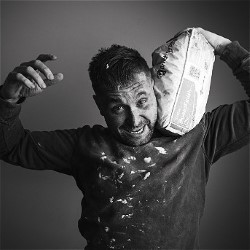
The exposed brick of a top-floor cavern at Underbelly Cowgate is the ideal setting for actor/writer Joe Mallalieu’s premiere of Rum, a solo play rooted in his experience of growing up in a working class family of three generations in the building trade, where the boys were born with a trowel in their hands.Danny has to urgently finish off some plastering before the wealthy customer returns. His mate should have done it yesterday, but instead scarpered off leaving holes in the wall. Bags of plaster litter the stage, along with his tool box, trowel, motorised paddle mixer and tub, all showing the signs of use, with hardened splatterings of plaster all over them. He also has to write a speech for a very special occasion today; not something he’s done before or is any good at, but it’s really important and adds to his stress. A can of beer and a line of coke relieves some of his tension, as does the next one.He’s one of the rum lads; the guys who work on building sites and tell stories full of bravado, of night-time escapades, of shagging and drinking and narrowly dodging the law; of having no care for the consequences of their actions and behaving larger than life. They are great storytellers with plenty to draw on and an ability to heighten the tragedies and comedies with a little ego-boosting embellishment.But the banter tends to be superficial. Danny might have all the tools of his trade but he’s lacking the tools to deal with emotional situations and his mental well-being. Besides, men don't talk about those sorts of things; they keep their feelings to themselves; they put on a brave face and maintain the stiff upper lip of masculinity because there’s a stigma attached to showing any signs of vulnerability.As the clock ticks and the big event draws closer we are drawn deeper and deeper into the raw recesses of Danny’s mind, where childhood memories lurk and his inability to deal with what he has to confront festers. Nothing and no one has prepared him for this and the abyss of male culture offers only a void to stare into.Mallalieu's storytelling is captivating and impassioned. His naturally rich Southport/Bramhall accent has a down-to-earth ring. There’s nothing fake or put on here. He was a plasterer long before he was an actor and he knows the people he’s talking about and their lives. Danny says, “If the prep’s done well, the plaster goes on well. If things are done right at the start, things go easier later on.” Along with Tess Seddon’s tight direction all the prep makes for a smooth finish, a highly polished performance and a deeply moving story.Rum is more than one man’s story. It’s a plea for men to open up, to educate their sons differently and to start tackling the crisis in male mental health. Fitting then that Max Emmerson Productions is partnered with Andy’s Man Club, a men’s suicide prevention charity who offer free to attend peer-to-peer support groups for men aged over 18.

Underbelly, Cowgate • 17 Aug 2024 - 25 Aug 2024

L’Addition – Here & Now Showcase

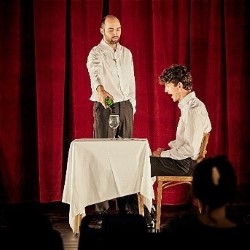
A waiter pours a glass of wine for a restaurant customer. It hardly seems like a philosophical matter, but not everything is as it seems here.The set is simple: a table, arranged with cutlery on a pristine white tablecloth, with a solitary chair. There is a waiter’s station stage left and two spare chairs.Our two performers, Bertrand Lesca and Nasi Voutsas, wander on to the stage at Summerhall. This seems unusual, as if they are about to issue a banal health and safety announcement. They seem borderline apologetic and explain the scene that is about to unfold. Is it suddenly tell, don’t show? They, somewhat hesitatingly, describe the scene, iteratively adding forewarnings of layers of complication regarding what ought to have been a straightforward premise. And, in so doing, they verbally lose the thread of the action about to ensue, confusing themselves.They realise that it would have been preferable all along to have simply played out the scene, so they finally set about this. They now assume characters of waiter and customer, identically dressed.The waiter pours a sample of wine, the customer approves, a glass is then to be filled, but the waiter pours too much and some is spilt on the table, to be cleaned up. The dialogue is initially delivered in deliberately stilted style, no verbal nuance to play with or build upon. But then the twist, signposted during the preamble: once the tablecloth and associated items are removed and replaced, the performers swap roles. They proceed to play out the same scene again.And again. And again.Each time, there is at least a subtle development in proceedings, either with regard to staging or performer’s demenour, at other times a shift. Their physicality unfolds, a swirl of exaggerated movements, stillness, confusion, stuck on a seemingly infinite time loop of repetition and variation. But what can it all mean? The piece is open to a myriad of interpretations. Identities? Nihilism? An examination of addiction? Is it a commentary on mankind’s struggle and inevitable failure to control external events? ...or indeed understand one’s place in the universe? The invisibility or anonymity of service sector employees? A variant on Waiting For Godot? Are one or both in purgatory, iteratively washing away their mortal sins? No need to decide.This is a masterclass of clowning, comedy, physical theatre and absurdism. Their initial dialogue, in which they interrupt, or over-explain, or finish each other’s sentences, or confuse themselves, is not only delivered with immense skill and timing, but acts as a prelude to the physicality to unfold. They have palpable chemistry, testimony to Tim Etchells’ direction, which is expertly tight, entrusting his talented cast.We are left on the existential matter of the bill – l’addition – but this extraordinary production will live long in the memory.

Summerhall • 13 Aug 2024 - 25 Aug 2024

A Letter to Lyndon B Johnson or God: Whoever Reads This First

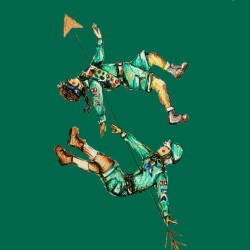
Xhloe and Natasha have been a Fringe icon for the past couple of years. Having won the Scotsman’s Fringe First award twice in a row now, the moment A Letter to Lyndon B Johnson or God: Whoever Reads This First, was announced, it was something I instantly put into my diary as one to watch. This Fringe has been a difficult run for the pair, with cancelled shows due to health issues and a fire alarm in the middle of the show I was present at. Yet despite these behind the scenes snags, the show itself is an absolute marvel, living up to what you’d expect from the pair as a seasoned Fringe goer, and a wonder for those who have never seen them before.A letter to LBJ looks at the story of two boys Ace and Grasshopper, mucking around at summer camp trying to become real boys and live up to their hero Lyndon B Johnson so they can meet him at the White House and truly impress him. The two of them play into the boyish charm of their two characters with full vigour, From Natasha’s LBJ obsessed and adventurous Ace, to Xhloe’s meeker Grasshoper constantly looking up to Ace. All the while the show would keep moving as they flipped and spun the giant tyre on stage, or would play iconic 60’s hits on their harmonica’s, never leaving a dull moment.Both Xhloe and Natasha also are using the staples of their work to the fullest and it once again works oh so well. From movement sequences perfectly in sync to a non linear story process that makes you never not want to stop thinking about the project to lighting and sound work that continues to blow me away. The show never stops moving even in its quiet moments, and its ability to play with pace, tone and setting naturally and still have it make sense is such an incredible talent.A letter to LBJ is incredible. It is truly insane how this pair keep bringing hit after hit to Edinburgh. It’s movement is tight, its story keeps you thinking and tears at your heart, and both characters are an absolute delight to watch. Even seeing the two of them forced to break character as the fire alarm rolled in and seeing the passion they had to get started once again was really incredible, the pair of them clearly love what they’re doing, and it makes their work all the more delightful.

theSpace @ Niddry St • 2 Aug 2024 - 24 Aug 2024

Taiwan Season: Lost Connection

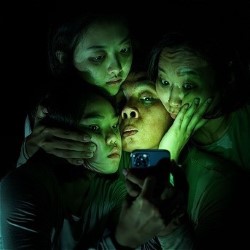
Sometimes a dance production is so stunning it leaves your brain unable to engage with your tongue: this is such a show – Lost Connection is a fitting name in more ways than one. It opens with a dark stage where the performers, each transfixed by the mobile phone held in front of their eyes, dance around the lit screens like moths. But this show is not a cold intellectual parody, programmatically reviewing the impact of mobile phones but is driven by intense creativity, excitement and passion.There is a seemingly endless sequence of dance scenes involving different techniques and focusing on different themes – fantastic solos, intense duets, astounding quartets – supported by effective changes to the lighting and the dynamic, stirring music (excellent throughout).The inventiveness of Wen-Jen Huang’s choreography is astonishing, with a bit rate of ideas running at 120 megabits per second. Faces distort in the lights of the phones – at one point the movement of the lights and bodies create a strobe effect that elongates mouths and eyes like a long exposure photograph. Bodies are distorted – or perhaps it is better said that new types of creature are being created – heads merge, torsos merge, arms merge; dancers combine into entities resembling deep sea creatures or space aliens. Shadows are used to create surreal bodies like Dali or H.R.Giger figures, or multi-limbed sculptures. The dancers, powered by enough energy to run a data centre, move at fibre-optic speed through isolation, conflict, sharing and confinement – and not all connection is lost – there are also moments of affection and depth of relationship.The intensity is so great that the 40 minutes of the piece seems to flash by in a heartbeat. The exhilaration and joy of this show is to see mind-bogglingly imaginative dance performed at full five-bars exuberant tilt. An absolute treat.

Summerhall • 1 Aug 2024 - 25 Aug 2024

An Adequate Abridgement of Boarding School Life as a Homo

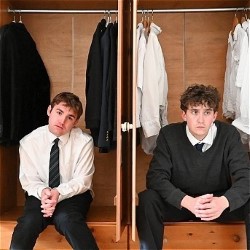
Not the longest-titled show at the Fringe, but surely in the top ten, An Adequate Abridgement of Boarding School Life as a Homo, at Just the Tonic, Cave, must also rate as one of the most outstanding. It’s a new play from Choir Boys & Co that explores the life of a young gay man in his last year at boarding school. The company points out that ‘the play is not a coming-out story, it is not a gay tragedy, and it is not porn. It is life through the lens of a queer young man, navigating masculinity, Grindr and an institution that is rife with shame’. Johnny (Ned Blackburn) is 18 and in his final year. That he has survived so long is remarkable. As a flaming homosexual and devotee of Britney he is hardly the best fit in an all-boys school, but then there are those who keep their inclinations secure in the changing-room locker. Harry (Will Walford), is a confident, charming, rugby lad. He insists, of course, that he’s not gay; he just like to fuck boys, in the plural, constantly. Johnny is not complaining. It’s what he is good at; actually the only thing he’s good at and he can't get enough.Blackburn wrote the play that is jointly and tightly directed by Meg Bowron and Joshua Stainer, carefully mixing the paces to ensure attention never falters. That we've all been through school, even if not a boarding school, means that there is plenty here with which we can all identify; fellow students, eccentric teachers and, for some, the school chaplain. Walford plays these and others, gifting them with distinctive voices and behavioural idiosyncrasies that mix scenes of sometimes tense and awkward situations with humour that Blackburn has so carefully woven into a rich emotional tapestry. The narrative follows a classic arc from seeing Johnny in the changing room where he introduces himself and the setting, through trigger points that advance the story and make the relationships increasingly complex, to a showdown and its consequences that lead to the denouement. As the events and incidents mount up, so does their emotional impact, on him and us, as he leads us through his experiences.Although he is the focus of the story, there is a strong chemistry between the boys that comes through whatever role Walford is playing. They know how to play off each other to create both humour and tension. They are also blessed with a varied soundscape tied into the scenes and some delightful mood lighting that reflects off the arched walls of The Cave and works particularly well in creating an ecclesiastical setting.All these elements combine to create a play that is a gem on every level; a theatrical joy that, with humour, pulls at the heartstrings.

Just The Tonic at the Caves • 1 Aug 2024 - 15 Aug 2024

Colin Cloud: After Dark

Let’s just get this out the way: Colin Cloud’s After Dark is the most powerful, impressive and poignant magic and mentalist show I’ve ever seen.Now for the review (with no major spoilers)…As I line up outside the McEwan Hall, the excitement is palpable. The excited chat from the group behind me is wild. The potential of being brought on stage, having embarrassing secrets revealed or potentially being hypnotised seems too much for them. As we enter, we’re given paper fortune tellers and the opportunity to write a secret to put in a locked box on the stage. So far, so nerve-wracking. The charismatic Colin Cloud strides on stage, his first Edinburgh show in four years, and immediately hangs a prediction envelope high above the audience. The show continues with a wonderfully impressive IMDB-based celebrity routine which gets the whole audience involved and an eerily accurate reverse-hypnosis routine with a pocket-watch and random – random! – numbers on a calculator. One of Cloud's methods of asking for volunteers was getting a sense of names through letters on the fortune teller. About 45 minutes into After Dark, I heard three words booming over the microphone:‘Where’s James Macfarlane?’ Yes, I, along with three other people, was chosen to go on stage to help with a razor sharp routine (my 12-year-old self was gleefully excited, whilst my very present 32-year-old self was panicking slightly). Not only did I help with the routine, but Cloud also revealed my cat-related secret. Still no clue how this happened – the box of secrets was locked! And in full view of the audience the entire time!I don’t think there are enough adjectives and superlatives I can use to describe the power and impact that the final 15 minutes of the show had on me and several other members of the audience. Cloud had promised that he would be revealing ‘his biggest secret yet’ (which I won’t divulge here. I don’t reveal other people’s secrets – who am I? Colin Cloud?) This section is structured to perfection and we as an audience were absolutely hooked. That’s all I can really say without giving anything away.After Dark is a triumph of the highest order. For the next few nights, Colin Cloud will be the hottest ticket in town. His passion, honesty, vulnerability, showmanship and humour are on full display during this jaw-droppingly clever hour. Oh my goodness, go and see this show - it's a five-star masterpiece.

Underbelly, Bristo Square • 17 Aug 2023 - 21 Aug 2023

Apple of My Eye

Attempting to retell the story of someone as iconic of the modern age as Steve Jobs will naturally present a challenge, particularly as books and films have combed over every aspect of his life in incredibly fine detail. However Joel Goodman and Stephen Smith comfortably rise to this challenge, putting on a performance as captivating as any of Jobs’ conference appearances, with some of the finest musical and technical talent on display.Recounting Jobs’ life story, from his adoption through to the founding of Apple computers and ultimately the development of the Mac and iPhone, Smith’s performance as Jobs not only gets the lookalike down brilliantly, but is able to capture the mannerisms of the man himself, easily drawing you into every aspect of his life and getting across the passion felt by Jobs over his work. Combined with an incredibly strong vocal talent, and an enrapturing soundtrack that ranged from songs concerning Jobs’ feelings towards his adoption, his elation at his success with Apple or his joys taking LSD in his youth, Smith is able to bring a large amount of humour and raw emotion to a story so often concerned with just success.No mention of Jobs can come without talking about his technology, something that even the set cannot escape. There are four iMacs on stage and Smith seamlessly interacts with these throughout the show, bringing in their visuals effectively, be they setting the date or playing some of Apple's most iconic advertising. Such usage of technology within the set complements Smith’s acting marvellously. Combined with a script interlaced with natural references to every aspect of both Jobs' and Apple's histories, Joel Goodman’s work acts as a wonderful love letter to the development of one of the most important computer forces in history.Putting on a one-man show with the scale required for a musical is itself a challenge, much more when the subject matter is a figure as titanic as Steve Jobs. Early Morning Productions is able to knock it out of the park with a technical and dramatic marvel more than worth the watch and something which should easily be a part of everyone’s Fringe planners.

Paradise in The Vault • 5 Aug 2023 - 19 Aug 2023

A Manchester Anthem

Making its Fringe debut after winning VAULT Festival ‘Show Of The Week Award’ and Pleasance ‘Pick of the VAULT Award’, Manchester Anthem has been restaged from the linear London tunnel to fit a black box at Pleasance Courtyard. The move somewhat changes its dynamic but the essence of its excellence remains. It’s still a stunning show. Here’s a reminder of what I said previously:This joyously uplifting solo show from Lyle Productions and ramblemill is an unfettered outpouring of humour, storytelling and characterisation from beginning to end, accompanied by flashing lights, pulsating sounds and a first-class high-energy performance.Although labelled as a ‘coming of age play’ that description does it little justice. This is no protracted journey of introverted, navel-gazing discovery, but rather an explosive and revelatory wild weekend in the life of a young man contemplating a life-changing opportunity. But will he take it?Writer Nick Dawkins has taken a simple storyline with a limited time span and packed it with events. This creates a pervading sense of immediacy and urgency within a tight transformative arc. Tommy (Tom Claxton) is a young working-class Mancunian. He lives with his mother. They rarely meet because his shifts as a barista rarely match hers as a nurse, but she leaves him notes and there is clearly a close bond between them. His father left him when he was six. They are rarely in touch, although he features in a scene towards the end. These are simply givens of the situation and never distract from the main thrust of Tommy’s decision-making process. A scholarship granted him a private school education; the start of a process of growth away from his roots, but that’s over now and Tommy is working his last shift before getting ready to take up a place at Oxford University. He will be the first person in his family to attend university, in fact the first in his whole street, but as he says, in a line typical of the play, “Oxford isn’t an interstellar journey away... it’s just south”. Nevertheless, it’s a giant step for him and this is his last weekend up north.Claxton relentlessly moves around stopping to create locations for various happenings, having meetings with his mates and dealing with others who feature in his roller coaster of encounters and events. It’s something of a work-out and director Charlie Norburn has never leaves a dull moment The night at the disco is a perfect example of this. Tommy’s ‘friends’ are there. Claxton has a voice for each and amusing descriptions of them, especially for some of the snobbier brigade who are also going up to Oxford. He locates them on different parts of the dance floor and proceeds to illustrate their different dance techniques and styles with his flexible figure consummately matching character to choreography.It’s not just a physical journey he’s on from place to place. More importantly, it’s an emotional expedition and a quest to find answers to the lingering doubts and suspicions that lurk in his mind. Events mount up as providing evidence Tommy must weigh up before he gets on that train to a new life. In so doing issues of social class loom large; matters of mobility that have nothing to do with physical fitness. Claxton draws us into that mental melting pot so that we go with go with him every step of the way.The nightclub with all its highs ends in a trivial but embarrassing event. He leaves and is thrust back into a world miles away from that set, where we meet more of the people who lives are unrelated to that crowd's privileged existence. Reality sinks in for Tommy and the road he’s travelled on this night’s wild journey finally takes him home. This time his mother is there.A Manchester Anthem, has punchy yet moving, well-structured writing from Dawkins and an outstanding performance from Claxton, who clearly enjoys every minute of this production, giving out assuring vibes that we are in safe hands. Importantly it also has a strong team behind it, from Producer Rebecca Lyle to the creatives: Set and Costume Designer Anna Niamh Gorman, Stage Manager Emily Darley, Lighting Designer Caelan Oran and Sound Designer Sam Baxter; the latter two really having their work cut out in this show with a host of unrelenting changes.Finally the show wouldn’t be complete without some pulsating House Music that goes with the title. No prizes for guessing N-Joi’s, Anthem is his favourite and Manchester Anthem is ours.

Pleasance Courtyard • 2 Aug 2023 - 26 Aug 2023

N.Ormes

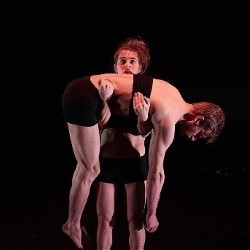
Starting with a single spotlight shining down like a streetlamp on a romantic Parisian street we see a man and a woman slowly dance in an intimate embrace. N.Ormes draws you into the story of a relationship which is passionate, sensual, and dysfunctional but told entirely through movement and acrobatics.With this spectacular Fringe debut, Montréal-based circus duo Agathe Bisserier and Adrien Malette-Chenier have created a provocative piece of physical theatre which challenges the gender norms of hand-to-hand acrobatics. We see the dynamism between the two performers as they throw each other around the stage with wild abandon. It’s rare enough to see women lift men in circus and it’s usually framed as a showstopper moment, yet N.Ormes sees Malette-Chenier hoisted into the air by the much smaller Bisserier as frequently as we see the reverse and she manages to make it look just as effortless.There’s also humour in the physicality of this piece. Both performers have solo moments where they quite literally get to flex their comic muscles. Malette-Chenier is a natural physical comedian and Bisserier, with her frantic acrobatics, speaks volumes on emotional frustration without saying a word.In a Fringe where you can see Yuck Circus showing that woman can be more than just pretty props and the all-female cast of Brave Space celebrating the strength of women in circus, N.Ormes holds its own. As well as the smashing of preconceptions on gender and relationships, it is also a fantastic piece of circus. There are some amazing stunts in the acrobatics; the solo and duo routines are tightly choreographed and a delight to watch.N.Orms feels like something out of a dream. This is enhanced by the dynamic and dramatic lighting design by Claire Seyller and an entrancing score by Simon Leoza. This show is not to be missed.

Assembly Roxy • 2 Aug 2023 - 28 Aug 2023

Poof!

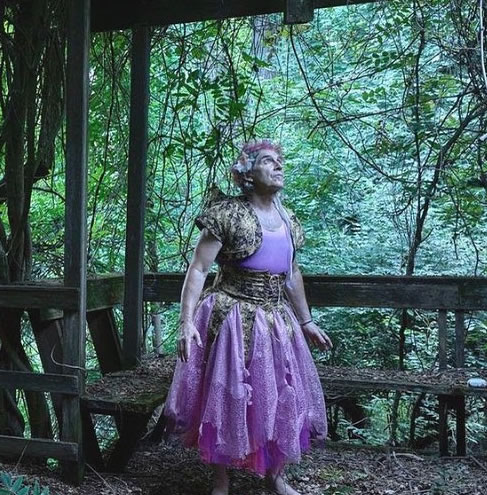
There is wonder here in Edinburgh, and it is being ignored. There is beauty and there is fun and there is the kind of hour that, in the words of one of my favourite films "reaches in and puts a string of coloured lights round your heart". It has been 22 years since I sat in a Fringe audience and felt what I felt here today. This is the kind of writing, and performing, and skill and joy and passion that, in this combative, destructive world, we almost never have the privilege to experience.We are, says our fairy friend, “all in the process of becoming”.This spell-binding hour is an other-worldly allegory which, while as seemingly light and delicate as gossamer lace, carries the stories and the hopes of all those who have never felt free to 'become' much less come out to be acknowledged and, even, loved.It might look fey, it might look simplistic, it might look even ridiculous, but it is the kind of hour that can change your world, given a chance.In a time when it seems that the best we can do is shout, and hate, and tweet, and threaten, when we are all about divisions, binary 'you are either for me or against me' divisions, this hour should be seen everywhere. Everywhere.I have always thought of theatre, any theatre, as just make-believe, sometimes aggrandised by set and costumes and whatever else it takes.More important to those who do it than those who see it. Celeste Lecesne creates a magic bubble, that, in the hour, holds the whole audience, but, given the opportunity, could hold the world. It won't. But they are starting. As they pop backwards and forwards through the fourth wall, Celeste makes you believe you can become.Go. Just go. Celeste Lecesne has all the stars I never gave, and the red pencil to make them matter the right way. Poof! may be the loveliest hour of your life.

Gilded Balloon Teviot • 2 Aug 2023 - 28 Aug 2023

Trial by Jury

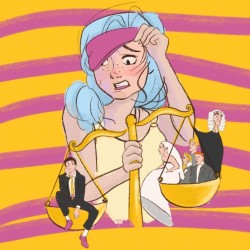
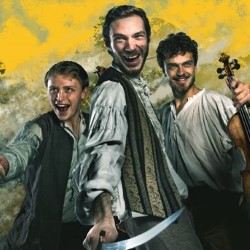
Stunning, imaginative, inspired, colourful, amusing, brilliantly performed and beautifully sung, this Trial By Jury is Gilbert and Sullivan at its very best.Always keen to take a dig at the establishment, the duo latched onto the offence of breach of promise of marriage as the subject for what became their shortest operetta and just happens to have the perfect running time for the Fringe. It was first performed in 1875 and became an immediate hit. The common law tort was repealed in 1971, so Velocirapture Productions (alumni and students members of Cambridge University G & S Society and few friends) have set their show in the year 1968. This has worked out extremely well in terms of costume which are in an array of colours and designs from the period, greatly cheering up the traditional dullness of Victorian attire. Everyone looks stunning with the ladies in pretty frocks and dresses and the all-male jury, retained from original, in jackets worthy of a regatta.The arrogant Edwin (Seb Blount) has been summoned to court by his ex-fiancée, Angelina (Tiffany Charnley). The stern Usher (James Ward) calls for silence in court and the battle ensues to see for whom justice will be done. It soon becomes evident that the proceedings will be far from impartial. The jury is manifestly biased, encouraged by the usher who says they can ignore what the ‘ruffianly defendant’ has to say. Hence, they greet him with hostility in some splendidly directed group movements. Meanwhile the Defendant admits that Angelina bored him and so he took up with another woman. The Learned Judge (Christian Longstaff) enters in vivid red robes, but in a wonderfully entertaining comic twist he seems to be the most youthful person on stage rather than the elderly gentleman who would normally play the part. He sings of his rise to power and admits to his own shortcomings in the same manner as the Defendant. Abandoning the usual wedding dress, Angelina arrives in a stunning black cocktail dress and the proceedings continue with some clever humour that must make this the most amusing Trial By Jury ever performed. Dramas abound in the ensuing quite ludicrous court case before everything is resolved to everyone’s satisfaction and ‘joy unbounded’ reigns.The large cast is tightly and imaginatively directed by Tiffany Charnley who says, “Our setting has allowed us to remove the character of Angelina from a position of victim in this trial, to a more powerful role who manipulates this outdated law to her own advantage”. One of the musical challenges for the show proved to be reducing a score written for full orchestra to one with only eight players and half the number of parts. Musical Director, Robert Nicholas, says: “[we] had to carefully select the instruments to best cover the textures and harmonies in the original score, whilst [still] producing a voluminous but easily blended sound. As the conductor, I am not exempt from multitasking, aiming to also cover the bass drum, cymbals, triangle and, occasionally, second violin!” Together they keep everything moving at a cracking pace and the quality of the acting and singing is outstanding throughout. The full-cast rendition of the highly complex A Nice Dilemma We Have Here sound like something out of grand opera. It’s hard to imagine that Gilbert and Sullivan themselves would not be thrilled with this production and delighted to see that comedic musical satire is still thriving and being performed to this level of excellence.
theSpaceTriplex • 22 Aug 2022 - 27 Aug 2022

Circa: Humans 2.0

In a big top tent, ten performers, upon a brilliant white, circular stage, perform a series of ever more amazing acts of acrobalance, tumbling, throws, and aerial skills. Costuming is simple: at first the cast are clad in lycra shorts and cropped tops before transitioning to sweaters and pants, before finally appearing in sheer body stockings which accentuate the vulnerability and yet the strength of the performers.The physicality of the cast is phenomenal. They throw each other around the stage with what seems like reckless abandon but there’s a sense of an easy trust between them. It’s also beautiful to see that this acrobalance show has no gender imbalance. We see men being lifted by women, women showing amazing feats of strength, and all of the cast being vulnerable and delicate. The choreography is incredibly tight, the action is non-stop, and the score by Ori Lichtik perfectly accompanies the action. At one point the cast break into a frenetic dance which seems to infect the whole performance with a frantic energy. A straps routine feels like it could be an entire contemporary dance piece in its own right and the few moments of quiet only serve to counterpoint the breathless energy of the performance. There are also some brilliant moments of perfectly timed playful slapstick comedy in amongst the spectacle.In their previous show, Humans, Circa set out to push the physical limits of what a person is capable of. 2.0 is a leap forward where Circa seems determined to push the limits of contemporary circus close to that line where it crosses over into dance. Undoubtedly, Humans 2.0 is contemporary circus at its finest. It’s poetic, entrancing, beautiful, and exhilarating. It is simply a triumph.

Underbelly’s Circus Hub on the Meadows • 5 Aug 2022 - 27 Aug 2022

Taiwan Season: Tomato

Tomatoes erotic? Yes, erotic, silly, surreal, constantly surprising, Tomato, a physical theatre piece by dancer/choreographer Chou Kuan-Jou is brilliant. Witty, original, exquisitely crafted and it may initially leave you hot under the collar. Much nudity and explicit content – this is not for under 16s. However, part performance and part live camera documenting the event, it soon becomes clear this is a multi-faceted, clever critique of sexuality with a feminist perspective.A cage full of tomatoes sits on stage and one is at first afraid they may end up being thrown at the audience. But fear not. It is the cast (two males and one female) who will indulge in a tomato fight, but that is to jump ahead. At first we are given a lecture by Tseng Zito, a commanding performance, on how to choose the best tomato: its weight, its shape, firmness etc while this is filmed by an androgynous person (Ne Chi Wai) in a hooded white plastic boiler suit. When the lecturer starts to peel the tomato, Chou Kuan-Jou in flimsy pink slip gyrates to a Billie Holliday track – the usual ‘he done me wrong’ victim theme. Her back to us, Chou hugs herself, her hands appearing around her shoulders as if being embraced. Pulling her slip over her head, there’s a shocking revelation: a tomato held between her legs. Even more shocking, when you know in Taiwan a tomato cut open symbolises the vagina, its juiciness, red like blood.A fest of sensuality ensues where the cast revel in the smell, the taste and the soft but firm feel like a baby’s skin of a tomato as they stroke one over their whole bodies. Sexuality is portrayed, not through the male gaze, reducing women to objects or victims nor to the sado-masochism of porn, but sexuality as sensuality where not only the female is liberated but the male lecturer is ecstatic discovering a new pleasure. The androgenous character now strips off the boilersuit he has been hiding in, to own his own – possibly gay – sexuality. This is a bold, brave piece and huge fun. You will never look at tomatoes in the same way again.

Summerhall • 3 Aug 2022 - 28 Aug 2022

Family Portrait

A charming, funny and touching interactive video installation, Family Portrait by Natasha Gilmore’s Barrowland Ballet features Natasha herself as mother and single parent and her three kids: Otis, Iggy and Frieda. This will delight anyone who has or has had small children, whether their own, grand-children or nieces and nephews. Four screens surround swivelling stools so only 6 people can watch at a time, so there’s safe distancing plus everyone is masked and no need to worry about going inside the venue, Dance Base.One presumes this was filmed during covid lockdown. What a way to cope with it. Frolicking about in the woods, by a lochside overlooked by the changing colours of the mountains, or ochre moorland, we see various Scottish landscapes through the changing seasons. Memorable images such as angel shapes in the snow appear independently on a screen, or occasionally continue from screen to screen as the children rush through the trees.We are treated to family hilarity, peekaboo between the trees, burying mum in bark, or dressing her up with lichen, a stick in her mouth, bilberries smeared on her cheeks and then being allowed to eat one; or mum and the two boys carrying a long branch on their shoulders from which wee (Scots: little) Frieda hangs. She also has a very grown-up ‘theatrical’ vocabulary for one so young! Iggy is a keen observer of spiders or birds who he decides may be singing to their babies, or he ponders, maybe their mate when they will ‘get busy’: Otis is weighed down by the responsibilities of being the oldest who must not show his fear to the other children: a long list including darkness, being alone and Pingu (!) but he conquers this with a brave, heroic deed (no spoilers).Natasha herself is a very hands-on mum, leading or encouraging their imaginative play, obviously the inspiration for her children. Lots of rough play but many hugs. In a moving vignette in which she curls up in an abandoned enamel bath in a field at a slight distance from the kids, every parent will recognize that need for some ‘me time’ however much you love your kids.Natasha Gilmore’s Barrowland Ballet always produces a wonderful range of shows, but it’s particularly inspiring to see how she has maintained her career as a dancer and choreographer throughout her children’s childhood, even involving them from when Otis, at 18 months, was passed from hand to hand by the dancers in A Conversation with Carmel back in 2013 and now joined by brother and sister. It’s a delight to see them over the years appearing in shows. A heart-warming family portrait which will bring tears to your eyes.

Dance Base • 12 Aug 2021 - 22 Aug 2021

1902

In 1902 Hibs won the Scottish Cup. It’s a year etched in a long, disappointing and frustrating history for the loyal fans of Hibernian Football Club who had to wait 114 years for their beloved team to win it again. Saltire Sky Theatre returns to the Edinburgh Festival Fringe this year with 1902, a play they first performed in 2018 at the Wee Red Bar in Edinburgh and with which they have just given their debut performances south of the border, opening the new Prince of Wales Pub Theatre in Moseley, Birmingham. This production is given added resonance by being performed less than a mile away from the team’s stadium. Leith Arches has the perfect gritty edge of worn exposed brick, industrial scaffolding and a basic bar to match the raw performances that define this play.Although called 1902 the story is framed around the second victory of 2016. Four lads will do almost anything to lay their hands on tickets for the final and bring some life to their dreary pub existence, but tickets are like gold dust. In desperation Derek "Deeks" Longstaff (Nathan Scott-Dunn) decides to borrow £1000 off the local wheeler-dealer and tough guy Craig Turnbull (Jonny Tulloch) with a sob story about needing money to fulfil his nan’s dream of a new garden. Craig obliges, but soon discovers the truth and demands not only his money back but also the tickets, unless someone would rather fight him for them. As nominations for a pugilist are put forward Deeks’ drug-dealing, drug-addicted, heavy-drinking ne'er do well older brother Tony (Sands Stirling) enters the frame. Their dysfunctional relationship comes to the fore and piles the pressure on Deek who is still reeling from the death of their father while trying to deal with his mother and cope with his mates. This trio drives the main story. Tulloch gives an implacably tough peformance as the guy you dont want to mess with, while Scott-Dunn and Stirling both have times when they can reveal the humanity and vulnerabilty that lies beneath the brash exterior and bravado.Scott-Dunn not only gives a hugely commanding performance, he also wrote the play and co-directed it with Stirling. Between them they have created a masterpiece of visceral theatre and assembled a cast of extraordinarily talented actors. Their passion and commitment is unwavering as they work their way through a gamut of emotional outpourings. Fueling the group’s ethos, they are Alexander Arran-Cowan as Samuel ‘Sambo’ Donaldson, Josh Brock as Frank ‘Frankie’ Armstrong and Cameron Docker as Thomas 'Zippy Collins. Each has his own story and that is carefully woven into the narrative at the Dug and Duck in Bonnyrigg where they daily while away the hours, served by the only character from south of the border. Ella Stokes plays the barmaid Margaret "Mags" Evesham, a Londoner. In the hands of Stokes, Mags is not one to be messed with either; she’s as hard as nails and ruthless as the rest of them. Underscoring the production is Sandy Bain, The Musician, up aloft, looking down on the action, interjecting and providing the accompaniment necessary for the traditional football songs and the inevitable moving number from Sunshine on Leith.Saltire Sky Theatre have created a stunning piece of immersive theatre, that's as uplifitng as it is tragic. It also is also rooted in the spirit of the nation, of Edinburgh, of Leith and above all of Hibs. It could not be peformed in a better place.

Leith Arches • 6 Aug 2021 - 30 Aug 2021

Myra's Story

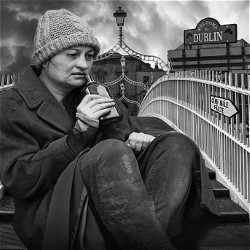
A ninety-minute monologue about a homeless person? Embrace it. Myra’s Story deserves to be the talk of the Fringe.Irish playwright Brian Foster walked past a homeless alcoholic begging in the street and turned his head away, pretending not to see or hear her. Unlike the rest of us, who have done just that so many times, he turned his feeling of guilt into what has turned out to be a spectacularly successful play full of humour and pathos about a middle-aged woman he named Myra McLaughlin, who was in that very situation.The play opens on a bitterly cold December’s day in the Irish capital. Myra is funny, feisty, and foul-mouthed as she begs for her drink money from passers-by. She wasn’t always on the street. Like every human being, she had a life that brought her to where she is today. She was in love, she was married, she had a child, but for her it all went wrong, as it could for anyone, but for most it doesn’t. Bringing Foster’s work to life is the accomplished Dublin actor Fíonna Hewitt-Twamley. As she unfolds Myra’s tragic tale, she vividly creates the characters who moulded her life, with a range of voices and physicality that gives them profound credibility. They are at times amusing, idiosyncratic, nasty, sympathetic, vengeful and always vulnerable. They are the real people who witnessed her demise and were unable to prevent it. Hewitt-Twamley captures them as vivid exemplars of humanity in a less-than-ideal world.Brian Foster has said, “I’m sure the reason for the play’s success is the mix of hilarity and heartbreak. Everyone...can relate to the damaged character they see up on stage. My play allows them to look into Myra’s face. To stand in her grubby shoes. Smell her stale odours. Hear her voice”. Performing to a full house at the Spiegeltent Palais Du Variete, as the lights dimmed on Myra's final moments we rose to give a standing ovation to his outstanding play and the stunning performance from Hewitt-Twamley who has brought it to life. This is not to be missed.

Assembly George Square Gardens • 6 Aug 2021 - 29 Aug 2021

Taiwan Season: Floating Flowers

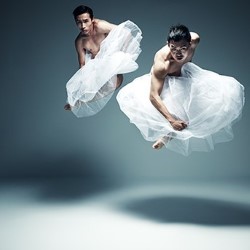
Floating Flowers by B. Dance is an extraordinary piece in its sheer beauty, its piercing emotion, energy and originality. Choreographed by 31-year old Po-Cheng Tsai, it will stay with you for ever.Four male and four female dancers (eight being a lucky number in Asian culture) float across the stage in long, white, billowing tutus symbolizing the candle-lit lanterns set adrift on a river as part of a Buddhist ceremony Po-Cheng’s late father performed with him as a child. As the lanterns drift down the river of life they take all your worries and fears so that you learn to let go. For Po-Cheng, unable to express grief in words, recreating this ritual in dance honours the memory of his father and is both celebratory and sad.The clack of wooden sticks struck together offstage signifies, as is Asian custom, the start of the show. The dancers raise and entwine their hands, fingers flickering like candle flames or form lines and patterns across the stage as if members of the corps de ballet in Swan Lake. But that is as close a reference to that ballet as we get. Rather, Po-Cheng combines the extended, graceful lines of classical ballet with the precise, short movements of Asian martial arts, a uniquely successful fusion of east-west tradition. Its originality lies in its extremes. Long lines of classical ballet are extended even further, some moves such as the low back-bends performed by a female dancer seem almost impossibly difficult and this is married to aggressive, jabbing movements, the precision needed in martial arts, and the exaggerated grimaces of Chinese opera. As the dancers perform ensemble, solo or duet, they whirl and jump and their fingers curl in anguish, they bring to the dance their own sorrows, conflicts or hopes, unspecific enough for the audience to identify and bring their own experiences to it.There is no sense of structure to this dance, but the experience is so intense and immersive, it does not matter. Po-Cheng is more interested in breaking the rules, for as he told me, if there are rules, there is no humour. There is plenty of that with the dancers raising their skirts to reveal their underclothes, or the females clambering onto the shoulders of the males so that they become a swaying giant or one female plays tricks on another, tapping her shoulder then jeering as she turns surprised.This is a dance for our dark times, to remind us that the candle symbolises hope, even if we do not know what the future holds. As Po-Cheng told me: ‘Is it you who creates your life, or does life create you?’ The last image of the show is the group frozen in a pose half in and half out of their tutus, spot-lit on a darkened stage. An image of unresolved meaning, posed on the brink of who knows what future, it is a wonderfully subtle and resonant ending to a powerful show.

Dance Base • 2 Aug 2019 - 25 Aug 2019

Letter to Boddah

“Will they or won’t they go through with it?” That is the consuming question that hovers for an hour over Letter to Boddah, written and directed by Sarah Nelson and performed by Watershed Productions at C Cubed. As always, the only way to find out is to see it for yourself and either be completely taken aback by the ending or be smugly conceited and say, “I saw it coming”. Either way, you will not be disappointed having experience an hour of gritty, chilling drama spiced with a shot of black comedy.When Nirvana frontman Kurt Cobain committed suicide in 1994 he left a letter addressed to his imaginary childhood friend, Boddah. In it he quoted Neil Young’s words, “It’s better to burn out than to fade away”. That sentiment is taken up by Billy (Sam Glen) and Neil (Jordan Reece) as they contemplate blowing up the local Tesco.They’ve locked themselves in the disabled toilet, where they make last minute preparations and contemplate the enormity of what they are about to do. The desert combat gear lends a militant militaristic image to their endeavours, but the dialogue of doubt and second thoughts that alternates between them, interspersed with total commitment to the task and mutual encouragement, belies that fact that they are amateurs at this. Billy has his reasons for carrying out the attack but Neil, somewhat reluctantly, has been dragged along just because they are best mates.The lads might be familiar to followers of soaps. Reece was in the cast of Emmerdale and Glen played Jay in Coronation Street. In addition they each have credits at several established theatres. Their talents shine in this production. Glen enters a quivering wreck with movements that indicate the fine attention to detail that persists throughout his performance. He’s the mastermind behind the plot, but as the appointed hour nears he increasingly has to pump himself up to stay committed and focused. He also has to deal with the questioning of Neil. In a comedy act Reece would be the foil, whose cogs turn rather more slowly than those of his partner. His dim-wittedness, tangential thinking and slower pace contrasts perfectly with the bright tempo of Glen and between them they provide some hilarious moments. Yet they each have reflective moments among the rising tension which they use to bring a sense of deep humanity to their characters.Letter to Boddah is gripping, dark and funny; a powerful blend that this company knows how to put together. Cobain once said, "The worst crime is faking it". There’s no hint of that in Reece and Glen who are genuine and authentic.
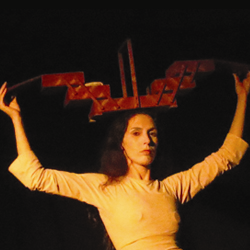
C venues – C cubed • 1 Aug 2019 - 26 Aug 2019

FAUX

The team behind FAUX, presented by Loose-Locked, is large and impressive. It’s a classy show, self-evident from the outset, which tackles an emotive subject: the fur trade. This new production is the result of developing the original show over a year-long period, which may help to explain the universal slickness and professionalism of the performers and the concise and very clever direction.Here, Filomena’s vintage clothes shop is in financial difficulties, but her friend Pam suggests that Filomena saves the business by selling off all her grandmother’s old furs, because punters are prepared to pay large sums to acquire them. At first, this seems like the obvious answer, but as she ponders this strategy in the seclusion of her deserted shop, Filomena isn’t so sure. Is this the right solution? Filomena is haunted by a series of deceased animals - Fox, Bear, Racoon-Dog and a trio of all-singing all-dancing rabbit fur shoes - who each tell their own stories, and slowly but surely Filomena thinks again. We may well think that we know all about the cruelty of the fur trade, especially here in Brighton – recently dubbed the vegan capital of the UK. But I’ve been vegan for close to 30 years and I learned something today. The show lays bare the shocking facts of the capitalist double-speak which allows manufacturers to pass off real fur as fake fur because it’s cheaper and now (obviously) has a larger market than correctly labelled fur products. It also raises the important debate concerning animal self-consciousness and their ability to feel love, fear and pain. The implications of this for the less glamorous relatives of these exotic animals are not difficult to see.If this all sounds worthy, ‘heavy’ and challenging, then the way in which it is presented perfectly counterpoints the seriousness of the narrative. Basically, it’s a beautifully performed musical, with puppets. What’s not to like? Emily Compton’s score is superb, offering songs ranging from Fox’s old-time number (sung to perfection by Julia Dray), to a great (if lyrically chilling) ensemble number from a trio of singing shoes. I defy anybody not to be moved by Bethan Kate-Tonkin’s instantly adorable Racoon-Dog or William Uden’s ponderous Bear. Far from being a downer, this show is unexpectedly uplifting and, yes, I frequently found tears in my eyes. Appropriately, the actors received a very prolonged and enthusiastic applause at the show’s conclusion. FAUX deserves a wide audience and it wouldn’t surprise me if one day, in some form, it found itself in the West End.

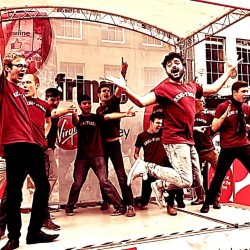
The Warren: The Hat • 17 May 2019 - 26 May 2019

Kids Play

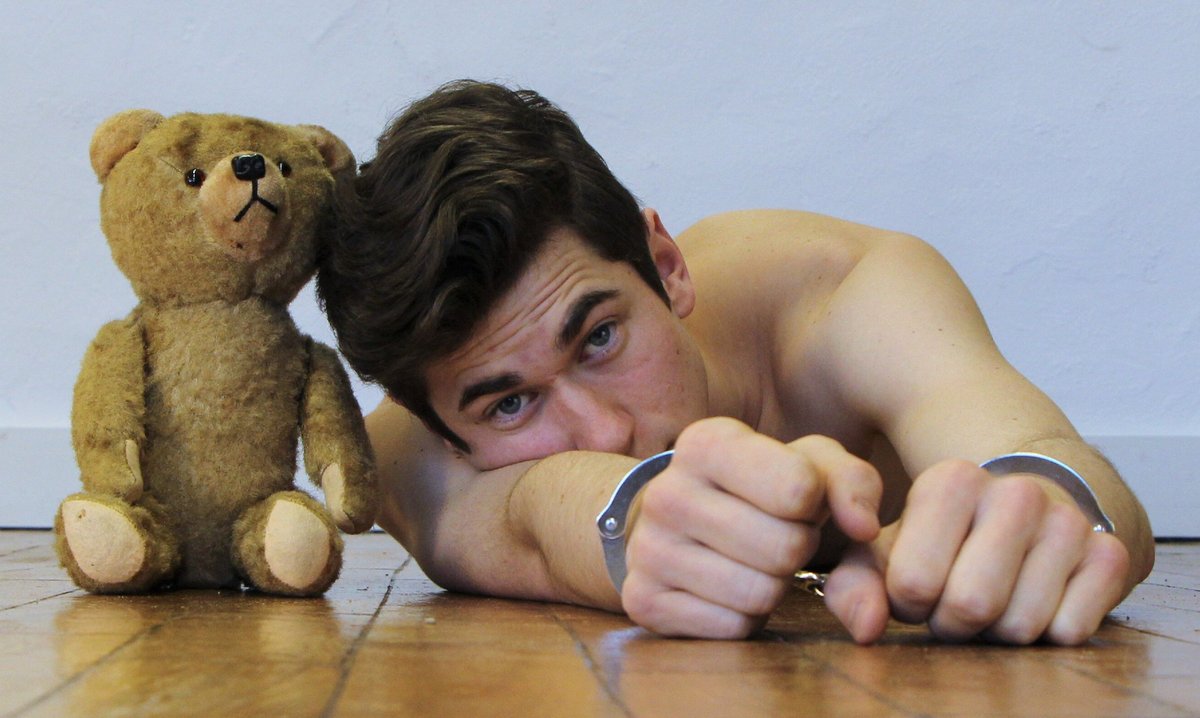
Glen Chandler, Edinburgh’s theatrical detective story-writing son, returns to the Festival Fringe this year with yet another ingenious triumph. The only similarity to Kids Play and anything that might be found in Taggart, however, is a pair of handcuffs. He’s changed the tone from the hugely successful and hilarious Lord Dismiss Us romp of last year to a two-handed tale that he describes as an ‘emotional corkscrew of a play with surprises galore’.Despite the title, this play is certainly not for children. Theo (Clement Charles) is a gay, 17-year-old, academically bright, good-looking boy whose job in the supermarket fails to pay for his lifestyle and who in any case really needs love more than money. Greg is a businessman with a secret life and multiple fetishes that would destroy his marriage with the crack of a whip. If only she knew!They two meet up in a hotel room in Brighton while Greg is attending a conference there. Things haven’t gone quite to plan even before the encounter and they soon embark on course that in the end leaves them both in a different world. The path is often dark, the summer night's hot and the humour sharp. The whole is a breathtaking study in loneliness, frustration and deceit through which shines hope.Charles was last year’s big discovery for Chandler. He had just completed his first year at Birmingham School of Acting and was appearing in the monologue About a Goth with Gritty Theatre. The play and the young man caught his eye. He went to see it at least three times. On each occasion he became more convinced that he had found the actor for whom he would write his next piece. His sound judgement has paid off. Charles has the looks, the ability to portray youthful naivety with determination and a focused understanding of characterisation that enables him to carry us through Theo’s torn existence with sympathy and understanding. His slender physique stands in stark contrast to the manly, exercised body of Watkins. After his partying performance in 5 Guys Chillin’ last year, he now creates a distraught yet pensive character who keeps us in the present while his mind is clearly in other places. The pairing provides stark contrasts and an affectionate coupling in a dynamic match.Writing is certainly not kids’ play for Chandler. His Christmas production is already written and he’s well under way with research for next year’s contribution to the Festival Fringe. With shows like this, let’s hope his pen never dries up. In the meantime, take out your tissues and prepare to be stunned.

theSpace @ Niddry St • 13 Aug 2018 - 25 Aug 2018

The Laramie Project

Fourteen cast members. One stage. Almost twenty years since the brutal murder of gay teenager Matthew Shepard by his peers that shaped the Hate Crimes Prevention Act of America. Moisés Kaufman’s verbatim piece The Laramie Project is based solely upon the words of those interviewed in the aftermath of this terrible event, and remains as poignant, touching and relevant today as it did upon its publication.Beginning such a show with a musical number is a bold move: the strangely upbeat tone, carried by a full chorus, contrasts heavily with the sombre foundation upon which this production is built. It is through this levity, however, that the Italia Conti Ensemble can truly demonstrate their ability to pivot through a rich spectrum of dramatic tones as the show continues. Moments of humour are artfully balanced with heart-breaking memories, preserved for over two decades and delivered with compassion by each member of the ensemble in turn.Whilst this is not a violent play, the spectre of what Matthew endured that night hangs over every person onstage and in the audience. Abstaining from ever attempting to recreate the events that catalysed these interviews, the sole reminder onstage is that of a fence post which dominates centre stage, its significance unveiled by one iconically harrowing interview with the cyclist (Jake Felts) who discovered his body.This is a masterclass in multi-role-ing: the delivery of each interview is carefully nuanced to produce over 30 fully-fleshed characters, standouts being the straight-talking Marge Murray (Kate Donnachie) and Alexandra Meyrick’s compassionate cop Reggie Fluty among many others. More than just a recital, dynamic movement and thoughtful interplay of interviews help to create a dialogue of perspectives within a scene, whether it’s the bar in which Matthew spent his last evening or the media frenzy that took Laramie by storm upon his passing.This is ultimately a story about a community, and with the whole cast onstage at all times we are persistently reminded that every character in this town is connected. The group’s constant engagement with each other is one such detail that brings this home, with unspoken reactions out of the spotlight not going unnoticed by the audience.The softness and kindness with which this production has taken shape belies the brutality of its subject matter. As taxi driver Doc O’Connor (played with poise by Matthew Gouldesbrough) remarks, “I didn't understand the magnitude with which some people can hate”. However, The Laramie Project is not a play about hate – it is a play about hope, and that is what makes it such a beautiful and powerful piece to experience.

theSpace on Niddry St • 7 Aug 2017 - 12 Aug 2017

All We Ever Wanted Was Everything

As the friend with whom I went to see the show so emphatically said, All We Ever Wanted Was Everything is ‘everything’. Heart-wrenching and heart-warming all at once, the production was half-live-music-gig, half-theatrical performance: almost all of the actors swapped in and out of playing the drum kit and electric guitars that took up the best part of Roundabout’s lower seats. As if this multi-tasking wasn’t impressive enough, James Frewer’s original live music was fantastic in itself, recalling bands like The Arctic Monkeys, The Kooks and The Pet Shop Boys. Presiding over everything was the swaggering, kohl-rimmed MC, Marc Graham, whose performance focused and energised the show throughout, and whose quick wit enabled ad-libs with the audience and his own cast members, bringing wry laughs to those watching. This style of gig-theatre is the brand on which Middle Child, the company behind All We Ever Wanted Was Everything, has built itself – and it really works for the story they’re trying to tell.Luke Barnes’ writing is smart and sharp. Okay, its topic is perhaps not the most original, but it gets you in the gut, and it gets you good. Stretched across three decades, from the ‘Cool Brittania’ era to ‘Broken Britain’ to ‘Brexit Britain’, the script introduces us to Leah and Chris, two millennials whose parents sacrificed everything for them, and who have told their children that, with enough self-belief and dedication, they can achieve whatever they dream. However, when that promise fails to materialise, Barnes’ script rips apart this endlessly-deferring promise of future happiness. It asks us how we communicate with those we love, what happiness really is anyway, how we measure it, and the extreme loneliness and isolation that can ensue as a consequence of not really being now, right now, at this very second. When references to Brexit were made (to a unanimously groaning audience), my heart hurt with how searingly close the performance was to my reality, as a Brexit Britain ‘millennial’ (although I hate that term, and its signifiers). When Graham came onstage in a Trump mask, laughing maniacally, my heart broke. The device of the singing asteroid (yep) heading to earth enabled Graham’s final monologue, in all of its visceral, muscled, boiling fury, to focus itself: “live your life”, he yelled at its climax, “I f****** dare you”.Go and see All We Ever Wanted Was Everything. The direction is fantastic, the design is fantastic, the music is fantastic and the performances are fantastic. The script may not be the most subtle or original in its content, but, as the backbone of Middle Child’s production, it moved me to tears, and has reminded me that sometimes you just need to get out of your own head.

Roundabout @ Summerhall • 4 Aug 2017 - 27 Aug 2017

Enter The Dragons

On an epic adventure to halt ageing in its tracks, writers and performers Abigail Dooley and Emma Edwards swim the sea of apology, march the bridge of tears and conquer the dark depths of the underworld on a fruitful journey of discovery. Dooley and Edwards expertly break the fourth wall and invite the audience in with open arms to join them, summoning spectators to participate in feel-good, cathartic activities. Excellently directed by Toby Park and Will Kerley, the actors deliver a delightful array of wonderful, wacky and original character sketches interjected with honest, eye-watering monologues. Dooley attacks the absurdity full throttle, finding utter enjoyment in the ridiculousness of each moment. Her bravery throughout is commendable and this, teamed with her ardent and frank speeches, ensures she is an absolute delight to watch. When paired with Edwards, the two are indestructible. The brilliantly satirical writing compliments Edwards' performance effortlessly, with a variety of witty impersonations and sharp-tongued one liners.At one point in the piece, the duo explore plastic surgery and approach the scene with humour and wit, yet begin to question the motives of their argument, leading to an insightful and resonant moment of discussion. This balanced, unbiased dialogue added a unique charm and morality to the piece. Lucy Bradridge delivers simple and clean stage design, cladding the community hall with white paper backdrops and props, like a storybook. Cameo characters brilliantly take the form of Barbie dolls, whilst larger than life characters are kitted out with a collection of atrocious wigs and hilariously long arms. One watches the clearly seasoned professionals in awe, as they marry hilarity and sincerity with such remarkable precision, it had the audience in both fits of laughter and heartfelt tears. Although many pearls of wisdom are imparted throughout the piece, a simple phrase speaks with resonance: “To live is to age and to age is to live”.

Exeter Street Hall • 20 May 2017 - 27 May 2017

How to Win Against History

On every front, this show is a winner. The writing is outstanding, the music is catchy, and the performances of each of the actors (including the pianist actor/musician) are faultless. In short, there is nothing not to like in this production which charts the life and times of the little known 5th Marquis of Anglesey, the cross-dressing, extroverted narcissist, and thoughtless spender Henry Paget. This is a smooth, self-aware and supremely polished hour of riotous laughter, participation and even emotional involvement with the protagonist.Having researched the little documented life of Paget, a figure emanating from writer Seiriol Davies’ own home island, the apparent indignity of his having been unscrupulously wiped from the annals of history is now redeemed. Appearing in an outfit of shimmering blue sequins, the protagonist seems as out of place now as he might have been perceived in his own time. However, performed by Davies himself, ably assisted by Matthew Blake and musical director Dylan Townley, this eccentric figure generates genuine good-feeling as his anti-establishment, norm-defying behaviour gets him both into and out of trouble. Played with wide-eyed exaggeration, Davies successfully conveys Paget as optimistic beyond reason, a characteristic crucial to the overall impact of the piece.While there is plenty of over-the-top flamboyance, glamour and choreography which fills the stage, though there are only two performers inhabiting it, the writing of this show in fact uses the stereotypically glitzy conventions of commercial musical theatre to cast a satirical eye over the way in which people on the fringes of society are perceived, and to highlight the humanity within people who may look and behave rather, or even radically, differently from what is perceived to be acceptable. Through their up-beat happy-clappy performance style, the characters’ assertion that they ‘don’t mean to challenge you’ could well be taken at face value. However, looking beneath the surface there is much to be learnt about the nature of individuality, even in a world in which the 5th Marquis of Anglesey’s transvestite tendencies ought to be received more readily.Full of modern day references carefully sprinkled into the tongue-twisting and articulately performed book, the attentively listening audience member will find a plethora of observations and witticisms that come and go faster than Henry Paget’s family wealth. Though one of the most catchy tunes of the piece plays upon the notion that in the theatre one ‘can’t please everybody all the time’, How To Win Against History at the very least will please most of the people, most of the time.

Assembly George Square Theatre • 3 Aug 2016 - 28 Aug 2016

Ten Storey Love Song

Ten Storey Love Song may be the greatest Fringe show I’ve ever encountered. And I’m going to try my hardest to explain why, because it truly is worth your time.Middle Child Theatre are based in Hull. Their website says they’ll “never play it safe”. Did they play it safe in Ten Storey Love Song? God no. It’s an adaptation of the novel by Richard Milward, described by Irvine Welsh as a “major talent” and a clear sibling to the likes of Trainspotting. But Love Song’s prose hits you even harder than Welsh’s, helped by the pulsing dramatisation of Soho Six writer Luke Barnes. He’s pulled, mined, and torn up the source novel, thrusting it onstage with the ample aid of Paul Smith, Middle Child’s artistic director.A tower block in Middlesbrough. Three stories of five people. Meet Bobby, Johnnie, Georgie, Ellen and Alan Blunt “the C*nt”. Bobby’s an artist. Soon to be the patronee of a pretentious London curator, though sweetheart George doesn’t like his drug-taking or, more precisely, his gulping down of every Winnie-the-Pooh-emblazoned pill he can find. There’s Johnnie, a hard man wielding a penchant for porn-style sex done on, rather than with, his girlfriend Ellen; though she knows she better leave before he blows up. Finally, there’s “the C*nt”, a racist pedophile who loiters by the schoolyard. But even he’s not the simple devil you want him to be. Five wretched people who deserve better. Will they get better, though? They may not, but make no mistake: this play’s got humanism right down to its DNA. Laughs are a certainty when Luke Barnes’ script is so bloody punchy, but still finds a way to lead on to the most bitter, sympathetic conclusion to a character you’ll see this festival. It’s one of those moments when any suspension of disbelief slips; not because it’s unreal, but because you can’t believe how bitingly good it is. The actors sit in on the Jack Dome’s teensy stage. There’s a DJ booth behind them manned by James Orvis and Anna Wilson: together they whip up a trippy techno storm that slots, razor-sharp, into the play’s atmosphere. Notice, too, the projections by Euan Baker: all ketamine-induced fury and psychedelic confectionery with a real mastery of the craft.Ten Story Love Song is a play for the working class. It’s also a play for women. It’s like they’ve taken all the buzzwords they can find — Brexit, feminism, strivers and skivers — and distilled the anger behind them into a shot of pure theatrical adrenaline. Don’t be surprised if you feel like a changed person afterwards. 

Pleasance Dome • 3 Aug 2016 - 29 Aug 2016

The Interference

It is hard to tackle a subject such as campus rape in America and get the tone right. Lynda Radley does just this. She expertly shifts between voices, presenting a detailed and clear cacophony of words that explore every conceivable aspect and opinion in a complicated rape case. It is hard to describe just why the production was so successful - was it the incredible soundscape written by Michael John McCarthy, or the astonishing acting from a group of young performers? I think the real success of Pepperdine Productions lies in their handling of a subject matter so vast and terrifying that putting it on stage seems nigh on impossible. Pepperdine Productions achieve the impossible.What is incredible about the writing in this production is that Radley does not shy away from the voices of those who seem to condemn the rape victim - classmates, policemen, news reporters, etc. It is difficult to listen to these voices, and when the ensemble cast start reading out abusive online comments, you might recoil in your seat at the amount of public vitriol that surrounds cases such as these. The production itself has been expertly directed, with slick scene transitions, and an ensemble that work together seamlessly.The cast were extraordinary, and special mention must go to the girls playing the police officer and journalist respectively, for their outstanding multi-roling and believable characters. Radley presents so many different sides to the case that we slowly begin to understand that everyone has their own agenda - even the well-meaning journalist and the career-hungry professors on the university panel. Radley handles these voices delicately, building them up so that they drown out the voice of the victim, showing how, tragically, it becomes about other people’s agendas, social media and money. This is a devastatingly brilliant piece of theatre; definitely a company to watch.

C venues - C • 3 Aug 2016 - 16 Aug 2016

Groomed

Groomed is an incredibly difficult show to watch but such a necessary one. The subject matter is abuse; abuse of a child and the effect that has had on his life. Harrowing to watch at times, it is full of pain but also bravery and is incredibly inspiring to watch.Difficulties aside, the actor was absolutely astounding. Writer and director Patrick Sandford is the only character on stage and portrays the child at various stages in his life, as well as his abuser. Every character has a distinct tone of voice and mannerisms, with each one as convincing as the last.He plays his parts with such passion and sincerity, it wasn’t surprising to learn that he had based it on his own life. This was only revealed after the show had finished but the way he captured the audience with his performance had already achieved the empathy and respect that was rightly afforded. Unrelated to his life were the references to Hiro Onoda, a Japanese Imperial Army intelligence officer who guarded his post, unbeknown to him, for nearly 30 years after WWII was over, and Adolphe Sax, inventor of the Saxophone. Seemingly unconnected, these stories were important metaphors in the picture Sandford paints. We learn Sax lived his childhood perils very publicly with many near-death experiences growing up which are referenced here to create a stark contrast to the boy who couldn’t relieve himself of his secret and pain until late adulthood. Tying in with this reference, the piece also included a live saxophonist, intended to interrupt the monologues, but rather than offering a moment of relief, it was extremely loud and often high pitched, so when sitting in such a small space it exacerbated the intensity. After the show, the audience were permitted to remain and discuss the piece with Sandford and a representative from Mankind, a Sussex-based charity that offers men the opportunity to talk about their experiences of abuse and who have heavily supported the show. It was surprising to hear that although previously performed for specific audiences and therapy groups, including the police, this was its first outing for a ticketed audience. Both educational and highly provocative, the audience seemed to be in silent agreement that this show should continue to be made public. The way in which such a tough topic was presented without reducing it to stereotypes or inciting a witch hunt was intelligent and the poetic use of language in the script really proved how accomplished Sandford is as a writer and actor.Brilliantly performed, heart breaking but still somehow hopeful, it is difficult viewing but a story that most definitely needs to be told. Sandford and his team deserve congratulations for making such an important piece of theatre that could really bring about an important and much needed change in the way we currently confront child abuse. 

Sweet Waterfront 2 • 7 May 2016 - 22 May 2016

Richard III

I have seen several performances of Richard III; Laurence Olivier and Ian McKellen on film, and Kevin Spacey at the Old Vic, but Emily Carding’s portrayal of the king who murders his way to the English throne is in a league of its own. Her performance is electric, perfectly capturing Richard’s manic glee as he executes foes, friends and even his own family. We are drawn into Richard’s world as soon as we enter the chapel of St John’s, as Carding greets us all individually by a character’s name and places an appropriate label around our necks. We, the audience, portray all of the other characters in Shakespeare’s drama, meaning that we do not sit idly by and watch Richard’s schemes; we are involved, his co-conspirators and, sadly for most of us, his victims. This innovative, daring re-imaging of the text means that the sense of danger as Richard’s schemes escalate, the sense of fear as we find ourselves to be pawns in his game, these feelings are physical, personal, palpable. There is no fourth wall. We are invested and involved in this performance like no other; and what a performance it is.It is clear that Carding is thoroughly enjoying herself portraying Richard, whether laughing with incredulity at the wooing of Lady Anne or calling across the room to Clarence when speaking to his murderers “I hope you aren’t listening to this!”. These occasional asides and Carding’s responses to and interaction with her audience show her skill at improvisation, further drawing us in as we laugh along with her, sharing in Richard’s amusement even though we know him to be a villain. There is a great sense of fun throughout this performance, the same joy that Richard has in his ability to “seem a saint when most I play the devil” yet, as this line would indicate, there is an ever-present danger behind this enjoyment. There’s daggers in men’s smiles. This sense of danger is heightened by Brite Theater’s adaptation of the text as a one woman show, manipulating it so that Richard can address characters as though they have spoken to him, responding to their nods and looks; a one woman show but no mere monologue, as the audience willingly works to aid Richard along his bloody path to power. Although a great deal is cut from the text, it feels as though there is nothing missing at all, so skilful is Carding in speaking Shakespeare’s language, his verse the star of the show and a testament to Richard’s complexity and malice. The story is made clear for those who do not know the play not only in this editing of the text but in Carding’s performance, gesturing or glowering at characters as she mentions them; looks made all the more terrifying for me as I was cast as one of the Woodvilles whom Richard despises, and eventually kills off. The manner of these deaths I will not disclose; suffice to say that the simplicity, and surprising humour, of these executions, as well as the minimalist set and props, only adds to the show’s strength.There is no set, as such, just a table and a swivel chair. Nothing else is needed. The contrast between Richard in suit and tie, in the office chair, surrounded by the audience as though at a board meeting, and the stained glass and stone walls of the church was an incredible fusion of the modern and medieval worlds for Carding’s Richard to bustle in, her physicality unpredictable and dangerous, as mesmerising as her speech. This proved atmospheric enough, but the echoes of Richard’s battle oratory about the chapel walls were sufficient to send chills down my spine. The props are as minimal as the set, with a paper crown heightening the sense of Richard’s play-acting, as well as the fragility of his eventual grip on power. Carding’s grip on the audience, however, is anything but fragile, and earned her a deserved standing ovation. With her powerful physicality and nuanced, mesmerising speech, it is her name, and not just Richard’s, that stands as a tower of strength.

Just Festival at St John's • 12 Aug 2015 - 31 Aug 2015

Captain Morgan 2: The Sea of Souls

Captain Morgan is back – and now he is armed with the Sands of Time. This does not sit well with his foes, who do all in their power to reclaim this precious artefact; a journey which takes us to the bottom of the ocean, the frontiers of the Wild West and the titular Sea of Souls. TapTap Theatre have set themselves the challenging task of creating a sequel to Captain Morgan:The Sands Of Time that is equally exciting, imaginative and entertaining, but the great news is they have succeeded. This romp through the latest adventures of Morgan (Joe Newton) and his First Mate Hammond (Edward Richards) will bring you some of the most fun you have ever seen with two actors on a bare stage.For those who haven’t yet caught the original tale, an amusing prologue brings everybody up to speed; for those who already have, they will be delighted to see several returning characters alongside some new faces. Both Newton and Richards are unstoppable forces of energy onstage: an encounter with sea sirens that leads to a musical showdown between monster and pirate is a fantastic example of the dexterity of their storytelling, not to mention the baffling speed with which these actors switch between friend and foe.Throughout the performance Newton and Richards are supported unceasingly by composer and musician David Ridley, whose electronic pick-up for the violin creates an endless range of eclectic sounds worthy of a film score. Creaking floorboards and swinging saloon doors are summoned effortlessly and brilliantly. It is easy to imagine that this show came from endless hours of play in the rehearsal room, perfectly preserving the freedom and fun that this brings.Sea of Souls is a completely satisfying piece of theatre – stories within stories on a level to rival Inception, impeccable characterisation and jokes for all the family. I won’t spoil the ending, but there is enough material to inspire a third adventure next year – catch these pirates whilst you can.

Pleasance Dome • 6 Aug 2015 - 30 Aug 2015

Luke McQueen: Double Act

It’s the top of the show and on an otherwise empty stage, in front of a capacity crowd, a phone is ringing. Audience members soon start to cajole each other into answering it and eventually one brave soul steps up to lift the receiver. “Hello,” intones the voice of our unseen comedian as the audience goes silent, “you’ve just made a very big mistake.”Luke McQueen apparently used to be in a double act with a comedian who has become very successful. This show (sort of) tells the story of how they met, how they parted and how bitter McQueen has become as a result. It’s a loose narrative and there are many digressions and silly games along the way.“I’m just looking for someone,” he says about twenty minutes in, as his eyes scan the crowd. “Is Martin Walker from Broadway Baby in?” As I raise my hand my stomach starts churning. This isn’t what’s supposed to happen. It takes bottle to have a go at a reviewer to his face during a show, even one who works for an organ such as this one. But within the context of the show it is absolutely the right thing to do. McQueen knows the rules of comedy and he enjoys burning them.This is a manic, playful, intelligent and unpredictable hour from an experienced stand-up comedian happy to take risks. His dynamism never lets up and so the room sparks with energy from start to finish. The more subversive he gets the more we respond. He deconstructs comedy like Stewart Lee with a rocket up his arse. Indeed, the more familiar you are with live comedy and its tropes, the more you’ll enjoy this terrific show.

Pleasance Courtyard • 5 Aug 2015 - 31 Aug 2015

Captain Morgan 1: The Sands of Time

If you think that swashbuckling adventures are only for children, think again. Captain Morgan And The Sands of Time will take you back to a world where sea gods rule supreme, arguments are settled by sword and pirates skirmish with the Royal Navy for precious treasure, unfolding madcap encounters along the way that jump through space and time with ultimate precision and immaculate timing.With nothing but a bare stage, two gifted actors and one tireless musician, TapTap Theatre have created a masterpiece of multi-roling that is bursting at the seams with imagination and vivacity throughout. Sent on a mission from his father and aided by a motley crew - as well as his trusty First Mate Hammond (Edward Richards) - Captain Morgan (Joe Newton) must race against his nemesis Captain Renshaw to find the legendary Sands of Time and become commander of the Seven Seas. Sharing over forty roles between them, both Newton and Richards are utterly convincing in their portrayal of each character, transforming from shady crew members to terrifying monsters in a single stroke. The pair are possessed of a bottomless energy and enthusiasm, never ceasing for a minute to delight and amuse.TapTap Theatre have proved beyond doubt that the power of imagination can supersede any blockbusting special effects: from wooden legs to steel cutlasses, the accompanying score conjured and performed by David Ridley works wonders in bringing each moment to life and captures their pirate world perfectly. Captain Morgan And The Sands of Time runs in alternation with its sequel, Captain Morgan And The Sea of Lost Souls, in which we are promised the same great characters on yet more adventures - and with more monsters. If the escapades I witnessed at Pleasance Dome are anything to go by, this next chapter promises to be equally unmissable.

Pleasance Dome • 5 Aug 2015 - 31 Aug 2015

Stitch It!

There aren’t enough positive accolades in the English language to describe how utterly magnificent this piece of physical theatre is. Inbal Nelly Lewis Fichman is absolutely triumphant in her solo presentation of a work that is so intricate and complex. Every movement was completely controlled and the images she created were visually stunning.Practically everything about this piece was perfect, the lighting was well thought out, the music was beautiful and the costume design was not only outstanding but was central to the stunning success of this show.Having developed a very unique style of movement that fuses butoh with mime, she was able to navigate the stage and story with such grace that you can’t take your eyes off what she is doing for a moment. The only object to accompany her on the stage was her sewing box but between this and her costume she was able to weave a story of womanhood which was neither pitiful nor clichéd. The way she threaded the yarn through her clothes so symbolically was really moving and the action where she took the buttons from her box to place onto her face was so simple yet completely changed the tone of what she was doing. There was a slight foray into a more sassy character, which probably seemed necessary in making the story progress; yet, it didn’t quite sit right in the piece. This was a shame but only lasted a moment before she slipped back into her original form and continued to stun her audience.What she achieves with this show is incredible, each small action produced a visually stunning consequence, the sewing box went from representing a bird to a sailing ship and her costume portrayed just about every episode of womanhood one can imagine. There is no doubt that this performance must have been incredibly physically challenging, but she doesn’t let on. The way she moved her body across the stage and interacted with her costume, until it became a part of her, was both inspired and highly impressive; clearly a great deal of work has gone into the making of this show.

The Warren: Main House • 17 May 2015 - 19 May 2015

The Duck Pond

About halfway through this performance, a mobile rings in the audience. It’s Tchaikovsky. He wants to know if he’s getting any royalty payments. He’s not, the performers tell him: they’re only using six notes from the theme of Swan Lake.Use them they do - the band plays them, a music box plays them into a mic, the audience, even, play them on glass bottles with varying depths of water - but despite its claims, The Duck Pond follows the story of the classical Swan Lake fairly closely. The tragic ending is portrayed as inescapable, the music an omen and an echo: for The Duck Pond, true love cannot find its completion in life.That might sound depressing, but The Duck Pond certainly isn’t. For their version of the story, withWings Theatre Company have replaced the famous corps of swans with rubber ducks in a fairground. Quite literally - the Prince Siegfried meets his lover Odette, here a man, by winning him in a game of Hook a Duck.The chorus of fairground workers, courtiers, and celestial ramp rats (you’ll see) are played by a fabulous small ensemble in woolly hats whose clowning keeps the tone light throughout. The room is won early with extended stagecraft, extensive audience interaction, and excellent original music - a pleasing mixture of cabaret, folk and rock performed live onstage.Siegfried and Odette’s courtship is particularly funny, awkward dorkiness ramped up as high as possible while they play fairground games, eat candyfloss and find only moderately convincing excuses to get each other’s shirts off. The audience are enraptured.Von Rothbart, the evil sorcerer of the original, is transformed into a sinister Soviet fairground owner. Tom Figgins plays this character’s grim humorlessness for laughs and he gets them, but he does not shy away from his role as dark centre of the piece. His reductive Russianness, reflected in the baleful choral music of his fairground, could merely be a reference to Tchaikovsky's nationality, but coupled with the explicitly taboo gay relationship at the centre of the story, it resonates deeper still with the country’s hostile attitude towards gay rights. The fame of Swan Lake allows withWings to play around with the story and still have its tragic events seem like fate. This of, of course, exactly what they want us to feel.There was a standing ovation at the performance I attended, and it’s inevitable there will be many more.

Bedlam Theatre • 2 Aug 2014 - 24 Aug 2014

Semi-Toned: Toned Up!

If you like a capella, see this show. If you like dubstep, rap, pop or rock music, see this show. Essentially, if you have ever listened to a piece of music and had any response other than wanting to tear your own ears off, you will probably find something to please you in Semi-Toned’s set list.Indeed, perhaps the most impressive thing about this show is the variety of music that is covered. Radiohead mixed in with Olly Murs, Jay-Z with Paolo Nutini. One moment, you could hear a pin drop in the audience amidst a choral ballad, the next the whole room is clapping along to Muse’s Knights of Cydonia. All of this creates an excellent platform for the different talents which have come together to form this group and soloists are carefully paired with songs best suited to their voices for maximum effect.Despite the impressive standard of their performance, there is the impression that this is not a group which takes itself too seriously. Those on stage are clearly having a great time and so we do too. The choreography is some of the most slick and inventive that I have seen from an a capella group at the Fringe, striking just the right balance between professionalism and comedic charm.Musically, the group does not let itself down. The harmonies are tight and inventive and the soloists commanding. Occasionally, the soloists could perhaps benefit from a microphone to lift their voices above the rest, but this is really only on the very odd occasion and does not detract from the atmosphere of the show as a whole.This show is charming and light, but with the occasional performance that is genuinely moving – the choral arrangement of Radiohead’s Motion Picture Soundtrack springs to mind. It is professional, but never loses the sense of self awareness and fun that is necessary in any student a capella group. This is perhaps the best example of a show of its kind that I have seen at the Fringe and more than worth your time.

theSpace @ Symposium Hall • 1 Aug 2014 - 9 Aug 2014

Thrill Me: The Leopold & Loeb Story

The now infamous case of the 1924 ‘thrill killers’ Leopold and Loeb is a well-mined source of theatrical material, from Patrick Hamilton’s 1929 play Rope, in turn transformed into Alfred Hitchcock’s 1948 film of the same name, to this, Stephen Dolginoff’s 2005 musical Thrill Me.Told as a series of flashbacks, this atmospheric two-hander begins at Leopold’s fifth parole hearing in 1958. Previously tight-lipped, but now desirous of release, Nathan ‘Babe’ Leopold finally decides to divulge the full story of the murder of 14 year old Bobby Franks, committed simply ‘because they could’. The claustrophobic relationship between the pair is explored to great effect in this well-constructed script and the lengths to which Leopold will go in order to satisfy the Nietzsche-worshipping Loeb’s depraved craving for thrills are tightly written.Director Guy Retallack has resumed the helm of this impressive production that comes from the same creative team that originally staged the show’s UK premiere at the Tristan Bates Theatre and there is much to admire in this intense, intimate and atmospheric piece. The richly drawn narrative progresses swiftly, seamlessly and with great clarity under Retallack’s direction and at its conclusion one is left wanting more.To its credit, Thrill Me resists the urge to descend into lazy melodrama and manages to steer well clear of cheap sensationalism. This is a show of tiny and exquisite detail: from the perfectly tailored suits to the era-evocative brass telephone and leather valise which populate the spare but highly effective set. Including effective lighting and sound and an impressively talented cast, this is a classy affair throughout.Much of the credit must go to the casting of both Leopold and Loeb. Danny Colligan captures impressively Leopold’s seeming vulnerability in his perfectly controlled performance and Jo Parsons’ psychopathic Loeb is beautifully judged. Both are in possession of fine voices, especially Colligan whose tone is exquisite.It may be incongruous to express how entertaining this production is considering the darkness of the subject matter; but utterly, grippingly, totally absorbing and thoroughly enjoyable it certainly is. A show of infinite quality.

C venues - C • 30 Jul 2014 - 25 Aug 2014

Just So Stories

Chances are you know Rudyard Kipling’s ‘Just So Stories’ already but you’ve probably never been told those stories quite like this before. Newbury Youth Theatre are a lively, inventive group who tell the classic stories, such as ‘How The Camel Got His Hump’ and ‘The Elephant’s Child,’ in a way which is joyful to watch. These aren’t the kind of stories to send children to sleep, they’re the kind that will keep them up all night asking for more.Before the stories begin, the cast lie asleep, lounging in huge suitcases, dressed like explorers, all mud-faced and dressed in knee-high socks. The quiet doesn’t last very long before someone rings a loud bell to wake everyone up. It’s time for a story. From the moment the cast first lined-up to introduce themselves, gleefully shouting their favourite things, it was clear that this group are natural entertainers. When one member of the ensemble yells ‘In the beginning!’ it recalled perfectly that initial excitement before the reading of a bedtime story.Every giant suitcase opened marked another story to tell, each conveyed as cleverly as the one before. It’s not the stories themselves but the way they were told that makes this such riotous good fun. The cast said every single word like it mattered and as ridiculously and loudly as they could. They’re an energetic, chaotic bunch, almost fighting to tell the stories but never overpowering one another. They used their bodies to illustrate the tales too: stretching themselves like the tall giraffe or giving a great big ‘humph’ like the camel. Their energy was incredible, it’s rare to see such a big ensemble working so well together to tell the story. It’s also impossible to pick out one member’s performance as standout, as they were all so fantastic and it was the combined voices that made these stories come to life.Their facial expressions and mannerisms are hysterical; if you can, sit near the front. It’s worth it to see such silly and carefree acting. This cast didn’t even need to rely on audience interaction because the way they told the stories was more than enough to captivate the audience. The songs are also gloriously good fun and the puppets and props used throughout were always used in surprisingly inventive ways.This is exciting and vibrant storytelling which invests new life into the old stories. No matter what age you are, you’ll want this group to tell you bedtime stories.

Unknown • 13 Aug 2013 - 25 Aug 2013

The Island of Doctor Moreau

Piper Theatre Productions’ Edinburgh Fringe debut is utterly captivating. With a cast armed solely with suitcases and bandages, accompanied by Lucas Syed’s cello and cajon drum, every scene is performed to perfection, with fully fleshed-out scenarios and characters magicked out of thin air.H.G. Wells’ tale of a shipwrecked doctor who comes across Doctor Moreau’s experiments and his island of monstrous creatures is a compelling story and the company never lose momentum in the telling of it. Transitions between characters and scenes are instantaneous, with the performers taking it in turn to play the protagonist, whilst switching effortlessly between characters and creatures in the blink of an eye. The mix of third and first person narration creates an intimate but claustrophobic feel to the narrative and the incessant pace gives the audience no time to rest. Exploring issues of humanity, morality and religion, it is thought-provoking without beating you around the head with some sort of explicit message. The ending offers little explanation or solace but is moving nonetheless.The stark score is spellbinding, adding movement and pathos to the piece, as well as contrasting with the perfectly-timed haunting silences. Everything about the production is choreographed to perfection, with every person’s movements embodying their character, using the space, and aligning with their fellow performers for all synchronised movements and speech. There are some stellar performances, with Christopher C. Cariker’s Doctor Moreau touching the right sinister notes without ever becoming pantomime. However, every single performer was able to perform a stunning range of characters, from half-witted pig creatures to a wild female puma to a conference of scientists to the creepy alcoholic sidekick to Moreau. An absolute must-see.

Unknown • 12 Aug 2013 - 25 Aug 2013

The Boy With Tape On His Face - More Tape

Before the curtain goes up on one of the most whispered about shows at the Fringe, The Boy with Tape on His Face looks at his already delighted audience with wide eyes and what must be a knowing smile behind that big black tape. They are already in the palm of his hand.More Tape is the physical comedy maverick’s second venture after the knockout success that took him to the The Royal Variety Performance, BBC2’s Comedy Prom and BBC3’s Live at the Fringe. The show is devised from a mixture of mime, stand-up and drama, with absolutely no words and more than a touch of magic. Since movie style sets and special effects entered into the world of theatre, the stage has forgotten the power of the imagination; The Boy has it in abundance and by going back to basics, has pushed comedy beyond the limits of fancy tech.Of course, there wouldn’t be a show at all if The Boy didn’t have someone to play with. He bounds through the fourth wall at break neck speed, blue eyes frantically searching for someone to join in the fun. It appears that a man of no words really is the definition of a charmer, or it could be that no one dare refuse his offer. For fear of ‘looking like a cock’, a severe warning given at the beginning of the show to those who don’t play along, victims slope off through the wall but always come back beaming.The Boy is resounding proof that some things are better left unsaid. Besides, he doesn’t need to make any noise; it’s done for him by the audiences who fizz with delight from start to finish and by a media trying to make sense of the magic. When you see it, you won’t be able to keep quiet about it.

Unknown • 3 Aug 2013 - 24 Aug 2013

Bin Laden: The One Man Show

What if I told you that Adolf Hitler was going to do a reading of Mein Kampf for a small audience, offering you tea and biscuits while you sit together and discuss his ideology? Now imagine, for a moment, that you've never heard of Osama Bin Laden. You have no preconceived notions or information about this fellow, he's just a man you haven't met before welcoming you into a theatre to have a conversation. I realise this isn't the simplest thing to do, considering that many of us have extremely strong feelings towards him. The attack on the twin towers, now infamously known as 9/11, is something that will be spoken about for generations to come. Al-Qaeda and Bin Laden are synonymous with terrorism, we have been taught to hate them as they only wish to do harm to anyone who gets in their way. Now imagine if you knew none of that. One of the most difficult things to do in any situation is to see both sides of a story, to weigh each of the parties’ actions evenly and decide who made the more rational choice. Here we are offered a peek at the other side of an incredibly sensitive subject - we meet the man behind the curtain. Sam Redway is Osama Bin Laden and the lead in this one man show. His performance is genuinely superb, he possesses a magnetism and charisma that requires you to watch his every move. He isn't in costume. He has a few very simple props. He's a young handsome British gentleman, blonde haired and blue eyed - not quite who you'd expect to be playing this role but he does it with grace and agility. That is just one of the many things that make this show so powerful and unique. Redway and his writing partner/director Toby Tyrrell-Jones have somehow managed to make this monster accessible. They figured out how to introduce you to a person, not a boogeyman you fear. Here he's just a man telling you about his life, his family, his hopes and dreams, and explaining how and why things came about the way they did. I can say in earnest that I never thought I'd care to learn more about this terrorist, however this show did something most cannot even dream of achieving - it made me think. Moreover it made me identify with someone that I can now look at as a human. You must walk in with an open mind and you must be willing to listen. If you do this, you will experience one of the finest pieces of theatre on the Fringe.

Unknown • 31 Jul 2013 - 26 Aug 2013

Mike Oldfield's Tubular Bells For Two

Mike Oldfield's critically and commercially successful prog-rock album 'Tubular Bells' has been lovingly recreated by Daniel Holdsworth and Aidan Roberts as a live, two-man performance. It's a timeless LP, an hour-long musical odyssey which flows more like a classical work than almost any other album of popular music, with recurring motifs and a natural ebb and flow stunningly realised by these two frighteningly well-rehearsed multi-instrumentalists.The pair take to the stage barefoot, unassuming and dressed in black. The iconic, hypnotic opening phrase begins on the piano and for the next hour the audience is treated to the masterful arrangement of the record. The music visibly moves through the two as they navigate changes of tempo and key. They seem to be completely in sync and if it weren't for the occasional whispers of 'again' or 'two, three, four,' their rhythmic awareness might appear to be down to telepathy. They move between the crush of their twenty or so instruments with feline agility and no breaks whatsoever appear in the music. Considering that this is one of the most complex compositions being performed at the Fringe, that's no mean feat.The duo are constantly active, sometimes with four or five instruments sounding at once. Loops are used flawlessly to replay riffs, backing the other instruments being played simultaneously: feet might be drumming against the stage alongside a synth loop, while a guitar and two sets of keyboards are played. This set-up could last only thirty seconds before an instrument change is required. The mind boggles at how the two remain so composed: their skill is truly virtuosic, especially in the context of the broad range of instruments.Particular moments of greatness are difficult to pick out. At the climax of the first half, Roberts relishes the introduction of the various instruments alternately playing the same theme. A wry 'two slightly distorted guitars' precedes the inevitable 'Tubular Bells', a glorious finale to Side A. Riotous applause follows. At this point, catching their breath and cooling off, the two sit on the cramped stage and take a short break for vital water, charmingly asking the audience to wait while they 'turn over the record'. Holdsworth hopes the audience is having a good time and unsurprisingly there is more applause. The pair don't seem too interested in chatting right now though; this show is all about the music. They seem to enjoy themselves most when they are playing and that's fine by us.Side B is equally impressive; once more almost everything is replicated from the album, including the five-minute segment of Oldfield's nonsensical grunts and howls (which were a defiant two fingers to Richard Branson's request for lyrics on the record). Holdsworth leaves the drum-kit as the piece becomes more tranquil, his heavy breathing filling the room and reminding the audience of the physicality of the music. The finale, traditional melody 'The Sailor's Hornpipe' is dizzyingly ratcheted up in tempo until the two can play no faster. Suddenly it's all over and many audience members arise for a standing ovation. It's a testament to the players' skill that without bombastic effects or lengthy interaction they can mesmerise their audience and inspire such pleasure.Anyone with an ear for talent cannot fail to be impressed by this performance, but in particular fans of the seminal 1973 record will be in paradise. Before the show, either introducing oneself to or reminding oneself of the music will be beneficial, as will taking in a bottle of cold water. This performance burns bright and the venue is equally scorching.

Unknown • 31 Jul 2013 - 26 Aug 2013

Ballad of the Burning Star

After two years dominating the Fringe with critically acclaimed Translunar Paradise, Theatre Ad Infinitum are back with a brand new show. Ballad Of The Burning Star is completely and utterly different from last year’s smash hit. The accordion accompanied masked melancholy of the company’s previous triumph is swapped for heel stomping, ball busting, burlesque fueled storytelling. Ad Infinitum take the audience through a tragic and thought-provoking tale set at the heart of the Israeli - Palestinian conflict. This project is, if nothing else, a risk. They have strayed away from their comfort zone and have without a doubt nailed it.The cross-dressed, camped up and scathingly sharp MC for the night is ‘Star’ (Nir Paldi). He assumes the position of head honcho, commanding a military costumed cabaret troupe; the ‘Starlets’. This ferocious, all female, international ensemble are one of the most energetic I’ve seen, driving home the political messages of the play with sharp and vivacious choreography. Their talent to swap between character and ensemble was phenomenal. They were hilarious, sexy, aggressive and moving all at once. Nir Paldi’s wit and intensity as Star punctuated the piece perfectly. As soon as an emotional climax was met, Paldi would snap in with side splitting diva attitude, never allowing the audience to rest too long on any one character or anecdote.This was central to the piece. The conflict in question has been the subject of blood spill and intense debate. Ad Infinitum did well to showcase both sides of the argument without bias, leaving the audience to make their own assumptions over moral and political ‘right’ and ‘wrong’. The ensemble start out delivering lines perfectly in time with music that underscores the entire show. Throughout the piece this timing waivers, Star becomes increasingly infuriated at the troupes ever more frequent mistakes, and as the political and moral debate intensifies the show and its burlesque facade unravels. The audience are left with a moving and truthful finale, without dress up, dancing, music or other such frills. This performance helps define Theatre Ad Infinitum as a stand out company. Translunar Paradise was one of my favourite pieces at the Fringe last year. Ballad Of The Burning Star is a completely different, yet equally exciting and compelling piece of theatre.

Unknown • 31 Jul 2013 - 26 Aug 2013

The Play That Goes Wrong

The Play That Goes Wrong is an impeccably glorious spoof of such amateur disasters, that centres upon Cornley Polytechnic’s production of ‘Murder at Haversham Manor’ as it descends into a hysterical fiasco that had its audience gasping for breath.Farcical comedy is familiar to anyone from Shakespeare fans to Fawlty fans, and perhaps a grumblemuffin may call it old-hat, but anyone with a funny-bone has to appreciate the essentially hilarious element of collapsing sets, misplaced props and mistimed lines. On arrival, we were greeted by a sulky sound technician, a very convincing Rob Falconer, who reminded us to look out for his Duran Duran CD while yelling at people to ‘budge up’; it was clear where this was going. However, the predictability of the ensuing debacle only added to the comedy. Indeed, I noticed myself sinfully grinning in expectancy that the female lead was about to get knocked out, or the inspector was about to mistake turps for whisky. I have to say though, that the climactic power reversal was both surprising and darkly funny.Actors playing actors can be very one-dimensional, but the beauty of The Play That Goes Wrong is in the subtle motivations behind the players themselves. Indeed, Charlie Russell is a very credible queen-bee, so intent on looking glamorous that her supposed horror over her deceased fiancé falls amusingly to the wayside. Dave Hearn was an absolute gem as the adorable schoolboy who expresses his lines via charades; at the sound of our chuckling, he would take a little bow and congratulate himself on such a convincing job well done. Additionally, the comic timing between Henry Lewis and Jonathan Sayer was just theatrical dynamite. Their sheer desperation to get through the play had us crossing fingers with glee by the start, and wiping tears away by the end.It is not just wandering scenery or slapstick tumbles that the audience has to look forward to though; the script is very clever indeed (kudos to Lewis, Sayer and Shields). There are wonderful moments such as long-suffering inspector, Jonathan (Greg Tannahill), frantically attempting to get the cast back on the right page of the script, and Perkins the Butler conjuring up a groundhog day whirlpool of repetition through his inability to remember who could’ve dunnit.The Play Goes Wrong does what it says on the tin and more. Fun for all of the family, I have never seen an audience so consistently entertained. A highly intelligent reprisal of the classic farce genre, this distinctly British comedy is set to be the hit of this year’s festival.

Unknown • 31 Jul 2013 - 26 Aug 2013

The Trench

For the opening 20 minutes of The Trench everything is rhythmic. The verse, naturally, through to the audible drops of water in the deepest tunnels of the trenches to the clashes of hammers and chisels used therein: all sounds chime in regular unison to the extent that the actual music, provided by Alexander Wolfe, does not simply accentuate the action so much as form part of it. Music is only one of a number of mediums that fuse seamlessly in the course of The Trench, a spectacularly moving and multifaceted production that marks another triumph for writer, director, and actor Oliver Lansley and his company Les Enfants Terribles at the Edinburgh Festival Fringe.The Trench is a play only cursorily concerned with the Great War. It is not, as might reasonably be expected, simply a reminder of the horror and sacrifice inherent in war, designed as an antidote to 2012's summer of national pride. Rather, the opening third of the play, grounded in the claustrophobic but by now somewhat familiar reality of life in the trenches, forms an extended introduction to a personal epic that is the true thrust of The Trench. After this departure, war serves as a backdrop to a fantastical, monstrous, and viscerally affecting quest narrative played out in the mind of one man in the throes of death.Lansley puts in an intensely physical performance as the play's protagonist Herbert, bristling with strength yet nonetheless cutting a tortured and downtrodden figure. Three further men besides Lansley are responsible for the play's narration, along with a variety of stunning visual effects. These narrators glide ghoul-like around the stage, constantly manipulating the landscape as they go and often controlling elaborate puppets representing the various demons Herbert is confronted with. Not only this, but they also occasionally join Wolfe on the side of the stage to supplement his vocals and guitar work with other instruments. No role is static and no medium out of bounds in The Trench, a piece of modern-day mythology perfectly executed in all of its complexities. It simply must be seen.

Unknown • 31 Jul 2013 - 26 Aug 2013

Belt Up's Outland

The works of Lewis Carroll are some of most overused in all of the arts. Just take a glance at the Fringe guide this year. Nearly every theatre company assumes that they can do something new, fun and interesting with the nonsense poet’s work, and most of the time they simply don’t hit the mark. Thank God for Belt Up then, who have combined elements of Charles Dodgeson’s later life and struggle with epilepsy with his later work Sylvie and Bruno perfectly. Curiouser and Curiouser.The show jumps between many different realities. Carroll moves seamlessly between the world of reality and the fantastical world of his stories: Outland. The development of Carroll’s illness is paired with expansion of the story in Outland as the two worlds inevitably collide around this sick man.The set created in the C soco studio was glorious. The room is set out with sofas and cushions in the round in what looks like a smoky attic study. The walls are covered with frames containing book pages, and even the ceiling is covered with soft fabrics lit by uncovered lamps. The scene brings us into the action brilliantly and sets an atmosphere perfectly for storytelling. When someone sat in the wrong place, one of the actors simply stole their handbag and put them in the right location.The set was the perfect backdrop for the consummate performances. The portrayal of Carroll himself is brilliant. The man comes across as charming and imaginative as he shambles around wonderfully with the support of his cane while his ever-increasing illness affects him. The characters of Outland are switched to liquidly, and all are distinctive and fun. My personal favourite was the King of Dogland who presides over the room with hilarious canine grace. Audience interaction is here too. People are stood up to join in and play characters such as the barrister and the banker in the hunting of the Snark. This happens smoothly and the audience are managed brilliantly by the three involving actors. The fleeting references to Alice pull us further down the rabbit hole but you don’t need to be a Carroll fan to enjoy this curious, immersive and fun piece of theatre. O frabjous day! Callooh! Callay!

Unknown • 1 Jan 1970

Max and Ivan Are Holmes and Watson

Basil Rathbone and Nigel Bruce. Robert Downey Junior and Jude Law. Benedict Cumberbatch and Martin Freeman. And now... Max and Ivan. Sherlock Holmes may be the most-portrayed movie character of all time, but that hasn't stopped this turbo-charged double-act from breathing fresh life into the tale, with spectacular results. Their ambitious take on the maverick detective sees the two performers portray a cast of hundreds, switching seamlessly between a dizzying array of characters, animals, and inanimate objects.In this slick and high-octane hour, the duo race through a rich and suspenseful saga of organised crime, intrigue and betrayal, with flashbacks, flash-forwards, and slow-motion action sequences. Such a frenetic pace and complex narrative could easily be confusing, but their tight choreography and precise characterisation means they can jump from one bizarre scenario to another in the blink of an eye, and confidently take the audience with them. A particularly outstanding set piece sees them portray every character in a bar brawl that descends into a Mexican stand-off between two Chicago gangsters and their molls. It has to be seen to be believed.Not only is this show very accomplished, it is, more importantly, brilliantly funny, with punchy writing and original ideas that blend satire, surrealism, and slapstick to great comic effect, while barely pausing for breath. This is as good as sketch comedy gets.

Unknown • 1 Jan 1970

In the Dust

From breaking to pirouettes, In the Dust is an exceptional example of contemporary dance at its finest. Split into three sections of destructive glory, the all-male performers of 2Faced Dance hurl themselves around the stage in a graceful whirlwind of choreographic genius.The first piece, entitled Subterrania, explores the theme of impending doom and is choreographed by the extremely successful Tom Dale. Motif and development is used to unravel the atmosphere from a state of peace to pandemonium. Circular movements, such as barrel leaps and forward rolls, are repeated, expanded and executed in organised chaos whilst core stability that will blow your mind allows the dancers to balance and support each other accordingly.The second of the three dances, Politicking Oath, assumes an Olympic theme whereby choreographer, Freddie Oppoku-Addaie, has combined a comical commentary with movement inspired by the sporting event. From sequences beginning with a gunshot at the start of a race to a breakdancing freeze-off competition, Oppoku-Addaie really leaves no torch unlit. The trio work both together and individually in an effortless display of choreographed athleticism, certainly deserving of a gold medal.Finally, the guys of 2Faced are let loose with stunning movement created by Tamsin Fitzgerald in her Haiti earthquake inspired piece, 7.0. Death, decay and collapsed communities are faced head-on with empathy and contemporary dancing which exceeds modern expectations of a world-class company. Huge credit is also owed to the composer, Alex Baranowski, who brings 7.0 to life with exhilarating music providing endless scope for creativity and drama, worthy of a soundtrack for an Oscar-winning action adventure film.In the Dust makes contemporary dance accessible to a wide audience, leaving people gasping as these talented young men fly through the air. There is a lovely moment in Subterrania which captures the magic I believe 2Faced is all about. The entire company performs in unison with technical accuracy and the pizzazz of street dancing b-boys, yet each dancer stands out individually and is not constrained by the reins of set choreography. The beauty of technical contemporary training to support flips, freezes and body ripples is highlighted by 2Faced as it enables them to stand out from the competitive crowd of breakdance acts that are body popping their way on to the Fringe scene this year.

Unknown • 1 Jan 1970

Baby Wants Candy

Like tightrope walking over the Niagara Falls, Baby Wants Candy is an ambitious concept: either it works or it ends up six miles downstream. Tonight, the cast are heroes. Tomorrow, they could be dredged from the drink. That’s how it goes when you’re improvising for your life.Stick seven actors and five musicians on a stage. Get the audience to suggest a theme. Take that theme and form a one-off improvised musical out of it. Songs; dialogue; dancing - all the trappings of a rip-roaring musical, but improv’d rather than scripted. Previous efforts from the group have included Disney Princess Whorehouse The Musical! and The Day That Gingers Rule The World The Musical! What shall tonight’s theme be? ‘Amish Girls Gone Wrong!’ shouts someone near the front. Amish Girls Gone Wrong The Musical! it is. The exclamation mark is entirely justified.How improvised is improvised, incidentally? Do the cast have a safety net beneath their tightrope, a series of fall-back routines so that if they trip and stumble there’s still hope of salvation? Is it really a spur-of-the-moment suggestion from an audience member in-no-way-affiliated-with-the-cast, or is it like 8 out of 10 Cats, where the comedians get to prepare their ‘spontaneous’ material in advance? And why do reviewers always have to be so cynical? It doesn’t matter; there’s no time for questions - the show’s already started.The action kicks off on the Amish farm where our chaste cast are struggling to contain their suppressed urges. Thankfully, they fail miserably. One moment they’re churning butter; the next they’re turning tricks in a grimy strip club. When Amish girls go wrong, they go really wrong.The cast, who are as disciplined as Shaolin monks, omnisciently assume their roles, harmonising over their colleagues, finishing one another’s couplets and simulating sinful acts in each other’s faces. The results are so engaging that you soon become immersed in the story and forget that you’re watching a bunch of talented actors cobbling lines together on the spot. Very few of them are fluffed.Had the first shout from the audience been ‘Virtualisation and Cloud Computing!’, perhaps our evening wouldn’t have been so much fun. We’ll never know. All that can be said for certain is that tonight was the first and last performance of Amish Girls Gone Wrong The Musical! It also happened to be the best. Baby Wants Candy is brilliant. Baby can have whatever the hell she likes. Baby wants five stars? Baby’s got ‘em.

Unknown • 1 Jan 1970

Mephisto Waltz

Derevo, multi-award winning company from St. Petersburg, take over the stage at Assembly Roxy with a mad, often ridiculous, but inevitably interesting mixture of physical theatre, stunning technical effects and numerous watermelons.It’s hard to describe the narrative. Notes made during the performance include “scarecrow v. snowman, April thaw a nightmare” and “food fight feat. Back to the Future hairdo”, but these scrawls come nowhere near a useful analysis of what Derevo is presenting with Mephisto Waltz. Strangely androgynous beings in black pollinate the stage filled with numerous props as we are whisked through scene after scene, each one reminiscent of something we’ve witnessed before but ultimately leaving us unsure how to describe what that something is. We scuttle through more and more psychedelic sections with our meerkat-like guides, occasionally pausing to observe the protagonist (if you can single out one individual from this almost seamless ensemble) apparently aging and losing control over his own position amongst the sunflowers, his peers, and even his sanity.The Derevo website offers no further illumination on what the show or the company are about, as similarly vague and abstract on their own intentions and influences as the description above. Perhaps this is because it’s profound and open to interpretation; perhaps it’s because even the company doesn’t know what their work is trying to say. Either way, it’s certainly down to personal taste whether you come away feeling like you’ve witnessed “a personal journey and a declaration of love”, or you come away splattered with mud, melon and flakes of snow, somewhat baffled and feeling a little violated.Technically, however, the show is empirically beautiful, the lighting in particular is a visual feast that illuminates the shuddering performers and incrementally bizarre sequences with true imagination and infallible technique. The topless dancer with furry legs would be far less intriguing without the stunning use of shadow and backlighting that punctuates the show so effectively.There is no doubt that Derevo cannot fail to grab your attention with this new work; it’s easy to see how they have managed to win so many awards. There is certainly evident talent, technique and a dedication to their own unique style that is to be envied. But when we question what purpose all the profundity serves, we are left somewhat dissatisfied. No doubt this is on purpose, but it is not to everyone’s taste. Why must we be so confused?

Unknown • 1 Jan 1970

Basic Training

Basic Training is a one man show, but you’d be forgiven if when it comes to the curtain call you expect bows from a cast of the full 23 different personalities. The show is an imaginative and quick-witted retelling of Ashanti’s family life and his experiences in the US Airforce. Kahlil Ashanti is described as a comedian on his flyers but it’s clear he has many, many more strings to his bow. During the hour he body pops, raps, sings, dances, tells jokes, makes the audience cry, laugh and join in with enthusiastic applause and above all he acts. Given that he also wrote the whole show, it’s safe to say he’s talented.His acting is superb, bringing a dizzying array of characters to life with just enough wry comic exaggeration to bring out the true to life humour in their manners and conversation. Some of his characters might initially appear stereotypical but as the drama progresses it becomes clear that Ashanti simply knows and recreates real people who are like that. The way he snaps between his mother and his younger self early on in the performance is sublime, somehow demonstrating the affection Ashanti obviously feels for her without diminishing the honesty of the performance. Ashanti is clearly not afraid to be honest; the performance does not shy away from the darker aspects of his life or his weaker moments. This only gives a greater feeling of triumph to the climax of the show.Ashanti navigates a story that could easily slip into a maudlin Lifetime movie with a deft hand for comedy – at points he moved me from tears to laughter in seconds. One scene set in a taxi could stand alone as a master class of timing and character acting and his presentation of a friend with Tourettes is both caring and funny. Ashanti’s comedy does cover some topics that might be considered sensitive, but he deals with each with raw honesty and sensitivity and there’s not a single joke that fails to raise a laugh.The whole show is technically adept, occasional blackouts and simple lighting changes heralding scene changes. It’s strange to say it, but in the moments when Ashanti moves from one side of the stage to the other, shifting character as he does so, it’s almost impossible to believe he’s the only man on stage. The telephone conversations that punctuate the show are also fantastically convincing in this regard. His physical comedy is outstanding from start to finish.There is no flaw in this show. Not one. Go.

Unknown • 1 Jan 1970

Anthony Rapp - Without You

The question of how a person really measures the value of their lives and those lives that they effect has always been the heart and soul of the Broadway smash-hit rock opera Rent.It’s the show that launched American actor Anthony Rapp to cult status with Rent-heads - a band of devoted followers of the iconic show. The show’s backstory is that the writer, Johnathan Larson, never lived to see the hit his musical became; for Rapp losing his friend Larson combines with his mother slowly dying from cancer. Understandably it ensures this will be a period forever locked in his memory.Rapp has taken the success of his autobiography and transformed it into a beautiful, poignant and engrossing play. We are allowed to look into his life and his view of how his participation in Rent makes him who he is now.Without You is something of very rare quality at the Fringe; you feel privileged to be able to watch it. Everyone can identify with the one aspect that affects us all - loss. Rapp truly shines as he smiles at the happy memories, and sheds a tear at those which break the heart. The show is filled with songs from both Rent and REM. Stunningly rearranged for a five piece band, they add real emotion to the overall production.Theme park analogies are oft overused, but here is a true roller coaster of a show. Rapp questions how open we are about our emotions and how we deal with the pain. His message is simply to ‘live through’; I totally concur.The audience are on their feet as Rapp powers through Seasons Of Love to bring it to close, an indication that this run will quickly sell-out both here and when it transfers to the Chocolate Factory in London straight after the Fringe. Go see this unforgettable performer.

Unknown • 1 Jan 1970