Reviews by Stephanie Green

The Snow Queen

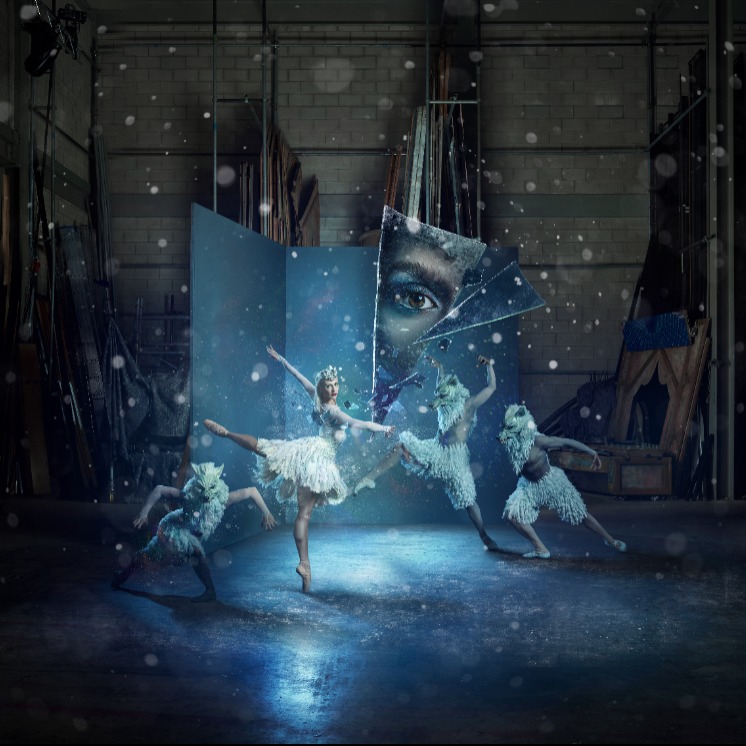
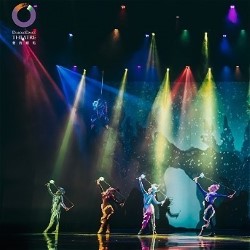
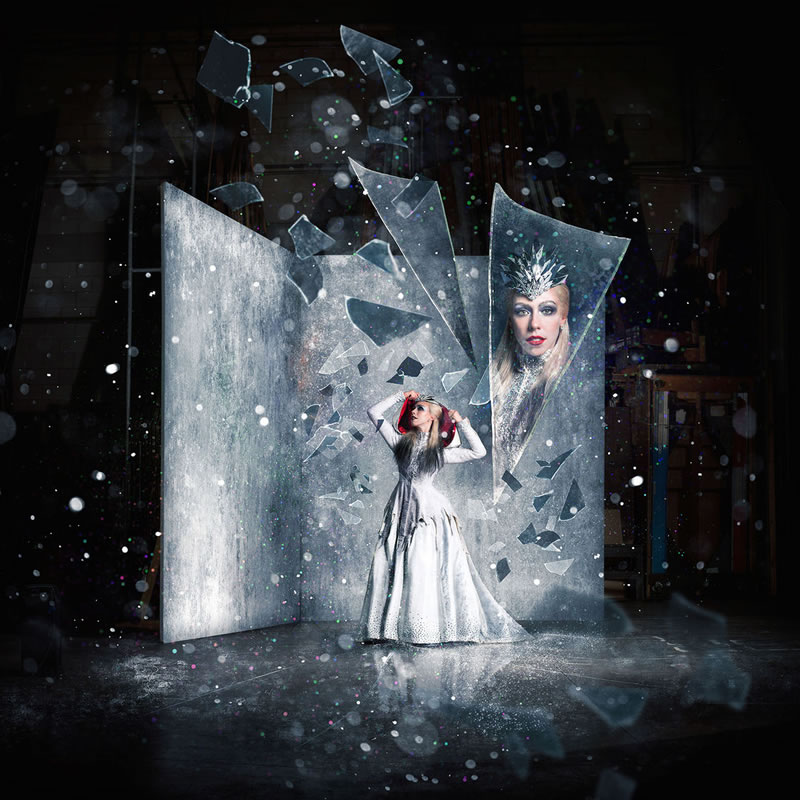
Ice and fire: just what we need at Christmas. Scottish Ballet’s The Snow Queen is a wintry treat, now in its third outing since the premiere in 2019. The Snow Queen’s icy world is contrasted with the warmth and colour of circus performers, Romani travellers and the heart-warming love between Kai and Gerda. Choreographer Christopher Hampson has welded together Hans Christian Andersen’s fairy tale with Disney’s Frozen, adding a storyline concerning the rivalry of the Snow Queen and her sister the Summer Princess for Kai, now an adult.Unfortunately, this subplot rather confuses the action. That said, the Summer Queen, disguised as Lexi, a pickpocket in a green jacket, is superbly performed by Marisa Poulson. Her malicious and fierce vitality dominates the stage, reducing poor Gerda (Kayla-Maree Tarantolo) to a wimp. No wonder Kai prefers the icily glamorous Snow Queen (Jessica Fyfe).There is much to admire: the breathtaking set designed by Lez Brotherson, the sisters framed inside a jagged broken mirror, animations of ice shards, the tracery of forest branches and the ice throne. The snow creatures’ costumes are terrific, especially the wolves with their grimacing masks and stylised fur, and the scary Jack Frosts. There is as much glitter as you could desire in the Snow Queen’s attire and the Snow Fairies, and in contrast there are colourful circus and Romani costumes and the latter’s encampment.However, a dull first act is mired in developing the Lexi pickpocket story, and the Snow Queen’s entrance fails to inspire terror. But the show comes alive in Act Two, in the Romani encampment, with a terrific Spanish-flavoured dance of males leaping and the skirts of the females swirling. An additional bonus is Gillian Rissi playing the fiddle live.Kai (Bruno Micchiardi) and the Snow Queen (Jessica Fyfe) perform beautiful pas de deux where her spiky moves and some heart-stopping lifts held upside down are impressive. However, there is no chemistry between them. He looks bewildered throughout and she fails to be scary, only smug. It is unclear how Kai wakes from the Snow Queen’s spell. As for the Snow Queen and Summer Queen’s reconciliation, it hardly registered.A muddled plot, a mistaken substitute for real drama, and a failure to delve into Hans Andersen’s exploration of evil and the symbol of the ice shard in one’s eye mean that this show lacks any depth. But does it matter? The kids won’t care.

Edinburgh Festival Theatre • 27 Nov 2025 - 7 Dec 2025

Cinderella: A Fairytale

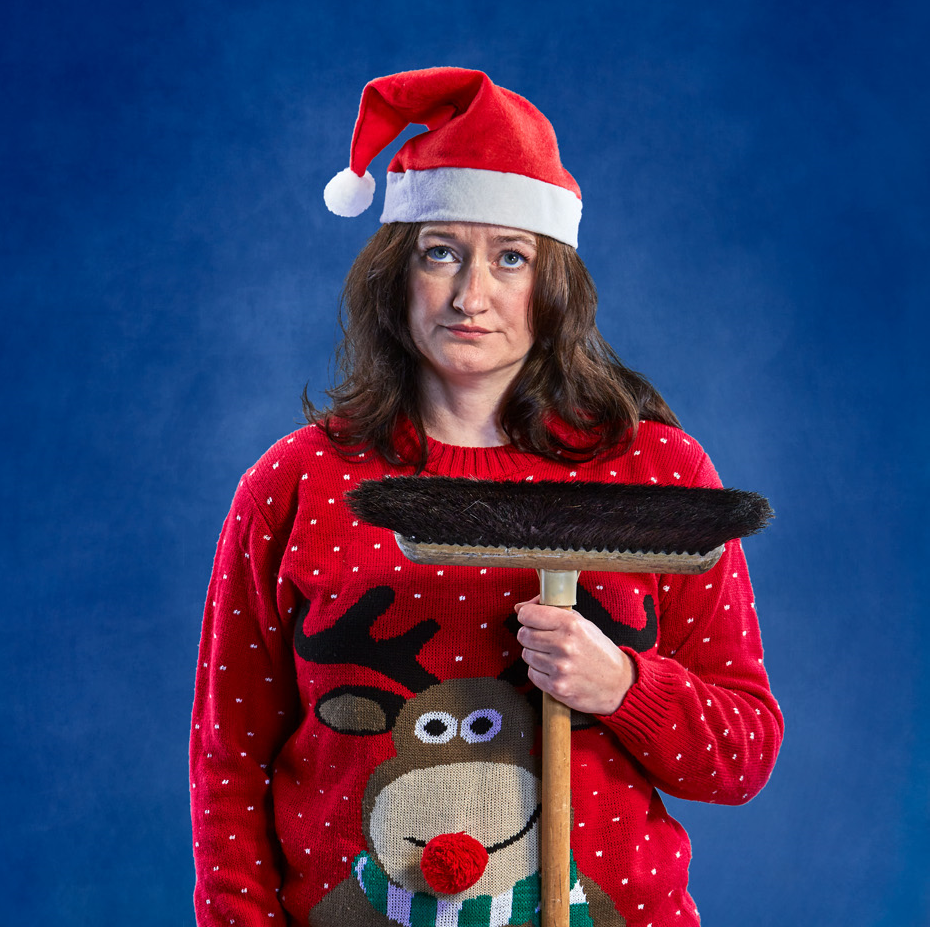
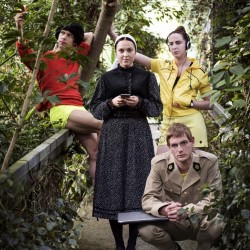
Puppetry, song, dance, silly jokes and pratfalls, Cinderella: a Fairytale by Sally Cookson, Adam Peck and the Original Company, directed by Jemima Levick, is certainly original. This Cinderella is Ella, surrounded by her friends the birds (puppets designed by Matthew Forbes), who teach her how to fly – that is, how to be herself – which of course means gaining her Prince (an engaging Sam Stopford), a twitcher.The human characters are in brightly coloured modern dress, with Ella (a charming Olivia Hemmati) in shorts, but the setting is timeless, as in a fairy tale, an imaginative canopy of trellis-like brooms and brushes designed by Francis O’Connor. Scaffolding, also featuring brooms, represents a tree where Ella sits in the forest to see the magical puppet birds swoop ahead on long poles, or larger birds with characterful beaks perch on her hand, manipulated skilfully by puppeteers on stage. There is also beautiful shadow puppetry to show Ella’s growing up.The story moves swiftly from her happy childhood with her widowed father (a twinkling Richard Conlon) to the arrival of the ghastly stepmother (Nicole Cooper), almost a panto dame in her tight-fitting, garish green and pink suit and over-the-top acting, which make her cruelty amusing. Her children, a boy (Matthew Forbes) and a girl (Christina Gordon), are both hilarious in their prim and proper ways. All three make Ella’s life miserable, dubbing her Cinderella, forced to sleep in the cinders. Ella scrubbing the floor and tricking her stepbrother and stepsister to take part is clever and funny, with the charm of the earlier scenes now replaced by knockabout comedy.Until this point the show’s charming atmosphere and humour suit all ages, but it now takes a more adult turn. Even from the start, the joke of the twitcher Prince’s use of the Latin names for birds is more suitable for older children. Now we have the stepmother’s overtly sexualised flirting with the Prince and finally the Gothic horror of the stepsister determined to squeeze her large foot into the small shoe, having her toes cut off and shockingly presented as bloody stumps on a plate. It’s a shame, as there is so much else suitable for all ages, particularly the audience participation, with cast roaming the stalls to see whom the slipper – in this case a sparkling trainer – will fit.I would definitely not take a child under ten to this show.

Multiple Venues • 27 Nov 2025 - 3 Jan 2026

The Seagull

An inspired choice by James Brining for his inaugural production as artistic director of the Royal Lyceum, Chekhov’s The Seagull marks the beginnings of modern theatre. The elegant adaptation by Mike Poulton is accessible and light-footed, aiding the subtle balance of comedy and pathos that is the hallmark of this production.John Bett, playing Sorin, the owner of the summer estate where the play is set, is one of the highlights of the show. His handling of complaints makes us laugh sympathetically. But Caroline Quentin is undoubtedly the star of the show, playing Arkadina, a narcissistic actress past her prime, with just enough hamminess to be funny without losing credibility. Constantly posing and looking round for effect, she also betrays her insecurities. She can be both cruel to her son, Konstantin (or Kostya), talking over the play he wants to impress her with, but later demonstrating her love in the moving scene where she changes the bandages on his head wound. This ambivalence is also successfully demonstrated by Lorn Macdonald as Kostya, both scornful of his mother and desperate for her approbation with his unintentionally ghastly play, searching for ‘new forms’. Likewise his volatility means he is unable to take rejection by Nina resulting in suicide. Trigorin’s explanation of his writing process, as an obsession, will resonate with would-be writers. Dyfan Dwyfor, rather too low-key before this, at last comes alive.Other characters make pleasing cameos: Michael Dylan as Medvedenko, the neglected schoolteacher; Steven McNicoll as Shamrayev, the blustering estate manager; and Irene Allan as Polina, his bullied wife, who is having an affair with Dr Dorn but is now neglected. Sadly, Forbes Masson as Dorn is so unpleasant it’s hard to believe he was once a seducer.Full plaudits to Tallulah Greive as Masha, with her deadpan ‘whatever’ delivery, a precursor of goth, all in black. Harmony Rose-Bremner as Nina contrasts the necessary overacting in Kostya’s play with naivety and hero-worship for Trigorin, the famous writer. However, her last encounter with Kostya is so overwrought it’s garbled.The sets by Colin Richmond and Anna Kelsey are not entirely successful. The opening scene by the lake is cluttered with reeds that look more like rye. There are also strange water sound effects - real lakes are silent. However, the sparse interior that follows is spacious, with the distressed look of an old country house. The last set, reduced to a small central space (perhaps to suggest Kostya’s confined life as a writer), is again too cluttered.Overall, this is an involving, though not overwhelming, production, and it bodes well for the Lyceum’s new era.

Lyceum Theatre • 9 Oct 2025 - 1 Nov 2025

War Horse

Would this show live up to the hype? A resounding YES. Powerful, hugely imaginative and devastating. In these troubled times and war in Gaza and Ukraine it is sad but also deeply relevant today that this show, War Horse, adapted by Nick Stafford from Michael Morpurgo’s novel, should be revived. As Morpurgo himself said: “It’s about the pity of war, a horse and a boy” – Joey and Albert. The original, directed by Tom Morris, was the National Theatre’s most successful production, a global phenomenon performed in 14 countries, seen by 8 million people, running since 2007 for seven years until the pandemic. Now, after a five-year break, it’s back under the direction of Katie Henry.Who would have thought back in 2007 that, due to War Horse, puppetry would become mainstream in the UK, although in eastern Europe and Russia it had long been valued in shows not only for children but for adults, even of the classics. Its success is due to the amazing South African puppetry company Handspring’s stunningly realistic horses, not only Joey but his companion Topthorn and several other more shadowy horses in the war scenes. Despite being made mainly of canvas and bicycle wire, their workings and puppeteers visible, it does not take long to forget the puppeteers as the horse (each with three puppeteers, one at the head) appears to breathe, ears twitch, tails swish, and they neigh and snicker just like the real animal. But it is the emotion between the boy and horse, and later men and horses, that makes this superb drama.The story starts in a Devon village, where Joey, a hunter gifted to Albert, is degraded to plough horse, sold to the cavalry and shipped to serve in the first world war pulling carts of heavy guns or of the dead and wounded. Albert, aged 16, enlists and follows, searching for Joey. There is a parallel story of Albert’s dysfunctional family and eventual reconciliation. Full cast performances as villagers or soldiers are impressive.The contrast between the village and the later war scenes is dramatic. There is also humour in the first half with another puppet, a goose which nips the backs of calves, contrasted in the war scenes with the sinister black raven puppets that peck out the eyes of the corpses.The bucolic village is suggested by birdsong and bird puppets swooping through the air on long rods. Mood and atmosphere are echoed in the suspended screen, like a piece of torn-off parchment with delicate sketches of countryside and village scenes by Rae Smith. Later these are replaced in the war scenes by harsh drawings of warships and machinery, then silhouettes of soldiers in the trenches. Stunningly vivid light and sound, simulacra of gunfire and explosions, is truly frightening and act one prefigures this with a terrifying charge as if into the audience. Throughout, the two worlds are linked by the strong performance of folk singer Sally Swanson on accordion or solo.Tom Sturgess as Albert is convincing as a naive but stubborn boy dedicated to his horse. Later, the performance of Alexander Ballinger as Captain Friedrich, a German deserter and also lover of horses, stands out. As the story moves from the trenches to no man’s land the stage is littered with corpses, both German and the Allies. It is the remarkable aspect of the show that both sides are represented, both are shown as humans and the pity and waste of war is clear. Yes, reader, I cried.

Festival Theatre • 2 Oct 2025 - 11 Oct 2025

R:Evolution

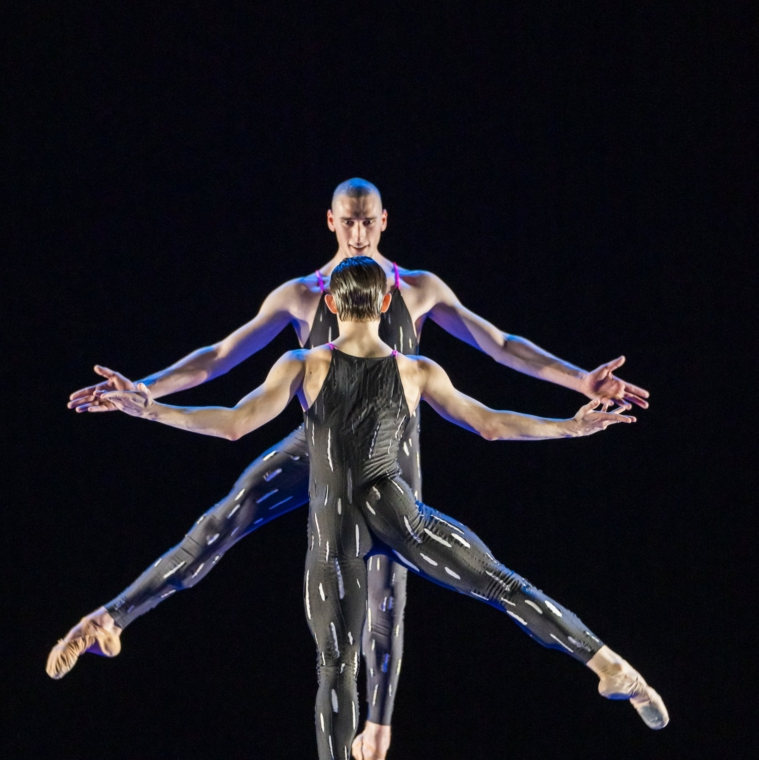
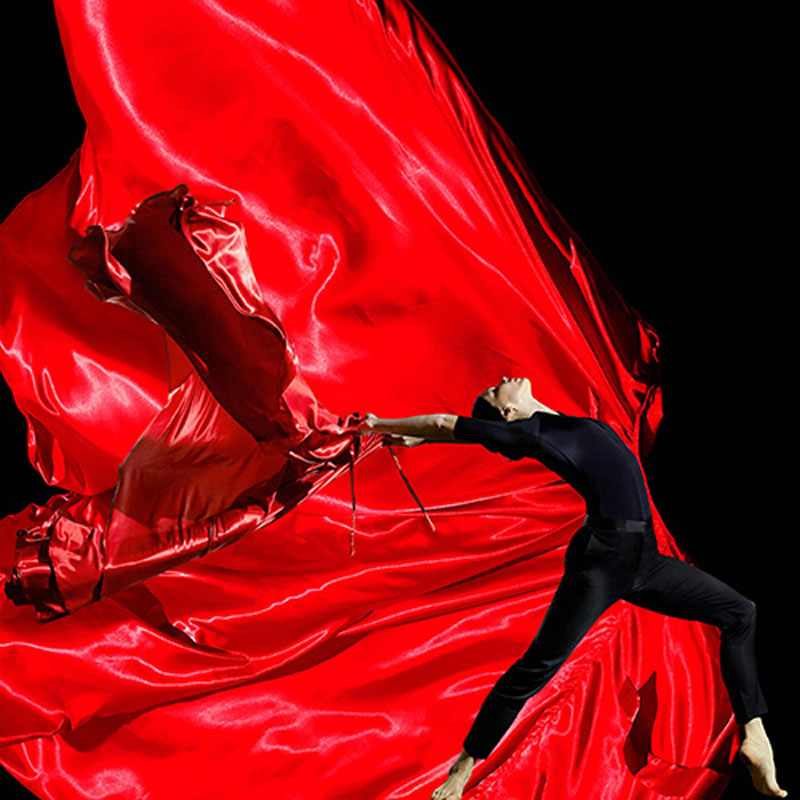
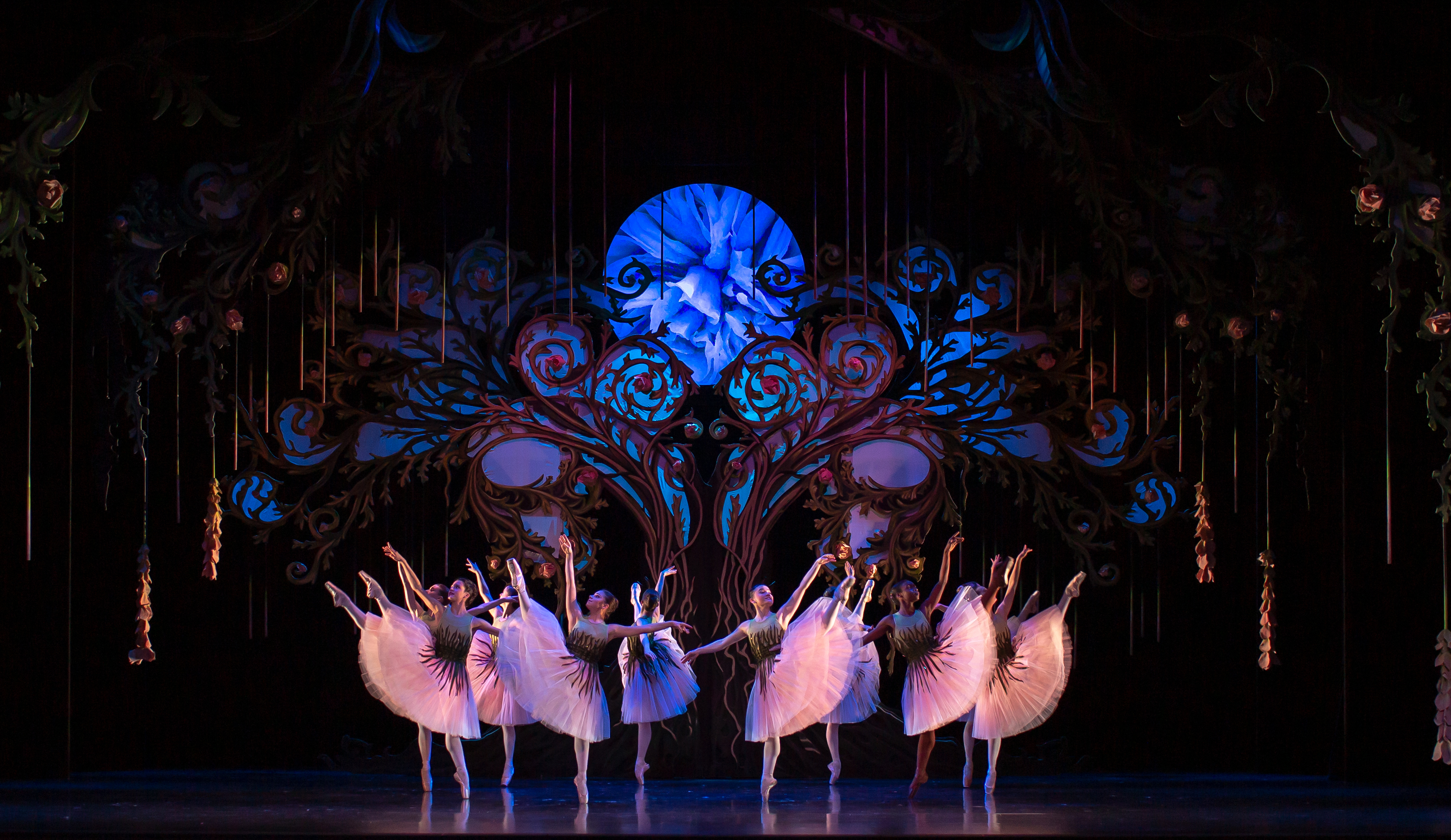
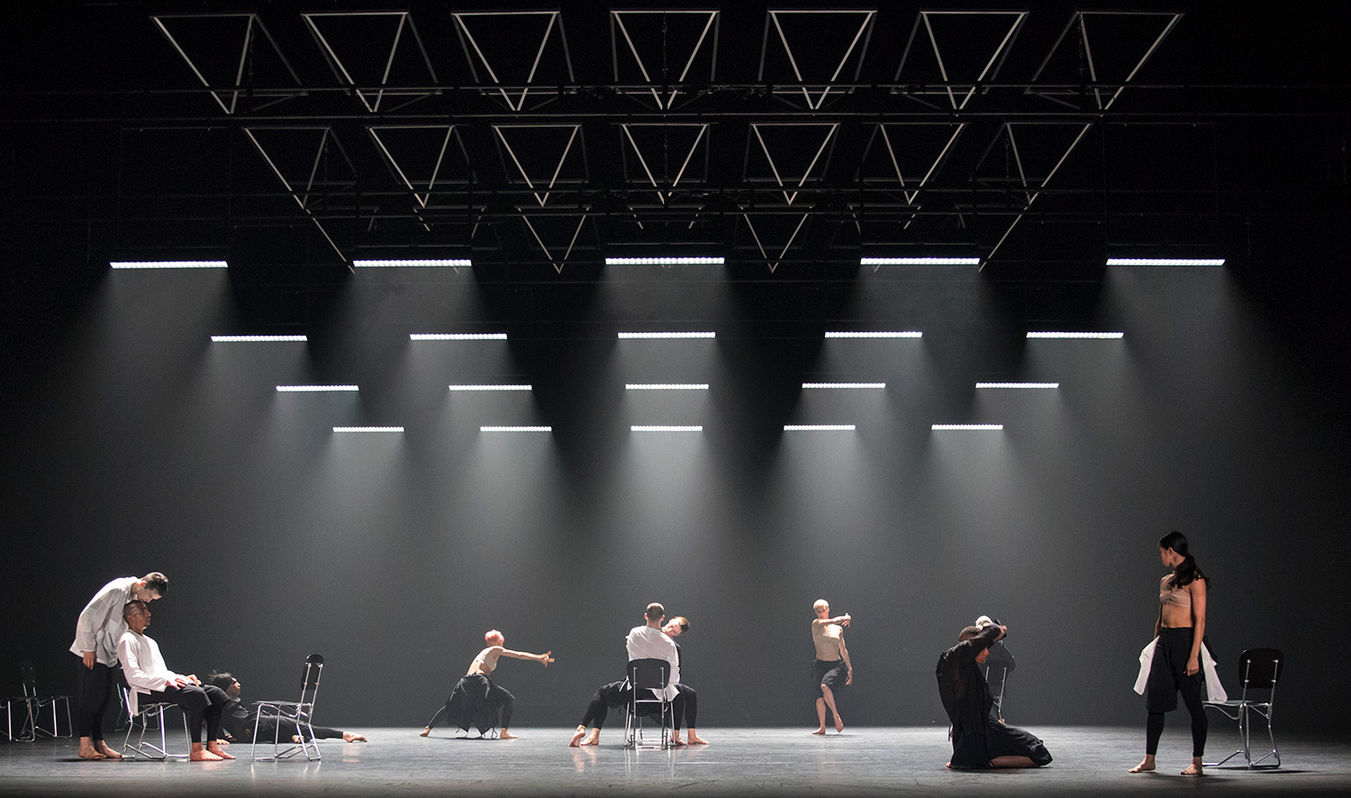
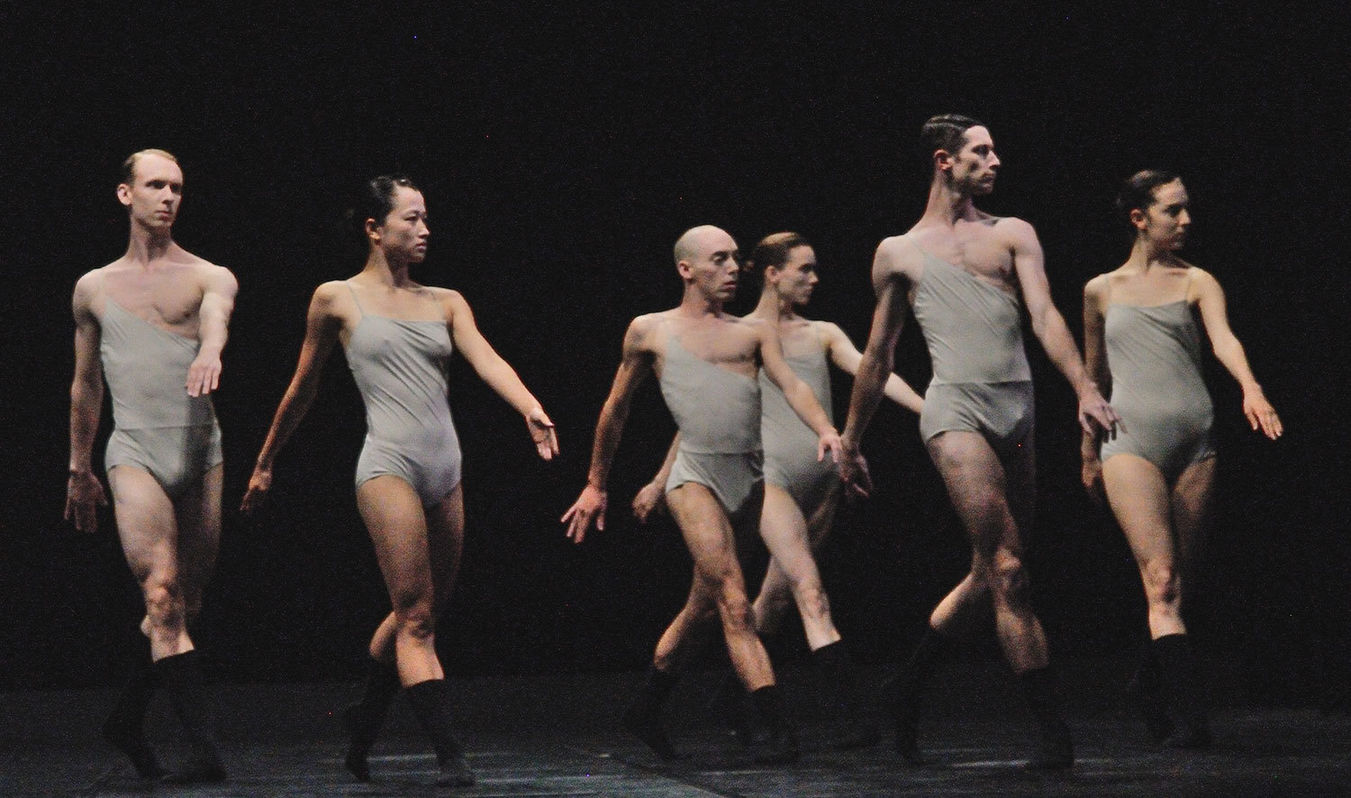
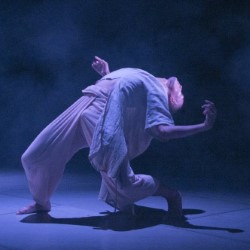
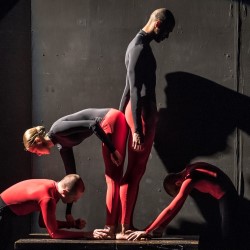
R:Evolution is four pieces exploring the development of modern ballet, of interest to anyone seeking an introduction or refresher course. What a great idea from Aaron S Watkin, artistic director of the English National Ballet.Balanchine’s Theme and Variations, set to Tchaikovsky’s music, sparkles – not only with chandeliers, tutus and tiaras, but with precision of technique and geometric patterns that respond to the score, whether swirling woodwind or later horns. Two fine soloists, Emma Hawes and Aitor Arrieta, effortlessly shine. Redolent of the St Petersburg Balanchine came from, it is a superb start, showing the classical roots of ballet.In complete contrast, pointe shoes are abandoned for bare feet in Errand into the Maze, which exemplifies Martha Graham – the mother of modern dance – and her visceral, raw style. A reinterpretation of the Minotaur myth, it follows Ariadne as she discovers her subconscious desire symbolised by the Minotaur. The music by Menotti is equally raw, all drums and syncopation. The set is modernist, bare apart from a treelike abstraction, a pole and a Picassoesque bird. Movingly danced by Minju Kang, with Graham’s signature contortions to her core – twisting and at one point climbing onto the Minotaur’s thighs to dominate him – while Rentaro Nakaaki, as the Minotaur, falls vanquished to the floor. In its day it would have been shocking. Now, perhaps, it seems a little dated, with a limited range of movements, but the birth of modern expressivity is clear.William Forsythe’s Herman Schmerman (Quintet), set to music by Thom Willems, is a joy and, along with the Balanchine, a highlight of the evening. Sassy and slick, it gives classical ballet a syncopated shake, echoing the music. There is connection between the five dancers as they smile at each other, the males swagger and the females throw knowing looks at the audience.Sadly, David Dawson’s Four Last Songs lets the evening down. A strip of glowering cumulae suggests Sturm und Drang, and the dancers look naked in flesh-coloured bodysuits, perhaps to evoke the elemental. But the choreography is pretentious, overblown hype. There is no authentic emotional connection between the dancers, far too much running in circles with outstretched hands, repetitive moves and some dangerously high lifts – perhaps a desperate attempt to match Richard Strauss’s soaring music. However, live soprano Madeleine Pierard’s rich tones were wonderful.

Sadler's Wells • 1 Oct 2025 - 11 Oct 2025

Mary, Queen of Scots

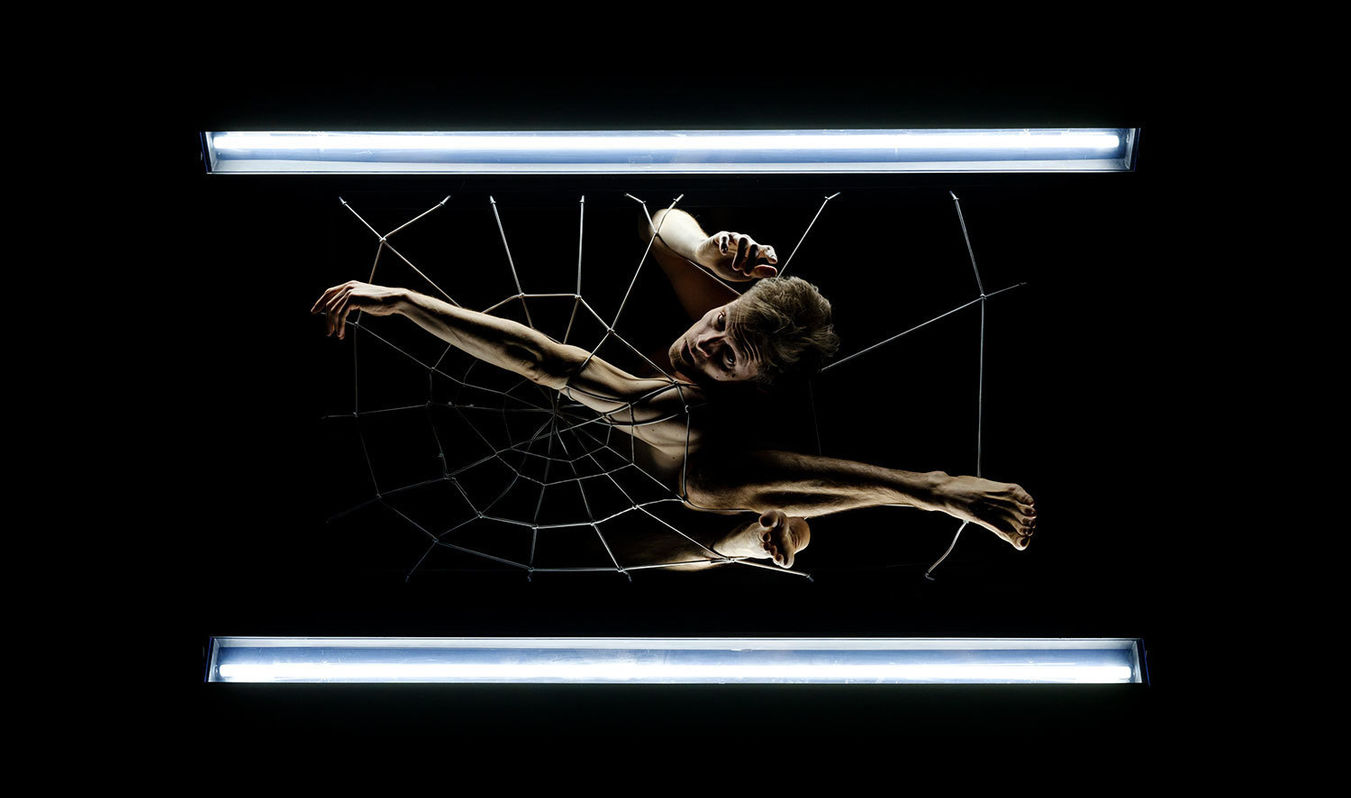
Imagination, not history; hugely inventive; the chutzpah of gender-swapping; visually stunning, with flashes of brilliance – Scottish Ballet’s Mary, Queen of Scots, choreographed by Sophie Laplane and co-creator James Bonas, is Mary’s story reimagined as the dying Elizabeth’s memories in flashbacks. It should have had everything going for it, but somehow the relentless pace of angular, jerky choreography became tiring, and the relationship between Elizabeth and Mary failed to move.Why not have the younger Elizabeth played by a tall man (Harvey Littlefield)? To be a stronger ruler, she had to deny her womanly side. Eye-catching, with long auburn hair, bare legs and puffy pants, sometimes on stilts to symbolise the gap between her and her courtiers, she is above them but also constrained. In contrast, the older Elizabeth (Charlotta Ӧfverholm) is a frail woman in her underclothes, her wigless, wispy hair revealed, wandering in and out of the action. Mary (Roseanna Leney), always in black, is young and lively. The Jester (Kayla-Maree Tarantolo), in lime green, is a highlight: it is inspired to make her Death, skipping and playful, rejoicing at each character’s doom.What one remembers are the visual details: Catherine de’ Medici in a steel hoop; spies as flies; Mary a spider consuming Darnley; a steel cage that descends on her; the dead Rizzio suspended from the ceiling; secret codes as graffiti. There is also some hilarious relief from the drama, such as old Elizabeth in her bath with the Jester washing her underarms and tickling her, and Mary’s baby (James) portrayed as a white balloon. Old Elizabeth (childless) is also shown cradling a baby – a white balloon, which is then popped.The two main duets are strong. Mary’s dark, fatal attraction to Darnley (Evan Loudon) is brilliantly conveyed: flinging her head back as she is lifted, then falling in a roll to be caught. This submission is then reversed as she exits, dragging Darnley behind her on the floor – genius. Rizzio (Javier Andreu) and Darnley’s bi-sexual relationship is less stunning, but still fascinating as they vary the power dynamic. Apart from a formal dance of the Elizabethan courtiers, it is a shame that this quality of choreography is not maintained in the uninventive ensembles, which become tedious.Warning: it is essential to read in advance the detailed synopsis online, or via QR code (the sheet given out at the show is useless) to understand who and what is going on.

Festival Theatre • 15 Aug 2025 - 17 Aug 2025

Dancehall Blues

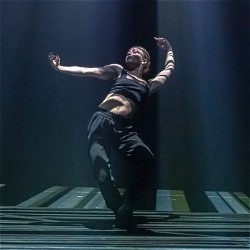
Brilliant and ambitious in its range, Dancehall Blues combines dance, text, voiceover and film. It is choreographed, with input from the dancers, by the acclaimed David Bolger of Dublin’s CoisCéim company, whose work has appeared at the Sydney Opera House and the Venice Biennale. This is dance theatre for our difficult times. Yet anger is tempered with lyricism and, surprisingly, the magic – perhaps illusory – of a burgeoning love affair, symbolised by a dance hall mirrorball.Set in a fictional 2030, it harks back to Orwell’s dystopian 1984. The two dancers first appear clad in hazmat suits, suggesting a post-nuclear apocalypse has occurred. Film projected on the back wall shows crowds and police in riot gear with shields. It is then revealed that the couple are in a dilapidated hall, possibly a former dance hall. The mirrorball makes a dramatic entrance. Throughout, sirens wail and the noise of angry crowds reminds us – in between the more playful and hopeful relationship developing – of the threatening world outside.The two dancers complement each other beautifully. Emily Kilkenny Roddy is more lyrical, while Alex O’Neill is a bad boy from hip hop, street dance and jazz. Yet she can rise playfully to match him, and there is great chemistry between them. Delightful angular armography is topped by witty chairography. O’Neill is mesmerising: angry, expressive and endlessly inventive, his rapid movements include krumping, chest popping, swinging arms and contorted fingers, but he can also melt into the lyrical love duets. Their relationship has an ambivalent edge, though. Is it real or imagined? A large gilt-framed mirror, tipped forward, projects images of the dancers in hazmat gear alongside the reflection of their ordinary attire, suggesting the world of the mirrorball – and of their love – is illusion.John Gunning’s lighting design is striking. The stunning music and sound design by Ivan Birthistle creates atmosphere, from a thudding bass to Pergolesi’s uplifting Stabat Mater sung by Philippe Jaroussky, and finally Jacques Brel’s sentimental, quintessentially French Ne me quitte pas. The show ends on a note of hope. The couple finally take ballroom hold – so clever to leave this to the end – and waltz around the lowered mirrorball, spinning and twinkling until its scattered light fills the space. A magical, ecstatic ending.With a bit of tightening of the hazmat beginning and some longueurs between the action, this could be a five-star show.

Assembly @ Dance Base • 12 Aug 2025 - 24 Aug 2025

Kathryn Gordon: A Journey of Flight

Sensitive and evocative, A Journey of Flight, created in Shetland, is about the migration of birds. Choreographed by Kathryn Gordon and danced by herself and Jorja Follina, it is full of birdsong, images of birds, wings and shadows, with flickering light suggesting wings.Animated film by Alison Piper of seabirds is projected on the walls and on white sheets hanging from washing lines. The material is underlay for wind turbines – a hint that blades and birds are not good friends? Sliding across the floor or leaping and dipping, the dancers suggest flight. Shirts held out become wings. Hands cross, casting shadows on the sheets, but there is nothing so unsubtle as arms flapping. The choreography is simple, the two endlessly circling the space – perhaps too simple – but it allows the audience to imagine the vast distances birds traverse.The soundscape by Jenny Sturgeon is one of the delights of the show. Birdsong recorded in Shetland, including the strange churring of storm petrels at night on Mousa, is mixed with electronic weirdness and live vocals: a song in Shetlandic, a poem by Kathleen Jamie and the traditional song Mullalyo among them, accompanied by a mountain dulcimer, a guitar and the rattling of limpet shells.Towards the end, there are voiceovers from locals about the need to leave and the need to return home. More could be made of the human parallels in the choreography itself, but there is much to recommend in this charming show.

Assembly @ Dance Base • 12 Aug 2025 - 17 Aug 2025

Wee Man

Bim! Bam! Boom! The sheer energy and physicality of the performers is amazing. This is edge-of-the-seat, in-yer-face stuff that leaves you breathless. Both humorous and terrifying, Wee Man, choreographed by Natasha Gilmore of Barrowland Ballet, is both a celebration and a swingeing critique of the ‘rules’ of masculinity. The intergenerational cast, including teenagers and men, moves to the relentless pulse of music composed by Luke Sutherland. Set on a football pitch, the cast wear sports gear, making the parallels clear. Gilmore, as a mother of boys, clearly knows what it’s like to watch the perils your ‘wee man’ (an affectionate Scots term for a small boy) must face to become a man.The ‘rules’ devised by Kevin Gilday appear on screens inside the goalposts, starting with upbeat ones such as ‘wear no colour except in socks’ and ‘walk as if wearing soggy porridge in your sporran’ – but mostly they are negative, carrying darker hints of toxic masculinity and the self-destruction required through the denial of individuality and emotion in order to be accepted. The performers hurl themselves at each other chest to chest, leaping, rolling, punching, twirling almost nonstop, culminating in heart-wrenching scenes of bullying. Sweat glints on bald heads, dreadlocks fly. Testosterone-fuelled and adrenaline-high, it recalls the strength and stamina of Russian and other mid-European dance traditions, or even South American Capoeira and the competitiveness of New York street dance.Gilmore’s work is always intelligent and warm as well as skilfully crafted. Here, the warmth is less evident until a gleam of hope appears at the end. The brilliant script occasionally gets a bit sentimental and squishy, but that’s forgivable as the performers carry each other – even the teenagers lifting the heavier men – suggesting the need to support one another emotionally, even if earlier it amounts to no more than a slap on the back.The cast is made up of members from Gilmore’s intergenerational Wolf Pack, a non-audition company, plus a mixture of professional dancers who have appeared in many of Gilmore’s past shows, including her son Otis (aged 15), and at the end some local community dancers, whom she likes to incorporate at every venue. It was heartening to see an 80-year-old taking her teenage grandson. A must-see show for every male, their mothers and family.

Assembly @ Dance Base • 5 Aug 2025 - 17 Aug 2025

Solitude Without Loneliness

Three figures with their clothes pulled over their heads suggest the prison-like state of loneliness. Sadly, the promise of this striking image is not continued in the rest of this mishmash of movement, text, serious then comedic scenes. It is a shame that talented dancers are given incoherent and repetitive choreography by Malcolm Sutherland, himself one of the dancers. The trouble with alienation is that it alienates the audience. Thankfully, an absurdist romantic dinner for two – a Blind Date spoof where lipstick replaces Bordeaux – and later Metro’s ‘Rush Hour Crush’ enliven the show. The comedy sketches are great. Pity about the dance.

Assembly @ Dance Base • 2 Aug 2025 - 10 Aug 2025

Inlet

The strange juxtaposition of bricks and nudity creates a raw tension. Inlet, choreographed by the Syrian-German Saeed Hani, is intensely visual, immersive, and above all, dance as embodied emotion. Referencing Roman myth – the story of Romulus and Remus – this dance/performance piece explores the significance of walls and borders, both of stone, barbed wire or of the mind. The dancers Francesco Ferrari, Ana F. Melero and Michele Scappa are superb.Founding his company in 2016 and based in Luxembourg, Hani is a choreographer of international standard, influenced by Pina Bausch and the avant-garde Dimitris Papaioannou, who directed the 2004 Olympic Games opening ceremonies, and is likewise interested in expressing emotions visually.Rainforest birds and torrential water create an environmental soundscape evoking the world of Eden, as we see only limbs appearing from behind two rectangular blocks. Eventually two males are revealed, their nudity as innocent as before the Fall. A woman crouches on top of a stone plinth, surveying the audience with two metal balls held to her eyes as if binoculars. It is clear the audience are to be implicated in the unfolding story. Slowly she stands and reveals, unashamed, her nudity.What follows is subtle, endlessly varied and unpredictable choreography, allowing the audience to interpret and bring their own experiences to the story. The lighting by Marc Thein, highlighting with squares of light or creating glowing columns, beautifully enhances the experience. Music by Jakob Schumo and the significant silence after the men fight are expressive, contributing to an artistic whole.There is nothing so banal as building a wall at first. Rather, the dancers shift the blocks around, steal them from each other, slap them down with a loud smack, pile them up or dismantle them as the relationship between the two males, and the three of them, evolves. It’s interesting that the dancers become clothed as the relationship between the two males becomes strained and a wrestling scene ends, as we know, in the death of Remus. The last scene has the depth of Greek tragedy, where the woman enters, bare-breasted but trailing a shroud-like fabric round her waist. She approaches the finished wall, a tall white column, then turns holding the fabric bunched in her arms as if cradling an orphaned or dead baby. As she is overcome with grief, pulling at her hair, one is reminded that in Arabic culture mothers show their pain, and Saeed, as a Syrian, is drawing on his own heritage.Along with the wide references from Roman myth to Greek tragedy, the audience might bring to mind the violence resulting in the Berlin Wall, a divided society in Northern Ireland, the Mexican/US wall, and contemporary issues in the Middle East – though none of these are explicit in this dance. However, the title Inlet, a place or means of entry, suggests that there is hope. Wishful thinking maybe, and not shown in this work.A must-see show and a choreographer to watch.

Assembly @ Dance Base • 1 Aug 2025 - 23 Aug 2025

Soil

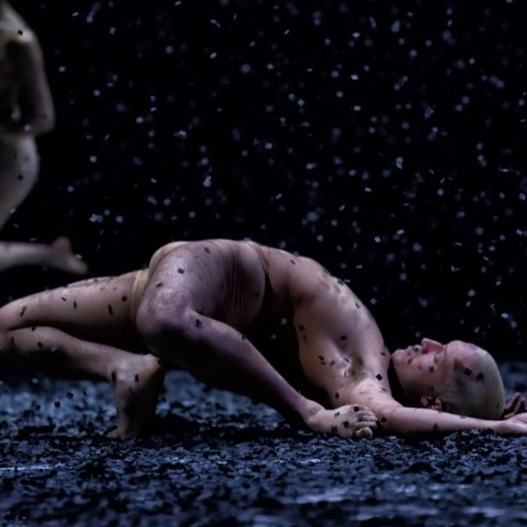
Aviaja’s Soil is about not belonging – choreographed and performed by Sarah Aviaja Hammeken, who is half Danish and half Greenlandic. Growing up in Denmark without her Greenlandic language (Kalaallisut), she does not feel at home in either country, and this impacts on her sense of identity.The show opens with her lying face down in a heap of black soil. Nothing happens for ten minutes, testing the audience’s tolerance. However, this image stays with one long after the show is over, and there is a potentially powerful performance piece waiting to be released. Sadly, it remains more of a lecture.

Assembly @ Dance Base • 1 Aug 2025 - 17 Aug 2025

Taiwan Season: Trace of Belief

Deceptively simple, Trace of Belief, choreographed by Hsieh Yi-Chun, is a captivating, dreamlike dance that deepens and grows on the viewer. Exploring, through temple processions and rituals, the experience of prayer – from the quietly meditative to the ecstatic, and applicable to any religion – it asks what we can put our faith in within an agnostic world. Is there still something beyond ourselves we can believe in?Multicultural, melding classical Chinese and Western contemporary dance, this is a subtle and delicate piece featuring dancers of remarkable flexibility and expressivity, accompanied by a soundscape flavoured with temple bells, Chinese drums, gongs, cymbals and suona (Chinese trumpet).Starting quietly with the sound of water drops and birdsong, six dancers – three male and three female – dressed in brilliant blue wide-legged trousers flecked with white, stand together, slowly swaying. As one dancer breaks away then turns and returns to the group, another follows. Later, more complex groupings evolve, suggesting that there is strength in unity, while individual solos speak to the need for independence. The piece becomes not just about religious experience but also human relationships. The beauty of this work is that it allows the audience to bring their own experience into it and interpret it as they wish.A particularly dramatic section features two men in painful rapture, their use of feathered fans – symbols of spirituality but also of male power – enacting the self-destructive potential of such intensity, as one turns his fan against his own abdomen.The choreography is skilfully varied, delighting with unexpected shifts in mood and style. Audience members may recognise Tai Chi movements and delight in the raised knee with bent foot, a gesture from Chinese opera, as well as Chun’s signature low pliés and fluid, circular movements, which she associates with flowing water – all combined with Western balletic lifts.The final section features Hsieh Yi-Chun herself, semi-naked and standing only in her underclothes, offering herself to the audience as if to say: this is who she is. Belief in self, belief in dance – that is what matters. Trace of Belief may not transport you in the way that a louder, more in-your-face piece might, but it may subtly transform you.

Assembly @ Dance Base • 31 Jul 2025 - 24 Aug 2025

Kismet

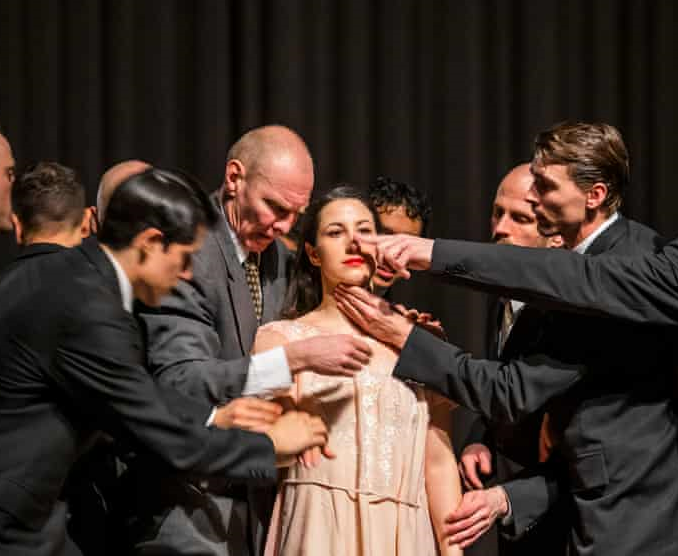
Kismet, a double bill from Rambert, begins with the hugely disappointing Gallery of Consequence by Dutch choreographer Emma Evelein – a shame, as this was a premiere – followed by B.R.I.S.A., much more accomplished but still a curate’s egg from the legendary Johan Inger, the Swedish choreographer.Gallery of Consequence is set in an airport waiting area and progresses through various scenarios of check-in, waiting, chance encounters, boarding, etc. Robotic hip-hop movements suggest how we are controlled and alienated in that environment, and those who love hip-hop will enjoy it. But a whole piece composed of jerky movements, spasms and incomprehensible gestures becomes tedious in the extreme. Attempts at emotional expressivity are made in some solos and duets – in particular, a love duet in which a girl is dumped and reacts by plonking herself on a bench and hiding her eyes in her hands. This clichéd lack of subtlety defines the whole piece.To be honest, the Departure Board, designed by AMIANGELIKA, which morphs into silhouettes of couples, was more interesting – though its list of flights boarding at the beginning, changing to flights cancelled at the end, was another heavy-handed attempt at pathos. Evelein’s background is in music videos and dance films, and her lack of experience in contemporary dance choreography is telling.B.R.I.S.A. by Johan Inger (premiered in 2014) saved the evening. Most importantly, the expressive, complex and subtle choreography allowed the Rambert dancers to show off their magnificent technique, flexibility and athleticism.Beginning with dancers shuffling around the edge of a large carpet – alienated and isolated – they then break out into frenzied movements, only to subside into depression again. Edinburgh’s audience may remember the recent production of his Passing alongside Crystal Pite’s Frontier with Ballet BC, where his quirky sense of humour shone. It’s evident here too, as he explores the theme of liberation using an increasing number of wind-creating gadgets: electric fans, a Japanese red fan, hairdryers and – to top it all – leaf blowers, as the dancers revel in the cool breeze. (B.R.I.S.A. is inspired by the Spanish word for breeze. A coincidence that this production coincides with a heatwave in Europe.)All this is set to the soulful voice of Nina Simone, singing Black Swan, Wild Is the Wind and Sinnerman. What a joy. Unfortunately, the piece descended into some incoherent rambling at the end, which spoilt an otherwise fascinating production.

Edinburgh Festival Theatre • 3 Jul 2025 - 4 Jul 2025

Ballet BC (British Colombia)

A memorable, hugely exciting double bill, Passing and Frontier, performed by Ballet BC – the leading Canadian dance company – feels as if it’s at the forefront of contemporary dance today. Two wonderfully creative choreographers, Crystal Pite (Frontier, a third iteration of her 2008 original) and Johan Inger (Passing), have created pieces that could not be more different, presenting a contrast of style and mood, light and dark. The link between the two choreographers is their experience with Nederlands Dans Theater – and it shows.One can see why Crystal Pite is one of the most sought-after choreographers in Europe today. In Frontier, she aims to explore doubt, made visible through shadows. It is an overwhelming experience, with embodied shadows: a vast crowd of dancers, hooded and dressed in black, crawl up from the audience, roll across the stage and later lift, stalk and importune with grasping hands, surrounding and enveloping spotlit dancers in white. The seething mass of shadows are at the same time embodied yet abstract, suggesting nightmare dreams surfacing from the unconscious – abstract enough for the audience to interpret with their own fears and desires. The darkened stage is swept at times with even darker shadows – an inspired design by Tom Visser. As Pite claims, the ‘neurotic’ – by which she seems to mean psychological – can also be linked with cosmic dark matter, of which, of course, we know nothing. Eerie music from Owen Belton and two uplifting choral pieces by Eric Whitacre bookend the piece.The skill and extraordinary fluidity of the dancers is shown off in Frontier with their extreme moves – reaching out, bending backwards and Martha Graham-esque deep pliés. In the second piece, Inger’s Passing, about birth, life and death in a community context involving the full cast, there’s an even wider variety of dance styles, including folk and tap. The individuality of the performers is highlighted, no doubt the result of improvisation in the choreography’s creation. It starts with great humour and lightness, full of surprises – dancers laugh, cry out loud, and there is a hilarious episode where a woman gives birth to adult dancers. Particularly affecting was the solo live singing of a Swedish folksong, reminiscent to Scottish ears of Gaelic melody.Although Passing successfully contrasts with Pite’s piece, its middle section feels random and loses its way. The final segment, with snow falling and a more sombre mood, could be potentially moving, but at present it feels overly long.

Edinburgh Festival Theatre • 23 May 2025 - 24 May 2025

The Lion, The Witch and The Wardrobe

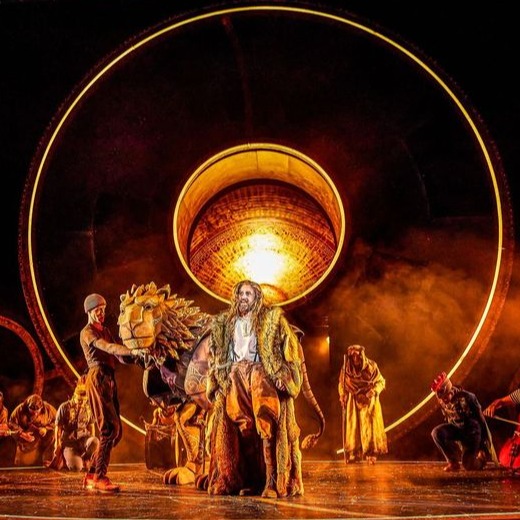
Magic, puppetry, dance, aerial acts and snowflakes inside an illuminated circle fill this musical version of C.S. Lewis’ The Lion, the Witch and the Wardrobe, directed by Michael Fentiman and based on the original production by Sally Cookson. It’s a wintry tale, including Father ‘Sinty’, so it feels rather strange to watch in spring, but with this being the anniversary year of VE Day, it is fitting that it is also a story of evacuee children during the Second World War. In this version, they are sent ‘in the middle of nowhere’ - near Inverness.Now in its 75th anniversary, many of us will have read this book as children or seen its various adaptations, and it looks set to enchant another generation with the world of Narnia.It’s a charming premise - the four children Lucy (a wide-eyed Kudzai Mangombe), Susan (a sensible Joanna Adaran), Peter (an upright Jesse Dunbar) and the traitorous Edmund (Bunmi Osadolor, likeably vulnerable) enter a wardrobe in a spare room and step into the magical world of Narnia, condemned to perpetual snow by the wicked White Witch (a commanding Katy Stephens). Fortunately, the children have appropriated fur coats from the wardrobe.On their adventure, they encounter a mixture of classical and folklore creatures such as Mr. Tumnus the faun (an intriguing Alfie Richards) and talking animals - beavers, a red squirrel and others - all played by a cast who take on multiple roles, including performing live folk music as they weave in and out of scenes.Charming puppets such as the Professor’s cat Schrödinger (a nod to Lewis being an Oxford academic) and the magnificent Aslan, a giant puppet with a stylised mane designed by Max Humphries and directed by Toby Olié, are the highlights of the show. There are striking stage effects - from the lit windows of a steam train (created with boxes held up by the cast) to giant pink Turkish Delight that taunts Edmund. Voluminous white veils drop from the ceiling and are used to breathtaking effect as the White Witch’s train, which she ascends in full majesty.The first act is delightful, with non-stop fun, movement, music and special effects. However, the second act stalls, not least due to Lewis’ own plot. His Christian symbolism - Aslan representing Christ, whose self-sacrifice saves Edmund and who then rises from the dead - is heavy-handed. The audience may be divided on this, but it undeniably creates a ponderous second act that drags on, despite the musicians and dancers’ efforts to keep the energy up, though by now their routines feel repetitive.This is not a show for children under nine, as there are some terrifying characters, especially the wolves and the Witch’s henchmen, as well as some explicit onstage violence.

Edinburgh Festival Theatre • 13 May 2025 - 17 May 2025

Pride & Prejudice* (*sort of)

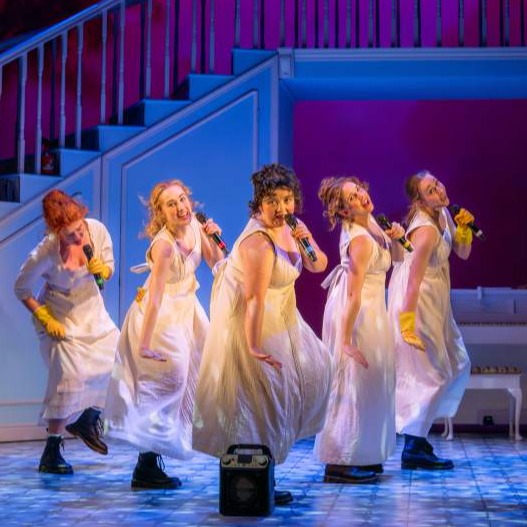
Great fun, at times hilarious, Pride & Prejudice, sort of by Isobel McArthur is a high energy spoof which will appeal to both Jane Austenites and those who’ve never read a word. Premiering in 2017 in Glasgow’s Tron and then touring the UK and to the West End, it is still going strong. Gustily performed pop songs, much gyrating, boogie woogie, rushing about and general silliness punctuate the plot which does sort of keep to the novel, and most people will get many of the references to the original as it is a truth universally acknowledged that many phrases have entered our language and there are sly references to wet shirts in the well-known film. The all female cast play all the parts, donning jackets over their dresses when playing the males with quick changes off-stage or behind a screen. The skill with which the actors can change character and voice is remarkable. In particular, Christine Steel plays Jane (the placid beauty), Wickham (the louche bounder) and Lady Catherine de Burgh (the snobby aristocrat); Rhianna McGreevy is a raucous Mrs Bennet with colourful language, still a hypochondriac (with an asthma spray) but not the whining character in the novel, and also plays Darcy with contrasting hauteur and repressed emotion; Isobel Donkin plays the innocuous Bingley, and his sister, the unpleasant Caroline, and a sad Charlotte with hints of an unrequited lesbian love. Naomi Preston Law is a spirited Elizabeth. A mention must be made of Eleanor Kane’s splits and hysterical flinging herself about as Lydia. All we see of Mr Bennet is the back view of his armchair and a newspaper - a brilliant touch.Jabares-Pita’s costumes range from plain white servants to the stand-out upright feather headdress and sweeping train of Caroline Bingley, and a caricature Lady Catherine de Burgh in vast hat and voluminous maroon dress, bulging with its own life. The minimalist set is perfect with its sweeping staircase and hidden doors. The various locations, the Bennet’s home Longbourn, Bingley’s Netherfield, the vicarage and Darcy’s Pemberley suggested by a piano and sofa, a crucifix or standing candelabras. A raised arm and finger click and the sky becomes a star-studded black to create a romantic mood.All the actors have terrific singing voices in the many well-known pop songs. Carly Simon’s You're so Vain is spot on, sung to Darcy by Elizabeth. Likewise, Lady in Red by her ‘nephew’ Chris de Burgh sung to Lady Catherine de Burgh. The cast ensemble singing and dancing is always full of energy and fun, especially in Bonny Tyler’s Holding out for a Hero. A shame that some of the actors often gabble when speaking and much of the humour is lost. But it’s still an entertaining evening out and much appreciated by the teenage girls in school groups in the audience going by their whoops. What a great way to enliven the school curriculum.

Festival Theatre • 22 Apr 2025 - 26 Apr 2025

Swan Lake

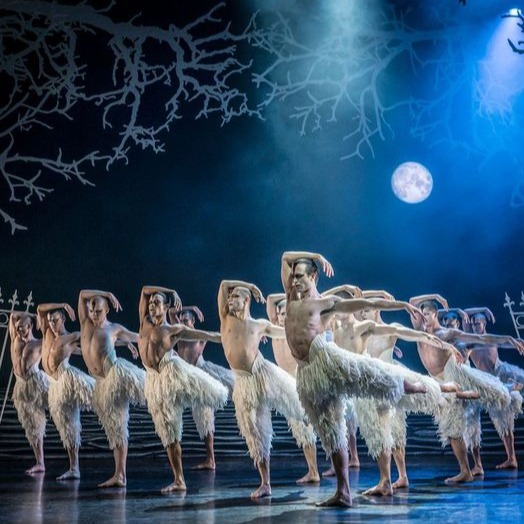
Hilarious, slick, moving and deeply powerful, it is clear why Mathew Bourne’s Swan Lake has become a legend, with thousands of performances all round the world and now celebrating its 30th Anniversary. Famed for its male swans, this is a transgressive contemporary interpretation of the classical ballet to Tchaikovsky’s glorious music, a gay love story, though love is probably too gentle a word for this tortured, violent sexual attraction and its dangerous love object, the Swan.Framed by palace scenes (the Royal bedroom and later ball) plus segues to a sleazy nightclub and posh opera house, there is much satire, contrasting costumes and choreography, all brilliant. However, it is the swan scenes which take your breath away. Apart from a delightful vignette from the cygnets and their memorable music, the male swans are not camp, but supremely masculine, muscular and strong, with the black streak down their foreheads, bare torsos, shaggy leggings and aggressive behaviour. Forget swans gliding gracefully on serene lakes. Real swans are dangerous creatures and danger is the operative word for these dancers. The choreography cleverly imitates the movements of real swans, an arm draped over the head with the hand hanging down suggests a wing, hands held together like beaks, jerky movements and sudden turns of the head or violent twitches of a leg and, most impressively the hissing, evoking a frisson of both fear and delight. The chief swan (Rory Macleod) is particularly frightening, staring from his lowered head. The Prince's dreams of freedom with the Swan (the white swan of the classical ballet) are overturned when he reappears in human form as the Stranger, (the black swan of the ballet), here a louche predatory bounder, in the ballroom scene. He seduces everyone, and cleverly, there are hints of the swans’ hand gestures and neck movements in the ballroom dancers’ choreography.The Prince (Leonardo McCorkindale) likewise is also a superb actor as well as dancer, and we feel his anguish as we follow his journey discovering his sexuality through his dreams of a male swan and then when he first views a nude male statue, his despair, and confusion (a strangely erotic scene with his mother), funny but poignant scenes with his ‘Essex Girl’ girlfriend (Bryony Wood, who incidentally is hilarious with her many faux pas) and the mockery he endures from other males.Mention must be made of the impressive synching of gestures and movements of the company as servants, nurses etc, the many humorous details, especially a corgi on its morning walk, a sly nod to our own royalty and the Prince’s yawning during royal duties. The sleazy nightclub and its dubious encounters are a great contrast to the opera house scene opening with a pose from Kurumi Kamayachi (the only dancer en pointe) leaning on the floor with one leg extended, reminiscent of Victorian photos of prima ballerinas. Lez Brotherston’s costumes have a terrific variety from those of nightclub goers, butterfly ballerinas and black slinky ballroom dresses. His sets are, as usual, outstanding: an enormous royal bed, a silver moon, a high barred window, open windows in the ballroom leading onto a balcony, all so economical yet suggesting whole worlds. In particular an empty long mirror the Prince gazes into, and his shadow played on the wall behind, graphically suggests the despair he feels about his unresolved sexual identity. Perhaps the choreography of the company is a bit repetitive at times but impressive solos and duets make up for this. A must-see show, ground-breaking in its interpretation but also in the company’s promotion of its next generation young dancers, Matthew Bourne is surely awakening interest in dance in young audiences and as a career for male dancers. 

Edinburgh Festival Theatre • 8 Apr 2025 - 12 Apr 2025

Ghost Stories

This is not Hitchcock’s Psycho. Scary enough to give you a frisson or two, Ghost Stories, written by Jeremy Dyson and Andy Nyman, co-creator of Derren Brown’s television and stage shows, makes for an entertaining if not terrifying night. Introduced as a lecture illustrated by fascinating slides of photos claiming to exhibit the supernatural, any horror is initially kept in check by the pseudo-science of the lecturer, Professor Goodman (an engaging Dan Tetsell) who claims that we see what we want to see. He aims to debunk the ghost stories that follow: a watchman in a deserted warehouse, a teenager whose car has broken down in a lonely forest and a father in a nursery prepared for a newborn and claims that the ‘ghosts’ arise from our own guilty consciences.Howling winds greet the audience on entering, later torchlight or car lights sweeping a dark stage, all ramp up the tension. Expect loud noises to make you jump and each episode containing unexpected ‘things’ - no spoilers - which appear, the only question is what and when. However, the rambling text fails to engage our sympathy with the characters, despite the actors putting their all into it. Each episode gets darker but it is Goodman’s own experience, in particular a traumatic incident in his childhood, which is truly disturbing. This is probably because it’s left to the audience’s imagination. You might have nightmares from this incident alone but to be honest, the trailer is the most scary part of this show.

Edinburgh Festival Theatre • 26 Mar 2025 - 29 Mar 2025

The Merchant of Venice

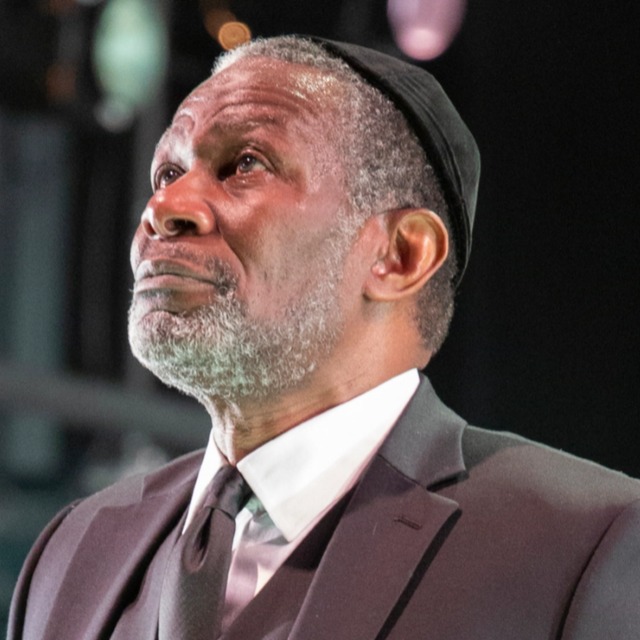
At times deeply shocking, sugar-coated with goofy humour, this is an extraordinary must-see production of Shakespeare's The Merchant of Venice, relevant to our dark times so filled with hatred, in particular racism and religious intolerance but also critiquing justice and capitalism. Directed by Arin Arbus of New York’s Theatre for a New Audience, a mutli-racial and ethnic company, Shylock is played by John Douglas Thompson, a Black actor, emphasising the similarities between anti-semitism and racism against people of colour. Set in the near future, this is a Venice more like an American dystopia with a concrete Brutalist set, contemporary grey suits and mobile phones, where street culture meets ‘For sooth.’Shylock’s cruel bond, a pound of flesh for a defaulted loan, if enacted will inevitably kill Antonio. Revenge indeed. The racist abuse that has led to Shylock’s attitude is cleverly referred to in throwaway asides, rather than major scenes, such as references to a hypocritical Christian society who treats him ‘like your asses and your dogs and mules’ emphasised by the cast continually spitting on Shylock so that we have sympathy for him. Yet it is Shakespeare’s genius to make Shylock a flawed man. The tragedy being that in his insistence on getting his bond, he loses his own humanity. The shock of Shylock’s treatment in the court scene is so visceral his faults are forgiven, not least by Thompson’s outstanding performance.With dignity, grace and a gravelly voice, Thompson elevates what is frankly not one of Shakespeare’s best plays with its ramshackle structure and unconvincing folktale-like casket scene, into a deeply humane portrait of Shylock. Thompson speaks his lines as if thinking aloud, so the audience can follow as if he is speaking English as comprehensible as that of today, not just iambic pentameter.Not all the cast have this facility, even Portia (Isabel Arraiza) is rather affectless in the first act but comes alive as the doctor of law, Balthazar, in the court scene and the famous ‘quality of mercy’ speech. The bit parts are hilarious, enlivened by caricature New York street swagger, high fives, ironic facial expressions with enough basic non-verbal humour to please our modern day ‘groundlings’ going by the whoops from the audience. What a joy to actually find Shakespeare’s comic characters funny when so often the humour passes us by. Particularly memorable are a drunken Gratiano (Haynes Thigpen) and Lancelet Gobbo (Matthew Saldívar). Rather confusing is Ariel Shafir’s interpretation of Bassanio in a similar style, all ironic facial tics but no clear emotional reactions. Purists will point out that the gay overtones of his and Antonio’s relationship is not suggested in the text - overt friendships between men were common in Shakespeare’s time. Perhaps this explains Shafir’s ambivalent performance.Other issues are a gratuitous abusive sex scene between Lorenzo and Jessica, a flagrant distortion of the original where Jessica has chosen the man she wants to marry (unlike Portia who must obey her father’s wishes) and there is a happily ever after marriage. But these are quibbles. Twists or additional material themselves can be hugely successful as is the chanting of the Kol Nidre, the Jewish Prayer on the Day of Atonement, with which Ms Arbus ends the play, underlining the sad breach in Shylock and his daughter’s relationship.A modern playwright would probably have ended the play after the court scene. The sub-plots that follow need resolving but are a little tedious. However, Thompson’s portrayal of Shylock’s humiliation and his abject exit will stay with you and more than compensates. This is a moment you won’t forget and leaves you with much to ponder on.

Lyceum Theatre • 18 Jan 2025 - 15 Feb 2025

Scottish Ballet: The Nutcracker

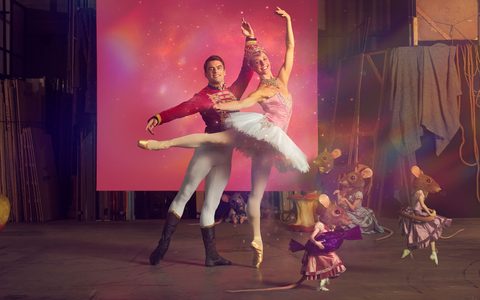
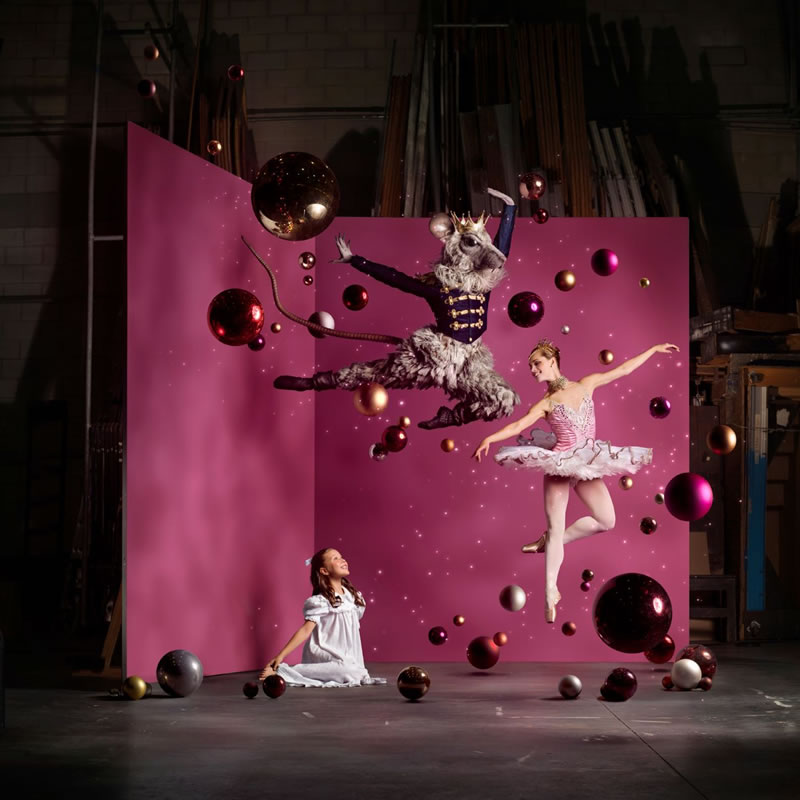
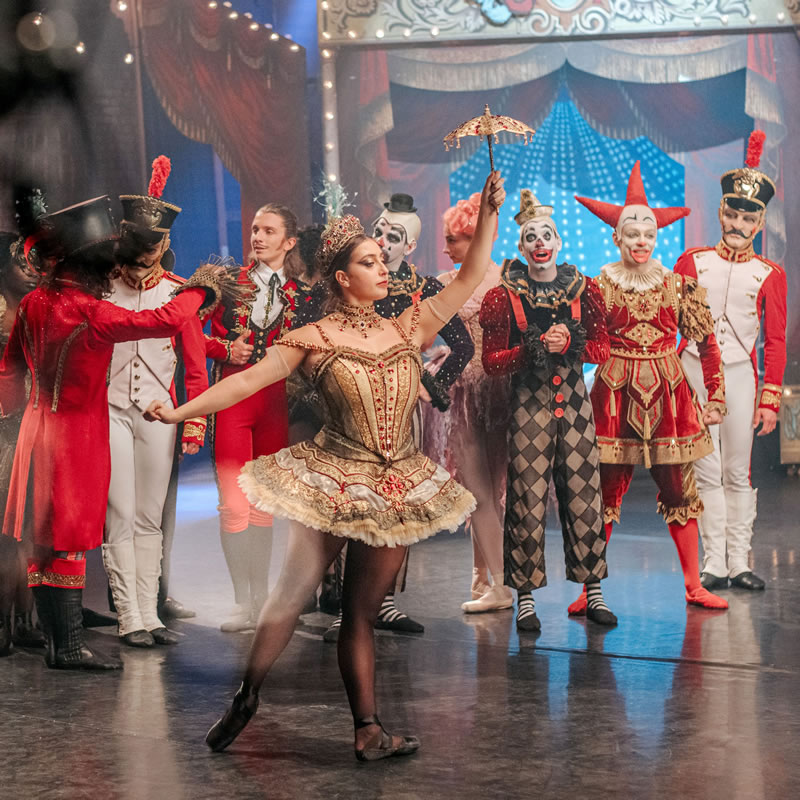
An exquisite production, bringing glitter and joy to lighten the wintry dark. Scottish Ballet’s The Nutcracker gets better and better. The magnificent Tchaikovsky score, performed live by the Scottish Ballet Orchestra, combines with Lez Brotherston’s set and costumes, complete with snowflakes, two giant Christmas trees (one silver), baubles, costumes and dance to die for. What more could you ask for? The 2021 production made radical innovations with a female Drosselmayer on alternate nights and revised choreography for the Sweets to address cultural insensitivity. Now in its 10th year the Artistic Director, Christopher Hampson has continued to tweak it to perfection with more dramatic focus and new choreography melded into Peter Darrell’s original, not only by Hampson but through the inspired idea to invite members of the company to choreograph the Sweets. On the night I saw it, we were also treated to Nicol Edmonds moon-lighting from the Royal Ballet as the Nutcracker prince.Act I at the Stahlbaums’ party is now full of drama and humour from guests, children and servants - look out for the discovery of a dead rat and the eccentric aunts in black (Amy McEntee and Kayla-Maree Tarantolo) who appeared in 2021 but have developed their antics. Not least, a female Drosselmeyer, (Melissa Polson) flashes the lining of her sparkling blue cape more often and she is now a children’s party magician, making her less sinister than before as she pulls ribbons out of a hat or hypnotises one of the aunts. The mice, performed by children, wear Edwardian dress and carry stolen giant sweets, plus an apple-core. Their tails are draped over their shoulders elegantly and the fight between the regimented, masked and moustached soldiers against the Rat King is satisfyingly shorter and tightly structured, created by Nicholas Shoesmith. The Rat King (Javier Andreu)’s brief appearance makes him less frightening with the nice touch of Clara jumping on his back.In fact, Clara (the charming Esme Noronha) is given prominence throughout but particularly in Act II when she watches the dancers and sometimes wanders through them and gives a twirl. The Snow Queen (Gina Scott) and Sugar Plum Fairy (Marge Hendrick) and their attendants are superb, consummate performers of the pure classical technique. The Nutcracker Prince himself, the handsome Nicol Edmonds, added class not only through his breath-taking leaps but his stately yet open demeanour.In the Realm of the Sugar Plum Fairy, the ‘Russian’ dance created by Sophie Laplane is hugely acrobatic and boisterous, including chest-bumps in fascinating red and gold Russian clown outfits with triple-pointed headdresses.The ‘English’ dance by Nicholas Shoesmith, features a Jack Tar mixing tremendous classical leaps with horn-pipe steps; the ‘Spanish’ by Javier Andreu is traditional Spanish though not flamenco, with striking red costumes, and includes the nice touch of presenting Clara with a fan; the ‘French Bon Bons’ by Jessica Fyfe, inspired by pure French classical technique and most interestingly by Edgar Degas’ paintings, wear distinctive long pink ragged tutus; the ‘Chinese’ dance, choreographed by Annie Au, introduced in 2021, replaces the previously dull costumes with eye-catching Chinese-style white-edged, with blue and gold.Much tighter and more child-friendly, it is definitely a production to introduce a seven or eight year old to as their first ballet. And with all the glamour, sumptuous costumes and the high standard of classical technique, mixed with national dances to please adults plus new elements, even if they’ve seen The Nutcracker many times before will transform this into a magical experience.

Festival Theatre • 8 Jan 2025 - 18 Jan 2025

Treasure Island

This charming re-telling of Robert Louis Stevenson’s classic tale, set in Leith and Orkney, by Duncan McLean, directed by Wils Wilson, is a festive, yo ho ho version full of pratfalls and piratey humour and will appeal to a Scottish audience. More of a ceildhe than a play, there is also Orcadian-style music composed by Tim Dalling, both recorded and played on stage by the talented cast on strings, accordian but also an inventive array of instruments including gongs, bells and jew’s harp. There is much to recommend. Starting off in a Home for Reformed Pirates, Slim Jean Silver has a puffin, not a parrot, and is played with a villainous glint in her eye by the disabled actor, Amy Conachan, in a wheelchair and Jim Hawkins (Jade Chan) also a gender swap. Alex Barry’s set is superb, economically evoking a ship with ropes and tackle descending from the ceiling. A step-ladder becomes the foc’scle as the cast chase each other round the set. It’s non-stop action. Sadly a bit samey, though Act 2 ramps up with a terrific storm, a flapping sheet the mains’l and later a shadow screen to show a momentarily frightening pirate, who turns out to be Ben Gunn (Tim Dalling), a brilliant cameo, full of much humour about cheese. Humour is the hallmark of the show. Nothing too scary for the weans. The star is the puffin, a delightful character, designed by Sarah Wright and manipulated with great skill by Dylan Read.

Lyceum Theatre • 28 Nov 2024 - 4 Jan 2025

Assembly Hall

A curate’s egg, flashes of brilliance but with a first third of tedious mire, Kidd Pivot company’s Assembly Hall, about an amateur medieval re-enactment society, will divide audiences. If you are expecting dance you will be surprised by what seems to be a play. Hyper articulated gestures and physical movement lip synched to voice-over dialogue in choreographer Crystal Pite and writer/director Jonathon Young’s now familiar style start the show, goes on and on and one longs for some dance.A parody of committee meetings with their rules and the tricky question (whether to dissolve the society) endlessly postponed provide humour as do comments like ‘Are you dead?’ to Dave (Gregory Lau) lying on the floor, the supernumerary member only there to fill a quorum. Eventually there is choreography of such brilliance you understand why Crystal Pite may be the most sought after choreographer of the moment. There are stunning solos and duets, performed with incredible skill, swirling pivots, lifts, interspersed with echoes of the physical theatre, a maiden in distress in white who throws back her long black hair in a pose as histrionic as Sarah Bernhardt, and memorable images, the king in tall pointed crown, or the society in full Arthurian armour in stilted moves enacting a battle to Tchaikovsky’s First Piano concerto. What is real life and what is mythic history is unclear as motifs and themes intermingle such as the maiden’s ‘wound’ which will never be healed and at last this is a show to remember.

Festival Theatre • 22 Aug 2024 - 24 Aug 2024

Nigamon / Tunai

Nigamon/Tunai is an inspirational immersive ritual created by indigenous artists, Émilie Monnet from Canada and Waira Nina from Columbia who seek to draw attention to the destruction of the environment by deep mining of copper in the Columbian Amazon. This powerful piece, a meditative experience, will surely affect you deeply and appreciate the urgency of this ecological crisis.The set is in the round, full of a multitude of things, ten living trees and amazing objects, mainly made of copper and we are given time to wonder: a sitar, gourd-like vessels hanging from the ceiling or placed by smaller pools. The women slowly move around the space performing rituals, as time slows and you learn to listen.Nigamon/Tunai means ‘song’ in their respective languages, Monnet’s Anishnaabe and Nina’s Inga. They believe that not only birds but trees, stones and water are sentient beings and can sing to us. There is the sound of water poured into the copper vessels, or dripping off their trailing wires into a pool below, a large stone emits a moan. It’s a thrilling moment to hold the trunk of one of the trees to feel its vibrations. Later we learn that all the sounds are activated by water made by inventions created by Leonel Vasquez who specialises in making the inaudible audible.Chanting, the voices of indigenous leaders in the Inga and Anishnaabe languages and others in Spanish, French create a magical, mysterious atmosphere. Bird song created by the two women, especially sounds created by a nose-flute is a highlight. A traditional instrument, the shell of a tortoise, Yagamama, is stroked by Waira Nina until it emits a weird humming.The importance of the Yagamama, protector of waters in Inga creation stories, is dramatically enacted by creating a tortoise shell pattern with light over the central pool, then destroying it with thunder and lightning, symbolic of the destruction caused by deep mining for copper.The spell of this ritual performance is powerful enough to encourage us to ponder on the meaning of the rituals and to supplement this there is audio-information and a post show talk.

The Studio • 15 Aug 2024 - 18 Aug 2024

This Is Not Romeo and Juliet

Not to be missed, hugely inventive, an extraordinary show, This is Not Romeo and Juliet choreographed by Danish Palle Granhøj is experimental but with broad appeal.Possibly tongue in cheek humour, a character runs across stage nude shouting ‘Juliet’, then later adding clothes bit by bit. It is indeed not Shakespeare’s Romeo and Juliet but of course, there are references everywhere: three couples are all called Romeo and Juliet, and the music is all excerpts from pieces entitled Romeo and Juliet (or Juliette) by Gounod, Berlioz, Mancini, Nino Rota’s Zeffirelli’s film, Ravel, Vasks and by the two musicians on stage, Dalia Dedinskaite and Gleb Pysniak.Set in war-time, (unlike Shakespeare, not warring families but countries), this is not explicitly referenced until the end, but the maelstrom of heightened tensions and rule-bending sexual relationships typical of such times is explored.A mature couple, Sofia Pintzou and Marius Pinigis, are in yer face, expressing the full range from neurotic insecurities to passionate attraction, the female literally leaping onto her partner followed by simulated aggressive sex. The younger pair, Dominyka Markeviciute and Povilas Jurgaitis, by contrast are more reminiscent of Shakespeare, sensitive, hesitant and romantic. The two musicians plant a delicate kiss on each other, whilst moving across stage continuing to play. As the show progresses, there are unexpected developments of character or changing partners, a LGBTQ aspect perhaps, though it might just be brotherly or sisterly affection, it is up to you the audience.The unusual choreography, baffling at first, then more and more convincing, is the result of Granhøj’s ‘Obstruction Technique’ a development of Nancy Spanier’s. A dancer’s movement impeded by another dancer tries to continue with the first movement, now transformed in fascinating ways. This might be caused by something as simple as a kiss where glued mouth to mouth they continue to dance around the stage. There is no need to have a scholar’s grasp of the technique to appreciate it. The point is this show. Does it work? A resounding Yes. It can be delightfully amusing, but at other times the original angles and contortions reveal deep psychological insights which get under one’s skin and enter one’s psyche.At the very end shots are fired and each of the performers in turn falls down dead. It seemed rather cheap, which spoilt – for me – an otherwise outstanding show.

Zoo Southside • 13 Aug 2024 - 18 Aug 2024

What songs may do...

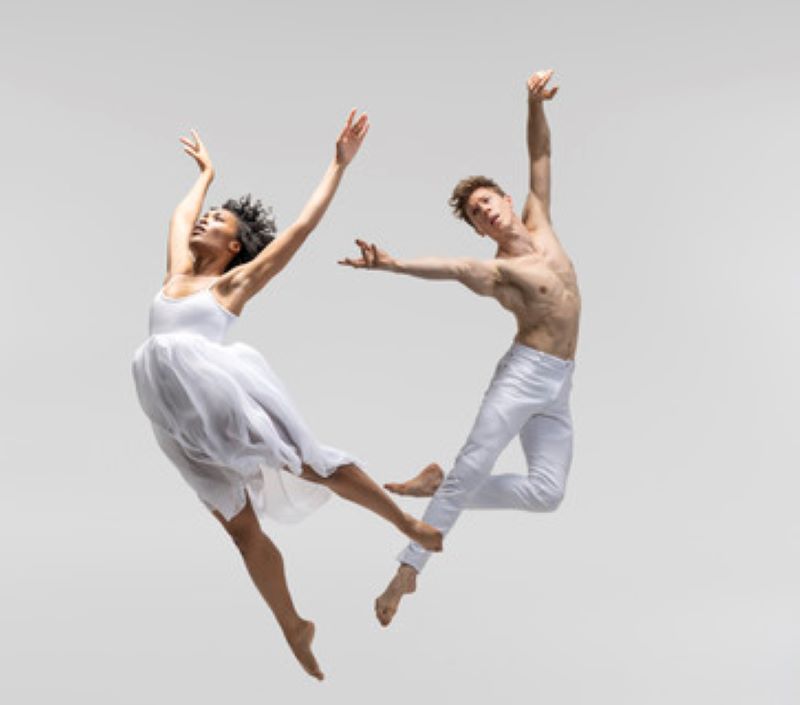
Impressive dancers and choreography by Mathieu Geffré in Rendezvous Dance’s What Songs May Do should have had everything going for it. Set to Nina Simone – not her best hits, but a selection of her more mournful songs movingly accompany a retrospective piece about a gay relationship; but sadly after a brilliant start, the piece disintegrates.The two dancers, Paolo Pisarra and the taller Oliver Chapman holding hands enter from the audience to Ne me quitte pas, and take us through the stages of nervous beginnings, exhilaration, antagonism and potential reconciliation. Displaying amazing skill in complicated moves, balletic lifts and more expressive grappling, twisting and turning, there are wonderful contrasting moments of stillness as they unbutton each other’s shirts. There’s a superb sequence of stylised slinky moves in a sensuous sexual encounter. But a first quarrel is enacted literally as a fisticuffs without any choreographic input. Mouths open startlingly suggesting animalistic desire but continues for so long it becomes weird. At one moment Oliver performs a headstand for no good reason.The show then disintegrates: the dancers standing still for tedious long periods. Literal silences show how much the emotion is dependent on Simone. There are efforts to create drama with a blackout plus lighting spots but the stop-start ending goes on and on.Originally a 12 minute version for Dance Company Wales in 2015, the piece was extended. This may explain the padding. Despite some impressive choreography, a show has to have an understanding of drama to win more stars.
Assembly @ Dance Base • 6 Aug 2024 - 11 Aug 2024

These Mechanisms

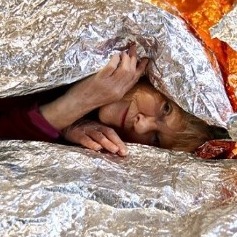
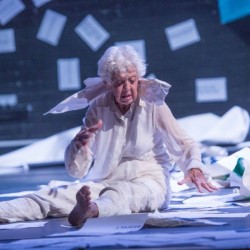
Absurd, joyful and breath-taking, this brilliant wee gem might be the dance/physical theatre show of the fest. 80 year-old, Christine Thynne holds us in the palm of her hands. Who would have thought such wit and humour could be conjured out of random materials: planks of wood, plastic bottles of water and ladders, orchestrating a repeating beat with her toes on a loop pedal and performance pad, with a sly smile to her accomplice and guitarist, Calum Paterson. Electricity and water mixed. Oh dear! But this show is about risk.Lying on a table at the start of the show she talks about the difficulties of getting out of bed for an 80 year old, itemising each arm, leg and pelvic movement needed before she can sit up. This is in speech only, no movement. Amazingly, the audience is rapt, especially when she then demonstrates these actions. It’s a clever way of fooling the audience. For this 80 year old proves to be extremely agile later, playing not only with the forces of gravity of the random materials on stage, but demonstrating an impressive balance herself, if a little wobbly at times, taking risks a younger performer would hesitate at. There are also moments of gloriously abandoned dancing to one of Mendelsohns’ Songs without Words: surprise and joy the hallmarks of the show.‘This performance isn’t about - or attempting to say - anything,’ says Robbie Synge, the show’s co-creator and director, disingenuously. Despite no story or autobiography, it celebrates with gobbledegook script, dry ice, chutzpah and gardening gloves for ‘health and safety’ that volumes can be told about Christine’s indomitable spirit, an inspiration to us all. The audience were rapt throughout. This collaboration between Synge and Thynne has evolved over decades. Long may it continue.

Dance Base • 4 Aug 2024

Lewis Major: Triptych

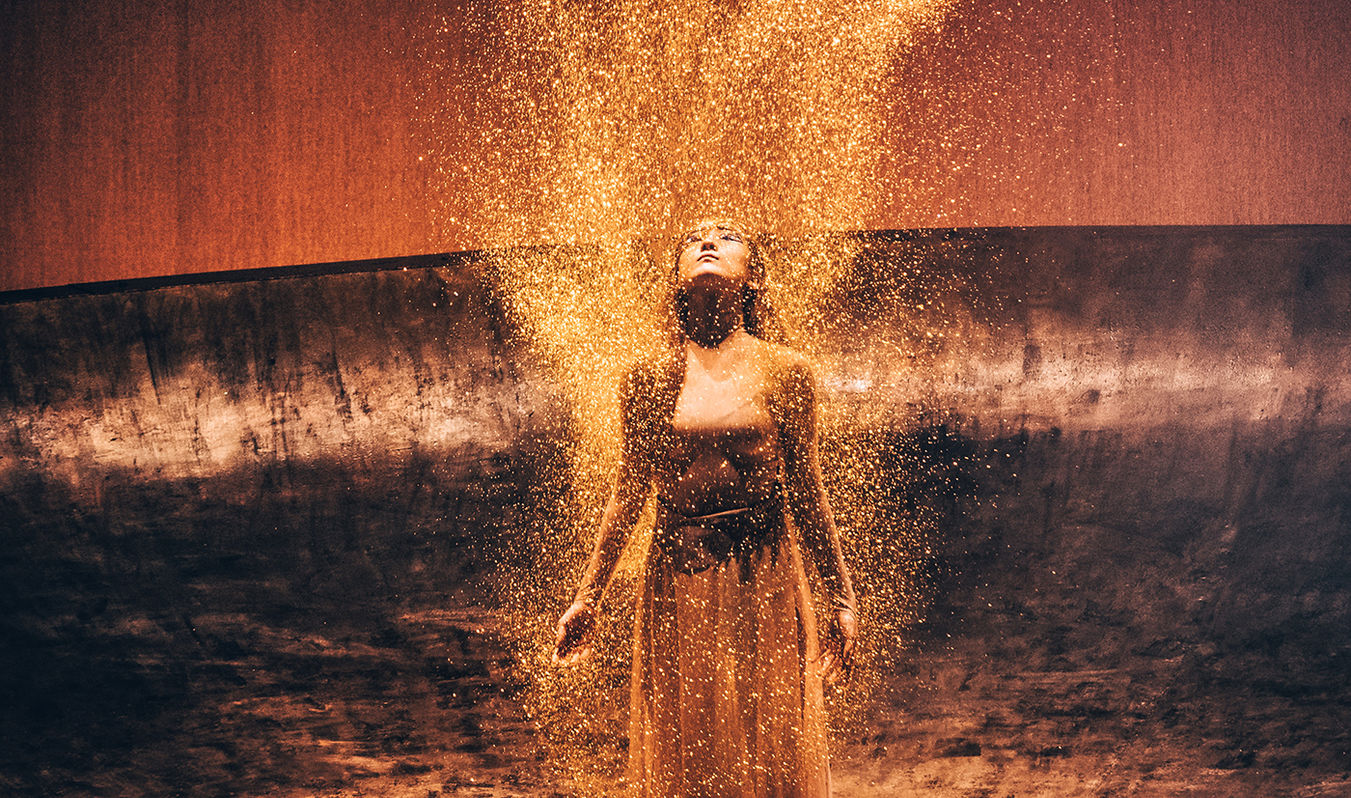
Mesmerising and minimalist in style, this quadruple bill of dance and light will stay in your memory as dance, lighting, and music all meld into an exquisite whole. The first piece, Two X Three, is choreographed by Russell Maliphant, and echoed in style by the Australian Lewis Major, who choreographs the second piece, Unfolding, and has been mentored by Maliphant and worked with Akram Khan, Sidi Larbi Cherkaoui, and others.Two X Three was originally created for Maliphant’s wife, then expanded for three dancers in three spotlit diamond-shaped areas, designed by Michael Hulls. The dancer at the front, Clementine Benson, is arresting, standing still with one arm raised, which she then slowly lowers to the sound of a single electronic note falling intermittently like a water drop. A slow turn of the head. The audience is rapt, proving that less is more. Two more dancers in spotlit diamonds behind her eventually join in, copying her movements. The precision and simplicity are intensely moving, considering how abstract it is. All is in the intensity.In Unfolding, a wide shaft of light (designed by Fausto Brusamolino) rakes the stage, and the dancers, joined by Macon Riley, are briefly illuminated. Again, the choreography is simple, less static, with rotations and arms raised in fifth or third, but as the electronic music becomes more frantic, the light washes over the stage like foam. As the dancers lie on the floor, the light plays over them, then shrinks to a single circle before it disappears. Spellbinding.Lewis Major is not only the choreographer but also the lighting designer of the last two pieces, Act 1 and Act 2 of Epilogue. Act 1 starts with Elsi Faulks balanced on the back of Stefaan Morrow, who is lying on the floor. An amusing beginning develops into an astounding exhibition of strength by Morrow and agility by Faulks, as her body never touches the ground throughout the piece while he lifts and swings her around his body, over his shoulders, and back again, twisting and turning her. Morrow’s panting is clearly audible, making the stamina required evident. The lighting is more sombre, with much of the stage in darkness, matching this almost grim sequence of bravado.The mood is beautifully contrasted in Act 2 with a meditative, slow solo by Clementine Benson, who appears centre stage out of the darkness in a nude-like costume with her blonde hair loose down her back. One hand is raised, and her statuesque posture is reminiscent of Maliphant’s in the first piece. White powder falls gently from her shoulders, and then as she moves slowly, more powder descends from her upturned hands, her stomach, and her back, as she creates circles with the powder on the floor with her feet. Finally, as she shakes her hair, a torrent.Lewis Major is clearly an emerging star as a choreographer—quite a journey for someone who started life as a sheep-shearer.
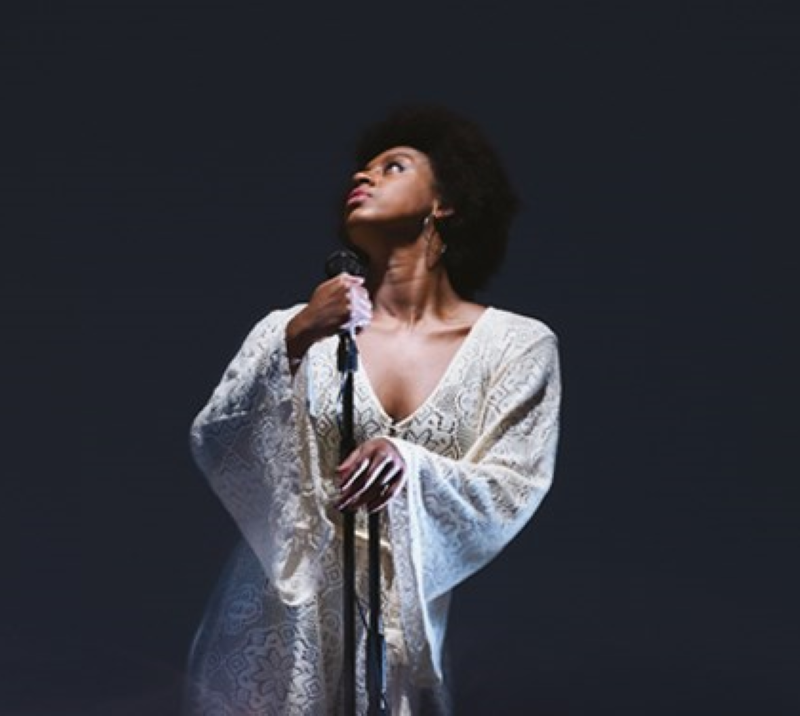
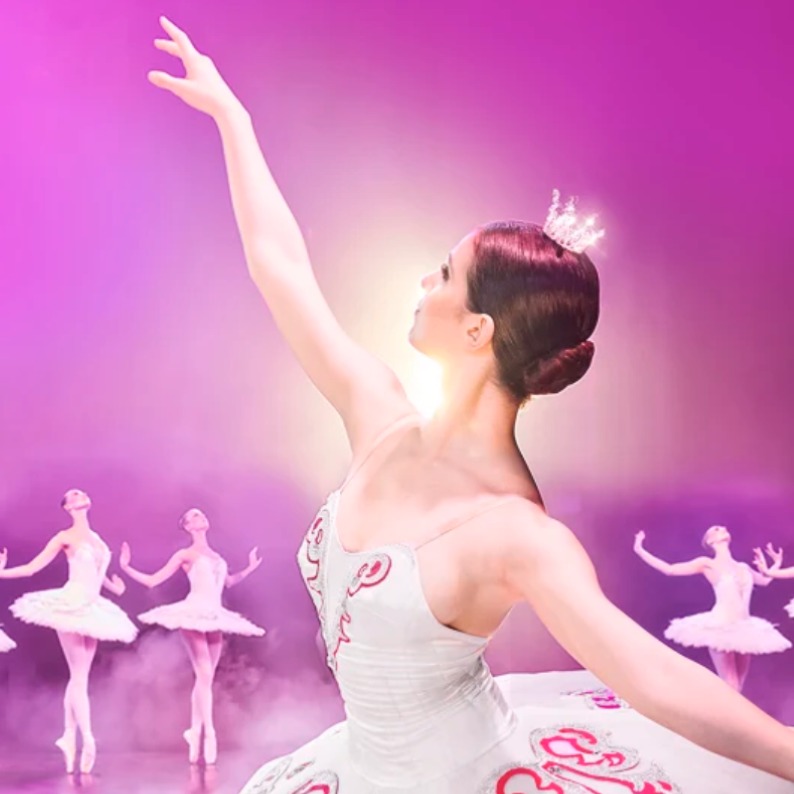
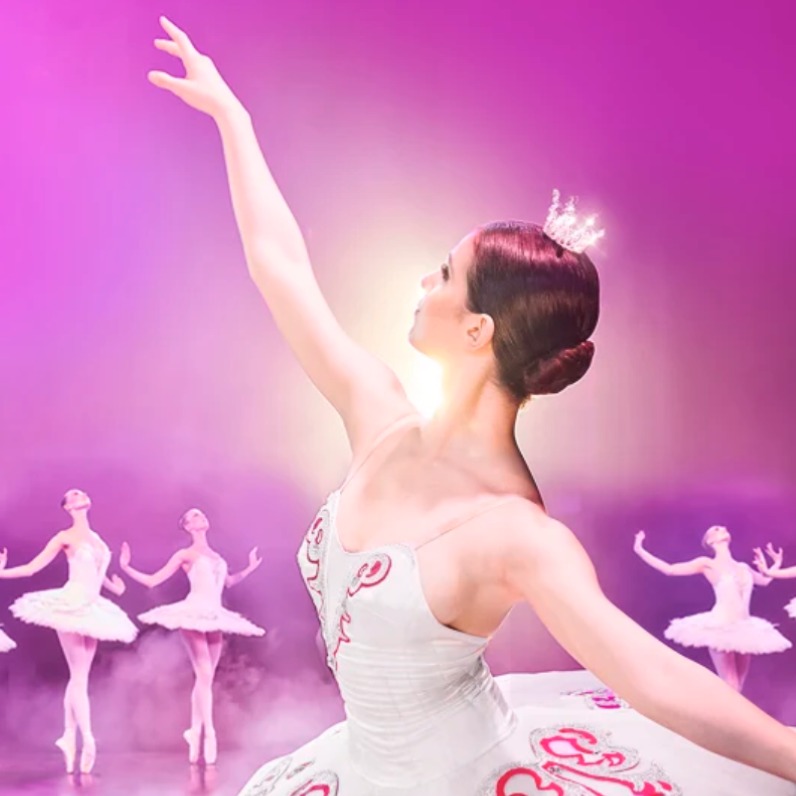
Assembly @ Dance Base • 2 Aug 2024 - 25 Aug 2024

Sleeper

Imaginative and atmospheric with striking visual images, there is much to recommend in Jajack Movement’s Sleeper, choreographed by Kim Yumi. It is an allegorical tale tackling the climate crisis with shamanistic ritual and dance, both traditional Korean and contemporary.Sounds of thunderous waves suggest the oceans are rising as three bedraggled females in black, like creatures destined to drown, crawl or drag each other towards a large transparent box covered in cling film. Curled up on the floor inside is a half-visible man. This is the Sleeper, representing humankind, who is responsible for the climate crisis and must wake to save the world.As he tears his way out of the box, the females return in long white dresses, symbolising purity, and enact a shamanistic ritual involving bangwool (bells), and gopuri (knot-tying) - here represented as long wide sashes of blue, red, and yellow, a healing ritual to release pain.There are arresting images: the box radiating light as if set on fire; the man’s face and outstretched arms against the cling film, desperate to escape; the virgins bent over their tinkling bells, turning this way and that. The choreography is simple, more like physical theatre than contemporary dance, though the man’s solo, as his trembling builds up to frantic shaking, creates a powerful climax. Following this, the ritual knot-tying scene in which the females wind the colourful sashes around his body, though a beautiful image, lacks emotional drama, and the show ends with a sense of bathos.

Assembly @ Dance Base • 2 Aug 2024 - 18 Aug 2024

Edward Scissorhands

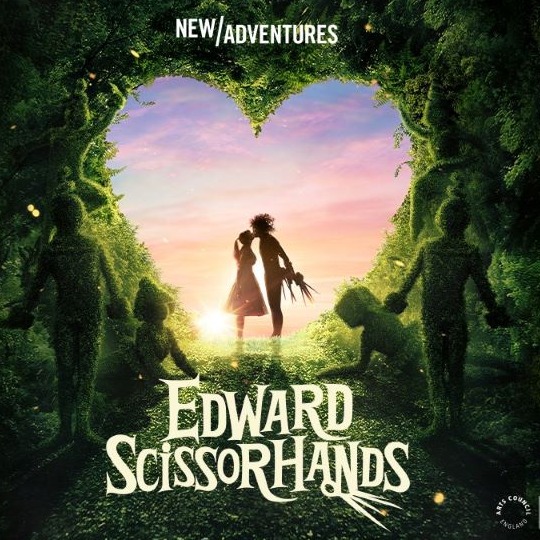
A sure fire winner, a tear-jerker with comedic appeal, Mathew Bourne’s New Adventures’ Edward Scissorhands, is based on Tim Burton’s 1990 film but reimagined for dance. The theme of a boy with scissorhands and therefore an outsider who fails to gain acceptance is one which fits with our times. Premiered in 2005, revived in 2014, Gothic (not too scary and suitable for all ages from 8+); it’s just a pity that the choreography is not quite up to scratch. A rather muddling prologue showing a gravestone engraved with Edward’s name leads one to suppose this is Edward Scissorhands’, but no. An eccentric inventor, Frankenstein-like, has created a ‘boy’ to replace his dead son and this is the first son’s grave. However, things take off. Terrific thunder and lightning and a huge silver moon introduce a Gothic atmosphere.The Pink Panther-like steps of a gang of teenagers provide humour on their way to the inventor’s lone castle. Their trick or treat antics give the inventor a heart attack and he dies before he has provided his new Edward with hands instead of scissors. Lez Brotherston’s designs are superb as ever. Not only the Gothic opening set, also swirling snow and a stunning Ice Angel. The weird angle of the Hope Springs set is particularly effective, an all-American 50s suburb of identical clapboard houses with picket fences where Edward is taken in by a kindly housewife, Mrs Peg Boggs (Sophia Hurdley). He also falls in love with her daughter, Kim (a cheery, pony-tailed Holly Saw) and the jealousy of her boyfriend Jim Upton, (a brutish Ben Brown) the Mayor’s son drives the plot. Stephen Murray as Edward has a suitably morose, white painted face like Pierrot but a range of expression is lacking. Dancing without being able to touch his partner is a challenge but the choreography is again rather limited. Each of the dancers deftly demonstrate their character as they move about their day, most memorable being the two gays with a baby and the Evercreech family of religious fundamentalists. There are brilliant details like the fixed grin of the Mayor Franklyn Upton III (Glenn Graham) and the nymphomaniac Joyce Monroe (a stand-out performance by Nicole Kabera) with shocking auburn hair and tight orange leggings. Her attempt to seduce Edward is hilarious - a never seen before on stage erotic moment as she sits on a vibrating tumbledrier. The problem starts with the Act I ensemble dance at a barbeque. A mash-up of rock and roll with other unimaginative moves that goes on far too long. Luckily both humour and drama are paramount in Act II. Edward becomes a celebrity as a barber creating spiky hairstyles like his own and even the poodle gets an extraordinary make-over. His topiary designs are a hit and we are treated to a dance of topiary creatures. The choreography of the Christmas Ball is a much more successful ensemble piece and could have gone on for much longer. The costumes are gloriously glamorous, especially a striped black and emerald striped one and Joyce’s elegant long black dress slit to reveal red tights.There are two duets for Edward and Kim - a fantasy sequence with normal hands, and then a love duet where, despite the scissorhands, he is able to balance Kim on his shoulder. The drama ramps up to a bloody death but an unfortunately confusing end. What happens to Edward? Is he dead? Has he run off?

Edinburgh Festival Theatre • 14 May 2024 - 18 May 2024

When Mountains Meet

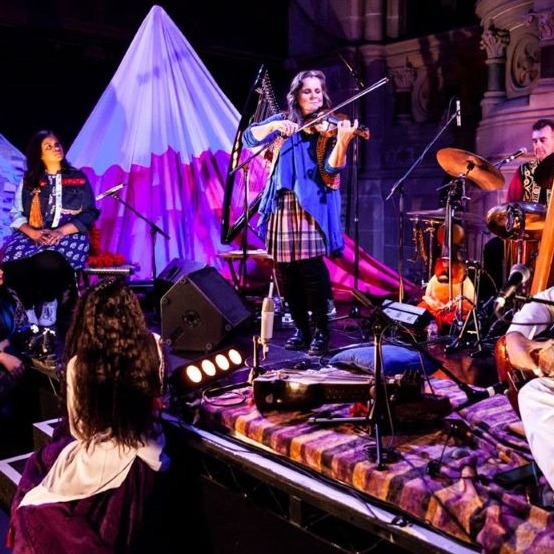
Heartfelt, feel-good, this is a highly enjoyable performance. A Scottish-South East Asian fusion of music, story-telling and gig theatre, Where Mountains Meet is composed and written by Scottish/Pakistani Anne Wood. It is also a true life story about her journey as a young girl to Pakistan in search of her identity and to meet her father for the first time.As the audience enters a pleasant atmosphere is created with a fusion of Scottish and Pakistani music played on electric harp, violin, tanpura drone and sitar played by the musicians on stage. The three actors, dressed in half tartan, half Pakistani gold embroidered outfits, are welcoming, moving amongst the audience showing us to tables cafe-style set with china tea cups for kahna (green tea flavoured with cardamom and cinnamon) and ladoo (delicious saffron sugary cakes). An effective minimal set (ideal for touring) of three tall triangular sheets to the side of the room on which coloured lights play symbolise the Scottish Highlands and the Himalayas. Pebbles of gneiss from the Highlands are also set out on the tables and have an emotional role to play in the script. Most amusingly a song about ‘The Moine Thrust’ provides an easily digestible geological history of the mountain ranges.Through song, a series of tiny dramatic scenes and some dance we follow young Anne played by Iman Akhtar (while real life Anne plays the violin) on her journey to meet her father. Throughout, there is a fusion of Scottish folktales with Urdu and Punjabi poetry, traditional ballads, strathspeys or reels with South Asian Teental. Particularly beautiful are the contrast and similarities of the solo Gaelic singing by Mary Macmaster on electric harp and the solo singing of raags by Rakae Jamil on sitar where despite the differences, there are similarities of tonalities and decoration. Anne’s father, a jovial charmer, is played with great sensitivity by Jamie Zubairi expertly combining warmth with embarrassment at the social predicament his daughter has placed him in. Farouq, her half-brother, played by Hassan Javed, also plays an array of bit parts: bazaar salesmen, an old woman, with great humour. At times the emotional scenes between father and daughter verge on sentimentality but Iman Akhtar as Anne plays with a charming blend of western-style independence then painful confusion and incomprehension of her father’s treatment of her. It is left to Farouq in his central role as half-brother to explain to Anne that she is ‘taboo’. Despite the feel-good factor of the show as a whole, it faces up courageously to the harsh reality of attitudes to illegitimacy in Pakistan. However, we are left with so much to admire and rejoice in, to appreciate the similarities and differences in Scottish and Pakistani culture through the music and song but above all, to sympathise with this poignant story and assert our common humanity. The audience were ecstatic.

The Studio • 25 Apr 2024 - 26 Apr 2024

The Girls of Slender Means

The delightful wit with its dark undertow of Murial Spark’s The Girls of Slender Means is caught brilliantly in this adaptation by Gabriel Quigley, directed by Roxana Silbert. Starting in the 60s the play then flashbacks to post-World War II between VE Day and VJ Day 1945 in a boarding hostel for ‘the Pecuniary Convenience and Social Protection of Ladies of Slender Means’, founded by the Princess May of Teck and known as the Teck Club in Kensington. The ‘girls’ (young women under 30) are caught between coming to terms with memories of the horrors of the Blitz and hopes for their future in the postwar ‘New World’. The plot centres round five girls whom we see perform a daily ritual of walking around with a book on their heads chanting ‘Poise is perfect balance, an equanimity of body and mind.’ Deportment and elocution seem to be their chief concern. The lead, Jane Wright (a strong and moving performance by Molly Vevers) is Scottish who nicely uses an occasional Scots word - such as ‘in a dwam’. She has a perpetual hunger, needing to nourish her ‘brain-work’ as a would-be journalist with literary ambitions in the days of rationing. References to disgusting spam, coupons for food and clothes (plus margarine which also has an amusing plot role) all evoke the era wonderfully, as do the spot on high shoulders, three-quarter length sleeves and the semi-bouffoned hair with side clips, designed by Jessica Worrall, inspired by Lee Miller’s photos in Vogue. There is also a stunning evening dress belonging to an aunt of one of the girls. ‘A work of art you can live in’, it is a Schiaparelli in a fuschia pink, the colour also invented by Schiaparelli, which is loaned out between the girls on their dates. Poverty and deprivation are the girls’ lives but all the best people are poor, says Jane. A backdrop showing bomb-damaged London is a striking set and one of the girls remarks on how staircases seem to survive leading to nowhere - a semi-humourous remark typical of the play. The set is cleverly minimal with moving pieces to suggest the girls’ sitting room with its tiny bathroom window (also a plot device where the girls must be ‘slender’) and the Smokey nightclub economically created by hanging blue twinkly strips.Of course, there’s a love interest, Nicholas Farringdon (Seamus Dillane) a louche poet who unconvincingly claims to be an anarchist. His conversion to Catholicism and becoming a missionary priest in Haiti in later life seems a little unlikely also. Other men are imaginatively portrayed by uniformed mannequins whom the girls whirl around in the Smokey nightclub but men, apart from Nicholas, are offstage and do not feature in the girls’ dreams so much as Beauty, Dresses and Poetry. These are what the girls value to keep the nightmare world of the war at bay. Set pieces show off their characters: Selena, beautiful but duplicitous, sings ‘I’m beginning to see the light’, in a lovely voice the first time, and, a second time with great skill breaking down. Pauline often wears the Schiaparelli to drive around in taxis to meet a famous and good-looking actor, Jack Buchanan and it becomes slowly clear things are not quite as she says, but her way of coping. Jo, (a poignant performance by Molly McGrath) is a vicar’s daughter, a seamstress, who reveals a skill for reciting poetry, in particular Gerald Manley Hopkins - the five nuns who drown commemorated in The Wreck of the Deutschland, of course, reflect on the troubles that the five girls face.Poetry, elocution chants and song are threaded through with background historical references such as a possible Labour government and how it might change the world, in particular the need for a National Health Service. This lightness of touch is Spark at her best but the hints of darkness grow to a devastating flashback of Jane working as a telephonist for Intelligence where the scrambling noises have damaged her hearing and still plague her, bringing back horrific memories of what she heard, a new reality undercutting the new world promised by Labour. This darkness is a prelude to the play’s ending which results in the death of one of the girls. In reflection, the darkness has been woven through from the beginning, despite Jane saying she ‘never felt so alive’ as during the war.Overall, a superb production, but unfortunately the girls’ screeching voices (apart from Molly McGrath as Jo and Molly Vevers as Jane) frequently made it difficult to tell one word from another. Such a shame that actors are not taught how to project their voices properly nowadays. It also meant that the show narrowly missed getting a fifth star from this reviewer.

Lyceum Theatre • 19 Apr 2024 - 4 May 2024

James V: Katherine

A brilliant gem, witty, gallus (cheeky) James V: KATHERINE by Rona Munro (a Raw Material and Capital Theatres Production) pulls no punches. The humour is undercut by the grim historical subject matter: the burning alive at the stake for heresy of Katherine’s brother, Patrick Hamilton in 1528 in St Andrews and how this impacts on the fictional love between two women, Katherine and Jenny. As with her famed James sequence, the forgotten history of the Stewart Kings, it has always been Munro’s aim to make the invisible visible, so why not reveal the possibility of lesbian love in the 16th century? The intricate complexity of the Scottish Reformation is made accessible by focusing on the agonising by Patrick Hamilton on whether to stand by his heresy and therefore face execution and Katherine’s own dilemma during her trial for heresy. In contrast to the panoramic historical sequence with vast casts of the James plays, we are offered an intimate, stand-alone piece ideally suited to a small chamber like the Studio Theatre. The to and fro of the conversational witticisms, even more effective with the occasional Scots vocabulary, make the historical issues more personal and affecting, though the anachronisms ‘Off we go then’ do jar a bit. However, modern expressions like ‘The Pope is shitting it’ are very funny. The relationship between Katherine and Jenny is at times erotic but sensitive and beautifully done, particularly moving when the painful recollection of presumed rejection is explored. Lesbian love is given full honour as opposed to bigotry: ‘If we cannae love like this in Paradise, why would we want to go?’ asks Jenny.There is so much fascinating information in this play, especially the physicality of details such as that it rained on the day Patrick was executed so that the wood was damp and it took six hours for him to die. The exploration of homophobia and misogyny of the Scottish Reformation reveals more shocking facts (e.g. accusing monks and nuns of sodomy) and James’ throw-away line ‘we burn witches, obviously’ not least one example of the casual dismissal of women throughout the play (such as his remark on Jenny’s ‘invisibility’) which also make this play, despite advances, still relevant today. The parallel with present day religious conflict is clear through James V’s ruminations on contrasting ways of looking at martyrdom: does it stamp out heresy, or electrify the causes and create more adherents?Catriona Faint as Katherine is stunning: braw, in yer face but melting in erotic love scenes with Jenny or pleading her case during the trial. Alyth Ross as Jenny plays her as more than just the loved object, and is a strong convincing woman in her own right. Sean Connor’s energy and forceful delivery creates on the edge of the seat tension in the double roles of the Constable and James V . Sadly Benjamin Osugo as Patrick Hamilton gives a weak performance but this is probably because his tedious script sounds like the text of a 16th century sermon or info dumps taken from a historian’s summary of the Scottish Reformation and not like real life speech. Osugo’s performance as Patrick is also too restrained and inward, no doubt an attempt to portray his meditative and sensitive nature described later in reminiscence by his sister. As Spence, Osugo is much more forceful.There’s an atmospheric setting with large, fat ecclesiastical candles at the front of the stage but the too loud electronic music used to mark different scenes and lighting aimed at the audiences’ eyes were irritating but these are winges for an otherwise superb production. Next time I am in St Andrews I will pause by the spot that marks Patrick Hamilton’s execution for a few moments and meditate not only on Patrick but his sister, Katherine.

The Studio • 10 Apr 2024 - 20 Apr 2024

On Before Carlos Acosta

For charisma, no other male dancer can beat Carlos Acosta, one of the greatest classical dancers of our times, still spell-binding at fifty. Do not expect a Prince in white tights. Granted there are no huge leaps across the stage but the amount of lifts show that Acosta still has strength and stamina. Instead, the nine pieces of On Before, an exploration of the highs and lows of a relationship, shows a new Acosta: his art honed, understated, the surprise of his still eye-catching muscular torso coupled with exquisitely graceful hands, subtle minimalist movements in classically inspired dance melding into contemporary expressivity and an occasional contorted roll on the ground, hip hop style, a nod to his Havana youth. Laura Rodgríguez, who shares the billing is given more obviously classical moves. A perfect balance to him, she is elegant with impressive flexibility, and some breath-taking backbends.The director of two dance companies, Acosta Danza and Birmingham Royal Birmingham, Acosta as ever draws both on his Cuban roots and his career with the Royal Ballet – Rodgríguez is Cuban, a founding member of Acosta Danza, and Cuba choreographers George Céspedes and Raúl Reinoso are included with European: Will Tuckett, Miguel Altunaga, Yury Yanowsky, Russell Maliphant and Kim Brandstrup.Despite being nine distinct pieces, they are united by a melancholic tone and by the crowd of black-clad figures that circle or cross over the stage between the pieces, creating a Gothic atmosphere. Unfortunately, the title piece On Before choreographed by Will Tuckett, is marred by a distracting voice-over by Christian Zeal but it flags up the theme of the need for healing. This piece aside, the theatricality of the whole show is stunning, not least the lighting designed by Chris Davey, in which the play of light and dark is part of the drama as the dancers step in and out of the light or shadows on the stage conjure windows (possibly of a church) in Yury Yanowsky’s Sirin. The most remarkable piece is Two choreographed by Maliphant a piece made famous by Sylvie Guillem, where Acosta dances inside a small square, his body and hands entering into a play of light and dark.The melancholy mood is elevated in Part Two by Kim Brandsrup’s Footnote to Ashton where the swelling phrases of a sung Handel piece and the moving solo by Rodgríguez surrounded by hundreds of candles create a religious feel. A film projected on a front screen, Falling Deep Inside directed by the Cuban Estudio 50, also plays with images of hands, hair and splashing water - a welcome change of media and mood, though slightly amateur with uninspired shots of shower water pouring down on a head. The other outstanding piece is the last one, where the black-clad figures assemble and there’s a live a capella performance (the only live music of the evening) of Morten Lauridsen’s O Magnum Mysterium sung magnificently by the Edinburgh University Singers, directed and conducted by Calum Robertson. Apparently wherever On Before is performed a local choir is enlisted. Created by Acosta in memory of his late mother, the choreography by himself and Zenaida Yanowsky, it becomes clear that the dark mood of the entire programme leads to this. The ecstatic music is contrasted with an extraordinarily simple and effective ending by the dancers. A lesser artist might have ended on a showy note but not Acosta. Rodgríguez lies prone and it is evident she has died. But then she rises and slowly moves towards the black clad singers, possibly the souls of the dead. As they retreat with Rodgríguez hidden within their midst, Acosta is left sitting on a stool, crouching, staring at the floor where she had once lain. So still, so sad. What genius!

Festival Theatre • 16 Feb 2024 - 17 Feb 2024

Cinders!

Is Cinders a male or a female? Audiences won’t know until the curtain rises on a particular night. This ingenious twist to the traditional tale adds a delightful surprise if you are lucky enough to have the male on your night as I was. And why not change gender? No stories are sacrosanct and this leads to some thoughtful insights into the characters and power dynamics and ingenious tweaks to Scottish Ballet Artistic Director, Christopher Hampson’s choreography. The love story is still there, and there is also an additional gay couple though a same-sex Cinders will have to wait for the future.The story is also re-imagined and set in a drapier’s store where Cinders first appears as a delightful small child (Seoras Piper) running around, indulged by his loving parents. However, the store (impressive Art Nouveau style maroon wood designed by Elin Steele burns down leaving the child orphaned (hence the name Cinders). There is no step-mother but a domineering American, Mrs Thorne who revamps the store whilst her three ghastly grown-up children bully poor Cinders (now also grown up).The Thornes entrance is superb as Mrs Thorne (Aisling Brangan) with an imperious lift to her chin throws down her giant hat boxes for staff to scurry about picking them up, her son, Tarquin (Thomas Edwards) already exhibiting camp mannerisms which grow more extreme as the show continues and Flossie (Kayla-Maree Tarantolo)’s prat falls are hilarious and so risky they make one gasp. Unfortunately the second daughter, Morag (Grace Horler)’s part has not been fully imagined and she is given little to play with. Their costumes are also stunning in vulgarity and loudness.Evan Loudon as Cinders is stunning. The gender swop comes into its own when traditional male choreography is softened and expanded to allow him to express vulnerability as the downtrodden boy in the store, then later hesitancy when meeting the princess, and yet still able to dominate the stage with superb dancing, sweeping moves and a glorious smile; the female choreography has more dramatic leaps and assertive moves. However, though regal and expertly danced Marge Hendrick’s interpretation lacks warmth.Elin Steele is to be congratulated on the exquisite gold filigree gates to the palace but elegant as the low-necked, fully skirted costumes shown off in many swirling moves of the corps de ballet are, an opportunity for dramatic colour is lost. Only the costumes for the prince and princess stand out in delicate, intricate blue and silver.Sadly the ballroom scenes go on and on and become tedious. There are also far too many soloists where relevance gets forgotten. Thankfully, the Thorne family’s outrageous costumes (particularly the flash of Flossie’s red petticoats and knickers) and their antics steal the show, plus the humorous and touching incipient gay love affair.However, despite all the wonderful dancing, and the uplifting score by Prokofiev, the show as a whole lacks magic. There’s no fairy godmother. This is more than compensated for by the beautiful rose garden dancers, but the ghost parents are confusing. They ignore Cinders at first. Can they even see him? They ignore him, more concerned with their pas de deux. There’s no coach to take him to the ball. One can put up with that (budget constraints no doubt and also it fits the more realistic story) but the ending is distinctly downbeat. No fabulous wedding (Now there the corps de ballet could have shone.) Instead we have the family, now a bourgeois couple seated with staff and their child under the sign of their new Emporium. Oh dear. However, I could forgive everything just for the sight of Evan Loudon’s smile.

Festival Theatre • 5 Jan 2024 - 20 Jan 2024

Mathew Bourne's Romeo + Juliet

Rape, homophobic bullying, knife crime and murder in a mental health/correctional institute, Mathew Bourne's Romeo+Juliet is probably the most shocking and bold of his re-imaginings of famous classical ballets. Prokofiev’s music is reworked by Terry Davies for a small chamber orchestra of 15 players. This is no-holds-barred production, a new version of his 2019 New Adventures one, where Bourne grabs attention with his sense of drama and a reinterpretation relevant to today’s society. Shakespeare’s essential story of intense adolescent love is still there. Juliet (Cordelia Braithwaite) is no wall-flower, but feisty and strong-willed. Romeo (Rory Macleod) is a dewy-eyed, gentle but troubled youth, but this is not about warring families, the Montagues and Capulets, but more about youth V abusive control by the authorities. The opening scene reveals the lovers, blood-drenched, lying together on what might be a mortuary slab setting the tone of the whole show. The ballet then flashbacks to white-clad youths dancing in regimented style to Prokofiev’s No.13, the Dance of the Knights, Montague and Capulet's march (which is threaded throughout the performance) with its ominous pounding beats. The strength and aggression of these moves are gripping with straight arms thrust out in one direction then another and jerking turns. Coercive control is echoed in the stunning set by Lez Brotherston: all white, glazed tiles dominated by a huge oval light, like an all-seeing eye. A raised walkway where the guards can survey the inmates is also magically re-used for the balcony scene.A do-gooder, but ineffectual chaplain (Shakespeare’s nurse and friar rolled into one) provides welcome moments of humour from Daisy May Kemp. The inhouse social organised by her shows the inmates dancing in stiff ballroom-like moves, but when the guards disappear for a few minutes, dirty dancing à la Grease takes over. This is a wonderful contrast to the still moment of Romeo and Juliet’s first real encounter, standing in the middle of the dance floor sprinkled by glitter ball lights. Later, Romeo and Juliet swoop up and down the stairs to the balcony or up and down the metal hand-holds on the walls, still enwrapped in each other in a swooning kiss which goes on for ever. Braithwaite and Macleod are overwhelming in this ecstatic dance.More variety of mood is provided by Daisy May Kemp again as the wife of a Senator, fully abetting him in getting their troublesome son, Romeo, locked away not to embarrass him during his political campaign. The three lads Balthasar (Leonardo McCorkindale), Mercutio (Ben Brown) and Benvolio (Euan Garrett) who rag Romeo on arrival, stripping him of his outdoor clothes and dressing him in the white uniform also create some fun. A love relationship between Balthasar and Mercutio is a nice re-interpretation and Mercutio’s murder by Tybalt is therefore homophobic - another relevant nod to issues of our times.The story takes a darker turn. Juliet endures rape by the brutal tattooed guard, Tybalt (a malevolent Danny Reubans performed with striking presence) while her friend, Frenchie, an invented character (movingly danced by Blue Makwana), is distraught outside the door, unable to save her. Act One is superb but Act Two is not so successful with its mixture of dull choreography for the depressed inmates and violence. Juliet’s rape provides the motive for the violent murder of Tybalt that is to follow and so this retelling of this tale can be justified. However, some of the audience, including this reviewer, might find it descends into melodrama. The tragedy of Romeo and Juliet’s death is just one more in a series of violent acts and it loses its pathos. Shakespeare might not be turning in his grave but he might wince.

Festival Theatre • 19 Sep 2023 - 23 Sep 2023

Ballet Black: Pioneers

Pioneers: Ballet Black is an inspired pairing of dance pieces, both in terms of subject matter and in their exploratory choreography. Then or Now choreographed by William Tuckett celebrates Adrienne Rich the Modernist poet and Nina: By Whatever Means by Mthuthuzeli November celebrates Nina Simone, jazz singer, songwriter and pianist, both iconic Feminist figures who broke the mould of their art forms, forging new expressions of rawness and honesty and were both also concerned with Civil Rights, justice and equality.Then or Now is exquisite, a sophisticated, elegant interweaving of three different strands - violin, spoken voice overs of Rich’s poetry from Dark Fields of the Republic and abstract dance all of which follow their own paths but are united by rhythm. There is an improvisatory feel to all three and in fact that is how they were each created. The recorded improvised violin composed and played by Daniel Pioro plays on notes taken from Biber’s Passacaglia (1676), the dance moves, superbly fluid classical choreography blended with contemporary expressivity does not merely imitate the subject matter of the poetry but was improvised around the music. There is no mere imitation of the subject matter except in one section where sending love was mimed - a segue which maybe cheapened the piece but added variety. Simple lighting and practice costumes mirror the ascetic feel. Overall the piece becomes mesmeric and creates a meditative space to contemplate the poetry, for instance, that we now are too concerned with the ‘I’ - personal poetry and forget the importance of ‘we’ which connects with community in these times of the ‘dark bird of history.’In contrast, Mthuthuzeli November’s Nina: By Whatever Means is Afro-ballet fusion, a narrative piece with both poignancy and punch, overtly activist. Sadly in these times of racial prejudice, the message is still relevant. Isabela Coracy’s aggressive stare at the audience as she stands front of stage by a microphone on her first appearance in a silver dress and turban as Simone is unforgettable, followed by her superb dancing. It is not just a list of Simone’s greatest hits (which would have gone down a treat, of course) but deals with her difficult life, the music composed by November and Mandisi Dyantyis using only Simone’s Mood Indigo and Sinnerman. Following Simone’s early piano lessons as a child (a section which is slow and goes on far too long), it moves through lively gospel (recorded voices of the Zolani Youth Choir) and a brilliant jazz club scene, scope for colourful costumes and funky moves, with Simone crouching over the piano. Later scenes of civil disturbance, shown by the ensemble in scary shroud-like robes running in circles holding placards about ‘Segregation’ and ‘Alabama Brutality’. The most visceral section was the raw anger of the abusive relationship with Simone’s husband. The show builds to a crescendo of pounding bare feet, with the bent backs of African dance to Sinnerman ending on a positive note of joy and power.Founded by Cassa Pancho, Ballet Black is now in its 21st year and going strong.

Festival Theatre • 28 Jun 2023 - 29 Jun 2023

The Nutcracker

Usually The Nutcracker means it is the Christmas season but here we are in March. However, this sumptuous, traditional production by the Bulgarian Varna International Ballet is just what we need to cheer us up in this dreich weather. Despite calls for UK companies to ban productions of The Nutcracker during the Ukraine war, thankfully this has been ignored. Though not flagged up by Varda, the main choreography is Russian: based on that of Vasily Vainonen (1934) which remains with the Bolshoi to this day. There are also additions from the Sergei Bobrov, Artistic Director of the Siberian Krasnoyarsk Opera and Ballet Theatre. You see where I’m heading. Above all, Tchaikovsky’s passionate and emotional music makes this ballet one of the most well-loved classical ballets despite its flawed dramatic structure. What has great art got to do with Putin? However, Varda could not resist a nice touch in that the costume worn in the Russian Dance is in Ukrainian colours which elicited a cheer from the audience. This dance is in fact originally a Ukrainian folk dance, the tropak, which later spread throughout Russia. A vast Christmas Tree, expert soloists, fun and variety from the rest of the cast, it is very much a visual production with glorious or inventive costumes, though there is an old-fashioned feel to the set. Trying to evoke the 19th century, its design seems stuck in the 50s, despite using the modern technology of digital projections. However, Marie as she is called here following Marius Petipa’s original synopsis (1892) not Clara as we usually know her, is expertly danced by Perdita Lancaster, an adult dancer. (The original plot was for children and involved no love interest.) Sweet in her long blue dress in Act One, an adolescent whose head is turned by the handsome Nutcracker Prince (a smiley Vittorio Scole) and then is transformed into a mature, glamorous (smiley) soloist in exquisite tutu in her fantasy dream voyage.Act One starts with the Christmas party, and a front of stage silhouette, Drosselmeyer, Marie’s godfather and magician,(stylized dancing by Pierre Gaston) in an eye-catching 18th century-like costume complete with wig. He then steps into the light to introduce the mayhem as first children, naughty boys taunting the girls then adults dressed as an extraordinary array of weird creatures (congratulations to the designers - I don’t know if this would be Gergana Karaivanova (Props) or Tonka Miteva and Eliana Krasteva (Costume) - most intriguing was the armadillo-like creature, the unfortunate dancer crawling backwards across the stage. Most impressive of the digital projections is the Christmas tree which grows to an enormous size and becomes the site of mice animations in the battle between toy soldiers and mice as a backdrop to real-life dancers on stage and most notably The Mouse Queen, (an impressive Federico Farina).The individual dances in the land of Sweets have a different projection for each dance reflecting an around the world tour. Additional animations depending on the scene bring this alive; even a peacock opening and shutting its tail. However, the Arabian set is confusingly like an Indian temple though this particular dance (performed by Giulia Visalli) with its mesmerising music stood out. Mother Ginger (originally a fertility figure), not so well-known in the UK, is an enjoyable addition, played as a drag queen (Federico Farino) who lifts his/her skirts to send out children, then scoops them back in. Surprisingly the well-known Sugar Plum Fairy does not appear and her dance is performed by two what I think were dogs since their hands were in paw-like posture. Charming enough, but it may disappoint many. The Sugar Plum’s dances were also given to Marie and the Prince in a magnificent Grand Pas de Deux, both dancers showing off their specific skills, pirouettes or leaps in their solos and the duets superbly executed. It brought this Act to a triumphant climax, much needed dramatic structure after the seemingly endless world dance sequences. A very brief return to the Christmas Tree in every day land is a satisfying end.

Edinburgh Playhouse • 4 Mar 2023 - 4 Mar 2023

Giselle

Giselle, the Gothic-Romantic iconic classical ballet of love, betrayal and forgiveness is one of the few ballets to have come down to us from the 19th century. This version by Varna, the Bulgarian International Ballet company founded in 1947, follows the traditional choreography of Coralli and Perrot, reworked by Marius Petita and now Leonid Lavrovsky revised by Sergei Bobrov to the original music by Adolphe Adam. This is one of a series of ballets they are bringing on their first tour of the UK.There is a charmingly old-fashioned feel to this production, especially the set in the first act with its backdrop of a Rhineland turreted castle on a hill like a 19th century oil painting. The story is irredeemably sexist, despite giving the female soloist’s part to a peasant girl, shocking in its day (1841) and there have been various feminist or otherwise reworkings. Giselle is passive and sadomasochistic in her self-sacrifice, committing suicide and later forgiving her betrayer. But really who cares? What audiences come for, of course, is the gothic Act Two with the eerie wraiths, the Wilis, ghosts of betrayed brides who haunt the graveyard and are out for vengeance on duplicitous lovers.Varna’s second act has everything: precision dancing from the corps de ballet in identical long white tutus, exquisite pattern-making over the stage and expert solos from the two main Wilis, Agnese Di Dio Masa and Andrea Conforti. The grey backdrop of headstones and crosses also has a suitably 19th century feel. There is a surprising addition of animations of Wilis floating across the backdrop, finally to sink back into their graves. Giselle (Anastasia Lebedyk) is delicate and graceful in the first act, but in the second her many solos which require much strength and endurance are amazingly graceful. The cad, Count Albrecht (Marco Di Salvo) also excels in impressive leaps. However, there is little chemistry between them until the very end when he shows remorse and she shows forgiveness.Overall Act Two is superb and certainly worth waiting for. Unfortunately, there is Act One to get through first. Starting with a male, for no good reason walking across the stage (not dancing) - we have no idea who he is, though later discover he is Hans, aka Hilarion, (Federico Farina) Giselle’s intended. Later there is much miming, little dance except for the pleasant enough peasant girls. It is almost painfully dull. Varna make the best of it with eye-catching costumes for the aristocrats, in particular the black costume with red vertical embellishments worn by Albrecht’s fiancée, Countess Bathilde, (Giulia Visallii) who gives us a magnificent imperious walk. It is quite baffling why most companies continue to perform Act One though interesting from a ballet historian’s point of view.

Edinburgh Playhouse • 2 Mar 2023

Rambert Peaky Blinders The Redemption of Thomas Shelby

Ballet Rambert’s Peaky Blinders: the Redemption of Thomas Shelby is male swagger, jaw-dropping, edge of your seat dance as pyrotechnics with all the cool of the TV gangster drama set in the 20s which with its stylised moves was always crying out to be remade as dance. Director, Benoit Swan Pouffer’s choreography is stunning, possibly exhausting but mind-blowing. This has violence, death, sentimental shlock, everything you could want from a West End musical, only this has the added skill of incredible ballet dancers. And not a pointe shoe to be seen. The music, partly on-stage, partly recorded is mainly Roman GianArthur, with Radiohead and much other similar Alt Indie plus the familiar TV theme Red Right Hand by Nick Cave and the Bad Seeds. A warning though. It is loud.Steven Knight, the writer of the TV show has created the story-line of this ballet which echoes the TV but adds different elements too, cleverly starting with a First World War battle scene which explains how emotionally and psychologically damaged the men are: ‘Dead inside.’ Benjamin Zephaniah, the rasta preacher from the series, is present as narrator, a gravelly recorded voice-over. The main characters are instantly recognizable: Arthur (Conor Kerrigan) with hunched shoulders, Polly (Simone Damberg Würtz) with one hand on hip, the other hand posing with cigarette (though her matriarchal power is not fully explored) and of course, Thomas Shelby (Guillaume Quéau) who could not reproduce Cillian Murphy’s dead eyes but achieves a striking presence with moments of stillness, brooding melancholy and a credible break down. Naya Lovell as Thomas’ love interest, Grace, is not an Irish lassie singing traditional songs, but a black jazz singer with cool slinkiness in shiny green dress. A new character, performed by Musa Motha is a star of the show executing difficult moves as he whirls on one leg and a crutch in various transformations. And look out for Adél Bálint who plays Ada, especially in the last Act line-up giving it her all in pink dress and cheeky facial expressions.It is amazing (maybe shameful!?) how enjoyable watching fight scenes can be. A whole ensemble of arms whirling like windmills, blocky leaps, ducking and lunging. Then later there are contrasts with female factory workers who perform complicated arm movements in the steel works (suggested by a vast chain hanging down and the clang of metal on metal) and night club scenes, girls in gold glitter even trans (the same dancer, Dylan Tedaldi, who plays the bulky foreman, padded out - quite an achievement of varied roles). But the pounding bass and mayhem of gang war breaks out again and threatens to pall until luckily there is a change of mood - gypsy dances, a wedding and a shock ending just before the curtain comes down on Act One.The second act is thankfully quieter and moodier as Thomas Shelby descends into opium dreams to dull the pain of grief. His two duets with males, featuring complicated lifts are beautifully choreographed, a welcome contrast to ensemble mayhem. However, there are longeurs. Worse, throughout the show, the raised level of the onstage stage with dancers performing behind it, prevented those in the stalls seeing the dancers’ feet.The set designer, Moi Tran, really should have avoided that. Such a shame as this show has everything going for it otherwise. It’s still a fabulous, hugely entertaining night out, sure to be a sell-out wherever it tours.

Edinburgh Festival Theatre • 28 Feb 2023 - 4 Mar 2023

Scottish Ballet - The Snow Queen

Magic, glitter, snowflake fairies, Jack Frosts, snow wolves and innocent love winning out, what more could you want? Circus acts, Romani travellers? A revival of its 2019 production, Scottish Ballet’s The Snow Queen has it all.Christopher Hampson’s claim that he has enhanced the choreography and that the story-telling is clearer is indeed borne out. It helps that better lighting means one can see what is going on in the crowd scenes and otherwise confusing sub-plot. For this is not Hans Christian Anderson alone, but Hampson’s additional story-line concerning the love/rivalry of the Snow Queen and her sister the Summer Princess, allegedly to give the Snow Queen a more sympathetic backstory. The pair are shown quarrelling over an image of Kai in a magic mirror.The Summer Princess runs away holding a green jacket and trews over her arm so we know she is the cheeky urchin, Lexi (Alice Kawalek) with light fingers, threading between the various crowd scenes that follow as she searches for Kai.Personally, this critic preferred an evil queen as in the original story but in any case here the Snow Queen (a superb Constance Devernay-Lawrence) often accompanied by creeping dry ice and scary snow wolves, came over as evil throughout, apart from the beginning quarrel and cobbled on reconciliation which hardly registered. In this version, Kai is no longer Gerda’s brother but financé, and the Snow Queen and his relationship is one of seduction and this certainly led to beautiful pas de deux, extended versions of the 2019 choreography. The Snow Queen's spiky moves, often involving bourrées, suggest a brittle nature which then give way in her seduction duets to more expansive moves with the couple literally swept away: the Queen’s scissor-like legs, and some heart-stopping lifts with the Queen held upside down. The contrast with Kai (Jerome Barnes) and Gerda (Roseanna Leney)’s choreography is brilliant, the young pair so innocent and delicate, both dancers sympathetic and vulnerable but later evolving into impressive steeliness.But that is to jump ahead. First, Lexi and Gerda in their search for Kai have many adventurous encounters: the lively, colourful costumes and characterful choreography of the circus acts, particularly the ringmaster (Rimbaud Patron) blowing his trumpet with sweeping moves, the superbly tattooed Strong Man (Ben Thomas) and partner (Kayla-Maree Tarantolo). Next is a traveller encampment, atmospherically lit by moonlight and flickering fires in a dark forest and a great excuse for the ensemble to perform Romani-syle dances, the star being Mazelda (Grace Horler) the fortune-teller. The highlight is Gillian Rissi, as previously, playing the fiddle.In the second act, the icy terrain of the Snow Queen involves Gerda’s encounter with Jack Frosts and snow wolves in striking masks. But oh dear, what happened to the snow wolves’ dance, one of the highlights of the 2019 production? What a shame it has been cut. Admittedly, its mixture of friendliness and aggression from the wolves was confusing but that could have been sorted. Please bring back the snow wolves if there’s a future production.The 2019 set and costumes are used and could not be bettered. Designed by Lez Brotherson, the contrast of cold glitter (though a stunning red splash inside the Snow Queen’s cloak) with colourful circus and Romani costumes, and the imaginative sets, silhouettes of the Edinburgh skyline - a nice touch that), forests represented with imaginative graphics and later ice shards for the snowy queendom are all superb. Look out for a weird green light (designer Paul Pyant) in the snowy scenes which dancers danced in and out of. A pity the Rimsky-Korsakov score is underwelming.Audiences will be divided on whether the sub-plot of the two sisters really works but it’s a magnificent outing for any ballet-lover and going by the ecstatic glittered faces of the small children queuing up to have their photos taken by the silver/blue Christmas Tree in the bar area, it will be a memorable Christmas experience.

Multiple Venues • 19 Nov 2022 - 4 Feb 2023

Innovations Contemporary Dance Platform Autumn 2022

One of the excitements for an audience is to spot future stars. Innovations is a contemporary dance platform created in 2014 to showcase emerging choreographers. The brainchild of Creative Director and Producer Oliver James Anwyl it has the much needed and laudable aim of providing a stepping stone for dance artists at the start of their career. Receiving over 100 applications for the 2022 autumn event, Anwyl presents four dances by three different choreographers or pairs: Barnaby Booth, Daniel Navarro Lorenzo with Anna Borràs Picó, and Malcolm Sutherland.In this programme the star choreographer was undoubtedly Malcolm Sutherland. Based in Scotland, Sutherland has performed in the Staatstheater Nürnberg Ballet and studied choreography, by Crystal Pite and Mats Ek amongst others and it shows. He has already choreographed two works at the Tafelhalle, Nürnberg. In his piece Ciunas Gan Uaigneas, Gaelic for ‘quietness without loneliness’, movements are melded beautifully with music by Arvo Pärt and Rabbie Burns. There was also a voiceover quoting text from Bukovsky, but the technical quality of the audio was too poor to hear what it said. That is being picky in an otherwise exquisite piece danced by Molly Dainter, (Fri), Jorja Follina and Sakura Inoue (Sat). The three moved in and out of shapes always conscious of a choreographic whole, an uplifting and joyous experience.Sadly the other pieces on offer lacked any concept of choreographic unity. Skeletons Nice by Trak Dance Ensemble, choreographed by Barnaby Booth started with a voiceover quoting a piece by the neuroscientist, David Eagleman, about atoms and how they disperse after we die. Unfortunately this text was more interesting than the dance that followed and seemed to be the justification for the dancers, Jadwiga Mordarska and Mate Asbot, to wander randomly about with too much stop/start. There was some arresting unexpected choreography here and there (demonstrating Booth’s experienced career) but overall the exploration of a male/female relationship was too predictable and unsubtle.A Fragile Geography: State and Exhale (Indra Dance Company) were choreographed and danced by Daniel Navarro Lorenzo (Scotland) with Anna Borràs Picó (Sweden). Both pieces were hugely depressing. The pretext was exploring alienation. The problem with alienation is that it alienates the audience. Even in the duets of reconciliation at the end they never looked at each other. The dance was heavy with portentous but meaningless gestures. It was as if the dancers, magnificent as dancers, were asked to show off every difficult move they had learnt at dance school, all cobbled together without a deeper understanding of the emotional and structural aspects of choreography.

The Studio • 11 Nov 2022 - 12 Nov 2022

Navy Blue

Navy Blue, the colour of workers’ overalls is an existential cry of protest, a dance/voice-over/visual performance choreographed by Oona Doherty and cast to Rachmaninov’s Piano Concerto No. 2 and a ‘dread’ electronic soundtrack by Jamie xx. As ever her work is hugely ambitious, taking on explosive topics: the dehumanising of capitalism, world violence, saving the planet with an almost messianic fervour and not least critiquing the oppressive world of ballet. However, sadly in this piece her choreographic skills let her down.That said, Doherty’s work is always fascinating. The depth of her sincerity shines through and she speaks to her generation in the same way spoken-word Kae Tempest does. The fact that choreographically Doherty’s work is limited is almost not to the point. She fell into public view, literally falling out of the boot of a car and landing on the cobbles outside Dance Base during the Edinburgh Fringe (2015) where her Hope Hunt and The Ascension of Lazarus gained her fiive stars for the visceral shock of her work. The spiritual underpinning of her work was already apparent. Since then her meteoric rise to fame in the world of contemporary dance led to Hard to be Soft: a Belfast Prayer which I saw at the Edinburgh International Festival (2017) but it was apparent the move from small to large stage was not yet in her grasp as she made little use of the space.This is a fault she has more than rectified in Navy Blue plus her use of ecstatic classical music (previously the Miserere by Allegri in Ascension to Lazarus) and here the uplifting Rachmaninov contrasting with the later ‘dread’ and extraordinary visual effects filling the stage, described below.Starting with the 12 dancers all in blue overalls in a line, where they turn their heads from side to side, or make small movements such as wriggling their fingers, the ensemble mimics ballet de corps, even performing bourrées (quick movements on the toes, although they do not wear pointe shoes and their feet are not turned out as in ballet) and their lines are not quite as regimented, revealing a glimpse of the dancers’ humanity. As they run across the stage, one or another dancer gets left behind, suggesting the punishing insistence on conformity. One dancer makes a sign of the cross, so brief, many of the audience might not catch it. It gets worse when perhaps evoking Netflix’s sadistic Squid Game shots are fired and the dancers are picked off one by one for their presumed failures. Perhaps we did not need to hear the shots fired?This lack of subtlety is more than compensated for by the stunning visual effect of a darkened stage and then blue light suggesting blood leaching out from each of the fallen bodies. Designed by Nadir Bouassria, the blue light continues to flow slowly, slowly until it almost fills the stage, suggesting maybe this flooded planet or the ‘pale blue dot’ coined by the astronomer Carl Sagan. The blue light is a powerful, affecting image which demonstrates Doherty’s extraordinary vision, speaking to us even more strongly than the voice-over rant co-written with Bush Moukarzel, that follows. Where it riffs on the ‘pale blue dot’ it achieves the status of spoken-word poetry but too much is a list of names of tyrants and world atrocities. Not only does it go on and on, but the technical sound quality was so blurred it was hard to make out more than a few words. But perhaps that was a blessing. I caught enough to get the idea: Hitler, the death of George Floyd, Putin’s invasion of Ukraine. This depressing list is enlivened by the amusing itemising of her production costs including childcare (perhaps the first time this has been incorporated in a dance) and her questioning of the value of dance and the arts. ‘What’s it all for?’ Most effective was the plea, a prayer in fact: ‘Thank the Lord for our insignificance.’A solo dance at the end of the show of a male flailing his arms and kicking out in frenzied repetitious moves is extraordinary, and then this despairing show ends with a flicker of hope as there is a group hug suggesting that the ills of the world can only be solved by caring for each other. This solo also demonstrates that Doherty has much more to give choreographically. It is not surprising that she was awarded the Silver Lion at the Venice Biennale in 2021. They could see, as we can in her work so far, that she is a rare, talented and original artist who maybe could just change the world, if not the world of dance, given time.
Sadler's Wells • 21 Oct 2022 - 22 Oct 2022

Jungle Book reimagined

Breathtaking projections of animation by YeastCulture steal this show and a set which is largely conveyed by lighting. What promises to be a magnificent production sadly does not live up to it. Since Akram Khan played Mowgli as a 10-year-old in Peter Brooke’s The Adventures of Mowgli, this dance production Jungle Book Reimagined must mean much to him. Here Rudyard Kipling is refashioned as a morality tale about our disconnect with nature, both the mistreatment of animals and the planet’s impending ecological disaster of rising seas; it is timely subject matter. With music by Jocelyn Pook, both contemporary and Indian influences melded and a voice-over script by Tariq Jordan, it should have had everything going for it.Driving rain and rising seas are a dramatic start, refugees huddled on rafts as the world’s towers and steeples drown including Big Ben and the Eiffel Tower, and Mowgli, a girl in this version, falls into a polluted sea, past floating tin cans and most relevant, masks, only to be rescued by a whale. On dry land she is deposited amongst a pack of wolves. So far, it is brilliant. But this gives way to lacklustre choreography, much sinuous movement, animal-like movement from the wolves but becoming repetitive and all at a low level on the stage’s floor, monotonous. The story takes an age to get going. However, the choreography improves as the story takes off. The cast are to be congratulated on their immaculate precision as an ensemble, moving as one, much swaying from side to side, arms splayed over bent bodies, rising and falling, with only a suggestion of Kathak whilst miming to the pre-recorded voice-overs. Wearing baggy-trousers this aided the wide-legged plieés Indian-style, but the costumes are rather murky. No doubt it was intentional to distance itself from Disney’s Lion King but different animals are hard to distinguish apart from the bravura performance of Baloo the bear by Tom Davis-Dunn, his muscular frame perfect, hunched stance, lumbering walk, swaying and sniffing the air. Bagheera, the panther, is not given enough to do to stand out, the python Kaa, portrayed by cardboard boxes is enjoyable and surprisingly snake-like, the eyes lit up on the front box but seems out of place when no other animals are portrayed by boxes. However, his hiss and the Hannibal Lecter slurp are spine-chilling.A complicated plot ensues where Mowgli is supposed to help the traumatised animals, monkeys who have escaped from research laboratories and Kaa who has escaped from a zoo but is psychologically damaged by being behind glass. It is Baloo who comes to Kaa’s rescue though. Mowgli has little to do but wander around carrying the box her mother gave her. When opened it is supposed to reveal her ‘identity’. Goodness knows how that symbolism works. It feels like one more currently fashionable issue crammed in too far. A lone hunter stalks the animals and gets his comeuppance, so there’s plenty of plot in the second half but does little to relieve the tedium of the choreography and monotonous music. To be fair, the end of each act culminates in moving songs in Indian style. Towards the end there is a rendition of the Agnus Dei and a fragment from a requiem mass which add an elegiac depth. This is definitely not a show for children despite being billed for over 10s. Unmemorable animals (apart from Baloo), lack of pace, a heavy moralising tone to the voice overs and each dance far too long drawn out to dirge-like music. Such a shame. And yet there is so much to admire. Those giant elephant animations sauntering across the stage will stay with me. This could be a wonderful show with some judicious editing.

Festival Theatre • 25 Aug 2022 - 28 Aug 2022

Coppélia

An electrifying production, Scottish Ballet’s Coppélia, reimagined with robots and a new story that only nods to the original, is not just for sci-fi fans but addresses the serious questions of our time: our relationship with technology, truth vs. reality (which might be a nod to the corrupting effects of social media) and, most importantly, the ethical implications of creating artificial humans. The essential question of the original Coppélia remains: what happens if someone falls in love with a nonhuman or half human creation, i.e. with a false reality?An astounding mix of media, this show is choreographed by Jessica Wright and Morgann Runacre-Temple (Jess and Morgs) with all new moves (not the famous Petipa’s). It combines film that has been previously recorded and is live projected on a screen above, spoken text written by Jeff James, and music composed by Mikael Karlsson and Michael P Atkinson. Although there are jumping off points from the original Delibes’ score, it's completely innovative with a mix of live orchestra and electronic soundscapes.Film and live dance interact and it is fascinating to see how what appears on stage looks different on screen. The roving cameraman, Rimbaud Patron, also a dancer, interacts his moves with those of the other dancers. At times it is unclear what is pre-recorded and what is live, and there is some fun when the virtual reality of another screen descends to the stage and live dancers appear to jump in and out of it.Swanhilda, superbly danced by Constance Devernay, is a curious journalist with the padded shoulders of an '80s power suit who wants to penetrate the secrets of 'NuLife', Dr Coppélius’ laboratory. We enter a vast, empty set of a grey and white world; technicians in white coats, pastel-coloured staff who work all hours then party together, their life consumed by their workplace. It is a brilliant portrayal of IT life, hinting at Silicon/Uncanny Valley. They slavishly worship their CEO, Dr Coppélius, who is distinctly uncanny, danced by a fiendish, narcissistic and mesmerising Bruno Micchiardi. He is dressed all in black with a polo neck, reminiscent of the late Steve Jobs. Micciardi’s hands creeping over his desk are particularly sinister as Swanhilda/Devernay interviews him. But it’s not all sinister, there is also a humorous vignette of his body-building sessions.As Swanhilda explores the laboratory at night, she discovers an array of robotic body parts: torsos, heads and, most disturbingly, a tray with a row of fingers are laid out - Sami Fendall, the Art Director’s, brilliant inventions. Robots in striking costumes of white plastic body parts, designed by Annemarie Woods, perform spell-binding dance throughout. The most memorable is when they are standing one behind the other, manipulating long artificial arms where the impression is of a car factory assembly line.The choreography is cleverly varied; an opening pas de deux between Swanhilda and her boyfriend Franz (Simon Schilgen) suggests a normal human relationship, but gradually a spiky aggressiveness appears in Swanhilda’s challenging interview with the doctor as it becomes clear he accepts no responsibility for his creations. The weird beats of the party scene are danced with '80s style moves, but as the relationship between Swanhilda and the doctor develops the music darkens, and the choreography of their duets becomes startling with unusual extensions and turns reminiscent of Wayne McGregor (whose company Wright danced with for 11 years).The show steadily becomes more exciting and dark as Swanhilda enters the body of the robot and seduces the doctor. The millions of robot clones multiplying on screen and spilling out into the stage’s walls is a stunning climax to the show, as is the dramatic coup; Swanhilda leaving the doctor inside the onstage screen suspended in a virtual reality for ever. Brilliant! I wish the ballet had ended there but, of course, we had to see Franz and Swanhilda reunited in their normal human relationship. Oh well.

Festival Theatre • 16 Aug 2022 - 16 Aug 2022

ROOM

Interminable, intellectually pretentious and self-indulgent, former circus performer James Thiérrée’s Room produced by his own Swiss Compagnie du Hanneton, is presented as physical theatre with musicians and dancers but it defies category. Purporting to have no meaning, this rambling show justifies itself as embracing chaos. There are also some magical moments, a moment long, circus acts or stunning visual creations but they hardly relieve the sea of tedium.Although conceived before lockdown, the symbolism of walls closing in has poignancy now. The tall walls of the set continually move, are re-positioned, taken down and put up, even turning to reveal the stage hands behind, so the mechanism of the show is part of it. But the moves are random and it becomes repetitious. Likewise the musicians/dancers enter randomly doing silly walks, or stand twitching, shout at Thiérrée and walk off. If you like pratfalls, silly walks and people shouting for no reason, this is the show for you. John Cleese comes to mind, or even Charlie Chaplin and his famous walk. Incidentally Chaplin is Thiérrée’s grandfather; but unlike his famous grandfather, there is no charming characterisation in any of this show’s silly walks. Likewise, it suggests the parade in Fellini’s 8½ but again, whereas the stunning stylisation portrays extraordinary characters in Fellini, there is none of that here.On the plus side, the musicians’ skill, when allowed to play towards the end of the show, is amazing, especially the voice of Camille Constantin. Mostly their talent is wasted, just unfunny business with the instruments which fails to amuse, apart from the euphonium which turns into a hilarious panting dog. Also there is the extraordinary skill of acrobatic performances, such as two girls spinning on a rope, one girl’s long dress twirling below, a sequinned character literally climbing the walls, the set’s ceiling spinning on a rope. A giant sequinned, sparkling armadillo-like creature’s random appearance is a highlight. Apparently the company’s name of Hanneton means the name of an iridescent creature and some kind of creature appears in all his shows.The humour is few and far between but occasionally bursts out such as a woman in a voluminous white dress that threatens to envelop her and other people and does; a phone that continually rings and interrupts the show, until Thiérrée eventually solves it by leaving it off the hook, some verbal jokes such as ‘What is the meaning of blah, blah, blah?’ (Never answered, of course.) And the continual question behind the show: ‘Why?’ Answer: ‘Because’.So there you have it, but it does not justify the random repetition. Hanneton can also mean ‘scatter-brain’ and this certainly describes the lack of structure in this show. There is also a profound misunderstanding of what is theatre, breaking the first rule: do not bore your audience. Billed as 1 hour 45 mins, the night I went to it started late and overran by 70 mins. Unforgivable.Brought up in a travelling circus family, and performing from the age of four, Thiérrée’s strength is circus. Perhaps he should stick to it.

King's Theatre • 13 Aug 2022 - 17 Aug 2022

End without Days

Cool with underlying passion and deceptively simple choreography by New Yorker/San Franciscan Stephen Pelton, End Without Days gets under your skin. A beautifully structured dance to the music of Purcell and contemporary Marc Kate, its theme of separation where time no longer seems to be ‘days without end’ but a heightened apprehension of endings, is explored through the relationship of a couple, danced beautifully by Freya Jeffs and Edd Mitton, who have been separated, and the tension of whether they will be reunited again.Its genesis grew out of the political and personal: the US Family Separation Policy which made it legal to separate children from their families at the US/Mexican border, his parents separated then reunited, the death of his father and the experience of lockdown. However, these are not dealt with head on but rather provide the emotional core.A dramatic start, a chair banged on the floor is indicative of Pelton’s background in theatre. There’s a wonderful use of space, lyrical, expressive movements in the Limon tradition: slow circling of each other at a distance, slow turns and arms outstretched, coming together and separating. The repetition of slow movements threatens to underwhelm but gradually the stately grandeur of this piece creeps up on you, especially during a sequence suggesting courtly dance and an exquisite moment, the meld of movement and music during the heart-stopping Purcell aria Upon a Quiet Conscience also known as Close thine eyes.The use of flowers is a little corny but this is being picky. This particular reviewer hates props in dance but you may like it. Overall, an unshowy gem which will transport both dancers and public alike.

Dance Base • 5 Aug 2022 - 21 Aug 2022

Taiwan Season: See You

See You is must see. Choreographed by Taiwanese Lai Hung-Chung with his own company, Hung Dance which was founded in 2017. This is a deeply moving piece – mainly in slo-mo – influenced by Tai Chi with elements of popping. This new emerging choreographer is hugely talented and imaginative with enormous ambition as he tackles traumatic subject matter, loss, longing and confrontation on a universal scale through a crowd of dancers.To start the show, a blue light shines on a group of dancers huddled together with one girl on top, the rest of the stage in shadow and throughout the superb lighting by Tsai Chao-Yu, plays an atmospheric part. The dancers are all clad in shapeless white long trousers and tops, their feet in socks, the costumes designed by Yang Yu-Tei. The movements are simple and slow, reflecting Tai Chi, where one can appreciate their full physicality. It is profoundly emotional and made one reflect how the simplest of moves can create powerful choreography and achieve an epic status. There are no showy tricks but an essential honesty in how various relationships are portrayed. At times, there is hypnotic music, at others, frenzied, to express the dancers’ differing states.Unfortunately, this piece narrowly missed gaining a fifth star. After an outstanding first twenty minutes it degenerated as it went on far too long with no sense of dramatic structure. But this choreographer will go far in the future as he masters his craft and this piece is certainly one to watch.

Dance Base • 5 Aug 2022 - 28 Aug 2022

Ice Age

Ice Age is a life-affirming show celebrating and bringing much-needed visibility to what disabled people can achieve as performers on stage despite being confined to a wheelchair. Choreographed by visually-impaired Taiwanese Chung-an Chang of Resident Island Dance Theatre and disabled co-choreographer and dancer Maylis Arrabit, mentored by Morag Deyes with support from Jih-Wen Yeh from Step Out Arts, it explores the physical and emotional stresses of being confined to a wheelchair and the intimate relationship with two carers (standing dancers), who may also suffer equal stress and which at times leads to abuse.Yu-Cheng Cheng is adept at suggesting the boredom of how to fill an average day, once he’s tidied his room and sits twiddling his fingers. He then suffers the undignified and painful manhandling by his carers, performed by dancers, Shih-yun Fang and Yi-chen Juan, as they administer medicine and physiotherapy before he can relax again twiddling his fingers. He speaks to the audience in Taiwanese, his words translated into English on a screen at the back. Meanwhile Maylis Arrabit who speaks in French, again translated on the screen, only thinks about the plane tree outside her window. It is a skilful balance of volubility and the taciturn.At first we feel sympathy for the carers whose life is so confined and can understand, though not condone, how they torment Yu-cheng Cheng, the male wheelchair user, pulling his hair until the female carer loses her self-control and strikes Arrabit, the woman at her mercy. The honesty of including this shocking and sad reality is to be commended.The use of space by the circling wheelchair users, their skill in whizzing round or letting the chairs lean back (with the help of the carers/dancers) is impressive. Light and shadow play a great part in creating the atmosphere as does the music composed by Thomas William Hill.Developed via zoom during Covid, the show also expresses the isolation caused by lockdown, mirroring the experience of life as a disabled person but also the joy of reunion now that the company can meet in the flesh. This joy is also mirrored in the disabled couple’s eventual romantic relationship. Watching the rising sun together is a lovely, uplifting end to the performance.It does go on a little too long but it is ultimately a moving show and will speak to anyone in a similar situation.

Dance Base • 5 Aug 2022 - 21 Aug 2022

Bold Moves

Virtuostic, one dark, the other light bursting with irrepressible humour, this contrasting double bill Us choreographed by Zoë Ashe-Browne and Stroke Through the Tail by Marguerite Donlon from Ballet Ireland may well be the stand-out show at this year’s Dance Base Fringe. A daring assertion as it’s the first piece this reviewer has seen but there’s no doubt as to its exquisite excellence.Ballet Ireland is the only professional ballet company in Ireland though the brilliant dancers are international. Both pieces are by female choreographers, of whom there are few enough and it is interesting how this female sensibility informs the first piece in particular.Us reflects on displacement from home. Noises off suggest a train station, people, whether migrants, refugees or asylum abandoned in a place of transit. Zoë Ashe-Browne's choreography is startling, full of angular, unexpected poses, hugely experimental and exciting informed by her classical ballet experience as a dancer but also studying under modernists like her mentor, Sidi Larbi Cherkaoui, Alain Platel and Crystal Pite.The dancers bring their own experiences of having to adapt to a new country and living with people who are initially strangers and having to get on. The men jostle with each other, there’s rivalry and a frightening moment when the group lift the female dancer and almost drop her into the audience. A sense of abandonment, dislocation and loss pervades the piece. Unfortunately, the lack of emotional connection between the dancers means that the audience fails to empathise with them until we understand that the dancers’ numbness is indeed intentional. This is redeemed when a woman cradles a bundle, suggesting a baby, only for her to shake it out and we see it’s only a shawl, symbolising her loss.The second piece, Strokes Through the Tail choreographed by Marguerite Donlin could not be more different. Danced to Mozart’s Symphony No 40 in G minor, echoing its mood and beats minutely, is a sassy, irreverent take on all the tropes of classical ballet including a nod to Swan Lake, the men wearing long white tutus, their hands folded in front, as they mince the instantly recognizable cygnets’ dance – but there is much more as the dancers bring their own individuality to the fore and we get to know them as characters. The only female, danced by Kesi Olley-Dorey, is in black long-tails, with a wonderfully expressive face, adding knowing looks to the audience as she bosses the males about. This laugh-out-loud piece is also technically impressive, showing Donlon’s choreographic influence from William Forsythe and Meg Stuart.You are guaranteed to leave the auditorium uplifted.

Dance Base • 5 Aug 2022 - 14 Aug 2022

Burn

Alan Cumming is a tour de force as ever. Thunder, lightning and driving rain on stage meet the audience as they enter and this sets the mood for what will be the highs and very much the lows of Burns’ life and a melodramatic performance. Creator, Steven Hoggett has opted to give the full warts and all Burns, not the tartan biscuit tin sentimentality but the mood swings, now recognised as bi-polar.Billed as dance, with only the occasional Highland Fling, this is more of a recitation, illustrated more by physical movement than dance and nothing wrong with that. As Burns said ‘I dare’ and so does Cumming. No dancer, and well past the age where that would be possible, it is still a pleasure to see an older body moving, punching the air, jogging and jigging around with the added bonus of Cumming’s expressive face that of a well lived life – just as Burns lived and above all, his strong, distinctive voice because the real enjoyment of the show is Cumming’s acting skills.Quoting from Burns’ letters, aided by headings on a backdrop we learn of his womanising and mistreatment of his wife, Jean, the narrow escape from getting a job in the slave trade – shocking news to some maybe – but saved by the fame and revenue gained by his first poetry collection. Later the need to support his many children by taking a job as an excise man involved hundreds of miles riding around the country and prevented his writing, the poverty and ill health at the time of his death. At times, it is moving. At other times, more of a history lesson. However, humour punctuates the show like the 18th century ladies’ shoes which descend on strings from the flies to represent the many women in his life.The video effects by Andrzej Goulding are stunning, particularly the animation of a white horse (suggesting the poem Tam o’Shanter?) and especially Cumming in great coat viewing a panoramic backdrop of Highland mountains and lochs in a stance reminiscent of Caspar David Friedrich, except that Cumming turns and gives a knowing look to the audience.Unfortunately the background electronic sound at times threatens to drown out Cumming's words and the overall effect is exhausting. If you like to hear Burns’ poetry in Scots then there is scant opportunity in this show except for one recitation of  a verse from everyone's favourite poem To a Mouse, that 'wee sleekit beastie', and the highlight of the production, Cumming’s appearance at the curtain call when he comes out, sits on the stage floor and recites Auld Lang Syne toasting the audience with a a wee dram, of course. A pity that there was not more of Cumming's voice without intrusive background noise throughout. He can well carry the show on his own.

King's Theatre • 4 Aug 2022 - 10 Aug 2022

The Strange Undoing of Prudencia Hart

Riotous, hilarious, alternately bonkers and clever The Strange Undoing of Prudencia Hart written by David Greig and co-created with Wils Wilson, has it all: folk music, especially ballads, crazy physical theatre, audience participation (not too worrying), and a ghostly (devilish) frisson. It is a great yarn, in the tradition of Scottish play and story-telling reminiscent of Burns’ Tam Lin, at a cracking pace and it too, amazingly, rhymes throughout.A revival of a National Theatre of Scotland commission in 2011, now refined and revamped, this show is a Royal Lyceum Edinburgh and Double M Arts co-production. Originally designed to take place in pubs, it retains this feel even in the 18th century grandeur of the Playfair Library which turns out to be a surprisingly fit setting in the second act. The audience sit at tables with the cast rushing about between them. (Brilliant movement directed by Janice Parker.) A warning, sit at the edge if you don’t like audience participation.Prudencia Hart, a strong performance by Charlene Boyd, is an uptight collector of folklore and especially ballads, dressed like a prim librarian on her way to Kelso, a remote town in the Scottish Borders to attend a conference to read her PhD on ‘The Typography of Hell’. Taunted by her rival Colin Syme (a multi-talented Ewan Black), who is so full of himself ‘he’d eat himself if he was a biscuit’, sidelined by the other snooty structuralist academics, she wants to return home but she is trapped by snow. (Much audience participation.) And so begins her undoing. Forced to go to a riotous folk session in a pub, where she is bullied to sing, she flees out into the snow. A sudden silence and the world turns eerie. As she searches for a B and B, the owner, whose eyes have a fiendish fire, comes to greet her. It is the midwinter solstice and midnight, a time when the gates of Hell open in an Asda car park (nice touch that) and it is, of course, the Devil, an impressive performance by Gavin Jon Wright.The rambunctious exuberance of the first act with musicians dressed in cowboy style like so many folk bands, comes to a memorable end with a soulful rendition of Bert Jansch’s Black Waterside sung movingly by Natali McCleary in Gaelic style, much decoration, half notes and slides, sending shivers down your back. This mood continues in the second act where the Devil keeps Prudencia in his library, which delights her since there’s every book about folklore in the world, and the Playfair comes into its own.How Prudencia becomes totally undone, falling for the Devil and how the Devil himself is undone ensues and there are interesting musings about the nature of love and poetry and how rhyme can undo you. Prudencia’s cold exterior in the first act melts and Charlene Boyd’s emotional transformation is beautifully acted, unravelling like her hair. Later she reveals what a beautiful singing voice she has. Gavin Jon Wright performs with multi-faceted subtlety so one begins to feel sorry for the Devil.Talking of which, look out for amusing rhymes such as ‘yobbish/snobbish’; ‘a fatal wooing that was her undoing’ and towards the end the only one rude one ‘verse/erse’. This light touch prevents the rhyme becoming too heavy-handed and is an impressive achievement. The addition of Tartan Army football chants, Wembley 1970, (audience participation) is a comic masterpiece, especially when Colin Symes (Ewan Black) becomes a karaoke hero, a cross between Tom Jones and Tam Lin.An uplifting show, whose mood will stay with you. But as you exit, don’t forget to study the portraits lining the walls above the grand staircase.

Multiple Venues • 3 Aug 2022 - 28 Aug 2022

Taiwan Season: Tomato

Tomatoes erotic? Yes, erotic, silly, surreal, constantly surprising, Tomato, a physical theatre piece by dancer/choreographer Chou Kuan-Jou is brilliant. Witty, original, exquisitely crafted and it may initially leave you hot under the collar. Much nudity and explicit content – this is not for under 16s. However, part performance and part live camera documenting the event, it soon becomes clear this is a multi-faceted, clever critique of sexuality with a feminist perspective.A cage full of tomatoes sits on stage and one is at first afraid they may end up being thrown at the audience. But fear not. It is the cast (two males and one female) who will indulge in a tomato fight, but that is to jump ahead. At first we are given a lecture by Tseng Zito, a commanding performance, on how to choose the best tomato: its weight, its shape, firmness etc while this is filmed by an androgynous person (Ne Chi Wai) in a hooded white plastic boiler suit. When the lecturer starts to peel the tomato, Chou Kuan-Jou in flimsy pink slip gyrates to a Billie Holliday track – the usual ‘he done me wrong’ victim theme. Her back to us, Chou hugs herself, her hands appearing around her shoulders as if being embraced. Pulling her slip over her head, there’s a shocking revelation: a tomato held between her legs. Even more shocking, when you know in Taiwan a tomato cut open symbolises the vagina, its juiciness, red like blood.A fest of sensuality ensues where the cast revel in the smell, the taste and the soft but firm feel like a baby’s skin of a tomato as they stroke one over their whole bodies. Sexuality is portrayed, not through the male gaze, reducing women to objects or victims nor to the sado-masochism of porn, but sexuality as sensuality where not only the female is liberated but the male lecturer is ecstatic discovering a new pleasure. The androgenous character now strips off the boilersuit he has been hiding in, to own his own – possibly gay – sexuality. This is a bold, brave piece and huge fun. You will never look at tomatoes in the same way again.

Summerhall • 3 Aug 2022 - 28 Aug 2022

Taiwan Season: Light of Life

A magical, charming show of dance and acrobatics which will delight children and adults alike. In Light of Life by Diabolo Dance Theatre sparkling diabolos are spots of light, blue, red and white whizzing, whirling between the dancers in changing patterns you never thought possible. It all looks easy despite the danger and fragility of the artforms, for both diabolos and acrobats.The lithe, female dancers appear in a variety of striking costumes from figure-hugging to long, floating balletic dresses, there are males with torsos covered in impressive (costume) tattoos and there’s a comedy act with a man in top hat and great coat. The changing video backdrop adds atmosphere from starry night skies to a scary scene with jagged mountains and volcano.Constantly different dance sequences are accompanied by a meld of Western and Chinese-influenced music. Block-buster-style is followed by oriental bamboo flute, and a nice nod to the show’s appearance at the Edinburgh Fringe, the first piece has a flavour of Highland reels. For contrast, dramatic displays of drumming are show-stoppers.The highlight of the show, however, are the duo of acrobats, the very tall Sun Cheng-Hsueh and the tiny Hsia Ling. When Sun lifts Hsia high then lets her twist and wrap around his body as she descends only to be lifted again at a different angle, their skill is heart-stopping. No surprise to learn that they have their own company 0471 Acro Physical Theatre, which recently performed at the Avignon Festival.All the dancers are superb but there is a moving, lyrical solo by Yi Jiun Lin in a long white tutu. If I had been a small child I think this would definitely have been a life-changing moment and made me want to be a dancer or acrobat or both. The six and eight year olds near me in the audience were rapt. Watch out, parents or grandparents, a craze for diabolos might ensue.The Director, Liu Le-Chun says he wants to spread joy through the world. I’m sure with this show he will.

Assembly George Square Studios • 3 Aug 2022 - 28 Aug 2022

The Scandal at Mayerling

Powerful psychodrama elevates Scottish Ballet’s The Scandal at Mayerling from what might have been mere melodrama, a skull and pistol its signature symbols, into an outstandingly moving exploration of an unbalanced mind and its tragic consequences. Violent sex, drugs and a suicide pact: it has all the block-busting ingredients, not least because the story is based on a true event, the murder/suicde pact between Rudoph, the Crown Prince of the Austro-Hungariarn Empire and his 17 year-old lover Mary Vetsera in a hunting lodge in the Austrian village of Mayerling in 1899.Based on Kenneth MacMillan’s 1978 choreography adapted by Christopher Hampson and Garry Harris, the three acts have been cut down to two, focusing on the unfolding mental illness, morphine-addicted and possibly syphilitic Rudoph’s obsession with death. His emotionally-deprived relationship with his mother Empress Elizabeth (Aisling Brangan) is economically evoked when Rudolph (Evan Loudon) places his hand on her arm, and she merely looks down on it coldly, explaining much of his dysfunctional relationships with his various mistresses, the loneliness and self-destruction to come.But it is the relationship with the two main women in his life, his bride, Princess Stephanie (Constance Devernay) and the young lover, Mary Vetsera (Sophie Martin) where the action comes alive with extraordinary, original, intense, and at times scary choreography. In particular, on Rudoph’s wedding night Loudon throws his bride into the air, then drops her in a spin, caught at the last minute only for her legs to shoot out before being thrown about like a rag doll again. It is jaw-dropping technical skill and prowess for both dancers - Loudon’s necessary strength and Devernay’s trust in letting her usual balletic control be at his mercy, at the same time as preserving some classical lines. But above all, the violence suggests rape.By contrast the duets between Loudon and his lover Mary Vetsera, danced by Sophie Martin, are less scary but equally distinctive as Martin clings to him and seems to slide down his body emphasising her utter dependency on him, her teenage hero-worship and all-consuming absorption in him.Throughout Loudon’s athleticism and stamina are amazing, and no less is his emotional expressivity as the rigid grimaces of his face and despairing, contorted body become more and more anguished. A tour de force both physically and emotionally.The period costumes by Elin Steele are well-researched but her minimalist set design is most memorable with Its  sumptuous colours of reds and browns echoing the drama.  The music by Liszt, with its dark texture, sweeping strings, much brass and drums also creates  an increasingly alarming mood, superbly played by the Scottish Ballet Orchestra conducted by Jean-Claude Picard.Apart from the exceptional psychodramatic scenes, the rest of the choreography involves court scenes of waltzing with lovely swaying skirts and peasants performing traditional dances which help vary the mood. A pity that the choreography of the Hungarian Nationalists which could have offered so much potential, is so lacklustre but the brothel scenes are no doubt crowd-pleasers, including posturing poses, strangely anachronistic, reminiscent of Cabaret, but never mind.What will stay in the mind will be the depth of this study of an emotionally deprived, mentally-unbalanced, drug-fuelled, self-destructive and murderous, but ultimately lonely and profoundly sad prince. The stunning psychodramatic scenes and their daring, inventive choreography will, in this critic’s opinion, be recognized as one of the most brilliant and powerful pieces ever created by Scottish Ballet.

Festival Theatre • 26 May 2022

NDT2: The Big Crying, Simple Things, Impasse

The convulsive pain of grief, a languorous classical quartet and an exuberant party piece undercut with darkness; these three pieces superbly contrast each other in mood and style, the latest offering by NDT2’s Artistic Director, Emily Molnar. This junior branch of NDT1 is famed for its athleticism, vitality and energy, not least because its dancers range from age 20-26. This production lived up to this reputation, where their confidence and talent, matched by the experimental choreography, takes your breath away.Marco Goecke’s The Big Crying opens the performance with a burst of flame, evoking a funeral pyre or cremation, for this piece was made after the death of his father. A darkened stage where the soloist Emmitt Cawley’s nude torso writhes, convulses and jerks to a rushing sound like a train in a tunnel, suggests the turmoil of grief sweeping through him. In the gloom, when other members of the cast join him, dressed in black with bare arms, the emphasis is on arms jerking, the hands like claws, grasping at the air, in hundreds of insectoid movements, remarkable in their precision. The intricate interlocking shapes, obsessively repeated, also suggests the physical pain of grief in an original startling way. Silent screams in open mouths are reminiscent of Francis Bacon’s art and later, female screams rip the sound-track. Tori Amos’ breathy voice in various songs is an inspired contrast to the agony on stage. The last tract REM’s Losing my Religion points to the theme that for unbelievers there is no solace in death. However, the soloist eventually quietens and is calm at the end in some kind of peace.The second piece Simple Things is choreographed by Hans van Manen, at 89, the Grandfather of High Modernism. Launched in 2001, this is the only one of the three not in its premier year. This is a sensuous quartet where the dancers show off their classical dance skills with more abstract inflections in elegant black and silver costumes by Keso Dekker. The males, Auguste Palayer and Emmitt Cawley seem to compete, one watching the other and then pair off with the females Kenedy Kallas and Cassandra Martin in patterned, smooth pas de deux accompanied by Haydn’s piano trio No. 28 in E Major and mixed with other music on jaunty accordion.Lastly, Johan Inger’s Impasse is a morality tale of three innocent youngsters who emerge from a house, a skillfully designed structure of neon lights, to be seduced by an exuberant party, where dancers in fancy dress, notably a silver, twinkling body suit topped with feathered headdress shows off the dancer’s sinuous body. The uplifting mood of French Lebanese Ibrahim Maalouf’s composition and jazz trumpet complements the fun, wildly energetic dance. However, as a black-speckled backdrop descends and their house shrinks, the youngsters find they cannot return to their past innocence. Despite this bleak moment it is brief and one leaves the theatre uplifted after, in Edinburgh, a standing ovation.

Festival Theatre • 6 May 2022 - 7 May 2022

The Great Gatsby

Manic parties and manic dance, glorious swirls of colour, Chanel-inspired floating dresses and jazz from the Roaring Twenties, contrasted with the green light throbbing in the distance across the bay, so near and yet so elusive, symbol of the unobtainable - these are the two main experiences one takes away from the choreographer David Nixon of Northern Ballet’s adaptation of Scott Fitzgerald’s The Great Gatsby, the iconic work of the 20th century literature exploring the American Dream. A medley of jazz, dance and song woven together by Sir Richard Rodney Bennett, and magnificently played by the live Northern Ballet Sinfonia, including the Charleston and Tango. Poignant, with soupy, soaring soundtracks for the doomed love affairs. The company has become identified with story-ballet, classical ballet with contemporary expressivity and The Great Gatsby is ideal material for them: Gatsby, the reclusive millionaire’s unrequited love for Daisy and her husband Tom Buchanan’s affair with Myrtle, the garage owner’s wife and his consequent anguish. However, the subtlety of Scott Fitzgerald’s critique of the sordid underbelly of the American Dream is lacking inevitably. How much a ballet can adapt a novel is problematic but Nixon has concentrated on his own strengths, focusing on the emotional relationships and the dramatic contrasts of mood and location, where full cast dance on a wide stage, with witty touches, playing party guests against the sober, strict conformity of the serving staff, which is then followed by intense, claustrophobic love scenes.Gatsby, danced by Joseph Taylor, often expresses his enigmatic restraint. Abigail Prudames as Daisy is a confused bright young thing. Lorenzo Trossello as Buchanan is wonderfully louche, muscular and loose-limbed - suggesting his sexuality. However the stars of the show are Minju Kang as Myrtle in her vulgarly loud orange, many layered dress. The sensitivity of her sensual love scene with Buchanan is a highlight, as is the moving portrayal by Riku Ito as her abandoned husband, George, with his heart-breaking soliloquy with a garage tyre.Lighting by Tim Mitchell expressively compliments Jérôme Kaplan's sets: Gatsby’s airy mansion and broadwalk with its view of the bay, the warm brown colours of the sophisticated Art Deco-inspired New York apartment and the enigmatic Mirror Hall, where the dancers’ moves are surrealistically reflected, and lastly the Edward Hopper feel of the bleak tonal shades of the garage where the American Dream has failed. This is where the contrast between the benefactors of the capitalist (criminal) world and the victims of the American Dream is most vividly expressed. However, the attempt to portray Gatsby’s dealings with the underworld with cartoon-like mobsters in long black coats and hats was more humourous than sinister.A shame that Act II loses its way: laboured plotting of ‘business’ with the car keys, and then Myrtle’s death whizzed over, leaving one cold. But the glorious Act I with its explosion of dance, colour, vitality and witty asides, glorious lighting, set and costumes make this a memorable show. It is also David Nixon’s ‘swan-song’ as we learn that he is retiring after 20 years as Artistic Director but I wish his successor, Federico Bonelli, all the best in continuing this company’s success.

Multiple Venues • 21 Apr 2022 - 11 Jul 2022

Kontakthof: Tanztheater Wuppertal Pina Bausch

Disconcerting, both humourous and visceral, Kontakthof performed by Tanztheater Wuppertal continues to shock. Created by the late Pina Bausch, dance icon, in 1978, it must have been doubly shocking at that time, breaking both the conventions of dance and revealing the male/female power play beneath conventional respectability. Although her techniques bringing theatre into dance, speech, addressing the audience and performers of all shapes and sizes are now standard in the contemporary dance world and have less shock value, the subject matter continues to have devastating power.Bausch cast older individuals from the locality, not trained dancers and later, used teenagers, both adding extra aspects. In particular, the older cast with their characterful faces brought an individuality which is lacking in the new cast of more middle-aged performers. However, this cast, continuing Bausch’s tradition, still enact an authentic expressivity by bringing their personal experiences to their performance.Set in a dreary post-war dance hall with chairs on three sides the company sit waiting to perform. The women wear stunningly seductive evening dresses with bright colours and satiny sheen, the men in anonymous almost identical suit and ties. Saccharine jazz music and tango from the 20s and 30s (including the Harry Lyme theme) lull us into a false sense of well-being. A woman walks to the front and examines her teeth, opening her mouth in a grimace, then pulls in her stomach, last minute checks, as if we the audience are a mirror in a ladies’ room. It is clear from the beginning that the audience are complicit as we recognise ourselves in these tiny, mundane actions. This is a theatre of gestures and steps rather than dance moves, structured around circles and straight lines broken by random incidents in ritualistic repetition. It does not progress in a ‘narrative’ but rather in a set of contrasts between unexpected silliness (a woman chirping like a peewit) and increasing horror. Nasty interchanges between possibly long married couples - slaps, pinches, even one woman putting her finger up her partner’s nostril, grow steadily nastier. There’s a clever set piece where the couples face each other at a distance on the chairs either side, the woman moving in wildly, the men’s arms waving frantically. As the men pull their chairs nearer until they meet the women we understand it is their actions which are causing the women’s distress.Finally, longing, desire and loneliness become frenzies and we are in a madhouse, with a woman’s hysterical laughter turning into screaming, abject men become predatory, chasing women around the stage culminating in a horrific suggestion of a gang rape when all the men crowd round one woman who remains impassive as they paw her more and more aggressively.The silliness and humour are welcome reliefs, in particular a film show of ducks (typically random) with an old-fashioned voice-over. Two men scat singing was delightful but there is little joy in this piece. Unfortunately this cycle of silliness, nastiness, silliness, nastiness becomes predictable and tiresome. The first act felt far too long by at least 20, even 30 minutes. Now PIna Bausch has achieved iconic status, it is perhaps time that the company became more critical of the work and dare to perhaps edit the over-long sections. It did not warrant the three hours, a Shakespearean length. That said, the second act redeemed itself. Each time the breakouts return to the identical gestures and ordered striding in circles or lines. Anyone, usually a woman, who collapses is left ignored on the floor. Only at the end do the couples waltz, drooping with fatigue after the maelstrom of emotion throughout the show. The political subtext of behaviour in a totalitarian society becomes clear, where everyone must conform. This show gets under your skin and we are left with a sombre reminder of its continued relevance to today.
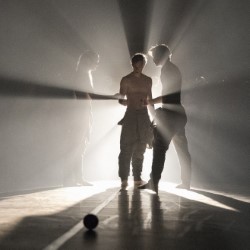
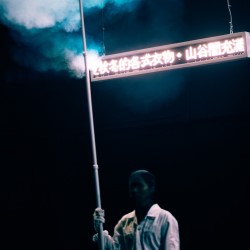
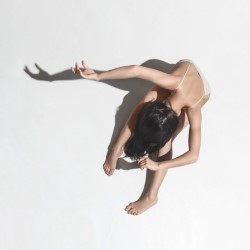
Sadler's Wells • 3 Feb 2022 - 6 Feb 2022

Carmen

A love triangle, passion, jealousy, the colour of red roses and bull-fighter capes: just what you would expect in this stunning contemporary dance version of Bizet’s Carmen, re-imagined and choreographed by Didy Veldman and produced by Bird&Carrot and Pleasance Theatre Trust, to the music of Bizet threaded through a new composition by Dave Price.A story within a story, this is set in modern times as the filming of a movie of Carmen and the life between takes which show different sides of the five characters. It does not retell the whole plot of the opera but is a series of concentrated vignettes of emotion. It could be made for Natalia Osipova: actually, of course it was.To the producer, Alexandrina Markvo, Osipova is Carmen and in fact, Osipova herself admits she identifies with much of Carmen’s character: passionate, mercurial but vulnerable, a rebel desiring freedom, though off-stage she says she is less dramatic. These qualities are brought out in Veldman’s choreography (developed alongside Osipova’s suggestions) with its emphasis on embodied emotion. As Osipova says, she needs to feel the emotion to create the moves and she does this so superbly we live it too.Osipova’s journey to challenge herself as a prima ballerina by performing contemporary dance, a difficult task for straight-backed classically-trained dancers, has taken years but here in Carmen she excels with hunched torso, transference of weight, awareness of pelvis, always grounded in connection to the floor, but equally sensual and flexible, with hints of flaring flamenco gestures, or classical lines which always fold back.This is not to forget the brilliancy of the two male dancers of the love triangle. Isaac Hernández as Escamillo/film director who enters with a showy, spiky jumps, demonstrating who is boss but otherwise cool, and then the earthiness of Jason Kittelberger as José. The intensity of the Carmen film scenes is relieved by humour in the real life interludes. Malarkey on the sofa, at times hilariously synchronized, by the film crew as their modern day selves josh about like characters out of Friends while Osipova naughtily sits in the director’s chair. Emerging artistes, Hannah Ekholm as Michaela, José ’s modern day girlfriend, and Eryk Brahmania as cameraman are both excellent. Michaela and José’s love duet on the sofa has an easy playfulness which contrasts with the love, or should I say lustful, duet with Carmen (the stand-out highlight of the show) which gets under your skin as Osipova leaps onto Kittelberger in a crouch, legs curled round him, or as the couple roll on the ground or over each other. The heart-stopping depiction of Carmen’s murder is a stroke of genius. No histrionics as you might expect but a stillness which is all the more terrifying. (No spoilers.)Everything about the production contributes to the whole: the set and costumes designed by Nina Kobiashvili, with glimpses of backrooms suggesting hidden lives. Carmen’s toreador-like three-quarter length black leggings with a red sash for she is the one who taunts her lovers; superb lighting effects by Ben Ormerod, particularly giant rose petals floating down the walls; the video clips by Oleg Mikhailov adding visual drama but above all, Dave Price’s sensuous, staccato melding of Spanish flavour and jazzy rhythms, with trumpets and percussion, at times solo violin, reflecting the bitter-sweet mood of this tragedy.

EICC • 17 Dec 2021 - 18 Dec 2021

Christmas Dinner

A heart-warming show of joy and magic at Christmas time, Catherine Wheels’ Christmas Dinner, written by Robert Alan Evans and directed by Gill Robertson, is particularly welcome with no Christmas show last year (we all know why). It may not be the extravagant affair we have been used to year after year at the Royal Lyceum but this is delightful fare nonetheless.All is doom and gloom at first as Lesley, a stage-manager, sweeps the stage of an empty theatre, refusing to join her friends and celebrate Christmas. The tension in the younger audience is palpable as yips of excitement greeted the slightest hint of action. Then ‘We’re back!’ cries Fruity, (a magnificent Richard Conlon) bursting on stage, a former actor hamming it up. He and three other loveable characters, the ghosts, or as they prefer to be called the ‘spirits’ of the theatre, want to bring the theatre alive. They must go in search of a story and in the process help Lesley to find joy again. A peacock who does not speak but charmingly chirrups (Sita Pieraccini), lithe and elegant in a silvery bodysuit and plume of feathers on her head; Madame Lady (Florence Odumosu) wonderfully OTT in a voluminous coat, descends from a theatre box where she used to watch shows and is thrilled to actually now be on stage, and Billy (Ronan McMahon) the hapless goof who first appears with his head stuck in a cardboard box. This was enough to set the small children near me into hysterics. It doesn’t take much to appeal to them and this company knows that well. High jinks, mayhem, prat-falls, one brief lavatory joke, and at one point a pantomime cow which wanders across the stage for no good reason but set the kids into hysterics again. The Christmas turkey dinner set piece is striking and the characters dressed as the ingredients is hilarious.As the spirits search for a story, there’s a hotchpotch of brief references to past Christmas shows: Red Riding Hood, Cinderella, Hansel and Gretel, Peter Pan (perhaps more for the adults or older children to appreciate.) There’s a rumbling groan as the theatre building itself becomes a character. As the actors patted the stage floor, ‘there, there’ the child in front of me hugged the pillar next to her, totally bound up in the make believe.At last the characters settle on a story, as Lesley tells her own. Dark subjects are touched on: death, sorrow and scary moments, (the six-year old child in front of me with hands over his ears or snuggling close to his dad), especially the appearance of the Snow Queen, rising high in the air, her white dress a vast icy triangle, designed by Karen Tennent and lighting design by Colin Grenfell is stunning, simply done but hugely effective. But the darkness of the story is balanced by the happy ending. The audience are asked to participate in warming Lesley’s heart. No spoilers here but the scattering of coloured dapples of light is particularly breath-taking. I asked the child whose reactions I’d watched throughout the show what he liked best: ‘Everything’, he said (despite the scary moments).A story to warm the cockles of your hearts.

Royal Lyceum Theatre • 6 Dec 2021 - 2 Jan 2022

Scottish Ballet’s The Nutcracker

Snow falling, Christmas baubles, glitz and magic - Scottish Ballet’s The Nutcracker to Tchaikovsky performed by the company’s live orchestra is like a box of chocolate treats. Based on Peter Darrell, the Founder of Scottish Ballet’s original choreography forty years ago, now re-imagined by Christopher Hampson, this is a show for all the family to get into the Christmas spirit with some surprising changes. Like Darrell, Hampson feels taking risks is essential to keep such an iconic piece alive.The principal dancers Evan Loudon as the Nutcracker Prince, Grace Horler as the Snow Queen, Marge Hendrick as the Sugar Plum Fairy - (and most people will know her solo’s music) are all superb. The choreography is nicely varied (though there are some unnerving and inelegant lifts in the Nutcracker/Sugar Plum pas de deux.) The set by Lez Brotherston is stunning, simple but focusing on the essential: a Christmas tree, one silver, in the Land of Ice and Snow and the riot of coloured baubles hanging from the ceiling in Act Two. The Nutcracker Prince and other soldiers look smart, black boots emphasizing their white leggings and all the magical fairies, not least the Sugar Plum, glitter in twinkling tutus. And most charming are the eight children, auditioned in Glasgow and Aberdeen for the party scene.The first surprise twist is to the casting, a female Drosselmeyer, a magician. Performed by Madeline Squire, she stole the show. Swirling a cloak to reveal flashes of its blue sparkly lining, she is the bringer of magic not only to the story but in her performance. (The part will be performed by a male on alternate nights but I was thrilled to see a woman.)This nod to feminism is a great success and it seems a little begrudging to note the stereotypical portrayal of the children in Act I has not been re-imagined: the girls are meek, nursing their dolls while the boys have all the fun, marching, blowing trumpets, rushing around making a nuisance of themselves. Of course, it’s Clara’s brother Fritz (Benjamin Brett) who breaks the Nutcracker. What if it was a naughty girl?Hampson is also keen to readdress stereotypical and racist portrayals of past productions especially concerning the Chinese dance. However, it’s a shame that the Chinese sequence, though it may now be authentic, is underwhelming, not helped by their dull murky green costumes. The Arab dancer’s costume, by contrast, is glorious and Roseanna Leney’s hands and wrist movements had an Arabic feel, but again, what is Arabic about a tutu showing all her legs? But maybe these are quibbles. The Christmas party in Clara’s home is now in Act I and there are some charming characterizations, not least the two eccentric aunts in black, wandering about. The adults’ costumes are rather muted, a contrast to later fairy glitz, but there seemed no reason why they could not be brighter. The whole act went on far too long.The major disappointment was the fight between the Nutcracker Prince, his soldiers and King Rat and his minions. This is the scene everyone remembers, especially if seen as a child. But this is a bit like the fudge left at the bottom of the chocolate box that nobody wants: it lacks drama and focus, fudged indeed, and the mice running around holding their cumbersome tails over their arms are ludicrous. Ok so they do use their tails as whips but in a half-hearted way.So to summarize: dancing - amazing; drama - could do better. But the lit up expression on Clara’s face (played by Caoimhe Fisher) perhaps says it all. It’s still a magical show.

Festival Theatre • 1 Dec 2021 - 31 Dec 2021

Starstruck: Scottish Ballet

Glitz and glamour, fun and frolics, Scottish Ballet’s Starstruck is a delight, just what we need after 18 months of closed theatres. A revival of Gene Kelly’s Pas de Dieux (pun intended), first performed at the Paris Palais Garnier in the 60's, this is a mixture of ballet and jazz, revolutionary in its day, to the music of Gershwin’s Concerto in F and Chopin. It is Gene Kelly’s love letter to ballet, and his only one for stage. Painstakingly reconstructed by Christopher Hampson and Kelly’s widow, Patricia Ward Kelly, from Kelly’s scribbled notes, there is also additional choreography by Hampson. Dynamism characterizes the show: the two styles of dance, long lines of ballet, leaps defying gravity contrast with earthy, syncopated jazz moves and plenty of hip action, classical and jazz music but also duets of tender love with the belting, energetic ensemble jazz just like a Hollywood movie musical.A ballet within a ballet, the story alternates between rehearsal and the show itself - the story of bored Aphrodite in Olympus coming down to earth with Eros to amuse themselves playing havoc with the hearts of two mortals, a lifeguard and his pony-tailed girlfriend, a vengeful Zeus and eventual reconciliation. A great opportunity for contrast between the scruffy leotards of the dancers in rehearsal, the bare set of ballet barres and mirror with the glamour of the Olympian costumes and the ensemble cavorting on the beach in the south of France (modelled on the original Parisian 60's outfits).The characterisation in Hampson’s prologue and epilogue is one of the chief highlights of the show. The thoughtful Choreographer, performed sensitively by Evan Loudon trying out moves; mischievous Eros performed by Jerome Anthony Barnes bursting on stage in jerky jumps in a nice contrast to the Choreographer’s more sweeping, sensual moves. Marge Hendrick, chief ballerina, (replacing Sophie Martin) arrives in smart, flashy turquoise suit and high heels, unlike the other dancers in their leotards. She is all diva and makes it clear she is in charge. Later Hendrick as Aphrodite in rainbow tutu is cheekily seductive. The range of Loudon and Hendrick's characterisation is stunning in the gradual stop-start making-up after the couple’s falling out. Jealousy, arrogance, anxiety, sorrow and many in between stages are portrayed not only in body language but facial expressions. (Do bring opera glasses if you can.) The psychological truth of such a bitter-sweet relationship will touch the heart of anyone who has experienced this.But lightness of touch, wit and humour are the overall mood of Starstruck. The diva’s naughty strip tease and a camp moment, Zeus strutting in his bronze helmet with its red feathers, a brilliantly choreographed fight between Loudon and the stage-hand, Rimbaud Patron for flirting with the diva and the imaginative play with mirror images when the choreographer dances with his reflected self, or Hendrick’s now you see her/now you don’t. I’d like to have seen more of that - but maybe that’s another show. The mortal couple, Simon Schilgen as the Lifeguard and Aisling Brangan as his girlfriend, are equally good. Glorious sets by Lez Brotherston, projections on a back screen of Olympian clouds, Paris upside down, the blue, blue sea with the lip of a wave uncurling to the gloriously mauve thunder clouds and lightning let loose by an angry Zeus all help create the uplifting mood of this joyful show. Sadly the live run has ended but you can still view a full feature film shortly to be released.Please note the cast reflects the performance I attended on Oct 16th evening in Edinburgh.

Festival Theatre • 16 Oct 2021

Starting From First Position

Mercurial, subtle and rousing Starting from First Position is a blend of dance and poetry performed by Nigerian born poet Ben Okri (also 1991 Booker prize winner for his novel, The Famished Road) and dancer Charlotte Jarvis. Okri’s declamatory verse, taken from his collections A Fire in my Head and the epic poem Mental Fight, has the strength of spoken word and the multi-stage setting beneath the towering military barracks of Edinburgh’s castle adds a commanding presence. Despite being poetry with a message, rather than a preacher’s rant, this is more of a charming, rambling conversation between poet and dancer with an insistence that we must learn to listen.A beautiful flow of images and exhortations in Okri’s deep and melodious voice are responded to by Jarvis in framentary moves rather than long drawn out choreography. The toing and froing of this poetic-dance is played in bursts, interrupted by pauses to reconsider and chat. We feel this is an improvisation in real time on the various themes of our difficult times: to save the planet, fight ignorance, the need for freedom and ultimately love. There are highlights when poet and dancer both move and speak together, repeating each other’s lines expressing the need for love in a humorous struggle which is part hug, part mock-battle and also a delightful set piece on telling a joke. This humanity and light touch is the essence of the show. ‘A child singing tells us more truth than all the comuniques of the government’ Okri declaims and we do indeed hear a child singing, their daughter, Mirabella, aged 4. This same simplicity has a power to reach millions such as when his poem about the Grenfell Tower fire was shared on Channel 4’s Facebook 600 million times and also retweeted. Here too there are piercing lines of poetry: ‘What if the ghosts of all the (drowned) migrants came to everyone’s house for dinner?’ A clarion wake-up call is literally played on the trumpet live by John Green whilst other music recordings provide a political under-current. Okri’s championing of Africa as ‘a dream not understood’ is here subtly brought in. Things are not what they seem: the hip-hop is by the black Canadian rapper/singer Drake, and what you might think was Mozart turns out to be by the 18th century Chevalier de Saint George, Guadalupe-born, son of a planter and his wife’s slave, considered a rival to Mozart (later forgotten until now) and what sounds like 19th century Romantic period, is in fact by Florence Price, the first African-American woman to be recognized as a symphonic composer in 1933, who faded into obscurity after her death, but has recently been rediscovered. For ultimately, this show is not just about doom and gloom, but about hope, how we can change the world. A very Fringe show about speaking your truth. And being in the open air, considering Edinburgh weather, you may need umbrella or hat and sun-screen.

MultiStory • 27 Aug 2021 - 29 Aug 2021

Family Portrait

A charming, funny and touching interactive video installation, Family Portrait by Natasha Gilmore’s Barrowland Ballet features Natasha herself as mother and single parent and her three kids: Otis, Iggy and Frieda. This will delight anyone who has or has had small children, whether their own, grand-children or nieces and nephews. Four screens surround swivelling stools so only 6 people can watch at a time, so there’s safe distancing plus everyone is masked and no need to worry about going inside the venue, Dance Base.One presumes this was filmed during covid lockdown. What a way to cope with it. Frolicking about in the woods, by a lochside overlooked by the changing colours of the mountains, or ochre moorland, we see various Scottish landscapes through the changing seasons. Memorable images such as angel shapes in the snow appear independently on a screen, or occasionally continue from screen to screen as the children rush through the trees.We are treated to family hilarity, peekaboo between the trees, burying mum in bark, or dressing her up with lichen, a stick in her mouth, bilberries smeared on her cheeks and then being allowed to eat one; or mum and the two boys carrying a long branch on their shoulders from which wee (Scots: little) Frieda hangs. She also has a very grown-up ‘theatrical’ vocabulary for one so young! Iggy is a keen observer of spiders or birds who he decides may be singing to their babies, or he ponders, maybe their mate when they will ‘get busy’: Otis is weighed down by the responsibilities of being the oldest who must not show his fear to the other children: a long list including darkness, being alone and Pingu (!) but he conquers this with a brave, heroic deed (no spoilers).Natasha herself is a very hands-on mum, leading or encouraging their imaginative play, obviously the inspiration for her children. Lots of rough play but many hugs. In a moving vignette in which she curls up in an abandoned enamel bath in a field at a slight distance from the kids, every parent will recognize that need for some ‘me time’ however much you love your kids.Natasha Gilmore’s Barrowland Ballet always produces a wonderful range of shows, but it’s particularly inspiring to see how she has maintained her career as a dancer and choreographer throughout her children’s childhood, even involving them from when Otis, at 18 months, was passed from hand to hand by the dancers in A Conversation with Carmel back in 2013 and now joined by brother and sister. It’s a delight to see them over the years appearing in shows. A heart-warming family portrait which will bring tears to your eyes.

Dance Base • 12 Aug 2021 - 22 Aug 2021

Grin

Challenging, daring, with longeurs but also explosive moments, this makes for uncomfortable viewing but is a much-needed and to be applauded show. ‘Wear the mask that grins and lies…’ a line from Maya Angelou’s 1987 spoken word poem inspired the title of this show, Grin by Mele Broomes and collaborators. This visuals and dance piece, best seen in the dark, aims to reclaim African-Caribbean dance from colonial stereotyping as hyper-sexualized or just a carnival joke.The two dancers, both now based in Scotland, are a good contrast in skills: the superb, long-limbed and lithe Divine Tasinda and the muscular Kemono L.Riot who excels in Poppin and Krumping. Mele Broomes, the director and choreographer founded V/DA as a way of connecting with the black diaspora in Glasgow, to share experiences and challenge objectifying perceptions. Grin is part of the ‘Made in Scotland Showcase’ and premiered at the DIG (Dance International Glasgow) Festival in 2019.The show opens with beautiful visuals of yellow fruits and then fades to linger on a twinkling landscape cityscape at night of unclear provenance, or possibly a phosphorescent ocean. Unfortunately the dance takes an age to get going (Eight minutes - I timed it) but don’t be put off. It is well worth waiting for (or possibly since this is digital, could be fast forwarded) to when two carnivalesque creatures emerge, their faces and bodies covered in a costume of shaggy tinsel. But these are not joyful apparitions, rather there is a sinister undertone created by the robotic movements and pulsing soundtrack.The longeurs are made up for by explosive confrontational moments such as when Divine Tasinda, in close-fitting singlet and shorts, lounges on the floor wriggling her hip up and down, in what might have been sexy apart from the aggressive, scary look in her eyes. Towards the end of the show we are at last treated to more carefree and joyful dancing and some stunning scat singing. The Director of Photography Daniel Hughes and Lighting Design by Michaella Fee are superb.Tense and challenging, this is an emotional journey for the audience and dancers alike drenched in history, not as it’s taught in schools but shrugging, shimmering, pulsing, rising and falling, drifting, floating… feel the rhythm. I recommend watching the audio-described version for an unusual take.

Summerhall Online • 6 Aug 2021

Amina Khayyam Dance – Catch the Bird Who Won't Fly

Amina Khayyam’s Catch the Bird Who Won’t Fly, a Kathak dance piece using animation and green screen is beautiful, subtle and moving despite its grim subject matter: domestic violence which has grown alarmingly during covid lockdown.Animations of fluttering or flailing hands warding off blows, expressive eyes and birds flying out of a woman’s mouth are intercut with only a few short real life images of a woman with bruised and bloodied face. The animation by Louise Rhoades-Brown successfully distances us from horror and allows us to appreciate the skill of the Kathak dancers, the varied tabla rhythms and soulful singing which are also a poignant, empathetic evocation of the women’s desperation.The prestige in which Khayyam’s company is held is reflected in the international super stars she has attracted to this show: British-based Punjabi Rup Khatker, one of the most famous actresses in the world of Asian cinema, and British-based globally acclaimed Bangladeshi singers Lucy Rahman and Sohini Alam. Their soulful vocals and Khayyam’s bols (rhythmic mnemonic syllables) create an exquisite soundscape along with Debasish Mukerjee’s tabla.Set in four different scenarios from the poorest homes to the wealthy: tower block, terrace, a comfortable garden suburb and a modernist contemporary house indicating that this crime takes place throughout society and though set in Asian homes in Britain it has global relevance. Although Kathak dance usually includes footwork, we only see the women’s long skirts. The swaying bodies, waving arms and intricate hand movements of Amina Khayyam and Jane Chan are powerfully expressive and not least Khayyam’s abinhaya or facial expressions for which she is famed. Both dancers enact happier times as well as the nightmare present, and Khayyam in particular can play the welcoming hostess hiding what she considers her shame. The only male, Mithun Gill, (a rising dance star who has performed in one of Akram Khan’s films, The Curry House Kid) enacts mental stress with great sensitivity showing how this crime impacts on the children, powerless to help. A fourth scenario demonstrates the tragic outcome that can occur; the white outline on the floor of a murder victim. Skilful cutting from scene to scene, or using split screen the piece rises to a crescendo emphasised by the frenetic rhythm of the tabla followed by a peaceful finale as the bird, symbol perhaps of the soul, flies free into a blue sky. Amina Khayyam’s company over the years has devoted itself to women’s voices who have been unheard or marginalized and this exquisite piece both laments but hopes to empower women through realizing they are not alone and they too can fly free.

Summerhall Online • 6 Aug 2021

Taiwan Season: The Back of Beyond

Tai Gu Tales was created by Hsiu Wei Lin, formerly a principal dancer with the iconic Taiwanese Cloud Gate company. Back of Beyond is a dream-ritual, where Chinese philosophy meets western dance technique. Choreographed by Hsiu Wei Lin, it is an immersive experience, or it would be if it was live. But the lighting and photography crew have nonetheless created a beautiful and mesmeric film of light and dark. Dancers appear in a mutating collage of images, sometimes spot lit or completely swallowed in the dark. A meditation on the cycle of death, life and rebirth, it uses the principles of yin and yang, stasis and movement, silence and sound to create a spiritual journey to a hypnotic soundtrack.The ritual begins unusually with Death as shrouded figures unwind to reveal male dancers with magnificent torsos (trained in Peking opera kung fu) and females in close-fitting costumes skin-coloured as if they are nude. The choreography is at times slow-moving and at other times frenetic. A female lying in foetal position unfolds as she observes her wriggling fingers and toes, suggesting a baby’s first explorations. Gyrating males, their faces stretched in grimaces suggest pain and struggle. Swaying females, arms seem to float as if they are underwater, deep-sea creatures. A beautiful sequence with candles, carried on the heads of slow-walking dancers, or placed around the stage are a symbol of life. Other imagery, abstract groupings, or solos, are more opaque and it is left to the audience to discover their own meanings in the hallucinatory and trance-like mood created by a sinister soundtrack of electronic music, occasionally the sound of metal bars being beaten or the surges of the sea. This show will divide the audience.Those who prefer more of a linear narrative or dramatic structure will be disappointed.Others who are willing to enter a trance-like state might experience at the end the peace that results from meditation - maybe not possible through a film. I hope when normal times return, this show can be experienced live again soon.

Summerhall Online • 6 Aug 2021

Taiwan Season: Touchdown

A man falls from the side of the screen onto the floor. Wow! What a way to start! Incandescence company’s Touchdown, a quirky, intriguing gem of a show with moments of brilliance as Hao Cheng demonstrates that both physics and art can be beautiful. Involving blackboard and chalk - No, not a teacher’s lecture - but part dance, part art installation: the blackboard the floor whilst Cheng crawls, rolls or stretches full out as he draws. Touchdown is so-called because that is exactly what happens as he stays on the floor throughout the show.If the terms Quantum Physics, electrons, ‘the uncertainty principle’ have you running scared, then fear not. This is physics for the uninitiated, like me, flaky arts students who dropped maths and science as soon as possible. However, a caveat, the film is prefaced with screeds of text ‘explaining’ the physics theories the show is about. Clear as mud, I’m afraid, to someone like me. I presume these would be programme notes if the show was live and could be read after the show (a better option) not before but they are not really needed. My advice is to skip them or skim and refer back later if you must. And don’t be put off, because this show is a beauty in what follows.As Cheng becomes more and more frenzied and the chalk ellipses become scribbles on the far edges, the lines becomes smudged and blurred and his dark trousers turn white with dust. There is a calm pause where he reflects on the similarity of electron paths with the fixed paths (which could be unfixed) we take in life: ‘the first kiss on a beach, you retire and see the fireflies’ in lines that could be poetry. Another lovely little touch is during the credits. Look out for the two small light dots, one yellow and one green. Notice the owl hoots and at each hoot how the yellow one gets bigger, absorbing the green one, and then the yellow turns green. Says it all. This show so narrowly missed being 5 stars and could be if Cheng trusted the arts (dance/art/poetry) to express his theme without any explanatory text. 

Summerhall Online • 6 Aug 2021

Taiwan Season: ai-sa-sa

Ai~sa~sa meaning ‘Get over yourself’ is brilliant. Choreographed by Baru Madiljin of the Tjimur Dance company, it is sizzling with energy, wit and originality, both hilarious and poignant. This is a must-see show filmed in village settings, on stage dance and studio comic inserts. Edinburgh festival-goers will remember the Tjimur Dance’s 5 starred Varhung-Heart to Heart in 2018. The company from south Taiwan is dedicated to reflecting Paiwan indigenous culture and in this performance how not only contemporary urban culture, phrases like ai~sa sa, are entering mountainous tribal communities but also how traditional gender roles and mores are changing, in this case a tomboy girl, and a gay man.A poem about red sweet apples and sour green ones and how life is full of laughter and tears, and how you must just shake it off kick-starts the show and then the dancers explode into exuberant jumps, leaps and spins danced to jolly French music by Hervé Rigaud from a CD amazingly found abandoned by Madiljin in a Paris street. Our tomboy, hair in plaits, performed by Meng Tzu-en is also a talented actor with humorous facial expressions. At first one of the lads, she is teased, courted then bullied by the three males with a lot of slaps on her bum and finger-pointing but she gets her own back and floors them all. Watch out for the old man in the village who mimics the exaggerated pursed lips of the courting couple. He appears later in a sadder episode when he just listens to a song of grief sung beautifully by Yang Ching-Hao. It is little touches like the old man that makes this such an exquisitely skilled show.All three male dancers are excellent but especially Ljaucu Tapurakac as the gay man in a polka-dot skirt who cannot make up his mind whom he loves: Chiang Sheng-hsiang (in lime green shirt) or Yang Ching-Hao (in mauve shirt) in two moving love duets. The music changes to wistful guitar and flute as we see Ljaucu alone, his stomach covered in blood, in what appears to be a cell with one swinging light bulb whilst he makes heart shapes with his fingers. The other three also make shadows on the wall, the snake-shaped hands of the bullying scenes now waving hands of sorrow. Edith Piaf’s famous love songs Mon Amour and La Vie en Rose bring the performance to a heart-stopping finale but we are not allowed to wallow in sorrow. A dancer weeps but he is cutting an onion. The show ends on a high note as silliness and jolly Gallic music returns to much apple munching and spitting of pips. ‘Formidable’ as it says in the poem!

Summerhall Online • 6 Aug 2021

Taiwan Season: Fighters

We need heroes in these strange times is the thesis of this show, and Les Petites Choses’ Fighters brings us five. Five (four male, one female) talented youngsters with impressive stamina are choreographed by Nai-Hsuan Yang in a fun, energetic production of kung fu (Peking opera style), hip hop and contemporary dance. Fans of manga or video games may recognize the five ‘godly characters’, inspired by the classical Chinese Han Dynasty’s The Romance of the Three Kingdoms, though now in their modern reincarnations. Originally a stage show, this digital version adds great humour and imaginative visual effects (though a warning, some of these are laser effects). The film director, Hsiao-Lu and the Director of Photography, Yo-Young Chuang, are to be congratulated. Starting with the slow awakening of the five, fallen asleep in contorted kung fu poses, it then follows their day of disciplined training. In one especially captivating moment, the colourful red robes are matched by floating curtains in one room whilst the young woman practices on a rooftop. Despite the necessity of social distancing, their individual moves are skilfully choreographed to work as a whole. Fierce facial expressions and stylized moves express their inner as well as physical strength as they fight their internal and extrernal demons.This is a joyful show full of vitality which will encourage everyone to get up and dance or at least chase their demons away.

Summerhall Online • 6 Aug 2021

Fugue in Two Colors

If Carl Knif’s Fugue in Two Voices is a joke, then it’s a dud. Having seen his excellent, visceral and arresting Red in 2016 at the Edinburgh Fringe, I was expecting a memorable piece at the very least. Set to Shostakovitch’s powerful preludes and fugues for piano, it aims to juxtapose these strict forms to seven ‘rambling’ dancers. The word ‘rambling’ sets off warning bells. It’s as if Knif has decided to be completely different to Red which is fine as long as it’s interesting but sadly this tedious show at 70 minutes feels interminable.Knif’s liking for improvisation-based choreography demonstrates all the pitfalls. One wonders if it is actually taking place in performance: paired dancers imitate each other's movements, one slightly behind the other as if not knowing what’s coming next, one female dancer stumbles at one point, the male with long blonde ponytail lying on a table nervously checks the edge as if he fears he may fall. This imprecision characterises the show. It feels like Knif has abnegated all responsibility as a choreographer. The ‘surprise’ entry of dancers from the front row of the stage is such a cliché only high school students would think it original. Dancers square off crouched like sumo wrestlers or swing away to just walk randomly about the stage. There are no arresting moments or fine lines. It is just a series of instagram images, unoriginal and at times, like anoraks used as matadors’ capes, bewilderingly random. Random, of course, is the key word. Random objects are introduced: a mic stand, a long blonde wig, a tree branch, a mirror etc, etc. Even the steel poles, which could have led to some interesting patterns and shapes, left me worried that someone was going to be unintentionally impaled. Scrolling through the internet afterwards I discovered an interview in Amusa (21.09.21) where Knif says he wants the dancers and music to ‘carry the work between wild, hilarious, precise and thoughtful expression’. So why doesn’t the blurb say this? Why isn’t it clear in the performance this is supposed to be playful? Even if I knew this beforehand, I don’t think I’d find the show any more fun. I feel like a viewer seeing Duchamp’s urinal (signed R.Mutt) in an art gallery for the first time and wondering if it is we the viewers who are taken for mutts.

Dance Base at ZOOTV • 6 Aug 2021

Opia

How do we interpret the world through our senses, particularly through sight? A mesmerically beautiful triptych of two solos and one duet, choreographed by Finnish Johanna Nuutinen, Opia explores the sense of sight primarily through the polarities of white and black, whether costume, stage or lighting design. Like the white nights of Finnish summer or the long dark nights of the winter, the lighting designed by Joonas Tikkanen plays with stark contrasts. This sensitive piece is at times elusive and minimalist, at other times suggesting more literal and realistic detail.Lying on a white floor against a white background, the dancer Mia Jaatinen is all in white, a white singlet and baggy trousers, tight at the ankle reminiscent of Indian or Arabian costume. Slow stretches develop until she stands, her moves also reminiscent of Tai Chi, but more fluid. These are my associations, other members of the audience will bring their own interpretation. The lighting creates shadows, or she is silhouetted against the background, leading to an imaginative sequence when her face is spotlit in the dark and shadows play over it like the phases of the moon.The second part is largely in the dark and we only get glimpses of the dancer in a black, hooded costume as both light changes and moves become more and more frenetic. Different coloured lights flash at times: our perception is unclear, and our sense of perspective is distorted.In the third section where the two dancers meet – the black costumed one takes off the hood and is revealed as Jenna Broas, a woman, somewhat of a surprise as her movements in the previous section were quite masculine. As the two women explore each other, tracing lines along each other's arms and bodies this could be a love duet and the movements are the most realistic in the piece. Another issue explored is how the environment affects our perception and for me this was suggested here as the lighting divides the stage into two, one half lit with green light to sounds of birds and jungle noises; blue to hisses (the ocean?), yellow to the sound of rain and lastly pale blue to I don’t know what. It’s up to the audience to interpret this emotional journey for themselves. It requires total involvement and will not be for everyone. A warning: there are also laser lights.I am looking forward to the two other pieces Nuutinen is working on as part of her three-year project on the senses of hearing and touch.

Dance Base at ZOOTV • 6 Aug 2021

Iconnotations

Music-theatre with solo cello plus dance, Iconnotations is extraordinary: surreal, wry, expressionistic, at times baffling, profoundly sad but at the end joyous. This is Peter Maxwell Davies’ rarely performed Vesalii Icones (1967) performed by Red Note, Scotland’s superb six person ensemble specializing in contemporary music, conducted by Geoffrey Paterson and danced by the iconic Matthew Hawkins (former member of the Royal Ballet) with his own new and arrestingly strange choreography, full of pathos and humour. Inspired by Vesalius’ series of 14 anatomical drawings of a flayed man, in which each ‘icon’ has further muscular layers stripped until the figure is a skeleton, it is then overlaid by the ‘icons’ of the 14 Stations of the Cross. The music itself is multi-layered: the sonorous lyricism of the solo cello performed expressively by Lionel Handy overlaid with allusions to Medieval, Renaissance music and fox-trot, with honky-tonk piano and a range of unusual percussion such as a cheese grater, typewriter, a car-horn. Is Davies having a laugh? Certainly. Hawkins too has described it as ‘a solo about martyrdom, autopsies and other larks.’ In the solemn environs of Edinburgh’s Greyfriars Kirk this is a daring piece to perform. At the time of composition, Maxwell Davies was an enfant terrible, an atheist who must have doubly enjoyed éclater les bourgeoisie. Yet this is not so much about Christ as about a modern Everyman, the human condition, stripped down like Vesalius’ anatomical dissections, suffering and mortality only relieved by silliness - a good message in these times of pandemic. Hawkins echoes this with staring eyes, weird costume of tights, elbow-length gloves and tight cap all a light patterned yellow, along with white t-shirt and grey shorts. His tall, slim frame, though muscular as a dancer, is not outrageously so. Nor is he skeletal, but with his blank stare and woeful expression he is almost a clown figure like Pierrot. (It’s interesting to note that the first performance of this piece was by Davies’ company The Pierrot Players.)It’s a shame there were no programme notes. However you can google the Vesalius drawings and the Stations of the Cross (of which there are many versions), but the version Davies used is best done by googling the record sleeve of the Fires of London Sextet recording which starts with the Agony in the Garden and ends with the Resurrection and Anti-Christ. However, this is only tangentially a help. Hawkins’ original choreography is an embodied response to the music itself and Vesalius and the Stations are used only as a springboard for his own modernist, abstract dislocations reminiscent of Wayne McGregor but with his own ultimately humane interpretation, as well as an eccentric sense of humour and enigmatic hand gestures.Just as the score uses unusual percussion, Hawkins introduces anachronistic modern props for humourous effect. Some are used for explicit references, flagellating himself with a large fleece top, drinking from an enamel cup (the vinegar offered by the soldiers). However, miming slitting his throat with a knife (the death on the cross) is perhaps rather crude. Musicologists might want to compare score with the choreography but for most of the audience it is best to let the performance carry one away and not try to analyse too closely.There are stand-out images though such as Hawkins’ head and shoulders trapped in a wooden rectangular structure (i.e.Christ laid in the tomb?) where his struggles expresses all mankind’s trauma of pain and death wonderfully transformed by the joyous ending, the Resurrection and Anti-Christ where Hawknis finally smiles and dances with wide balletic movements and the irresistible ‘Anyone for tennis?’ moves. A second dancer, Soraya Ham did not have much to do and it was not clear why she was included apart from the exaltation of her raised arms suggesting Resurrection. But this is a quibble. Do watch this bonkers and glorious show which for all its humour is profoundly moving.

Dance Base at ZOOTV • 6 Aug 2021 - 25 Aug 2021

The Secret Theatre

Where is the glitter and magic, our annual Christmas treat, without the Sugar Plum Fairy or the Snow Queen? With theatre doors closed during these sad times, Scottish Ballet have come up with this brilliant feature film, The Secret Theatre, based on The Nutcracker and The Snow Queen, choreographed by Christopher Hampson and Peter Darrell and designed by Lez Brotherston to the music of Tchaikovsky and Rimsky-Korsakov. But it is not just extracts. The film-makers, Jess and Morgs (Morgan Runacre-Temple and Jessica Wright) have instead skillfully woven the dances into its own imaginative story written by Sam Brown about a small boy’s adventures discovering the wonders of theatre. For what small child has not wondered if the characters go on living in their secret world when the theatre is shut?Starting with the small boy (a charming Leo Tetteh) creeping into the empty theatre, evading the torch beam of the security guard, a terrific tension is created. At once the viewer is hooked as he climbs onto the stage and wanders back-stage. Dancers climb out of wicker baskets or through costume rails. Leo is befriended by a young woman, Lexi performed cheerily by Alice Kawalek and hey presto, the dances begin. The film works best when everything is seen through the Leo’s wide eyes or when he is involved in the action: flexing his own muscles imitating the Strong Man, chased by a snarling silver wolf or spiky Jack Frost, terrified by the Snow Queen (the scarily magnificent Constance Devernay) or even Leo showing off his own skills spinning a football. Of course, we must have the set pieces of the Sugar Plum Fairy (the exquisite Sophie Martin) and Waltz of the Flowers but concentration might flag for the younger viewers during the overlong Roma sequence. When Jess and Morgs are given full reign this is a superb cinematic experience, working as a dramatic whole, using all the tricks of film-makers: swirling camera, transformation of characters before our eyes into snow wolf or Jack Frost, a roving camera behind the main action, showing the lurking Snow Queen waiting to strike, or with the sparkle of a Christmas tree bauble whirling us to a party where the Nutcracker Prince leaps and spins (superbly danced by Jerome Anthony Barnes). The dancers play to the camera, thrusting a top-hat into the frame or giving a wink, (the dramatic Bruno Micchiardi as Ring-Master) for, of course, the advantage of film is that we get a close-up of the dancers’ expressions, can admire the details of the golden braids on uniforms or silver-embroidered tutus, the jewels of the tiaras, or shiver at the blue lips of the Snow Queen. Everyone has front row seats. And what better way to introduce a child to ballet? Perhaps more children, in particular boys, like the one in this film will have their imaginations fired and desire to become a ballet dancer?To produce this film in full compliance with covid restrictions must have been a massive undertaking, let alone the dancers having to learn a new way of working for film. Scottish Ballet and their orchestra are to be congratulated. The beauty is that this film can be seen by a wider audience than those of us living in Scotland. It’s FREE but I urge you, in these difficult times for all theatre people, to consider a donation.

Scottish Ballet • 21 Dec 2020

Antigone, Interrupted

Experimental, inventive and hugely daring, Antigone, Interrupted is Sophocles re-imagined, the first production by Joan Clevillé since becoming Artistic Director of Scottish Dance Theatre. This is physical theatre, body-based sound and spoken text, both excerpts from a translation of Sophocles by Don Taylor and Owen McCafferty and ‘interruptions’ of contemporary text, sound and song. Those expecting dance or classical theatre will be disappointed but the extraordinary physical theatre performer, Solène Weinachter, playing all parts may well win you over.Events in Barcelona in 2017, and Clevillé’s own Catalan background shocked him into exploring the theme of civil disobedience and led him to Sophocles’ Antigone where a teenager challenges the state. Creon, the tyrant, who has ruled that the body of a traitor, Antigone’s brother, shall not be buried but left to the dogs is opposed by her knowing that this will lead to her death. Interestingly, Creon is not portrayed as a villain. His point of view is given rationally, explaining that he wants to do the right thing. This production is open enough and the stronger for it, leaving the audience to see parallels with modern issues and events. The only explicit intervention is a feminist pro-Suffragette song to the tune of Mary Poppins' Sister Suffragette performed with gusto and humour. Other ‘interruptions’ are Solène’s charming interactions with the audience, comments such as ‘It’s Greek tragedy so it won’t end well, you know’ and reminiscences of seeing Jean Anouilh ’s version of Antigone when she was a child of seven. These add variety of tone and pace and make the piece humourous and accessible. Whether this adds or distracts from the searing force of the original Sophocles is debatable.However, the piece rests on Solène’s physical performance. Those who saw her in Lost Dog’s Romeo and Juliet at the Edinburgh Fringe will know how talented she is. Her extraordinary contortions (influenced by Lost Dog’s Ben Duke and his performance methods) are based on tension and release leading to original and expressive movement. The most arresting scene is when Solène barks like a dog. Potentially risible, as the barking goes on and on and on it has the visceral effect of Greek women keening and the audience too is overwhelmed. It is also an intriguing and ambivalent symbol since it is dogs who are desecrating her brother’s corpse. The extraordinary vocal skills employed to achieve this is based on Nadine George’s technigue used by the voice coach, Jean Sangster. It is only a pity that Solène’s voice when delivering text could often not be heard but this is a glitch that will surely be put right over the run.Luke Sutherland’s recorded sound track is also highly original and apt, the sounds amazingly created by using the body. Emma Jones' lighting is strong and economical, suggesting a minimal set, but the audience are too often blinded and Solène’s face left in shadow. However, the atmospheric effect helps suggest Antigone’s isolation.Ultimately, Sophocles this is not. The piece lacks the force of Greek Tragedy, with downgraded text and distracting ‘interruptions’ and for this critic, Antigone’s dilemma, apart from the exceptional barking scene, fails to devastate. However, it is well worth going to see, despite style over substance. This is a company that dares, and if you don’t dare, you don’t achieve anything really original and strong. Their strengths are physical theatre. I would like to have seen more of that.

Traverse Theatre • 20 Feb 2020 - 12 Mar 2020

Scottish Ballet: The Snow Queen

A wintry tale of fire and ice where selfless love wins, The Snow Queen, choreographed by Christopher Hampson, is a dangerous journey encountering bandits and snow creatures. At the centre is the magnificent but cruel Snow Queen herself, imperiously performed by the superb Constance Devernay, the star of the show. It is the second ballet created to celebrate the company’s 50th anniversary year, a retelling of Hans Christian Andersen with elements from Disney’s animation Frozen.The prologue, seen through a jagged peephole, are two sisters - the Snow Queen and her sister, the Summer Queen (Kayla-Maree Tarantolo), quarrelling over what they see in a magic mirror: Kai, who in this version is Gerda’s fiancé, not her little brother, the advantages being two sets of love triangles and great opportunities for love duets. Gerda (a pleasing performance by Bethany Kingsley-Garner) is by turns plaintive and begging, then later fierce. Kai (Andrew Peasgood) demonstrates strong dancing, and an impressive range of emotion, from cold to fawning.Stunning visual effects such as the mirror breaking into splinters, which spin and transform into the next scene and the atmospheric sets designed by Lez Brotherston are part of the wonder of the show, and the pièce de résistance, the mirror-faceted Snow Queen’s castle, all stalagmites and flashing reflections. Fantastic costumes of circus performers, bandits strikingly colourful in contrast to the snow creatures in frosty glitter or white fur: snowflakes airily danced, whilst wolves scarily pounced in life-like heads and torsos and stylized Jack Frosts have eerie, backward-slanting hair. After a slow start to Act One, luckily, but far too late, we are treated to the lively characters of a circus show, in particular the Ring-Master, a masterful Bruno Micchiqardi blowing his horn, the tattooed Strong-Man Evan Loudon, flexing his muscles and his partner Alice Kawalek, both eye-catching performances. Fast forward to the brilliant Second Act where Gerda sets off on her search for Kai and drama and action fuse: swirling dances by the gypsy bandits, with splendid machismo by the Bandit leader (Jerome Barnes) and drama by Mazelda, a fortune teller (Grace Horler), against the background of gypsy caravans and a flaming fire, and the skin- tingling performance live on stage by solo violinist by Gillian Risi. It is in the final scene in the castle that Christopher Hampson’s choreography shines most. A duet between Kai and the Snow Queen with expressively psychological details where she ignores Kai’s held out hand and instead grabs him from behind to demonstrate she is in control. In the subsequent lifts, her legs stick out like open scissors, symbolising rigidity and her frozen emotional state. Later there is a touching moment (also literally) in Kai and Gerda’s dance of reconciliation, pressing their palms together, a motif harking back to their innocent first meetings.Sadly Hampson’s choreography is not always so effective in crowd scenes where action is unclear and dramatic focus gets forgotten. In particular, the wolves and Gerda are shown confusingly happily co-existing before and after an attack. Act One is frankly tedious scene-setting, with villagers wandering in and out and in such poor lighting it is impossible to see what is going on and to determine who the main characters are. And who on earth is the woman dressed as a boy in a green jacket and jaunty hat? If you have not read the synopsis first you will be as confused as I was, since I am guilty of believing a show should be clear from its own action. It might help to know that this character, Lexi, is the Summer Queen in disguise. Apparently, the whole Summer Queen/aka Lexi v Snow Queen sub-plot is an attempt to win sympathy for the Snow Queen so that we see she has a vulnerable side but I’m afraid I just don’t buy this. Some may like this interpretation, but I, for one, want to see a cold and impregnable icy Snow Queen, or she loses her evil power. This sub-plot is also a distraction, creates a confusing plot and both Queens’ eventual demise is embarrassing, eliciting guffaws from the audience, surely not intended? This is not, after all, a panto.I’m not sure I was totally won over by Kai as an adult since the story became one of a faithless lover’s head turned by a glamorous older woman: rather a cliché and lacking the frightening psychological depth of the original story of a boy with ice in his eye but then I’m just a critic with ice in her heart.The score, an assembly by Richard Honner of little known opera by Rimsky-Korsakov only worked in places, terrific brass and shimmering strings but too often it was only meh and one can see why his operas got forgotten.But despite these quibbles, there is so much gorgeousness in this production, the standard of the Scottish Ballet dancers so high, that I would hate to put you off going.

Festival Theatre • 11 Dec 2019 - 29 Dec 2019

An Edinburgh Christmas Carol

Full of good cheer, fun and jokes, carols under falling snow, spooky ghosts and glitter, what better way to get into the Christmas spirit than go to An Edinburgh Christmas Carol, Dickens rewritten and directed by Tony Cownie transformed into a Scots tale? Set in the shadow of Edinburgh castle there is even the delightful addition of Greyfriars Bobby performed by a puppet. The theme of heart-wringing poverty, beggars and homelessness will sadly remind us this is still relevant today but the show is lightened by swirls of Scottish dancing, general hilarity and pratfalls, peppered with terrific Scots words like ‘scunnered’ and ‘glaikit’, much play on words for the adults and bum and fart jokes for the wee ones, aged five and up.The puppet, Greyfriars Bobby, is, of course, the star of the show, manipulated so skilfully by Edie Edmundson, one forgets a puppeteer is there. With a suitably rough coat, strands of cotton rope, the puppet is rather bigger than Bobby is usually portrayed but this way one could see his wonderful crouching and naughty antics better. Tiny Tim was also a puppet, a clever way to avoid over-milking the pathos.The skinflint Ebenezer Scrooge, played by Crawford Logan with great character, is not too stern so we can laugh at him as he undergoes his terrifying ordeal, then impressively changing into the kindly old gent he becomes with expansive benevolence.The ghost of Marley (Grant O’Rourke) is a highlight of the show, clanking in with yards of chains through spooky mist (dry ice, of course), shaking his grey shaggy locks, but not too scary for the kids. The spirits of Christmas Past, Present and Future, here called Lang Syne, Nouadays and Ayont, are also highlights. Lang Syne, like a glamourous Queen of the Fairies whose sparkly emerald dress and glittering tiara is breath-taking, acted with sweeping command by Eva Traynor. In contrast, Nouadays falls down the chimney with a loud skirl of bagpipes. Dressed as a Highland Chieftan in kilt and full regalia, tall pheasant feather in his large, floppy beret, he arrives with aplomb, a deep voice and laughter played superbly by Steven McNicoll. Ayont (Taqi Nazeer) in tartan trews, though not so dramatic, is given an imaginatively sinister feel by not speaking (he is headless), instead beating his drum.The costumes designed by Neil Murray are excellent throughout, not only the ghost and apparitions, but the Victorian dress of the rest of the cast from top hats to crinolines. The set (also by Murray) is stunning too, no exact location, a mash-up of points of view, but who cares, the forboding atmosphere of the Old Town evoked with crow-step gables and overhanging top-stories, the iron gates of Greyfriars’ Kirkyard to one side and the castle, seen from the barracks’ direction, a dominating, oppressive presence. The change of sets with fast rise and fall of the back-drops elicited gasps from the 5 year old sitting next to me, and my 12-year old guest was intrigued by how the wagging of Bobby’s tail was achieved with no visible wires. Other stand-out performances were Belle Jones as Mrs Fezziwig and Steven McNicoll as Fezziwig. Grant O’Rourke as the policeman and Brian James O’Sullivan as the Dog-catcher elicited boos from the audience at the curtain call, always a sure sign of success. But this is no raucous panto, more of a subtle, moving and cheering show of the excellence we have come to expect from the Lyceum. The inclusion of different choirs each night for the carol-singing is an inspired way of involving the community and added festive atmosphere. If you don’t enjoy this show, I say to you Bah! Humbug!

Royal Lyceum Theatre • 28 Nov 2019 - 4 Jan 2020

Rite of Spring

Luscious colours, hypnotic dance, the exotic (to westerners) Chinese/Tibetan interpretation of Stravinsky’s Rite of Spring should make Yang Liping’s Peacock Contemporary Dance Company an extraordinary show. Devised in three parts, Stravinsky’s music book-ended with Tibetan music composed by He Xuntian, there is much to admire; gasp at and ponder but sadly the piece is too beautiful, almost saccharine and instead of the visceral dance experience Stravinsky’s music demands, it is anodyne.As the audience enter, we see thirteen female performers already on stage sitting cross-legged meditating. Their heads adorned with a circle glinting with jewels and we can guess that these are deities come down to earth. They sit on a vast circular form of thousands of brick shapes joined together with others scattering the stage, and throughout the show a monk pieces them together like a jigsaw. What they signify is unclear.There are additional programme notes but so many it’s hard to know what’s relevant before the show.There are wonderful visual effects, not least the vast golden bowl that dominates the set designed by Tim Yip (well-known in the west for his work for Akram Khan). We can guess that this is the heavenly sphere. The dancers sway and flutter their long finger nails. This arm and hand movement is a familiar trademark of Yang Liping who has been called the Peacock Princess in China since 1986 when she gained nationwide fame for her dance piece Spirit of the Peacock – a development of a folk dance from her own Bai culture in the Yunnan province of south-west China. The most stunning of these visual effects are the long green nails fluttering in ultraviolet light, symbolising the green shoots of spring. Lined up behind each other, their feet clamped in stirrups, the dancers then perform impressive back bends, swaying backwards and forwards.The sacrificial dance of the virgins to Stravinsky attempts wild abandon but unfortunately pales in comparison with Pina Bausch’s visceral interpretation (revived in London earlier this year). In Liping’s version a shaggy-maned lion-head appears – the god which the chosen victim will be sacrificed to. A male dancer then slips out of the lion-head and simulates sex with a splay-legged dancer and they perform various acrobatic convolutions. Confusingly, there seem to be more than one girl about to be chosen and this goes on far too long. The final chosen one ends up stuck with pieces of the brick jig-saw. Baffling and clumsy, even if one did know or could guess the meaning.The additional programme booklet explains that these bricks form thousands of six-word mantras which are incantations in Tibetan Buddhism, an obsession which must be lost to achieve enlightenment and reincarnation. This is part of the problem of this show. Too much needs explaining, instead of being imaginatively or dramatically felt by the audience. That said, the male ‘god’ who ravishes the girls is clear enough, he is ‘desire’ but when as Lion he bites off the head of the chosen victim with a great chomp the effect is bathos rather than frightening. The show ends on a brilliant image of the victim reincarnated: flying and then standing in the shining bowl as a stream of gold pieces pour down on her from above. And still plodding away, the monk trudges by with a basket loaded with brick pieces oblivious to the girl’s ecstasy, a superbly humourous touch, contrasting heaven and earth.A mixed experience then as a dance performance. The beautifully illustrated booklet is something to treasure though, as an introduction to Tibetan Buddhist philosophy.

Festival Theatre • 22 Aug 2019 - 24 Aug 2019

Hard to Be Soft: A Belfast Prayer

Hard to be Soft: A Belfast Prayer choreographed and directed by Oona Doherty is at times an explosive, visceral and overwhelming experience. There is no doubt that Doherty is hugely talented and original with a vision which is almost evangelical. Laying bare the violence and misery of disaffected, unemployed male youth and the trauma post-Troubles that inflict the city, the ‘prayer’ of the title is a plea for mercy and also one of hope. This is a theme familiar to those who saw her five-star performance of Hope Hunt and The Ascension into Lazarus at the Edinburgh Fringe in 2017 and they will no doubt be excited to see a Fringe star being taken up by an International Festival. Sadly, though strong and hugely impressive, minor glitches make the transfer not as successful as it could be.A group of youths wearing anoraks and with heads bowed huddle around what looks like a gutting bonfire. One imagines they are homeless. Then a waft of incense reaches the front rows - a thurible? This is a moving image to start the show, suggesting that sectarian religion that tore the Northern Ireland apart is thankfully dying down.As ecclesiastical choirs sing and a vertical beam of light pours down, the glorious set by Ciaran Bagnall of lit bars on three sides evokes mystical prayer. It might be a high vaulted church but the set also suggests a cage.Oona is not only a choreographer, but a visual artist; her strength is in use of image aided by the set and lighting design but also in body language, performing vignettes of physical theatre to suggest the disaffection of male youth. Her appearance is androgenous in all-over white and hair tied back. Swaggering walk, overarm throws (miming stone-throwing), jeering gestures with one finger or to imply f*ck off, that word plus sh*t come out loud and clear in a voiceover but these stereotypes of male aggression are undercut with vulnerability as her face contorts in pain. This visceral performance is both Oona’s strength but also her limitation where the minutiae of her expressions cannot be seen in a large theatre unless one is prescient enough to bring opera glasses.Her inexperience on a large stage is also shown by not owning the space and especially by not coming forward to the front of the stage. This is also shown in the second section, The Sugar Army, when a large group of young girls perform too far back. Dressed in bright waist-length anoraks and skin-tight white jeans they perform marches or run in a circle, in an almost war-dance, exuding self-confidence, one girl sticking out her tongue at the audience and some tossing long pony-tails.The voiceover was clearer and moving, explaining how looking good, putting on ‘armour’ is how they face the world. With no jobs and no future ahead of them this is a poignant piece of bravery in comparison to the aggressive despair of the males in the earlier section.These girls are locals who have been attending workshops given by Oona for this performance, as she had done when the show appeared in Dublin earlier. This laudable generosity is part of the force which drives her work - to create opportunities for those who might never experience this otherwise.We see Oona’s powerful use of a single image again in the next section, Meat Kaleidoscope, where the confrontation of two men (John Scott and Sam Finnegan), bare-chested with pot-bellies like Japanese sumo wrestlers, gradually approach each other to meet in a great hug. A scene of solemity and power, a huge green cloud morphs into the distorted images of a kaleidoscope.Unfortunately, the male voiceover is almost impenetrable, not just the Belfast accent but technically as the sound system muffled the voices. Odd words could be caught like ‘Respect’. This is an attempt at a generational reconciliation between father and son who are unable to express their emotions but there are echoes of the post-trauma of the Troubles too.In the last section, Helium, Oona returns with a solo work, rather too similar to her first one but this time with wide arm gestures to express hope but with the inevitable falls. In an altercation where she plays two parts, her opponent says "You forget where you came from." This indeed is something that Oona does not do but is trying to turn things around and offer some hope, also suggested by the vertical light beam which ends the performance.Hard to be Soft: A Belfast Prayer is a thought-provoking show which would have been outstanding if not hampered by technical glitches.

The Lyceum • 21 Aug 2019 - 24 Aug 2019

Juliet & Romeo

Both humourous and sad, Juliet and Romeo by Lost Dog company, presented by The Place, written with sensitive forensic analysis and directed by Ben Duke, is a subversion of Shakespeare. In this version the couple do not die and, now in their forties with a child, are struggling with their marriage. At first with the house lights on, we are invited to watch them relive in a counselling session the memorable moments of their relationship and find out why their love died. This is expressed through dialogue, movement, dance, excerpts of Shakespeare’s text, music and popular love songs. Sitting on mauve chairs, a pot plant on the table, Ben Duke's Romeo and Solène Weinachter's Juliet share early memories which turn out to be different (reminding one of Maurice Chevalier’s I Remember It Well). "It was summer," says Romeo. "October," corrects Juliet. This wry sense of humour is alternated with beautiful dance, memorably a sequence danced to the most famous excerpt of Prokofiev’s Romeo and Juliet. Weinachter's long hair adds to the physicality as Duke throws her about and they dance with superb strength and sensuousness. They enact the stages of their romance: the ecstatic first glance across a crowded room to Shakespeare’s death scene in the chapel vaults. The playwright is described as a visitor who arrives with a bottle of whisky. Romeo can’t remember much of the conversation but confesses he "overshared".What really happened in the vaults is enacted several times as they try to recreate the true version, increasingly hilarious as Juliet tries to lug the ‘dead’ Romeo about. Again, each of them has a unique version, rather different to Shakespeare’s. Running off together, their first moment at their flat is movingly dramatised as a moment of stillness, enacted to Paul Simon’s The Sound of Silence. The couple then go berserk, literally climbing the walls (actually possible as they are made of wire netting) and knocking over the furniture, turning somersaults in joy. This contrast between humour and overwhelming love are the strong points of the show and the superb dancing cannot be faulted.Unfortunately, it is at this point in the show that Ben Duke, as the playwright, loses his sensitive touch. Juliet gets pregnant, the ultrasound shows she has lost the baby but the couple get over this appalling experience (we imagine a miscarriage since Romeo notices something flowing down her leg) rather too quickly, dancing to jolly music. However, despite this blip there is a moving moment when Romeo holds Sophie, the new-born ‘crinkled-faced’ baby who survives and he quotes Shakespeare: "I ne’er did love till now."The couple’s life begins to unravel. The long hours of separation with Romeo away at work and Juliet stuck with a toddler take their inevitable toll. This is movingly portrayed but unfortunately goes on far too long and loses some of its pathos.
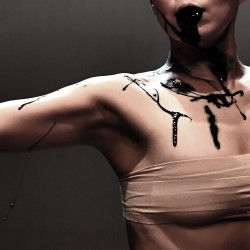
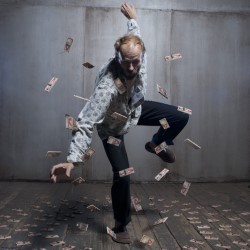
Dance Base • 21 Aug 2019 - 25 Aug 2019

The Hospital

A brilliant Scandi noir of the psyche, spoken in gibberish in a surreal world, Norwegian Jo Strømgren Kompani’s The Hospital, is gripping; moving from bizarre, black humour to darker, sadistic and frightening exposés of power relationships. Three women, two nurses and their matron wait in a deserted hospital but with no patients available, they practise on each other. They appear to be abandoned in an unspecific war zone but what exactly the circumstances are we do not know.To make this show even more surreal the actors speak gibberish based very loosely on Icelandic. There is no original script and the speech is built up through improvisation which concentrates on rhythm and tone but amazingly the actors know what they are saying and the audience have a good idea too.Two walls, one in front of the other painted the familiar dirty cream and olive dado of so many old hospitals serve as a corridor into which the nurses can disappear. Storm lanterns suggest their remote location. There is also a bed with a blood-stained mattress setting up an ominous tension before the action even begins.The music ranging from Bach to Jan Garbarak creates a range of moods. Though mainly physical theatre there are sections when all three actors dance in unison in stiff military style, suggesting their devotion as nurses in their buttoned-up uniforms to their shared duty, before it all goes horribly wrong.The Matron is a bully. She even wears a badge which the audience can’t read, of course, but the actor who plays her, Guri Glans, tells me it says ‘Powersick’. The two other nurses Ingri Enger Damon, the blonde, and Gunhild Aubert Opdal, the dark-haired one, respond sullenly but later in fear as the cruelty grows. All three actors are stunning, shifting totally believably in infinite gradations, from the dominant to the submissive one.Building from tiny instances, the tension grows, with more and more unexpected developments, some hilarious, so that the audience is on the edge of their seats throughout. Submitting to being wounded in various nasty ways including sexual abuse, the two nurses eventually get their revenge on Matron. In the meantime there are manic set pieces resulting from raiding the drug cupboard.Every now and then a helicopter drones overhead and finally a package is dropped. The contents create a crisis; the nurses break out into American English - the only time a real language is used - giving us some background context. As the nurses bring out photographs of American patients they have treated in the past, pinning them to the wall and start to kiss them, this builds to an alarming breakdown of literally abandoned, abject sexual need. Without going into detail, the ending is both harrowing and strangely funny. This may be one of the most original shows of this festival.

Dance Base • 20 Aug 2019 - 25 Aug 2019

Looping: Scotland Overdub

Billed as part Brazilian street dance and part Scottish ceilidhe with everyone invited to share the dance floor and a whisky, this suggested a rather more joyful, carnivalesque experience than was actually delivered by Scottish Dance Theatre’s Looping: Scotland Overdub. This piece is a development of a collaboration begun by Fleur Darkin and 7oito company inspired by Looping: Bahia Overdub itself based on street festivals and the contradictory social and political situation in Salvador, Bahia. Choreographed by Joan Clevillé, Barcelona-born, a member of the company previously as dancer and now Artistic Director since March, 2019 this is also political agit-prop including spoken text, light effects, song, some stunning dance moves by the company and eventually the promised audience involvement.On entering, the audience encounters haze and a sinister electroacoustic, mixed live. People stand around the edges of the space, some in pairs or trios with arms round the waist of their neighbour and one presumes a Scottish reel is about to begin. Unsure what to do some people line up behind, but then the initial pair drift away to stand by others. A new group forms elsewhere but also moves away. Occasionally a person is added. Perhaps we are supposed to link up? No one is sure. The dancers are unsmiling and unwelcoming. This went on so long that at last it dawns that the linked dancers are members of the company and the audience is being played with. Whether you can tolerate this sort of confusion and alienation will be subjective. Personally I’ve seen this trick so often it has become a cliché of so-called radical theatre.That said, when the company actually start dancing with Brazilian-style lambada-style swaying of hips from side to side, arched legs and leaning back with extraordinary agility, then clustering close, one only wishes there had been more of this and better lit. When the audience are at last encouraged to link arms on shoulders or round waists, and charge at eachother, not only head long but in swirling circles at side angles, the experience is like being on a rollercoaster, exhilerating and at times, terrifying. The well-known swoop to the centre of Scottish ceildhs which can get a bit rough is also performed, the similarities of Brazilian and Scottish dance at last made. Make sure you wear comfy, flat-soled trainers.The second half is more meditative and poetic, and a much needed chance for a breather. The sound of breaking waves and a beautiful live performance of the ‘Freedom Come-all-ye’ is sung by a male. Well-known in 60s’ protests this song was inspired by Glasgow’s Broomielaw, the stretch of the Clyde where emigrants would leave for a new life in America and so introducing the political element to the show. The company lie on the floor balancing light boxes on their bodies, gently moving, so that against the dark space, almost black of the floor they suggest the sea surrounding Scottish islands, and light buoys bobbing in the waves. A radical text written by the playwright, Kieran Hurley, is declaimed which makes explicit the political message: the need for change and connection. The shared experience of participating in the dance and the more inclusive, celebratory second half somewhat makes up for the alienating start. As Joan Clevillé told me, this is a work in progress. Perhaps later versions will be less harsh on the audience.

Zoo Southside • 19 Aug 2019 - 24 Aug 2019

Hear Word! Naija Woman Talk True

"Hear Word!" is how Nigerians start a story, a sort of town crier’s call and Hear Word! Naija Woman Talk True co-written and directed by Ifeoma Fafunwa is definitely attention catching. This production by Fafunwa’s iOpenEye and American Repertory Theater is agit-prop theatre at its best, forceful and hard-hitting, at times horrific. The show also contains humour with ten women castigating men for mistreating women, whether through gender inequalities, sexism, abuse and rape but also taking to task the women who condone this behaviour.In the vibrant colours and bold patterns of Nigerian costume including elaborate headdresses (gele), each of the women performs in turn in a collage of monologues and some ensembles accompanied by percussion by Blessing Idireri, Emeka Anokwuru and Emmanuel Uzoka which emphasies or responds to their speech as well punctuating each tale. The diction of all the women is not always clear, so sadly some of the details are lost. But the general message always comes across loud and clear performed with stylised expression and exaggerated movements, with much bottom shaking and occasionally terrific moments of dance."It starts small," says the first performer - then instances of unwanted touching are listed in the office and the dilemma made clear, "I really need this job." The examples magnify as a girl’s youth and inexperience walking at twilight with a man can lead unwittingly into rape and the marriage of a seven year old girl to an old man which is no better than rape by a paedophile. A story about the beating of a wife, where she gets her own back is amusingly told but underlines the problem of a society which also thinks that she must have done something to deserve it. The most harrowing story is of a young wife who gives birth to a still-born child. Her internal complications mean she can no longer bear children so her husband divorces her and she is ostracised by society.It is clear that the status of women in Nigeria is amost non-existant, legally as well as socially. Some women condone this, thinking the birth of one male child is better than several female children.But it is not all a catalogue of horrors. The second half is celebratory of women’s strength, power and sexuality. Not all men are bad in this section but are celebrated here. The pièce de résistance performed magnificently by Taiwo Ajai-Lycett in yellow and gold dress, plus an imposing shiny mauve headdress. Merely entering and standing centre stage is a statement, encouraging women to own their sexuality even at an older age. Followed by a hilarious vignette Songs of Praise performed by Ufuoma McDermott, a born again Christian who celebrates her orgasm as God.These feisty women will surely start a sea-change in Nigeria. In fact, you’d be surprised that any man would stand up to them, but of course societal change has a long way to go. Their message is relevant throughout the world too and this uplifting show is one not to miss.

The Lyceum • 19 Aug 2019 - 25 Aug 2019

Body Language by David Bolger and Christopher Ash

If you have ever wondered how contemporary dance choreography is created (as opposed to classical ballet) this fascinating show, CoisCéim Dance Theatre’s Body Language directed by David Bolger with photography and video by Christopher Ash, will demystify it for you. Since contemporary dance terrifies so many people, its mention resulting in a grimace or step backwards, it is wonderful to find a company dedicated to opening up its not so arcane mysteries since, as it turns out, ‘writing with the body’, an emotional language, is in fact instinctive to us all. To make it even more fun, each performance is unique, created in real time and so the choreography I describe here will not be exactly what you will see.At the start a hundred or so still digital photos of a young girl are projected onto three walls of the stage from floor to ceiling. Two video screens either side of the stage play the video they are taken from. However, just when you have absorbed these they disappear. A different girl is brought on stage. This will be a local chosen from a Facebook call-out, not a member of the company so that this will be a new, fresh encounter. Eventually the walls fill up as the photographer takes photos of her: close-ups or different parts of her body as she makes gestures. This goes on rather too long but it’s worth being patient since the results become intriguing.Once the dancers enter and react to both the girl and the photos, one can see how each dancer chooses an image that appeals to them. There are no rules, David Bolger told me, only that they must not repeat what they did in a previous show, nor be ‘performative’. The task is to react with the limbic brain (the emotional brain) spontaneously. The dancers are intensely aware of each other, just as we instinctively avoid bumping into someone in the street and one can see echoes as one dancer takes up the gesture of another or invents something new, taking the original shape and turning it into something else: open wide arms with neck back so it becomes an ecstatic pose or by contrast folding into a crouch. Some moves seem to have nothing to do with the images on the wall and come from the dancer’s own life history, maybe an unconscious family gesture or expressive of a personal psychological issue. One begins to understand the emotional ‘body language’ of dance is not so different to the body language we all read every day.Solos become duets, then trios and a quartet all recorded on the video screen and at one point camera trickery creates thousands of mirror images receding into infinity. It is easy to see how a choreographer might fill a stage with a vast cast of dancers or else cherry-pick the most interesting moves to create a fixed piece of choregraphy later. But for now, paired with the atmospheric soundscape composed by Michael Fleming, this fluid show is a show in itself which may well open your eyes.

Dance Base • 15 Aug 2019 - 25 Aug 2019

Oedipus

White hot, stripped down to its essentials, this searing version of Sophocles’ Oedipus, adapted and directed by Robert Icke may well be the defining drama for our times, where fake news and the lies of politicians are destroying our society. In Dutch with English surtitles, it is produced by the Internationaal Theater Amsterdam (formerly the Toneelgroep) whose Artistic Director, Ivo van Hove is well-known for his iconoclastic productions. So it is not surprising that Robert Icke, also known for his original re-workings of the classics (Hamlet, Mary Stewart, Uncle Vanya and the Oresteia), has found the perfect partnership and the result is explosive. This is a thriller with a real time countdown.Oedipus is re-imagined as a politician on election results’ night. Starting with an apparently documentary film of him rallying his supporters with one last speech he declares that the country is sick, poisoned by lies. This is a clever nod to Sophocles where Thebes has the plague. Oedipus promises a change. That this message of hope is a parallel to Obama’s acceptance speech, is suggested inside the HQ where we see Oedipus’ poster in the same two-tone colour as Shepard Fairey’s for Obama.Truth emerges as the chief theme. Is the truth withheld a lie? Does a politician’s private life matter? What do people need to know? Creon (Aus Greidanus Jr.) is furious that Oedipus has gone ‘off-script’ by saying he will investigate Laius’ death (Jocaste’s first husband). As campaign-manager and spin-doctor, Creon wants to control Oedipus’ image whereas Oedipus wants the truth. It is this need to know himself that leads to tragedy as the red digital countdown clock ticks away.As in the original we know the outcome early on – Tiresias, the blind seer, announces that Oedipus has killed his father and had sex with his mother. But Icke is faithful to Sophocles in the unravelling of the truth. The revelations come in the same order. As for the Ancient Greeks, the audience can appreciate how the gradual unveiling is handled and in this case it is with supreme subtlety and contemporary resonance.Unlike in Sophocles, Oedipus and Jocaste are already married and their teenage children and Oedipus’ foster mother are given prominence. There are some delightful scenes showing the tensions of a close-knit famly over a pre-victory supper, using the sexual life of the two sons as instances of what can be revealed and what withheld from their parents; Antigone, their daughter, discovers her parents having sex on the floor in a half embarrassing and funny scene. Modern issues such as whether to turn off the life-support system of a dying man, paedophilia, gay sexuality, car crashes are introduced but in a totally convincing way.Performed with outstanding sensitivity and skill by Hans Kesting as Oedipus, both as patriarchal authority, at times a bully, at others lovingly fond of his children and by Marieke Heebink as Jocaste, combining warmth and a wonderful sense of humour with intense love for Oedipus. Love, whether sexual or for family, and the friendship and loyalty of staff is also an inextricable theme.Jocaste’s final revelation to Oedipus is met with silence to extrordinary dramatic effect after so many words of lies and half-truths. It is silence that expresses the truth best, just as true sight is given to the blind Tiresias. Jocaste is happy to carry on as they were, their love more important than truth. Oedipus, as we know, blinds himself. The modern representation of this with the stiletto heel of one of his wife’s shoes, suggested (we see nothing gruesome) but it is shocking enough. A black screen comes down and we hear the loud cheers and drums of his supporters on his election success. It is arguable that this would be an effective ending without the actual one given: a flashback where Oedipus leads a blindfolded Jocaste into their campaign HQ. The blindfold removed, she is delighted with the clean, white room. A bit cheesy? An attempt at pathos and irony? Whatever, this production will be a new classic of importance at both a political and personal level.

King's Theatre • 14 Aug 2019 - 17 Aug 2019

Red Dust Road

Jackie Kay’s memoir Red Dust Road, adapted for the stage by Tanika Gupta, is a huge disappointment. It should have had everything going for it. Jackie Kay, Scotland’s Makar (the equivalent of Poet Laureate) is much loved and famed for her humane, warm poetry and short stories as much as her personality. Even if Kay’s work is unknown to you, the subject matter about being mixed race, gay and adopted should ensure its success. Instead this rambling, anecdotal piece jumps back and forth in time, a structure which may work in a memoir but is unsuitable for the stage. There is no sense of dramatic tension, and the audience’s attention is lost.Even the set by Simon Kenny is clumsy: a vast frame, half-gilded, half-tree, a bent ugly bough suggesting Nature v Nurture or civilised Europe and savage Africa? If so, that latter interpretation is unfortunate but its use as a proscenium stage is infrequently used and for a story about a journey its static quality is symbolically inappropriate. Sadly there is too little action in this play: people sitting around reminiscing, looking at photo albums.There are important themes: what it is like to be black in a white society and yet considered white in Nigeria; why an adopted child wants to find their birth parents however loving their foster ones; why finding your roots is important for a sense of identity and what that means when you are mixed race.There are wonderful moments: Sasha Frost who plays Jackie brilliantly with wide-eyed curiosity meeting her birth father in Nigeria. A black Nigerian, Jonathan is now a born-again Christian and self-proclaimed healer, performed magnificently by Stefan Adegbola with deep hammy voice, sweeping arm gestures who prays to O My God Almighty to heal his daughter whom he sees as sin. He refuses to acknowledge her publically unless she converts, though this is less prompted by missionary zeal than an attempt to safeguard his own reputation. This is the first scene in the play, though the goal of her journey, so the events that led to this moment are all flash backs contributing to the lack of momentum.An encounter with Nwanyiafor (lyrically performed by Seroca Davis) a wise woman who welcomes Jackie to her ancestral village is memorable, as is the brief meeting with her half-brother (also played by Adegbola). Both these actors command the stage and could be heard clearly, something that could not be said for many of the white actors who failed to project.Jackie’s adopted parents, Helen (Elaine C Smith) and John (Lewis Howden) are delightfully played, especially the scene when Helen recounts how she had to hide any signs of her Comunism, hiding newspapers under the sofa, hoping the rustle won’t alert the social worker come to assess whether they are suitable foster parents. Their Scottishness, ceilidh dancing and Maxwell singing or reciting Burns at any opportunity adds life to the play and one is staggered at their generosity of spirit when Jackie has to find her birth parents, showing great interest in photos of her Nigerian half-brother. Her white birth-mother, Elizabeth is movingly played by Irene Allan and the reasons for giving up a baby she calls Joy is shown to have a devastating affect on her, later suffering mental breakdowns and dementia.There are also scenes with black feminist activists charting Jackie’s intellectual journey as a black writer and a role-call of authors that inspired her, but lists don't make drama and sadly though the dancing is fun, this section slows the drama. Her on stage encounter with Chimamanda in Nigeria, an iconic black writer, is more succesful as her influence is dramatised encouraging Jackie to visit her ancestral village.So much poignancy and richness here, so many themes of value and yet swamped by the unfocused adaptation. The best thing to do is go read the book.

The Lyceum • 14 Aug 2019 - 18 Aug 2019

21 Futures by Olly Hawes

At the Scottish National Gallery of Modern Art, there is a work by the artist Robert Montgomery, a large piece of signage that declares ‘THERE WILL BE NO MIRACLES HERE’. It’s striking, and unfortunately, it comes to mind when reflecting on 21 Futures, a new play by Olly Hawes and the Macready Theatre Square Pegs Young Actors Company.The play attempts to approach the lives of modern teenagers in the face of an uncertain future. Such subject matter screams with opportunity for modern, inventive and fresh theatre-making. There could be miracles, or rather, futures here! Unfortunately what emerges is a show where it's only saving grace is the obvious and beaming talent of its young cast. Also some pretty swag tracksuits but we’ll get to that.The energy and spirit of 21 Futures lies in the 21 young actors who appear before us in an array of colourful tracksuits that would make Lewis Capaldi explode. This presentation allowed us to regard each actor individually; discovering them and meeting them. It’s truly a very exciting moment – just the sort of dynamism the production is so capable of emanating. Yet the destiny of the piece lies in its script which thrusts us head first into a poetic style that feels less 2019, more 1924 and a cycle of topics such as teen pregnancy, drug use and vanity – effectively all the stereotypes stereotypical older people stereotypically think teenage life today is like.This is a reality the script does not shy away from, with the young actors often subversively referring to their ‘older, white male’ writer – so subversive, so trendy! Storytellers accepting their position in regards to the stories they’re telling is the first step towards achieving sensitivity but it isn’t the only step. This throwaway comment does not excuse the fact that this very much feels like a play about teenagers, fantastically performed by teenagers, but ultimately written by not-a-teenager.This poses an interesting question: what exactly was the extent of the cast’s involvement? Did they contribute to the script? Did they come together in the devising of the piece? Were those fab tracksuits their idea? I thoroughly believe that a piece written and devised by this young cast would have been drastically more engaging, relevant, capable and necessary than what we are presented with.There are so many ground-shaking issues affecting teenagers today that simply aren’t even considered here. Even if they are, they’re either skirted over at surface level (abuse towards females) or handled in a genuinely slightly disgusting way (suicide). There is so much to work with, so much nuance to be discovered with a bright and brilliant cast more than capable of this investigation. Unfortunately the production is sabotaged by the fact that it simply doesn’t seem to understand what it is to be a teenager. At one point it is suggested that the writer of the piece never left adolescence. There will be no breath held here.

Pleasance Dome • 10 Aug 2019 - 17 Aug 2019

Kalakuta Republik

Kalakuta Republik will stay with you, for good or bad. Named after the commune founded in the 1970s in Lagos by Nigerian Fela Kuta, founder of Afrobeat, a legend to rival to Bob Marley, politically radical, (influenced by Black Power), who challenged the corruption of the Nigerian military junta and fought for freedom of expression (not militantly) but through his music. This is not a celebration of his life, but more an evocation of the deeply depressing effects of a life of poverty and oppression; a broken people embodied in broken dance. The choreographer, Serge Aimé Coulibaly has been influenced by Pina Bausch, Alain Patel and Sidi Larbi Cherkaoui, a role call which makes one realises this confusing, unstructured dance is intentional. It is both personal and political.Fragments of documentary film play throughout on a screen at the back. Clouds of smoke probably the Kalakuta commune which was set on fire and destroyed by the military, then crowds of people running for their lives. Slogans on the screen also divide the show, part one being ‘Without A Story We Will Go Mad’.Taking place in what appears to be a seedy nightclub, what is remarkable is that the seven dancers all perform in a vacuum. There is no interacton, even if some of the moves are echoed by another dancer later. At times the knees jerked up, shaking shoulders, enigmatic gestures are so repetitive, the dance is in danger of sending the audience to sleep.However, what makes the show is the music. The first half is one piece an hour long (Kuta was famed for his long sessions). Its Afrobeat is a mixture of jazz, High Life, blues, funk (which he claimed James Brown stole from him) and traditional Yoruba polyrhythms. It is the beat which gets under your skin in its cool, smoky way and once caught, you cannot get enough of it. Occasionally a trumpet line snakes out, evidence of Kuta’s love of Miles Davies.The second secton of the first act, has a change of mood with snatches of melody but its beauty is undercut by the scene where a man embraces a woman then half strangles her before flinging her away. Kuta was notoriously sexist and a polygamist.Act Two also takes place in the nightclub but is more focused on various characters. The slogan is ‘You Always Need A Poet’. The poet has to be Kuta, of course, but various characters take the spotlight, notably a man in a tight yellow sheathe-like dress, and another in pink suit and hat who blows smoke in his face and derisively up his dress. A girl in flowery black and red dress gyrates in an increasingtly erotic manner, and eventually sits astride a man lolling on the sofa and appears to be f*ing him. Kuta after his return from America renamed his nightclub ‘The Shrine’ and increasingly behaved like a high priest, using face painting and rituals like pouring libations. This is demonstrated by white painted faces and powder poured in a circle on the stage which the dancers roll in. This second act makes no pretence to glorify his life-style or his egomaniac delusions. Some of this is suggested in Act Two but the show does not pretend to be an autobiography. To find out more of his scandalous life - the drugs, the sex, the polygamy, death by AIDS - you will have Google it for yourself.The show ends on a strong note: three pairs, one carried on the shoulders of the other, enter the auditorium, their hands signalling a pattern of semi-enigmatic, semi-comprehensible signs to suggest that the fight for justice in Nigeria, and by extension the whole of Africa, will go on.

The Lyceum • 8 Aug 2019 - 11 Aug 2019

The Crucible

Stunning, visceral and heart-breaking, pitting light against dark, superstition and hysteria against the steady flame of truth and love, Scottish Ballet’s The Crucible choreographed by Helen Pickett is outstanding and justly celebrates their 50th anniversary year.Based on Arthur Miller’s iconic play about the witchcraft trials in 17th c Salem, Massachusetts, written as a protest to the political ‘witch hunts’ of the McCarthy era, it is also a fitting subject in our own troubling times where false news is rampant. This production is also notable for casting a black dancer, movingly danced by Cira Robinson as Tituba, a slave, giving this role more prominence than in the play as she becomes outcast and scapegoat. Light and dark are central to the overall interpretation and literally by the lighting designer David Finn’s lit screen which cleverly tilts to become a skylight in Abigail’s bedroom, or upright, marked with a cross, the background to the minister’s church. Fitfully lit trees create a distinctively spooky effect where the girls accused of witchcraft dance.Skilfully condensing the complicated plot to its emotional heart and expanding scenes which are off-stage or in the past in the play, we are shown John Proctor and his servant, Abigail caught by his wife, Elizabeth, in flagrante. The young girls dancing in the woods are also joyfully naked, led by Tituba (clothed), in spookily fitful light, the witchcraft aspect emphasised as Abigail tears Elizabeth’s shawl to conjure a curse against her.The most striking aspect is the close union of Pickett’s choreography with the music composed by Peter Salem. A spare orchestration, sometimes just a violin with a bass drone below or wild and chaotic as the hysteria mounts. The most memorable motif is the mounting tension of beats created by wood sticks on wood. Salem told me he had in mind the sound of a judge’s gavel. The brutality of the witch-finders and the judge’s verdict of death by hanging, is shown to be as hysterical as the possessed girls accused of witchcraft.The choreography whether graceful or contorted and crabbed, melds the expressivity of contemporary dance with ballet, an unusual achievement in a ballet company, responding precisely to the music and not afraid to puncture action with moments of stillness. More fluid love scenes or the wild abandon and screams of the possessed girls are contrasted strongly to marvellous effect with the formal, regulated abstract moves of the minister and congregation. In control at first, these moves become increasingly faster as the minister and judges become gripped by their own manic righteousness.Constance Devernay, playing Abigail is sly, pretending innocence to seduce Proctor, then convulses ecstatically, alternately crouched and spreading her limbs wide in her sexual encounter with Proctor. His complicated character, easily tempted then wracked with guilt is danced with impressive contrasts of vacillation or later strength by Nicholas Shoesmith. Fluent melodies express Elizabeth’s gentle and steady character, expressed in wide, sweeping arms and graceful turns, beautiful and sensitively danced on the first night by Araminta Wraith.We do not see any hangings, only a gruesome row of gallows, their poles and knotted ropes bathed in a sinister bronze light. The accuseds' fate is skilfully left to our imagination as the girls have maroon hoods placed over their heads and are led out. Proctor is the last to be sentenced and the ballet ends on a dramatic note (which I won’t spoil by describing). Suffice to say, this show will leave you shaken.

Edinburgh Playhouse • 3 Aug 2019 - 5 Aug 2019

Pizza Shop Heroes

Phosphorus Theatre works with refugees and asylum-seekers to create original collaborative autobiographical storytelling. Their new piece, Pizza Shop Heroes, features Tewodros, Goitom, Emirjon and Syed – four young male refugees to the UK – and their stories. They are joined onstage by Kate, a British woman and core member of Phosphorus, who acts as a facilitator. Through the setting of a pizza shop in which the men work, stories of their past and their journeys to the UK from Afghanistan, Eritrea and Albania are presented to the audience. We experience child imprisonment in Libya, heart-wrenching phone calls with families thousands of miles away, and the first steps of a refugee in the UK. Hopes and fears, past, present and future; all on stage before us.What is most striking about Pizza Shop Heroes is that, though we hear in striking detail the stories of the men’s past in the countries of their birth and their journeys to the UK, the show is ultimately not about any of that but the futures they hope to build for themselves and their children. The performance acts as a seizing of destiny by each man, coming to terms with their many journeys (geographical and otherwise) affirming their identities and pointing to those of their future children by stating the names they will once hold. It is an exquisite, moving event to witness; you might not fully realise the weight of it until long after leaving the theatre. Phosphorus demonstrates a clear understanding of the necessity for applied theatre and of the tangled mess of post-colonialism, but also knows that the best way to work for something true in and amongst this is to start with honest, direct storytelling.The Decolonial Project is an idea still relatively unexplored at the Edinburgh Festival Fringe – something I hope will change soon. A key theme is ownership, which springs to mind when watching Pizza Shop Heroes. Though the piece hinges on the stories and actions of the four refugees, the facilitating arm of Kate is ever-present. Ultimately, a movement must be lead by the people that it is speaking for, and while the ‘heroes’ are very much centre-stage, it is hard to deny the message relayed by Kate’s onstage power and status. This is all a conversation to be had, given extra meaning by the debate over ideas such as ‘White Saviour-ism’. Another issue that becomes apparent quickly is to what extent applied theatre needs not be held to the same dramatic rigour that other theatre does and can settle for doing less – the danger here being that by not attributing dramatic reverence to such productions, we are devaluing the abilities of the people the work is being created by/for.Pizza Shop Heroes is a very skilled piece of theatre-making by one of the country’s leading applied theatre companies. It’s greatly important that many people see it. It is a theatre for our future.

Summerhall • 3 Aug 2019 - 11 Aug 2019

Tess

The blank, sterile corridors of Surgeons Hall are not where you might expect to find folky fun late at night. And yet, that is where Tess – a sun-kissed retelling of Thomas Hardy’s classic Tess of the D’Urbervilles – and the live band that accompanies it can be found. It’s a lovely 65 minute jaunt back in time, and though the storytelling may feel transient, the wonderful atmosphere and inspired performances are enough to make it a well-worthy addition to your fringe schedule.As soon as you enter the space, Tess’ world radiates from the music of the band and the atmospheric performances of the cast. Soon, we meet meet Tess and her family in their idyllic rural home, and though the company’s assertion that the production is semi-immersive is really quite optimistic, the space manages to feel full of the bubbling whimsy. The music does wonders to provide a dynamic pace, a jovial momentum that is for the most part matched by the skilful, inventive devising work of the cast. It’s a lovely, fun thing to watch the cast and band work together, but it can also feel tinged with a slightly overbearing nostalgia too – like an advert. As Tess’s tale pushes forward, the characters she meets along the way are all vibrantly awakened and portrayed by the cast with skilful, thoughtful variety. Familiar story turns are given new resonance (literally) by the addition of the band and imaginative image-making.However, it is the story that proves Tess’ greatest thorn. The tale is one of great tragedy, heartache and injustice; in utilising it, the company have placed themselves perfectly to provide a modern, feminist perspective – post-#Metoo Tess, anyone? Yet, the more sensitive moments of the tale, where we might experience these fresh and contemporary revelations, feel weightless, surface-level investigations of actually earth-shaking actions. There is an argument that considering the graveness of the story and exploring depth has been sacrificed here in order to achieve an overall style – which in turn appears as flimsy. Not grounding the story’s twists and turns undermine its theatrical effectiveness, but not allowing the power of Tess’ many tragedies to have their days quietens the potential roar of the entire endeavour. This manifests in an ending that simply feels confusing, like a non-event, with a return to the heavy quaintness and rose-tinted nostalgia of the opening, this time backed by a slightly painful ‘happy ending’ volition.Tess is a super production filled with exciting performances and devising work. There is so much to like here, but the lack of care towards the story sinks the piece. It’s so light and digestible that some truly golden opportunities are missed and the extremely substantial story ultimately feels lacking in substance.

theSpace @ Surgeons Hall • 2 Aug 2019 - 17 Aug 2019

The Secret River

Who owns the land? What if the land you think is yours already ‘belongs’ to someone else? The tragedy that is Australian history, the encounter between the ‘savages’ and the white former convict settlers is movingly portrayed in The Secret River based on Kate Grenville’s epic novel, adapted by Andrew Bovell and directed by Neil Armfield. Facing up to this history is a form of reparation and also sadly depicts opportunities which, if taken, might have led to a different outcome.Atmospherically accompanied by live music composed by Iain Grandage, there is also a Narrator who represents the ‘secret’ river, called Hawkesbury by the whites but Dhirrumbim or Deerubbun to the First Nation peoples. The actor, Ningali Lawford-Wolf, who should have played the River/Narrator, was sadly taken ill and this and another part she played had to be performed by other members of the cast. This Narrator part skilfully links past and present and provides context.Birdsong, of a kind unfamiliar to westerners’ ears, starts the show against a blank creased backdrop, occasionally showing isolated trees, suggesting the vast Australian bush. Eucaliptus branches frame the stage. It appears to be an empty landscape, with no fences marking off ownership. Then a group of Darug people enter: a magnificently white-beared elder, Yalamundi played by Major ‘Moogy’ Sumner and warriors carrying long spears. They speak their own language, Daruk, throughout so that the audience experiences the same incomprehension as the white settlers, but the fact that it is a real language and not just portrayed as gibberish give the Darug a rightful dignity and suggests another, equally sophisticated culture, if only the whites could try to find out what. Yalamundi meets aggression and orders to get off his land by William Thornhill with quiet majesty. Hand gestures suggest that the chief also wants Thornhill to move off this land.Thoughtfully, the play first shows us the Thornhill family, William, Sal and two children In London and the poverty and hopelessness of their lives, so that when William, a thief has his sentence for hanging commuted and he is transported to Australia, we sympathise with him. A future he would never have had in London is offered: the thrill of ‘owning’ his own land - he runs about shouting and pointing: ‘ My tree’ or scrambles up a hill to show his youngest son where he will build, one day, a stone house. Thornhill is shown to be a good man, humane in his dealings with the Darug at first. It would have been too easy just to make all the white characters evil.There are plenty of baddies, however. Cleverly three of them play dogs when we first see them, barking in frenzy. Later we warm to them as humans, especially tall, straggling long-haired Loveday, played by Bruce Spence. And the other two, Smasher Sullivan (Jeremy Sims) and Saggitty Birtles (Mathew Sunderland) are played hilariously as loveable rogues - at first, until things turn nasty. One Thomas Blackwood (played sympathetically by Colin Moody) has a Darug wife, though he wants this kept secret. A pipe-smoking old Mrs Herring,brief and to the point,is played with great character by Melissa Jaffer. She is a female friend in this community of men to Sal, Thornhill’s wife.It is Sal, despite her longing for home (which is still London for her), who creates a relationship with two Darug women, as they exchange gifts – mostly food, though some hilarious bargaining over Sal’s skirt. She understands the Darug are thinking the same as them: hoping they will just move away. But it is the youngest son, Dick (charmingly played by Toby Challenor) who plays games with the Darug children, eventually learns some words in the their language. He even watches the Darug create fire out of two sticks rubbed together. A way forward for the two tribes, white and indigenous to live peacefully side by side, but this hopeful opportunity is smashed by his father who beats him for swimming naked with the Darug boys. The violent turn events will take is prefigured.Sal almost dies in child-birth and saved by Blackwood’s Darug wife, Dulla Djin, notably played by a stand-in, Elma Kris, cringing in fear of the whites then commanding respect. This opportunity to create a bond between the Thornhills and the Darug also fails. As the play turns darker and darker, Thornhill listen to the group of baddies who think violence is the only way to get rid of the ‘savages’. The massacre that follows is shown, first from the settlers’ point of view firing their guns, then re-enacted with the Darug falling slowly, one by one, to the ground, giving their deaths a solemn dignity. The play ends with the one survivor, Ngalamalum (performed by Shaka Cook) maimed, sitting on the ground, singing a heart-breaking lament in Daruk. Thornhill despises him for just sitting in the dirt. “This is my place,” replies quietly. A devastating end to the play.

King's Theatre • 2 Aug 2019 - 11 Aug 2019

Kiinalik: These Sharp Tools

Kiinalik, in the Inuktitut language, means when a knife is sharp. When it is blunt it is said to have no face. This show is an attempt to metaphorically sharpen the ‘ulu’, a silver moon-shaped blade, to demand respect for Inuit culture, an acknowledgment of the inhumane history of colonisation and the crisis of global warming which affects us all.Don’t expect a three-act play, but neither is Kiinalik a rant of blame or a wallowing in guilt. Rather this fascinating, affecting performance, both charming and at times fierce, produced by Buddies in Bad Times Theatre, is a mixture of personal reminiscences, history, songs and stories, a collaboration between the Inuit story-teller, Laakkuluk Williamson Bathory from the north of Canada and the queer, white folk-singer Evalyn Parry from Canada’s south. An atmospheric setting is created by a lit screen by Elysha Poirier showing films of glaciers, ice floes, or whales and the performers stand on a lit slab suggesting ice. Evalyn strums her guitar and sings in English and Laakkuluk performs the spine-tingling sound of ‘throat music’ and often intersperses English with the Inuktitut or Kalaallisut (Greenlandic) languages. The unfamiliar Q or K sounds to non-Inuit speakers draws one in. An echoing cello, played by Cris Derksen creates half tones and sliding notes evoking a non-western harmonics.Evalyn sings The North West Passage bringing back happy childhood memories of her father and crowds at camping sing-songs until one day Evalyn noticed the word ’savage’ and was brought up short. Evalyn decided she would discover the north from the Inuits’ point of view. Joining a research ship where she met Laakkuluk, she discovered that the forced relocation in the 1950s by the Canadian government of Inuits to settled reservations further south destroyed their culture and way of life and was still going on in the 90s in her life-time.The show never degenerates into mere lecture. Interesting snippets of history, such as Franklin’s ill-fated voyage and the hated Frobisher or facts about global warming where the home of the Inuits is turning to water beneath their feet are slipped in between the songs and even audience participation. We are asked to discuss with our neighbour what we mean by ‘north’ and to volunteer how far north people have been which is marked on a map on the screen. Then the globe is turned upside down, giving the point of view from the Arctic which Inuits think of as the belly of the world.The highlight of the show involves a closer encounter than some might like. But Laakkuluk warns us to just indicate no by a raised palm. She paints her face black with red lines, her tongue and eyes wide, she mutters, shakes and emits eerie cries, as if possessed in a shamanic trance. This is ‘uaajeerneq’, what anthropologists term a ‘Greenlandic mask dance’, which somewhat takes away its power. It is a frightening experience, a semi-erotic enactment of female power but with flashes of humour. And don’t think just not sitting at the front will spare you. Not a show for children.As Lakkuluk comes out of the trance and wipes off the paint, she tells us of many Inuit beliefs such as the Northern Lights and the souls of the dead, the significance of women’s tattoos, banned by missionaries but now being revived, each one a unique personal memoir. The show ends on a happy note, if not of total reconciliation, then one of optimism. Thoughtful and poetic, this uplifting show provides an entertaining experience of a powerful culture.

The Studio • 2 Aug 2019 - 5 Aug 2019

Steve Reich Project

If this was billed as Music and took place in a concert hall, the MP4 Quartet’s perfomance of three pieces by Steve Reich, Pendulum Music, Different Trains and WC 9/11 would earn five stars for their superb rendition, but confusingly this takes place in Dance Base, the Edinburgh home of contemporary dance and one can be forgiven for expecting rather more dance from the choreographer Isabella Soupart than this show contains.This is especially disappointing as the two latter pieces commemorate such horrific tragedies: Different Trains which compares the holocaust trains that took their inmates to the gas chambers to the peace-time trains in New York and the last piece, WC 9/11, the World Trade Center atrocity. In the first piece, Pendulum Music, the dancer (Shantala Pèpe or Johanna Willlig-Rosenstein depending on the date you see it) plays with the long lead of a microphone, holding it out, stroking it, pointing it at the audience. Eventually she lets it swing (like a pendulum). The banality of this is breath-taking. This cannot be said of the little amount of dance she eventually performs.In the second piece, the choreographer has given up even trying to create dance and the dancer is relegated to the role of stage-hand, moving the musicians’ stands round the stage, so that they have to follow her. I notice the stands wobbling which would make reading the score impossible, but luckily the musians know it well enough for this not to matter. This is not the sort of thought you want intruding during a performance, taking the audience out of the imaginative and musical moment. And the point of this moving around the stage? Some heavy-handed notion of moving suggesting trains moving? Whatever it signifies, it is irritating and detracts from listening. Apart from the brilliance of the music, the back screen is the only commendable part of this mixed media collaboration. Showing broken lettering, spelling out 'Different Trains', it is a visually affecting metaphor.In the last piece, WC 9/11, the dancer at last performs a beautifully moving piece of choreography, turning round and round with arms outstretched as if someone falling from the towers. Inspired in its simplicity, it gives honour and dignity to the tragedy. Any more complicated choreography would bring attention to itself inappropriately. What a shame that this quality of sensitivity is not expressed in the other two pieces.Go if you want to hear Steve Reich’s music but maybe sit there with your eyes closed, except for the last piece.

Dance Base • 2 Aug 2019 - 18 Aug 2019

From the Top

A delight, witty but profound exploration of the power relationship between choreographer and dancers, From the Top, choreographed by Hong Kong-based Victor Fung, is a send-up of a dance rehearsal where anyone who has been to a class will recognise this expression. However it will appeal not only to dancers and choreographers, but members of the audience who have wondered what goes on inside a rehearsal studio or who have been mystified by pretentious programme notes. At a deeper level, the show also resonates with implications concerning other power relationships, whether personal or political.The performance starts with two figures clothed in black, one with a hessian bag upside down on his head. Haze and sinister electronic music, composed by Ruth Chan, set a grim scene. (A victim and kidnapper? Prisoner and executioner?) The victim remains rigid as a mannekin however much he is moved from side to side by his captor. The lights go up, the victim takes off the bag and a voice-over starts suggesting improvements. The audience has been misled. We are in a rehearsal.As the show progresses, the voice-over makes demands such as more abstraction or more risks. The dancers, Kenny Leung and Ronny Wong, politely listen and smile but their thoughts are displayed on a lit screen at the back. ‘What the f*k?!’, ‘You try it’. Even funnier are the thoughts that have nothing to do with choreography such as ‘Does my bum look big?’Despite the frustration for the dancers having perfected a new version, the choreographer may then decide to stay with the original but the pair accept this gracefully. More and more complex lifts and manipulation, two of the main demands from male dancers, are seemingly effortlessly performed, only to be rejected again.A fascinating glimpse into how choreography might be developped is then enacted as the dancers are asked again and again to be more extreme and we can see moves being pushed to almost impossible limits, requiring amazing agility and strength.The potential for backache or injury doing the splits becomes clear from the many expletives on the screen.The third thing most asked of male dancers is that of being Superman or Spiderman. Hilarious, stereotypical poses follow. As the choreographer asks them to transform, imagining the iron filling their insides, or the dragon (a nice bit of fun from an Asian company) the dancers’ thoughts are rather more basic. No Method acting for them.A short exquisite piece, (30 minutes) with depth. A serious message underlies the humour and reminds us of the importance of the dissenting voice.

Dance Base • 2 Aug 2019 - 25 Aug 2019

Last Life: A Shakespeare Play

Last Life feels like a social experiment. As a higher power ensnares two beings within a confined space before our eyes, we witness an explosion of connection and conflict, poeticised by a striking assemblage of Shakespearian dialogue. These are two fantastically exciting ideas: chucking two people in a room without doors and seeing what happens (my description avoiding the beauty and sensitivity of how this actually is brought to life on stage) and reassembling/reframing Shakespeare’s words – and your favourite quotes – within this new narrative. Company The Box Collective succeed in sustaining the excitement and promise of this concept. The trickiest factor of this endeavour is undeniably the simple fact that while Shakespearian text often escapes its context and favours more general musings, our memory of it is intrinsically linked to the narrative for which it was written; it is hard to not remember Hamlet, and Helena, and Henry V as their most famous words are patched together. Getting away from this inherent recollection and comparison – and potential to become a Shakespeare ‘Greatest Hits’ – is wildly necessary for creating something truly new, and Last Life does this to great effect, creating an engaging and fascinating new story and relationship that feels not only truly fresh, but worthy of sitting alongside the tales of Shakespeare’s greatest lovers. The physicality and dynamic presence of the company of three actors electrify the space and the interplay with fiery and yet sensual power; every breath charged with vibrant energy, every movement sequence matching the dialogue’s potency.Just as with all modern experiences of Shakespeare, there is work to be done beyond concept to maximise its capacity for translation, and Last Life has no exception from this. For the most part, this work is done by the simplicity of the narrative – a new relationship’s broad twists and turns are easy to interpret. However, it is when the piece turns towards the deep and complex investigations it is obviously striving towards, that the onstage action loses its dynamism and becomes more monotone. The danger of this being that these seeds for the narrative’s climax remain slightly complicated, and jeopardise the experience of the resolution and the overall journey’s cohesiveness.Last Life is an inspired choice for those looking to find Shakespearian fulfilment this Fringe – especially if you’re smart i.e. not keen on the idea of watching a production of The Tempest heavily cut to fit a one hour slot. It's a bright and brilliant reframing of Shakesperian text, one that gleams with overflowing love and admiration for its sources. It is also not only a cutting edge bit of theatre-making but essential viewing for those looking to expand and modernise their understanding of Shakespeare and his work.

Greenside @ Infirmary Street • 2 Aug 2019 - 17 Aug 2019

Another

Another is a quadruple selection of dance pieces by the fledgling company Ballet-works founded by a former soloist of Stuttgart Ballet, Robert Robertson and comprises both contemporary dance and ballet en pointe. ‘Fledgling’ is the operative word since the quality is uneven and the four pieces do not sit together as a show, giving the impression they were hastily cobbled together. However, this is worth seeing for the accomplished performances by these talented dancers.There is no programme, only, albeit intriguing, art work by Tizziano Portas and Robertson on post cards but the lack of identifiable information as to content takes some time to match them with title or piece performed, apart from the last piece since Satie’s Gymnopédie is so well known.The first piece, Edge me Away choreographed by Emrecan Tanis starts with dancer, Pablo Von Sternenfels breathing deeply and as a second dancer, Robert Robinson, arrives they seem to be struggling for space. There is an inspired clicking by Robertson, which suggests an embarassing inability to be himself, whether as a stutterer or from a deeper psychological complex of inadequacy. Unfortunately the two males resort to fighting, a depressing, if too true, portrayal of typical male behaviour but which has become a bit too familiar in dance. Another dancer then throws himself on stage followed by a black-out. At great touch of drama.30 Minimum Visible, a piece with James’ Fisher’s voice-over about touch has the most uncomfortable choreography squashing contemporary and classical together with no understanding of how the two aesthetics and techniques might inform each other. This was followed by a mesmerising solo Ugly Angel, choreographed by Louis Stiens and danced impressively by Robert Robinson.The highlight of the show was Nuda, classical dance choreographed by Fabio Adorisio to Satie’s Gymnopédie performed by Von Sternenfels and Lowden joined by Martina Verbeni, en pointe, an Italian who has also worked with the Royal Swedish Ballet. This beautifully choreographed and performed piece delighting in the beauty of the body shows that this company is happiest in the classical tradition but their experiments with contemporary work have yet to take flight.

Dance Base • 2 Aug 2019 - 7 Aug 2019

Taiwan Season: Monster

Monster choreographed and performed by Yen-Cheng Liu of Dua Shin Te Production is a show about the monster within us but the trouble with alienation is that it alienates the audience. Haze fills the stage and this unintentionally suggests that the choreographer has not made up his mind what sort of show this is and has lost its way.An enigmatic figure dressed in a white boiler suit and black balaclava (with no eyes) stands holding a long pole with microphone attached. Her significance never becomes clear. Many props litter the stage, all white. Again, what is the point of these? It takes a distracting amount of time for a lit screen on the floor to be moved from the floor to the back of the stage, then attached to chains to hang from the ceiling. Portentous messages are flashed on the screen such as ‘What is the time?... What is time?’ – an effort to give the show some philosophical depth. A ball covered in white paper is unpeeled to reveal a mirror ball which is then hoisted to the ceiling, its glitter a welcome relief. At last a bit of action.When Yen-Cheng finally performs some very brief movements, he is stilted and clumsy kicking his legs like a spoilt child. Presumably this is supposed to enact his inability to express himself, imprisoned by the monsters in his mind. Sadly it just looks like he cannot dance.There are flashes of humour but after the slow, ponderous beginning establishing a serious mood, it took a few minutes to realise that humour was intended. The first of these was when the balaclava figure lowers the microphone on her long pole to a tiny white radio on the floor to amplify its sound. The ridiculousness of this demonstrates a nice sense of irony. But this came too late in the show. The warnings outside the performance studio that the show contained nudity turned out to be rather more of a joke against the audience, since very little flesh is seen. I won’t describe what happens and spoil it. These two inspired moments show that Yen-Cheng has talent and if he followed his own instincts and imagination he could produce a far more satisfying show than this cluttered, unfocused and unwittingly clichéd one.

Dance Base • 2 Aug 2019 - 25 Aug 2019

The Chosen

How do we face dying if we know we have a terminal illness? And also how do we live in the face of death, imminent or not? Losing several friends in the same year, Kally Lloyd-Jones, Artistic Director and choreographer of Company Chordelia faces these questions in The Chosen. Normally associated with narrative dance inspired by historical figures or dramatic texts she has thrown off the shackles, so to speak and choreographed her most abstract dance to date and with great success, allowing more empathy from the audience as we bring our own stories to the experience.Six dancers (three females, and three males) in every day clothes sit on mirrored boxes to the sound of thudding heart beats emphasising our common fate. This is followed by the sound of breaking waves. The dancers eventually run forward to the front of the stage then back, arms flailing imitating the surf swooshing on a shore in a ragged line then the swash retreating. This goes on for a long, long time, testing the audience’s tolerance, then if one relaxes into it, the sounds and movements draw one into a trance-like state. This whole sequence suggests beautifully the passing of time, our cyclical lives.One of the dancers, a male in black T-shirt, does not run with the others, but noticeably, walks slowly forward, his face with a worried, distracted expression. He is the one who knows he faces imminent death. Later he often falls, and the others occasionally comfort him but most of the time they are preoccupied, moving the boxes and sitting on them, only to move them again later. At times the dancers sit scratching their heads, drumming their heels, restlessly twitching, worried with trivial issues, we presume, not fully living their lives with joy. This section (repeated several times) fails to convince, being far too literal and clunky in comparison to more subtle sections of the choreography.Another dancer, a female tries to perform an arabesque and falls, intimations of death, whilst life goes on as two males in love embrace. Each dancer undergoes similar expriences, rising and falling, rising again. At one point, bright lights come on and everybody, sitting on a box, looks up to soaring music, only for them to slip off and fall to the floor. Towards the end the ensemble stand together and open their mouths in silent grief.Uplifting music from an array of composers adds an ecstatic feel, especially the operatic excerpts to the piece, amongst these by Richard Strauss, François Dompierre, Vivaldi, Tchaikovsky and finally an excerpt from Mozart’s Requiem. This piece narrowly failed to get a five star, because of the clunky bits and the fact that the repetitions were not all justified and made the piece too long. It is also a shame that Lloyd-Jones entitles the piece The Chosen after The Rite of Spring since to be pedantically picky, there is no sacrificial victim in this piece, though she has explained that she was extrapolating the idea of what it must be like to know you are dying. It is nevertheless a beautiful and moving piece in which Lloyd-Jones is at last trusting to the language of dance without narrative.

Dance Base • 2 Aug 2019 - 25 Aug 2019

Taiwan Season: Floating Flowers

Floating Flowers by B. Dance is an extraordinary piece in its sheer beauty, its piercing emotion, energy and originality. Choreographed by 31-year old Po-Cheng Tsai, it will stay with you for ever.Four male and four female dancers (eight being a lucky number in Asian culture) float across the stage in long, white, billowing tutus symbolizing the candle-lit lanterns set adrift on a river as part of a Buddhist ceremony Po-Cheng’s late father performed with him as a child. As the lanterns drift down the river of life they take all your worries and fears so that you learn to let go. For Po-Cheng, unable to express grief in words, recreating this ritual in dance honours the memory of his father and is both celebratory and sad.The clack of wooden sticks struck together offstage signifies, as is Asian custom, the start of the show. The dancers raise and entwine their hands, fingers flickering like candle flames or form lines and patterns across the stage as if members of the corps de ballet in Swan Lake. But that is as close a reference to that ballet as we get. Rather, Po-Cheng combines the extended, graceful lines of classical ballet with the precise, short movements of Asian martial arts, a uniquely successful fusion of east-west tradition. Its originality lies in its extremes. Long lines of classical ballet are extended even further, some moves such as the low back-bends performed by a female dancer seem almost impossibly difficult and this is married to aggressive, jabbing movements, the precision needed in martial arts, and the exaggerated grimaces of Chinese opera. As the dancers perform ensemble, solo or duet, they whirl and jump and their fingers curl in anguish, they bring to the dance their own sorrows, conflicts or hopes, unspecific enough for the audience to identify and bring their own experiences to it.There is no sense of structure to this dance, but the experience is so intense and immersive, it does not matter. Po-Cheng is more interested in breaking the rules, for as he told me, if there are rules, there is no humour. There is plenty of that with the dancers raising their skirts to reveal their underclothes, or the females clambering onto the shoulders of the males so that they become a swaying giant or one female plays tricks on another, tapping her shoulder then jeering as she turns surprised.This is a dance for our dark times, to remind us that the candle symbolises hope, even if we do not know what the future holds. As Po-Cheng told me: ‘Is it you who creates your life, or does life create you?’ The last image of the show is the group frozen in a pose half in and half out of their tutus, spot-lit on a darkened stage. An image of unresolved meaning, posed on the brink of who knows what future, it is a wonderfully subtle and resonant ending to a powerful show.

Dance Base • 2 Aug 2019 - 25 Aug 2019

And the Birds Did Sing

Christine Devaney’s And the Birds Did Sing is a gentle, moving meditation on the loss of her father, expressed through story-telling and some expressive physical movement to an evocative score by Luke Sutherland as she comes to terms with grief.The set is strewn with hundreds of screwed up paper balls in rows which Devaney contemplates, then rearranges. A ball here, a ball there. This goes on for far too long but it is worth putting up with this preamble for the story that follows in which Devaney bears her soul with sensitivity.Hanging at the back of the stage are a collection of large paper formless shapes, and it is unclear at first what they represent. As the story unfolds the most likely interpretation is that they are vast bird wings as the story centres around her neighbour whom Devaney as a child nicknamed Birdie due to the woman only being seen through an upstairs window feeding the birds.The story progresses through snatches of arresting observations. The sound of water in the street drains is ‘the devil trying to keep clean’ and a beggar is ‘selling her hands’. As her attempt to control her life by collecting the paper balls into piles proves impossible, she kicks them apart. Crouching into a ball herself, hands wound around herself, her despair is apparent. Eventually, a relationship with a lover is expressed through fluttering hands and hope appears to be in reach. It is what she learns from Birdie, however, that begins the process of healing.It is only a pity that Devaney does not trust her own poetic fragments and expressive movement to suggest the meaning of this piece, instead of spelling it out to us.

Dance Base • 2 Aug 2019 - 11 Aug 2019

The Wild Unfeeling World

The Wild Unfeeling World is an ingenious bit of storytelling; not only is it an innovative and eccentric reimagining of Moby Dick, but a stunning example of a wonderfully modern approach to theatre-making.Writer and performer Casey Jay Andrews invites into an exceedingly intimate space thats walls chart the story of the piece through the visage of an intriguing investigation. Her friendly, open manner discards the pretensions of performance and sets the tone for the hour. Before long, she begins her tale and we meet Dylan, a Moby Dick by accident, and an unlikely, yet fun recreation of the famous Captain Ahab.The first, most obvious thing to note about The Wild Unfeeling World is that it feels wildly fresh; the way the story is presented and the tone is achieved feels very much unlike anything you might have seen before but still utterly natural. At one point, Casey refers to her creation as ‘handmade’ theatre. This phrase perhaps speaking more for the apparent intimacy and personality than these words ever could.We feel Casey as a person penetratingly at the core of the design, story and writing – her individuality and what she presents as a theatre-maker is the core of the piece; arguably at times at the sacrifice of the storytelling, as well-meaning but tangential interludes take us away from the narrative, though pep us up with enchanting and insightful musings. Similarly, while Dylan’s story is lovingly crafted, it is one seemingly very easy to get lost in as we are quickly whisked around a vignette-structured tour of West London. This is another interesting feature of the piece, the prominent adoration for London – a very unlikely setting for anything to do with Moby Dick. Casey triumphs in establishing London as – like the ocean – a place of great wonder but also perspectival hostility. All in all, it seems Casey can't resist rebelling against the titular quality of 'unfeeling' with an affirmation of warmth – not just her own, or her characters, but of London's.This reimagined tale is packed with everything you could hope to find in such a show; it’s an exceedingly fun and endlessly eclectic adventure, but it stands out with its beautiful design and breathtakingly honest performance.

Pleasance Courtyard • 1 Aug 2019 - 25 Aug 2019

Matt Hoss: Here Comes Your Man

Here Comes Your Man is a lovely hour of storytelling from a bright new talent Matt Hoss. Where so many stand up acts at the Fringe utilise the comedy of destructing others or plundering Brexit, Hoss opts for speaking honestly about what matters to him and what he wants from his life. It is this warmth and geniality that makes the show a delight but it is the fact that this is all made so potent by an aura of fearlessness that makes it special.Hoss first hits us with a dissection of the title, and its unfortunate relation to a Pixies song, before getting down and dirty with his ideas of love and his tale of romantic fulfilment. It’s not uncommon for a comedian to plunder a relationship for an hour long show, and while it couldn’t be said for certain whether this particular story is enough to stand out and above those, it is well told and cozily digestible nonetheless.Hoss punctuates the material with his playful riffing and flashes of audience interaction. We feel invited in warmly; weirdly even when he reacts to our hesitance at points to get onboard. Though the material could have been tied together more seamlessly along the way, he does well to keep the core takeaway of the show intact.Hoss’ frantic and energetic presence is thrilling foundation for his spiel and helps to create an atmosphere of excitement. However, better managing may be required as it can perhaps feel a little overused. His numerous tangents – such as a look at a country and western album based on his break up – are interesting additions to the show, helping to add texture, but at times can feel a little bit unfounded and a tad unfocused. This is, however, Hoss' debut show so it is all part of him searching for his identity as a comedian, which he seems to be well on his way.Hoss tells us that art is turning negativity to light and after watching him for an hour, I'm sure of it. All in all, Here Comes Your Man is a fun addition to your Fringe schedule made so by Hoss’ fantastic presence. I look forward to seeing what comes next for him – here’s hoping a functional and loving relationship – hopefully at the cost of any future shows.

Just the Tonic at The Grassmarket Centre • 1 Aug 2019 - 25 Aug 2019

Imaan Hadchiti: Being Frank

Being Frank is a truly very special show, performed by stand up veteran Imaan Hadchiti. If you’re looking for a step away from the stand-up boys club of the mainstream venues, Hadchiti is a total gem. Not only is his schtick and his outlook infectious and hilarious, but an hour with him is made poignant and exciting by his striking freshness, and his total honesty. It’s the second of these that he wants us to focus on; he pleads with us to speak uncompromisingly genuinely. The truth is, the show this review was drawn from was less than usual, with a small and intimate audience leading to much more of a discussion about the world than a traditional hour of stand up – and yet still made very funny and warm by Imaan.We are amiably greeted by a friendly face and a cracking bit of observational comedy based on his experiences living in Berlin and his experience as a person of short stature. Speaking of uncompromising honesty, Hadchiti asserts that he does not mind the term ‘midget’, despite the fact he is ironically berated by other (taller) people for using it. Hadchiti’s stature is a core factor of his identity, and thus his act; and though we may get caught up in the nuances of the most conscious ways of how to approach it – much to Hadchiti’s amusement, by the way – Hadchiti breaks down these barriers of awkwardness, while at the same time asserting an identity beyond his size and the way his background is blurred by many. Through hysterical stories and insightful, politically-tinged views of the world and its issues (his self-aware attempts to ‘solve the world’s problems’) we are invited somewhere that ultimately feels exceedingly intimate; in the way that many of the packed-out mainstream stand up shows simply don’t – though this isn’t simply an audience size thing.Heroes of the Fringe has changed so much of the way independent talent has existed at the fringe in recent years, but Imaan is a figure totally worthy of the title of ‘hero’. He brings a seeming abundance of geniality and warmth to a room as small as five people. He and people like him keep the certainly characterful, but fundamentally, artistically honest core of the Fringe alive. Hadchiti doesn’t try and be anyone else than the person he is, the person he’s trying to show you, and the simple truth is that that is a person who’s worthy of you spending an hour with on the top deck of a bus next to Potterow Port.

Heroes @ Bob's BlundaBus • 1 Aug 2019 - 25 Aug 2019

Blizzard

Breath-taking, Blizzard produced by Flip Fabrique from Quebec, is so much more than a circus show. It is pure poetry. Not only aerial dance, acrobatics and all you would expect, its wonderful music and story-line about winter and snow will blow you away, not just for adults but children too.Howling wind, dry ice and blizzard-like snow create atmosphere. We are warned by voice-over of extreme weather conditions and how we will have the urge to pull on warm socks during the show. This is only one example of the blend of drama and humour. An enormous box, the only set, is moved about, creating many, imaginative spaces. To the sound of footsteps crunching snow, a girl in white leotard appears on top of an enormous box only to somersault into the arms of a man below and so begins hundreds of whirling acrobatics as the large cast of strong males and two sylph-like females perform intricate routines, leaping on or over each other, rising and falling, twisting in the air, the whole cast moving forward in a wave then retreating in tandem with whoever is performing. And all to the amazing music performed on stage by Ben Nesrallah on an upright piano, adding effects from an electronic board inside the piano. Romantic duets and crazy comedic turns are accompanied by Ben, by beautiful melodic pieces, then crazy honky-tonk.The most spell-binding sequence is the aerial dance hanging from silken ropes performed by a male and female. Moments like these are when circus turns into ballet, with the sheer beauty of the exquisite moves, seemingly effortless, though we know it is dangerous and requires great strength and trust between the artistes. The rest of the cast pull ropes in the background, contributing to the illusion that they are on an Arctic ship. The story-line is never forgotten.Cleverly these slow, romantic sections are followed by fast-moving somersaults and juggling, memorably with snow balls and snow shovels, plus comedic turns like the clown-like William Jutras who becomes the butt of the others’ jokes. From dressing him up in layer upon layer of clothes to ward off the winter cold to a trick, nasty in real life but hilarious here, played by the two females who tempt him to lean forward for a kiss only for this to go horribly wrong. Set-pieces by Jutras, dressed in tropical short-sleeved shirt and shorts, or later a Hawaian reed skirt, are hilarious as he juggles with hoops on top of the piano ending with camp shakes of his behind. Ice-roller skating, and a terrific trampoline display shows off the machismo males’ strength with bravado. Something for everyone. Above all, a never-forgotten story-line which transforms this show into a dramatic ballet, not just a sequence of athletic moves.

Assembly Hall • 1 Aug 2019 - 26 Aug 2019

Heroes

What a delight to hear the giggles and laughter, sometimes hysterical, of children, aged four and up in the audience throughout Heroes, a circus, acrobatics and aerial dance show about, what else, Superman and Superwoman whom our two protagonist/acrobats want to transform themselves into. This is also a charming story-line about friendship and what really makes a hero told with words as well as acrobatics.The combined companies of All or Nothing and Room 2 Manoeuvre have certainly got the measure of what children want. This proved to be mainly the acrobats falling over repeatedly and each time greeted with hysterical laughter.The charming story-line is of two friends, who then have a disagreement as the tall, burly male is jealous of the tiny, but strong female, dressed as Superwoman with red cloak, who is in the limelight. There is lots of hoop work on the ground and some amazing stunts by the would-be Superwoman inside, in and out of the hoop, suspended in the air from scaffolding. One piece of aerial dance using harness is not enough to satisfy the adults maybe but the children were happy enough. One child told me the bit she liked best was when the two acrobats holding onto the hoop, with the other arm outstretched, each one facing a different direction as if flying. The children’s imagination did not need real flying through the air.Barbie dolls of the superheroes and masks of the Holywood actors come into play to help our two protagonists resolve their quarrel and decide that a real hero is a supportive friend (literally) whose heroic acts are less visible. A happy ending. Just what we all want.

Underbelly, George Square • 1 Aug 2019 - 26 Aug 2019

Ivo Graham: The Game of Life

Tommy Fury once said “if life is a game, then love is the prize”. The Ivo of Fringe 2019 is still glowing with new fatherhood, bringing a show about adapting to a new stage in life while still peppering in all the usual Graham patter. Knowingly or not, Ivo seems to have taken on Tommy’s words as he strides the gymnasium-cum-stage of the Pleasance Forth, now a master of his craft and brimming with the clarity and skill of someone who has found everything he is looking for; all of this making for his most mature and well rounded show yet.On the night of this review, an emergency situation had meant that many people were halted from entering the Pleasance Courtyard for some time before the area could be deemed safe. This meant that a large chunk of Ivo’s audience – including this mild-mannered reviewer – were forced to enter late. Many comedians would have put off by such an interruption, distracted from the delivery of the narrative – but a pro such as Ivo? By now a veteran of the many fringes and the stand up circuit? Was indeed still very much a victim of this. And yet, his skilled and experienced handling of the situation and successful attempt to work it all in only added to the spontaneity and warmth of his performance, barely impeding the momentum of the show at all. If anything, it added to it. But please nobody either going to Ivo’s show or working on Ivo’s show do anything hasty to once again direct the emergency services to the Courtyard. Please.The show is a lot of fun. All of the expected war stories of new parenthood are here, although he settles us with the promise that it’s not all about having a child, and that there’s a bit at the end about going to the dentist. We get the inside scoop on the Johnson brothers, the proficiency of Etonian schoolboys with Microsoft Powerpoint, and a lament over a loss – Ivo’s old car, the ‘beast’. It’s all funnier than I’m making it sound. Promise. Boules tournaments, self-awareness about boules tournaments, the customary reevaluation of being an old Etonian, a light yet smart touch on Brexit, it’s all there. Ivo’s signature anxious analysis is very much in full force, and yet unhindered from going further and faster. 2019 Ivo is fearless, it’s great.While previous shows have focused on identity, there’s no need for that now. Ivo’s smashed it with a show that confidently asserts why he’s one of the most skilled and contemporary stand up talents around. But just as, if not more importantly, he’s gained the love of a daughter and a fiancée. So he’s winning on multiple fronts. Nice one Ivo!

Multiple Venues • 31 Jul 2019 - 25 Aug 2019

The Last of the Pelican Daughters

The Wardrobe Ensemble is back at the Fringe with a powerfully emotional story of family.While 2017’s Education Education Education is still fresh on the minds of many after its startling debut and continued success with a recent run at the Trafalgar Studios, The Last of the Pelican Daughters is, contrastingly, a more intimate exploration of loss, sisterhood, care, and much more. Unlike EEE, it doesn’t try to unpick the politics of zeitgeist but instead turns that powerful collective Wardrobe Ensemble brain to something far more personal.Unsurprisingly for a company of such spirit and vibrancy, The Last of the Pelican Daughters does this wondrously. The play centres around Joy, Storm, Sage and Maya Pelican, the four dynamic daughters of the late Rosemary Pelican – bohemian, supermum and recently deceased. As the sisters are brought together again to celebrate their mother’s birthday and realise their inheritance (financial and otherwise), familial chaos erupts and the sisters are pushed any which way but functional. Visually, the play is stunning; the Pelican house is fantastically brought to life onstage with a fantastic set accompanied by vibrant sound and light effects. The ensemble inhabit the space with a brilliant, sparkling energy. Colour is everywhere: in the performances, the characters, the luscious pastel pink of the walls and the eclectic and witty spirit of the story. It’s all a bit Wes Anderson – but not in an overly Wes Anderson way. The core is the Pelican sisters, who are introduced at the play’s outset with great excitement and reverence – just like your favourite girl band. They, and the male characters who we later meet are almost all sharply defined to the point of stereotypes, arguably sabotaging the nuanced and personal connection the ensemble is trying to carve with the audience. One character, for example, is not much evolved from the hippie backpacker archetype made famous by the BBC’s Cuckoo and elsewhere. Often, the realistic individual traits that the characters do portray are transient, and seem to fall at the mercy of the story rather than acting as the engine that pushes the plot forward. This said, the raw and cutting moments in which the characters shed their facades and ‘types’ and speak more truthfully are deep and powerful fragments of storytelling that are sure to strike a chord with so many and ground the plot. The ending served as a microcosmic manifestation of the play’s spirit; it’s funny, and poetic, and yet tinged with a slight unoriginality – as opposed to the fearlessly fresh EEE – and a sense of isolation from the play’s arc – as if the company was relying on the audience picking up on the feeling and journey they were attempting the find for the Pelicans and just going with it. And yet, the infectious energy, invigorating devising and delightful spirit of the ensemble is more than enough to propel the production to joyful heights. Any chance to watch the Wardrobe Ensemble is a treat, and especially with such personal subject matter.

Pleasance Courtyard • 31 Jul 2019 - 25 Aug 2019

Giants Are Fjörd

Everything about Giants Are Fjörd, the Fringe favourite duo’s new show for 2019, is exciting. The entrance of the titular couple to the Pleasance Baby Grand past the queuing audience; the characterisation of Lars and Ulrich; their at times deeply loving and others venomously spiteful relationship; the story of their success, and, of course, their music! The show is truly ingenious example of the beauty of character comedy, as the boys of Fjörd bubble with colour and layers to be enjoyed by the audience with electric vigour.As Fjörd press on with the story of their rise to success as a major force in Eurodance, confident, sharp storytelling and a tremendous gag-rate rule. We’re wowed by their most famous hits and enchanted by their stab at a musical based on a famous franchise, then we’re right there with them as they overcome the differences that come to divide them in order to fight for the glory of eurodance. And as an audience, we follow with wide eyes and lengthy grins, laughing hysterically and having the time of our lives. The Giants succeed in crafting something that feels funky fresh but also universally accessible, a style that anybody and everyone can enjoy.Fjörd, as a comedic creation, have just the right balance of ridiculousness and careful characterisation. You’ll leave desperate to see more of them. What’s more, the show around them is perfectly considered, fantastically paced and charged with an exceptional vibrancy that pushes the whole thing forward with powerful, dynamic momentum. It’s an incredibly tight hour of comedy and storytelling, and a joy to witness.

Pleasance Courtyard • 31 Jul 2019 - 25 Aug 2019

Not Quite

It’s a secret epidemic, one that affects every new generation of young people. The recruitment process, a painful yet universal reality for so many. Not Quite from company Thick ’N’ Fast dives into this strange world of hand shakes, assessments, buzz words and power-plays; emerging triumphant after managing to turn relatable but banal subject matter into colourful and engaging storytelling. Georgie and Cassie are our heroes venturing out against a big, scary employment Goliath. They are portrayed skilfully and energetically, with top-tier commitment and exuberance helping to bring a wonderfully witty script to life. We watch their job interviews, feeling like a hopeful sports crowd rooting for a couple of plucky underdogs. The interview system provides endless opportunity for comedic plundering, the ridiculous style perfectly illustrating the ridiculousness of the whole process – the right shoe is very important, apparently. The story takes some ingenious turns towards some hilarious and very memorable moments.Not Quite is very much emboldened by hilarious and vibrant stylisation, but at times the devising here can feel slightly underpowered. Opportunities for experimentation and growth instead remain basic, with images that stick out sorely against the inventive heights that the show reaches later and that the company are obviously so capable of creating. In addition, moments of collaboration between the script and performance are often sabotaged as the script’s wit isn’t always matched by that of the performance. With subject matter that has such obvious possibility for re-evaluation post #Metoo, it is interesting to note that this was a thread not pulled on. It could be understandable that the company just wants to remain in comedic territory and rather not attempt to untangle such a tricky and careful issue, but is an investigation that could have perhaps been a missing ingredient for a contrastingly more rounded show. Not Quite is a lot of fun, and a fantastic addition to your fringe schedule. With any luck, it will get companies thinking about the efficiency and effectiveness of their recruitment processes – which would be great as my best pal is dying to move out of his parents’ house in Stirling and join us in London. Keep trying matey, Cassie and Georgie have your back.

Gilded Balloon Patter Hoose • 31 Jul 2019 - 26 Aug 2019

00

It’s 1999, soon to be 2000, and two sisters are wandering the woods of the Bournemouth area after fleeing a party. They come across two Y2K-ers waiting for the computer apocalypse to erupt. What follows is an energetic but dysfunctional hour of adventuring into uncertainty.00 is elevated by an energetic and committed cast who are, unfortunately, unsupported by the theatre-making behind the production. The story of the unlikely group of survivors progresses slowly and makes for a mostly banal series of dramatic events before taking an other-worldly turn; at this point it’s best not to try and spend too much time trying to understand why something is happening, but rather just accept the given circumstances and enjoy the onstage action.Breaking free of the previous act is what sets the piece in an interesting direction, and perhaps with increased thought could be its making. A lack of invention plagues the endeavour. Simple setups and slap and dash situations could have been bright and gleaming opportunities for imaginative theatrical play, but unfortunately fall far short of their potential. Similarly, the characters at first appear hollow, and remain so for much of the play. But suddenly, as each of them receives a turn with a microphone alone onstage, new heights are reached. Cutting away from the backdrop of the coming millennium and plot, and rather focusing on seemingly isolated explorations of character, invigorate the hour. The concept of Y2K is so fantastically big and full of gushing possibility, but ultimately the question of what the situation is saying about these characters is never satisfactorily answered.Millennium themed musical/general content is always welcome – who doesn’t love a bit of bit of peak Robbie W. at half eleven in the morning mid-fringe! And, much like a bit of peak Robbie W. at half eleven in the morning mid-fringe, the show’s narrative descent is joyous and entertaining, featuring a great S Club 7 segment. I’d be lying if I said Bring It All Back wasn’t front and centre in my mind for the rest of the day (not that I’m complaining). Ultimately, it’s the fantastically devoted cast that make 00 watchable, with the occasional glints of something bright lurking deep in the characters’ experience. There is fun to be had here, but not nearly as much are there could have been.

Pleasance Dome • 31 Jul 2019 - 25 Aug 2019

She Persisted - [ENB]

A landmark for female empowerment, She Persisted is a trilogy by three female choreographers celebrating female icons. Following on from She Said in 2016, they are part of the Artistic Director Tamara Rojo’s aim to promote female choreographers. Not least is Grayson Perry’s striking curtain. Broken Wings, choreographed by Annabelle Lopez Ochoa bursts with colour and joy though essentially it is about the lifelong pain of the painter Frida Kahlo transmuted through her art. Although it was disappointing that Tamara Rojo was unable to perform Kahlo due to injury, her replacement, Katya Khaniukova was superb, both sassy and full of pathos.Kahlo’s love of Mexican culture, folklore and costume, which she habitually wore, are all delightfully represented in the bold colours of folk art, like retablos paintings, and all to rhythms of Latin-American music.A black cube dominates the stage, on which the tragic accident, the collision of a bus with a trolley car in which a metal handrail pierced Kahlo’s spine, is stunningly enacted. Laser beams rack Kahlo whilst skeletons, reminiscent of the Mexican Day of the Dead, cavort around her. Later the cube opens to show a white interior suggesting a hospital bed. From this imprisonment, swathed in the straps of her surgical bodice, Kahlo’s surrealistic imagination fills the stage.A moving tableaux of glorious traditional costumes, designed by Dieuweke van Reij parades by, worn by a group of men, straight-backed, swishing long skirts and wearing headdresses, the most eye-catching the petal-like lace resplandor framing the face. Much of the tragi-comic humour comes from Kahlo’s husband, the painter Diego Rivera, also famously a philanderer. Irek Mukhamedov performs him with lumbering, swaying movements, and almost clown-like but endearing kisses up her arm. A deer with tall antlers, a Huichol symbol of fertility and spirituality, takes long sensuous steps contrasting with the trembling humming-birds. Fluttering hands, wings or leaves, all suggest the delicate healing process of nature, a subtle echo of Kahlo’s earlier trembling pain. Beautiful and moving, this show fully justifies being repeated from the 2016 programme.Nora, after the iconic character in Ibsen’s A Doll House is the first work for the main stage choreographed by Stina Quagebeur. Of course, it is impossible to create the seismic shock that met the first production of Ibsen’s play. But Quagebeur bravely takes this on as a distillation of Nora’s emotional journey, five dancers representing the turmoil of voices inside her. There is some sensational choreography, sadly marred by too much clumsy stage business and longeurs.Junor Souza is a quirky, off-balance Krogstad and particularly fine is Jeffrey Cirio as Torvald, out-stretched movements alternating with enclosing Nora, infantilising her by sitting her on his knee. Between each duet, he retreats to his desk. A fine example of dramatic stasis expressing how he ignores her. In contrast the five voices are left hanging about with no purpose. A shame, because when the voices hound Nora whilst she struggles to escape they are dramatic and effective. Crystal Costa’s skills as a dancer are also not used to the full, since she remains passive and immobile so often. Clumsy stage business, attempts to convey narrative, instead of concentrating on dance should not overshadow the fact that Quagebeur is a talented choreographer to watch out for.Pina Bausch’s Le Sacre du printemps (The Rite of Spring) is a knock-out: overseen by a member of Tanztheater Wuppertal with intense, hypnotic dancing, alternation of drama and stasis, precisely responsive to Stravinsky’s music. Not least, the mesmeric vulnerability of the Chosen One, on the night this reviewer saw it, Francesca Velicu who won the Olivier Award for this in 2016. However, each night will be a different dancer, adding to the suspense.

Sadler's Wells • 4 Apr 2019 - 13 Apr 2019

Scottish Ballet Cinderella

Stylish, elegant and magical, Scottish Ballet's Cinderella, choreographed by Christopher Hampson, at times takes one's breath away. Its sheer beauty glitters all the more for its undercurrent of grief and loss contrasting with bursts of hilarity, echoing wonderfully the depth and humour of Prokofiev's score. Originally devised for Royal New Zealand Ballet in 2007, this revival of Scottish Ballet's 2015 production follows the story of the well-known fable but with imaginative additions: opening with a darkened set and mourners under umbrellas, this is a journey from darkness to light reflected in expressive lighting by George Thomson and, not least, the thousands of Swarovksi crystals on Cinderella's tutu at the ball. There are inspired new creations of a dancing master and quirky insect dress-makers plus back stories for the human characters such as the drunken father unmanned by grief.Most notably, a rose motif features in both set and story, a symbol of love for both the Prince and the Fairy Godmother (A surrogate mother?) and a cue for a corps de ballet dance of the roses. The sophisticated set designed by Tracy Grant Lord is a nice nod to a Scottish icon in a stylised rose half-obscured by the curlicues of a garden gate, reminiscent of Charles Rennie Macintosh. Later the rose turns into the moon and at sadder moments, like the midnight chimes, it turns blue. Although the slipper is not forgotten, it is the rose which identifies Cinderella for the Prince.Sophie Martin as Cinderella excels, displaying childlike vulnerability as the grief-stricken and bullied Cinders in the fluid simplicity of her movements, alternating bursts of desperate passion between rebuffs. Later she effortlessly transforms in the ballroom and performs difficult classical choreography with assured precision.Barnaby Rook-Bishop as the Prince dominates the stage with his leaps and a jaw-dropping lift where he drops Martin in a spin then catches her, all in seconds. Araminta Wraith repeating her 2015 role is a superb Fairy Godmother. Particularly graceful in open-armed gestures, she radiates motherly love.The comedy of the Ugly Sisters is a highlight, as are their bright costumes in contrast to the more subdued palette of others. Their knockabout routines at the ball are pantomime at its best. Kayla-Maree Tarantolo as the Short Sister takes jerky steps, head rolls and back flips or reveals her knickers whilst Grace Horler, the Tall one, is amazing in her elasticity, creating almost surrealistic images, her snake-like neck appearing to elongate as she venomously prods and terrifies her dancing partners. The Short Sister, who is kinder to Cinders, shyly nervous at the ball pleasingly gets her man.Jamiel Laurence is a gloriously self-important Dancing Master with exaggerated, narcissistic preening and extensions. He also performs the Grasshopper tailor, in a contrastingly tight performance with jumps from side to side, imitating the sawing movement of the insect itself. There are clever innovative scenes where shoe-makers, with head-lamps like miners, labour to produce replica slippers and the search for who the slipper will fit is shown by a brilliant image, a chorus line of bodiless white-stockinged legs.The highlight of the show, however, is the entire Act 2: an extended ballroom scene with superb ensemble dances, flowing lines and swaying movements, long dresses in subdued pink and startling black, giving way to the classical solos and pas de deux of the Prince and Cinderella. His first glimpse of ‘the one’ and then losing her across a crowded room is just one of many psychological resonances to the choreography. This reviewer reverted to a spell-bound child of eight and did not want this act to end.

Multiple Venues • 8 Dec 2018 - 2 Feb 2019

Wendy and Peter Pan

Rumbustious, fast, furious and funny, yet full of magic and fairy dust, Wendy and Peter Pan will delight all ages: an awfully big adventure and the perfect Christmas show. It is also a new version of J M Barrie’s well-loved play, adapted by Ella Hickson and directed by Eleanor Rhode, which re-imagines gender roles (the swopping round of names in the title is no typing mistake) and also re-interprets the theme of "Lost Boys", the theme of mortality adding poignancy and depth. Swashbuckling pirates, fighting or, to our surprise, dancing; at times the frenetic action literally bursts out of the stage into the auditorium. Loud punchy music by composer Michael John McCarthy, and a set designed by Max Johns cleverly provides slides and a trampoline to evoke a playground, reflecting the theme of endless game-playing. The slapstick and pratfalls (especially the particularly hilarious performance by Dorian Simpson as Smee) and lavatory humour had the 7 year olds near me squealing with laughter, almost falling off their seats with joy, while the more sophisticated 10 year old appreciated the technical wizardry of the stage-craft from flying to surprise appearances. Wendy (a strong performance by Isobel McArthur) does not want to be a damsel or a button sewer but instead to fight pirates... and wow, she does just that with great gusto. Tink is no longer a mere dancing light but a wonderful, in-yer-face fairy, played by Sally Reid with hands on hips, feet akimbo, ever up for a ‘radge’ (and wearing a hilarious costume designed by Max Johns). Tiger Lily (Bonnie Baddoo) is also a feisty character and their descent on a large swing at the height of a battle is a terrific celebration of Girl Power, the cheers bringing the house down.Captain Hook is played with nice ironic humour by Gyuri Sarossy, providing much for the audience's obligatory boos and "He's behind you" panto routines, though he and the croc are not too scary for the wee ones. There are sly remarks for the adults to appreciate too. Listen out for when Mr Darling realizes it is time to give his elder son a talk about women!A critique of male stereotypes is also humourously touched on. John (a strong performance by George Naylor) says "Boys are supposed to be disgusting" and Mr Darling's invocation to him, "Be a Man", is nicely challenged by his hugging his other son, Michael (well played by Cristian Ortega), who likes flowers and is thrilled to be a Mermaid in Neverland. Peter Pan, played by Ziggy Heath as the sort of active leader whose team you would want to be in, is given a new and effective back-story of sadness. One of the most memorable scenes is when Peter and Wendy climb up ladders to face each other against a stunning backdrop of blue, studded with twinkling gold stars; it provides a much needed still point. Peter meditates on whether forgetting or remembering the past is better; for a moment, they almost kiss as Wendy leans forward, but Peter, of course, still thinks a kiss is a thimble and turns away, the writer cleverly linking growing up with facing mortality. There is no Nanny Dog but she's barely missed. We have to wait for the flying, essential to this show, but when it comes it is ecstatic! You may well believe in fairies by the end of this delightful show.

The Lyceum • 1 Dec 2018 - 5 Jan 2019

Our Man in Havana

The widely acclaimed ex-Young Pleasance physical theatre ensemble Spies Like Us returned to the Festival Fringe this year with not only one show but two brilliant shows in an adaptation of Büchner’s Woyzeck and the return of their award winning debut Our Man in Havana, based on Graham Greene’s iconic novel. They stand out as fantastic examples of the success of the Young Pleasance and Pleasance Futures programmes.Telling Graham Greene’s classic story of Jim Wormold, the accidental spy/occasional vacuum cleaner salesman, and the colourful characters around him, we are exhilaratingly immersed in a vibrant world of espionage, tango and blunder. The show is packed full of impressive and truly ingenious images that are massively enjoyable to see put together onstage. As far as physical theatre goes in 2018, this is arguably the gold standard for storytelling. In addition, the musical numbers are truly stand out with the dancing thrilling to watch. All of this considered, you’d be forgiven for thinking it might all be at the sacrifice of the acting and dialogue, however it is greatly gratifying to find that the acting has a pleasantly easy way to it and the conversational scenes wonderfully sharp and witty. The environment of Havana is stunningly and effectively brought to life with small touches that help to make every scene pop, such as a wonderfully lifelike dog. What shines through is a sense of just how rehearsed and tight the group is – though this is not surprising for a show already having enjoyed one run at the Fringe. Even the smaller characters are given fantastic detail and attention; particular favourites being Lopez, the hilarious assistant, and Segura, the nefarious chief of police. The ensemble’s utilisation of props is brilliantly effective as they run about the stage creating images with all manner of vacuum cleaner parts - drawing from the backstory of Wormold’s occupation as a vacuum cleaner salesman, a magical and genius burst of inspiration. The only areas the show noticeably underperforms in are a lack of a general feeling of warmth and, at times, charisma.The climax to the action is wonderfully conceived and executed and truly felt like a worthy culmination of the show’s build while the final scene and resolution is wonderfully satisfying. All is all, one year after its debut, Our Man in Havana is a stunningly created, carefully rehearsed and hilariously performed physical theatre stunner from Spies Like Us and just as worthy of a watch now as it was a year ago.

Pleasance Courtyard • 21 Aug 2018 - 27 Aug 2018

BEASTS: Best of BEASTS

Best of BEASTS is a wild and brilliant explosion of a show packed with slightly smaller explosions throughout – and I’m not talking about pyrotechnics. Owen Roberts, James McNicholas and Ciarán Dowd are just as high-octane and fired up as ever – so if you were worrying about them running out of fuel, don’t. The BEASTS storm the stage of the Pleasance Queen Dome through an excited audience. Their liveliness immediate, their energy infectious, these are guys who know exactly who they are and exactly what they’re here there to do. This is not their first Fringe, they’re not another rookie sketch group unsure of their identity – they’re BEASTS, the original gangsters. Perhaps it’s this certainty, this confidence that makes them feel so distinct, so ‘next level’. Or perhaps it's the fact that James just started building a barricade on the stairs while Ciarán is charging around with a flag a la Les Misérables. It’s the latter – their magic lies in their spontaneity. What looked to be a formulaic ten minutes of trialling songs for Owen’s new play about a notable African leader was suddenly broken into the Les Mis style franticness previously described. It was an utterly hysterical and truly beautiful classic moment of “what the *#@£ is going on?”. Wonderfully for a ‘best of’ show, there are remnants of a narrative in recurring gags such as Owen’s new play, as well as all the classic sketches. The vivacity with which these are performed makes them feel as uncannily fresh as when they were first shown. It would seem the main theme of Best of BEASTS is ‘control’. The comedic ambitions of each member are quickly shot down: Owen’s impressions flirt with racism as the other two step in to stop him while James expresses his desire to involve falconry in the show to the others’ surprise. And Ciarán? Ciarán just wants to get naked. The audience thoroughly enjoy the constant struggle to keep the peace as moments and sketches are thrown in wild new directions and blended in hilarious ways, adding new levels to already brilliantly funny moments. It seems appropriate then that the show’s culmination is a rejection of this control as the boys let loose. Unfortunately, a moment in which we expect to see the full force of the BEASTS’ wildness feels anticlimactic and underwhelming. In addition to this, the guys’ attempts to interact with their audience felt inorganic, like they were ticking certain boxes instead of actually connecting. The description for Best of BEASTS refers to the guys as the ‘Kings of Sketch’. It’s a big assertion, one a lot of people will argue with, but darn it, these guys just may be right. For all the things already mentioned, but also because we are incredibly aware as the lights go down that the three men before us are three great friends having a lot of fun goofing around together – and that sounds exactly like what sketch comedy should be.

Pleasance Dome • 16 Aug 2018 - 19 Aug 2018

Alfred Hitchcock's Writers' Room

You do not often look around an audience during a show and see barely any unsmiling faces; scarcer still, there is unanimous overheard praise afterwards.And yet, Alfred Hitchcock’s Writers’ Room is a funny little play from the Reading University Drama Society that achieves both of those things. Perhaps this is because, despite its faults, it accomplishes something rarer and rarer demonstrated in recent Fringes - a remarkable sense of playing onstage. Undoubtedly this is credited to the direction of Cameron Gill (who is also to thank for a fantastic script with Ades Singh) and a winning cast of Thomas Sparrow, Rebecca Penn, Conor Field, Jess Davies and Luke Cox.We are taken (surprisingly) to the writers’ room of the famous director Alfred Hitchcock. An excitable detective (Luke Cox) shares his investigation into the murder of a woman known as ‘Sarah’. As he dives behind a couch, the scriptwriters arrive, each sharing their visions for the next big Hitchcock thriller and suggesting an explanation to the mystery in their subtext. The engine is the group’s abundant dynamism, striking fluidity and tremendous wit; all thoroughly enjoyable for audiences – as well as, seemingly, the cast – and just incredibly fun. The vignettes of the writers’ stories feel brilliantly cartoonish, though this style at times strays too far, sacrificing nuance and quality. The script is full of great material - “Murder makes me hungry” – that fantastically sends the retro theme through the prism of modernity. There is also some truly intuitive lighting courtesy of George Ormisher - not often seen in student productions. Unfortunately, there are workable issues. Some performances overtly lack the detail and vividness of others in addition to the presence necessary to fill their (significant) roles – not to mention inconsistent accents. This is partially responsible for the main issue that plagues Alfred Hitchcock’s Writers’ Room – rhythm. Momentum is steadily built but quickly and awkwardly slashed. There is often an obvious lack of sharpness and snappiness with ‘fat’ yet to be cut from certain scenes. This energy could be better focused into making some of the bigger moments – such as the detective’s revealing of himself and the killer’s confession – more significant (for there are other levels to ‘big’ beyond screaming). The creation a trendy sense of ‘meta’ falls flat through a lack of commitment, though with more thought and consistency it might have appeared more tangible.The resolution is appropriately satisfying; while the killer’s confession is marvellously deadpan – “I’m deadly serious when it comes to murder” – it lacks energy and drama, feeling anticlimactic. But the blurring of the writers’ ambitions and those of their characters in the final moments is a gratifying expression of the piece’s joie de vivre. Terrific story aside, it is the enthusiasm, energy and fun with which the cast bounce around the stage and off each other that ensured the audience’s delight and that makes Alfred Hitchcock’s Writers’ Room a jolly good time this festival.

theSpace on North Bridge • 13 Aug 2018 - 18 Aug 2018

Autobiography

Blinding with science comes to mind in Autobiography, choreographed by Wayne McGregor. Startling dance, breath-taking in its precision and complexity this piece, inspired by the structure of the human genome and specifically McGregor's own, is almost impenetrable in meaning.McGregor is known for his exploration of other disciplines. In 2017 McGregor's entire genome was sequenced and the twenty three pairs of chromosomes that contain the human genome are reflected in the dance. Randomised by an algorithm, a new combination of the twenty three is played at each performance, so no two are totally the same. One sees the continued influence of Merce Cunningham and his fascination with unpredictability.This is not an autobiography of event and character, though inspired by a family history of twins, memories, objects and influences. The dance itself is fractured, a multi-texture stream of consciousness no doubt influenced by his research for his 2015 piece Woolf Works inspired by Woolf's Mrs Dalloway. Frenetic action full of extensions which rise and fall, and couples who come together only to move on are followed by slower, more meditative pieces but the meaning of both elusive. The surtitles do not help and might even be interchangeable, though 13 Not I suggests the multiplicity of selves that we all are, made up of changing sense impressions. There is, however, a moving male duet, one cradling the other with an intimacy and tenderness not shown before in McGregor's work.Set, lighting and sound all meld beautifully together with the dance. Ben Cullen Williams's hanging metallic geometric shapes similar to Crick's molecular structures are raised or lowered, creating strikingly different spaces. Lucy Carter's lighting design is also superb including a laser, its sculptured beam raking the audience. At times the light is blinding, the dancers reduced to silhouettes - or they appear in a smoky gloom. The avant garde electronic music by Jlin is equally stunning and continuously varied, with its rhythmic beat overlaid with other composers such as Max Richter, most memorably, the surprise of a piece by Corelli.The best thing to do is let the piece flow over one and become transported without worrying too much about what it means. It is clear that McGregor's protean, mercurial imagination is seductive but not to be caught.

Festival Theatre • 11 Aug 2018 - 13 Aug 2018

Bullingdon Revisited

Bizarre is the word that has stalked my mind since watching Bullingdon Revisited. Telling the infamous story of Dave, Boris and a pig, we follow a young David Cameron as he arrives at Oxford and pursues the attentions of the Bullingdon Club. Soon Dave and an artful dodger-ish Boris Johnson begin an outlandish journey of debauchery in epic farcical fashion.We open with an older David Cameron (Adam Martin-Brooks); it isn’t clear if the scene is making light of dementia or condemning Cameron’s disregard for others. We quickly travel back in time to Oxford. The main issue with the way Cameron is presented is that he doesn't really resemble the man that we all know; there is no intriguing twisting of his demeanour or even caricature. At least Boris (Luke Richards) sounds accurate and has the dynamism to convey youth as he storms on stage in a wacky wig and shiny suit. There are no interesting insights into the subjects, but rather stale one-sided characters who have already been done better by others. When Margaret Thatcher (Alison Young) appears as the queen of the boys’ hearts and the main subject of the farce’s disgust, we are at least treated to some character work – even if she appears more like the Queen than Thatcher. All this might be forgiven if there was any sense of tone, however the piece is devoid of such with awkward gaps preventing momentum. The performances as well as a simplistic script by writer Tess Humphrey rely heavily on a selective audience, even though the event exudes universal comic potential. There are other issues: questionable references to Jewish people stick out, while we are often not quite sure what is happening. Neither The Bullingdon Club’s significance nor the boys’ constant sexism (in spite of their reverence for Thatcher) are ever definitively explained. A dance number to Baba O’ Riley is unfounded, rhythm is repetitive and non-varied, while pacing is nonexistent.Bullingdon Revisited is a ramshackle production; audio comes late, at one point so late it caused the actors to break character in a bizarre interlude where the pig’s head quotes Enoch Powell. As well as tech, reactions often came before the action they were responding to, indicating a serious lack of active listening and receiving.Bullingdon Revisited has many things going for it. The cast provide abundant energy and commitment while the script includes great gags – Boris is seemingly unable to pronounce his own middle name – but they aren’t well executed and opportunities are missed. The piece’s main issue, however, is that it does little to no work to create something engaging and seemingly relies almost completely on an audience it has little respect for to share its sense of humour and mindset. The irony is that it seems to resemble a play put on by a boy’s boarding house in the Bullingdon itself.

Laughing Horse @ The Phoenix • 11 Aug 2018 - 26 Aug 2018

Love Cycle: Love Chapter 2

Love Chapter 2 by L-E-V, choreographed by Sharon Eyal and Gai Behar, is a twin-piece to OCD Love, both part of the Edinburgh International Festival. Whereas OCD Love is mesmerising and expresses a deep psychological understanding of the mental disorder, the meaning of this follow-up is so opaque, the movements so repetitive and obscure, its effect is soporific.The same dancers as in OCD Love are featured, but all are now wearing androgenous grey leotards with a wrinkly washed-out look, and long calf-length black socks, appearing in a greyish yellow light. A techno soundtrack by Ori Lichtik starts with a metallic tick tock in a similar way to the previous show. Deeper in tone amd with a strong two-beat rhythm, later incorporating melody, the sound of a fiddle playing a reel is followed by a latin singer. The choreography is also more varied, fluid, beautiful at times but fails to express much except alienation. As before, the dancers barely acknowledge each other though there is some blocking and line formation with synchronous movements. Much of the movement involves reaching out and retracting, a swaying which becomes hypnotising. The dancers move as if in a trance and sadly, many of the audience will feel it hard to keep their eyes open. Towards the end of the show one female dancer punches another (Mariko Kakizaki) and at last we can see some expression of the avowed theme of the show, the hate that follows having at first loved an OCD lover. This straight arm punch, as Makizaki recoils only to rebound and be punched again and again, is a multiplication of the one in OCD Love. The problem for this reviewer is that it is possible to recognize many of Eyal's choreographic signatures of the other show, walking on tip toe, deep pliés, extreme back bends (though this time it is performed by a male, Darren Devaney) but merely expanded and repeated. The straight arm punch is the only move with psychological justification. The rest are in danger of becoming mere tics or tricks.The dancers perform with amazing stamina and skill and are to be congratulated. It is a shame that the dance itself is so enervating.

King's Theatre • 10 Aug 2018 - 12 Aug 2018

Hocus Pocus

Hocus Pocus, by the Philippe Saire company, didn't live up to its initial promise. This is an ultra-violet light show performed by two live dancers, aimed at adults and children (7+). However, it is sadly mis-titled, since the 'hocus pocus' of the show is only in its technique. Despite some beautiful images, there is little story to grab us since the two men, Lucas and Victor (performed by dancers Mickaël Henrotay-Delaunay and Ismael Oiartzabal) do very little other than fight.The first few minutes are intriguing, as mysterious shapes appear then disappear in the black centre of the light box. Objects placed in the flow of the UV rays can be seen by the audience, and anything outside becomes invisible. More shapes appear, only to disappear again, and we are involved guessing what they can be. This goes on far too long and, clever as this is, the novelty soon wears off.At last two men appear and embark on a mock fight, affectionately cuffing each other and jostling until it becomes tedious and when some action occurs, inevitably it is another fight. There are some visually stunning effects such as a spider web and a flying contraption with vast wings that poke out into the auditorium space, particularly beautiful, pulsating shapes in an underwater scene. But beautiful effects are not enough, and the children in the audience were restless.

The Studio • 10 Aug 2018 - 12 Aug 2018

Love Cycle: OCD Love

A profoundly disturbing show, OCD Love (part one of Love Cycle) is produced by Israeli L-E-V dance company with original and technically difficult choreography by Sharon Eyal in collaboration with Gai Behar and influenced by his background as a DJ. 'Lev' is Hebrew for 'heart' and so inspired by slam poet Neil Hilborn's OCD about the attraction and repulsion of his lover for him, this show aptly concentrates on the dysfunctional relationships and loneliness of this condition.The performance starts with a single female dancer, Rebecca Hytting, spotlit on a darkened stage. Her strikingly long arms stretched above her head at times are almost pulled out of their sockets. When a male, Darren Devaney, enters with outstretched arm in front of him in a rigid pose, he circles the stage but ignores her. Each is focused on their own interior world, a mental state that has seized and controls them. For a lesser choreographer, it would have been easier to imitate repetitive ticks and spasms of OCD symptoms, but this is mainly left to the techno soundtrack by Ori Lichtik starting with a ticking like a metronome, then swelling with cello-like tones and looping sequences. Eyal's genius is to portray the disorder of the mind, focused on its terrifying interior landscape, unable to escape and to graphically express this through the contortions of the five dancers locked into strange poses. Deep pliés, insectoid arms like a preying mantis, the drooping wrists of Nosferatu, the dancers are in the helpless throes of movements at times so extreme, especially the backward bend of Mariko Kakizaki (whom we presume is the lover attracted by an OCD dancer) which symbolises the dangerous effect on the physical and mental well-being of such a love. Indeed, one is in fear that the dancer really will damage herself. That rigorous training for this choreography is evident from the muscular bodies of the dancers. The more grotesque the movements the more chilling the affectlessness of their disassociation from each other. Ugliness dominates the aesthetic. Black costumes, for the females so skimpy that the cheeks of their buttocks bulge out and for the males, Gon Biran, with a nappy-like bulging pad in front, and only a thong behind so that his muscular buttocks are exposed. The other, Darren Devaney, bare-torsoed and with black leggings and socks which weirdly reveal only part of his calf. He too later becomes infantilised later as he sucks his thumb. There are moments when couples seem to communicate, notably a rapt encounter by two of the females who then rush around the stage in joyous liberation but these moments are few.Torn between admiring the dancers' technical ability, the brilliant choreography and yet feeling uncomfortable by the mental states portrayed, the last image as the dancers all move in a bunch towards the back of the stage evokes pity as one female turns her face to the audience in a plea for help. Her head is ruthlessly wrenched back by one of the others to face away. A heart-rending show, initially alienating but ultimately expressing deep understanding for this pitiless mental disorder.

King's Theatre • 9 Aug 2018 - 11 Aug 2018

Tibetan Monks Sacred Dance

Tibetan Monks Sacred Dance is a special experience, not quite a religious rite and not quite a performance show as five Tibetan monks from the Tashi Lunpo Monastery in South India exiled from Tibet give a taster of their ceremonies, prayer, chanting and sacred dance.The audience, a full house, are rapt as the closely shaven-headed monks in their maroon robes topped with orange wraps chant, long horns blew their low note, cymbals clashed and bells rung. It is a hugely thrilling, atonal sound, to westerners strange and exotic. We are unsure whether to applaud, or remain in respectful silence until a female presenter arrives and encourages us to clap if we want to. Later she says to think of it as like going to a concert to hear Verdi or Fauré's Requiems, originally religious works, but performed in a secular surrounding. What we hear are only extracts. One section, the Kunrik (All Knowing) which takes five minutes or so, in reality the monks would chant, performing the 'mudras' (symbolical hand gestures) for five hours.Luckily, the presenter explains the significance of each of the prayer sections and sacred dances that follow. Wearing an array of colourful costumes of satin-like material, multi-coloured and patterned, the monks shake beribboned sticks. The dance steps are usually slow hop steps, frequent turns with a swaying movement and hypnotic rhythm. But the most eye-catching and extraordinary feature is of course, the masks. The Sha-Ma, Deer and Buffalo Dance features full head masks, the buffalo black with bright orange eyes, the deer brown with lurid green eyes and both with horns wound round with threads. The Buffalo nods sagely whilst the Deer lowers his head coyly to one side. The most dramatic and ghoulish are the Dur Dak (Lords of the Cemetery) wearing enormous skulls with colourful fans in place of ears, grinning jaws crammed with teeth, their finger-bones and toes like claws.We catch a glimpse of Buddhist philosophy in the Choed (Cutting) a chant to overcome self-cherishing and grasping of ignorance, the monks imagine cutting off parts of the body and feeding them to meat-eating demons and ghosts. Trumpets made from human leg bones are blown, emitting a painful cry. The demonstration of a Taksel ( Debate) – a different topic every day – appears passionate but the monks must not feel so and it ends in humour. This fascinating experience certainly made this reviewer want to learn more about their branch of Buddhism.If you too, want to learn more, there are also workshops where people are invited to watch the monks create a Peace Mandala – a prayer pattern from coloured sand – and create for yourself prayer flag printing and butter sculpture. Learn some Tibetan language or make a dukar wheel.

Quaker Meeting House • 6 Aug 2018 - 22 Aug 2018

Giselle

This version of Giselle, re-imagined by Ballet Ireland in modern dress is bound to cause controversy between traditionalists and modernists. You may love it or hate it but this reviewer falls some way in-between, loving much of the Gothic second act, but finding fault with the first act's uneasy balance of realism and classical dance. The choreographer, Ludovic Ondiviela, formerly dancer and choreographer of the Royal Ballet, dispenses with the tedious peasants' dance and hones in straight to the disastrous relationship between Hilarion (Rodolfo Saraiva) and Giselle (Ana Enriquez-Gonzalez): all false smiles from her and humiliation for him as she immediately ignores him for the duplicitous Albrecht. The problem is that the treatment is so superficial, the dancing so stiff, it is hard to empathise. Things liven up considerably as a crowd of tourists enters amusingly taking selfies, a nice contemporary touch. The action moves swiftly to a crime scene.In the crowd's mêlée it is unclear how Giselle dies – of a heart attack as in the original version, we presume, only to realize the truth as Bathilde (Albrecht's fiancee) is silhouetted behind a screen holding up a knife: a terrific image which somewhat compensates for the earlier confusion. In the police interrogation scenes that follow Bathilde, performed by Ryoko Yagya, is a brilliant actor as well as dancer, radiating evil in her facial contortions. However, the combination of realistic moves, police staff putting up identikit photos or coming in to put a paper on the chief's table, walking in realistically and then unaccountably performing arabesques or other classical moves just because they can, and creating the cardinal sin of bit parts taking attention away from the main characters results in a ludicrous misalliance of modern and classical.The second act however, set in a morgue, redeems the ballet. The Wilis, unlike in the traditional version, include males allowing for lifts. Covered in veils, faces painted white, they are superbly Gothic creations. The sheer beauty of the classical moves and particularly the en pointe performed backwards by Ryoko Yagya, now playing the part of a Wili drifting across the stage, has a breath-taking brilliance. Ana Enriquez-Gonzalez's choreography is also technically more interesting and emotionally moving. Rodolfo Saraiva (Hilarion) and Mario Gaglione (Albrecht) the two male leads now too come into their own. This act a satisfactory ending to a shaky first act start which will surely please both traditonalists and modernists.

Dance Base • 3 Aug 2018 - 19 Aug 2018

Jungle

Jungle by the Bernese company Pink Mama under the direction of Slawek Bendraf and Dominik Krawiecki, purports to be about post-colonialism and in particular who survives but how does it relate to post-colonialim? Search me. This tedious, unimaginative show strives to be a semi-surrealistic and absurdist dance/drama but fails spectacularly.Set in an unspecified jungle, in post-apocalyptic times where humanity has been destroyed except for our four performers, this scenario will remind British viewers at least of the TV show I'm a Celebrity. Get me out of Here, except that here the four do not have to undergo humiliating and revolting ordeals like eating maggots but instead they are informed by an evil Asian overlord portrayed on film that they must dance or die.Cue four 'types'. Sporty, muscular Vicki, in yellow shorts, described in the programme as a 'British feminist', though what is feminist about her is unclear since all she does is obsess over Instagram. Carmen, a Venezuelan trans-woman in tight yellow skirt, black wig and twinkly red high heels, who seems happy enough ogling the audience. Billy a young 'traumatised' American soldier, though what is 'traumatised' about him is unclear apart from an unsatisfactory relationship via his monologue to microphone addressing a lover we do not meet, nor know if he/she responds. Finally. Theresa wearing a Quaker-like peasant dress with head-scarf, a 'lost' missionary who is the only character who successfully inhabits her designated character, expressing disorientation with compulsive jerks and increasingly abandoned movements as a gradual break-down of her disciplined behaviour as missionary escalates. This reviewer warmed to her, particularly when she lusts over an ice cream Vicki is tauntingly eating. All four flail their arms about and jump about on the spot rather a lot and the only interesting dance is when Carmen divests herself of her clothes down to underpants, including jettisoning the wig revealing a bald head, and Billy strips off his shirt, (presumably as wild as he gets) and the two perform a strange 'courtship' routine.If you've already bought a ticket, you may as well go. There are moments of fun, few and far between, but don't say you weren't warned.

Dance Base • 3 Aug 2018 - 19 Aug 2018

This Is the Title

A dazzling white floor space sets off Nigerian/Finnish Ima Iduozee’s black skin and his grey and black outfit perfectly in This Is The Title, a production in association with From Start to Finnish. Lovers of break-dancing and dancers interested in release techniques and somatic practices will enjoy this show but for the general public there is not much more.It has to be admitted that Iduozee is beautiful. His taut muscle, flexible body and controlled movements are superb. Crouching off stage, but in view, he throws himself onto the white space as a dramatic entrance. Slides, break dancing, body flips are all expertly performed. There are even moments of stillness where his expressive face and smile charm the audience. And yet, should there not be more to producing a show than what is essentially a fly-on-the-wall's view of a practice workshop? One can’t help wondering if the title This Is The Title, far from being a cool nod to post-modernism, is the result of not knowing what the show is about.Iduozee’s PR has produced a wonderful description of the content of Iduozee’s work: “Notions of identity, representation, memory and the edges of the human experience”. What a pity that none of this is evident in this show. It’s an early work of 2012, but Iduozee has since garnered praise for later works in 2017 and 2018. It would be interesting to see if these later productions have more content, for Ima Iduozee is a hugely talented dancer in search of a choreographer.

Dance Base • 3 Aug 2018 - 19 Aug 2018

The Meeting

Traversing Edinburgh in August is sure to invite all sorts of flyerers. But this festival, you may be asked “Have you ever met a psychopath?” I suggest you follow up immediately. If your answer was ‘no’, it is about to change. The Meeting is an energetic, skillful and fascinating piece of theatre by BareWater Productions – a small-scale company originating from the Liverpool Institute of Performing Arts – and University of Edinburgh-trained new writer Mell Flinn. We are initially confronted with what looks to be a support group meeting. A suited, eccentric looking man (Andrew, final year student Louis Gale) prepares for the members’ arrival. Each bring their own flavour and presence; Lisa’s feistiness (final year student Rebecca Ozer) and the spits and spats she shares with Jules (student Pete Smith) provide semi-violent delight before the tense arrival of newcomer Chris (student Jack Sanders). This fans the flames of the group’s madness while recurrent questioning after an absent member looms ominously.The piece has a liveliness which is instantly apparent as the cast fantastically illustrates varying degrees of sanity. Through the frantic Jules (don’t call him Julian), the aggressive Lisa, the skittish Andrew - who appears to be their leader only officially - we experience a sightseeing tour of crazy before meeting Chris, who vehemently proclaims sanity. Gale and Sanders do a terrific job of illustrating the ambiguity of ‘sane’. Flinn has more than succeeded in creating enthralling figures with intriguing backstories, who’d be completely believable if you could fathom the extent of their insanity. Magic sparks from this mish-mash and thrilling interplay. The cast operates like a machine but remains natural. Miraculously, the text is expertly and carefully expressed despite the franticness.The pacing is well set and consistently varied, while suspense is built with gripping moments like a particularly tense confrontation between Chris and Lisa. The play arguably gives too much away too quickly, and jumps from one unearthing to the next. The plot is forwarded and the audience is grasped but the piece may be relying on a constant supply of reveals to create drama. The in-the-round style works ingeniously to exhibit the dynamic movement of the characters in and around the space. A minimalist set compliments the rawness of the action, while occasional lightbulb flickering does multitudes for ambience. However, a tonally-stale general lighting state and distracting and seemingly unnecessary background audio stick out. The play features well-investigated explorations of themes including mental health, violence and sexual assault. However one vivid moment should be noted by those wary of scenes displaying sexual violence. While the scene fits the play’s narrative and tone, taking more steps to warn viewers might be prudent. The play’s resolution is a stroke of genius, although audiences may be disappointed that they are quickly taken away from a new realm of possibilities. All in all The Meeting is clever, striking and as sharp as a serial killer’s razor blade – essential viewing for those seeking captivating narratives and energetic performances this Fringe.

theSpace @ Niddry St • 3 Aug 2018 - 18 Aug 2018

Taiwan Season: Varhung – Heart to Heart

Varhung- Heart to Heart will touch your heart. A mesmerizing experience of exquisitely melded indigenous and contemporary dance, it is choreographed by Baru Madiljin of Tjimur Dance Theatre, whose explicit aim is to preserve and transform the Taiwanese minority Paiwan people’s culture into an expressive body language for today.Three performers (two male, one female) Ching-Hao Yang, Ljaucu Tapurakac and Tzu-En Meng, dressed in peasant outfits of rough cotton tunics over loose trousers dance mainly in unison, their movements imitating the picking, cutting, drying and peeling of the shell ginger plant which the villagers harvest yearly on the mountains. Their swaying, repetitive movements continue throughout the show creating a hypnotic effect and heightened experience for the audience. Balancing on one leg while raising the other is a key movement, the technique of the dancers evident as there is rarely a wobble, and these continue throughout in what must be an exhausting test for the dancers. Yet at the end of the show, the legs are even higher and their energy is amazing. The traditional “Four Step” dance with hands linked and crossing (evoking the sense of a community) is woven into more contemporary moves as the performance progresses and these become larger and wilder. Baru Madiljin says that he is influenced by Akram Khan, Tao Dance company and Pina Bausch and the latter is particularly evident in the use of speech when they break away from each other and continually cry out “anemaq?” (why?) or “makudja?” (what happened?). Since the Paiwan people often keep their feelings locked inside, their traditional songs help express emotion and the show culminates in haunting songs, the two male voice particularly beautiful as the story of a broken love emerges.Glancing at the songs listed in the programme, there are some intriguing titles such as “An old hag that wears shoes and stomps over people’s stomachs at night making them breathless”. The audience too will be breathless at the emotional power of this extraordinary show.

Dance Base • 3 Aug 2018 - 26 Aug 2018

Taiwan Season: Bon 4 Bon

This exquisite, delightful show by Chang Dance Theatre riffs on the childhood memories of four boys growing up together and, surprisingly, mangoes. Growing out of improvisation and choreographed by Israeli Eyal Dadon, it has a charming intimacy surely only achieved because it was created by and is performed by the four brothers themselves: Chien Hao Chang, Chien Chih Chang, Chien Kuei Chang and Ho Chien Chang who also founded the company.The four young men pace the stage, joshing and cuffing each other affectionately as young boys do, each one breaking off to speak into the microphone and share memories, especially the mock-serious theme of who ate the mangoes. At times their moves are synchronised, in beautifully precise stop-start poses in time to the rhythm of the music played (notably Paul McCartney's Blackbird and Bon Iver's 666) and like the music there is a cool, hip feel, a sophisticated wit and a lightness which looks so natural but, as any performer will know, is the result of great skill, technique and a finely tuned sensibility.Like in all families, sibling affection is mixed with darker feelings of rivalry and jealousy. Here an undercurrent of distrust culminates in a mock execution of the guilty mango thief. This is performed so humourously as the killer poses with two fingers raised, imitating the James Bond smoking gun, that we know this is all done in jest.The show's title has many associations. 'Bon' is, of course the French for 'good' but it is also a reference to the American Indie Band, Bon Iver whose name resulted from their founder, Justin Vernon's experiences in Wisconsin, where inhabitants greet each other as they emerge from harsh winters with “Bon hiver” (“Good winter”) implying a good summer will follow. In the same way, this show suggests the brothers' love for each other endures, despite whatever mango crime was committed. You will have gathered that this reviewer adored this show.

Dance Base • 3 Aug 2018 - 26 Aug 2018

The Spinners

The Spinners is a collaboration between Lina Limosani of Limosani Projekts as choreographer and Al Seed as director. Readers may remember Al Seed’s tremendous physical theatre show Oog from the 2015 Edinburgh Festival Fringe. The Spinners is an attempt to push physical theatre into dance and drama but unfortunately, though this is a powerful show with many strengths, its lack of subtlety fails to make the grade.A stunning image of the three Fates opens the show: the performers, one behind the other with arms akimbo suggests a six-legged, three-headed spider with terrifying impact. Lina Limosani, Tara Jade Samaya and Kialea-Nadine Williams, grim-faced, give an impassioned, intense performance. Angular movements spinning, weaving and cutting the thread of life create complex patterns which are utterly absorbing. Particularly arresting is the birth of the thread pulled from the mouth of one of the Fates.In a suitably claustrophobic set, a cave dripping with green moss and lichen, the three Fates toil at their task of creating and controlling life. We soon realise as the light changes that the growths on the wall of the cave are hanging tassels, symbolizing the souls of the unborn and the dead. As one of the Fates draws her hand across a magic cauldron, to a spooky sound effect, the souls are thrown in, one presumes to be born as this is the cauldron of life.Are they spiders, weavers, slave-labourers, witches or madwomen? As the show progresses their hair unravels suggesting witches or madwomen, but the repetitive nature of their work is akin to slavery or a modern-day workforce as if they too are trapped. This is an interesting interpretation of the myth and should have added depth to the piece but unfortunately this added twist only creates confusion since the punishment for rebellion by one of the Fates is to be thrown into the cauldron, which one had presumed was a symbol of birth. Has she become mortal and therefore will die? Who knows. The theme is undeveloped and remains a mystery.The loud and monotonous soundtrack is relentless, the show goes on and on and this reviewer longed for some variety of mood. A shorter, more subtle show with light and shade would have let this reviewer award four stars, but sadly the Sound and Fury, though not quite signifying nothing, was definitely OTT.

Dance Base • 3 Aug 2018 - 19 Aug 2018

It’s Not Over Yet... and How to Survive the Future

It’s Not Over Yet… choreographed and performed by Emma Jayne Park (aka Cultured Mongrel) is a heart-stopping autobiographical show about cancer. A brave subject for a cancer survivor to perform but also a show which will take some bravery to watch if you have experienced cancer or know someone undergoing treatment, or who may have lost the battle.The extraordinary element of this show is the humour that Emma Jayne brings to the subject. Sitting throughout wearing a floor-length hospital gown, she pulls at her long blonde hair which comes away in wisps. With her expressive face, she has almost a comedienne’s gift for rueful eyes, downturned mouth, or huge smiles which are all the more devastating as the hair comes away in larger clumps until she grabs a pair of scissors and hacks at it. “That’s better,” she says beaming at us. Pills fall from between her legs, as if she is on the lavatory and the humour grows as more and more pills descend. But after an enactment of the painful side-effects of the treatment, her wide smile is heart-breaking as are her continual assurances that she's fine.This is an honest, deeply affecting show with enough humour and upbeat rock music to give hope to anyone involved with cancer and an example to all in how to live your life, whatever is thrown at you.It’s Not Over Yet… is a hard act to follow but How to Survive the Future, choreographed and performed by Tess Letham, is the perfect companion piece with its similar theme albeit of a more light-hearted nature. In some ways, it feels even more slight in contrast to the excellence and depth of the preceding show but there are still many things to recommend and it is enjoyable in its own right. With the soulful eyes of Buster Keaton, Tess is going through an existential crisis of a shallow, narcissistic variety. She attempts to cure what is wrong with her life listening to self-help, Mindfulness tapes while she squirms on a beach mat trying to follow the movement exercises. When this does not help she resorts to frequent wig changes and dresses, the highlight a black sparkling see-through number and floppy hat where she pouts, poses and sings to The Girl from Ipanama which will guarantee you leave the auditorium singing along

Dance Base • 3 Aug 2018 - 12 Aug 2018

WRoNGHEADED

WRoNGHEADED is a collaborative dance, poetry and film piece produced by Liz Roche Company about the devastating effects of a repressive society in Ireland, particularly on women. Although this show was devised before the recent repeal of the 8th amendment to the constitution concerning abortion, many issues remain and WRoNGHEADED is still hugely relevant. However, this show is not a political rant but rather a moving and disturbing show.The poetry and voice over by Elaine Feeney creates a claustrophobic world expressed through dislocated images conjuring a woman's disintegrating sense of self, her bewilderment, fear, pain, and sense of entrapment: “a room, a cell, a womb: This room makes madness of us all.” We gather that she is in a maternity hospital, possibly referencing the punitive Magdalene institutions where unmarried pregnant girls were locked up not so long ago in Ireland. Her guilt: 'I'm sorry, sorry, sorry' is touching and sad. The poetry sequences are repeated in a loop creating an even more claustrophobic feeling. Cries for air and the need to escape into the outside world become increasingly despairing and eventually suicidal. The black and white film by Mary Wycherley melds beautifully with the poetry, evoking a similar sense of entrapment as unidentified bodies of women morph into others, merging with harsh landscapes of rock or water. Unfortunately the film is displayed on the floor at the very front of the stage, so only those in the first row could see it.The point of the dancers is initially unclear since during the first half they just wander vaguely about, occasionally venturing over the film making ineffectual gestures. When the film, for some unaccountable reason just stopped – a pity as it was the best part of the show – the dancers came to the fore but this reviewer could not see any connection between the choreography and the poetry. A response to the rhythmic pattern of the spoken word was all they offered, the movements largely inexpressive and irrelevant.This show is worth seeing for the poetry and film but for a more rounded and balanced collaboration, it needs a little less poetry and more expressive dance.

Dance Base • 3 Aug 2018 - 19 Aug 2018

Single Life

Every now and then a sparkling gem comes bubbling to the surface of the Fringe. The energy in this effervescent dance and story-telling show, Single Life is sheer delight. Pirita Tuisku the choreographer, based in both Finland and Edinburgh, and Christine Liddell, Scotland-based, are a well-balanced duo, giving us a glimpse into the world of internet dating.As the audience enters, House music is throbbing and Tuisku is already on stage dancing in black bra and leggings. When her flatmate Liddell enters, the music changes to a swinging Bossa and the couple spend ages trying on outfits from a clothes rail bound round with twinkly Led lights. What to wear on a date? Liddell with long blonde hair is self-confident, choosing flowery, chiffon skirts and dresses, beaming at her reflection in an imaginary mirror. Tuisku with shorter dark hair is unsure of herself, her mobile face showing she has a comedienne's gift as she charts a journey of dissatisfaction to total despair. Orange cards are held up like speech bubbles in a cartoon culminating in “CRISIS”. Females in the audience will empathise with this true to life dilemma. Males who have not yet lived with a female may be shocked at how long a decision takes.Throughout the show, dancing continues with unflagging zeal, interspersed with bitter-sweet reminiscences of past dates. How come the perfect man is so hard to find? What do the girls like best? Glastonbury, music and mud or a fantasy bunch of roses and trip in a limosine? Tuisku has superb story-telling skills keeping us on tenterhooks as she recounts a Tinder meet-up in Russia which turns scary. Cucumbers and lemons feature in a hilarious routine Liddell performs, pulling some extraordinary faces which get more and more extreme. At one point, Tuisku monologues in Finnish whilst body-scrubbing herself with a pineapple. Probably there will not be many Finnish speakers in the audience but this does not matter since this ridiculous routine speaks for itself.Tuisku and Liddell are not afraid to make fools of themselves and they are great dancers. This feel-good show will have you bopping in your seat. Do go. Only a few shows left.

C venues – C aquila • 2 Aug 2018 - 9 Aug 2018

Warhol: Bullet Karma

Warhol: Bullet Karma invites you to meet everyone’s favourite eccentric pop artist. We bear witness to Andy Warhol as he tells of his Pennsylvania roots, his move to New York and the establishment of the famous ‘Factory’. We meet a collection of revered contemporaries such as Edie Sedgewick and Valerie Solonas. Garry Roost’s detailed and technically brilliant performance succeeds in resurrecting the legendary artist. Roost remains steady on the tightrope of caricature and authenticity - an inevitable risk with such a character. This Warhol conjures enough of what we already know while also suggesting hitherto only propounded traits. However, Warhol’s movement remains often static, lacking in the dynamism of his voice. The confessional style of the piece drags at first; the blocking feeling misplaced as Roost switches between talking to a camera and breaking out to the audience – which works insofar as demonstrating the character’s insecurities and care for the opinion of others as well as the intriguing divide between the public and private.The first act’s story is crafted skilfully but consistently monotone, keeping us from surrendering our full attention just yet. Early fragments featuring other characters are a saving grace for pacing. Fortunately, as the play continues new gears are found, the story snowballs quickly and what seemed odd becomes natural. The character switches vary in success - the switch is understood but the tone and rhythm of the scene remains often uninterrupted. It becomes clear that the play’s world does not seek to bring its story down to earth but remain heightened with its enlarged Warhol as our guide - suiting and reflecting Warhol’s distinctive artistic style.All of the characters presented feel enjoyably vibrant and their colours do indeed ‘pop’ although a couple do not feel fully separated from the core performance or like fully formed characters. While the tone of the characters is apparent, that of the overall piece and its encapsulation of the time and character is let down by a lack of flair in its stagecraft. Basic lighting, uninteresting audio and a lack of care for props keep the piece from feeling fully thought through. ‘Why is this relevant now’ is quickly answered through the inclusion of issues such as mental health, fame and power, positing interesting insights for today; not to mention one particular tone in Warhol’s voice that sounds oddly Trump-esque - an intentional point or honest coincidence? Indeed, sneering references to the “seduction of the inner American desire” do seem to point right towards Trump’s America.As the play circles its landing Roost and the piece’s director, Kenneth Hadley’s reverence for their subject as a lens to which regard our culture of today become clear – one feels aware that a point is being made that while true talent and genius worthy of such fame has faded, it is not unable of rising again. A skilled performance and a layered story make Warhol: Bullet Karma a more than worthy way to spend your 11:45 - 12:45 this Fringe.

Sweet Grassmarket • 2 Aug 2018 - 26 Aug 2018

Daniel Cook: Carpet

Watching Daniel Cook run wildly around Pleasance’s Bunker Two, three things are clear: 1. He’s really, really funny; 2. He knows who he is as a performer; and 3. He really likes his sky blue trainers. Telling the story of his feline companion Carpet (yes, that is the actual name of the cat), Cook takes us on a funny little journey that avoids so many classic Fringe stand up landmines. Cook begins with a healthy dose of audience appreciation, accepting that we could of been anywhere else and perhaps should of been while hilariously suggesting he’s just a knock-off Ivo Graham. But as he said this with a shriek and proceeded to storm around the stage appearing (and only appearing) to be on speed to a level that would surely make Ivo run for the hills, it was pretty easy to see Cook wasn’t trying to be at all like anyone else. He blazes through his story swiftly but still manages to take the audience with him the entire way through – if anything he could afford to take more time to enjoy what he’s saying. The tale of Carpet the cat is thoroughly witty and peppered with hilarious tangents such as stories of Cook’s own teenage unpleasantness – all wonderfully somehow connected to the main narrative. In addition, his side-riffing about the setting of the Bunker was priceless.Cook’s interaction with the audience is carefully considered and just on the right side of imposing. Similarly, if Cook was any more manic he would probably have to be sectioned. It’s all just enough to be completely bonkers and hysterical but not too dramatic that it loses its charm. This said, Cook’s theatricality is one of his strongest attributes as a comedian; even touches such as performing some of his set from a sofa onstage feel like a nice way to add some drama and storytelling to proceedings. There is a brilliant sense of showmanship that separates Cook from the sea of stand ups at the Fringe as he fantastically balances comedic monologue with audience connection.Carpet is a truly different kind of show performed by a truly different kind of stand up in Daniel Cook. It’s a gem, a gift to those who watch it. Don’t believe me? Believe his glimmering eyes.

Pleasance Courtyard • 1 Aug 2018 - 26 Aug 2018

Ivo Graham: Motion Sickness

Everyone’s favourite ‘virgin until the tender age of twenty one’ stand-up is back. Ivo Graham has a new flat, a looming marriage and a whole host of new self-aware gags. But, luckily for us, he’s just as charming and hilarious as we remember.As Graham appears onstage to a packed Pleasance Cabaret Bar, where he made his first Edinburgh performance as a vulnerable nineteen year-old years before, he comfortably emanates a genuine feeling of friendliness. Comedy is a multi-headed beast but there seems to be something to be said for approaching audiences with warmth. The usual gags about his slow descent into adulthood and his easily-targeted sex life are back, but with the deeper level of his recent engagement. Graham’s carefully balanced mix of anecdote, social comment and wit is as fresh and sharp as ever. The angles at which he approaches situations is genuinely unique and his attention to detail when interrogating the extent of a subject’s hilarity is thrilling. A tangent regarding Graham’s fandom of Thomas the Tank Engine is typical of his hysterical style, without feeling too tired yet. Old Thomas and a reverence for the rail system is called back toward the end of the show, as Graham asks for the audience’s favourite rail stations. This is either to establish a narrative through the symbolism of journeys, or to replicate a similar audience interaction system to last year’s Educated Guess, which had him guess details about MPs with audience members acting as quiz masters.Narrative is key here. It seems to be the accepted standard at today’s Fringe for a stand up show to involve more than just an hour of material. It also needs to have a journey for its subject, and Graham’s previous efforts have all fallen into this category. While Motion Sickness should be perhaps the strongest of these due to the sudden enormousness of the events in Graham’s life - marriage, moving out, the possibility of children etc - it comes across as the weakest and arguably least personal in this aspect. More than this, it appeared at times that he was regurgitating words written and solidified long ago; the spontaneity that separates performing stand up comedy from making a comedic speech not always apparent.However, Graham vocalised a previously unrevealed tone in this year’s show as he proceeded to hilariously investigate why he was saying what he was saying before our eyes. This included an analysis of his old Etonian U.S.P. It felt like a thoroughly interesting change of pace, as we were invited in for a proper backstage look at his process.It is easy to read the politeness existent in Graham’s manner even now, many years after he handed out handwritten thank you notes to his audience members at Bow Ties and Johnnies. And while we received no such gift after Motion Sickness, we did feel once again thoroughly charmed as we left, still laughing and with aching bellies. The only thing left to say is congratulations Ivo and Bride!

Pleasance Courtyard • 1 Aug 2018 - 26 Aug 2018

Hunch

Hunch, one of two productions from DugOut Theatre this festival (along with Songlines at the Pleasance Courtyard) continues the company’s new approach of single-person storytelling with personal but universally accessible narratives. Following on from last festival’s effort, Replay, Hunch takes this mode and soars. The result is an immensely captivating story and a wonderfully whimsical world.Hunch is the story of a young woman, Una, and her journey to become the titular superhero of the tale, armed with the power of making gut decisions for others. One by one she answers the summons of the citizens of ‘Hum’ and makes their decisions for them all while dealing with her struggles to balance superhero-ing and her personal life; it’s a wonderful and thoughtful upturning of the superhero genre. The production is anchored by a whirlwind performance from Kate Kennedy, who expertly juggles switching between intrinsically detailed characters, creating the world of Hum and demonstrating intensely sharp wit. Every character performed is given equal effort and respect with details such as accents and posture giving the world a sense of magic and vividness while Kennedy navigates their transformations with precision and magnetism. The play begins in dramatic fashion as we are quickly introduced to Una and thrust into her world. There is an argument to make here that the rush to create an exciting opening is to the detriment of creating a solid foundation for the audience’s understanding of the story - for this is the kind of story that requires a fair bit of attention and listening on the audience’s part to avoid getting lost. Early moments were occasionally not given space to breathe, be fully expressed or taken in by the audience. This said, once the story progresses and the rhythm settles it is increasingly easy to be hooked by Kennedy’s engaging flow. Her performance is perfectly accompanied by a thematically appropriate set recreating a photography studio that makes ingenious use of studio lighting, and audio that helps to provide depth to the tone of the tale. The subtext undercurrent in Hunch’s exploration of decisions and heroism bubbles steadily and reeks throughout the performance. The piece’s climactic ‘action’ scene feels appropriately grave thanks to a skilful and exciting performance and is added to by an intriguing antagonist; this, however, doesn’t prevent a simplistic resolution to the action. This said, the ending does eventually tie together many of the play’s threads nicely. Una’s story is sure to linger in your mind long after you leave the theatre - perhaps more than you thought it might at first - not least due to the allegorical twist that fantastically brings the heart of the piece straight down to earth. Hunch would be a win purely for its powerful performance from Kennedy and precise direction by Sara Joyce, however the story (painstakingly crafted by Kennedy herself) propels the piece up, up and away.

Assembly Roxy • 1 Aug 2018 - 26 Aug 2018

Ken

Terry Johnson’s deeply personal Ken enjoyed a geographically personal run in as part of the Edinburgh Festival Fringe, where much of the play takes place. The play is a deeply affectionate reminiscence of the playwright-performer’s friendship with the infamous theatre legend Ken Campbell. What shines through is not merely a reverence for the man but a desire to celebrate his uniqueness and share the wisdoms Johnson gained from him.The theatrical concept the play relies on – Johnson recounting his story to the audience while Ken (Jeremy Stockwell) lives and breathes before us, reacting to Johnson's narration and interacting with the audience - feels brilliantly natural and fresh, packed with abundant energy and dynamism (where it could very easily be static) as well as terrifically inventive. Stockwell’s Ken is suitably iconic and worthy of the esteem the play holds for Campbell. The moments where the characters of Ken and Johnson interact – with Johnson filling the role of ‘straight’ guy - are particularly strong, demonstrating a wonderful balance of the two; there are some hysterical Withnail and I-esque moments to be enjoyed. The play’s colour and sense of humour truly shines through. The recurring jokes about it being a play about plays are hilariously ‘meta’ while Stockwell’s clown is charmingly witty. A short break that occurs in place of an interval includes an activity that was one of my favourite gags of the entire festival this year. The exotic set adds wonderful flair to the piece and is made excellent use of by the nomadic Ken.It would be exceedingly easy for Ken to exist solely as a radio play as it is effectively just a long speech splattered with asides from Ken. But the here-and-now dynamic representation of the title character pushes the piece to far greater heights. However, on the subject of Johnson’s ‘speech’, there is a significant risk of the piece lagging on due to the simplistic concept, no matter how well it is performed. Perhaps it is because of the Fringe setting - where 60 minute running times are the norm - but this problem felt present at times during the performance. Johnson, in his script, feels so eager to share all his memories that the question becomes if he ever attempted to kill any of his darlings. The plus side of this is that the piece is so jam-packed with wisdom that viewers are very likely to walk out of the theatre trying to remember all the wonderful quotes Ken espoused.We are told in Ken that ‘other’ is the only word capable of explaining the sheer size of life and its possibility. What is certain is that Johnson’s moving tribute certainly captures the wondrousness of this sentiment and of Campbell himself.

Pleasance Dome • 1 Aug 2018 - 27 Aug 2018

Tobacco Road

Tobacco Road is, more than anything, a lot of fun to watch and a strong example of the power of devised theatre and the ensemble. Incognito Theatre, the creators of the sell-out All Quiet On The Western Front, return to the Fringe with the story of a group of young Londoners seeking to climb to the top of their city's underworld in the 1920s. It’s all very Peaky Blinders and Guy Ritchie. Instantly apparent in Tobacco Road is the piece’s tone; Incognito absolutely smash the right level of fun and grit needed for the piece. The raw stylisation of the storytelling and action is wonderfully balanced and never too indulgent or overpowering, with intuitive lighting and modern music helping to achieve a Tarantino-esque vibe. Incognito’s vibrant devising and image-making is top notch as evidenced by a thrilling boxing scene. The cast is charismatic, likeable and confident - they have a lot to be confident about - and thus, the plot and characters are believable and real, providing a solid grounding for the action. There are also some more serious moments peppered into the script that transcend the piece's jovial tone, providing the story and characters with crucial weight.The minor drawbacks are barely significant compared to the piece’s overall success. A couple of scenes lag noticeably; perhaps as the emphasis on constant action leaves the more conversational scenes feeling static and lacking in interest. A midway is possible and Incognito, being the capable and inventive company that they are, are sure to find it. Another worrying issue is that, for such a fun show, the cast didn’t consistently appear to be enjoying performing the story as much as we were watching it; meaning that some of the piece’s inherent joie de vivre failed to materialise at points. Granted, this review was taken from the final show of a long Fringe run. In addition, though the elements of the show’s stagecraft are solid in an excellent set of lighting, sound, set and costume design, a particular turning point in the narrative is let down by its lack of ‘magic’, thus taking us momentarily out of the story and robbing the play of a potentially breathtaking and innovative - albeit shocking - moment.The road to the conclusion is finely laced with suspense while the finale itself manages to feel appropriately climactic despite the consistently high energy and excitement. The choreography here is especially astounding as the cast demonstrate masterful teamwork. The resolution is worthy of the lead-up, although we are left wanting a slightly more emotional punch. Tobacco Road is a ingenious piece of devised theatre from a fierce ensemble in Incognito as well as a fantastic example of the Young Pleasance and Pleasance Futures programmes.

Pleasance Courtyard • 1 Aug 2018 - 27 Aug 2018

Drenched

A raincoated man bursts into one of two bunkers in the lower section of the Pleasance Courtyard. He fumbles around in the darkness before the lights come up and he introduces himself as Daniel Drench, Cornwall’s most prolific storyteller. The man - who repeatedly pleads with the audience to “come with” him with increasing desperation - is actually Dan Frost, the co-writer of Drenched along with Director Eddie Elks. What follows is a deep dive into forced friendliness and flat attempts at subversion but also truly special storytelling. It’s a mixed bag - it doesn’t know if it wants to be a backpack or a full-on case - but an excuse for a jaunt to the clifftops of Cornwall is still welcome; even if this background appears to be a vehicle for Frost and Elks’ subversive agenda. A sense of Cornish pride is instilled from the outset as we are warmly greeted with Cornish language and beautiful glints of Cornish musical tradition. The classic folktale The Mermaid of Zennor is related to us through a blend of storytelling, acting and mime as well as some aggressively repetitive gesturing including arm motions that seem to imply crucifixion. We meet Mathew Trewhella, our protagonist, and follow him on a journey of heartbreak and despair apparently crafted by Frost and Elks themselves separately from the original story before we hear the actual story. The tale is effectively conveyed with stunning moments but also junctures that seem more like black holes, sucking away precious energy. In several unexciting conversational scenes utilising an audio track to provide a second voice, Frost genuinely appears to have forgotten his words as the gaps between the lines are so long.Indeed, as the piece sinks further and further into this suggestion of subversion it just gets more confusing. This is not to say there is no place for that style, but it just doesn’t really fit here. Inserting self-deprecating, self-aware gags about the show’s past reviews and abusive asides from Drench towards the audience, the lighting technician and the production team of Poldark feels misplaced. Frost’s post-show affirmation that he wasn’t actually berating the lighting technician is welcome in terms of settling the audience’s mind but shouldn’t be necessary. Perhaps the piece would have been more easily enjoyed were it to either commit to being a distinct and colourful retelling of its subject matter or a character comedy with an actually interesting character.The problem with the play’s attempt to go further than just heartfelt storytelling is that the effectiveness of its best moments are hindered by the overall tone. There were also instances that were obviously lovingly conceived but seemingly devoid of meaning save for leading up to the next moment. Drench tells us that our story "isn't true, but it could be true". Similarly, Drenched has the potential to be deeply moving, but its eventual lack of care for the story means that we are eventually left pondering its significance or benefit at all.

Pleasance Courtyard • 1 Aug 2018 - 27 Aug 2018

Taiwan Season: Once Upon a Daydream

Once Upon a Daydream, produced by Sun Son Theatre, bursts with life and colour. A show which will appeal to adults and children alike (four upwards). Live actors and musicians on stage interact and slide in and out of the fantasy world of a lonely young girl in pursuit of love.Primary colours and child-like drawings of the girl's bedroom, bubbling sounds as a goldfish swims in a bowl, and a human face with an animated black tear tracing a way down her cheek appear on screen to set the scene. Chuang Hui Yun starred as the young girl on the day this reviewer saw it (there are two separate casts), wearing an enormous black curly wig. Notable was the character of a cheeky postman, Ng Cheng Han, in a yellow costume and round hat with beak. Both are irrespressibly lively, with cartoon-like exaggerated movements and constantly surprised faces. Back home from her office job, the action becomes increasingly crazy as Chuang sings, using a pink lavatory plunger as her microphone. This evokes two boy band singers wiwth black curly wigs, who then disappear as she wakes up from a dream. There is a wonderful sequence as Chuang tries on outfits, wich is played over her body as she stands in front of a screen. The fun really starts when she transforms into the goldfish, her costume a white body suit with a few pink scales and delightful long, floating gills. But again, she is disappointed in her search for love. Internet dating is her next adventure, as she encounters a scary fox-like creature. Pink balloons in the shape of hearts float by only to pop. But there is a happy ending, of course, as she finds her true love is the boy next door.The upbeat rhythm of the live percussion band, accompanied by synthesized music, add jollity throughout the production. The musician's expressive faces impress, and the superb, imaginative animation is doubly impressive for being hand-drawn. This proves that high tech is not needed for a successful show – just imagination, fun and humour.

Summerhall • 1 Aug 2018 - 26 Aug 2018

In Loyal Company

If you were anywhere near the Pleasance Courtyard this year, you’ll of heard of Lab Rats Theatre’s In Loyal Company as it shook the Fringe with its sell out run and critical acclaim. It isn’t until you watch David William Bryan carefully and skilfully relate the true story of his great uncle Arthur “Joe” Robinson that it all makes sense. Being a World War II drama, you might expect guaranteed attention from an older demographic ever-present at the Fringe; and while In Loyal Company is, at its heart, that play it also accomplishes so much more than typical stories about War to the point where it sets a new standard for the genre.Bryan’s Joe exudes friendliness as he interacts with an audience unused to modern subversive styles in a play about War. This immediately established charm is constant, forming the backbone of Bryan’s connection with the audience. Soon, Joe is introducing himself and his family life in Liverpool; Bryan’s warmth here is perfectly positioned to contrast with Joe’s later experiences in War. Joe feels fantastically honest, never becoming as cliche or naive as he could. A massively enjoyable early scene illustrating a dancehall perfectly demonstrates one body’s storytelling power. From here, the story quickly starts rolling in a totally fresh way. The narrative flows seamlessly, powering forward like a dance while remaining real and alive. The Liverpool Blitz is scarily brought to life by powerful sound and light design from Jamie Keene, before Joe leaves to join the War in the South-East Asian Theatre. There is an urgency to Bryan’s storytelling, a striking and heartening eagerness to relate Joe’s story that becomes so much more understandable after finding out that the two are actually flesh and blood. The story is adapted in an exceptionally sharp script from Bryan and Sascha Moore; its finer details and nuances carefully cultivated in Bryan’s performance while the host of colourful characters are all wonderfully brought to life with individual flavour. The action is remarkably illustrated and exciting to watch as Keene’s design and Bryan’s performance elevates Joe’s journey as he makes his way through the Battle of Singapore to incarceration at the hands of the Japanese. As the story takes its toll on Joe, what is striking is how the storytelling becomes prevalent in the character’s appearance and demeanour, creating a clear arc and acting as a testament to Bryan’s powerhouse performance.Bryan’s constant friendliness and deep emotional clarity combine with a stunningly simple yet detailed story to create a truly magnificent piece of theatre. As a stunned audience quickly rise to their feet in the Pleasance Beside to applaud Bryan, he does not bow immediately, but instead stands in a salute as the last post is played. This respect for the subject matter shows a moving level of care that seals the fate of In Loyal Company as a not only a masterpiece of War storytelling but also a masterpiece of storytelling in general.

Multiple Venues • 1 Aug 2018 - 27 Aug 2018

Vivarium

As anyone who’s been to an Edinburgh Festival Fringe can attest, word of mouth is crucial to a show’s success. There’s a reason Vivarium has been hot on the lips of many this year. Bruised Sky Productions’s new play written and directed by Don McCamphill and performed by John Travers presents a gloomy tale set on a council estate in Northern Ireland of an ex-con dad who reaches out to his mouthy young son (both impressively portrayed by Travers) by way of social media and the relationship they build together. It’s a dark and tonal journey that is sure to stay long on the mind. McCamphill’s writing is immediately sharp as thirteen year-old Euan takes the stage and launches a flurrying account of a school day at the audience; his ranting recurs enjoyably throughout the play, evidencing the piece’s subtle sense of humour as well as the character’s naivety and blind optimism. Soon after we meet Paul, Euan’s recently released, drug-addled dad; the story becomes told by the two in tandem as they trade off the stage with lighting changes that feel natural and seamless. The characters nicely offset each other in their shared state of oddity. What’s refreshing is that McCamphill at no point makes special effort to make either especially likeable.Travers is confident and commanding in his technically detailed performance, although it could be said that at moments he felt too caught in the specifics of technique. While his movement is largely static and lacking in dynamism, he succeeds in maintaining an active body. The inner monologues of the characters are marvellously captured in addition to their outward expressions. However, problematically, at times they felt somewhat chained to the ground; they could have been taken further but instead it felt like McCamphill and Travers were holding back, and thus we as the viewers held back with them - despite Travers’ otherwise expert engagement with the audience. Attempts to create ambience and foreboding through breaks featuring audio tracks just feel misplaced and mess with the piece’s rhythm. The momentum and energy are not varied and this effects pacing and our attention as the piece takes time to find new gears to shift to. For this reason, the narrative’s ‘hook’ is suggestively faint for much of the play.But the most significant issue here is the believability of the emotional resonance that the piece later shifts to. The emotional arc is at times clear as day, and at times not. This means that when the play reaches its dramatic climax, instead of feeling solidly grounded, it almost just happens. This is a terribly small problem that will not scream out to most viewers, but it is a small detail that halts the play from reaching the highest of heights. This in its place, Vivarium is an extremely well made piece of confessional storytelling that is simply must see – as well as proof that you should believe what you overhear at the Fringe.

Bedlam Theatre • 1 Aug 2018 - 27 Aug 2018

Finding Fassbender

The Fringe is all about first impressions; the opening minutes of a free stand up show, the six word spiel spurted at you by flyerers with an outstretched hand, the carefully chosen pose for the poster that will adorn Edinburgh’s walls for a month. Unfortunately those first impressions aren’t always given the opportunity to shift as much during the festival as in ‘normal’ life. But in Finding Fassbender – written and performed by Lydia Larson (known for her work with the Bunker) and directed by Blythe Stewart – what seems at first to be unambiguous and only questionably significant turns out to be not only charming and witty but a confident and sharp piece of storytelling. The play tells the story of Eve, a thirty-one year old woman who boldly decides to leave the comforts of her hometown of Wolverhampton for the lights, smoke and adventure of London – because it’s something you should do apparently. Taking a job at a trendy office that’s so cool they give out free beer at day’s end – hint hint B.B. – and a room in a grimey flat that feels a long way away from home, Eve dips a hesitant toe into the energy of the capital before being coming across a mysterious letter addressed to a famous actor who’s name may or may not rhyme with ‘Cycle Bats Gender’. From here we follow our intrepid heroine on a romantic comedy-esque journey across London to track down the letter’s recipient, providing endless enjoyment as we meet some wonderfully colourful inhabitants of London; particular favourites include a policeman with a penchant for puns and a flower salesman ripping off more than just flower prices. Eve is thoroughly likeable and brings us quickly onside, making it a pleasure to sit back and enjoy as she relates her hilarious tale. Larson is equals parts charisma and warmth as the genuine Eve and delivers a crisp performance surprisingly energised for so late in the month. Larson is brilliantly complimented by Stewart’s tight and focused direction, keeping the piece fresh and moving forward. The piece’s resolution lacks full explanation, suggesting a sizeable moment for the character but one perhaps oddly equated to the journey we have just witnessed. We live in a time where stories of female empowerment are more necessary than ever but crushingly Eve’s uplift is kept from being either moving or notable by lacking grounding, proper thought and a fully formed arc – perhaps due to the dilemma of the sixty minute Fringe running time. The other issue with this is that it resurrects and leaves hanging the older question of how important Eve’s story is in actuality. This said, Finding Fassbender is a very special story made so by its genuineness and honesty. And while it doesn’t quite stick its landing, its more than warmly recommended viewing. The only question is why there isn’t a joke about how ‘Fassbender' sounds like ‘Returntosender’?

Pleasance Courtyard • 1 Aug 2018 - 27 Aug 2018

To Be Me

To Be Me pairs a recording of Kate Tempest’s poetry and live dance choreographed by Julie Cunningham; it’s a risky undertaking which is both fascinating but, at times, teeters on the edge of not working.The show takes on the subject of gender fluidity through exploring the myth of Tiresias who was born a man but transformed into a woman. The four dancers (two males and two females), wear variations of red and black close-fitting outfits and two, with shaven heads, have an androgynous quality. Their movements too are not gender-specific. There are no lifts. In couplings, neither one or other is dominant. Abstract minimalism rules with only the barest of hints at gesture echoing an occasional word in the poetry. The technique of all four dancers is impressive.Julie Cunningham's training in ballet is evident, yet the emphasis on clarity of line and precision reflects more her experience working for Merce Cunningham (no relation). But whereas Merce liked to concentrate on dance divorced from music, narrative or symbolism, Julie’s choreography closely responds to the rhythm and breath of Kate Tempest’s energy and the beats of her spoken word/hip hop delivery.At times Tempest’s voice soars in extraordinary, incantatory evangelical ecstasies with in-the-moment street language, such as describing Tiresias as ‘born freak, born weirdo, born blind’ and ‘macho man ate cars for breakfast’ and her questioning of gender sterotypes: ‘The best girls will fuck like a man given half the chance’. And like all evangelicals, Tempest has a message, or several messages, from anti-racism to anti-capitalism: ‘You are more than the last pair of trainers you bought.’ Unfortunately, the cramming in of topics to attack and the bathos of lines like this one means the poetry is uneven but this is a small criticism against its power to sweep you away.The main problem is that it is difficult for the audience to concentrate on both dance and poetry at the same time. Inevitably you find yourself watching one or listening to the other and in this reviewer’s case, it was the poetry, despite its flaws, that was the more compelling.

Dance Base • 23 Aug 2017 - 27 Aug 2017

Lear

It is brave to reimagine Shakespeare, in particular arguably his greatest tragedy but Lear by John Scott Dance is a deeply moving, subtle and superbly performed interpretation of Shakespeare’s play through physical theatre, dance, speech and fragments of text focusing in modern terms onhow we treat old age and dementia.Nothing can top Shakespeare's language, of course, and this production skilfully weaves in fragments; Shakespeare’s words or phrases are pasted on the back wall, ‘That way madness lies’, ‘spit fire, spout rain’ or even an enigmatic ‘Ha?’ so that the tragic outcome is foreshadowed even if you don’t know the play. Opening with Lear played by Valda Setterfield, in her 80s, her arms sway in gentle movements as if performing callisthenics but also suggesting courtly gestures. On her head a paper crown, tellingly symbolising her empty power and approaching infirmity. The role-reversal is strikingly forceful when her ‘daughters’ appear. The older two performed in energetic, powerful choreography as they intimidate their frail mother is somehow more frightening for being muscular males; Mufutau Yusuf as Goneril with over-exaggerated praise in a deep fawning voice, Ryan O’Neill as Regan, higher-pitched, more mealy-mouthed and cruel. The youngest ‘daughter’, Cordelia is an adored spoilt son played by Kevin Coquelard with dyed-blonde hair and delightfully quirky dance moves, ostentatiously different from the other two, refusing to give false praise.At this point Valda turns to him and mutters: ‘Kevin, have you read the play?’ The French performer milks this by spiralling into a non-Shakespearean speech about how he just wants to drink wine and eat cheese before flouncing off stage to an Edith Piaf song. This hilarious dropping out and into the role gives a lightness of touch and humour to the show making the tragedy that follows more shocking.Goneril and Regan’s treatment of their mother is a piercing critique of ours today; too busy to visit, exasperated because she’s lost her glasses again, ‘are the stairs too much for you?’ and frighteningly accelerates. The raging storm and encroaching madness of Lear in the heath scene is powerfully created with howling sound effects and paper, the torn words, the torn map of the kingdom, scattered and swirl. And again, it is paper (the map of the kingdom) that Cordelia wraps round Lear in what was once her throne, now a wheelchair. Valda’s portrayal of the onset of Lear’s ‘madness’ is heartrendingly pitiful, recognisable to anyone who is familiar with dementia patients; not knowing where or who she is or recognising others, with flashes of her old self, both entranced by her beloved Cordelia but concerned he will hurt himself when his attempt to amuse her get out of control. The last thing to go with dementia is the ability to remember songs and this is beautifully shown as Lear and Cordelia sing Hey, Ho, The Wind And The Rain...‘Let me not go mad’ is a cry that echoes down the centuries and this show is both a wonderful tribute to Shakespeare, and a re-imagining with shockingly modern relevance.

Dance Base • 23 Aug 2017 - 27 Aug 2017

Here Comes Trouble

Keira Martin’s Here Comes Trouble contains some impressively executed Irish dancing to music which is a meld of Irish melodies and Jamaican beats in a memorable piece about identity. Who are you if you’re both Irish and Jamaican and live in Barnsley? ‘Where do you come from?’ is a question she’s often asked and like Jackie Kay, the poet, her answer is ‘Here’ but this show becomes gradually darker in mood.Martin first appears in an enormous Goldilocks-like wig of yellow curls and wearing a bright red Irish dance dress embroidered with gold Celtic designs. She flashes the audience a beaming smile as she unpacks her wooden chest, taking out a microphone and stand before setting them up and proceeding to dance on top of the box.She then takes other objects out of the chest, undresses down to her underwear, takes off her wig to reveal a brown Afro and gradually unpeels her own psyche and history. The continual stop-start of this, as she puts stuff away or takes other stuff out, undresses or dresses up again, rather slows the piece down but this is more than made up for by the darkening mood that is created by her reminiscences or confessions. It’s clear, if you’re born in Barnsley, South Yorkshire you have to be ‘hard’. Taking on the persona of her mother, she puts on a grey, figure-hugging, floaty dress, and the piece becomes even more anguished. It is not clear what the back story is but you don’t need to know the details. Keira Martin successfully manipulates the audience’s emotions, and each time a more harrowing episode ends, there’s a beaming smile. This is both a charming and moving piece with some stunning Irish dance.

Dance Base • 22 Aug 2017 - 27 Aug 2017

Profundis

Profundis choreographed by Israeli-born Roy Assaf, is amusingly and slickly performed by the National Dance Company Wales but is more of a ‘five-finger exercise’ for dance students; a mind-game with much mime and posing with very little dance.The central part of the show purports to answer a voice-over’s question: ‘What do you think music is all about?’ and by extension dance or any art form. The dancers call out suggestions from a variety of concrete things to abstractions: e.g. ‘a penguin’, ‘waves’, ‘a knife’, ‘pain’, ‘yearning’, ‘retreating from a strange point of view’ or what it is not: e.g. ‘it is not about my country’ and, in each case, the dancers mime what they have said in a pose or action. It is charming and amusing but no more so than a child’s game.Before this playful word game begins, a girl in yellow ruched bathing suit lies, spotlit front of stage, seductively turning like a model in a photo-shoot, her hand at one point between her thighs. Is the choreographer intending us to interpret this girl’s movements as sexual? Five men in black Victorian bathing suits enter and at one point give Nazi salutes. There is no doubt what these gestures mean but how the two sections are relevant to the word-game which follows is impossible to guess at this stage.Later, two men wrestle to beautifully intimate choreography which ends in violence. The same moves are repeated but end in a kiss, raising the question of how we interpret actions. This section has a depth and emotion that is profound in a way that the rest of the show is not and though different in mood and approach, complements the Q and A word-play.The final voice-over question is: ‘What idea is it (music) trying to tell you?’ The answer is that it does not mean anything, it just is. A nod to Gertrude Stein’s ‘A rose is a rose is a rose’ maybe but an over-knowing get-out.Overall the show has an uneven quality, the wit unsuccessfully balanced by the more enigmatic sections. Some people will love it, others will be tempted to walk out.

Zoo Southside • 21 Aug 2017 - 26 Aug 2017

Folk

Folk is Caroline Finn’s first piece for the Cardiff-based National Dance Company Wales since becoming its Artistic Director two years ago. It is a hugely exciting, surreal if somewhat incoherent show but that is probably the point since it aims to explore social dynamics which, in this show, appear to be largely dysfunctional.The start is too slow but this is forgiven once the piece gets going.The grey trunk and roots of a dead tree suspended in the air suggest we are underground. Perhaps it symbolises the psychological world of the characters though, if so, one wonders why there is a pile of leaves underneath. Suddenly a girl pushes up through the leaves; it’s a combination of surrealism and realism that continues throughout and makes for a fascinating, if at times confusing, semi-narrative. The dancers appear to be characters as if in a play and yet their story is unclear, other than that each pair or group is unhappy, antagonistic, distraught or failing in some way. Groups form, gesticulate, writhe and freeze-frame only to reform and freeze agian in different poses. On one hand there is terrific energy and inventiveness in this cast-devised group choreography but on the other, despite expressing dysfunctionality, it verges on obscurity at times.There are some striking set pieces. Pina Bausch’s influence is shown when a girl steps forward and talks and shouts in French. What it is about is unclear, even if you speak French, since her words are half-heard. Small groups walk in unison in tiny steps round the stage. At times they clap. Why? At other times, they laugh. Why? Despite the mystery, this successfully conjures a depiction of group dynamics and the feeling of being ostracised.In marked contrast to the cast-devised group sections, the central section where three different combinations of lovers are choreographed by Caroline Finn, the clarity and beauty of the lifts and lines are striking. In particular, there is a finely judged simplicity to the couple at the back, where the man lifts the woman in a vertical hold and they remain stationary throughout except for her arms alternately reaching upwards in contrast to the other lovers who are more complexly choreographed.Despite appreciating that the chaotic style of the devised work suits the general theme of dysfunction, this reviewer could not help longing for more editing and shaping to give the piece more emotional depth. However, Caroline Finn is definitely one to watch and I urge you to see a talented choreographer in the making who will surely go great places.

Zoo Southside • 20 Aug 2017 - 25 Aug 2017

Mind-Goblin

Thisis a solo show where the Korean dancer and choreographer Lee Kyung-eun, inspired by the shamanic gut or rite to expel ‘goblins’ or evil spirits, aims to turn this around and suggest that acceptance of all sides of our psyche is better, thus balancing yin and yang. Unfortunately Mind-Goblin is a disappointing show which does not work at any level.Mind-Goblin, a translation of the Korean Dokkaebi (spirits or goblins who are grotesque but humourous), does not really work in English since we never use such an expression. ‘Devils’ might be better? No doubt, the supernatural explanation for mental problems reflects Korean beliefs but one would expect, in the 21st century, a deeper psychoanalytical exploration too. Self-doubts, angst and all the psychological traumas are sadly lacking in choreography that is oversimplified and inexpressive. At the most basic level, whilst playing both possessed and exorcist, it is often unclear which Lee is at any one time.Lee has an androgynous appearance with her breasts bound flat and it is to be lauded that she is attempting to challenge the Korean perception of what a female should be. She has a strong physique and athletic ability, particularly notable when she undertakes yogic positions and a head-stand, but much more is needed in terms of an artistic production.The lighting is poor, either ineffectively dim, or bright for no obvious reason. The backdrop screen is sometimes struck by the dancer causing it to wobble, but it is unclear if this is an accident or not until the end when ripples spread across. Towards the end, a viscous black liquid slowly leaches out of her mouth; it’s a startling visual image but sadly not enough to save this show.

Dance Base • 16 Aug 2017 - 27 Aug 2017

Dollhouse

This is a curate’s egg of a show. Amusing, brilliant, at times too slow and self-indulgent and at others, riveting, Dollhouse is performance art and avant garde music which is usually seen presented more often in an art school student event rather than a dance centre. It is certainly a different take on tap dance. Pushing the boundaries of an audience’s tolerance, it also fascinates with its experimental range of movement and acoustic effects in a series of endurance tests mounting to biblical proportions which ultimately evoke a frightening world which is falling apart.Bill Coleman, inspired by Buster Keaton, has the same blank expression as the world turns against him. At the start he stands in front of the audience, staring at us, for a very long time, and I feel that this does not bode well for the show but eventually he contorts and writhes emitting strange cracking, tap-dance like sounds – created not by metal-shod shoes but seemingly by the body. How this is achieved soon becomes apparent but no spoilers here. There are no recordings in this show. All the acoustic effects, designed by Gordon Monahan, are achieved by contact with objects on stage and it is littered with clutter; some electronic, some mechanical Heathcotian inventions, tall metal stands festooned with flowers or straw and sprouting whirring blades, tables piled with computers and equipment, a large metal ‘thunder’ sheet hanging from the back wall and much more. As Bill encounters these objects, there are hilarious moments, particularly with mouse-traps and sticky-backed lino but the show proceeds with stop-start momentum. At one point, Gordon wanders on stage and sticks electrodes onto Bill which create a range of sound effects by monitoring his muscle movements. Fascinating as this is technically, one feels the geek interest has made the pair forget the need for dramatic relevance.But the show takes on a deeper resonance; as the objects appear to attack, Bill’s solution is to divest himself of his clothes until he is down to his underpants, perhaps suggesting humanity trying to escape entrapment, the title surely a nod to Ibsen’s A Doll House. The sound effects begin to suggest his bewildered interior world and there are some arresting images such as the suit studded with white feathered arrows designed by Edward Poitras, possibly a reference to Saint Sebastian’s martyrdom. A deafening climax of cymbals, drums and the thunder sheet, plus blinding lights as Bill is drenched in water is a powerful ending. Absurd as this show is, it redeems itself with its darkness, reminiscent of one of Bill’s other influences, Antonin Artaud.

Dance Base • 15 Aug 2017 - 27 Aug 2017

Hope Hunt and the Ascension into Lazarus

A double-bill of extraordinary power and originality, Hope Hunt & The Ascension into Lazarus performed by Belfast-based Oona Doherty, gets beneath the hard exterior of disaffected youths to the humanity beneath in a show which achieves the hard act of being visceral and in-yer-face but also tender.Starting in the street, as Oona rolls out of a car and hits the cobblestones with a thwack: a dramatic, shocking start as she brings the street with her into the auditorium. A sense of humour bursts out here and there and she astounds with her flexibility and quicksilver lightness as a dancer.I say ‘she’ but she has an androgynous look; the baggy clothes hinting at prison outfits, the loose walk, swinging arms and curled lip – all the swagger of street dance as she performs with fragments of hip hop, popping and locking to East 17 amongst other ‘dirty’ boy bands, interspersed with broken words or fragments of speech, some in German and French, referencing Kurt Schwitters, the Dadaist German artist famed for his collages (Oona, too is an artist who makes collages). This fragmented approach brilliantly expresses inarticulacy and a desperate search for self-expression, a rebellion against being thrown on the rubbish heap. Tellingly, the only set is a rubbish heap of fast-food cans and detritus in the corner. Hope Hunt is not a rant, more a hunt for hope. Even more so The Ascension into Lazarus grows naturally out of it as a companion piece, continuing the theme of hope but conjuring a deeply moving elegiac mood. Oona lies on the floor, her face white and withdrawn as a heroin addict’s, she is dressed in white as if it is a shroud, like Lazarus whom Christ brought back from the dead. To the heart-rending High Renaissance choral work Miserere ('Have Mercy') by Allegri, with its impossibly high C then falling notes echoing from the heights of a great cathedral, mixed with the sound of shattered plates and angry voices, Oona rises and is spotlit at the back of the stage as if ascending into heaven suggesting that even in the bleakest of lives there is redemption. This is a show not to be missed.

Dance Base • 15 Aug 2017 - 20 Aug 2017

Majuli

Majuli is a gentle piece, beguiling in its simplicity in which the dancer and choreographer, Shilpikda Bordoloi evokes the world’s largest river island, Majuli in Assam’s Brahmaputra river and the islanders’ way of life, dependent on the river, its fertility and at the mercy of its destructive flooding when the villagers lose their homes and must learn to start again.Dance and movement resulting from improvisation mingle with fragments of formal Indian dance and Bihu folk dance in fluid changing moods reflecting the river, accompanied by an atmospheric soundscape of deep water drops and a mesmerizing musical score, played on traditional instruments of the Assamese, the Deori and the Mising communities, and at times, a film backdrop showing shots of the river.Shilpika is a skilled Indian classical dancer, having studied Manipuri from the age of three and later Bharatanatyam. In this piece she incorporates Sattriya classical dance and one can only wish there had been more of this in the show, since where this occurred it was superb. Her story-telling through mime such as agricultural activities and rowing on the river are strong and since she has purposely not trained in contemporary dance, these sections are refreshingly naïve and unsophisticated expressing her individuality.A large stone head of Garuda, the eagle-beaked god, a medium of transport for Vishnu, faces the audience at the side of the stage and for Shilpika this connects with a parallel means of transport for her island: a boat. Some paper boat models also remind us of the hazardous life by the river. Many costume changes, white or yellow floating fabrics, also add to the pleasing visual effects and in particular, her opening costume of broad white trousers where blue/green stains rise from the hem, as if soaked by the river. The film shots of the river are particularly effective: the fast-flowing current mid-stream, choked by weeds nearer the river bank suggests the danger that always awaits and later the sun-splashes on the waves is a beautiful, peaceful end to the show.Overall, movement, visual and sound effects unite in a pleasing whole but the evocative traditional music is to be singled out for its sheer beauty and range of emotional and acoustic effects. 

Dance Base • 11 Aug 2017 - 20 Aug 2017

Green Knight

A one-woman dramatic monologue performed with great storytelling skills, Green Knight is an enthralling show. Debbie Cannon, the writer and actor, holds the audience in the palm of her hand as she takes the well-known mediaeval story, full of magical ‘fairie’ set at the time of King Arthur, Sir Gawain and the Green Knight, and re-tells it from Gawain’s would-be seducer’s point of view with a great blend of drama, humour and atmosphere created by scene-setting mediaeval music.But first she muses on being a woman who is of no interest to men now she’s old, at all of forty. The relevance of this to the main story will become clear later. She is ‘considering being holy’ and entering the order of Saint Catherine so after tonight no one will hear her story – she adds disparagingly – but God, hence her burning desire to tell us.Debbie now launches into a spine-tingling rendition of the tale of the Green Knight, a giant with green skin and red eyes who arrives at the court of King Arthur with a challenge taken up by Sir Gawain, the purest and as yet untested Knight of the Round Table. Playing all parts, varying her accent or producing a gruff low voice for males, Debbie also uses various props in an amusing way to represent characters, an upturned brass bowl on her head when she plays King Arthur, a white tablecloth as a gown, or a green apple for Gawain.The story now takes, in Debbie’s words ‘a more sophisticated turn’ as we learn how the two strands, the old woman about to become a nun and the tale of the Green Knight, intertwine. As Gawain nears the chapel where he must meet the Green Knight and his fate, he is invited to stay in a castle nearby and for three nights he must undergo another test: of his famed purity. It is, of course, our old woman story-teller, as a young woman and lady of the castle, who tries to seduce him. We learn of her father’s disparagement of her as a girl compared to her brother who will become famous in battle. Forced to marry her father’s choice, she is determined that she too will be famed for her own triumphs, not as a warrior but as a seducer.Skilfully building up the tension, with humorous moments and unexpected twists, it is not only a seduction of Sir Gawain but of the audience too as they are beguiled and teased. The story ends in her feelings of betrayal, as she sees it, by her father, husband and witch-like mother-in-law and by the perfect knight himself, who turns out to be all too human.

The Royal Scots Club • 7 Aug 2017 - 23 Aug 2017

Taiwan Season: Together Alone

An exquisite piece, Together Alone, danced nude by Zoltán Vakulya and Chen-Wei Lee of Art B&B, is a profound meditation on relationships through a sensitive exploration of the body, its muscular tensions and constraints and the simple joy of its beauty. This is not a sexual show, but a celebration of intimacy where two bodies are joined together throughout and where one goes the other must follow.Neon squiggles of light are overhead and electronic music, a low note with higher restless notes above, create a mesmeric atmosphere as the woman stands behind the man, her arms exploring his outstretched in front of him. Moving from touch point to touch point, they encircle each other, sometimes elbow to elbow, hip to hip, back to back or spin round facing each other, brow touching brow. Sometimes they lean away from each other, stomachs still touching or face each other, feet together, their heels only slightly lifting in little jumps.Given the limitations of the body, only one part of the body touching at any time, it is extraordinary how fascinating this is. Although the movement is repetitive, tiny variations prevent monotony and increase the intensity. The slow movement lets the audience bring their own stories to what unfolds, as at times the couple strain against each other but must negotiate if they are not to fall apart. The human dynamic of relationships is therefore enacted.And just before the slow movement loses the audience’s attention, Benny Goodman’s Sing, Sing, Sing blares out and the couple break into a jive, knees high, kicking out and leaping round the stage in joyful abandon - still touching, hand to hand.The next section is even stronger for the previous contrast and slower than ever. This time the couple roll on the floor, head and knees tucked in, crouched and folded over each other in numerous intricate combinations, head to toe, or vice versa, crawling over and under, but always stuck together. The strain on their muscles is apparent as each has to support the other as they roll over as slowly as possible and the parallel with the difficulties of human relationships is clear.Finally, standing up, they spin and spin and we begin to wonder how will they end? Wrapped in each other’s arms as at the beginning? No, just as throughout the show their movements have constantly surprised us, the end is something shocking and unexpected. On reflection the ending is the only possible one and we are left to ponder on the deeper meaning, that however close a relationship, we are always alone.

Dance Base • 4 Aug 2017 - 27 Aug 2017

Lady Macbeth: Unsex Me Here

Three male dancers perform Company Chordelia & Solar Bear’s Lady Macbeth: Unsex Me Here choreographed by Kally Lloyd-Jones and cast. Being three, this is a nod to the witches, and that these Lady Macbeths are possessed by evil: cue howling winds, cawing ravens and the wish to be ‘unsexed’. This production has it all: melodrama to the hilt (literally), blood, babies’ skulls bashed out, wringing hands and madness. What could go wrong?It depends how much melodrama you can take. Subtlety is not this show’s strength. The psychological insight and wonderful balance of theatre and dance in Company Chordelia’s previous production Nijinsky’s Last Jump, led to high expectations but sadly this current offering is disappointing.The decision to include British Sign Language is laudable and also honours the fact that one of the dancers, Jacob Casselden, is deaf though his dancing is equal to the other two. However, too much miming and in-your-face clawing, even a forefinger and little finger raised in the devil’s sign just look clunky.There appears to be no justification for having three dancers. The choreography does not explore the dynamics, and there is no psychological depth added. One can see the usefulness when two jump out of role and play the sleeping grooms and only one Lady daubs them with blood. Incidentally, Lady M shows horror at the blood on her hands. Whoops, that was Macbeth, wasn’t it, in the play? Having Lady Macbeth morph into Macbeth only once in the production, was obviously a step too far, but it does lose the contrast with Shakespeare’s Lady M’s steeliness here in contrast to her mental deterioration later. Again at the end when one Lady lies dead on the ground, the other two wash her corpse then very strangely, the corpse jumps up and swops with one of the servants, to be carried out by the other two creating a ludicrous effect.At the start, the three men apply makeup in booths with rounded light bulbs suggesting a backstage dressing room. Maybe this is a hint that just as theatre is pretence or role-playing, so are gender roles, but this significance is not explored in depth. In Shakespeare’s times, women’s parts were played by males and so in the 400th anniversary of his death, it must have seemed an inspired choice to cast males, but putting on makeup and red skirts does not turn these men into women, nor does it illuminate the nature of femininity versus masculinity.Much is made of the Lady Macbeth’s rocking a babe in arms (which later is tellingly revealed to be a bundle of stones). Although in Shakespeare the Macbeths have no children, this production’s interpretation rests on the link between horror at killing a baby and Lady Macbeth’s descent into madness. It begs the question that femininity equals maternity (and I can hear the howl of feminists at this slur to childless women). That said, this is a convincing re-telling and justifies departing from Shakespeare. It is only at this point that the choreography comes electrically alive with frantic rocking of empty arms portraying the descent into madness, and particularly expressive anguish from Thomas J. Baylis culminating in Jack Webb’s searing embodiment of distress – though again, since this finale is a solo, it poses the question of why not one Lady M throughout?All three dancers are superb but this flawed production does not do them justice. It’s a case of three dancers in search of a choreographer.

Dance Base • 4 Aug 2017 - 27 Aug 2017

Un Poyo Rojo

If you want a bit of light relief from Fringe shows taking themselves too seriously, come to this hilarious, technically mind-blowing piece which calls itself physical theatre but defies genre. Aurora Nova’s Un Poyo Rojo performed by Alfonso Barón and Luciano Rosso has it all: contemporary dance, wrestling, acrobatics, martial arts, mime, burlesque, farce, hip-hop battle, body percussion and just plain silliness in this male locker room scenario. This physical tour de force also takes on the clichés of male competitiveness, sexuality and seduction and turns them on their head. There are only two performers, despite the poster, but they create a myriad of characters from sporty body builders to drag queens.As the audience enters, joyous Argentinian music greets us but when the show begins it is turned off. Disappointing at first, its lack is completely forgotten as the heavy breathing, muscle flexing of the two men performing warm-ups begins. Eyeing each other, one shows off a move and the other reverses it until, more and more competitive, they perform death-defying acts.Just as you get over the shock, they descend into silly moves. Luciano Rosso’s face is particularly mobile as he pulls his mouth into a square, makes his eyebrows dance, struts like a chicken or flutters his eye-lashes, flirting with the audience. But his chief object of conquest is Alfonso. Will he or won’t he? Ah, you’ll have to see it to find out.But I can tell you cigarettes feature. Luciano’s routine gets more and more over the top until Alfonso has the last laugh. At one point, they listen to an analogue radio, and there’s much switching between channels from Scottish dance tunes - quickly moved past - to a Radio 4 arts programme where Bernard MacLaverty’s latest novel is discussed - moved past - to stay with pop music. By amazing co-incidence, we get a snatch of an intellectual discussion about gay legal history and the Wolfenden Committee. This has to be pre-recorded I thought but no, at the end of the show, we are told that the radio is live. So every audience will hear something different. However, the double entendre with the radio aerial will no doubt stay in. If you are lucky, Luciano may perform an encore demonstrating his incredible facial mobility. This brilliant show is bound to be a sell-out so get your tickets fast.

Dance Base • 4 Aug 2017 - 27 Aug 2017

The Humours of Bandon

This show is a delight. Storytelling with a tiny bit of dance taking us behind the scenes of the competition world of Irish dancing. Produced by Fishamble, Dublin’s New Writing theatre, which brought the five star Underneath to Edinburgh in2015, The Humours of Bandon is equally knock-out and Margaret McAuliffe, the writer and performer is a star.Even if you’re not an Irish Traditional Dancer, anyone who’s taken part in any kind of dance, or any kind of competition, will recognise the hours, nay years, of practice, the tension, the stress, the rivalry and jealousy, the bitchiness and ‘politics’ behind the scenes. The rest of us can just sit back and enjoy this emotional rollercoaster ride.Margaret McAuliffe plays 18 year old, Annie O’Lochlan Harte who lives for dance, reminiscing on the eve of the Open Championship. Playing all the beautifully observed characters, McAuliffe also has a terrific ear for accents; Annie’s loyal and long-suffering mother from Cork and her strict teacher, Assumpta a ‘Dub’, and the Northern Irish Noonans who are Annie’s chief rivals. Deft touches bring the characters to life; Stephen Kirwan noted for his ‘Roly Rally’ and Rita Noonan whose very first pose, her pointed toe is similar to throwing down a gauntlet.We learn the importance of the correct vocabulary; ‘bendies’ for rubber curlers, ‘pumps’ for shoes and McAuliffe demonstrates some basic moves: the rock, the scissors, chops, drum-drum-heel-toe and teaches us essentials like dazzling white socks, why once you reach eighteen you must wear black tights, breathing through your mouth and above all, never miss your place in line. For thereby hangs a tale, but no spoilers here.The title is a well-known Irish jig performed to a tune of the same name. Bonaparte’s Retreat, a nicely symbolical title, ends the show with a performance of Irish dance from McAuliffe – well worth the wait. We only hear about the ‘massive’ (Dub teenage slang for ‘gorgeous’) dress but you’ll have to look at the poster for that.

Dance Base • 4 Aug 2017 - 27 Aug 2017

Leviathan

Leviathan, inspired by Melville’s Moby Dick is choreographed by James Wilton to a pounding score by Lunatic Soul. As a show, it certainly takes some beating for sheer energy with testosterone-fuelled breakdance, capoeira, contemporary dance and wow-factor, but sometimes less is more.There are moments of stillness and beauty; in particular, the stunning opening image of the white whale, performed by Sarah Jane Taylor, blowing watery spray into the air, took my breath away. A black-out, then crash, bang, wallop! Dancers flying through the air, throwing themselves at each other as Captain Ahab subdues his crew, all along beating his own breast, mea culpa, mea culpa, (‘my fault’, ‘my fault’) a Catholic ritual acknowledging responsibility.Captain Ahab’s dark obsession with pursuing the white whale is cleverly given Freudian significance by casting a slim, graceful girl as the white whale. In Moby Dick the whale is male, of course. Sarah Jane Taylor’s undulating body, arching her back and subsiding, beautifully suggests a whale’s appearance above the waves, cresting then rolling beneath the surface to dive below, her nonchalance a perfect foil to Ahab’s grimness. His wounding by the whale is portrayed by his leg’s entanglement in the very hawsers used to try and catch the whale. Obviously harpoons were not going to work on stage and this was a convincing substitution.Unfortunately, the piece becomes repetitive and the overall effect is tedious. An attempt to lift the mood is made when the crew are transformed into a school of white whales but it nullifies the impact of the single white whale and went on far too long. Much tightening is needed throughout the show. Overall, the music is too loud, there is an over-reliance on fight sequence and what started as an exhilarating piece became an exhausting experience. 

Dance Base • 4 Aug 2017 - 13 Aug 2017

Fall Out

Founded by Avalon Rathgeb, Fall Out is tap-dancing like you’ve never seen before. A spectacular, breath-taking show. Not top hat and tails (though there may be bow-ties), nor cane in hand but with all the flair and charm of Fred Astaire transformed into jazz from Oscar Peterson’s Tin,Tin Deo to Kanye West’s Blame Game performed to a live band on stage.Expect nothing so predictable as all of the cast in one line-up all the time. Over ten sets, the six dancers move around on three wooden boards, varying solos, duets, threesomes or what have you. There are costume changes too, mainly in grey and black with grey tap shoes, and occasionally bare feet. Buddy Riches of the dance floor, the musicality and inventiveness of the dancers is staggering as they replicate the exact rhythm of the band, or against it, engage in call and response or do their own thing. Technically difficult steps are made to look easy. One minute graceful, next exploding with raw energy, it’s apparent that Avalon, their choreographer and co-performer, has imparted the group with the same vitality she learnt from her Oz tutor, the famed tap-dancer, Grant Swift. From cool slides to floor scrapes, high kicks, hand claps, slow, lazy beats or energetic, lightning fast rallies to cries of ‘Yeah’ from other dancers, the show has the feel of street dance. But there’s also the smoky atmosphere of a nightclub provided by the mellow voice of Tara Ivory. True to jazz, each musician, drums, guitar and keyboard has a spot-lighted solo while the dancers stand still in respect.Memorably, there is an inventive three-person dance to Jenia Lubich’s Russian Gin, Tara Ivory’s lovely voice excels in Jamie Woon’s Shoulda and Benjamin Clementine’s Condolence where the dancer, after the music stops, cleverly continues with trailing footsteps. Danced in bare feet as well as shoes, watch out for the dancers’ casually back-kicking each other’s heels in Alexi Murdoch’s Orange Sky. A keyboard solo in piano mode in Kanye West’s Blame Game proves sometimes less is more with a lovely female and male duet. But, of course, the finale is all cast. The show goes out on a high, and so will you.

Dance Base • 4 Aug 2017 - 13 Aug 2017

Taiwan Season: 038

038 is the telephone code for Hualien, a small city on the east coast of Taiwan and it is the first few numbers the many emigrants to the bigger cities must dial to phone home. What is home if you have to leave and what is home when your return is no less fraught? This is the question posed by this group of ten young girls, who have trained together for ten years since the age of ten with Kuo-Shin Chuang and his Pangcah Dance Theatre. This is a beautifully moving show of dance, soundscape and film where the contemporary, urban world and rural tribal inheritance meet.The show opens with the sound of the sea. In the blackout there is one ray of light which lightens to reveal the group, bare foot, all in long grey robes, their black hair loose or in pony-tails. Moving in a block to electronic music, their heads fall backwards and forwards, shoulders shake, their arms stretch out to the audience then move across their own bodies to hold hands, reminiscent of their traditional tribal dances. At one point they cover their mouths with their hands. The movements are restless, repetitive as they circle the stage in tiny, jerking steps. They appear to be automatons, their emotions repressed, trapped in a relentless cycle of city life. At times, they run, going nowhere.A sequence of sitting and vacating rows of chairs suggesting their trip home to Hualien by high speed train is equally stressful when the girls can not afford the price of a seat and have to relinquish their seats to a ticket-holder. Real life recordings of train noises and station announcements in the Hualien (also called Amis) language create the scene. As they near home, beautiful film of the landscape and coast give way to shots of the danger they are returning to; swaying palm trees and wild seas of the typhoon season. At a deeper level, this suggests that home-coming is not necessarily happy and there may be more than financial reasons for leaving.In the last scene, the music is mixed with the sound of the ocean waves and the traditional chant of female elders as the group embrace and pace in a circle. It is an emotional moment and one only hopes that they can resolve their split lives, balancing urban life and modernity with keeping hold of their tribal inheritance. It is a problem that so many people share throughout the world, when the young have to leave the countryside for the cities.Incidentally, August is the typhoon season in Taiwan and the group were lucky that their plane was the last to take off before the airport was shut down. It is lucky for us too in Edinburgh that we have the privilege of seeing these talented young dancers.

Dance Base • 4 Aug 2017 - 27 Aug 2017

After 4 – Over the Moon

In Korea when somebody dies, people say they have gone ‘over the moon’ or ‘crossed the river’. Yoo Sun-Hoo, the choreographer and dancer of After 4: Over The Moon has used these metaphors to inspire a beautifully poetic and sensitive dance meditation on death accompanied by four live musicians on stage playing a variety of traditional and electronic instruments and composed by the contra-bass player, JC Curve. Developing the shamanistic JinDo gut or purification ceremonial rites before the soul is free to enter the world of the dead, she imagines four rivers the dead person, an 80-year old woman, must cross: the Black, Invisible, Ash and Soul rivers before reincarnation is possible.A gong-like bell announces each stage of the journey creating a religious atmosphere. A simple white set; a semi-transparent hanging at the back and a sheet laid on the floor, creates an austere mood, no less because white is the Korean colour of mourning.Yoo Sun-Hoo, as the deceased old lady, appears dressed in white hemp fabric traditionally used for shrouds but in a beautifully folded modernist version. A striking image, a white flower, grasped in her teeth is a reference to the flowers that are placed in actual graves. Throughout, traditional dance moves are incorporated learnt from her Master, Sun-Hee Yang but Sun-Hoo has also created her own expressive choreography. At first standing on one leg, arms outstretched to the side, she moves slowly and mesmerically but in each of the successive scenes, as she encounters the different rivers, the dance changes rhythm and movement, each river symbolises the various negative emotions the soul must overcome.Encountering the Black River she walks along a black line on the sheet, raising her knees, contorting her body in anguish expressing fear and sorrow whilst the mood is heightened by the eerie stammered, nasal and guttering chanting of a Korean requiem by the singer, Eo Youn-Kuong.In the Invisible River, hidden from view under the white sheet, the dancer’s panic-ridden shapes suggest a suffocating experience where fear mounts. This is the least successful of the pieces as the repetitive movements lack gravity. However, the mellow tones of the Rav, a German steel drum, and the beautiful baritone of the musician Lee Kung-Gu’s voice save this scene.Hundreds of tiny bits of paper are thrown in the air represent the Ash River. This is, of course, the ash of the cremated body but the dancer’s joy in throwing it around, suggests the happiness of oblivion, the mood echoed by a whirling tune played on the flute.The last river, the Soul River, is represented by a long pink scarf with which the dancer plays and whips around. There is a fascinating call and response between dancer and Yu Kyung-Hwa, the musician on an hourglass waisted drum. This was the only river I had to ask the choreographer about, but once explained it was clear that the joyful mood created did suggest human obsessions and folly.At the end, the old woman has rid herself of all her worldly attachments. Balletic movements to the breathy sounds of the long bamboo flute, the daekeum bring the show to a moving, peaceful end as the dancer smiles, a flower in her hair, suggesting she has been reincarnated as a flower.This show, dance and music perfectly melded, has moments of exquisite beauty and will be a special experience for the audience.

Zoo Southside • 4 Aug 2017 - 28 Aug 2017

Kokdu: The Soul Mate

Kokdu: Soul Mate is physical theatre with charm, humour and a supernatural frisson inspired by Korean shamanistic rites and belief in the Kokdu, a spirit guide who accompanies the deceased to the afterlife. It tells the story of a dying old lady and her squabbling grown-up children who are fighting over her will. Shadowplay, scary masks, colourful traditional costumes including wonderful hats with swirling long streamers and stylised acting all give this production a distinctive quality but it’s a shame that incoherent storytelling means that western audiences will find some elements hard to follow.Owl hoots, eerie music and threatening hands silhouetted on a screen, doubling as the house’s doorway, create a spooky atmosphere as grotesque masks, evil spirits, float about. Two characters in tall wide-brimmed hats arrive but to westerners it’s not clear who they are. If they arrived with the Kokdu we might gather they are his assistants, come to cleanse the house of the evil spirits but unfortunately, there’s a gap before he appears. Also since a Kokdu guides the deceased to the afterlife, it’s a bit confusing when the old lady appears still very much alive. Perhaps scenes with her family that follow are flashbacks? Or maybe this is just the last few days of her life? Once her family enter, however, the story is clear. A few English words are provided (‘will’ and ‘money’) but are not really needed as their miming is so expressive. The highlight of the show is these stereotypical characters, reminiscent of commedia dell arte: the old lady with her high-pitched chirruping who hawks and spits (though perhaps she overdoes this) and her three grown-up children, two brothers and a sister. Their hilarious facial expressions and tonal range of their voices, rising on a scale almost like singing is extraordinary, and the slapstick and lightning changes of mood are highly polished. One's heart goes out to the old lady as she climbs on top of the table or under it in fear of the evil spirits and there is a particularly moving scene when her daughter spits in her mother’s food.When the Kokdu does finally arrive, with white painted face and black hat topped by a large white pom pom, he is particularly sinister as he sniffs the audience. The white ribbons representing the bier are a beautifully visual image and the eerie music and wails throughout the show are effective. So there is much to recommend but quite a bit of rewriting and tweaking of the opening exposition before western audiences will fully appreciate this production.

Assembly Hall • 3 Aug 2017 - 28 Aug 2017

Last Clown on Earth

Derevo are a legend. This is not clowning Coco-style, but dark, surreal and dreamlike with an apocalyptic vision tempered by absurd humour and heart-wringing moments of pathos. The company have been coming to the Edinburgh Fringe for 20 years and their latest show, Last Clown On Earth is as weird and magical as word of mouth promised. Dresden-based, Anton Adassinski, who founded the company in Saint Petersburg in 1988, has declared that he has at last grown-up and become a superman for this is the first time he has a solo show.Shaven-headed, gaunt, dressed in rags, Adassinski makes a poor specimen for a hero, but miming putting on Superman gear and toting an imaginary laser gun, he tries to break through an invisible wall and fails, only to find that divesting himself of all this gear, he can enter a doorway, just as an ordinary man. In fact, he becomes a sort of Everyman on a journey through chaos as the sun explodes and silver fragments fall from the sky. Aided by expressive sound effects and iconic moments of stunning visual imagery, (which, though often enigmatic, will stay in your mind) Adassinski stumbles into one surreal happening after another, sometimes in the form of weird, inexplicable objects on stage, ( my favourite is the red, upside-down sculptured baby’s legs worn as a hat) and also graphics reminiscent of Dadaist art on a screen at the back with which he interacts. At one point, he mimes a fluttering bird in his hands which is thrown into the screen and turns into thousands of tiny upside-down men in black and white check suits, mirroring the same suit that Adassinski now wears. At another point, he appears to run into the screen, up the graphics of stairs to encounter God and the Devil, no longer graphics, but filmed actors blown-up like giants, in rather scruffy, stereotypical costumes, all the more funny for it. Remonstrating with God, it is clear, that Adassinski is blaming him for the mess the world is in.The scenes with God and the Devil are sheer pantomime and the comedic enactment of the Garden of Eden is hilarious. Adassinski’s pouting, simpering Eve is a delight as is his Adam who is more interested in admiring his own muscles but Adassinski’s own interpretation of the murderous consequences are grim. As each scene or image morphs unexpectedly into another, the show becomes darker and darker. Horrific images such as a film of a man with a bloody brain exposed, another with black gunk dripping from his nose are randomly alternated with an enormous red balloon-like object that hangs from Adassinski’s nose but end up thrown into the audience, as do many more objects. Beware if you choose to sit in the front row.The show ends with a similar swerve from the ridiculous; an ironic portrait of a rich man obsessed with his red car which he can only squat in as it’s so small, to a sudden switch to the theme of death. For all his riches, the millionaire is unhappy for he must die. This is the nearest to a political critique we get for the show is more about the elemental facts of common humanity. The resulting funeral procession with coffin is only the prelude to a cataclysmic ending. No more humour, but a shocking, drawn-out end with full, devastating sound effects and visuals, to rival a Wagnerian opera’s end of the world which left the audience shaken. No other show in the Edinburgh Fringe will run you through the whole gamut of emotions like this one, with such inventive, surprising and explosive imagery that you enter another world, enigmatic, elusive but still recognisably our own.

Pleasance Courtyard • 2 Aug 2017 - 28 Aug 2017

Taiwan Season: Heart of Darkness

A psychic journey, through physical theatre and music, Sun Son Theatre’s Heart of Darkness explores the damage inflicted on a woman by arranged marriage. Inspired by the choreographer and dancer, Low Pei-Fen’s grandmother – who the males in the family called crazy – this show is a little gem. The movement and music meld into a searing non-verbal dialogue evoking her conflicting emotions.Long hair features throughout, symbolising the tie which must never be cut and which binds her to her parents’ expectations, but whether she’s protected or trapped is in question. As the woman relives her pre-wedding emotions, anxieties and fears, her braid swirls around her and stretches on the floor; she walks on it symbolising her path in life. Throwing it in all directions, she momentarily rebels with fierce Tai Chi martial art inspired moves.Low’s versatility as a performer is impressive. From anguish conveyed by Butoh-like contortions and crouching to hysterical laughter, her varying moods are matched by the mesmerising and spine-tingling music like nothing I have heard before: both eerie and heart-rending. Played live on stage by four musicians using traditional Chinese instruments such as the gu zhen (harp), er wu (fiddle) and instruments from throughout the world, a rainstick, Malyasian gongs and the Indian Shruti drone box, plus electronic music composed by Goh Lee Kwang, impressionistic contemporary sounds are interspersed with chanting, throat gurgles, wails, horns and staccato clicks of wood. Occasionally, these soundscapes are interrupted by recordings of Chinese traditional Bei Guan wedding music to remind us of the woman’s impending fate.A turning point is reached indicated by drumming. The three female musicians dance with large drums attached to their backs, hit by curving sticks which they must swing behind them. The burden of responsibilities and duties a woman must bear throughout their lives, the drums also indicate a ritual to drive out evil spirits. Strengthened, the woman at last calms herself to face the uncertain future of her marriage with courage and dignity.Costumes and set are simple but striking. in particular the use of red (It helps to know that it is the Chinese symbol of happiness and weddings). Her undergarments, revealed in the back flips are red, masked by the muddy colours she wears on top, perhaps suggesting that her inner self and potential happiness are suffocated by the strictures of marriage. Vast red flags are waved and the sudden unfolding of a red banner at the back of the stage is a dramatic prelude to the nuptials. The lowering of a red cloth over the woman’s head and hiding her face finally erases her individuality and is a moving end to the show as she walks down a red carpet to her wedding.Low Pei-Fen is a dynamic performer but the real star of the show is the extraordinarily expressive soundscape.

Summerhall • 2 Aug 2017 - 27 Aug 2017

Taiwan Season: The Backyard Story

The Backyard Story, directed by Chen-Chieh Sun with lively music composed by Chien-Hsun Chen, is a charming black-light theatre show for children aged 5+. It features two human neighbours who are spiteful to each other as they try to rival each other’s colourful clothes on a washing-line. At night, when touched by a magic red balloon, the clothes come alive and dance through various relationships, boy/girl courtship and family scenes.At this venue, the ultra-light necessary for full black-light theatre effects is not available, so the puppeteers are visible in their all-black costumes, masked faces and hoods, climbing on and off stools and manipulating the clothes but the children in the audience were fascinated regardless. As the story unfolded, the puppeteers were forgotten and soon all eyes were on the dancing polka-dot skirt, lace blouse, mauve dress and white trousers covered in sparkling designs.The show aims to appeal to a wide age-range of primary school children. This means some elements will interest older children more than younger ones, such as the two pairs of white trousers’ rivalry for the blouse, skirt and dress, or the courtship scene, with a red jacket and mauve dress sitting side by side on two swings. But this is followed by an enchanting scene which might be more appealing to the younger ones, where the couple, now parents, play with their toddler, a little yellow jumper. There’s a delightful moment when he sneezes and the parents insist on piling on more and more layers of clothing, including scarves, hat and gloves.A storm adds drama and there’s a heart-stopping moment when the mauve dress (the mother) is blown away and the yellow jumper (the toddler) is left alone. The younger children in the audience were audibly upset. Unfortunately, the clothes family are not reunited in the show. This may cause distress to some sensitive children, and there’s a long wait before the yellow jumper is shown again skipping along and swinging acrobatically on the washing-line. It's surprisingly happy at the end of the show, despite the lack of parents in sight. However, the show does end on a pleasingly positive note. Involving the two humans, it could be considered a rather old-fashioned moral ending for western tastes nowadays but it's charmingly done. Overall, this show will be an enjoyable experience for all the family.

Summerhall • 2 Aug 2017 - 27 Aug 2017

Paul Merton's Impro Chums

Paul Merton and his “Impro Chums”: Mike McShane, Lee Simpson, Richard Vranch and Suki Webster, have been practising short form improvised comedy for decades and bring their combined centuries of experience to create a new, never-before-seen show on the spot. Sketches, songs, skits and gags cover anything and everything the audience can throw at them and are spun almost effortlessly into a hilarious and dazzlingly impressive evening.Whilst the prospect of creating something on the spot in front of a paying audience seems risky and can strike fear into the heart of many, the Impro Chums seem safer than ever when they’re left to their own devices. This is a very tight-knit, incredibly talented group who clearly understand each other’s processes very well but can also surprise each other (and often themselves) even after all this time. Particularly astonishing was their production of Shakespeare’s latest work, ‘King Lairy’ which saw the troupe creating a fully formed and concluded plot complete with rhyming couplets and poetry Shakespeare himself would have found entertaining.It is the synergy of the group that is so delightful, that somehow the Impro Chums together are greater than the sum of their parts, this is something a lot of short form improvisation groups tend to struggle with as one or two performers will inevitably outshine the others. Their shared success is at its most evident during one game in which Merton was required to guess what his occupation was – nothing so simple as a builder or policeman but instead he is a man who retrieves geostationary satellites through the means of modelling (specifically) double-stitch knitwear. The audience had settled in for a long night as they’d wait for Merton to finally figure it out but the group managed to drop enough hints for Merton that he guessed his occupation word-for-word within fifteen minutes. Not just funny, but absurdly clever, too.Equally inspiring was the sheer joy expressed onstage by all performers throughout. They love their jobs and indulge in every single moment of their performance. Paul Merton’s Impro Chums is an exhibition in passion and unfettered enjoyment. It has all the polish of a scripted performance with the added jeopardy of it being co-created as you watch.Rarely do you find improvised comedy that could pass as devised and pre-rehearsed but this fresh and thrilling production gets very, very close and must be seen to be believed.

White Rose Rotunda • 31 Jul 2015

Thinking Drinkers' Guide to the Legends of Liquor

Ben and Tom are the Thinking Drinkers, a pair of sharply tuxedoed bartenders intending to lead their audience’s through their search for history’s best drinkers. Equally intellectually stimulating and utterly puerile with the odd drink thrown in for good measure (pun intended), the Thinking Drinkers’ Guide to the Legends of Liquor is an automatic crowd-pleaser which doesn’t take itself too seriously.Overall, this cabaret-style show is very entertaining – making the most of Ben and Tom’s incredibly likeable nature and in-depth knowledge of the history of liquor. At times a cerebral history lecture and at others a silly sketch show of hackneyed jokes, there is certainly something for everyone. The pair bound between fascinating facts and groanworthy gags with ease and above all, show an unwavering love and respect for alcohol.Including the line “several free deluxe drinks” in your advertising material is always sure to go down well in Yorkshire. However, the Thinking Drinkers’ show is much, much more than an open bar but you’d be quite hard-pushed to convince some of the audience of that. The Thinking Drinkers’ strapline is to help their audience “drink less, drink better” but unfortunately it was a case of closing the stable door after the horse had bolted. At their 8:30pm timeslot, many of the audience had clearly been doing some last-minute “rehearsals” before the performance. This led to a restless crowd often engaging in their own conversations and regular heckles throughout the performance. The Thinking Drinkers cannot be criticised for the audience’s behaviour but they did seem bafflingly underprepared to deal with the more enthusiastic spectators. Unfortunately, this stalled the performance and often railroaded the proceedings showing the bare bones of the show and highlighting the Drinkers’ inability to improvise and adapt.This show’s success was, in part, dictated by its audience. Ben and Tom’s impatience with the louder spectators became evident and started to tarnish what clearly is an otherwise highly enjoyable evening (although it would have taken the patience of a saint to forge on regardless). Nonetheless, their seventy minutes of education, skits and drinks is a very worthwhile experience and one that should be enjoyed responsibly. 

The Turn Pot • 30 Jul 2015 - 31 Jul 2015

Sam & Tom from TV!

Sam Nicoresti and Tom Burgess used to be on Nickelodeon until "the incident we can't talk about", happened. Now they're trying to bring back the dizzying glory days they enjoyed as two eight-year-olds in 1997 with their reunion tour. Presumably considerably taller but not much more mature, they're hitting the live sketch circuit to try and make all the ladies want to kiss them again, but it's not as easy as that. Fractiousness creeps in from the offset which ensures the reunion performance will never be smooth sailing.Sam & Tom From TV is not for everyone. It is anarchic, directionless and sometimes just plain weird. The whole thing has an air of "let's just see what happens" which will make some audience members feel very uneasy. The show is a Frankenstein's Monster thrown together from the limbs and organs of Monty Python, The Young Ones and Reeves & Mortimer; a marvel to some, terrifying to others. It is silly and it is messy and yet, amongst this monster's garbled attempts to present as human, there are small recognisable flashes of genius inspired by its composite parts - a bizarre instructional French video, silly disguises and a case of Sam forgetting quite how Knock Knock jokes work.It would be great to see this show with a little more structure behind it. Whilst their shambolic nonsense is sometimes thrilling, it has a tendency to fall flat and appear self-indulgent, revealing the real Sam and Tom behind the stage Sam & Tom (and there are already quite enough Sams and Toms as it is by the end).Perhaps caught up in the madness of it all, the biggest fault with the show is that it doesn't really know what it is. It leaps between sketches, skits, songs, improv and audience interaction without ever really settling and making the most of each opportunity. Jokes are left unfinished mid-air and tangle the already fairly tenuous plot which is dragged along by an anarchic, but fairly useless, lack of commitment. They ask for more belief from their audience than it sometimes seems they have in themselves.Watch Sam & Tom From TV with a spirit of willingness. Leave conventions and expectations at the door and, chances are, you'll be able to see what is really special about these two but equally, you'll be wishing they'd take this opportunity to make the most of their exciting, left-field wit by channelling it into something with a bit more finesse. 

Tea Pot • 26 Jul 2015

Mitch Benn - That Was The Future

You may not realise this, but we are in the future. We’re sat somewhere between 2001: A Space Odyssey and Blade Runner and later in the year we can expect Jaws IX, according to Back to the Future II (Spielberg better get a move on). This is the premise of Mitch Benn’s latest show and it is brilliant, irreverent and terrifying in equal measure.The production is nearing the end of its development for the Edinburgh Fringe and, as such, is still a little rough around the edges but Benn’s larger-than-life personality and clear passion for all things science-fiction more than make up for the lack of polish.One thing that is often difficult for musical comedians to balance is the strength of their songs against their spoken material. It can often be the case that musically prodigious comedians struggle when it comes to regular stand-up but Benn never falters in this respect, he is adept at all aspects of his craft. Although he never interacted with his audience beyond a couple of shows of hands (“Who has kids?”, “Who will be at the Edinburgh Fringe?”) and one particularly poor heckle, his comfortable demeanour created an atmosphere of intimacy and inclusion serving only to make his material more successful, despite terrifying everyone with the recognition of the power of today’s technology and quite how long ago Back to the Future was released.Supported by backing tracks played from his phone (how very futuristic), Benn and his guitar provide songs with such power it is difficult to believe it is just one man on stage. His songs are tight, polished and filled with jokes covering all sorts of futuristic themes. Particular highlights include a Damien Rice-inspired love song to Pluto, an angsty Springsteen-esque rant about the perplexing popularity of Minecraft amongst young children and a fabulous Life on Mars homage about why exactly we’re not on Mars yet, complete with crowd-pleasing classic Bowie voice. Benn covers all aspects of “the future”: technology, space travel, global warming and beyond and finally gives a rather satisfying answer to the constant cries of “Where’s my hoverboard”?Benn’s show will clearly only get better over the coming month. It is light-hearted, fascinating and an excellent vehicle for his talent and impeccable sense of humour. This is fun, clever comedy and one not to be missed in future (and don’t forget, the future is now).

Tea Pot • 25 Jul 2015

Jim Higo and Miki Higgins - Never Mind The Pollocks

Jim Higo and Miki Higgins are, in one word, brave. Onstage, Higgins unfortunately had her leg strapped up from an injury and not, as one might be led to believe, from the bullet wound where the pair shot themselves in the foot when they committed to this show.Throughout their hour, they claim all art is rubbish. Poetry, painting, sculpture, music, theatre, comedy, film and television - all “rubbish”. Higo and Higgins neglect to realise that their audience is presumably one that enjoy and, more importantly, appreciate “art” as they dismiss it all childishly with an air of undeserved superiority.Many comedians have made their name in antagonism – Jack Dee, Rhod Gilbert, David Mitchell; the list goes on. A vital component of their success is substance; the ability to analyse something to within an inch of its life and extract every last joke, surprising the audience with their wit, rage and shrewdness. Higo and Higgins instead take a blanket dislike of all art, “just because” with no considerate justification like a child who hates broccoli only because they’ve never tried it. It’s not only regular targets like Jack Whitehall, Danny Dyer and Miranda Hart but spoken-word sensation Kate Tempest is criticised for her accent, The Stranglers – a bastion of English punk since the 1970’s, with 23 Top40 singles - are picked on because of a single lyric and Picasso? Well he’s “just s**t”. This show is gobs of pedantry bound together with facile playground imitations. Wit, keen observation and depth could make the pastiche successful but the pair rarely demonstrate a fraction of the talent of their targets. This is an hour-long study into the cultural Napoleon complex. Whilst dismissing the success of others, Higo regularly repeats BROS’ “When Will I Be Famous?” (with a cavalier attitude to tune and key) and reminds us he did “three years in drama school” but his plea for recognition errs of the side of genuine desperation. The pair appear embittered, ignorant and generally unfunny rather than cutting and Wildean as they apparently aim for – though they probably think Wilde is rubbish, too.There are a couple of good jokes and some of Higgins’ interspersed songs show a glimmer of the talent and in-depth vitriolic analysis required in a show of this type but these moments are brief and throttled by the more irritating sections, including one entirely worrying and unnecessary exchange about using alcohol to get women to sleep with you.This show could work, but it needs work – an aspect of the creative success the pair paradoxically hate but also strive for. It will come as no surprise that the pair dislike reviewers and I’m afraid this time, the feeling is mutual.

Tea Pot • 25 Jul 2015

Al Murray – The Pub Landlord’s Saloon

Al Murray, one of UK comedy’s longest-standing character acts, is classed amongst the biggest names at the inaugural Great Yorkshire Fringe. Boasting a two-hour slot twice a day during his visit, his stamina and energy is to be praised but his material seems to be spread all too thin.Affable and boisterous as ever, Murray bounds about the room, pint in hand, meeting his punters. There’s a general ribbing of the audience’s professions, age, background and so on, but nothing that hasn’t been done with more edge and perception by other comedians. It is unfortunate, then, that this comprises a large part of the show and rarely develops beyond playground ribaldry.Murray often hits on a rich seam of comedy without fully embracing it whilst other, less impressive gags can be wheeled out again and again. There is scant mention of his recent campaign to become MP for South Thanet – the notorious Farage constituency – and there are only a few flashes of close-to-the-knuckle bigotry which Murray has made his mainstay over the past two decades. Daring but brief stabs at Yewtree, Islam and the Royal family as Nazi sympathisers get the crowd’s pulse racing but Murray never really capitalises on them. The proceedings are lifted, however, by Murray’s very talented house band who punctuate the evening with their excellent brass covers of a diverse range of popular songs. There’s no denying Murray is amusing but the stitching between improvisation, banter and skits is too evident, making for a regular reminder that this show isn’t as freewheeling and unpredictable as you’re initially led to believe. It is also frustrating that the scripted sections often fall much flatter than the non-scripted, leading you to question why there’s the need for a script at all.Whereas Murray’s strongest material used to mostly tap into the audience’s thoughts which modern political correctness would have you believe is wrong (maybe subconsciously we do all think that wine is for ladies and beer is for men), in this era of Farage, The Daily Mail and meninism we are presented with bigger and more threatening characters than Murray on a daily basis. Murray is a great pub landlord but he is a diluted version of the comically awful people he originally imitated; the bigots have surpassed him and he is no longer a caricature.There is no doubt that Murray is a great character to be around and it’s almost impossible to stop yourself wanting to be his mate. His conviviality is really the heart of the show’s appeal. This latest outing is two hours of songs, giggles and games but rarely the hearty laughter one might expect to be delivered by such a seasoned performer. Whilst an enjoyable evening, underscored by chuckles, you can’t help but feel like it’s all been done before. Murray clearly has a sharp intellect with incredible potential and it would be marvellous to see him employ it fully. Until then, let’s hope it isn’t time for last orders just yet. 

White Rose Rotunda • 24 Jul 2015 - 25 Jul 2015

Lapin Wants Breakfast

Lapin Wants Breakfast is the bilingual story of a hungry rabbit desperate for his petit-dejeuner. Tania, a Parisian woman, has just flown from France to Edinburgh and introduces us to her french rabbit friend, Lapin. It is early in the morning and Lapin wants his breakfast so Tania must help him find it with the aid of her three friends: Escargot, Oiseau and Ver. Lapin Wants Breakfast is a one woman show in which Tania imaginatively manipulates the puppet bodies and voices of her animal friends. The storyline is simple and the colours are bold, making this an ideal morning out for families with particularly young children.What is most impressive about Lapin Wants Breakfast is its capability for interaction between the audience and characters and its subtle use of the French language to help ingratiate children into learning new words. Parents are supplied with a list of the vocabulary used in the play so they can take it home and continue their child’s exploration into different languages. Through repetition, the children pick up new words surprisingly quickly. By the mid point of the performance, the young audience were shouting ‘Bonjour’ and ‘Au Revoir’ to all their new friends and calling them by their French names. This is a play where children are encouraged to shout, sing and dance along. Tania’s stage presence is friendly and genial but she still manages to keep the more excitable children in the audience under control.Her handmade set and puppets are delightful and her ability to manipulate them is simple yet impressive. The morals of the story are also subtle yet important. Lapin Wants Breakfast shows the importance of sharing, helping, and being grateful, without being dogmatic.My criticisms for this show are entirely technical. Sometimes transitions between scenes last too long and started to drag. The repetition of the basic theme tune also became quite irritating after five or six times. Other than this, there is little to criticise for a show so dedicated to its young audience.If you are interested in developing your child’s awareness of new languages, this is a wonderful platform in which to do so. Pretty, enjoyable and funny, this children’s show is not only educational but very entertaining

Unknown • 2 Aug 2013 - 18 Aug 2013

Evelyn Evelyn

Evelyn Evelyn are two musically talented yet utterly quirky conjoined twins hailing from Walla Walla, Washington. The two girls are played by Amanda Palmer and (bearded) Jason Webley playing a plethora of instruments using just their two arms between them. The evening takes the guise of a freak-show exhibition compered by suitably shady Thomas Truax as he ushers the twins onstage and quells their perennial attempts to flee the due to bouts of nervousness. The show is a telling of the girls' unconventional upbringing through songs, shadow puppetry and a bizarre experiment testing the power of their superior minds.The twins are delightfully awkward, shuffling about onstage, unsure of where to look, terrified by the prospect of being paraded in front of uproarious crowds. This awkwardness is torn asunder once they begin to play their music together. As Palmer and Webley are both accomplished musicians, the songs are the highlight of the show. Providing their own accompaniment, each twin manipulates half of an instrument, whether it be keyboard, guitar, accordion or a particularly troublesome ukulele. Playing a mix of covers and original songs, their musical talent shines as they brim with confidence of their ability (though how much of the performance is the twins and how much Palmer and Webley's we are never certain). The show can sometimes feel a little self-indulgent and is definitely tongue-in-cheek. The performance is not polished and a few lyrical slips and instances of corpsing make this clear but Palmer and Webley have such a magnetic stage presence, you can forgive them for all their misdemeanours.This bizarre gem of a show is probably quite unlike anything you've ever seen before or will see again. The creativity of the piece is to be applauded, although it could do with a tidy up around the edges. Unique and entertaining, this show is a treat for anyone looking for something a little bit different.

Unknown • 1 Jan 1970

Festive Season

Set over the duration of one Christmas Eve, Festive Season is an abstract exploration of familial responsibility and the loss of loved ones. Two brothers engage in petty squabbles and await their elderly, ailing mother's arrival that evening. Their mother is not the only one to turn up, though. She arrives flanked by two sharp-suited mystery figures referred to only as One and Two, who reveal themselves to have designs on her fate.The script is interesting and heartfelt and there is an fascinating depth to the characters; the finely tuned dynamic between the two brothers is particularly impressive. In terms of performance, the company's youth is undoubtedly an inhibitor, particularly when set such tasks as playing a senile woman, who often becomes an irritating vehicle for humour rather than an emotional portrait of someone on the edge of mental degradation. Nevertheless, they still manage to do very well and, on the most part, provide impressive sincerity in their performance.My only criticism of the script is that it starts out in a very abstract fashion, but never properly capitalises on it, leaving the resulting narrative quirky rather than surreal. This can get confusing at times and detracts from the more important plot points. The concept is very interesting but can become muddled, especially in its quasi-realistic setting.The biggest problem (and one that can be easily rectified) is the scene changes, they are far too long, loud and done in half-light. The actors do not retain their characters through them either, so suspension of disbelief becomes that little bit harder for the audience. Unfortunately this undoes the tension built in the preceding scene and jilts the flow of the piece as a whole.Festive Season is, at its heart, funny and moving. This young troupe show great potential and, if they choose to carry on as a company, will undoubtedly do well in the future.

Unknown • 1 Jan 1970

Odd Man Out

Peter Tate writes, directs and stars in this cacophony of self-indulgence. The unnamed man wanders into the performance space and babbles on without direction for 25 minutes whilst staring into middle-distance. He covers the stench of humans, the moon's selfishness, a reluctant cat to whom he wishes to feed its own eyeballs and his ex-lover who has left him (a wise choice on their part).I was the only member of the audience and not once did the performer make eye contact with me, making it very difficult for me to connect with him on any level. Usually when I am the only member of an audience I feel sorry for the performer(s), this time I only felt sorry for myself. If I had to compliment the piece I would have to settle with 'blissfully short'. At 25 minutes you can be thankful that though the man's monologue verges on unbearable, he doesn't keep you that long, leaving you to get on with more worthwhile things in your day.What is most disappointing is that while Tate is an accomplished actor, his talents as a writer or director are clearly far less developed. I am left entirely bemused by the critical acclaim he has received elsewhere. Perhaps Odd Man Out is a blip on what could be a very successful career.From any piece of theatre I want to be able to take something away with me, even if it is just a single thought. I failed to detect the purpose of Odd Man Out. If we were supposed to feel sorry for this solitary character, this is quickly overridden by a distracting sense of unease which pervades from the moment he starts talking about the aforementioned cat.Consider yourself forewarned.

Unknown • 1 Jan 1970

Wet Paint: A Magic Show - Free

Wet Paint is made up of two magicians, Ben Hart and Neil Kelso, with 'ideas so fresh they're still wet'. An unlikely duo, Hart is the tall, mysterious David Copperfield-esque 'traditional' magician, with his dour complexion, air of seriousness impressive sleight of hand. Kelso is 'the funny one'; short, giddy and excitable but with no less magical talent than his counterpart.Almost entirely unscripted, the pair admit to making up the playlist of the shows over breakfast. This gives a brilliant spontaneity to the proceedings. Their ramshackle performance is far more enjoyable than any professional magic I have seen. Although Wet Paint undeniably have the talent to employ the pretentious mysticism of many professional magicians, they choose not to. Hart feigns at doing so but his persona quickly falls apart with his confessed inability to 'do the jokes': the chink in his magical armour. Both create a magnificent rapport with the audience. What makes Wet Paint so successful is the ability of the two magicians to create a comfortable stage presence and a good relationship with the audience. Perhaps it was all part of the performance, but it's nice to feel appreciated. These two magicians are doing what they love and their passion is evident throughout this brilliantly entertaining show.Understandably, some tricks have been seen time and time again and sometimes the audience may guess the outcome of the trick before its conclusion, only lengthening the rigmarole towards inevitability. Having said this though, there are some tricks which are genuinely mystifying.Wet Paint is fun, friendly and, at the heart of it, supported by some truly incredible magic which will leave you wondering for hours after its conclusion. As it's part of the Free Fringe, you have absolutely no excuse to miss this gem.

Unknown • 1 Jan 1970

The Card

The Norfolk Youth Music Theatre present The Card, a musical charting the rise of cheeky northerner Denry Machin from washerwoman's son to Mayor of his town. A young, 25-strong ensemble make up the cast and are accompanied by a live band of seven.There are some very impressive performances put in by these young actors. Fraser Davidson as Denry Machin is particularly accomplished at both singing and acting and takes on the weighty task of carrying the entire musical with ease. He is supported by the comical Charley Nicol as his disappointed mother and Jess Davidson as his troublesome fiancée.The musical is strongest when all the cast are singing together. Their harmonies are delightful to listen to, particularly in 'Typical Machin' and 'Time to Spend (Beside the Sea)'. The energy of the ensemble was engaging - they all threw themselves into the performance and coped very well with the regional accents.Unfortunately, The Card suffered from the usual problems of a show with a big cast and lots of scene changes. The transitions were overlong, boring and broke up the action. Solo singers often struggled with volume and this is a criticism that can be made for the show as a whole. The performance space is very big and it became very difficult to pick out some of the lines, meaning we lost whole chunks of narrative.The young cast work very hard but are unfortunately held back by a musical which isn't very entertaining. Commendation must go to the ensemble for their energy and enthusiasm.

Unknown • 1 Jan 1970

The Ugly Duckling

C Theatre perform Hans Christian Andersen's much-loved children's story about the tough life of a little misfit cygnet trying to fit in in a world which only judges him on his outer appearance rather than his good heart and noble spirit.The charming plot is a family favourite and sure to keep children rapt, as it has done for generations. However, the company's attempt at ‘enchanting’ children’s theatre sadly falls short of the mark due to basic performance mistakes which could be easily rectified. Enunciation was poor and despite the stage being in a thrust format, the actors often failed to address the young audience sitting at the sides of the stage. During the 50-minute show, the children at the side who could sustain interest spent their time trying to crane their necks to see and hear the action while the others became increasingly fidgety and distracted.Although The Ugly Duckling suggests a great amount of potential fun at the opening, the performance quickly descends into laziness and the direction lacks creativity. Staging is simple and boring, and many characters felt underdeveloped and haphazardly improvised (aside from Mother Duck, the Cat and the Rooster). Some aspects showed promise but were rarely capitalised upon, such as Toad's talents as a musician and tap-dancer. New characters brought silly voices and funny faces but were largely indistinguishable from each other - hence the prevailing unrest amongst the key audience, whose average age was around five.The script is delightful and peppered with laughs for children and adults alike, yet the important ending felt very rushed and overlooked the moral message of the play.Whilst The Ugly Duckling is not awful, there is children's theatre in Edinburgh that is better developed and far more exciting to keep your little ones entertained and enchanted.

Unknown • 1 Jan 1970

The Pretender

A man is preparing for his wedding day and thanks the audience for responding to his ad looking for wedding guests. He begins to tell us the story of his life from his childhood until the present day through short monologues, projected films and pieces of physical theatre. He uncovers the horrifying truths and creates a disturbing sense of unease as the boundaries between fact and fiction begin to blur.At first, The Pretender seems to be stand-up comedy: the tribulations of an unprepared groom on his wedding day. This quickly falls apart as 'the pretender' starts to perform a physical theatre interpretation of the morning of his wedding day. The movement is completely out of the blue, and unfortunately, the actor's physical capability is not developed enough to stop the movement from looking clunky and contrived. He also interacts with some of the projected footage but, again, although we understand how it is supposed to look and feel, the execution fails to live up to the ideas.The redeeming feature of the show is some of the films projected onto the wall behind the performer which he doesn't interact with, in particular 'My Childhood'. They are moving and, although quite abstract, make perfect sense to those willing to apply some thought-power.It is difficult to decipher whether The Pretender is supposed to be silly or deeply profound; certainly there are moments which are one or the other. The result is that the performance becomes confused and we start to resent the performer more than feel for him. This is not helped by his wooden delivery and awkward stage presence. I did not care about his wife, his aspirations or his lies.This piece definitely needs cleaning up around the edges. If you are curious about it, go and make your own decision as I feel like this is a play that is going to split opinion.

Unknown • 1 Jan 1970

iCroon

Richard Shelton may be known for his role as murderous Dr. Adam Forsythe in Emmerdale, but the tension and high drama of soap opera is nowhere to be found in the return of iCroon to the Fringe. On entering, the audience are given cards on which there are the titles of over 60 classic songs from the era of swing, and are asked to handpick their favourites, then to be sung by Shelton amidst light chat and humorous anecdotes.The performance started slowly as some of Shelton's opening discussion with the audience was stilted and contrived but as soon as he began his first song, the showgoers were instantly won over. Shelton sings with charm and soul, his voice is effortlessly smooth and impressively powerful. The variety of songs in his repertoire are timeless favourites such as My Way, Mack the Knife and New York, New York. A joy to listen to, at the end of the show the audience are unwilling to leave.The format is very relaxed as there is no set playlist. It allows for a fresh sense of spontaneity as no one knows what will come next, not even Shelton himself.Shelton manages to do what many singers fail to - he brought character to his songs. This was particularly impressive in the slower, more sombre songs as opposed to the jukebox classics. His rendition of Moon River is hauntingly emotional. In a show that could so easily regress into karaoke, Shelton manages to maintain an emotional connection with the lyrics. His dialogue with the audience, although sometimes drifting into bouts of self-indulgence, is often amusing and he pays special respect to his spectators, engaging them in conversation and dedicating songs especially to individuals - much to their delight.iCroon is not overthought or pretentious, it is entertainment at its most basic and it makes for a truly enjoyable afternoon.

Unknown • 1 Jan 1970

Swimming With My Mother

Swimming With My Mother features a real mother and son, Madge and David Bolger, exploring their relationship and mutual love for swimming and dancing through a 40-minute show accompanied by multimedia projection and the sultry sounds of Nat King Cole.It is easy to see why this show has made such an impact in previous performances, it is strangely beautiful. The dance is not perfect, there are a few steps out of place and some timing issues, but the most important aspect is there: heart. Madge Bolger is in her 70s and narrates the majority of the piece which follows her life, from learning to swim as a youngster up to the present moment, through its many trials and tribulations. Her son, David, narrates infrequently but, when he does, his voice and movement is saturated with emotion and love for his dear mother. When he swims, he always feels safe with her.The imagery on stage is poignant and beautiful and, even without knowing about their genetic relationship, there is undeniably an unbreakable familial bond between the two - there is something instinctive in the way they move together.The story develops naturally with David cleverly and subtly transforming from an energetic, bounding young boy to a strong, controlled man. With no pun intended (or perhaps there is), the movement is very fluid and looks simply effortless. The pair traverse through the highs and lows of their life - from the comedy, as they are blissfully mischievous together, to the emotional drama of losing David's father to bronchitis, which is mirrored perfectly in the choreography as David dips underwater, struggling for air.The power and simplicity of the show is most impressive. It is astounding to watch the real life stories of these two dancers played out through a combination of their passions - swimming and dancing.Swimming With My Mother is beautifully heartfelt and definitely worth a watch.

Unknown • 1 Jan 1970

Sweet Charity

Northern Theatre Company take the classic musical Sweet Charity and transpose it into the gay scene of modern day New York with an almost entirely male cast. Young rent boy and hired dancer Charity decides he's tired of life as a prostitute and goes out in the search for love.Set against the backdrop of a filthy male urinal, Sweet Charity is one of the most offensive and utterly horrendous shows I've ever seen. What’s most irritating is the overarching lack of direction. What were the audience supposed to be thinking? Is it intended to be a ghastly stereotype of homosexuality? How did the scene in the Roman spa EVER get past the editing? Why are they miming props? Why does a character come on in jeans and a hoodie halfway through? Are we supposed to empathise with the infuriatingly tawdry Charity? Are we supposed to empathise with the young actors who looked like they wanted the ground to open up and swallow them in every single scene? I saw this show on its opening night and a lot of things went wrong. Not willing to review it on such a shoddy performance, I attended the second night. Oh dear. If anything, it was worse.Sweet Charity contains every outdated gay stereotype there is, it is poorly researched and downright awful. It suffices to say that if a rating of no stars was available Sweet Charity would be struggling to fight its way out of negative figures.The acting is limp and unremarkable, the dancing is unimaginative, boring and executed with zero precision, the singing is often out of time and tune and lacks the vitality of the once-vivid and energetic musical that is now forever sullied in my mind. The less said about the diabolical synthesizer that accompanies every number, the better. (Though I must thank whoever decided to change the setting from parping, deflated brass on the first night to the far more sensible piano on the second). This theatrical travesty is truly, unabashedly awful.The only redeeming feature of the whole musical is the acting of the young man who played Oscar. He was competent but definitely stood out against the background of bumbling inadequacy.Conceptually, a gay version of Sweet Charity could work very well if the right thought, attitudes and sensitivity were applied. Unfortunately none of this was done and what results is an abysmal hour of devastatingly offensive and magnificently bigoted theatre that will have you in hysterics at its terrible execution. When a botched sound cue gets an applause, you know your audience is against you.They say that charity begins at home, it should have stayed there. If you want to see the cringe of the Fringe this year, go - just don't forget to feel thankful that you're not one of the poor boys roped into this frankly embarrassing show.

Unknown • 1 Jan 1970

Fred Cooke: Comfort in Chaos

Comfort in Chaos is unsure of itself, just as Cooke seems to be unsure of himself. His jokes are either observational and dull, or absurdist and contrived. The show begins strongly as Cooke interacts with his audience, engaging them in light banter. He has a very friendly demeanour and respects his audience. He is lovely to talk to, but before long he seems to lose confidence which makes interaction stilted and uninteresting. The audience may put this down to nerves on his part, but the fidgety, awkward demeanour never relents - he appears to lack a certain confidence that is vital in a profession as cut-throat as stand-up comedy.He opens by playing a song on his guitar about the trials of life as a comedian, the aspirations he started out with and what he will make do with further down the line. His musical talent is average, and the song is just one joke all the way through and is tiresome to listen to. This does not set him off on the right foot with the audience and all of his work at the beginning is now undone. His jokes are unimpressive, unoriginal and often drawn out, leaving the audience yearning for them to come to their inevitable conclusion. His material also suffers from inconsistencies, whether this is because he ad libs and makes mistakes by accident or whether his narrative jokes suffer from a lack of editing is uncertain. Nevertheless, I spent most of my time trying to figure out the tangled mess of plot rather than listening to the punchlines. He brazenly admits that he only prepared 20 minutes worth of material for a 50 minute performance (which under-ran).The show then loses the stand-up element and descends into a bizarre showcase of Cooke’s talents. An overlong interlude in which he prances about the stage dancing like Michael Jackson, although a good party trick, is not funny in the slightest, especially for a prolonged duration. Then on to the melodicas. Cooke takes song requests from the audience as he claims he can perform from memory any popular song he knows. As far as I or anyone else in the audience is concerned, this is not a joke; this is not funny. These strange tangential performances would be fine if he had an impressive talent, but there is no such luck.Often Cooke laughed at his jokes more than the audience. He seems nerve-ridden and uncomfortable. This show needs more jokes and editing. The potential is there, but in its current incarnation Comfort in Chaos painfully limps towards its baffling conclusion.

Unknown • 1 Jan 1970

Dave Gibson and Charlie Talbot - Battle of Britain: North vs South

The premise of Battle of Britain is very simple and one that has been done to death: which is the better half of Britain, the North or the South? For the purpose of this exercise we’ll disregard the Midlands. Gibson and Talbot, North and South respectively, lead the audience through several gameshow-type rounds to finally decide who is best. They cover music, food and soap operas amongst others.Gibson and Talbot are competent hosts but sometimes have an awkward stage presence. Gibson is far more relaxed and comfortable with the audience but still not entirely so and it almost feels as though the pair of them are slightly embarrassed by their concept. Rightly so, the links between rounds are just limp place-name puns that, although funny at first, quickly lose their humour. Unfortunately, the puns are clearly the most well-thought-out part of the performance as the rounds become tedious and uninteresting. One is just watching the two comedians drink a pint. The whole show feels like the ideas were far funnier in conception than in the execution. Amidst a barrage of silly accents and 'we say dinner, you say tea' mundanities there are some small glimmers of comic opportunity, but these are quickly extinguished before they can take hold.Possibly the worst thing about Battle of Britain is the high level of audience participation in rounds. When audience members are onstage it is simply not funny but embarrassing and leaves many audience members terrified at the thought of being the next one dragged up to the stage to take part in the show.This show is definitely better after a few drinks. To say that it is the brainchild of two accomplished comedians leaves me wondering why Battle of Britain is so lazily put together. There are a bevy of comic opportunities in the show, few of which are capitalised on. At least when I saw it the North won, so it's not all bad.

Unknown • 1 Jan 1970

If Walls Could Talk

The premise of If Walls Could Talk is deceptively simple. Five twenty-somethings sit around and each tell two real stories from their life, and a guest speaker is also invited from the audience to share a story from their own lives. As I said, deceptively simple.Astonishingly, this simple format provides for some of the best theatre I have not only seen at the Fringe, but some of the best theatre I have seen this year. It is heartfelt, passionate, funny and inspirational. The selection of stories the young cast have chosen to share are perfect (and some are particularly brave). They are punctuated with spurts of live music by the talented cast. If Walls Could Talk has a lovely home-made feel about it and by the time you leave, you feel like you've made five new friends. The actors laugh and cry with their friend's stories. The performance was completely devoid of pretension and the atmosphere was very relaxed.Usually this is the paragraph in which I point out flaws in the performance; but to criticise anything in this show would be pedantry of the highest order. The relaxed nature and direct relationship with the audience means that this show can be forgiven for faults other plays may be criticised for. The sheer power of the performer's storytelling is enough to outweigh and possible criticisms. I only give five-star reviews to shows that either keep me thinking for hours afterwards or affect me emotionally in some way. If Walls Could Talk did both - I laughed, I cried and I spent hours wondering how something so simple could be so powerful.I absolutely implore you to go and see this show at any cost, you will be as surprised as I to see how something so basic can be so impressive. It is a testament to the cast that just by telling stories for an hour without high dramatics they can produce something far more incredible and entertaining than a big-budget, over-rehearsed production.

Unknown • 1 Jan 1970

My Big Gay Italian Wedding

This is the European debut of Anthony J. Wilkinson's farce about same-sex marriage. It's New York, and Anthony and Andrew are getting married, but there are problems. Anthony's Italian family will only allow him to get married under severe regulations, and Andrew's old flame Gregorio is threatening to jeopardise the wedding. Joined by a bevvy of Italian-American lesbians and a diminutive yet fierce wedding planner, what results is a rollicking farce full of fun and feist. I can honestly say that they live up to their claim of being 'the campest show in Edinburgh'.There are a lot of things wrong with this production. The blocking is awful, some acting is below par and the direction leaves a lot to be desired. But let me explain my star rating: My Big Gay Italian Wedding is ridiculously fun. The characters are larger than life and the energy of the piece is phenomenal: there is not one moment in the show which does not make you howl with laughter. As a hooting group of New Yorkers usher you in, you begin to realise that this is more of an experience than just a performance and the audience are truly a part of the proceedings. This show feels like a pantomime in the best possible sense: it is loud, brash and sassy and the fact it is so terrible is what makes it so brilliant. Unfortunately, exaggerated performances by the ensemble can sometimes drown out important lines from the speaking characters, but this can be easily rectified.I strongly suggest that if you are feeling the under the weather and you don't mind being heckled by gay stereotypes, head over to C to liven up your evening. It will probably be one you won't forget soon.

Unknown • 1 Jan 1970

Mr Darwin's Tree

Mr. Darwin's Tree is one of three new plays airing at the Fringe by award-winning writer and director Murray Watts. This one-man show starring Andrew Harrison follows the life of Charles Darwin from his journey on the Beagle through his battles with science and religion and culminates in his death.A one-man show is a notoriously difficult terrain to handle, especially when the single actor is required to play multiple roles, but Watts and Harrison manage to navigate the course competently. Although at times Harrison's side-stepping to indicate a change in character is amusing for the wrong reasons, it serves its purpose and Harrison's impressive dexterity between characters more than makes up for the odd stage technique. Harrison plays not only himself and Darwin, but almost every person Darwin encounters in the play. His capability to transform into characters and not caricatures must be commended; his emotional manipulation of the audience is outstanding. The direction is very well thought-out and the most is made of every character, anecdote or explanation.Watts must be applauded for his writing: it is accessible, informative and entertaining. Often with plays of this nature it is very easy to either patronise the audience with reductive simplicities or blind them with complicated science. Watts strikes a perfect balance and the audience easily invests in the characters he creates. The script has a great depth to it which explores not only science, but religion, the divine intricacies of the soul, and what it is to be human. Unfortunately, towards the end, the play tends to drag and feel lengthy, though Harrison never drops his energy or focus for a second.This touching portrayal of a man at the front line of science is a rare treat and a very welcome departure from poorly researched, shallow and self-indulgent examples of the same genre.

Unknown • 1 Jan 1970

Petrol Jesus Nightmare No.5 (In the Time of the Messiah)

Henry Adam's Petrol Jesus Nightmare is set in a military hideout against the backdrop of the Israeli-Palestinian conflict. It explores religious extremism, particularly Christian fundamentalism. However, it is not only about grand humanitarian issues, but also looks in microscopic detail at the individual, and the lengths to which they can be pushed before they break.Christopher Fraser Rybak's direction is experimental and he clearly wants to make the show as exciting as possible. The audience are led into the performance space one by one and we are forewarned to make ourselves known if we are claustrophobic or heavily pregnant - an indication of the experience to follow.Petrol Jesus Nightmare has a lot of ideas in it it that, though impressive, fail to hit the mark. For instance, some of the audience are sat in the performance space to supposedly make them feel amongst the action. Ultimately I only felt in the way; although a nice novelty at first, after two hours it became rather tiresome.The cast are all highly talented actors. Particular mention must be made of William Mitchell who plays Captain Yossariat: it is very rare to see an actor so young perform with such maturity and gravity. I was thoroughly convinced by his dark yet well-developed portrayal of a man at the end of his tether.The play is very exciting and does not feel overlong in its two hour duration. Rybak's decision to amp up the energy and emotion is a wise move as the play could easily drag, but unfortunately doing so loses some opportunities for subtlety. The play can be quite shocking and intense and the show would benefit from quieter, reflective moments.If they could only refine their ideas, this will be a great success in the future. If there's one thing this play will do, it is spark discussion. Petrol Jesus Nightmare is a wonderful play from a promising emerging company.

Unknown • 1 Jan 1970

Within Range

Isobel Cohen's latest production, Within Range, is set in November 1989 at the fall of the Berlin Wall. Cohen examines the lives of those involved in the separation of Eastern and Western Germany, from political collaborators to the victims of the partition. Primarily a dance piece, Within Range also employs multimedia and short, non-naturalistic acted scenes. Everything about Cohen's work is simultaneously terrifying and beautiful. Her choreography has an astounding power. Most notable is a prolonged scene featuring two female political prisoners trapped inside prison cells composed entirely of boxes of light. The two prisoners perform frenetic movements in perfect synchronicity, all the while never crossing the illuminated borders but coming within a hair's breadth of doing so.Not only does Cohen master the deeply dramatic, Within Range is also marvellously tongue-in-cheek and particularly humorous.Where Within Range falls short is clarity. Scenes and dances are often quite cryptic and, whilst the audience may catch a general gist of what is happening, we can never fully relax and appreciate the movement. We are stopped short by a desire to figure out the intent of the scenes. Unfortunately, the performance I saw underwent technical issues (which are entirely forgivable at the Fringe when a show does not hold full residence in a space) so I do not feel like I saw the full potential of the technical aspect, but if it is anything like the other facets of the performance it will only serve to enhance the impressive power of the movement.Even if you are not interested in the subject matter, the outstanding manipulation of the human body is something worth seeing in itself. Within Range is highly recommended for anyone wanting to watch what could be the most mesmerising show at the Fringe.

Unknown • 1 Jan 1970

Three of Hearts

A mother, lover and cuckolded spouse describe their relationships with an unnamed victim that links them together through rounds of rhyming soliloquy. A sixteen-year-old boy falls in love with his thirty-year-old teacher and embarks on a relationship with him, only to be discovered by the boy's devoutly religious mother who calls attention to the relationship, eventually leading irreparable disaster.The script is inherently a tough one to handle: a series of monologues completely composed of rhyming couplets with no dialogue between the three characters at any point. At first, the rhymes and highly personal nature of the script feels like a confessional hosted by Dr. Seuss as the actors place undue emphasis on the couplets. The play is best when the actors disregard the rhymes and speak as though they were not intentional, as the plot is far more impressive than the structure. Having said that, there were delightful moments in which the characters are trapped by rhyme, struggling against their inevitable conclusion such as the confession of a scandalous affair in which the lover set himself up with a rhyme in which 'boy' could be the only object of his desire as 'girl', 'woman' or even 'man' were not permissible under the established form.The play suffers from its completely static blocking: the three actors recline in plastic chairs across the stage. This leaves the audience's attention on the power of the lyrical script and provides a strange intimacy, but is undeniably dull to watch. The acting was competent on the whole, but the raw passion and intensity of the mother conflicted between love for her son and love for her God is in no way echoed by her two onstage counterparts, whose performances often drift into lazy recitals of their woes and fail to engage the audience emotionally.The subject matter of Three of Hearts is truly intriguing, as it examines the grey areas between hero and villain, and the force of love across all boundaries. The plot is sure to spark interesting discussion, but its execution still leaves much to be desired.

Unknown • 1 Jan 1970

Hannah Gadsby - Mary. Contrary.

In this show, Hannah Gadsby takes us through an art history lecture covering the developing representation of the Virgin Mary in Eastern and Western art since the 3rd Century AD. You’re right, it doesn’t sound particularly hilarious but, in this case, you’re mistaken. Mary. Contrary. is highly informative, fascinating and enjoyable with an extraordinary laugh rate. Gadsby has put together a detailed presentation and delivers it with rebellious wit without ever resorting to cheap jokes or immaturity. This show is a gem unlike any other you are likely to see at this year’s Fringe.Gadsby is endlessly likeable, her relaxed persona making the performance feel like more of a chat with mates rather than a serious discussion about the development of art. There is a childish glee to the show. Laughing at incredible artwork feels naughty, like giggling in church, but the show runs off this energy and reverence and respect is always paid to the art. The electric atmosphere of the performance is easy to get swept up in and the time flies by. The set jumps from slide to slide so rapidly that the performance never stagnates and there was always something that elicited giggles from the audience, whether it was the tattooing habits of the Russian Mafia or the bizarre ways in which artists have decided to depict Mary’s impregnation by the Holy Ghost.The only disappointment with the show was that there seemed to be far more material than could be covered in an hour which meant that the last five minutes were speedily rushed through, making the performance feel unbalanced and sometimes compromising Gadsby’s comic timing. Nevertheless, the success of the material keeps the show afloat in spite of these timing issues.On leaving the show I couldn’t help but feel well educated and entertained. Watching Gadsby’s show is time well spent. It is a rare but immensely satisfying thing to feel genuinely informed after a stand-up set and for that alone I suggest you go and see this wonderful production.

Unknown • 1 Jan 1970

Vocal Associates presents: Faybulous!

The Vocal Associates bring distinguished composer Tony Makarome’s musical adaptation of Aesop’s fables to this year’s Fringe. The Singaporean company sing and dance their way through three of the stories, breathing life into characters, updating settings and never forgetting the all-important morals behind the tales.This show is great for young children. The traditional characters have been slightly updated not only to better appeal to youngsters but also to allow Makarome to compose his songs in widely differing styles. Children’s favourite ‘The Tortoise and the Hare’ is updated to include Missy Cool, a hip tortoise and Jacky Rabbit, an arrogant, gossip-obsessed young hare. The song styles range from swing and jazz to pop and rock styles in this short fable alone providing a great variety of songs, rhythms and dances to keep children entertained. As always with Aesop’s fables, the stories are simple, their selection strong, and the morals are clear; teaching the values of honesty, patience and humility. The rhyming couplets of the narration and songs give the whole piece a nice steady rhythm and the presence of Raymond Ducker as the narrator keeps the show from becoming fragmented.However, during some songs, the lyrics were hard to decipher and the choreography did little to explain the current opinions and feelings of the characters visually. These are the points at which some children in the audience became restless. The content of the musical is geared towards younger children but I fear that other than segmenting the show into three parts, there is little done to capture their attention towards the end of this hour-long production. Unlike other musicals of a similar ilk, there is no interaction or opportunity to sing along and the lyrics can sometimes be too a little over-complicated for the younger children’s comprehension.Having said this, the musical is enjoyable and has a lot of heart. The lessons it teaches are crucial and, though intended for children, Faybulous is interesting and complex enough to keep parents equally entertained. The cast and live musicians cannot be faulted; there is not one weak link to be found amongst them. Perhaps a revision of the book and choreography would help this show be the perfect children’s musical it shows the potential to be.

Unknown • 1 Jan 1970

The I Hate Children Children's Show

The I Hate Children Children’s Show is back for another Fringe and this year, they’re meaner than ever. The duo of Paul Nathan and John Anaya torment Edinburgh’s children in a show filled to the brim with magic, music and laughter, not forgetting of course absolute contempt for anyone under the age of fifteen. Outrageously enjoyable for both young and old - including the reviewer who secretly wanted to join in too - this show is one of the hottest tickets for children at this year’s festival.Don’t let the title fool you, Nathan and Anaya may play the antagonists but they clearly have hearts of gold. They pledge to let every willing child in the audience have their time to shine on stage and come hell or high water, they will fulfil that promise. Not only did the kids get to come onstage, they were made stars of the show and got to perform magic tricks alongside Nathan. The magic is simple and spectacular, endlessly engaging and surprisingly masterful, the children clearly had a magnificent time joining in.The magic would suffice as an act on its own but Nathan and Anaya go a step further to make this one of the most original and entertaining shows out there. Their rapport with both children and parents was exemplary and never felt contrived. Both are genuinely very funny and managed to wind up the children in the audience whilst maintaining a mutually respective relationship with them, making for a relaxed, enjoyable experience for all.The exuberant joy on the faces of leaving children was all I needed to cement my opinions of this production. It is informal and highly enjoyable but never unprofessional and the most entertaining thing I have seen in a long time. Even if you don’t hate children, this is a show not to be missed.

Unknown • 1 Jan 1970

The Smoking Boy

Written by (and starring) Jenn Robbins, The Smoking Boy is the story of an upper middle class family from New Haven, Connecticut, in 1917 amidst America’s entry into the Great War. The son is sent to fight; the daughter experiences a crisis of faith; the father’s absence becomes more and more palpable; and the mother does nothing but note her experiences and turmoil in her beloved journal, becoming increasingly insular and removed from her relations.The plot has potential, although it is not entirely original. The First World War - and war generally - has been the subject of numerous plays examining the destruction of the family unit and the conflict’s impact on those at the battlefront. The Smoking Boy does very little to introduce anything new to the huge catalogue of plays about the war or match the successes of previous war plays.For such a potentially emotionally vibrant plot, the performance is platitudinous and we never really feel the threat of war or fear the destruction of the family. This is the result of unimpressive writing, directing and performance. Perplexingly, Robbins’ writing deals either in broad brush strokes of emotion, or self-indulgent, detailed analysis, both of which are laborious in their delivery. Long emotional speeches are tautologous and rife with unsubtle and inelegant symbolism masquerading as poetry. Direction is unimaginative and seems to be confined to where people stand and when they speak, rather than real character development (surprising given that the writer is part of the cast). Performances by the majority of the cast are not exciting and never display the emotional distress of a family on the precipice of war, even though the subject matter is rich with opportunity. There are rare glimpses of real palpable emotion, but both of these arise from support characters Mrs. Dickie and Mr. Acorn; all other attempts by the core cast are ham-fisted and insincere.This overlong production is also poorly resolved and leaves a bitter taste in the mouth. Rifts that have supposedly plagued the family for over a year are concluded within the same final five minutes of the production, indicating that this was a speedy escape for a writer tired of dragging out the plot. There is also a definite lack of style. Neither poetic, comedic, tragic, or realistic, the show seems to be undecided in its execution. There are a plethora of ‘rehearsal room ideas’ that should have stayed in rehearsals as they cloud the performance’s form, such as moments of unnatural synchronised movement between characters that, although they may incite laughter, negate the emotional quality or realism of the play’s happenings.If you are interested in theatre about the war or domestic turmoil there are probably better shows than The Smoking Boy at this year’s Fringe to sate your appetite.

Unknown • 1 Jan 1970

Jack Barry and Patrick Turpin: Your New Mild Friends

This pair of independent comedians is sure to evoke a titter from even the stoniest of critics. The stand-up styles of Jack Barry and Patrick Turpin are very different and each warrant an individual review. As an hour of comedy however, the pair manage to provide some good solid entertainment that is polished and shows prowess and potential beyond their experience.Jack Barry opens the show and his everyman demeanour is perfect for settling an audience in. He admits he is new to comedy but it doesn’t show. He clearly riffs between predetermined gags but his spontaneous conversational delivery makes his flow seamless and measured. He has not yet pinpointed his comedic style: jokes meander between puns, anecdotes and silly musings but each manages to hit the mark well. The tone also jumps from stories based in reality to more abstract concepts (his opinions on Cluedo are a particular favourite). With a more refined focus I predict that Barry will be one to look out for in future.Patrick Turpin is a little more alternative and risqué. Accompanied by props and a slide projector, Turpin appears to have stepped out of a world entirely different to Barry’s. He may not have the universal appeal of Barry but he is certainly no less adept at comedy. His stage persona is more mysterious; there is an unearthly quality to his demeanour and his set which is based on off-the-wall concepts. His weirdness tends to be the source of his comedy and you may find yourself unnerved and amused rather than rolling in the aisles, but his style is certainly memorable.Regardless of your comedy tastes, there is no reason to miss this pair of stand ups. There’s certainly nothing mild despite what the title might suggest; these guys are great.

Unknown • 1 Jan 1970

The Funeral of Conor O'Toole

Conor O’Toole, with a tremendous amount of forethought, has already made plans for his funeral, from the service to the sandwiches. The performance consists of O’Toole regaling the audience with his desires for the event, bookended by some quirky, sombre songs played on a spring on a stick. By its very nature, the show is dark – an oblique look at death and the afterlife. However, O’Toole’s fantastic stage presence is enough to make the morbid subject strangely comfortable. Not quite the overblown showman, O’Toole is awkward yet likeable and completely magnetic.From the Underbelly, O’Toole escorts you to the undesignated location of his funeral. The audience is small and intimate and the show feels ramshackle and mysterious but the whole thing is tremendously charming. O’Toole’s quirky affectations are original but don’t make his performance feel contrived. His comedy is freewheeling and tangential and makes for a relaxed, conversational atmosphere. Constantly spurred on by his director, who sits discretely to the side of the stage, he seems to have no control over the rest of the performance - a quality that is endearing rather than annoying as an informal atmosphere is vital to O’Toole’s performance.O’Toole’s comedy sometimes misses the mark and becomes a little convoluted and confused but the charm of the whole performance is enough to keep the experience thoroughly entertaining.This show is a hidden gem at this year’s Fringe and provides a quaint little stroll into the absurd. I highly recommend this to anyone looking for a bit of quirky comedy off the beaten track. If you’re looking for laugh-a-minute stand up, this might not be for you but if you’ve got a spare hour or so, give this a try. You never know, it might just be the best funeral you’ve ever been to.

Unknown • 1 Jan 1970

Edward Reid: Living the Dream One Song at a Time

Like a Glaswegian Louie Spence, Edward Reid bounds through an hour of anecdotes and musical numbers with enough campness and glitter to make you think you’ve accidentally stumbled into La Cage aux Folles. 2011 Britain’s Got Talent semi-finalist Reid made his name with his jazzed up renditions of favourite nursery rhymes. This show is intended to be a whistle-stop tour of Reid’s life punctuated by songs of his choosing.For anyone wishing to see more clever reimaginings of old favourites, you will unfortunately be disappointed but Reid’s performances of camp classics and musical showstoppers should be enough to keep you sated for the hour.Unfortunately, the whole show can’t help but feel like an extended director’s cut of the notorious sob stories present in so many reality TV programmes. Reid has been through an awful lot in his life, but to dredge up so much heartache in such a short time feels contrived and manipulative. The show is also devoid of flow and skips about from devastating anecdotes to silly, flamboyant numbers. Not only does this make the show lose composure but the sadder moments lose poignancy and feel hamfisted as a result. Reid does have a charming and infectious personality but the emotional interjections between songs often feel insincere.Undoubtedly the most impressive parts of the performance are Reid’s songs. His voice is not perfect but has a beautiful, soulful tone to it and his dexterity is truly impressive. He does well at every song he is faced with, from musical numbers to soulful ballads and even a splash of Tina Turner.This show is very entertaining and I imagine more so if you are a follower or fan of Reid from his days on Britain’s Got Talent. I just can’t help but feel that the show doesn’t need his life story behind it as it clouds the music and gives it an unnecessary emotional agenda. Reid’s talent alone would have been enough to make a strong, entertaining and powerful performance without the peripheral and superfluous anecdotes.

Unknown • 1 Jan 1970

Stephen Carlin: Pandas vs Penguins

In this show comedian Stephen Carlin claims he can split the entirety of the human race into two separate camps: pandas and penguins. Pandas are solitary, fluffy creatures whilst penguins are communal. This seems to be the entirety of the comparison and, quite frankly, this concept isn’t strong enough to hold an entire show. So what? Who cares if they’re a panda or a penguin? It doesn’t mean anything and is a limp gimmick to try and involve the audience which falls at the first and almost every following hurdle. The show that results is a boring, superficial anatomy of the human race (mostly Scots vs. English) which painfully recycles jokes at a rate of knots.Carlin’s show is merely an updated version of the age-old “us vs. them” stand-up routine but lacks the proper insight and depth to inject some vigour into the tired old format. Understandably, the English come out the worse as ‘pandas’ but Carlin never really explains what is so terrible about pandas or brilliant about penguins.Carlin began the show as a likeable figure; he has a cheeky rebellious glint in his eye which helps him keep the first part of the show afloat. However, the audience’s focus began to waver at the halfway mark and a muttering between two audience members stopped Carlin in his tracks, mid-joke. Mistaking the low voiced chat for heckling, Carlin dealt with the situation without any decorum or comedic backchat. He stopped the show and we all sat in silence for at least a minute whilst he floundered, bemused. This lack of professionalism marred the experience of the whole show and Carlin quickly lost his likeability.It is difficult to pinpoint anything original in this set that is funny enough to salvage the show and Carlin is in danger of alienating his audience if he does not strike up a successful rapport with them. This set shows little promise but Carlin clearly has some talent as a comedian. All in all, whether you are panda or penguin I doubt that there’s much in this show to keep you interested.

Unknown • 1 Jan 1970

Influence

Four students fresh out of sixth-form take inspiration from Philip Larkin’s famous poem ‘ This Be the Verse’ (They f**k you up, your mum and dad/ They may not mean to, but they do…) and turn it into a short devised physical piece centring on the disenfranchised victims of poor parenting. In recent years, devised physical theatre has gone from strength to strength; one only has to look at companies such as Curious Directive or TongueTied to see how professional, potent and thrilling devised theatre can be. Unfortunately, Furness Influence fail in their attempt to emulate such successes.There is something very ‘A-Level’ about it all. All the hallmarks of low-budget, angsty theatre are there: everyone dressed in black in a black box space; angry red lighting; speaking in unison; stereotyped characters; a general atmosphere of enmity that is never fully justified. This approach leaves the performance feeling unpolished, unsophisticated, and superficial. The piece does not reach the depths necessary to give the audience any epiphanies about a child’s relationship with its parents. It opens with a recital of the poem and does nothing to explore why your mum and dad f**k you up, but simply reiterates that they do and that life’s pretty horrible as a result.There are some good moments in the show, as well as some impressive ideas and concepts, but the whole thing feels under-rehearsed and slow. The performance also lacks focus and can often seem like a jumble of ideas hastily stapled together without much thought and then strapped onto an overarching narrative. There are several instances in which the pace drops, usually when the whole cast are required to lug about large black boxes to set up for the next ‘scene’. The dynamic staging is a great idea, but could have been slicker in its execution to help keep up the energy of the piece and match the energy of the four performers who each put their all into the show.Nevertheless, Influence remains purposeless. It neither fully explores issues, nor does it resolve the very basic problems it highlights. It says nothing more than Larkin does. In saying less, it undermines the purpose of the performance. Perhaps in future these young performers will be able to create something with more bite and depth, but for now they will have to just chalk it up to experience.

Unknown • 1 Jan 1970

Josie Long: Romance and Adventure

Josie Long’s latest solo show at this year’s Fringe is optimistically titled Romance and Adventure. When Long tells you that she named it that for no other reason than ‘because it sounds cool’ you quickly get an idea of her style. A politically-minded, mischievous pseudo-teen with a penchant for funny voices, tangential character work and impulsive mayhem, she clearly loves every minute of it.The inspiration for her set isn’t particularly revolutionary. Her material centres on the stand-up mainstays of politics, growing older and unstable relationships. Nevertheless, the quality of her jokes shines through and the content feels fresh and anarchic thanks to Long’s quirky style of delivery. Despite having just entered her 30s, Long still has the air of a stroppy, disenfranchised teen. Her anger and disappointment at the current state of the nation does not manifest itself through too much moaning or cynicism but adopts Long’s childish but informed style of delivery. Yes, she may be doing silly voices and pulling faces but her grasp of British politics is clear and her arguments rarely feel unjustified.The best moments of the show come when Long lets her set run away into madcap comedy. In particular her predictions of Ed Milliband revealing his true self if and when he is elected as Prime Minister provide some of the biggest laughs of the whole show. There is a restrained chaos to Long’s work and even though the stage of Pleasance One is vast Long’s enthusiasm dominates the entire space.Long is a great comedian to watch; she is engaging and entertaining and has the demeanour of an indie-film heroine - supremely quirky and weird but you can’t help wanting to be her best friend. Romance and Adventure may not be the most inspired of sets but it is definitely worth seeing.

Unknown • 1 Jan 1970

Nick Sun: Potty Time!

Nick Sun’s latest show, Potty Time!, is truly bizarre. His comedy is a conglomeration of filth, absurdity, dance, poetry, anecdotes and wild, impulsive tangents. Usually in stand-up, audiences are aware that, whilst the comedian seems to be speaking in the present, sets are precisely planned and rehearsed beforehand. With Nick Sun, there is no such indication of prior planning. Regardless of this, Potty Time! treads the fine line between genius and absolute madness, sometimes taking great, unashamed leaps in either direction.Sun’s set doesn’t focus on anything in particular, nor does it seem to be inspired by anything, an approach which is both daunting and refreshing for an audience. It constantly switches style, theme and tone which, although effective for keeping an audience on their toes, tends to be quite alienating as we never get a rounded picture of the man himself. Unlike other stand-up comedians, Sun lacks a consistent stage persona. Some jokes are cruel and antagonistic, others rely on his insecurities and anxiety in the face of scrutiny, then there are those that take a complete departure into whimsical mayhem. The cracks that begin to appear in his once stony façade are then absurdly filled by something completely different and unexpected.It is unlikely that you would have seen anything quite like Potty Time! before and, as far as professional stand-up goes, this is one of the most mercurial and inconsistent sets around. There are rare glimpses of brilliant ideas hidden amongst rambling diatribes, and many of the better anecdotes tail off into mediocre gags involving the toilet humour inferred so bluntly by the show’s title. Watching this set is an exhausting but fascinating experience.Sun is clearly a competent comedian and can be admired for breaking the traditional structure of stand-up, even if it is not always a successful endeavour. A show that is guaranteed to leave you speechless, you come away feeling unsure about what it is you have just experienced. Given that this show is part of the free Fringe, it is worth going to and making your own mind up about Sun. If nothing else, Potty Time! is certainly a show that will give you something to think about for a long time afterwards.

Unknown • 1 Jan 1970

Gráinne Maguire: Where Are All the Fun Places and Are Lots of People There Having Better Fun?

Comic and self-confessed ‘try-too-hard’ Gráinne Maguire visits Edinburgh this year with her latest show Where Are All the Fun Places and Are Lots of People There Having Better Fun? You would be forgiven for thinking the title is a little wordy but it perfectly embodies not only the tone of the show, but Maguire herself, dealing out aspiration and desperation in perfect measure.Maguire’s nervous energy is hardly contained by the small stage as she impulsively bounds about, freewheeling about weird crushes, new Labour and her problems with Kate Middleton . Her set feels like a runaway train which could go hurtling off the tracks at any moment but Maguire never lets the material become tangential or chaotic; there is always a point to be made and sometimes these points are surprisingly poignant. These moments of poignancy combined with Maguire’s almost constant self-deprecation and unabashed quirkiness make for a delightfully endearing show which may not have you rolling in the aisles but will certainly keep you well amused.The material is inoffensive despite the odd violent outburst borne of Maguire’s inability to control her excitement, a trait which makes her bizarrely respectable. There is something child-like about her but it is important to mention that she is not childish but instead possesses the audacity and undefeated outlook on the world that can often only be found in children (or the outrageously whimsical). Maguire is a storyteller . Despite being very well informed politically, she admits that she is not concerned with the audience’s political bent, she makes few grandiose or controversial statements and her demeanour suggests a belief that the audience will always be cooler than she is. Unlike some contemporary comedians, she is not out there to rattle cages. Her comedy centres on palpable human anxieties which anchor the show and give it heart.However, a few jokes miss the mark and the show sometimes suffers from Maguire’s lack of self-assuredness. At points there is a distinct absence of commitment to punch-lines which makes well-established jokes slowly deflate instead of going out with a bang. Some gags feel over-extended or simple, lacking the complexity of comedy which is so satisfying in stand-up, especially that which relies so heavily on storytelling. Nevertheless, Maguire creates a comfortable atmosphere and develops a successful (if unbalanced) relationship with her audience and provides some amusing vignettes which may not be revolutionary but are a safe bet if you’re looking for an amusing and satisfying little show at this year’s Fringe.

Unknown • 1 Jan 1970

John Hastings: UnRelentless

John Hastings’ Edinburgh preview is nowhere near as unrelenting as the title suggests at first glance. Hastings is a good comedian and has a lovely patter with the audience but the hit-rate of his jokes is unsatisfyingly low. The flow of his show is strong and rarely becomes tangential but the pace is so slow jokes often take a longer time to unfold than is warranted.That is not to say, however, that Hastings is not funny. At times he comes out with some surprising moments of originality - nothing to have you rolling in the aisles with laughter, but a few amusing anecdotes that might catch you off-guard.Hastings’ stage persona is amiable and relaxed; he does not ostensibly try too hard but he manages to win the respect of the audience nevertheless. A few well-placed jibes at the audience destroy any tension between performer and spectator. Hastings’ must also be commended for managing to deal well with a small audience, a situation many other comedians suffer under.However, his conversational style is insufficiently bolstered by the laughs the audience expect. His material resembles pub banter more than a fully-fledged stand-up set. This was my main criticism of the show and is one that I’m sure Hastings will be able to combat in future. He has a strong wit and the set would be better if it was pumped with more jokes in the same style. Sometimes the material wavers towards childish crudity which doesn’t translate so well to an audience, particularly during an anecdote about his possibly pregnant ex-girlfriend. It’s a shame to see a comedian full of potential choosing to make cheap jokes. With more work I suspect that we will be hearing more of John Hastings, but not just yet.

Unknown • 1 Jan 1970

Tibetan Book of the Dead: The Musical - Free

The title of this particular show may lead you to expect certain things that the final product fails to deliver in every way. Intended to lead you gently and supportively through the process of death, this production leaves you clamouring for the end. This show is completely baffling, embarrassing, and pointless. I’m not sure whether it was supposed to be tongue-in-cheek or deadly serious; either way, there was something I (and, by all accounts, the rest of the audience) just wasn’t getting. There was no single redeeming feature about this production; it didn’t even have the common decency to be hilariously bad. It was just terrible.The show consists of one man taking on a multitude of indefinite characters delivering monologues about death. The monologues are neither poetic nor revelatory and the whole piece feels devoid of dramatic merit or purpose. We learn nothing new about the process of death or how to deal with it. Combined with the indiscriminate style and tone of the production, one leaves the theatre feeling entirely unsure of how to react.The directionless monologues are separated by short ‘musical’ interludes (I use the term ‘musical’ as loosely as possible). The sole performer constructs his backing tracks on stage with a loop machine, paying scant attention to the very basics of rhythm, tone, and tune. Once the overly loud tracks were completed, he then began ‘singing’, or rather screaming, ‘you are all going to die’. I defy anyone to decipher the purpose of any of these abstract tangents.There is, of course, the possibility that this is all a hoax and the performer is fully aware of the atrociousness of his show and it is supposed to be amusing. Yet, as I mentioned before, aside from occasional titters borne of awkwardness, this piece is in no way hilarious. The production feels as though it has been cobbled together last minute from a jumbled selection of ideas; either that, or the actor lost a bet and his forfeit was to stand onstage and waste everybody’s time.

Unknown • 1 Jan 1970

Hanks and Conran - Pigs in Blankets

It is surprising to see Hanks and Conran screw up the duo dynamic entirely. Susan Hanks and Lou Conran provide the most lacklustre and low-energy comedy set I’ve ever seen. They have their set ‘characters’, Hanks is the no-nonsense pessimistic one whilst Conran is the bubbly off-the-wall one. However, the bickering and bantering that arises from this unlikely duo is completely unentertaining: Hanks shoots down Conran’s mad ideas and Conran constantly bounces back amidst snide petty comments about each other’s weight. The whole set follows this formulaic and unoriginal construct. The jokes are poor, comically worthless, simple and constantly repeated throughout the show. There is no element of finesse or complexity to the humour. These two are more like bickering past-their-peak women you might find in a dark corner of a Wetherspoons on a Saturday evening rather than supposedly worthwhile comedians. Jokes peter out and are rarely allowed to flourish, comic timing is all over the place and their relationship with the audience is a sketchy one at best. There are a few giggles to be found but no more than mere titters amongst a sea of awkward silences and dying gags. The worst thing is, it is possible to see what the pair are trying to get at. Watching them struggle through an entire set that more able comedians would have been able to make only vaguely amusing is a painful experience. The whole show descends into further banality when unsuspecting audience members are yanked onstage to take part in the shared death of the routine, leaving audiences perplexed, unsatisfied and itching to leave.

Unknown • 1 Jan 1970

Graham Rex

As always, there are a multitude of comedy sketch shows at this year’s Fringe. With all this competition in mind, it is important for hopefuls to stand out in any way possible. Unfortunately, Graham Rex fails to provide anything more than a few titters at overtired and unoriginal jokes.The Inbetweeners-esque comedy is unsophisticated and the show often errs on the side of simple childishness. The stagecraft of the four-man troupe also leaves a lot to be desired. The piece feels under-rehearsed and moments of corpsing and talking over each other are irritating and happen all too frequently. Characters are underdeveloped and rarely distinguishable from each other, making callbacks to previous scenes largely unnoticed until the last minute. The comedians largely look uncomfortable onstage too and shuffle and fidget like children in a nativity.There are small glimmers of potential in the show. The Calvin and Hobbes sketch shows strong signs of originality and well-crafted comedy, for example. The concepts of the majority of the sketches need refining and elaborating as the hit-rate for laughs simply isn’t there. There is potential for this group but it will take a lot of work to extract the best sketches from them. At an hour the show feels overlong and the demise of the comedians’ energy was palpable in the face of an unresponsive audience.This is not a show that will have you rolling in the aisles, no matter what your tastes are. As a preliminary attempt at the Fringe, Graham Rex should probably just chalk this one up to experience.

Unknown • 1 Jan 1970

DeAnne Smith: Livin' The Sweet Life

When DeAnne Smith entered the stage dressed in an adorable ensemble, picks up her ukulele and started singing a tune that sounded like it had been lifted from the soundtrack of 500 Days of Summer I thought she must be as sweet as the title of her show suggests. Not true. Once she hits the chorus it’s clear that she may in fact be the devil in disguise. With a wicked sense of humour in this no holds barred routine Smith constantly subjects her audience to below the belt jokes and little bouts of trickery. Which is fine, if you like that sort of thing. However, when Smith is met with an audience that doesn’t, she tends to flounder a little bit.Smith seems genuinely upset when one audience member on the front row displays signs of discomfort but this worry seems insincere when it is followed by another routine ‘trick’ on different audience member. She also described her disappointment in us as an audience - perhaps she would have preferred a raucous crowd in an underground comedy club as opposed to the Sunday evening Edinburgh clientele she was met with. Certainly a rift was driven between Smith and the audience. Nevertheless her actual material shows promise.The set is a deconstruction of when instances in Smith’s life, which seem to be going swimmingly, quickly take a turn for the terrible. Smith explores various tales of dating, beauty treatments and trips to A&E. The set is very funny and skirts with taboos, at points going a little too far (interrogating an elderly gentleman on the front row about his internet history comes to mind). Her routine is not as ‘sunshine and rainbows’ as her publicity might suggest.

Unknown • 1 Jan 1970

Juliet Meyers: Raised By Fridge Magnets

The premise of Juliet Meyers’ show is quirky and original and provides a solid anchor to her routine. As a child she was inspired by the messages written on the fridge magnets at a friend’s house and realised she created a life philosophy based on the wisdom of said trinkets. Of all the insignificant, inanimate objects in the world, it is fridge magnets that have the ability to advise us in times of need, their mass-produced quotations - mostly courtesy of Eleanor Roosevelt - providing a glimmer of hope at moments of conflict or struggle. Meyer’s set, however, is not entirely composed on her musings of various shop-bought souvenirs but rather focuses on the applications of their teachings in her own past experience. This approach gives the show a rounded, self-contained wholeness which shows no cracks or inconsistencies. Meyer is sardonic and grounded and she does not seem to be the kind to riff in fanciful tangents. Her material sometimes delves into darker human experiences which brings a maturity to her set in comparison to the silliness or crude humour that some comics tend to resort to. Unfortunately, sometimes the subject became so sombre that the atmosphere was tinged sadness which, when followed by a simple gag, was a little unnerving. Meyers is clearly a strong woman and though she is more capable of dealing with the tough issues she sometimes touches upon - such as her mother’s early onset of dementia - the audience didn’t feel quite so prepared. Nevertheless, the majority of the material is kept light-hearted by stories of her own frivolousness of which she is not too proud, a particular highlight being her anecdote about inventing an imaginary husband so as not to be pitied by a visiting plumber.Meyers is a confident performer and treats her audience with the respect of an established friendship. Her material is strong and very amusing and the diminutive size of the venue assists her style. It is only a shame that it won’t hold the audience her impressive work warrants.

Unknown • 1 Jan 1970

Thinking of you - Free

Knot Theory presents a new piece of writing about the decline of a suburban family in a piece of new writing by Niki Orfanou. The piece clearly has poetic and dramatic potential, but unfortunately fails to prove itself as anything more than a superficial pseudo-analysis of familial destruction.The first major problem with this production is specificity. The only factual elements that the audience can grab onto are the roles of the family members (and even here they stop at ‘Mother’, ‘Father’, ‘Boy’ and ‘Girl’). Beyond this, nothing else is concrete or even barely decipherable. The ‘poetry’ of the writing is convoluted and lacks the tenderness necessary to create believable characters beyond the stereotypes we are presented with. The most frustrating example of the play’s vagueness, however, is a constant wavering between fantasy and reality. There aren’t sufficient clues for an audience to recognise what, when, where, and why the current scene is occurring. Questioning the purpose of each scene is a fruitless endeavour thereby rendering each vignette ultimately pointless and undeniably irritating.Blackouts between each scene hindered the flow of the production and were another cause of irritation. Each blackout allowed for a change of set, but the minimal set design and clear distinction between each scene heralded by the change of characters on stage made the lengthy blackouts feel unwarranted.The style of this piece is also indistinct. Performance and direction tend to lean towards abstract and stylised characters, but this stylisation makes the acting seem ham and depthless, especially when dealing with such an intricate subject matter. Some slip-ups in the writing style also create jarring moments that throw an audiences’ focus, disallowing emotional investment in the situation as it unfolds. For instance, throwaway comments about the Oedipus complex leave us wondering about sordid subtext that is never capitalised on or explained and makes the character of the Mother alien to us.The subject matter of the play is fertile soil for a fantastic production and some moments in the play certainly show promise. However, I fear that the piece needs to be given more focus. The vagueness of the play is unsatisfying whether or not it was intentional and leaves the audience feeling cheated rather than intrigued.

Unknown • 1 Jan 1970

Alpine Horn with Flange Krammer - Free

Comedian Neil Dagley is Flange Krammer; German Olympic skiing sensation and interminable ladies’ man. In a show peppered with silly projected videos, audience interaction and a baffling guest appearance by the man from Del Monte, Krammer gives the audience an insight into his life. Much in the style of Borat or Angelos Epithemiou, Krammer is a character complete with catchphrases and zany affectations, the guise of the character allowing Dagley room to be as wacky as possible.It is important to note that whilst Alpine Horn is undoubtedly very entertaining, it is not particularly sophisticated; the laughs are as cheap as the entry price. Fortunately the sheer volume of innuendo and questionable puns cause the show to burst at the seams. Jokes are quick and fast and Dagley is clearly under no illusions as to their tenuous nature. However, his sheer energy is outstanding. Dagley flies with all guns blazing towards every groan-worthy punchline and his enthusiasm is powerful enough for us to forgive him his comedic sins. Nevertheless, there are some surprisingly well constructed jokes which are sure to bring a devilish smirk to even the stoniest of faces. The comedy is madcap and light-hearted and is a welcome dose of pure silliness. Sometimes the material errs on the side of crudity which added an unwelcome note of tension to the atmosphere but there is certainly a populous audience out there who will relish the close-to-the-bone humour.I suspect this is a show that is at its best after a few drinks. It is a show you have to be prepared to give your all in; leave your reservations at the door because there is a chance that you will be invited to join Krammer onstage to partake in his games. He may put you on the spot but it’s all in the name of fun. For a free show, it’s definitely worth investigating if you enjoy mad character comedy complete with well-meaning digs at the audience. Pack your skis and give it a go!

Unknown • 1 Jan 1970