2 Star Reviews on Broadway Baby

An Audience with Abraham Lincoln

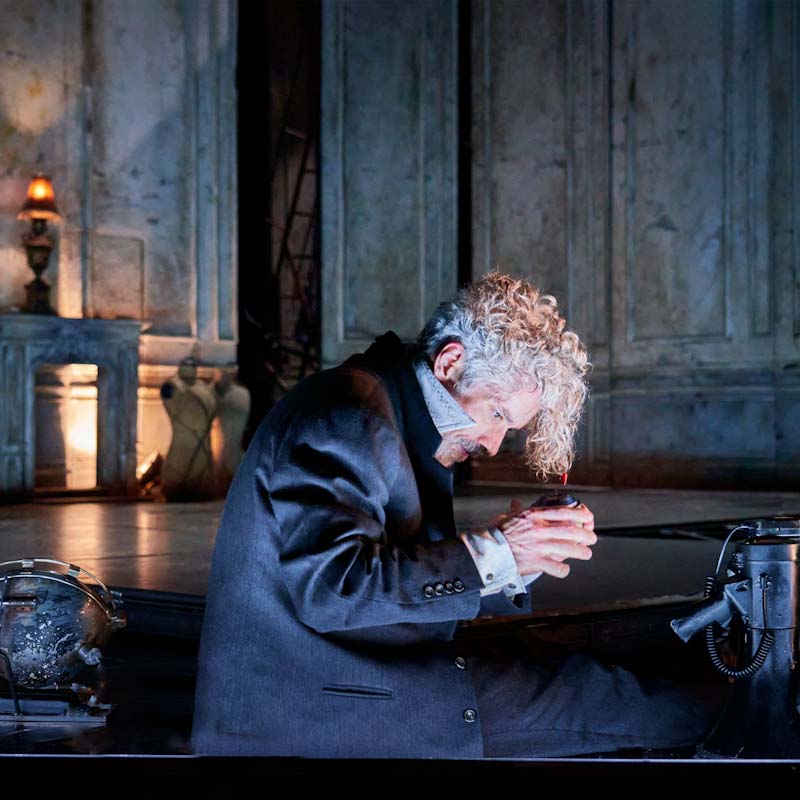
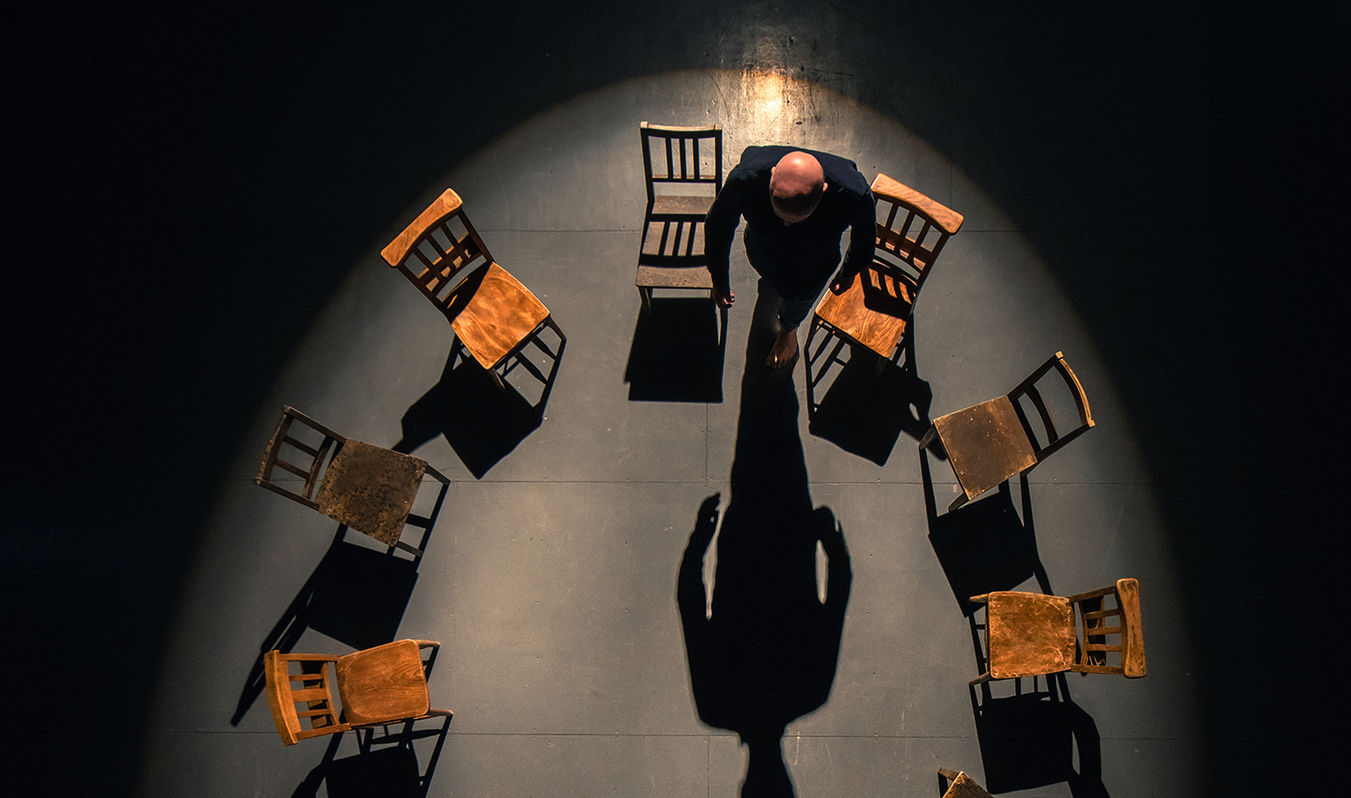
The UK première of An Audience with Abraham Lincoln, at Greenwich Theatre, also marks solo performer Jacob Truax’s first professional engagement in this country.Truax is an award-winning Lincoln interpreter recognised for his rigorous historical research and detailed knowledge of the 16th president’s life. This is evidenced throughout the play, with references to the minutiae of ‘Honest Abe’s’ early life, the positions he held, his rise from humble rural beginnings, and the career-changing encounters that led to him becoming a lawyer and politician.A front-of-house announcement before the performance explained that Truax would have to take a break before the end of his 75-minute monologue in order to accommodate the interval of the main-house show, which would create disruptive noise in the adjacent bar. This seemed to be something of a programming error on the part of the theatre, breaking the continuity of the storyline and disrupting his flow. It took him a while to regain his concentration thereafter.Lincoln was known for his storytelling and for relating anecdotes in order to make political and moral points. We hear several of these, some of which were clearly meant to be humorous but, for the most part, raised no more than a smile or a chuckle. In comedic terms, they largely fell flat.Increasingly, the performance became more of a costumed lecture delivered in the first person than a piece of theatre, the narrative being delivered in an almost uniformly soft voice, even when reciting some of the anticipated great speeches. These included Lincoln’s Lecture on Law, the House Divided speech, the Second Inaugural Address and the famous Gettysburg Address. It was often hard to distinguish where one ended and another began in vocal terms.The narrative moved chronologically, but little possessed the rousing tension or excitement found in works such as Doris Kearns Goodwin’s Team of Rivals. Lincoln’s genius in navigating the complexities of assembling his first post-election cabinet is barely addressed. Some tragedies of his private life are related, but his love for his wife, Mary Todd Lincoln, seems underplayed. The tragedy of his assassination is, of course, absent, as this is an encounter with the living man.The ponderous historical narrative is not helped by the lack of movement direction, which consists of little more than a couple of steps back and forth between a seat and a table. Meanwhile, the fixed lighting often leaves Truax half-lit or in shadow.An Audience with Abraham Lincoln ends up as a drawn-out talk about one of the most important US presidents of all time, one that fails to ignite enthusiasm or sympathy for its subject and that requires substantial editorial and directorial input if it is to have real impact as a solo show.

Greenwich Theatre • 2 Jun 2026 - 5 Jun 2026

Lessons from Teacher x

Cam is a school teacher looking for love, but also Crystal, who is a ‘cam girl’ - an online erotic model and occasional dominatrix for money. It’s clear this is a choice: Crystal offers Cam empowerment, making her something Cam is unwilling to give up. Barbara Smith is an interesting performer, drawing attention with a strong stage presence.The overarching story is, however, predictable, even if the final scene feels unlikely. There are some interesting aspects to the narrative: Cam’s need for Crystal, and the increasingly frequent shifts between the two personas. This backstory piques interest. However, there are issues, including an overuse of modern references, which risks alienating parts of the audience; an elaborate set featuring huge red chess pieces that suggest symbolism but feel disconnected from the narrative; and periods where Smith spends time behind a screen, leaving the audience looking at an empty stage, or on the floor, affecting sightlines.Smith handles accents well, but some of the characters within the multi-rolling story would benefit from further development and physicality, which would improve their authenticity. A mid-show line prompt underscores the need for more rehearsal. The production would also benefit from more focused work on the script and staging.

The Lantern @ ACT • 25 May 2026 - 27 May 2026

735

Anyone who’s ever sat through a team-building seminar, a mandatory training session, or a manager enthusiastically explaining “workplace culture” will recognise the world of 735 almost immediately. Thomas Pagett’s one-man corporate satire drops us into the life of an employee known only by a number, endlessly completing pointless tasks while an unseen manager issues instructions from above. It’s an idea with clear comic and thematic potential, even if the execution struggles to sustain it.Pagett regularly recruits audience members to play co-workers, eventually leaving five slighty uncomfortable volunteers stranded on stage for much of the performance. I particularly felt for the first participant, brought up within the opening minutes and seemingly trapped there until the end. One poor soul spent a substantial portion of the show sitting silently in a ball pit, which perhaps says more about Fringe endurance than corporate oppression.Audience interaction always carries risks, especially when your scene partners aren’t trained performers. Conversations became difficult to follow as volunteers understandably failed to project their voices — though Pagett himself often struggled to cut through the cavernous acoustics and background rumble of the Rotunda. Large stretches of dialogue simply disappeared into the tent ceiling.The satire itself is hardly subtle: modern work is repetitive, corporations treat employees as disposable, and managerial language is deeply absurd. Fair enough. But the show spends close to an hour circling this single idea without ever really developing it further. By the time 735 finally quits and is immediately replaced by another audience member, the message has long since submitted its resignation letter.

The Rotunda Theatre: Bubble • 2 May 2026 - 16 May 2026

Howie the Rookie

Contracting scabies and the death of a Siamese fighting fish are the somewhat minor incidents that set in motion a series of chaotic events with disastrous consequences in Mark O’Rowe’s visceral drama Howie the Rookie at The Cockpit Theatre, in collaboration with Burning Coal Theatre for their biennial UK visit, directed by Jerome Davis.The drama unfolds in two fast-paced, intense monologues set over an action-packed 24 hours. In part one we meet the scabies-riddled Howie Lee (Lucius Robinson), who is trying to track down The Rookie Lee (Andrew Price Carlile), from whose old infested mattress he contracted the condition. He intends to “give him a hiding” for the discomfort he is enduring. In the second half it’s the turn of The Rookie Lee to give his side of the story, but mostly to explain his own troubles in finding the money to repay Ladyboy, whose expensive fighting fish he killed in an unfortunate accident. Here, it seems, not even the fish can live in peace.Both actors give powerful performances. Robinson, playing the rougher of the two, relishes the seediness of the role, immersing himself in all the filth and sexual depravity of everyday life, along with the essential threats, violence and aggression that come with the territory. Price Carlile plays a softer role that relies more on charm and good looks to survive, while suffering the panic of a repayment deadline he has little hope of meeting. They each introduce us to some eccentric characters and mingle humour with wounded pride in a plot that ultimately ends in tragedy.The action takes place in Dublin’s gritty underworld. It is here the production falls short, despite the masterful performances of both actors. Their utterances have a generic Irish sound to them but are lacking in precision. The tones and lilt of Dublin are missing. Some sentences are rendered unintelligible and trying to grasp what is going on, particularly in the first half, is very difficult.The level of effort and concentration required to understand what is being said and to follow the story is way beyond what should be necessary to appreciate the play.

The Cockpit • 24 Apr 2026 - 2 May 2026

Iphigenia

The themes that permeate Greek tragedy are timeless. Every age has been able to identify with the great issues that confronted the classical writers and this is made abundantly clear in Iphigenia at the Arcola Theatre. Based on the story by Euripides, this English version is by Stephen Sharkey and is adapted and directed by Serdar Biliş. However, the promise of an exciting new take on the ancient myth fails to materialise.There's a gimmicky introduction that would have made more sense had it been part of a bookend device, but that didn't materialise. Instead it is a very weak scene by way of a mobile phone conversation Simon Kunz has with his son while explaining that he’d forgotten it was his turn to set the stage for the play. This includes rolling out the carpets that transform Set and Costume Designer, Mona Camille’s glossy ‘sea’ into an interior space. With that nonsensical opening out of the way, he then dons a formal military jacket as Agamemnon.Agamemnon's duty is to redeem the honour of Greece against the Trojans or face revolt by his troops, but his fleet cannot set sail without the fair wind that the gods control. Their price is that he sacrifice his daughter. His torment and conflicted position are the heart of the story. In an attempt to place his internal strife within a wider context, devices are employed that detract from this rather than assist the debate.Projections of womenm from around the world mgiving their views on war and the loss of loved ones disrupt the flow of the play and add nothing to the storyline, but rather form a documentary commentary on the tragic plight of families in regions of conflict. Similarly, when the cast break out of character in asides that tell personal stories of growing up in relation to parents and domestic strife, the connections are too loose to impact the great Greek tale.The main story is woven amid these interruptions, seemingly making it difficult for the cast to maintain emotional involvement and credibility. Rather, they seem to have distraught set pieces while pleading their causes and debating the issues. Kunz, not surprisingly, dominates, but overwhelmingly appears as a general who would direct from behind the lines at GHQ rather than brandish his sword leading the troops into battle. Mithra Malek plays a devoted and dutiful Iphigenia trying to reconcile herself to the situation while Indra Ové is a distraught yet assertive Clytemnestra. The underused resource is Cretan-born singer and composer Kalia Lyraki, whose pipe-playing is a prelude to the action and her only song has the air of a lament. She could have made a fitting chorus in a differently constructed play. The plot ultimately becomes confused as an alternative ending, where eagles appear and a deer replaces Iphigenia, is tangled with a version in which she is sacrificed. Yet another unnecessary inclusion in overall disappointing attempt to update the work.

Arcola Theatre • 9 Apr 2026 - 2 May 2026

A Mirrored Monet

There is undeniable appeal in the idea of a musical about Claude Monet – a figure whose life encompasses artistic revolution, personal turmoil and enduring legacy. A Mirrored Monet, written by Carmel Owen and directed by Christian Durham, frames this story through the artist’s later years, as he struggles to complete his Water Lilies while reflecting on his past. It is a premise rich with potential, but one that results in a curiously low-stakes and dramatically muted evening.Visually, the production is appealing. Charing Cross Theatre is dressed with canvases that line the stage, brought to life through projections. While often generic, there are moments where design and storytelling align – particularly during the En Plein Air sequence, where the visuals vividly evoke Monet’s outdoor painting style. It is here that the show feels most cohesive.There are also thoughtful tonal choices. Mercifully, the production avoids exaggerated French accents, opting instead for consistent British ones, which lends a welcome sense of restraint. There is also something quietly fitting about staging the show in London, given Monet’s fascination with the city’s fog and light.However, the central issue lies in a lack of dramatic urgency. By framing the story with an older Monet looking back, much of the tension is removed. We know where the journey ends, and the production struggles to create a sense of risk along the way. This is most apparent in an act one finale that lands with surprising flatness, raising questions about where the stakes truly lie.The writing also sidesteps some of the more complex aspects of Monet’s life. Camille is given a stronger presence, and Brooke Bazarian delivers a sincere and engaging performance. Yet the relationship is simplified, glossing over more difficult truths – including Monet’s later involvement with Alice – leaving the narrative feeling somewhat sanitised. Similarly, more desperate moments from Monet’s life, such as his attempted suicide, are absent, reducing the emotional depth of the story.Musically, the show struggles to leave a lasting impression. Despite a large number of songs, few are memorable. The score lacks distinctive melody, and audience reactions remain polite rather than enthusiastic. En Plein Air stands out as a highlight, while other numbers, including the overlong I Was Important Then, feel less effective.Performance-wise, the cast are consistently capable. Jeff Shankley and Dean John-Wilson offer solid portrayals of the older and younger Monet, though the material leaves both feeling somewhat underdeveloped. Bazarian, meanwhile, provides the most compelling work of the evening.There are glimpses of a more interesting show – particularly in moments that hint at the tension between artistic rebellion and tradition, such as the Marquis’ pointed instruction to “follow the rules”. Yet these ideas are never fully explored, and even key influences such as Eugène Boudin are absent.Ultimately, A Mirrored Monet is a pleasant but forgettable production. It offers an accessible introduction to its subject, but those seeking emotional depth, historical complexity or memorable musical theatre may find it lacking.

Charing Cross Theatre • 14 Mar 2026 - 9 May 2026

America The Beautiful - Chapter 1

Heralded as a “sensational UK premiere”, it is hard to imagine that this first trio of plays in the trilogy, America the Beautiful, comes from the pen of Neil LaBute, the man who gave us In the Company of Men and The Shape of Things.To be clear, there are nine works branded as an “exclusive collection of savage short plays offering a uniquely skewed view of life and relationships in the modern world”. They were “written over the past decade for the LaBute New Theater Festival in the US” and are now presented for the first time in three groups of three, produced by Greenwich Theatre for the King’s Head as an initial venture in their new partnership. Described as “chapters”, the first two are being performed at the King’s Head Theatre, while the third can be seen at Greenwich Theatre. The hyperbole surrounding the works continues with a description of chapter one as “a blistering trio of short plays from Neil LaBute that take a radical, bitter view of modern relationships”.Snippets from the conversation between the lovers in Hate Crime suggest that they are up to no good, plotting the demise of pretty boy’s soon-to-be husband in order to make an insurance claim. The stilted, bland and vague dialogue leaves us trying to put the pieces together after an argument about a lost key card to the hotel room, that turns out not to be lost, and a question as to whether Danish pastries come from Denmark (they don’t) and if one filled with cheese is a legitimate variety (only in the USA!). Borris Anthony York is annoyingly coquettish as he wiggles and poses around the room in shorts and a vest, in stark contrast to Liam Jedele’s sinister revelling in the gruesome details of what he will do to the victim to make it look like a hate crime. Then the pair separate, vowing not to meet until the deed is done.In the solo work, Kandahar, York impressively transforms himself into a decorated soldier who served in Afghanistan. He’s seated in the dock, although it could just as easily be a confessional, having taken revenge on his wife and committed several murders motivated by the adultery she committed with a fellow soldier. His static and protracted story and rationale for the crime are almost interesting, even if the conclusion is predictable, but the telling lacks the heightened angst, torment and tension one might hope for in such a tragic tale.With two down and one to go, it’s the turn of the two female actors, Anna María and Maya-Nika Bewley, to assume the stage and give Artistic Director of Greenwich Theatre, James Haddrell, one last chance to make something of LaBute’s writing. The Possible pits a lesbian who has sex on multiple occasions with the boyfriend of the woman she is obsessed with in order to teach her a lesson, in the hope that it will bring the two of them together. Finally we see some emotional engagement in the midst of this unlikely scenario, and moments of humour lighten the improbable situation. It too has a predictable outcome and, while in no way being exceptional, it is the saving grace in a lamentably uninspiring event.

King's Head Pub and Theatre • 9 Mar 2026 - 14 Mar 2026

Ukraine Unbroken

Mariia Petrovska sits aloft at the Arcola Theatre dressed in traditional costume, armed only with her country’s national instrument, so despised by the Russians as an expression of Ukrainian unity and identity that they executed people for playing it. The bandura has been at the heart of Ukraine's history and folkloric traditions for centuries, its 36 delicate strings creating magical sounds and accompaniments for songs that tell of triumphs and tragedies, love and loss. Having fled to Britain with her parents after the Russian invasion, she has an intimate connection to the production.Along with Petrovska’s situational narrative and enchanting vocals, it provides interludes between the five short plays that form Ukraine Unbroken. Her sequences also cover the significant scene changes required to move from one play to another. Credit here to Naomi Shanson (Stage Manager On Book), Ryan Denton (Assistant Stage Manager) and their team of hands for so expertly bringing about the transformations.The quintet is a worthy and ambitious project directed by Nicolas Kent with Victoria Gartner (Associate Director) and Maryna Kursik (Assistant Director – Ukrainian), performed by an adept six-actor ensemble of Daniel Betts, Ian Bonar, Sally Giles, David Michaels, Clara Read and Jade Williams.Act One, Demonstrations & Invasions, opens with Always by Jonathan Myerson in which we view the 2014 Maidan Square protests from a hotel room where two gunmen intend to shoot participants. This strategy comes as a surprise to the MP and his wife whom they are holding hostage, causing her to fear for her son who is out there with the crowds. Despite its inherent tensions, the outcome is rather bland.Next, David Edgar’s Five Day War examines Russia’s 2022 “Special Military Operation”. Imbued with some dark comedy, three potential post-victory leaders compete for positions while a bureaucrat pulls their strings. It’s an interesting, if rather game-ridden, take on the delusional world of false narratives.War is the simple descriptor of Act Two. Three Mates by Natalka Vorozhbyt is an intensely dramatic monologue in which Ian Bonar becomes Andriy, wrestling with his conscience as a man who, by various deceits, has managed to avoid conscription. Finally, we have a piece of theatre with which to identify and experience emotional turmoil.This leads into David Greig’s Wretched Things, which takes us to the front line where issues of morality and rules of engagement pose problems for three soldiers. The arguments and dilemmas are interesting; it might come over more convincingly in a film than it does on stage.That’s not the case with Taken by Cat Goscovitch, which confronts the harrowing reality of the 20,000 Ukrainian children stolen by Russia, handed over to other parents hundreds of miles away and subjected to a world of propaganda. Jade Williams, as the mother, movingly expresses the distress of families torn apart, and Clara Read as her 12-year-old daughter chillingly reveals the impact of re-education.Hence, it’s a mixed bag performed over nearly three hours. For those with a passionate interest in the subject matter, the didacticism and expositional content might be of interest, but overall, as a piece of theatre it falls short of the mark.

Arcola Theatre • 27 Feb 2026 - 28 Mar 2026

Loot

The essential elements of Loot are its irreverence towards the taboo of death and the traditions of the Roman Catholic Church, and its attacks on the integrity of the police force. The script both overtly and by innuendo allows for these to be highlighted, if you know how to play it, and that is where this production falls short.Black comedy, of which Joe Orton was a master, is a demanding genre. It’s not simple laugh-out-loud comedy, although it contains many hilarious moments, nor is it pure farce with split-second timing avoiding disastrous consequences, yet it contains elements of both. Instead, it treads a precarious path between the two and demands a very specific interpretation that delivers its unique style.Ultimately, everything is down to the director, but all play their part. Casting director Chloe Blake has assembled actors who appear as caricatures, churning out lines at speed with little awareness of the nuances and subtleties contained within. There is an excess of eccentricity from some, with unrelentingly high-octane, monotone diatribes that should have been reined in, while underplayed delivery of potentially comic lines comes from others. What’s lacking is the credibility that these are real people engaged in outrageous behaviour. Orton’s homoeroticism is also lost through a lack of seductiveness, along with the underlying sense of menace.The abundance of often hyperbolic activity and delivery is sustained at such a level as to become monotone and does not negate the overall feeling of blandness. The set and costume design by Zoë Hurwitz convey the period, but the looming illuminated cross, while impressive, is overstated, especially when, with no context, it turns to red, white and blue at the end.Loot marks director Bethany Pitts’ first opportunity to “lead work on a mid-scale stage”. It appears in this case that Orton’s peculiar type of theatre proves to be too demanding and too big an opening gambit.

Multiple Venues • 19 Feb 2026 - 7 Mar 2026

Mrs President

Plays often attempt to redress the balance of male-dominated history, and Charing Cross Theatre is currently hosting Mrs President, a two-hander that places Abraham Lincoln’s wife, Mary Todd Lincoln (Keala Settle), centre-stage with the ground-breaking photographer Matthew Brady (Hal Fowler).The period is artistically established with a conservatively furnished set by Anna Kelsey, who also designed the fabulously impressive costumes. Greens, blues and browns dominate Mary’s functional room, with a carver chair that brings back memories of her sons who died at the ages of three, 12 and 18. Behind a gauze screen that blends unobtrusively into the room’s layout is the photographic developing studio. It might appear somewhat dull but for the imaginative lighting from Derek Andersen, who also supplies multicoloured artistic flashes that heighten key moments. Meanwhile, Eammon O’Dwyer’s sound effectively complements both the setting and the action.Director Bronagh Lagan makes excellent use of everything supplied by the creatives and, along with associate and movement director Sam Rayner, gives Settle plenty of room to swirl her layers of hooped petticoats. Despite all these factors in its favour, along with the invested experience of two accomplished actors, and notwithstanding all her stories, the tragic deaths she experienced and the devastating sectioning of her by her eldest and only son to reach adulthood, it is still hard to identify with her or to feel a sense of emotional attachment. Her cause is not helped by the excessive wailing and screaming in some scenes.Fowler takes on several roles, including one as a judge in which the emancipation timeline seems completely awry. This, and other scenes, provide glimpses of the eventful times in which they were living, but nothing is explored in depth.The missed opportunities to create two characters with hearts, confronting major personal and social issues, are manifold, denying us both emotional understanding and historical insight.

Charing Cross Theatre • 23 Jan 2026 - 8 Mar 2026

Ms. Holmes & Ms. Watson – Apt. 2B

Sherlock Holmes has captivated readers and audiences for over a century. Doyle’s brilliant, eccentric detective, equal parts genius, addict and neurotic, remains one of literature’s most adaptable figures. Yet after countless remakes, updates and reimaginings, the character now borders on oversaturation. Any modern adaptation must therefore justify its existence. Unfortunately, Ms. Holmes & Ms. Watson - Apt. 2B misses that mark.The production markets itself as revolutionary for reimagining both Holmes and Watson as women in a post-pandemic world. However, very little in the text or plot makes this choice feel necessary. The characters could have been any gender without altering more than a couple of lines. If the title highlights the gender switch, the story should have offered a clear reason for it, not just the occasional cheap joke.This leads to my second major gripe: the humour. What I love in good Holmes adaptations is the sharp, rapid-fire wit, the contrast between Watson’s grounded, dry practicality and Holmes’ linguistic acrobatics. Here, the jokes felt weak, panto-level broad. Clever wordplay was almost nonexistent, punchlines were shouted rather than delivered and the funniest moments came almost entirely from Tendai Humphrey Sitima’s improvised work as Lestrade and Elliot Monk.Several American-centric jokes were also included. As a Canadian, I am more than happy to laugh at our southern neighbours, but the humour fell flat, largely because Simona Brown’s American accent landed somewhere between robotic and indeterminate. This is no fault of the actor, who clearly has talent, but if a character’s nationality is a recurring point of comedy, their accent must be convincing.The plot reworks familiar Holmes cases, stitched together with abrupt lighting shifts and jarring musical cues. Max Dorey’s set design cleverly transforms the apartment into various locations, but the transitions felt messy and required the audience to work too hard to suspend disbelief. Had the play focused on the relationship between Holmes and Watson as modern women, and how that dynamic might differ today, it could have been far more compelling. Instead, it relied on gags about pot, TikTok and Gen Z catchphrases to create a veneer of modernity.While the cast was committed, subtlety was lacking. Sitima was consistently strong, and Alice Lucy’s turn as Irene Adler had some power. But ultimately, I struggled to believe in the Holmes–Watson relationship.If this had been pitched as a Christmas farce or panto, my expectations would have been different. But as a more serious comedic attempt at a classic, it left me wanting much more.

Arcola Theatre • 28 Nov 2025 - 20 Dec 2025

When life gives you garbage

There’s an intriguing idea buried somewhere in When Life Gives You Garbage - a meditation on clutter, chaos, and the rituals we use to rebuild ourselves. Unfortunately, like the piles of rubbish strewn across the stage, it never quite finds form.Greek performer Savvina Romanou-Pylli spends much of the show navigating her own domestic debris, speaking in Greek with English and Italian surtitles projected above. The concept - cleaning the house as a metaphor for cleaning the mind - has promise, but the execution feels indulgent and opaque. At one point she eats peanut butter from a banana, and I found myself wondering what it was meant to signify. Perhaps I missed something profound.There’s room for abstract physical theatre, but audiences still need a thread to follow. Here, that thread gets lost among the clutter. Even the lighting seemed confused - a single LED beam fixed squarely on me throughout the performance, a fitting symbol for misplaced focus.When Life Gives You Garbage aspires to say something about resilience and self-renewal, but the result feels more like an unfinished workshop than a finished piece. The mess might be the point - but that doesn’t make it compelling to watch.

Fabbricateatro • 23 Oct 2025

Shotgunned

We begin at the end of their relationship, as Dylan sheepishly returns to Roz’s flat to collect his belongings. There’s still a hint of affection between them: Roz has gone to the effort of arranging his console games in order, something Dylan finds both touching and unnerving. He’s offered water (not tea) and, despite their efforts to be cordial, the breakup is just too raw. It’s an interesting way to introduce us to the characters, flipping the script so we’re left pondering what led the couple to this bitter denouement.Both actors are assured in their respective roles. Dylan, played by Fraser Allan Hogg, is an adrift and disillusioned graduate, reluctant to apply for work that’s unrelated to his degree, whereas Roz, played by Lorna Panton, is pragmatic and headstrong, with hopes of starting a family. There’s something slightly antiquated about the gender dynamic here—where the male character is career-focused and the female counterpart is primarily defined by her maternal aspirations.Written and directed by Matt Anderson, this two-hander is structured as a series of vignettes that move in a non-linear way back and forth throughout their relationship. It’s an ambitious way to approach a breakup narrative. In its best moments, these fragmented scenes hold a mirror up to how human memory works—the way moments from the past flash before us unbidden.Yet, when the play tackles weightier topics—such as miscarriage—the character of Dylan doesn’t feel fully realised, making it difficult for him to engage with Roz in a meaningful way. It’s a subject that calls for delicacy, and I fear Shotgunned may have slightly missed the mark here. If the intention was to comment on how some men struggle to truly sympathise with a partner after losing a pregnancy, then Dylan certainly offers this. But I’m not convinced this was the aim. Indeed, when Dylan makes a quip about the correct name of his console at a heightened emotional moment, the scene suddenly falls apart. This doesn’t detract from Lorna Panton’s performance, which, at one point, lays bare Roz’s loneliness and grief with sincerity.Shotgunned succeeds in capturing the precarity of life in your early twenties as well as the tender awkwardness of early love. But, despite some strong performances, the play doesn’t offer a nuanced perspective on the more complex themes it seeks to explore.

Riverside Studios • 12 Sep 2025 - 28 Sep 2025

113

Without memories, how much of our identity would remain? Separated by a wall, 49 and 64 cannot see each other and have only fleeting, imperfect recollections of the past. 113 is a conceptually ambitious but technically simple production that dramatises the conflict between the stories we tell about ourselves and the reality of our lives.The crowd is split in half so that we only see one of the actors for the whole play, cleverly enabling the audience to share in 49 and 64’s sense of separation. However, the physical distance between the characters only highlights the lack of chemistry between them.So much of the plot is spent uncovering their respective backstories that little space is left for character to emerge through action and manner. Consequently, the love story strand of the plot feels unconvincing and somewhat gratuitous.113 is a thought-provoking play that poses interesting questions about the relationship between memory and identity. However, this production fails to maximise the potential of its premise and ultimately falls short due to an unnecessary romantic subplot and unconvincing characterisation.

theSpace on the Mile • 18 Aug 2025 - 23 Aug 2025

Born with Teeth

In the hands of director Daniel Evans, Liz Duffy Adams’s well-researched play about the relationship between William Shakespeare and Christopher Marlowe becomes something of a comic showcase for Edward Bluemel and Ncuti Gatwa – though their performances are nevertheless impressive.On the expansive stage of Wyndham’s Theatre, Born With Teeth asks us to imagine a cramped room above an inn, where the literary giants pen pages of Henry VI Part I, a work now shown to be a collaboration. It’s a tall order, especially with only a table for a set and vast banks of lights beaming out at us – 80 on the rear wall and 56 on each side – with scene changes marked by pixelated projections.In the early 1590s Marlowe was the man of the day, with Shakespeare still a mere fledgling. Marlowe was also a government spy, which gives rise to much talk of Catholic-Protestant rivalry and faith in general, along with his atheism, debauchery, procrastination and attempts to seduce his fellow playwright, placing historic rumours beyond speculation. The contrast is sharp: Will, single-minded in his commitment to finishing the play, is cast as a sensible family man who avoids trouble.Life’s dangers are well aired, but reported second-hand, which dulls their impact. If only these teeth had more to bite into – some first-hand politicking, heresy and treason to immerse us in. Instead, we are left with an abundance of physicality and frolics, mixed with too much puerile humour and schoolboy smut.

Wyndham's Theatre • 13 Aug 2025 - 1 Nov 2025

Coming Out With Dr Who

This cramped little show fundamentally fails, as advertised, to explain how the iconic BBC science fiction series helped writer/performer S J Wyatt “come to terms with being a bipolar, queer, neurodiverse, wannabe activist” – although the psychiatrists they view as emotionless Cybermen would doubtless be interested in their repeated Mother/Dalek comparisons.Consisting of various reminisces that neither gel together nor build momentum, an unfortunately silence-laden “song” mid way, and a banal self-penned episode called The Biphobic Monster of Doom (performed by some innocent audience members), this is frankly disappointing.On the plus side, though, the sparkly home-made props are quite good.

Laughing Horse @ The Brass Monkey • 13 Aug 2025 - 24 Aug 2025

Score

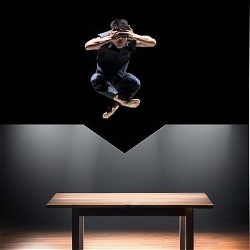
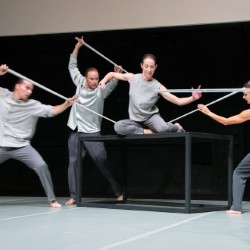
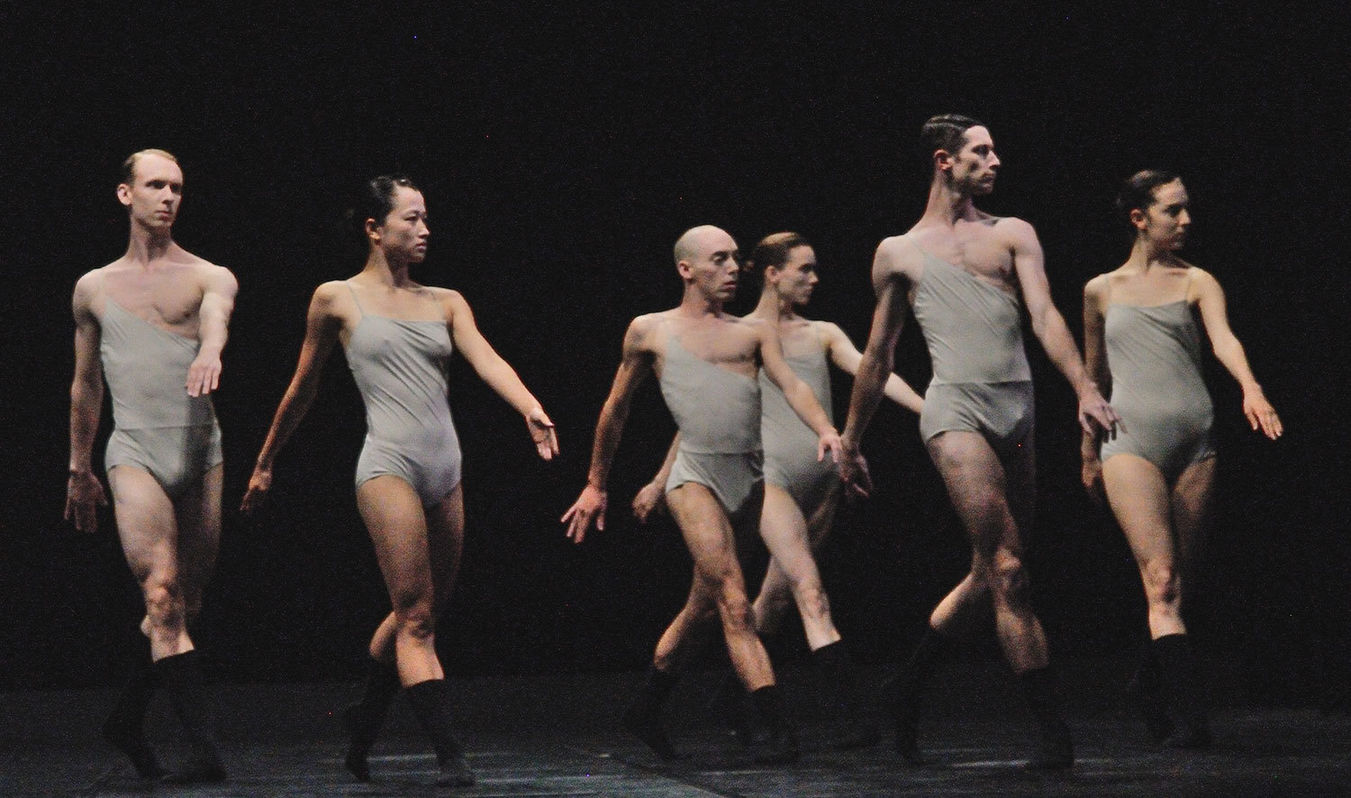
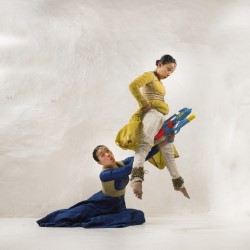
Three dancers are wired to equipment which makes their muscles move involuntarily.We see muscles twitch in an unnatural way, but I don’t believe the majority of the performers’ movements are controlled by computer. This ambiguity isn’t a fault; anyone who has had to report a problem via online chat knows there is no practical difference between machine and human bureaucracy.The experience is intellectual, not emotional. The piece prompts thoughts. Should technology rule us, or the other way around? The dancers largely seem unconscious of manipulation – is humanity in a “boil the frog” situation?However, you can get those thoughts after a few minutes of the performance, or even from seeing the photograph of the dancers.Isaiah Wilson has made interesting work in the past, but Score, while unique, has little beyond the initial concept.

Assembly @ Dance Base • 12 Aug 2025 - 24 Aug 2025

Jack Off the Beanstalk: An Adult Pantomime

Jack Off the Beanstalk is a reasonably fun adult pantomime, taking many of the tropes of traditional pantos and twisting them for an adult audience. As the title suggests, this is Jack and the Beanstalk reimagined, with our impoverished hero selling his cows for beans, which grow into the stalk that leads him to a world where Giant Donald Trump reigns supreme.The premise could work, but the production feels amateur. The writing is weak, with streams of lazy innuendo delivered by one-dimensional characters. A couple of songs fall flat, and none of the actors truly take ownership of their roles. The strongest performance comes from a Cinderella-type character trapped in Trump’s castle, but she spends most of the show offstage and only appears ten minutes before the end. Rhyming interludes from angelic and demonic guides land fairly well, but lack gravitas, and the actors never quite connect with their audience.The plot is coherent, and there are laughs to be had. Yet there are many missed opportunities to make it feel like an event. The classic audience interactions of “He’s behind you!” and “Oh, no, he isn’t!” are glossed over or absent, and when a loud-mouthed audience member heckled throughout, he was ignored – only to be invited onstage later.This is not a bad show, and if the premise appeals it will entertain. But with the wealth of highbrow, thought-provoking comedy available, or even sillier shows that raise laughs without leaning on clumsy digs at Trump and the church, your time is probably better spent elsewhere.

Greenside @ Riddles Court • 11 Aug 2025 - 16 Aug 2025

A Covert Affair

There is much to admire in A Covert Affair. There is also much to be desired. I was instantly drawn to its synopsis: two operatives from opposite sides of the Iron Curtain locked in a game of seduction and espionage to exchange state secrets. The conflict is explicit from the start. These are spies whose national loyalties are tested by love, whose misdemeanours risk severe punishment, and who face constant threats in the tense setting of mid-century Budapest.The premise offers all the ingredients for a high-stakes political thriller, echoing the romance and tragedy of a Cold War drama like Paweł Pawlikowski’s Cold War. The dangers are built in – perhaps so much so that the play largely leaves them unspoken. Absent are the local threats of the Hungarian secret police or the looming possibility of our lovers being caught, tortured, or killed. What the production most needed was greater world-building: importing historical and social detail from the period, or even just the streets of 1960s Budapest, to ground the dramatic stakes before moving us through a series of steamy interiors where differences between the lovers inevitably widen. Without that foundation, the hour-long narrative feels flat, and we have to be reminded that what the protagonists are doing is dangerous.While the historical and ideological context is clumsy, the central performances offer much. Faced with a wooden script and lacklustre direction, the actors find a sense of pace and turn corny, misjudged jokes into moments of endearing awkwardness – subtly drawing the characters closer. By the final sequence, when the two dance together – which might have made a stronger closing moment – there is a genuine connection, an aura of longing. It is one of the few flashes of brilliance in A Covert Affair, and it makes the experience at least partially worthwhile.

theSpace on the Mile • 11 Aug 2025 - 23 Aug 2025

Josh Cake's Dancefloor Piano Bar

Josh Cake’s Dancefloor Piano Bar bears little resemblance to its blurb. There is no sign of “Fringe’s wildest free late-night party where the dancefloor is always packed”. In fact, there is no dancefloor – let alone any wildness. The crowd at Brewhemia’s Beer Palace is quietly enjoying post-show drinks and meals.Josh Cake plays pop bangers on the piano, but his attention remains fixed on his sheet music rather than the audience. Interaction is non-existent, and the musical delivery is unremarkable. While Cake has had success as a poet and performer, describing him as an international cabaret icon feels like an overstatement.If you visit Brewhemia on a Sunday night, don’t expect a wild dance party – this is more background music than a late-night Fringe event.

Brewhemia • 3 Aug 2025 - 24 Aug 2025

Solitude Without Loneliness

Three figures with their clothes pulled over their heads suggest the prison-like state of loneliness. Sadly, the promise of this striking image is not continued in the rest of this mishmash of movement, text, serious then comedic scenes. It is a shame that talented dancers are given incoherent and repetitive choreography by Malcolm Sutherland, himself one of the dancers. The trouble with alienation is that it alienates the audience. Thankfully, an absurdist romantic dinner for two – a Blind Date spoof where lipstick replaces Bordeaux – and later Metro’s ‘Rush Hour Crush’ enliven the show. The comedy sketches are great. Pity about the dance.

Assembly @ Dance Base • 2 Aug 2025 - 10 Aug 2025

Atomic Cabaret

Atomic Cabaret goes heavy on the atomic and light on the cabaret. Lynda Williams brings a genuinely laudable passion to a dark and difficult subject, but unfortunately the performance feels more like a government-issue infomercial than a cabaret. The slide deck feels amateur, and the songs struggle to truly captivate.However, the show had poignant moments that prompted serious contemplation – particularly a rendition of Peter Seeger’s translation of Never Again the A Bomb. The upside is that I learned more about MAD realities; the downside is that that’s a hell of a mood killer. A little levity would have helped.

theSpace @ Surgeons' Hall • 1 Aug 2025 - 9 Aug 2025

The 25th Annual Putnam County Spelling Bee

The 25th Annual Putnam Country Spelling Bee is a quirky musical that is quite tricky to pull off. Its premise is that of the “trapped in a lift” variety, namely that a group of children are competing against each other throughout to spell complex words in a spelling bee. The words are generally words that they will probably never use or need, crammed full of Zs and Ys and lurking Cs, and to some extent this creates a futility in the enterprise that is perhaps a dry commentary on the teaching of literacy within primary education. However, the real heart of the musical is to play out the backstory of each competitor so that the richness of their life story is revealed, explaining and endearing them to the audience. Such is the key to this musical, and at its best, it has secured itself Tony, Drama Desk, and Theatre World Awards on Broadway, and a place in the hearts of many American high school theatre programmes. At its best. However, this depends on the charm of the characters shining through the tedious pointlessness of the competition. This never really happens in this production.We are greeted with a busy stage, decorations of bunting and signage all pointing to the fact that a spelling bee is about to start. All very informative and all very practical, but it makes it hard to escape the setting and keep dynamic as we move later into the backstories of the characters. A series of young competitors are presented, after which we bounce between spelling attempts of varying success and breakout song-and-dance numbers as the competition heats up. It is disciplined and clean but without charm, the primary characters lacking the innocence that might win you over. Of these, George Rohan’s nerdy William perhaps gets the closest in an accomplished performance. Madeline Watson also has fine stage presence as Mitch. But it is never quite clear what age the adults are portraying – there is a brattish nine-year-old, an abandoned 14-year-old, a nerdish 12-year-old – these are all enormous differences within school age, and it is hard to believe this is the age range actually intended by the production. A smart costumier is controlling the colours, which makes this attractive to look at, but not sufficiently to compensate for the lack of light and shade within the character stories. This was not helped by some colourless songs, which tidy choreography doesn’t save, and I do not blame the five people who walked out during an unnecessary song about erections. By the end, this character’s member was the only thing that was standing.All in all, this is a tidily presented show from competent performers that clearly has its fans in the audience, but it never casts a spell over me.

Greenside @ George Street • 1 Aug 2025 - 23 Aug 2025

Timestamp

Timestamp is constructed on the thesis that women feel oppressed and stunted by the expectations placed on them. The show simply collects evidence to support the premise. There is no exploration of women’s lives outside this scope. There is nothing new.This narrow outlook is a shame because the two performers have talent and commitment. The show comes alive when they look away from the abstract and actively explore – when speaking about their own concrete experiences, or when they invite the audience to submit photos celebrating important women in their lives. That sort of focus could produce something original and engaging.

Dovecot Studios • 1 Aug 2025 - 24 Aug 2025

Garden Party – Truman Capote's Black and White Celebration

There were probably occasions when the ubiquitous socialite Truman Capote might have wished he’d been left off the invitation list – even of his own party. Garden Party – Truman Capote's Black and White Celebration at theSpace @ Symposium Hall is probably a case in point.We’re invited to don a black lace eye-mask to feel fully part of this immersive theatrical experience by Paris-based Kulturscio’k Live Art Collective that uses all available space. Two hosts, Sean O’Callaghan and Paul Spera, mingle with the guests and engage in chit-chat about the rich and famous, bandying around names such as Audrey Hepburn, Greta Garbo, the Bloomingdales, Peter Lawford and Patricia Kennedy, David Niven, Tony Curtis, Natalie Wood, Hope Lange and many more. Meanwhile, director Alessia Siniscalchi hovers around in the manner of an operatic diva, fanning herself. Cue song and dance routine as the gentlemen take to the stage as socialites for an interlude of musical entertainment with live backing from Didier Leglise, who has been seated behind his keyboard with guitar playing incidentally – all part of what they call the ballad of hypocrisy.More mingling follows and it terminates nearly 20 minutes before the end of its programmed 50-minute running time. As with many parties, you sometimes wonder why you went.

theSpace @ Symposium Hall • 1 Aug 2025 - 9 Aug 2025

Soil

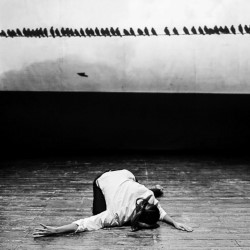
Aviaja’s Soil is about not belonging – choreographed and performed by Sarah Aviaja Hammeken, who is half Danish and half Greenlandic. Growing up in Denmark without her Greenlandic language (Kalaallisut), she does not feel at home in either country, and this impacts on her sense of identity.The show opens with her lying face down in a heap of black soil. Nothing happens for ten minutes, testing the audience’s tolerance. However, this image stays with one long after the show is over, and there is a potentially powerful performance piece waiting to be released. Sadly, it remains more of a lecture.

Assembly @ Dance Base • 1 Aug 2025 - 17 Aug 2025

Escape Room: The Musical

Escape Room: The Musical is a great premise that surely appeals to my fellow fans of genre mashups, in which a cast of seven play out a mystery thriller intercut with songs and problem-solving.It’s a strong setup, but a weak opening number doesn’t bode well, as the songwriting and vocal performances here are very amateur. The cast seem proud of their performances though, and you can occasionally feel the tension as they pause for laughter or applause that never arrives. Despite lacking gravitas, there is still expectation that the show will deliver on the novel idea.As the drama unfolds, we learn that the characters have been invited to the escape room by a mystery person and they each have secrets to reveal. This tried-and-tested premise (albeit in other locations) could really lead somewhere, and the writing is fine if not a bit underwhelming. Some of the characters are well-defined and engaging enough, and the script certainly isn’t without jokes that land well. Although there are actually some excellent jokes that just don’t get their deserved acknowledgment due to suboptimal delivery.A couple of the songs are quite enjoyable, though the musical elements are probably the weakest part of the show, yet the audience remain hopeful until the end that a great twist or revelation will justify the journey. There are some major flaws I can’t discuss without spoiling the ending regarding some characters’ significance to the plot, and I found it somewhat ironic that one character said in the final act: “You can’t be hiding parts of the puzzle in your head,” when this is exactly what the writers did to their audience.The escape room element is a fun idea, but the audience don’t really get to participate in solving them, or even being fully briefed on what all the puzzles are, as they’re explained by the cast as they proceed through the story. This could probably succeed as a more interactive piece, putting the ‘Escape’ element centre stage while the ‘Musical’ part humbly retreats. In the hands of another creative team, this could easily be a four-star show, and perhaps if they keep working on it, they’ll get there. It still held our attention to the end, but judging from some of the comments I heard from audience members on the way out, perhaps the venue was the real escape room all along.

Just The Tonic at the Caves • 31 Jul 2025 - 24 Aug 2025

Enjoy Your Meal

An immersive theatre experience where a successful comedian cooks real food while having a “meltdown” is an exciting prospect. Unfortunately, Enjoy Your Meal doesn't live up to the strength of the premise it was built on.It’s hard to tell through what lens this show should be viewed. Cory Cavin has impressive credentials as an Emmy Award-winning comedian, so perhaps it would be fair to judge this work as a comedy; but it doesn't really present much in the way of humour. Perhaps it was created as a serious play, but there isn't much of a plot or character development, and if it was meant to be naturalistic, the acting was unconvincing. Maybe it’s intended as a food demonstration, but the food wasn’t particularly tasty or interesting, and didn’t have much of a story behind it.Cavin’s character comes across as a very sweet and kind man, gently guiding his dinner guests through the experience, but at most, he seems slightly stressed—far from the “meltdown” referenced in the show's blurb. Ultimately, the concept is fantastic, but nothing is pushed far enough to make it more than a light appetiser in place of a full meal.

Summerhall • 31 Jul 2025 - 25 Aug 2025

The Foreskin Diaries

One person speaking their truth with passion should, I believe, be applauded – in principle. And so I cannot dismiss Ron Low's hour delivering The Foreskin Diaries out of hand – if you'll excuse the pun.Ron is about as militant as it gets when it comes to the foreskin – he calls himself an 'intactivist' – and invented the TLC Tugger, the purpose of which is to restore the foreskin of a circumcised male.It has, to date, restored over 63,000.His hour comes to you in the Musicals and Opera section of the programme. So, horrendous details of devastated relationships, ruined sex lives, suicide and gruesome photos (yes, you will see a lot of male junk here) are interspersed with songs. To my ear, it did sound more like one song in several variations, with lines like "Between your thighs, my fragile pride abides" and titles like Love Through My Boy's Eyes.Ron’s outrage is expressed in a 'more in sorrow than in anger' tone. But words like mutilation, penetrative assault, and amputation fly freely. We are asked to close our eyes and imagine a world without male circumcision and exhorted to persuade pregnant friends to leave their boys intact.Owners and lovers of the foreskin might find their people here, Upstairs at Laughing Horse @ Bar 50.

Laughing Horse @ Bar 50 • 31 Jul 2025 - 24 Aug 2025

Narin Oz: Inner Child(ish)

Narin Oz: Inner Child(ish) is a passion project for Oz. It portrays a series of experiences that are beautifully and painfully relatable for anyone neurodiverse.Unfortunately, this rawness often bleeds into an unpolished performance that is at times abrasive. Oz’s concept does not always reach full execution, and the intimate space sometimes becomes oppressive with her delivery. Jokes often fizzle into excruciating awkwardness, and at times it feels a little like a pop quiz on her struggle or outlook.That said, beneath all its flaws, Oz is likeable and funny. She pours her heart into this piece.

Just the Tonic at The Mash House • 31 Jul 2025 - 24 Aug 2025

Space Hippo

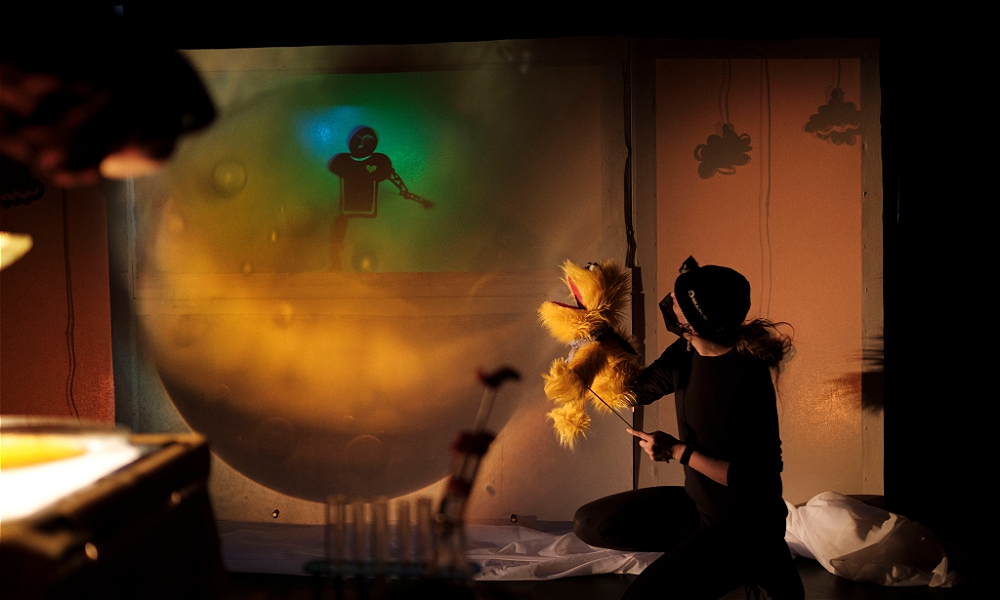
With only five years to save the planet from complete environmental catastrophe, what is the only solution? To send a hippo into space to block the sun, of course! This absurdist political resolution to a very real crisis is played out through a bilingual shadow puppet show that turns into a sort of intergalactic buddy road trip story. Sounds like there is a lot going on! Yet despite all this action, the storytelling often ends up feeling repetitive and slow.While the shadow puppets are undoubtedly beautiful and it clearly took a great deal of skill to create the piece, it falls flat. What at the beginning feels as though there may be a powerful political allegory coming, ends up amounting to little. The musical backing is a real highlight – reminiscent of the silent movie era – and there are some fun characters we meet along the way. However, despite the glimmers of stardust that can be found, this Space Hippo is lacking gravity.

Underbelly, Cowgate • 31 Jul 2025 - 24 Aug 2025

Facility 111: A Government Experiment

This show is hard to rate because it is an experiment rather than an entertainment. It depends on whether that idea floats your boat.The audience sits in darkness. Most shows in that genre aim for scares and high drama. This experience is quiet and contemplative, and demands concentration and patience. A voice guides the audience in imagining various images – that’s the bulk of the show.Even for someone attracted by this idea, the most positive response is likely to be “That was interesting.” There is no scientific or psychological wizardry. As a show, it doesn’t work, but it has sincerity, and it’s different. It would be interesting to see what the author does next.

Assembly Rooms • 31 Jul 2025 - 17 Aug 2025

Delusions and Grandeur

Towards the end of her emotional clown show about the struggles of being a world-renowned classical cellist, Karen Hall says she was once advised by a university lecturer to go into every performance 110% prepared. I fear that’s what went wrong here.Although her cello playing was fantastic, Hall delivered her lines with an over-rehearsed pacing and intonation that left no space for authentic vulnerability and sincerity – two key elements of clowning and emotional theatre. The few moments where she briefly engaged in crowd work and dropped the script were (aside from the musical interludes) the best parts of the show, with the biggest laughs and emotional reactions all coming from these short segments. The bulk of her performance fell flat, however, with Hall’s long emotional silences feeling more awkward than profound.

Summerhall • 31 Jul 2025 - 25 Aug 2025

Midnight at the Palace

Midnight at the Palace is an extroverted, unapologetic musical comedy by Brandon James Gwinnett and Rae Binstock based on true events. The Cockettes were an avant garde ensemble of hippie drag artists who became known for their psychedelic theatrics and countercultural politics from 1969 to 1972. Founded by Hibiscus in San Francisco, the short-lived collective began by parodying musicals but soon transitioned to performing their own material, garnering a cult following in the process. They created 20 shows over the course of their two-and-a-half-year existence and performed a series of midnight drag shows at the Palace Theatre in New York City. This is the backdrop of Gwinnett and Binstock’s Midnight at the Palace, which makes its world premiere at the Edinburgh Festival Fringe 2025.I was instantly impressed by the production’s beautifully idiosyncratic scenic design, which feels fundamentally makeshift and DIY, as the Cockettes and their lifestyle inevitably were. Signs with location names (“San Francisco”, “New York”) are scrawled like finger paintings and presented – often comically – to audiences in what amounts to vaudeville-esque and amusing feats of storytelling, which the audience appreciated. In fact, it is in this very facet – the production’s self-conscious celebration of its own fakeness – that Midnight at the Palace really shines. The musical score is sometimes rather original, crossing the familiar rhythms and progressions of classical show tunes with something more rollicking that resembles the rock’n’roll of the Woodstock and post-Woodstock period. In many ways, the score is the most impressive part of the production, which its ensemble of actors handle with eloquence and style, all in spite of the occasional mic malfunction.That said, the often clunky dialogue, cheap jokes and lack of effective characterisation to distinguish each unique personality in the Cockettes – including any compelling character development – leave the show feeling flat. What the script amounts to is a cacophony of character introductions, recitations of historical facts and figures, and very little action or engagingly dramatic events. What could have been a very strong show, with impressive production value and much to be praised, is ultimately let down by a limp script that lacks the sharpness and immediacy to make this story as compelling as it should be.

Gilded Balloon Patter House • 30 Jul 2025 - 24 Aug 2025

How To Kill Your Landlord

To say there is a housing crisis in Britain is something of an understatement, with successive governments proving unwilling or unable to reverse a generationally disturbing trend. Rents have spiralled beyond affordability, especially in city centres. The tightening of lending criteria following the banking crisis, along with the inability to save for a deposit, have proven to be stubborn barriers to homeownership.Resentment has grown, therefore, towards the wealth division, and a perception has emerged of parasitical owners subduing an entire generation. Which brings us to How To Kill Your Landlord.Burke (Robbie Fletcher-Hill), Harriet (Frankie Weatherby), and Joq (Elijah Khan) live in a flat, seemingly at the whim of their landlord, Archie (John Gregor). The apartment appears to breach swathes of housing law. There is also the suggestion that Archie conned Joq’s grandmother out of the flat, fuelling their sense of grievance. When Archie lets himself in unannounced and verbally gives them one week’s notice to quit, they decide to murder him.What follows is a series of absurdist, slapstick events, with a sold-out Bedlam crowd enjoying the antics.The performers are clearly talented, with Weatherby in particular delivering a measured performance. However, the script lets them down, giving them precious little to push against. Setting aside the decades of housing law being ignored in this premise, incredulity is simply stretched too far, too often, in this production. With some rework, there is a decent piece of comedy theatre here, and the theme of generational disgruntlement is definitely ripe for exploration.

Bedlam Theatre • 30 Jul 2025 - 25 Aug 2025

Andrew Frost: The Greatest Card Magician in the World

Andrew Frost is The Greatest Card Magician in the World. Except, he isn’t, as he claims soon after he comes on stage. Yes, this lowers expectation to reasonable levels before we are given the opportunity to reach this conclusion ourselves, as he confesses that this was a quote from a random reviewer that becomes an underlying theme of the show’s narrative. But also, it immediately erodes trust and negates the reason most of the audience probably selected this show above the plethora of competition.Frost is an amusing and personable performer, and as he welcomes us in and warns that this show is going to be a full hour of him finding our cards, he lacks the showmanship required to be classed as a “great card magician” – the stage skills being equally important to the dexterity required to master sleight of hand. Many practitioners of the magical arts will state on their website that they have been voted “the greatest magician in the country”, before adding a footnote that this poll was conducted solely among their family, but to put this claim in your Edinburgh show title is audacious if you can’t back it up.To his credit, he is a good magician. The range of tricks is pretty wide considering he’s confined himself to using playing cards for the whole show, and his execution of the effects will baffle most audiences. He provides a strong finale, making good use of a Chekhov’s gun that had been dripped into the narrative. His scripts, sleights and audience interaction are all solid, though he puts up a barrier between us by telling the audience he’s disappointed with some of our reactions.Most of his tricks are tried and tested, even if he does frame them slightly differently. If you see a lot of magic shows, there’s not going to be anything in here to blow you away, and if you’re new to magic, it’s a safe introduction to card tricks. Were I to review Frost at a performance in your local town, it would probably be worthy of an extra star – there’s certainly nothing bad about it. But at Edinburgh Fringe, for an above-average ticket cost, your time would be better spent enjoying one of the more experienced high-production magic shows in the same price range, or on the Free Fringe, which still has some of the top magicians at the festival.

Pleasance Dome • 30 Jul 2025 - 25 Aug 2025

Nick Hornedo: Watch This When You Get Home

Nick Hornedo feels like a sad clown: self-aware, feckless, and just a little bit pathetic. It is a fine balance to get this act right, but as the hour-long, wince-inducing spectacle went on, it just felt like kicking a puppy.His monologue lurches from “Woe is me” to “But I’m so talented” without the charm needed to carry that off. To his credit, Hornedo manages to deliver a sometimes relatable cringe-fest for millennials who had their first love stories online and their hearts trampled in theatre.Sad clown shows are all about arc; Nick’s story does not really have any. I went in wanting to root for him; instead, I just sat and cringed with him in a drawn-out performance that should probably be in a different category.

Underbelly, Bristo Square • 30 Jul 2025 - 24 Aug 2025

Heart of the Country

There’s a version of Heart of the Country that I’d love to have seen. One where the oddball premise – four Scottish performers spinning tall tales and tunes about Lyndon B Johnson around a campfire – lands with the charm and profundity it clearly hopes for. Sadly, this wasn’t it.The show bills itself as “less a biography than a counter-mythology”, which is a poetic way of saying “we made stuff up”. Fair enough – fringe theatre thrives on imaginative leaps. But those leaps need somewhere to land, and here, they mostly just circle the fire and vanish into the smoke.The structure is loose: stories about LBJ’s life (sort of), each ending with the refrain “and that young boy was LBJ”. Initially funny. Eventually grating. The performers take turns narrating in a style that lands somewhere between campfire anecdote and podcast audition – pleasant enough, but lacking the dynamism or theatricality that might elevate it beyond spoken word.An audience coin toss supposedly determines whether we get a song or a story next, but as every piece is performed by the end regardless, the illusion of choice feels just that – an illusion. It’s a neat idea in theory, but without consequence, it adds little beyond mild confusion.The cast are likeable and clearly committed, and there are flickers of musical and lyrical talent throughout. But for a show all about the power of storytelling, the stories themselves rarely ignite. There’s little movement, little interplay and a lot of sitting still and talking – which is fine if your words crackle. These mostly smoulder.There’s potential here, and some thoughtful ideas flicker beneath the surface about myth, history and democratic storytelling. But Heart of the Country ultimately feels like a show still trying to figure out what story it wants to tell – and why we should want to listen.

Café Club Míšeňská • 29 May 2025 - 31 May 2025

Murder at the Manor

Murder at the Manor starts strong with a witty nod to 1940s film noir, complete with detective narration and moody intrigue. Billed as The Play That Goes Wrong meets Clue, it promises sharp spoof but delivers obvious farce instead. As it spirals into innuendo and slapstick, the noir charm is lost.Brenna Simpson stands out as Detective Fred Herring, delivering a delightfully over-the-top performance, including a succession of hidden moustaches. A couple of solid gags spark laughs, but not nearly enough to carry the full show. With more focus and restraint, it could be a Fringe gem.

The Lantern @ ACT • 10 May 2025 - 26 May 2025

Becoming Maverick

Starting with a child discovered locked in a trunk in 1919, this one-woman show tells a hard-hitting story of triumph over adversity. The stories she recounts of growing up in an orphanage with cruel overseers are reminiscent of the hideousness in Jane Eyre. When she runs away, she reinvents herself, setting her on the path to a completely different life.Becoming Maverick is not for the faint-hearted, with brief scenes of rape as well as child abuse in the orphanage. If you’ve never seen anything with this subject matter, it might be profound. However, the style is at times quite sensationalist, with melodramatic poses. Rather than letting the material speak for itself, it often becomes overstated. The writing is also a little overblown - much of it rhyming and often too florid, as if trying to be poetry, while the use of second-person address doesn’t quite land.The denouement is satisfying and interesting, delivering a little “aha!” moment and providing the strongest part of the piece. It serves to inspire the tale. However, there is a coincidence which stretches credibility, some improbable occurrences, and the timing of a key historical context is not mentioned.Overall, this is interesting, but it needs to be more than that in order to be shocking. It feels as if it still needs some work.

The Actors - Theatre • 3 May 2025 - 4 May 2025

The Lightning Thief

When the historically worst ever book-to-film adaptations for Percy Jackson are your frame of reference (so bad they were disavowed by the author) the bar is set very low. Joe Tracz and Rob Rokicki’s The Lightning Thief is better than the films, but that's not saying much.Based on the book by Rick Riordan and with direction and choreography by Lizzi Gee, this show centres on the demigod, Percy Jackson (Max Harwood), and how he might retrieve Zeus’ stolen master bolt and prevent a war breaking out between the gods. It brings in elements of the later series with off-the-cuff references to jokes, events and Greek mythology, often leading to vast bouts of exposition and stilted dialogue. The musical suffers from an indecisiveness of tone, often employing comedic techniques to poke fun at itself and that it’s a theatre production, that doesn’t always match the gravity of some moments. This creates a messy and careless dichotomy that suggest the actors have been given opposite sets of direction. The show requires multiple tracks that are physically and vocally intensive, including choreographed fight scenes, occasionally whilst belting at the top of their range. Some, including Harwood, struggle to reach notes and often miss them. His delivery is monotonous, often with a blank expression and no variation in tone or intonation making reactions to a given scene or piece of dialogue disappointing and lacklustre in failing to live up to the character. However, his sleight of hand in producing Riptide is fundamentally impressive and is unarguably a very cool moment.As fan-service, The Lightning Thief is incredibly successful. As a theatre experience, encountering one of the many monsters in this musical would be a hell of a lot better and more enjoyable.

The Other Palace • 23 Nov 2024 - 2 Mar 2025

Birthday Fish

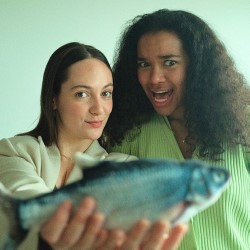
Birthday Fish is an absurdist physical exploration of the feeling of being a ‘fish out of water’. Bearing a cartoonish quality, Erin Hughes and Stephanie Burrell have created an intriguing show that has great potential. Erin and Steph are upstairs, sitting amongst the remnants of a birthday party. Fixating on their anxiety-ridden experiences, the two suffer existential crises as they sink deeper and deeper into their feelings of inadequacy and shame. Numbing the pain with alcohol and layers of lipgloss, the pair become more and more uninhibited as the evening rolls on. Hughes and Burrell use a variety of theatrical devices to communicate their story: VoiceOver, physical theatre, absurd props and imagery, which at times feel disconnected from one another. Moments of dialogue don’t quite manage to expand upon the world that the two characters are inhabiting and it would be more striking for us to enter into the play in medias res, hitting us with the dramatic absurdism from the start. If naturalistic text is integral to the piece, then it needs to be in stark contrast with the more artistic performance styles and provide background to the characters’ relationship and behaviour. Hughes and Burrell’s choice of imagery is brilliant, as the visual picture of a fish cleverly reflects the strange internal reality of the characters as well as being an excellent fit for the absurd style. Set to the backdrop of Tommy Wallwork’s impeccable sound design, the stage pulsates with energy. Unfortunately, other choices were less successful, such as the sequence where the pair clean up at the party as robots, which felt detached from the rest of the show. Similarly, though their commentary on the struggles and conflicting demands of current society is interesting, this short section of the play bites off more than it can chew, and it would be more effective for them to delve deeper into the psyche of the protagonists themselves instead. Dramatic, exuberant and considered, Birthday Fish is an intriguing production with buckets of potential. Hughes and Burrell have real creative promise, their performance just needs a few adjustments to take the next step.

Greenside @ George Street • 20 Aug 2024 - 24 Aug 2024

Outing

Written and directed by L.T. Hewitt, Outing opens at the end of a house party where the fatigued host Adam reveals to his friend Jamie that he has broken up with his girlfriend and is now gay. Spurred on by this revelation, and his inebriated state, Jamie returns the confidence by confessing he feels there’s an 80% chance he might be gay too.From this sitcom-style premise spins an hour of inconsequential dialogue in which Jamie and his girlfriend develop their relationship in a series of vignettes, but fail to explore the doubts Jamie is supposedly experiencing around his sexuality.The only time these doubts are surfaced is when Adam is back on stage, attacking his friend with a stream of ‘are you sure you’re not gay’ questions which feel entirely inappropriate given they’re based exclusively on the drunken confession of five years prior. The whole thing feels divorced from reality.Indeed, it also feels incredibly outdated, with little awareness of the new ways people discuss and reflect on sexuality. There is a token throw away line which lists every identity in the LGBTQI+ pantheon as if it’s a tick box exercise, but nuance and insight are absent.Time is wasted on shuffling boxes around in scene transitions which hold up rather than progress the story, while unnecessary props like tennis balls are distracting and cause jokes to fall flat. The cast of three, led by Joshua Shea as Jamie, are affable and energetic, but for some reason all wear primary colour T-shirts that make them look like members of a children’s pop group.Outing proves that the plight of gay men stuck in straight relationships, and the consequences to girlfriends and wives, is a topic worthy of exploration. But unfortunately this play throws no new light on the conversation.

Hen & Chickens Theatre • 19 Aug 2024 - 20 Aug 2024

Too Close to the Sun

Wrong Tree’s Too Close to the Sun follows three groups of people on the edge of apocalypse. Journeying through the Arctic, a doomsday cult and outer space, we witness vignettes of drama as the characters navigate the panic of realising the sun will no longer rise. Passionate but overall overcooked, the group could benefit from an outside eye to help edit their ideas.The first scene features two friends who have been on an expedition in the Arctic (though the location is unclear) for seventy five days. Though their conversation begins focused, the writing unravels as too many ideas are introduced to the text, resulting in incongruent musings on life and a heavy reliance on metaphors to express feeling. With the help of the rest of the cast (who are not featured in the scene until this point) moments of physical theatre are introduced which, though fitting for the genre, lack purpose and motivation.The second segment of the show is the strongest, communicating a clearer narrative with stronger dialogue. We are introduced to a group inhabiting a bunker. With one suspicious addition to the group, tensions rise as questions of leadership are raised and news of the apocalypse is transmitted through the radio. Though this section has its flaws, it certainly gave the piece momentum.Finally, we join an astronaut with his AI robot assistant who is running out of solar power after the disappearance of the sun. Much like the rest of the play, this section suffers from the use of cliché and mistimed injections of existentialism. The narrative has potential, but the company need to be careful of falling into tropes that impede authenticity.Overall, Too Close to the Sun needs further development, but it is clear that the company are spirited and dedicated to telling their story.

Greenside @ Riddles Court • 19 Aug 2024 - 24 Aug 2024

Things We Will Miss

The show is an intelligent, serious meditation on the most serious of subjects: the climate crisis. The script is devised within the company with actors performing a collage of soliloquies accompanied by video and audio and some stage singing.Quibbles could be raised with the play's text, but the main themes of our feelings of powerlessness and guilt come over clearly. The key question is literally asked on stage – what is the purpose of the show: What is the point of rehashing what we all already know?One of the actors says that he has fear in his mind but not in his body. This show makes one compare works that have achieved those stunning theatrical images or metaphors that do put the fear in the body.It may be harsh to demand similar levels of art, but unfortunately that is the requirement of the themes that square product theatre have chosen to tackle; they do not succeed.

C ARTS | C venues | C aquila • 12 Aug 2024 - 25 Aug 2024

Edinburgh Tales

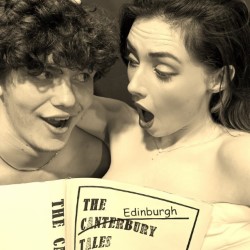
They are called Edinburgh Tales but are not really about Edinburgh, in the same way the model for this show, The Canterbury Tales, is not actually about Canterbury.The tales are updated spin-offs from Chaucer's originals. Unfortunately, the show suffers the same problem as every attempt to re-imagine Chaucer as drama – the stories simply work better as narration. And the updating of the tales generally detracts from the originals.This is a shame because the cast is skilled at getting the audience comfortably settled in, and the acting is fine – the players providing vivid characterisations across the multiple roles.

Greenside @ George Street • 12 Aug 2024 - 17 Aug 2024

The Comings and Goings at No 10

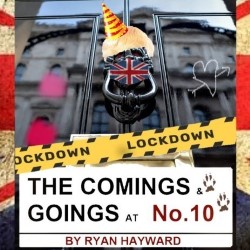
In a weird way, this Fringe (and this year) has seemed to be a bit of a moment of reflection. With a change of government last month, the wide variety of shows covering the last 14 years of Conservative rule seem all the more poignant. None so far that I have personally seen seem more on brand than the Comings and Goings of No10. Yet in many ways like the past government, this show has a lot of ambition, yet fails to deliver. Set during the Johnson years, on Dominic Cummings last day as Downing Street Chief of Staff, he very suddenly gets locked into a state-room, unable to leave as government ministers come and go and get themselves into embarrassing situations. With many figures at the top of government being depicted the impressions feel weak and unclear, with it taking me until the halfway mark of the show to realise that Matt Hancock and lover Gina Coladangelo were on stage, despite being present for a decent chunk of the runtime. Combined with a narrative that feels confused and reliant on “remember when x minister did this thing” the show seems more interested in being a clip show of the last government's worst moments, rather than having any point to it.The idea of Cummings’ last day in office is a strong pitch, a man who was so controversial and key to the start of Johnson’s premiership is rife for satire as is much of his government, it was a shame to see this not be fully exploited, when there is more than enough material from the last 14 years to play with.

theSpace @ Niddry St • 12 Aug 2024 - 17 Aug 2024

Dan Lees: Vinyl Reflections

Charity shops are amongst the last bastions of recycling society’s unwanted items for one to stumble across a precious find. Amongst the mounds of bric-a-brac and boxsets of ageing sitcoms, Dan Lees has uncovered several obscure titles time has forgotten that he wishes to share with us through a series of prop-laden parodies. Is there a diamond to be found in this rough act? Not if Lees is content to settle for thrift shop rhinestone.Vinyl Reflections traverses the ignored segments of yesteryear that have rightfully been disregarded, seeing Lees resurrect the ghosts of C-List musicians. But what we get from the yellow-suited comic is a frustrating act that too often shows promise only to lapse into bad habits, where the audience are left to fill not blanks but gaping holes. The opener – a mock audience tease with the microphone – goes beyond pseudo extended warm up to emerge an extreme version of show padding. Fifteen minutes in and we finally hear our first D chord; twenty-five minutes in and we finally hear Lees utter words. He doesn’t roll a gutter ball on his adaptation of Stephen Bishop’s Bowling In Paris, but it is by no means a strike, a bit which overstays its welcome.When he drops the elongated segments, Lees appears to be very proficient in small doses, where his Mick Robertson garners many a snort and grants him a chance to exercise his dexterous improv with well-liked audience interactions. At the halfway point, Lee’s amusing twist on Sean Dunphy complete with mouth-moving dog mask proves he can still lead the crowd, but as pints empty and attention spans wander, the laughs are thinner and the audience hungrier for something new.Can Lees control a group of drunken late-night revellers? Absolutely, a feat many are not given nearly enough credit for in the veritable Congo that is Free Fringe comedy. Is he charismatic as an entertainer? To a large degree. But the bulk of this show, sprinkled unevenly with haphazard gags, makes for an inconsequential slot, insulating itself with over-extended skits that only block out the better parts of the evening.

PBH's Free Fringe @ Banshee Labyrinth • 3 Aug 2024 - 25 Aug 2024

If I Only Could

These young actors have energy and plenty of charisma and the script has many flashes of originality and fun – the death scene of the older sister Joan is cleverly done, as is the representation of purgatory and God. Unfortunately no amount of charisma and bright flashes can overcome such an unfocused script.There is a suicide attempt that is glossed over with no clear explanation as to the motive. The driver of the play seems to be how the younger sister (Lizzie) can forgive the death of Joan. Yet Lizzie’s hurt is simply symptomatic of her thoughtless and selfish nature. Ultimately the relationship between the sisters remains a personal issue between the characters rather than something that touches the rest of us.

theSpace on the Mile • 2 Aug 2024 - 24 Aug 2024

It's Not My Body Chapter 3.5 / This Is

This bill consists of two conceptual pieces, connected by an emphasis on the body in space. The soundtrack of the first short piece is electronic drones and silence. The performer portrays conflict with his own body. Apart from a few seconds of grace, it is ten minutes of angst.The second piece has no music, and the movement is a series of extended poses. The soundtrack presents a collection of vacuous statements which we are expected to make something of. I applaud the spectator having to do some work. I object when the spectator has to do all the work.The bill gets two stars because the first piece displays thought and discipline.

Assembly @ Dance Base • 2 Aug 2024 - 11 Aug 2024

CSI: Crime Scene Improvisation

If you’re bringing improvised sketch comedy to Fringe, it has to be truly exceptional to compete with the multitude of renowned acts that return year after year. CSI: Crime Scene Improvisation promises big, but falls short. The show follows the classic improv format within the framework of a detective story: the audience provide the victim’s name, occupation and murder weapon and the troupe flesh out the rest of the story, guided by a lead detective who addresses the audience. Other than a few votes via crowd cheers, the audience participation is infrequent and opportunities for plot prompts are missed, which would add intrigue and further spontaneity. There are some standout members of the team that help drive the plot and ensure their fellow actors stay on course. Nevertheless, the dialogue often feels laboured as the performers strive to 'be funny', which (as many actors will know) breaks a key rule of improvisation. To their credit, the scene changes are very slick and premises are conjured up quickly, showcasing their talent for thinking on their feet. However, this is curtailed by scenes that become circular and lack focus, not revealing any further clues for the audience in the ‘crime scene investigation’. There was a slightly lacklustre air to this particular performance, which was disappointing. Perhaps the halfway point of Fringe has caused some fatigue, but for a full house, it felt the team were relying on easy laughs and a generous audience. Could it be that they are resting on their laurels?

Underbelly, Bristo Square • 2 Aug 2024 - 25 Aug 2024

Alice in Wonderland

Nardone’s Academy of Performing Arts has brought its production of Alice in Wonderland to theSpace’s thrust stage in the Upper Theatre this year. Unfortunately though, much of this performance was directed towards one side of the audience, leaving the rest unable to fully enjoy the show.Many actors seemed to struggle with the choreography, affecting their breathing, and, although the show is aimed at children, the emotions portrayed by most felt somewhat unconvincing. However, the costumes, especially the Cheshire Cat, stood out positively. While there is potential, I fear this production may need further refinement to meet the standards of other children's shows at the Fringe.

theSpace @ Niddry St • 2 Aug 2024 - 11 Aug 2024

Malion

I was intrigued by the idea of a feminist interpretation of Pygmalian myth because it's seen now as one of the classic stories about men being pigs; and by modern standards it is full of non consensual sex acts. This adaptation takes that as its starting point and runs with it. It's about boys being boys in the worst and most violent way possible. In the original myth; from within the soup of misogyny that was ancient Greek culture; the sculptor Pygmalian, for whom no real woman was enough, builds and then falls in love with one of his own status, which then the goddess Aphrodite turns into a real woman.It’s really good to see male playwrights and directors using feminism as a lens through which to make art, this is something I want to encourage, both here at the fringe and beyond. It’s a unique feeling to be watching a play by men for men, but the story is a feminist one.In this version of the myth Galatea is a daughter of Aphrodite, whose marble body is given life when Aphrodite imbues Malian's statue with living spirit. She has a little more agency than in the original, Gatea is also here as a test. It is a little unclear if the test is god given or from Galatea herself, but she wishes to test the love of Malian before fully revealing herself to him. In the original Ovid the statue didn't have a name, she was still an object, even in the happy ending where she becomes Pygmalian’s wife. A sign of how far we have come, and yet have still to go.We begin in ancient Greece. Good effort has gone into the design; someone clearly spent some time on the same bits of Pinterest as I do. Everyone needs a little more practice moving around in the historical costume. The ancient style dialogue is flowery and more incomprehensible than good storytelling. The starting in ancient Greece is mercifully brief, and doesn't connect through into the modern day story.The show really starts to sing when it gets to the modern-day. As Malion tries to show his two friends his work of art. I’ve worked in plaster myself and you do get asked some very odd questions. The locker room talk is turned up to 11 and it makes me squirm and have to look away. I was surprised to be hearing so much pornogaphy, the worst sound effects I’ve heard this Fringe. Malian believes himself to be above the crass objectification of his friends. The inevitable violence against Galata was well built too, and horribly lingered on.The main flaw with the piece is that the show has not transitioned well from rehearsal into the space it is being performed. Actors are outside the light on stage so regularly that it stops looking like an artistic decision and more like sloppy blocking. The moments where I think the actors are meant to speak to us from darkness the use of voice is so muttering that it does not carry and is hard to hear. This means I'm a bit unclear about some of the characters. For example I'm not sure if Jordan Monks and Ben Kay are playing the mythical twins Cupid and Eros and they are also Malian's friends, or if they are simply two separate pairs of characters played by two actors.There is real potential here; this is a show who's heart is in the right place, but there is work that needs to be done, particularly with clarity of performance.

theSpace @ Surgeons' Hall • 2 Aug 2024 - 24 Aug 2024

Cosmos

I wanted to be able to recommend this performance. Ashtar Muallem is our solo performer for the evening and the piece was created in collaboration with Clément Dazin. Muallem is a Jerusalemite artist who did her circus training in France. These are exactly the kind of artists and work I want to see elevated at Fringe, particularly given the escalating but ongoing Palestinian genocide. Unfortunately, the show is trying to do too much, all at once, and therefore does not give the ideas time to breathe.The piece needs a clearer artistic aim. Is this show a participatory ceremony, where we all take part in a ritual? Is it using contortion to parody yoga and wellness influencers who are doing impossible things with their body as they pretend you can be just like them? Is it a dark comedy that actually means its earnest message? Is this a claiming of space for Palestinian art and artists, and a clarion call for their freedom to be liberated from their colonisers, or is it a story about losing one's religion? I would have watched a full show of many of these kernels of ideas but they don’t get the depth they deserve. It leaves us feeling like we are skimming over the surface - you can’t sink your teeth into anything before the moment is discarded.The show has moments that ring with truth, the contortionist and aerial work is sublime. As is Muallem’s communication of the sheer disorientation that comes from being colonised; winding descriptions of Dazin’s grandmother and of Jerusalem and the simple solution proposed to end violence in the world. A strange, humble and honest ending. Strange after the dry irony that makes up much of the rest of the piece.

Summerhall • 1 Aug 2024 - 11 Aug 2024

The Bookies

A routine day at a rundown bookmakers on an Edinburgh high street. Two employees Pat (manager) and John (cashier) are chewing the fat, while Pat barely tries to disguise his contempt for bedraggled Harry, sadly, and with a tragic resignation, feeding money systematically into a roulette machine.Area manager Michelle breezes in. An awkward exchange ensues. John is dismissed to the back room, so that they eventually discuss a highly sensitive personnel and operational matter, all within earshot of the shop customer. This is the first of many jarring choices in this script. The devastating news for Pat is that, rather than the arrogantly expected five figure bonus for employee of the year, the shop is to be closed down and he is offered a redundancy package. He is asked to sign before the end of the day, swathes of employment law being ignored here.Gambling addict Harry is roped into a scheme to steal £100,000, inexplicably still in the safe.This is a laudable attempt at examining the societal devastation of gambling addiction. There are moments of strong comedy timing and there is something to be admired in the performances. However, the script, staging and combat scenes require substantial revision.

Summerhall • 1 Aug 2024 - 26 Aug 2024

Conversations We Never Had, As People We'll Never Be

A couple has thirty minutes to decide whether to erase the memory of their failed relationship. A perfect dilemma for a drama, with scope to go in many directions. Unfortunately, the script can’t decide which direction to take.There are lots of good qualities to this play: the discussions are insightful and expose dramatic revelations and conflicts; there are engaging flashbacks with good jokes about embarrassing situations, trying to impress, and passive-aggression. The characters feel real, and the chemistry between the actors is good.The script, however, meanders without any through-line or consistency. The opening monologue divides people into two types. Yet these types don’t fit the characters. It is pointed out that anything said in the 30 minutes will be wiped. Yet this idea is not developed.The focus may be relationships, but if the play is based on a science fantasy premise there needs to be clear rules. It is not discussed what happens if one person wants to keep the memories. The flashbacks are like shared visions, yet ‘the kiss with Sam’ has two versions. Does that mean the other flashbacks are untrustworthy?The final scene repeats their first meeting, including all the very particular circumstances and details. So is the ending a flashback or has fate engineered them to meet again? And did they wipe their memories or not? Is the ending meant to be ambiguous, or is it just unclear?Good for exploring a relationship, not so hot for plot.

Assembly Rooms • 1 Aug 2024 - 25 Aug 2024

Nerine Skinner: The Exorcism of Liz Truss

If you're known for impersonating a particular public figure, it can be difficult to shake that typecasting; a fact Nerine Skinner is all too aware of. Following on from her viral videos during the ever brief Truss years (or more accurately month), Skinner’s set unfortunately relies on the same tired jokes surrounding the former Prime Minister, but with glimpses of something better on the horizon.The premise of Skinner’s set is laid bare in the title, an exorcism of the spirit of Liz Truss that has entered her body and is refusing to leave. A point made more poignant following Truss’ brief appearance at the Fringe on the 4th of August. The impersonation is solid, being Skinner's bread and butter for the past couple years, though a lot of the jokes around it are at this point overplayed. There is only so much pork markets and cheese that can carry a set.Skinner does have some elements which are very enjoyable, her crowd work flows naturally, her storytelling abilities are fun and interesting, ranging from her struggles with Britain’s Got Talent to her bike being stolen as a child, ironically the show titled about Liz Truss does a lot better when Truss isn’t the focal point.I want to see what Skinner can do next outside of the realm of the gimmick. She has fun characters, very confidently works with a crowd and good storytelling abilities. I just hope her next set isn’t hanging off of a dead political career and is given the room to grow into its own.

Just The Tonic at the Caves • 1 Aug 2024 - 25 Aug 2024

Sherlock Holmes and the Man Who Believed in Fairies

The game is afoot, this time it’s not murder that Holmes is solving but a case of deceit perpetrated against his own creator - Arthur Conan Doyle. Coed Celyn Productions presents this novel Holmes mystery. The conceit is a strong one as it tackles the case of the Cottingley Fairies. This infamous incident tarnished Conan Doyle’s reputation as he vouched for the credibility of fake photographs of fairies in an article in the widely circulated Strand magazine. In this production, word of the incident spreads to an ageing Sherlock Holmes who takes it upon himself to mobilise his powers of deduction to prove how and why these images were faked. Holmes drags Watson along on this mystery to clear his name and discredit Conan Doyle. The production starts promisingly with an affable John Watson (played with a gentle charm by Kenneth McConnell) informing the audience of how it has come to pass that in their more senior years, Holmes (Harry Meacher) and Watson are living again at 221B Baker Street. Watson has been widowed and Holmes has escaped being sent into a retirement home. Through a chance encounter with a former Baker Street irregular Conan Doyle’s Strand article falls into the hands of our iconic duo. How exactly Sherlock Holmes exists as a fully fledged person within the same world as his own creator is left completely unexplained to the detriment of the piece. It is not a fragmentation of Conan Doyle’s own psyche as Holmes is our protagonist and it is not the case that Holmes has managed to deduce his way into reality. As a result, the worlds of Sherlock and Conan Doyle merge in a frankly confused way, where no one questions the existence of Sherlock Holmes despite the existence of Conan Doyle’s many books in the same universe. Indeed, Holmes has decided that Conan Doyle is his enemy after he tried to kill him off at Reichenbach (presumably neglecting the fact that it was Conan Doyle who resurrected him). The density of the text proves to be a stumbling block for both audience and performer with Meacher seemingly reading vast swathes of text from a notebook that he carries on his person in many of the expository scenes. A decidedly un-Sherlock like characteristic. Certain dramatic devices such as Watson’s narration are used inconsistently. The mystery proves to be rather repetitive, especially as the audience and the characters are already in agreement that the images are fake. The investigation through various locales (effectively projected onto the back screen) unearth little new material and Holmes’s ultimate unravelling of the case is overlong and lacks energy. Sherlock Holmes & The Man Who Believes in Fairies was a neat idea in concept, but overly dense writing and uneven performances ensure that the game never really takes off.

C ARTS | C venues | C aquila • 31 Jul 2024 - 25 Aug 2024

FREAK OUT!

Drawing from their research into UK communities affected by coastal erosion, Coin Toss Collective’s Freak Out! investigates the small town of ‘Portsford’, which is fighting a losing battle to the sea. Though the subject matter is urgent, some arguably questionable creative choices sabotage the poignancy of the message.The show focuses on the local community, kicking off with projections of real-life interviews with seaside dwellers on what the beach means to them. Each character then introduces themselves in the same format, revealing that they are all a member of the community (local councillor, business owner, founder of “friends of portsford”). They hold a fundraiser to raise money to support people whose homes are at risk (based on the real events which the show was inspired by) and conversations are had about the future of the town and the people in it. Coveting the town’s fossilised footprints and ancient history, the townsfolk convince themselves, “We can stop the sea if we have the will to do it”.This narrative is interspersed with absurdist scenes that feel out of place. For instance: the scene freezes and a caricature emerges singing to himself and asks the audience to build a sandcastle, two people have a conversation about their experiences in the town whilst dunking their head under water and someone aggressively hands out cake to the audience whilst having an argument. In addition, there are moments of physical theatre and breath-work to serve as metaphors for the crumbling land. These ideas in themselves are interesting but feel inconsistent with the main thrust of the play. These elements require much more intention behind them which begs the question, why are they included in the show?Coin Toss Collective should be commended for their bold creativity and for raising awareness of important local issues. The subject matter deserves to be centre stage, but unfortunately has not been communicated as effectively as it could, with symbolism that doesn’t quite land.

Pleasance Dome • 31 Jul 2024 - 26 Aug 2024

You Can't Escape an Aussie Boy

Hailed by the company as ‘loud, obnoxious and darkly humorous’, one is left wondering what happened to those elements in You Can’t Escape an Aussie Boy. The three-man play tells the woeful tale of Marydale Tigers Football Club and the once-in-a-lifetime opportunity that arises when the wholly unqualified lads stumble across a chance to revive their ‘jockstain’ of a footy club, making themselves rich into the bargain. All they lack is experience and knowledge.The plot sounds appealing and the cast clearly have performance skills; it just isn’t a particularly gripping storyline, though they come out with some entertaining Aussie vocabulary, expressions and imagery.

C ARTS | C venues | C aurora • 31 Jul 2024 - 25 Aug 2024

Jessie Cave: An Ecstatic Display

Jessie Cave says she would like to be remembered as a “fun mum”, which we certainly get aglimpse of in An Ecstatic Display at Assembley Roxy. Cave is dressed like a 90s children’s show presenter and in the centre of the sizable stage is a handmade shadow puppet theatre, which she also accompanies with toys, paper aeroplanes, canvases that she’s painted her and her partner’s faces on, bubble blasters, and a hand-painted storybook. There’s a lot to contend with and that’s before getting to the topics she broaches which mainly revolve around her on/off relationship with her partner and father of her children.Cave describes their relationship as one between “an emotionally unstable star sign believerand a bipolar alcoholic,” and through the couple’s imagined therapy sessions, she shows howthey seem to largely be incompatible.Cave gets tongue-tied a lot and twice when she messes up a punchline and throws herselfon the stage, much like a child having a tantrum, but she has such a likeable presence, weencourage her on through cheering. The laughter comes in smatters, though there’s reallynot much to chuckle at, as Cave excavates the last few years of her life including the deathof her younger brother. There’s more of a collective feeling of wanting things to go well forCave, both on stage and in real life.

Assembly Roxy • 31 Jul 2024 - 25 Aug 2024

Frankenstein (On a Budget)

What if Mary Shelly’s gothic horror classic Frankenstein was resurrected as a campy one-man musical? An interesting premise explored by LampHouse Theatre in their new show playing at Pleasance, Frankenstein (On A Budget). The show follows the success of the company’s work last year - War Of The Worlds (on a budget). Its high energy performance is led by Tom Fox who is really putting his all into this. Unfortunately, 'his all' is heavily reliant on awkward audience interaction and bad puns. Many of the musical numbers were funny and exciting, however many felt dragged and failed to bring in new ideas to the show, at times feeling like we were hearing the same song over and over again. The opening number was excellent and really felt as though we were about to see something special. However, by the end, this zany Monty Python style comedy comes to a complete halt when the show ends very oddly with a seemingly sincere song delivering a moral message about enjoying life, ukulele and all. Things had already gone significantly downhill before that ending though. Although the concept of the show is being ‘on a budget’, it is unclear exactly how much of a budget that was. Some of the props were made to look intentionally bad as though perhaps a toddler had designed them, this could be a very funny visual joke, however it was inconsistent as others were well-made and clearly took a fair bit of resources to put together. While Fox is undeniably charismatic, his character's running joke of being overly arrogant and dismissive of the ‘stage manager / tech / narrator’ character just made him come across as unlikeable in this production, even if the two did make up with each other by the end. Some parts of audience participation were very fun, however criticising individual audience members for not laughing and making regular asides about how the show “doesn't get any better from here” made it challenging to fully get behind. I could imagine this show really working in another context if they were to lean even harder into the limited budget (without leaning harder into the idea that somehow a limited budget makes the jokes worse) and perhaps placing it within the free fringe setting to complement this. After the success of their previous work, the overall experience taken away from this was disappointing.

Pleasance Dome • 31 Jul 2024 - 26 Aug 2024

Gloria's Gift?

Wouldn’t it be lovely to place the blame for all the world’s current woes, from war and inequity to the threat of the climate crisis, at the feet of an almighty creator? Gloria's Gift? both promises and denies that wish.The play provides us with a god as human character in the form of brassy, swaggering and irritable deity Gloria, who is more than happy to accept responsibility for our creation. The trouble is she tapped out of human affairs after the momentary amusement of making a whole new species in her image and claims the rest of the world’s ills are very firmly on our own shoulders.Erica Tavares-Kouassi certainly makes this a believable concept. She is an energetic stage presence, preening with over-confidence even as her intended one-woman show begins to crumble around her.However there are scores of philosophical and theological inconsistencies in Leona McLoughlin’s script that leave the characters and plot too worm-riddled to hold together. An almighty god character with an enviable vocabulary but who’s stumped by simple words like car (they’re initially metal boxes) and has never heard of Wotsits. A lonely and alienated god who finds it incredibly easy to mount a one-woman show and make an instant connection with the audience. These contradictions wrangle. Certainly this take is more inclusive than many others, with a plethora of religions getting a passing mention, but the references are superficial and ultimately god’s true name of Gloria overtly roots us in a Christian context.There are moments of genuine surprise (don’t worry, no spoilers here!) and some funny gags that draw a giggle or two but overall Nicky Allpress’s direction felt flat. In short, the god as human trope has been done too many times before (most recently perhaps by Zoe Lyon’s in An Act Of God, but arguably going back to the Christian story itself) not to treat the subject with more rigour and imagination.

Old Red Lion Pub • 29 Jul 2024 - 2 Aug 2024

The Hot Wing King

A white man saying he has many black friends is a poor defence against racism. The proximity to others of a different skin colour does not create an automatic osmosis of lived experience.We may, therefore, question a play with all black characters if the playwright is white.The same lack of lived experience doesn’t appear to be a problem when it comes to sexuality. At least, not according to the Pulitzer Prize judges who awarded Katori Hall the 2021 Drama Prize for The Hot Wing King, a play that centres around four gay black men, now at the National Theatre’s Dorfman.Hall, best known for writing Tina: The Tina Turner Musical, is a black, heterosexual woman. But she has a gay brother. So that’s all right then.Even if brother and sister are borderline incest-close, Hall’s understanding of gay men can only be narrow, based on hearsay. The characters she has written with positive prejudice are not offensive, but provide little more than modern-day stereotypes.They lack depth in a production that aims to be a sitcom but has a drawn-out “sit” and only unsubtle “com.”The Main GaysThe action follows four friends as they prepare for the next day’s Hot Wings cooking competition. Being awarded the title of The Hot Wing King is the goal of Cordell (Kadiff Kirwan). Having entered five times but never won, for him the potential title now represents purpose - something he’s been lacking since moving in with boyfriend Dwayne (Simon-Anthony Rhoden), and losing his wife, children, and job in the process. Cordell is ‘tough muscled gay’. His confidence comes across as brash, but clearly masks insecurities. (Yawn!) Boyfriend Dwayne is ‘straight-acting gay.’ (Yawn, yawn!) With an air of self-importance and success defined by his job as a hotel manager, he is a straight man, living a straight life, in all but sexuality.The strength of their relationship is illustrated through exposition (a “this is how they met” story), repetition (“but we’re partners”) and ill-placed references to fucking. They are both clearly the creations of a writer who believes that the only difference between gay men and straight men is a preference of genitalia. The Supporting GaysHelping the *couple* is ‘daddy gay’ Big Charles (Jason Barnett). He is a long-standing friend of the couple or, as it turns out, the man who has been their barber for five years. The dialogue implies that Charles' weight or height may have led to the 'Big' moniker, but neither is unusual in Barnett, who stumbles through lines as though it isn’t merely prop beer being drunk onstage.Players of Gay Bingo will likely already have guessed the final gay trope of this foursome; Isom (Olisa Odele) is ‘camp bitchy gay.’ More of a hindrance than a help, moving in lunges and speaking in innuendos, Isom is the blissfully self-unaware gay we often see in plays: one moment, stretching his butt cheeks wide as he lusts over a straight guy, the next bemoaning the fact that men only want him for sex. Even the hot wings that they make live in front of us fail to connect these four: Isom has only been involved for a year, in which time he has occasionally slept with Big Charles. Dwayne is just there because he’s fucking Cordell.The only thing that brings these faux gays together is the conceit of the playwright.Dwayne says he must return to work (cue “it’s me or the job” rows with Cordell) but is actually picking up troubled nephew EJ (Kaireece Denton). EJ's father, TJ (Dwane Walcott) appears, to pour straight oil on the bubbly gay water. Really, nobody cares. The ApproachThe play is performed with a meta approach to sitcom, but its scene changes and character entrances are punctuated with musical stings and its plot points are foreshadowed with a farce-like lack of subtlety. Describing the searing heat of a chilli, then hiding it out of the way to avoid its accidental usage, is almost patronising.It wouldn’t be out of place to hear canned laughter. As if sensing this, the audience fills the gap, reacting to arguments with audibly exaggerated gasping and greeting jokes not just with laughter, but with waving hands as its members guffaw loudly. The already overlong script pauses for an impromptu rendition by the cast of Luther Vandross’ Never Too Much. The full song. With dance moves. It’s performed so well that I saw at least two audience members singing along. But really, what is the point?The performance looks sleek but its unnecessarily large stage literally thrusts out into the audience. Forcing the removal of the first five rows of the stalls, the scale feels too grand and shouty for the intimacy required from a single set play.The Concerning VerdictIt may not seem to merit a Pulitzer Prize, but on face value, The Hot Wing King is harmless, if unremarkable, fun. This is summer season and sometimes we want to grab something from the BBQ rather than sit down to a satisfying meal. It fills a culture gap, then with one loud belch, it’s out of your system.But the play's portrayal of gay men disturbs me.We have moved on from the time when a play's gay character would lead to the raised eyebrows of theatregoers. But visibility is not the end of the story.In our acceptance of gay representation, we have come to assume that all representation is positive. The Hot Wing King is a return to cliché – albeit a warm, cuddly, positive cliché – that justifies the belief many hold as comfort. It suggests there are just two kinds of gay men: the sexualised 'others', neutered as figures of fun, and the non-sexualised 'us', different only by their unspoken bedroom habits. These are the beliefs of a heterosexual woman. Beliefs extolled by the judges of a prize. For me, that doesn’t seem like progress. It doesn’t seem like progress at all.

Dorfman Theatre • 18 Jul 2024 - 14 Sep 2024

Red Speedo

As the Summer Olympics approach, the UK première of Lucas Hnath’s Red Speedo at the Orange Tree Theatre, Richmond comes with timely prescience of the almost inevitable doping scandals that will mar the event.The play launches in at the deep end with the discovery of performance-enhancing drugs in the swimming club’s refrigerator. It could be a play that poses serious moral questions that create dilemmas all round. Indeed they are there, but the treatment lacks depth and with the exception of a couple of impassioned speeches the manoeuvrings around the situation seem mostly concerned with heightening the comedy. Ethical issues float around but without detailed exposition and neither the script nor Matthew Dunster’s direction lives up to the play’s billing as a thriller.Finn Cole (best known for his roles as Michael Gray in Peaky Blinders and Joshua ‘J’ Cody in Animal Kingdom), perhaps surprisingly at the age of 28, makes his professional stage debut as Ray, a somewhat dim-witted, exceptional swimmer who stands on the brink of selection for the Olympic team and, if he changes trainer, a lucrative sponsorship deal. Portraying a young man detached from reality with a level of naivety that often amounts to stupidity, seems to leave Cole detached and not fully at ease with the role. In contrast, Ciarán Owens (also Peaky Blinders), gives an animated performance as Peter, a lawyer of flexible principles and Ray’s older brother and manager. His rapid-fire conversations are often prefaced or interspersed with a raging monologue filled with truncated lines that suggest a loss for words or a sudden change of tack.The script is easily envisaged with its half-formed sentences and rows of dots as the idea falls off and the next one picks up, but the device often sounds like fumbling.Between these two comes the considered performance of Fraser James, known only as Coach, the trainer and mentor who increasingly becomes the investigator. He remains calm in the crises and seems to have a firm hold on ethics, which is why his about-face at the end lacks a certain level of credibility. To answer, “Where did the drugs come from?” Parker Lapaine, also making her stage debut, convincingly plays Lydia, a girl with whom Ryan has failed romantically and who has escaped from her former role as a supplier. The link is there, but the love story is hardly necessary and something of a diversion from the main issue.Given the level at which Ray is competing and the number of events in which he participates, it’s incredible that at no stage in the story do the authorities carry out a drugs test. Of course, that would throw a spanner into the works sufficient to require a rewrite, but it is a niggling issue. Really annoying, however, is the ear-splittingly loud horn from sound designer Holly Khan that marks each scene change and is at odds with the pleasing set designer by Anna Fleischle who along with lighting designer Sally Ferguson has converted the theatre into a shimmering natatorium complete with a small sunken pool and stainless steel steps. It all ends rather mysteriously with an unconvincing fight scene directed by Claire Llewellyn as Roy Orbison reprises, Anything you want, you got it, which, as far as i could tell, remains a pipe dream for Ray.

Orange Tree Theatre • 13 Jul 2024 - 10 Aug 2024

Getting Over Hugh

Described as a supernatural rom-com, Getting Over Hugh might better be expressed as a fabulous hot mess of a show. Whilst it’s certainly an entertaining hour, the jumbled chaos of ideas never quite works out what type of show it wants to be.The plot is almost completely nonsensical which I will do my best to give it justice. Late twenties Rory ends up sitting next to late forties Alan to watch a matinée performance of the gay classic Beaches. Alan, recently widowed after the death of his husband, is somewhat surprised when a man young enough to be his son starts making moves on him and agrees to meet with him for a drink later in the week.When Alan returns home for the evening, the ghost of his ex-husband appears (the eponymous Hugh) and chastises Alan for flirting with young Rory. Hugh has been regularly appearing since his death, but only Alan can see him. Also, he’s dressed in a Regency period outfit (as this is, apparently, what he wore for his wedding).By the end, Rory turns out to be wealthy, with Microsoft wanting to buy his tech company. The man who witnesses Hugh’s suicide turns out to be the one who killed him. Alan starts dressing as a hipster, Hugh stops wearing Regency outfits and dances with Alan to Diana Ross while his ashes are sprinkled on the stage. Oh, and I forgot to mention that the reason for Hugh’s suicide was that he caught Alan in bed with his (straight) brother.Getting Over Hugh certainly doesn’t lack ideas; however, what it does lack is the overall narrative structure that allows all these ideas to coalesce into a plot. There’s just too much going on at any point in time—whether plot points are being introduced or a sudden shift from comedy to heartfelt sadness. There comedy of finding your husband and brother in bed together is awkwardly juxtaposed against the tragedy of the suicide, which isn’t played for laughs. When the finale exposes the cause of Hugh'’s death, it’s unclear whether you’re meant to laugh or cry. Similarly it's not quite clear what emotions we're to feel with Alan’s suicide attempt, as Hugh attempts to talk him out of it (still, as I say, dressed in a Regency period outfit).There are numerous issues with the staging throughout. Let’s start with the scene changes—usually done in a blackout or with minimal lighting. Less often, as this show does, done in quite a bright floodlight. The characters turn ‘dead-eyed’ at the end of the scene and then rise from the metaphorical dead in this bright ghostly light to set the stage for the next scene. Staging issues continue throughout, and by the end of the show, the stage is littered with popcorn, suicide pills, and Hugh’s ashes.I was left with many questions by the end. Why is Rory, a man with a successful tech company, interested in Alan, a late-forties widower? Why is Rory watching Beaches in a matinée performance? Why does the ghost of Hugh reappear after his suicide? How does Rory get hold of the train station footage from the police to expose that Hugh was killed? Why did they decide to use what looks like a red concertina for chairs, despite using two chairs to tie this between? Why did the show decide to end with the revelation that the man who killed Hugh has received seven years for manslaughter?It’s a shame I couldn’t share a drink after the show with the cast and put these questions to them, as it’s clear they’re having a fantastic time on stage. This energy helps keep the audience engaged and on-side throughout, whilst the trio kept the show together despite everything going on. There’s much to be said for a show that keeps the audience both entertained and guessing what’s going to happen next, although I left with the feeling that there might have been a couple of drinks involved when writing this marvellously jumbled mess.

Café Club Míšeňská • 28 May 2024 - 1 Jun 2024

Coleridge-Taylor of Freetown

We meet George Coleridge-Taylor terrified and hiding while bullets are heard loudly around him. He is a retired Diplomat now Philosophy Professor and this is Fourah Bay College in Freetown, Sierra Leone, in the midst of civil war, and rebels have taken over the college. George reflects on his life and how he got here, talks of his childhood and every part of his life from young to old, moving easily between the extra multi rolled characters while always returning to his central one. Taya Aluko who also wrote the piece, plays George and all the other roles, changing physically between them in front of us. He has a natural skilled ease as an actor who knows he is good at his craft. However, there are several stumbles in lines with self corrections or checking with the accompanying musician Allyson Devenish, who plays lightly and beautifully in the musical pieces. Although it is not seen, there are quite graphic allusions to the repeated abuse and rape of the woman who the rebels capture and hold captive in the next room to George. The soundscape is evocative and works incredibly well throughout, as does the various lighting states, helping to indicate times of day as well as the difference between fantasy and reality. George feels powerless to do anything to defend or support this poor woman and can’t cope with what’s happening to her, so during the times she is being violated he escapes into a fantasy world where he is touring the world giving concerts using the music of his uncle: the famous composer Samuel Coleridge-Taylor. Taya Aluko has a lovely rich tenor voice, with warm tonal qualities and is pitch perfect.In the Q&A after the show Aluko talks of the real George who wrote a memoir, which furnished much of the content, supplemented with extra research. The story of him being at Fourah Bay College and hiding from the rebels is absolutely true, but the woman is a metaphor for the horrors perpetrated so often in war situations. There is a rich exploration of Sierra Leonean history and exposing corruption, however it’s so packed and in a non-linear narrative so anyone not already knowing about this period of history would be left feeling slightly confused: like they had seen a movie based on a book where they needed to read the book first. It’s clear that a lot of work has gone into this but the lack of certainty in lines gives rise to a feeling of unease; a lack of feeling confident in the production, as well as the profound discomfort of what’s happening to the woman we can only hear and never see on stage. During the Q&A Aluko mentions this is a work in progress, which is another problematic element, as this obviously has potential to be a really good show and aspects of it are there already, but by no means all of it, and that affects everything. It should also have been made clear at the outset that this is a work in progress, to do less is misleading the audience.

The Rotunda Theatre: Bubble • 10 May 2024 - 26 May 2024

The Elagabalia

The Elagabalia explores the idea of where we all belong as people. Whether we are in the right body or not, or whether we are truly serving our purpose no matter which era we are in. We meet Varia - a teenage girl who seems to be trapped in the body of a weak Roman emperor, confused as to where she truly fits in. As a man, they could truly follow the calling of traditional greatness. As a woman, they could be one of the best High Priestesses in the world. But can they also have a romantic life alongside their rather difficult position power wise, as well as be their most authentic self?Whilst the concept is good, the issue that occurs here is that it seems to cram so much into one hour, that it becomes almost chaotic and too intense to properly follow. Some of the characters are not as well formed as they could be, such as the almost God-like figure that is silently present throughout the whole piece, watching Varia make some atrocious mistakes, yet challenges them to ascertain their loyalties to the senate. It doesn't seem clear until nearer the end what the purpose of this character is. Alongside this, The Elagabalia as a piece of writing seems confusing as to which era it is set in. The costumes are modern, the language and events are modern, yet the places and names referred to are more traditional in placement; such as taverns and the Senate.One way of exploring this idea in more detail to potentially make it more palatable is to turn it into a film. Whilst theatre is a great way to make certain things more interesting in a smaller space such as The Actors Theatre, on this occasion it seems to intensify the action on a grander scale than it needs to due to the shortness of the piece. By turning it into a film, Achy Bits Productions would have more scope to expand the story and explore all these interesting themes in more detail.There are however two characters that particularly stand out which makes this play more interesting to watch. Firstly, Varia's grandmother, who despite being a more traditional grandmother figure on the outside, comes across as a more ruthless, political figure controlling the puppet strings. Her calm and collected approach gives a more rounded contrast to Varia's chaotic mindset, that we question who the real manipulative ruler is here. Then we see Varia's lover Heracles, who is originally bought as a slave for pure pleasure. The simplicity in the delivery of the performance of this role brings a sense of power over Varia's madness. The love you feel here is raw and in the present rather than being an archetype of a lover one can expect from a piece like this.The Elagabalia has potential to be developed further and is right now particularly suitable for audiences who want to be introduced to Greek Tragedy and Comedy in a different way.

The Actors - Theatre • 6 May 2024 - 8 May 2024

The Government Inspector

Bribery and corruption, greed and stupidity dominate Nikolai Gogol’s The Government Inspector. Dating from 1836, it’s a play begging to be transformed into our own age as a satirical commentary on the vices that have plagued recent governments and dogged institutions. Yet director and adaptor Patrick Myles misses the opportunity at the Marylebone Theatre in a bizarrely staged farce that might easily portend the pantomime season.Gogol penned a damning indictment of the political establishment and its administrators. What we would now call the right-wing press (ie all the press) were up in arms about it, but Tsar Nicholas I, considering himself to be above those at whom it was aimed, wanted the play staged. On seeing its premiere he declared, "There is nothing sinister in the comedy, as it is only a cheerful mockery of bad provincial officials." It reinforced his contempt for the petty bourgeoisie and exposed them in public.Taken out of Russia, the setting is now a small English town located in an unspecified part of England somewhere north of Watford, to judge by a Brummy and a strong Pennine accent among the indistinguishables, but new location makes some lines from the original seem out of place. Who in England would suggest that a person’s head felt like a Cossack’s hat? Distant London is held in awe by the locals who associate it with a lavish lifestyle far removed from their own mediocre existence. It’s a place where balls are held. If that raises a smirk, then you are in tune with the tone of the production. There are something in the order of four miserable attempts to drain hunour from the word, which are overshadowed only by attempts to make the title Count sound like a well-known four-letter word. Talking of whom, when he finds himself without trousers and is offered a pair of green breeches he is so appalled at having to put them on he proclaims the most distasteful line of the show, that “even a refugee would burn them” rather than wear them, though some found it amusing. The play revolves around two key figures. Gogol’s Russian Mayor is now the Governor of the English backwater, though why he has that utterly unEnglish title remains a mystery, when the country is host to many mayors and the only Governor runs the Bank of England. D.S Mirsky observed that the character “is full of meaningless movement and meaningless fermentation incarnate, on a foundation of placidly ambitious inferiority". Little could he have realised how prophetic his words would be. Dan Skinner as Governor Swashprattle charges onto the stage and shouts his opening lines at breakneck speed, rendering them unintelligible. This over-the-top style is moderated only slightly as the action progresses. He also looks out of place, dressed in a bright red and gold military dress uniform that gives him the appearance of a toy soldier from the nursery floor. Indeed, the costumes throughout give the impression that designer Melanie Jane Brookes opened the wardrobe and the cast were given free rein to grab any period piece they fancied. Her green and gold set, however, looks stunning.Skinner also has the misfortune to deliver the lines that famously break the fourth wall: "What are you laughing about? You are laughing about yourselves!" We should have screamed back, “Oh no we’re not”. Gogol’s history-making words require a pointed and nuanced approach to the script to make any sense and so here the whole business of jumping off the stage to make a direct address seemed ridiculous, but by that point it didn’t seem to matter.Martha Howe-Douglas performs eccentrically, but retains a matronly role as Mrs Swashprattle, longing for an elevated status in life and to part of high society, (she has a thing about balls!) even as she lays herself open to seduction by the man mistakenly believed to be the Inspector, for whom anyone would do anything in order to gain a glowing report. Kiell Smith-Bynoe as Fopdoodle milks this role and certainly appears to be more of a fop than a government official as he swans around in fine clothes. In contrast to all the foolery, Daniel Millar as Fopdoodle’s manservant, Fudgel and Chaya Gupta as Connie, the Swashprattle’s daughter, bring subtlety and a breath of fresh air to their roles in a style of performance that has depth.Gogol intended the play to be a comedy of errors, but surely not in the way it's portrayed here. Myles’ Government Inspector is not so much lost in translation as destroyed in adaptation.

Marylebone Theatre • 3 May 2024 - 15 Jun 2024

London Tide

Standing ovations, once reserved to acknowledge only the highest calibre of performance, are now part of the theatre routine. They are as everyday as ticket checking and pre-ordering interval drinks. Like the service charge on your restaurant bill, standing applause is an expected part of the exchange between provider and receiver. Expected, but still optional.After being dragged through the funereally long 3½ hours of London Tide – an adaptation of Charles Dickens’ Our Mutual Friend, now at the National Theatre’s Lyttleton – aside from a handful of assumed family and friends, the audience remained seated. That takes effort.Which says a lot.Contrived and forcedOur Mutual Friend was Dickens' last completed work. Though more positively reappraised in recent years, the characters were initially considered contrived, the plot forced. Add to this that Dickens’ verbosity makes staging his work (outside of Oliver and A Christmas Carol) notoriously difficult and adaptor Ben Power has had his work cut out here. The main narrative (there are several) surrounds John Harmon, returning to London to claim his inheritance from his estranged father. The legacy is conditional upon him marrying Bella (Bella Maclean), a pretty but hard-faced young girl he has never met. In narrative-explaining monologue, we are told how drugs, theft, murder, and mistaken identity, have led everyone to believe Harmon is dead.This means the fortune has passed to his father’s poor and stupid ex-employee, Noddy Boffin (Peter Wight). Guilty at receiving Bella’s ‘almost win,’ Boffin invites her to enjoy the inheritance with him and his wife. Meanwhile, the not-really-dead John Harmon calls himself John Rokesmith. With little effort, he becomes the lodger to Bella’s family and the secretary to Boffin. With equally little preamble, he then declares his love for Bella.Meanwhile…On the other side of London, we have the Haxam family. This is the part of the city we may as well call ‘Dickens’ Docks’. A place where women have ‘earts of gold, and men steal that gold for a tot a’ gin. ‘Gaffer’ Haxam (Jake Wood), trawls the Thames and drinks what money he steals from the floating corpses he finds. His martyrish daughter Lizzie lives only to help others. This renders her blind to the natural beauty and raw intelligence we are told she clearly possesses. Lizzie teaches brother Charley to read, then uses her savings (selflessly obvs) to send him to school. Charley’s desire for betterment leads him to dismiss his sister and blindly follow his cruel schoolmaster, Bradley Headstone. Headstone loves Lizzie because she is so beautiful (again, obvs).You may wonder why the Harmons were estranged. You may wonder why there was a condition of marriage to a stranger in the will. You may wonder what happened to Mrs Haxam. You may wonder at the sexual dynamic between Charley and Headstone. I also wondered these things. I still do. Power does his best to draw everything together. He cuts characters, tweaks plotlines, and changes elements of the story. He is only partially successful. It’s hard to argue with the initial view that this is contrived and forced.Masterclass in overactingThe performances don't help with believability. Only two characters seem to hail from London. I won’t name them, but their training at the Dick Van Dyke school of Cockerney will make it audibly clear. As Rokesmith / Harmon, Tom Mothersdale is shifty, always hovering round the edges. His shoulders are hunched, and he seems to constantly shiver as though in bad withdrawal. Rufus Wright and Jamael Westman portray the middle-class lawyer types by striding around in a middle-class manner. Ami Tredrea and Brandon Grace as siblings Lizzie and Charley, may be alluding to a shared familial condition. Both seem to use their arm to open their mouths, unable to deliver a line without gesticulating widely either downstage (her) or upstage (him).Giving a masterclass in overacting is Scott Karim who portrays the evil of Bradley Headstone by swinging his arms, overarching his eyebrows, and shouting. His performance is aiming towards comedy rather than threat, but still misses that mark. Closer to what one may expect from a seasoned amateur, it is surprising to discover this is not his first professional role. Dire and depressing Perhaps the actual characters matter little. Symbolically, the main character in this adaptation should be clear from its new title. In London Tide, London is the star, with the River Thames giving able support. Bunny Christie's design gives the sense of an ever-present river, flowing as the blood through the veins of the city. Banks of fifty or so lights are lowered and raised over the stage, undulating like a heartbeat. The river gives life and serves death on its shores.But this is no loving lament to London. Instead, it is a dire and depressing dirge. It is dark, shadowy, and grey, grey, grey.Beaten to submissionThis is a musical. But a musical in the National Theatre sense of the word. Although billed as a ‘play with songs,’ I would suggest that when a show has thirteen songs, it becomes a sizeable libretto, not just some tunes served as a side dish. The music has a major impact on the tone and atmosphere. How you view this impact will likely depend on your enjoyment of the music stylings of its writer, PJ Harvey.Wikipedia describes Harvey’s musical style as “alternative rock, punk, Blues, art rock and avant rock,” and says she “experiments with electronica, indie rock and folk music.” It’s possibly the sort of music that her fans will say only intelligent people “get.” Certainly, it’s an acquired taste. It appears I am neither intelligent nor acquired. Considering this plethora of influences, there’s little differentiating these thirteen tracks. To my ear, it may well have been just one extended number, laden with nauseating screeches and toneless shouting, and paused to allow the story to continue.The songs don't advance plot. They don’t display characters’ emotions. They don't function as comment. The opening number chants “This is a story about London…and death.” Later we have the monotone of “London is not England; England is not London.” It feels like being beaten to submission by endless repetition. Okay we get it, London is shit. Now please just let us go home. The last nailThe songs interrupt the already meandering plot. Or perhaps it’s the other way round. Never have I dreaded more hearing the opening bars of a number striking up. Only for the relief at the song’s end to be quickly diminished as it made way for another scene to be lumbered through. Again, if you're a Harvey fan, the music may be the appeal of London Tide. But for me, it was the final repetitive banging of the last nail in this cumbersome coffin.Dickens wrote Our Mutual Friend a decade after the death of Charlotte Bronte, whose life with her sisters is currently given a refreshing take next door in the Dorfman. Underdog: The Other Other Bronte takes a 19th century tale and makes it engaging, entertaining, fresh, and fun. London Tide takes a 19th century tale. And there the comparison ends.

Lyttelton Theatre • 17 Apr 2024 - 22 Jun 2024

My Beautifull Laundrette

Hanif Kureishi’s adaptation of his screenplay for My Beautiful Laundrette was at the Liverpool Playhouse as part of its UK tour, courtesy of the Theatre Nation Partnerships convened by the National Theatre. His script remains strong, but the production is far removed from the 1985 film's powerful exploration of interracial gay romance and racial tension directed by Stephen Frears that received and an Academy Award nomination and two nominations for BAFTA Awards.The Laundrette is owned by Nasser (Kammy Darweish), but it’s currently run down, perhaps partly due to the time he spends having an affair with Rachel (Emma Brown). He sees the Laundrette’s transformation as a major business opportunity for his nephew, Omar (Lucca Chadwick-Patel), a young British Pakistani, who is filled with enthusiasm for the challenge. That doesn’t carry over into Nasser’s other plan, that Omar should marry his daughter, Tania (Sharan Phull). ;The families are living in London during Thatcher's premiership; years that brought success for some and hardship for others. Omar’s father, Papa (Gordon Warnecke, who played Omar in the film), once a significant fighter in Pakistani politics, is dispirited by the times. He has turned to alcohol as an escape and relies on Omar to look after him, his wife being deceased. Salim (Hareet Deol), on the other hand, who works for Nasser, has taken full advantage of the rising drugs scene and is running a lucrative dealership.It was a period of racial tension and rising opposition to the number of immigrants entering the country and those already established communities. (Nothing changes!) Omar, although born in the country, still falls victim to skin-head gangs out on a spree of “Paki-bashing”. Led by the aggressive Genghis (Paddy Daly), accompanied by Moose (a role in which Emma Brown very successfully doubles) they count the seemingly less committed Johnny (Sam Mitchell) among their ranks. When the gang approaches Omar he recognises Johnny, whom he’d known at school, speaks to him and manages to diffuse the situation. Their friendship is rekindled and Johnny joins in the Laudrette’s renovation. Slowly a romance develops between them, leaving Omar to face his family and Johnny to deal with the gang. What should be a powerfully engaging social drama is strewn with weaknesses. Grace Smart’s set, in predominantly dreary shades grey if great is difficult to interpret A wall winds its way around the stage but looks as though it has been hewn out of rock. Integrated washing machines are matched by freestanding ones and an ever-moving flexible multi-level gantry provides a vehicle for scene creations. The thrill of the brightly illuminated shop that appears in Act II is diminished because its unlit neon arch can be seen looming above the wall throughout. Meanwhile, the rigs for Ben Cracknell’s lighting hangs visibly from aloft, detracting from the naturalism of the play. Music by Neil Tennant and Chris Lowe, interwoven into Tom Marshall’s sound design is great to listen to, but does no more than remind that we are in the era of the Pet Shop Boys.The lack of chemistry between the would-be lovers seriously detracts from the credibility of their relationship, despite the random bouts of kissing, and they mange to reduce the famous two-way mirror sex scene to a comic turn. While Chadwick-Patel fairs well in some scenes with his family, Mitchell never seems out of place in all settings. Meanwhile Darweish and Warnecke rarely infuse the script with any conviction and Deol seems isolated in an intervening storyline of his own. While the casting in those cases is questionable, there are some exceptions. Daly gives an energetic and chilling performance that reveals the extent to which which skinheads were a threat to safety on the streets and how their mindset posed a risk to an integrated society. Phull and Brown brighten up the production with vibrant performances. Phull express the inner conflicts and frustrations of a young woman trying to reconcile the opportunities and freedom of life in British society with the traditional restrictions and expected conformity within her own culture. Brown, meanwhile, has no problems with brazenly being the ‘other woman’.It’s a production riddled with weaknesses that director Nicole Behan doesn't seem to have a grip on and as such is a major disappointment.

Liverpool Playhouse • 26 Mar 2024 - 30 Mar 2024

Foam

Harry McDonald’s Foam, at the Finborough Theatre, is a chronological series of snapshots that capture events in the life of Nicky Crane (1958-1993). If you wondering who he was, join the club. Not that is should be necessary, but if you swat up on his life you will understand far more of the play.The five scenes take place in April 1974, June 1978, September 1988, August 1990 and November 1993. For those who didn’t live through the period it’s also worth acquiring some background to the social and political context in which he grew up. In April 1968 Enoch Powell, the Conservative MP for Wolverhampton and Shadow Secretary of State for Defence, gave what became known as the Rivers of Blood speech. Powell was an outstanding academic and his speeches were often riddled with allusions, references and imagery rooted in the Classics, which he had read at Trinity College, Cambridge. On this occasion he drew on a prophecy from Virgil's Aeneid, from which the title of the play is derived. “As I look ahead, I am filled with foreboding; like the Roman, I seem to see 'the River Tiber foaming with much blood'”. The body of his speech struck a chord with those who felt their country was being overrun by an almost open-door policy towards immigrants from Commonwealth countries. It fuelled the flames of racial hatred and it cost him his job. But the scholar had spoken for the masses and it opened up the floodgates to a wave of racism not encountered since the antisemitism of the brown shirts and the Battle of Cable Street. In particular his speech appealed to a growing number in the skinhead movement who were attracted to a neo-Nazi philosophy.The series of vignettes, explores the often complex relationship between homosexuality, the skinhead movement and right wing (fascist) politics as Nicky (Jake Richards) encounters individuals from various walks of life. Aged fifteen, he has been followed into a public lavatory, cruising territory with which he is already familiar. He spends some time (too long) shaving his head. A much older man enters who has been stalking the boy. He’s called Mosley. With the moustache, Matthew Baldwin bears a certain facial resemblance to Sir Oswald Mosley (1896-1980), founder and leader of the British Union of Fascists and speaks in a similar manner, which is painfully slow. Director Matthew Iliffe clearly chose to play this entire scene in a ponderous lentissimo. It generates an exploratory air as Mosley questions Nicky about about his beliefs, commitments and habits, but makes for an agonisingly tedious opening whose effects are difficult to shrug off, even though the pace picks up in the following scenes.With his new Dr Martens, a gift from Mosley, who seductively licks them before handing them to him, he is ready to go into the world and especially to a club recommended by Mosley for boys like him. Over the remaining scenes, Richards convincingly transforms himself from schoolboy, to punk rocker, to gay porn performer, to bouncer in a gay bar and finally to the man on his death bed with an AIDS related condition; all via a four-year term in prison. Richards gives a strong performance in which he embraces a wide emotional range, a number of ages and a development of character. These scenes all take place in various lavatories, with a curtain pulled over the toilets for the final hospital episode. The set, by Nitin Parmar, is starkly simplistic yet powerfully representative of a immaculately well-sanitised public convenience, complete with that special style of white tiles. It’s given a less-than-realistic warm purplish/pink hue, by Jonathan Chan’s lighting design, which makes it seem camp enough for a later conversion to a cocktail bar. Needing no conversion, Gabriel is the subject of a seduction scene, which establishes the play’s gay credentials, while Chris, a fellow actor, spots Nick's Nazi tattoos and so declines to socialise with him but would gladly have sex with him. Both parts are played by Kishore Walker who successfully creates two distinct characters across the gay spectrum. With his impressive height and physique, chequered past and moments of violence, Nicky stands out and is recognised by Bird (Keanu Adolphus Johnson) who commands this next scene with his anti-fascist tirade that does more than the others to expose Nicky for who he is and the tightrope he walks. He later plays the nurse in the hospital scene where Baldwin reappears, this time as Nicky’s partner, emotionally tormented, angry and compassionate.With a weak opening and some parts of the scenes that seem redundant, Foam is interesting rather than gripping. The hospital conclusion, although historically accurate, has had a place in so many plays that it comes across as no more than yet another unimaginative version of what we’ve seen so many times before. If you know about the life of Nicky Crane, then there is perhaps some appeal in seeing it staged in this format, which must omit so much. If you know nothing of him, Foam, is simply a rather odd collection of scenes.

Finborough Theatre • 19 Mar 2024 - 13 Apr 2024

Dear Octopus

As a title, there’s something intriguing about Dear Octopus, now playing the National Theatre’s Lyttelton stage. The salutation to the eight-legged creature suggests a surreal or fantastical theme.You may wonder if this is the sort of new writing more usually seen at the National’s smaller Dorfman space. Or if the movement associated with the titular creature alludes to another performance art piece like the recent Kin. Sadly, it isn’t. And it doesn’t.Dear Octopus was written in 1938 by Dodie Smith (of 101 Dalmatians fame). Set during this pre-war era, it revolves around an upper middle-class family who come together in the grand family estate to celebrate the golden wedding anniversary of their parents. It looks nice.It is performed well.And it is dull, dull, dull.Visiting the Lyttelton six months ago, I wrote “If you think this theatre is only for stuffy classicists, The Effect could make you think again.” This production of Dear Octopus completely reverts that statement and backs up the initial presumption. It is theatre that exists in and of itself. It should only be seen by people of a certain age and temperament: many of whom may be National Theatre patrons. The play simply gathers its characters and lets them blandly converse for two and a half hours. It has no story to tell, no insight to offer, no thoughts to provoke. It is not just that the rites and rituals of the classes it portrays no longer exist, it’s that they probably never did. This is theatre’s pretence of life, not a reflection of any history other than the history of theatre itself.As is common in hundred-year-old plays we lazily call ‘classics,’ the dialogue is unnatural and clunky. People ‘wonder’ about things and look askance. Memories are given voice without any prompting. The only thing missing is the spoon by which they could feed us these large morsels of supposed intrigue. Nobody speaks like these people speak. We accept it because we recognise the same patterns from similar bad representations.Each character is introduced in turn, sandwiched between analepses and prolepses. There is no subtlety to characterisation. Family and friends arrive as though reaching the head of the queue for their turn and tell rather than show the personality traits that describe their particular archetype. The daughter who has been away for seven years. (“But where?”)The son they wish hadn’t died. (“But how?”)The friend whose glamour evokes jealous barbs. (“But why?”)The precocious children who erupt with glee over a jigsaw. (“But…oh just fuck off!”)Such prolonged build-up naturally builds our expectations of the expositions that may follow. We are sadly disappointed. Only those who slept through the first act – which would be understandable – could be surprised by revelations of romantic feelings or war-related deaths. It’s not all tedium. There is amusement to be had by some of the bitchier lines given to Dora, the matriarch of the family, played with delicious devilment by Lindsay Duncan. Her subtle ageing of her ‘friend’ as she ponders how she manages to wear her made-up face in the rain, provoke much laughter.It’s pleasant to look at. Designer Frankie Bradshaw has built a very traditional theatrical set. It has scale and grandeur. It has a front door down stage right, so we see the actors come onstage and wait for their entrances. It has stairs that exit to a hidden corridor of bedrooms. It is the sort of set you would expect to see at your local theatre production of an Agatha Christie play. But a more expensive version. Dear Octopus is for you if you hark for theatre as it used to be. The sort of theatre where you know what you’re getting, and you’re glad you got it. Theatre that should be watched on a Sunday night with a cup of tea and a slice of Battenburg. It’s Downton Abbey on diazepam.Everyone else should just let it pass them by. File it along with the likes of The Corn is Green, Rutherford and Son, Translations…as the annual National Theatre production that gets rolled out to please the high value donors. Like the bigotry of an elderly relative that has not been tempered by time, sometimes these things are best left ignored.

Lyttelton Theatre • 14 Feb 2024 - 27 Mar 2024

Till the Stars Come Down

Before digital TV made it a thing, “watching on catch-up” used to mean spending your Sunday afternoon in front of the EastEnders omnibus. One big fat two-hour block of soapy goodness beamed right into your living room, delivering every shock, slap, screech, and shag-filled moment of drama like little rabbit punches, their impact disappearing the moment they landed.Observing such high levels of soap intensity condensed in this way highlighted the fantastical camp of a world where so much happened to so few, so quickly. Watching Till The Stars Come Down, now at the National Theatre’s Dorfman, is a similar experience. Set around the events of a family wedding, it throws out duff duff moments like confetti. And like confetti, they blow away as soon as they land. I’m not saying theatre always needs to have some big purpose. I’m a big fan of fun for fun’s sake. But writer Beth Steel seems to want to make a point in Till The Stars Come Down. She seems to want to make many. Far far too many. So let’s try and get to the key theme here.It may be the location. As with many of Steel’s previous plays, Till The Stars Come Down is set in the East Midlands: an old mining town, forever marked by its history, and subsequent poverty. In the programme, a timeline shows key years in the history of British coalmining. It also has an essay subtitled “How Society Treats its Deindustrialised Towns.”Ok, we think, fair mileage. It worked for Billy Elliot. And the BBC’s Sherwood. The coal miners’ passions run high. Memories haven’t faded. Grudges still exist. It’s rich territory.The play doesn’t follow through. Occasionally a character says ‘sen’ instead of self. We’re told two brothers haven’t spoken since the strikes. We anticipate an eruption of long-held grudges. We wait for a long time. The men share the same table without so much as a menacing glance between them. After about an hour, one attempts an apology. They briefly brawl. Subject closed. It’s not location then. Perhaps it’s about sisterhood. Central to the drama is the reunion of the three sisters; painted clearly as Harridan, Harlot, and…Her. There’s Hazel (Lucy Black). In a dead-end job, a dead marriage and with two kids who are dead behind the eyes, she is one of life’s “bitter but blameless.” Then there’s Maggie, given make-up, a tight red dress, and a passing comment to multiple marriages to define her as the “tart with a heart”. Lisa McGrillis does a fair job of carving three-dimensions out of a character stuck with lines like “I’m not a bad mother, I’m just having a bad moment.” Lines like these are common. They appear from, and go, nowhere. Finally, there’s bride Sylvia, who Sinead Matthews plays as either dim, spiritual, or screechy as demanded by the inconsistent script. Marriage plans have been fast-tracked, possibly to escape the burden of caring for her (fully able) father, since the mother died (six months ago).The sisters alternate lines like “I’ve missed this,” or “We always laugh when we’re together” or “Remember how happy that time was.” This is soap, so we take these as the ominous portents they are. It’s clear that Maggie only left a few months ago. She calls every week. Hazel and Sylvia still live in the same town and see each other every day. The basis of this dramatic reunion is rather shaky.Maybe the point is about racism. The groom, Marek, is Polish and played by Marc Wootton, who you may have seen in the Nativity films. I am told that Wootton is himself "of Polish heritage and has lived experience of growing up in a mixed household in the UK". This doesn't seem to have benefited the accent he adopts, which would sound uncomfortable even in an ITV sitcom c 1981. Few of the family have met the groom before the wedding. One says they have an "odd feeling" about him. We aren’t given the reason for either of these points. His groom’s speech thanks the guests, then segues into how he arrived in the UK with no money, but now runs his own (non-specific) business. His anecdotes are about being unafraid to work hard doing the shitty jobs Brits refuse to do. Standard wedding speech fodder.A child pipes up that one of her schoolmates was called a “Fuckin’ Pole”. She is told to be quiet.Later Marek gets angry with his new bride for not supporting him against her family’s blatant racism. We’ve seen one slightly bigoted remark being made so far. The argument feels a bit of an overreaction. But the fight ends quickly as bride and groom decide to fuck in the back area of the wedding disco instead. A sister interrupts them mid-act. Events move on. As if to stress this unseen inherent racism, it is used as grounds for an over-the-top retaliation to an unfounded allegation. Marek ends up in hospital. He is in a bad way. We know this when Sylvia appears from his bedside, her wedding dress looking like it was borrowed from the set of Carrie.That’s racism dealt with.Perhaps I’m looking too literally.Maybe the meaning is more spiritual. The staging is in-the-round, with the audience occasionally referred to as the other wedding guests. Like in panto. Between scenes, a large glitter ball rises and falls at its centre. Characters move towards it. They stare. They point. A child flies a toy space shuttle in its path. The space theme continues to pop up. One child wants to be an astronaut. She thinks aliens will run the world and eat all the fossils.Bride Sylvia has several moments of mysticism. One of her “remember when“s is about watching a TV programme, where the character paused time by pressing her fingers together. Then Sylvia presses her fingers together. And time stops. Then starts again.This happens twice. It doesn’t have any impact on anything.But space and time is all a bit Doctor Who, no?.These are just my guesses. But you could play the game yourself, the possibilities are almost endless. Clear alternatives include old age, loneliness, adultery, regret, unemployment…off the top of my head. Including all themes here would give them more thought than the play does. The whole thing is a mess.Though mostly an enjoyable, very funny mess. The script is packed with jokes: the kind that seem to have been written to be punchlines, rather than dialogue. It’s possible many have been lifted from a metaphor-heavy stand-up routine. Most of these jokes are delivered by the play’s own stand-up act: the larger-than-life, slightly potty-mouthed, glam granny, ‘Aunty’ Carol. Constantly popping up to deliver a punchline and steal the scene, Lorraine Ashbourne handles the role with ease. As you might expect, given we have seen her play this role multiple times before. The high gag count makes Till The Stars Come Down a very pleasant way to pass the time. It’s lightweight and throwaway. Dramas arrive and leave as though passing through on a conveyer belt, too flippant to be worthy of thought. As a bit of onstage soap, with added jokes, Till The Stars Come Down is fine. Its catch-all approach makes it a perfect choice for amateur theatre companies across the country.But I sense the intention was to be deeper than that. Some themes demand more weight than the play’s construct allows and end up feeling half-arsed. It would be much better without them. By trying too hard to do too much, I’m afraid it misses far too often.

Dorfman Theatre • 5 Feb 2024 - 16 Mar 2024

The House with the Chicken Legs

There’s a famous quote by Winston Churchill that says that Russia “is a riddle wrapped in a mystery wrapped in an enigma”. Sophie Anderson’s The House with Chicken Legs embraces this idea all too much, and this show becomes a full throttled orientalisation of Slavic culture and folklore. The House with Chicken Legs is to Slavic culture what Ridley Scott’s Napoleon is to the French. A show based on a book around the same name that creates a new storyline for the Slavic folk figure of Baba Yaga, The House with Chicken Legs follows Marinka (Eve de Leon Allen) and her grandmother, Baba (Lisa Howard) as they guide the souls of the departed to the stars. After a fateful incident, Marinka must learn what it means to be a yaga and the responsibility that comes with it.Does this show need to be a musical? Absolutely not, the same way that it doesn't need to include a romantic subplot between characters who are meant to be twelve or a song that sounds like a rip off the 2012 Russian Eurovision entry, Party For Everybody. The composer, Alexander Wolfe, seems to be following the typical musical theatre blueprint rather than think about what would work for this show. There are a lot of set changes, that although set to music, interrupt the flow of the production, and are very obvious in that the stagehands are moving the set around dressed head to toe in black, marking them as completely separate from the rest of the production. This show seemed to be intent to create some kind of magic – in a venue that's too big for the kind of intimacy and immediacy that is needed to achieve such a thing – but when stagehands come out in theatre blacks, it's the kind of jarring indicator sends up a flare that instantly breaks the spell that is cast in a theatre. Even if they were dressed in a similar manner to the cast, the set changes would’ve become more part of the story. There's a lack of care and attention to detail in this show that shows a complete misunderstanding of Slavic culture, making its connection to its stories tenable and little more than a selling point for the production company. Marinka’s entire arc oscillates between frustrating and downright unlikeable, a character that is incredibly passive about how things are rather than showing any grit and determination to do something about it. Anything remotely Slavic is portrayed as ‘different’ or ‘weird’, or a punchline - which the script makes Baba's only purpose, to the point of becoming downright disrespectful of her place and role in folklore. The sloppiness of this production is perhaps best chalked up to the character of Baba, her role as the light relief, turning her into a stock character. If the director and production company had to include Russian in the show, the least they could do is make sure the actress having to speak it could pronounce the words correctly, or at least to a level that we could understand what she's saying, perhaps by hiring a dialect coach. Considering that there’s such an emphasis on Russian heritage and culture, but then nothing is done to actually back it up is surprising. And no amount of affected, stereotypical Russian accents can make up for that lack of attention. The House with Chicken Legs is the product of an anglicisation that sits uncomfortably and that occurs throughout this show; what an English person might think Slavic culture is. This is certainly the case with Jasmine Swan’s set design where the house itself seems to lack the magic we’re constantly told that it has. It is so mundane and bland, especially when put against something as vibrant and visually stunning as Nina Dunn’s video design. But that’s probably what you get when the word ‘izbooshka’. is improperly translated to house rather than hut or cabin – you get something that could be passed off as a new-build rather than a conscious magical portal. The Russian for where Baba Yaga lives in fairytales is 'izbooshka na koorih nozhkah' which roughly translates to 'a hut on chicken legs'. Lack of care with translation or attention to the source material can result in such glaring mistakes and inaccuracies, as this show perfectly exemplifies. Dunn’s hand-drawn landscapes create the magic that is lacking from other aspects of the show. It’s really the video design that does most of the heavy lifting to create this fairy-tale, magical atmosphere in the show. The only part of the video design that is confusing is why Marinka's journey to the stars was shown on video and not through puppetry like the other story-telling moments are. Samuel Wyer’s puppets makes these miniature tales more immediate and curious, something different, especially since the wood puppets themselves are so intricately detailed, and we can tell how much care and effort went into their creation. There’s a cultural consciousness about them, but they also just have a quality that makes them more alive and engaging. Whilst the various members of the cast are talented in their own rights - as is indicated not only by their command of a variety of instruments but their ability to smoothly navigate between different art forms - and bring the odd positive moment, like Dan Willis' command of puppetry as Jackdaw. The best part of the show is without a doubt Stephanie Levi-John’s performance of Yaga Tales as the character Yaga. It’s incredibly light and high-energy, almost out of place but in the fun way that we’d expect from a character song, especially when coupled with Levi-John’s powerful stage presence and voice, a truly spectacular performer. There are a few things about Baba that Howard no doubt had no control over. The mispronunciation, that’s on the production team to make sure that the actress could pronounce the words correctly. Baba’s characterisation? Anderson. But it is Howard’s decision to put on a Russian accent at an unrealistically high pitch which is at worst offensive and at best a caricature of a stereotype that is based on decades of Hollywood films and typecasting, going all the way back to the Cold War era. Watching The House with Chicken Legs felt like someone lit my childhood on fire in front of me, and it isn't just how Slavic culture is used throughout, but how this show seems to mock everything about it. It’s as if this show took the aesthetic of Slavic culture, slapped a Russian phrase here and there to make it more ‘authentic’, but did so without any degree of cultural consciousness or understanding of the source material, and this is why The House with Chicken Legs is so upsetting to watch. It’s a bastardisation of a living, breathing culture and the absolute lack of care that this creative team has taken with it is absolutely shocking; a group that is naively unaware of the implications of its portrayal and perpetuation of its representation of ‘otherness’.

Queen Elizabeth Hall • 13 Dec 2023 - 30 Dec 2023

The Homecoming

The Homecoming, as with much of Harold Pinter’s work, is a timeless play, charged with machismo, pride and tension. Matthew Dunster’s production at the Young Vic delivers a glossy, stylised Pinter that, in spite of the evident talent on stage, does not quite hit all the notes required for this iconic and complex text. A strong cast such as this inevitably raises audience expectations prior to the show, and the acting prowess on stage is evident from the offset. At times, however, the respective performances in this production feel distinctly individual, even isolated from one another. It seems as if they each responded differently to the material—some emphasising the absurdism, others favouring naturalism. For example, Lisa Diveney’s Ruth is eerie: vacant, mysterious and slightly unhinged a la absurdist style. This could be a strong choice in another production, but felt disjointed in conjunction with the other actors’ styles. Furthermore, a significant amount of the shouting on stage lacked intention and motive, and the production would benefit from a greater presence of the characters’ inner lives. The production places a noir filter over the play that, ironically, waters down the impact of the narrative. The chic styling, clean lines and stark staging are clever choices but they, in turn, demand even meatier performances than is already required. A particularly distracting instance of this is the use of dramatic spotlights and suspenseful music that attempt to articulate chosen moments of climax. This is a confusing choice for a playtext where characters are inclined towards heightened outbursts (in-keeping with the style); it feels forced and thus deflects from the characters’ intentions in that given moment.There are elements of the show that work well. Kev McCurdy’s movement direction, for example, creates consistently pleasing clarity. There is effective contrast between dynamic movement and stillness on stage, guiding our eyes and making for a very easy watch. In addition, the comic timing is excellent and, despite an awkward and clunky collapse in the closing scene, Nicholas Tennant’s Sam is particularly eye-catching and serves as an incredibly strong supporting character. In sum, this production leaves one feeling somewhat bemused. Some of Dunster’s direction is confusing, which is especially dangerous when tackling Pinter. Overall, the show needs more attack, more ‘oomph’, or at least, a stronger sense of cohesion and build.

Young Vic • 28 Nov 2023 - 27 Jan 2024

I’m Sorry Prime Minister I Can’t Quite Remember.

There are four strong performances in I’m Sorry Prime Minister I Can’t Quite Remember at the Cambridge Arts Theatre, written and directed by Jonathan Lynn, following the passing of his co-writer of the the original series, Antony Jay. It’s a production courtesy of Built by Barn that's transferred from the Barn Theatre, Cirencester.Clive Francis, who appeared as a guest star in an episode of Yes Prime Minister, plays Sir Humphrey Appleby, opposite a skilful and hilarious performance by Christopher Bianchi as Jim Hacker. A new character is introduced in the form of Sophie, Hacker’s young care worker, played by Michaela Bennison. Between them there are some golden moments of physical comedy.This final instalment in the saga of Hacker and Appleby is set in Hacker’s new residence, the master’s lodge at the fictional Hacker College, Oxford. Through the windows we can see a garden, rather unconvincingly displayed on LED screens. Instead of conveying mood or atmosphere, this is a generic scene of foliage with weather effects, communicating nothing that isn’t already said in the dialogue.Lynn’s satire, which was so pertinent and sharp in its jabs at the government during the run of the TV series, now attempts to engage with present-day conversations about race, colonialism and LGBT rights. However, the dialogue meanders around the topics without saying anything new and with weak arguments all round.When Hacker uses a deeply offensive slur, he is only lightly admonished by the stereotyped woke character of Sophie, a poorly-researched and reductive caricature, who simply comes off as annoying and overly sensitive and leaves us too shocked to laugh. It’s one of those moments that calls into question why this additional episode was thought to be a good idea. It seems as if Lynn is so concerned with being allowed to say whatever he wants that he doesn’t stop to question whether it’s actually worth saying.The show aims to make the final chapter of two beloved long-running comedy characters a moving one, as well as funny. There is an undercurrent of the existential dread that comes with approaching the age of ninety, which is quite touching at points, but it never reaches the point of being truly compelling or heartbreaking.Strangely, even as a live show in a theatre, it feels more like a sitcom than a play. Its structure is weak and there is no satisfying sense of resolution at the end. There are enough laughs, witty dialogue and nostalgic references to sustain interest but ultimately it lacks substance.

Cambridge Arts Theatre • 21 Nov 2023 - 25 Nov 2023

The Confessions

Written and directed by “l’auteur du naturalisme”, Alexander Zeldin, The Confessions feels like a too-small show on a too-big stage. It is playing for only two weeks at the National Theatre’s Lyttelton between two theatrical spectacles: the powerful staging of Jamie Lloyd’s The Effect and the (expected) budget blowout for Christmas show, The Witches. Blink and you’ll miss it.It attempts to make its presence felt by demonstrating a sense of its own theatrical superiority. It wears techniques like brash shiny badges, unashamedly telling us how clever it is. Critics will love it for being clever. They will tell you to see it so you can feel clever too. If you like being told what to enjoy, then The Confessions is one to add to your list. For everyone else, best just to blink and let it pass you by.The play opens when a ‘woman-off-the-street’ awkwardly walks on to the stage. Standing in front of the still-down curtain, she speaks nervously to us. She doesn’t know why we would be interested in hearing her story: she’s “not clever…not interesting.” Of course, we know this is theatre, but the cues are also writ large to avoid mistake.Amelda Brown is the woman – the older version of the play’s protagonist Alice – her body cowed, arms flailing, and eye contact poor to ‘play real’. The curtain resembles an old music hall prop. The line is faux self-deprecation, the theatrical equivalent of the fashionista’s “what? this old thing?”. Such well-worn tropes will either bore you for what is to come or make you hard for being in on the self-aware display of its own intelligence.What follows is two excruciatingly mind-numbing hours, crammed with enough displays of meta-theatricality tricks to fill a drama student’s bingo card. Zeldin previously wowed critics with his hard-hitting, naturalistic social commentary in the Inequalities Trilogy: LOVE; Faith, Hope and Charity; and Beyond Caring. His nothing-much-happens storylines, delivered with underplayed line readings, may have worked in the intimate Dorfman. In the Lyttelton, the emptiness left by such an approach is like a chasm that left me cold. We’re told the story is inspired by conversations Zeldin had with his mother – and her acquaintances – during lockdown. Not sure why lockdown is relevant here other than implying he was just killing time. These memories become snapshots of Alice’s life, in disparate scenes spread over eight decades across three continents. There is perhaps a comment on the fragility of memory here; the way we remember things not actually being how they happened.This would explain why we are never allowed to get involved with the action onstage. We are shown it is a set within a set within a set. The staging exists inside a false pros arch that we watch revolving and being reset by the stage crew and cast between scenes. The house lights are left on for at least half the show. If you have ‘Brechtian’ on your bingo card, tick it off now.Alice begins as a shy, average student, who flirts with visiting Naval officers and fails her first year at Uni. Her mother and friends encourage her to give up her dreams of being an artist and accept her lot as a wife and mother. She marries unhappily. She reads some books and quotes them uncomfortably. One of her friends moves to Europe and embraces lesbian tendencies. She goes to evening class and makes a new friend, with possible gender disassociation. Her unhappy husband wants to cash in his rights as a heterosexual and bring an unhappy child into their unhappy marriage. She refuses. Then accepts. Then refuses. This all takes place during a dinner party made up of guests who we don’t get to know, and who are unlikely to ever be friends. A trifle is eaten in silence. A man displays inherent sexism as he talks of his life in Spain. Alice is compared to a gypsy as she gyrates to the music put on the record player. People speak over each other. Sentences are left unfinished. There’s some shouting. Simone de Beauvoir is quoted. Affairs are unsubtly implied. Anger is badly suppressed, then comically displayed. Then we just move on. If you’re keeping up, your bingo card should now be filled with checks over “playing naturalism.” It’s like Caryl Churchill as represented by students of Caryl Churchill. As we skim through poor Alice’s life decade by decade, we get more of the same. Often the action is overlooked by older Alice, remembering, reacting, and sometimes stepping into events as they unfold. At one point, older Alice takes over as her younger self, stripping naked to reassert control over a man who may have raped younger Alice. It’s a scene that’s either powerful in its display of sexual liberation, or exploitative in its use of nudity in the elderly. You can decide which box it ticks for your scorecard. A lot happens over 80 years. Because a lot happens over 80 years. We see events in Alice’s life and the impact the society evolving around her has on it. It’s crammed with enough issues and comments to bring a Guardian reader to orgasm. Primarily these are gender and sexuality based. Through marriages, divorces, births, and deaths, we see Alice deal with gender, homosexuality, sexual expression, sexual liberation, sexual equality, sexual control, and sexual assault. Strangely it is not at all sexual. It is the type of naturalism that veers on being impossible to watch. Yes, we know people often sit in silence. We know that not everything spoken is heard. But, jeez, can you give us something more engaging than half-finished lines delivered like TV soap opera actors playing to camera? Watching people in real life can have a voyeuristic appeal. For a few minutes. It quickly becomes boring, and you move on. When this is all there is to see, having empathy is nigh on impossible. The Confessions is the result of a bunch of clever theatrical conceits made by people who like other people to know how clever they are. It set out to be good theatre, knows it's good theatre, and is proud to be good theatre. But an intelligent audience has seen techniques like the ones used here before. Relying so heavily on them is not good enough. I may be alone in my discerning view on a press night likely to garner glowing reviews. But it was also a press night that saw several people leave before the one act play had finished. Though I couldn’t ascertain the reasons for leaving, I doubt it was due to offence or shock. More likely it was just due to boredom. Or maybe they had filled their bingo card and took the opportunity to leave early and claim their prize. If you want to wear a badge to show you “get theatre”, go and see The Confessions. Otherwise, you’d be better off going to see something that isn’t so far up its own theatrical arse that it’s forgotten how to make theatre we enjoy because we want to. Not because we are told we should.

Lyttelton Theatre • 23 Oct 2023 - 4 Nov 2023

Trueman and the Arsonists

Writer Simon Stephens has taken Max Frisch’s 1953 Biedermann und die Brandstifter, variously translated as The Fireraisers or The Arsonists and given it a heightened absurdist interpretation with songs in a production at the Roundhouse by Represent Theatre.The central themes remain the same, though the Germanic context is changed. This version contrasts the gullibility and arrogance of the well-to-do Smith (Tommy Oldroyd) with the machinations and determination of Trueman (Adam Owers), a man far below him in social standing, Trueman appears at Smith’s doorstep in something akin to a prisoner’s outfit. This might be for no other reason than that it is fun to dress up and can reinforce a claim to absurdity, but it might be a clever device for showing that Smith’s imminent foolishness has been staring him in the face all the time. Trueman appears to be genuinely in need of a place to stay and is the sort of chap Smith believes he could get on with, as he has with other vagrants he’s accommodated in the past. His wife, Bobsy, (Nadine Ivy Barr) goes along with this. After a some haggling, Trueman offers him the attic for the night, but Smith stays on and takes advantage of the hospitality by inviting Molly (Angela Jones) to move in with him. Smith accepts this and even when the pair start stockpiling barrels of petrol in the loft he is unable or unwilling to make the connection with the arson attacks that have been taking place around the city. Worse still, he becomes embroiled in the planning by helping to measure the detonating fuse and provide the couple with matches, making himself an accessory. Thus, no matter how much the evidence points to the contrary, Smith cannot bring himself to admit an error of judgment and stop believing that Trueman is a decent chap. Frisch’s original deployed the firefighters in the style of a Greek chorus. Now we have a motley collection of characters resembling trendy individuals from the 1970s. As a group they belt out the chorus music and lyrics of Chris Thorpe with guitarist Aaron Douglas as lead vocalist and Lucy Yates on drums and additional effects. It’s all very entertaining but exists rather as an aside to the thrust of the play’s message. Director Abigail Graham has clearly had a lot of fun staging this version and misses few opportunities for eccentricity. What’s lacking is the depth of writing and performance to draw us into the situation and convince us that we should see ourselves in Smith’s position and reflect on what we would have done in his circumstances or the the extent to which we are blind to the truth that surrounds us in so many areas.Given the times in which we live that surely should not be difficult. The stockpiling of oil and related climate issues along with the plight of refugees are really not far removed from the core of Frisch’s play if you really want to update it.

Roundhouse • 17 Oct 2023 - 8 Nov 2023

The Threepenny Opera

Taking on The Threepenny Opera can be a precarious business, as OVO demonstrate, without flinching from the challenge. They promise ‘a riotous and a rough reimagining of Bertolt Brecht's zany musical’. They don't stop there with the assurances but go on to say that in his ‘spirit of experimentation this ambitious modern update of theatre's first musical defies theatrical convention whilst aiming to shock, engage, mock and even disturb its audience’. It begs the question as to whether the production lives up to the hype.The claim to its being ’theatre's first musical’ is at the very least questionable. Brecht himself referred to it as ‘a play with music’ and it would take more than this rendition to shock an audience nowadays. A couple of things stand out from the start. With instrumentalists spread around the front rows, Musical Director Lada Valesova has her work cut out just establishing where they are, who’s playing in a particular number and which way to face. However, she looks the part in black tails; though it might be more as a circus ringmaster than conductor. But it all comes together and justice is done to Weil’s punchy music.With audience on four sides of the performance square, the cast of over twenty actor/musicians are well directed in using the space by Adam Nichols with Julia Mintzer and weaving their way in and out of the central scaffolding frame. That structure suggests a construction site, underscored by a cast mostly in hard hats with bright orange and yellow hi-vis jackets. Bottom halves of shop mannequins are frequently hung up and moved around. When when combined with the abattoir scene they suggest the fate that might await those who cross the path of Macheath (Peter Watts); that nasty piece of work around whom the action revolves. Others, hanging by a noose, indicating what awaits even a petty criminal. Then there are the people in white coats, with the appearance of lab workers, who keep the proceedings in order as they announce the fleeting scenes over the tannoy. The overall effect is to make the production more ridiculous than absurd. The harsh London setting in which the original was envisioned and to which the text so pertinently relates is lost in the mish-mash of abstract locations amongst the poles. Modern references to the police, political figures and royalty hardly count as an update and counteracts the timelessness of the message. Performances are energetic but songs and text tend to be belted out rather then letting the subtleties of the music and the nuances of the script do their work.Somewhere beneath the medium with all its shenanigans is Brecht’s message: A socialist critique of the capitalist world; far simpler and much purer.

The Cockpit • 25 Sep 2023 - 7 Oct 2023

Sunset Boulevard

Thirty years ago I stood on The Strand in a queue for eight hours intent on getting my hands on early tickets for the first production of Sunset Boulevard. It was worth every minute to watch Patti LuPone bring Norma Desmond to life. The production was gorgeous in every aspect. Fantastic costuming, lighting and sets. And that iconic staircase. It was everything. It was theatre.Based on the 1950s Billy Wilder film of the same name, it’s the story of faded silent movie star, Norma Desmond, who plans to make her great comeback to the silver screen with a self-written script Salome. A chance encounter with a luckless screenwriter sees Norma hire him to edit her garbled screenplay ready for submission to Cecil B. DeMille. Many setbacks along the way, Norma gets a call from the studios and is convinced she’ll be back in front of the cameras soon. But all they want is to do is borrow her vintage car. There is no happy ending.This year, Jamie Lloyd has taken a crack at it. Known for stripping things back to the bone (chipboard sets in The Seagull), this is Sunset Boulevard for a TikTok generation. The costumes are minimal; the lighting is bleak and as for the set, well, there just isn’t one. The mainstream media seem to think they’ve found their new wunderkind, heaping praise on him for being bold and daring; but for me, this is just a case of The Emperor’s New Clothes. This approach to theatre has been done for years – just take a look at pretty much any production at the Edinburgh Festival Fringe. Financial constraints and impossible get-in times mean most end up looking like this.The staging is very monochromatic. Stark white spotlights illuminate black and white costumes through a seemingly constant haze. Actors deliver lines straight out front, disconnected from each other. The gimmick is roaming camera rigs transmitting live close-ups to an enormous screen that swings in behind the action with annoying regularity. Isn’t it meta? A forgotten movie star who’s desperate to get back in front of the cameras and ‘ready for her close up, Mr DeMille’, is constantly on-screen in close up. Which brings us to the casting of Nicole Sherzinger as Norma. There’s something of an emotionless flatness to her performance, much like the two-dimensional video projection which she persistently mugs to. Yes, she can sing, but it sounds like a pop star and not carrying the drama of a musical theatre heavyweight like LuPone, Close or Paige. It’s like she’s in a different show to the rest of the cast, leaving her co-star Tom Francis to do most of the heavy lifting as screenwriter Joe Gillis. I have no issue with reimagining shows to find new meaning. Inventive directors have staged many a production I thought I knew well and opened my eyes to the possibilities within. This, however, left me cold. My only takeaway was that stunt casting rarely works.

Savoy Theatre • 21 Sep 2023 - 6 Jan 2024

Boys From The Blackstuff

The extent to which you appreciate James Graham’s adaptation of Boys from the Blackstuff might depend partly on how well you know Alan Bleasdale’s original television series. It consisted of just five episodes, originally transmitted from 10th October to 7th November 1982. They were a follow-up to the one-off The Black Stuff, performed in the Play for Today series in 1980, although it had been filmed in 1978.It soon developed a cult following and the dates are important, because it’s critique of high levels of unemployment and the personal and social consequences that come with it coincided with the election of Margaret Thatcher in 1979 and the austerity and recession that followed. These Boys, however, are not the miners who experienced the bitter confrontations with her and the police. This black stuff is the tar that the five now out-of-work men used as road builders. Amy Jane Cook’s impressive set establishes the industrial dockland setting of Liverpool and flexible gantries prove useful in creating various settings for the action, but the grandeur of the huge cranes seems detached from the specifics of the men’s work; part of another industry and another story. It comes into its own, however, in the scenes when the men are lined up answering the same old questions from the benefits agency, like suspects in an identity parade.The bureaucratic benefits system, and those who administer it with the aim of meeting targets, serves to break down these would-be hard-working men, eroding their dignity and embroiling them in a world of humiliation. However, Director Kate Wasserberg keeps a balance in the moods. The heavy and tragic are contrasted with plenty of wit and humour. Barry Sloane as the unhinged Yosser demonstrates encapsulates this mix, however, his recurring refrain in the original, which became his mantra, is here laboured to death. “Gizza job,” he would say, “Go on, gizzit, go ‘head, giz it if you’ve got it, giz it, I can do it. Giz it then. Go ‘head, gizza job.” The brief scene in which he repeats it ad nauseam to every worker on the street is particularly absurd, but setting that aside he gives a powerful performance as the man driven to anger and tears by the loss of everything he values in life.The rest are in similar situations yet, setting aside the odd dodgy practice, dignity and attachment to principles is a characteristic of these men. This is well illustrated in an emotional exchange between Angie (Lauren O’Neil) and husband Chrissie (Nathan McMullen). By now she is desperate for some income and implores him to take a job he has been offered, but issues of loyalty stand in his way. Snowy (George Caple) similarly sticks to his beliefs in socialism as the way to a brighter future, rather than caving in to the capitalists.Andrew Schofield as George, a retired man of wisdom and sound advice, captures the joy of his age. He’s a refuge to whom others can turn and a man who’s seen it all before and knows how to live through and overcome troubles and mourn the losses the community suffers. His is the voice the government would like us all to listen to as he encourages us to come to each other’s assistance while they abandon us.There are further fine performances from the rest of the cast, many doubling up in multiple roles. There also so several more memorable scenes, but as a whole the production lacks cohesion. The series focussed on the story of one of the men in each instalment. This worked well in the original but that episodic approach also dominates this stage version. Effectively this makes for a series of vignettes that lack depth and provide no more than a series of snapshots about what is going on in their lives and how they relate to each other. It serves to introduce the characters, and set the scene, but we have to wait until act two before the biting effects of their circumstances are brought home.As a trip down memory lane it might have a comfort factor and it's a tribute to Bleasdale's imagination that riled the government of the day.

Royal Court Liverpool • 15 Sep 2023 - 28 Oct 2023

Rebecca

After all the hype from it’s reception elsewhere in Europe combined with the legacy of the original film version, the intriguing yet simple plot and the clear characterisation in Daphne du Maurier's book, the musical of Rebecca by Michael Kunze and Sylvester Levay, translated by Christopher Hampton at Charing Cross Theatre is a major letdown.It all starts fairly well. Lauren Jones as the Second Mrs de Winter makes a furtive entrance through the audience to stand shyly on the apron, completely in character. She delivers the Prologue song, Last Night I Dreamt of Manderley, the solo that looks back at the story of Manderley, the stately coastal edifice that was home to the wealthy Maxim De Winter and his first wife, Rebecca, the woman, who despite her recent death, dominates the story.The subdued start is then thrown into the sort of stuff that makes a musical. Bustling her way through the audience New York would-be socialite Mrs van Hopper (Shirley Jameson) makes a grand arrival at the Monte Carlo hotel with I (as the script refers to the second Mrs de Winter, whom du Maurier deliberately created without a name of her own). She is Hopper’s companion. Maxim de Winter (Richard Carson) sees her and it’s love at first sight, and although the book makes this a whirlwind affair, the marriage occurs so quickly on stage as to lack credibility. However with the deed done, the Monégasque life-style is swept away and the setting moves to Manderley, where there is surprisingly little glamour.Despite the style in which Rebecca would have lived, Nicky Shaw’s set has a spartan bedroom and a morning room with just the essential writing desk. The huge flats, with dull motifs move noisily to create the various rooms and the seashore, often changed behind a thin curtain. The visual effects used for the fire and sea also seem below par by modern standards and contribute to overall shabby feeling. The great staircase is imposing, but again heavily dull, though suited to the stern demeanour of the too-young-looking housekeeper Mrs Danvers (Kara Lane) who cuts a chilling figure standing in their midst when the great demise comes.Both women have fine voices as does Carson, though the universal habit of belting out top notes becomes increasingly jarring. Even for a musical, Rebecca is song-heavy. The official toll of twenty-two doesn’t allow for reprises and while there are poignant numbers amongst them, most notably the title song itself, sung with passion by Kara Lane, there’s much that that might have been left to dialogue or narrative. Then there is the dodgy character of Jack Fervell, Rebecca’s cousin. Alex James-Ward looks every bit a wheeler-dealer merchant or tic-tac bookie in his loud check suit. He’s given a couple of song and dance routines that might have suited the Victorian music hall but cannot be taken seriously in this context where he becomes an out of place joke. The good news on the music front is the eighteen-piece orchestra under Robert Scott that does credit to to the score and also the energetic chorus, even though their big song and dance routine often seem out of place in this tragic tale.Then, when the complexities of the plot become too much for yet another song, there is a strangely out of place investigative scene that delves into finding our what really happened to Rebecca and Maxim de Winter’s involvement in her tragic death. Credit to David Breeds for creating the engaging mentally challenged character of Ben whose memory plays an important part in the unfolding of the story.Given the people involved in this production its shortcomings are surprising and the failure to rise to the challenge of Du Maurier’s great work disappointing.

Multiple Venues • 5 Sep 2023 - 18 Nov 2023

God of Carnage

Who has not experienced a situation in which a surmountable incident escalates out of all proportion? Then, on the way to resolving it, further baggage accumulates around the subject, which in turn spreads into numerous diversionary arguments that become subjects of dispute themselves and overshadow the original argument.Yasmin Reza’s celebrated God of Carnage, for which she won the 2009 Tony Award for Best Play, takes this simple phenomenon as the stimulus for what should be an intense exchange between two couples trying to resolve a playground altercation between their respective sons. The issue, concerning what should be done to resolve or compensate for the situation in which Alan and Annette’s son hit Michel and Veronica’s son in the face with a stick, soon fades into the background, though it is intermittently revived when the couples run out of things to say. Very soon, what starts out as a polite evening of potential reconciliation between the two families soon descends into visceral exchanges that attack the weaknesses of each character and the dysfunctionality of both couple’s marital relationships. The carnage into which the evening descends sees temporary alliances formed between the women against the men and husbands or wives from one marriages lined up against their opposites in the other.Christopher Hampton’s translation of Reza’s carefully crafted dialogue affords opportunities for nuanced delivery, humour, emotional highs and lows, impassioned outbursts, displays of arrogance and conceit along with self-deprecation. These diverse ingredients once thrown into melting-pot should make for an unnervingly tense encounter between these strangers. There should be dramatic waves and an ebb and flow of these elements that create an ever-changing and harrowing landscape. However, director Nicholai La Barrie misses most of these opportunities in a production that is flat, not for lack of energy but from an absence of undulations that should craftily ring the changes of tone and be dramatically captivating and absorbing. Instead, we have monotonously overly-exaggerated, loud exchanges that seem anything but heartfelt.Casting by Heather Basten sees Freema Agyeman and Martin Hutson, respectively play Veronique and Michel Vallon and Ariyon Bakare and Dinita Gohil Alain and Annette Reille. With neither couple is there any sense of marital chemistry that might have brought them together. They stand as individuals whose dysfunctional pairings are exacerbated by vitriolic exchanges and isolated idiosyncratic behaviour. What might otherwise be strained claustrophobic exchanges of people trapped in a sitting room lose potency in Lily Arnold’s visually satisfying minimalist set. Placing it on a revolve, for no apparent reason, without walls leaves it lost in the expansive stage, with the actors often annoyingly blocked by a lamp or statue. Richard Howell’s lighting design is bright, and features a surrounding semicircle of lights that rise at the start of the play and descend at the end. Again, visually impressive but short on significance. Meanwhile, Asaf Zohar’s sound design and composition blasts through the amps as a prelude to the play suggesting only that what might follow is going to be equally grating and loud.The production is a missed opportunity to meaningfully stage Reza’s magnificent work and expose the shallowness of relationships and the superficiality that exists below the veneer of respectability.

Lyric Hammersmith • 2 Sep 2023 - 30 Sep 2023

A Teacher's Lament

A Teacher’s Lament is not the revolutionary political statement that we would expect a show of this nature to be. This show is made up of repetitive scenes that are so satirically bad that we have to wonder whether Keele Drama Society is mocking the education system rather than raising awareness about the plight of teachers. The show is devised from a teacher’s memoirs, spanning different years and subjects, with the overall message being (spoiler alert) that teaching is very difficult, or at least that's what we have to assume the message is, it's not particularly clear. We see several of the same scenes; the cover teacher doesn’t know what to set during the class, children don’t want to work, the head of department checks in and gives them questions from a textbook. If anything, it seems to blame the failings of the education system on teachers. Even the points of analysis that accompany the show are all said in the same tired manner, there’s no deviation and it makes the show incredibly formulaic to the point that any impact that its supposed to have just disappears as A Teacher’s Lament progresses. Keele Drama Society might want to look to 2019’s Teach for inspiration and pointers next time they put on this show. Teach covered the same subject - experiences of a teacher in an underfunded school - it was performed as a spoken word piece in such a grippingly emotional way that showed some degree of caring and investment in the subject, I still remember it to this day because the writing and performance had a profound impact on me. In the case of A Teacher’s Lament, I will very quickly and happily forget this show, as it seems to be performed to score some points rather than to try and contribute to the conversation about the faults in the education system. There’s just something incredibly grating about adults playing children; it’s pretty much the nails on the chalkboard equivalent of acting. It’s not just the shrieks that are too loud for the size of the venue, but the intense whining that accompanies every line, everything about it is profoundly irritating.Not a particularly impactful, annoying and overly dull show, A Teacher’s Lament needs to be either completely restructured or scrapped, because as it stands, it's pretty much unwatchable.

Greenside @ Infirmary Street • 22 Aug 2023 - 26 Aug 2023

Vocal Vengeance: A Murder on the Stage Floor

Steelworks A Cappella group presents a murder mystery, Vocal Vengeance, which is like an musical version of Cluedo. With the lead member of their collegiate a cappella group murdered, we discover (through song of course) which members of the group have a vendetta against the main diva. Think Murder on the Orient Express meets Pitch Perfect.The show begins with the dramatic death of the leader of the group. As any a cappella group would, they all melodramatically cry while performing the most dramatic song ever and "mourn" her; but it's clear there was some foul play as the Detective Inspector takes all the members of the group in for questioning and we then establish the main suspects.Each character has their own song to match their personality. I thought this was hilarious; a song about unrequited love for a wallflower who can’t confess her love for a fellow aca-member; a Britney banger to go for the camp aca-member who whips the rest of the group into shape, and so on and so forth. The cast harmonise fabulously, and there is great sound quality. But some of the cast overact a bit; others underact, and a few stumble in their dialogue, with people speaking over one another at points. Certain members of the cast are just reciting the lines the way you might in rehearsal, not giving much emotion or expression. It's also difficult to tell when a scene changes, and that becomes confusing trying to figure out where they are. It's a shame, because the script is decent. Multiple characters have multiple motives for murder, and that keeps it fresh and leaves you questioning throughout the show.Vocal Vengeance is a fun idea for a show, and constructing a murder mystery through a cappella is very original and clever; though for me the performance was a disappointment.

theSpace @ Niddry St • 21 Aug 2023 - 26 Aug 2023

The Father

It isn’t easy representing old age on stage. In his recent one man national tour, even the eighty year old Sir Ian McKellen bemoaned his schoolboy self’s portrayal of an octogenarian. However, this play illustrates such important issues of dementia and elderly care that it is worth laying down such a challenge to an actor.French director and dramatist Florian Zeller created his play The Father to explore the impact of dementia on family life. The play, translated into English by Christopher Hampton and later turned into a film with Sir Anthony Hopkins, explores the life of the aging Andre, who is convinced that his daughter is seeking to take away his flat as he falls into a growing mist of dementia.In this production, pupils from the King’s School, Chester take on the challenges of directing, performing and teching the show. It's presented on a fixed set depicting three different areas, with nothing moving throughout the play. This adds an inflexibility to the staging and confines action to one third of the stage at any point. A story like this calls for the elderly man to be centred in the staging, and the father is too often pushed to the side. An interesting social commentary on those with dementia, perhaps, but it doesn’t facilitate an effective staging.Freddie Spillane takes on the enormous challenge of presenting the father, immensely tough for an eighteen year old performer. Spillane is clearly a capable actor but struggles with this role, his characterisation bearing the hallmarks of a teenager rather than a man in his later years. He is not helped by a costuming that sees him with jet black hair and tartan pyjama bottoms, rather than the dowdy pyjamas, dressing gown or walking aid that might be expected in this role. Evie Rutt is more convincing playing the daughter, arguably a less challenging role, and the rest of the six strong cast work hard in support.Pupil Ted Toovey directed this play at the school in December and appears here to be managing the tech. Juggling all this must be immensely difficult, and how impressive to be doing it at all, but leaving the house lights on throughout this performance is a mistake. It means that the audience are left in the light throughout, with blackouts only partially effective and a latecomer distracting from critical early scenes.At the end of the play, Toovey asks the audience to contribute to fundraising for Dementia UK, and this is enormously praiseworthy as an aspiration. The play carries forward an important tale and certainly justifies his appeal, to which I hope sincerely that audiences will respond. It was a powerful and important choice of story, despite the difficulties faced in the staging.

Greenside @ Infirmary Street • 21 Aug 2023 - 23 Aug 2023

My Life Online

My Life Online is an incredibly well performed piece of modern opera, with an unfortunately lacklustre story. We see Kay, played by Sarah Minns, navigating a post-Covid world where she hasn’t left her apartment in a year. She Skypes, shops, has therapy and works out all from the comfort of her home. The issue is that for 95% of the show, this lifestyle is all the plot we get. Until a splash of excitement is added at the end there is very little to keep us hooked. The day is predictable, which in all fairness is somewhat the point, however it means you leave wondering what the reason for a large portion of the show was. The opera itself is interesting and it is a form of performance that is rarely seen in completely new productions. The music was very well performed and Sarah Minns did an exceptional job keeping her stamina in a one woman opera for the entire hour. Her vocals were flawless and there was no sign of fatigue even towards the end of the show. For a comedy show, however, a lot of the jokes fell flat. It is hard to tell how much this has to do with delivery, but it’s fair to say that part of the problem is definitely the medium the comedy was delivered in. It being an opera made it very hard to fully deliver on a key element of comedy; timing. This opera does show promise and it is certainly exciting to see such an uncommon art form being brought into the modern age. As we watched Kay attempt to escape both the physical and psychological walls keeping her inside, it was possible to see what the show was trying to say. However, the audience for this production is so specific it’s hard to know who it was actually for.

theSpace @ Surgeons Hall • 14 Aug 2023 - 26 Aug 2023

Here You Come Again

Creating an effective vehicle for performers, be it musical, play, comedy set or improv format, is arguably the most challenging task a creative artist can undertake. Bad vehicles can rarely be salvaged even by great performers, while those creating the greatest vehicles have theatres named after them, be they Pinter, Coward or Sondheim. Putting words together to tell stories of depth and interest is a fearful undertaking. Doing it well is a life’s work, even for those with the talent required.In this production, 18 year old Emily Brigstocke is taking on this challenge for the first time, in order to explore relationships and the power structures within them. She sets out to tell the story of eight characters aged 17-23 and their interactions.Brigstocke is seeking to create a vehicle for her classmates from Hurtwood House, a private school for sixth formers in Surrey that proudly promotes its creative arts provision, describing itself as the “most exciting school in England”. There is certainly a dazzling alumni, with past students including professional composers, singers, film makers and actors, such as Emily Blunt and Hans Zimmer. In the group performing here, there are a range of talents, with Gracie Lupton and Ashton Henry-Reid standing out, the latter producing a particularly striking and effective portrait of an unusually upbeat young gay man.The script has some nice touches and there is potential. However, it is only partially successful at feeding the cast. A range of conventional relationships unfold before our eyes. Boy meets girl over hot drinks. He turns out to have a fiancé already. Boy is settled with girl who is aspirational actor. He fears he may lose her to a lesbian friend and so turns for comfort to a younger girl met on a dating app. Girl wants to play the field and live on parents’ money (Sally Bowles-esque) even though these parents have already turned a sibling’s bedroom into a meditation room. These stories are interwoven with each other to create the play. We are asked to be interested in these relationships as they unfold before our eyes.Fundamentally, though, many of the relationships are too conventional, too superficial, too safe and too shallow to be of real interest. There is plenty of teenage angst but not enough thought appears given to character in depth, not enough to light touch but revelatory backstory. Actions and reactions are often predictable rather than nuanced or surprising. Profound moments are lacking. The script wants to be edgy but this comes in the casual use of swear words and the presentation of a seventeen year old girl looking for sex with a much older man (he is an ancient 23) - there is little that feels truly bold or adventurous as these relationships develop. It is a bit like a toe dipped in cold water before squealing and backing away, cautious and risk averse.There are moments of promise and interest. Lupton and Henry-Reid are given a powerful story to tell about a young gay man testing out his sexuality through an encounter with a girl in a nightclub. He touches her ‘left boob’ and dwells on it afterwards. When they meet again by chance, we see a burgeoning friendship, her asking him why he only touched the left boob and what was wrong with the right one. It is unusual, it is interesting, and it provides great material which two talented young actors pick up and use effectively. We need more in this vein.Brigstocke should certainly be praised for a bold undertaking - pulling together a script and a Fringe show amidst her A Level year is no mean feat. But there is much more to do in exploring character in depth, finding interest and surprising the audience through her writing. The work continues.

theSpace @ Surgeons Hall • 14 Aug 2023 - 19 Aug 2023

Losing the Plot

Losing The Plot is a new queer jukebox musical comedy, jam-packed with top hits from the 70s and 80s, Originally performed in Manchester and has now come to the Fringe this year.The story of main character, Eric, a struggling musical theatre writer who has lost his creativite spark. In an attempt to get back on track, Eric enters a competition to write the best new musical. If he's going to have any chance of winning he needs help, so he recruits an eclectic team of fellow writers and more drama arrives than ideas. There's many an argument, as creative chaos ensues.Eric is an eccentric character with a Hefner style robe/blazer. That's about all I can say about him because as the show continued, Eric became less and less noticeable. He was overshadowed by other characters such as Scarlet, who is a complete metal head; Camilla who is a mysterious posh totty, or the alien obsessed girl Stella. Then there's Evelyn and Angela – Evelyn is a standard theatre kid; she's forever energetic and loves the limelight and she introduces Angela to the group. Angela is the complete opposite of Evelyn, she's quiet and loves science.The show also has antagonist Beck, who seems to mysteriously already know Angela... Beck also writes her own musical and wants to win on her own.Reminiscent of The Breakfast Club, a group of very different young people, in one space for a long time, who fall out at times but ultimately have one united aim.I think Losing The Plot could have a solid foundation but seems incomplete. The main character Eric is a bit of an unknown and doesn't contribute that much to the drama. Beck the antagonist causes problems for Evelyn and Angela but this was barely noticeable as it seemed all so rushed. And the ending had no real conclusion.A good concept for a jukebox musical, but poorly executed.

theSpace @ Niddry St • 14 Aug 2023 - 19 Aug 2023

Alice in Wonderland Musical

Lewis Carroll is turning in his grave at Tim Nelson’s Alice in Wonderland. This overly cheesy and mundane production is a complete waste of time, as we cling onto better versions of the story in order to get us through this travesty of a musical. When Alice (Charity Bielicki) falls down the rabbit hole into a world of nonsense, she steps into Wonderland; a world of nonsense where she meets a host of characters on her way to the Queen of Hearts’ (Avi Walton) croquet game. There are musicals based on books that are done well, where the composer focuses their talents on making the score original whilst borrowing lyrics from the book itself, showing that they actually have thought about paying tribute to the source material. Nelson’s issue is that he tries to make Alice in Wonderland completely his own original work, pretty much dancing on Carroll’s grave as he does so. It’s as if he is trying to make his own Disneyfication of the story. A great example of this is In My Mind where Alice is saying what world she would build. Firstly; spoiler alert and secondly it seems a prime opportunity to use what Carroll has written because Carroll is a much better writer than Nelson, and his writing is clearly applicable beyond borrowing the plot and characters. This also introduces us to the core problem of this musical; the lyrics are just regurgitated expressions that Nelson has dunked into a thesaurus and called them his own, which causes an unbearable cheesiness and makes the songs rather forgetful.No big Broadway numbers or toe-tapping here. Let’s All Go To The Fair as an opening number is pointless, as it doesn’t fit into the story except to mildly introduce some of the characters, but all I could hope at that point is that he wasn’t going to shoehorn Tweedledum and Tweedledee into his musical, because as we all know, those characters are from Alice Through the Looking Glass. His lyrics are trite and unoriginal, Carroll’s insane and colourful characters become flimsy with poor attempts at characterisation to the point where they are shadows of their former selves. Vincent Aniceto’s projections are just a glorified PowerPoint of random mystical looking mushrooms. Again it’s so cartoonish, as if he just searched 'mushroom' into Google and chose a random one. They look so bad that it would be better just not having the PowerPoint at all. The transitions are rather jarring, kind of like changing pictures on a slideshow. This is one musical that will not see the lights of Broadway.

Greenside @ Riddles Court • 7 Aug 2023 - 12 Aug 2023

Pandemonium – The Musical

Written and composed by Bethany, Cameron and Natasha Lythgoe, Pandemonium is a biblical musical of mundane proportions built upon a confusing amalgamation and re-telling of stories from the Bible about the division of Heaven and Hell.Natas narrates the tale of when Hell as we know it came to be. The Seven Virtues try to solve the problem of overcrowding in Heaven, leading them to collaborate with the Seven Deadly Sins. Looking beneath the surface of the plot, the show seems to consider the importance of seeing past stereotypes and not making assumptions based on them, but the execution is rather trite. This production is only a 45-minute snippet of a musical at least twice its length, and the omissions are very obvious as events progress without much explanation. Pandemonium is neither clever nor clear, and though it's a shortened version of a longer musical, at no point do we get a glimpse of what this musical could be. For seven sins and virtues, there are only six people - five if Lilith is present in a scene - and so, while the Lythgoes may have a plan to create complicated seven part harmonies and counter melodies, as it stands, there's a rather confusing casting deficit and each song and harmony sounds incomplete. The lyrics are incredibly verbose in an effort to fit some context and references to Scripture in them, but the words get lost against a monotonous backing track that repeats the same harp music over and over again. The rhyming scheme is very basic as well, with the Lythgoes foregoing the usual ABAB scheme in favour of the AAAA scheme that, like the harp, repeats in just about every song. Once we notice it, we can’t stop noticing it, which makes the entire thing very predictable. Sound imbalance is a common problem at the Fringe, and there’s not much an average company can do about it. Nevertheless, in a musical as wordy as Pandemonium where much of the context comes from the songs, not giving the cast microphones is a disservice to them and us. To their credit, the cast do fight against the backing track and we can see them projecting their harmonies as best as they can.This musical is in the very strange place of being both incredibly complicated in its story but underwhelming in its score.

theSpace on the Mile • 6 Aug 2023 - 19 Aug 2023

Lucky Pigeons

The true judges of any show aimed at children are the children in the audience, and the kids at Lucky Pigeons at Underbelly’s Circus Hub seemed to have a good time. Their little minds weren’t necessarily up to buying into the concept – one tot in front of me confidently declared, “Those aren’t eggs; they’re just balls!” during a juggling sequence – but they were still attentive and excited. Unfortunately, Lucky Pigeons didn’t stand up as well for this adult reviewer. The aforementioned concept – four of the five cast as pigeons in elaborate costumes with a charming homemade aesthetic, with a visiting human protagonist – was fun once established, although the mime/floor sequence which did so was long and a bit confusing. The costumes were a highlight, and played well with the custom set piece, which evoked steel rebar with a hint of birds’ nest. A key issue was unfortunately with seating. Lucky Pigeons is set on the floor of the Beauty, which doesn’t have a rake. Most shows I have seen in the venue use a raised thrust to compensate, the utility of which became obvious from only the third row. The show was very floor heavy, featuring clowning, acrobatics, floor work, and a juggling act, which meant that there were several tricks I missed completely – for example, a one-armed handstand that I only correctly identified when the performer's free arm rose briefly into my eyeline. In addition, there were performances on corde lisse, lyra, and aerial straps, as well as a sweet moment of short silks on pulleys functioning as a sort of inverse teetertotter. While the performers all had stage presence and aplomb, the difficulty level and density of moves was lower than I have come to expect from circus at the Fringe, especially at Circus Hub itself.Nevertheless, there were highlights. The corde lisse act was particularly good, and the interaction our protagonist elicited from children and adults alike in the opening clown sequence was delightful. Lucky Pigeons represents a first effort from Fringe newcomers Brainfools, and I absolutely believe they will go far as a young company.

Underbelly’s Circus Hub on the Meadows • 5 Aug 2023 - 26 Aug 2023

Beehavioural Problems: Something Something Autism

As comedian Stephen Catling ambles onto stage, clad in a novelty dog head, it's apparent that we're sitting in an absurdist comedy show. Catling fills the hour with a range of silly bits and characters that happen to be hosted by an autistic comic, who refers to his autism regularly, without really delving that deeply into his experiences with it. It's clear from the outset that this show is in completely the wrong timeslot as well, and would be ideally placed mid-afternoon, rather than straddling midnight. Though some people might want that vibe to end their evening.For a show that relies on audience participation, Catling places multiple barriers between himself and his crowd - initiating awkward and unnecessary interactions, then snapping uncomedically at their responses, calling one out for responding to a direct question, which was indiscernibly referred to as 'rhetorical'. He then struggles to get back on track, retracing the last 20-30 seconds of material to find his thread. This is exacerbated when one audience member arrives in the middle of the show, and Catling can't decide whether to engage with him or not. He tries but doesn't know how, and appears more frustrated with the latecomer for this than he was at the lack of punctuality.For me, this is a negative, but for some, it could be interpreted as autistic tendencies which would justify their coming in the first place. On the point of autism, it is a running theme throughout the show, and he shares some interesting information on autism (especially the segment on Sia's movie Music), without providing the personal insights and experiences that other autism-based shows do, and are implied by the title.This is still a decent comedy show, with some fun segments and props (except for the backfiring Nerf section in which all three guns were faulty, and a reimagining of Eye of the Tiger which suffered from woeful timekeeping). Audience members invited on stage will leave with positive memories of having done some random gameshow-type duties that none of their friends will have done before, including eating yoghurt with chopsticks.If you're after a screwball comedy show with a variety of sketches and sillinesses to end your Fringe night (plus some autism-inspired anecdotes on the side), rather than a roll-in-the-aisles thrill ride or real insight into the depths that autism can impact a performer, then this one is still worth a punt.

theSpace @ Surgeons Hall • 4 Aug 2023 - 26 Aug 2023

Peer Gynt: A Jazz Revival

Peer Gynt: A Jazz Revival by Cambridge company Phonofiddle! comes with an intriguing proposition: taking Ibsen's complex work and transmuting it into an hour of jazz-infused theatre. Unfortunately, the execution doesn't quite live up to the promise.This is a play which was famous for having a sprawling narrative once considered unstageable, and here that story is condensed into a series of vignettes that trace both Gynt's physical journey from Norway to North Africa and back, and the journey his character goes on from capricious youth to repentant old man. This structure, while ambitious, fails to translate the depth and intricacy of the original material into the revised format. It is necessarily reductive, but not entirely satisfying.Technically, the production delivers an inconsistent mixture of highs and lows. The use of a projector to shift backgrounds adds a clever touch, but the intrusive noise from fans pointed at the audience to regulate temperature in the performance space, and the ever-present music, make a fair bit of the cast’s dialogue inaudible. Andre Ediagbonya-Davies's robust portrayal of Gynt is a notable exception as he attacks the role with gusto. His full-blooded performance can certainly be heard, even if there’s not a lot of nuance to be found in the delivery.When it comes to the music, the show is similarly inconsistent. The playing and composition generally range from competent if not particularly inspired, to a bit all over the place. However, it's not a complete disappointment on this front. A highlight comes during a sequence of music and dance where Gynt attempts and fails a seduction. For a while, the play seems to find its footing and offers a glimpse of what might have been achieved.Peer Gynt: A Jazz Revival is an adventurous undertaking that ultimately fails to deliver on its dramatic and musical promises. The ensemble's energy and endeavour are commendable, but the overall lack of polish is apparent. This is a company with lots of potential, but they’ve not delivered a production which is refined and cohesive enough to put in front of paying customers.

Greenside @ Nicolson Square • 4 Aug 2023 - 26 Aug 2023

Ripper

Ripper is an unfortunate example of a show that may have promise, but not quite the ability to realise it. This telling of Jack the Ripper starts with a monologue by Jack himself before showing interactions between a police detective, Frederick Abberline, and a ‘whore’, Mary, who talk of the horrifying actions that Jack commits. These characters then continue through the rest of the show before a final, exciting twist-ending. The overall plot and story telling of this production is paced well and keeps it admittedly interesting and engaging. The dialogue is fairly well written and the characters certainly have their own personalities and identities, such as the police detective being an alcoholic and Mary having aspirations past her profession, but the sexual nature and uncomfortable eye contact made by the Ripper and police detective makes for a slightly uneasy watch.The music is probably the greatest downfall of this show. This rock based musical generally fits the edgy and gritty nature of 19th Century London and the vocals slot well into this style. But the lyrics sometimes appeared uninteresting or unimportant to the story. Some songs would end on the same line repeated multiple times with the characters and plot gaining nothing from the repetition. The music itself was fairly well composed, but there weren’t any melodies I left the theatre humming or lyrics being sung on my way home, which sadly leaves me finding it somewhat forgettable. It would also have been nice to see more full-cast numbers with harmonies and structural variety, as I found it to be a very solo-heavy show. The cast generally did a good job with what they had, although there were points where the men seemed to become almost cartoonishly angry, which drew me out of the show. Shannon Daly, who played Mary, was personally my standout with a very pretty but surprisingly powerful voice, and a good solid character. Owen Redmond performed his character of a defeated man on the edge to great success, his vocals suiting the rock music well, although sometimes he came across somewhat parody-like in the high notes. John Christopher commits to the part of Jack with immense gusto, and performs with an energy that can’t be denied. His vocals began somewhat shaky, but he seemed to warm up during the show and was enjoyable to listen throughout. There is definite promise for the music and show, but there seems to be a need for more workshopping of the lyrics and music to get it to a point of being exemplary.

Hill Street Theatre • 4 Aug 2023 - 27 Aug 2023

Trust

People You Know Productions are going for a cross between Posh, and an Agatha Christie novel, except that nobody here actually wants to work out who the killer is. That’s far too sticky a situation and who would want that staining the family reputation. What would father say? It’s a shame that neither the performances or the script deliver on that promise, it becomes like watching someone do their best Boris Johnson impression for 50 minutes.A group of university friends meet again at the family pile, in order to celebrate a birthday party, which becomes a surprise wedding. We experience the night in fragments and flashes, chopping and changing about in time, in an ambiguous manner that leaves the audience a little scrambled for what has happened and what is drunken revelry. Effort had been made with the props and costume, and the cast looked the part.The comedy comes from jokes worthy of the worst stag do from the men, and your standard catfight bitchiness from the women. That I am not entirely sure if the production wants us to laugh with them or at them. The piece is performed with gusto, although the performers seem a little unprepared for the thrust stage.Due to the fragmentary delivery, the darkness in the story is a bit muddled and the true darkness is backed away from. The story also draws some strange false equivalencies - I’m not sure if I would describe gay panic on the same level of darkness as kidnapping, abuse and murder.The show contains one of my real irritations in theatre stereotypes, every woman in the story is in love with one man. However, with the increased diversity of representation in many shows now the modern twist on this is to add pining gay people, still in love with the same straight man. Stacking a trite female stereotype onto a trite queer one.It also runs afoul of the Game of Thrones-style shallow characterisation. For example, if we have lots of dialogue between characters saying something about a figure in the story, but you don’t show an inkling of this in the performance of that character or the plot as a whole, it doesn't make it feel true to the audience. It is precisely this weakness that undermines the final twist of the story, making it unearned and confusing. It frustrates me because there are touches of a really interesting scenes - the moment where the two women in the piece, actually talk to each other like adults, about the way they have been lied to and tricked and set against each other was revelatory. It's a shame it had to come after some slut shaming and a cat flight.

ZOO Playground • 4 Aug 2023 - 19 Aug 2023

Report to an Academy

Report To An Academy is not Franz Kafka’s best work, but Robert McNamara brings the elusive central character with precision and animal rage that is very watchable. The titular report is being given by an individual who used to be an ape, played by McNamara, who observed his human captors well enough to eventually pass as a human. The Academy of Academics wishes to hear his report on the process. However, he feels that as it was so long ago and his apelike existence has faded from his mind, he is not able to give the Academy what they have requested.McNamara's physicality and presence is the most intriguing thing about a stage adaptation of this specific text. In the original short story, the physical person of the ape is absent. We only encounter him via his words in the report, which he stresses is an inaccurate method of communication for representing the truth of ape life. This is because, over the years it has faded from his mind; but also, you cannot communicate ape life in human tongue. It is a challenge McNamara rises to well, limping from his two bullet wounds from when he was captured, at times demonstrating the ape’s slow deliberate mimicry of human movement, at others leaping to a smoothly rehearsed set of steps from a variety show.In McNamara's vocal performance, he captures the mimicry and inconsistent tone of a language learnt though observation and practice, but with that animal instinct still coming through. Unfortunately, when it becomes particularly animalistic, the lack of clarity with the diction of the words makes things a bit hard to follow.The weaker elements of the performance include the breaking up of the report being given by the man as moments of reflective movement. While they act as good buffers to the storytelling, they feel underused. As do the choices of accompanying music, that come and go without really having much of an impact on the stage action. Also, there are a few attempts at audience participation that come out of nowhere, which are surprising for the audience, and feel out of place in the work.Having opened strong, the ending of the piece sadly fizzles out, and I was a bit unclear as to what had happened. As with any Kafka there is much interpretation to be made, and satirising the idea of Western civilization as a place of freedom by presenting it as a mere heavy blanket of conformity that even an ape can learn, thus demonstrating that the ape has in fact left his place of freedom and security, and not found it here in Europe. If you are a Kafka fan, I wholeheartedly recommend this production. If not, I would say there are clearer and more accessible places to start exploring his work.

Zoo Southside • 4 Aug 2023 - 27 Aug 2023

Sophie Santos… is Codependent

Sophie Santos…Is Codependent details Santos’ journey through their breakup, narrating the tale combining both comic storytelling and song, embodying conversations with their personified OCD.It is always exciting to see an artist combine multiple disciplines into their show, especially when a vocoder is involved. Santos gets creative in their set, with an array of lights, voice over, vocal effects and video backgrounds. Whilst the high level of production is effective in creating an atmosphere, the writing is at times discordant with the lavish staging as it doesn’t provide enough of a foundation to work with. These moments run the risk of disengaging the audience and straying from the purpose of the storyline.Notably, Santos puts forth considerable effort to elicit laughter from their audience and they have charisma on stage. Their delivery can sometimes come across as strained, which can occasionally overshadow the genuine moments of humour that do emerge from their anecdotes. This spills over into some of their lyrics which, while catchy, often become repetitive and don’t contribute as meaningfully to the storyline as their potential suggests.The personification of their OCD resonates with the audience at first: the idea is both relatable and whimsical. At times, however, some of these moments can come across as clichéd and detract from the overall impact of the performance. Perhaps if Santos structured these moments to surprise the audience more, it would be beneficial in better capturing their attention. It is very difficult to transition from high energy performance to quieter moments of reflection, and while moments of sincerity do arise throughout the performance, they can be undermined by instances where Santos’ performance feels curated in the same style as their stand-up. This can disrupt the emotional connection between the performer and the audience, making it difficult to fully engage with the deeper layers of the material.Sophie Santos…Is Codependent strives to weave humour and introspection into their tale of self discovery and growth. Some of their execution detracts from the potential impact of the show, and moments of genuine sincerity are sometimes hindered, preventing the audience from fully immersing themselves in the narrative. With refinements to its pacing, comedic execution, and the avoidance of cliché, the show has the potential to strike a more harmonious balance and create a stronger connection with its audience.

Underbelly, Bristo Square • 2 Aug 2023 - 28 Aug 2023

Bacon

A good story is surely one that absolutely demands to be told. It is difficult to reconcile this with Sophie Swithinbank’s Bacon, a story that appears tangled and unnecessary, as well as a poor representation of the ages it purports to represent.The untangled version of the story is (I think) this. Darren is disadvantaged, with an abusive father and an inclination towards aggression. Mark is more timid, devoted to his pet Labrador Barney. Both are born on the same day, both uncertain of their sexuality. The two become friends of a sort at school, meeting in Year ten. They go for a ride on a stolen bike. Away from prying eyes, they flirt. But things go rapidly downhill and the consequences, explored through the play, are profound for both boys.The story is told primarily through monologues from the two boys, and this device serves to pull them further and further apart, with minimal interaction between them. This makes it very hard to believe in any sort of authentic relationship between them. The action takes place at various different time periods but little in the staging helps us understand what age they are supposed to be at each point.And age is a big problem for me in the characterisations. The production is apparently put together by a string of people in their late 20s or older - the writer, the director, two 29 year old professional actors. This makes it challenging (although not impossible) for them to capture the essence of a pair of Year ten students (aged 14-15). I don’t think they succeed in that challenge. Darren and Mark might have some credibility as Year 11s but we are firmly told that they are in Year ten, and there is a big difference. For example, Mark says at one point “this could come up in the mock exams” - every teacher knows that this is a comment from a Year 11 and not a Year ten. Darren says “I’m tired to my bones” - Year 13 yes, Year ten no. They are portrayed as too aware, too knowing, without the innocent calculation and repetition for effect that one sees with this age group.The lack of attention to detail annoys me too. Darren is described as smoking a cigarette but he isn’t. The same boy is described as having dirty shirt cuffs but his sleeves are rolled up. It all undermines the credibility of the central trauma.Designer Natalie Johnson’s set centres on a large seesaw, opening up interesting staging possibilities. Her decision to adopt green school blazers jars with me for personal reasons but works for the production. The lighting is simple but powerful, the sounds add interestingly to the action at each stage. But none of this rescues the core drama for me.Corey Montague-Sholay, who trained at Bristol Old Vic and here presents Mark, offers considerable presence and intensity. At times, his innocence convinces. LAMDA alumnus William Robinson (Darren) plays the delinquent well, although resorts to shouting rather too much for my taste. HFH Productions has recruited two good young actors here. I just wish they had been given a more resonant story to tell.

Summerhall • 2 Aug 2023 - 27 Aug 2023

Eulogy

The company Darkfield are a Fringe regular now, known for their shows housed in completely dark shipping containers. It is a bold and striking concept, but how far can they expand this idea across multiple shows?In Eulogy, the participants are seated in separate wheeled cages, similar to those used for filling shelves in supermarkets. There are some creepy bureaucratic routines, and the lights go out as we are handed over to our individual guides.Using darkness or blindfolding the audience can produce memorable experiences. Darkfield uses headphone audio effects instead of actors. There are some advantages to this: the sound effects can take you through different environments (a swimming pool, a car park etc) and the set can physically move to evoke the moving cages or lifts descending.But ultimately, if the concept or the script is not good enough the technology becomes a gimmick rather than an experience. And unfortunately the concept and script is hardly The Twilight Zone or Black Mirror. The event is meandering, confusing and ultimately unengaging.At the start of the show the setting is diffuse. Are we dead? Are we descending into hell? Over time the surrounding becomes clarified as a dreamlike hotel, and the experience is a combination of bureaucratic nightmare and anxiety dream.But the hotel setting means most of the episodes are merely trivial: I don’t care if I’m not allowed in the canteen. Most of the bureaucratic issues are because the guide is an irritating idiot. Each of these unaffecting episodes brings you out of the dream illusion.Another weakness is there are many environments that will prompt more visceral reactions than a hotel. I was also distracted by the logic; for example, I understand being in the dark for a seance but why does that apply to a hotel? And how come the guides can see?There was one frightening point, which wisely, the show did not linger on. (A limitation of the form is that you are literally trapped in a container, so Darkfield have to be careful not to terrify people too much.)The noticeable technological difference with an earlier show such as Flight is that the headphones are equipped with a microphone. A speech recognition system requires you to give ‘Yes’ or ‘No’ answers in a similar manner to the routing systems you get on telephone answering services. The information I provided was only used at one point in the show. Perhaps if I had interrupted the guide’s speeches it might have produced a different experience, but I doubt it. (Darkfield can’t be expected to be using ChatGPT quite yet.)The show is 30 minutes, which is a good thing as the boredom threshold is being reached by this point.Performers can show incredible skill at their craft or they can show work that is the product of deep personal commitment: sometimes both. This concept and script shows neither, so we are left with the equivalent of a rather unexciting fairground ride.

Pleasance Dome • 2 Aug 2023 - 28 Aug 2023

Lady Inger

Ottisdotter theatre company’s production of Lady Inger provides a rare opportunity to see one of Henrik Ibsen’s earliest, least performed and less well-known works. His writings from this early period form their specialist domain to which they have given years of study and performance. Aficionados of Ibsen might want to seize this chance, while seasoned theatre goers might decide to give it a miss. There is often a reason why a play has been presented in the UK on only five occasions in 120 years, with one of those being by the same company.Amongst the murmurings to be heard during the interval and afterwards the name of Shakespeare could often be heard along with a mention of Hamlet (the Danish connection making this inevitable) and Macbeth, for the hand-wringing agony of tragic death. The translation never reaches the heights to which the Bard rose, indeed it’s a rather odd mix of archaic and modern English, but the plot is riddled with complexities and intrigues worthy of his histories. The story is based on events that took place in 1528 in the ongoing conflicts between Norway, Denmark, and Sweden; part of a period (1387-1814) for which Ibsen coined the phrase “400 years of darkness”. It’s something of a minefield and for what follows I’m indebted to notes that were prepared for a production at Vassar College in 1924. I’m glad they worked it out. The Danes, have slain or outlawed all the old Norwegian nobility, and have sway over their lands. Their ally is King Gustav of Sweden, but their position is not secure as he faces attempts to oust him by a party in Sweden headed by Peter Kanzler. The Norwegian peasantry consider this an opportune moment to mount their own rebellion against Denmark and look for a leader in Lady Inger Gyldenlove, to whom they make their case in the first half of the play. She is sympathetic, but although she hates the Danes and would like nothing better than to drive them from the land, she dare not align with Sweden for fear the Danes will discover that Nils Stensson, the son she had with Stens Sture, is held as a hostage in Sweden by Peter Kanzler. He has promised to return her son to her when she vows to support the rebel cause. However, the presence of the Danish representative Nils Lykke, who realises her considerable influence as leader of the main regional province, leaves her between a rock and hard place in terms of her son, despite the strategic strength of her position.The historical complexities of the story are further complicated by deaths, marriages and love stories woven into the political fray. Ottisdotter have reduced Ibsen’s original five-act play to a two-act drama that still runs for two hours and twenty minutes. That would not be an issue if this were a gripping thriller, but the slow pace of the action and convoluted dialogue that is interspersed with monologues and soliloquies that never really engage make for hard work. Director Mark Ewbank makes impressive use of the performance area and the number of locations for exits and entrances, with the audience on two sides and a minimalist set. The cast of Kristin Duffy (Lady Inger), Ivan Comisso ( Nils Lykke), Thomas Everatt (Olaf Skaktavi, Juliet Ibberson (Elina Gyldenløve), Joe Lewis (Nils Stenson) and Siôn Grace (Chief Steward Bjørn) are clearly invested in the work, but it is difficult to find any emotional attachment to them as they plough through a text that makes for stilted delivery. Ibberson and Comisso generate something of a romantic relationship and Lewis injects some invigorating youthful energy into the fray, but it’s not enough to save the day.It’s an all-round valiant effort with commendable devotion to the cause of promoting an obscure work, but it seems like a lot of energy that could have been directed towards a different and more engaging play.

The Space • 27 Jun 2023 - 8 Jul 2023

Some Enchanted Evening with Alissa Finn

From the outset the jazz club on the top floor of Toulouse Lautrec appears to have a cosy rustic atmosphere, like one that we'd associate with a gazebo. However, we very quickly realise as Alissa Finn’s Some Enchanted Evening cabaret progresses, that between the overwhelming heat, lack of air flow and amplification of sound to the point of pain, this is a very poorly designed cabaret space that is completely unsuitable for audience members, especially during the summer.The cabaret itself is fine. Accompanied by Math Roberts on the piano, with Aaron Oliver as a storyteller, and guest musicians Nitai Levi and Woogie Jung, and in a soprano that is often at a pitch that only dogs would hear if it weren’t for the exorbitant volume of her mic, Finn explores the meaning of home through fairy tales, sometimes stretching the limits of a song’s purpose and message to fit her rambling narrative. Rodgers and Hammerstein’s Some Enchanted Evening and Cinderella are too obvious for Finn, as she instead leans heavily on Stephen Sondheim’s catalogue, although her song choice varies from his better known On The Steps Of The Palace from Into the Woods to Take Me To The World from Evening Primrose. To her credit, the cabaret does span genres, from more indie, alternative style-songs like Kate Bush’s Wuthering Heights - of which Finn’s rendition has to be my favourite - to opera with Charles Gounod’s Je Veux Vivre. But unlike Lev Tolstoy’s Natasha Rostova in No One Else by Dave Malloy, Finn’s cabaret and characters don’t really show much growth or development over the course of the evening. Despite this command of different styles of music, Finn has chosen songs sung from the point of view of the ingenue, which links the cabaret, but is a tiring repetition that limits Finn’s performance until her encore of The Girl in 14G, where we really see how impressive a performer she can be as she leans into the full use of her voice.Oliver and Levi’s contributions are perhaps the most interesting parts of the evening. Oliver is a talented storyteller who understands the nuance and language of fairytales, and their stories are simply engrossing. Levi performs a couple of original songs that provide a nice respite and bring a calm over the evening, like a breath of cool air that would be very welcome within Toulouse Lautrec’s cabaret space. Jung’s rendition of Sondheim’s Being Alive is a brave attempt at a well-known song, especially because of how familiar the song is, but who seems to equate the term ‘emotional nuance’ to ‘simply get louder with every phrase’, constantly using vibrato which creates a rather unpleasant warbling and monotony throughout the song. There’s no doubt that Finn’s a talented performer, but the lack of variation - like the venue - is a little stifling. The volume that she produces through the strength of her voice is enough to give anyone tinnitus, or in my case, a headache.

Toulouse Lautrec • 25 Jun 2023

Roald Dahl’s Charlie and The Chocolate Factory – The Musical

Charlie and the Chocolate Factory is one of Roald Dahl’s best known books, which is why the expectations are high for James Brining’s tour. Unfortunately, this adaptation of David Greig, Marc Shaiman and Scott Wittman’s musical has not those expectations. Greig’s book follows the plot of Roald Dahl’s book faithfully. Charlie Bucket’s (Amelia Minto) family lives in poverty in the shadow of Willy Wonka’s (Gareth Snook) chocolate factory, which has been closed for many years. After finding a golden ticket, Charlie joins the other winners - Augustus Gloop (Robin Simoes Da Silva), Veruca Salt (Kazmin Borrer), Violet Beauregard (Marisha Morgan) and Mike Teavee (Teddy Hinde) on a tour of the factory in an effort to win Mr Wonka’s mysterious competition. Brining’s direction is very uneven. Moments that are meant to have a greater impact or gravity – like Charlie finding the ticket – aren’t given the time that they deserve (especially given how pivotal this moment is) and instead are glossed over before moving swiftly on. Another example of this problematic pacing is whenever a tragedy is to befall one of the children, there is a significant pause where it seems like Wonka could easily step in and stop it from happening, which hampers the flow of the scene, but then again maybe Snook's Wonka just hates children. Chris Fisher’s illusions are interesting, from Wonka’s cape and hat to Mike Teavee’s miniaturisation, and provide the occasional moment of wonder, something this musical sorely lacks. Simon Wainwright’s video design tries to make up for the minimalist approach of Simon Higlett’s set design, and whilst I realise that there is a difficulty with transporting large pieces of set around the country and having to set them up in different venues, it just doesn’t feel the same without there being something more to see. The space just seems empty, and for a musical about a magical factory that has all sorts of concoctions beyond our wildest dreams, it’s incredibly disappointing to not see anything close to that onstage. The stage at the New Wimbledon Theatre is just too big for video to effectively take the place of set, and it often looks like the cast are playing to nothing. It’s hard to really care about the show when it’s missing the magic at the heart of it.Minto is suited to the role of Charlie, her complete innocence is very endearing and her voice matches the score well. Willy Wonka is an iconic role and with so many greats tackling it, Snook is open to many challenges and comparisons as he takes on this role. There’s not much he can do that we haven’t already seen, but there's just nothing in his itnerpretation of the character. He doesn’t have the whimsy and sadness of Gene Wilder’s (a comparison made even stronger by the direct lifting of Pure Imagination into the score), Johnny Depp’s darkness and snark or Christian Borle’s mischief. The thing is, even on his own merit, his performance is rather bland, and despite him increasing his volume every so often, he doesn't do much else. His big showstopper, Act 1 finale It Must Be Believed to Be Seen doesn’t even properly register as one. He's hasn't made his performance in this role big enough to make an impression. All of the performers playing the golden ticket winners act believably like children, to such an extent that on occasion it’s hardly noticeable that they are adults. In particular, Borrer’s performance as Veruca Salt leans into the petulance and spoiled nature of the character to such an extent that her exhibitions where she is at the centre are enjoyable and humorous blips in an otherwise mediocre musical.This UK tour of Charlie and the Chocolate Factory is anything but like stepping into a world of pure imagination. This adaptation is basically a bit of nothing, and in the end just seems like a wasted trip.

New Wimbledon Theatre • 21 Jun 2023 - 1 Jul 2023

Self Tape

Jonas (Michael Batten) would ideally like to be in full-time employment as an actor on stage. He has an agent, who seemingly works hard for him, but currently his life is consumed with making just the self-tape audition pieces for commercials advertising mostly stuff he loathes. To generate income he also performs in front of the camera, but this time as a webcam model for the benefit of on-line clients who are not in short supply. There’s is momentary enjoyment in this work, but he finds it unfulfilling and ultimately degrading, resenting the demands of those who call the shots. His husband, whom we never see, is in the adjoining room, from where we hear him playing the piano, an activity connected with his job. Their marriage started out well, according to Jonas, but the sparkle went out of it some time ago; a situation that adds to his misery. Jonas believes his husband knows nothing of his online activities, which is hard to believe given the short distance his moanings and groanings and conversations with clients need to travel. With no other source of income how, one wonders, does Jonas explain having money? One interpretation of the mystery surrounding events that lead to the tragedy in Jonas’s life suggests that that his husband has always known what’s going on but has just never mentioned it.Batten, who also wrote play, conveys the emotional stress that all of this brings. Faking enthusiasm for products and pretending to be someone he is not for clients all take their toll on his life. He has only the memory of his mother to cling to; her photo placed face-down when he’s doing sex shows, but brought back up when he needs to speak to her and reminisce. The client who has become overly attached to him, disturbingly voiced by Neil Burgess, makes requests that ultimately even Jonas cannot accede to, and so his world increasingly collapses around him as his mental health deteriorates.It’s a play that grew out of lockdown and it certainly has the air of that period about it, in which everyone surely engaged in some form of introspection. It’s an interesting exploration of identity, self-worth and compromise, but also highlights the complexities that can beset a person’s life and invites us to reflect upon the judgements we can so easily make about others.It perhaps opens too many avenues that are not explored in depth and the repetitious snippets alternating between self-taping and camming in the early stages become rather tedious without furthering the plot. The same can be said of the prolonged sexual fantasies, mimed masturbation and anal posing that create an uncomfortable air of gratuitously over-indulged sexual activity. The mystery cam-caller’s knowledge of Jonas provides a source of intrigue but the ending is largely predictable. Jason was right to shield his mother from his excesses.

King's Head Theatre Pub • 18 Jun 2023 - 2 Jul 2023

Robin Hood: The Legend. Re-written

The myth of Robin Hood has been told and re-told through the centuries, and in the oral tradition, each storyteller has put their own spin on the tale. Carl Grose’s Robin Hood: The Legend Re-Told invites us back to the original myth; a large and somehwat arrogant claim considering how wrapped up this story is in myth and magic to the point where it’s hard to know exactly what’s the truth. Directed by Milly Still, the constant shift in focus is tiring so that watching this play is more work than enjoyment. After Woodnut’s (Dumile Sibanda) father is arrested by Baldwyn’s (Alex Mugnaioni) inability to pay the king’s newly raised taxes, the Green Hood gatecrashes the execution, creating a myth and rebellion to the king’s rule.In Grose’s script there are elements of a quasi-Shakespearean nature, except for the fact that this show has a confused identity and purpose, and alludes to a more high brow appreciation than it deserves. The moments of humour and odd quips set an uneven tone and confuse this show more, turning characters that are meant to be threatening into caricatures, and this is on top of tribalistic chanting in Jenny Moore’s music that evokes a spiritualism found in the oral tradition of storytelling, which begs the question; what is this show trying to do? What even is it? Is it a comedy, or a statement on the politics of bad advisors or an attempt to create a legend through mysticism or even an anti-monarchist statement? It’s just not clear what it’s supposed to be.Jenny Moore’s music, whilst adding to the tribalistic, almost mystic folklore aspect of Robin Hood, is unnecessary and complicates the overall story. In many places, it doesn’t add anything and in fact confuses the show. The overuse of the songs makes the climax of the show less impactful with its discordant melodies and tribal beats. The only aspect of this show that has a clear aesthetic is Chaiara Stephenson’s set design. The austere metal trees that double as cages and additional levels separates the characters and action with a few different interpretations; whether it’s class or location.Robin Hood: the Legend Rewritten is exhausting. This show is a stylistic nightmare of complexity in its attempt to create a unique commentary on the corruption of power, a message that should have more meaning and impact in today’s climate. Unfortunately, in its attempt to be ‘different’ from any other show with the same message, everything about it is just overwhelming and frustrating to watch.

Regent's Park Open Air Theatre • 17 Jun 2023 - 22 Jul 2023

Sweeney Todd - the Victorian Melodrama

Opera della Luna's latest production of Sweeney Todd will show you the barber as you have never seen or heard him before. This Sweeney could not be further from Sondheim; it is an adaptation of George Dibdin Pitt's 1847 penny dreadful play, The String of Pearls. It's an admirably ambitious task, with Victorian music plodding away throughout and opera singers acting in a script that requires too little of their epic voices. Appropriately staged in Wilton's Music Hall, the atmosphere is super for a spooky scare or two. Wilton's is a stamp of history pressed into London, and this Sweeney Todd was an excellent programming choice that harks back to the music hall's history. The peeling paint and crumbling proscenium offer an inviting portal into the history of the capital; this show could have been a perfect match. Yet, this Sweeney Todd is dated and drab. The audience gets no sense of the murderer's motives, and it is unclear what the muddled production is trying to achieve. The complicated plot twists and turns in and out of London's sewers, barbers, bakeries and boats. There are some golden moments, as a muffin man (Matthew Siveter) tells us with a bite, "I've heard of having fingers in many pies, but that is too many fingers in one pie."This is not a panto parody, though, and any sense of scare is sapped within the first killing. Director Jeff Clarke's decision to project the murders onto Elroy Ashmore's set is a jarring one. The cinematic effect clashes with the music hall setting. Katie Mitchell this is not and, indeed, the projections are the only thing that feels current. The cast of seven work hard to multirole a mighty character list. Paul Featherstone's Lupin is expertly creepy, and Caroline Kennedy's Tobias and Mrs Oakley is an impressive performance of two halves. It is Lynsey Docherty's marvellous maid, Cecily, who rules the night. Her droll comedy fits the East End setting with enviable ease, and when she starts to sing, her soprano fills the hall with a magical tone.The strange lack of songs makes this a frustrating watch, however. We only get a sense of the casts' collective sound in the final scene. Despite the eleven-strong orchestral band and stunning vocals, the pace is sluggish, slowed down by air doors and squeaking boxes that take the drama out of melodrama.It's 2h40 and the second act is increasingly fun, with the audience able to boo and hiss the villain. But the pace struggles to pick up and panto interaction is not enough to save this hot-blooded show that ultimately runs cold.

Wilton's Music Hall • 25 Apr 2023 - 29 Apr 2023

Jules and Jim.

In a rather surprising debut choice, Stella Powell-Jones has commenced her incumbency as Artistic Director of Jermyn Street Theatre with Timberlake Wertenbaker’s uninspired adaptation of Henri-Pierre Roché’s autobiographical wartime novel Jules and Jim, made famous in François Truffaut’s film. The play follows the fluctuating relationships between three characters. A casual encounter brings Jules (Samuel Collings) and Jim (Alex) together and their mutual interest in the arts is outweighed only by their compulsive engagement in the conquest of women. These two elements generate a blossoming friendship and lifelong bond. Their respective Austrian and French backgrounds give them different approaches to romance and ways of handling the fairer sex, though neither performance conveys the nationality of the individual. They go to Greece, where the smile on the statue of a goddess sets their hearts beating. Upon their return the image and their rambling conversations are given a focus with the arrival of Kath (Patricia Allison) whose face, and in particular her smile, they see as the deity’s incarnation. Thus the ménage à trois is born. Marriages and break-ups abound. The divisive First World War comes and goes with scant mention and seemingly little impact on them, despite their being on opposite sides. Allison creates such a strong character that it begs the question as to she why she bothers with either of them. Kath is obsessed with having children, but she is dismissive of the two she has, now that they are more grown up. They are as much loose ends as Gilberte, a sometime fiance of Jim’s, and Albert, a neighbour with whom Kath has an affair. Though much is related about these people, knowing this to be a three hander there is no hope of their popping up in the flesh to create a storm and inject some passionate controversy into the play. Instead they are consigned to being characters of repeated passing reference and monologue material. Across the board this is a below par production. Isabella van Braeckel’s set is an abstract swirl of blue lines that cover the walls and floor stand in contrast to her rather dull costumes. The screened-off bubbling water frame makes it’s contribution when revealed for underwater scenes, but is something of an oddity. Lighting by Chris McDonnell and music and sound design by Holly Khan have their moments but overall are not captivating and fail to lift.The production fails to live up to its promise of being ‘romantic and emotionally compelling'. Overall, a disappointing start at the theatre for Powell-Jones where she has previously made impressive inputs.

Jermyn Street Theatre • 20 Apr 2023 - 27 May 2023

Trumpets and Raspberries

Given the vast repertoire of plays available to theatre companies one often wonders how they decide on what to perform next and why: in this case, the somewhat lesser-known work by the hugely demanding Dario Fo, Trumpets and Raspberries (Clacson, Trombette e Pernacchi). There were certainly easier options available to Wayward Theatre Productions who have taken on the challenge of reviving this 1981 play, historically entrenched in teh 70's, at Barons Court Theatre, Curtain Up and it’s not gone well, starting with choice of venue.The place has one of the smaller stages among the many London theatre pubs, yet it can often fit the bill perfectly, as seen, for example, in A Butcher of Distinction with a cast of three. Fitting nine actors and a hospital bed complete with body into its confines is ambitious to say the least. Other cluttered scenes present a real hazard, as illustrated when one of the cast fell over a small table and the performance was temporarily stopped. Accidents happen, but this play with all its clowning around just needs more space, as seen in the recent highly successful production of Fo's Accidental Death of a Anrchist down the road at the Lyric, Hammersmith.Fo’s plot clearly relates to the 1978 kidnap of Italian prime minister Aldo Moro by the Red Brigades, but substitutes for him Gianni Agnelli, the wealthy head of the Fiat corporation from 1966 to 2003, so that Antonio can be one of his employees who becomes embroiled in a a failed kidnap attempt and also rail againg the evils of capitalism. Antonio, attempts to rescue Agnelli, but flees the scene in a hail of bullets, leaving his jacket on Agnelli's body. Unrecognisable, the hospital begins reconstructive surgery on the largely missing face of Agnelli assuming him to be Antonio who is now branded a terrorist. Agnelli recovers but with the face of Antonio. With two Antonio’s in the frame the scene is set for the classic farcical mixups of mistaken identity.Fo’s play is rooted in the Italian, indeed mainland European, terrorist ethos of the period. He realised that this setting might not survive the test time and so unlike more protective playwrights he encouraged future directors to adapt and rewrite to to make the socialist, anti-capitalist agenda relevant to a new age. Unfortunately, this opportunity has not been seized upon. An aside about COVID and a passing reference to a UK tabloid really doesn’t bring it into the politics of today or the ongoing battle of the working class against the elitism of a stratified society and the rule of corporations. Admittedly, that is hard to do in country that awaits the coronation of its next monarch and refuses to espouse a left-wing agenda.The productions redeeming feature is the energy of the cast, but even this doesn’t always contribute to the script’s delivery. The shouting of lines becomes wearisome, especially given the confined nature of the venue. Alex Hayden J Smith loudly gives an over-the-top, eccentric performance as both Agnelli and Antoni. Thea Rubina as his wife is marginally more controlled with nuanced delivery in the creation of a character full of both outrage and humour. Ian Crosson as the Doctoris is more balanced in a powerfully comic and considered performance as the eccentric Germanic professor. The cast enter spiritedly into the farce. It’s a disappointment, therefore that the potentially hilarious nose-feeding scene that is imaginatively devised falls flat because the ingenious contraption can’t be properly affixed and simply doesn’t work.That the evening drags on for two hours, forty-five minutes simply adds to the unfortunate shortcomings of the production.

Barons Court Theatre • 18 Apr 2023 - 6 May 2023

Dixon and Daughters

The National Theatre continues its support of new writing at the Dorfman with Dixon and Daughters: an emotional play dealing with the far-reaching effects of historic child abuse. Written by Deborah Bruce, the play is brought to the National Theatre by Clean Break, one of only two theatre companies in the world to focus on women and criminal justice. Clean Break’s aim is to inspire debate and effect change. With that in mind, it’s disappointing to find there’s little here that we haven’t seen before. A search in IMDB shows that in the last 10 years, there have been 597 films released that include “child abuse” as a keyword. Spread evenly that’s a new depiction hitting the big screen every week. And that’s before we look at the TV, theatre and real life.Dixon and Daughters doesn’t seem to know where it stands amongst this crowd, shifting in tone from drama to comedy, with elements of farce and even horror. At times, it becomes difficult to watch, not because of its themes, but due to its haphazard, jarring delivery.Family Dynamics. The Dixon of the title may be the name of the recently deceased abusive father. It’s an odd title considering the name is never mentioned – at least not to my note. It might just as well be the maiden name of the mother, Mary. She returns home at the start of the play, having served half the six-month sentence she received for perverting the course of justice during her husband’s trial.Family dynamics are quickly laid out. The relationship between them defined by expectations of what a family should be, rather than the truth of what it is. Mary is a ball of self-pity, running on resentment. Her words are bullets of anger intended to hurt her daughters. An angry cyclone of flat vowel sounds propels Brid Brennan’s performance.She tolerates “sensible organised “daughter Bernie (Liz White) whose job was to pick her up and drive her home. She has no time for daughter Julie (performed mainly by the shrugging shoulders and exasperated hand moves of Andrea Lowe), who she sees as an alcoholic wastrel, deserving of the abuse dealt out by her partner. The only smile she gives is for Bernie’s “bright as she is beautiful” daughter Ella (Yazmin Kayani, who looks around 30, speaks like she’s 20 and bounces gaily around the room like she’s not quite 10.)Together they walk a tightrope between truth and tact. The addition of two more daughter-like roles topples that tightrope.A Clown, Displaced.Mary has saved her real vitriol for stepdaughter Tina (Alison Fitzjohn). As her husband’s accuser, Mary holds Tina solely responsible for the graffitied “Paedo” on his grave and for her own prison sentence.Here's where the tone begins to jar. Tina appears looking overdressed for anywhere, wearing a tight, layered, purple dress, and a fake fur coat. Tina recently changed her name to Briana, in a clear attempt to reclaim her life. This becomes a running gag, aided by the pretentious name choice, used to cast doubt on her truth. Adding to the shakiness of her claims, much of Briana’s dialogue consists of self-help mantras straight from Hallmark or speeches of forgiveness that sound like an American TV evangelist.The character is like a clown, displaced from a sitcom. You expect it may be a device, like she is being “in the face of adversity” funny or “masking true emotions” funny. But this isn’t a character whose comedy is intended. Briana isn’t written for us to laugh with. She seems to be there for us to laugh at. Fitzjohn has the physicality and timing to give a strong performance of the character as written. But it’s written for a show with the high camp of an Absolutely Fabulous episode. If there’s a point to this representation, I’m afraid it’s been lost on me.Fool With Tourette’s.The final “daughter” is Leigh (Posy Sterling), a young woman with whom Mary became close as they worked together in the prison library. Mary forgives her obvious flaws and overlooks her crimes and addiction, showing sympathy and understanding for the childhood abuse suffered that made her this way. It’s hard to see the intensity in this relationship that has little base to it. If you can accept that, it becomes difficult to believe it developed over a few weeks. If you can also swallow that, it then seems odd that Mary seemingly bumped into her on the street the day after her release, unaware of her surrogate’s release or location. It’s a stretch to suspend so much belief.As Mary offers Leigh her bed, having just refused it to Julie - also homeless and an addict – it is clear that the character exists to illustrate the contradictory parallels. Once that has been writ large, Leigh’s purpose is diminished. With nothing else to do, she becomes the Fool with Tourette’s to Mary’s Lear with a Northern twang, constantly interrupting with swear-laden inappropriateness. Again, no fault lies with the acting. Sterling fully inhabits the role and has an acid sharpness to makes us all titter in the aisles. She just doesn’t need to be there. Off-kilter. Kat Heath has designed a two-storey Any House with its fourth wall removed: the sort that could belong to Any Family in Any Suburb. It only looks off-kilter when you look closer.Downstairs the mainly unused kitchen is larger than the living room where most of the action takes place and becomes overcrowded as soon as one person enters. A door leads to a toilet that the layout dictates must be a potty in the street.Mary’s bedroom is upstairs, opposite a sterile looking windowless room. This room, lit by naked bulb and containing only a bed, might as well have a sign on the door saying “Abuse Room: Please Knock”. Where the children who weren’t being abused slept is unclear. Characters don’t stay put for long, moving with a rapidity that would embarrass Brian Rix. They make full use of a staircase that may be structurally impossible. It’s difficult to explain why but makes sense – or rather it doesn’t – when you see it.A rug is pulled back to reveal the stain of blood spilled by Tina when she first mentioned her abuse. This was when she was a child. The stain has remained, the carpet has remained, the rug has remained for over 40 years. Belief suspension is pivotal once more. Maybe the room was barely used during this time. The family may have preferred the spacious kitchen. Unless they were using that as the other bedroom of course. Perhaps.These problems may seem like niggles. Possibly they are. But they are holes that, alongside the text, suggest a lack of thought. Together they erode believability. It’s not an expectation of perfection, but it’s an expectation of the National. Of course, there is a world where this may be intentional.Perhaps the plan was to create something that seemed normal but then break it with subtle inaccuracies. Perhaps this sense of wrongness works like product placement, subliminal messages hidden between the frames of adverts. Perhaps this is also the reason for the problems in the writing. Perhaps the problematic tonal shifts and underwritten characters are there to permeate our subconscious minds. Perhaps the whole piece is intended to be highly symbolic. Perhaps it is even Artaudian.Or, you know, perhaps it could just try harder.

Dorfman Theatre • 15 Apr 2023 - 10 Jun 2023

Macbeth

A Macbeth that features only the eponymous hero and his wife is an opportunity to define the characters and chart the shifting balance of power between them as the tragedy unfolds. This production by The Faction, at Wilton’s Music Hall, however struggles to lift the the text from the hacked pages and seems to lack clear intent.The production makes use of the full stage and lower level apron. It’s a big space for two actors, that serves to keep them separated when performing at the same time in different locations, but also frustrates their intimacy and denies a sense of claustrophobic entanglement in a plan that grows increasingly awry. The physicality of perfromance associated the company is also missing, except for the opening of Act II, where it comes as something of a surprising change of style that then seems out of place. Two well-matched actors with considerable chemistry between them might make this situation work, but Sophie Spreadbury and Christopher York lack that and director Mark Leipacher seems to have given them free reign in developing separate roles rather than forging a tightly bonded reciprocal relationship. Despite the text and the settings York just doesn’t seem to establish his credibility in the role as a soldier and a man desperate for power who is capable of committing atrocities; a situation that leaves him with little by way of contrast for when Macbeth's agonising self-doubt and demise set in. Spreadbury fares slightly better and seems more focussed on the mission and the fulfilment of Bellona’s ambition. (Yes, Lady Macbeth has this alternative name; - as if her character needs to be reinforced as a Roman goddess of war!) Having established her earlier strength she is able to contrast the Lady’s descent into madness and suicide. There’s more that just doesn’t hit the mark in this production. Costuming lacks coherence. The opening war scenes have Macbeth in modern desert combat gear, complete with what is possibly a replica AK47. Lady Macbeth is casually attired at home as she receives letters from the front. Later they dress up in tartan suits to greet their guests and yet other scenes see them in Elizabethan outfits. Not establishing an overall style also applies to the projections that make good use of the plain cyclorama. Titles appear with act, scene and line references to commence each section of the performance and then fade. Suggestions from the text are visualised, as with the falcon flying repeatedly across the moon. A BBC News-style clip makes a one-off appearance. The overall effect, however, is of a collection of ideas thrown together because the means of doing so happened to be available.Zeynep Kepekli has some striking features in lighting that leave us in no doubt as to how much blood is swishing around. Sophia Simensky design fares less well. The oversized bath tub that is wheeled on and off seems excessive, despite the references to washing in the script, and Macbeth's bath was unconvincingly depicted.The appearance of bears, ranging from the walk-on of a monstrous Disney-style character, to a string of tiny teddies being pulled from the symbolic cot brought laughter from the auditorium and not in a kind way. The jury is still out on the red feathers for blood that gave the appearance of shredded boas.This approach to Macbeth is not without successful precedent but here the vision and skill to pull it off is seriously lacking.

Wilton's Music Hall • 15 Feb 2023 - 18 Feb 2023

Rebus: A Game Called Malice

The Queen’s Theatre, Hornchurch has opened its Spring 2023 season with the world premiere of Ian Rankin and Simon Reade’s Rebus: A Game Called Malice. John Michie plays retired detective John Rebus, who just happens to be a guest at a dinner party in a very posh house where a rather unfortunate incident occurs upstairs.The others present are played by Rebecca Charles, Billy Hartman, Emily Joyce, Forbes Masson and Emma Noakes. The meal is over, but the wine is still flowing. The hostess has devised a murder mystery game set in a comparable stately home. The guests have their information sheets and in snippets of conversation, amongst other postprandial small-talk, they consider what have been established as the key elements of any investigation: means; motive and opportunity. Rather irritatingly they consistently refer to it as playing charades, even though they have already said it bears no resemblance to that game. Back stories and antecedent trifles that expose elements of their lives fill the remainder of Act 1 and indeed much of what follows after the interval. If the game is in some way meant to inform the main story, it doesn’t and with nothing happening in respect of a real detective story let alone a murder mystery we are left waiting until the last line of Act 1 to be told that something has happened in the house. (No spoiler here, although it is tempting to say what it is if only to add some momentary excitement to a heretofore dull scenario.) We head to the bar for a much-needed livener in the hope that the case will get underway, the mystery will unfold and investigations can reveal all.However, the back stories now become increasingly complex and rather mind-boggling. In a novel, with time to take everything in and pour over the pages, they might prove comprehensible, but crammed into a short second act the flow is far too thick and fast to fully digest all the connections between people and events. Rebus takes control in classic detective fashion. He calls the police, but we never see them. On arrival he escorts them directly upstairs and he reports to the room what they are doing, which is less than gripping. As more secrets and past machinations are revealed the somewhat disappointing story of what happened is finally revealed, but it's certainly not a journey that has sent us ‘hurtling towards a gasp-inducing conclusion’ as promised.With performances that range from lack-lustre to annoying there is some comfort to be had in admiring the furnishings of the the drawing room, designed by Terry Parsons and lit by Matthew England. Even here, however, the tasteless excess of paintings over books, is questionable, even though they have a subplot of their own. The adaptation fails as a captivating story and with such flawed raw material, director Robin Lefevre leaves us sitting back wondering what on earth Rebus: A Game Called Malice is all about rather than on the edge of our seats filled with suspense.

Queens Theatre - Hornchurch • 2 Feb 2023 - 25 Feb 2023

SMOKE

Too many cooks, so the saying goes, can spoil the broth. If they also mess around with a reliable recipe that has been tried and tested, the end result might not be as good as the original. It is a fate suffered by Kim Davies’ Smoke at The Southwark Playhouse (Borough).Davies specifically describes a naturalistic setting for this intense work: ‘a dark kitchen, clean and neat, in a large apartment in New York City’. She goes on to say: ‘Loud music, chatter, and a little ‘mood’ lighting stream in through a half-open door that leads to the rest of the apartment, where a noisy, cheerful house party is underway. The kitchen has a large window leading out to a fire escape’. In other words it’s a classic tenement of the type that features in so many films set in the Big Apple.Compare that to Sami Fendall’s set. No doubt, it fits the design brief she was given, but it might be more at home in the Tate Modern. A black square frame delineates the ‘kitchen’. Within it the floor is covered in fine black sand, reminiscent of a volcanic beach in Lanzarote. Placed diagonally in on its side in the centre is a refrigerator, which, when opened later on spews dry ice. It doesn’t contain the fruit juice but does hide the knife, originally intended to be in a rucksack, and a goldfish swimming in a plastic bag of water.The party is attended by BDSM aficionados with varying levels of experience and a variety of specialist interests, but their activities are taking place in other rooms. The kitchen is a quiet space and chill area and has only two people in it. First to enter is John (Oli Higginson). From hereon the black sand takes on symbolic roles. He should take a cigarette, from missing backpack, open the window, which is not part of the set, and blow the smoke out before texting messages on the phone, which he also doesn't carry. Instead, the pouring of sand through the fingers and air becomes a symbol for these missing elements as it does for represent sexual organs and activities represented in arrangements on the side of the fridge.He is joined in the kitchen by Julie (Meaghan Martin), a privileged college dropout who has become fascinated by the prospect of exploring sadomasochism. In their tentative initial conversations it emerges that John is an intern in her wealthy father’s business. Bullied by him he lacks the courage to stand up to his unreasonable demands. That relationship highlights issues of power and control which adds to the tension in the fragile relationship John and Julie are developing. He is experienced on this scene; she naive. As they hesitantly try to ascertain each others interests, enquiry gives way to experimentation that challenges their levels of trust and consent. Things do not go well.Higginson and Martin gradually raise the stakes in the game of cat and mouse piling on the tension as the situation develops, having clearly established their characters. The abstract elements built into the production, however, detract from the reality and if the situation, which makes it more subdued and far less hard-hitting than might be expected.There is also the issue of how many people it takes to put on a seventy minute two-hander. To start, the play is co-directed by Júlia Levai and Polina Kalinina, with all the issues that raises. They are both experienced, but it’s hard not to imagine that greater clarity of vision would not have come from a single director. In addition they took on Intimacy Director: Asha Jennings-Grant and Dr. Kimberly Barker, a Creative Process Pyschology Consultant. Perhaps all these inputs and the multitudes of concerns these people explore explains how a degree of immediacy was lost in order to tread carefully.A cigarette appears at the end and a cloud of smoke rises, but it is perhaps too little too late to bring the play back into the real world.

Southwark Playhouse - Borough • 1 Feb 2023 - 25 Feb 2023

We’ll Always Have Paris

The Mill at Sonning is a quaint venue that provides all the amenities for a great theatre trip. However, Jill Hyem’s’ We’ll Always Have Paris is a lengthy and dull play that doesn't rise to the occasion. Directed by Sally Hughes, We’ll Always Have Paris follows three retired school friends from England, Nancy (Elizabeth Elvin), Racquel (Debbie Arnold) and Anna (Natalie Ogle) as they eat, pray, love their way through Paris in an attempt to transform themselves and live life to the fullest. It’s a play with very little structure, but contains moments of genuine, dry humour. As the script stands, there just isn't enough time to develop the plot properly. The show attempts to do too much, with a lot of focus on unimprotant aspects of the show, which means that it just doesn't have the time to develop the fundamentals that are plot, character and relationships. Dialogue and backstory are shoehorned in quickly in order to give context and motivation, but because of this, it doesn't feel natural or believable. The play’s progression does not make sense, and the weakness of the script and character development means that We’ll Always Have Paris becomes quite slapshod. The action takes place entirely in an apartment in Saint-Germain, and Michael Holt’s set design creates a cozy backdrop to the action onstage. It’s almost as if we are looking through the 4th wall in rose tinted glasses. There is a romanticism to Holt’s design, an escapism that it provides, and in doing so, he creates the perfect apartment that anyone would give their right hand to own.The performances by the cast are fine; they are let down by a script that doesn’t quite accomplish what it sets out to do. The show is written with an English attitude and point of view, which is stating the obvious, but it comes across quite jarringly and makes the characters appear quite self-absorbed to the point where we can’t help but wonder whether Madame Bouissiron (Basienka Blake) may be right. Blake is by the most interesting presence onstage, and although she only appears twice, she certainly makes an impression. An imposing and disapproving figure, and the way that the characters talk about her she might as well be the Boogie Man, but in hindsight, may actually be the only likeable and sympathetic character in the show.We’ll Always Have Paris fits in with the overall aesthetic of the venue. there’s good food and if you’re lucky enough, good company, but with this play the hearty meal easily becomes a sedative.

The Mill at Sonning Theatre • 19 Jan 2023 - 11 Mar 2023

Hamlet

There are time when you wonder, “Why?” Lazarus Theatre Company’s Hamlet at the Southwark Playhouse, Borough, is one of those. Why does one of the Bard’s greatest, most thrilling plays, full of grand speeches and lyrical poetry have some of it’s main characters removed and be hacked to pieces so that only a partial story remains, then to be rushed through to fit a hundred minute slot? The company has a rational behind this carnage, so in fairness let’s give them the first word.Their aim is to ‘embark on a new and radical transformation (that)... will champion exciting young talent, many making their debuts, in this raucous rendition… Thrown into an urban community of lost teenagers’. Furthermore, ‘This classic tale, with its violent twists of physical and mental intensity, archaic script and intricate personalities, is reworked into a strikingly unpredictable, visceral and contemporary show’. It also comes with the assurance that, ‘For audiences who think they know Hamlet, this cast of young talent will inject an enticing, raw, and gutsy interpretation into one of the most iconic Shakespeare plays, revitalising the suspense and shock of the Elizabethan tragedy and offering an all-new experience of Hamlet. All of this sounds thrilling and inviting. Elements of it are also indisputable. Lazarus Theatre Company is committed to ensemble work and a collaborative approach to creating radical reinterpretations of classical works. Those elements are evident from the outset. The obviously young cast (they are probably all in their early twenties) gather in a circle on blue plastic chairs. Reluctantly the first actor takes the mic from the stand, introduces himself nad the part he plays and adds a line of verse. He passes the mic to the next person, who repeats the format until everyone is introduced. This, along with the rest of the play, is also live-streamed onto a large TV screen stage left for us to view. Three other screens will be used for effects later on. This prologue features in a truncated form at the of the play. In both cases It’s an interesting exercise but hardly essential to the production or furtherance of the plot.As this is a version of Hamlet for ‘young talent’, all older characters have been expunged from the performance, which creates some storytelling difficulties and eliminates some key scenes, which are covered only by implication from what remains of the text. In these circumstances Sam Morris as Laertes nevertheless does a commendable job lamenting the death and defending the reputation of his unseen father, Polonius, who has been removed from the dramatis personae. Michael Hawkey, in his professional debut, similarly copes well with an absent mother and father-in-law uncle. Despite being orphaned, his Hamlet dominates this production, with perhaps more lines than the rest of the cast put together. He seems always to be on stage, often charging around like a man possessed, making quick-fire exits and entrances and rattling off lines at the pace of a Gatling gun. Some of the lines land but many are lost in the heat of delivery along with any sense of poetry and verse form. As per the above promise, however, his perfromance is certainly ‘raw, and gutsy’. Much is made of the scenes on the ramparts of Elsinore (if that’s where we are), with Bernardo, now Barnarda, (Kiera Murray), Marcellus (Juan Hernandez) and the ghost who appears in a black cloak and helmet akin to Darth Veda. This add to the darkness of the night, necessitating the predictable, hand-held torches that beam light into the scene and illuminate the characters. Similar prominence is given to the band of players and The Mousetrap, perhaps because these can all be youngsters. Kalifa Taylor recites eloquently in leading this troupe and is an example of how when given the chance to show their talents individuals do well. In between these major scenes are snippets from other parts of the play and various speeches. Alex Zur has a commanding presence and clarity of voice. It would have been a joy to hear more from him as Horatio, but he fell victim to cuts. Director Ricky Dukes created a delightful scene of potted plants, flowers and herbs for Lexine Lee, also making her professional debut, to distribute to characters around the stage in her well-delivered Ophelia speech. Thereafter we have a hand-held camera pursuing her through the corridors backstage, or wherever, to her demise, relayed on the big screen. This was then played back in reverse before the cast reassembled to conclude the play. Make of that what you will.It as certainly an ‘all-new experience’, but it’s hard to see how this treatment in any way makes it more ‘contemporary’. There is arguably far less ‘suspense and shock’ in this version than is found in the original, which is a pity given the talent Lazarus Theatre Company possesses.

Southwark Playhouse - Borough • 12 Jan 2023 - 4 Feb 2023

Hex

When you’re a child, Christmas is all about that one big day. It’s unwrapping the presents that have been taunting you from under the tree. By the time you reach adulthood, the build-up becomes the thing. Much more enjoyable than the reality of a (usually) rainy Bank Holiday Thursday, spent with otherwise unseen family in the too small semi-detached house of your childhood.There has certainly been a great deal of build-up for the National Theatre’s Christmas show this year. Hex, a new musical based on Sleeping Beauty, finally reaches the Olivier stage, having been postponed, and then finally cancelled, last year after just a handful of previews, by that Ghost of Christmas Past, Covid.That may not have been a terrible thing. Although it didn’t make it to press night in 2021, informal feedback suggested it was still a bit messy. Perhaps an extra year, a few more workshops and a mainly new cast, would be just what was needed to bring the show up to the standard of 2016’s Peter Pan and 2017’s Pinocchio.I didn’t see it last year so can’t say if the show is now better. If it is, then I can’t imagine the state it must have been in before. Like that Christmas when your dreams of the Xbox are cruelly shattered by the unwrapping of a jumper, our hopes have been dashed by reality.Off the markThough he since directed Small Island earlier this year, Hex was the first show for which the National Theatre’s Artistic Director Rufus Norris performed the non-administrative part of his role for three years. That was for the underwhelming Macbeth, so is best forgotten. Hex certainly seems to be his love child. He has been there from the outset. Alongside Katrina Lindsay – who designed the sumptuous set and extravagant costumes we now see – he came up with the original concept “some years ago.”Created with such obvious love and perseverance – and given the extra year it could be refined post initial audience reaction – why is Hex still so far off the mark? Why does it not hit the spot as either a children’s show or just as a new musical?For a start, there are the songs. As well as being enjoyable, clear and, ideally ‘hummable,’ with most of the show being sung, the songs need to aide plot development.The songs here are sometimes enjoyable. In parts. Like the first scraps of an idea a musician may jot down in a pub. Not really started; never finished.Many songs just repeat the same line over and over. Show-setter The One takes its title literally and seems to contain no lyrics other than the word ‘one’ which is endlessly screeched and wailed.Rhymes – such as the potential future classic, “I’ll build a trampoline, When I’m sixteen” – may have been generated by AI. Norris is also named as the lyricist. To put it another way: He wrote the words to each song, With choruses too long, Refrains that sound wrong, And you can’t sing along, Or play at ping-pong.Piling onThen, there's the story. More a collection of scenes with different origins that have been thrown together in the hope they kinda gel.The traditional Sleeping Beauty is its starting point. A bad fairy hexes a baby princess. Princess is condemned by a prick to a lifelong sleep. Prince saves Princess with love’s kiss. That’s all wrapped up in the 100 years that pass during Act One.At first it seems this is the real story of the supposedly bad fairy. Played for laughs by professional singer and folklorist Lisa Lambe, her singing style may be questionable – head hanging back and eyes closed as though performing a gig – but her fairy isn’t really bad. Here she is... well I’m not sure what she is. Or why she is dressed like a street urchin. Or has an Irish accent. Or employs a horribly grating screech each time she performs (or pretends to perform) a magic blessing.This ‘Low Fairy’ is outcast by the other ‘High Fairies’ for being wingless and consequently (?) being too literal with her spells. It’s implied the real reason is because she is a working-class, slightly stupid fairy. I never knew fairies were intellectual snobs with a class divide, but there you go.But the focus veers away from the fairy as other elements keep piling on.Fragments of storiesThe story also takes inspiration from the French tale, La belle au bois dormant. So, Fairy befriends a pregnant ogress: Queenie (camply overplayed by Victoria Hamilton-Barritt). They co-rear her son. Unaware of his mother’s ogreness, the son becomes the prince who kisses Beauty. Prince and Princess immediately have babies (they’re 16, but meh). Princess meets Prince’s mother. Prince’s mother eats the babies. Followed by the heart of the Princess. (At least she thinks she does.) The scene where Queenie believes the children are being killed and cooked for her, and then eats each of them in turn, is a questionable choice for a Christmas show. And the scene goes on and on and on, becoming as tediously repetitive for the grown-ups as it may be nightmare-inducing for the children.We’re given fragments of stories like this that never really conclude. Each one takes too long to tell and then gets dropped before the same is done with another fragment seemingly from another story. Pantomime fillersWhole chunks of time are devoted to scenes that resemble pantomime fillers. Like when the Strictly stars do a five-minute tango at Worthing Pavilion’s Jack and the Beanstalk. It’s not to develop plot, but to give the crew time to change the set, or for Biggins to change his frock. For no such reason here, ten minutes is spent on the thorns thwarting the other princes from waking Beauty. At first the song – Good Morning led well in a mockney-style comic turn by Mark Oxtoby – is fun and catchy. As it labours through Good Afternoon then Good Evening, there is an overwhelming sense of relief when it finally reaches Good Night. Much of the second act is given to an unnecessary subplot around the thwarted princes (they come back to life when the princess wakes). The identically dressed group get wheeled out many times. Each scene and / or song centres around how pathetic they are. Generally this is demonstrated by their imperfect bodies, their effeminate mannerisms, and a general lack of masculinity.It should be said that the same supporting cast play the thorns and princes as well as servants, palace staff and animals. Rarely offstage and with many song and dance numbers to perform, they are deserving of much praise.But surely the National Theatre can look to better influences than Joe Pasquale?Well-meant but forgettableWith so much time spent on so little purpose, it’s impossible to know what the show is trying to say. Instead of clear through line or focus, there is an attempt to pull it all together in the finale song, On the Inside. The well-worn message of “just being yourself” may have been an afterthought. It’s generic enough to work at the end of any musical. And adds little.Done well, a Christmas show at the National Theatre can be magical, exciting and enthral both children and adults. I really wanted to like Hex. I was predisposed to liking it. But it’s just like those Christmas Days of childhood. The anticipation cruelly vanquished by just another well-meant, but ill-fitting and forgettable Christmas jumper.

Olivier Theatre • 7 Dec 2022 - 14 Jan 2023

Handel’s Messiah: The Live Experience

Being dead, the great maestro of late baroque composition has the hope of being raised incorruptible. However, Handel’s Messiah: The Live Experience illustrates how his extant work is only too susceptible to mortal corruption.If it were possible to isolate the performance of the great oratorio from all the nonsense that surrounds it in this senseless production we would hear a fairly standard interpretation of the work. Those looking forward to this might well close their eyes to avoid being distracted, but even then there would be issues. The Theatre Royal is a spectacular building but it is not designed for works such as this. Lacking the acoustics of a fine church or purpose-built concert venue, or indeed the Coliseum, the London Symphony Chorus were deadened by their location on the rear half of the stage. They were certainly audible but the quality of the sound went upwards to be lost in the flies and outwards to hit the proscenium. The English Chamber Orchestra, being further forward, however, were in fine form with enough body to support the big chorus numbers and sufficient restraint to accompany the subtlety mic’d soloists. Tenor Nicky Spence, with a welcoming smile, sang the opening Comfort ye my people with tenderness and passion. He sustained that warmth throughout, announcing that the iniquities of God’s people would be pardoned, which is more than can be said for the abominations perpetrated by those responsible for this production. Cody Quattlebaum cut a dash as he entered with his naturals curls flowing to a length beyond the wildest dreams of a Restoration wig-maker. Complete with boots, breeches and a black frock coat, images of the voice of one crying in the wilderness came to mind, although he exhibited a presence akin to musketeer. His rich bass provided bold renditions of the often fiery solos Handle gave to this voice, leaving us to believe that darkness might well cover the earth and that the trumpet shall sound. Mezzo Iddunu Münch similarity rose to the occasion, her smooth tones imparting the sincerity of a prophetess as she announced with a air of mystery, Behold, a virgin shall conceive and with the stated sorrow and grief proclaimed He was despised and rejected of men.Danielle de Niese, however seemed to be carried away with creating something on a grander, more operatic scale which culminated in her florid, overly-embellished, rendition of I know that my Redeemer liveth. While her credentials as a soprano are beyond doubt this rendition sounded as staggeringly out of place as her outfits appeared. Quite why she needed so many changes of costume remains a mystery on a par with the choice of a see-through dress with silver tinsel-like designs and black under garments and a gold outfit with what looked like a flat Christmas-tree star decoration reaching beyond the sides of her head, which had it spun might have lifted her into the rafters.Handel’s Messiah: The Live Experience is the first event to be created by Classical Everywhere, a new venture from Immersive Everywhere, the multi-award-winning creators of events such as Peaky Blinders: The Rise, The Great Gatsby and Doctor Who: Time Fracture. Their ‘vision is to bring together the world’s greatest classical musicians and music with outstanding venues and creative and imaginative staging. The aim is to enhance the narrative and emotional power of the music to create an evocative, exhilarating, and entertaining classical experience that will appeal to ever wider audiences’. Judging by this hotch-potch of artistic endeavours the effect of their efforts might be just the opposite.Throughout the production a floor to ceiling rectangular portrait LED appears like a giant screen-saver, splitting the choir in two. The opening image of the sun with its erupting surface persists in various forms for some time. Other scenes suggest Dalian landscapes until it all becomes just a series of flashing and melding abstracts. As an installation in the Tate Modern it would be fascinating and worthy of praise for its creators flora&faunavisions GmbH. In this context it proved to be an irritating distraction. A trio of dancers fell into the same category. Dan Baines, Jemima Brown and Sera Maehara performed in front of the orchestra, their bodies merging against a backdrop of instruments and music stands. Again, as a dance production, at say Sadlers Wells, it might have proved fascinating, although the choreography of Tom Jackson Greaves could have been applied to any number of contexts. Meanwhile, the flamboyantly arm-waving Gregory Batsleer, Artistic Director of Classical Everywhere and conductor at times seemed as though he were part of their performance.The final element woven into this very disappointing, over-hyped, multi-media theatrical miscellany came in the form of specially commissioned poems on the theme of Mother and Child. These may or may not merit close attention but on a first hearing, recited by Arthur Darvill and Martina Laird with the words on paper in their hands, they came over as pretentious, irrelevant and an excuse for some parading around in bizarre costumes better suited to Game of Thrones.A few entrances through the auditorium hardly counts as an immersive production and quite why Messiah needs this treatment remains a mystery; it certainly doesn’t make it any more accessible, even if the premise of its being inaccessible were to be accepted. As Beethoven observed, Händel is the unattained master of all masters. Go and learn from him how to achieve vast effects with simple means. Perhaps Director, Neil Connolly could take a leaf from his book.
Theatre Royal Drury Lane • 6 Dec 2022

It's a Wonderful Life - English National Opera

Opening the London Coliseum festive season is the UK premier of It’s a Wonderful Life, based on the classic 1946 Frank Capra movie. It is here where we see the English National Opera (ENO) bring to life the classic festive film that has gripped families for generations. For those who have not seen it, the premise is quite straightforward. Set in Bedford Falls (New York) on Christmas Eve we are introduced to George Bailey who is on the verge of suicide. With his world collapsing around him, he can see no way out until his guardian angel Clara comes to show him what impact his life has had on others, his community and the world around him. Clara (Danielle de Niese) follows George (Frederick Ballentine) through his life and witnesses the many sacrifices he has made. From saving his brother Harry (Donovan Singletary) from drowning in an icy lake, to supporting the family business with his Uncle Billy (Ronald Samm) when his father passes away and helping out the community in their moments of need. All George wants to do is escape to college and eventually travel the world to see places such as London, Paris and the Colliseum (I suppose he got one out of three). The issue I have with this production is perhaps the actual styling of how it is delivered. It’s a Wonderful Life is written as an opera but presented to us as an over dramatic americanised musical. Of course an opera is supposed to be sung throughout, but certain elements of the performances fell flat or over compensated for when there wasn’t necessarily a need for it. Small moments such as discussing the petals of a flower in the later scenes of the second act, seemed to drag on with additional coloraturas placed into the scene which left me wondering – why couldn’t they just say it? That being said, I am still struggling to remember any standout song from the show. The production as a whole is visually pleasing to experience. From the opening of the first act, we are enticed to beautiful aesthetic of the snow falling onto the Earth along with the twinkling of the stars in the sky as Clara sits upon a cloud and listening to the prays from the community of Bedford Falls. One particular scene that stands out by far is presented in the second act when the men are called to war as Clara walks through the life of George. The presentation of the star spangled banner on the ceiling further highlighting the loss of several soldiers from the community and the pride the community feels for these men really stuck out.As we reached the ending of the performance, it was clear to see that the resolution of It’s a Wonderful Life was abrupt. The main elements of what took George to his despair washed away in a quick blink and everyone wen’t on with their lives where no justice to any potential villain was made. Of course a festive production should surely have a happy ending but there could have been room address this but hey, at least we all got to join in with the cast to sing along to Auld Lang Syne. It is just a shame some of the audience members where hitting Z’s when they should have been enjoying the high C’s.

London Coliseum • 25 Nov 2022 - 10 Dec 2022

Something in the Air

A note on the back cover of Peter Gill’s latest play, Something in the Air, at Jermyn Street Theatre, claims that the stories of the two old protagonists “flow like mist down the Thames”. The reality is that their tales create a fog that is often hard to see through. “As the old men’s youth comes to life, so do the young men they once loved.” Thanks for that. It’s unfortunate that this gem of information is not made more widely known from the outset, for therein lies the key to navigating through the clag. Before reading the sleeve a conversation on the street after the play with a man who had fathomed it out allowed me to unravel the mire of this play on the way home.Alex (Christopher Godwin) and Colin (Ian Gelder) sit side by side in matching red leather armchairs staring somewhat hauntingly into the audience, when not nodding off. Neither has a direct gaze, as might be the case if their alternating reminiscences were addressed to us in the form of a monologue. Neither are they part of a conversation each has with the other. Only occasionally do they interact. The appearance of two young men, Nicholas (James Schofield) and Gareth (Sam Thorpe-Spinks), one on each side, might suggest that these two are the younger incarnations of the old men. Believing that can lead to considerable confusion, for these two apparitions are in fact the respective first loves of the two men, who exist in their minds and to whom their words are addressed.They are joined by two real-time visitors. Clare (Claire Price), the niece of Colin and Andrew (Andrew Woodall), Alex’s son, whom he frequently confuses with his other son Robert, a reminder that his mind is not what it used to be. His obsession with a family dog not being not allowed on the premises further illustrates his mental deterioration. There’s more to the Robert and the dog story, but telling would spoil a tiny twist.The rather shallow Andrew makes a great deal of fuss about the men placing their hands on top of each other and what the carers might think while not understanding why Clare is not bothered about it. She points out that he is making a fuss over nothing and it’s hard not to disagree and wonder why this element was ever included. Indeed, the existence of the four minor characters often seems questionable, given that their parts are considerably underwritten and that they remain idle for much of the time. The two men never leave their chairs and the direction under Peter Gill and Alice Hamilton makes for an essentially static and lifeless production, with the most minimal of sound matched by lighting that remains constant throughout. An encouraging aspect of the play is that here we have a new work that provides an opportunity for elderly actors to assume centre-stage. Godwin is 79 and Gelder 73. The downside is that they become stereotypical portrayals of men in the declining years of life in a nursing home, but then that is what the play is about.Throw in some rambling memories of happier days and that is Something in the Air.

Jermyn Street Theatre • 13 Oct 2022 - 12 Nov 2022

Last Sales Conference Of The Apocalypse

Mixing survivalism with psychoanalysis, Dave Bain’s Last Sales Conference of the Apocalypse is a fractured and confused trip that leaves us with more questions than answers.Set before a sales presentation, the CEO of the tech start-up supportme, Sam (Jonny Brace, accidentally triggers a nuclear meltdown. With the help of his employees Aesha (Zara Evans), Stats (Katie Penfold) and the delivery boy, T-Base (Daniel Nayari), he has to work through his mind palace and come to terms with his past trauma in order to save the world from annihilation. Whilst this musical appears to be trying to create a discussion around abuse, its forms and methods of dealing with trauma, unfortunately like everything else, it appears shoved in at the last minute.Last Sales Conference of the Apocalypse has a lot of plot. It’s a rather confused story, because it has at least three moving parts; the imminent apocalypse, repression and coming to terms with abuse and Sam’s regency-era TV show. The reason we can tell that too much is going on is that if we remove any one part, the show makes just as much sense wiithout it and doesn’t particularly lose anythin. This is because each part is not particularly developed or utilised properly in the narrative, which gives the impression that it doesn't have any bigger purpose. It's just there and we have to accept that the focus has shifted for no particular reason. This musical tries to do a lot in order to explore the relationships between the characters fully, and the libretto frequently gives us a glimpse of the tension and conflicts that the characters have, but none of it appears to be resolved. Nothing seems to fit properly, even the title of the musical is misleading. Bain’s songs contain rather generic lyrics, and whilst upbeat and functional as self-contained snapshots of emotion, don’t particularly move the plot forward (as they should in a musical) and would be better suited to a song-cycle than a full-length musical.The technical aspects of the musical don’t help to show the change in focus. Valentina Turtur’s set captures the futuristic, disaster bunker apocalyptic part of the show, but this appears to be such a small part of the overall narrative that it just adds to the confusion as we try and work out exactly what else is going on. Oliver Hynds lighting design, whilst staying true to the futuristic vibe of the set with the strips of LEDS in the wings, doesn’t always seem to match the emotions expressed in the songs, making the lighting rather jarring at points.The actors work well together, building on each other’s performances, switching between characters and personas incredibly quickly. Apart from the odd flat note, the cast give a high energy performance, full of technical skill that is amusing to watch play out. It is easy to get lost during the Last Sales Conference of the Apocalypse. Everything about it is misleading, and the fact that it's incredibly confused whilst dealing with an incredibly heavy topic and all of its manifestations, weakens it considerably. There’s a lot of potential here, if only everything about this musical wasn’t so muddled.

Waterloo East Theatre • 4 Oct 2022 - 30 Oct 2022

Antigone

It’s a classic David and Goliath, if by the end, rooting for Goliath seemed like a reasonable thing to do. Adapted from Sophocles’ play, Inua Ellams’ Antigone is a liberal band-aid that is designed to make us feel better about the state of the world.Directed by Max Webster, a healthy dose of scepticism is needed to watch this play that continually contradicts itself. From Webster’s direction, the themes of family, loss and standing up for your beliefs shine through. Set in present-day London, Antigone (Zainab Hasan) faces the closure of the youth centre that she works at, and the fracturing of her family. Years later, a newly elected Creon (Tony Jayawardena) is faced with a politicised dilemma of his own making over the deaths of his nephews, Polyneices (Nadeem Islam) and Eteocles (Abe Jarman), as his niece Antigone goes as far as possible to do her duty to her family. The narrative of Sophocles’ play has generally been translated well into a modern context from the importance of funeral rights to the cause of Polyneices’ and Eteocles’ deaths. Others are quite jarring, most notably the incest and the decrees placed on Polynices’ corpse, for whom Ellam tries to create sympathy, but builds the background in such a contradictory fashion that resorts to complete inventions that are easily beaten back by logic, as well as forgetting its own narrative, creating infuriating inconsistencies. as when Antigone mourns the loss of Polyneices and blames the state for radicalising him. The problems are narrative and they create problematic logical links, with Ellam trying to get us to feel emotions without giving us much reason to. Polyneices is killed whilst actively committing an act of terror, so we really have to ask, why do we care? Should I be bothered about a terrorist being stripped of his nationality after he is already dead? Why am I being asked to have sympathy for him?Those familiar with the circumstances of bin Laden’s burial at sea would understand Creon’s logic of not wanting Polyneices’ grave to become a shrine to his supporters, another reason that drowns out Antigone’s emotional pleas. This is the biggest departure from Sophocles’ own work where there is a grey area to be found in the two brothers’ roles and where it is hard to make a moral distinction between the two, unlike in Ellam’s writing where Antigone’s behaviour is justified. Ellams’ also takes a number of liberties over certain political technicalities that, considering the modern setting, some of us might take as fact, which in this day and age of ‘fake news’ is rather irresponsible.Ellam clearly has a talent for painting pictures with words, and when coupled with Carrie-Ann Ingrouille’s choreography and Jack Knowles’ stark lighting, leads to some visually stunning and dramatic moments; the only let-down being when the writing itself reverts to stereotype, like the role of the media, or are designed to whip up some liberal moral righteousness and feelings of complacency. At the beginning, it is not entirely clear how Leslie Travers’ hot pink soft play set will be used, until the actors start moving it to create their surroundings from the mish mash of shapes, which are then quickly discarded, despite several moments where they could have been continued to be used. Such an empty stage so early in Act 1 thereby means that it has less of an impact in Act 2 where the action takes place around the focal point that is Antigone. Hasan puts incredible weight behind every word she says, carefully rationingthe amount of emphasis she places on certain ones. However, there is a lot of anger in her performance that overshadows any other emotion she might be feeling and doesn’t always fit with the text, leading to the occasional repetitive or monotonous moment. Jayawardena’s portrayal of Creon is the best developed in the show, going from a person trying to do good to a completely totalitarian figure. The change is interesting to witness, because Jayawardena does physically appear to harden and his edges become sharper, even if he isn’t necessarily stronger than when we initially meet him. The sudden change that we see in this character at the end is reflected in the sheer physicality of Jaywardena’s performance, an emotional outburst of regret over his actions that we would pay to see from our ownrepresentatives. The problem with this development is narrative; whilst the purpose of Creon in this case is to show us how power corrupts along with the slippery slope to authoritarianism that can occur, the trigger for Creon’s humanity seems forced and muddled, especially in themodern setting.The overall problem with Antigone is the narrative and its attempt to comment on reality, fitting as many issues as it can without bringing much depth to their portrayal beyond their mention. This is a difficult play to adapt to a modern setting thematically, and Ellams’ writing warps the intentions of Sophocles to the point where the play becomes more of a sermon than something enjoyable to watch.

Regent's Park Open Air Theatre • 3 Sep 2022 - 24 Sep 2022

Sarah Sherman

Hailing all the way from the bright lights of New York, Sarah Sherman’s self-described horror comedy show - with the emphasis on the horror - is incredibly ghastly and overly graphic.Sherman does come off as rather chaotic and unprepared, mostly due to her reliance on improvisation between jokes, which just spirals into insults at us in an incredibly aggressive manner. If anything, Sherman proves that American comedians do not know how to swear, in that she cusses every second word with little rhyme or reason, setting herself apart from most British comedians who use the words sparingly to, more often than not, hit a punchline, something that Sherman doesn't seem to understand. She has a couple of good impressions; her repetitive spiral that culminates into listing all the downsides of New York; how her dad could hook any one of us with any job using ‘Jewish geography’, and what it was like living with her during the pandemic. However, her use of Scottish words, places and accent (like her swearing) is quite cringeworthy and relatively hubristic. Between that, her constant begging for stars from reviewers whilst doing a poor impression of Oliver Twist and telling us that if we don’t laugh at her jokes, we hate women, the entire show just falls flat and is physcially painful to sit through.In an attempt to tap into the self-deprecating vein that Fringe audiences enjoy, Sherman narrates and shows us some incredibly graphic videos that are just uncomfortable to sit through. In trying to make fun of herself by showing these over-exaggerated and vulgar videos, she actually goes too far, to the point where her protest comedy highlighting and over-exaggerating society's perception of female bodily functions and aspects actually undermines current feminist narratives on body positivity and destigmatisation.Sherman says that her show isn’t necessarily funny, but it is interesting, despite the most basic characeristic of stand-up is to be funny and make people laugh. This show is shocking, but in perhaps the worst way possible. Incredibly vulgar, this is not for those with a weak stomach and who desire more from comedy than the juvenile punchlines that Sherman delivers.

Gilded Balloon Teviot • 15 Aug 2022 - 21 Aug 2022

ROOM

Interminable, intellectually pretentious and self-indulgent, former circus performer James Thiérrée’s Room produced by his own Swiss Compagnie du Hanneton, is presented as physical theatre with musicians and dancers but it defies category. Purporting to have no meaning, this rambling show justifies itself as embracing chaos. There are also some magical moments, a moment long, circus acts or stunning visual creations but they hardly relieve the sea of tedium.Although conceived before lockdown, the symbolism of walls closing in has poignancy now. The tall walls of the set continually move, are re-positioned, taken down and put up, even turning to reveal the stage hands behind, so the mechanism of the show is part of it. But the moves are random and it becomes repetitious. Likewise the musicians/dancers enter randomly doing silly walks, or stand twitching, shout at Thiérrée and walk off. If you like pratfalls, silly walks and people shouting for no reason, this is the show for you. John Cleese comes to mind, or even Charlie Chaplin and his famous walk. Incidentally Chaplin is Thiérrée’s grandfather; but unlike his famous grandfather, there is no charming characterisation in any of this show’s silly walks. Likewise, it suggests the parade in Fellini’s 8½ but again, whereas the stunning stylisation portrays extraordinary characters in Fellini, there is none of that here.On the plus side, the musicians’ skill, when allowed to play towards the end of the show, is amazing, especially the voice of Camille Constantin. Mostly their talent is wasted, just unfunny business with the instruments which fails to amuse, apart from the euphonium which turns into a hilarious panting dog. Also there is the extraordinary skill of acrobatic performances, such as two girls spinning on a rope, one girl’s long dress twirling below, a sequinned character literally climbing the walls, the set’s ceiling spinning on a rope. A giant sequinned, sparkling armadillo-like creature’s random appearance is a highlight. Apparently the company’s name of Hanneton means the name of an iridescent creature and some kind of creature appears in all his shows.The humour is few and far between but occasionally bursts out such as a woman in a voluminous white dress that threatens to envelop her and other people and does; a phone that continually rings and interrupts the show, until Thiérrée eventually solves it by leaving it off the hook, some verbal jokes such as ‘What is the meaning of blah, blah, blah?’ (Never answered, of course.) And the continual question behind the show: ‘Why?’ Answer: ‘Because’.So there you have it, but it does not justify the random repetition. Hanneton can also mean ‘scatter-brain’ and this certainly describes the lack of structure in this show. There is also a profound misunderstanding of what is theatre, breaking the first rule: do not bore your audience. Billed as 1 hour 45 mins, the night I went to it started late and overran by 70 mins. Unforgivable.Brought up in a travelling circus family, and performing from the age of four, Thiérrée’s strength is circus. Perhaps he should stick to it.

King's Theatre • 13 Aug 2022 - 17 Aug 2022

Madagascar Jr

Madagascar Jr is the stage musical version of the 2005 children’s movie, a charmingly simple story of friendship amongst lovable animals.A group of zoo creatures in New York City escape, are caught, get put in crates and shipped to Kenya. However, they fall overboard mid-journey and are washed ashore at Madagascar, where they struggle to adjust to what should be their natural habitat. The crew’s natural leader is Alex the Lion, but his best friendship with Marty the Zebra is threatened by Alex’s love of steak and the machinations of current Madagascan kingpin, the villainous Julien the Lemur. There are lots of catchy songs (like ‘Relax, Be Cool’) along the way to, obviously, a happy ending. It also contains the wonderful line about young children “they are so cute - from a reasonable distance”, which makes all in the audience laugh.This show is straightforward but expensive to stage in a long run at a large professional theatre, much harder to stage at the Fringe in a necessarily scenery-light one-hour show. So why choose to bring it here? Platform YP is a Berkshire-based musical theatre school of 3-18 year-olds who aspire to a career in the industry that has had considerable success in securing West End castings and a range of other theatre, TV and commercial placements. The young people have raised £22,000 to be here, presumably to show that they can sing, dance and act; to catch the eye at Edinburgh.That was clearly Aimee Brotherton’s plan as King Julien – and boy does she come out fighting. Aimee’s confidence and swagger lifts the performance every time she rolls onto stage. Rob Barlow has some great lines as Alex the Lion (“children love me”) and a gleaming white smile (making the line “I got the teeth” particularly funny) but it would be nice to see the rest of him sparkle more. Why is he hidden in the second row during the dancing? I want to see the hero stride forward, front and centre stage, and own the house. This is too cowardly a lion.The penguins are fun and the wider company clearly enjoy themselves but it is frustrating to see young performers so undermined by the technical aspects of the show. There is a real problem with audibility, with no microphones used to enhance the performers’ sound. Even when the leads speak from backstage while apparently in crates aboard ship, there is no microphone and this makes their dialogue very difficult to hear. The audibility problem is amplified further by a loud whirring fan in the corner and music that overpowers the vocals in both song and speech. At the same time, the one thing that really needs sound cue support, Alex’s roar, gets nothing. The company seems uncomfortable at times on a big thrust stage and it would be nice to see more confidence teased out of them.A show like this should be a runaway success with young children watching but all the fidgeting rippling through the youngest in the audience told the story of an opportunity missed here. More energy and attack from the cast, please, and improved audibility.

Greenside @ Nicolson Square • 8 Aug 2022 - 13 Aug 2022

Prometheus Bound (Io’s Version)

Prometheus Bound (Io’s Version) finds itself in a double bind. As it wavers between the half-tragic and half-comic, it doesn’t quite succeed in either, and the pathos of Io’s story is lost somewhere in the middle. Production value is impressive and feminist sentiment spot on, but the great potential of Myths Unbound Productions’ first show burns itself out.This take on Aeschylus’ classic ought to be a breath of fresh air in a tale that sidelines Io (Alyssa McGuire) for Prometheus (Gunnar Bjercke) with his hero complex. Missing,however, is the fear driving these tragic characters. The play’s focus is, understandably, on Io, but as much as Bjercke’s sarcasm is comical in the first half, Prometheus never seems particularly inconvenienced by being bound: perhaps his chains are too slack?One of the more effective moments of physical theatre is the pursuit of Io as she herself is bound and turned into a cow, but McGuire doesn’t quite convey the grotesquerie of her metamorphosis and torture of gadflies. Any pathos in McGuire’s performance is suffocated by quips that cheapen the tragedy of the plot. By her final monologue, however, we see a glimmer of the humble, resigned Io, and when it comes, it is beautiful: “I had dreams of doing things. Then I had dreams of things being done to me.” Its frankness is the script’s saving grace.This is not to say that humour has no place in tragedy. 'Professional daddy’s boy' James Hay brings clever characterisation as Hermes and Hephaestus to heighten the banality of Zeus’ evil, but jokes about Roombas and Google Maps distract from the sexual violence Io faces. The chorus works well as a unit and Sarah Michelle Ault’s comedic timing is superb. It would have been poignant to see them finally empathise with Io’s suffering, but their comical aloofness does not serve the central thrust of the tragedy.The cast show real passion as they pull together to perform well-choreographed movement sequences, rearrange the set, rattle chains, address the audience, while music blares and lights flash around the theatre. Their energy is astonishing but only by the end of the play does it approach the pity and fear we look for in Io’s story. I return the chorus’ question back to the cast: “Why are you just sitting here? This is a tragedy!”

theSpace on the Mile • 7 Aug 2022 - 27 Aug 2022

The After-Dinner Joke

The After-Dinner Joke doesn’t quite land. Caryl Churchill’s made-for-TV script does this stage production no favours, despite some attempts to lampoon the politics of charity and development. Lukewarm caricatures and tiresome repetition leave us hungry for political satire that bites back. Taxi!Dozens of sketches recur in this early work of Churchill’s, exploring the politics of charity and development until they gradually coalesce into a hostage situation. The punchline? All charity is political. Perhaps it hit harder in the 70s, but now you’d find more radicalism in an Instagram infographic. Political calibre aside, the script offers a simple take on the slippery language of development. “The slums” become “the redevelopment area,” and countries are neither “poor” nor “underdeveloped” but “developing.” And let’s hope the poor and needy say “thank you!”.You’d need real verve to liven this script up, but sometimes the cast seem only to be going through the motions. Kaycee Renee Wilson draws the short straw with her roles, but her MAGA paranoia gets the message across with a nasal American ring. Cameron Ledingham’s confident stage presence as a snooty Tory MP is classic parody of the British class system - just listen to the breathy way he pronounces “charity,” darling! Aid-worker Selby (Irena Kumunjer) proves her worth in a diatribe on the politics of coffee, and Michael Brown strikes a comically tender note with his beloved pet snake, but both could do more to convince us of their respective passions: apolitical charity and politically-homeless boa constrictors.That said, Alisdair Halkett brings a refreshing charisma by saying more with his facial expressions than others do with words. His ease on stage – “I mean, they’re like dying, man” – makes for the best humour of the show.Part of the issue is Churchill’s made-for-TV script. Seamless TV transitions become clunky and very rarely do they pay off. Is it worth rearranging the set just for the same characters to rehash old jokes? The I’m a Celeb sketch offers little in the way of political commentary or plot, and the incongruity of Renee Wilson’s thief until her final speech is too little, too late. Perhaps there is a need for some reduction or at least reorganisation of the script. One thing I cannot forgive, however, is a fake custard pie to the face.The inheritors of The After-Dinner Joke’s political satire - Spitting Image, Yes Minister - run on caricatures. No need to hold back! Ditching the naturalism and relishing the absurdity of the characters would give this satire more edge. Come closer to the audience (literally and figuratively) and let us in on the joke.

theSpace on the Mile • 7 Aug 2022 - 27 Aug 2022

Spank!

For regular Fringegoers who aim to tick all the most talked-about and cultest shows off your list, I’m going to make a prediction: you’ve seen Spank! before. I’m right, right? Well, whether you’re a Spank! virgin or if it’s an annual pilgrimage for you, I have one word of advice as it enters its twentieth and final year - avoid.Year after year, word has reached my ears of this wild debauchery-filled night of outrageous comedy and guaranteed nudity, and after eight years, I have finally Spanked. To say it did not live up to its reputation would be an understatement.The hosts Alexis Dubus and Sikisa are clearly able performers but did little to generate an atmosphere in the packed out room, or give the show any kind of unique feel you couldn’t find in any old generic mixed bill comedy night. The lineup consisted of a variety of forms of comedy – mostly stand-up, with a dose of sketch and musical comedy thrown in.On the first Saturday of the Fringe, you’d expect a cult hit with a reputation for being a raucous affair to pull in some star talent. There were seven acts and the first five would each have warranted one or two stars (Stokes and Summers, Alex Kealy, Caitlin Cook, Sharlin Jahan and Erika Euler). The penultimate act was mostly-one-liner comic Ryan Cullen, whose show is the only one any reasonably discerning comedy fan might want to see after a 10-minute taster. The headliner was an off-form – but still decent – John Hastings, incapable of bombing but not able to rescue a failing night.Whoever is in charge of booking Spank! either has an agenda that supersedes prioritising the audience’s optimal enjoyment, or simply knows very little about comedy. The ‘legendary’ 60-second opportunity for an audience member (today, three members) to share their members while promoting their show is the only thing separating Spank! from your bog-standard open mic night.If you’ve seen Spank! before and want to relive supposed past glories, preserve the memory and take a punt elsewhere. If you’ve not, and you want to try it while you can, same advice. Of course, as with all rotating lineups, there’s a chance I just got unlucky and a night of headlining legends awaits you. But I doubt it.

Underbelly, Cowgate • 5 Aug 2022 - 27 Aug 2022

Let's Try Gay

The Edinburgh Fringe may have a porn addiction. A surreptitious browse through this year’s programme returns a fair few porn-themed shows: Irvine Welsh’s Porno, Loveless, Sex-i-ety. And I wanted to love I Birbanti’s contribution, Let’s Try Gay. Trust me, I tried! The play’s description teases us with parallels between the stage and the bedroom, be that performance anxiety or the dream of 'making it'. But the promise of Alessandro Onorato’s award-winning script never truly materialises. We are left with a play that could be both so camp and so clever, but instead fumbles its potential somewhere under the bedsheets.The premise is eye-catching, to say the least. Two art students decide they want to make it big. Their means to fame? Starring in a gay adult movie. But there is one slight issue: Jack and Phil are both, as unconvincing as their performances may be, straight guys. It’s fertile terrain to explore sexuality, male friendship, and what it means to 'perform', but we’re slow to get to this central premise, and when we do, the poor comedic timing means it just doesn’t land.There are some chuckles when the two begin to declaim their seduction in deep, Shakespearean tones. When they decide to watch My Big Fat Greek Gang Bang, accompanied by the comically plodding notes of Greek folk music, we’re primed for a sequence on porn parodies… but it never comes! Porn is exaggerated fantasy, yet these two actors never bring that frenzied energy to the stage. Are they nervous, or do they not know their lines?Lurking behind Onorato’s script is some good stuff. He toys with tantalising riffs on ageing, family rejection, and the desire to go back in time and try 'different roles'. But these flirtations go nowhere, and instead we are offered some timid flexing and a bizarre spanking sequence which, in its lethargy, fails even as slapstick. Not tonight, dear, I have a headache…It’s a shame, because porn’s popularity at the Fringe goes to the heart of performance and theatre. Jack and Phil talk about “getting ready to perform tonight” and speculate about the need for “performance enhancers,” but even as performers themselves, they seem blissfully unaware of the comedic or metatheatrical potential of these lines. In this case, Viagra won’t help. More confidence and a clearer focus on performance and sexuality are needed to get this brilliant premise going, but Let’s Try Gay doesn’t quite do the job.

theSpace @ Symposium Hall • 5 Aug 2022 - 27 Aug 2022

Flesh

Whilst it may be apt to stage John Montgomery and Derek Batchelor’s Flesh - a musical about Burke and Hare - at Surgeon’s Hall, the novelty stops there. A clumsy musical that still has teething problems, the show definitely feels longer than the hour and thirty five minutes that it runs. Sometimes a non-linear structure works; starting at the end and then jumping to the beginning can produce some dramatic effect and tension. In this musical’s case, it just introduces the fact that the scenes drag and the dialogue is broken up with the occasional modern reference, that more often than not falls flat. We are introduced to Burke (Jeremy Fraser) and Hare (Roddy MacLeod) at the end of their career as they toast to starting a new life in America, before Burke is arrested for murder. We then flash-back to the start of their body-selling days as Dr Robert Knox (Frank Burr) offers to pay the pair for every body they find, no questions asked. Meanwhile two aspiring journalists - Annie Gray (Katie Laird) and Thomas Ireland (James Cumming) - try to find the scoop on Burke and Hare’s activities, creating an underdeveloped and forced romantic subplot that this show most definitely does not need. The cast seems ill-prepared to be on the Fringe. Between noticeably early lighting cues, an odd recording from the director about the amount of newspapers named by Laird and Cumming and the fact that some of the chorus look like they don’t know what they are doing and don’t want to be there, everything just appears half-hearted, as if everyone involved could not care less. With Scots/Irish accents that drop into American as soon as the cast starts singing, the lack of care taken by the creative team is noticeable. Despite all of this, the songs themselves are pretty decent, and in all honesty, a concert-version of this show would have been a lot more enjoyable. Chorus numbers such as Sailing to America and Whisky’s the Bait are fun to watch, but these moments are few and far between. The instrumental song Murder is definitely the best-staged part of the entire production, and makes large portions of previous scenes obsolete. Flesh misses the ‘it’s so bad, it’s good’ nature of some Fringe shows and heads right into ‘it’s just bad’ territory. A discount Jekyll and Hyde, Flesh is a mutilation of the story of Burke and Hare. I for one will be happy to see this musical confined to the ash heap of musical and Edinburgh history.

theSpace @ Surgeons Hall • 5 Aug 2022 - 13 Aug 2022

Waterloo

Waterloo is a whacky, one-woman show by Bron Batten detailing her affair with a conservative military official. Raw and brutally honest, Batten speaks directly to the audience throughout and makes it clear she wants to throw everyone in the room head-first into her story. Whilst I admire the honesty and self reflection, the artistic choices were so jarring that I found myself struggling to maintain interest.Batten begins blindfolded and one wrist bound behind her back by an audience member, along with others blowing up and throwing balloons onto the stage. This appears, initially, as mysterious and fun, but very quickly descends into something strange and, frankly, unenjoyable. She crawls around the stage, thrusting her knife blindly at the balloons in the hope of bursting them, all whilst narrating her early encounter with the army official, amusingly named Sergeant Troy. This becomes much too long, and is ruined by the technician frequently having to warn her against accidentally striking people in the front row. The incessant bangs of bursting balloons makes this uncomfortable, as I struggled to focus on what was being said out of anticipation for the next pop. Batten gets us involved in a multitude of ways, having us fill out a quiz to represent a democracy, whilst others were ruled by a singular audience member who threw ping pong balls into ‘yes’ or ‘no’ labelled buckets; this represented a dictatorship. Whilst this is certainly unique and yes, pushes us to confront our political standpoints, as Batten had to do throughout the affair, it ultimately feels directionless. It seems to prove no point by comparing an autocracy to democracy, getting the audience involved merely for the sake of it. Batten’s cynicism is entertaining at points and helps certain jokes to land well, but her tone quickly becomes monotonous, and these audience participation methods appear as an attempt to make up for her lack of dynamism in her delivery.The explosions do not stop there, as Batten fills a wheelie bin full of these ping pong balls, creating a huge eruption through using liquid nitrogen. This is visually beautiful, but again seems pointless and only there to make the show appear daring or unique. Batten is vulnerable in her honest, spiralling thoughts surrounding Sergeant Troy’s family, his political views and army involvement. I enjoyed this moment of weakness from her, really encouraging us to question what we would do in her position, and how love or attraction pushes us to act against our morals. However, Batten ends the show with another visual, loud gag that left me feeling fed up with the onslaught of rattling expressionistic choices.Whilst certainly being unique, Batten’s Waterloo is ultimately a peculiar and almost irritating watch.

Summerhall • 3 Aug 2022 - 27 Aug 2022

A Dark Place

A Dark Place by Boreas Productions at Pleasance Courtyard is an insight into the relationship between friends, Ash and Sam, and how Sam’s mental health struggles have twisted their dynamic and strained the care between them.Advertised as a black comedy, the piece’s tone flits between sombre and humorous, showing how Sam’s mental illness begins to erode his sense of self and sanity. It mostly focuses on the inner monologue of Ash, how she copes with Sam’s episode, her fears for his life, and her struggles with the country’s flawed mental healthcare system. Ffion Jolly guides us through the show with assuredness and poise, though this collected demeanour leaves the piece lacking a true emotional peak and therefore a genuine sense of purpose. It seems unlikely that someone would remain so calm as Ash when faced with such distressing and difficult circumstances, and the piece is noticeably starved of an emotional breakthrough from her character. This unfortunately bleeds into the credibility of the friendship between the two of them.There are promising moments when the two characters interact, creating a break from Ash’s extensive monologuing. In these scenes, they tap into more heartfelt emotion than elsewhere, though this ultimately falls flat due to the absence of a well-communicated, grounded connection between the pair. There is an excess of flashbacks used to spell the length of their friendship, rather than making this self-evident through their interactions. The awkward positioning of chairs often obscurs Jolly’s face, removing an opportunity for her to demonstrate more visibly her feelings and breaks in composure.It is the performance of Tom Giles as Sam that stands out. He moves through panic to confidence; fear to friendly affection. The lighting changes compliment his shifts in emotion, and he utilises the space well to fit with his outbursts and nervous ramblings. This stresses the important notion that a person is not defined purely by their mental struggles, and can be as suave and comedic as they can be sad or hysterical. His vulnerability is touching at points, and he executes his battle with his own sanity very well. The writing, unfortunately, holds him back from making up for the other faults of the show. There seemed to be no meaningful direction to the play, nor a clear message we were meant to walk away with. Without a moment of catharsis or a resounding and poignant close, one was left wanting a feeling of closure and an understanding of the play’s objective.A Dark Place raises some key issues surrounding mental health with good intentions, but is unfortunately disappointing.

Pleasance Courtyard • 3 Aug 2022 - 29 Aug 2022

Today I Killed My Very First Bird

Today I Killed My Very First Bird, a piece of new writing by poet, playwright and performer Jason Brownlee and directed by Lee Hart, is a strange beast. Based on Brownlee's own lived experience the five performers invoke the seedy underworld of South London gangsters, drug dealers and the people around them being destroyed by addiction.There's no denying that the performers all do a very good job of breathing life into the diverse cast of characters they are given (a particular stand-out is Amber L. Jacobs who has the plays most affecting monologue listing various sordid sexual encounters, with varying degrees of consent, her character has experienced) but unfortunately the characters still never feel like more than stereotypes, like characters in a gangsters movie from the early aughts.The piece is devised from a poem by Brownlee and is all in verse. A lyrical, poetic exploration of a bad man's path to (sort-of) redemption sounds like a fresh, interesting way to approach this well worn subject matter but with its dated references and often simplistic rhymes, Today I Killed My Very First Bird too often feels like a nursery rhyme directed by Guy Ritchie. But hey, maybe that's your thing!The decision to keep the text in verse also serves to create a distance between the play and the audience. It's hard to connect with characters and their very real struggles when the way they tell us about them feels so disconnected to reality. Which is a shame because there are some good performances and interesting characters to be found here.The simple staging serves its Fringe constraints well: the performers sit at a long table, with drugs and money strewn about and five lamps in front of each performer that they turn on and off when needed like mini-spotlights. At times very effective, the staging does however start to grate as the play goes on and mostly serves to turn the spotlight on the text itself which doesn't really stand up to the harsh light.

Pleasance Courtyard • 3 Aug 2022 - 29 Aug 2022

7 Seventeen-Year-Olds in a Screwed-Up World

You can have too many carrots in one show. Is that the sort of thought that thought-provoking theatre should provoke? But if carrots are indeed your bag (or bunch), let me introduce you to the Macready Theatre. The Theatre is a working professional theatre wholly owned by Rugby School, a coeducational independent school for 13-18 year olds in Warwickshire. The theatre’s policy is to give away one third of all touring work tickets for free to local school groups, which is a five star decision in itself. The cast here, called the ‘Square Pegs’, comprises seven A Level students, all from the school, in a play principally written by their lead drama teacher.The play explores the attitudes and mindsets of young people through an echo of Beckett’s Waiting for Godot. So far, so good. There are plenty of parents who might be convinced that absurd characters sitting around talking a lot of nonsense but doing very little have something in common with their own teenagers. The play asks us to observe seven 17-year-old children in a box, surrounded by a wall of noise, who talk like English teenagers but turn out to be foreign language refugees. The children are dressed in black tailcoats and white shirts, all with suitcases to denote their refugee status. This bit is harder to swallow. Do refugee children really have the same materialistic chat as middle class English children from a private school, even if one of them is presenting everything in a Liverpudlian accent? Manvir Bawa was engaging and self confident but even he struggled to present an image of teenage thinking that truly crossed borders. Is there actually a universal teenager? It is hard to see that such a figure would focus primarily on the state of their nails and variations of carrots.There were some fun lines in the script. I enjoyed “I’m not racist, my mother’s a quarter Welsh” amongst other similarly snappy one-liners. “We are all -ist” said one character and this seemed only one letter p away from pithily describing the entire Fringe. But it was difficult to see what it all added up to, even if the intention was to provide an inner monologue for a teenage refugee. And the one thing that Beckett does give us in Godot are moments of silence, extended pauses, periods of tranquillity. These were entirely missing in this piece. The non-stop cacophony, continuing even during the picnic of carrots and incorporating knocking, thunder and loud music, would have benefited from occasional calm. Even more grating to my ears was the decision to put bad language into young mouths – was it necessary to use the F word 17 times? (Yes, I counted). The school’s desire to give young people a voice is praiseworthy, as is advocacy for refugees, new writing and their commitment to theatre access for local schools. But it needs more sensitive handling than this, more truth, more moments of silence and perhaps a few less carrots.

C ARTS | C venues | C cubed • 3 Aug 2022 - 13 Aug 2022

The Land of Lost Content

The end of show speech to an audience. Do you plan it? Or do you just deliver it like Henry Madd does; gentle, loveable, endearing words shaped by earnest conviction. The 28-year-old poet and performer speaks just as charmingly in a brief post-show chat. So why does his voice grate on me throughout his performance?Madd is here to take the step from award-winning poet to playwright. He comes from the small Shropshire town of Dulowl and wants to recount his small town early life. From two actors (Madd himself and Marcos Titos), The Land of Lost Content charts these origins, focusing on a time when Madd tries to jump in the river but is dragged back at the critical moment by a friend. I come from a small town background too. I should be glued to every word, but I’m not. Why?Part of the answer is ‘Blue Remembered Hills’. The term is used evocatively to describe the romantic Shropshire Hills lying in the Welsh Marshes and covering perhaps a quarter of southwest Shropshire. It is one of the first powerful terms we hear in the play. But these are not Madd’s words. They are from A. E. Housman’s poem ‘A Shropshire Lad’ and are used again by Denis Potter in his 1979 television play. This borrowing of terms for impact continues throughout the play; “a spoonful of sugar”, “keep calm and carry on”, “we support our local pubs”, “hey, big spenders”, “I’m king of the world”. How can we hear a new, little voice amidst this anthology of reference points?When we do hear Madd’s voice, must it be so aggressive? The words come at us like a machine gun, rattling off people, places, and events until we drown in it all. This is chronology, not empathy. We are bedevilled by detail. When Dylan Thomas speaks of small town life in Under Milk Wood he reveals inner voices and dreams. Where are those here? The actors’ performances are very aggressive for an intimate, 60 seat theatre. They shout and leer at us as we cower in our seats. “Let’s go fucking mental”, they jeer. “Let’s go fucking mental. La la la la”. In my small town, when I saw lads like this I abandoned my pint and fled.Madd has loyal friends and I can see why. Nic Connaughton, Head of Theatre at Pleasance, has carefully nurtured him for two years now, which Madd clearly appreciates. Connaughton directs this production deftly; building props into the set carpet is a lovely touch. Madd has also (rightly) been supported by the Marlowe Theatre. He does have an authentic voice and I would be interested to hear it, reference free and stripped back. More heart, less mouth. At times, there are lyrical rhythms and natty rhymes. But I want to hear these build stories, like when he answered the door to a herd of cows. Which river? Why did he go there? Why did he nearly jump in? Small town depression? His own sexuality? Its impact on his best-mateship? Or was he just going for a swim? There is certainly something here to be explored. Poeticise these stories and put them front and centre instead of this blustering laddishness.Twice Madd says, “I always find it easier telling other people’s stories than my own”. To my mind, that is because telling your own story requires courage, revelation of vulnerability, and honesty. Qualities I think his true voice may have.

Pleasance Courtyard • 3 Aug 2022 - 29 Aug 2022

The Lion, The Witch and The Wardrobe

Whether it was the book or movie, C.S. Lewis’ The Lion, The Witch and the Wardrobe has had a significant impact on the lives of multiple generations of British children. It is an incredibly well-known story and an important piece of British culture. That being said, Michael Fentiman’s production is a recognisable retelling of the classic, if a somewhat warped interpretation, which utilises theatre tech to the fullest extent in an attempt to bring to life the magic of Narnia.Opening with a full-cast rendition of We’ll Meet Again to contexutalise the evacuation of children during the Blitz, the Pevensie siblings - Peter (Ammar Duffus), Susan (Robyn Sinclair), Edmund (Shaka Kalokoh) and Lucy (Delainey Hayles) – are sent to live with the eccentric Professor Kirk (Johnson Willis). There they discover a wardrobe that takes them to the magical land of Narnia that is under the spell of the White Witch (Samantha Womack) making it always winter but never Christmas.The show’s undoing is in its pacing in that it is incredibly unbalanced; the action and delivery occur too quickly and moments of gravity and tension are not given the time that is required for them to make any sort of impact. The production's only saving grace is Dan Canhum’s movement segments, for example when Lucy first goes through the wardrobe, Edmund’s Turkish Delight hallucination and the Stone Table (which despite its importance is incredibly rushed) – but the emphasis is still on the wrong parts of the story, and too much time is wasted unnecessarily and frivolously over the course of the show.The changes made to the story and characters do not do this work any sort of service where the proper care and time has not been taken to adapt C.S. Lewis’ work properly. This production utilises every theatre technique under the sun - from puppetry to art-muso – which does create a few visually beautiful and stunning moments – but despite this fact, it still remains underwhelming. The biggest culprit of this is Rae Smith’s relatively cold and bare stage design which literally forces us to fill in the blanks ourselves. The emptiness and darkness of the stage makes it hard to find any magic or grandeur in this show.There is something extremely grating about casting adults to play children. Lines that we would attribute to a combination of childishness and innocence come off as whiny and spoiled and themes about children being forced to fight in a war and growing up are lost, much to the detriment of this production. Despite this fact, out of the four Pevensies, Hayles is probably the most endearing, despite the unnecessary changes to the character of Lucy Pevensie, which border on character assassination. Womack does not suit the role of the White Witch at all. The White Witch may be cold, she may be expressionless, but there is no variation to Womack’s performance, no subtleties that would suggest that this is a character to fear. In fact, Womack is the least imposing and impressive presence onstage. An incredible disappointment.Theatre is meant to transport us to another world, another reality. It is also the main point of The Lion, The Witch and the Wardrobe, which notably falters before this bare minimum. This production is incredibly lackluster and empty compared to our own expectations and hopes for anything set in Narnia. A poor adaptation, all we can do is hope that it does not harm Lewis' legacy too much.

Multiple Venues • 18 Jul 2022 - 28 Jan 2024

Starcrossed

Shakespeare knew what it took to pen a romantic tragedy when he wrote Romeo and Juliet and hence carefully structured all the ingredients to meet the demands of the genre and create a fulfilling theatrical experience. There are moments that require the willing suspension of disbelief but overall it is a coherent work that delivers what it promises. The same cannot be said for Rachel Garnet’s Starcrossed, at Wilton’s Music Hall. Reinterpreting characters from a play or using them as stimulus for a new drama has its precedents; in the Shakesperian world most notably Tom Stoppard in Rosencrantz and Guildenstern Are Dead, which successfully took an existentialist and absurdist approach to devising a tragicomedy. Garnet has not specified a genre, but rather has gone for a stylistically open-ended approach based on the verse ‘Here’s much to do with hate, but more with love’ (Romeo and Juliet 1.1.172) asking, “What if Shakespeare’s Romeo and Juliet had told a different story?” Well, manifestly it would not have been Romeo and Juliet which Shakespeare, as a victim of his time, probably felt had more appeal and a greater chance of success than a play entitled Mercutio and Tybalt. Garnet’s ‘fresh twist’ redresses his missed opportunity and turns this pair of rivals into ‘the two hours' traffic of our stage’ and transforms them into fated lovers.Her aim is to reveal ‘the intrigue and passion of a forbidden romance forged in strife, stifled by circumstance and silenced by history’ and in the process ‘reimagining Shakespeare’s verse for the modern age’. This is the play’s UK premiere, having opened at the New York International Fringe Festival in 2019 with Connor Delves as Mercutio, a role he recreates in this London run. He is joined by Tommy Sim'aan as Tybalt and Gethin Alderman as Player, a part worthy of a touring company, in which he takes on all other characters. That is no mean feat and one that requires multiple changes of voice and costumes, as he flits between Capulet, Romeo, Paris, Benvolio and a new character, the beggar Salvatore, and perhaps more. Doubling-up is a well-used device but it wears a bit thin when it reaches the level of sextupling and his last character is the maidenly Juliet who would not be out of place in a pantomime. It gets some laughs as do many exchanges, but also contributes to the general confusion as to the nature of this play.It opens with the familiar ‘Two houses’ prologue and passages of the original emerge throughout the play but most is newly created or adapted in a manner which at times is clever and imaginative and then conversely irritating and shallow. The early part of the story is familiar but the departure takes place with a kiss given by Mercutio to Tybalt as they leave the masque ball. Delves has no problem in flaunting the gayness of Mercutio. He’s at times flirty, camp, witty, and seductive and always intent upon gaining the love of Tybalt, who suddenly finds himself thrown into a world of doubt and insecurity that challenges his very existence. Sim’aan captures the man’s tormented condition and they both reveal the difficulty and necessary secrecy of being consumed by ‘the love that dare not speak its name’. Given performances that have considerable accomplishment there is a sense that this should be a success, yet the mish-mash of tragedy and comedy at times approaching farce, the stylised language and usurpation of the original leave it unsatisfying. It’s not helped by the expanse of the Music Hall and the madrigal-style songs they perform which seem unnecessary and are performed so crudely as to add little to the period feel. Ruari Murchison’s dull set of a wooden wall of boards and doors does nothing to add life to the proceedings while the momentary flashes of colour in the costumes barely lift the air of brown banality. Director Philip Wilson makes maximum use of the ample space and the flight of steps that span the width of the stage, as does fight director Haruka Kuroda when the swords are brandished. It is one of those fights that brings a predictable end to this drawn out tale that seems to know not where it belongs.

Wilton's Music Hall • 1 Jun 2022 - 25 Jun 2022

Fragile

Written and performed by Agustina Dieguez Buccella, Fragile is a one-woman show of how fierce independence is also isolating and can mask loneliness. It is very personal, emotionally explorative and honest and as she says to the audience after the show is over, it’s based on her true life experiences. This is profound subject matter and some very well written pieces within the whole. The in depth exploration of self, trying to discover how she became this way: so guarded and so very protected is very real and full of openness. This is juxtaposed with some well observed comedy, but the travel between the two extremes is slightly confusing and often jarring. Of course an otherwise heavy piece needs some lightness but there is so much comedy, played for laughs rather than played straight, which makes too much light of the message that she is trying to convey that it lessens it, which is a shame. There is some multi rolling alongside her telling her story direct to the audience, and while some of this is done well, it’s also all for comedic effect. Intersected with this are some quite moving pieces of exposition of what it means to be a modern woman in charge of her own life and all the contradictions that this brings: being ladylike and demure yet independent; being a happy singleton and not needing anyone else yet feeling the need for others; feeling the pressure to present a happy face to the world and not even admit to herself all the insecurities and feelings that are teaming away underneath. This is something current and moving to explore, yet just like the character she is describing, whenever it gets too close and too exposing, she changes tack and there is more comedy. The beginning is Agustina on a hiking trail alone, but the transitions between the mixture of performing the story and recounting to the audience and engaging them directly makes it problematic in the places where she is including us in the room, and the character is aware of us in the room, yet she says she’s alone. There are also two movement sections: one dance adding more comedy and one more abstract which is a little baffling. Some of the staging being low down or on the floor hasn’t taken account of the performance space, with only the first two rows being able to see those bits clearly.Some of the deep dive into loneliness disguised as independence and keeping the heart protected is really worth listening to, although because of the direct address to the audience akin to a lecture, is at times reminiscent of a TED talk. There is a lovely section about how you can’t be selective about allowing feelings, that allowing the ones that you enjoy go hand in hand with those that are less pleasant: the clever metaphor she uses is if you tell someone you’ll fall in love with them but when you break up you won’t get upset. However, the show has an abrupt unexpected end, only indicated by the stage lights going off, and with no ending and definitely no resolution, it seems as if it is still in the middle of the story. Which indeed we are, as she explains after the show is over to everyone what actually happened when she experienced that situation in real life.At 40 minutes running time, this has potential, but it needs to decide whether it is just a light hearted comedy night or a serious piece with some funny elements; the latter being how this version is billed. While some of the writing is really well crafted, it might be helpful for her to be clearer about what story she wants to tell and what message she wants to get across. If it’s a serious message then some of the comedy and playing things for laughs need to be dropped; if it’s a comedy then some of the heavier bits need to be taken out. This has possibilities in either direction, but at the moment it’s trying to be both, which is frustrating and disappointing.

Laughing Horse @ The Walrus (Raised Room) • 28 May 2022 - 2 Jun 2022

Soho Boy

Soho Boy, at the Drayton Arms Theatre, is a new musical, written and composed by Paul Emelion Daly. It provides the professional debut for Owen Dennis who will graduate from the Italia Conti Academy this summer. He plays Spencer, the only character in the show.The storyline is familiar, simple, straightforward and contains no surprises. Spencer is gay, but not out and will remain that way until he leaves his hometown. He packs his bags and moves to Soho where his mother thinks he will find a nice girl and settle down. She even calls him to see how he is progressing in that respect. He does some busking and gets a job in a clothes store from which he borrows clothes that he flaunts in multiple costume changes that show off his slender physique. He meets Jonathan on one of many nights spent partying and they hook up; for a while. Spencer’s life goes downhill from there. In pursuit of Jonathan, he feels obliged to indulge in the sleazier side of the gay scene which is the excuse for the predictable and gratuitous nude scene. I’ll leave the ending, lest you decide to see the show, but the idea that, according to the publicity, this ‘is a modern take’ on the gay scene could not be further from the truth. There is nothing new here and there are hints of decades past.Dennis looks the part and he must be thrilled to have landed the role in a world premiere before he fully embarks on his professional career. He has an adequate voice, but one that leaves room for more development in order to carry off sustained solo roles. David Shields’ set of a couple of moveable clothes rails full of outfits establishes Spencer’s lifestyle and the stripped bed cleverly doubles up as a stage, as Spencer does a cabaret song and dance routine. Producer and lighting director, Richard Lambert, makes the most of the flashy disco vibe and lifestyle of Spencer to flood the set with vivid colours and intensely bright lights that add further sparkle to his wardrobe, just in case it’s not all quite camp enough. Talking of things that sparkle, the back wall is veiled in black cloth with individual white bulbs that blend the disco imagery with that of the sky at night. It fits perfectly with the last song of the show, Why ask for the moon, which has the line ‘Why ask for the moon/ When the stars are shining?’ a near pillage from Now Voyager that one wishes might have been avoided, even though it pretty much sums up the general level of the lyrics.Director Matt Strachan allows Dennis to wander around the room, but he has little to work on. The songs are predictable rather than memorable and combine with a minimal libretto that has a shallow storyline lacking in complexity and with insufficient narrative to build up emotional depth and create a sense of involvement and attachment.

Drayton Arms Theatre • 24 May 2022 - 4 Jun 2022

For You I'd Wait

One of the best things about theatre, and art in general, is the space it creates for difficult conversations and analysis. For You I'd Wait has a lot of potential to engage in both, but the musical lacks sensitivity and comes across as self-indulgent and shallow. Based around the November 13th Attacks on Paris, For You I’d Wait follows three couples before and after the attacks. Engaging with sensitive materials requires a degree of maturity and skill, and it is clear that the creative team behind this musical sorely lacks both of these qualities. The subsequent effect is that the attack’s significance is diminished to the extent of trivialising it. Due to the stereotypical, and therefore interchangeable nature of the main plot, the impression is that the creative team needed ‘a traumatic event’ and chose the November attacks to try and create some depth within the musical. The narrative itself relies heavily on stereotypes; it is easy to predict the path each couple will follow. Act I is simply a matter of establishing the characters and their conflicts, most of which were magically solved by the start of second half. There is absolutely no emotional payoff in Act II, as the rushed cut-away scenes between songs are filled with self-pitying dialogue that change quickly from survivor’s guilt to relationship problems. The only resolution is the final song telling us that there is resolution. There is an unfortunate trend in musical theatre where performers are asked to belt at the top of their range from the start until the end for seemingly no particular narrative reason. The score for this musical is no different. The songs are easily forgotten as the music is generally formulaic and lacks variety: quiet start, a soaring melody which modulates into an even more soaring melody which has the actors singing at the top of their range. It is a wonder the actors make it all the way through with their voices intact. Handling the challenges of the score, the casts’ vocal skills alone save the show. Olivia Walker-Toward (Lily) practically carries Act I, and her voice is distinctive, melding together a legitimate, operatic vibrato to the demands of the score. Michael Karl-Lewis’ (Nic) rendition of Writing in the Dark is the only attempt made to add depth to this otherwise juvenile character. However, since he disappears for the rest of the act, this development means very little. The biggest emotional pay-off that we see is Billie Kerr’s (Renée) rendition of I Want to Go Back. This song is a truly vulnerable moment, and is a beautiful contrast to Kerr’s previous no-nonsense, detached persona and dry sense of humour. With Kerr’s vocal talent, knack for comedic timing and overall acting abilities, Renée becomes by far the most interesting and developed character. For You I’d Wait has glaring issues from stereotypes to underdeveloped characters and an uninteresting score; a combination that makes this musical very difficult to engage with.

The Turbine Theatre • 11 May 2022 - 21 May 2022

Middle

In 2017, David Eldridge’s play Beginning dramatised an awkward conversation between two white, financially comfortable, urban-dwelling, adult Gen X-ers, caught in that time of emotional limbo that comes post flirt, pre-fuck. For 100 minutes, the two strangers overshared. They whined about their struggle to find time for relationships whilst maintaining their career success, financial stability, and independence. The play struck a chord with middle-class early-40s singletons everywhere. Taking a brief respite from Guardian Soulmates, they ran to see their own problems being played out on stage. An audience bearing the cross of a high disposable income ensured the play got a West End transfer and subsequent UK tour.Beginning morphed from being one play into the first of a trilogy. The second chapter – Middle – would have been with us much sooner if it weren’t for Covid. One wonders if in the rush to maintain the momentum, the actual point has been lost. Middle is connected to Beginning at only the top level, with any potential originality or modernity stripped away. A change of narrativeThis is a trilogy on a theme, not three parts of the same story. Middle doesn’t tell us what happened next to Danny and Laura from Beginning. It does follow the same construct – a two-hander, played in real time – but gives another couple the chance to air their first-world problems. This time we are eavesdropping on Maggie (Claire Rushbrook; still loved for Secrets and Lies), and Gary (Daniel Ryan, who gives great amiable neighbour / police officer in many a TV drama). They are two more spoilt children in adults clothing who believe their lives are more difficult than anybody understands. They are the same dreary, self-pitying, navel-gazing, self-cast victims of life who raise the sort of self-reflective questions that are of little interest to anyone apart from themselves and their financially remunerated therapist. In their late 40s, they are not much older than the protagonists in Beginning. Unlike their predecessors, Mags and Gaz are married. 15 years married. With an 8-year-old (unseen) brattish daughter. It completely disregards today’s shifts in attitude towards both marriage and relationships, as laid out in the first play. So, it raises nothing new; just the same trite cliches seen a million times before. And marriage immediately excludes the millions who don’t relate to what they see as an outdated institution. Take out the reference to an iPhone and this could be a couple and a play set anywhere in the last 50 years. An unstructured jumbleWe join the pair around 4:30am as they potter around the downstairs of their 6-bed house in posh Gants Hill. Maggie hasn’t been sleeping. Gary has been. Maggie is heating milk in a pan. Gary asks why she doesn’t use the microwave. Maggie says she hasn’t slept in weeks. Gary takes a pork joint out to defrost.Maggie tells Gary she doesn’t love him. Gary asks if they have any fennel. Maggie says they need to talk. Gary charges his mobile phone.It may sound trivial, but this is a strong opening. It suggests what we are about to see may be like the worlds created by say a Bennett or a Churchill. Where conversations that pertain to be about the mundane reveal hidden truths and pain. The suggestion doesn’t materialise. Though not through want of trying. Eldridge appears to want to use this approach to reality, but his writing can’t realise the intention. We end up with an unstructured jumble of unrealistic styles. It is heavy on ‘monologue disguised as conversation’ (“remember the time we went to X, and you said Y”). And it’s packed with repetitious irrelevance (namechecking of Bros, Sinitta and Yazz as though trying to force relatability).It’s messy script For the best part of two hours, the speeches meander without focus. Issues are thrown out haphazard like a handful of ping-pong balls flying across the net. There are things that happened when the couple first met. Things that took place just a few days before. And everything in between. Some feel little more than filler to ensure the running time is consistent with the first play.Admittedly, conversations also meander in real life and we often lose focus when talking, especially during difficult conversations. But eventually the intended point is landed, even if not in the intended way. It’s difficult to know what the point even is here. Maggie says they need to talk. She says this many times. Even when they have been talking for an hour and a half, she still says they need to talk. She says she has rehearsed what she wants to say but by the end of multiple ramblings, it’s still not clear what she is saying, or why now.This isn’t messy conversation. It’s messy script. For a first draft, it shows potential. It would be interesting to see it after a few rounds of editing.Rushbrook and Ryan maintain a degree of believability in their characters. But they can only do so much. Now and again, they appear lost. It’s unsurprising. They have been left to negotiate the arc of a journey that has an unclear destination, given only the most vague and conflicting of directions to follow. Removal of originality The topics in the conversation of the first play were relatively original for a drama. Though still tedious demonstrations of self-importance, they seemed very timely, very new. Switching from a relationship’s Beginning to a marriage’s Middle removes this originality. In place of intangible emotions, the characters bring up the sorts of issues that have been stock fare since the days of Angie & Den and Jack & Vera. It’s like couples therapy bingo. There’s the affair. The in-laws who never liked you. Procreation and coparenting. Abandonment and spousal blame. Look, here’s an ex to be jealous of. Is that an ambition from youth, unfulfilled and longed for? Here’s independence. And let’s not forget sex. Sex drive. Sex fulfilment. Sex-periments. Porn. Nine-inch dildos. And books. This isn’t making the play relatable to more people. It’s just throwing out lots of mud and hoping enough sticks. Removal of tension Marriage also removes any dramatic tension. There is no ‘will they stay together’ in Middle. If we are reflecting reality, they just won’t. Consider the stats.• There are more people single than married in the UK. • 70% of those married or civil partnered are over 45. • Around 200,000 weddings take place every year while about 100,000 divorces are finalized.• The average length of an opposite-sex marriage is currently 11 years, 9 months. • For a same-sex marriage it is 5.1 years. In other words, marriage is not the common rite of passage it once was. To go from relationships to marriage is to take a wrong turning. The rarity of marriage – especially one lasting 15-years – makes the whole construct unrelatable to an audience today.Frankly, we just don’t care.An end to Middle Eldridge says that, for him, the success of Middle would be if “a couple actually have an argument on the way home about whether they stay together or not.” It’s entirely possible. However, I think the argument wouldn’t be caused by the gamut of topics jammed into the play. More likely it would come from one partner questioning the other’s judgement if they thought for a moment that the play reflected reality or offered anything new.Given the circumstances, it would be perfectly acceptable – and imminently sensible – if the plans to make this a trilogy were quickly revised. It would only take a change in title, and we could happily bring an end to Middle by making Middle End.

Dorfman Theatre • 2 May 2022 - 18 Jun 2022

The Corn is Green

As a title, The Corn is Green proves the old adage about books, covers and the perils of judging thereof. Providing no allusion to the play’s subject, it may disappoint ticket-buyers hoping to enjoy a story of agriculture, colour psychology, or podophilia. But perhaps this ambiguity was a purposeful decision by writer Emlyn Williams. If the title made it clearer that this was a semi-autobiographical, polemic-lite on education set in late 19th century Wales, thick in cliché and thin on character, it may not get the audience.The PrebootThe foundations for the story come from Williams’ own schooldays in North Wales. Specifically it is inspired by the influence of one teacher, Miss Cooke, who nurtured his talent for language and learning. The teacher ultimately helped Williams leave Wales by getting a place at Oxford University, leading to a life in London as a writer and actor. A nice enough story. But a dull play. In The Corn is Green, Williams makes the “hoorah for education” the central point, attempting to unpick connotations around tradition, self-betterment, and xenophobia (in its original definition). The voice over may be “How a strong woman helped an overlooked boy develop his talent, leave mining behind him and become a star.”If that sounds a bit Billy Elliot, in essence it is. Go back a century. Replace ballet with books. Relocate from a mining community in Newcastle to a mining village in Wales. And replace Elton John with 10 or so men from a Welsh Male Voice Choir. (Feel free to write your own tabloid headline there.) It could be Billy Elliot: 1885. The Preboot.Emphasising the semiEmphasising the semi, rather than the autobiographical, Williams morphs into 15-year-old Morgan Evans. Before we discover his talent, Evans is painted as a typical cheeky rapscallion – asking strange ladies he meets for a kiss, twice – with a sad backstory – working in the mines and living alone since his entire family died five years ago.In his professional debut, Iwan Davies does well to convey the loneliness of this child forced into adulthood. But he is restricted by a part that is, like most here, woefully underwritten. Before his final-act emotionally rousing speech, the character can’t have spoken more than a dozen lines.The main protagonist is the Miss Cooke inspired teacher. Miss Moffat arrives in the village, planning to spend her vast inheritance educating the children currently working the mines. Miss Moffat is strong of opinion, middle-aged, wealthy, and unmarried, all of which cause consternation in the village for being traits better associated with a man. As such, her ambitions are thwarted from all sides.You may wonder what fuels this ambition. Or why she chose this village. Or whether it’s necessary to dress her in the high-waisted skirt, tight blouse and pulled back hair, so often lazily used to represent 19th century lesbians. All good questions. I have no answers.Welcome returnMiss Moffat has been played by the likes of Sybil Thorndike and Ethel Barrymore (in the original London and Broadway casts respectively), Katharine Hepburn and Cicely Tyson (in 1980s’ revivals) and Bette Davis (in the 1948 film, and the short-lived musical version that followed). Adding to this list is Nicola Walker, best known for TV dramas Unforgotten, The Split and Last Tango in Halifax.Stylistically, Walker is quite different to those other actors. Her performance is more controlled and nuanced. She makes text sound so effortlessly natural, it’s easy to forget the mastery behind it. Walker is adept at bringing characters to life through the smallest of facial expressions. Her performances draw you in. Perversely this means they also rarely stand out. She is always excellent but never showy. It’s a welcome return to Walker who last performed at the National ten years ago in The Curious Incident. It’s disappointing that the play she returns in falls short of her ability.Fact and fantasyAbout to give up on her plans due to the opposition faced, Miss Moffat flicks through a left-behind schoolbook. In a poem called My Holiday, she reads the line, “when I walk through the (mine) I can touch…where the corn is green.” The moment changes everything. The line reignites her belief in an education for every child. And specifically an education for Morgan Evans. It also finally gives relevance to the play’s title.For this conceit to work, we must accept the metaphor has a spark of genius to it. That it has come from the pen of a writer whose talents may be equitable to Shakespeare or Tennyson. This much we are told. It only feels odd when grounded in the truth. That Williams, the writer, wrote this line and ascribed it to the character based on his child self. He also wrote the high praise and the assumptions of talent given to the writer. And then he used this self-proclaimed outstanding metaphor as the name of the play. It somehow blurs fact and fantasy.Passing time For the rest of the play, the villagers get on board, the classes grow, and they try to get the boy into Oxford. Most of the studying is offstage. Passing time, the supporting cast generally do their best with the scraps provided. From the village, we have the Squire (Rufus Wright) who wheezes and flusters as though being flashed a pair of breasts before every other sentence. Alice Orr-Ewing does her best to make us not hate Miss Ronberry, the clueless simpering assistant teacher in an array of ill-fitting frocks, always ready to take a beating if it’s what the gentleman requires. And Mr Jones, who we are told is conflicted between his Welsh heritage and the English promise. This isn’t demonstrated, but Richard Lynch does seem permanently exasperated behind his plentiful (assumedly stuck-on) facial hair which may also be the beard for his paedophile tendencies. Arriving with Miss Moffat is her housekeeper Mrs Watty. An ex-thief saved somehow by the teacher and now reborn as Salvation Army captain, the character lacks belief and Jo McInnes can do little else but play her for laughs. Saffron Coomber performance as Mrs Watty’s daughter, Bessie, seems out of kilter with the others. It feels unnatural, and lacks self-belief, as though Coomber was a late joining the cast. But one wonders if less time has been spent on the character. She is an uncomfortable reminder of the time this play was written. It’s easier to look away.The male gazeBessie epitomises the male gaze at its worst. A one-dimensional female character written by a man to be cast solely as villain. She is at times a liar, thief, blackmailer, gossip, and ultimately whore. She is written without empathy. Her devout Christian mother wishes she’d never been born. Others refer to her as vile, inhuman, unworthy of redemption or time. Her flirtatiousness is blamed for the old man’s sexual attraction, and for her pregnancy. The play pertains to challenging stereotypes, but the writing of Bessie reminds us just how deeply intrinsic sexism was back then. The hypocrisy it displays would be laughable, though I worry it still passes us by unnoticed. Even a 21st century audience will likely leave the play feeling only resentment for the character. That should worry us all.Meta miss-hitDirector Dominic Cooke has added the role of Emlyn Williams to the cast. We see him (in the 1920s) struggling to write the script between acts. Remaining on stage throughout, he speaks lines, makes edits, and reads stage directions around the actors. It makes us focus on the quality of the text. This is a bad idea. It gives a sense that the play is fresh from development. This is a worse idea.The construct quickly becomes formulaic. It may have seemed great for five minutes in early rehearsal but should have been culled before it got so laboured. It is a meta miss-hit.Every year the National puts on a forgotten play set around this time. Most years it just reminds us why it has been forgotten. Paper-thin characters, flimsy plots, and outdated sexism aren’t what we need to keep theatre alive. On the bright side, it is a true joy to see the talented Nicola Walker on stage again. Next time, let it be with less time passed and with more quality to the vehicle.

Lyttelton Theatre • 27 Apr 2022 - 11 Jun 2022

Shake the City

If we ever needed more proof as to why second wave or white feminism should no longer be considered relevant, here it is. Sitting somewhere between The Steamie and Six, Shake The City written by Millie Gaston is an intimate look into not only an overlooked moment in history, but Britain – the North. Centred around the cloth workers strikes in Leeds in the 1970s (which in the end appear as an afterthought), Shake The City is a story of female friendships spanning across generations and issues within feminism. Shake The City’s one saving grace is that it passes the Bechdel test but for a show about feminism and feminist movements, passing the Bechdel test is the bare minimum.Firstly, we need to make one important distinction. Shake The City is not a musical, it is a play with songs. Songs in musical theater are required to move the plot forward. This is not the case with the songs in Shake The City, they exist both outside and inside the plot, but they do not move it forward. The songs are more like window dressing than anything else. The show tries to tackle every issue under the sun; from those within feminism, to working-class struggles, and North-South rivalry and alienation embodied in Heather’s (Emma Leah Golding) move to Oxford. In this way it becomes an eclectic mess of two shows jammed into one, as we are taken back and forth between Leeds and Oxford for no other reason than to keep a character in the show. This lack of focus detracts from the main issue of working class women’s experiences and contributions to the feminist movement, which cheapens the issues that were name-dropped in every new scene. None of them was discussed or explored beyond their initial mention, which made the overall tone of the play more like a complaint than a genuine contribution to the discussion around the issues brought up. This thin attempt at intersectionality by focusing on an example of working class women’s contributions to the feminist movement is undermined throughout the play, to the point of performativism. Firstly, again by Heather’s monologues about ongoings at Oxford that break up the action, and then by the other characters' responses and attitudes to Lori (Courtney George), a member of the Windrush generation who is treated as a nuisance rather than someone making a genuine point and going through extreme hardship. This is because the characters appear as harmful stereotypes, the most egregious examples being Lori – who comes over as angry and unreasonable, indicated by the reactions from other characters – and Heather (Elizabeth Robin) a character who is essentially the personification of the ‘dumb blonde’ stereotype. This had nothing to do with the talents of the cast; they adapted quickly to the varying stylistic demands of the show. The various arcs and resolutions also appear as an afterthought as the show switches between sacrificing plot and character for feminist commentary and vice versa. If anything, this show is proof that political commentary requires focus and a deft hand, which Shake The City lacks.Everything about Shake The City feels juvenile and slapdash, like a high-school drama response to a stimulus. The show has potential, but needs to be refined. A solid attempt at political theatre that very depressingly indicates how little has changed since the 1970s.

Greenwich Theatre • 26 Apr 2022 - 28 Apr 2022

Dev's Army

Dev’s Army, by Stuart D. Lee, is built around critical and highly sensitive issues in the history of the island of Ireland that to this day determine its politics and its divisions. We’re told in the programme that the play is ‘a comedy that examines the first major foreign policy decision the nascent nation made independent of British rule namely, to remain a neutral country for the duration World War II’.Humour can often lighten and indeed enlighten the most serious of topics and seeing the funny side of something can be a source of relieving tension. At times this production does just that. It opens very much in the style of Dad’s Army, to which it is no doubt indebted. The Dev of this army, Taoiseach Eamon de Valera, has his image displayed on the wall near to the colourful green, white and orange flag and reminders of the country’s Roman Catholic allegiance. Designer Phil Newman has paid attention to detail in creating the tiny hut that looks out towards the Isle Man as part of Ireland's early warning defence against invasion. No doubt Paul Freeman had fun putting together the sounds for the raging winds that convincingly blast through the dwelling every time the door is opened with related lighting issues firmly under the control of Amy Daniels.Paddy Devlin (Paul Murphy), the senior former soldier in this trio of the Local Defence Force that occupy the hut, potters around the hut muttering often amusing lines to himself as he flicks through various radio stations broadcasting what have become famous lines from Churchill and songs by Vera Lyn that set the scene. He is joined by the seemingly dim-witted Michael O’Connolly (Eoin McAndrew) who becomes the butt of many jokes, which tend to be rather demeaning after a while, but it is he who will provide one of the major twists in the plot. The political tension mounts when they are joined by Dermot Ryan (Nick Danan) who fought in the First World War and is a British sympathiser. Paddy, on the other hand, is a staunch republican with exaggerated claims to involvement in such events as the Easter Rising. The first major turn of events comes with a mighty explosion and the discovery of Betty Pope (Niamh Finlay) washed up on the shore. The mystery surrounding her now becomes the focus of enquiry and questioning. From this point on the play becomes increasingly farcical before heading towards tragedy in its denouement via elements of black comedy. It makes for an uncomfortable series of changes in style and a loss of credibility that suggest either flaws in the play itself or that director Helen Niland simply hasn’t come to terms with handling the transitions.Strange Fish Theatre Company, which specialises in producing Irish drama, scored two stunning hits with Quietly and The Matchbox. Dev’s Army, at The Bread & Roses Theatre, however, is just not in the same league.

Multiple Venues • 8 Mar 2022 - 24 Mar 2022

Rain and Zoe Save The World

Rain and Zoe Save the World by Crystal Skillman at Jermyn Street Theatre is an action adventure story that follows two teenage friends as they embark on a journey to disrupt some oil refineries and pipelines in North America. The play, directed by Hersh Ellis, is about agency and idealism - sticking to your principles and taking action in order to change things and make the world a better place. Both Rain (Jordan Benjamin) and Zoe (Mei Henri) manage to do this in spite of the various obstacles that lie in their way. They also succeed in spite of having had parents whom they felt had failed them.The cast of four have to be admired for their efforts. Benjamin makes the most of the rare moments of vulnerability and introversion that his character allows. Richard Holt and Salma Shaw valiantly hold the production together with physical theatre devices and supporting characters. Holt is great both as Rain’s imagined dad and his best friend (who, in the funniest scene in the play, tries to help Rain and Zoe by making some guns using his 3D printer). Jasmine Ricketts, the movement director, creates some magical moments - particularly the motorbike on which Zoe and Rain are travelling. The design team: Zoe Hurwitz (set and costume), Pablo Fernandez Baz (lighting), Elizabeth Mak (projections), and Ellie Roser (associate designer) make excellent use of the small space – enabling the play to move right across America from Yellowstone Park to a redneck bar, to a retirement home for burnt out activists and then deep into the oil refinery itself.Unfortunately the plot is more complicated than it is complex; the play’s philosophy is overly simplistic; there is a lot of exposition and too much information dumping; the characters are drawn with all the bounce and simplicity of children’s TV presenters and I found myself wondering how young I would have to be to feel challenged and entertained by this play. In the final scene, the lights are turned on the audience as if to inspire us towards similar action. Unfortunately, the play had somewhat the opposite effect on me and I went home resenting this particular style of activism because of its misuse of the theatre as its megaphone of choice.

Jermyn Street Theatre • 10 Feb 2022 - 12 Mar 2022

Krapp's Last tape

Throughout his life, on his birthday, Krapp records a review of his year using an old fashioned tape recorder.Today is Krapp’s 69th birthday, and he is about to record his last (or possibly his latest) tape. Before he does, he sits alone at his desk, eats a banana and contemplates his life. Then, checking the records he keeps in a ledger, he listens back to a previously recorded entry he made on his 39th birthday. We see him reacting to the recording with criticism and derision - glad that he is no longer like his 39 year old self.The play is intrinsically funny and tragic - showing our petty foibles and concerns - and their futility in the long run. We are presented with private moments of real human vulnerability and vaingloriousness.John Chapman has the voice and physicality of Krapp but tends to play to the audience - deploying some elements of clown in order to endear the character to us. It is a style of performance that might easily suit one of Shakespeare’s comedies.In this play, however, as soon as we are given a role as an audience, the illusion of Krapp’s privacy is shattered. The only relationship on stage should be between Krapp and himself, as he is now and as he was at 39. The situation is already profoundly tragicomic – we don’t need him to try to be funny or sad. The performance requires no additional demonstrations for the benefit of the audience. We want to see what this man is like when there is no one else around to witness his behaviour. Yes, Krapp is playful and sometimes performs for his own benefit - for example, he delights in the word ‘spool’ and repeats it to himself. But even this silliness is private. The recordings of course might well be for the benefit of other people - relatives or historians who might happen across them in years to come, and therefore, they might have a performative element. But this would have a very different flavour - the kind of performance we do in the privacy of our own homes - the Oscar speech in the shower.Krapp’s recording when he is 39 years old is truthful and poignant, beautifully done by Chapman. But it would be delightful to watch the 69-year-old Krapp reacting to this with some sincerity.The costume design by Sheila Burbidge is excellent, as is the complex sound design by Laurence Tuerk.This has all the trappings of an excellent production, but the choice of performance style interferes with our experience of the play.

Tower Theatre • 25 Jan 2022 - 29 Jan 2022

Wilf

Edinburgh’s Traverse Theatre continues its tradition of being non-traditional this Christmas season. This December’s offering is Wilf by James Ley, a play about ‘love and loss and pain and happiness… But it’s funny!’, a description, it turns out, much easier to use as a tagline than to execute on the stage. Wilf begins with a lot of promise: 80s music blasting throughout Traverse One before the play begins with a jolt. The lights go down, the music stops abruptly and the main character Calvin (Michael Dylan) forces himself on to the stage clearly in distress, about to tell ‘his story’. From there we meet Calvin’s driving instructor and unofficial therapist Thelma (Irene Allen) in a first scene which goes at 100 miles per hour, that I enjoyed immensely, but more in part to the expert direction of Gareth Nicholls. As the play progresses and we learn more about the toxicity of much of Calvin’s life, we meet Wilf, an old Volkswagen Polo and Calvin’s newest purchase after passing his test. After finally escaping an abusive relationship, Calvin takes Wilf for a road trip around Scotland attempting to find himself but instead discovering more about loneliness and self-love. I’m very much a champion of queer storytelling and, while I respect James Ley immensely as a queer playwright, for me, Wilf is a big swing and an even bigger miss. Such excellent direction and performances are, unfortunately, let down by the writing. Since the original stage production of Fleabag, I’ve noticed a lot of writers attempting to create those same fourth-wall-breaking characters: single, sex-obsessed, in denial and emotionally damaged who attempt to redeem themselves in the end. The issue with the character of Calvin is that he is played for laughs the entire time: his pain; his struggles; his story. As a result, all emotional weight is lost. I couldn’t take Calvin seriously throughout and thus any potential redemption in his story arc was lost on me. The writing favoured too many graphic sexual escapades of Calvin and not enough time trying to develop the character emotionally. Ironically, these attempts at gritty realism made me even more detached from him. Even when there were poignant moments for Calvin’s character, the mood is ruined by a sexually charged comment in a desperate attempt to be provocative. At times, the dialogue itself is a little all over the place. As Calvin and Thelma share their first scene together, there were a lot of buzz words and phrases, seemingly shoehorned into the dialogue to be as relentlessly relatable as possible, that just weren’t hitting – ‘cancelled’, ‘triggered’, ‘sashay away’, ‘emotional cum dump’. Once again, this results in the opposite of the intended effect. This is not how people talk. Furthermore, the general representation of Calvin’s character onstage through lazy stereotypes just made me feel demoralised as a queer person. It leaves me with a question: who was this play written for? Queer people? Young people? Straight women who have gay friends? I’m not sure. Overall, Wilf boasts strong direction and a charismatic central performance by Michael Dylan. It’s unfortunate that the script does not live up to that same standard.

Traverse Theatre • 8 Dec 2021 - 24 Dec 2021

The Curious Incident of the Dog in the Night-Time

There are few things worth travelling the length of the Jubilee Line for on a cold and wet rush-hour on a December night. Attending the first night of the 10th anniversary touring production of The Curious Incident of the Dog in the Night-Time is one of those few things.Sadly, it turns out to also be one of those things that heighten the eagerness to do the return journey home.Anyone who has had children of the appropriate school-age, will likely already know something about The Curious Incident. Mark Haddon's book – a life-changing voyage of discovery, written in the first-person by its teenage protagonist, Christopher Boone – was 2003’s Book of the Year. It came 19th in The Guardian’s 100 Best Books of the 21st Century. Like any good book, it’s also had its fair share of dissenters. Bad language and negative religious views made it the fifty-first most banned or challenged book of the last decade, according to the ALA. (Interestingly, it sits between The Color Purple and The Holy Bible.) It has also drawn criticism for its depiction of someone living with Asperger’s or autism – Haddon has remained deliberately non-specific about Christopher’s disorder. But there is no arguing the fact that the book has entertained and educated millions of children, parents – and childless adults – alike.Adaptation RedefinedThe National Theatre’s 2012 stage adaptation redefined the words stage adaptation. Simon Stephens’ script doesn't just turn novel into narrative, or description into dialogue. He retains the book’s sense of stream of consciousness by making Christopher's personal tutor, Siobhan, the narrator of the book Christopher is “writing”. It’s somewhat meta but is key to showing us our world through Christopher’s eyes. Director Marianne Elliot – with designer Bunny Christie – contain this world in a box that walls the stage. Exploding with neon lighting and film projection, it magnifies even the smallest events to the scale of importance they have for Christopher. When he faces problems, it is the structure he uses as a coping mechanism, a place where he can draw in straight lines and count in prime numbers. Thanks to collaboration with Frantic Assembly, the production has a physicality to it, rarely seen outside of dance pieces. The ensemble flow together as one to create stunning human tableaux of Christopher’s imagination and perception. They take him on journeys into his unknown; whether flying through Earth’s orbit or fighting through London’s Underground.At the centre of the original show were heart-stopping performances by a cast including Luke Treadaway as Christopher, Niamh Cusack as Siobhan, and Nicola Walker and Paul Ritter as his acrimoniously separated parents, Judy and Ed.Elliot’s production was adored by many. Including me.Same. Difference.This is all still relevant to the new touring production that kicks-off at the (oh-my-God-but-it’s-ugly) Troubadour Theatre in Wembley. Of course, it has a different cast. And language associated with neurodiversity and autism has been altered to reflect terms used today. But, on paper at least, this is the same production. The programme even lists Elliott, Christie, Frantic Assembly et al as the creative team. Yet, it is quite a different experience. Perhaps seen with virginal eyes, without knowledge of previous productions, it may be just as enthralling as it was. Perhaps watching the show will leave you feeling similarly exhilarated. I accept that I can’t unsee what I have seen. Nonetheless, I find it hard to believe that the reactions will be comparable.An Adequate AssimilationThis production feels more like a by-numbers recreation than a by-heart revival. Like it has adhered to the specifics, the rules, the instructions taken from the minutes of the original rehearsal process. It feels blocked rather than created. I suspect the day-to-day involvement of the creative team still listed may have been minimal. I imagine that this was put together by the many Associates also named, in smaller type, below the originators.“Putting something together” implies the following of a process. Something driven by logic, timings and to-do lists that can be ticked off. “Creating” is something less tenable. It evolves from fluidity, emotional investment, and an undefinable belief that something beautiful will be borne.This is an adequate assimilation of the original. It lacks the spark and magic that make for truly exciting theatre.Redefined Responsibility In 2013, The Curious Incident took the Olivier’s for Best New Play, Best Director, Best Sound, Lighting and Design (and was nominated for Best Choreography). Treadaway and Walker were named Best Actor and Supporting Actress. This showering of awards was repeated on Broadway in 2015, with the same gongs given by the Critics Circle, the Drama Desk and the Tony’s.Since then, the output of that original meeting of creative minds has continued to evolve. But as something – though equally laudable – rather different. It has extensively toured the UK, the USA, and the world. There have been multiple touring versions performed for free at schools. In 2019, a new 90-minute version of the script was published, adapted with minimal technical requirements making it suitable for performances by schoolchildren in classrooms and assembly halls. With this ever-growing audience came more responsibility. The play became part of discussions on autism and neurodiversity. This naturally evolved into the bigger topic of accessibility and diversity in entertainment. In 2017, the US touring production cast Mickey Rowe as Christopher. Rowe was the first autistic actor to play the role. This casting directive has been repeated in subsequent US productions and now here. Playing Christopher on alternative nights are David Breeds and Connor Curran; the latter giving a perfectly acceptable performance on press night.Ignoring InclusivityFor this touring version, the positive representation goes further. The production is supported by Access All Areas, who “make award-winning, disruptive theatre by learning disabled and autistic artists.” It means this is the first time some of the actors have performed on stage professionally. Others are old-hands – figuratively-speaking – whose own lived experiences and disabilities are clear enough for them to be assigned to the characters being played. As an approach to casting, this is undoubtedly a positive step towards a more inclusive society. But with it, comes questions that remain unanswered.Are we to pretend not to notice a character is – to use one example – deaf? It is never acknowledged on stage because it isn’t scripted. If we do, does that truly represent our society? Or should theatre represent an ideal society, in the hope that, over time, this will lead to a realised ideal? More broadly, what are we to say about a performance we would see as sub-par in another context? Is it patronising to make concessions? Or cruel to not take this into account? Avoiding the Truth Being critical of performances that others love can always ruffle feathers. It comes with writing what I hope are honest and fair reviews. Causing real offense by inadvertently saying the wrong thing, or being taken in the wrong way, is never my intention.This review does not include moments that ordinarily I would highlight. It ignores details I think are important when choosing which show you’re going to spend a few hundred quid taking the family to see. I really don’t know the rules. I don’t like self-editing. But, to avoid any possible upset, that is exactly what I have done. I feel a little uncomfortable that the result is a review I can’t honestly say is my full, honest, and truthful opinion. I can’t shake the feeling that this renders my review pointless. Perhaps over time, more openness will, in turn, lead to more openness. Until then, we may just have to watch our words.

Troubadour Wembley Park Theatre • 20 Nov 2021 - 9 Jan 2022

Accidental Birth of An Anarchist

Luke Oldfield’s Accidental Birth of an Anarchist at The Space on the Isle of Dogs tells of two novice activists from The People’s Movement to Protect the Planet who get jobs on a North Sea oil rig with the sole intention of staging a sit-in protest. Alice (Aurea Williamson) and Lia (Pip O’Neill), working from within, rather easily discover the code that will open the door to what is presumably the operational centre of the facility that contains vital instrumentation for it to function and be safe. Believing they have a window of opportunity in the security rotas to enter the room and glue themselves in, they nevertheless come unstuck when the Captain (Michael Jayes) makes an unscheduled visit. Alice knocks him out, despite their commitment to non violence. He quickly comes round and after some chat they raise him from the floor and tie him up in a chair. Loosely secured, they are able to explain their intentions, albeit rather vaguely. What follows is a series of conversations about companies putting profits over lives, the state of the planet, the rights of protesters, the nature of activism as opposed to terrorism and just how many years the women might spend in prison once all this is over. Veganism, pizzas and Tupperware also manage to enter the fray. Released from his bondage, shades of Stockholm Syndrome seem to beset the Captain and ultimately there is a reconciliation as the rig, in the midst of adverse weather and a possible military intervention, faces a massive technical glitch that could destroy it. The explosive noises and the theatre filling with smoke suggest at least one of those things happened to end the tale.Director Neil Sheppeck, assisted by Francesca Boccanera, has chosen a rectangular thrust stage on which to set the play, perhaps to suggest the confines of the control room, but it brings with it the associated issues of blocking. In some cases this might not be an issue, but given the often poor enunciation and low-level delivery of the cast it doesn’t always work well. While the play tries to link into current environmental concerns, the activism of the two women seems to have come from some dizzy, ill-conceived, drawing-room conversation or text-book guide to protesting. It lacks the passion and depth of people truly committed to the environmental cause. Hence, there is a huge credibility issue surrounding them and why the Captain, who in Jayes’ lacklustre portrayal seems to volunteer himself as a hostage, doesn’t just walk out of the situation and have them arrested. In a play that has adapted the title of Dario Fo’s famous work, some elements of his style might have been expected. Instead, we have a far-fetched incident of two would-be, yet very unlikely, anarchists, without any elements of bawdy slapstick or the use of alienation effect, both of which might have given much-needed extra dimensions to this unconvincing plot and pedestrian production. Even that famous willing suspension of disbelief doesn’t carry the day for this play.

The Space • 3 Nov 2021 - 12 Nov 2021

Joe & Ken

A stony silence filled the air at the end of act one of Joe & Ken at The Old Red Lion Theatre, Islington, the old stomping ground of the eponymous couple who lived just down the road. No one was moved to clap and the tension was broken only by the request to leave the upstairs room so that 25 Noel Road might be transformed into the holiday flat in Tangiers for act two.The difference in the settings was negligible, but imagination can work wonders. While the conversation changed from trolling London’s toilets to banging compliant rent boys in Morocco, the bickering, arguing and tedium of a shared existence remained as claustrophobic as ever. Living together was never easy for Joe Orton (Craig Myles) and Kenneth Halliwell (Tino Orsini). As Orton’s career flourished and he achieved celebrity status, Halliwell’s insignificance as a writer increased and he became more of a social recluse and embarrassment. His mental health deteriorated and his dependence on prescription drugs rose. Ultimately, overcome with envy and marginalisation he ended both their lives in one of the most dramatic scenes he ever created. The hammer is poignantly on the table from the outset. Halliwell can't even successfully use it to stick a nail in the wall to hang a picture. He failed at everything, except in delivering the blows that cut Orton down in his prime.There is often a problem with retelling well-known biographies and probably everyone seeing this production knows only too well all that has been written about Orton and Halliwell. Writer/director John Dunne, for JD Productions, has created some contrived role-playing scenes; games that the boys play to relieve the monotony of their existence and that try to inspire some creativity in Halliwell for a play about their lives. There is nothing new or revelatory here, with well-known events rather painfuly woven into the text. Myles and Orsini rattle off lines that seem to carry little conviction and some hesitancy at times, even eight days into the run. Direct addresses to the audience pop up, but seem strangely out of place as does the finale. Orton goes for a walk, leaving Halliwell by himself. Then, in a complete disconnect from that scene, Orsini, in something of an epilogue, tells in the first person how Halliwell ended both their lives and the play is over.Joe & Ken is disappointingly dull and certainly wouldn't entertain Mr. Sloane.

Old Red Lion Theatre Pub • 19 Oct 2021 - 30 Oct 2021

The Witchfinder’s Sister

The Salem witch trials are well known, perhaps in large part due to Arthur Miller’s outstanding play The Crucible that put the Massachusetts town on the map. Those in Manningtree less so, and Vickie Donoghue’s adaptation for the stage of Beth Underdown’s award-winning novel, The Witchfinder’s Sister, taking the same title, is unlikely to put the town on the map of Essex.On entering the auditorium we are greeted by designer Libby Watson’s stunningly impressive set. Its vast scale is dominated by sturdy wooden beams and uprights, in places reminiscent of scaffolds, they form frames for exits and entrances in various locations and matching doors are flown and lowered to make the image complete, along with staircase to offstage levels. Trimming the forestage are rows of grasses that suggest an open marshland area and these are repeated on the other side of the house far upstage. Some vivid red metal chairs are located in various places, some as though blown aloft by a storm, the symbolism of which escaped both me and my friend, but they look spectacular; perhaps ducking stools. Costumes blend perfectly into this setting until closer analysis fails to identify them as either roundhead or cavalier or indeed place them uniformly in any particular period.The lighting design by Matt Haskins fully complements the set and there are some spectacular sudden changes from the soft tones of everyday life to shafts of steel that illuminate the more surreal moments. Owen Crouch’s sound design is imaginative, if excessively loud at times, but gives much-needed support to moments of heightened tension and impending events.The play is based on the activities of the infamous witchfinder Matthew Hopkins (George Kemp), who from 1644 until his death in 1647 was responsible for the deaths of more alleged witches than in the previous hundred years. He was also well-known for paying informers to commit perjury in order to secure a guilty verdict. The story, however, is told through the hard times of his sister, Alice Hopkins (Lily Knight), who comes home to live with her brother after the untimely death of her husband. There she finds her brother to be distant, controlling and secretive; all of which Kemp effectively displays.With the focus on her rather than him the play is devoid of any dramatic courtroom scenes, trials and interrogations and instead becomes a rather bland tale of family history and secrets, people’s motives, and the unravelling of a few somewhat mysterious events. Knight holds the storyline together and is earnest. Jamie-Rose Monk, as the matriarchal housekeeper, maintains order and strictly follows her master’s wishes. She makes sure that Grace (Miracle Chance) is kept in her place and prevented at all times from idleness. Chance gives a suitably fearful and trembling portrayal of life on the bottom rung. Much of the family’s past, and everything that goes on in the village, is known to Bridget. Debra Baker captures her well-intentioned nature and sense of justice in a down-to-earth performance that is warmly worldy. What we know of the trials is told by Rebecca (Anne Odeke), who stays in the house for protection, as one who will give evidence against others and defend her mother. Odeke performs with passion and gives the production a much-needed lift in act two.The production is directed and choreographed by Jonnie Riordan who has made a valiant effort to put life into a bland story and somewhat emotionally numb script that gives the impression of being all back story rather one that confronts the main issues. As a domestic tale it is nothing special and with major events reported rather than witnessed it generates a feeling of frustration.

Queen's Theatre Hornchurch • 7 Oct 2021 - 30 Oct 2021

Ida Rubinstein: The Final Act

How do you successfully relate the biography of a theatrical legend, tell the history of a remarkable period in the development of the arts, create portraits of the famous names of the period and incorporate the world events that shaped it? There are many ways, but to have a journalist arrive at the person’s house to ask her questions for a feature article that invites a litany of didacticism opening up chapter after chapter of her story is perhaps not the most imaginative. Yet it is the chosen means of writer, director and choreographer Christian Holder in Ida Rubinstein: The Final Act at the Playground Theatre. There is much to tell. Ida Lvovna Rubinstein was born into a family of considerable wealth in St Petersburg in 1883 and lived until 1960. She inherited a large sum of money at an early age following the death of her mother and then her father before she was ten. They were patrons of the arts, well educated and moved in influential circles, which gave Rubinstein a head start in life and eventually the wherewithal to form her own company. She became fluent in English, French, German and Italian and private tutors instructed her in music, dance and theatre. Although not a natural, she worked hard to develop her skills, becoming a dancer and performer rather than a ballerina. She moved to Paris and took up acting. Her family discovered she had entered what was then regarded as the profession of prostitutes and to save their reputation her brother-in-law, a Parisian doctor, had her declared legally insane in order to commit her to a mental asylum. Eventually returned to her family in Russia she was guarded by a chaperone until she found release in an unconsummated marriage to her first cousin. Thereafter she worked with some of the greatest names of the period: Fokine, Diaghilev and the Ballet Russe, Bakst and Nijinsky; Ravel, from whom she commissioned the famous Bolero; d'Annunzio, Debussy, and Stravinsky, whose Firebird was in her company’s repertoire. Her ground-breaking exotic performances were to be seen in Scheherazade, Cléopâtre and Le Martyre de Saint Sebastien.Her bisexuality led to an affair of three years with the painter Romaine Brooks and a longer relationship with Walter Guinness, later Lord Moyne, who was assassinated in 1944. Ten years earlier the French government had awarded her the Légion d'honneur, and then in 1939 the Grand Cross of the Légion. This highest civilian honour followed her being granted honorary French citizenship. She converted to Roman Catholicism, in which she found much solace when she ultimately faded from public view to a life of obscurity and solitude in Vence. Prior to that she had lived in England where she nursed wounded soldiers during the war.All of this is told by a variety of means. Naomi Sorkin captures the stylised movement for which Rubenstein became famous and frequently goes into this mode as she recalls her past; although it is hard to believe she always swanned around her house in this manner. There is no doubt that Rubenstein was an eccentric but Sorkin, who bears an uncanny resemblance to the eponymous lady in her later years and shares her Russian and Jewish heritage, comes across as overly dramatic in both style and voice for everyday life. Her excess in the role is heightened by the blandness of Max Wilson’s performance as Edward Clément, the journalist who is on stage with her for almost the entire play and whose background provides the twist to the end of this story. The inclination towards exaggerated performance throughout the play continues with Marco Gambino as D'Annuzio, whose lines in Italian, French and English with various accents tend to create caricatures. Kathryn Worth who doubles as Rubenstein's French maid Sorreto and her American lover Romaine Brooks fares no better in the accents department. Voice-overs with words from key figures in Rubinstein’s life are among the almost tick-box of devices including projections, period video footage and musical extracts that intersperse the production. Darren Berry successfully displays his competence on the piano as Ravel, but many of the movement sequences possess an uncomfortable naivety in their execution, particularly when taking us through the war period. The set and costume design by David Roger captures the period with the unmistakable Rubenstein chaise lounge central to the piece along with the flowing robes with textiles by Charles and Patricia Lester. A carpet on the floor would have completed the imagery and reduced the clumping noise of shoes, but the staging is sensitively lit by lighting designer Declan Randall.The play ends with an overblown scene at Rubenstein's grave that brings the production to a suitable close and really is the final act.

The Playground Theatre • 23 Sep 2021 - 16 Oct 2021

Alexithymia

Alexithymia is a short play about conflicting human emotions and the disability to connect with your inner feelings. The narrative comes to life with projections, shadow figures and puppets. The play offers some visual eye candy, but the dialogue falls flat.If you enjoy watching colours and bubbles blend into swirling water, you’ll like the first part. It is very meditative with an interesting soundscape to match. This was the best part of the performance, especially when you could see the artist making the reflections on a projected surface. It rose my curiosity and led to expect something interesting to follow. Unfortunately, I was dragged away from my enjoyable mindfulness moment into a very mundane dialogue. The story follows the inner turmoil of Friend, a character who has broken apart as a result from losing their ability to understand emotions. The two conflicting emotions are represented by a shadow puppet Sadness/ Fear/Anger and a Sesame Street lookalike Happiness. The big takeaway from the dialogue is that our bodies have a potential for both anger and happiness. Who would have known! Predictable scriptwriting is a shame really, because the topic could have been developed into something interesting.Alexithymia is a dysfunction in emotional awareness, social attachment and interpersonal relations. High levels of alexithymia occur in approximately ten percent of the population. They have difficulty in distinguishing and appreciating the emotions of others, which leads to unempathetic and ineffective emotional responses. Sounds like the makings of a sociopath. There is even a thing called normative male alexithymia, which stems from conforming to the western cultural notions of masculinity. Reading about Alexithymia on Wikipedia was more interesting than the performance.Alexithymia feels like a college art project, which it actually is. It is the American artist Madison Weinhoffer’s thesis performance from Columbia College in Chicago. Her goal was to connect art with neuroscience, so in hindsight, I suppose the blending colours and bubbles into water represented brain activity. I certainly didn’t make the connection while watching the play. The visual side of the performance was pleasing to the eye with some clever stage work and good lighting. The dialogue, however, felt rather patronizing and dull. Speaking too loud into cheap microphones doesn’t help either. Alexithymia is a pre-recorded 25-minute video performance, so don’t be fooled to believe that it is a live online show because it is scheduled to start every day at 6 pm. In such a short play, there were too many conflicting styles and not enough room to develop any ideas further. The idea of being attacked by your inner saboteur is interesting and with better dialogue, I might have cared about what happens to the lead character. Bizarre, yes. Memorable, not really.

GMF Digital Events • 1 Sep 2021 - 30 Sep 2021

Intricate Rituals

Intricate Rituals by York DramaSoc at theSpace Triplex is a monologue with alternating actors. The role of Siken is played by Izzy Baxter on odd-numbered dates and on the even-numbered nights by Luke McDonald, whose performance I saw.Written and directed by Seth Douglas, a combination that is often not a good idea, it’s billed as a piece ‘about queer longing, catholic guilt, bugs and necromancy’. There’s also a mouse thrown in, trapped in a box located at the corner of the downstage which Siken addresses from a rather awkward angle in the centre. Cast as ‘your average gay university student’, whatever that is, McDonald does possess a considerable measure of ordinariness. The main flaw, however, is that his poor enunciation leaves much of the script unintelligible. What might be key moments in the story are often lost and he only reaches the emotional intensity of which he is capable in the final scene.The story of Siken’s unrequited love is wrapped around the tragedy that befalls the straight best friend whom he idolises. This leads Siken to find bizarre remedies to cure his condition that come from a bygone age and that no rational person would dream of pursuing. He also seems to find some consolation and meaning in the allegory of the ants.If the rituals he espouses are intricate, the play as a whole certainly is not, though its concept and tight scene structure don’t leave it beyond redemption. For the time being, however, it is singularly unimpressive, unless Izzy Baxter makes a better job of it.

theSpaceTriplex • 23 Aug 2021 - 28 Aug 2021

The Bank Job

What are the ingredients for a bank robbery comedy? A ragtag criminal gang, a double serving of double-crossing, a training montage, and many pairs of dark sunglasses. The Bank Job has it all. Airebourne Theatre even add a superspy parody into the mix. A team comes together to steal an indeterminate (but certainly copious) amount of gold. They plan the heist, they prepare for the heist, they heist. Complications come in the form of love-triangles and ineptitude. Comedy comes in the form of toying with your expectations. If you’ve ever seen a movie in which an infiltrator crawls through a conveniently large vent, then you’ll enjoy a recreation of that trope with a child’s play tunnel standing in for the vent. Plus, the prize isn’t the only gold involved. As it turns out, our heroes also have hearts of gold. They’re stealing to fund a foodbank. This isn’t just Oceans 11 meets James Bond; its Oceans 11 meets James Bond meets Robin Hood.But you won't need me to tell you the plot. Narration is provided throughout by an inventively sardonic voiceover (Matthew Morton), who begins by introducing the key players. Morgan King stands out among them from the moment he forward-rolls through his opening scene. The six-strong cast match each other’s high energy and adeptly manage to portray distinctive characters, in spite of their fairly homogeneous costumes.The best farces tend to begin with chuckles, and build to side splitting hilarity towards the end. Unfortunately, The Bank Job never quite gets there. A few punchlines, metatheatrical asides and popculture references win laughs from the audience, but that’s about as successful as the humour gets. The aforementioned vent is probably the comedic highlight. The characters don’t have enough chemistry or development to encourage investment in their relationships, and the plot is resolved so quickly and easily that it verges on anticlimactic.At the end of the performance, the audience is asked for donations to The Trussel Trust, a charity which aims to alleviate hunger in the UK. Like their well-meaning protagonists, Aireborne Theatre’s heart is undeniably in the right place, whether or not every element of their production succeeds.

theSpace @ Symposium Hall • 19 Aug 2021 - 28 Aug 2021

Laura McMahon, One of the Gals

One of the Gals is completely packed. So packed, in fact, that staff at The Street Bar have to bring down several more stools for the extra guests. The vibe is electric and reminds me of the atmosphere of live shows pre-pandemic. It’s clear that Laura McMahon has a lot of fans. Regrettably, after seeing her solo Edinburgh debut, I can’t say I’m one of them. Her press release filled me with a lot of hope – there were many reputable comedy credits to her name. However, there was also another, slightly abrasive, section: “If you hate Laura McMahon, women in general, or comedy then this isn’t the show for you.” I’ll admit I didn’t like the show, not for any of these reasons, but because, for the most part, I didn’t find it funny.It seems from the very start that Laura McMahon doesn’t want to take responsibility for anything. The show begins on a bold note. She states that comedy shows normally start with a support act, explaining that it’s usually an unfunny man who goes on for too long. Unfortunately, this was the type of humour that ran for around half of the show. The ‘men are trash’ narrative became alienating, one-note, and got tiring very quickly. Even Laura herself admitted that at times the show was like a lecture about how things in life have been ruined for women. Except it didn’t. At least with some lectures, they are engaging and thought provoking. The material in One of the Gals ran like an agenda of all the reasons Laura McMahon was right, and everyone else (men especially) were wrong. It was clear in McMahon’s set that there was scope for improvement with joke structure. Around the 40-minute mark, the material turned into a bizarre mess of personal anecdotes. These were made a tad grating by being propped up by “and I was like…and he was like…and I was like…” to bring us to the conclusion (I counted 8 “like”s in one story). With a little work on structure and delivery, this section has the potential to be a strong final act of the set. For right now, I felt like I was on the outside of her in-jokes. Although this final section needs some work, it gave McMahon’s personality a chance to shine through. As a performer, she’s a natural. Looking round at the crowd, they were hooked. It’s rare for a comedian to have that instant connection with their audience and this was a bond that only grew with time. The room was consistently in awe of her confidence on stage. After a tough 18 months for the comedy industry, Laura McMahon definitely retains her charisma. However, underneath the persona is a performer with a lot of work to do.

Multiple Venues • 12 Aug 2021 - 25 Aug 2021

Smile Like You're Happy

Smile. [Like You’re Happy] is a debut work written by Blue McElroy for Sparkle Sarcasm Productions who are part of New Celts, a consortium of students from Edinburgh Napier University and Queen Margaret University where McElroy completed this thesis production for the MFA playwriting course. It’s directed by Grace Baker at the theSpace@Surgeons Hall.There seems to be a lot of work still left to be done in bringing this play to the point at which it is focussed and coherent. Primarily it deals with issues of mental health, in a world where people try to be true to themselves, yet are obsessed about their public image on social media. Kate (Robyn Reilly) has recently graduated and is in a relationship with Patrick (John Whyte) who encourages her to share her feelings and experiences online. He recognises that she is a novice in this area and offers the services of his somewhat nerdy brother Grem (Lex Joyce) in recording and posting her material. This might be straightforward, but into the melting pot is thrown the nagging voice of her mother (Jess Ferrier) who physically hovers around her as a form of alter ego, advising, criticising and generally getting in the way. As if this were not enough, there is also the burning question of the relationship Kate has with Patrick. He might appear to have her best interests at heart, but as Whyte develops the character his unpleasant, self-centred, controlling and manipulative disposition comes increasingly to the fore. As the play progresses, what is going on between the two of them increasingly takes over as the main focus, reaching a climax when he goes to physically assault her. Apparently all of this is influenced by Blue having seen The Taming of the Shrew.In addition there are several niggling aspects to the production. Whyte is tall and imposing but looks uncomfortable dressed throughout in a dark grey suit, in contrast to the informality of the others. Presumably this is to emphasise his success in the financial sector and superiority, but it gives more of the appearance that he has just returned from a funeral. Kate uses a ring lamp when making her recordings, but Reilly seems ill-at-ease with it. The numerous recordings she makes means her phone is constantly being attached to it and taken off with a great deal of fiddling around that becomes increasingly annoying and distracting. The largely shallow dialogue, which is not short on clichés, and the generally low-key performances simply cannot cope with so much distraction.The potential is there to make a much sharper play out this material, but at the moment it is unlikely to produce many smiles or make you feel happy.

theSpaceTriplex • 7 Aug 2021 - 27 Aug 2021

Femme Ta Bouche

Femme Ta Bouche: a gender-bending cabaret star with cancer, cooped up in rural Arkansas, wants to make a statement. She goes to the gay conversion therapy camp she was sent to as a teenager, in full drag regalia, accompanied by her Momo (grandmother) Jean and filmmaker friend, to challenge the homophobic Pastor Bingham. It's an ambitious concept and an important message, but sadly the show doesn't live up to expectations. While I'm all for more queer representation in theatre and at the Fringe, it needs to be delivered well and Femme Ta Bouche fell short. Shows with fewer props, lighting and music need to be held up by strong writing, and this regrettably had neither. Written and performed by Teddy Walker, this piece of new writing from company A Drunken Sailor is promoted as being a 'melodram-edy', and while there wasn't a shortage of audience laughter at the right times, the writing was not strong enough to be anything close to melodramatic. At numerous points I was left bored, waiting for something to happen, and it felt like the most important parts of the story were not given enough time and were instead rushed towards the end.Walker's performance was strong considering the show's shortcomings, as well as the rest of the cast. In between scenes, video montages were shown from Femme's childhood and past, which featured an impressive performance by young actor Fraser James Holmes. Some parts of the show didn't feel like they fitted in with the wider narrative. A frank conversation about racism and segregation in the Deep South felt shoehorned in, as well did the numerous moth metaphors that didn't really land. There are only so many times you can say "shut your mouth" in reference to the name of the show and the character before it gets old. It's a shame when a show with a strong, politically important message falls short of expectations, but in order to convey this message as it deserves to be conveyed, there is a lot of scope for improvement.

theSpaceTriplex • 6 Aug 2021 - 21 Aug 2021

A Weekend Away at the Hotel Decevoir

Chalkhill Theatre Ltd currently has a double debut with the company’s first appearance at the Festival Fringe and the premiere of their new play. The hype for the show proclaims that ‘if Basil Fawlty and Agatha Christie had a child, it would look much like A Weekend Away at The Hotel Decevoir’. That seems unlikely on both counts.At the heart of what would have Christie’s plot is the mysterious disappearance of a framed award, given in recognition of the Decevoir being the best hotel/restaurant in the county; or was it the country? There seemed to be some doubt. The allocalade creates a protracted dispute between the reception and kitchen as to who actually earned the reward. Failure to agree on that leads to its being located for a week at a time in each place, complete with a handover ceremony at 1230. Some ten or so guests arrive in succession, each having their own histories, revelations and arguments which fill time until they all come under suspicion of having stolen the award and are assembled in the lobby for the Poirot-style investigation by ‘the hotel’s deranged manager’ who questions the ‘ridiculous characters’ as to their whereabouts and motives. The company claims that ‘this show parodies all the classic murder mystery tropes…minus the murder’. Certainly, there is no lack of deliberate exaggeration for comic effect, otherwise known as over-acting, as the caricatures of the old, the servile, the rich, the famous, the pompous and the arrogantly privileged strut around what becomes at times a very crowded and chaotic stage.It’s a well-intentioned attempt to parody the famous sitcom and the work of the great detective writer. However, there is neither the intricacy of plot associated with Christie nor the quality of humour found in the writing of John Cleese and Connie Booth and the performances in Fawlty Towers. In some unwisely chosen words from the company, ‘this show will make you cringe’.

theSpace @ Surgeons Hall • 6 Aug 2021 - 14 Aug 2021

Theatre-19 Presents: John

Described as a ‘wonderfully chaotic and colourful tragicomedy’ Theatre-19 Presents: John is a particularly silly devised piece at theSpace@Surgeons Hall from a group of Bristol University students, presumably called Theatre-19.John Smith has died in his twenties under sudden and mysterious circumstances. That is not a spoiler, but the starting point of the play. A ragbag of characters on a scale from the relatively sound of mind to the utterly weird and bonkers attend the wake. It’s hardly a murder mystery but there is the suspicion that any one of them might be connected to John’s demise as revelations abound concerning what was going on in his life. There is the mysterious housekeeper, the completely over-the-top and camp hippy-style flute teacher, his partner, the only person dressed in traditional funeral attire, the confused Penelope, who reconciles hunting with a gluten-free vegan diet and Giles, the man-bunned Bohemian. It’s a group that could create the worst nightmares and they make a pretty good job of it.Apparently it was a sell-out show in Bristol earlier this year and received rave reviews, which clearly puts it into the category of a Marmite play. There are shades of My Night with Reg, without the emotional depth and Loot without the skill of black comedy. It could approach farce if it were more skillfully constructed and the odd scene would not go amiss in a Punch and Judy show. There are some niggling errors surrounding champagne, which doesn’t come in the style of bottles that were flaunted and neither does it require a corkscrew to open it, but those are minor concerns in a play with so much else of concernThe invitation to ‘immerse ourselves in the drama, comedy and chaos’ of the production is generous, but is one that is perhaps best responded to with an apology for having a prior engagement, like a funeral to attend.

theSpace @ Surgeons Hall • 6 Aug 2021 - 14 Aug 2021

Fugue in Two Colors

If Carl Knif’s Fugue in Two Voices is a joke, then it’s a dud. Having seen his excellent, visceral and arresting Red in 2016 at the Edinburgh Fringe, I was expecting a memorable piece at the very least. Set to Shostakovitch’s powerful preludes and fugues for piano, it aims to juxtapose these strict forms to seven ‘rambling’ dancers. The word ‘rambling’ sets off warning bells. It’s as if Knif has decided to be completely different to Red which is fine as long as it’s interesting but sadly this tedious show at 70 minutes feels interminable.Knif’s liking for improvisation-based choreography demonstrates all the pitfalls. One wonders if it is actually taking place in performance: paired dancers imitate each other's movements, one slightly behind the other as if not knowing what’s coming next, one female dancer stumbles at one point, the male with long blonde ponytail lying on a table nervously checks the edge as if he fears he may fall. This imprecision characterises the show. It feels like Knif has abnegated all responsibility as a choreographer. The ‘surprise’ entry of dancers from the front row of the stage is such a cliché only high school students would think it original. Dancers square off crouched like sumo wrestlers or swing away to just walk randomly about the stage. There are no arresting moments or fine lines. It is just a series of instagram images, unoriginal and at times, like anoraks used as matadors’ capes, bewilderingly random. Random, of course, is the key word. Random objects are introduced: a mic stand, a long blonde wig, a tree branch, a mirror etc, etc. Even the steel poles, which could have led to some interesting patterns and shapes, left me worried that someone was going to be unintentionally impaled. Scrolling through the internet afterwards I discovered an interview in Amusa (21.09.21) where Knif says he wants the dancers and music to ‘carry the work between wild, hilarious, precise and thoughtful expression’. So why doesn’t the blurb say this? Why isn’t it clear in the performance this is supposed to be playful? Even if I knew this beforehand, I don’t think I’d find the show any more fun. I feel like a viewer seeing Duchamp’s urinal (signed R.Mutt) in an art gallery for the first time and wondering if it is we the viewers who are taken for mutts.

Dance Base at ZOOTV • 6 Aug 2021

Oleanna

“Misogynist Mamet.” “Oleaginous Oleanna.” Judging by social media feeds, this revival of David Mamet’s Oleanna, now at the Arts Theatre in London, has reignited the fiery passion people feel towards both the playwright and this play.Carol (Rosie Sheehy)-a somewhat shy, anxious student-has met with her Professor (John) in his office. Terrified of being flunked, she wants to know her latest grade, which seems to be lower than expected. She talks of doing exactly as she is told in lectures but of being unable to understand anything.John (Jonathan Slinger)-distracted by his upcoming tenure and the associated property purchase-talks of wanting to help a student who, he says, reminds him of himself. He proclaims them equals, breaks accepted structural norms, shares rambling personal stories and attempts to provoke argument. He offers to do more 121 sessions because he “likes her”. We then see the events unfurl as the action of this first meeting leads to accusations of inappropriate behaviour, sexism, and ultimately, rape. Witnessing a war When Oleanna premiered at London’s Royal Court in 1993, it was labelled a response to ‘political correctness gone mad’. It was hailed and decried in equal measure. The original John, David Suchet, spoke of audience members telling him they wanted to “stand up and shout ‘Kill the bitch’” in the third act. (Heterosexual) couples ferociously argued their opposing views as they left the theatre. The power of the script is in the forced proximity of these two protagonists, both resolute in the righteousness of their opposing, unswerving beliefs. We are witness to a non-negotiable war that takes place over three short acts. It is not merely a battle of the sexes. It is a fight for the rights assigned to class, to privilege, to authority. It is a war to reclaim power. Phew. It’s incendiary stuff. Except here, it isn’t. A light rally of opinions Director Lucy Bailey has opted to underplay the emotion that’s expected with such passionate argument. Instead of a fight for power, we have a light rally of opinions. She has the actors eschew the guidance provided by the hyper-realism of the script. Mamet’s lines cut over each other, interrupt, repeat and divert. Comments are thrown away to return spear-like and pierce their initial self-aggrandising pomposity. It is written as a stream of consciousness that should flow between the actors. Here, lines are delivered precisely to the beat. They are less interrupted, more tightly cued. It’s never clearer than in the interruptive phone calls John takes. Their one-sided nature should reveal more about John than his self-proclamations ever could. But all we see is an actor pausing before his next line, rather than listening to the unheard responses.When Slinger cites John’s own words as written in the accusing statement, his delivery is not dissimilar to when he initially said them ‘off-the-cuff’. The case against, and for, John is that his prejudices and self-importance are inherent. It is why he feels so affronted by the accusations made against him. When the words are clearly as rehearsed, this argument falls flat. Directing by numbersNothing here goes further than the first read. Anger simmers but never boils. Painful self-revelations never seem to hurt. Disbelief only seems like mild surprise.Mamet contains everything in the four walls of the Professor’s office. Stage directions describe just a desk, two chairs and a telephone. This gives an excuse to the invasions of space John continually makes that are, in his mind, acceptedly paternal rather than predatorily sexual. Bailey seems uncomfortable to move away from directing by numbers. She appears to fixate on making sure the actors ‘fill the space’ and punctuates every few pages with a bout of stage circling. You can count the blocking as Sheehy traverses the area in that way nobody ever does in real life. Start centre stage. Head upstage right. Curl round downstage left. Pause and do some wistful middle-distance staring. Like people do when they have secrets and stuff.Then there’s the sofa. Been at the desk too long? Let’s do a shufty over to the sofa. Why? Well, hopefully, it will make up for the lack of pace change. (What is it with the sofa anyway? Is the provision of a sofa a rite of passage in American education given just before tenure? Or is it just a glaringly obvious dumbass visual metaphor for the casting couch? In case we forget the whole Weinstein vibe. I dunno. You decide.)Why bother with all that acting shit?The second act is where John shows his true colours. It’s here we see how dismissive he is of the views of others simply for not being his own. It’s here we see Carol gain her voice. Her growing confidence means she won’t take being spoken over so easily. But she still finds self-belief difficult.Why bother with all that acting shit though? It’s easier to use visual cues to show the balance of power shifting instead. Dress Carol more smartly and have her sit with a better posture. And make John slightly more hunched. Job done.By the third act, John, having slept in his office for two nights, is all unkempt hair, wrongly buttoned shirt and mostly foetal. Meanwhile, Carol, in a smartly fitted top and black heels, strides purposefully – though needlessly – around the room with her head thrown back.If this is a comment on the link between physical appearance and confidence, making her look like a sitcom “businesswoman” sits uncomfortably.It feels particularly derivative in a play like Oleanna.A passionless production The lack of emotional depth douses any of the fiery passion that the audience may have brought along. In place of anger at – or support for – the comments either character makes, there are just giggles. Choosing which character to side with is less important than choosing which tube line to take home. It’s unsurprising that by the time the final argument escalates into violence, nobody in the audience flinches. In what is perhaps the least believable fight I have witnessed for a good while, the actors dance around the stage – using the whole area, naturally – pre-empting slaps, throwing props that weren’t in the way and shaking bodies as though participating in a silent disco.The programme names Philip D’Orleans as Fight Director. No biography is included for us to ascertain whether this was just a bad day. Is Mamet sexist? Does Oleanna attempt to legitimise the male viewpoint of self-appointed privilege? Is cancel culture the only way to resolve decades of imbalance? Whatever your views, this passionless production of a play that creates so much passion adds nothing to any of these arguments.

Arts Theatre • 21 Jul 2021 - 23 Oct 2021

Exile

Exile at the Southwark Playhouse, by JoMac Productions Limited & Blue Heart Theatre, is an interestingly constructed piece consisting of two life-crisis monologues by individuals whose lives tangentially cross, creating an overlapping storyline towards the end of their respective tales. The play was written by Niamh Denyer, who also plays Donna. The year is 2016. Abortion is illegal in Ireland and the penalties for breaking the law are harsh. Unexpectedly finding herself pregnant from a one-night stand she seeks the popular solution of taking a day-return flight to London and a visit to the Marie Stopes clinic for a termination. She entrusts her secret to her friend but deciding what to do with her mother raises the whole vexed history of the abortion debate in the Republic and family ties.In stark contrast, Darren (Sammy Johnson) is overjoyed with his wife’s pregnancy and the prospect of becoming a father for the first time. However, he has his own difficulty to confront. At school he had been infatuated with a boy he once kissed. They went their own ways: the boy declared his sexuality and became a success in the city; Darren remained in the closet, married and became a taxi driver. A chance cab booking reunites them and creates emotional mayhem for Darren.It’s another taxi ride that brings the two stories together after Donna’s flight lands. Having already heard Darren’s story in full, this comes as no surprise once we know of her plans. Indeed, there are few surprises at all in two accounts of experiences that are not uncommon. Johnson relates his story with some humour and rattles through events and the various emotional responses they elicit in the style that Darren developed in order to fit in with the macho society that surrounds him. Following on, Denyer ups the laughter and energy giving the feeling her performance might turn into a one-woman comedy stand, but she appropriately lowers the tempo and eases off the wit when dealing with the serious matters that Donna has to confront.The piece finishes neatly and perhaps a little abruptly with a sense of, ‘Is that it?' and ‘So what?’

Southwark Playhouse - Borough • 6 Jul 2021 - 11 Jul 2021

Retrogression: A Horror Play

An escape room style experience with a paranormal twist, Retrogression is about a ghost who scares visitors to the Brighton Toy Museum and needs to be released. We have to find the clues in order to spell the ghost's name name in each 'room' and therefore free her, and win our own release. It's a good concept with a satisfactory level of difficulty to solve the puzzles involved, including finding numbers for locks to open, discovering the significance of toys, and more. This was all accompanied by a stunning soundtrack played through our headphones from the perspective of our ghost as she takes us through all that happened to her.However, this show needs a lot of work to make it more streamlined and easier to become immersed in. Firstly, we had to go into the museum only six people at a time and, due to Covid restrictions, we had to keep progressing in one direction. My team somehow managed to miss the fourth letter in the ghost's name, and these restrictions meant that we couldn't go back to double check as the next team were coming round soon after us. Normally in escape room experiences there's a set amount of time that you use to escape from one room. However, because we had to keep going from one section to the next after solving the puzzles, we seemed to miss out on part of the experience. It may help to have set staggered times of entry so that there is less concern about social distancing restrictions with other groups on each other's tails.My group also felt that having the audio on our phones made it difficult to focus on the clues. This may well have added to missing that last letter, as we worried about whether the WiFi was working or not. However, that doesn't mean to say it's a bad idea in the long term. What might help to make it more of a more spooky experience would be have stages of the audio played over a loud speaker system/tannoy as the audience enters each section, revealing more of the story. Alongside this, dimming the lights more so that the torches provided worked more efficiently would have made for a more fully immersive experience. Other groups may have a different experience to us, and there may have been other venue restrictions in place, so it would be interesting to see what Retrogression could become when current restrictions are lifted, or potentially in a different venue.Despite this, Retrogression has potential to be a strong show in the future. All it needs is to be streamlined as aforementioned, and this will grow into a very unique and interesting experience.

Brighton Toy and Model Museum • 25 Jun 2021 - 27 Jun 2021

Divorced, Beheaded, Survived: An Audience with King Henry VIII

Period music greets loyal subjects as they enter the Friends Meeting House to attend Divorced, Beheaded, Survived: An Audience with King Henry VIII, written and directed by John White, who also performs it under the name of Jack Abbot, for Select Society, as part of the Brighton Fringe.A chair of red velvet surmounted by a crown occupies a central position on a palatial rug and a fanfare announces His Majesty’s grand entrance. Appearing a little older, larger and with beard less finely trimmed, he looks remarkably like the figure in Holbein’s flattering portrait, especially as the lavish, bejewelled robes also match. Probably with the gout playing up and certainly with old wounds causing discomfort he uses a walking stick to steady his gait.The story that follows takes a chronological journey through the king’s life as one wife after another fails to deliver the male heir he desperately seeks. While Jane Seymour gave birth to Edward, she died within two weeks and, given the high mortality rates of the period, one son was still insufficient to guarantee the male lineage. Henry always wanted a woman by his side, and so the themed story continues. This format provides for something of a tick-box narrative that is predictable, though not without some insights into His Majesty’s thinking.Primarily the focus is on the performance. Using a pseudo-Tudor style of language makes him sound sufficiently pompous and he creates an imposing figure in the flamboyant robes, though he still seems oddly out of place in the vast space of the venue. On a bright summer’s afternoon with light pouring through the large windows on both sides, creating any sense of atmosphere or intimacy was impossible, especially with only a handful of people in the audience. A small stage area that could use varied lighting would prove advantageous.However, it is the almost unrelenting bellowing of lines that grates after only a short time. His authority is already established by virtue of his office and there really is no need for ear-splitting declamations to make him appear important. Although aiming for historical accuracy, the high pitched squealing at the ends of sentences is becomes equally irritating. The few moments of quieter reflection he has when seated ponderously on his throne come over far better than all the ranting. There is much potential in the idea behind the play, but currently it needs to be rethought to provide more subtlety of interpretation, a more nuanced style of delivery and a storyline that contains a least a few surprises to make it a less predictable tale.

Friends' Meeting House • 11 Jun 2021 - 14 Jun 2021

Make-up

One day perhaps someone will write a play about a drag queen where, beneath the frock and below the wig, above the high heels and under the layers of slap exists a man who is happy, contented, at ease with the world and not forever bitching about the profession he has chosen and who didn’t have a dysfunctional relationship with his father. There was La Cage aux Folles, of course, but until then we have Make-up. Some writers and performers have explored this genre with great success and heartrending tales. Harvey Fierstein in Torch Song Trilogy probably tops the bill in that and closer to home and with a slightly stage character Peter Duncan gave us Dame. Unfortunately, this piece, written by Andy Mosely and performed by Moj Taylor for NoLogoProductions at the Rialto Theatre as part of the Brighton Fringe, doesn’t come close to either of those. The format and the metaphor are standard for this type of show. Lady Christina does her final number to rapturous applause and enters the dressing room where over the course of the one-hander the make-up comes off and the costume is exchanged for a shirt and jeans, while the alter-ego converses in the mirror with real-life Christopher Laneghan. It had been yet another night on another stage at another pub where he has as much contempt for his audiences as he does for the next generation of drag queens. The big, if rather unsurprising question, is whether he can forsake it all and make a living without a frock. After a very slow start, Taylor works his way into Laneghan’s past and reveals the mostly downs of his childhood; his father’s disgust at having produced such a boy, the bullying at school and the sad tale of his mother driven to deceit in order to see her boy after her husband had kicked him out of the house. He tells it with some emotion, but largely in a gloomy monotone, statically ensconced in his chair amidst a spartan set, wearing an understated costume. The piece is undoubtedly well-intentioned and a heartfelt attempt to reveal what lies beneath the surface of so many performers, but there is absolutely nothing new here. Make-up needs a serious makeover.

Rialto Theatre • 11 Jun 2021 - 13 Jun 2021

Jerk

If you took the E4 teen drama Skins and combined it with Disney’s Inside Out, the by-product would be something similar to that of Jerk. The story follows Ivan (Nick Edgeworth), Ellen (Harley Truslove) and Simon (Ryan Harris) – three characters working inside a young boy’s brain as he journeys through his teenage years. It is via these characters, and the unseen omniscient presence of Sarah (a robotic control centre for the body) that decisions are made in the pursuit of dopamine, and the combat of guilt. It was an original concept exploring obsession and how humans mature through puberty. However, the inclusion of non-consensual sex was poorly thought through. The dynamic between the three characters was well written. Truslove hit the mark acting as negotiator Ellen, ensuring the smooth running of operations by frequently diffusing tension between Ivan and Simon. Edgeworth evidently understood the way desire fuelled Ivan, portraying him as manipulative and gluttonous and Harris’ concerned tone when attempting to rein in Ivan worked well in contrast. What I found to be disappointing was the fact that there were no significant consequences for Ivan’s actions. At the peak of the play, Ivan’s impulsive desire for pleasure meant that the boy who Ivan controls did not gain consent before engaging in a new sexual act with his girlfriend. Her boundaries were violated, and she was left distraught. Although Ellen and Simon frankly expressed their anger towards Ivan, Simon’s apology was made to the girlfriend as ‘damage control’, which left me feeling uncomfortable. The control centre, where the play is situated, later was flooded with guilt, represented through dimly lit red lighting and Sarah’s voice becoming glitchy. Simon appeared to have given up on morally correcting Ivan, highlighting that although Ivan felt guilty there were no external repercussions on these abusive actions. When the play cut to the closing scene of the boy at uni, it was evident that Ivan still did not possess a concrete understanding of consent, which left me wondering how far his character had grown.

Brighton Fringe Streaming • 28 May 2021 - 27 Jun 2021

Ancient Antics: Mock the Greek

Mock the Greek was a show that sent up the myths and legends of Greece. Dodo Dramatics used the art of "ham-ature dramatics" to give a different take on these myths and see what happens when comedy and Greek Tragedy combine.Whilst this show had some good moments, sadly a lot of it fell flat with its approach. One example is when they combined puppetry with real life people to create the action that unfolded on screen. The puppetry aspects were slick and well put together to create elemnents like a stormy sea, the minotaur and Medusa's snakes in her hair, plus the puppets seemed to have more energy in their performance, as opposed to when we saw the 'real life' characters, such as Detrius. It seemed that as soon as the real life action happened, the energy in performance dropped and the uncertainty about what they were doing became evident. Maybe a suggestion to help make things run a lot more smoothly would be to deliberately stick with the puppetry and allow themselves to have more fun with it, rather than have the disjointed sensation of going between the two different states.Another issue seemed to be having moments that appeared a little too random for what they were trying to do with Mock the Greek, such as playing What Shall We do with the Drunken Sailor and having the Trojan Horse brought in by a builder. These seemed to be tactics to fill the gaps in between the action, and were not necessarily relevant to the sequence. Again, if maybe a different song was to be chosen that was more in keeping with the period for the storm, and the usage of puppets and sets had been made more of, then it would be a funnier approach to this piece.Having said all this, there were two other highlights during the show. The Minotaur (voiced by Ronnie Martin) was portrayed by a stuffed toy, operated by two girls, and was seen as a vain creature. There were elements reminiscent of Monty Python and the Holy Grail's Black Knight sketch with all sorts of body parts being chopped off. Also, Medusa herself (played by Trudi License) was a great character. Her portrayal was as a spolit girl who can't get herself a man, with snakes for hair that were her 'yes' people. The best line she had was mentioned after a disastrous date: "nothing was set in stone!" However, it was the snakes who stole the show as they showed themselves to be two faced. Nice one moment, then nasty as soon as she fell asleep.Mock the Greek needs a lot of work, but by concentrating more on the puppetry and sets and raising the performance energy, this has potential to grow into something special.

Brighton Fringe Streaming • 28 May 2021 - 27 Jun 2021

Séance

It’s Halloween evening at the Brighton Open Air Theatre and what better time for a séance? Even if it has to be a socially distance séance – there’s no hand holding or group glass-moving in these especially strange times. With a bright full moon beaming above and the day’s rain finally over, I turned up in anticipation of my first live theatre since lockdown and the opportunity to embrace the uncanny on this night when the veil is thinnest. The evening was billed as “for adults” and, as we arrived, spookily dressed volunteers whispered warnings of mysterious happenings. Unfortunately, Séance never lives up to this fright hype. Despite a willing audience, many of whom had dressed up for the occasion, the show never captured anyone’s attention long enough to really send chills down the spine. A jump scare worked the first the time, but became less effective upon repetition, and a lack of finesse in the performance meant that it was hard to suspend disbelief. You don’t attend a séance expecting all new set pieces, but using the same tricks makes it easy to compare against more slick performances with the same format, such as those by the charismatic and quick witted Griffin and Jones. Perhaps the sterile nature of the Covid-secure performance didn’t lend itself to unearthly terror and flights of the imagination, but thoughts remained firmly on sanistiser rather than ectoplasm. Often the focus was on what couldn’t be done (due to Covid), instead of building anticipation for what was to come. Explanations were long winded and off pace, and it was easy for attention to drift – especially when the performance was competing against small firework displays in the near distance. Our resident Ghost Hunter, the single performer leading the séance, only really seemed to hit his stride when unexpected things happened. An added bonus of holding a séance outdoors on an October evening is that the visiting spirits might choose to embody themselves in a gust of wind, creating supernatural moments where props toppled onto the stage. The on stage volunteers seemed game, but generally unconvinced of the Ghost Hunter’s powers and their hesitant and droll responses sent the audience into ripples of laughter, not shivers of fright. The Ghost Hunter played off this and other unplanned moments of comedy – a BOAT volunteer on occasion needing to spray the stage microphone with sanitiser was another element of joviality - with good humour, but never gained the authority necessary for the performance to be effective. Nonetheless, it was a certainly a treat to spend Halloween at BOAT, even if the show had fewer tricks than hoped for. All of the Covid-secure measures put in place certainly felt safe and seeing live theatre again after so long added a sense of grandeur to the occasion. Fingers crossed for BOAT’s first ever Christmas programme to go ahead as planned and the opportunity to be back watching performances again soon.

Brighton Open Air Theatre • 31 Oct 2020 - 31 Oct 2020

Lady M

In Nia Williams’ upcoming new musical, Lady Macbeth is a creepy life coach who takes advantage of the collective incapacity of lockdown to bring her own particular brand of… well… something… to the hunkered down masses.Somewhat inexplicably, Susanne Sheehy as Lady M sings, chats to the camera like a character set free from the 2020 panto-season, flourishes a child’s fairy wand with gay abandon - and in every way creates precisely the sort of Tibetan-cymbal clashing nightmare guru that is guaranteed to have me reaching for the gin rather than the therapist’s email. This is a snippet of a future show from Three Chairs and a Hat, and if this trailer is anything to go by… then Lady M certainly promises to deliver on all the disturbingly wild-eyed psychobabble one might expect if one of Shakespeare’s most emotionally fragile characters chose to set herself up as a purveyor of paint-by-numbers-zen.

The Space UK • 8 Aug 2020 - 31 Aug 2020

Haunted

The chaos of a house move.The upending of a divorce.The claustrophobia of an obsessive relationship. The feeling that something is not-quite-right.One woman trying to make sense of it all.Unfortunately, the woman desperately attempting to separate dull fact from dodgy fantasy is our unreliable narrator… and possible / probable antagonist. So if it’s answers you’re after, you’ve come to the wrong place. Writer and performer Nia Williams deploys a poetic knack for helping the audience visualise the frantic, whirling colours of her character’s fixations, and layers her writing with clues as to the deep-seated unhappiness and emotional frailty which drives the superficially so-far-so-ordinary plot yet hints at the darknesses beneath. This familiarity of her environs and situation help feed our growing unease: are we dealing with good, old-fashioned neediness or something more sinister? We never quite find out, but put it this way: if I were her nearest and cringe-makingly dearest, I’d be sleeping with one eye open.

Thespace • 8 Aug 2020 - 31 Aug 2020

Lady Wank (And Other Fairytales For Adults)

Marketed as a comedic, feminist fairytale mashup, the concept of Lady Wank (And Other Fairytales For Adults) offered much potential. Sadly that expectation was left unfulfilled. With an hour to play with, the company brought some fairly dead material to Brighton's FemFest 2020 Programme. Audience participation was encouraged on entrance into the auditorium and ensuing laughter seemed to be reluctant and awkward. The production's message was in questioning the central figure's feminism in the face of sexual submission. This question was initially depicted in sexualised fairytale scenes and then turned suddenly into a conversation in which writer and performer Julia Quayle's audience members posed as her feminist self and her vagina. While the idea could have taken off, in reality the script didn't quite add up. The performance failed to join the dots and convey the message that presumably was meant. This was a collection of thoughts that lacked a consistent backbone rather than a well-rounded thought provoking performance. I was hoping to leave the theatre thinking further about what it means to be both a feminist and in desire for submissive sexual practise. Instead I felt none the wiser and probably more confused than before.Julia Quayle's performance however was strong, with a wealth of very impressive and convincing accents and interesting characters under her belt. This was a production that would have felt at home amongst Edinburgh's Free Fringe programme, alongside many other performers divulging into areas around feminism and the body. Sadly I won't be recommending this production to a friend.

Werks Central • 8 Mar 2020

Mrs Puntila And Her Man Matti

Mrs Puntila and her Man Matti is that relatively rare thing for the Royal Lyceum Theatre—a star vehicle, rather than an ensemble production, that happens to have two audience favourites: Elaine C Smith (the titular Mrs Puntila), whose position as a Scottish national treasure and broad pantomime favourite has more to do with TV’s Rab C Nesbitt than her undoubted talents as a serious stage actor; and Lyceum audience’s own favourite Steven McNicoll (Matti).It’s a pairing, however, which not only doesn’t work, but fails to gel in remarkably uninteresting ways. McNicoll’s appreciated because of his expertise in marrying theatrical contrivance with layered humanity, so he’s ideal casting as much-put-upon chauffeur, and “voice of the common man”, Matti. Unfortunately, his performance can’t help but illuminate the limitations of Smith’s harsh, show-boating approach to wealthy landowner Mrs Puntila, which feels more suited to a few minutes on the variety stage of the nearby King’s Theatre than this Brechtian revamp of the Lyceum—except that it lacks the subtlety you’d expect even there. Smith opts to give us the flat boredom of a drunk who is just as grating when she’s supposedly sober; worse, given that she’s arguably best known for her work in comedy, Smith fails to “land” many of the play’s major comedic moments. As an example, her drunken outrage at the social injustices arising from a zero-contract, minimum-wage gig-economy really should come across as funny, given her position as a major employer, or at least deeply ironic. Sadly, the result is a lifeless “Isn’t this terrible?” feeling leaving you untouched, emotionally and (given this is Brecht) intellectually. Smith and McNicoll’s differing approaches (unfortunately mirrored in the rest of the cast) are symptomatic of a production with no firm idea of what this Scottish retelling is supposedly “about”— with director Murat Daltaban forced to resort to a scatter-gun approach of theatrical business to enliven Denise Mina’s meandering script: which, all too late, suggests Mrs Puntila as a perfect symbol of Scotland’s skewered land ownership. An insight, of course, given to McNicoll’s Matti.

Royal Lyceum Theatre • 28 Feb 2020 - 21 Mar 2020

My Brilliant Friend

The challenge in attempting to adapt Elena Ferrante's 10 million-selling quadrilogy, The Neapolitan Novels lies not in finding the time to read through the 1,600 pages of source (about 2 and a bit Harry Potters), but in deciding which of the multitude of mini-melodramas deserve focus and which can be glossed over to make a digestible and impactful staging. Ferrante seemingly thinks that a page without high drama is an unnecessary tree death and has thrown in everything except an alien abduction (Book 5 perhaps?) to try and break the 70-year friendship of her cliché-drawn protagonists, Lenu and Lila – as similar to the Tellytubbbies in emotional roundedness as they are in name.Unfortunately for us, it seems that April De Angelis couldn't decide. To be fair, how can you judge the impact something would have on the sort of baseless friendship common to trash fiction, which we are told to believe rather than shown any foundational evidence. The result is a rickety rollercoaster ride of drama-heavy, empathy-light nonsense that wastes everybody's but the most ardent of fan's time.Admittedly, I've not read any of the books but my betting is that if I were to replace every page with a single emoji to summarise the dramatic point contained, and then thumbed through the 1,600 pages like an old-style flick book, it would take less time, have more believability and at least equal the emotional impact of this 2 play, 5 hour sprawling mess.There's no emotional stone not thrown at the girls/women/wives/mothers – though their friendship remains throughout, mainly because that was the author's conceit when she began writing and she's going to bloody well stick with it. The friendship may be more grounded in the books, but here there is no time for them to develop any kind of relationship as they're far too busy negotiating their way through poverty, abuse (sexual and physical), rape, murder, adultery, organised crime, working-class oppression, sexuality, more rape, more murder…and all before we're able to take a breath and have an ice-cream in the first interval.Before any of the book's fans points out that the murder of the Mafioso cross-dressing homosexual by the Mafioso brother of another Mafioso who used to fuck the first Mafioso when he wore one of Lila's dresses, doesn't happen till the fourth act… the point remains. It's reminiscent of the "never mind the depth, here's another explosion" tone of the old Telenovelas; those daytime soap operas with the ridiculous storylines you'd stumble across when holidaying in Spain or Greece in the nineties. Plots as flimsy as toilet paper, but watch more than one episode, and the addiction is like heroin.Which likely explains the books' popularity. Set against the backdrop of the poor but community-spirited Napoli, where the sun's heat and the political corruption are equal oppressors, and the simmering rebellion doesn't just ooze sex, it creates huge fat globules of sweat that dollop from the mopped brow to the floor. To add worthiness, there is the idea that the narrative shows the strength of women battling – in different ways – against male oppression. Not dissimilar to how several decades ago, Jackie Collins claimed the success of her bonkbusters (selling 15 million – popularity is not a kitemark of quality) was due to her portrayal of strong, adversity-facing women, fighting through a man's world. The feminism badge being proudly worn by every reader, as they hurriedly fingered through to the fellatio on pages 24-28.For those who have read and loved the series, the adaptation will be as enjoyable as flicking through an old photo album from a long-ago birthday, bullet pointing shared memories. Indeed most of the snippets of overheard interval conversation concerns whose read what bit, what happens next, and if the Mafioso men are as brooding as they should be. For those who haven't read any, it's as entertaining as when said photographs are of an occasion you weren't at, of which you have no interest. When the memories continue to be explained for a relentless 5 long hours. 5 hours that could be much longer if there was ever a pause for breath. Some mercies.The breakneck speed is aided by the use of 4 huge staircases to represent "every-set", wheeled around to be magically transformed from a set of 4 huge staircases to become a set of 4 huge staircases in different positions. Whilst a video backdrop seems to show anything they could find a cinefilm on that had some sort of link to something happening onstage, regardless of style but to fill the space.With little thought given to style over content, it's tonally all over the place. One minute we're supposed to be moved by the panic of a mother losing her child, the next the death of a woman is done with the double-take mugging of a Pantomime Dame. By the end of the second play, though the themes get darker, it's degenerated into pastiche, with a couple of characters starting to make impressions of Julie Walters' Mrs Overall. Perhaps the actors are just exhausted. As an audience member, I can empathise.The crime of this 'throw enough mud at the wall and some will stick' approach is that it wastes the clearly talented Niamh Cusack and Catherine McCormack in the lead roles. With "opposites attract" the only definer of the friendship to go on, Cusack keeps the prettier, more meek, clever and straightlaced Lenu a consistently irritating, squeaky-voiced, highly slappable precocious child-self no matter what age she is. Whilst at the other side of the mirror, McCormack's Lila does broody, sexy, brave, smart and rebellious, and is tiringly cynical, as though aged 50 from the moment we meet her. It's not difficult to see why anyone would want to murder either. In a production where, for a big theme, being included is satisfactory and being examined superfluous, they too remain lost in this maelstrom of big ideas that are all too small to touch the Olivier's sides.

National Theatre - Olivier • 2 Dec 2019 - 22 Feb 2020

Call of Cthulhu: A Cold Case

As a horror fan, I approached this performance with high expectations; I wanted to be scared, disturbed or mildly agitated at the very least. Unfortunately, this lukewarm retelling left me feeling somewhat cold when what I was expecting was a chilling re-telling of the H.P. Lovecraft’s gothic horror tale, The Call of Cthulu.A two-hour, one-man show is always gutsy, but it was difficult to know which character was narrating whose story. This could be more forgiven in a shorter performance that aimed to cram it all in, but as a long, quite drawn out show it proved to be more of a conundrum than even its source material would have hoped for. The props were also a bit of a let-down. As a bit of a purest when it comes to storytelling, I tend to find props superfluous anyway but if they are absolutely necessary to help drive the narrative I would have hoped for a bit more than a couple of print outs and a scruffy old book with sticky notes. For a factual lesson in The Call of Cthulu it would have sufficed, but the details that were lingered on seemed trite and didn’t really add anything to the interest of, and certainly not the horror of, the tale. Removing the definition of a bas-relief and a strange introduction about the narrator’s youth spent in Pagan Society would have left more room for the terrifying monster or the murderous cults for which most of us attended. The Brexit reference and point about disused space craft bobbing around in the sea brought it too far into the present when the scene should have been set and kept to in the early 20th century. There was just too much information and not enough gore.To give credit where it’s due, there were some excellent sound effects of the cultish drumming and the pronunciation of some difficult language was impressive. The personal details were at times quite endearing and the audience did warm to our narrator, particularly his clever dodging of some potentially very racist Lovecraft-esque terminology. However, for an evening of terror at Brighton Horrorfest, it was sadly off the mark.

Sweet Werks 2, 15-17 Middle Street • 18 Oct 2019

Vassa

In a rare proscenium-style presentation at the Almeida Theatre, director Tinuke Craig offers Maxim Gorky’s Vassa as her debut production for the venue in a new adaptation by Mike Bartlett. Whatever the mark was meant to be in this joint effort, however, neither seems to have hit it.The full-length, dark blue curtain draws back to reveal Fly Davis’ blandly brown, laminate wood-panelled walls and beige carpets that create a space reminiscent of a GHQ, with a large desk centre stage covered in papers with piles more underneath. This room forms the administrative hub of a struggling business in a building that is also the family’s home. It suggests no particular period, other than one with little taste and the costumes add to the confusion. If one wanted to be very generous it might, perhaps, all be designed to heighten the timelessness of the play’s themes. Ruling this dysfunctional mini Russian empire is the formidable matriarch, Vassa Zheleznova (Siobhán Redmond), whose name, as Rosalind Bartlett points out in a programme article, means ‘of iron’. Her ability to control is by no means absolute, however, and she is often preoccupied with damage limitation. That doesn’t prevent her initiating an abundance of Machiavellian schemes to further her own ends at the expense of others. She has her work cut out covering embarrassing histories, current sleaze and future ambitions in a world where no one is to be trusted. As succinctly put by the Almeida itself, in this crowded house ‘the father is dying. The son is spying. The wife is cheating. The uncle is stealing. The mother is scheming. The dynasty is crumbling.’ This chaotic mix comes vividly to life on stage in a production that’s as messy as the character’s lives. The vehicles of tragedy, comedy, farce and black comedy enter the theatrical roundabout, sometimes giving way, sometimes overtaking, sometimes hogging the road, but crashes always loom heavily and sometimes carnage ensues. None of these styles is able to establish itself as a satisfying genre to hold the play together. There are enough dead bodies for a tragedy and more annoyingly slamming doors than the average Whitehall farce, but it never fully becomes either. The humour is unsettlingly ambiguous, questioning whether it is simply funny, dark, sick or tasteless. Redmond’s performance, at times sterling, manoeuvres it’s way around this labyrinth of uncertainty and acerbic exchanges assisted by the rest of the cast who appear as victims and villains, comedians and sad cases. Moments of shambolic blocking add to the unease along with Joshua Pharo’s lighting that casts shadows all over the place.It’s an unusual spectacle at the Almeida that sits uncomfortably in the theatre. Whatever the intention behind Vassa, this feuding production fails to satisfy as either a critique of capitalism or as a coherent piece of drama.

Almeida Theatre • 16 Oct 2019 - 23 Nov 2019

Velvet

To compile his one-man show, Velvet, Tom Ratcliffe combined personal experience and the disturbing revelations that emerged as the #MeToo movement gathered momentum. Following a highly successful run at the Edinburgh Festival Fringe in 2018 and performances at the VAULT Festival earlier this year, he now brings a run to Above The Stag.As the big international stories of men behaving abusively towards women, taking advantage of their vulnerability, were hitting the headlines, Ratcliffe had already begun writing his story, which illustrated how gay men could find themselves in similar situations. The public statements that increasingly emerged from victims simply gave it added urgency. His character, Tom, is setting out on what he hopes will be a highly successful career, but he faces the problem common to so many actors of how to get started and where to find the break. He’s been trying for a few years, during which time he’s done the usual round of jobs to stay alive, attended endless auditions, had boyfriend issues and resorted to support from his parents. He believes in himself and that he will ultimately be successful, so hold out against all the pressures to give up. Then one day, while trolling Grindr, a figure appears who might just be the answer to his dreams. The man has power and control over the sort of opportunity Tom is looking for. His demands, however becoming increasingly personal and intimate, forcing Tom to consider what he’s prepared to do and risk in order to further his career.The action is carried out on a chessboard floor, perhaps suggesting that actors are often mere pawns in a game that is dominated by a hierarchy of more powerful players who make predictable moves to achieve their goals and desires. A slightly camp chaise-longue carries the seductive overtones of the infamous casting couchand perhaps also promises a more opulent future. Hanging above and behind it is the screen surrounded by dressing-room style lights on which the online chats appear, accompanied by the earnest, deep voice of the other person. It’s a basic set by Luke W Robson that carries all the right messages.Ratcliffe comes over as an energetic and passionate guy who’s a delight to watch. He enthusiastically romps through the script relating the various aspects of Tom’s life and current situation with candour and humour. After a while, however, Andrew Twyman’s direction becomes rather formulaic. There are multiple conversations in which Ratcliffe eloquently plays both parties but often at a pace that is too rapid to reflect upon their substance. The movement follows a pattern of stand up, sit down, recline and repeat. Once the online conversations are underway, watching text appear on the screen and listening to the booming voice struggles to entertain.Velvet is a sincere and amusing take on a serious subject, but Tom needs more depth and fleshing out as a character to sustain a level of interest that rises above the banter.

Above the Stag Theatre • 2 Oct 2019 - 27 Oct 2019

Brooklyn The Musical

Set in the shadow of Brooklyn Bridge on a shabby corner, Brooklyn The Musical is a play-within-a-play staged by a rag-tag bunch of street performers who call themselves the City Weeds. Described throughout as a ‘fairy tale’, they’re here to tell us the story of Brooklyn (Hiba Elchikhe), a Parisian ‘orphan’ whose mother Faith (Sabrina Aloueche) hung herself after the disappearance of her American father Taylor (John Addison), presumed dead in the Vietnam War. Brooklyn discovers she has a prodigious singing talent that takes her to New York in search of who her father was. And this is just the first twenty minutes or so.Brooklyn’s arrival and rising fame in the New York borough that she was named after causes conflict with fading diva Paradice (Emily-Mae) who challenges our heroine to a winner-takes-all sing off at Madison Square Gardens. But where’s the jeopardy? If Brooklyn wins the contest she says she’ll give the money to charity; if she loses, well, meh.I wanted to love it. Justin William’s set design is gorgeous and detailed – highly ambitious for Greenwich. Jack Weir’s lighting is clever and cuts no corners. Andrew Johnson’s sound is crystal clear, balancing the live band with the vocals perfectly. And talking of the band (hidden behind a cloth, stage right), there’s six of them! Rarely do we get treated to such indulgences away from the West End. The high production values are obvious but not gaudy; the cast and creative team are doing some of their best work – I just think they’re doing it in the wrong show. There’s probably a reason this hasn’t played in Europe since it closed on Broadway in 2005.The first act is thick with exposition. The conceit of a play-within-a-play partly excuses this, as a street singer (Andrew Patrick-Walker) narrates us through the backstory, but it’s still a bit of a slog through. Then there’s Mark Schoenfeld and Barri McPherson’s heavily vocalised score which is loud and sung with admirable passion, but just a bit too saccharine and relentless in an X-Factor wannabe kind of way. The second act gets better, with songs in a more traditional musical vibe and one particularly note-stretching number that Jennifer Hudson would be proud of, but I never really found a connection with misty-eyed Brooklyn who’d found success before the end of Act I and her panto villain counterpart Paradice, who was never a threat anyway.There’s a twist at the end (that in true reviewer’s code I can’t reveal), but it just raises a thought that either there’s more to Brooklyn’s story that we weren’t told, or she never really loved her father anyway. So much for a happy ending.

Greenwich Theatre • 27 Sep 2019 - 19 Oct 2019

Fatherland

It seems like a few years now that people have been saying virtual reality is the future of theatre. Yep, you read that right – plastic headsets and projectors virtual reality. Sounds exciting, right? Or maybe something in the opposite direction? With this new media, and its huge range of possibilities, threatening to reinvent theatre as we know it, I thought it was probably about time I found a production in which to experience it. Fatherland offers just that.The play sees a lone performer take to the stage decked out in several little lights which, as he proudly explains, correspond to the cameras dotted around the space. These cameras use the lights to track his movements and replicate them in the virtual reality space which is either witnessed in 3D by a single volunteer at a time through their headset, or the audience as a whole on the large screens at the front. Admittedly, it is pretty impressive initially to see the actor/writer transposed onto the animated characters, and into their world – yet still controlling it from ours – but once this effect wears off, there isn't a lot to praise.Unfortunately it seems like this is a case of a good idea being let down by its realisation, because the idea in itself isn't bad (a performer telling a redemptive story of a man in denial of his father's illness forces him to face up to his own difficulties), there are too many decisions which let it down. For instance, where I am sure the numerous moments at which character motivation and metaphors within the story are intricately explained were meant to edgy and creative, they rob it of all its subtlety, and the audience of all its agency.In truth, however, the main problem is the technology itself: in order to explain to each and every volunteer what is going to happen whilst they have the headset on, and presumably how to stay safe during it, the audience is pretty much left to fend for themselves, with only a little soft music to pass the time; the actual animation looks really cheap and primitive compared to the artistry we're all used to thanks to cinema screens, so the very flat looking characters lose humanity and emotion; the silliness of the blinking lights, chunky gloves and moon boots which the performer has to wear seriously undermines his commendable and otherwise pretty believable attempts at poignancy. In the show I saw, the projector at one point shut down and had to be rebooted, like a poor piece of school equipment, while the audio carried on, out of sync.I wonder if the technology is still not quite developed enough to make the transition smoothly into performance art. Or if perhaps it takes a much bigger budget than this one man show allows to carry off well. Either way, in this context, it doesn't quite work, and the virtual reality element not working sadly corrupts the whole show.

The Old Market • 19 Sep 2019 - 20 Sep 2019

Youth Without God

Youth Without God at the Coronet Theatre is heralded as ‘a dark fable about the individual conscience in a time of social uncertainty’ and the 1937 novel by Ödön von Horváth, from which it derives, is proclaimed as ‘a shocking evocation of life under fascism’. The high hopes raised by these sentiments, however, fail to materialise as Christopher Hampton’s work unfolds. The central character is known only as The Teacher (Alex Waldmann), and as such becomes the generic embodiment of those coming to terms with life in an increasingly totalitarian regime in which indoctrination takes precedence over education. Waldmann portrays a committed teacher of history and geography, the former of which he will soon become a part of and the latter making him suited to accompanying his students on their youth camp in the mountains. That event turns into a disaster as bullying and conflicts in the camp along with adolescent sexual foraging leads to a murder. Teacher experiences considerable discomfort with governmental interference along with the specific intervention of a parent critical of his liberalism and ideology that is at odds with official teaching, Waldmann, however seems far too relaxed, comfortable and laid back about the whole situation. He wrestles rather calmly and logically with moral dilemmas and matters of truth and honesty, but has a detachment that makes him seem aloof from the deep personal strife and conflict they might normally engender. A hotchpotch of other characters is involved in a variety of situations that only tangentially affect the main thrust of the play, and certainly don’t rise to the level of subplots. The compromised behaviour of priests and the complicity of the Church in the rise of fascism, prostitution, drunken eccentricity and the role and responsibilities of parents are all thrown into the melting pot without any profound revelations emerging. To this is added the use of largely recent graduates as the school students. Even dressed in shorts, this doesn’t help to convey the idea that it was young teenagers whose minds the regime was trying to control.Justin Nardellaten’s austerely spartan set of black period chalk boards around the perimeter of the stage, with basic classroom chairs denotes the school setting, which dominates throughout. It provides little opportunity for creating other sets that aren’t embedded in this structure. The wintery grey and white woodland images which appear on the reverse of the boards when revolved, provide little relief and certainly don’t evoke the sense of summer. The second act courtroom scene looks like classroom furniture, which is what it is, simply rearranged as it might be for a drama lesson. The script at this point also creates only the semblance of what a serious trial scene might be. Piercing compositions and sound by Mike Winship which divide the scenes suggest more cutting-edge, penetrating and tense moments than ever emerge.Stephanie Mohr’s direction, in what sounds like a potentially gripping production, makes the control exercised by the authorities feel like an inconvenience that can be worked around rather than a serious threat to anyone’s life, though at the time it certainly was. Throughout there is a disappointing disconnect between what is promised and what is delivered.

The Coronet Theatre • 12 Sep 2019 - 19 Oct 2019

Everyman

As the saying goes, "The path to hell is paved with good intentions". If that is the case the members of Goat Theatre are well on their way with their Everyman at theSpace on the Mile.Meet Alice, or rather listen to her as she makes announcements to the souls trapped in hell in a style that blends newsreader with weather forecaster. The name seems to have no particular significance but rather unfortunately stirs up memories of the delightful song by Smokie, Living next door to Alice, which in many ways the lost souls are. That original rendition was an inoffensive lament. Then along came the Gompie parody with the famous refrain, Alice, Alice, who the f*** is Alice?; an apposite question, the answer to which would traditionally be ‘God’, although the idea of ‘big sister is watching’ is often conjured up in this production. Of the two versions of the song this Everyman is certainly in the style of the latter, with expletives in abundance that carry no meaning and lack dramatic impact. Line after line of f*** and c*** is no substitute for well-crafted sentences and insightful dialogue.There are regular updates from Alice concerning events in the world and reminders of the plights of the three sinners paying the price for their evil deeds. Bryan Carvalho, Grace Garland and Shaquille Yusuf Play the ensemble with great sincerity and earnestness, trying to inject something profound into the insubstantial script. Each has committed a grave sin and these are illustrated in grainy black and white footage projected onto the curtains. It is one of several worthy points and clever devices in this multi-media production. The lighting is evocative, with pervading darkness brightly illuminated by haunting greens and intense red used in an extended movement sequence of torment. Individually, many things are impressive, not least the choice of music. The opening tableau is powerful, with the three characters bound together by exceptionally thick rope on their inescapable journey. That same rope proves to be a versatile prop ingeniously used in several scenes.This debut play is directed by Ivan Loboda and Bill Messer who clearly have ideas for creating an impressive performance. What the company needs is a worthy vehicle for their energy and creativity and this Everyman falls short. What they have is a downward spiral of good intentions.

theSpace on the Mile • 19 Aug 2019 - 24 Aug 2019

Rattigan's Nijinsky

Written by Nicholas Wright for the Chichester Festival, Rattigan’s Nijinsky explores sexuality, privacy, autonomy and unconditional love within the central conceit of why the dying playwright was forced to abandon his screenplay about the life of the much-lauded ballet dancer in the 1970s.Terence Rattigan was one of the most dazzling British playwrights of the early-mid twentieth century, one of the highest paid scriptwriters in the world and a prolific record-breaker. He was also - to cannibalise one of his own titles – a ‘celebre’ who had no desire to become a ‘cause’: a closeted homosexual even after decriminalisation, someone who guarded his privacy jealously from the safety of his Bermuda home and a man whose own reticence and repressions texturised most of his plots and shaped many of his characters.Rattigan’s plays have become an established part of the canon and his own name a byword for a very specific type of English restraint and self-sacrifice. So to place him as the central character in an exploration of personal courage is an interesting proposition. Wright fuses the ‘present’ of the 1970s, in which Rattigan consults Nijinsky’s erstwhile mentor and lover, the impresario Diaghilev, with a rattle through Nijinsky’s ‘past’ - his early career, dazzling promise, unexpected marriage and eventual schizophrenia.The script is a complex one and was written as part of Rattigan’s centenary celebrations in 2011. The themes are tricky but eternal and touch on some deeply discomfiting tropes which are not really satisfactorily resolved for a 2019 sensibility. Unlike, say The History Boys which is at pains not to glorify pederastic tendencies, Rattigan’s Nijinsky seems to enjoy setting up inappropriate relationships without fully resolving the vulnerabilities and exploitations implicit within them.This casual glorification of male sexual privilege seems irresponsible in the wake of #metoo and appears to suggest that money, superiority and position can allow you to bed whomever you choose. A bellhop-Rattigan relationship and a grubby ‘casting couch’ scene, for example, are so faintly drawn and devoid of emotional damage limitation that they could be straight out of Carry On Pirouetting.It is a brave choice for a young group and there were committed characterisations from Alexander Clay as Rattigan, Marcus Tapper as Diaghilev and Daisy Kakkar as Nijinsky’s widow Romola. The stand-out performance is the very strong George Churchill as BBC producer Cedric Messina and it was a shame not to see this natural and commanding performer take centre stage for much more of the time.Wright’s script allows for an engaging enough insight into the rarefied world of artsy types and their anxieties but ultimately leaves more questions than it gives answers.

theSpace @ Surgeons Hall • 18 Aug 2019 - 24 Aug 2019

Buzzing

Buzzing is the story of Julie, a 50-something recent divorcee who is wanting to discover herself and “find meaning”. A one-woman play by Debbie Bird, Julie’s story is told chronologically and discusses her going to erotica parties, exploring vibrators, going on Tinder and the exciting world of casual sex.It’s not often that you see the sexuality of older women represented in the arts, which was refreshing to see, especially given the context of learning to love yourself. However, I felt that Buzzing missed the mark a little. Although Bird’s performance was good, the story didn’t fully resonate with me and at times felt a little awkward and disjointed. Parts of the story seem to jump around, making it confusing as to what was happening. Despite this, there is a clear narrative and story arc detailing Julie’s journey to empowerment and happiness, which is evident by the end of the show.I did enjoy the display of vibrators and sex toys laid out on the table, which the audience is greeted with as they enter the room. We rarely see such an open display of female sexuality. It’s awkward when Julie picks them up one by one and turns them on tentatively, even engaging with the audience to show one of them how it feels when you hold it against your nose.Julie goes through a list of men she wants to have sex with, and ticks them off one by one - however, she misses some out and the storytelling feels forced and unrealistic. It seems more like a stream of consciousness than a story, which works sometimes but Buzzing really could have benefitted with some more structure to bring us into Julie's world.Although Bird is clearly a talented actress, I felt Buzzing could’ve been improved with the addition of some background music or recordings, as well as more structure, to really bring the story to life. Without this it fell a little flat, which is a shame, since it has potential.

PQA Venues @Riddle's Court • 15 Aug 2019 - 26 Aug 2019

Rock'n'Roll Girls

When so many songs written by men are condescending (Wake Up Little Susie), dangerously demeaning (Blurred Lines) or darn right creepy (Every Breath You Take) towards women, it is right to evaluate their pervasive presence in our culture. Often hidden behind upbeat tunes, you innocently hum along, picking up the catchy riff, and it might not be until years later that you properly listen to the lyrics for the first time. Who here has grooved along to Brown Sugar before realising its casual references to slavery?Rock’n’Roll Girls takes five women featured in these songs – Brown Sugar, Lola, Eleanor Rigby, Roxanne and Monica from Mambo No. 5 – and places them in a room together. Stuck living the life their lyrics have prescribed, they're only now realising that they can be more than thinly drawn characatures.Unfortunately, the show never lived up to its promise. None of the young women convincingly inhabited their roles; Efe Uwadiae was perhaps the strongest as the group's ringleader. She had fun strutting around the stage and provoking the other women into revealing their secrets with outrageous remarks. Monica's wide-eyed naiveity generated a few hearty chuckles, but she never got to do much more than flop around the set. The costuming at least was well chosen, giving each character a distinctive look that embodied their prescribed personalities.Time and time again themes are introduced without being sufficiently thought through. The celebration they are attending is never truly explained, the conceit of the card game doesn't ring true and the dialogue is often clunky. Strangely enough, even though the characters are trying to break free from their lyrical tyranny, writer Rachel Jermy seems scared to move away from the characters' musical origins, perhaps worried that they would be too unrecognisable if she diverged too far from the source material.Perhaps most disappointingly of all is the lack of 'original music' promised by the flyer. With the show's title and premise, you'd think that this would be a great opportunity to clap along to some great tunes. At the end of the show, we were told that the original music was by a band called Hoarses. However, it was barely heard and only played at the very edges of the performance. PRS allowing, it would have been a good idea to introduce each woman by playing their respective songs. It took a while to realise that Monica was referenced from Lou Bega's Mambo No. 5 and, although the songs are very famous, if you don't make the connections quickly then the jokes will fall flat. Integrating more music into the production as a whole would be an important change to make. After all, it seems wrong to set a show at a band practice without playing or singing a single note.Rock'n'Roll Girls is a fascinating premise and one worthy of further exploration. The five young women on stage seemed to be having a lot of fun – it's only a shame that the audience weren't invited along to the party.

theSpace @ Venue45 • 13 Aug 2019 - 23 Aug 2019

This Island's Mine

The Italia Conti Ensemble changes its membership every year as another cohort passes through the famous drama school. Hence, they are subject to highs and lows; from the group that won The Broadway Baby Bobby Award for The Laramie Project in 2017 to the those who surely left with regrets in 2015 for choosing to do Pam Gems’ Piaf. The cast of This Island’s Mine join the latter group for a tedious production of Philip Osment’s play, making a double whammy for director Sue Colgrave who was also responsible for the aforementioned Piaf.The play dates from 1988. Although it’s themes of homophobia, racism, social isolation and AIDS at times seem a little dated, it faithfully reflects the Thatcherite period out of which it arose. It was recently revived at the King’s Head, Theatre, Islington. Osment passed away shortly after the opening night, having managed to see it despite his ill health. That production was well received, indicating that it can still be successfully mounted despite the passage of time.The work is a labyrinth of interconnected stories with multiple characters, making it ideally suited to a large cast, such as this ensemble. The various scenarios indicate the extent to which the issues impinge on the lives of people in so many walks of life and from diverse backgrounds. The play should be packed with movement, dynamism and energy, the original requiring a cast half the size of this one to take on all the roles. This production easily spreads the load and in so doing slows down the pace. The writing is of little help here, as much of it is third person narrative interspersed with dialogue. It’s conducive to falling asleep, as one might listening to an audio book, if not delivered with vigour, which here it’s not.It’s the scenes featuring Miss Rosenblum’s cat, Vladimir, that provide some physicality and amusing relief from the formulaic Italia Conti style and the sliding accents that stretch on a circuitous route from one side of the Atlantic to another without seeming to settle anywhere. The humour is underplayed and the tragedy rarely moving.Overall it has the feel of a devised piece from high school students rather than a fully-fledged work from a decent playwright.

theSpace @ Niddry St • 12 Aug 2019 - 17 Aug 2019

The Heresy Machine

The Heresy Machine, by Seth Majnoon, claims to be about Alan Turing. The “queer cyborg lovestory” features Turing, his computer and a mysterious woman who seemed to have no reason for being onstage.There was almost no connection to the imprisoned historical figure, who was American according to Marc Sinoway’s interpretation. This was a shame; I came to learn more about such a fascinating and, until recently, unacknowledged man. The play should have stuck with it’s avant-garde “post-gender” and “posthuman” self-imposed labels, and made a love story only about a person and a robot.I was lost for almost the entirety of the hour. Although the writer might have some grand (and perhaps eloquent) explanation for what on earth was going on, the audience seemed no wiser. If avant-garde theatre at the festival now entails pretentious, unnecessarily academic and elitist writing, I know I’m not interested.Even the physicist who fell asleep sitting next to me wouldn’t have cared to explain the plot. Who was the strange girl who seemed to have no clear function in the story? Why was she talking as if she was in A Midsummer Night's Dream? What was she trying to achieve? I still have no idea. Perhaps I gave up trying to find out.The piece touched on a theological objection regarding whether a robot could have a soul. This refocussed my attention which then soon fizzled out again. Nonetheless, considering the diabolical play these actors were thrust into, their performances were strong and I enjoyed watching the robot move in sync to accompanying electronic music.Majnoon’s writing might have been awful but his choreography was good. This made the piece just about watchable and at times comprehensible through a visual language that made up for the inaccessible scientific-speak.Despite this, the play is undoubtedly one to avoid, whether you’re interested in Turing or not. It was indeed ‘weird’ and ‘experimental’ but was equally devoid of any meaning whatsoever.

Greenside @ Royal Terrace • 12 Aug 2019 - 24 Aug 2019

21 Futures by Olly Hawes

At the Scottish National Gallery of Modern Art, there is a work by the artist Robert Montgomery, a large piece of signage that declares ‘THERE WILL BE NO MIRACLES HERE’. It’s striking, and unfortunately, it comes to mind when reflecting on 21 Futures, a new play by Olly Hawes and the Macready Theatre Square Pegs Young Actors Company.The play attempts to approach the lives of modern teenagers in the face of an uncertain future. Such subject matter screams with opportunity for modern, inventive and fresh theatre-making. There could be miracles, or rather, futures here! Unfortunately what emerges is a show where it's only saving grace is the obvious and beaming talent of its young cast. Also some pretty swag tracksuits but we’ll get to that.The energy and spirit of 21 Futures lies in the 21 young actors who appear before us in an array of colourful tracksuits that would make Lewis Capaldi explode. This presentation allowed us to regard each actor individually; discovering them and meeting them. It’s truly a very exciting moment – just the sort of dynamism the production is so capable of emanating. Yet the destiny of the piece lies in its script which thrusts us head first into a poetic style that feels less 2019, more 1924 and a cycle of topics such as teen pregnancy, drug use and vanity – effectively all the stereotypes stereotypical older people stereotypically think teenage life today is like.This is a reality the script does not shy away from, with the young actors often subversively referring to their ‘older, white male’ writer – so subversive, so trendy! Storytellers accepting their position in regards to the stories they’re telling is the first step towards achieving sensitivity but it isn’t the only step. This throwaway comment does not excuse the fact that this very much feels like a play about teenagers, fantastically performed by teenagers, but ultimately written by not-a-teenager.This poses an interesting question: what exactly was the extent of the cast’s involvement? Did they contribute to the script? Did they come together in the devising of the piece? Were those fab tracksuits their idea? I thoroughly believe that a piece written and devised by this young cast would have been drastically more engaging, relevant, capable and necessary than what we are presented with.There are so many ground-shaking issues affecting teenagers today that simply aren’t even considered here. Even if they are, they’re either skirted over at surface level (abuse towards females) or handled in a genuinely slightly disgusting way (suicide). There is so much to work with, so much nuance to be discovered with a bright and brilliant cast more than capable of this investigation. Unfortunately the production is sabotaged by the fact that it simply doesn’t seem to understand what it is to be a teenager. At one point it is suggested that the writer of the piece never left adolescence. There will be no breath held here.

Pleasance Dome • 10 Aug 2019 - 17 Aug 2019

Hustlers

The stage is strewn with detritus, traces of lives lived on the margin. There are hypodermic syringes, packets of condoms, torn strips of material and clothing, mess, waste, garbage. This bleak scene is the backdrop to Hustlers, an original play produced by Hoof and Horn which proves to be an entertaining if not entirely convincing piece of theatre.It’s LA in the 80s, a fact rendered obvious by the unironic use of stonewash double denim. We’re given a look into the family of pimp Tony ‘Trouble’ and his two working girls, James and Harlow. The play starts with the two prostitutes getting up and ready for their day, the motions of preparation presented as a stylised dance.From there we go on to explore the life of the two sex workers, their pimp and then a new addition to the self-styled and ever dysfunctional family ― a small town girl called Clarity. Of all the characters, the most interesting by far is James whose shifting name and identity is backdropped by a deep sense of fatalism. She is played excellently by Megan Ruppel who is a definite standout in the cast.The rest of the characters are performed ably but less memorably. While there’s a lot of great material in the play and the performances, it isn’t fully realised by the work. Nichita Matei’s Tony is unconvincing as the swaggering pimp; Amelia Holt does a better job as Clarity, but the character lacks depth. Likewise, Lou Lou Curry’s Harlow does tease some depth, but this potential is never fully realised.They may all be typical of the kind of people who ended up hustling the streets of LA in the 80s, but the characters feel a bit flat. These are chaotic lives, but the play lacks that energy. It’s well thought out and well intentioned but it isn’t dramatic. The addition of AIDS as a plot device at the end is similarly weightless, belying the power and fear that the epidemic truly had in the 80s.There’s a lot to enjoy about Hustlers. In dealing with a fascinating subject, the play is thought-provoking but in a slightly unsatisfactory way.

Multiple Venues • 9 Aug 2019 - 24 Aug 2019

Suicide Pact

Any piece of art that tackles a complicated subject like mental health is worthwhile. Musicals like Dear Evan Hansen have been paving the way for the kind of conversations that Jason Goodwin-Tully’s Suicide Pact is trying to provoke. But we can’t change hearts and minds through theatre without some level of entertainment.Suicide Pact is the story of two men who meet at the lowest point in their lives and form an unlikely friendship. Feeling depressed and detached from society, they bond over their decision to end it all, and spend time together united by this common, grisley goal. According to Stonewall, over 50% of LGBT people in Britain have experienced depression in the last year, so there is no doubt that this issue is of vital importance. But as a musical, it’s very disappointing.The script seems to be trying to embrace dark humour, while also spreading an uplifting message and educating the public about the stigma of mental health, ensuring it falls short on all sides. There are some enjoyable interactions between the two men, and their friendship feels very genuine. Goodwin-Tully’s wildchild character brings an element of humour to the piece, and Ronan Radin evokes our sympathy with his portrayal of an earnest young man in a desperate situation. Both actors have a lot of potential.The biggest failing of this musical is the music itself. Neither performer is a very strong singer, but the melodies don’t give them much opportunity to showcase their talents. The piano accompaniment is quite rudimentary and repetitive, while the tunes are monotonous. It doesn’t help that there is no background music in between. Writing an original show is a huge challenge, but Goodwin-Tully has clearly prioritised the narrative. It’s a bad sign when the dialogue has been sustained for so many unaccompanied minutes that the audience forget they’re even watching a musical.The dramatic ending, with Radin reading aloud from a letter and Goodwin-Tully reacting lyrically, is unsatisfying. The music overpowers Radin’s words, confusing the audience and dividing us over which person we should be straining to hear. While we can admire the commitment it takes to tackle a complex topic that others might shy away from, it’s hard to identify the central message of the piece.Suicide Pact has great potential to be re-imagined as a play, giving the performers more time to develop their characters rather than struggling to animate rather lifeless songs every ten minutes. The concept is unusual and intriguing, and these diverse stories are definitely worth exploring, but this first iteration of the show has a long way to go before it can have a real impact on society.

PQA Venues @Riddle's Court • 8 Aug 2019 - 25 Aug 2019

Total Immediate Collective Imminent Terrestrial Salvation

It was the title, I must admit, which first attracted me to review Total Immediate Collective Imminent Terrestrial Salvation; its promise of combining "stage action and illustrated text", about "a man who manipulates a group of people to sit in a place together and believe in something that isn't true". It sounded either fascinating or pretentious, brilliantly witty or a waste of time. Unfortunately, it proved to be nowhere near as effective as presumably intended.It relies, to a large extent, on creating a kind of religious atmosphere as we gather together in a public space, brought together in to a circle to read from the hardback volume placed on every chair. This echoes the narrative of a man, following a near-death experience that killed his young son, seeing the end of the world in a predicted eclipse, but also the salvation of himself and his believers. We're not just the audience - we're placed in the role of those followers, expected to believe in every word we believe he has foreseen and written down for us.Much of this is symbolised in how we 'read' the story; we are told when to turn the page by cast members with a repeated, smiled "OK" that increasingly becomes condescending or strangely scary. It's a slow burn on occasions, as writer/ cast member Tim Crouch clearly underestimates how quickly some people can read. This is perhaps the most disturbing aspect of the piece – robbing reading of the individuality which so distinguishes it from the shared experience of performance. Time and again I felt restrained, pressured, oppressed by the lethargic pace of the production and inevitably, I resisted. I peaked ahead. Not much good did it do me. Illustrator Rachana Jadhav's work failed to impress anything beyond the realisation that a graphic novel which has to constantly name its characters from one page to the next has failed at the first hurdle of narrative continuity. Overall, this is a calculated, heartless affair. Now, perhaps that’s the point, though I place little value on the results. Portentous, pretentious and miserably inadequate, it essentially left me imaginatively... cold.

The Studio • 7 Aug 2019 - 25 Aug 2019

Meatball Séance

As the caffeine levels increase and you approach the final week of the Festival Fringe, it is a fair observation to make that your shock tolerance increases. What may have startled you on day four barely makes a dent – at this stage you’ve seen it all before, right? Then, along comes Meatball Séance and you’re forced to recalibrate your judgement...John Michael bounces onto the stage, apron-clad (and I mean only apron-clad) and ecstatic. “I have a BOYFRIEND,” he screams into the slightly bewildered audience. It seems that things are looking up for our host, until we discover that his mother passed away a short while ago and there is nothing that can be done to satisfy his wish that the two meet.So begins the meatball séance: a re-creation of his late mother’s infamous recipe guaranteed to summon her back from the dead in preparation for their introduction. With the help of the audience, together we embark on a supernatural journey through the elusive lands of raw garlic cloves, grief and Fleetwood Mac.Much of the humour comes from absurdist audience interaction, and whilst participants are consenting, the predominant punchline consists of the lengths to which John Michael will go to shock. And spoiler alert: it’s quite far. What is branded as subversive participation is ultimately a more extreme version of the usual, with the audience providing the perplexed energy force with which the otherworld may be contacted.Unfortunately, what starts out as intriguing soon becomes grating, and the preposterousness of the storyline quickly becomes too farcical for its own good. Though John Michael is admirable in his ability to remain engaging for the duration of the entire performance, it is simply not enough to sustain interest without the backing of a fully-fleshed narrative.Admirable in its intent, Meatball Séance is a bizarre but ultimately confounded performance that blurs the distinction between mourning and humour. Though John Michael makes for a talented performer, it might be worth pursuing the vegan option next time.

PBH's Free Fringe @ Bar Bados Complex • 3 Aug 2019 - 24 Aug 2019

Miss AmeriKa

If you can make it here, you can make it anywhere. The concrete jungle where dreams are made of is the subject of Spitfire Company’s new work about art, immigration and integration.Migrant artist Mckenzie Tomski is an immigrant to America and the central character of Miss AmeriKa. Tomski grew out of the real experiences of Spitfire Company's Miřenka Čechová, a Czech performer who moved to New York full of the hopes of a young artist. Tomski's dreams, or Čechová’s, were soon crushed, but not before she documented the looming loneliness of immigrant artistry in NYC.Raised on a bountiful diet of American culture, Tomski wants to make it in the Big Apple, the city that never sleeps, the place that she will live happily ever after… Part hip hop, rap, slam poetry, ballet and stand-up, Čechová’s performance is sewed with an enigmatic charisma. She's a bolt of electricity with a plethora of talents. Sadly, the different threads of her performance rarely align, and the audience is left with a sense of disjointed confusion. Perhaps that is what Čechová intends though, as her character struggles to fit into the beat of New York. Much of Čechová’s angry script and intriguing facial expressions are lost amidst booming music and a projection of lonely snapshots and cartoons of the city, which sticks in odd places. Despite technical flaws, there is an overwhelming energy to Čechová’s performance. Tomski knows her dreams will probably always be just that, but this doesn’t stop her pulsating with enthusiasm for the city and the hopes that it houses in its alleyways and subways routes. This was a piece born out of social media experiments, and later developed into a book of the same title. Čechová’s observations of the immigrant American Dream and its falsehood is hardly original - however, it is a confident and vibrant piece of work.

Summerhall • 3 Aug 2019 - 25 Aug 2019

Cabaret of Curiosities

Tatwood Puppets make their Edinburgh Fringe debut with the perfectly titled Cabaret of Curiosities. It takes place in one of the more curious venues in the city - a 20-seater tent in Hill Square, a space that suits their format aptly. The show stars a range of gorgeously crafted puppets, opening with the wheelchair-bound narrator Horatio the Hare. Whoever designed and created the puppets is the unsung star of this show. Each puppet is truly beautiful and carries the potential to boast an intriguing personality to boot. Sadly, this potential is far from met. While the puppets can of course move, their facial expressions are static and the puppeteers, though perfectly competent at operating and voicing them, simultaneously don’t breathe real depth into them. The thunder and lightning bearing down on the tent do much to enhance the ambience, but the performers lack the improv chops to go off script and reference it.The storytelling aspect of the script is mostly generic, and the writing lacks the gravitas required to adequately draw the audience in to the world they aim to create. Much more attention has been lavished on the beautiful props, such as an elaborate shadowy scene and zoetrope-like briefcase. The highlight for the audience seemed to be Count Ocular, the one-eyed magician who features in their marketing. The idea of a puppet performing actual magic is novel, and the sleight of hand skills are impressive for amateurs (or mediocre if they would claim to be pros). But you've probably seen all the effects a hundred times in the street, and the visual spectacle far outranks the execution.The show is billed in the cabaret section and claims to be suitable for all the family. I would disagree with this, as it is fundamentally a childrens' show. And aside from puppet enthusiasts, adults may not find much to marvel at beyond the puppet and prop designs. Finishing ten minutes shy of its aleady short 45 minute runtime, don’t expect top bang for your buck. But if you fancy a curious cabaret that’s still more fun than your typical Punch and Judy show, this one’s worth a punt.

theSpace @ Symposium Hall • 3 Aug 2019 - 24 Aug 2019

Well That's Oz

Absurdism runs amok in Well That’s Oz, one of four plays in this year’s programme from CalArts at Venue 13. It starts with the initial scene, which opens on a fish farm in Kansas and nothing goes swimmingly thereafter.The characters are familiar and the story well known, but this distortion strips the cosy musical of its charm and replaces it with a cheerless world of perturbed anthropomorphs led by dear Dorothy (Nic Prior), who is in a state of shock and ill at ease once transported from the calm the calm of the countryside. Her only consolation seems to be found in her talking dog, Toto, and even that relationship ultimately becomes too much for her.The idea is that during this dreary journey all must face ‘the reality of their existential struggles’. The Scarecrow (Antonia Cruz-Kent) is an optimist in this dark world, but delusional and his ramblings are of no help to his fellow travelers. The Tin Man (Ashley Sanchez) has a lumberjack’s obsession with trees but finds no love within their branches or anywhere else. The Lion (Holly Tobias) boasts glowing white teeth, but they are his only source of pride. Ultimately he has none of the qualities expected of a lion so has a profound sense of failure.The costumes by Colin Yeo (Director/Playwright/Sound Designer) are amusing and offer a bright note amidst the lifelessness that characterises most of the production and which is most pronounced in the depressingly dull, almost monotone voices deployed for much of the dialogue. Quite what possessed anyone to think that having virtually all of it spoken with the echo effect turned on remains a mystery. It distorts the sound and ultimately becomes annoying and painful on the ear even when drowned out in the closing stages by the volume of the soundscape.This yellow brick road does not lead to a ‘new dark comedy’ as the company had hoped, but in their other words it does prove to be more of a ‘melodrama of imperfection’.

Venue 13 • 3 Aug 2019 - 24 Aug 2019

The Domestic

To make a piece of gig theatre work, you need to find a musical genre or vibe that can imbue the show with energy, and you need to find a story and a storyteller that can harness that effectively to communicate that music’s emotions. The Domestic has one, it does not have the other. What it has in amazingly fun music, it lacks in narrative drive, and in individual charisma.The Domestic is a play about a teenage mother who gets suckered in by a chakra healer, inherits her mum’s extraordinary wealth, becomes an addict, and loses her son, Jake, tragically after he runs away from home. The narrative is objectively a bummer, but the show attempts to present our main character, Em, as a sort of fun, cool mess, whose life may be disordered, but who’s still a good time. This presentation falls apart when you realise that Em never really tries to reorganise her life – there is no great realisation of her dependencies and problems that we see. She is unhappy but is never self-reflective about the conditions of that unhappiness, which makes empathising with her difficult. Her attitude towards her son’s sexuality is also odd – on the one hand defending him with screams against a homophobe giving her an interview, but on the other, visualising a sex scene between her son and another man that was bordering on offensive levels of patronising. Em may not be portrayed as a good person, but that imagery falls on the company, not the character.This is not to say that the performances are bad, what’s honestly more unfortunate is that the cast is so charming. Our lead actress, Maddie Ince, is both engaging and entertaining for the most part, and the band behind her are absolutely joyful to watch. The humour they bring is necessary to keep the script moving, and their energy is palpable. As musicians they’re working overtime, giving us the concert feel I was praying the show would have. The music is unrefined, but it feels gleeful and young in the way that good Garage-rock does, and you can easily find your foot tapping along with it.But that’s what makes this show a disappointment. Half of the battle is there, but the other half just isn’t. The energy of a good gig is definitively there, the company just needs to find a fuller narrative to hitch it to. There are other issues, namely the odd use of puppetry, which felt a bit tacked on, but the show’s soul is somewhat cracked. It’s not beyond repair, but it’s definitely in need of a lot of work.

theSpace @ Surgeons Hall • 2 Aug 2019 - 24 Aug 2019

Stepping Out

Stepping Out, performed by Stage Avenue Performing Arts at theSpace @ Nidry Street, is a serviceable production of the British comedy originally written in 1984 by Richard Haaris. The play follows the lives of eight different characters from varying social and economic circles who come together in a weekly tap dance class in the basement of a dingy North London church hall. This production suffers from some uneven acting by the core ensemble. There were many moments where the audience was straining to hear dialogue, making the nuanced circumstances of the multiple characters hard to fully follow. The direction also struggles with the deep thrust nature of the space, making it hard for the audience to see and hear all of the characters. The clear standout from the performers are the former patient/professional dance instructor Mavis, who brings a quiet dignity and depth to the role. The show is also helped along by the great comedic timing of Mrs Fraser, whose witty retorts bring great moments of hilarity to the production. The choreography is a highlight of the production, and the actors do not disappoint on the final cathartic dance number. I only wish each of the actors had infused the drama with more immediacy and vocal energy. Just the slightest shift in performance could make for a great evening at the theatre.

theSpace @ Niddry St • 2 Aug 2019 - 10 Aug 2019

Taiwan Season: Monster

Monster choreographed and performed by Yen-Cheng Liu of Dua Shin Te Production is a show about the monster within us but the trouble with alienation is that it alienates the audience. Haze fills the stage and this unintentionally suggests that the choreographer has not made up his mind what sort of show this is and has lost its way.An enigmatic figure dressed in a white boiler suit and black balaclava (with no eyes) stands holding a long pole with microphone attached. Her significance never becomes clear. Many props litter the stage, all white. Again, what is the point of these? It takes a distracting amount of time for a lit screen on the floor to be moved from the floor to the back of the stage, then attached to chains to hang from the ceiling. Portentous messages are flashed on the screen such as ‘What is the time?... What is time?’ – an effort to give the show some philosophical depth. A ball covered in white paper is unpeeled to reveal a mirror ball which is then hoisted to the ceiling, its glitter a welcome relief. At last a bit of action.When Yen-Cheng finally performs some very brief movements, he is stilted and clumsy kicking his legs like a spoilt child. Presumably this is supposed to enact his inability to express himself, imprisoned by the monsters in his mind. Sadly it just looks like he cannot dance.There are flashes of humour but after the slow, ponderous beginning establishing a serious mood, it took a few minutes to realise that humour was intended. The first of these was when the balaclava figure lowers the microphone on her long pole to a tiny white radio on the floor to amplify its sound. The ridiculousness of this demonstrates a nice sense of irony. But this came too late in the show. The warnings outside the performance studio that the show contained nudity turned out to be rather more of a joke against the audience, since very little flesh is seen. I won’t describe what happens and spoil it. These two inspired moments show that Yen-Cheng has talent and if he followed his own instincts and imagination he could produce a far more satisfying show than this cluttered, unfocused and unwittingly clichéd one.

Dance Base • 2 Aug 2019 - 25 Aug 2019

Apollo: Take 111

James Stuart – or Stuart James – is passed out at his desk as the audience file into the space. He’s been working long days and long nights as an overworked and sallow state servant. The reason why it’s hard to remember his name is that his existence is, well, quite forgettable. This is a core gag at the heart of Strickland Production’s Apollo: Take 111, which has a really attractive premise but does not deliver on its mission statement.James Stuart – or Stuart James – has been told by his boss to join the effort of landing men on the moon. He is an important but forgettable cog, in an important history-making machine. Realising his task is impossible, he instead attempts to film a moon landing in his basement – anything to keep the Russians on the back foot and strengthen the USA.This is a farce on a shoestring, which is fine. It’s a joy to see shameless rapid-fire ridiculousness at the Fringe in a black box space and it must be said that Apollo: Take 111 has probably the most visionary and flexible use of cardboard boxes in contemporary British theatre – which may not be the accolade Strickland Productions were looking for, but such is life at the Fringe.Stuart James’ task is complicated and this is where Apollo: Take 111 stumbles – nothing entirely makes sense and there is a lack of commitment within the show itself. It is not fully absurd, it is not entirely surreal, and it’s plot often feels lazy. It feels like the writing is not committed to the actual premise, and so the storytelling is really very jagged. Two masquerading Russians appear, for the ‘Russians wear furry hats and steal state secrets’ gag, and are then forgotten by the play. When Stuart James’ relationship falls to pieces, there’s no emotional or considerable force that was worth investing in the couple anyway. There is no replacement for a script that can deliver its key plot points, and unfortunately Apollo: Take 111 struggles to do this. Sometimes a funny moment is undermined due to the length of an actor’s monologue; or the same joke is rephrased over several minutes. It all feels extraneous, which is frustrating when character motivations see almost no stage time.The pace picks up when Stanley Kosminsky, a savage film director, turns up to film the moon landing in James’ basement. Things get funnier and the performances here show commitment to the silliness, as well as delivering that silliness with panache and choreography.But the writing struggles. Even a farce needs a plot, and farce can be one of the hardest styles of comedy to successfully pull off: it requires meticulous attention to pacing, character motivations, and choreography. Like Strickland Production’s lovely cardboard boxes, which were at times a desk or a film camera, the plot of Apollo: Take 111 felt like a cardboard cut-out of an idea rather than an actual narrative. Apollo: Take 111 acknowledges the anniversary of the moon landing, but feels starved of oxygen from the outset.

Zoo Southside • 2 Aug 2019 - 26 Aug 2019

Romeo & Juliet

A classic retelling of Shakespeare’s tragedy, this piece is brought to us by Guy Masterson, TTI in association with Maverick Theatre Co. The group have brought this piece to the Fringe in an attempt to add an innovative sheen to the most well known and overdone love story in existence.As a basic rendition of a Shakespearean classic, this piece works on an uncomplicated level. It’s reasonably acted – a few stumbles over words and missed lines, which can be forgiven early on in the run. However the direction doesn’t do what it says on the tin. It’s marketed as "a fresh, feminist take on Shakespeare’s classic". I struggled to understand how the piece could in any way be considered feminist. The Juliet in this piece, as in most others, is an insipid slave to devotion to her man and enslavement to her father, and at no point broke with this traditional trope. It plays out very conventionally and in keeping with the original text.The freshness of the piece was the spin on the setting – the first scene sees the House of Capulet actors adorned in Aston Villa football strips, with the House of Montague repping Birmingham City FC. The introductory scene portrays a battle scene mimicking a football fight. However this theme is all but forgotten throughout the rest of the performance, bar the fact that the actors are all wearing football strips throughout. Had this element been threaded throughout the performance, it would have had much more of an impact. By the end, I was left perplexed as overall, it was a bog standard retelling of the Bard’s tale of tragedy – with inexplicably random football scarves thrown in.The actors in this piece all showed moments of brilliance with their portrayal of their characters. In particular, the character of the Nurse/Juliet’s mum played by Amy Anderson was outstandingly polished – with every one of her scenes enacted exceptionally and convincingly. The performance is a good adaptation of Romeo & Juliet – however the danger of bringing such a behemoth to the Fringe is that it’s all been done before. So in order to really stand out, the offering has to be nothing short of phenomenal. All hope is not lost – the concept behind this is good, and being further teased out and marketed appropriately would elevate the overall standard.

Assembly George Square • 2 Aug 2019 - 25 Aug 2019

Landscape (1989)

With its eclectic composition of scenes, monologues, choreography and voice-over, Landscape (1989) is a genuinely intriguing production full of interesting elements – although the overall result is perhaps a mixed success. The show opens with the two actors delivering a speech about the year 1989. They muse upon a famous paper published by the political scientist Francis Fukuyama in which he declared that 1989 would be ‘the end of history’ – no major sociopolitical changes should be expected. With the defeat of socialism, Fukuyama proclaimed, society had reached its stable end-point – a naive assertion which they observe has been proven wrong. They then segue-way (via a brief stopover in Chernobyl) to discussing the Humongous Fungus, a giant subterranean mushroom in Oregon which is thought to be the world’s largest living organism.It’s an interesting beginning and it peaked my curiosity; however, as the play went on I became none the wiser. A series of disconnected scenes followed, in various styles and on various topics. Mushrooms cropped up often, but other overarching themes were hard to identify. Looking down at my notes the words ‘what links all this?’ have be twice underlined. Perhaps this post-modern meandering is the ultimate rejection of Fukuyama’s (distinctly un-postmodern) end of history narrative.The actors themselves are talented and deserve credit for their performances: they embody good stage presence, strong chemistry with each other, and their physical and vocal performances are convincing. Sometimes they neglect to consider sight-lines and disappear from view for the back row of the audience, though this a minor infraction. Many individual scenes have been nicely done too (a tender episode in which featured the actors cook mushrooms on stage, evoking a cosy campfire feel, sticks in my memory).The show’s technical aspects are simple. Warm floods of different coloured light are used to set the mood and the occasional spooky voice over or song adds atmosphere.Although it’s current iteration lacks coherence and energy, with some improvements it could be made into a strong piece of surreal theatre.

ZOO Playground • 2 Aug 2019 - 25 Aug 2019

The Perfect Body

The Perfect Body is a one woman show written and performed by Lavinia Savignoni. She plays a personal consultant on health and ‘clean eating’ who’s preparing for a TV appearance. She runs through all the requirements for a healthy body, getting increasingly manic as the pressures of doing everything ‘right’ take her from juicing to squatting on the toilet to very graphic depictions of the joy of coffee enemas. As she’s talking the cracks begin to show and we begin to realise her hunger for attention and love (and cheeseburgers) are clearly issues she’s dealt with from childhood.Savignioni is also a trained dancer and that is evident in her committed physical performance. She throws herself across the stage, transforming from the health guru to a ballerina to an old man and all the while holding the tension created by a lifetime of pressure to be perfect in her body. That tension is also present in the monologue itself, translated from the original Italian by Marco Quaglia and performed for the first time in English here at the Fringe. Savignoni’s delivery is high-pitched and frantic from the word go, only getting more so as her character starts to lose her grip on the situation. Perhaps it would have helped to slow things down a little for the English version as words get lost in the constant stream of dialogue and no moment is allowed to breathe. Instead of satirising the holier-than-thou industry of health gurus and Instagram stars, it starts to feel like the audience is being lectured on how we’re not good enough, and after fifty minutes of being yelled at, you leave the venue feeling drained.The pressure to be perfect, whether it’s having the perfect body, being great at our jobs or being the perfect parent/child, is something we’re all familiar with and it’s not helped by the constant stream of seemingly perfect people presented on social media and in magazines. The Perfect Body has a lot to say on the issue... shame it gets drowned in an avalanche of words that struggle to land with the audience.

PQA Venues @Riddle's Court • 2 Aug 2019 - 25 Aug 2019

Shakespeare Up Late!

This 50-minute adaptation of Hamlet is one for Shakespeare lovers with short attention spans.From the group that created the successful Shakespeare for Breakfast, now in its 28th year, this version of Hamlet is billed as a naughty late-night adaptation. The raucous cast inject humour and scandal into Hamlet, but it's never quite naughty enough to justify the name and time of the show. They squeeze in a talk show segment, a blow-up sex doll, a sock puppet and interpretative dance, along with a heavy serving of the original text. It’s all very gimmicky but is still an impressive feat in under an hour.The company have a good understanding of the original material, which allows them to rip it apart. Subtle subtext in Shakespeare’s original play have become glaringly obvious narrative anchors. All of this makes for a Hamlet for the fans. If you have no knowledge of the text, this show would be a struggle and one would risk missing the best bits, like Claudius operating Polonius who is a sock puppet. But for those of us who enjoy nothing more than a debate over Gertrude’s true motives, this tongue in cheek version of the Bard is often a blast.They have made this Gertrude’s play and she is fantastically sarcastic and outrageously shrill. Paired with a booming Claudius, this production has chosen one interpretation of the paly and run with it; subtle, this is not.Despite a witty use of a sex doll as Ophelia, one can’t help thinking this production has missed some of the darker aspects of Hamlet that the ‘up late’ name of their show implies they explore. Villainy and revenge are replaced by fruit shoots and a Morphsuit, neither of which result in enough laughs to justify their presence in the show. Sloppy moments of audience interaction fell short of a chuckle and an interpretative dance was awkward for all involved.Nonetheless, this is a fun interpretation from an energetic cast who’ve done their research. Their love for the original material is infectious. And this is just one of the company’s shows; they have two more Shakespeare interpretations to catch this Fringe.

C venues – C aquila • 1 Aug 2019 - 26 Aug 2019

Bismillah! An ISIS Tragicomedy

The premise of Bismillah! An Isis Tragicomedy, in the Fringe guide, "a story of radicalisation, disenfranchisment and the rock band Queen" was compelling enough to want to watch the show. Unfortunately by the end of the hour I was the one being made to feel disenfranchised.This two-hander, from Wound Up Theatre, starts strong – British soldier Dean is tied to a pole, hooded, while singing Queen's I Want to Break Free. Interrupted mid-flow by IS fighter Danny, they embark in a conversation that divulges personal information, from girlfriends to working in Weatherspoon's, all from an Iraqi prison cell. Danny is from London while Dean comes from Leeds and although they take completely different standpoints on life, it is their Britishness that manages to create a bond between them.There were some interesting ideas within the piece, particularly when debating bad birthdays and family obligations but not enough background was disclosed about each man to develop a concrete character. A couple of decent jokes weren't enough to make this piece of theatre a black comedy, as ultimately the dramatic arcs were not pronounced enough – the comedy needed to be funnier, the tragedy more severe and ultimately, it meant that little sympathy was felt for either character's plight. At times, this was the consequence of overacting and rushing over lines, which made the conversation difficult to hear at times. When the story reached its climactic points it felt quite erotic, which I'm not sure was intentional. Originally seen by Broadway Baby in 2015, it received a more complimentary review. The reason for this discrepancy I can only put down to relevancy – we have acquired so much more information about IS now, that the piece seem a little outdated. It doesn't delve into the real atrocities committed by both sides nor does it strive to get to the heart of what this political conflict is all about.Overall this was a story with a clear message, that we all are far more similar than we believe ourselves to be. But an IS fighter who changes his mind on jihad over the course of an evening is a little farfetched by any stretch of the imagination, about as much as the idea that he'd never heard of Bohemian Rhapsody.

Multiple Venues • 1 Aug 2019 - 25 Aug 2019

Tom Lenk Is Trash

Rarely is a title so apt. Ok, that’s not entirely fair. Tom Lenk is not trash, but his show is halfway there. Coming off the success of Tilda Swinton Answers an Ad on Craigslist, which has also returned to the Fringe, Lenk’s newest show is an under-rehearsed mess of contradictions. The sketch comedy flounders into improv, and the improv presents as a casual conversation he’s having with whoever happens to be closest. He admits right off the bat that he hasn’t put much preparation into the performance, and that turns out to be an understatement. Is he a funny, likeable guy? Yes. But unfortunately his brand of comedy doesn’t work well in a vacuum. If we attempt to give it more structure than was actually intended, Tom Lenk Is Trash can be divided up into roughly six segments. Act 1, Scene 1: the audience become the performers while Lenk and his volunteer assistant watch us. There is some light improvisation and a few quirky jokes in the dialogue⁠—calling out fans of true crime for being bloodthirsty psychopaths, referencing the discomfort Scottish people feel about audience participation and accusing a biscuit of being homophobic. This is probably one of the stronger segments of the show.After that, there is a lot of reliance on the projector. Scene 2: using what we can only assume is some version of Windows Movie Maker, Lenk’s team has put together a slideshow illustrating all that he has learned from becoming an Instagram celebrity. Our leading man gives the impression that he himself did not watch the presentation before getting on stage, and fans of his social media accounts will have seen a lot of the content already. Scene 3: his assistant from the first segment, who turns out to be involved in another show which they spend a few minutes promoting together, helps Lenk do crafts. Very little goes according to plan.Act 2, Scene 1: the projector is back and it’s time for a TRASHx Talk. The title is promising, the material is not. Lenk now takes us through the three things that prove the past was better than the future. Nothing that is currently springing to your mind right now is included⁠—this I guarantee. Scene 2: we are joined by Lenk’s alter-ego/mother Aileen, craftswoman extraordinaire. She encourages us to be creative with pipe cleaners and we do make... something. Scene 3: Lenk teams up with his assistant again to compete against some audience members to create a Sandra Bullock-inspired ball gown. The other team crushes it. This man is an Instagram legend, and his Tilda Swinton show has rave reviews. He is clearly very talented in many different ways, but Tom Lenk is Trash just feels like a half-assed add on that he threw together to fill time before the main event. On the bright side, if you play your cards right you might leave with a bag full of Poundland goodies. Perhaps that’s all one can hope for in this garbage-filled world.

Assembly George Square • 1 Aug 2019 - 25 Aug 2019

Google Me

Google Me is the new offering from 2018 Fringe debut comedian Eleanor Colville. The flyer copy promises a show written by an algorithm. I’m not sure if I was the naïve one to take this at its word but I did genuinely think an algorithm would at least inform the show or perhaps some basic computer program would influence which elements made it into a show on any given day. It seems not, and instead was a convenient linking device to allow Colville to discuss her tortured millennial existence on the Internet, in a way that was neither interesting nor novel. To begin with the positive, Colville is highly likeable. She has an infectious energy that you can see play out when she appeals for audience participation. People want to help her because she seems so genuine. She is certainly a capable character actress with vocal and physical skills. However, I think this show is a let down for her. A punter would want one of two things from this show; either a voyeuristic look into someone’s private life – you know we all love it, queue every single reality show ever – where Colville would literally sell her internet history for seats filled. Or an informative, yet comical, look at algorithms, privacy, growing up on the Internet. The latter would be less original, but with an actual informative bent on algorithms and the inner-workings of computers it would perhaps balance out. However what is abundantly clear is that Colville has no more than layman’s understanding of how any of it works and the whole ‘algorithm’ sell is a gimmick, and a poorly research one at that. So, let us put aside the algorithm and focus on the character-comedy. We began with Pat Riarchy (sigh), a Ted Talk giving, mansplaining, manspreading, sexist douche bag. Colville actually references virtue signaling in online echo chambers, certainly implying it to be a negative phenomenon, but I can’t see what else the purpose of this character was other than her own virtue signaling. It certainly wasn’t any spectacular, or even mediocre insight, into feminism. It is impressing in its delivery by Colville, who as mentioned brings plenty of energy to the impression, but it isn’t enough to override the lazy writing. Her other characters seem equally banal in the observations they seek to illustrate. We have Pat’s wife, Australian-born Sharon, who is into vlogging and seems to serve no purpose other than to allow Colville to show a weird video of her as a pre-teen careening around a field speaking in an Australian accent. There is an actual ghost who – guess what – represents ghosting people. I thought it a better vocal impersonation of the Fergie, Duchess of York than a ghost but that’s beside the point. We have section dedicated to a nostalgic dive into Facebook status of the late-2000s teens and MSN nicknames. If you are also mid-twenties you’ll enjoy a ping of nostalgia but no more. It feels like Colville was on a sofa one day showing embarrassing decade old social media content to her friends and thought ‘there could be a Fringe show in this.’ There could, but not this one. Finally we end with the big polemic crescendo. Colville decides to take back control from the bot and encourages us to do the same. It’s an on-trend message but lacks any actual weight. Why? How?... we are left asking. It seems childish in its simplicity, and doesn’t make up for it by being funny. I have faith in Colville as a performer, but this show I’m afraid is a miss and a miss made even worse by the fairly misleading flyer promises. If you think you’ll be getting some grand insight, or a clever concept for a new Fringe show, you will also be sadly disappointed.

Just The Tonic at the Caves • 1 Aug 2019 - 25 Aug 2019

Sketch You Up!

Sketch You Up! bills itself as “Catherine Tate meets Little Britain”, and mostly manages to replicate the character-driven performances that made Tate, Walliams and Lucas household names. Unfortunately, the show falls short of the mark, compounded by issues that were easy to overlook in the early 2000s, but feel dated nearly two decades later.Without a doubt, the energised performances from a well-balanced cast are the best part of the show, but these are undermined by strange structural choices and shallow writing. The show opens with the cast lamenting that the show isn’t called ‘Sketch Marks’, which is a harbinger of later off-the-shelf punchlines such as “I’ve wet myself” and, in reference to a chlamydia diagnosis, “you dirty bitch.” The cast are inexplicably reluctant to perform, tempted back by the promise of money; this framing device is never returned to, and sits at odds with what are otherwise very committed performances.Sketches that are described as “observational and familiar but with a contemporary Sketch You Up! twist” are in fact instruments of blunt irony that frustratingly lack depth. The joy of sketch comedy is to be introduced to an idea, a new way of looking at the world, and watch as it spirals out of control or collides with reality. Unfortunately for Sketch You Up!, the concepts can be understood in the first few moments and rarely escalate. Some concepts are excruciatingly familiar, such as rude waiting staff, and posh friends who despair at the idea of being poor. Disappointingly, sketches that had little promise were brought back multiple times to repeat jokes.This major flaw shows in a multi-part sketch set in a world where heterosexuality is marginalised while gay culture flourishes. So far, so political-correctness-gone-mad. The intended message of how bizarre and destructive the ostracisation of LGBTQ+ individuals can be is sabotaged by lapses into derogatory gay stereotypes such as demands for pornstar martinis, shrill screaming, and tight rainbow hot pants.As with much of the sketch scene at the Fringe, a talented cast is undermined by poor writing. Sketch You Up! might successfully mimic the non-PC comedy of the past, but whether an appetite still exists for this style in 2019 remains to be seen.

Just the Tonic at The Charteris Centre • 1 Aug 2019 - 25 Aug 2019

Friendsical: A Parody Musical About Friends

Friendsical is billed as a ‘musical parody’ of Friends and unfortunately it fails to hit the mark on both counts. The premise of the show is that Ross, who acts as narrator, is celebrating the group’s ten years of friendship by committing it to a musical. Throughout the performance Ross breaks the fourth wall to include the audience in his observations, asking us to utilise theatrical license and suspend belief in terms of chronology. We’re happy to do this, as we are taken on a swift nostalgic trip across a decade which will have been formative for most of the audience.The characters are easily identifiable and all inhabit their alter egos well – perhaps too well, in places. Several characters over-act their parts which became annoying, though this could be forgiven. The artists are relentlessly energetic, present and bold in their portrayal of the six friends. There are also many, many moments where the audience chuckle with the glee of recognition as all kinds of small, but unforgettable moments are worked into the script. Cups, fireball, Chandler’s third nipple, Ross’s leather trousers, Janice, Gunther, Phoebe’s babies, and that Rachel hairdo which swept the nation into a frenzy of replicas at every hair salon in the country.The musical element of the show unfortunately fell far short of expectations. The songs were pleasant but forgettable, and the quality of vocals wasn’t great. Two of the characters had excellent voices, but the rest of the cast were lacklustre. Rich vocal finesse is the bare minimum I expect from something billed as a ‘musical’. This wasn’t helped by the dreadful sound quality, and I’m not sure what caused this. For the first ten minutes, I could barely understand the words the characters were singing. This can’t be excused as ad hoc Fringe venue issues as I’ve seen other performances in this venue which didn’t have this problem.In terms of being a parody, Friendsical was a fantastic opportunity to challenge the many problematic elements of the original series, steeped in 90s attitudes which have been universally dismissed as irrelevant in the context of 2019. Unfortunately Larson failed to explore any of these – the casual homophobia; the lack of any kind of diversity; the toxic masculinity which saw the male characters mocked for any hint of a display of ‘non masculine’ characteristics or behaviours – and the biggie, the sickening objectification of women. Friendsical actually reinforced these tropes, with songs like Xerox Slut and the replica scene with Joey running around shouting for a ‘hot girl’. The character of Rachel was constantly adorned in comedy large protruding nipples and the generous part of me wants to believe this was in fact parody alluding to the fact that Rachel was the most sexualised character in the show. Though the fact that she gave up her dream job in Paris to remain in an ill-fated relationship with Ross was celebrated in the show, which leads me to believe my generosity may be misplaced. The only slight parody element was the reference to a few continuity errors, like the fact that Monica and Rachel’s flat number changed between seasons.The saving grace of the piece was the energetic, well-choreographed dance routines by Darren Carnall. They were exceptional and the artists synchronised and performed them beautifully. A delightful hybrid of High School Musical and Glee, the powerfully animated routines brought the lazy concept of the show to life and elevated it substantially. This show is selling out and I imagine that’s because we all fell in love with the concept of Friends. And on that very basic level, people won’t be disappointed – the performance is basically ten years of Friends distilled into just over an hour. The dance and drama of the performance also enriches the show, so on that level it’s satisfactory. It just didn’t reach the potential of what it could have been, which is incredibly disappointing.

Assembly Rooms • 1 Aug 2019 - 25 Aug 2019

Inspirational India

With over 4000 shows to contend with, including some of the largest exhibitions and names in the art world, it’s understandably difficult to stand out from the crowd. Whilst you can’t compare this exhibition to it’s larger competitors, the quality of small local exhibitions are incredibly high. Unfortunately, Galerie Mirages falls a little short.The shop is tucked away down a picturesque alleyway and you’re greeted by the warming smell of incense as you walk through the door. As the gallery specialises in fairtrade goods from around the world, it’s not immediately obvious that there is an exhibition taking place. The whole shop is filled with beautiful examples of jewellery, textiles and other goods, however finding the information about ‘Inspirational India’, was a little arduous. The exhibition consists of wall hangings, block print examples and applique. Whilst the examples are ornate, the busy layout created a bit of a sensory overload. The exhibition information is presented on A4 pages placed surreptitiously on nearby tables and could easily be missed by any gallery ambler. The average Fringe-goer has limited and precious time, planning where to go with precision in order to make the most of their trip. Galerie Mirages is well presented and nestled in a beautiful part of Stockbridge, encapsulating the beauty of Edinburgh wonderfully. This gallery would be best enjoyed as part of a wander around the historic part of town, unfortunately a trip for this alone would leave you wanting. The topic is one that is prevalent, in a time when we question the cultural appropriation and treatment of those who make our clothes. The focus on the links between the paisley print and the Indian textile industry is an interesting one, but the content needs to be fleshed out in order to engage with visitors. The exhibition would benefit from some more engaging content and a more striking layout, in order to lure festival-goers so far from the fringe favourites.

Galerie Mirages • 1 Aug 2019 - 1 Sep 2019

Lucy McCormick: Post Popular

Post Popular is Lucy McCormick's attempt to follow-up her fantastic and hugely popular show Triple Threat. To keep things very simple, where that show looked at religion this show looks at famous women of history, as McCormick goes on a whistle-stop tour starting from herself, then moving on to Eve (of Adam & Eve), herself, Boudica, herself, Florence Nightingale, herself, and so on. The narcissistic nature of the show is very much character work from Lucy McCormick, a talented performer who deserves her success, but one can't help thinking upon seeing it that McCormick seems to have enjoyed making Post Popular more than the audience are supposed to enjoy watching it.The show is touted by critics and audiences alike as tasteless. It is bookended by crude acts involving genetalia and the act that closes out the show takes a sudden sharp left turn towards brilliance not seen before it, but with those two exceptions everything else that occurs in Post Popular seems remarkably toothless. If it were occuring at a regional theatre matinee it may raise the eyebrows it expects but clambering over audience members and yelling in their faces is, by this point, practically passe. The 'interval' in the middle of the show, wherein Lucy sits and tosses off a few half-jokes about random items she's purchased in Tesco, feels less earned and more placed to stretch out the runtime. Numerous jokes throughout the show stretch a good ten or twenty seconds passed their natural expiration, seemingly relying on a shock factor that for many audience members isn't there.Throughout the show McCormick impresses simply through her talent. She is an extraordinarily-talented singer and an even better dancer, accompanied by two backing performers she choreographs a series of electrifying dance routines. These are never long enough though, and before the audience knows it she's back to squirting ketchup all over her neck again for what feels like at least two full minutes. Lucy McCormick has shown in the past that she's capable of combining this genuine talent with genuine shocking performance art to create some of the finest moments of any given Fringe festival. She is undoubtedly one to watch, just maybe when she comes back with a show more worthy of her own prodigal talents.

Pleasance Courtyard • 31 Jul 2019 - 25 Aug 2019

Daddy Drag

Leyla Josephine presents us with 'Daddy', a seeming parody of Rab C Nesbitt, oozing toxic masculinity. Josephine strides on stage in a vest, Y-fronts and check housecoat, facial hair, massive package and a persona that’s the life and soul of any party. Throughout Daddy’s time on stage, he knocks through three tinnies of lager; burps constantly; loves meat; goes fishing; and makes a BBQ whilst wearing a ‘booby’ apron. He’s basically the personification of the 1980’s male that everyone loves to hate. However Josephine doesn’t hate him; this is her father – and this performance is her exploration of the man behind the apron.I get the impression that for the first part of the performance, we’re supposed to enjoy Daddy and appreciate his comedic side. This is reinforced by voiceovers from Josephine and her mother discussing him. He said "yes" to everything, and made her feel "loved and special". However as the performance develops, a darker side to Daddy is revealed. A cruel, embittered and violent side experiencing major mood swings and treating women incredibly badly. This element of his character builds up to a sucker punch which is heart breaking, but more for the impact on Josephine, rather than for the loss of the character. There’s also a message on how toxic masculinity makes it hard for men to seek support, however this lurks ominously and almost unmentioned.Toward the end of the performance, Josephine removes the ‘Daddy drag’ and assumes her own persona. All traces of Daddy are poignantly put in a box, and she washes the facial stubble make-up from her face. These scenes last an inordinate amount of time, and land awkwardly with an expectant audience. We understand what’s happening, and we’re conflicted… we feel every ounce of Josephine’s emotion at the loss of her dad, and her struggle to come to terms with the type of man he was. However the almost painful pauses just last too long and suck some of the emotion out of it. The concept behind Daddy Drag is intriguing and offers a fresh perspective on family dynamics, grief and the various ways the patriarchy disadvantages men. However the production of it is where it falls short. The opening ‘daddy rap’ was excruciating, lacking any rhythmical prowess or structure. Josephine’s portrayal of her dad in the first half of the performance is so hyperbolic that it took on a pantomimesque quality. ‘Daddy’ was not a credible character, and I get the sense that if some of those moments hadn’t been so tediously drawn out, it would have had a punchier impact when we discovered the truth behind the man. As Josephine brandished dildos and BBQ sausages, wailing ‘I’m only jokinnnnnnnnn’ repeatedly and laboriously, I just wanted it all to end.There are elements to this performance which could be lifted substantially by a few changes to tempo and pathos, and would do the concept proper justice. It’s difficult to be critical of an expressesion of personal grief, however it’s being presented in front of an international audience. The portrayal of a flawed character is not uncommon, yet the character arc here is too sharp to be credible. The concept of being conflicted on loving and missing flawed characters is tremendously insightful, and deserves more than empty minutes of silent stage. I understand why Josephine has employed these mechanisms – the juxtaposition of mood and ambience indicating the sombre reflection her character is undergoing. It’s just that Josephine’s moments of brilliance indicate to us that this piece is in its early stages.

Summerhall • 31 Jul 2019 - 25 Aug 2019

My Mum's a Twat

What happens when your mum abandons you at the age of 12 to join a cult and move to Canada? That’s exactly the predicament Anoushka Warden found herself in, subsequent to her parents’ relationship breakdown. As the performance starts, Warden regales us with tales of her idyllic childhood – sailing, horse riding and tennis lessons; breakfast in bed; shopping splurges and lots of kisses and creative support. Until her mum sets up home with ‘moron’, and they both become attached to the insidious ‘Heal Thyself Centre for Self Realisation and Transcendence’. They consume all her time and money, so when her mum relocates to Canada, she decides to stay in the UK with her dad. No more shopping trips, no more hot drinks, and no more cuddles. Ironically, it’s during her visits to Canada that Warden finds solace in the arms of a local drug dealer and the culture of gangsta rap.The piece is autobiographical, and therefore has the potential to be an engaging story. Warden does confess that she’s not an actress – however her story has been over-rehearsed to the point of removing every ounce of emotion from it. The delivery is staid, robotic and devoid of passion which means that our attention drifts over the hour. On the surface, we feel like we know the story of Warden’s life by the end – however there’s a depth that’s never reached. I’d liked to have heard more about the emotional abandonment, and how she survived those years. There was an air of privilege and teen angst in the fact that, despite now being in her mid-20’s, Warden’s main source of indignation is receiving shells for her 18th birthday. One gets the sense that there’s a whole other level to Warden’s experiences that we never quite get to hear about.My Mum’s A Twat is an interesting story of parental neglect and self discovery. To elevate the performance, Warden must dig deeper and provide some emotional depth to the writing. Focussing purely on the material aspects risks Warden coming across as spoilt, and I don’t think this is the case. It’s possibly easier to focus on the tangible elements of abandonment – but it doesn’t make for a convincing performance.

Summerhall • 31 Jul 2019 - 25 Aug 2019

Forest

You’d be forgiven for thinking that the Forest in question refers to the cast – a fourteen strong group of graduates from the Moscow Art Theatre School. But they are not doing Stanslavski’s naturalism here. Instead, the large cast move carefully, deliberately, until a woman is standing on an upturned log, singing. The lyrics are in Russian, like all lyrics and voiceovers in this show, and the song is hauntingly beautiful. Unfortunately, the Russian words and lyrics which pepper Forest – which exists right on the boundary line between dance and physical theatre – are not translated or captioned. They raise the question of whether the piece would have been clearer, had they been understood. As it stood, the forest imagery moved in and out of clarity – the second half of the piece felt strong, with a clear connection to theme. The first half felt much more focused on human stories, told wordlessly by pairs of actors in contact at the center of the stage, while their castmates watched. Besides feeling tenuously related to the theme, the interlude featuring five different pairs was very strictly gendered. Each pair consisted of one of the seven men and one of the seven women, and for at least half the time, it felt as if the movement was on the verge of turning either violent or sexual or both, though it never did. The partner exercises also felt like a waste of an unusually large cast for an Edinburgh Fringe show. There are probably hundreds of two-handers at the Fringe – if you’ve got fourteen actors, it feels silly not to use them. This issue was rectified in the second half, when the whole group got involved and the sheer number of them contributed dramatically to the impact of each section. Despite a continuation of the antiquated gender roles – all the men dancing with axes while all the women washed a large sheet in a bucket of water, for example – the volume of bodies and decent synchronisation went a long way. The imagery of the forest also strengthened, into an exploration of logging – the use and abuse of the forest by the people near to it. Forest made full use of the large, airy space of Assembly Checkpoint, both with Anton Astakhov’s lighting design and Dmitry Melkin’s direction and set, consisting of wooden logs that the actors often stood on. The performance was in many ways as vertical as its namesake, a credit to the designers. However, the quality of the performance was inconsistant – sometimes timely and relevant, but often feeling more like an end-of-term showcase than a coherent piece of theatre or dance.

Assembly Checkpoint • 31 Jul 2019 - 11 Aug 2019

Spray

We find ourselves between a neighbourly feud in a block of flats in Seoul. The resident of 709 is plagued by an inconsiderate neighbour, whose screechy cat and night-time musings repeatedly keep him awake. One day, our protagonist finds himself in erroneous receipt of a parcel intended for a different flat, but rather than return it he discovers that it gives him a thrill like nothing else. Soon he finds himself rummaging through post boxes; dodging the night guard and avoiding the judgements of his co-habitants in search of this newfound adrenaline: a deep-held desire only the postal service can satiate.It is a rather silly storyline, but one which works well with the over-emphasised clowning of Cho-In Theatre Company. Korean dialogue is translated by two assistive television monitors, although the production’s strength lies in its physicality rather than narrative. Sets are changed by a polished ensemble moving several large fabric screens across a gridded floor in precise unison, before projections transform them into a myriad of different locations. The premise of this physicality is impressive, requiring an expert and precise manipulation to align the screens with the wealth of projections illuminating them. But beyond the concept of these transitions, the actual delivery is patchy and erratic. Projections only cover a small number of fabric screens, working to highlight the beige nothingness of those unilluminated. Similarly, the aesthetic vision of the projections is a wholly inconsistent haphazard concoction of pseudo-realism and saccharine cartoons. Ensemble work is tight and evidently well-rehearsed, but the excessive exaggeration of even mundane plot points makes for excruciatingly mawkish viewing. When the storyline comes from physicality rather than text, a lack of differentiation in facial expression creates a somewhat confusing affair. Elements of clowning that may have once added to the theatrical experience become a monotonous and unwelcome standard of hyperbole.Bold in character and unique in presentation, Spray is promising in its concept but ultimately fails to deliver.

Assembly Roxy • 31 Jul 2019 - 26 Aug 2019

Like Animals

Through a series of slightly disjointed comic scenes, two actors, Pete and Kim, tell the story of three different relationships.The first one is between Alex, a famous grey parrot, and Irene Pepperberg, the animal psychologist who trained him to speak. The second is between Peter, a dolphin, and Margaret Howe Lovatt, a NASA-funded scientist who is trying to train him to speak, this time in the hope of learning how to communicate with extra-terrestrials. The experiment caused a sensation in its day because of the sexual relationship which Margaret is alleged to have had with Peter. The third relationship is Pete and Kim’s own. The concept is interesting and the actors are good, although the overall show could be more polished in its execution.These are interesting and original subjects. It’s unusual to see theatre made about human-animal communication and the duo deserve credit for this innovation – as well as for bringing these fascinating true stories to life. It’s also well-acted as the pair deliver an endearing high-energy performance mingling dialogue, movement and fourth-wall-breaking narration which is very entertaining. There’s also great chemistry between the two of them.However, the story doesn’t really go anywhere. There are some scenes which, individually, are lovely but they don’t necessarily seem to fit together beyond the fact that many of them concern training animals to talk. There are some common themes that run through the three tales, such as communication barriers and uncertain futures, but these are nebulous and the message is unclear. Are the human-animal relationships allegorical for their own one? As the show goes on, the pace drops, the novelty of the premise wears off and the show starts to feel more repetitive.The set and costume are low and colourful, and they lend the production the feel of a cheap and cheerful sketch-show. A dolphin onesie, a parrot costume, some snorkelling gear, a paddling pool, a stool to perch on, some multi-coloured feathers, and a glittery tinsel curtain all grace the stage at various points.This production has a strong cast and the bones of a good show. It just needs a little more work on to drawing out its themes and reducing repetitions, for its imaginative content to really shine.

Summerhall • 31 Jul 2019 - 25 Aug 2019

The Gray Cat and the Flounder

One bright and sunny day, a fish jumps out of a river, and promptly meets a fellow animal with whom he will share the next 46 years of his life. The gray cat seeks organisational perfection, the flounder dreams enough for the both of them. With no shortage of charming visuals, PNME’s production tells a tale as pure and simple as they come. And though told with considerable skill, this story of love, imagination and eventual loss is hampered by it's own simplicity.Said story of love concerns Bernadette Callery and her husband Joseph Newcome. Accompanied by the music of composer Stephen Foster, The Gray Cat chronicles the first meeting and later adventures of the couple. A small group of incredibly talented musicians score the piece, which features a plethora of varied forms of visual, as well as audible, storytelling. To top it off, each audience member is given their very own headset, supplying 360 degree surround sound straight to each and every set of ears.Having conjured up tantalising possibilities for the use of this, the binaural mic is then placed in the centre of the small orchestra. Whilst certainly adding to the overall aural excellence, this seems such a waste of the capabilities on offer. This is true of so many aspects of the performance: exciting opportunities afforded by the space and the equipment are squandered - the bare minimum amount of effort is put in. Even in a heartwarming sequence featuring shadow puppetry, the feeling of over-simplification – and lack of impressiveness – is inescapable.Perhaps this all can be traced back to an inherent issue with the plot. The scenes on display are perhaps never dull, but each one is extended past making their point, and in combination don’t really seem to have an impact. In one instance, the actress playing Bernadette outlines her new categorisation system for the library where she works. Once again, the accompaniment is fantastic, perfectly timed with the rhythmic and deliberately repetitive speech. But past an extravagant character introduction, the section serves little purpose and once the initial pleasure of the music wears off, the explanation really starts to drag. Elsewhere, projected animation is far more cute in its construction than it is artistic – another example of the limitations of PNME’s creativity. Again, this is maybe a problem with the source material; the animation is taken from the images created by Bernadette and Joseph of the animals, and so artistic license perhaps was not an option. But then, what is it that is supposed to be special, or striking, here?This is not to diminish Bernadette’s life in any way – on the contrary, her and Joseph’s life together is a testament to the existence of soulmates, a fact which should melt even the hardest of hearts at least slightly. It is merely that PNME do so little to convince that this is a tale that deserves to be shared on such a scale. The technology at their disposal is never utilised to anywhere near its full potential, and even the consistently brilliant work of the musicians does not hold up an otherwise uninspiring piece of theatre. As Foster’s Beautiful Dreamer begins to play, the temptation to drift calmly into a soothing slumber is strong. And given the lack of impression made by what appears on stage, why resist the urge?

Assembly George Square Studios • 31 Jul 2019 - 22 Aug 2019

R'n'J: The Untold Story of Shakespeare's Roz and Jules

Perhaps the end of Romeo & Juliet wasn't quite as tragic as we remembered. Perhaps not everyone involved had to suffer, not every young life had to be cut so short. Maybe in that crypt, surrounded by the weight of death, something chose the exact right moment to shock Juliet out of her lovedrunk reverie and remove the tip of a dagger from her breast. That thing probably wasn't the chime of her cousin Rosalind texting Romeo, but R'n'J: The Untold Story of Shakespeare's Roz & Jules supposes that perhaps it was, and it's up to Roz to help Juliet through what comes next – pregnancy. Thus the tone is set for a twist on one of the most famous Shakespearean plays, not unusual just for letting the story pick up at the end and give a character a chance at life, but for making the story not only viable but vibrant with the technology of the modern day. Juliet discovers the truth of the man she loved through catfishing. Secondary action is made visible by videos played on the back of the stage. Unfortunately, this technology is not always used well. There are several jarring disconnects between what should be seen and heard in the moment and when it actually happens, and none of the actors seem comfortable acting around the prerecorded versions of themselves, or even like they had any time to rehearse with it. In addition, although it may have been an artistic decision to record some of the videos in what is obviously another room of their venue, it just makes the whole thing look unprepared and last minute.R'n'J does not have a slim cast of characters, but it does have a slim cast. Four actors manage over a dozen roles between them, breathlessly running out of the room to switch costume to bring a new one in every few minutes and ultimately abandoning the premise at the end and breaking the fourth wall. Quick change can be excellent comedy but only about half the cast succeeds in bringing enough life into each role to differentiate them from each other. In this aspect, the actors playing supporting roles certainly outshine the protagonists, with Ella McCallum in particular notable in her total, unique embodiment of each individual character.McCallum also leads the cast in impressive subtly, where overall R'n'J struggles with the cast's tendency to overact. Hysteria and distress are used for a replacement for any full spectrum of human emotion. The one true exception is one scene where Juliet (Carmina Bernhardt) and Roz (Oma Salinger) discuss the future of Juliet's as-yet unborn children, a quiet but intense discussion on an issue that so many women contend with for some of the exact same reasons (albeit not because they're banished from Verona). R'n'J is the story of the 'what next' for Juliet after Romeo, but doesn't develop this story very far. All that's next is childbirth, and after that, the entire rewriting becomes aimless. Did Juliet really need children? Did Roz really need to adopt her children? Was this all just a reflection on the difficulty for women to deicde whether to abort or not? These questions are unavoidable, but R'n'J provides very little in answers.

Gilded Balloon Patter Hoose • 31 Jul 2019 - 26 Aug 2019

The Female Role Model Project

The Female Role Model Project is just that, a project. One of the most conceptually interesting shows I have seen at the Fringe, US-based company, Transforma Theatre Inc's new piece about our gendered world is more of a hypothesis than a final product.Brimming with audience interaction, this show will not let you sit still. Theatre games designed to reveal unconscious bias get the audience up on our feet from the beginning.Billed as ‘a scientifically enhanced multimedia devised theatre piece’, the selling point of this show is the science. A team of phycologists and neuroscientists have collaborated with the creative team to produce this hybrid of tech and art. Headsets are worn by the cast and members of the audience, as brain waves were projected above us. Beautiful patterns of attention were recorded live but were poorly explained. Indeed, despite the live interpretation of the science from Radha Kumari, a biomedical engineer and PhD student, her monotonous, fast-paced explanation left me clueless. Her description was cryptic, and I honestly have no idea what I was watching apart from some pretty shapes. The real problem with The Female Role Model Project is its binary depiction of gender. In an early moment that felt like an add on, Meggan says she sometimes feels like a boy and sometimes like a girl. Notwithstanding occasional virtue signalling, the show ultimately ignores trans issues and propels binary gender roles, with a perspective that surely comes ten years too late. A sexist caricature of Malania Trump goes on to reverse many of the good work the script had done in debunking the dynamics behind female role models.Despite the show’s flaws, the cast of four put on an energetic, tightly knit and highly enjoyable ensemble performance. Made up of Tjasa Ferme, Gina Simone Pemberton, Sabrina Sng and Meggan Dodd, rarely have I seen such diverse cast of women on a Fringe stage. The show is at its best when it divulges from science and focuses on the personal stories of the women on stage, who had fantastic chemistry and never let the energy drop. Their touching tales of family dynamics can’t fail to move the audience but when the show returns to the science, the tech does nothing other than hinder the beautiful and personal stories that the women reveal.Ultimately, this was a disappointing but conceptually interesting show. If they do choose to persevere, hopefully, their binary discussion about gender is opened up for the Twenty-First Century.

Bedlam Theatre • 31 Jul 2019 - 25 Aug 2019

Ogg 'n' Ugg 'n' Dogg

Ogg 'n' Ugg 'n' Dogg starts brilliantly, with Ogg and Ugg peering through the backdrop grasses, and simple choreography that made all the children laugh. The two performers emerge and introduce themselves in a caveman style then start talking in a normal way, pointing out that they fooled everyone, but that they are not actually hunter gatherers. It starts with energy and enthusiasm and the children are engaged straight away, being encouraged to tell Ogg and Ugg their names in the same way that the characters shared theirs. It’s a lovely way to include all the children from the start and let them know that participation is encouraged.The first (approximately) 20 minutes is absolutely great. Ogg and Ugg sing original songs throughout. The first song is about being hunter gatherers and they include the whole audience (adults too), climbing on chairs and creating a really fun atmosphere. They gather food from various parts of the room, including grapes, a dodgy looking mushroom. They also have a fight with a small snake, which turned out to be a balloon with a covering. When it popped, they got very scared and announced that it had shed its skin. The wolves are puppets, moved about and voiced by the same performers. At the start this works well, but each time they become the wolves they don extra clothing on top of their outfits, clearly to encourage people to just see the puppets. However, after the first transition to the wolves, they could easily have dispensed with putting on the extra clothes as the audience got it, and it took too long.There was a lovely section where a child from the audience is asked to help them look at the food they have gathered. This worked really well and all the children loved it, but it is only used once in the show. There could have been other opportunities for a child helper. There is also a lovely section where they perform a song and human beatbox as accompaniment, and a very clever setting of fire with the use of orange fairy lights.However, after a very promising start it does slowly go downhill. The back of the sliding grass panels is meant to be fire at one point but isn’t in the same vein as the other props so it doesn’t work. The most off-putting thing about this is the amount of time the audience spends looking at nothing, because the performers do everything themselves; switching between the humans and wolves and the putting on of an extra costume piece of grass skirt, seems to take an inordinate amount of time. The children were definitely getting restless as the show progressed, and they were still trying to take part, but the performers ignored some of them. While those interjections may have been unwelcome, the performers could have managed it better. The ending, where the performers change into modern people, albeit with bizarre dress sense, is just confusing and doesn’t work. It’s a shame as the show is a lovely concept and it starts so well, but by the end the children were much quieter and the applause was polite rather than genuine. It’s as if they had one good script writer and director who either disappeared or just gave up. There was definitely not enough material here right now for a complete show, but with some work this could be one to watch.

Komedia Main Space • 1 Jun 2019 - 2 Jun 2019

Icons

A single actor, Jack Klaff, tell a series of interconnected stories about the most influential minds of the 20th century in Icons. This includes dictators, physicists, presidents and activists, many of whom you would recognise, and some of whom you don’t. He does so by speaking from their perspectives, as well as some of the women in their lives, even to the point of playing both sides of a conversation. It is a play about relationships, communication, and life.The problem with featuring such a huge and diverse range of characters is that, as an audience member, you never end up very invested in any of them, especially since none of them are present throughout. Each appears only briefly for their segment, with an accompanying portrait displayed behind, before the focus of the performance moves on. This results in little-to-no emotional impact in the moments which are clearly intended to have one. It becomes confusing and leaves no room for the inattentive spectator – a momentary distraction can cost you the names of the current principles and therefore, unless you can recognise them from their photographs, their significance.It also isn’t a production for those uninterested in history as the very nature of it relies upon an appreciation for it and even some prior knowledge. I found myself very glad to have studied the Cold War as this at least illuminated me on some of the events referred to on stage, although my companion was not so lucky. She left the auditorium with more questions than answers and not in a good way. For a play aiming to enrich your perception of real life figures it never tells you very much about them. While I wasn’t expecting a lecture, I would have appreciated being saved desperately trying to remember the extent of Kennedy’s involvement in the Bay of Pigs catastrophe, or the specifics of Ghandi’s career. Of course, by the time I had given up on or managed to dredge up enough information to contextualise the interaction on stage, the action had moved on.In its globe and decade spanning exploration, Icons is very creative and does go some way to imbue you with an awareness of the complex tapestry of life, but it doesn’t do so comfortably, and succeeds in little else.

Rialto Theatre • 25 May 2019 - 28 May 2019

Sink

The current offering at The Space’s Foreword Festival, which champions new and upcoming playwrights, is Sink, by Tobias Graham. Sink is staged in a bathroom at a drug-fuelled house party in a flat. The friends come and go, taking drugs, hooking up, arguing, being sick and gossiping about the other revellers. The six friends are well played by the cast, but several parts were left underdeveloped by the writer. The actors tried hard to fill in the blanks but ultimately not all the characters felt like fully rounded individuals with lives outside of the bathroom. There is no lead character as such, but Crispin makes the most impact. Dominic Holme was a joy to watch, particularly when his drugs kick in and he goes on a trip to confront his own past. His various camp costumes all made an impact and he was believable in his love for his best friend Benny. Of all the characters it was Benny who I had most trouble with. He was wonderfully portrayed by Charlie Wright, with lots of self-doubt and confusions, and a genuine platonic (or is it?) love for his best friend, but a lot of the decisions made by Benny just did not make sense to me. Ultimately, it is Benny who we are meant to have the most feelings for, but we still did not understand the choices Benny took during the show. I truly wanted to like him as he was nice to everyone, charming and funny but I was given no reason as to why he was having his crisis later on, or why I should even care. His friendship with the confident hardman of the group, Caleb, seemed so at odds with any of Benny’s beliefs that I sat there for ages waiting for an explanation which sadly never came. Caleb was energetically played by Alexander Hackett. Full of confidence and swagger, he oozed danger and bravado wherever he went, but quite why Caleb attends these parties remained a mystery throughout, as he seemed to have no genuine respect for any of the other characters. He was somehow a both a leader and a misfit at the same time. Lissie, we discover, is the owner of the flat. Gloria Akinfe tried to deliver a strong performance and there was the glimmer of someone, fierce and torn about which way her loyalties lie, so it is a shame that the character never really got to display any emotion. Lissie is dealing with betrayal, death and a very uncertain future, so she should have been given scenes that deal with all that but she seemed to be merely a pawn used by the male actors, as opposed to a willful participant with her own feelings and desires. She was given one scene which showed promise of going somewhere but this entire plot was later discarded by the writer with no resolution, or if there was a resolution then it got lost in the context of a more developed relationship happening elsewhere. Amy, played by the delightful Alice Lucy, made a fantastic first impression, taking cute Instagram selfies on the toilet, but she sadly got lost a short while later in the middle of a scene and took a long time to fully recover from the stumble. By the end of the play she was once again stealing all scenes as she literally ate popcorn and watched her bickering friends. I would love to see her story arc again with Alice on top form, as there was definitely an intriguing dark side to her character which didn’t quite shine through during this particular performance. The final character in this ensemble is Rocky. Billy Ashworth played Rocky exceptionally well but, like Benny, the changes in his character were hard to follow. The Rocky in the final scene is miles apart from the Rocky in the first scene and all character growth appears to have taken place offstage or is merely mentioned by the rest of the cast. It would have been great to see more of him – to understand his journey rather than seeing the beginning and end product.The characters come and go into the bathroom from all angles and they change their various fancy dress costumes offstage so you are never quite sure what trope is going to walk through the door next. Kelli Baleta deserves a special mention for her costume design as they were all wonderful! The artwork for Sink is not a sink... It's a toilet. The play itself was equally baffling! The scenes overlapped too often, sometimes with two or more scenes happening at once. There is no hint as to why any of this was the case and so it was not until approximately halfway through the play that I understood the concept of the show, and why the characters were hitting on and arguing with each other's best friends and partners. This led me to missing various plot points and I spent more time trying to work out who all the characters were meant to be to each other, rather than enjoying the storyline(s). I ultimately feel like I missed a lot of early vital information and would need to watch the show a second time to be able to understand the main storyline properly. The play was directed by Patrick Bone, who was assistant to the directors on The Inheritance (my absolute favourite play in recent years) and I am slightly disappointed that he wasn’t able to clarify some of the play’s peculiarities with time and space to a confused audience. Although, the scenes with Crispin’s trip were wonderfully done. One rather frustrating concept was that the door to the stage was wedged open – and a curtain was hung it’s place. The curtain then acted as a door to the bathroom. It didn’t help that several cast members’ then tripped over the curtain. Why they did not simply use the door as a door was perplexing!The sound design by Keri Chesser was great with the party down the hall and chatter being constant and a nice backdrop to the action happening on stage. The lighting by Vanessa Morton was particularly good during the dramatic scene changes when the whole bathroom was drenched in a blood red light. The set was a simple bathroom consisting of a sink, a toilet, an overflowing bin and some drawers. It worked but it forced all the action to happen in virtually one spot. There was no reason they had to make it real-size while the rest of the direction was dreamlike and Brechtian. A lot of the stage went unused.It was a very good effort by the entire team and there was definitely some good dialogue by Tobias Graham, but he needs to work on developing all the characters and story-arcs, as well as ensuring that the audience are taken into account – we want to be taken on a journey rather than feeling like we are one step behind everyone else in the show. To want to see a show a second time, like I did with The Inheritance, is a wonderful endorsement for a play but to NEED to see a show a second time, just so it can be truly understood, shows there is sadly room for improvement.

The Space • 21 May 2019 - 25 May 2019

Ross & Rachel

Billed as a 'dark, uncompromising play about the myths of modern love', this starts promisingly enough but soon veers off. It is unclear at the start that this is a one woman show - perhaps she is practicing to herself for a conversation that was happening later, and the male character would appear? But no, this is a dialogue between Ross and Rachel, and it is hard at times to discern who is speaking, especially as much of it is spoken quickly. Beyond a slight tonal voice change, there was no physical change in the actor, which, however slight, would have helped to avoid confusion.The beginning holds much potential: why is her name always second, why does he always speak for her? Especially for women who have been brought up on the idea of striving for a 'fairytale ending' together? At the beginning, Rachel has lost sight of who she is in her own right, and this is an interesting theme to explore. We gain insights into her thoughts and feelings, her crush on her work friend Daniel, and her fantasies of a romantic tryst between them. It is clear that being with Ross has squashed her individuality. However, after a very short time the whole play changes as he is diagnosed with a brain tumour and given 12 months to live. So, what could have been interesting then becomes her coping with his impending death, having been about to leave him. Guilt, despair, a whole gamut of emotions could have been explored but was instead shown as numbness. The way Ross died at the end was drawn out in a way that just felt highly manipulative, while this left Rachel free to find herself outside of a couple and make it interesting again, the play ended.The whole play seems to relate to the actual characters Ross and Rachel from hit TV show Friends, which is a little odd. Rather than simply using the names as a conceit to indicate the 'ideal' couple that so many people in the 90’s believed in, the references in the play are all about the characters in the show, even the reference to the infamous 'we were on a break', with Rachel still seeming to be obsessed about Ross having slept with someone else. This was was hard to believe. Showing a couple who have more in common, bear closer resemblance to life, and have more grounding in reality would have made for far more poignant viewing and been closer to how the show was described and billed.It’s a play that obviously resonated with some audience members, who were sobbing, but there were also several seen yawning and looking at their watches. Some of them raved about the actor’s performance, but it lacked depth and was disingenuous. At one point she broke down in sobs but it just wasn’t believable - a shame, the publicity promised much but the script was immature and weak.

Rialto Theatre • 18 May 2019 - 22 May 2019

Stand Up Yours

Entering The Old Market on a Thursday night, to view a 'prize-winning feministic and queer Swedish comedy' was soon to be met with disappointment. A self-proclaimed '50 minute stand-up show' was not delivered. The performers engaged in a lot of time wasting, delivering two slow, drawn-out 15 minute sets.Therese Sandin and Pernilla Hammargren entered the stage, with a distinct lack of material and pace, which reduced the audience to silence. A joke about delivering the show in ‘Swenglish’ and a Julian Assange reference gave some hope of a thought out set; these hopes were soon to be dashed, as the duo waffled on about nothing in particular. After some minutes, they announced that they were ‘going to get started’.Sandin began her solo set with tales of touring in the US; a strong line about being the first comedy club to do abortions in Alabama landed well, as did imagining the woman’s voice from elevator announcements to be the voice of your psychologist. A joke about the average body size in Sweden, in comparison to that in the US received a mixed response; it could be construed as fat-shaming.The front row of Swedish supporters provided some energy and response to lacklustre stories about how to deal with a crying baby on a plane - by chastising the mother - and an over-long set on childbirth, through the eyes of a midwife.Sandin questioned the audience about where they were from and if there were any cat owners, yet there appeared to be no related material or punch lines about the subject. The theme of loneliness was explored via asking the audience who lived alone and ‘single-shaming’ them; more thought could have been put into this by considering that some people may live alone by choice, rather than through the implied ‘you’re a sad lonely single person’.Hammargren took the stage, to present their 15 minute set. Material about social anxiety was delivered by looking at the floor and holding onto the mic stand; the audience were unsure whether this choice of delivery was for comic effect, or if Hammargren was indeed experiencing anxiety. The audience responded well to material about Hammargren’s mother viewing the entire series of Orange is the New Black and her hippy-style strategy of tackling her daughter’s anxiety through camomile tea. The strongest joke in the set entailed what could happen if feminist terrorists took over an aircraft; this created laughter and could have been developed further. Hammargren’s performance seemed to step up a notch when presenting material on raising her son as gender neutral. A pre-schooler returning home to ask his mummies ‘why didn’t you tell me I was a boy!’ created much laughter. However, further material on trying to ‘break down’ a child if they were male, in preference to the ‘building up’ of a female child, received a mixed reaction from a queer/non-binary audience.Hammargren’s performance at times showed an animated face and comfortable movement around the stage; they have the potential to use physicality to great comedic effect. Hammargren’s set then trailed off track, as notes and the time were openly checked. ‘Coming out to mother’ material created some laughter.The show ended with a ‘dance off’; a self-proclaimed last-minute addition to the night, which although carried comic potential, particularly when Hammargren ran into the audience, was not carried through. The audience left the show with an all-encompassing feeling of disappointment.

The Old Market - Waterloo Room • 15 May 2019

Mary Blandy's Gallows Tree

Based on actual historical events, Mary Blandy’s Gallows Tree is a one-woman play that charts the last hour(s) of Mary Blandy as she awaits the gallows in Oxford Prison in 1752, for the crime of poisoning her father. The monologue consists of a series of (imagined?) conversations with her maid, her jailer, her hangman and others as she tries to convince herself – and presumably us – of her innocence.As the monologue unfolds it becomes increasingly difficult to decide whether Mary has been badly let down by her lover, Cranstoun, or not. Did he put her up to it, tricking her into feeding her father poison, or did she murder her father knowingly because he disapproved of their union? Was her maid, Betty, in on it from the beginning, and whose side is she really on? Will Cranstoun appear at the last minute to save her? Along the way, we hear of the conditions in the prison, the iniquities of the legal system of the time, often motivated by religious sectarianism, and of child prisoners.The play, written and performed by Lita Doolan, is a short affair something over 25 minutes in length, although advertised as 50. The writing has an authentic period ring with many well-turned passages, and the subject has clearly been well researched. The problem lies with the performance. Doolan delivers the monologue at more or less the same pitch throughout, offering little light and shade, and therefore fails to meet the considerable emotional demands of a complex text. This is a pity as there is some good red meat in there. Occasional lines are articulated with a curiously modern delivery, and the pace is sometimes too swift to properly grasp what is being said. Luckily, this is a lunchtime performance which does not have to compete with the usual Warren hubbub, but even so it is often difficult to hear, as some portions of the monologue are delivered with insufficient projection even for the tiny Burrow. Unfortunately, this cocktail somewhat hobbles Doolan’s own rather good script.Frustratingly, there is a good piece of work struggling to find the light here. Some re-direction, making the transitions between the various ‘conversations’ Blandy conducts more explicit, would do much to mend matters, as would a significantly sharper performance and longer period of orientation for the audience at the start of the piece. Doolan has produced many plays , but this one seems to fall short of its potential.

The Warren: The Burrow • 10 May 2019 - 12 May 2019

Unmythable

Unmythable promised an ‘unforgettable blend of sketch comedy, cross-dressing, stories and songs’ but unfortunately, it didn’t deliver. Perhaps the fact that ‘cross-dressing’ is being used as a selling point for a show in 2019 says it all. It seems the show’s writer is less concerned with making something unforgettable and innovative and more concerned with hammering through all of the Greek myths with a bit of pantoesque comedy. The show did have some excellent moments. When the actors were left to shine, they were utterly hilarious, able to chop and change between Greek Gods at the drop of a hat. Yet, in general, the underwhelming writing left me disappointed. Well-known myths that would have made great sketches were mentioned only in passing. Meanwhile, lengthy monologues and cheesy showtunes were given too much airtime. The jokes that did work, including a rather convincing Godfather impression, were left to go on too long and eventually lost their impact. On the positive side, the cast did give incredibly energetic and skilled physical performances, keeping up the energy in the room with a healthy dose of audience participation. But, despite being encouraged to bark like an argonaut (several times), by the end I found it difficult to join in the fun. The all-female cast were generally excellent, and one of the show’s highlights came from the creation of the ‘first-man’ and then the ‘first-woman,’ Pandora, and the feminist critique of the Greek myths that ensued. Sadly, though, even this scene was a bit of an anti-climax. Tension was built around the presence of the infamous ‘Pandora’s box’ on centre-stage and then left hanging as the cast quickly moved on to the next musical number. Equally disappointing was the massive range of accents used by the cast to signify a character-change. As the cast moved from Scottish, to Welsh, to Received Pronunciation, we were left more confused than entertained, especially as some of the actors seemed to struggle keep to one accent at a time. While there was nothing subtle about the humour, the pairing of exaggerated sound effects with the cast’s talent for physical comedy was pretty entertaining. But, even if it did draw some raucous laughter from the crowd, it was not enough to sustain our interest for the entire hour. Saying that, with singing, dancing, rapping, novelty props and accents the show was definitely a lot of fun. I just can’t say that it was funny.

Multiple Venues • 4 May 2019 - 25 May 2019

Conflict of Interest

Punny man Richard Pulsford hangs up his comic hat in tribute to the many that perished during The Great War. Conflict of Interest is somewhat of a personal story, being that 'the many' include relatives of his, so there’s a big emphasis on ancestry, marriages, offspring and, well, pictures of old family homes.Pictures indeed. It’s a slideshow-and-speak setup, and we’re shown many images of old, ranging from broad chested, moustachioed men to hastily converted steam trawlers under the service of the Royal Navy. Richard has the facts to back up these images, and it’s clear he’s done his research – even the chest measurements of his lost kin are included. We hear of trench fever, coastal bombardments and vessels sinking at sea, and he illustrates well the hardships of life for those only two generations removed. The extent at which his family were involved in significant historical events is, at times, quite remarkable.From the whistle he leaps over the top with a swathe of information, but he speaks calmly with the air of a well versed history teacher meaning not all of what we hear hits the mark. It becomes clear as we move forward that there’s little buzz to the show, which is unfortunate considering his comedy background, but it’s apparent that he has stepped away from his usual rhetoric so one must embrace this when going in.An interest in The Great War is preferable in order to maintain a lock on what’s being said, however the backbone of it all revolves around a man’s personal journey of discovery. Regrettably the effect of this on the performer is lost somewhat as he grazes over his moving visits to cemeteries – it would have been nice to hear how he felt as an individual. There’s a lot here to squeeze into an hour, we’re swamped with information at times, and it’s clear that he’s marching us down a road rife with cold, hard facts. We’re certainly not on a journey to passion-dale. For those of us who find acts of bravery and gallantry more moving than the woes of romance, then there are a few wide eyed moments, perhaps that sting in the chest, but with Richard’s calm and casual air the sentiments are kept at a simmer.If you’re looking for some concise history or the pains of a man’s lengthy investigation then this is perhaps not for you. Yet, if you’ve ever considered family research then the plain results here are quite fascinating. Richard closes the show in the hope that the audience will embark on their own climb through the branches of the intangible family tree, and considering the intricacies of his own story, I can’t say it’s a bad idea.

Sweet Werks 2 • 3 May 2019 - 5 May 2019

The Trials Of Oscar Wilde

Court rooms can often make for high drama, but unfortunately in this case the transcript of ‘the trial of the century, proves to be less than gripping.The Trials of Oscar Wilde at the Greenwich Theatre, and on tour till mid April, is co-written by Wilde’s grandson, Merlin Holland and director John O’Connor. The play scores highly on the authenticity of its subject matter, as it uses the words spoken in the court cases in which Wilde was involved in 1895. At that time he was well established as a writer and was enjoying considerable success. His judgment, however, was less secure. He took offence at a calling card left at his club by the Marquess of Queensberry that read, ‘For Oscar Wilde, posing as Somdomite [sic]’. Others saw the card and Wilde subsequently brought a prosecution against him for criminal libel; an unwise move, given that the noble gentleman was the father of Wilde's lover, Lord Alfred Douglas. His Lordship disapproved of the relationship and Wilde, realised his mistake once details of his private life emerged and possible interpretations of several of passages in his writings were explored to his detriment. He ultimately dropped the case. Queensberry’s pugilistic temperament, however, left him unsatisfied. He launched and won a financial counterclaim against Wilde, whose assets were seized and sold at a humiliating public auction, leaving the author bankrupt. Worse was to come. By now he was down but not out. Queensberry next made all the evidence and names he had collected available to the police who brought twenty-five charges of gross indecency against Wilde. Despite his plea to the contrary he endured two embarrassing trials and was ultimately found guilty. The judge imposed the maximum sentence of two years' hard labour.The story is so well known that telling it here is hardly a spoiler. It also means that there are no surprises in the storyline of the play, which puts pressure on the four actors, in various roles, to provide compensation in their performances. It’s unfortunate that they don’t rise to the occasion. John Gorick has the looks of Oscar Wilde but provides an effete portrayal of the Irishman in a studied pose that leaves him looking and sounding like a curiosity with whom it is difficult to make any emotional attachment. The bewigged Rupert Mason and Patrick Knox give routine performances as barristers, respectively playing Edward Carson, on behalf of Lord Queensberry, and Sir Edward Clarke. They are, of course, hampered by a script tied to the original courtroom rather than one devised for the stage. Benjamin Darlington assumes the roles of Charles Parker, a valet and Alfred Wood, a rent boy, but in both cases they verge on being caricatures of lower class individuals. The same can be said for other portrayals the cast gives between them. Antonio Migge, the Savoy hotel’s “professor of massage,” is shown as an over-the-top and rather ludicrous Italian while Jane Cotter, a chambermaid, bears a remarkable resemblance to Dan Leno as Widow Twankey.The spartan furnishings of a few very ordinary chairs are placed on opposite sides of a very large and very vivid square of red carpet, whose symbolism I am still pondering. It is matched by a tasseled backdrop curtain of similar hue that forms the stage curtain at a performance of The Importance of Being Earnest, which was playing at the time of the trials. Interjections from that play act as a reminder of this but otherwise add nothing to the drama. Bland lighting, with the exception of an unfathomable sentencing scene, and some faded projections do nothing to help the situation.Wilde may well have observed, ‘It was only in the theatre that I lived’, but The Trials of Oscar Wilde injects very little life into him.

Greenwich Theatre • 2 Apr 2019 - 6 Apr 2019

The Conductor

The tragedy of World War II is remembered in many ways, but The Conductor, at The Space, takes a highly focussed look at just one small event in Russia’s window on the west in 1941 when Peter the Great’s city was under a siege that was to last 900 days and claim over half a million lives.In the preceding years Dmitri Shostakovich had been working in his home city on what would become the 7th symphony, commonly known as the Leningrad. He was evacuated from the city before the siege began and it is a matter of dispute as to whether the work relates directly to the event or whether it was a more general tribute to the people’s resistance to invading forces. The work requires a huge orchestra, but when it was premiered in his home city only fourteen members of the Radio Orchestra remained. Conductor Karl Eliasberg had to scour the neighbourhoods in search of anyone who could play an instrument.Joe Skelton plays Eliasberg and provides a narrative on the period as well as insights into the suffering of the people through exchanges with his mother (Deborah Wastell), mostly on the subject of food and the unending hunt for bread. He also portrays the often fraught and envious relationship between Eliasberg and Shostakovich (Danny Wallington).Wallington has very little to say and for the most part remains seated at the grand piano playing passages from the symphony. These interludes are the highlight of the production. He is clearly an accomplished pianist and masters the piano reduction of some momentous passages with ease. Impressively, in the invasion theme he plays with his left hand while his right hand taps out the haunting march on the snare drum. The spartan set of just a couple of chairs and a music stand combined with the chilly air of the theatre conveys the austerity of the period, but Wallington aside, the enormity of the symphony is not matched by the scale of the performances. In addition to the mother, Wastell takes on several other roles yet there is little to mark them out as distinctive individuals. Whether as Shostakovich’s wife or a local official, all seem to be subdued characters. Similarly, with the exception of an outburst towards the end, Skelton sustains a largely hushed, monotone performance and often loses the ends of sentences. The play’s running time corresponds roughly to that of the symphony, but if director Jared McNeill’s production were a piece of music it would probably be marked ‘lento non appassionato’. Devoid of crescendos and contrasting diminuendos or a range of tempos, it is a listless piece that sustains interest thanks only to the sounds of Shostakovich.

The Space • 26 Mar 2019 - 13 Apr 2019

Othello

The need for ‘a willing suspension of disbelief’ traditionally associated with an appreciation of Shakespeare’s Othello reaches a new level necessity in director Phil Willmott’s attempt to reinvent this classic at the Union Theatre.Commemorating the centenary of the Jallianwala Bagh massacre, the setting is moved from Venice and Cyprus to the Punjab in the days of the Raj. Othello (Matthew Wade), no longer the Moor, is an Indian officer recruit who along with Cassio (Jerome Dowling), now an army chaplain, trained at Sandhurst, where they met the beautiful débutante Desdemona (Carlotta De Gregori) and became friends. Fast-tracked to the rank of general, Othello is sent to Amritsar, which is under the jurisdiction of Desdemona’s father, the Duke (Jeremy Todd). She and Othello secretly marry and he requests that Cassio be made his lieutenant. Upon his arrival he enters into a relationship with Bianca (Megan Grech), who might be politely described as a courtesan or otherwise as the local prostitute. Iago (Rikki Lawton) is Othello’s orderly, whose social status prohibits his rise to officer rank, but who nevertheless holds a powerful grudge against Othello for promoting Cassio. This engenders resentfulness and envy in him. Innocently assisted by his wife, Emilia (Claire Lloyd), Iago plots the demise of both men while being pestered by Roderigo (Maximilian Marston) who has amorous designs on Desdemona. In this reduced cast, Montano (Kit Carson), Othello’s predecessor, survives the chop.The colonial setting is enchantingly created by Justin Williams & Jonny Rustand beautifully lit by Zoe Burnham, though for those not familiar with the play the prolonged use of a single torch in the Roderigo/Cassio fight scene might leave some in the dark. Sound designer Julian Star creates evocative background sounds although there were times when the dialogue would have benefitted from a toned down chorus of birds and crickets.The production is a noble effort that unfortunately raises more questions than it answers. It would present even a far more accomplished cast with an insurmountable task. The text is heavily edited and there are the inevitable, irritating changes to make it consistent with the new setting, though why a Judaean should be chosen to replace the ‘base Indian’ remains a mystery.Also worth pondering over is why Cassio has been turned into an army chaplain. Whilst it might lend credence to the unnecessary addition of a hymn-singing scene, it doesn’t make sense elsewhere. Even given the propensity of clergy for sexual misconduct, it is highly unlikely he would have been seen cavorting in the streets with a strumpet and equally unlikely that he would be appointed either as Othello’s lieutenant or later to the office of commander, once Othello was stripped of the position. Similarly in this revised plot, if Iago is insufficiently trained or too lowly to be appointed to the rank of officer why is he so put out by Cassio’s appointment? He must at least be in with an initial chance to make his subsequent peevishness credible.Othello is newly out of officer training and that is certainly the impression that Wade gives. The lifetime of military exploits and tales of extraordinary encounters that so bedazzled Desdemona, that won her heart along with the minds of those who heard him, are glossed over in his great speech in Act 1. This creates a significant hole in the credibility of how they came to be together and reduces his status and power. This lack of dominating authority also diminishes the incredulity that should accompany how so great a man could be so easily duped and weakens the impact of his ultimate demise.With Othello as an easy target, even the casual, working-class approach that Lawton adopts to Iago has its effect. His plots come trippingly off the tongue as though he has done all this before. The great soliloquies that should engage the audience in his scheming and in which he ponders the schemes he will hatch are sent out into the air or spoken into a mirror as though everyday occurrences. There is little of the menacing ‘motiveless malignity’ traditionally associated with the character as his machinations unfold.There is always a case for seeing Shakespeare in a new setting and a different light. It can work brilliantly on occasions, as when the National Theatre put Henry V into the desert, just as Bush and Blair entered into the Iraq conflict. Alas, on this occasion, both the inspiration and the cast fail to convince.

Union Theatre • 13 Mar 2019 - 6 Apr 2019

Shipwreck

‘I haven’t had a Trump free 24-hours for… I don’t know how long’ complains a house-guest, ushered in from the cold before a snowstorm strikes a recently purchased farmstead, where seven middle-class Democrats have made their weekend retreat.They have no food – all assuming the others would bring plenty. They have no coffee – all of them assuming that the hosts would provide the basics. And they have nothing to talk about – their inner monologues unable to compete with a cacophonous narrative coordinated from the Oval Office.Shipwreck is written by Anne Washburn and directed by the Almeida’s own Rupert Goold. It is a dual narrative. The first strand follows the story of seven self-assured liberals, caught in twisting circles of reflexive panic as they question their own truths – think of it as an existential (and just as long) prequel to Quentin Tarantino’s The Hateful Eight.The second strand of the narrative follows a young African man (a touching and blistering performance from Fisaya Akinade) as he grows up from a boy to a man. This unnamed character is adopted by two white farmers who ‘cannot afford to adopt a white baby’, and who, essentially for reasons of institutionalised racism, feel more comfortable adopting an African baby and Americanising him, rather than adopt an African-American baby. The implication – never entirely articulated, but referenced throughout – is that adopting an African baby rather than an African-American baby is less troubling to the farmers’ family. There is a cheap currency exchange in the framing of this story around racism among liberal thinkers and humour, and I’ll expand on that shortly. Visually, Shipwreck is a convincing panopticon – an invisible but ever-present (Trump) tower within a circle, within a circle, within a circle. Shipwreck explodes itself several times – leaping from the naturalism of the farmhouse into huge, over-accentuated caricatures. Trump fights George Bush. Trump torments Comey. Trump’s face is imposed upon figures at a Vatican mass, and finally, Trump appears sprayed in gold and decorated in a headdress and cape like an all-American Montezuma. To some extent, these explosions of space are effective. Shipwreck is a self-aware battle over the truth, where political and moral authenticity are framed as being equivalent. In Washburn’s universe, everyone is half-cartoon. Yet these scenes quickly become pantomimes of themselves, exchanging on-the-pulse and cutthroat satire for ‘he’s behind you’ pantomime. And although there is an argument to be made that American conservatism and American liberalism have been reduced to pantomime structures, Washburn is at her best when she is wielding knives instead of candy floss.In investigating the racism amongst ‘well-informed’ liberal enclaves, Washburn reveals some unsettling structural issues in her own play. Akinade’s character arc feels completely relegated and sidelined. Akinade’s character provides the information required for a spatial twist at the end, and his acting provides the sensitive motivation which gives a soul to the entire play. But the arc feels like a ribbon intended to wrap the show up, rather than a genuine narrative investment. Akinade does not get to share the stage with the other actors until the end of the play, yet his monologues, which chapterise Shipwreck, are exemplary. It is his show, yet he is peripheral. If this is a dramatic decision designed to illustrate the effects of systemic racism, it is a jaundiced methodology.There is one really uncomfortable transition in particular, where one of the ensemble calls ‘AND NOW, FOR SOME BLACK MAGIC’. They look directly at Akinade, who takes the stage and once again delivers a monologue in a universe of his own.Lines like this are unnecessary. If Washburn’s script was more accommodating of its own touching heart (Akinade), the story would feel more like a thorough and unflinching challenge against structural racism, and against the cabal of Trump, rather than a formal and dedicated transcription of it. In this swansong to the modern American liberal, Washburn and Goold make it clear that liberalism has lost the battle to convince – a problem at the heart of the script. In an early conversation about the timelessness of theatre, characters wrestle over Shakespeare’s intentions when he wrote Julius Caesar. It all feels painfully self-referential when they discuss if there is a responsibility to capture Trump in literature. And in trying to aggressively categorise the Trump psyche, Washburn’s script immediately suffers a counter-invasion from the very post-truth universe it seeks to contain – an insurgency from which it never fully recovers.

Almeida Theatre • 11 Feb 2019 - 30 Mar 2019

The Story's End

I didn’t actually see this performance; not by virtue of being absent, but rather because I had followed the request of actor and spoken word poet, Paul Daly, to blindfold myself. A length of black material was supplied for the purpose. I covered my eyes, wrapped the cloth around my head and secured it with a knot at the back. This was Daly’s debut recitation with his new piece of writing, The Story’s End. The following taste of his style and summary of the story he tells appears in the programme:John wasn’t differentIn fact he was just the same.He was born to regular parentsAnd was given a normal name.But John had turned to JonnyAnd Jonny had turned to drugs.And John, now Jonny’s, familyHad all but given up.In a nutshell, that is it. The story is elaborated in the verses that form the work and the trials and tribulations of John, now Jonny, are related over a period of around thirty minutes. It’s a narrative tragedy with a contrasting visual ending that comes with the removal of the blindfold. The format is interesting and the blindfolding experience was probably different for each member of the audience. Initially I thought it would help in focussing on the words, but it didn’t. Instead my mind wandered into matters totally unrelated to what was being said. That might say more about my inability to focus and concentrate than it does about Daly’s writing or presentation. However, his voice seemed to lack the timbre, intensity and variations in tone to grip the imagination and without being able to engage by seeing him, it was easy to drift away into other thoughts. The light meter of the verse also seemed a mismatch with the heavy substance of the tale. Blindfolding was optional but recommended. Another time I’ll keep my eyes open. This play was presented by Threedumb Theatre as part of their Six Plays, One Day event at the Tristan Bates Theatre on 9th February, 2019.http://www.threedumbtheatre.com

Tristan Bates Theatre • 9 Feb 2019

When We Have Sufficiently Tortured Each Other

It was only towards the very end of last year that it was announced – or rather whispered, hidden away as it was somewhere in the list of actors always included in the National Theatre’s press releases on the upcoming season (it’s not very British to make a fuss!) – that the actress Cate Blanchett (her off of movies and stuff), was going to be breathing the same South Bank air as us mere mortals. And now here she is, kicking off Rufus Norris’ fifth (and possibly final, I assert without basis but hey, who knows) year in charge, and setting the stall for a year of theatre that we hope will offer more enthralling highs than appalling lows. This production has an air of the programming schizophrenia that we have become used to recently – where for example, two similarly treated Shakespeare texts can achieve such dramatically different responses across the board as to make one wonder if playing at the National has the same implied level of quality assurance to it any more. When you look past the glare of name in lights you see that she makes her debut in a new play that is based on / inspired or motivated by / justified of its own existence, by that tried and tested source of theatre; an eighteenth century epistolary book trilogy by Samuel Richardson about a wealthy landowner’s romantic pursuit of a young manservant named Pamela.Yes, that’s “epistolary” as in written in the form of a series or letters, with no dialogue or interaction. Yes, that’s the “Samuel Richardson” as in the printer who some say created the idea of novel as literary form with these books.And yes, that’s “romantic pursuit” as in less Romeo, Juliet and balcony soliloquy love-y and more violence, kidnapping, forced marriage rape-y. With all these ingredients, it’s just surprising that Pamela: The Musical hasn’t been gracing the West End for decades. Though I would place a safe bet that it may have provided many a student of Drama, Lit and Gender Studies with thesis source material. So after the (somewhat surprising) Black Friday type rush for tickets – and the subsequent balloting process put in place to manage the demand to see this Eva Peron style saviour of the theatrical world we’d been waiting for-never for – should you still be punishing yourself if you’ve missed out so far? Are you missing a tour de force that the press is implying contains so much gratuitous sex and violence that St John’s Ambulance have doubled staffing to deal with the amount of audience fainting? (Side note: One woman, elderly, passing out whilst sitting in a dark theatre for the interval-free two hours doesn’t make such a great headline). Well quite frankly, no. Stop metaphorically kicking yourself. Carry on with your life. If you’re desperate to have a National visit booked, I hear good things about Follies which is back in February. Alternatively, take up crocheting or do some sudoku. At least you will have learned something for the time you’ve invested. The reasons to avoid are endless but the top three…One: Stephen Dillane is very very good.Whilst Cate Blanchett may be the name to inspire your desire for a ticket (and she can act, no qualms there), it’s Dillane’s performance that makes you ok with staying. (Well, that and the fact that it’s difficult to escape without interval, without awkwardness.) For the two hours the entire cast remain on stage, he creates a shadow around himself masking a character both painfully fragile and darkly terrifying. You sense he is losing control and constantly on the verge of explosion, without knowing how this explosion would manifest. And yet the touchpaper never reaches its destination. Which makes his performance all the more absorbing. And that’s in spite of the fact that he and Blanchett constantly switch between playing the Lord and Pamela (or “mynamesnotPamela” to use the oft-repeated title), often mid sentence, usually whilst swapping the costume signifiers of his linen suit and hat and her French maid outfit. It’s a piss-poor, 101 device to highlight gender imbalance and gets tedious really quickly but highlights the reason that Dillane should appease any ticket mourning. Unlike Blanchett, Dillane does a lot of theatre in London. So it’s likely you will get the opportunity to see this talent in the not too distant future – but without having to waste two hours with nonsense like this.Two: It’s more pretentious than the pretentious dinner party hosted by Mr and Mrs Pretentious as part of National Pretentious Week on Planet Pretentious.Unless you’re one of the aforementioned Undergraduates – or the type of crushing bore who talks about the vintage of the grape whilst others drink the wine – its sense of self-importance is unlikely to gratify anyone other than the company. As intended. Perhaps not to be unexpected when the wordiness of the full title continues with the subheading 12 Variations on Samuel Richardson’s Pamela with the unspoken sneer Try and hashtag that you Twitter Proletariat Scum.Is the setting of a garage complete with real car a sign this is a modern day group of semi-masochistic friends complicit in their re-enactment of the book? Is the occasional use of handheld mics distorting voices a metaphor for the workings of the inner mind? Is the gender swapping challenging society’s view of accepted behaviour of man versus woman? Who knows? Quite frankly, who the fuck has time to care?Let’s face it. Critics are of course inverted snobs who were always going to be down on such star casting. It’s sold out – Friday Rush tickets still open of course – and if you want to go, then you’ll try and get tickets if you haven’t already. All the hooha and brouhaha has probably got a slightly wider audience talking about the National. And it’s given Cate Blanchett something good to put on her CV, fill some down time and talk to Graham Norton about. So it’s not like it’s an entirely bad thing I guess.It’s just much more pedestrian than it thinks it is. And it’s not as if they haven’t tried very hard not to be. Blanchett’s ‘Not Pamela’ asserts early on that she would “rather be raped than bored” and whilst I’m not sure it should be such a binary choice, alleviating boredom requires more than closing a scene with her simulating anal penetration on him whilst speaking the words “I’m perfectly capable of making a sandwich.” Or are my expectations far too high? Oh, reason three? Netflix has announced they will have the LOTR trilogy on their service from November 1st this year. So you can soon enjoy Cate Blanchett for nine hours whenever the mood takes you.

Dorfman Theatre • 29 Jan 2019 - 2 Mar 2019

An Enemy Of The People

‘Enemies of the People’ is a welcome and observant theme for a theatre programme as we enter another year of post-truth politics, domestic division, and the third year in the reign of the Mad King Trump. The Union Theatre’s new programme seeks to package the most incendiary of our vox-pop characteristics into new adaptations (Can-Can, Othello) – with An Enemy of the People leading the way. The Union Theatre’s production of Ibsen’s text makes it clear from the outset that this adaptation (via Arthur Miller’s welcome 1950s facelift of the text, which removes Ibsen’s commentary on eugenics) is a response to the populist apricot currently serving in the Oval Office. Director Phil Willmott imposes a tight lens upon the play, and although this serves the core brief – an adaptation of Ibsen/Miller that comments on politics today – it has moments where the scope feels restrictive. Much of the action onstage feels like contained energy. Arguments take place in the shadow-cum-aftermath of a tyrant who is elsewhere, demanding walls and workforces and weapons, and the intricacies and intimacies of small-town American life are never fully realised. The production never achieves the vibrant contemporary reality it promises to deliver – this depiction of small-town America feels like a pop-up prop, rather than as a living community undergoing a complex and unfair agony of truth. Similarly, although Ibsen’s text evangelises academia and depicts the service of a doctor within a (largely) uneducated rural town as a missionary-type status, this is a surface-level pastiche of a voter base that brought an authoritarian apricot into office. In Willmott’s depiction, it is the financially poor provinces that are to blame for electing a nightmare, despite the enormous young-male college-student (many in major US cities) demographic that also elected him. Actors Mary Stewart (Mayor Stockmann), and Jed Shardlow (Hovstad, upstart editor) do much of the heavy lifting to ensure the play proceeds at pace. Enemy of the People is a play with a large cast in small spaces, including a famous town-hall scene where many productions explode the action into the audience stalls. Stewart and Shardlow carefully buoy these scenes where required to avoid the risk of static interaction. But even with their oblique interspersions, this scene feels awkwardly stage managed and lacks the welcome chaos of communal agitation. In a play about those who command the centre in order to take control, and those who are pushed to the fringes as an outcome, the direction does not lay claim to the centrepieces in the play. These centrepieces can be monopolised – they are gifts, the most obvious being the town hall debate scene. Yet in almost every scene, actors back away to the edges of the Union space just as their characters have made ground. Although this might represent the capricious pendulum swing of public opinion, it is jarring when an actor has just established their place and purpose onstage and then watch them cross the stage and continue their scene stood against the far-back wall. It denotes odd blocking instructions and diminishes them just as they have established a new energy.Other aspects of character require development. American accents slip. The relationships of intimacy, anger, and loyalty within the Stockmann family members requires some work in order to achieve an emotional impact. Currently there is very little love within the Stockmann family from the outset, which endangers the dramatic yield of the final scenes - where a family is asked to reupholster themselves for the greater good, or live as impoverished and forgotten ghosts. This production deserves note for its extensive cast and has the seeds of a performance that can deliver the realities of a small-town faced with devastation. Some more complexity in the setting and blocking would help depict the Stockmann family as unnecessary casualties, in the war over truth.

Union Theatre • 4 Jan 2019 - 2 Feb 2019

The Gospel According to Jesus, Queen of Heaven

When Jo Clifford ("proud father and grandmother") first performed her play, The Gospel According to Jesus, Queen of Heaven, at Glasgow's Tron Theatre, it attracted both full houses and some 500 protestors outside the building. Nearly a decade later, the outrage continues: one petition, demanding that Edinburgh's Christmas festival apologises for including this "blasphemous" play in its 2018 programme, has attracted more than 26,000 signatures so far. Yet reviews continue to touch on five stars. The problem, though, is that both reactions strike me as having their foundations more in the play's subject (critiquing Christianity through a queer, and in particular trans, perspective) rather than the actual quality of the play itself. It's difficult otherwise to understand how anyone could become quite so impressed or incensed by this portentious, pretentious sermon performed with such soporific repetition that its hour-long running time feels interminable. Yes, there are a few, all-too-brief moments when genuine poignancy magically touches the heart, but they're fragile islands soon drowned under the rising water of uninspired Biblical plagiarism. "Beware the self-righteous and the hypocrite," our Jesus says. Perhaps she should add theatre critics on that list, but it's a dangerous assertion to make, given how close Clifford subsequently comes to glorifying the trans and queer. "Think poetically," she adds: yet there's little here that can be described as memorable, let alone "poetic". The script frequently lumbers as much as Clifford does physically around the long table which constitutes the "set"; the predictable recasting of familiar Biblical parables (a drunken "Queen" becoming the Good Samaritan, the prodigal son transitioning into a daughter, etc) alas retain their horrendous innate superiority. It would certainly be interesting to see this work performed by a trans actor capable of presenting this Jesus, less mannered, as distinctly less authorial. This may well explain its international success; as it is, if this "Gospel" has anything to say about the state of trans and queer rights in the world, it's that we're sadly still at the point where we'll praise something for being done at all, rather than for it being done well.

Traverse Theatre • 13 Dec 2018 - 22 Dec 2018

The Recruiting Officer

In her article for the British Library on Restorations Comedy Diane Maybankobserves that “little can be gained from removing the plays from their historical settings”. This sentiment is completely borne out at the Red Lion Theatre in an adaptation by Charlie Ryall of George Farquhar’s The Recruiting Officer (1706), directed by Jenny Eastop for Mercurius Theatre that runs in rep with their other work, Indebted to Chance.The play surely draws on Farquhar’s experiences of working as a recruiting officer in his home town of Shrewsbury, where it is set. It highlights the impact of a military descent upon a thriving market town and the inevitable flirtations and amorous liaisons that followed. These are pursued in a bed of theatrical confusion so beloved of the period. While the original text is mostly retained its linguistic impact is largely lost through attempts to bring it into a contemporary setting around the conflict in Syria.Most of the cast utter sentences over three hundred year old in a casual, modern manner in costumes that span the centuries. There are army green combat trousers with white vests, hardly the uniform of a recruiting officer, blue jeans and a courtroom scene featuring a wig and assorted items of generic country clothing from indeterminate periods, that also appear elsewhere, but certainly little that is overtly 21st century. Linguistic inconsistencies match the costume confusion. Benjamin Garrison’s over-the-top portrayal of Brazen would probably not have seemed out of place if the rest of the production were to be in that style. At least in his performance there is something of the mannered flamboyance of the period that is consistent with the language. Instead, highlighted by his bright red military uniform, reminiscent of a clockwork toy, it verges on the embarrassing. Fitting into nothing is a bizarre episode that occurs with two would-be recruits specifically mentioned as being from Herefordshire. Enveloped in hoodies they translate the text into something that could probably be described as ghetto Estuary English. Elsewhere actors use their natural voices and some valiant performances emerge within this flawed context. Daniel Barry provides hints of Canada and is a well-suited suitor. Elliott Mitchell battles for Australia and leads much of the action as a rather laid-back yet seductive Captain Plume. Lydia Bakelmun adds an air of sophistication as Melinda, in contrast to the country simplicity of Susannah Edgley’s Rose and Beth Eyre successfully manages two roles as a sergeant and a fortune teller. Meanwhile, Andy Secombe uses a range of interesting accents to highlight the social status of his various characters and pulls off some delightful scenes as Balance. Charlie Ryall has spent much time studying Charlotte Charke and clearly relishes the opportunity to disguise herself in the breeches role of Sylvia that she once performed.A play is not updated or made more relevant to another age just by mentioning contemporary locations and events or changing the clothes and the name of the monarch. In matters of war there is also the danger of insensitivity or even offence. Threatening to send someone to Aleppo instead of Flanders simply jars, although reference to the war on terror raised a laugh, whereas a potential duel with hand grenades seemed far-fetched.Maybank concluded that the best approach to this genre “is to relish the sparkling wit and brilliant dialogue, while engaging with the sexual politics”. Style and delivery fail to let the former shine through while the latter seems bland by modern standards without the strong period setting. Charlie Ryall has completed a remarkable project with these two plays, but The Recruiting Officer betrays the period and lacks any appeal.

Old Red Lion Theatre Pub • 7 Nov 2018 - 18 Nov 2018

Parents’ Evening

The Rebels’ Season continues at the Jermyn Street Theatre with Bathsheba Doran’s Parents’ Evening. In this case the rebel is the ten year old child of a nameless middle class couple referred to as simply Mother (Amy Marston) and Father (Peter Hamilton Dyer). Delinquent daughter, Jessica, never makes an appearance, which in some ways is a pity as a few tantrums from her and some flaming arguments with her parents might have spiced up what is otherwise a rather tedious play.As the title suggests, it’s parents evening at the daughter’s school. The play is divided into two acts: one before and one after the event. In the first half a number of the girl’s offences are related. Her misdemeanours increasingly serve as a stimulant to expose the underlying issues affecting the couple’s marriage. Mother is a career woman who spends much time out of the house, though she contests that, and is doing everything she can to ensure her rise to partner level in the law firm. He, meanwhile, assures her that although he is at home every day, he is working equally hard writing his novel. The downside is that the process has been going on for some time and the finished work is nowhere in sight. He clearly lacks a certain amount of imagination and inventiveness if the cause of his writer’s block is how to get his heroine from an unspecified location to Portugal where he has set the bits he’s written. Act one is a to and fro of rather lethargic antagonising, whinging, moaning and repetitious harping on about the other’s shortcomings and where the blame lies for having created a monster. Act two continues in much the same vein, although at one stage the debate does become more animated and reach the height of a real row. Inevitably, parents’ evening doesn’t go well and dealing with the school’s suggestion on how they might all be helped serves to heighten the feuding. Marston’s promotion-obsessed mother has credibility and her frustration at clearly not handling the balance between her job, her husband and her daughter as well as she would like is clearly evident. She portrays a mostly cool legal mind in the face of endless provocation from her husband’s petty bickering. If Doran’s intention was to make Father a rather obnoxious, unpleasant, self-obsessed, irritating individual then Dyer undoubtedly succeeds. He creates a very unattractive, ageing bohemian boy who probably contributes considerably to his daughter’s deviancy, not least by smacking her. Those of us with devious minds might well see this as a veiled suggestion that other abuse could well exist, but that’s probably another story.The play takes place in the couple’s bedroom. Charlotte Espiner’s bland cream and white creation with a double bed centre stage surrounded by uniform fitted wardrobes from floor to ceiling might be symbolic of the divisions that exist between Mother and Father as they argue from either side of it. Or it might not. In either case the space feels cramped and looked uncomfortable to perform in. A final quibble has to be with the promotional material for this production. Two quotations from the New York Times appear under the heading ‘Praise for Bathsheba Doran’. However, ‘A piercing portrait of contemporary social architecture. Simply terrific….perhaps the finest new play of the season’ refers to her play Kin while ‘ A perfectly wonderful new play‘ was said in respect of The Mystery of Love & Sex. What the NYT said about Parents’ Evening is in marked contrast to these statements and would not encourage anyone to see it.Director Stella Powell-Jones has done what she can with with this rather tiresome script but it might well have been more entertaining to spend the night at a real parents’ evening.

Jermyn Street Theatre • 10 Oct 2018 - 27 Oct 2018

The Prisoner

Full disclosure. The respect and admiration I have for Peter Brook is monumental. It’s not just that his seminal book, The Empty Space (scarily reaching its 50th anniversary this year) made me understand, for the first time, how it felt to feel truly inspired. Or that his approach to directing theatre and film has always seemed more about a belief than a process. It may seem hyperbole, but something about the whole package of Brook helped shape the person I am today. It means however that fear and trepidation now battle with excitement of seeing his return here – to bring us new work, The Prisoner, originated at the Paris Bouffes du Nord home he set up forty years ago, when his parting words to London were that its “middle class” (ie West End) “theatre is deadly”. With my many diatribes against “Theatre for The Pretentious” – where one is sneered upon for not knowing that the writer / director / company are known for “the rhyming hyperbole thing, and the multivariate casting thing and the physically inside, metaphorically outside naked things which makes it apolitically politic and layered in intellect yet so easy to just ‘get’” – my fear was that I would be proven hypocrite, blinded by the shining lights atop the skyscraping pedestal on which I have placed the God, Brook. Fortunately, I need not have worried. Unfortunately.For what may possibly be the longest 75 minutes of sheer dullness it is possible to sit through, any such lights that could attain to this genius, are so seldom, so dim, that you will have a battle on your hands to remain fully awake throughout to catch them.It’s the content that’s the problem, though you can see why Brook (and the company) felt it was something worth workshopping. During a trip to Afghanistan around forty years ago, Brook was told of a man who had spent most of his lifetime sitting alone in a desert outside of a prison, just facing it, though he was physically free. Brook says that whenever he mentions it, people have been intrigued and had many questions. That’s fair. It is intriguing. And if you can’t think of any questions, glance at the programme, where an astonishing SEVENTEEN of the 20 sentences in the introduction are just such questions. In fact, if you read these 17 out loud, you’ll quickly notice that the sound becomes monotone, repetitive, almost sing song and feels parody as the expected cadence for an answer remains empty. You’ll notice exactly the same very soon in to the play.(Two questions aren’t listed but need to be raised: 1) Why didn’t Brook ASK them to find out more whilst he was in Afghanistan for Christ’s sake? and 2) If The Prisoner is a fair reflection of the tedium of conversation that followed such questions at those dinner parties, why didn’t those who had suffered before start interrupting with “No, no, no please let’s not do Afghanistan, ask Peter whether the actors went mad on the set of Marat/Sade or something. More wine?”?)Brook and long time co-director Marie-Helene Estienne – also co-writer, astonishing as it is to believe it took two people to produce the poorly constructed, cliché, quasi-religious philosophising in the fortunately sparse text – may have accidentally stumbled on Plus Belle La Vie, the trashy French soap opera that prides itself on fantastically lurid storylines around dark family secrets. For the reasons they have given to the prisoner’s circumstances could have been lifted straight out of the Soap Opera 101 Plot Development handbook. It’s the well-worn “Brother finds Sister fucking Father; Brother kills Father; Uncle cripples Brother; Sister saves Brother; Brother wants to fuck Sister; Uncle puts Brother in prison; Uncle puts Brother out of prison; Sister has a child; Sister becomes Doctor” basic storyline that we’ve seen so many times before.These bullet points of progression are usually signposted by a few words that may have been directly quoted from the sort of philosophising usually attempted at student parties where the munchies are common. Here the words are dispassionately mumbled by Herve Goffings – all deep sighs and eyes and arms aloft to the heavens – as the Uncle, though the reasons he has the authority is never explored. Mind you, even less explored or even acknowledged is that thing about… you know… the thing about fucking… which is possibly like extreme child abuse and… I don’t know… just might have had an impact on the woman? It seems neither of these points were felt important to the narrative.For the majority of time though, we are in a deep silence – the type where the silence is so loud that you can hear the breathing and swallowing of the person next to you. As the prisoner himself Mavuso, Hiran Abeysekera creates a few moments of joy in this silence. His physicality changes as he fascinates with the tiny details around him whilst nothing real happens - other than the rolling lighting denoting the days, months, years, that pass. He befriends, plays with, then kills and eats a rat. He forages, cooks and eats dirt and vermin. It’s all mimed of course, and they are but tiny tiny moments, but these are the moments that show the genius of Peter Brook at work. It’s as though we are being teased with what could have been. Why isn’t there more of this deftness of hand on display? Will The Prisoner be the last chance we get to see a new work at The National by the 93-year old Brook? Did the student get it right when he said after the show – and without irony – that Brook’s intent must be for the audience to experience the same levels of boredom and cluelessness as the prisoner himself must have done? Have I awarded an extra star than The Prisoner truly merits out of respect and admiration?It is better for all of us when some questions stay unanswered.

Dorfman Theatre • 20 Sep 2018 - 4 Oct 2018

Prairie Flower

Perhaps as a five-part radio serial Prairie Flower might provide some particular interest to crime enthusiasts, but as a two-hour monologue in the Upstairs at the Gatehouse, even with a fifteen-minute interval, it progresses somewhat tediously. The story is rooted in East London against a backdrop of gangland feuds and endemic rivalries when the Kray twins ruled supreme. They might be the most famous but were not the only bad guys of the age; there were plenty of less well-known characters darkening the streets who had a major impact on life in the pubs, clubs, homes and businesses of the area and beyond. One of them was Danny O'Halloran. He featured prominently among the ranks of gangsters who were both feared and respected. It’s his story that Ryan Simms has written up and now relates on stage. As O'Halloran’s son, Simms is well placed to give the low-down on his father’s achievements and failings as a career criminal. There is no lack of passion or energy in the telling of the story but there is no relief from it either. Events march on relentlessly as we are taken through a catalogue of encounters with notorious characters and enough crime scenes to keep the police busy for years. Life inside, dealings with prison warders and the hierarchy of those doing time are all featured. Apparently, there is honour among thieves and for those who don’t play by the rules there are serious consequences whether in jail or out on the streets. Simms abruptly exits the stage after about an hour. I puzzled with a numbed friend for a while whether this might be the end, having not registered that there was an interval. We were clearly not alone in this confusion. Failure to pace this break reflected an underlying problem with the piece as a whole. The momentum remains constant; there are no highs and lows, no significant contrasts in emotion or breaking up of the material into manageable scenes. The single creaking chair that forms the set has no significance. Simms seemingly sits down, stands up, paces back and forth and generally moves around the space as the mood takes him. From time to time he drinks from a beaker and the bottle, but that is presumably just to sustain his speech. There are no props or changes of costume to relieve the sight of tan leather shoes, pale grey trousers and a white shirt pacing hither and thither. The story is clearly well learned and there is a lot of it; too much in fact. The style is casual, almost as though a series of responses in a chat show from a man who just wants to pour out story after story. The hot-seating session at the end gives the audience the chance to pose any questions they might have. The answers, however, come across as yet more well-rehearsed highly adaptable responses. Ultimately, the hype that accompanies this play is far greater than the substance. Director Paul Caister has a a wealth of material here but more becomes less as the ability to absorb is eroded. Prairie Flower is overflowing with anecdotes and gives a rare insight into a bygone age, but it fails to deliver the punch it needs to survive on stage.

Upstairs at the Gatehouse • 12 Sep 2018 - 6 Oct 2018

Blood Wedding

Some productions are enhanced when a director changes the contexts of a play. Loncraine’s Richard III set in Nazi Germany; Hytner’s Henry V transposed to the time of the Iraq war; Baz Luhrmann’s Romeo and Juliet set in corporate New York; but Lorca in London? It’s true that one of the major themes in Blood Wedding is the individual’s fight against the Andalucían Catholic rural culture of the 1930s which suppressed freedom; but in George Richmond-Scott’s re-imagining of the play Spanish migrants in London and beyond – with the inevitable and lamentable struggles migrants may have – offer very little to connect it to the characters in Lorca’s Blood Wedding. By adapting the script the loss of Lorca’s poetic language and much of the symbolism is quite frankly tragic.It opens with three women – one miming looking at a photograph album to suggest nostalgia perhaps? Another texting. Were they meant to remind us of the prophetic girls winding red wool from the original text? Christianna Mason's design doesn’t offer many clues about where it’s set. The floor and walls are fake marble and the doors look like Venetian blinds but are operated by hand. To open and close these doors was tricky, but the reason they were there became clear at the end when the dead men walk through them – a nice touch.Maria de Lima’s performance as the Mother provides adequate passion as a woman deprived of her husband and sons through vendettas. However it was rather disturbing when at times the audience saw fit to laugh at the mother’s description of members of her family being knifed to death. Maybe it became apparent that there is little to link knife-crime in London to the vendettas of pre-civil war Spain. She also played the homeless woman in Act III with equal passion and much humour helped by a great costume.But the main source of passion and sexual tension in the play between the bride and Leo is palpably missing unfortunately. The bride (Racheal Orfori) did at times exhibit the complexity of the character who is torn between her love for Leo (Ash Rizi), her love for her father (Yorgos Karamalegos) and her need to do the right thing. Leo’s wife (Miztli Rose Neville) does convince with her jealous outbursts at the wedding when she refuses to go on his bike, which is the means by which Leo visits the bride in the night when he should have been with her. The bike – which is a symbol of machismo in our society – is acceptable as a modern equivalent to the symbolism of the horse in the original. What also worked well was the audience becoming the wedding guests in the interval. After a beautiful song performed by Camilla Mathias as the neighbour and friend, the mother comes in and demands everyone should search for the runaways. However to make a greater impact the mother should have moved further around and into the audience as her cries to take sides were often lost.The third act is always problematic for a director as the style moves from naturalism to symbolism. The woodcutters become street cleaners, which works well, the beggar woman; the symbol of death works well as a bag lady and most interesting of all is the leather clad living embodiment of the devil? Whoever he was it was certainly engaging and physically skilful. The sound designer Daniel Balfour provided some very good and evocative moments, which certainly helped the audience’s understanding of the action, but the ending is anti-climatic and the production as a whole lacks the cohesion to leave the audience either emotionally moved or intellectually stimulated.

Omnibus Theatre • 4 Sep 2018 - 23 Sep 2018

Bad Luck

Billed as part cabaret, part wannabe warehouse rave, my expectations were prepared. An industrial soundtrack heralds Black’s arrival on stage, as she opens with a perceptive and political spoken word/rap piece. Drawing the audiences’ attention to ‘riots, recessions and referendums’, Black creates an atmosphere of discerning merriment.Bad Luck features an eclectic mix of comedy, cabaret and song. Much of the songs have been written by Black, and are sung to the backdrop of her classically trained piano compositions. There’s a Lily Allan-esque quality to some of these, and her piano cover of Faithless’s Insomnia is a masterstroke of ingenuity. However Black’s voice doesn’t work with most of the songs she sings. There’s no depth to her vocals, and a mediocrity to her singing talents in general. This is juxtaposed with her expert aptitude on the piano, and just doesn’t hit the heady heights she’s aiming for.There are moments of Bad Luck which are clutching desperately for brilliance, however it’s just a fraction out of reach. A few cabaret tricks are peppered into the performance, which were a weak aspect of the show. A cotton bud in her nose, and a party popper let off in her mouth. There’s a general lack of cohesion and theme to the narrative, and rather than being the promised 'wannabe warehouse rave' (how much fun does that sound!), there’s sporadic reference to general parties which is steeped in mediocrity.An inexplicable interlude comes in the form of Marv Radio, a drum and base artist who performs a ten minute beat box piece. Black was absent from the stage for the whole duration of this, which felt like a prolonged period of time for her to be missing from her own show.Black’s strengths are in her off-the-cuff adlibs. She’s tremendously and effortlessly funny, and her audience interaction was successful. They enthusiastically did her bidding, and were on board with her the whole way throughout. The bass guitarist, Erictric, was also a highlight. A bit more finesse to the theme and a refining of her art will elevate this show. Overall, Bad Luck aims for brilliance but achieves mediocrity.

Underbelly, Cowgate • 20 Aug 2018 - 26 Aug 2018

I Am Orestes and I Am Electra Too

The far future. After 25 years in Spain, Orestes (played by writer and co-director Arif Alfaraz) arrives as a psychoanalyst at a Greek asylum to treat his long-lost sister Electra’s (Marta Ramonet) ‘madness’ that he believes has been misdiagnosed. Electra sits on her father’s grave (presumably she’s allowed out of the asylum to visit) in nightclothes and boots.The entire story is bookended by the notion that the audience is at a reading given by Orestes of his book on psychoanalysis, after which the play is named. These sequences impede the play a lot; they are uninteresting and accompanied by schmaltzy music, sounding inappropriately like Disney narration. They also lead to a confusing and rather forced denouement.The rest of the play follows along chiefly as its Greek source material does. Electra is obsessed with her dead father Agamemnon, killed by their mother Clytemnestra, and longs for revenge. Orestes is reluctant to help kill Clytemnestra. There are some new, puzzling additions to the plot – a momentary news report voiceover reveals a new fate for both Cassandra and Iphigenia – but they are never fully explained or explored, nor is the fact that the play is set in the future. The play needs a clearer purpose in reworking the original.There is enough potential, however, that it's almost three stars. Alfaraz has his weaker passages, particularly in those sections at the book-reading, but both actors are generally strong. Alfaraz’s shakiness and twitchiness, as if constantly on the verge of tears (particularly when begging unseen officials to allow him to treat his sister’s supposed mental illness), is engaging. Ramonet is a powerful presence, brimming with hatred, stroking her father’s tomb with believable devotion, and becoming, at times, a figure of serene poise to contrast with her fury.The writing also has moments of clarity and originality. Orestes wanted to be a hairdresser, did not live up to his parents’ ideals of masculinity, and had a frequently-mentioned bed-wetting problem. During his time in Spain, he was forced to participate in the bloody slaughter of bullfights until he was ‘broken’, a visceral, relevant and creative twist on the original story. And Electra has a brief monologue asking, if everyone who cares about you is gone, do you count as a person any more?Visual touches to show a modern Electra are minimal but highly effective, like her playing games on her phone while sitting on the grave, or stapling paper chains around the cross. Use of sound is fervent with a great deal of echoing, but can drown the actors’ voices and cut off too abruptly.Does I Am Orestes and I Am Electra Too add much to its source material? Not really. Creating an entirely new play out of Orestes and Electra requires more than setting the same story in the future without explanation. But with the maturation of certain ideas raised, Alfaraz could be onto a good play.

Greenside @ Infirmary Street • 20 Aug 2018 - 25 Aug 2018

In Your Own Sweet Way

Hoghead Theatre Company Returns to the Fringe with their devised piece In Your Own Sweet Way. It's performed by six actors who playing six friends in search of a play.Soon they will all be heading off to university or taking other paths. Before they split up, they rent a place in the country in order to focus on writing a play. This task falls largely to Jacob, with directorial assistance from Hutch and some less than helpful contributions from the rest of the gang as partying, turbulent relationships, pranks and feuds take over the creative process.It’s one of those teenage productions with profound intentions and lofty claims that ends up being yet another paddle in the murky pond of youthful angst. It runs the gamut of teen pressures from peers and parents, touches on mental health and gender issues and even pays glancing indebtedness to Peter Pan. It’s no great surprise that each of these is afforded only the most cursory of glances by the cast of Thomas Gonzalez-Carvajal, Guy Sharpe, Charlie Johnson, Nick George, Natasha Pope and Jenny Harker and that the promised enlightenment the play is supposed to provide is not forthcoming.There are some funny moments and comic exchanges, but generally delivery tends to be flat and rather casual. The content of dialogue is often predictable and along the lines of youngsters chatting to their mates. The demand from one of the contributors that there should be no freeze frames in the play is predictably followed by a series of freeze frames in this play. There’s a long girly conversation in the girls toilet prefixed with questions about why girls talk in toilets. Further, there are various attempts to untangle the web of half-hearted efforts to form relationships, and the inevitable commentary on the stresses of dealing with parents who are splitting up.There is plenty of potential in the concept of this play but it needs to be reworked, become more focussed, and attempt less in order to achieve more. What purports to be teenage issues are only interesting up to a point, and have been covered so many times before that to be successful a play one really has to find a new take or deal with issues less superficially.

theSpace on the Mile • 20 Aug 2018 - 25 Aug 2018

The Fun Club Presents...

I’m not sure how to explain The Fun Club Presents… Three performers – Sara Page, Franny Anne Rafferty and Alistair McPhail – in a room, all in animal face-paint, talk obliquely about themselves. It’s a cross between a GCSE drama lesson and a group therapy exercise. It’s about how to make an audience feel a connection with the person onstage and they have struck gold with a fascinating concept. The delivery of the concept, however, is underwhelming.The words ‘meta’ and ‘wanky’ come up almost immediately in a self-aware tone, as if this vaccinates the show against these afflictions. It doesn’t, I’m afraid. The tone throughout is an uncomfortable combination of casual chumminess and of self-proclaimed ‘wankiness’ (the phrase ‘this isn’t original’ is repeated like a philosophical mantra), of half-hearted humour and sudden sadness. Humorous lines were often delivered with little energy or conviction, as if the cast themselves weren’t confident in their jokes. (I should commend Alistair McPhail though, whose delivery is particularly engaging.) I wondered whether I was the only audience member who wasn’t a friend of the actors, and felt a little alienated rather than enthusiastic when encouraged to cheer because it was one of the characters’ birthdays, or when another character was cajoled into trying stand-up comedy. I’m also unsure why they choose to do a dance at the end; it gives a nice warmth to the ending, but there could have been something to warrant it.Push aside the mess, however, and there is some great core material. I’ve no idea how many of the stories and insecurities shared in the show are autobiographical, but these are what breathe life into it and made me respect the company. There are vivid stories about sleeping on the stairwell when locked out of your flat, about being mugged, about accidentally hugging strangers and about having your heart broken. They have wonderful sensory images and emotional force. When telling these stories, the actors show their real ability. These stories need to be lifted out, rubbed off and put in a more polished show.The Fun Club Presents… has such an earnest vulnerability that to give it a poor review feels like a cowardly attack. There is a diamond hidden beneath (quite a lot of) rough here. But for most of the performance I felt like I’d been taken to a party where I didn’t know anyone, and after twenty minutes of listening to three people I’d never met cracking in-jokes, opening up and trying to philosophise, I felt awkward and wanted to leave.

Zoo Southside • 16 Aug 2018 - 27 Aug 2018

3am Waitress

3am Waitress by UK company Rogueplay is billed as "merging physical theatre with dance and aerial circus", but may be better described as a duo acro-dance piece since there is little physical theatre or circus to be found. Following the exploits of a world-weary waitress and her male companion whose role is never clearly contextualised, they execute a series of dance numbers to a barrage of eclectic music in an Americana-esque setting. Underpinned by a well scripted piece of performance poetry evoking the lonely, timeless isolation of a waitress at a late-night diner, none of the themes found in the evocative text manage to make their way into the physical performance. The gritty issues of solitude, remoteness, and feeling lost in a temporal black hole are frequently at odds with the perky dance numbers which do not flow or build but often sit in disconnected fragments and rely on the artist interplay with the set to give continuity from one vignette to the next. Sat off to the side, unused and unintegrated for almost the entire duration of the work, the aerial silks make their first appearance in one of the most aesthetically promising moments of the show where they are stretched out diagonally and scaled in slow motion. Unfortunately this innovative promise isn’t realised in the final closing aerial routine, which is incredibly average and adds little in terms of a narrative or emotional climax. The random addition of a rain machine to this section sadly offers no additional gravitas or spectacle, and instead comes off as a cliched effort to buoy up a flat ending. That said, there are odd moments of aesthetic intrigue to be found in the work, and although the choreography feels very dislocated from the themes the technicality and quality of the dance delivered from the artists is of a good standard and they move well together, but ultimately this show has all the semblance of content while managing to say very little.

C venues – C south • 16 Aug 2018 - 27 Aug 2018

Plucked

Plucked is a barnyard fable declaring the high ground on animal cruelty, a sermon on cycles of violence from bird to child to wife. However, like PETA’s performative little cousin, this show lacks nuance. The physical theatre is exemplary and thoughtful. The youngest child, Rudi, puts on a breathtaking performance. However, it’s hard to get past the overly simplistic script. The show follows a family who owns a chicken farm. The gruff pragmatic father asserts that he has little choice when it comes to his work. He did not grow up with privilege and sees this as a way to make a good living. As the show progresses, he uses more industrialised methods of farming which the mother and daughter fear are inhumane. The youngest, Rudi, has left her toddler years behind but she still is unable to make a peep. Oddly, there is no discussion of whether this is a legitimate mental or physical impairment. Rather, the mother seems to believe that the child is “giving me the silent treatment since birth” while the brother believes that she’s just a bit “thick.” Rudi, has a commanding stage presence. Her eyes search and strain across the audience. The energy contained in communicating without words casts a spell. She is also an accomplished dancer. She often dances with the chickens who mimic her subjugation and distress. The shapes created with her body pair nicely with the evocative diamond mesh chicken wire set pieces. The movement director deserves a commendation. The performers expertly employ shape, dimension, level, tempo and space to suggest a barnyard nightmare. Some of the actors fall short in their ability to clearly articulate their inner motivations and relationships with another. The father figure is low energy and ill-defined, a mere suggestion of a man. The brother’s cruelty lacks dimension or the rich psychology to explain his interior life. However, the mother is far more alive, articulate and specific in her point of view. Unfortunately, her character embodies an internalised misogyny that is neither revelatory nor insightful. The mother tells her daughter, “we’re not tough like them” (in reference to the men of the household). She doesn’t work or occupy any role outside the women’s sphere and is treated as worrisome and unimportant by her husband, She even refers to herself as “fragile”, “delicate”, and “breakable”. While she does make a half-hearted attempt to stand up to her husband’s treatment of animals, she never comes to the point of empowerment. The question remains, “why did she even marry him?” It is unclear whether the show’s aim is to keep people from eating meat, killing animals, or using industrialised forms of slaughter. Ultimately the lacklustre performance and vague script, leave much to be desired. While there are compelling moments by mother and daughter and evocative, surreal dance movement pieces, this narrative is so tired and preachy, it borders on propaganda.

theSpace on the Mile • 15 Aug 2018 - 19 Aug 2018

From Today Everything Changes

Before Chris’s wife died, she made him promise to be himself. She had known he was gay before he did, but things were different ‘in those days’ and you stayed together. Newly widowed and embracing ‘from today everything changes’, he begins online dating, not really believing he has anything to offer – especially to men younger than his own pensionable age. Grindr is confusing and he is stood up by a few men before he meets the perennially late forty something man who is interested enough in him to want to form a relationship.The daunting nature of dating after a relationship of thirty plus years strikes a chord regardless of sexuality. The fact that at over sixty years old, Chris has never courted a man. He doesn’t know what to do, which could make for some shy awkward moments which weren’t shown as well as they could have been. His life is not without difficulties, he seems to have a temper he struggles to control and he’s incredibly insecure. He sweetly hopes his partner doesn’t object to him having a family – a son and daughter and grandson. He has an interesting relationship with his daughter, who at first blows up due to shock, but then becomes so incredibly understanding and is instrumental in patching things up between her dad and partner when things go wrong. This is not unbelievable per se, but there was little emotional journey for the daughter to work through, it appeared very simplified in the telling.This is a laudable subject, very worthy and fairly unknown, so perhaps unique in terms of exposure at theatre level. However, the piece is more a narration of a story than a play, controlled by the main character, Chris. Everything is told to the audience – how he feels, what they looked like, even when the wine is poured, all in specific detail. The two other players in the piece – the new boyfriend and the daughter, sit at the back throughout the piece until they are required to come forward. The mixture of audio book, radio play and narrated story is a little confusing. We're here to watch a play, and you don’t get what you expect. The characters are downplayed and the actors have a lot less to do as everything about them is explained to the audience. As the audience it is important to see and feel what the characters go through rather than have it described to us.This is a pertinent tale which should of course be told, but the way it is told is also very important. The message that this is the first day of the rest of your life is a vital one to be telling, and while the actors did their jobs reasonably well, it could have been so much better.

theSpace on North Bridge • 14 Aug 2018 - 24 Aug 2018

The Forecast

I’ll start by being honest – it is incredibly difficult to do sci-fi at the Fringe. The ability to use props and set dressing to create a world is limited when your budget is next to zero and you’re working out of a closed-down church. That said, you have to at least try to create plausibility for the world you’re building, and The Forecast just doesn’t. This play is about four women who have been purchased to be a set of human garden gnomes for a wealthy family. While much is done to explain how the main characters got in this bizarre situation, little is explained as to why on earth anyone would want human garden gnomes or how they came to be. It’s a consensual career – the women have all signed contracts to be there, but vague references to “our men in government” and the police cracking down on escapees makes it seem as if it isn’t. None of the technology making this work is explained, none of the societal mechanics which make human garden gnomes desirable exist, and while this all could have worked as a metaphor, it was played dead straight. I have a strong ability to suspend disbelief, but you have to give me a helping hand – which this script did not.It’s a shame too, because the show features some fantastic performances, namely Gaël Le Cornec as Maria, the plucky Brazilian with a heart of gold, and Dami Olukoya as Aramide, a harsh but incredibly intelligent woman from an unnamed country in Africa. The cast as a whole are fantastic at making some of the more contrived plot elements feel emotionally salient; when their own backstories come to the forefront. Their own personal stories are easily the highlight of the hour, as the actors make each moment feel brilliant. That said, they get somewhat lost in the space, as the massive structures designed to represent the garden gnome housings dominate the entirety of the stage. They’re often moved around and used as screens for shadow puppetry, both of which feel clunky and awkward. I’ll say it again – sci-fi is hard to do at the Fringe, and when done well it can highlight some great performances. But The Forecast doesn’t have the bones to do that – its world is unbelievable, its staging is clunky and its strengths cannot make up for its many weaknesses.

ZOO Charteris • 13 Aug 2018 - 26 Aug 2018

Reigen

Some plays lend themselves to radical reinterpretations and stagings while others need handling with more care. Arthur Schnitzler’s critique of Viennese society from 1903 probably falls into the latter category. To tamper with Riegen requires more skill and understanding than is evident from the treatment it receives from Cambridge University Amateur Dramatic Club.The original has a very specific historical context that makes it a scandalous assault on a highly stratified society riddled with upstairs-downstairs hypocrisy - not to mention sexual diseases. There is no other comparable setting and to tamper with this is to undermine its message. Schnitzler devised a tight structure for his play. In his script five female characters (The Prostitute, The Housemaid, The Married Woman, The Young Girl and The Actress) and five male characters (The Soldier, The Student, The Husband, The Poet and The Count) are paired in five scenes, with each new person moving into the following scene for the next liaison until the last completes the daisy chain with the first. Each has a specific status in society and is identified by manner and dress. The reworking of this by Cambridge students has worthy intentions but unsatisfactory outcomes. Their aim is in some way to update the ‘relentless mechanics of desire, gender roles and power imbalances’ of the nineteenth century to show that they are equally relevant today. The ten parts are played by four actors. While doubling-up can be effective and unobtrusive in many settings, here it merely obfuscates. Add to this a cast dressed in an array of white and cream costumes that fail to denote who they are and all sense of definition is lost. The clothes are delightful and the bamboo and string screens that move for each scene are artistic creations - but none of this compensates for the lost message.With so many many plays to choose from, it’s a pity that wiser counsel did not prevail. David Hare’s 1998 stage adaptation of The Blue Room (also by Schnitzler) at the Donmar should have sounded alarm bells. If he couldn’t pull it off to critical acclaim with Nicole Kidman and Iain Glen it probably means the chances of success are rather slim. This young group joins others who have meddled with the play to their peril; let’s hope it serves as a warning to others.

Multiple Venues • 13 Aug 2018 - 25 Aug 2018

Forget Me Nots

Forget Me Nots is a new piece of ‘queer theatre’ from Rokkur Friggjar, a collective of theatre makers based in Iceland and the UK, who are contributors to this year’s Army@Summerhall Festival Fringe programme.In 1941 Iceland was occupied not by Germany, but by Britain, in a military exercise known as Operation Fork. It was a preventive measure to hold back a suspected German invasion. The Icelandic government protested vehemently against the violation of its neutrality and in many cases the men of the island were less than happy that their chances of amorous liaisons had been reduced by half by the presence of troops from the UK, USA and Canada. Many of the women took a different view. It is against this background that the story of Forget Me Nots very slowly unfolds. Siggi (Fannar Arnarsson) and Gréta (Halla Sigríður Ragnarsdóttir) grew up together playing games and enjoying the beautiful Icelandic countryside. When the soldiers arrived they both found employment at the barracks. Then the handsome and charming Thomas (David Barclay Fenne) arrived and they both fell in love with him. The tale continues as the characters come to terms with the nature of their sexuality and an event that will affect their lives forever.The idyll is related in the past tense with the protagonists describing events as they recall them along with the emotions they experienced. This deprives it of immediacy, vitality and urgency. The tediously slow pace is rooted firmly in the writing and direction of Anna Íris Pétursdóttir. As the plot plods along it’s all very sweet, very nice and very pleasant, it just needs a bomb to go off under it. Even the movement interludes fail to reach the aspired rank of physical theatre. The actors are clearly competent and full of potential. They are physically easy to watch and deserve better, but they are severely restrained in their craft by this production.It’s frustrating to sit in a theatre willing a play to be better than it is or to be wishing that in some way it might be possible to take a handle to crank it up and it's unfortunate that Forget Me Nots just doesn’t live up to its name.

Army @ The Fringe in Association with Summerhall • 12 Aug 2018 - 21 Aug 2018

Bullingdon Revisited

Bizarre is the word that has stalked my mind since watching Bullingdon Revisited. Telling the infamous story of Dave, Boris and a pig, we follow a young David Cameron as he arrives at Oxford and pursues the attentions of the Bullingdon Club. Soon Dave and an artful dodger-ish Boris Johnson begin an outlandish journey of debauchery in epic farcical fashion.We open with an older David Cameron (Adam Martin-Brooks); it isn’t clear if the scene is making light of dementia or condemning Cameron’s disregard for others. We quickly travel back in time to Oxford. The main issue with the way Cameron is presented is that he doesn't really resemble the man that we all know; there is no intriguing twisting of his demeanour or even caricature. At least Boris (Luke Richards) sounds accurate and has the dynamism to convey youth as he storms on stage in a wacky wig and shiny suit. There are no interesting insights into the subjects, but rather stale one-sided characters who have already been done better by others. When Margaret Thatcher (Alison Young) appears as the queen of the boys’ hearts and the main subject of the farce’s disgust, we are at least treated to some character work – even if she appears more like the Queen than Thatcher. All this might be forgiven if there was any sense of tone, however the piece is devoid of such with awkward gaps preventing momentum. The performances as well as a simplistic script by writer Tess Humphrey rely heavily on a selective audience, even though the event exudes universal comic potential. There are other issues: questionable references to Jewish people stick out, while we are often not quite sure what is happening. Neither The Bullingdon Club’s significance nor the boys’ constant sexism (in spite of their reverence for Thatcher) are ever definitively explained. A dance number to Baba O’ Riley is unfounded, rhythm is repetitive and non-varied, while pacing is nonexistent.Bullingdon Revisited is a ramshackle production; audio comes late, at one point so late it caused the actors to break character in a bizarre interlude where the pig’s head quotes Enoch Powell. As well as tech, reactions often came before the action they were responding to, indicating a serious lack of active listening and receiving.Bullingdon Revisited has many things going for it. The cast provide abundant energy and commitment while the script includes great gags – Boris is seemingly unable to pronounce his own middle name – but they aren’t well executed and opportunities are missed. The piece’s main issue, however, is that it does little to no work to create something engaging and seemingly relies almost completely on an audience it has little respect for to share its sense of humour and mindset. The irony is that it seems to resemble a play put on by a boy’s boarding house in the Bullingdon itself.

Laughing Horse @ The Phoenix • 11 Aug 2018 - 26 Aug 2018

John-Luke Roberts: Terrible Wonderful Adaptations

As a reviewer I'm fortunate enough to get free tickets to many shows. As it was the last Friday night of the Fringe I thought I'd invite some friends along to see John-Luke Roberts: Terrible Wonderful Adaptations. So I bought them tickets, we had a few beers beforehand and settled into the King Dome for an hour of absurdist cabaret from "an all-star cast of the Fringe's best comedians and worst idiots". Unfortunately I'd made a bad decision. After a decent opening from Roberts and his co-host the rest of the show was, for the most part, pretty boring. I wish I'd spent my £20 elsewhere. As I imagine did the guy sitting next to me who popped his headphones in and started listening to a podcast!Frankly I expected more from a show at the Pleasance. It actually felt more like a Free Fringe variety night. The reviews for this literary cabaret have been good, and Roberts himself is an engaging performer who held the space fairly well. But it struck me that perhaps he's stretched himself too thinly, with a solo show and the daily Alternative Comedy Memorial Society (ACMS) night at the Monkey Barrel. Obviously the point of the show is that comedy performers are invited to present a segment of a classically unadaptable text (last night it was Ulysses and Á la Recherche du Temps Perdu), so we're expecting the performers to fail in some respect, but not in the basic task of producing an engaging and entertaining three minute bit. Most of the acts felt like they hadn't made much effort, reading things off their phones, or simply repeating one gag until their three minutes was up. It felt messy, and not in an hilariously chaotic way. We had two Irish guys on stage drinking Guinness, a pair of underused musicians stood to the side (one of them filming the proceedings on his phone), and a lady at the back trying to make an audience member cry. At one point someone was invited on stage to eat an onion. The performances weren't all bad though. Luke Rollason was charming and cheeky, scooting in on his Heelys with a Casio keyboard strapped to his arm and an extendable table tennis net in the other. Madeleine Bye of Siblings Comedy was also excellent, doing an "ART" piece and covering herself and the stage with cooking oil.For me and my pals though, this show wasn't worth the ticket price, and I wish I'd spent my money elsewhere.

Pleasance Dome • 10 Aug 2018 - 24 Aug 2018

Love Cycle: Love Chapter 2

Love Chapter 2 by L-E-V, choreographed by Sharon Eyal and Gai Behar, is a twin-piece to OCD Love, both part of the Edinburgh International Festival. Whereas OCD Love is mesmerising and expresses a deep psychological understanding of the mental disorder, the meaning of this follow-up is so opaque, the movements so repetitive and obscure, its effect is soporific.The same dancers as in OCD Love are featured, but all are now wearing androgenous grey leotards with a wrinkly washed-out look, and long calf-length black socks, appearing in a greyish yellow light. A techno soundtrack by Ori Lichtik starts with a metallic tick tock in a similar way to the previous show. Deeper in tone amd with a strong two-beat rhythm, later incorporating melody, the sound of a fiddle playing a reel is followed by a latin singer. The choreography is also more varied, fluid, beautiful at times but fails to express much except alienation. As before, the dancers barely acknowledge each other though there is some blocking and line formation with synchronous movements. Much of the movement involves reaching out and retracting, a swaying which becomes hypnotising. The dancers move as if in a trance and sadly, many of the audience will feel it hard to keep their eyes open. Towards the end of the show one female dancer punches another (Mariko Kakizaki) and at last we can see some expression of the avowed theme of the show, the hate that follows having at first loved an OCD lover. This straight arm punch, as Makizaki recoils only to rebound and be punched again and again, is a multiplication of the one in OCD Love. The problem for this reviewer is that it is possible to recognize many of Eyal's choreographic signatures of the other show, walking on tip toe, deep pliés, extreme back bends (though this time it is performed by a male, Darren Devaney) but merely expanded and repeated. The straight arm punch is the only move with psychological justification. The rest are in danger of becoming mere tics or tricks.The dancers perform with amazing stamina and skill and are to be congratulated. It is a shame that the dance itself is so enervating.

King's Theatre • 10 Aug 2018 - 12 Aug 2018

Hocus Pocus

Hocus Pocus, by the Philippe Saire company, didn't live up to its initial promise. This is an ultra-violet light show performed by two live dancers, aimed at adults and children (7+). However, it is sadly mis-titled, since the 'hocus pocus' of the show is only in its technique. Despite some beautiful images, there is little story to grab us since the two men, Lucas and Victor (performed by dancers Mickaël Henrotay-Delaunay and Ismael Oiartzabal) do very little other than fight.The first few minutes are intriguing, as mysterious shapes appear then disappear in the black centre of the light box. Objects placed in the flow of the UV rays can be seen by the audience, and anything outside becomes invisible. More shapes appear, only to disappear again, and we are involved guessing what they can be. This goes on far too long and, clever as this is, the novelty soon wears off.At last two men appear and embark on a mock fight, affectionately cuffing each other and jostling until it becomes tedious and when some action occurs, inevitably it is another fight. There are some visually stunning effects such as a spider web and a flying contraption with vast wings that poke out into the auditorium space, particularly beautiful, pulsating shapes in an underwater scene. But beautiful effects are not enough, and the children in the audience were restless.

The Studio • 10 Aug 2018 - 12 Aug 2018

Working Class Hero

Working Class Hero’s biggest flaw is that it isn’t about anything. It involves issues but mentions very little about their impact, and even if it did, our main characters are just insufficiently developed or interesting to make me care. It had interesting moments, and some good heartfelt pieces, but not enough to make me genuinely believe I enjoyed it.Working Class Hero is about a boy who’s just gone off to Uni, and his dad, a proper salt-of-the-earth bloke from London. They talk about John Lennon and rap, and how crap Arsenal is this season, but they really just want a connection. And they have one. What’s odd about this is that it seems as if the script wanted us to believe that these two weren’t close, and that their developing relationship is key. But they genuinely have a pleasant and likeable relationship. Which would be nice, and novel, if there were any other real source of tension. Instead, the two characters we see genuinely adore each other, and may not get a chance to spend a load of time together but because of circumstance, not because of any real problem.Beyond this, there just kind of wasn’t much there. Other characters were introduced, but went away without much fanfare. The show wasn’t funny, apart from a few groaningly bad puns. While the acting was competent, both main actors fell into the same trap of delivering their lines in a way that made you think, “Oh right they’re trying to act,” rather than just playing their characters. To be honest, I can’t really find much else to say. The unfortunate reality about Working Class Hero is that while it has competent elements, it has an insufficient level of tension to be dramatic and not enough of everything else to be interesting.

Greenside @ Infirmary Street • 4 Aug 2018 - 24 Aug 2018

Jungle

Jungle by the Bernese company Pink Mama under the direction of Slawek Bendraf and Dominik Krawiecki, purports to be about post-colonialism and in particular who survives but how does it relate to post-colonialim? Search me. This tedious, unimaginative show strives to be a semi-surrealistic and absurdist dance/drama but fails spectacularly.Set in an unspecified jungle, in post-apocalyptic times where humanity has been destroyed except for our four performers, this scenario will remind British viewers at least of the TV show I'm a Celebrity. Get me out of Here, except that here the four do not have to undergo humiliating and revolting ordeals like eating maggots but instead they are informed by an evil Asian overlord portrayed on film that they must dance or die.Cue four 'types'. Sporty, muscular Vicki, in yellow shorts, described in the programme as a 'British feminist', though what is feminist about her is unclear since all she does is obsess over Instagram. Carmen, a Venezuelan trans-woman in tight yellow skirt, black wig and twinkly red high heels, who seems happy enough ogling the audience. Billy a young 'traumatised' American soldier, though what is 'traumatised' about him is unclear apart from an unsatisfactory relationship via his monologue to microphone addressing a lover we do not meet, nor know if he/she responds. Finally. Theresa wearing a Quaker-like peasant dress with head-scarf, a 'lost' missionary who is the only character who successfully inhabits her designated character, expressing disorientation with compulsive jerks and increasingly abandoned movements as a gradual break-down of her disciplined behaviour as missionary escalates. This reviewer warmed to her, particularly when she lusts over an ice cream Vicki is tauntingly eating. All four flail their arms about and jump about on the spot rather a lot and the only interesting dance is when Carmen divests herself of her clothes down to underpants, including jettisoning the wig revealing a bald head, and Billy strips off his shirt, (presumably as wild as he gets) and the two perform a strange 'courtship' routine.If you've already bought a ticket, you may as well go. There are moments of fun, few and far between, but don't say you weren't warned.

Dance Base • 3 Aug 2018 - 19 Aug 2018

...and Peggy

Attempting to create a spin-off to one of the most beloved musicals of recent memory is a brave choice, and unfortunately it is a gamble that didn't pay off in this case....and Peggy is a spin-off to the hit musical Hamilton, focusing on the very minor character of Peggy Schuyler, and aims to show her side of the now-famous story behind the American War of Independence. Musically, the show is able to stand on its feet; its songs are composed well, and the cast does a good job of vocalising and harmonising where appropriate. This is supported by the well-rounded cast, with the stand out amongst them undoubtedly being Elissa Dun who plays Peggy. Dun is a marvel onstage, bringing a forceful presence to her performance and commanding the scenes she’s in. She also easily has the best singing voice of the cast, and brings out the raw emotions and longings contained within the lyrics. From her first moment on stage she instantly made me interested in finding out what Peggy’s story was. It was unfortunate, then, that the storyline itself was the production's weakest point.For a show that very deliberately posits itself as a spin-off to Hamilton and uses that show’s own lyrics and fame to market itself, it is remarkably unrelated in any way to its source material. The musical style is completely different from the now famous Hip-Hop and Rap influences that made Hamilton sound so distinctive, and the production ignores much of the characterisation, plot and themes that made the source of the musical so interesting. This wouldn’t be as much of a problem if the production was able to use this difference to its advantage, which it regrettably does not. The story focuses on Peggy’s struggle to advance in the male-dominated 18th century, an important topic for sure, but one that’s been done to death and which this production fails to make interesting or fresh. The musical also suffers from a very rushed pace, and several pivotal events in the narrative occur off-stage, which we only find out about in very clunky dialogue after the fact.From watching the show, one gets the impression that the production team wanted to capitalise on the fame of Hamilton, yet weren’t able to mine anything interesting out of its side characters, and thus fell back on tired genre cliches. This is a shame as I do believe that within this cast and concept there is definitely a brilliant show buried; one that addresses the under-representation of women in history and asks why we celebrate figures like Hamilton yet forget ones like Peggy. As it is, Hamilton fans will be disappointed at its lack of connection to the source musical, and I doubt newcomers will gain much from the story as it is presented. In the end ...and Peggy falls short of the great potential it had.

Greenside @ Infirmary Street • 3 Aug 2018 - 18 Aug 2018

Sex Waitress

Sex Waitress catapults us forward to the year 2020, in which a dystopian London has emerged from female empowerment and consent campaigns, to a society in which misogynists and sex offenders- or ‘Keiths’- are shielded, and even promoted. They have infiltrated societal power positions, and have their own public events.As a concept, I appreciate what the writer- Ellie Rowland-Callanan - is trying to achieve. As a feminist activist, I understand the point Rowland-Callanan is trying to make. However I don’t feel either is achieved through this production.The performance begins with five mysterious characters on stage, taking us through the historical chronology which has seen society get to this place. We are then transported to an East London jail, where two activists are being held for protesting against this. For some bizarre reason, despite being in jail due to a protest against patriarchy and having recently split with her girlfriend, the character of Agnes decides she’s going to screw the prison guard. She is then taken aback by the raw and rough sex which ensues. As a sex-positive feminist, I appreciate what this scene was trying to achieve but it was performed clumsily and seemed to jar with the atmosphere and character development attempting to be created at such an early point in the performance.Stereotypes abounded throughout, with all five central characters entering a commune where they indulged in homemade humous, threeways and placenta eating. Although I can appreciate the juxtaposition of the characters’ political aspirations and how this is reflected in the chaos of their personal lives, again I don’t think it was written or performed in a way which accentuated this aim. The audience were audibly uncomfortable as some scenes were incredibly over-acted, particularly the drunken musings of ‘Lila’; the bad sex and the birthing of the baby. I understood that I had not connected with any of these characters in any way whatsoever when I was completely unphased when one of them dies, and apathetic when a male character appropriated the female voices, a move which, as a feminist, ordinarily would have me seething. I appreciate the performance is categorised as comedy, which would perhaps account for the exaggerated acting. However, in dealing with such serious topics as anal rape and incest, it created discomfort.The twist at the end, with the character development of Kirk, was interesting, and one can spy that Rowland-Callanan is highlighting a very realistic prospect for the future. It’s not so far removed from the present, after all, and this last scene shines a spotlight on this in quite an expert and natural way. This was the highlight of the performance for me, and if the rest of the show was written and performed in this style, perhaps it would be more relatable.It can be forgiven that the majority of shows during preview week have a few wrinkles to iron out. However I’m not sure even botox could help this one. Steering away from stereotypes, tightening up the storyline and some refinement of the art would be a good start to elevating this performance.

theSpace on North Bridge • 3 Aug 2018 - 5 Aug 2018

Framed!

Art and crime collide in a ‘brush with the law’ from Laughing Mirror. In this lively comedy, Ashley Lancaster, a foolish and inept criminal, longs to become a wanted man. Unfortunately, he lacks the skill to catch the attention of the police or the papers. His previous venture to steal the London Eye with a hammer and chisel has done little to aid his reputation. When the Mona Lisa arrives in London on a cultural exchange, Ashley decides to seize his chance at notoriety by stealing the work. However, he finds that his challenge is not only with the law, but a band of art collectors who are also after the masterpiece. A fantastic pace jolts this show to life as two heists are planned and put into action. However, a lack of polish with regards to physicality dominates the scenes. Slapstick sequences are withheld from their comic potential due to clumsy and awkward movement. There are amusing performances amongst the cast, such as Bread and Butter, a pair of dim-witted policemen who can’t get anything right. However, the acting is mostly frantic and imprecise, thus instilling a sense of messiness into the production.Framed! is at its funniest in sharp moments of sudden wordplay. Unfortunately, some of the other comedy is less successful. There are frequent attempts to evoke humour from the pure absurdity of a situation, which doesn’t quite work. A policeman drawing torture implements from his part-time job at Mothercare is notably underwhelming, no matter how many times the gag is repeated. The script contains a number of smart quips, but ultimately struggles to sustain a fifty minute performance. Framed! is certainly not a lost cause. Children at the performance seemed delighted by its farce and the threads of the story tie together in a witty conclusion. However, to compete with the abundance of comedy at the festival, this show needs some refinement.

theSpace on North Bridge • 3 Aug 2018 - 18 Aug 2018

I'll Have What She's Having

Millennial anxieties are unpacked and explored in devised comedy I’ll Have What She’s Having. Written and performed by Jess Brodie and Victoria Bianchi, two women who live completely different lives and fake their own happiness around each other. However, powerful envy haunts them both. Music, dance and spoken word all contribute to a varied yet disjointed show about the 21st century female experience. It is unfortunate that most of the performance is based around monologues since these are not particularly compelling. Brodie and Bianchi convey deeply personal anxieties that are buried within society, but their speeches lack any kind of intimacy in their delivery. In general, their words sound recited rather than emotionally expressed. The actors occasionally switch into different roles, but with limited variation in their performances, this adds little.Moments of the writing are powerful. A scene involving numbers and measurements written over the body in felt tip effectively highlights the markers with which we are too often defined. Some of the dialogue between Brodie and Bianchi involves each of them turning away to reveal their true thoughts on the conversation, which brought great amusement amongst the audience. However, other segments are so random that it’s difficult to see their purpose. A ‘party scene’ involving shot glasses felt disconnected to the performance. The meaning behind the banana references that are interspersed throughout the show is eventually explained, but not before we’ve spent most of the show wondering what on earth they’re meant to signify, if not just a sexual joke. I’ll Have What She’s Having does manage to communicate its overarching message: that we all compare ourselves to each other no matter what stage we’re at in life. The pressures extending from how we define success are thoroughly scrutinised throughout. However, the emotion behind the performance fails to reach the auditorium. This show is fun and relatable, but it could be so much more.

Assembly George Square Studios • 2 Aug 2018 - 27 Aug 2018

Saucy Jack and the Space Vixens

Saucy Jack and the Space Vixens is the plastic-and-glitter-wearing spiritual sister of shows such as The Rocky Horror Picture Show. Durham University Light Opera Group (DULOG) are the team behind this year's version of the classic Fringe musical: although they have brought buckets of enthusiasm to the loopy space opera, sadly overall the show feels unfocused, under-rehearsed and underwhelming.We are set in Saucy Jack's dead-end dive bar, in a far corner of the sleazy side of the galaxy. The bar's patrons, performers and local criminal undesirables dream of getting out of town: however, bar owner Jack is not fond of letting a good act go, and coincidentally, anybody who tries to go gets killed by the 'slingback killer'. Into this den of vice arrive The Space Vixens, intergalactic deities who fight for truth and justice though the power of disco. They are hot and in heels, and hot on the heels of the murderer. As the two groups collide, old flames are reignited, new couples fall in lust and love, and we discover how far people will go for ‘love, independence and good head’.The two standout performances were Sammy and Jubilee. Sammy, the talented saxophone player in the bar, was dressed like he had walked out of the credits to The Fresh Prince of Bel Air. He spent the whole show practically vibrating with energy as he threw himself into the movement, whilst the over-the-top playing of the saxophone really struck a chord. Jubilee is the leader of the trio of Space Vixens and has a voice like a dream. Her unshakeable sense of character is the trickiest role in the show. During the flashback to her past, we see a younger version of Jubilee - and young, pliant and silent Jubilee and older, self-assured, confident Jubilee are very different people but still the same person.Sadly the rest of the performance lacks finesse. The dialogue floats about, going between not big enough to carry the ludicrous character or storyline, and sometimes reams of just shouting. The choreography was fairly simplistic and over-reliant on standing in lines and unison, which was made worse by the fact the cast really struggled to do anything in unison. Jack had a habit of drifting vaguely around the stage in a very distracting manner, whilst Booby - the drag queen character - had clearly seen enough RuPaul to get a few coquettish hand gestures down, but the rest of their physicality was wooden. In a show where it is crucial for Booby to walk in glitter boots, the fact that they could not do so without looking unbalanced and uncomfortable was a real shame.As a performance that often takes place in a real bar, the performers have to work twice as hard to create that atmosphere in a theatre, and it never quite made it to those levels. There also seemed to be a slight lack of awareness of the cult nature of the musical: for example, audience members often come dressed for the show, and are expected to join in with the dance numbers. It is always slightly embarrassing when members of the audience are better dressed than the cast. Whilst they did pull people up onstage to dance at the end of the show, it felt much more like a school disco than a intergalactic disco in a bar on the edge of space.This production is sweet and well meaning, energetic and fun, but poorly performed. If you don't mind that, you will still have a enjoyable time.

C venues – C • 1 Aug 2018 - 19 Aug 2018

One Life Stand

After their five star runaway success with All We Ever Wanted Was Everything, Middle Child were always going to suffer from difficult second album syndrome and it’s a real shame that One Life Stand just doesn’t have the same magic spark. I wanted to love One Life Stand, I really did. There are possibilities of a fantastic play about the promises and pitfalls of monogamy, but the end result is simply patronising and shallow.In what feels like an anxious attempt to be a ‘zeitgeist-y’ writer, Eve Nicol covers everything from zero hours contracts to social media socialism, cat GIFs and sexual liberation. All interesting subjects, but here they compete for time and space leaving none of them satisfyingly explored. As a result, any possibility of character depth or development is sadly lost. The central relationship is rendered dramatically inept by the fact that nothing is actually at stake; neither of them are happy together and we’re left wondering “Will they, won’t they?” or “When are they going to split up?”. Additionally, much of the dialogue falls into the trap of telling rather than showing us what the characters are feeling, which adds to the sense of being talked at rather than being engaged.It doesn’t help that James Frewer and Honeyblood’s music jars with the narrative and doesn’t contribute much - except a longer running time. The company should be praised for branching out and continuing to experiment in their mission to reinvent musical theatre, but unfortunately it just doesn’t complement the tone, narrative or characterisation. Having seen the heights this company can soar to, it’s disappointing to see they’ve lost touch with what made their work special in the first place. Fingers crossed they find their spark again; the Fringe is duller without it.

Roundabout @ Summerhall • 1 Aug 2018 - 26 Aug 2018

Skin Deep

This comedy revue is billed as a ‘celebration of (and for) every body’, an admirable theme for our times when people of all genders, persuasions and body types are finding their voice and becoming part of both the #MeToo and #ItGetsBetter movements. Skin Deep presents the cast of four men and one woman tackling several body image issues through song, monologues and dance. Subjects covered include the casts problems with spots, height, sexuality and weight with some more numbers about circumcision, dating, Tindr and how high school bullying can lead to suicide. These are subjects well worth addressing but it’s all a little too on-the nose and has the feel of a theatre in education school tour with added smut. A song about dancing in the semi-nude and another about streaking are well-written and would be lovely interludes in any comedy revue. The performers on these numbers really stand out as having comic timing and charm but it’s too little in what is a confusing mix of messages. I’m baffled when the cast's solution to their collective body image issues is for the men to take a nude selfie and to spend the second half of the show convincing the one outlier that this is the only way to feel confident about themselves. Another song sees the cast gang up and shame another into cancelling their plans to appear in a porn film for, apparently, paid sex work is the taboo too far?To her credit, host Diana Diamonte has a fantastic voice and is well-served by her solo numbers including her show-stopper finale number but, by this point, I'm ready to leave and no amount of promised full frontal nudity is going to save this show for me. The nudity comes and goes and I don’t really feel that anything has been done to make anyone feel better about their own bodies but the audience, on the whole, seem to enjoy the performance. Perhaps they have fewer hang-ups than me?

Gilded Balloon Teviot • 1 Aug 2018 - 27 Aug 2018

Demi Lardner: I Love Skeleton

Demi Lardner feels the need, at one point in their most recent show, to unveil a banner listing their previous accomplishments and awards they have won. This is presented alongside a series of self-depracating laughs at technical errors and admonishing of the welcoming audience applauding their routines. These elements are a staple of Demi Lardner's deservedly-lauded act, as their clowning exists in tandem with their rejection of mass appeal, but this is the first time Demi Lardner has brought a show to the fringe where their self-deprecation feels at least partly justified.I Love Skeleton seems to be a show thrown together with a smattering of new material as well as jokes taken from Fringe shows past and popular viral videos. The show has no structure, unlike their previous Fringe outings, and a conceit set up as the audience file in is thrown away at the conclusion to create the illusion of a closing callback without putting in the effort of crafting one. Demi Lardner is as virtuosic as they have always been but I Love Skeleton feels like a comedian with something to say (even if that thing is "it's funny to do strange things") not being prepared enough to say it clearly. There are a few routines which manage to surprise and many which draw laughs from the crowd but the end result of the show is unsatisfying as many of the surreal sketches feel as though the comedian is spinning their wheels.Demi Lardner underperforms here by failing to develop their best traits. Whilst they have a definite recognisable style that continues here for another 40-minute blast of surreal absurdism, there comes a point where a formula starts to appear amongst the organised chaos. Whilst previously her surreal material has seemed revolutionary in its unwillingness to bend to any clear comedic structure, here it has become evident that it is simply adhering to a repetitive structure of their own creation. More than it has seemed before, it is apparent that if you've seen one Demi Lardner show you've seen them all. Whilst Demi Lardner is undoubtedly a strong performer, they would perhaps be best suited for taking some time off before coming back with a clearer show that demonstrates their significant talents more clearly.

Assembly George Square Studios • 1 Aug 2018 - 26 Aug 2018

Home, I'm Darling

An exquisitely detailed design of a picture box façade-free house. A multitude of circle dresses that swoosh beautifully around Katherine Parkinson as she seemingly dances every step before you. These are the Polaroid images that Home, I’m Darling will firmly imprint in your mind as they so strongly epitomise our expectations of how rose-tinted spectacles make everything seem so tempting, so delicious, so perfect. They make it easy for us to empathise with the yearnings for the 50’s lifestyle of American Apple Pie TV that Parkinson’s character Judy has – though hopefully not like her to the extreme of it being so all encompassing as to eschew all thoughts of the real past and any hopes for a possible real future. This isn’t simply a lazy comment on design as getting this look so desirable is key to us accepting the believability of the conceit – if not the plot itself – co-created by writer Laura Wade (of Posh fame) and director Tamara Harvey which comes to the Dorfman after its critically adored world premiere at Harvey’s residency, Theatr Clywd. And it is visually stunning.However, just as with those metaphorical specs, once the tint here loses its rosiness, what’s left at the root of the play is in fact, a bit disappointing. A bit underwhelming. It’s ok – well passable – for the most part. It’s just all a bit grey and empty and not that much to look at after all. Having taken voluntary redundancy from her job in ‘Finance’ (working for the ‘Head of Tax’ and with a degree, but apart from that, details are scant), Judy tells her Estate Agent and fellow 50s’ fan hubby Johnny (Richard Harrington) that this is their opportunity to live what they love and plans to replace her role as erstwhile breadwinner with that of a typical (as seen on TV) 50s’ Housewife. This clearly would take their hobby up a level from finding stuff on eBay to decorate where they live, to adhering to the ‘rules’ that dictate the roles they fulfil and the actions they carry out in all they do. Convinced not in small part by his love of the era’s cars, his love for Judy, and the promise that as the centre of this new/old world, attention and sex will be his on tap, he readily agrees to a six-month trial.Three years later (which is when we join them), this winning lifestyle choice isn’t winning them much anymore. He’s losing his potential to be promoted just as quickly as she’s losing her acceptance of 21st century life outside of their bubble. Meanwhile, their friends in the adventure are just losing their interest in the whole 50s game (though truth be told, she’s only in it for the dancing and dresses, while he sees it as a licence to adopt the chauvinism and wandering hands of the time). And Judy’s feminist, ex-commune dwelling Mother is losing patience with her daughter’s fictional fantasies of a past that never existed. It all chinks at the vulnerability of the façade that she has drawn around her that has become more straitjacket than security blanket.(The question of quite why the previous 29 months over the intended trial period seem to have gone by without a hiccough is likely just picking at theatrical disbelief…. Though really, not even a moment of previous tension…? Not a realignment of shared interests….? Not a stumble or cross word? The complete lack of history does nothing to give depth to any of this)This of course allows for nods to questions about the nature of feminism – just because you may not agree with the choice she makes, it’s still a choice she has made. The natural tendency for generations to rebel and still get it wrong – from commune to pristine. And there’s a frisson of #MeToo – how can it be sexual harassment when the woman is ugly? They’re harmless little points of banter seen to with the lightness of a Mrs Beeton’s Victoria Sponge.The discomfort here is that the entire play (not just Judy’s attempts to recreate) seems as though it was actually written, and is being performed, in the 1950s rather than the here and now. The style, the structure and the attempted dramatic tension of the piece is so hackneyed as to make each episode of I Love Lucy seem richly layered with complexity, gripping you to the last moment to discover whether Lucy and Desi will survive the adventure this time (spoiler: they do, they always always do). It becomes a checklist of cliché. The surface happy relationships where the tension is not so much quietly simmering under, but more boiling over with great big slopping splashes hitting the worktop. There’s creakingly unsubtle builds of the scenes that are just missing a cymbal crash to signpost the upcoming crescendo of the end reveal to make them any more obvious. The hidden props that are left just out of sight, waiting to be found and cause all sorts of trouble (yes, Judy really does store all the final demand notices in the cupboard under the sink, clearly hoping there won't be any accidental spillages requiring a cloth.... oops). These are the sorts of devices more expected in the performances of local author’s new whodunnit playing many a Little Theatre across the country every summer.It’s a crying shame as there is so much more potential here to be played with and I simply can’t believe these are intentional stylistic choices to build the 50’s atmosphere. What could have been sharp and witty and clever and memorable West End theatre is just pleasant fodder for Am Dram groups across the country (no offence intended to Am Dram groups – my point is that this can be done with little effort, not little skill).I expected and wanted to love this. Instead the best I can say is that it was very nice to look at. The biggest disappointment of all is that Katherine Parkinson – of whom I am such a big fan, I would happily watch just reading from the script – is left to wring out her talent to give a performance that is just fine. And that in itself is a crying shame.

Dorfman Theatre • 1 Aug 2018 - 5 Sep 2018

Trump'd!

There is such a plethora of Donald Trump-inspired shows at Edinburgh Fringe Festival this year, it feels like it should almost become its own genre. From theatrical performances to musicals, there are so many mediums to dramatise the past two years of his presidency. The premise of Trump'd! sounds intruiging — transported through time to the year 2030, Donald Trump has brought society to the brink. In this dystopian future, Trump is constructing the Wall of Mexico through the fictional town of "Pleasantville" and sees the protagonist Donna gather her army in a Wizard of Oz-esque fashion. Unfortunately, despite its potential, this plot-line fell far short of the mark, prioritising absurdism over producing a piece of sophisticated political satire, with Donald Trump speaking in an accent more akin to Austin Powers' Dr. Evil than the tangoed man in the White House. For example, the Mexican Resistance Army of three guerilla fighters hoping to be deported back to Mexico, could be explored in subtle nuances. Perhaps this shortfall was due to the risk of not wanting to come across as racial stereotyping. However if this was the case, then the scene where Hilary Clinton smoked from a bong and rapped (and whose weed dealer was Barack Obama) was almost definitely prejudicial to the African American community. Then there was the satirisation of ISIS as two seemingly affluent members of British society, which seemed poorly judged and just not necessary to the plot. Also it is never quite explained why Arnold Schwarzenegger has become Trump's second in command but all would have been forgiven if the actor could have at least had a decent Arnie impression in his arsenal.The final scene was the saving grace, with a well-choreographed sequence where an armed standoff led to Arnold Schwarzenegger and one member of ISIS being fatally shot and Arnie providing the most comedic lines of the whole hour.Trump'd! delivers some light-hearted moments of entertainment but unfortunately not enough to call this a groundbreaking piece of musical theatre.

C venues – C • 1 Aug 2018 - 27 Aug 2018

Sarah Keyworth: Dark Horse

Dark Horse covers lots of ground and it is evidently the result of Keyworth tirelessly exploring multiple comic avenues. The hour touches on gender, sexuality, the comedian's childhood, and her current job being a nanny to two children from a very wealthy family, but it is well-structured and never spreads itself too thinly. Unfortunately issues start to arise when the show takes that familiar Fringe turn to speechifying. This is not a problem in itself as many fringe comedy hours have been elevated from a good distraction to great art by providing some depth to their humour. However, here Keyworth's material occasionally belies her message, leading to an hour that feels somewhat unsatisfying.At two points early in the show Keyworth mines humour from misunderstanding gender and sexual identity. First from not understanding polyamory, then from disbelief at someone using they/them pronouns. Though these instances are mild the humour in them can only be drawn from laughter at what is perceived by Keyworth and the audience as "the other". Keyworth later rests the emotional crux of the show on "the impotance of language" in how we address women. Her points in this later section are entirely correct, but they ring hollow when 30 minutes earlier she was wringing laughs from the words people use to identify their sexuality and life choices.Enjoyment of this show is largely dependant on finding the antics of a demanding posh five-year-old both funny and sympathetic. As the stories go on they stretch credulity and we are given many more examples than we need of child precociousness. Though they are eventually used to tie together the narrative threads of the show, this section feels horribly drawn out if you were never a fan of Kids Say The Funniest Things. Though Keyworth is undoubtedly a charistmatic on-stage presence with an original comic voice, it is disappointing that her material ranges largely from rote comic avenues to reinforcing sexuality stereotypes, to gaining empathy with the audience by leaving an awkward pause after recounting two people telling her they sleep with a non-binary person.

Pleasance Courtyard • 1 Aug 2018 - 26 Aug 2018

BARK! The Musical... How the Little Dog Found His Voice

The secret life of man’s best friend is pondered in BARK: The Musical. This quirky show from Swansong Productions tracks a day in the life of a group of dogs who congregate in a local park. Rocks, a young rescue dog, is new to the gang and it seems that he has a lot to learn. After an opening number of screechy and over-amplified vocals, BARK launches into what limited plot it has. Rocks is a ‘yelper’ in search of his bark with help from the other dogs, but this constitutes such a minor part of the performance that it doesn’t succeed in holding the piece together. Otherwise, each dog simply sings on rotation about a different aspect of their existence. The book and lyrics from Gavin Dillard, Robert Schrock and Mark Winkler provide a varied exploration of a dog’s life, including house-training, fleas and a crush on Lassie. However, without a clear plot line, this performance seems to drag on endlessly and could use trimming. Emily Chesterton gives outstanding vocals and her operatic voice suits the upper class canine she plays. Dale Adams also performs a great wide-eyed innocence as Rocks. There’s no false ears or tails here; the audience are simply expected to suspend their disbelief and see the humans before them as animals. All the performers showed a reasonable amount of doggy behaviour, but still could have gone further with their roles to become more believable. Choreography from Francesca Goodridge, who also directs, is consistently smooth throughout the performance and it seems that every line or lyric has been allocated a concise movement. The entirety of the stage is used with actors occasionally even sitting on the empty front row seats. However, reinforcements are definitely needed on the park bench at the centre of the stage, which struggled under the force of the dancing upon it. A loud crack seemed to take both actors and audience by surprise.There’s fun to be had at BARK. The overtly cheesy jokes and awkward digs at the audience will appeal to some. I did see a number of dog owners in the audience nodding and laughing in recognition of their pooches’ odd behaviours. However, without a driving plot, it’s fun that tires quickly.

C venues – C • 1 Aug 2018 - 27 Aug 2018

Flies

I was excited about Flies. An award-winning theatre company. A sold-out show. An eager looking crowd. A delicious cheese toastie in preparation. I was ready to be swept away on an absurdist wave. Sadly, Les Enfants Terribles and Pins & Needles didn't quite deliver on their promises of leaving my "skin crawling with fear and mind buzzing with excitement." It was definitely absurdist. Definitely energetic. But it never quite managed to draw me into its world as much as I'd hoped.Flies is billed as an absurdist tale. You can expect moral ambiguity, a non-traditional plot structure, and plenty of odd human (and fly) behaviour. The plot focuses upon Dennis (George Readshaw), who is terrified of flies. Dennis is so terrified of the titular insect, that he's sealed himself in his house, taping up the cracks in the walls and doors. A suave fly (Piers Hampton) in a tuxedo delights in telling the audience how he "took a sh*t on your food", all because he doesn't like you. Flies is about a bored psychiatrist (also Piers Hampton) who may or may not be a figment of Dennis's crazed imagination. It features three blokes on a stage running around for an hour, making music, playing different characters, and narrating action as they go.The tuxedoed fly bookends the play with effective and creepy monologues about Old Mother Hubbard, starving children in Africa, and crawling into your ear to lay maggots in your brain. The live-mixed music (by Kid Carpet) and foley work (by Harry Humberstone) is excellent, and punctuates the narration and action with heck-tons of energy. The energy remains high throughout the whole piece, which is also one of the things I struggled with. For a show with so much inventiveness it often fell flat. The frantic scenes failed to reach into the realms of the truly absurd. The space felt messy, instead of wilfully chaotic.I needed a bit more from Flies. The fat-shaming gags, mildly sexist vibes, poverty references and mental-health tropes were a little heavy-handed. This kind of commentary can alienate rather than entertain, and I don't want to just laugh at cheap gags. I need more nuance, even, especially when looking through the lens of the absurd.

Pleasance Courtyard • 1 Aug 2018 - 27 Aug 2018

The Last Straw

People Show have been producing work for more than 50 years which, given the self-indulgence of People Show 130 (or The Last Straw, to give its more Fringe-friendly title), is something of a surprise. This is a work that’s needlessly puzzling, inherently boring and very occasionally startling in turns, although it's most often the latter for not particularly interesting reasons: an exercise in theatre-training that’s somehow escaped out into the real world. But what's going on? There's a man (Gareth Brierley), dressed in purple and pink; there's a woman (Fiona Creese) mainly in green. They talk, more or less intensely, for the best part of an hour, sometimes at each other, sometimes at where they were standing just moments before, sometimes into each others' faces. "Here’s a thing. Where are the Philippines?" he asks at the start, without thought of looking for a map. "With great stories come great truths," he adds, portentously. Frankly, it's too easy for the mind to wander, to become distracted by the setting, and what it contains. Within Summerhall’s Demonstration Room, where who knows what veterinary lectures were once given, People Show have created a circular performance space carpeted in shredded white paper. (Using newspapers might have been more symbolically appropriate, given the supposed theme here.) The space is partly illuminated by floodlights erected in four "corners". In the centre there's an erect door in a frame (which is opened precisely once during the show) with a dog-shaped draft excluder at its base. There's a fan, some heaters; and, distractingly, a hamster cage in the rear which is, annoyingly, not featured once, so why is it there? At one point Brierley tells the story of self-serving, authoritarian bears elected by warring squirrels who just want things to get better, while Creese tells of a lost grey parrot in the park, which she fears has been brutally killed by seagulls. Genuinely upset, she then repeats a happier version of events which Brierley whispers in her ear; and for one, brief glorious moment People Show 130 actually works. But, alas, it doesn't last.

Summerhall • 1 Aug 2018 - 26 Aug 2018

Grace

Katie Reddin-Clancy’s solo show has the potential to be fantastic – with a delicious, sharply observed script that is slickly performed. It is a show that appropriately evades simple labels, a mix of character comedy, cabaret, variety, new writing, monologues, solo-show and theatre, all wrapped into one. The piece is charged with a social discussion point of the day, with a subtle exploration of gender, specifically when combined with performance identity and how that allows the imposition of illusion into reality. The work includes a variety of conflicting viewpoints. However, in the end it is difficult to see how it all hangs together as one piece.Zora, is making her return to the stage after the collapse of her previous show The Grace and Archie Show, where her male alter ego, Archie, performed alongside his lover and the now deceased, Grace. Archie was created as way for Zora to get over her stage fright, but complexly became just as real in his own right when Grace fell for him, and not Zora as a whole.Whilst we wait for Zora to arrive as she suffers from stage fright offstage; we are treated to a collection of colourful characters, from the stalling theatre manager, to Zora’s agent, to an amdram enthusiast who will take to the stage if it is left bare for too long. Each of these felt unique and fascinating and slyly funny in their own right. Reddin-Clancy has a knack for conjuring characters at a glance. Aided by beautiful costumes throughout, each was individual and different and clearly had a sense of character. However, some of the characters feel like tangents who don’t belong in this show. This is not to say the characters were not good, but their stories didn’t really cohere together clearly into one show.Sadly, overall the different characters and jumping about in time, left a disjointed impresion, and made the piece hard to follow. After the impressive opening characters, and all the stalling, the audiences confrontation with Grace and the ending are not really worth the wait. It leaves us craving a satisfying ending - even a post-modern one. Whilst the piece is fractured, giving us multiple viewpoints, there is not really enough meaty material for us to draw our own conclusions in a truly post-modern way. Grace is a confusing if well-meaning show that is trying to make a point about lots of serious things, but doesn't land them very clearly. If you have an interest in gender or vaudeville, or the entertainment industry’s poor treatment of performers, this is the show for you. Otherwise, see it after some more development.

Gilded Balloon Teviot • 1 Aug 2018 - 27 Aug 2018

BaseCamp

Fever Dream Theatre’s BaseCamp promises an immersive experience in the rivalry between two world-class mountain climbers preparing for a joint ascent of a Himalayan mountain. The audience is split between their two tents, hearing one side of the multi-faceted story of their relationship and career. The two tents are connected by walkie-talkie and are within earshot of each other. Unfortunately, the script fails to deliver on the undeniable promise of that premise. There is a good heart to the show. In my tent, the unnamed climber played by Colette Eaton speaks on her love of the mountains, her competitive drive, and the development of her relationship with the other climber, an agemate who came up through the same instructor. However, the script is underdeveloped in a few ways. Transitions between topics come around seemingly at random, or when the character runs out of things to say. Conversely, much of the writing is overwrought and stilted, leaving Eaton to repeat relatively cheesy, unmotivated lines that feel out of character. Most frustratingly, climbing jargon is listed off and then under-explained, ultimately adding nothing to either the scene-setting or the emotional core of the play. At a few moments throughout the performance, the climbers checked in with each other via walkie-talkie and occasionally had in person confrontations. The publicity claims that “voices travel through the camp and the line between truth and lies… begins to blur.” Unfortunately, voices did not carry, and there were not very many strong claims made in the tent to doubt or have challenged – only vague allusions to who made it to a given summit first, or an unsubstantiated accusation that the other climber lies to the press. Throughout, it was difficult to gauge the actual nature of the relationship between the two climbers, which made the resolution of sorts at the end of the play less effective than it should have been. BaseCamp does have its moments – the finale is genuinely heartfelt and goes a long way to actually developing and explaining the characters’ relationship, giving purpose to their joint venture and depth to the connection between them. Alas, it’s too little too late to make up for the vague, meandering majority.

C venues – C south • 1 Aug 2018 - 27 Aug 2018

Polaris

Holly & Ted’s Polaris opens with a slow explanation of the characters the two actors will be playing, frustratingly broken up by the use of a tablet to control an impressive soundscape. From the off, it becomes clear that this is going to be one of the more unique shows at this year’s Fringe, as the performers jump between three timelines set 75 million years apart.One of these timelines takes place in the year 2096, where spacecraft captain Aoife struggles against the masculine ego of one of her crew. The scenes here are the most overt in their exploration of the show’s themes – feminism as defined by a negative male presence. The actors, Holly Norrington and Teddy Lamb, give slightly caricatured performances for each of the many roles they play, but it works for the style of the piece. The sounds created live on stage are excellent and extremely fitting, but never used to their full potential.Jumping back to the Jurassic era, the two play dinosaurs, a T-Rex and a Velociraptor, trying to co-exist in a small village. There is comedy to be mined from the physicality of the roles; ignoring this, it feels a little disappointing. And although the stage design is intelligently used, it is not helped by the fact that Holly and Ted appear to switch roles multiple times over the course of this plotline, confusing things to no end.Perhaps the most relevant, or accessible, of the three timelines is that of Sarah-Jane and Lou-Ann, two Year Ten schoolgirls experiencing drinking, parties and the consequences of kissing boys for the first time. This is familiar ground; friends falling out over a shared crush and said boy acting insensitively brash to play to his supporters. But just as in the other scenes, there is little that is groundbreaking here. There is a pivotal use of Autotune to outline the differences between the way a boy and girl are spoken about after getting together, but that difference is too obvious to be insightful.Polaris points out a great many wrongs still existing within the social structures of today’s society. But Holly & Ted’s production does so without considering the originality or nuance of the point they are making, without offering solutions to the problems outlined. Occasionally the writing makes an astute observation: “He loves his wife, his two daughters, and his mum, so he must be a feminist, right?”. But most of the time is spent regurgitating things we all know, or should know, and have heard or seen in better, more self aware productions before now. Beneath all of the whimsy, there is merely a sense of pessimism that in 78 years time, we will still live in a toxically masculine society. Some excellent creative choices do not make up for a script that neither fully satirises the issues at play, nor believes that there is any way to solve them.

Pleasance Courtyard • 1 Aug 2018 - 27 Aug 2018

No One Is Coming to Save You

No One is Coming to Save You is an abstract piece of theatre which eschews character development and plot narrative, in favour of exploring recurring images. Glasses of water, a hammer, a television set, and a dawning and dying light. Directed by Charlotte Fraser and devised by This Noise theatre company with writer Nathan Ellis, we are presented with a man and a woman in separate flats, who cannot sleep. Their minds run rampant through fragmentary memories and teasing twilight thoughts. The play constructs a world of information overload, with a kind of affection that is infectious. It attempts to knit together a patchwork of abstract images in an attempt to deliver the message ‘everything will be okay’. Sometimes, this message lands. Other times, it feels like the play is battling itself.Actors Agatha Elwes and Rudolphe Mdlongwa should be commended for carrying demanding performances with an easy grace. They stylishly jump from image to image with quirky inflections and total dedication to the task. The humour in the play is – in almost all instances – a product of their own performances. With cadence of voice and careful physical suggestion, they occasionally transform Ellis’ imagery into something loaded and hilarious. Ellis’ script is a dense text, which needs a bit more unpacking before it can deliver an emotive impact. Only in one scene is there dialogue between Elwes and Mdlongwa – all other speech is comprised of something like prose-poetry. Here, there were moments where energy faltered. Ellis’ writing is colourful and rich, but many of the images were detailed to an extent that the narration of them became labyrinthine and excessive; other images were refreshingly simple and resonant with the tonal message – that everything will be okay. The audience trusted Elwes and Mdlongwa’s performances more than the words they wrestled with. Their calming presence was often more meaningful and suggestive than the scenes they described.The space is intimate, and Elwes and Mdlongwa encourage audience interaction with a mischievous air that works. By the end, all audience members give the performance something (without necessarily participating), and the closing scene is encouraging and optimistic. If the play felt less discordant, the abstraction of experience felt by two lonely people in the dead of night would be affecting and persuasive. Currently, No One is Coming to Save You plays with a web of spoken imagery, without landing essential and powerful punches. It is probably the case that many audience members can relate to the dread felt in the middle of the night – of lives slipping away and the world moving too fast. That the play marries these fears with an overall optimism is commendable, and shows that the seeds of something moving and resonant are there. This Noise have constructed a strange twilight space, which can feel whimsical and overbearing. Elwes and Mdlongwa are charismatic ambassadors of the narrative abstraction, and tactfully shepherd the audience through a sequence of odd and often perplexing gear changes.

Pleasance Courtyard • 1 Aug 2018 - 27 Aug 2018

Space Doctor

This November happens to mark the 55th anniversary of the BBC broadcasting the first ever episode of Doctor Who, so it's hardly surprising that several shows on this year's Fringe have again opted to grab hold of this now-iconic part of British culture; indeed, the people behind Space Doctor even touch on some of the aspects which distinguish Doctor Who from other popular British TV shows like EastEnders—its active fandom base, for example.So this show begins with its audience suddenly playing the role of the audience at the 40th anniversary convention of Space Doctor, a (very) short-lived series apparently broadcast for little more than a minute on BBC2, back in 1978. This hasn't stopped at least one devoted fan, Nancy Adric, from organising annual conventions, and writing new Space Doctor scripts (although for copyright reasons she's changed the names of most of the characters and concepts). The suggestion is that she alone has kept enthusiasm for the long-cancelled show high among the guests and audience alike—albeit at gunpoint. Certainly there’s potential here: it was near enough on its 40th anniversary, after more than 16 years 'lost in the wilderness' as an ever-so-derided piece of cult TV, that the news broke about the BBC making a new series of Doctor Who. This is not, however, the fate for Space Doctor; we're promised a re-enactment of the first episode, but this stumbles on the not-so-shocking revelation that Space Doctor is actually real and that the biggest mistake the programme's producers made was to show just how low-budget the rest of the universe actually looks. What follows is an unsubtle parody of Doctor Who's vengeful aliens, 'celebrity historicals' (hello Henry VIII) and 'timey-whimey' plots; it has all the speed of the best farces, but lacks the clarity, sharpness, and slammed doors—like a rushed student revue where the cast are having more fun than the audience. As for the final plot twist about the relationship between time-travelling Space Doctor and Doctor Who, well… you’ve probably guessed it already.

Gilded Balloon Teviot • 1 Aug 2018 - 27 Aug 2018

Alma, a Human Voice

Alma: A Human Voice is a one-person performance focused on portraying and contrasting two characters from the early 1900s. One of these is painter Oskar Kokoschka, who famously made a life-size doll of his former lover, and muse, Alma Mahler; the other is the main character in Cocteau’s Opera, La Voix Humaine, a heart-broken woman. Sound complicated? It is.We begin with a setting of the scene from La Voix Humaine: a room, a phone, an outfit and an atmosphere of desperation. Our performer in this one-person play, Lorenzo Piccolo of Nina’s Drag Queens, builds the scene perfectly for us, explaining each detail, musing on every element of this scene. It feels somewhat like we’re deconstructing the opera in a class, but it’s intriguing nonetheless. However, he then catapults us through various parts of two different stories: one fictional, one real, flitting between telling the story and acting out the scenes. From this point early on, this combination of storytelling and live performance becomes messy and confusing. With two separate stories, two timelines, and too many characters, there is simply too much for one performer.Throughout the performance we revisit Mahler’s past, Kokoschka’s life and explore and unravel various scenes from La Voix Humaine. This is done through a variety of elements including recorded extracts of La Voix Humaine, lip-syncing, live performance and dancing. It’s an ambitious piece of work, and it is clear that a lot of effort and meticulous research went into the piece. However, the concept and complexity of the stories being told were just too much for a one-person performance to handle. Despite the confusion of the performance, Piccolo remains a likeable and charismatic performer. His passion and warmth allowed the characters he was playing to really shine. Piccolo's comedic timing and demeanour made the performance enjoyable to watch, even when the script and direction of the performance were completely lost. The individual character performances and narratives being told were complex, interesting, beautiful and tragic in themselves, but a constant skipping between the two meant that the stories ultimately got lost in translation.

Summerhall • 1 Aug 2018 - 26 Aug 2018

Fallen Fruit

Two Destination Language are encouraging audiences to see the personal narrative behind history with their performance Fallen Fruit. Set in 1989 at the fall of the Berlin Wall, Katherina Radeva presents two perspectives on this life-changing moment. One is Radeva’s own memories of her childhood in Bulgaria, and she merges her own recollections with those of her parents. The other is two lesbian lovers, Frieda and Serena, who become divided by their choice in where to call home after the changes. With her expressive movements and open narration, Radeva clearly has talent as a performer. However, flaws in the writing of Fallen Fruit detract from this. The show begins with a laboured explanation of the Bulgarian alphabet and continues to plod along with a similar slowness. Radeva uses repetition to emphasise the innocence and naivety of her childhood self, but the result is unengaging passages of monologue.Small cardboard boxes, though a consistent feature of the performance, are not always used very effectively. They litter the stage like a jumble sale and make the performance space seem unnecessarily cluttered. Radeva holds one in each hand as the lovers' heads while she narrates their conversation, which unfortunately borders on comical. The boxes also become props for a game show in which audience members must answer questions on the Communist Manifesto. This scene is broken up by Radeva reaching for boxes with the multiple-choice answers written on them, which makes the sequence feel quite fractured. There is potential for this to be a highly emotive performance. Radeva shows amazing honesty with regards to how she approached these topics, and the process of reconstructing memories. However, she needs to inject more pace and excitement into the performance to ensure that it does not rest on historic value alone. As it stands, Fallen Fruit is very much lacking.

Summerhall • 1 Aug 2018 - 26 Aug 2018

Pity

Statistics show that last year the most common reason cited in UK divorce papers was "irreconcilable bathroom habits”. In the same year, a US state approved benefit payment to anyone out of work due to jobs available “being a bit shit really”. And globally, 84% of deaths by public gunfire were caused by the shooter "just wanting to give it a go”.If these headlines are to be believed (*), it seems we may be living in The Age of the Meta – where we put our only hope of defence against the insane, into the hands of the more insane that we elect. Maybe we are on the cusp of implosion as a society as the blurred scale of normalcy has lead us to deal with the mundane by using the extreme. Maybe now is the time we really are sweating the small stuff. Maybe this is why playwright Rory Mullarkey is back so soon to once more show us the dangers of caring about the wrong things for the wrong time and in the wrong way…. This would explain why not much time has passed since last year’s laboured parable at The National, Saint George and The Dragon , which seemed to be making the point that we ‘Little Englanders’ no longer care about anything anymore but was only memorable for moments of BBC3 sketch show-style silliness and for being a mess that was at least a third too long. This is almost a repeat as Mullarkey has another go at the same conceit here with Pity.With the same style, 'sketches' that manage to seem both rushed and overblown and an ensemble cast playing multiple roles defined by a single character trait rather than actual character, the only thing he hasn't brought this time is the titular characters of either George or a Dragon. But, unfortunately, neither has he brought across any learnings or improvements from the last outing – sometimes there are benefits to reading the reviews…The exposition of Community as both cause and effect of society's breakdown – drawn out over generations in Saint George – is here focussed no less on the extreme but all within the confines of “One Day In The Life”, as unemployed Person takes to the Town Square to watch the world go by in this typical English 'Fuck Hole'. It’s an impressive debut stage performance by Paul G Raymond, maintaining a level of concern for only himself with constant “I’m okays” as everything falls apart around him. And the village-y setting allows for some un-Royal Court-like pre-show business as we're led to enter through the stage whilst the brass band plays, partaking of an ice-cream, a pint and a tombola ticket. Almost immediately Person has met and married Daughter, whose obnoxious Father dies when struck by lightning moments after giving the aforementioned FH moniker to the town. From death to marriage to explosion in moments as the rest of the cast then multi-play every sort of character (trait) you could expect to find in the soap opera representation of a society today. The speed and extremity of events around them gather apace, but with an ennui towards such atrocities that means talk of motive is replaced by general chit chat; a superstore is bombed killing many and the staff battle for hierarchy in the ranks; the PM visits to support with emotion, but is overtaken by doing a song and dance number about choosing cheese or ham as a sandwich filling; the SAS’ arrive and move threateningly, but punctuated by ballet moves, as their choices of accommodation explode around them, causing chintz to drop from the heavens.By the end of this day, bombs, civil war and plague have all been and gone, and many have died. It’s no spoiler to say they all die at least once, each mugging the event with an upstagey ham moment played out front. It’s a lot of surreal in one day and yet, boy does the 1 hour and 40 minutes seem to drag on. To use the sketch show comparison, this quickly becomes that unnecessary final series watched only by the diehard, when everyone else has got bored with the repetition and moved on. Many of these ‘sketches’ become just excruciatingly overblown and tedious – the Reds versus Blues murder-dance-marathon stands out – as to make you wonder if Mullarkey is proving his point by forcing us to care disproportionately about the small stuff. If so, a tiny hand clap for this cleverness. Fortunately I hadn't packed my handgun.Playing the required comic asides with the timings that punch the gag, whilst amply dealing with this madness in a way that feels real, the cast ably manage the buffoonery around them. They make for some proper funny moments that frankly stop the audience from walking out. Well that plus the clever lack of an interval of course…And there are worse ways to spend 100 minutes this summer that wouldn’t give you the chance to take home that Lucky Bag tombola prize (outside of the Edinburgh Festival, natch). But if Mullarkey really wants to get his point heard, even debated, he needs to cut out the waffle, and keep the comedy on point if he is to keep his audience from losing their patience and their interest. It would be ironic if this theme of a lack of caring only results in that same of lack of caring to what has the promise of being some really great work. (*They’re not to be believed. Any resemblance to fact is entirely coincidental in these not even googled for reference lies!)

Royal Court Theatre • 12 Jul 2018 - 11 Aug 2018

Translations

It can’t be easy creating a programme that justifies the term National given to the theatres on London’s South Bank, when you know that your most frequent visitors of critics and ‘season ticket holders’ will be harsh and loud and hold you personally to account. One month a mob screams for your blood after risks that didn’t quite pay off (step forward Salome). Another, you’re beset by lusting advances following luscious revivals (please welcome Follies). So if brief respite from this high emotion can be achieved by an occasional selection from critic-pleasing file ‘Intellectually Stimulating (And Achingly Aware)’, then one can understand the fundamental reason for another revival (last seen at the NT only 13 years ago) of Translations, as it offers an enthralling and exciting night for a few but at the cost of being an enjoyable one for the many.On paper, it seems pretty straightforward.. if a little dull. The setting is rural Ireland in 1833 – an Ireland that almost smells of fable, which may be on hard times (we see this in our knowledge of the upcoming devastation of the potato famine of which these characters know nothing) but is also replete with rolling hills and romanticised tradition. And ostensibly, the events centre around the old ways about to be ripped apart by the misguided efficiency of the clinical and cold English. But of course, it’s really much more than that – with so much hidden in the words used and the allegory being drawn it will either keep your puzzle solving mind agile and alert, or it will switch off as your attention wanders to something much more….If that’s more metaphor than you can handle in an opening, then this isn’t going to give you the best return on the cost of your ticket. The playwright Brian Friel – to some, the Irish Chekhov or Ibsen – made it clear himself that Translations should be seen for its style rather than its subject and in case that got lost in… time, this line is repeated in slightly differing ways by different characters on a cycle that feels like it marks the passing of every ten minutes. The intellectual conceit / theatrical gimmick – depending on your viewpoint – is that the English soldiers who arrive in the small Irish village to give official new names to local landmarks for purposes of mapping (and taxing) the area, don’t understand a word of the raggle taggle salt of the earth locals’ Irish dialect. Meanwhile, the Irish themselves are in turn deaf to the words barked in the orders given by the snooty English Army. And yet – here is the rub – actually they are ALL speaking in English so we can plainly understand their misunderstandings, (Note that if you see the play elsewhere in the version that Friel himself really wanted to be the main text, the language they all speak is Irish. But if you see the lesser played Welsh version… you get the picture). It’s very very funny. Sometimes it’s funny. Overall it’s slightly amusing but possibly this was just as much led by necessity as it was by inspiration.The comparisons of Yesterday, Today, Tomorrow are endless and range from the warmth of the community spirit in the Hedge School the Irish attend to learn Latin in place of English, to the promise of America versus the idea of yet more heavy lambing. Genius points aren’t awarded for guessing the representations made by the triptych central to the story – elderly alcoholic teacher Hugh (given a bearded Godlike presence by Ciaran Hinds), Patriarch to all and Father to eldest stay/trapped-at-home son Manus (oozing resentment with the intonation of every stretched necked syllable by Seamus O’Hare), and returning prodigal Owen (who lollops and fidgets about as though Merlin star Colin Morgan really really wants to be taller). To ensure no metaphor has chance of passing you by, each of the men is given a similar, yet slightly different, abnormal physical trait that impacts their movement (it’s the ‘common thread that binds them together… it’s the vulnerability behind their strength… it’s their chink in the chinkless something that shouldn’t have chinks’ (not sure all of those are the best of metaphors but hopefully the rhythm makes up for the meaning). And for absolute avoidance of doubt, time is well spent on plenty of different perspectives demonstrated through literal different sightlines, along with everyone’s favourite, the “triple stare into the middle distance all at the same time” look.There is plenty of talent at play here. And if it’s a text being studied then I am sure this will be a great way to see it being brought to life. But the idea of play that is about construct not content is not just not new but already feels a bit old fashioned and overdone. Whether it’s with more surreality (like Caryl Churchill); or by slowly eroding linguistic norms (Alistair MacDowall perhaps), or in a more subtle manner that makes a play enjoyable on whichever level you see it (look no further than Nina Raine’s Consent), the point is that it’s done much more now than it probably was when Friel used it here. And so of course, it’s also now done much much better. With its ‘Modern Classic’ label being shrieked out as introduction you may be expecting a sumptuous theatrical feast to be set before you. What you get is more like the remains of the feast’s carcass, with its bones visibly held together by chunks of rich metaphor and morsels of linguistic dexterity. For some there is enjoyment to be had by picking at each bit, examining and then re-serving, reheated in opinion. For those who prefer some meat to be provided with the bones, it can feel like staring at an empty plate – one that leaves you unsatisfied, untouched, unmoved and just really really uninterested.And that is the last of what I am aware is an abundance of apt alliteration to aide your meander through a maze of meticulous metaphors. For much like the production itself, it gets bloody dull bloody quickly doesn’t it?

Olivier Theatre • 6 Jun 2018 - 11 Aug 2018

The End of History

The End of History is billed as “a moving and funny site-responsive play with music which uses a chance encounter to explore the impact of gentrification on two radically different individuals”. Paul works in property, is gay and something of a party animal. Wendy is single, in her fifties and is employed in the charity sector. They exist in two different worlds, yet they both live in London and both are lonely. When they bump into each other they discover that for different reasons they are each having a bad day; possibly the worst of their respective lives.There is no complexity in this storyline, which, on the contrary, is plainly set out. Its development remains mostly flat with the two characters speaking of themselves in the the third person, until the play’s denouement. This late flash of realism is warming and heartfelt, giving them the opportunity to finally relate to each other on a level of sincerity, understanding and compassion. Both Sarah Malin and Chris Polick seem more comfortable in this style of theatre, bringing depth that is missing in the rest of the play.Together, they give evenly matched performances in competence of narrative delivery and in handling the overwritten script of Marcelo Dos Santos. They also jointly face the various hurdles presented in other aspects of the production. Comfortable on a traditional stage or in front of a camera, Gemma Kerr’s direction often seemed to leave them lost in the spacious chancel of St Giles-in-the-Fields. Dealing with the acoustics of the church without microphones was clearly a challenge, not least in the songs, with neither having a voice that could adequately match the demands of the music and the setting. Consequently, Ed Lewis’s appropriate and original music received a less than fair treatmentThe play was developed in response to an invitation from St Giles’ Rector, Alan Carr, who believed that a dramatic exploration of the region’s past could perhaps inform the present. He might well be disappointed. While this thinking has considerable potential it is not realised in The End of History. There are historical references at various times and a lively song about the days when this part of London was known as the Rookery; an area that went from being very desirable to one of the most notorious parts of the capital and that has risen again. The individual stories of Paul and Wendy could be told without any of this and so it is that the work lacks a clear focus and intention. The drawn out exploration of Paul’s health issues provides another facet to the play but seems dated and adds nothing new to the topic.There is a wealth of historical material from the life of St Giles himself, patron saint of beggars and lepers, to the Great Plague and the Great Fire and not least Hogarth’s inclusion of the church in his famous Gin Lane that might have informed the exploration of gentrification and made this play more profoundly “site-responsive”, but the tale of Wendy and Paul does not rise to the occasion.

St Giles-in-the-Fields • 5 Jun 2018 - 23 Jun 2018

Carol Cates: Lady Carol

If ever there was a show of two halves, this was it. Carol begins by telling us she's bad at starts, and she’s right. In the first half hour there is no flow and the themes she brings to us are too shallow for the length of time she allots to them. After each song she reboots and 'starts' again to highlight her character’s lack of self esteem. But the neurosis is the same and the songs are frenetic and deafening. She undoubtedly has a good voice but she deliberately sabotages her talent; I assume this is to bludgeon us into understanding that this is funny. It’s a sledgehammer to crack a nut. A neat idea is her anxious rapper song. To prove she is agitated, Carol interrupts herself, citing concern over whether she has left the front door unlocked. She leaves the stage, ostensibly to return home, demonstrating the contrast between her confident rapper persona and her real agitated self; it’s clever and we giggle. She then contrives to leave the stage again and again and again. The concept is great but the execution lacks confidence.It is only when she starts to talk/sing to her younger self that we start to believe in her. The advice to the teenage Lady Carol to 'leave your eyebrows alone' takes us by surprise and feels true. It’s clever and very funny, as is the song that examines the relationship between nature and nurture in personal development. Here, she is decisive and performs with conviction, close to the knuckle at times, and with the volume turned down the humorous lyrics are allowed room to breathe.These two ditties are followed by the story of a doomed romance and an ode to being single which maintain the assured calm comedy. Not only are the individual pieces in the second half good on their own, they are also intertwined with neat one liners that bring them together.Lady Carol is definitely a clever writer, with some great observations, but needs to trust in herself and her audience.

Komedia Studio • 2 Jun 2018

Don't Worry Be Yoncé (XS)

Have you ever wanted to be Beyoncé? Well, this 45 minute show is a light-hearted attempt to teach you to. Quite literally. There is no more to it than that.So, how’s it done and does it work?Two young women dressed in sexy black trouser suits posture like Queen B on stage and present the show as a glorified lecture. Pens and papers lie on desks in front of audience members and our lecturers (with qualifications ‘in Beyoncé’) talk us through ten steps to revealing your inner Bey. They themselves, they reassure us, have perfected that ‘unleashing the diva/queen/mother/woman/pop icon/feminist’ thing. "You can ALL become strong, powerful, black women like Beyoncé" they drawl citing "Fierceness", "Stage Persona" and "The Voice" as skills to master. They pose, sing phrases, instruct, all in front of a screen bullet-pointing key phrases.There are dubious moments that don’t quite raise a laugh. For example, what’s with "If you’re white, be more black, if you’re black, be more white"? And then there’s a recounting of how feminism was a dirty word in the performers’ families – until Beyoncé defiantly declared herself "a feminist" and then all was ok. I felt sad rather than elated at this point, and am doubtful that this was the intended reaction.On entering The Hat at The Warren my friend and I were told that we must sit at the front. I explained to the usher (not a member of Fringe staff but part of the show’s production crew) that said friend suffered from anxiety and needed to sit in any row but the front one. Surprisingly this was unacceptable to the usher, and not until I’d had a stern chat about accessibility did he concede to let us sit in the second row – and this, although the large auditorium was practically empty. By the time a long and difficult conversation (which should have been quick and easy) finished, the front row was full, and we gladly sat in the second. Let me tell you, Beyoncé would most definitely not have taken that s*&t, and I felt I’d passed a Fierceness Test with flying colours, pointedly flicking my hair and not smiling before sitting down. It’s just a shame the interchange wasn’t actually part of the show – not only would it have excused bad behaviour, but it would have lent the performance the increased audience involvement and depth that it lacks. Or maybe it needs a packed house?I left trying to work out who would really enjoy this straight-up Beyoncé-Admiration Fest. Hmmm, a Hen Night posse might appreciate the dancing, or perhaps an outing of uber-fans (although they wouldn’t learn anything they didn’t know). But it was 4.15 on Friday afternoon, we were a diverse bunch, and we needed either more audience participation to raise the fun factor, or new Beyoncé facts to sashay away home informed. Or perhaps after a re-write, in a different space, free of rows and seats, this show would make a funny and impressive dance lesson? Don’t Worry Be Yoncé, did at least deliver in one way for this punter… providing the perfect opportunity to release my inner Sasha Fierce, albeit just before the show began.

The Warren: The Hat • 1 Jun 2018 - 3 Jun 2018

Cooked

With the teaser image of a banana on a plate and a blurb that includes previous accolades listed on its promotional material, Cooked promises to be a darkly comic rom-com where a new beau on the first date meets the new date's ex who has reluctantly agreed to cook them dinner. To say this would be met with disappointment is vastly understating the experience.We are first introduced to Lucy with a newborn baby. She turns out to be the new beau, Adam’s, sister but this is only made clear in the second scene. Instead, we spend roughly 20 minutes with Lucy and Adam in a scene reminiscent of an 80s TV sit-com, which nobody expects as the whole premise of the play is that Adam is going to dinner. He’s met a guy in a bookshop and is going on a date. We did not need 20 minutes backstory for that. Acting realistically with a prop that’s supposed to be a baby is tricky but should not be impossible, yet it’s barely credible here. This opening had some obvious gags which the audience at this viewing didn’t laugh at, including a very unfunny massaging of breasts scenario which was uncomfortable to watch. This opening was more like watching a school play than a Fringe production.The idea of the ex meeting the new beau is an interesting one, but there is nothing new in this play. The second scene where Adam (played by John Black) meets Henry (played by Tobias Clay) is really lovely. Henry peels a carrot and prepares food with such anger – it’s very funny. His attempt to ignore the guest while singing angrily to tunes, whilst Adam tries to be polite and diplomatic, is very entertaining. An extension of this scene as the main meat of the play would have been a lovely two hander, in the safe hands of two good actors, portraying their characters with sensitivity and humour. However, this play suffers from very poor directing: the interplay between the characters, except for the scene mentioned above, just seem forced and not believable. There is no chemistry between Adam and his new date Brett, there is no chemistry between old lovers Brett and Henry, and not much between Adam and Henry either. Some lines are delivered as if they are being read, others are just inaccurate, including a line about little black dots in crème anglaise being vanilla pods, (they are of course the inside of a vanilla pod), which may seem like a small thing, but so much is made of Henry being a good chef, and any budding chef would know that. It’s unclear whether that is one of the many writing inaccuracies or whether it’s a director error but the outcome is the same. Some lines are so overdone in their content and their delivery that it’s like watching an old war melodrama.The plot leaves much to be desired and unfortunately the ending can also been seen a mile off, as there was no reaction from the audience at this viewing. The scenes with the baby are just bad. If the direction had been tighter and more effective this could have been more interesting to watch, although the plot would still need serious rewriting. For example: a new mum who has not returned to work, with a very young newborn, refers to case files which she would not have access to. Maybe some of the jokes would have been funny if they had been directed differently but it’s quite hard to tell because they were just not funny. The only thing that lifts this whole show from being awful is the Adam and Henry scene. This seems more a first draft work in progress than a finished play.

Rialto Theatre • 30 May 2018 - 3 Jun 2018

Think Outside The Box

A light-hearted, inventive way of exploring the distinctions and limitations of thinking inside the box and thinking outside the box. This show captures the importance of escaping the safety of the rational and the logical, encouraging the creativity and originality that comes with thinking from a new perspective. Throughout the performance, we are exposed to the sad consequences of thinking inside the box continuously and the entrapment and isolation that comes with the safety of being (literally) inside your box. You can be sure to leave having had your previous conceptions of staying inside your comfort zone thoroughly questioned. Thinking Outside the Box incorporates elements of comedy, song and physical theatre to tackle this philosophical problem in a light-hearted, child-friendly way. The set consists of three large boxes, individually decorated on the inside walls, highlighting the differences between the people inside these boxes. Using these boxes as the physical representation of the boxes, we think inside and outside of, meant the distinctions between the two levels of thought could be shown clearly and concisely. However, this distinction was blurred a little by the physical theatre which seemed to resemble the mundaneness of thinking inside the box - yet this was performed outside of the box! I felt this detracted from the distinctions made clear at the beginning of the performance. Furthermore, the physical theatre section was a little out of time and lengthy, repeated at several points consecutively. Although I appreciate this demonstrates the tedious, dull life of living 'inside the box', the message was portrayed after only three of four repetitions of the sequence. Ultimately, this lead to the performance having elements of tedium, an issue not resulting from the acting of the actors who all performed brilliantly. All three actors were bold, bright, clear and energetic, particularly Megan Vickers who carried her energy throughout every word, movement and facial expression. Overall, Thinking Outside The Box explores a hugely interesting topic creatively. Although there were some elements which hindered the impact of the performance, the delivery on the whole was energetic and fun. Although the age recommendation for this performance is 12+, I think it would be enjoyed by a younger audience.

The Warren: The Burrow • 30 May 2018 - 31 May 2018

Passing On

With a plotline exploring important topics like same-sex parenting, surrogacy and genetic history I had high hopes for Passing On. Unfortunately, these were not met, and I was disappointed by this production. The play, put together by Blue Heart Theatre Company and Acting Out Theatre Group, follows Tom (Steve Kenneally) and Brian (Brian Gaughran), a couple in their thirties who desperately want to have a child. Their friend Jane (Rachel Fayne) kindly decides to act as their surrogate although there is debate over who will be the father since Tom is an adopted child and knows little of his ancestry and to whether he is a carrier of any hereditary diseases. As Tom delves deeper into his past his relationship with Brian is tested.One of the main issues I took with this production was the believability. I couldn’t invest in Tom and Brian’s relationship as I wasn’t convinced by either of the actors’ performances. The couple’s marriage had no depth as neither Kenneally or Gaughran fully embodied the love for each other. I found it slightly awkward since neither of the actors really absorbed the emotion needed to carry the piece. Lots of the acting was either melodramatic or nonchalant; as an audience member I didn’t feel like I was getting an insight into Tom and Brian’s lives, I was instead aware that I was watching a play. Considering there were extremely serious moments within the piece, for example the doctor (Shane Kavanagh) would be discussing Tom’s health, the actors would speak with a tone of indifference rather than sensitivity – which I found very odd. Ultimately, the blame cannot be fully placed on the actors as the script was partially at fault. I felt that the language used was so artificial, the conversations were obviously constructed in order to move the play on. There were moments within the dialogue that felt awkward just because people don’t speak to each other in such a rigid way. It was only during the final, intense scenes where Tom and Brian argue about Tom’s health that I was able to connect with it. From these scenes onwards came the most realistic acting in the whole play, almost as if it had taken them the majority of the earlier scenes to fully get into character. The most emotional part is the ending, which is disappointing because if the acting was as convincing as it was in the last scene it would have been a much stronger production overall.

Sweet Werks 1 • 21 May 2018 - 24 May 2018

Another Fine Mess

Another Fine Mess is a one act play about a Laurel and Hardy tribute act. Phil, played by Philip Goudal, and Steve, played by Daryl Bennett, live and work together with Steve’s recently moved in girlfriend Meg, played by Kirstie Lilleystone. Steve, ever critical of his partner, has noticed that Phil has lost weight. Almost too much weight to play Hardy. The play goes back and forth between story and Laurel and Hardy impersonations, with the impersonations actually being more convincing than the acting.The plot is supposed to be simple but the Laurel and Hardy impersonations complicate things. The impersonations often have no real narrative reason. While they are good, they make the acting of the rest of the play look worse. Perhaps they are so frequent because they are used as a distraction from the rest of the production. The characters have very predictable story lines and are not fleshed out. The audience are never really invested in the characters, and so the ending never really has a pay off.While the impersonations of Laurel and Hardy are good, the acting and the over all story is not. The actors were not listening to each other, rather they were pretending to listen. There was zero truth in the acting from all three of the actors. Also they were always crowded around one side of the small stage stage. Even in that small space they manage to unbalance it.The story tries to be hard hitting, with some nice moments between Phil and Steve. However, the play was predictable and garbled. Parts of it are unclear. To give credit where credit is due, it’s never boring and never seems rushed. There are attempts at having a climax in the narrative, but the acting and the impressions distract from it.Another Fine Mess is a bit of a mess. Everyone is trying their hardest, but it falls short. The impersonations are pretty good most of the time and there seems to be a delight in playing them. But the over all production is cliche and predictable has no spontaneity at all. Unless you are a die hard Laurel and Hardy fan, it is probably best to give it a miss.

Broadway Lounge • 19 May 2018 - 24 May 2018

Space Doctor

Have you ever turned up at a party to find yourself surrounded by people you didn’t know who all seemed to be united by an in-joke you didn’t get? That was my Space Doctor experience. The stage was full of people who all appeared to shout a lot. There were flashing lights, loud noises, a rickety portaloo time-machine and an unnecessarily complicated plot. So let me try and explain. There’s a demented fan/robot/alien who despite her unwavering enthusiasm in every part she plays, never manages to convey the irony of being in a production that’s obviously meant to be rubbish. There’s a man with a beard and an American accent, possibly the agent of the actor playing Space Doctor whose default setting of exasperation is demonstrated by sucking on a large cigar. There’s Space Doctor himself, who essentially did get the irony and did a decent job of conveying total confusion by the action taking place around him, while throwing pots of jam into the wings. It did make me feel a bit sorry for him, as sometimes it’s better not to know. Other characters who add to the complicated plot include someone called D.J Vortex and King Henry VIII. They fall in love due to a time/space/gender crumple. I think. So everyone is gathered in a convention to celebrate the Space Doctor phenomenon, which is meant to be a parody of all that is equally dreadful and wonderful about Doctor Who. The Doctor’s young assistant becomes possessed by the spirit of an evil alien, but this possession manifests itself in a high, whiney voice. The Doctor’s old assistant of forty years ago materialises from Bolton, explains her youthful looks on Botox and walks with a stoop. Are you with me so far? No? I’m not surprised. Space Doctor’s most celebrated scenes are recreated; cue flashing lights, loud noises, everyone shouting and some grainy film footage. The evil alien is eventually defeated, the assistant’s voice returns to normal and the fan makes a fortune by stealing the portaloo and the idea for a sci-fi series about a Doctor. I’m not giving anything away, honestly. I’m just trying to help.The problem with Space Doctor being a parody of everything terrible about science fiction programmes is just that – it comes over as being not very good. Have I missed the point? Probably. Was there a real Space Doctor TV programme? Could it have been one of the myriad of sci-fi cult series from the 1970’s? Does this mean there’s more scope for parodies of Blake’s 7, Logan’s Run or Space:1999? The mind boggles. Discerning Doctor Who fans know that most of the early episodes of the cult sci-fi series featured terrible rubber monsters, over-acted scenes and problematic plots but they love it anyway. Fans of Straight-Up Productions' spoof obviously feel the same judging by the chuckles from the audience. The predominant positive element of the whole confusing experience was the sheer enthusiasm and total commitment the large cast of seven had for the production. Despite attempting to join the revelry and understand the in-jokes, I’m left with the feeling that I’m at the wrong party. Beam me up Scottie.

The Warren: The Blockhouse • 19 May 2018 - 25 May 2018

About A Revolution

The latest production from Windmill Young Actors attempts to explore the spirit of revolution and a multitude of ambitious ideas with varying degrees of success. Sadly, it struggles with tonal inconsistency and creating a unified vision for the performance. The stage is bare except for an impressive and exquisitely crafted replica of Lissitzy’s Beat the Whites with the Red Wedge that looms overhead. A young Bolshevik sprints on stage waving a red flag as workers appear around the audience to rage about Tsarist Russia. Lenin himself (Jamie Johnson) then emerges to mount his soapbox and declare the revolution. It is at this point that you may recheck your ticket to make sure you haven’t just arrived at the next Communist Workers International. It is quite an overwhelming opening with action occurring both on stage and around the audience. The audio however all comes from one direction and a lot of people were searching around to see who was speaking as it rapidly changes. The pattern of good ideas with clumsy execution continues throughout. Lines are fumbled, entrances are miscued and microphone levels veer from whispers to screams.We travel across time, usually with Lenin, to visit socialist figures in history and most significantly a homeless teenager in modern Britain (Jemima Adams-Kirkham). The play moves between socialist realism, interpretative dance and personal stories from members of the cast about their own revolutions. It can however be difficult to line up a personal story of someone being bullied next to the brutal execution of Rosa Luxemburg. I’m not entirely sure how to react as the play goes from Soviet speeches and rage about Grenfell tower to Stalin being portrayed with a comedy moustache on a stick and a Benny Hill police chase scene. The performance never seems to be comfortable with its subject matter. There are some great ideas to be found in About a Revolution. When it refrains from comedy to show the impact of feminism or read speeches from those who lost family in Grenfell tower it has real power. However, for every success there are difficult moments such as an attempt at audience participation that the actors did not seem comfortable performing. They ask what makes people angry and why they haven’t done anything. When people shout back their answers, the responses were impro comedy or “yeah… fair enough”. Bouncing back and forth between so many styles and different ideas means it all feels a bit paper thin and the ones that work are overshadowed by the ones that don’t.While it is good to see young actors perform such difficult material, this was not executed with the delicacy that the subject matter requires.

The Warren: The Hat • 16 May 2018 - 17 May 2018

Waiting for Curry

The opening premise of Twilight Theatre’s Waiting for Curry, written and directed by Susanne Crosby, runs thus: Rob and his wife Chris have invited their friends Phil and Sue over to their house for a take-away curry, but it fails to arrive. So, what happens when two couples with history are kept waiting for their food and have access to large quantities of wine? Apparently, an exploration of who is, or has been, in love with whom.Staged simply, with four seats around a small table, the play tells the story of the uncomfortable dynamic between the two couples. Rob and Chris’s relationship is misfiring, and Phil and Sue are together for very different reasons, it seems. Some of the dialogue takes the form of party chit-chat, but periodically, exposition and character development is effected by a soliloquy from one the characters, while the remaining actors freeze in position. This is perhaps the most successful aspect of the play. Sue (Alex Louise) gets the best of these soliloquys, with a nice passage about how love feels. However, the actors, all recent graduates of Brighton’s Academy of Creative Training, are much less comfortable once the emotional temperature of the piece is raised. Here, we have a domestic drama after the style of Alan Ayckbourn, but with less interesting characters, fewer jokes and little of the poignancy. At times, the script veers in the direction of cliché: 'Money doesn't buy you happiness, but it does allow you to be miserable in comfort,' Rob tells us unironically as the story moves towards a predictable ‘ending’. However, the actual ending of the piece works as a kind of punchline which seems confusingly to undo what has gone before, a device which is both unsatisfactory, and illogical. I cannot say more, without revealing a spoiler.Waiting For Curry might have been an opportunity to mine all sorts of secrets and issues – Rob is a self-made right-winger, and Phil is a lefty social care worker – but these things are left on the sidelines as soon as they are mentioned, in favour of an ultra-light domestic drama that leaves us as hungry as the curry-less characters.

Sweet Dukebox • 14 May 2018 - 20 May 2018

The O.S. Map Fan Club

On paper – cartographical paper by preference – this is the sort of show that is the heart of fringe theatre. A quirky, solo performance with dozens of slightly Blue Peteresque props and a niche theme. The room was so busy that extra chairs had to be commandeered. Helen Woods stands, in functional fleece and rucksack, ready to provide the audience with Kendal Mint Cake and guide us on a virtual walk in the countryside. There is a buzz of expectation as she unveils a huge annotated map. I really like maps. I really like comedy. I really, truly, desperately wanted to love this show but what followed left me bemused and slightly bored. Woods uses a route on the map and photo props to tell disparate stories of her own life and love of maps alongside the history of the Ordnance Survey. She delivers earnestly, but awkwardly, and while she often attempts to involve the audience, many of the interactions fall flat and are swiftly abandoned. The narrative lacked purpose and there seemed to be no uniform style to the show. We had: demonically lit pseudo-horror, Jam and Jerusalem poetry, 70s suburban anecdotes and some unfortunately clumsy character skits in wigs. The main issue with the show is it is difficult to tell how self aware this all is. If it is intended as cringe comedy in the style of The Office it needs to be a lot sharper and to be delivered with more panache. If it is a straightforward celebration of cartography with some funny stories then the stories need to be funnier. There are moments to be enjoyed though, the poetry is rather good and I loved the final five minutes. What is there not to love about a giant paper crane made from a map?This is a well meaning ramble through an hour, with a lot of heart, but it drifts aimlessly and is in sore need of a compass to go with the map. You do get a free badge though so…

Sweet Dukebox • 14 May 2018 - 20 May 2018

5 Encounters on a Site Called Craigslist

Craigslist, for those unfamiliar, is a site where people can advertise jobs, sell things and also meet people for 'casual encounters' – which basically means no strings attached sex, so I was unsure what to expect from the one man show 5 Encounters On A Site Called Craigslist by Sam Ward.At the top of the show Ward asks us to remove our shoes – not sure why, but it was quite nice. He then tells us he has had encounters with women, but these are five stories about hook ups with men. He asks if we have ever heard of the social researcher psychologist Arthur Aron. Aron came up with 36 questions to ask your partner to help you find real intimacy and love. I’m not really sure why this was relevant as Ward didn’t want intimacy with the people he was advertising for on Craigslist. Unless his idea of intimacy is a hook up in a public toilet.Audience members were asked to join him on stage to help him tell the stories of his encounters, which included them peeling a carrot, rubbing pants on a microphone to popping balloons. This was confusing and distracting to his stories. However all five encounters were more or less the same. The strangers came and left.In one part of the show, the audience were asked to write on paper what they regretted not saying to someone. You had to to start it by writing 'I just wanted to say' then pop it in a box if you didn’t mind it being read on stage. An audience member was used to read them out, but Ward self indulgently started shouting about himself over them. Upsetting, as some people had clearly poured their hearts out in what they had written and it couldn’t really be heard.This was followed by Ward unnecessarily taking all his clothes off. I’m guessing it was to bare his soul or maybe he was hoping someone in the audience might be his next encounter. The hour and five minute long show over ran by 20 minutes and I looked forward to putting my shoes back on.If Ward really wants find love and intimacy with the 36 questions he discussed throughout the show, I’d suggest not going on Craigslist. I think the show was meant to be like group therapy, but I came out more confused than I went in.

Marlborough Theatre • 11 May 2018 - 12 May 2018

There Was a Ship

Located inside the hulking monolith that is St Bartholemew’s church, the veritable belly of the beast, is a wacky art installation by sculptor and spoken word artist Brian Mander.Like a ship sunk in the bottom of the ocean (the church is cavernous inside), the abstract model is made of stone cherubs, fat snakes of rope, buckets, scaffolding, and, interestingly, what appear to be the wings of a sea plane or helicopter propellers. Perched on top of the central mast is what looks like a shop mannequin, with an eerily boyish face, wings for arms, and a cross spray painted onto his chest. His chin is tilted up towards the looming 30ft cross mosaicked into the wall above the altar. The gold mosaic of Jesus and the saints overlooks all.The scene was set, and Mander paced up and down his plank, playing the Mariner as he read from the poem The Rime of the Ancient Mariner. In true character, he attempted to swig from a bottle throughout his reading, although this proved difficult between trying to keep the audience engaged and occasionally forgetting his words. Although a monotonous reading at times, the acoustics in the cavernous church created a spooky, gothic atmosphere – the words of the famous poems echoed, and at times the green evening light seeping through the rose window above the door added to the impression of being sunk down at the bottom of the ocean. Even though some of the poem’s meaning was lost on the audience, the sculpture was visually interesting and there was a good sense of atmosphere. The staging would have lent itself well to a production in the round, as it looked good from all angles. Mander did some impressive work making the sculpture but could have used the space he created more, although placing a paper boat in the bird bath at the prow of the ship was a lovely touch.Worth a visit to the church to see the sculpture, especially if you’ve never visited England’s tallest church without a steeple.

St Bartholomew's Church • 7 May 2018 - 1 Jun 2018

The Erebus Project

The Erebus Project has an interesting premise. Sam, an Aspergic Ph.D. student, is developing a computer programme to eavesdrop on a person’s thoughts. But what if the subject is then wired up at the point of death? Will this reveal whether there is an afterlife? Thus arises The Erebus Project, Erebus being the primordial Greek God of darkness who is associated with death.Sam finds his subject in the form of Rory (a diminutive of Aurora, the Greek mythological goddess of dawn). Rory is terminally ill with cancer, has been given just two weeks to live, and she readily becomes the first formal subject of The Project. As it turns out, this is less a sci-fi play about the possibility of life after death and more a family drama about love and loss. There is nothing wrong with this in principle and there are some poignantly played moments as Rory’s death approaches. However, expectations had already been set too high with the original premise for it to be de-emphasised in favour of a domestic drama about who is in love with whom.References to Buddhism, quantum physics and Greek mythology promise much – the repeated refrain of ‘Merrily, merrily, merrily, merrily, life is but a dream!’ set up an expectation in this reviewer of an exploration of ontology and reality, in which death might have the final say. Despite a suggestive ending, none of these themes are fully or satisfyingly developed and none of the performances are strong enough to carry an unfocused script that is trying to be two things at once. This felt more like a work in progress than a finished piece.

Sweet Werks 2 • 6 May 2018 - 12 May 2018

A Song of Plague

Set in London during the devastating plague of 1665, Lost in the Fog’s A Song of Plague blends music, puppetry and poetry to tell the story of a physician’s attempts to find a cure for the deadly disease. With well-crafted melancholic folk songs, characterful puppets (hand, shadow, bunraku), and a set displaying the cityscape as well as the inside of the physician’s laboratory, the necerssary elements for a fine show were there. Indeed, this mix can be a superbly dynamic way to tell a story. But in A Song of Plague there are too many holes and difficulties to make good on the potential. Musician-Actor Sonny Brazil plays guitar and sings beautifully, but when tasked with narrating the simple tale, his rhyming couplets are delivered without a sense of significance. A lack of cohesion is more broadly reflected in the narrative itself. For example, there is a confusing shadow-puppet flashback mid-show, that should have been presented earlier to contextualise the relationship of the main characters. The design of the character of Death was also a misstep. In representing Death as a plague doctor, visuals trumped logic. Here, Death is a symbol of the plague itself and also someone trying to cure it (a plague doctor). Finally, as the plague of 1665 was in fact eradicated by the great fire of London in 1666, there was an opportunity to end the piece on a high with images of purging conflagration. This option was not taken, and the chosen ending verged on bathos. Puppeteers Joanna May and Morag Haswell show their experience in their always careful manipulation of their puppets and their ability to work within complex and cramped spaces. Special mention must be made of the black rat puppet, which was both entertainingly energetic and gnawingly repulsive. Lost in the Fog looks like a new company possessing talent and an eye for detail. With more concern for narrative development and delivery, I would expect to see some thrilling productions from them in the future. Given the crushing heat of the Burrow, the cast deserved their rousing applause at the end!

The Warren: The Burrow • 5 May 2018 - 13 May 2018

Art of Printmaking: Open Studio

The Art of Printmaking exhibition features the art of those involved with the Fine Art Printmaking and Photography Cooperative. On the day I visited, six artists’ works were featured, including Angela Cowan, who was watching over the open studio space. She focuses on shapes of nature in her work and showing how different aspects of nature share similarities. Her work reminded me of Rorschach’s inkblot tests in that you could identify the subject of the art as many different things, which is both interesting and entertaining to view with a friend. The building itself was small, but an upstairs area held more art pieces. Another artist to note is Helen Whitmore, who creates one-line art. The intense black ink contrasting with the white space allowed each illustration to stand out and capture the eye. While the art was wonderful to look at, I struggle to call this an exhibition. Some of the art was hung on the walls, but several copies were laid underneath available for purchase at a reasonable price. This layout reminded me more of an art shop rather than an open studio or exhibition. If you’re looking to support a local artist and pick up some unique art pieces then it’s great, but as an exhibition is was lack luster. Being advertised as an open studio I was hoping to see a glimpse of the printmaking process and have more conversation with multiple artists regarding their work. While Angela was very kind and open to having conversation, the setting was awkward as it was only me and her in the entire shop. Because it is in a small space you can easily view all the art in 15-30 minutes. For the future, more would have to be added to be considered an exhibition.

North Star Print Studio • 5 May 2018 - 20 May 2018

Gauhar Jaan – The Datia Incident

Looking at a beautifully lit and visually enticing set on a traverse stage, this production of Gauhar Jaan - The Datia Incident looks very promising. The dais at one end is in a red light with luxuriant cushions; there are authentic-looking carpets and muslim symbols painted on the floor. The sounds of sitars fill the small Omnibus Theatre, establishing the mood and lavish environment of a Maharaja's palace. At the other end, the white curtains have differently angled silhouettes of windows symbolising the outside world. When music is not playing, the sound of the monsoon is constant. The intentions of this play, written by Tarun Jasani, are admirable: to bring the cultural heritage of India and the story of one of its most famous singers to the attention of a London audience. The circumstances surrounding The Datia Incident are re-imagined and given three completely different explanations by three different characters (all played by the same actor) to Fred Gaisberg, who is seeking to record the famous singer Gauhar Jaan, played by Sheetal Kapoor. The play is well written, but the scenes need to be re-ordered to make full use of the traverse. Too much time is spent in the palace, before the slow pace is broken by the livelier scenes with Fred Gaisberg (competently performed by Jordon Kemp) and his encounters with a variety of characters, enthusiastically played by Jas Steven Singh.Sheetal Kapoor's performance lacks the necessary diversity of mood. This supposedly volatile singer never changes her vocal tone or physicality and never even sings. The exchanges between the Maharaja and his advisor are indeed interesting as they discuss and elaborate many of the cultural attitudes of the time. There is good deal of character development in these scenes, enabling the actors to offer the audience some dramatic tension. Devesh Kishore, playing the advisor, is best when on his own, philosophising about the nature of the Moghul despots, and the role he plays within that culture. He is engaging as he uses the acting space with a natural ease, connecting well with the audience. However the palace scenes still feel laboured; even when the dance sequences are performed with great subtlety and beauty, the skilful movements often appear to have little meaning.The endings of almost all scenes were ineffective with the last lines having little impact; the multimedia ending was momentarily engaging but its purpose was unclear. Was it meant to provide an element of authenticity? Or was it a convenient way of avoiding what might have been a very difficult scene to perform from a technical point of view? And was it really necessary to put up the casting and production details already in the programme?The three different accounts of The Datia Incident are at the core of the plot and seemed to dominate it. This should have been more balanced with what seemed to become a sub-plot; the search to record the singer.This has the potential to be a great and dynamic play in performance, but like The Datia Incident itself, it needs re-imagining when next performed.

Omnibus Theatre • 10 Apr 2018 - 29 Apr 2018

Is This Thing On?

A difficult look at a physically and mentally abusive relationship, Is This Thing On? uses a mixture of physical theatre and words to take us on an uncomfortable journey through the history of a relationship. Disa Andersen’s debut play is hard to watch. It tackles emotional and physical abuse. We see a young woman trying to navigate friendship and love; loyalty and betrayal. Andersen’s writing is strong in parts. There are moments of wonderful poetry, in particular a monologue by Alice (played by Julie Vaapenstad Holm) in the last few moments of the play. The imagery used is clear and concise, helping us to understand what Alice is going through. This is one of the highlights of the show. Although there is a choreographer (Vaapenstad Holm showing she is mulit-faceted) there is no director credited. The production is muddy, a mixture of movement and words, there is no specificity and a director would definitely have helped with this. The physical movement says so much more than words ever could. The strongest moment of the show comes with Joanna (Disa Andersen) and Jack (Joshua Stretton) in a clear, defined, strong movement sequence, caught in a spotlight (lighting by AK Lie). It’s beautiful.Perhaps this is the problem then? The script is not concise, yet there is not enough detail. A 30 minute piece can be difficult to write; one can only delve so far in that time. There is so much material but it hasn’t been fully explored. Frigg Theatre pride themselves on dealing with taboo subjects. They are definitely doing that, but Is This Thing On? needs to go further. We want to know more about the characters, and what they really feel. The descriptive imagery in the monologues helps with that, but the relationships between the characters needs developing. The dialogue is occasionally flabby, but the movement is clear and full of feeling. We want more movement. A complex mix of moment and script, Is This Thing On? is difficult to watch and not always in the right way. A taboo subject, that definitely needs a voice – it’s admirable that Frigg Theatre are tackling it, but in this case actions speak louder than words.

Old Red Lion Theatre Pub • 26 Mar 2018 - 31 Mar 2018

Macbeth

There’s a moral sense of the inevitable in Macbeth. Man is greedy. Greedy is bad. Murder is badder. Bad men – especially the badder ones – die. Brushing aside accusations of over-simplification, any fan of the Channel 5 Afternoon Movie could predict from the start that things won’t end well for this eponymous antihero, despite the power and fame that the witches predict for him. Inevitable. And that’s the summary of Macbeth in a nutshell!Perhaps it’s this inevitability that has pervaded the cast and creative team in Rufus Norris’ first Shakespeare for some time. To quote from Yogi teachings “If you accept that the next moment is inevitable, then you will be lethargic, lazy and dead” – and with little passion, pace, colour or energy displayed here, we can only be grateful that noone seems actually dead. Perhaps the sense of ennui was so strong that Norris could only manage to send in a couple of texts with his ‘direction’; perhaps Rory Kinnear and Anne-Marie Duff (Mr and Mrs MB) only had the energy for a semi-rehearsed reading; perhaps designer Rae Smith hoped that grabbing as many black bin liners as she could fit in her arms to chuck at the ramp and revolve that may have been onstage from a previous production would be ok for ‘moody’. Perhaps the bare minimum was all they could muster. Franky this is so pedestrian even for lesser talents than those before us that I have to assume it is this way for a purpose that passed me by. It’s all suffocatingly wrapped up in a darkness of set – at first, strikingly foreboding as it invokes the witches’ arrival, but remaining this way for most of the play and so quickly becoming a by-numbers representation of some post-apocalyptic nowhere. The oft-used ramp swirls on and off with little purpose other than to vary a sightline or enable the stage direction of “looks afar”. The witches themselves – committed performances as they are by Hannah Hutch, Anna-Maria Nabirye and Beatrice Scirocchi – are all too easily packaged into ‘Tall Thin One’, ‘Squeaky-Voiced, Echoey One’ and ‘Gallops Apace Around The Entire Stage Area… One’. Guess everyone has to have a gimmick – just having a little more besides would be nice.(I lie about the the darkness. There’s also a party. A sort of rave affair. Neither timeless or timely, it’s that stalwart interpretation a first-time director always applies to such an occurrence in Shakespeare. Think The B52s' Love Shack playing when Romeo first sets eyes on Juliet. Ghetto blaster wheeled on, shapes ‘thrown’ on a sort of caravan park that is Macbeth’s grandiose home. Oh well, better here than during ‘Blind Spot’ I guess.)Kinnear clearly knows his way around the prose but starts with an ‘anxiously fretting’ delivery and stays resolute to this level so displaying none of the emotional and mental undoing of Macbeth. His anguish when faced with the supposedly nightmarish – but oddly comic – visions put before him by the witches is more akin to that which one experiences when misplacing a newly topped up Oyster card. Although Kinnear is around the age Macbeth probably was at the time to which Shakespeare is alluding, he seems like a man whose just very, very, very tired of his middle-age.And if there’s any sense of the psychological machinations of Lady Macbeth’s powerfully controlling manipulation in Duff’s portrayal, it’s so deeply implicit that it’s somewhat surprising when she picks up the dagger to complete the first murderous task. With last year’s Common, Miss Duff was broadly forgiven for doing her best with a bad lot – with this sub-par performance following so soon, one wonders if awards for theatrical performances back in 2008 still merit the assumed high expectations a decade later. The rest of the cast are of the usual diversity that gets applied to Shakespeare more than to any other writer as standard. Normally ignored, with so little else going on, the lack of purpose to this Scottish clan being made up of strongly accented denizens of the likes of Liverpool, Northern Ireland, Surrey and Newcastle – plus the usual gender swaps and cross-colour families – is just another tick against the list of vapid achievements.Particular mention of the unnecessary though must go to the portrayal of the ‘holy hero’ against Macbeth’s ‘evil villain’; the strong, valiant, avenger who leads the final battle against the tyranny. Patrick O’Kane’s Macduff is a tightly-jeaned, sleeveless t-shirted, Northern Irish bellowing ‘Muscle Mary’ – mincing into battle with his sword dangling beside him, favouring the overlong dramatic pause and askance eyebrows representations of shocked, and shouting ‘Horror, horror, horror’ with a timbre of screechingly high-pitched aghast that reminded me of the response I heard recently when the wig was knocked from a Drag Queen’s head mid-performance of This is Me. No implication of sexuality here and no suggestion from me that camp men are unable to lead into battle – it’s just an interpretation of the emotional and sensitive elements to Macduff that I haven’t seen before. (Fact fans may be interested to know that The Telegraph described O’Kane’s 2007 RSC performance in this title role as being “like Ian Paisley (making) a three-course meal of the verse… shouting with his mouth full… sacrificing the rhythm of the verse to long, showy pauses”. Not that much seems to have changed since.)Perhaps this will be a slow-burner that wasn’t quite ready for Press Night. Broadcast to cinemas nationwide as part of NT Live on 10 May and then running at the Olivier to the end of June, there’s only a short break before the production then embarks on a six month national tour through to the end of March 2019 (though the cast for that is still to be confirmed). It’s unfortunate that another inevitability is that Macbeth is such a surefire way of achieving the remit of doing theatre outside of the capital with an assurance of ticket sales (thanks GSCE 101!) that effort is not a prerequisite. If there is an achievement to be taken here, it’s that the bare minimum really has been applied.

National Theatre • 8 Mar 2018 - 23 Jun 2018

Indigo's Pianolympics

Indigo’s Pianolympics is a very silly show. Classically trained pianists India Hooi and Hugo Selles have invented a new genre, the piano-themed sketch show. They spend the duration of the performance telling jokes, playing characters and mugging appropriately and the audience laughs along with them throughout. There’s a lot of jokes in this show so it’s unsurprising that some fall flat. There are a few good-natured groans from the audience but Hooi and Selles are an endearing couple on stage and they’re obviously having a great time. If you know a bit about classical music, you’ll get plenty out of this show as the jokes are definitely aimed at the fans; however, some of the punchlines may fail you if the subject isn’t your thing.The piano playing is the real star of the show and I do wish that there had been more. The idea to create a comedy piano concert is an excellent opportunity for these talented musicians to show off and when they do it’s very good. Unfortunately, more time is spent on costume changes and running gags than is entirely necessary and there are a few too many dips in energy. Indigo’s Pianolympics feels like a great new take on the classical concert but could do with a little more time in rehearsal.

The Jade • 18 Feb 2018 - 2 Mar 2018

The Twilight Zone

Welcome to another theatrical dimension, beyond which there may be no clear sense of purpose. A dimension that at times is just a fun, semi-respectful staging of a TV Classic, but at others takes itself too seriously to unnecessarily attempt making some other point. It is the middle ground between actors playing characters as you might expect, and actors playing ‘the actors playing’ the characters... between clever audio visual trickery to make you jump in your seats, and simple umbrellas being rotated by Oompah Loompah-type supernumeraries, to mock the ‘scientific unknown’. They may be wanting us to travel through another dimension, but the travelling is confused, disjointed and ultimately loses its way as it takes us on this journey to a dimension called...No matter your age - or even if you’ve ever actually watched an episode - you’re likely to be able to finish the sentence spoken by Rod Serling at the opening and closing of most of the episdoes in the original series of The Twilight Zone; eight of which have been adapted here for the stage by Anna Washburn. Most of the actors get a chance to do an impression of Serling’s recognisably clipped delivery at some point in the proceedings - leaving their fellow cast members looking on bemused – creating an atmosphere of this being a gentle shared joke, that we are very much a part of.The simple staging here could be the bedroom wallpaper dreamt of by any 10-year old fan of William Hartnell's Doctor Who; all black with just white swirls, depicting the most simple representation of the galaxy. It allows the chosen episodes to seamlessly intertwine, as hidden doors swing open and shut for simple tweaks to furniture to create new settings. For the first act, Washburn has weaved key elements from episodes around each other so they overlap, repeat, pick up and underline recurrent themes. Even without knowing the episodes, you'll recognise ideas like the human ventriloquist dummy, the girl lost in "another dimension” (“my best guess” says the physicist in that tale), an alien being hidden in plain sight… Some of these morals get resolved, others don’t, with Serling’s monologues not seeking to mark any particular point in the process other than to remind us of their origins.The cast of ten hurry through the different roles, most taking a turn at being the tortured central character at the heart of a Twilight Zone twist. It retains the televisual style of the time where simple personality signifiers are more important than any attempt at depth, and so we have a full sixties gamut of ages, races, heights (more important than you think when it comes to power play and wearing alien costumes) and a 60/40 gender split. Perhaps our current moans of short attention spans in an audience is nothing to do with the muti-channel, internet of things world we live in as there’s no thinking to be done here in a 50 year old world. It’s like skipping through a Best Of, then skipping more to the Highlights, pausing, going off and getting a beer, rewinding and watching some other bits - a little messy perhaps, but undemanding fun. Or as I heard someone in the interval put it more eloquently, “Yeah, I’ve no idea what’s going on really but it’s a good laugh. I love this kinda shit”.A great deal of Act Two will either make or break the night for you though. The weaving and rambling of the stories, the little bits of magic taking place on stage and the voices seeming to come around you from all sides of the theatre before you see the speaker, all still abound (it’s not often one calls out sound design but Sarah Angliss and Christopher Shutt deserve recogntion for their aural trickery). But then Washburn suddenly seems to take an altogether different approach to her adaptation that stands out as unusual in this context.What seems like the entire episode of The Shelter is suddenly played out in the most straightforward and linear style of the night (as though merely lifted off the screen and plopped on the stage). It’s one of the more politically charged episodes that Serling used to use the show’s vehicle to “sneak in” as there’s no spooky shocker here apart from the deep rooted prejudices revealed when an imminent nuclear threat removes any social niceties in the battle for survival. It’s a strong point to make, and well played by most the entire cast (the longest time for the stage to be this full) so may make you feel dramatically satisfied. The problem is that it just doesn’t fit in the show we have been watching up to then – it’s not even been built to in any way - and so it drains the pace and disregards what has come before as though that was just an excruiatingy long build up to what the company really wanted to do.Once this episode has been done, there is a complete drop of energy in the theatre – cast and audience alike. Though it may never have had clarity of journey beforehand, it now feels completely lost. After trying to revert back to the choreogaphy of the other episodes, the final representation of Serling is by a man who has been pulled from another tale. The various protagonists converge awkwardly (we did realise they were actors and it wasn’t real, if that’s the point being made) and there’s about three times when it feels ready to finish. But rather than allow this to happen, the engine keeps puttering on, until the last seemingly endless and tedious monologue takes all the goodwill we have shared and just spits it right back at us. I’m sure some point was being made about imagination here but I was busy imagining how much happier I would have been if I’d left at the interval. To go from sharing a caring pastiche to attemping an ill-fitting didactism could almost make this Twilight a No-Go Zone.

Almeida Theatre • 15 Dec 2017 - 27 Jan 2018

Goats

Set in a village in Syria, Liwaa Yazji’s Goats translated by Katherine Halls directs its focus on the struggles of a community devouring state controlled propaganda deep within the throes of civil war.The Royal Court Jerwood Theatre Downstairs stage is fitted with flat screen televisions scattered around six coffins with flower wreaths and portraits of war heroes presented to the audience. A live-feed displayed across the screens is established by a camera-woman – used effectively throughout the play to highlight intimate moments between the actors, led by the morally questionable and patronising presenter (Sirine Saba). Abu Firas (Carlos Chahine) desperately heckles local politician Abu Al-Tayyib (Amer Hlehel) as he honours their fallen sons in a speech hailing them martyrs. Both Hlehel and Chahine continue to to threaten, intimidate and tiptoe around one another as the action unfolds, bringing the slogan questions of the play to a peak: “Has anyone ever told the truth? Has anyone ever demanded it? Does anyone want it? Does anyone even need it?”Al-Tayyib rewards and honour the loss of each fallen soldier sacrificed to fight the “terrorists” by presenting their families with a goat in compensation. He ain’t kiddin’, six goats trot about the stage, butting in on the drama unfolding around them. Their playful innocence and sweet-natured cheekiness adding dynamics, rich symbolism and softness in the harshest of moments. A little distracting too!It’s disheartening to admit that these frolicking goats are the true stars of the show. A 12-strong diverse cast is such a delight to see on stage, but overall the audience were subjected to lacklustre acting, obviously feigned passion, and empty, repetitive intonation. However, Souad Faress, Isabella Nefar, and Sirine Saba delivered three outstanding and sincerely powerful performances. Faress’ silent fury speaks louder than the words of others; as Imm Ghassan, a grieving mother who has sworn to never speak again until her son’s death has been avenged. Whenever she returns to the stage, she creates and bolsters a potent thickness in the air, a tension the play was miserably failing to sustain. Even the humming drone of the televisions or the occasional eerie bleat from a goat struggled to create a sense of atmosphere when so many actors were void of feeling and energy. Nefar played Zahra showing gentle determination as the pregnant wife of soldier Adnan. In the scene where Adnan returns to his mother Imm Ghassan and wife Zahra, we have what could have been the most effective scene of the play. Amir El-Masry endeavoured to be intimidating and desperate as the text suggested this soldier’s return should, but instead came across as insincere in his delivery, which shattered the audience investment. Ultimately, Liwaa Yazji’s brings us a story that deserves to be told, but is let down by lifeless performances and a text translation by Katherine Halls moves between riveting and clunky throughout. See it for the story, it’s imagery, it’s insight into how a nation can be propagandised, and the goats. 

The Royal Court Theatre • 24 Nov 2017 - 30 Dec 2017

Half Baked

It’s rare when the title of a show manages to effectively review itself. Unfortunately, this is the case for Half Baked. As the very first show from new Brighton-based theatre company Covert Accomplice, you might not expect a fully polished performance. However, everything from the writing to the performances only ever seemed to get halfway there.Four twenty-somethings, a mixture of not-so-recent graduates and self-proclaimed failures, are stuck in dead end jobs in a dead end town. Sky wants to go on a life-changing gap year, but her friends Elly, Tweak and Frankie seem to have no plans beyond where to buy the next packet of crisps. Any ambition they once had has been ground down by a cycle of rejection and a lack of opportunity and they forget their sorrows with endless parties.Too often it feels like the show’s form too closely mirrors its content, with the results giving off more of a student workshop vibe than that of a completed play. A prolonged scene where the characters are stoned sees the cast having more fun than the audience, especially as some of the so-called jokes were as dull as a poorly rolled joint.In all fairness, writer and director Chance Bliss Dini seemed to want to develop characters and their interactions, rather than having a focus on a plot. However, this just resulted in a storyline that didn’t go anywhere fast, and took a long time to get there. The show would have benefitted from editing; for example an under developed storyline about domestic abuse was introduced without ever being given the time it needed to be effective.The show was not helped by a magnificently unconvincing performance from Louis Heriz-Smith who spent much of the play looking as though he’d wandered onto the stage somewhat by accident. Bright spots existed here and there and, as a package, the play is not without merit. A general sense of ennui gave me flashbacks to misspent student days, whilst Frankie was excellent: a well-written character with an intensity convincingly played by Sam Razvi. There was a natural chemistry within the group, making for a believable bunch of friends.It was an enjoyable evening and there were enough moments where I was briefly caught up in the story, before some clunky dialogue, forced moment or unconvincing performance broke the spell. The play either needs a more engaging plot, or sharper dialogue. Preferably both. Without which, I am once again drawn to the title for the perfect summary:Half Baked.

Rialto Theatre • 17 Oct 2017 - 19 Oct 2017

Saint George and the Dragon

For those who don’t know much about mid-20th century Russian literature – I’m sure there must be one or two – satirical playwright Evgeny Schwartz’s 1943 play, Drakon (The Dragon) is the inspiration for this Saint George and The Dragon, now at The Olivier. The original was an allegory of a Knight who slayed a dragon to free the villagers living under its tyranny, only to return a year later and find a dictator in charge (clearly recognisable as Stalin), making the people’s lives worse than ever. Painting a dragon as something that walks amongst them – to an audience living through Stalinism at the time – was both brave and dangerous, but had much to say. However, whilst this 21st century version may or may not have ever set out to be either brave or dangerous, neither does it have anything remotely new to say. And sadly, it takes an awfully long time to say even that.To bring the meaning up to date and maintain relevance, writer Rory Mullarkey has kept the Knight / Dragon metaphor but replaced a couple of teeny-tiny points; the country and the society-changing underlying message. Now we are in a ‘little island, not too different to our own’, inhabited by characters named primarily after their working skill (Miller, Butcher, Brewer – no Candlestick Maker sadly) and covering all colours, accents, sizes and possibly sexualities. Sort of like if Britain was designed by those who created the Benetton ads of the mid-eighties – but without the thought.It’s possibly a misnomer to say these are really characters though, as for the most part, the large supporting cast of around 15 generally represent roles rather than inhabit them, as though they each picked a random job title from one bag and a single personality trait from another. And the times when they come together as the country en masse, rather than a strong and cohesive ensemble, it feels like we are watching under rehearsed and unwritten workshops as they stumble over each other’s lines and nearly move together but never quite all together.I do accept that there is some need for this simple signifier of roles as the sprawling set around them changes over time and times. In this version, George leaves twice and returns a year later each time – but for the crowd, centuries have passed, yet they remain the same people who have only been through 12 months of their lives. After the initial dragon-slaying (plot spoiler?), he leaves them in their humble “Ye Olde Englande of Time Past...(e?) beginnings to be free and do whatever they desire. His return is to the Industrial Era, where the dragon has come back as the evil notions of ‘Profit, Loss and Tax Ledgers’ that now rules over them and stops them caring for each other. And the next year (post-interval, but post-same ‘release to be free for themselves’ – the structure does get quite repetitive quite quickly) it is ‘Non-Specific Modern Day’ where getting pissed, watching ‘da match’ and being mutually proud / resentful of ‘Britishness’ has made the metaphorical dragon intrinsic to their existence. Cos he’s kinda the bad stuff in us all. Like Voldemort... or a fully-rounded personality.At the centre of all this is George himself – played by John Heffernan as the sort of likeable, campy, naive buffoon who is part Blackadder (the Tim McInnerny and Hugh Laurie parts) and part Sir Lancelot from Monty Python’s Spamalot. His enjoyment for the jokes and silliness he has to play with as he frolics around the stage makes much of this simply unadulterated fun – only struggling in the last act when he’s given the task of reminding them (us) to be proud and positive and ourselves. That’s sort of the message – and also the most cringeworthy of scenes.Opposite him, Julian Bleach’s sneering, haunched, raspily sibilant Dragon is just the right side of panto villain – with the undercurrent recognition of his Davros voice managing to maintain menace. Again it’s in the no-place for subtlety third era (or second act) when he’s somewhat forced to moralise, that his playing becomes rather chained into only doing. There’s fun to be had here and it’s at its best when knowingly self-aware and includes us in the joke - on ourselves and on the genre. But at nearly three hours and pretty much only one hour of structure, rinsed and repeated, there’s not enough fun to keep it going through such endless group scenes as the narration of the first George vs Dragon battle (as the ensemble stare at the non-action behind us, sway and begin every sentence with never-spoken-in-life “Look how he...” and “I think he’s about to...”s) and the football match watching pub crowd (same staring, swaying and sentence prefixes but now with a sprinkling of chants). These are but two examples – each of which lasting at least three timings too long - that are so toe-curling that you wonder why noone said stop earlier. Perhaps the really hidden message here is that there are dragons – bad people – at the core of theatre too... perhaps..If Saint George and The Dragon was the total cast list as well as the title, the cuts to the cast and the scenes not focussed primary on these two – along with the requisite time saved – may make this a silly fun show with a dash of morality for good measure. As it is, it’s not silly enough, not moralistic enough and, quite frankly, not clever enough to maintain interest for most people over Nursery age. Whilst there may have been some intention of a similar – acceptedly less risky – objective to Schwartz’s, it’s turned out more like one of those movie soundtracks labelled “inspired by”, where in place of any actual tracks from the film, they end up being packed with space fillers of songs that have nothing more than similar titles to its name; it can be enjoyable in parts – but you’re glad of the Skip button to pass through most of it.

National Theatre • 4 Oct 2017 - 2 Dec 2017

Jane Eyre

The year for the National Theatre so far has been beset by the dramas over the dramas on its programme – depending on your viewpoint, it either doesn't contain enough classics or it has far too many revivals; it's too risk averse or it includes too much theatrical pretension for a venue with inclusivity at its heart. The return of the Bristol Old Vic’s devised interpretation of Bronte’s Jane Eyre seems like it must offer a brief respite from this chatter, being a surefire crowd pleaser that will make everyone happy as it's come back to the National as part of a long-running UK tour, bursting with critical acclaim. Yet the overall impact of this production is so ineffective as to make you wonder if these critics saw a different show to the one here – or to question how attuned their acclaim is to the swathes of the paying audience who decided not to return after managing to sit through the mind-numbingly dull two hours of the first act.It turns the tale of Eyre into a “Life Story” of positive female attitude, played on a stage filled with plain, unmoving timber and scaffold, by a multi-skilled small cast of ten; one of whom is a woman with an ethereal presence and powerful singing voice, Melanie Marshall, who spends much of her time appearing from nowhere and without warning to give a rendition of some classic lament. With such obvious signifiers from the outset that this is ‘intelligent theatre done by intelligent people', it deserves a good response if it were a piece produced by an end of year Drama School troupe. But I can only assume that whatever it was that created such cheers for the original is now just the bare bones of an idea with little more meat to it than over worn, textbook performance art cliché, devoid of characterisation, empathy or truth.What it has in bucketloads is a pretentious pomposity reminiscent of Salome – but without the balls to do something that makes an audience care. At least with Salome, it was difficult to say you had ever seen anything like it before (even if you may never want to again). The same can’t be said here as it seems to work through the checklist of clever theatrical allusory devices. From the aforementioned, ‘easily tourable' planks of wood that make ‘everywhere, nowhere’ settings that the performers can - and do - continuously walk around and around, and over and under. To the cast acting, singing and playing the musical instruments, remaining onstage at all times and slipping through roles with little more than a new smock top. The common looks into the distance for anguish... The making of the sounds and movements of a train, to be... a train... An actor playing the role of a dog by slapping his leg with a truncheon, sticking his tongue out and gasping a lot. The last one gets a lot of laughs, which also acts as a way to wake some members of the audience. It feels like it was such a good idea on paper - Jane Eyre wasn’t a weak woman but one whose desire to be free caused her to struggle against the role society expected her to play. But it’s an idea that is never quite brought to life with anything unexpected or thrilling. At one point, Jane sews with another woman and looks dissatisfied a lot. At several other times, we see her torment with her inner demons – we literally see it as the other actors speak to her as her conscience. And she is driven wild by the power that love can have – which is made clear as the singing lady hovers and sings Mad About The Boy. She sings it well. And it hints at a dark side to her character coming through. But unless you don't go to the theatre that often. none of that should surprise you.What the execution may be lacking, the effort and utter conviction of those involved is clear, rarely deviating from a particular speech rhythm or explicitly choreographed move, such is their belief unswerving. The small cast – including Nadia Clifford as the drearingly earnest monotone Jane and Tim Delap as the thigh-slapping, qausi-pantomime villain Rochester – play more ages, genders, animals, vehicles and buildings than is possible to keep up with to try and fill the epic timespan of the Bronte book. But somehow this shared conviction leads to nothing you haven't seen before, all done with a shared delivery, movement, expression and use of metaphor that quickly leads to a lack of surprise. After over three hours of watching, you may feel like you have sat through something which had a lot less impact, created by a lot less people and performed for a much smaller audience. You may also find it difficult to leave having less interest.

The Lyttelton Theatre • 26 Sep 2017 - 21 Oct 2017

1984

George Orwell’s magnum opus novel 1984 is eerily relevant today despite being published in 1949 and shows us a world of constant war, omnipresent surveillance and propaganda conditioning. The King’s School plainly present a retelling of the novel that somewhat lacks imagination and vigour.The piece has been abridged in such a way that the whole piece seems to be in staccato, we can hardly get into the scene before it’s the blackout and a sound effect of the door closing. The production lacks flow with these awkwardly choppy transitions, making it difficult to follow the story and to connect to our characters. We only begin to feel for the protagonist when we get to what must be the longest of the many rapid scenes. As the show continues, it becomes somewhat frustrating to see the lights go down and know that we’re jumping on once again.Despite a few little line fumbles, the cast is focused, capable and do deliver the performance as permitted but what fails to capture the audience is probably a result of the rather banal direction from Rebecca Hatten. The whole show felt rather lifeless and mixed with the ridiculous heat of the room, it felt as if the whole audience were itching for the show to end. It takes our leading man Winston (Edward Ramsey) almost half of the play to warm up but once he does, his performance was emotional and passionate, and slightly disturbing during the torturous scenes – a much needed reprieve from the monotony of the long set up premise. His burst of energy is a thankfully received and juxtaposed against the calm, composed and confident evil of O’Brien (Barney Rule).It’s difficult to know what else to comment on as there was not anything which was an outrageously bad move, but there were no risks taken and therefore it was a bit of a non-event with not very much to comment on. The King’s School’s 1984 lacked the innovation and vitality to lift the words of Orwell’s frightening and suspense-filled novel off the page and, for the most part, was generally mundane. We are told the story of the dystopian tyrannical society but without any verve to engage an audience. The eager cast endeavour but are let down by a lack of captivating direction. If you are a fan of the novel, you will enjoy the simple storytelling but there’s not much else to catch your attention. 

Greenside @ Infirmary Street • 23 Aug 2017 - 26 Aug 2017

Lucille & Django's Totally Restorative Yoga Retreat!

Lucille and Django are two young yoga leader characters with a surfer-vegan-spiritual vibe and chirpy Australian accents. Throughout the show, what seems to be a happy duo descends into a passive aggressive (and then actively aggressive) relationship. Intense love and hate is revealed, as well as several potential murders (human and lizard).The two performers from PlayFool Theatre generally work well on stage together, and some of the best moments are the details: the two synchronising their ridiculous bows, and the frequent gestures that accompany their catchphrases: ‘namaste’ is pronounced more ways than you can imagine. However, the revelation of their feelings for each other is not well charted, and the lines where we first glimpse the cracks in their friendship are neither deliberately throwaway nor worked into a structure. Seeing as this relationship is what drives the show, the script needs a sharp eye and some replotting. There were glimmers of delightfully silly ideas. In classic fringe fashion, the performers hand out props to every member of the audience in the form of hats and waistcoats (‘appropriate yoga attire’) and there are chances to win ‘prizes’ through audience participation, which are then denied. The idea of the yoga class is a really fun one, which could have been played with more - the parts were we were invited to join in with breathing and gestures worked well, and I was surprised that they didn't utilise the idea of getting into parody yoga poses more often themselves. When they did demonstrate yoga - with Django deliberately much more impressive than Lucille - the audience was very much on board. I'm aware that I saw the show on its opening night, and the difficulties you would expect from a first performance were all there: the moments where lines were forgotten, cues were missed, or timing was off may well be fixed for the rest of the short run. However, the overriding feeling was that the show wasn't quite ready for performance. With some rejigging, responding to the ways in which audiences react, this could develop into a really enjoyable late-night show. Go along with some drinks, a group of loud friends, and if you like surreal fights involving stretches and fish pillows, hope that you picked for audience participation. This quintessentially Fringe show is a fun idea, but still in its early stages.

theSpace @ Surgeons Hall • 21 Aug 2017 - 26 Aug 2017

The Sandman

This Victoriana adaptation of a gothic adaptation of a children’s fairy tale figure is not exactly breaking new ground. It could have come from any number of the white-shirt and braces wearing wacky student troupes here at Fringe. The Sandman, has some good moments, and a dark sense of humour but generally doesn’t stand out from the busy crowd.Eta Hoffman’s dark take on the kindly sleep-sand scattering figure of the Sandman. Hoffman’s transformed The Sandman into a haunting figure that steals eyes from the bad children who won’t go to sleep, a figure that haunts the tale of Nathaniel’s descent into madness.In Shindig Theatre’s adaptation, Nathaniel’s father meets with Coppelius, a mysterious man who wanted his father to make something for him. When Nathaniel’s father refused Coppelius killed him. When Nathaniel is older, he leaves his fiancée behind briefly to go away to university. In the town he hears mysterious singing from the house across the street. When someone who looks a lot like Coppelius sells him a spyglass with which he can see the source of the singing. The beautiful and cold Olimpia, a woman of few words for whom Nathaniel immediately falls for. However, there something not quite right about Olimpia, something rigid, mechanical even. A secret so dark you may never wish to have seen it.The trio’s stylised performance were sound but weren’t quite as over the top as they needed to be. The movements were often there, but the expression did not spread to their faces. This was also true of the points of choreography and physical theatre, there were good ideas, but they hadn’t been pushed to their full potential. This was particularly disappointing when the characters are as one dimensional as classic gothic horror tropes, so you can really go for it. It was a really good decision to swap the gender of the professor, making it a mother missing a daughter story was an interesting angle to go for.There were a number of poor choices – if you are going to store props in pockets, don’t put the cast in tight shorts. Apart from that the sense of set and costume design was strong. On occasion the lighting was frankly bizarre, at some points leaving half the stage in shadow. The performers were drowned out by very loud atmospheric creepy whispers, which rather fail to work if you can’t hear the cast over them. The direction seemed a bit startled by the surprise thrust staging. And then there were the prop placement difficulties – putting a hat stand through the roof rather detracted from the opening.Once it gets into its stride, The Sandman might be worth seeking out if you are already a fan of the myth – but it’s not going to convert any newcomers.

theSpace on the Mile • 21 Aug 2017 - 26 Aug 2017

I Love You, You’re Perfect, Now Change

I Love you, You’re Perfect, Now Change is earnestly performed by a youthful and small cast – the reason for scraping the second star – but the uninspired script and the overall piece really struggles to succeed. The music isn’t catchy, the plot is not worth remembering when it’s good, and errs on the offensive side when it’s bad. Moments are passably funny and the cast do what they can, but that’s about it.In a series of scenes – from first meetings, through the minefield of dating, marriage, kids and eventually flirting at funerals – we are treated to men and women mostly struggling to get along. It was difficult to grasp any overall message as the tone of the scenes shifted rapidly from dark cynicism one minute, to surprising levels of hopeless romanticism the next. The show struggles to fuse these tone shifts into a coherent whole, resulting in a bizarre and messy through-line. Unsurprisingly this fails to create any clear overarching message or point.The cast of four do their best with the material, singing and acting well. They did a good job chopping and changing between partners and ages, from the nerdy young ones, through the frustrated young singles then through to the older generation. The music doesn’t move much beyond classic show tune.It was an odd choice to have a young and reasonably talented cast working on a sanitised version (no Satisfaction Guarantee here) of a musical about the knots we tie ourselves into over love, sex and dating. What remains is the peculiar kind of unconvincing PG love you get in youth musicals. The best song, the Marriage Tango, where two parents try to get laid before their kids interrupt, really had the wind taken out of it; the actors seemingly struggling to say the word sex with any kind of convincing delivery.For a piece ostensibly about love and dating we never move beyond uncomfortably rigid heteronormativity: lesbians exist only as a punchline and society’s gender roles are viciously enforced. This was particularly clear during Tear Jerk, a frankly uncomfortable song in which the poor guy spends the whole time beating himself up for wanting to cry at a movie – even worse a chick flick. I can hear the sound of some fragile masculinity shattering.If you find men crying and women lying during a bad date hilarious, this is the show for you. Otherwise, I would recommend finding something else.

C venues – C • 21 Aug 2017 - 25 Aug 2017

Certain Young Men

Peter Gill”s Certain Young Men was first performed at the Almeida Theatre in 1999. According to Cambridge University Queer Players this is its first revival. Seemingly it did not occur to them that there might be very good reason why the play has languished for eighteen years without seeing the lights of another theatre. As I sat through this production the possible reasons became increasingly evident.It took me only a couple of minutes to Google a conveniently grouped set of reviews about the original staging that was directed by Gill. Everything then fitted into place and my worst fears were confirmed. In an article entitled Long on courage, short on drama, Charles Spencer, writing in the Telegraph, referred to the play as an “underpowered but intermittently fascinating account of modern homosexual manners.... In this play it's all bickering, self-absorption and maudlin heartbreak…there is little sense of narrative urgency or emotional involvement.... Fatally, Gill's writing lacks the revealing detail and the texture that might bring the characters to life”.It's possible that a single reviewer can sometimes be out on a limb, but that was not the case here. Sheridan Morley in the Spectator lamented along similar lines. He chose Four couples in search of a plot as his title and quite rightly pointed out that they never discover it. He went on to confirm Spencer’s point “that that Gill doesn't tell us enough about any of his men to make us really care what happens to them; we are given brisk background sketches, but these... duologues began as workshop exercises... and have never really graduated to full dramatic status.” Such weaknesses of character development in the script of the full two-hour play were inevitably heightened in this eighty-minute reduction The upside was being saved from more of the same for another forty minutes.Given that the professional production did not fare well, despite some actors being credited with having made the most of poor material, the Cambridge group of amateurs faced the almost impossible task of pulling off a successful performance. However, having chosen to perform a flawed script they then decided to make yet another rod for their own backs. The play was written for an all male cast playing four pairs of gay characters. It was visually intelligible even if the substance of the dialogues was rambling. In this production that casting was set aside and in a press release filled with vain aspirations the company explains that “Our use of female actors to play male parts also gives new vision to the play – as a lens through which to examine female narratives through queer male narratives.” It continues in a similar vein but what follows is even more mind-numbing. Hence male actors playing gay characters talked to women actors playing male gay characters who talked to other women actors playing gay male characters. If this was ‘new vision’ it was totally obscured in a cloud of confusion.If it is to be performed at all, this play needs advanced skills of direction and mature acting ability to enliven and break up the dialogue into manageable sequences that are not confined to people seated on the sofa or chairs. This group possessed neither. There were times when some of the cast in certain scenes rose above the weak, rather mumbled set of opening lines that set the tone for this production, but they were insufficient to make it an overall success.  

theSpace @ Venue45 • 21 Aug 2017 - 26 Aug 2017

Towers of Eden

Exploring the relationship between a brother and a sister growing up in a climate change fuelled apocalypse, Towers of Eden explores many classic dystopian themes as well some more relatable ones around family relationships and connections. Unfortunately, these promising ideals weren’t reflected in the play’s final performance. A lacking script and less than ideal acting made this play one that lacks enough punch to make it worth the trip.Set far in the future, climate change has left the world in ruin and the government is doing all it can to fix the mess we humans have made. If that involves taking away freedom of press and keeping a Big Brother-style watchful eye over all its citizens, then that’s what they must sacrifice to save everyone from starvation. At least, that’s what one high achieving lawyer, Zoe, argues. Her brother Kai, the genius engineer behind the country’s newly developed sky farms, isn’t so sure. And after he discovers the truth about what the government is doing with those sky farms, he’s more determined than ever to attempt to break the system to reveal the truth.Through various flashbacks and conversations, we come to see the story behind the relationship of these close siblings and how their past is to influence their decisions now as they both try to convince the other that they are right. Not only does this play explore these global issues, it also looks at more down to Earth themes, especially at how loyalty and life choices can so easily tear apart even the strongest of childhood relationships.The story itself is unravelled cleverly, being thrown straight into the action that the play then spends most of its time explaining how that point was reached. I particularly enjoyed how they portrayed the effects of climate change and the destruction of the world, playing various, disastrous news reports over the speakers as the characters go about their daily lives on the stage, a beautiful juxtaposition.The good premise is let down by mediocre acting and an unexciting script. The writing isn’t especially gripping, tedious and lacking in the tension needed to keep the audience engaged. Although the character development was there and the connections between the characters felt real, the dialogue is often quite clunky, not realistic or relatable.This wasn’t helped in any way by the performances. The everyday conversations feel believable but as soon as there was any deep emotion in the climactic scenes that realism vanishes. Touching monologues about the characters journeys felt quite awkward to watch and the confrontations slightly forced. Perhaps that was why Zoe’s character arc felt so unbelievable; it was just too difficult to connect to the emotional turmoil she was going through.A good premise led to a less than spectacular final result, and Towers of Eden left me feeling a little unsatisfied. The potential is there, with some clever elements to the story, but it was never quite absorbing enough to bring it any further. With some work, this play could be a win for the audiences but Towers of Eden left me with one word bouncing round my head: unconvinced.

theSpace on the Mile • 21 Aug 2017 - 26 Aug 2017

And Then There Were None

Agatha Christie’s classic And Then There Were None is difficult as a play. The self-serious tone of the novel feels contrived on stage, and actually seeing people thrust into such a contrived scenario in person is patently camp compared to reading it on the page. Close Up Theatre’s production, while energetic, fails to adequately contend with this element of the script, and doesn’t maintain the relentless intrigue the play requires.And Then There Were None is a classic of the Golden Age of mystery novels; ten strangers are trapped on an island, slowly being killed off one by one. As panic sets in, identities and motivations are questioned, and no one can be trusted. An intriguing premise is complicated by the facts of the case: each of the characters are connected to an unsolved murder, and the method of each killing is connected to a nursery rhyme. The exactness of these complications is what makes the story so interesting, but also undercuts the suspension of disbelief. This is epitomized by ten small soldier statues representing the ten victims, which slowly and surreptitiously disappear as the body count racks up – a clever conceit, but dubiously realistic when scrutinised.Believability, then, became the production’s overriding problem. The young cast give admirably spirited performances, but don’t adequately sell the ridiculousness of the situation. The reactions to the first few deaths in particular raise an eyebrow; this should be the most important turning point of the play, and yet everything feels strangely subdued and rushed. A few individual performances stand out, particularly Max Thomas as Justice Wargrave who displayed a stoic intensity and strong stage presence throughout. Thomas also did an excellent job of playing older; while this wasn’t a huge problem for the rest of the cast, it’s a little hard to believe these actors as the various ages they’re supposed to be.These problems were compounded by a somewhat bloated runtime and uncreative staging. This production relied very heavily on blackouts, but the nature of the venue meant that virtually everything was entirely visible which undermined some of the mystery; a more creative staging might have alleviated this issue. Additionally, the use of ambient music was overall a distraction – though often effective in creating tension, it was overused on the whole, and left the impression that the entire production was set to a slightly-off musical score.And Then There Were None is a play with built-in challenges, especially for a Fringe venue and timeslot. Close Up Theatre’s production had intensity and personality, but failed to deal with these obstacles in a satisfying way.  

Greenside @ Nicolson Square • 21 Aug 2017 - 26 Aug 2017

Julius Caesar

Of all Shakespeare’s plays, Julius Caesar is perhaps the best aware of its historical place. It’s a retelling of an event already mythologized at the time of its writing – the assassination of the eponymous Caesar – and takes stock of its own place in the historical canon; it, more than any other Shakespeare play, confronts its own role in future recreations of the story it tells. Imperium Theatre’s production clearly has profound respect for this historicity, but it doesn’t successfully execute on all its big ideas.This version of Julius Caesar is set in the Vietnam War, relishing in an Apocalypse Now kind of vibe and pumping hits of late 60s rock ‘n roll through the scene changes. The sounds of the jungle serve as tasteful ambience, and the show overall has a confident and clear personality with this adaptation. It is, however, let down somewhat by the space. Very little set dressing and a cast of eight means that the large (for the Fringe) theatre feels a little bare. Add to that some underwhelming costumes and prop Vietnam-era weaponry and the show as a whole becomes dull to look at, undercutting the compelling wartime setup. There’s a little cognitive dissonance with accents as well – US ARMY is displayed prominently on the cast’s combat fatigues, but consistent British accents grate against this.Performances were a little hit-or-miss, but generally strong where it’s important. Jack Read as Brutus and Saskia Douglas as Cassius in particular deserve a mention; both had clear control of the verse, and brought energy and momentum to the show when it flagged elsewhere. Read displayed gripping depth in his dilemma of killing for the good of the state, and Douglas epitomized Cassius’s ‘lean and hungry look’ in her resentment of Caesar.Despite this, key moments of drama fell flat which caused the whole play to buckle under its own narrative arc. Exemplary of this problem is the moment of Caesar’s assassination; this is the most important sequence of the play, which draws the battle lines for the conflict that will resolve the plot. This production, however, rushed through the scene and left it feeling underwhelming to an almost bizarre degree. “Et tu Brute” was adequately melodramatic, but there was very little commitment or nuance in the assassins’ reactions, which left the following scenes feeling shallow and inconsequential. Though intensity picked up in the final third of the play, this was an issue of pacing and dramatic priority that permeated the directorial approach to the show and it was weaker for it.Julius Caesar is a difficult play to pull off, especially in a Fringe setting. Though Imperium Theatre should be lauded for telling the story in under an hour and for some markedly good acting, too many small weaknesses undermined the play’s visual design, and too many structural missteps left the drama unsatisfying. Without nailing these two elements, it’s hard to recommend a Shakespearean classic, especially at the Fringe. 

theSpace on Niddry St • 21 Aug 2017 - 26 Aug 2017

All's Well That Ends As You Like It: A Lamentable Comedie and Hysterickal Tragedie, by William Shakefpeare

Farce has a proud place in British theatre history. From 14th century mystery plays, to Oscar Wilde, through to Alan Ayckbourn and Tom Stoppard, it has tickled and shocked audiences by playing with the boundaries of absurdity, driven by a speed and a vigour one seldom sees in any other genre. Likewise, the ‘play-within-a-play’ is a trope which has featured in works by our most treasured playwrights, including William Shakespeare.Perhaps a perfect example of when the two come together is in Michael Frayn’s hilarious 1982 piece Noises Off, a timeless exposition of a play that goes wrong – within a play. A tightly crafted tale of theatrical chaos, it elicits wild laughter from misunderstandings, bumbling tomfoolery and hysterical personalities, while remaining a powerful satire of the theatre industry. Questing Vole Productions’ All’s Well That Ends As You Like It: A Lamentable Comedie and Hysterickal Tragedie by William Shakespeare, reduces the delightful tradition established by Frayn and his kin to an hour of the least imaginative and repetitive slapstick to grace a Fringe stage. Its humour, rooted exclusively and unvaryingly in people getting hurt, is as trite as the two-dimensional non-characters that people its scenes.We sit through the story of a megalomaniac director who has dedicated his life to staging a play he has written in Shakespeare’s style under the guise that it was the bard himself who wrote it. The production disintegrates into disaster as several actors keep hurting themselves and dying, while those who remain endlessly improvise in iambic pentameter. This cycle is then repeated ad infinitum. Though at first one thinks this may be a Blackadder-esque satire of Elizabethan customs, or maybe a much-needed mimicry of Bardolatry, the all-consuming superficiality of its repetitive comedy and the flatness of its plot negates either of these. The piece aims for the lowest common denominator: humour based on violence between characters who are mostly stock carbon copies of each other. Noises Off, much like Fawlty Towers, works on an interplay between mismatched personalities and a carefully constructed pacing, from an anxiously precarious beginning to a catastrophic climax. Their unpredictability is also a key to their humour, taking us with twists and turns into wild situations which progress accumulatively into overall disaster. All’s Well That Ends As You Like it, in the same vein as its breathlessly long title, begins by flooring the accelerator and holding it there until the end, launching forward in an hour-long melodramatic scream of a play that never diverts from its childish tone. Even its blocking seems to not have been thought through, as in the first few scenes the audience have to look into an obfuscated corner of the stage, while the huge space this theatre group was blessed with is hardly ever used to its potential. Frayn’s farce also uses dramatic irony and the distinction between onstage and offstage, between what is and isn’t known, to great effect; confusingly, we are meant to believe that all the events of All’s Well are occurring onstage and in front of the audience.Efi Gauthier and Jacob Griffiths may be praised for slightly more subtle portrayals of Lady Julia and Disposable Servant respectively. Their acting induced the faint traces of a bond between the audience and their characters, the embryonic outline of actually caring about them. They had to work hard, however, against a structureless and monotonous script which gave their characters very little escape from identical phrases and actions, and no room for development or complexity. If what you want is an hour of students falling over each other, go see this show. If you like comedy, don’t.

theSpace on Niddry St • 20 Aug 2017 - 26 Aug 2017

Hands-On Messiah

Hands-on Messiah, written and performed by F. Mary Callan, is a one-person adaptation of the Gospel of John told from the perspective of characters, great or small, who met and interacted with Jesus. We never actually see the titular Messiah himself onstage. An interesting enough concept, but one that very much struggles to get off the ground in this production. Central to this is the performance itself, one-person shows are incredibly difficult to do, requiring a herculean level of energy, stamina and sheer versatility to hold an audience single-handedly for even an hour, and despite all her clear enthusiasm and charm, Callan was unable to achieve this. The energy frequently dropped in key scenes, compounded by certain wooden, or at least very stiff, line reads that sucked the life out of some sections and made others slightly hysterical. The exclamation of "Oh Shucks" by a Roman legionnaire during the crucifixion, in particular, still stays with me. The script, in contrast, is a bit more solid, providing a relatively stable narrative for events, but on closer inspection it too falls flat. It moves at an incredibly quick pace and relies very heavily on the audience knowing a lot about the Bible and the Gospel of John to begin with. Had I not been familiar with this gospel already through my school days I would have been lost entirely.More damningly, the show falls short of the potential its own concept provides. Rather than interrogating the idea of Jesus from a variety of different conflicting perspectives the script stays true to it's source materials, showing him as the completely all loving saviour with few exceptions. It clear this show is intended for believers and will do little for those seeking to challenge the well-worn messiah narrative. Yet for believers looking for an entertaining performance of the myth of Christ they will find a half baked show filled with issues and one that I cannot in good conscious recommend.This show certainly could be a nice enough Sunday school performance piece, but it needs a lot of work and tweaking before it can even reach that.

St Patrick's Church • 17 Aug 2017 - 27 Aug 2017

Breakfast Plays: B!rth

The Traverse Theatre sadly need to offer more than a bacon roll to make Breakfast Plays: B!rth worth getting up for. Whilst the addition of breakfast and a hot drink is a nice touch, they aren't enough to compensate for a dull performance. The theatre has invited four writers, each from different countries, to create a script on the theme of birth within their own cultures. A different show is performed each day, and I attended Choices by Stacey Gregg from the UK.The inescapable problem with this format is that we are watching Breakfast Readings rather than Breakfast Plays. Script in-hand readings still have the potential to be lively and entertaining, but the uninspired staging of the production means that this opportunity is missed. Actress Tessa Parr stands at a lectern reading her third-person narrative off the pages in front of her, as if the audience is being lectured. She briefly gestures to two chairs on the stage as symbols for characters, but this is not developed and drops off the radar after the opening. Interjections are frequently made into a microphone in the form of conversations or private thoughts, but without variation in voice or performance, it fails to add much. Overall, the story is told rather than performed and a sleepy early morning audience needs more than this to hold their attention. Stacey’s writing is somewhat emotive and thought-provoking. However, it loses its impact because she tries to incorporate too many themes surrounding birth into one script. Abortion in both England and Northern Ireland, miscarriage, birth control and problems conceiving are all addressed in a mere 45 minutes. The result is an over-complicated story that becomes difficult to follow when read aloud. The different characters floating in and out sometimes seems to border on chaos. Stacey is clearly a talented writer. She has a warm sense of humour and her brief ‘meta-narrational’ asides into the process of writing feel insightful as well as original. However, an early audience needs something more interactive and engaging to stop them drifting off. Filling the 9am slot with this monologue style of performance seems like an odd decision. 

Traverse Theatre • 15 Aug 2017 - 27 Aug 2017

Over the Garden Fence

The debut play from Haylo Theatre, comprising Hayley Riley and Louise Evans, Over the Garden Fence, follows Annabelle and her Gran, Dolly who is suffering from dementia. Through flashback and a huge roster of silly neighbours, we see the impact of her illness on their lives as the actors explore forgetting, recalling and reliving memories. Performed with sincerity and a genuine passion for their subject matter, these actors should be commended for taking on such a difficult topic.I would’ve liked some more detail or nuance as all the characters were painted in broad brush strokes, including, unfortunately, our protagonists. Much of the characterisation tended towards stereotypes and, to evoke the level of melancholy they are aiming for, we really need more rounded and three-dimensional characters. Dementia and cancer are issues which, while they affect a large proportion of people, don’t present themselves homogeneously. This could’ve been a lovely opportunity to explore the subtlety and specificity of just one of the wide range of people that are affected by these issues but instead we are left with what feels, regrettably, like a generalisation.The performances weren’t quite pitched to the small space and as a result I was quite overwhelmed by the volume. I felt that the actors resorted to shouting far too often and I wondered if they could find another reaction to the emotionally-charged scenes. For me, the piece didn’t succeed in delivering the pathos they intended as it spent a bit too much time wallowing in sadness. There isn’t enough lightness or humour here to justify how thick the sorrow is laid on throughout the play.A challenging theme that, while approached with the best of intentions, needed to be handled with slightly more care and precision to be worth the ticket price.

Greenside @ Infirmary Street • 14 Aug 2017 - 19 Aug 2017

Red Button

Red Button is a quirky and peculiar piece of science fiction theatre that doesn’t quite find its feet. As it is sadly let down by a messy and ambiguous script.On a floating city above the war-torn land below where the mutants roam, Help Corporation is here for you providing you with drugs, running your radio stations, providing your daily doses of propaganda and giving out buttons that destroy the world out to couples they like. Greg and Beth are one such couple – singled out to receive a button that could end the world. The play follows the months afterwards as they warp and change in response to such power.The show is soundtracked by the percussive songs on the radio, all with excellent, surreal song titles, played energetically and eccentrically on a collection of household objects and PVC pipes – Blue Man Group style. They were very compelling to watch and provided a neat counterpoint to the action on stage. The show was mostly well performed. Including one of the most disconcerting bad trips I have seen – making excellent use of speaking in unison. The cast did their best with the heavily one dimensional and stylised characters. Greg’s character arc genuinely involved discovering he had no personality. The difficulties crept in from the script itself. It was tough to tell what the point was supposed to be. Horatio Theatre Company claim that their work is from a political or social perspective. I would not be able to tell you the political message of the show: authoritarian, totalitarian dystopias are bad, don’t get addicted to drugs kids, power corrupts or listen to your local prostitute – it could have been any of them. Also the costume didn’t help distinguish between different characters, meaning you could happily assume that the cast all played on character throughout the entire thing. Which was logistically confusing.If you are into dystopias, eerie drugs trips and bizarre propaganda or have a particular interest in homemade instruments Red Button might be worth for you. Otherwise, it’s not worth seeking out.

theSpace on North Bridge • 14 Aug 2017 - 19 Aug 2017

An Audience With Ted Pendleton

It is an interesting idea to stage a comedic play about the backstage conversations that take place between stage hands, in the shadow of the performer that they work for, but this idea has not been developed well here. Two individuals, whilst setting out the props required for the upcoming show, discuss the various entertainment careers that their secretive boss has had, jumping into the different role themselves. However, neither are natural entertainers or actors. So, expect short, cringe-worthy bursts of musical, vaudeville, and even a bit where they read out the puns on seaside postcards. The slice of stand-up, accompanied by an ostrich puppet, is especially groan-inducing. It is all quite clunky and amateurish.The whole performance is intended to develop an aura of mystique around Ted Pendleton but the script doesn’t achieve this. It instead merely raises never-answered questions about a relationship with his sister, and references how he will probably get angry at anything that his assistants do. The two stagehands have loosely defined characters themselves — there’s the new, young female one who wants to find out a bit about the person she is now working for, and there is the loyal, old male one who seems to have various secrets to keep for his long-time friend. But the acting is really quite bad throughout, and their default is to drastically over-do it. There is also a small role for a third actor, who plays the forever-young sister of Pendleton, who is for some reason still ‘trapped in the woods’, and also plays an interval ice-cream seller who walks onto stage for no reason. As I hope is evident, it all doesn’t make much sense, and struggles to hold together as an overall narrative. Be wary of setting up an audience with Ted Pendleton.  

Paradise in The Vault • 14 Aug 2017 - 19 Aug 2017

Sean Hughes's Blank Book

Improvised comedy is always a high stakes game. Unscripted shows walk a narrow path, attempting to circumnavigate an abyss of complete disaster and reach the coveted realms of spontaneous hilarity. This is a process that comes with serious risk, and in the case of Sean Hughes’ Blank Book, the show unfortunately didn’t just stumble into the abyss, it fell in headfirst.The concept of the show is to gather a group of comedians together and play the classic ‘story-round-the-circle’ game we’ve all attempted at least once at school. Sean Hughes, Carl Donnelly, Hannah Norris and Joe Rowntree improvised material around a pre-written opening, with the aim of reaching a pre-written ending that has been kept from them but revealed to the audience. They must also incorporate four audience suggestions, all the while having no idea where the story is heading, and with only Hughes holding all the cards and attempting to steer the narrative.After a very slow start it was clear that the performers were struggling to claw back the room. Rather than being liberated by the lack of script, the material felt very constrained, constantly trying to reach a convoluted end point and consequently becoming increasingly unengaging. It wasn’t devoid of anything positive – the performers were all clearly very talented and made brave attempts to try and turn the show around. Their perseverance was commendable, and it was a shame to see them struggle with a good concept, but ultimately a static format and an increasingly unenthusiastic audience which gradually shrank over the course of the hour.All in all, today’s performance was disappointingly flat – I say today’s because, that’s the thing with improv, this might just have been one bad show in a run of good ones. However, that being said, the biggest problem here seems to be the form that the show has taken and I can’t see that being changed before the end of its run. 

Gilded Balloon Teviot • 14 Aug 2017 - 24 Aug 2017

Maklena

Perhaps at the time it was first written this play would have been seen as fantastic, dealing with themes that were deeply entrenched in many of the Soviet plays of the early 1930s. Bringing Kulish’s Maklena to today’s stage, however, is an entirely different matter and one that the Cambridge University Amateur Dramatic Club has failed to do successfully. Although the Brechtian ideals and clever use of stage space made it interesting to watch, the mediocre acting and some peculiar interpretations of the script were enough to make me question the decision to bring this show to the Fringe.Written in 1933 by the Ukrainian Kulish, the story follows that of a young impoverished girl who has a dream of joining the Bolsheviks in the land of Soviets. However, with her family barely able to feed themselves and her sick father unable to work, that seems like a very far off wish. Things start to go downhill when her landlord’s bank goes bust and forces them to pay up on the rent they owe. Both her dreams and those of the landlord’s are shattered and both of these poor souls are forced to do what they can in order to get the money they need to survive.Following true Brechtian style, there was no off-stage in this play. The characters and stage hands are switched in and out, sometimes rearranging the scene and sometimes a part of the performance. The clever setup of the stage seen to make the scene changes flow naturally and the live music in the background – a compilation of accordion, guitar and keyboard – succeeded in rounding off the mood in each setting.Unfortunately that is where the list of positives ends. Although there was supposed to be a lot of heavy symbolism in the play, it sometimes felt like the representations of characters and objects stretched a little too far, becoming cryptically strange at times and difficult to understand. This only made the disjointed storyline even more unbelievable. With a mishmash of implausible actions by the characters and some altogether bizarre sequences, everything felt very confusing. Whether it was the fact the show had been cut down from its full length or simply that that was the style of writing at the time, there was little that felt intriguing or believable in this play.A jumble of communist and capitalist ideals from 1930s Soviet Union, the premise seemed interesting but the execution was not up to grade. Odd choices of interpretations by the theatre company, a confusing plot and some second-rate acting from some of the performers were enough of a combination to leave a disappointed taste in the mouth of the audience leaving at the end.  

theSpace @ Venue45 • 14 Aug 2017 - 26 Aug 2017

Spring Awakening: A Reimagining

Not the 2006 Broadway musical, but the 1981 play on which that was based, Spring Awakening is notable for its controversies upon original publication. Censored for many years, it dealt with sex, abortion, suicide and homosexuality.Updated for a more contemporary age where teenagers are more familiar with 50 Shades Of Grey than the appropriate length of a lady’s skirt, Milo Morris’s reworking of Frank Wedekind’s play follows Moritz, Melchior and Wendla as they traverse the minefield of adolescence. Moritz is suicidal because he thinks he’s going to fail his exams and Melchior & Wendla appear to have developed a BDSM relationship. Teenagers do grow up fast, but I guess that was Wedekind’s point.There are elements of Wedekind’s play here, but none of the subtlety. Shoehorning the whole thing into a mere 45 minutes strips the original three-act play so aggressively that characters are left without any depth; and with the subject matter at hand it’s this motivation that we really need to see developed.The homosexual relationship remains, albeit switched genders to Lesbians, but curiously abortion – a pivotal moment in the 1891 play – is gone. Moritz’s suicidal darkness appears as a masked figure with a large yellow beak, and this, perhaps, is a gimmick too far.Mixtape give contemporising Spring Awakening a good shot, and they should be applauded for the attempt at such young years themselves; but the interpretation suffers from the cuts and clunky dialogue that can’t match the talent of Wedekind.

SpaceTriplex • 14 Aug 2017 - 26 Aug 2017

Arbikie Gin Masterclass

You are guaranteed to be off to a great start when you step into the gorgeous Merchant’s Hall with a G&T in hand. Seated in banquet style seating, you quickly make acquaintances with those at your table and the atmosphere is light but relaxed.As our confident and articulate host, Adam Hunter, notes it is indeed the biggest gin tasting you’ve probably ever been to. The large room is filled with gin appreciators alike ready to learn more about the spirit – or possibly just in it for the free sample. But either way, there’s no judgement here – to each their own!Hunter sets us off with a presentation about the Arbikie Gin company and informs us of their unique position of being able to make gin with 100% Scottish ingredients, all produced on the Arbikie farm up in Arbroath. A great thing to hear, as who doesn’t love local produce? We then move on to a series of videos about the company and their distilling process however, this was projected onto a very small screen considering the size of the room and the amount of people having to crane their necks to see what is being said. Furthermore, the videos seemed to go on for quite a while so it seemed to dampen the atmosphere in the room a little. Perhaps the different sections could have been spaced out to break up the videos and verbal presentations. Much time was spent discussing Arbikie’s vodka and whiskey products as well, which I’m sure is great but it did not seem very relevant at the event specifically targeted at gin drinkers.The tasting provided the opportunity to taste three of Arbikie’s gin varieties, along with the complimentary gin and tonic upon arrival – one of which, the AK’S gin tasted surprisingly delicious with ginger ale because of its sweet honey flavour. I didn’t expect to like that combination but I actually think it’s something I would try again. Hunter guided us well through the different steps of the spirit tasting, explaining what sort of things we should be able to identify by smell and taste and I felt this section was well produced and presented.However, following this tasting which was only about half way through the one hour event, the audience was informed that the presentation had concluded and we were free to stay and finish our drinks whilst some members of the company came around to answer any questions we may have. This felt like a bit of a cop out considering the fact that you’re paying for a full hour of masterclass. Overall, it seems that it wasn’t much of a masterclass, I didn’t emerge with any new information about gin or feel like I had been particularly engaged by the event. The crowd seemed to enjoy themselves, an easy task when you’re on the gin, but that seemed to be the extent of the event’s fall out. 

Merchant's Hall • 11 Aug 2017 - 19 Aug 2017

Ami and Tami

Ami and Tami is a reimagined Hansel & Gretel for the modern day. This musical rendition takes the classic fairytale and catapults it into the 21st Century, making it more relevant and appealing for the whole family. However, some parts of this new storyline are a bit too complicated and don’t quite make sense, and so whilst the entire performance is energetic and the musical vocals are fantastic, this talent is lost in its weak storyline.Lukas Papenfusscline and Kierna Conner are Ami and Tami in Matti Kovler’ musical upgrade of the original Hans Christian Anderson tale. The duo bubble and overflow with energy and excitement, illustrating the mischievous and playful children perfectly. They are bored with their overly-planned lives that are dictated by their strict, pushy parents (Casey Kennan and David Hughes) and dream of adventuring off into the magical forest nearby. The cast give stellar performances in their roles as the happy family, with particularly strong vocals from Kennan, and I cannot fault the enthusiasm and dynamism of all the characters. However, this wonderfully talented cast is let down by a strange storyline and even stranger dialogue. The concept of ‘upgrading’ this old fairy tale to a more modern story is not a bad idea in itself, but it was almost too clever and too modernised, I’m not sure how many younger children would understand all of the dialogue and references used.The musical loosely follows the original fairytale but there are several additional characters to the old story. There is an additional villain in the ugly ogre, Humm, (also Hughes) who conspires with our wicked witch character – Yaga the Entrepreneur (Kennan) – to cook the children. Other new additions include some singing headlice and an Imf (hilariously portrayed by Matthew Shifrin) who help Ami and Tami navigate their way through the forest. If you think it sounds a bit confusing, it is. The story moves a bit too quickly, and without any real explanation as to why these singing headlice and this magical Imf have appeared, the story starts to unravel and the wonderful musical performances and beautiful set can’t make up for this.Often the best children’s shows have the simplest storylines; the reason that Anderson’s tales have been repeated throughout time is because the stories work. The addition of the Imf, a troupe of singing headlice, and an ogre to the original Hansel & Gretel cast is overcomplicated. All these creative and additional characters are funny and lively and they do entertain with their silly expressions and clear, strong voices. However, their place in the performance doesn’t always make sense and rather than adding more to the story, they merely distract and take away from the premise of the entire tale.It is always ambitious to take on and remake such a classic and well-known fairy tale, and the intention behind elevating this story to the modern day world is good but it just doesn’t quite hit the mark. Despite some great original music, and lively performances, I fear that those expecting something more closely resembling a fairy tale will be left feeling disappointed.

Underbelly, Cowgate • 11 Aug 2017 - 24 Aug 2017

Beauty

'What is an artist without his muse?' Beauty constantly asks this question as it delves into what it really means to create a legacy as an artist, and investigates how morals are explored and brought into question in the world of art.This production depicts the story of successful photographer, Ty Jackson, who struggles to find a muse to secure his legacy, having only had one groundbreaking success 20 years before. Yet, in searching for his muse among teenage models, his motivation is examined by everyone around him including the media. This is a show that is filled to the brim with melodrama and art.The set’s props and parts are altered between scenes to credibly present the idea of time passing and the costumes also follow this naturalistic route. This level of detail in both aspects of the production gives us clues to the mindset of the characters and effectively depicts the wealthy house of a famous artist. However, the melodramatic nature of the play undermines the naturalistic style of acting and by further incorporating humour, the production seems to struggle with the which tone it aims to set.It is unclear whether the show is taking a serious look at the delicate subject of an artist photographing young girls and by overdoing the comedy, the performance sometimes feels as though it is not giving the dark content the gravity it requires. Furthermore, one is never sure whether this is a moral or artistic debate, or even an attack on the country’s media and its approach to ‘scandal’ – an unfortunate result, as one is left unsure how to feel about the story.Even so, the scenes of high tension are dramatic, particularly the final scene. Much of this is down to Matt O’Hagan’s portrayal of the insolent, cocky model who aggravates Ty. His confidence and passion are palpable as he pushes the play to its climax during only a small amount of time on stage. Regrettably, his energy is not matched in Gregor Haddow (Ty) who seems quite lifeless during much of the performance as the tension required between him and Ty’s girlfriend, Heloise (Laura Jimenez), and the journalist, Justine (Wendy Brindle), falls flat.This is a production that should be commended on approaching an important subject matter, but the muddled manner with which it executes this harms the message of the performance – specifically when dealing with sensitive subject matter – and the weak performance from the lead holds this performance back.

The Royal Scots Club • 7 Aug 2017 - 12 Aug 2017

The Alchemist

Caterham Rep’s adaptation of Ben Jonson’s classic tale The Alchemist is exactly that: don’t expect any surprises here. If you know the play, then this is a nice romp through his well-known Jacobean farce, and if you don’t then you’ll certainly pick up the gist fairly quickly.Exploding onto stage from between two screens, it’s a promising start to the hour as plots begin to weave around a house whose master has departed, leaving servants Jeremy (hence known as Captain Face) and Subtle to abuse this opportunity for tricking the locals out of pocket through a variety of means.Slick scene changes and super-fast cues keep the energy bouncing nicely from scene to scene, using live music to punctuate each episodes with a charmingly off-tune riff on the flute or ukulele.On a nuclear level it can be quite a complicated plot to follow – disguises are adorn and discarded quite literally at the drop of a hat, and the characterisation needed to make these changes apparent is simply not strong enough. The script is littered with opportunities for comic potential that are repeatedly missed by this cast, although certainly not for lack of trying.Enjoyable caricatures of the swaggering braggadocio Kastril and the appropriately-named Surly are played with aplomb by Josie Branson and Charlotte Cross, and our leading man William Ward carries the plot as Captain of all misadventures taking place. Amongst the whole ensemble, however, there is a tendency to swallow lines and a lack of compulsion that robbed some scenes of the energy needed to carry this fast-paced production.Caterham Rep is a tightly-knit company that works well together to produce this new adaptation, but just as the Captain’s victims were kept waiting for gold that never appeared, I found myself hoping for a lift in projection and pizazz that did not arrive. There is potential here, but perhaps their recipe for gold isn’t quite right.

SpaceTriplex • 7 Aug 2017 - 12 Aug 2017

Wrong Tree Adventures

This August, Durham-based Wrong Tree Theatre are bringing three shows to Edinburgh; currently on offer is Souvenirs, a light-hearted adventure that draws on the heavy use of props, puppetry, physical comedy and traditional storytelling techniques to advance its narrative. The Professor, a skilled botanist, is hunting for her long-missing grandfather, also a botanist, with the aid of a talking cat named Terence. On their search, which takes them to South America, the pair meet a series of quirky characters and find themselves embroiled in a criminal scheme of international proportions. Yet despite the potential for fun offered by this travelling storyline, the production is unfortunately too clumsy to take flight.Souvenirs has multiple structural issues. More attention has been paid to individual scenes and set pieces than to the plot and consistency of the whole piece, which could be excused given that the play is so influenced by the form of sketch comedy. While the idea to loosely model the project around a sequence of sketches is strong, the segments are just too poorly integrated into the end result to be effective, leaving the structure of the performance with gaping plot holes. Pacing, notwithstanding the poor opening, is dealt with slightly more efficiently: a linear building of energy is managed well and grows fairly consistently from start to end.Comedy is an important element of this Wrong Tree Adventure, but as with the structure we again have some problems. Many of the jokes are overly cheesy, audience interaction is unoriginal and the inclusion of animals mimed by bits of stationery is just not very funny (with the exception of two glorious tape-measure snails). But there are moments of inspiration too. Several scenes are raucously comic; particularly brilliant is the passage set in a port. An old sea captain is a terrific character, and is given a truly hilarious opening line. Outside the comedy, there are sparks of well-realised creativity. The decision to have one actor read all the lines for four plane passengers as they mime along to his words is excellent, and is evidence of the heights this production has the capability to reach.Other than some dodgy accents, the cast are comfortable in their roles. Worth spotlighting are Angharad Phillips as the Professor, who gives a controlled and subtle performance, and Kieran Laurie who is the true comic heart of the project. The collaborative nature of the play is enjoyably clear to see – director Jazzy Price has led her team in devising the drama – with warm camaraderie visible between all members of the ensemble.Silliness does not justify theatrical weakness. Yet even with the serious faults that run through Souvenirs, by the end of the play you will find yourself with a grudging respect for its lo-fi wackiness.

Lauriston Halls • 7 Aug 2017 - 17 Aug 2017

Doctor Faustus

Doctor Faustus is a new musical based on the Christopher Marlowe play/ancient story archetype. In this modernised telling, Emma Faustus is a pharmaceutical scientist who joins a shady company (HEL) to continue researching a cure for the disease that killed her girlfriend.The production’s boldest idea is its worst. Doctor Faustus is a sung-through musical, like Hamilton or Les Mis, meaning all spoken dialogue is during a song. But there aren’t enough ideas to support the length of the piece. So many songs are just straight-up discussions without the usual trappings of music, like refrains, harmony, or repeated ideas. There are shallow attempts to establish character-based leitmotifs, but the pre-recorded instrumentals (driven by synth beats) don’t pop enough to sell those callbacks.The few songs that do have solid concepts are successful. The tune that accompanies Faustus as she triumphantly tells her boss she’s quitting is a banger, with a catchy chorus, three-part harmony and (admittedly sloppy) choreography. Similarly, the closest thing to a villain song comes bursting with character and a tap-dancing number that is more energetic than good; and it is extremely energetic. I can’t help but feel that if the sung-through concept were abandoned, we’d have a better musical; one that didn’t have to fit the word “algorithm” into meter.Those in search of the traditional Faustus and his tragic story might also be disappointed; this is not it. Mephistopheles, the devil, hardly has to tempt anyone, because HEL is never anything more than ‘vaguely suspicious’. Instead, it’s very much a story about moving on with your life after the death of a loved one, which is fine, but not what I came to see. The set is pretty, and the five-strong cast do their utmost to sell the writing, but it’s not enough. This production attempts to breathe new life into the Faustus story, but like Marlowe’s version of Helen of Troy, it is little more than a shadow of the original.

Paradise in Augustines • 6 Aug 2017 - 27 Aug 2017

Radio

The concept behind Sunscreen Productions’ Radio is pretty familiar: a group of flatmates at the end of their university careers grapple with past tensions and future anxieties while trying to get their deposit back. Think Ella Hickson’s Boys. The formula is mixed up somewhat by the introduction of a seemingly sentient radio – it starts turning itself on, playing suspiciously relevant music and responding to what the characters are saying, escalating the simmering drama of the play. It’s a clever twist on what could be a clichéd setup. Unfortunately, too much of the rest of the production holds back a lot of what’s best about this show.Archie Thomson’s script has personality and humour, and even though not every joke lands, they come at a sufficient pace to keep the play amusing and engaging. However, the plot has very little forward momentum. Though the script bounces from subplot to subplot with energy, within the discrete interactions things get bogged down and start feeling circular. The individual scenes (such as they are – the play is in real time without blackouts) don’t have enough shape or flow to keep the characters’ increasingly strained relationships moving believably.On top of this, Radio does an awkward job of dealing with the issues it contends with. For example, during a spat midway through the play, one character goes off on one about ‘political correctness’. He intones that no-one can say what they mean anymore, and throws the term ‘safe space’ in there for good measure. It doesn’t feel like real young people talking about the issues they care about in a personal way, more like the writer took buzzwords and talking points commonly used in colloquial political conversation and jammed them into the script. This isn’t a big problem when the issue is political correctness or class privilege, but the issues at the end of the play become noticeably darker, and the ham-fisted theming undermines them to a large degree.The acting was the highlight of the production, all six actors turning in largely credible performances. The characters are each believably portrayed as a familiar stereotype of uni student life, and it works well here. Occasionally, however, some of the actors fell back on these stereotypes rather than exploring more distinct personalities, which robbed the production of some depth. This was a trap avoided only by Joe Perden who, as the northern wine-loving Paul, found the complexity in his character and displayed excellent stage presence.Radio has a lot of things going for it: an intriguing premise, a solid group of actors, and an authentic, end-of-university mood. The script is just a little too stagnant and a little too clichéd to amplify them.

Paradise in Augustines • 5 Aug 2017 - 19 Aug 2017

Ballot Box

Ballot Box from Tea and Tonic productions may be categorised under ‘New Writing,’ but it fails to provide an original scope on Brexit. This comedy satire follows the impact of the EU referendum on two out-of- work actresses, Molly and Lydia (played by Keri Bastiman and Emily Parker-Barratt, who also wrote the play). Despite their contrasting backgrounds, these two housemates are like sisters to each other. However, as voting day draws near, their differences start to create alarming cracks in their friendship.Molly and Lydia represent two sides of the debate splitting the country, and they sadly don’t stretch far beyond that. Presented so unsubtly as personified arguments, it’s hard to feel much for them as they perch on their living room sofa regurgitating all the Brexit lines heard day after day in the media. Though their conversations are lively and animated, Molly and Lydia are so contrasting that it’s hard to believe they could have been friends in the first place. This isn't helped by the opening scenes which, aside from a shared singalong to The One Show theme tune, do little to establish chemistry and closeness between the girls. Without this, the break up of their friendship doesn’t mean a lot and the play falls apart.Ballot Box doesn’t feel like satire. The closest it gets are the ‘Trump will never win’ jokes, which become tired very quickly. Politics isn't being sent up or ridiculed here; Molly and Lydia are simply swept up in the fray, just like the rest of us.The show is not completely without humour or charm. The girls’ flirty attempts to get the landlord off their backs are amusing and the sense of devastation when tragedy strikes is also impressive given how two-dimensional the characters feel most of the time. However, with the EU referendum so fresh in the public memory, theatre on the subject requires something inventive and innovative. This is where Ballot Box sadly falls short.

Paradise in The Vault • 5 Aug 2017 - 12 Aug 2017

Alex Smith – Real Man

The laws of stand up hold that childhood diaries are always good for a laugh. The whole 'wasn’t I a daft little so-and-so' shtick provides the impetus for Alex Smith’s attempts to come to terms with not being a ‘real man’. It’s a light-hearted hour, and Smith is not with his charm, but it feels stretched at times, with his material not quite enough to cover the full sixty minutes.Smith lays the campness on thick. There’s nothing wrong with this but the idea that dressing like Russel Brand and taking up a musical instrument as a child makes you not a real man seems a bit thin, especially in the context of the world’s biggest arts festival. Leaving this aside however, the show’s premise is workable for the most part. Throughout, Smith reads from his childhood diaries and, having been written by a boy with theatrical aspirations, it is every bit as cringeworthy as he aims for. Kids do in fact say some of the funniest things and Smith gets some decent laughs from this.He pads the show out with songs, mostly those he wrote as an adolescent. Cue some comic-horrible love songs and faux-profound ballads. Smith has no problem taking the piss out of his younger self and plays up how much of pretentious twat he once was; at times, he seems almost perversely proud it. It’s not very clear how this links into the idea of manliness however, and some of his observations about middle-class life, decent bits in and of themselves, seem a bit shoe-horned in.Smith has a lot of things going for him – confidence, charisma, and a good singing voice among them. On the evidence of Real Man though, it seems that joke writing isn’t near the top of that list. At the same time, you could do a lot worse than spend an hour in his company.  

Whistlebinkies • 5 Aug 2017 - 26 Aug 2017

Heartwood

Pinecone Penguin Theatrical’s Heartwood has all the makings of an enchanting production, but the slow and insipid script just does not deliver. Through music and puppetry, this family musical follows young Eleanor, a nine year old girl with a serious illness, who wakes from her hospital bed to find herself in a strange woodland full of odd creatures. Can she find an exit before the evil voice calling her name catches up with her?Heartwood holds an important message for young people: that they have the strength within themselves to face life’s challenges. These lessons about courage and resilience are incredibly valuable, but Heartwood lacks the momentum needed to communicate them inspirationally. Meeting the woodland creatures feels more like plodding through names on a list than an unexpected journey and every scene seems dragged out. The shows has brief moments of intrigue. Artful Dodger-type street pedlar named Mr Mungo brings much animation to the stage, whilst a Queen Hornet bossing about her subordinates is amusing. The puppetry of Eleanor may be nothing radical, but it adds some magic to an otherwise flat production.Though the ending is powerful and inspiring, attention will probably have been lost by that stage. The show is far from a lost cause,however. Its songs are fun and the touching exploration of bereavement is moving. Pinecone Penguin Theatrical is clearly an imaginative group, but they need to channel their creativity into a sharper production. 

Venue 13 • 5 Aug 2017 - 26 Aug 2017

Avalon

This is an insight into a piece of work in its infancy, and it does have a long way to go before it stands on its own two feet. This staged read though of Avalon is littered with clumsy tropes, a lack of consistency in its world building, and an ambiguity in what it is trying to achieve.The performance centres on the real life tragic Hollywood starlet Natalie Wood, who was best known for her performances in Rebel Without a Cause, Miracle on 34th Street and West Side Story. In mysterious circumstances that shocked America, Wood drowned off the coast of California, near the island city of Avalon on Santa Catalina Island, in 1981. Or did she? In a morbid turn, this play reimagines the end of this young woman’s life.This play envisions Natalie, played by Michele Martin, waking immediately following her apparent demise, as an amnesiac in a strange house. Her only company in this strange place is a man calling himself King Arthur, who is played by Sean Cronin. Apparently this building is on the mythical Isle of Avalon. But who really knows, it’s all rather unclear - there is no explanation given for her apparent survival, or indeed for how she wound up inside this house. The only thing that is clear is that King Arthur didn’t help her out of sea. This confusing lack of attention to detail continues throughout the meandering tale of Natalie rediscovering her memories while, naturally, teaching King Arthur to love again – after his wife Guinevere and best friend Lancelot fell in love leading to a conflict that pulled apart his kingdom. Both Natalie and King Arthur make use of filler exposition heavy flashbacks to pad out the time. Little happens, and not in a Beckett style sense of being in purgatory either. The pair are trapped in Avalon, until they can see a way to escape. The narrative’s presentation of Natalie was tied up in an antiquated view of women tinged with misogyny. It mixed together troubling tropes. On top of the previously mentioned amnesia, was layered the manic pixie dream girl accompanied of course by the brooding, aloof leading man. King Arthur was mainly employed as a foil for Natalie’s feminine civilising talents to put him in touch with his feelings again. However, speculations about Wood’s private life and death have been made fact in this piece, adding the uncomfortable rape victim narrative to the layers of Natalie’s characterisation. Both King Arthur and Natalie therefore really lack arcs, and the ambiguous almost romance between the two felt forced.Visually Martin was a dead ringer for Wood in her turn as Maria in West Side Story, on a low budget. She had a heightened, intense, stylised performance method which takes time to get on board with. Cronin’s golden jacket bedecked King Arthur seemed quite reticent, and wielded the world’s most disappointing Excalibur – although his snap changes between characters when jumping in and out of flashbacks multi rolling, were the most engrossing parts of the show.My main response was apathetic bafflement – confusion as to what the piece is trying to achieve. The plot, or the interactions between the characters and the flashbacks, did not create an interesting dynamic, or reflect interestingly on the lives of Wood or King Arthur.

Paradise in The Vault • 5 Aug 2017 - 12 Aug 2017

Iphigenia Crash Land Falls on the Neon Shell That Was Once Her Heart (A Rave Fable)

The premise of Caridad Svich’s Iphigenia Crash Land Falls on the Neon Shell That Was Once Her Heart (A Rave Fable), here performed by Clumsy Bodies Theatre, is truly exciting. The play is a female reclaiming of the Iphigenia myth translated into the contemporary rave scene amidst political turmoil and horrific femicide. Dripping in poetry, this project promises a lucid and colourful revaluation of one of the West’s oldest stories. However, having witnessed this Edinburgh production, I could not help feeling that the play itself was seriously flawed and did not live up to its potential, did not reach the heights of its stylistic predecessors in writers like Mina Loy, Caryl Churchill and Sarah Kane. While certainly not the fault of Clumsy Bodies Theatre this did seem to hold the company back; the production was not able to overcome the problems posed to live performance in Svich’s script.Generally speaking the aesthetic of the piece is consistent, although everything could have been louder and brighter. Jennifer Walton’s lurid music and Caitlin Ivory’s lighting fuse in a suitably psychedelic – if not intense – meeting of mediums which is most effective in a passage that sees Iphigenia experience an extended trip. Details have been considered too; a black birthday balloon is a nice addition to the overall design. But whirring behind the actors is a screen showing various images of warfare and pop culture: central to the drama of the play, this is a poorly put together film that fails to justify or explain its presence. Yet nonetheless it does have its moments – a cinematic passage introducing the figure of Achilles as he has been portrayed through cultural history is a rare instance of the film complementing the themes of the text.Blocking and choreography are handled with mixed results and the acting is not bad. Jess Rahman-Gonzalez as Iphigenia is capable of mustering a piercingly vacant stare and realises their character most fully towards the end of the play, culminating in a well-rehearsed closing monologue. Sam Kindon’s Achilles is another of the show’s stronger points as he slinks about the stage on his quest for pleasure and oblivion. However, Kindon’s physicality is more impressive than his spoken acting: there are times when his slow drawl reduces his character to pastiche. The ensemble needs to be credited too as some of the most challenging scenes involve everyone in the cast, but again the choreography in these passages needs more work to avoid undue cluttering of the stage.Clumsy Bodies Theatre deliver an important message in Iphigenia Crash Land Falls on the Neon Shell That Was Once Her Heart (A Rave Fable), but ultimately this production is weird rather than wonderful.  

theSpace on Niddry St • 4 Aug 2017 - 12 Aug 2017

The Future of Desire

What is the future of desire? I hoped Neil Frude, a leading lecturer on abnormal psychology, would be able to tell me. Except what happened within this 45-minute talk was two things: I learned about the multitude of condom flavours on the market and fundamentally, that sci-fi TV series Humans on Channel 4, is in fact accurate. What I’d envisaged being a mind-blowing discovery into the future of desire became just a really awkward sex-ed class.The frustrating this is that talk had so much potential. When again, if you’re not a student, are you going to be in a room with a lecturer who’s written two books on this very topic? What Frude did confirm was that we cannot turn desire on and off at will, but we do control our actions. Frude said we act the same with food and the more visually enticing food becomes the more we find it irresistible. That must explain why women are sometimes used as sushi platters.Frude went on to describe what desire looked like in the Victorian era, namely how they were obsessed with constipation — an odd detour from the world of desire that we were hoping to learn about. He did, however, get back on track with a slideshow of anti-masturbation genital pouches circa 1910, and the story of how John Harvey Kellogg invented cornflakes to quell sexual desire and the Scouts founder Robert Stephenson Smyth Baden-Powell issuing dire warnings to boys who explore their “secret vice”. All interesting, but should’ve been summed up much quicker as we still know nothing on what the future holds. Moving into the current day and the £35 billion industry that is sex toys. Another montage of current vibrators on the market was, again, wholly, unnecessary. The only interesting one being the vintage 1960s Vibra-Touch, where the model was using it as a back massager, which was greatly amusing. Finally, into the future and the hyper-desirable “sexbot,” and it was Frude’s line, “the skin of a sexbot will be warm and moist and of a fragrant nature” which had the room in hysterics. Yes they’ll have personality and be bought in showrooms and second-hand dealers and eventually get into robot pornography but essentially, if you’re a follower of Humans, there is nothing more that Frude enlightened us on... other than the volume of fleshlights being sold on Amazon. I was left with so many questions. The nature of this talk lends itself to a Q&A, so that I could ask some burning questions like the future of reproduction, child robots and STIs? You know, the real implications for our seemingly inevitable Future of Desire.

Greenside @ Infirmary Street • 4 Aug 2017 - 12 Aug 2017

Trumpus Interruptus: The Impeachment of Donald J Trump

A panoply of productions about Brexit, Trump and alt-right politics are gracing this year’s Edinburgh Fringe – Trumpus Interruptus is Mea Culpa Theater’s contribution to the emerging sub-genre. Although the show does provide some moments of merriment, its blunt satire does not distinguish itself in the competitive Trump-mocking market.The two-man show zooms in on the final days of the precarious administration, as an ebullient Donald Trump (Zach Tomasovic) and an anxious Jared Kushner (Nate McLeod) fend off their critics in a desperate bid to cling on to power. Things all start to unravel though, when Donald decides to sell military intelligence to a Machiavellian Vladimir Putin (Nate McLeod, again). Soon incriminating recordings emerge, impeachment looms and Trump locks himself in the bathroom to escape. The farcical plotline is robust enough for a comedy of this nature. Similarly strong is the barrage of bad puns and the informative smattering of political trivia – who knew that Mike Pence calls his wife ‘mother’? McLeod also deserve credit for playing such a multitude of parts, surely setting a record for the most American politicians impersonated in a single hour.These accomplishments, however, are sadly undermined by the show’s shortcomings. Rather than trying to convincingly mimic their characters, the performers instead offer pastiches. The show struggles to find an original angle from which to satirise ‘the Donald’. Jokes about Trump’s infantile incompetence, his negligible attention span, and his homoerotic relationship with Vladimir Putin feel slightly cliché. The punchlines can be predictable and they sometimes rely on problematic gay tropes – it’s uncomfortable to watch and does a poor job of challenging Trump’s own homophobia. Finding an original angle on something as widely satirised as the Trump presidency is a tall order, and ultimately this show falls short of that mark. It’s not without redeeming qualities, but the hit-and-miss gags need a bit more work to be truly convincing. 

Greenside @ Infirmary Street • 4 Aug 2017 - 12 Aug 2017

Shit I'm in Love With You Again

In Shit, I’m in Love with you Again, Canadian comic Rachelle Elie relates her life story through the mediums of story, stand-up and song.Elie is a charming performer, with a veteran’s stage presence. She likes sequins, and costume changes (evident from the set, but confirmed through the show) and loves sex. The explicit communication of her sexual history drives much of the story, and by extension the comedy, with mixed results. Some of her jokes are genuinely surprising, and elicit genuine laughs. But at times the comedy relies on her being crass, being loud or both. And at others she falls back on the relation of relatable scenarios in a way that is neither new nor interesting.The writing is at her best during the original musical numbers, which continue the topics raised during the narrative in interesting ways. Elie’s voice has demonstrated range, but a surfeit of acting during the singing prevents her from ever sounding amazing. However, the songs are funny, and having a live guitarist to accompany is a treat. Shame then that they have been cut down to fragments in the transition of the show to Edinburgh.During the storytelling parts the comedy fails to float an only mildly engaging narrative. While many comics use autobiographical anecdotes, telling what is essentially one’s whole life story better have a point. It should have a punchline, or a message, and Elie’s has neither. I was often left wondering why I should care about her third boyfriend, or second pregnancy. The story was, in short, more self-indulgent than it was entertaining.If you come for the songs in Shit, I’m in love with you Again, you’ll be stuck staying for the narrative that holds them together. If you’re so interested in hearing those, sneak into the line afterwards. She’s selling CDs.

theSpace @ Surgeons Hall • 4 Aug 2017 - 19 Aug 2017

Alun Cochrane: Alunish Cochranish

Alun Cochrane’s 2017 offering Alunish Cochraneish feels very well-named: with enjoyable skits and well-time delivery, this show is a collection of thoughts that make up what it must be like to be inside Alun’s brain. Billed as a silly set with moments of seriousness, I’m not sure it’s really silly or serious enough to be either but is stuck somewhere in the middle.It’s clear that Cochrane understands his own impact on a room and can control this beat for beat, from the facial expressions on the front row down to which demographic each line is targeted towards. This leads to confusing contradictions such as his promise not to cover any political material, which is promptly broken less than ten minutes into the set, provoking the awkward reaction that Cochrane predicted and resulting in a self-aware chuckle from the audience. A strange way to go about entertaining, but it does work for the most part. Other musings follow in a disconnected manner, with observational comedy remaining a consistent strong point.This set is a self-proclaimed slow burner, but I was left wondering at the end whether it had ever really got started. I’m also not sure whether pointing out the weaknesses of a set within a show makes them more allowable, as it seems to here.As Cochrane says himself, it’s baffling that with such an overwhelmingly large array of comic potential available at the Fringe, so many people have packed into a warm underground room to watch this pretty average solo show. For me, the line in Cochrane’s attitude between relaxed and lazy is too blurred to feel that this is really a show that can be called value for money at the largest international arts festival in the world. One particularly long sequence about wasting police time seems to sum up this production perfectly: it’s good enough, but with so much to see this August you can probably do better.

The Stand Comedy Club 3 & 4 • 4 Aug 2017 - 27 Aug 2017

Hide

As a big fan of The Strange Case of Dr Jekyll and Mr Hyde, I was very excited to see Boiling Point’s spin-off. It plays with some of the main themes of the original story: a concentration on the splitting of personalities and the dangers which ensue. However, I felt that the darker side of the Jekyll and Hyde concept was not touched upon at all; the enemy in this production was the state, rather than any inner darkness. What was so fantastic about the original – the idea of a hidden dark side and the temptation to set this loose - was completely lost.As a narrative and concept in its own right, it is uninspiring, unfortunately. Its saving grace was its high quality production value; visually, the play is stunning. There are vertical bars of bright light on stage, and huge steampunk costumes, with goggles and cogs and the whole shebang. The music is powerful, and accompanies sections of physical theatre and dance. All of these factors are genuinely a joy to watch and add a much needed difference in pace to the performance.The show continues to visually excite with a particularly stunning section of shadow puppetry to tell the original tale of Jekyll and Hyde. This was a totally appropriate medium with which to tell the story and fit in very nicely with the steampunk aesthetic; definitely the highlight of the piece.The high energy of the six performers was engaging at first. However, it became less inspiring as it continued in a very one-note manner. There was a lack of conviction from the six, which was perhaps why at times it was hard to tell the characters’ personalities apart. Some stronger directing was needed here in order to pull off the ambitious writing. Doing justice to the intricacies of the characters is vital to the working of the piece, I imagine, and sadly this was not achieved; there was not enough light and shade, and so the crescendo at the end felt forced.Aesthetically, this is faultless, and the concept was more than enough to reel me in. However, I felt slightly let down by the execution and lack of engagement with the core ideas of Jekyll and Hyde – which could have been brilliantly used in the setting that the play creates. The production was ultimately let down further by the lack of nuance from the performers, despite their admirable and boundless energy. 

theSpace on the Mile • 4 Aug 2017 - 25 Aug 2017

The Rape of Artemisia Gentileschi

A true story, this dramatic two-hander is a fascinating exploration of 17th century life in the city of Rome filled with drama, conflict and art.Set 33 years after the tragic rape of Artemisia, her friend Tuzia returns to her to find some resolution to her own guilt. Although not related, a major focus of this production is the tumultuous relationship between a woman, scarred by a violent event, and her mother figure.The script is clumsy and lacks finesse during the impassioned scenes where the two women row over lovers, Artemisia’s father, and the court’s verdict on the rape. However, one must commend the writer on the sensitive approach to a delicate subject matter. The detailed description from Artemisia as she stands in court at the start is frank, holding nothing back, and yet is handled gently and with tact.Julia Munrow (Artemisia) and Julia Rufey (Tuzia) are confident and Rufey’s comic manipulation of Munrow for more wine is done artfully. Unfortunately, their line delivery is often restrained, and interpretations questionable at moments. Munrow appears too childlike for a jaded woman who has suffered the way she has for the last 33 years while Rufey’s impression of the infamous Agostino’s dying words is more comic than dramatic.The physicality of the actors individually is confident and certain, yet the violence attempted by one on the other is fumbled and thus loses its initial force. The lighting changes at questionable intervals and the costumes are a little cliched but the props are used effectively.This is a production that faces the subject of rape head on and is still relevant to this day. It sheds light on victim shaming and raises awareness of the haunting nature of the violence Artemisia underwent. The execution is perhaps not up to standard but the drama is certainly there.

theSpace on the Mile • 4 Aug 2017 - 26 Aug 2017

Edison

Static Assembly attempt to give us an insight into the lives and rivalry of Thomas Edison and Nikola Tesla but really just leaves the audience confused. While they claim they are presenting an ‘experimental’ and ‘divine’ insight to this true story, the term ‘unique’ to mean an attempt to be bizarre in every sense.One of the only redeeming qualities of Edison is the talented cast, made up of an ensemble of twelve performers, whose skills are very apparent although perhaps not effectively applied with this show. Throughout, the production is supplemented by the ensembles voices and percussion, adding pace to the piece. Their voices are individually strong but with beautifully blended harmonies. The other redeeming quality is Hannah Sandler’s choreography of the very physical piece. There were some gorgeous dance sequences but unfortunately this didn’t add any sense to the piece.Joshua Logan Walker’s script is incredibly difficult to follow with vague narratives that make it hard to even know who the characters are, never mind what is supposed to be happening. The show dances between storylines and, honestly, I’m not sure if I even understood whether the timeline was linear or if it was a flashback. In this version of history, Edison is made out to be a dystopian society dictator, censoring those who speak out against him. There is mention of him ‘always watching’, presumably characterised by the bizarre pigeon-headed woman who is later revealed to be his wife. Yeah, I don’t know either. The actual character of Edison, however, is rarely seen other than in a baffling clown-ish slapstick scene where he rolls around on the ground with a mound of gold streamers. At other points in the show there are scenes like this that seem completely out of context and separate what small moments of storytelling there is.Overall, I don’t feel like anything can be learned about two of science’s great inventors from this production. Unfortunately, a talented cast are let down by a ludicrous and perplexing show. When leaving the venue I even overheard a ‘what on earth was supposed to be happening?’ I wish I knew. 

Zoo Southside • 4 Aug 2017 - 27 Aug 2017

Lipstick and Scones

Venture Wolf’s production of Lipstick and Scones is a combination of familial drama and comedy that raises questions about love, identity and relationships.This 45 minute discourse at theSpace on the Mile’s stage follows the conflicts and encounters of three sisters who are reunited for the eldest’s fourth engagement that year. The sisters bicker and attempt to irk each other as their other halves spectate, jumping in occasionally in attempt to remedy the most awkward situations.The roles of the sisters are strong, each clearly representing the extremes of emotions that their audience could easily identify with, presenting in turn feelings of validation, nostalgia and nervousness. Such differences can lead to drama which this production has in abundance and Paul Vitty’s writing shows all of this with nuance, moving from the curt, passive aggression to pure anger. A special mention must go to Bibi Lucille whose performance of Liz, the volatile older sister, was well handled as she moved from anger to joy to drunkenness with almost seamless transitions.However, there are a few weaknesses in this performance that mean the final climax is less dramatic than one would hope for. The monologues of some of the characters seemed a little restrained and the passion you would expect between the couples was missing at significant moments. Moreover, the delivery of lines in the angry discussion between the sisters about their mother felt a little pedestrian and didn’t hit the mark in conveying their bitterness towards her.Although the portrayals of the characters were clear, it was hard to sympathise with them and believe in them as people. While all humans are faulted, I struggled to empathise with, and believe in, the pain the characters were meant to be suffering and the way that discussion moved from confrontation to general discussion and back again sometimes felt forced during the performance.Wit and drama are powerful factors in this love song to the likes of Ayckbourn and Coward but unfortunately the production falls down at few key moments.  

theSpace on the Mile • 4 Aug 2017 - 26 Aug 2017

The Intimate Strangers: Mister Bond

The Intimate Strangers: Mister Bond is one of those shows made up from two guys (most of the time), a collection of wigs, cloaks, scarves and, guns that are mixed together with a whole host of seemingly normal scenarios that rapidly get wildly out of hand. The performing pair work admirably to bring together their series of sketches, and will make you chuckle. The show is a safe collection of entertaining sketches – which you will enjoy at the time, but generally is a little too bland to be truly memorable.The scenes meander from bad dates, elderly women and guns (lots of guns) to quick-fire rounds of bad puns. Mostly the skits stay very safe, with a bit of drag here, and a camp figure there – men being feminine is funny is hardly radical new ground. It’s a shame because the slightly more surreal and weird ones were the sketches that really worked. The arcing narrative is that one of the performers has been cast in (not as) James Bond. The resulting finale with a collection of sketches was one of the great points of the show – I am very ready for the Bond villain Alan Bennett – but it too needed a bit of work on tightening it up, polishing the performance and the writing.The double act work well as a balanced twosome. One mostly plays the idiots, the other plays the smarmy ones – so frequently, I wished they would shake it up a bit. The sketches were initially performed shyly, but once they got into their stride they came into their own.The Intimate Strangers: Mister Bond was a sufficiently enjoyable show to watch, but easy to forget in the slew of Fringe comedy shows.

theSpace @ Jury's Inn • 4 Aug 2017 - 26 Aug 2017

Someone Dies at the End

A small group of survivors huddle in a bunker, eating beans and reminiscing on their favourite foods. Before long their camaraderie is shattered by new arrivals, recriminations and mistrust.Someone Dies At The End is a post-apocalyptic thriller dealing with the infinitely rich subject of humans under pressure. This new play, written by Freddie Fulton and Matthew Consalvo has been brought to Edinburgh by Squeaky Wheelz, a collaborative ensemble based in New York that creates work exploring diversity.I find myself wondering if perhaps the characters are supposed to represent archetypes, but the character’s motivations seem entirely based only on what they are required to bring to the situation. Even then, there’s a lack of consistency in the motivation; for example, one character is aggressive and confrontational until he’s not required to be so anymore and then he switches to genial and playful, acting like he’s been a part of the group for ages. This is representative of the biggest problem of the play; there’s no sense of the tensions ramping up. The play is only 45 minutes long and feels like it occurs in real time. The characters leap through emotional states with often no reason or rhyme to their actions. The cast are all talented performers and each has a solid take on their role but, unfortunately, the staging is completely unsuited to the space; the sightlines are terrible and, from where I’m sitting, every time a cast member sits, squats or lies down, they completely disappear from view and I’m left simply listening to the play. This is clearly a problem for my whole row and happens so often that there’s a great deal of frustrated sighing at each occurrence.The ending of the play is left open, with the hint of a bigger picture that the characters may only just be aware of, but it’s a sudden ending and I would have liked to see this play developed more.

theSpace @ Surgeons Hall • 4 Aug 2017 - 19 Aug 2017

Know Brexit

Geoffrey Brown guides us through the sticky path that is Britain’s exit from the EU armed with a gaudy slide show, an intro song, It’s the End of the World as We Know it and I Feel Free, and a collection of statistics.The show sets out to detail anything you could ever wish to know about one of the major political shifts in the last year with a focus on context, the exit and the deal. Following his Fringe show Knowing EU in 2016, Brown’s focus is on informing us of the potential outcomes yet his voice appears amongst many others, with very little said that has not already been commented on.The structure of the work itself is refreshingly unique. Brown employs a star rating system highlighting how three stars are for unquestionable facts, two stars for facts open to interpretation and one star for those statements that are debatable. The interaction with his discussion does not end there with multiple choice questions asked throughout the performance — interesting though asked a little too often.However, a concern for the Fringe-goer is the dry subject matter with a focus on the bureaucracy which does not always hold attention. One can feel a little lost among the many different organisations and numbers mentioned. Furthermore, while Brown’s decision to jazz up current affairs is highly commendable, the jokes made sometimes fall a little flat. The use of classical art to mimic amusing political moments or relationships fails to elicit a laugh at times as the moment is either rushed or the political relationship less amusing to the audience.But the world is changing and, in an age where “alternative facts” are becoming a greater issue to the everyman, an attempt to bring colour into politics is greatly appreciated. Such colour comes from Brown’s undeniably bright personality and he certainly induces smiles among the organisations, abbreviations and numbers.

theSpace @ Surgeons Hall • 4 Aug 2017 - 26 Aug 2017

What Lies Beneath

What Lies Beneath is a semi-absurdist exploration into male grief, observing how it plays out in our minds and affects those close to us. Paired with Scandinavian folk music and portrayed through increasingly surrealist movement, we learn about the protagonist through his largely abstract flashbacks.We begin with an acapella rendition of a folk song, which conveys the scene of a desolate mountain very effectively. A man is grieving and this is his self-help. Whilst several questions remain unanswered; a blend of physicality, song and interesting lighting are used to create the story in the process. Gradually more and more people from his life before the tragic event (which is still ambiguous by the end beyond the fact that his significant other has died) emerge from the solitary tent on stage as figments of his imagination, bringing him back to who he was and trying to help him get through the mourning process. Whether they aid the development of the plot (as is the nature of absurdism) is a subjective matter, but I can’t help but feel that they have destroyed any emotional build-up and contributed nothing to the story other than time in the script with their somewhat jokey manner of speech.The company as a whole is clearly very talented, and present several different styles of theatre with conviction. The problem is, however, that the chosen styles seem to clash more than they complement one another. Physical theatre can be emotive, powerful and expressive – perhaps more so than naturalism – and when the company performs these scenes, they tick all of the above boxes. Near the end of the piece Chris Mawson, Benjamin Ecclestone and Michael Blundell-Lithco surpass all expectations with what I would refer to as a mute monologue; an informative series of movement conveyed through abstract physicality.On the other hand, dialogue between the male characters; the protagonist and his father, brother, and friend seemed too naturalistic and is entirely incongruous. Whilst my interpretation of this is a representation of how male dialogue in real life equally never scratches below the surface or bonds on a deeper level, it doesn’t fit with the piece and so the message is lost. If the protagonist’s own family are unable to connect with him then the audience certainly aren’t able to either. Any atmosphere or responsive tension created by the folk songs or by the physicality are quickly wiped out, and as a consequence the production has little lasting effect on me.What Lies Beneath is strong in its concept, but fails to deliver upon its execution. Whilst trying to be everything at once it somehow manages to be very little: and though individual scenes serve as the redemption from certain others, the full piece somehow feels empty.So, what really does lie beneath? It seems not a whole lot.

Zoo • 4 Aug 2017 - 28 Aug 2017

The Local

Sometimes, all a show needs to be good is to be simple and earnestly performed. This is not one of those times. The Local needs a lot of work to be anything more than an attempt to put a modern trend of local alehouses closing into song. Even if it’s done with a smile and with a lot of positive energy, forced conflict combined with a lack of polished vocals meant that this show didn’t have the staying power necessary to save itself.In a town somewhere in England, a pub is being closed. Liz, who’s owned a pub most of her life, is feeling the pressure when her pub is meant to be sold to a developer. However, the regulars band together and stand behind her, and try to fight the forces of modernisation. The story of this show, for the most part, feels like a very special episode of an American sitcom, where people examine real world issues through a fuzzy lens. People come in and out of the door with a new problem, sometimes to do with the campaign, sometimes with their personal life, which they all discuss and explain through song. The problem is that these conflicts are rarely set up properly. For example, after a rousing song where everyone shouts about their love for the pub, one of the regulars, Robbie, is kicked out for an event that occurs offstage. This creates tension, but it doesn’t feel natural. This is seen across the show: Martin’s job, Sue and Liz’s fight, and every other conflict seems to pop up out of nowhere without any forethought.The other major problem with this show is the music. It is almost entirely lacking in percussion, which for the most part removes the driving force of the songs and also prevents many of the cast from staying on rhythm. In addition, vocals are unpolished and most of the performers seem uneasy and uncomfortable with the songs. This makes the show seem that much less confident in its delivery. This show is charming and likeable but that can only take it so far. It’s hard to look at the cast, who seem and act like people who genuinely love their corner pub and say that they’ve not made, at the very least, an inoffensive, agreeable musical. But as agreeable as it is, more polish and substance is needed to make it a show that’s anything beyond that. 

Greenside @ Infirmary Street • 4 Aug 2017 - 19 Aug 2017

The Breakup Monologues

The Breakup Monologues is billed as a comedy chat show hosted by BBC Radio 4 regular Rosie Wilby, discussing all things breakup with ‘other top comedy, theatre and spoken word acts’. Or perhaps I should say usually hosted by Rosie Wilby. On the day I saw the show, Wilby had taken the day off, and comedian Paula Varjack was acting as her stand-in.Joined by Carmina Masoliver and then Catherine Duquette, Varjack led an hour that felt less chat show and more slightly awkward interview. The set-up was very informal; at the start those involved in The Breakup Monologues were sitting in the audience, and several members of the actual audience wandered in late. The show itself was similarly relaxed.In fairness, it delivered pretty much what the title advertises: a few people talking about their past breakups. However, the tone didn’t quite manage to strike that of friends convivially chatting about past relationships; no-one in the show knew each other and there was a slight but unignorable sense of discomfort.Catherine Duquette looked far more at home in front of the audience than Carmina Masoliver, and her breakup story was quite a rollercoaster, with some funny moments. She, unfortunately, couldn't quite make up for the fact that the whole set-up felt like I was just listening in on people trying to work through their breakup issues. If you have a craving for the gossip of complete strangers, then perhaps this is the show for you. Sadly, there was little of the comedy and none of the dynamism that I had hoped for. I felt that The Breakup Monologues overall failed to shed any new light on its engaging initial premise of the difficulty of navigating the endings of relationships. It failed, even, to particularly entertain.I acknowledge that, on the basis of the changing daily line-up of guest speakers, there is scope for variation in the quality of the show, and perhaps I attended on a particularly lacklustre occasion. The saving grace of The Breakup Monologues is that it is part of the ‘Free Fringe’, however, I would certainly feel dissatisfied if I had bought a ticket. Moreover, there's little point in excusing sub-par shows just because you can't technically ‘not get your money's worth’ when there are plenty of great shows on the Free Fringe. Maybe seek out those instead.

Laughing Horse @ The Counting House • 4 Aug 2017 - 12 Aug 2017

The OS Map Fan Club

Helen Wood delivers a bizarre, amiable love letter to the ordnance survey in The OS Map Fan Club. She is a companionable host, leading us through a virtual romp through the English countryside using her beloved map. This set-up conjures up visions of a choose-your-own-adventure, however the show’s structure is more haphazard than that, with facts about the OS Map interspersed with anecdotes about her own childhood.The writing is hit-and-miss but Wood does know how to deliver a joke well. However, she sometimes falters in her delivery and doesn’t have the most natural stage presence. Wood sets up a nice atmosphere for the crowd, and you settle into the show, feeling as though there should be a flask of tea in hand. The stage has a very pleasing set up that, while, feeling a bit DIY, doesn’t seem cheap, with a huge print-out of the OS map and pictures mounted for the audience to see. Unfortunately, some moments within the show felt like they were there to fill time. An uncomfortable section with some uninspired characterisation as part of the history of the OS map failed to get the desired laughs, tales from her own life are dropped into the script without any rhyme or reason and a bemusing moment of patriotic poetry loses the audience. It’s fair to say if you’re as enthralled by the ordnance survey map as Helen Woods, this show will be far more enjoyable and you will get references that will go over the head of the average punter. As someone with brief OS experience there were times when I was interested in the lecture-like speech, but ultimately, this is perhaps a show for the specialist. Woods is a pleasant host but fails to hold the audience. The OS Map Fan Club is a nice way to begin your morning, however, and if you’re nostalgic for a time of analogue navigation, this is the show for you. 

theSpace @ Surgeons Hall • 4 Aug 2017 - 12 Aug 2017

Hyperthymesia

Hyperthymesia is a mixture of physical theatre and emotional monologues that certainly wasn’t a show that had the audience jumping onto their feet in appreciation. Admittedly a difficult subject to bring to the stage, Cece Otto’s attempt to connect the wider world to a mostly unknown condition did little to entice the audience. Instead this one woman show only left me feeling confused and underwhelmed, even if I learnt a little bit on the way.The show follows the inner monologue of a woman with hyperthymesia, the clinical term describing someone who can remember every single moment of their life. The plot delves deep into what it’s like to live with this sort of backlog of memories, learning how she deals with it and reliving the moments with her as she brings them out in front of her with click of her fingers.The mishmash of emotional stories, scientific explanation and interludes of dance in this show at times leave me feeling slightly confused. In order to link the personal tales with the scientific jargon, there are moments of slow dance overlaid by dramatic music and sound effects. Although the dance reflected the script well, it seemed somewhat detached in the midst of the story; a failed attempt to bring a little bit life into the otherwise lacking storyline. Otto’s explanations about the disease and her daily dealings with it felt, to me, far more interesting that the stories that were brought to life this way.The simplistic set up of the stage was necessary to make way for the energy and enthusiasm Otto brought with her; as is the nature of monologues, the spotlight was on her for the entire play and she managed to fill the stage with ease and, though by no means a phenomenal performance, it made up for the uneventful storyline. Although her bursts of emotion did feel overacted and slightly unnecessary at points.Although interesting, Hyperthymesia was not overly compelling to watch and – hindered by a wanting story line – did little to grip the audience. The jumps between scientific explanation, dance and outbursts of overacted emotions made it slightly confusing to watch and left me wondering whether such a subject was meant to be done in the physical theatre style or whether it would have been best left as a simple but powerful monologue.

Greenside @ Infirmary Street • 4 Aug 2017 - 19 Aug 2017

Salome

In Oscar Wilde’s timeless twist on the biblical story of John the Baptist’s execution, princess Salome lives luxuriously in a bustling Middle Eastern court with her mother and stepfather, the perpetually inebriated tetrarch Herod Antipas. Salome, widely worshipped for her pale beauty, develops an intrigue in Jokanaan, one of the prophets the tetrarch holds in his dungeons. Coupled with her stepfather’s unrequited lust for her, and the confusion of superstition and belief, the tragedy culminates in death and despair.In this one man rendition, Dan Harlan manages to convey the identity of each of the play’s numerous characters through a single object associated with their persona. With brilliant minimalism, each object speaks volumes to the audience about who a certain character is, what they desire, and what their weakness is. Precious Salome glides around draped with a dainty golden shawl. Flamboyant, bumbling Herod is glued to his flask of wine. Guileful, mysterious Herodias whispers from behind an elaborate mask. Interactions between the characters often take the beautiful form of interactions between the objects themselves, with our sole actor as a skilful storyteller shifting between the voices attached to each object. Harlan thus captures the true essence of each of these characters. However, their essence seems to be the only thing he captures.The actor is beset with a very difficult task; his breathless darting between each character, between male and female, master and servant, fool and wiseman, naturally impedes his ability to portray each character with the subtlety and complexity Wilde accorded each of them with his words. We are left with mere caricatures, as the famous tragedy assumes an unwelcome farcical tone. Moments of traditionally devastating anguish become laughable. Salome’s enigmatic eroticism is degraded to a silly high-pitched voice. Wilde’s exploration of the nature of religious belief and prophecy is rolled to the wayside. Within this bubbly and humorous atmosphere, the Victorian play’s racist idealisation of whiteness, along with its anti-semitism, is rendered all the more jarring and ridiculous.Harlan, an energetic and expressive performer, has a style that is compelling. Salome’s iconic dance is staged in particularly irresistible fashion and with an arresting solemnity, magnifying its portentous seductive grace. However, this style is too often prioritised over substance. Many shows work well as one-man renderings – Wilde’s Salome, sadly, does not.

theSpace on North Bridge • 4 Aug 2017 - 26 Aug 2017

Hero

Let me preface by saying that Hero suffered from technical issues when I saw it, which was announced at the play’s beginning and therefore meant that some of the lights for the production were compromised. I’m still not sure, however, that better lighting would really have made that much of a difference.The play’s premise is simple, but topical: it asks what drives youth towards violent organisations, how extreme nationalism can be justified, and what effect prioritising the state over the individual has. The script, however, was unsubtle in managing these problems. The well-theorised dialectic of ‘other’ against ‘self’ was played out through a number of confrontations: teacher vs. student, lover vs. lover, voicing pro- and anti-war sentiments by way of these dialogues. But none of them ever really got going: ‘we only kill the bad men’, insisted the teacher, to which the resistant student replied, ‘but what if we’re the bad men?!’ It’s not a revelation to recognise that the polarities of good and evil are untenable, particularly in any war-torn state. The indoctrination and brainwashing of younger generations was well suggested, by having the same student who had so fervently question his teacher later become the very ‘bad man’ and blood-stained soldier of whom he had been so wary. It was an effective dramatic use of circles and repetition but, again, it wasn’t especially nuanced or original.The set was interesting and adaptable, fitting the minimalistic aesthetic of the wider production, and was well used to create the different environments of the play. Similarly, the use of stones to mark graves was an inspired touch in its effective simplicity. But the relationships played out within those environments were under-developed and, in some cases, completely unbelievable, as the performers had no connection or chemistry to make me really invest in their characters’ lives. Some performances were pantomime-like in their tone, designed more to elicit laughter from the watching production team than the audience, and therefore self-indulgent and discordant in a play whose subject matter was so solemn. Connections between characters would appear from nowhere – a gay kiss suddenly manifested, never to be seen again, an exhibition of queer baiting that, as an openly bi-woman with a girlfriend, makes my skin crawl. Fights between characters were played out in one monotonous tone; there is nothing more frustrating than watching actors think that conveying fury entails shouting at one another. It’s just not necessarily true to how people fight in real life. Naturalism was also sacrificed in physical movements, as performers moved across the stage because they had been directed to do so, without any character motivation or momentum.Overall Hero is a play that could have been a nuanced exploration of growing up amidst violent nationalism and that could have humanised individuals and relationships, thus demonstrating the devastation wreaked by war and its prioritising of the state, but it never really hit its stride.

Upper Church @ Summerhall hosted by RBC • 4 Aug 2017 - 14 Aug 2017

Henry Ginsberg: Molesting the Corpse of Traditional Masculinity Since 1987

Henry Ginsberg spent most of his adult life envious of his male friends scoring on the weekend. Now bordering 30, he misses his virginity. He is the lord of all that is self-deprecating and lends a face to the forgotten depths of Reddit’s forever-alone forum. But these are insecurities which play into his overall strategy. This is an awkwardly entertaining well to draw from, one that puts the audience at ease with Ginsberg’s relatable and likeable charisma. But does it stand to gratify in the long term? Yes and no. Many times our host shows the potential for more, but never enough to completely satisfy the audience.The comic starts off exceptionally, but on the night of this performance a couple of wobbles bucked him off course and found him scrambling to recover. When jokes missed their targets it noticeably shook him and slew his growing momentum thereafter. From there, the trajectory spiralled downwards and out of control.After twenty minutes, the lonely neurotic/chronic masturbator act gets a little old, and looking at patterns from previous reviews it would seem that Ginsberg hasn’t evolved much over the last two years as a comedian. Still, it is often not his material but his delivery which lets him down. The quips about James Bond and Nero were well received, as was his curt retort to criticism from Katie Hopkins. But when you have to laugh your own jokes to get them off to a start it’s generally not a good sign. Ginsberg could be something remarkable if he only condensed his jokes down and developed better stage presence.Admittedly Ginsberg doesn’t get nor wish to understand lad banter, but he seems happy to satirise it, which is something he has a great talent for. Yet much of his material is inherently laddish without deliberately invoking irony. In this respect, the title is very misleading. One moment finally shines a light upon this mismanaged project when Ginsberg confesses that his opposition to patriarchy is largely wrought out of self-interest in the hope that somebody will date him, not from subscriptions to Everyday Feminism. What are we to make of this? Simply that the show is not a molestation of ‘the corpse of traditional masculinity’ but a Machiavellian quasi-political-comedy amalgamation with a scattershot message on women’s rights. Halfway in and the feminists don’t forgive him for his anecdotes about trying to hit on women in nightclubs, and it is here that everything unravels. The show begins to pool awkwardly with silences broken only by the anxious laughter of our host. Floundering and sweaty, Ginsberg retreats into castigating misogynistic YouTube comments, but it is too late: the damage is done.The third quarter is mostly spent lamenting the failures of his previous stand up efforts with Ginsberg micro analysing the ins and outs, the whys and the hows, and extensively mulling the reasons why the blonde in the front row didn’t find him funny. Meanwhile the clock is ticking and the audience are wearying of his persecution complex: a vicious cycle seems to be emerging. Thus we lumber slowly and painfully toward a dreary finale. He makes it to the end, but it is not comfortable. Not a jaunty stroll down the home stretch but a desperate marathon collapse over the finish line.Ginsberg needs a better environment to flourish in and advice from seasoned comics of the Fringe to help him – working with a comedy troupe or in a duo might do him wonders. But sadly the free late night slot combined with the second half’s dubious, lengthy monologues are incentive for show goers to slip away to the bar and never return. I have no doubts that when you see Henry Ginsberg later in the festival it will be to a much higher standard; perhaps I’ve been overly critical about his opening show. The audience didn’t deserve him at times, but what did he do to keep them? Unfortunately, I have to go on what I watched.

Laughing Horse @ Bar 50 • 3 Aug 2017 - 27 Aug 2017

Gayshit

If I were to condense this review into a single word, it would unfortunately have to be the title. Gayshit is a queer cabaret and comedy night, created by Wayne Carter in response to a lack of job opportunities for other like-minded performers. A wonderful concept in theory, but one that failed to achieve any sort of success.Wayne comperes the night with an air of unpreparedness, leading us through an unimpressive line-up of distinctly average performers, of whom several have standalone shows up at the Fringe. The first act – a Glaswegian drag queen – takes her place on stage, and the incorrect backing track is played. Perhaps the night is not going be the accomplished celebration of variety for which I had hoped. Following suit is another drag queen; this time the correct music is played but the queen has decided not to pin her wig and to wear heels she can’t walk in (let alone dance) without falling over.Australian comedian Rosie Brady manages to save the night a little, bringing her uniquely brash sense of humour to the otherwise dull line-up. Her stand-up routine incorporates how similar the Scottish are to Australians and punchy anecdotes about feminist issues of the modern world entertain before sadly it’s time to return to Gayshit.Rosie Sings also makes an appearance, using her time to sing and to tell us about the diva lifestyle of her character, but it isn’t enough to attract me to her show.In the interest of giving credit where due, I was impressed by the Jesus sketch of double-act Hurt and Anderson, in which they discussed the testament as though it had happened in the modern day. It’s true: the party doesn’t start until Jesus walks in (and turns everything to wine). If only he could have been there for the rest of the show – I certainly needed it. 

Just The Tonic at the Caves • 3 Aug 2017 - 26 Aug 2017

Wolf Meat

Grandma is a drug dealer. Her grandson appears to be very special and her granddaughter regularly takes medication, seemingly to stop her eyeballs rolling out of her head. There’s also a copper who seems dead set on taking Grandma ‘downtown’. This is Breaking Bad meets Mrs Brown’s Boys, in the weirdest way possible.Barmy, chaotic and often confusing, Wolf Meat takes us on a merry dance through the many problems of being a septuagenarian drug dealer. The police are constantly on Grandma’s tail in a variety of disguises, desperately trying to get her and her grandson Wolfie in as many compromising positions as possible.. Wildheart Theatre Company have created a fourth-wall-breaking show of mayhem. Their physical comedy is undeniable, and there are moments of brilliance (such as the actors breaking out of character to explain to the audience what they’re doing), yet the disorganised fun does feel a bit too disorganised. Wolf Meat contains some interesting songs (written by Grandma herself, don’t you know?) and the cast most definitely go for it during these moments. Mick Barnfather directs this rowdy bunch and the choreographed movement and dance is effective; though slightly more control might be needed throughout the majority of the dialogue. The space is used well, and the audience participation works, in places. The actors are clearly working very hard to engage a rowdy late night crowd who have been drinking since midday. Wolf Meat is not a show for everyone. If you are easily offended, this is not for you. It’s not always clear whether the laughter is out of fear, awkwardness or genuine hilarity. This is very much a late night show. It’s offensive, brash, and ever-so bizarre, and the majority of the boozy audience seemed to enjoy the let loose approach. Don’t take your parents. 

Underbelly, Cowgate • 3 Aug 2017 - 27 Aug 2017

Andrew Lawrence: The Happy Accident Tour

Controversial viewpoints and a dismissive attitude to PC culture can work if two criteria are met: good style, and the ability to fully explain the rationale behind an opinion. Andrew Lawrence has certainly not been afraid to court controversy in recent years, but unfortunately his Happy Accident set fulfilled neither of these criteria. Lawrence has been on the comedy circuit for many years, yet on the night of review, the comedian’s trademark reserved style and monotonous approach made for uneasy listening; he was performing to a sombre Sunday night audience who were not reacting as well he had hoped, and it looked like it made him on edge. Lawrence’s routine lacked a clear structure and was rather loosely held together by various anecdotes about his family. He spoke about his past relationships and made various juvenile jokes about his new one year-old child. Lawrence’s delivery was clever and he often had excellent timing when dropping punchlines – but neither of these qualities went very far to redeem him from his disappointingly immature content. The final joke of the set summed up the entirety of the experience: a crass dick joke complete with a culturally insensitive slur.Which brings this reviewer on to a wider point about the politics of The Happy Accident Tour. Whilst it’s not the job of a comedy review to have a political stance, perhaps I may be permitted to paraphrase Aristotle, who said that “comedy should not cause pain”. Over 2,300 years after that particular philosopher’s death, making a mockery of oppressed groups does come across as old-fashioned comedy of the worst sort, and a lazy choice from a performer who is seemingly unaware of his own privilege. Many of Lawrence’s lines were just outright offensive, rather than at all thought-provoking or interesting, and it seemed from this performance that he has chosen to ride on his reputation rather than develop any necessarily comic material.

Assembly Rooms • 3 Aug 2017 - 13 Aug 2017

Lovecraft’s Monsters

David Crawford's one man show about the great granddaddy of weird fiction, the one and only H.P. Lovecraft, tries to be both an insightful look into the life and times of the strange gentleman of providence, and a performance of some of his greatest works. Unfortunately it fails at both ends and instead reveals itself as a bare-bones, tepid and at times hard to watch muddle.The show sets itself up as an exploration of Lovecraft as a person, aiming to understand the man behind the strange and eldritch tales he wrote. Certainly an interesting and intriguing concept, it's a shame it doesn't actually materialise on stage. Instead of any sort of in-depth understanding of the man or his work we are treated to a CliffsNotes like version of his life that rushes over several important aspects such as his mother's death, his marriage and his divorce. Fans of Lovecraft, like myself, will be presented with nothing they didn't know already and other audience members will likely be scratching their heads at the speed with which these events fly past. This is then compounded by the fact the show gives up on narrative entirely by the halfway mark and decides to become simply a one man performance of Shadows over Innsmouth, one of Lovecraft's more famous novellas. There appears to be no reason for this, no attempt to justify what this story says about the author, his work or the broader themes of the play. It simply appears to pad the show and help it crawl towards the hour mark. All of is not helped a jot by Crawford's performance, his conversational tone throughout slows the pace of the play and leads to frequent umming and ahhing that breaks up the flow of the piece and during the drawn out performance of Innsmouth makes scenes that should be tense appear under-rehearsed and toothless. Crawford appears to be holding back throughout, never fully committing to the role and whispering rather than shouting at moments of high tension or pain, almost as if he's trying to avoid waking someone up next door. This results in a nadir of energy that made the final 20 minutes ebb by agonisingly slowly.Whilst it is clear Crawford has a great deal of love and respect for Lovecraft, and despite my own desire to recommend a great show about the author, in its current form this piece is not one worth seeing. Neither an insightful deconstruction of the author nor an engaging performance of his work, Lovecraft's Monsters is a show that needs some serious tweaking before it reaches the full potential an author like Lovecraft deserves. 

Sweet Grassmarket • 3 Aug 2017 - 19 Aug 2017

Prom Kween

From the producers of bold, subversive and wonderfully camp comedy musicals: Margaret Thatcher: Queen of Soho and How to Win Against History, Prom Kween certainly has a lot going for it and looks promising to fans of the genre. So it really is a shame and a let-down that the new offering lacks the level of wit and self-awareness to be considered in the same league.The basic premise is that a non-binary high school student wants to become Prom Queen but is such a ‘nobody’ that they have no chance of beating the popular, obvious choice, Lexi. There are some inspired comedic moments, courtesy of Lexi, who is a terrifying mixture of Theresa May and Regina George from Mean Girls, and in her own words, ‘like a Disney princess but not as racist’. There are some other highly amusing stereotypes and subversions of them, from the high school jock and nerdy sidekick to the gun-toting, white supremacist, homophobic policeman and parents that liberals love to hate. It’s notable that the actor playing the RuPaul-inspired drag queen compere is the one to provide the most insightful observations and is, arguably, the most realistic character of them all. This is highly commendable and encouraging to see as it does go some way to providing a somewhat accurate voice for some members of the LGBTQ+ community. This is especially the case in the moving final moments when they pay tribute to the true stories that inspired the show and the horrifying homophobic massacre in Orlando last year.However, this is also where some of the issues with the show start to emerge: the company clearly have enough wit and intelligence to recognise and mock the problematic cultural influences that inspired Prom Kween but in some cases it only perpetuates them, especially the transphobia that is so prevalent in drag culture. The main character being non-binary feels tacked on and poorly realised while the majority of the jokes and songs seem designed to cater for straight people who can then pat themselves on the back for being so understanding and open-minded. By playing into certain stereotypes, the cast and creative team do both the straight and LGBTQ+ communities a disservice.It’s clear to see just how good Prom Kween could be, which is frustrating as I genuinely wanted it to be an uplifting and empowering experience for the LGBTQ+ community. Unfortunately, like so many high school students, it’s had a crisis of identity and can’t decide what it wants to be yet.

Underbelly, Cowgate • 3 Aug 2017 - 27 Aug 2017

C'est La Vegan

I had really high hopes for C’est La Vegan, principally because it’s a subject matter I know about. But Dave Chawner’s hour show about veganism didn’t live up to my great expectations. This is largely because I felt like I learned more than I laughed.That being said, although the show isn’t full of laugh-out-loud moments, it was most definitely an entertaining way of getting educated about veganism. Chawner offered us bundles of vegan-wrapped information to take away with us, from names of high-profile celebrities to what foods you can and can’t eat. We even got to partake in a mini herbivorous-focussed game show. All of this is valuable information, if just not funny. Chawner’s best jokes came in the section where he talked about his anorexia. It was a dark style of comedy that suited him well, managing to walk the line between distressing and sanguine with the precision of a tightrope walker.Chawner delivered too many cheesy lines, far too cheesy in fact... for a vegan show. He then went off at a tangent about living in “over gentrified” Brixton, which did not feel like it followed the natural progression of the story. What was most frustrating was that the best one-liners in the show were credited to Chawner’s friends. From what his housemate said when he found out computers weren’t vegan, to a friend’s comment on the non-vegan five pound note. More effort should have been made so that we can credit the funny bits to himself and not his friends. He was onto something when he began a bit about human and animal milk but it failed to deliver that winning closing line.Overall there is lots to be taken from C’est La Vegan, it’s just you might not be walking away with a bellyache from laughter. Chawner’s ability to speak humorously about a topic that many people find disinteresting must be encouraged. But if he can elevate the more predictable areas — namely the common questions meat-eaters say to vegans, farting and the food web — weave in more clearly defined jokes about all the quirky things that surround veganism, I believe this show will become a knee-slapper for vegans, vegetarians and meat-eaters alike. 

Laughing Horse @ The Counting House • 3 Aug 2017 - 27 Aug 2017

Creature

Creature is a contemporary dance show that tries to capture the essence of being human through what the publicity calls ‘aerial acrobatics and earth-bound choreography’. This is not the only intriguing quality promised by the show’s marketing – around Edinburgh you might have noticed the company’s wonderful posters depicting a person inside a huge dimly lit orb. However, exciting expectations are not delivered. Creature seeks to inhabit the space between flying and falling: unfortunately it remains firmly immobile.To be fair to Vanessa Cook, the creator behind the project, Creature opens well. The low levels of lighting give just enough illumination for the audience to make out the orb of the poster in one corner of the stage, occupied by an embryonic human. This is an immediately captivating, mysterious image. Then we have darkness, and notice the faint silhouettes of three people dangling from the theatre’s rig. This too is excellent, and as the figures slowly descend, wriggling and squirming, the lights come up and they eventually reach the stage. A positive to note here is that the performance takes the time it needs to develop its opening. Dance theatre, especially with elements of circus acrobatics, can all too often rush headlong into a high-energy set piece designed to provoke gasps from audiences, so I respect and admire the slow, considered approach taken by Creature, which works marvellously.But from this point onwards, the production reveals itself to be seriously flawed and structurally incoherent. The beauty of the meditative beginning gives way to a sequence that relies on visual clichés. We have an unoriginal spawning scene, an awakening passage with some admittedly interesting shadow-play before we are jolted into what appears to be a fight scene involving all members of the ensemble. We skip from random segment to random segment, punctuated by a few effective displays of artistry (there is a particularly satisfying instant in which two performers form the vertical mirror image of the other), but ultimately the performance feels too disparate and empty to achieve its ambitions. That being said, the production does manage to close in style with the orb of the poster finally reappearing after its opening cameo and being put to good use. Lacklustre and often messy, Creature is saved by occasional moments of grace and elegance.

C venues – C south • 3 Aug 2017 - 28 Aug 2017

David Huntsberger: Big Nothingness

David Huntsberger’s stand-up show is problematic as a comedy show as it has very little resembling a joke. The humour throughout seems to consist only in pointing out how strange it would be if such and such a strange thing came about. The decision to include a projector screen with abstract animations playing throughout, most of the time only vaguely related to what he is discussing, was also probably not a good move. For a significant part of the time the visuals held sway as the more enticing thing to focus on, making Huntsberger’s rambling stories even more difficult to follow.The ruminations he tells are loosely based on science, and the subject matter of his material is interesting and novel, but he appears unconstrained by any understandable logic of thought that typically distinguishes this academic field. A prime example of this problem is as follows: building on the interesting fact that human beings share 50% of their DNA with bananas, Huntsberger then quips that this means that it could well have been that bananas were the dominant species on Earth. He continues that this obviously means that there is a planet somewhere in the universe where bananas are the dominant species. The lacklustre finale to this extended section is Huntsberger expressing repeatedly that he is excited to try and find this planet. It is as if the creators of hit-show Adventuretime had decided to devise an episode that was entirely devoid of story arcs or punchlines.He also covered quite a lot of very similar ground multiple times throughout the show. There was an extended section towards the beginning which imagined potential matter discussing which animal they hoped to be brought into existence as, and how they felt that living as insects, for example, would far outweigh the monotonous lifestyle of humans. Following shortly after, he imagined people discussing which afterlife they want to end up in, discussing how an afterlife entitled the ‘lobster void’ would far outweigh the rather monotonous perks of heaven. Still later in the show, there is then another section in which he again imagines potential matter weighing up which world, out of an unlimited variety of different potential worlds, they would most like to live in. After another convoluted bit, they initially opt for somewhere called ‘marshmallow world’, as they conclude that the task of eating three times a day is something of a bore, before eventually deciding that this probably wasn’t a good choice after all.One of these sections might have been a positive addition to the show but taken in sum, they weigh down the creativity, and there is no explicit acknowledgement that they are all playing on the same theme. Huntsberger was aware throughout that his material was falling somewhat flat, but never seemed to grasp that it was because his flights of fantasy were themselves something of a bore.  

Just The Tonic at the Caves • 3 Aug 2017 - 26 Aug 2017

Stephanie Laing: Mad About the Boy

Fellacio, faecal ‘docking’ and physical abuse. A bold choice for anyone, and sweet-faced Stephanie Laing is not the candidate to pull it off. A thirty-something riddled with self-exclaimed public anxiety, she clumsily skips from subject to subject with little structure.There is no question that Stephanie Laing has balls in hunting comic material with vicious self-scrutiny. Nonetheless, there is a clear distinction between her writing and her performance. It is as though she is standing onstage not to entertain, but instead to rid herself of personal demons with the odd stab of humour thrown in. This isn’t to say there aren’t laughs to be had; Laing has a uniquely quirky persona which is charmingly awkward, but when twinned with a lengthy ramble about an abusive relationship there is only a certain amount of laugher one can summon. Laing’s main problem, though, does not lie in any of this. It is the inability to control an audience; albeit an unfortunately difficult one on this particular occasion. It is uncomfortable to watch her stage presence diminishing with the frequent and unwelcome yelling of certain spectators, but she withers under the pressure. She falls short of the quick-tongued expectations held for her job description; moments of confident comedy are compromised by a lack of control exerted over her space for the majority of the show.From anecdotes about acid trips to badly delivered and tired quips propositioning her louder members of the audience, she leaves a small window for laughter. It’s a shame that she flits from idea to idea with little development, as with a lot of polishing she has the capacity to be very funny in her clumsy manner. By neglecting her authority as performer, one can only hope she will shape a more confident show and understand the significance of comedic dominance. 

Nightcap • 3 Aug 2017 - 27 Aug 2017

Performers

One figure doesn’t appear in Performers, Irvine Welsh and Dean Cavanagh’s new play inspired by some of the behind-the-scenes stories surrounding the making of 1970 cult film Performance—in which a London gangster (James Fox) hides out within the mansion of a former rock star (Mick Jagger), with all the cultural clashes you’d expect when different social worlds and ideas of masculinity run into each other towards the close of the “Swinging Sixties”.Thankfully, if only for reasons of taste, we never see the film’s co-director, Edinburgh-born filmmaker Donald Cammell. Instead, our attention is on Burt and Alf (George Russo and Perry Benson), two well-turned-out, but otherwise low-rent members of London’s criminal fraternity. They’ve been invited for a meeting with Cammell who, in search of “authenticity”, has decided to cast real London gangsters in the film’s gangster roles. Unfortunately, he’s now stuck in an interminable meeting with Mick Jagger, although production “runner” and self-described “acolyte” Crispin (Lewis Kirk) sees an opportunity to help with the audition process.If you’re hoping for some sharply written, gritty collision between Waiting for Godot and Goodfellas, you’re going to be disappointed. Alf is clearly a good sort, amiable and proud-as-punch of his young niece (Maya Gerber) who’s working as Cammell’s secretary, but his interminable monologue is incredibly annoying—though not as arse-clenching as the so-called Sixties Cockney which sounds so cartoonish it saws through any ropes suspending your disbelief. The cast here are doing their best, but the script is frankly against them, while Nick Moran’s staging feels incredibly blocky and old-fashioned, even for the 60s.When it comes to portraying the straight white working class male, Welsh and Cavanagh have surely never been this bad before, stretching to reach levels of so-called comedy that even a contemporary Carry On… film would have almost certainly avoided. This is a lumbering, laboured farce that pathetically repeats the homophobic and racial slurs of the period without any comment, and considers Perry Benson’s naked arse a suitably fitting climax. Arguably, it is. Avoid.

Assembly Rooms • 3 Aug 2017 - 27 Aug 2017

Daniel Piper's Day Off

Daniel Piper’s Day Off is a one man comedy show that goes through the different anxieties one feels when calling in sick to work. The show opens with Daniel out in a nightclub. He uses the entire venue as his stage popping up in different places between audience members armed with a bottle of Blue WKD. He takes a selfie with the audience before retiring to his bedroom on stage. In his intoxicated state he decides to write an outrageous email to his boss. Thankfully he doesn’t send it but spends the show then to-ing and fro-ing between the decision on whether to rebel or be responsible.This show has a lot of promise - the concept is a good basis for a one man comedy play and Daniel Piper is a likeable guy. It deals with the everyday problems young professionals face and contains some insightful observations. However something just doesn’t work for me. The opening scene in the nightclub goes on for too long, the performer tries to create too much suspense with the will he, won’t he decision about sending the email to his boss, and some of the material is just not engaging enough to hold the audience’s attention throughout the showHowever there are a number of good ideas in this show. Piper uses a Sliding Doors method to tell his story playing out a number of different scenarios which works well. He uses the space effectively and encourages audience participation. He takes time to reflect on his existence and explores a number of questions that most people in their twenties ask themselves. He mocks our ever changing consumer society and our dependence on technology and social media.This performer has talent and potential and with some fine tuning this show could be very funny. Unfortunately at a festival with so much to see this show failed to make its mark on me.

Underbelly, Cowgate • 3 Aug 2017 - 27 Aug 2017

Auditions

The premise of this musical is that four professional actors share their insights into the scary world of auditions. The problem is that based on this show I would struggle to give a single one of them the part. Auditions – created by Michael Sharmon as a collective of his personal experiences – follows the achievements and struggles of the actors as they divulge anecdotes and advice which only an expert could know.As the first jarring chords of the synthetic backing score blared out of the speaker I realised that this musical was going to be cheesier than a toasted sandwich. Shortly after followed the floods of overexerted facial expressions and uncomfortably dramatic arm movements. Corny jokes and excessive prop changes ricocheted violently across the Sweet Grassmarket stage, before a pink-sequined and lacklustre attempt at a finale ushered us out of the door.In terms of musical ability, it was evident that each of the cast could sing, and Sandra Waters’ sensitive vocal portrayal of Vivian landed particularly softly on the ears. I was surprised to discover the large number of accolades the cast hold between them – Ralion Alonso, who played Lee, was a former Disney lead vocalist in Hong Kong – and between them they have enough theatre credits to cast the entirety of the West End. Sadly, on this occasion there seemed to be a clash between the performers and the material – a lack of engagement I believe stemmed from the superficial nature of the content. Olivier-winners would struggle to bring any sort of genuine meaning to the musical numbers Best of Luck and Who I Am, and the result was a shallow production.Fusing together song, short dialogue and soliloquies wasn’t enough for redemption, though, and the piece failed to convince on any sort of meaningful level. How did Auditions go? No callback this time, I’m afraid.

Sweet Grassmarket • 3 Aug 2017 - 13 Aug 2017

Coppélia

Coppélia is originally a comic ballet based on the writings of Prussian romantic author, E.T.A. Hoffman. It tells the tale of Dr Coppélias, who creates a lifelike doll so beautiful that Franz, a young man from the village, abandons his flesh and blood lover, Swanhilda, to pursue the doll, Coppélia. Feathers of Daedalus Circus has taken this story and fashioned it into a multi-disciplinary performance piece that is, unfortunately, something of a Frankenstein’s monster; there’s beauty in its soul but it’s hard to love.We open with three dancers as ballerina dolls who act as a Greek chorus for the piece. The dolls introduce us to Dr Coppélias and his creation around whom the story will revolve and we experience the first of many short abstract films that are projected on a distant, small screen. Shortly after this we meet Franz and Swanhilda who dance a seemingly out of place jive before the first of several spoken word recordings are played. These seem completely at odds with the rest of the show; written and performed by Sophie Leseberg Smith, they’re solid performances but it’s jarring to hear that classic spoken word cadence and accent played over the action. I find myself wondering if it might have been better to have this narrate the entire piece rather than drop in between the mix of classical and contemporary music.As the story progresses, the cast perform dance, cyr wheel, Chinese pole and acrobalance but none of it manages to be very engaging. The circus skills are often side-lined by the dancers being on stage and blocking the sightlines or a routine will begin and end before the audience has had a chance to react. Circus should be paced with clear beats for the audience to applaud or gasp and yet each routine moves on so quickly that the entire show plays out to a stony silence from the crowd.There are moments that lift the piece; the ballerina dolls choreography is a lovely mix of delicate ballet and rigid movement that works well to establish their non-humanity, there’s some real skill shown on the Chinese pole by Gabbie Cook’s Swanhilda and the fusion of dance and acrobalance is well done in the interactions between Josh Frazer’s Doctor and Tessa Blackman’s Coppélia.Taking abstract film projections, collage and spoken word performances and attempting to merge them with dance and circus means that the whole piece feels disjointed. Perhaps this was an intentional move on the part of the creative team but it creates a jarring shift each time we change from one art form to another. The music is equally lacking in flow and the piece would have benefited from sticking to one genre of music for the entirety of the show.I really wanted to love Coppélia but it felt like too many ideas were thrown at the stage and it created a performance that was less than the sum of its parts.

Assembly George Square Gardens • 3 Aug 2017 - 28 Aug 2017

Andy Stedman – Parental Guidance

Andy Stedman's son Freddy has been gifted a stand-up set in his honour. As well as talking about his boy, Stedman jokes and sings about his relationship with his family, growing up and his experiences as a new father. There’s also one weird Nazi joke. Stedman is, in every fibre of his body, a Dad, evident from his slightly unfortunate sense of humour. The gags, by and large, are fairly cringe-worthy, and those times I laughed were out of politeness. 'Don’t kids say the darndest things?' also made an appearance. The vanilla jokes soon gave way to vanilla (and patronising) pedagogy, including such nuggets of wisdom as 'Isn’t coolness, really, just... being true to yourself?' Stop the press, folks, Socrates is back from the dead. Sometimes, Stedman's show descended from sentimentality even deeper into smugness as he chastised a laundry list of generic pet hates from Kanye West to hipsters. This was cheap, drawing more cheers from cynics than genuine laughter from the unconverted. However, this is a show that explicitly states that it is for the converted. Stedman at the start gauges how many parents are in the audience, and has everyone write advice to their younger selves on sheets of paper, which is actually a cute device. Throughout the show Stedman attempts to riff on the salient counsel handed to him, but his banter tends to devolve into tedious small-talk. There was one particularly dire moment as Stedman gave two ten-year-olds tips for spicing up their school-life and causing a ruckus in the classroom, like Stedman himself presumably did in his own youth, This is England style with a can of spray paint and a crowbar. His suggestions were so lame (Andy’s hot take on classroom decadence is…'try and include specific words, like homogenise, into everything you say to the class - it might help make the lessons go by quicker' - such a dangerously unhinged rebel really shouldn’t be dishing out advice to new parents) that Andy came out looking exactly like the square he so desperately didn’t want to look like. Mercifully, Stedman gave up quickly, and I was briefly able to stop cringing into my armpit. Perhaps the bit could have been saved if Stedman went full throttle and cared less about boring the kids, Dad-style.At least Andy Stedman is a genuinely friendly and likeable man, and for all his comedic shortfalls brings an undeniable warmth to the stage.Dad level hit fever pitch when Stedman brought out his guitar. Some songs were actually mildly clever and original, including a song about reverse psychology which implores his son not to do things in the hope that he'll do the opposite. Hitler's Dad, about catastrophically unsuccessful fathers, had some potential but collapsed quickly into cliched ‘mum and dad’ observations, the level of wit never surpassing 'Hi, Hungry, I’m Dad.' Parental Guidance is the show for you if you like being accosted by insufferable relatives at dinner parties. 

Laughing Horse @ The Counting House • 3 Aug 2017 - 27 Aug 2017

Sandra Hale: Self Helpless!

Sandra Hale presents herself as kind of a Bad Grandma type. She may have reached her late 60s, but that doesn’t mean she can’t drink, smoke and explore dalliances with other men if she wants. But unlike a lot of these types of acts, Sandra’s dominating feature is that she needs your applause. She doesn’t want it very badly, she needs it in the same way most of us need water, air, or food. This desperation is meant to be funny, however, not unlike the way I feel when a Jehovah’s Witness bangs at my door, it ends up making me feel pity over all else. When you integrate a tap dance number entirely unironically into your show, I think it may be time to consider a different tack.That isn’t to say her show is entirely unfunny, because that is fundamentally untrue. The problem I see is that the intro to most of her jokes are funnier than the actual execution. And while some bits, like her dominatrix material, had me howling with laughter, I fear the overall structure of the show doesn’t suit her ability as a comic well. Her delivery is slow and considered, while the writing overall suits a quicker pace of speech. And for every great joke, there were moments where I sat just a bit bored.It’s difficult to say, because I recognise that this character isn’t meant for me. But if I was to ask myself the question “did I think the hour I spent was worth my time,” I don’t know if I would say yes. Sandra Hale isn’t fundamentally unfunny, but her show needs more work to be something I could recommend.  

Just The Tonic at the Caves • 3 Aug 2017 - 26 Aug 2017

Kokdu: The Soul Mate

Kokdu: Soul Mate is physical theatre with charm, humour and a supernatural frisson inspired by Korean shamanistic rites and belief in the Kokdu, a spirit guide who accompanies the deceased to the afterlife. It tells the story of a dying old lady and her squabbling grown-up children who are fighting over her will. Shadowplay, scary masks, colourful traditional costumes including wonderful hats with swirling long streamers and stylised acting all give this production a distinctive quality but it’s a shame that incoherent storytelling means that western audiences will find some elements hard to follow.Owl hoots, eerie music and threatening hands silhouetted on a screen, doubling as the house’s doorway, create a spooky atmosphere as grotesque masks, evil spirits, float about. Two characters in tall wide-brimmed hats arrive but to westerners it’s not clear who they are. If they arrived with the Kokdu we might gather they are his assistants, come to cleanse the house of the evil spirits but unfortunately, there’s a gap before he appears. Also since a Kokdu guides the deceased to the afterlife, it’s a bit confusing when the old lady appears still very much alive. Perhaps scenes with her family that follow are flashbacks? Or maybe this is just the last few days of her life? Once her family enter, however, the story is clear. A few English words are provided (‘will’ and ‘money’) but are not really needed as their miming is so expressive. The highlight of the show is these stereotypical characters, reminiscent of commedia dell arte: the old lady with her high-pitched chirruping who hawks and spits (though perhaps she overdoes this) and her three grown-up children, two brothers and a sister. Their hilarious facial expressions and tonal range of their voices, rising on a scale almost like singing is extraordinary, and the slapstick and lightning changes of mood are highly polished. One's heart goes out to the old lady as she climbs on top of the table or under it in fear of the evil spirits and there is a particularly moving scene when her daughter spits in her mother’s food.When the Kokdu does finally arrive, with white painted face and black hat topped by a large white pom pom, he is particularly sinister as he sniffs the audience. The white ribbons representing the bier are a beautifully visual image and the eerie music and wails throughout the show are effective. So there is much to recommend but quite a bit of rewriting and tweaking of the opening exposition before western audiences will fully appreciate this production.

Assembly Hall • 3 Aug 2017 - 28 Aug 2017

Robin’s Hood

C Theatre's production of Robin’s Hood is a silly pantomime style show featuring the classic characters. The show is earnestly, if not skilfully, performed with fun fight scenes, but even for a children's show, the plot is on the wildly convoluted side. It takes the wind out of the jokes and the oomph out of the endingKing John has taken away everyone’s weapons, leaving Robin without his trusty bow. Like the original stories, Robin actually loses a lot of the fights he picks. When Maid Marian sets up a wrestling match, Robin needs the help of his friends Friar Tuck and Jill Scarlet to train and get ready. However, the Friar is pining after Jill Scarlet while Jill is trying to get Robin to notice her. The story has been modernised somewhat; gone are the bows and arrows, and hooded cloaks, replaced with wrestling and green beanie hats. However, Medieval influences are not completely banished - there are still tunics and swords a-plenty. This timeline fusion may throw off the adults, but children will roll with it.The stand-out points of the show are the comical wrestling scenes. They were well choreographed and great to watch. King John’s performance as the over-the-top, power-grabbing younger brother of the true King Richard also never fails to raise a laugh. His rendition of Michael Jackson’s Bad is a great choice as a villain song. Unfortunately, the rest of the cast, whilst full of potential, are not as strong. Their acting seems muted and perhaps a bit shy. This means they struggle with carrying the wild plot with believability necessary for it to work. The piece suffers from a lack of plot consistency. It is surprisingly vague as to who was supposed to be the villain. King John is mostly being manipulated by Maid Marian and it is unclear as to whether she was doing this for moral or selfish reasons. The final decision regarding who gets to be in charge after the finale goes against everything that the good guys had been striving for during the show. The reliance on repeating scenes lead to their overuse and also drains the comedy from them, particularly the training montages.The piece makes some changes to the myth. Will Scarlet is Jill Scarlet whilst Maid Marian is less the romantic interest and more a scheming self-aware troublemaker manipulating King John and Robin to do what she wants. This is in some ways a welcome breath of fresh air into the legend; it fleshes out Maid Marian from a one dimensional love interest. Unfortunately, the handling of Jill Scarlet is less astute. Jill was head over heels in love with Robin at the start, which was the source of much of the humor. Yet halfway through, she and Friar Tuck share as much as a meaningful glance, and all of a sudden her love for Robin is swept aside. Robin’s Hood means well, and is a passably enjoyable, if messy, show for pre-existing fans of Robin Hood who feel the classics need a bit of a revamp. I cannot recommended it for anyone not already seeking out tales about Robin of Loxley. 

C venues – C too • 3 Aug 2017 - 28 Aug 2017

Kaitlyn Rogers: Can I Get an Amen?!

Can I get an Amen?! Is the subtitle of Aussie Comic Kaitlyn Rogers’ show and I do feel like yelling 'Amen' by the end of the show, because I’d been praying for it to be over.Rogers’ show is a whirlwind of funny, bad dancing, Aussie references, audience participation andher shouting ‘Amen,’ but she’s got a few, tired jokes and references that she keeps pulling back to and unfortunately, they’re just not funny. At all. And so, the longer the night goes on and she refers back to a foundation of unimpressive material, the feeling in the room is one of tiredness.Rogers is incredibly dynamic with her facial expressions – she reminds me a lot of Kath and Kim – and these are probably the highlight of the show. She has bundles of enthusiasm and energy but I feel like her jokes and quips lack any form of creativity, it’s all stuff I feel like I’ve seen or heard before. It’s bog-standard Aussie female comic: complain a bit about *insert small area or town in Australia that she grew up in*, talk about being lonely, complain about Fringe venue/cost, make some jokes about sexism that are more offensive than funny, reference how much Aussies looooove to drink. And do it all whilst wearing something a bit OTT and laughing at yourself.She launches into various tirades about 90s music and Whoopi Goldberg movies, whilst teaching us all what it means to be sassy. Some of her interaction with the audience are really funny but that seemed to be more down to the audience member, although I can’t fault her bubbliness and ability to charm everyone in the room throughout the performance. The show is ‘inspired by a healthy obsession with RuPaul and Whoopi,’ but I didn’t really get that much from her about either obsession, and I’m a big RuPaul fan myself.The lowest point for me, however, was when Rogers touched on a fairly emotionally stressful topic, sexual assault and sexist language towards women. She opened up and I felt like we were seeing behind her act, only for her to then make a lewd joke out of the whole scenario which made me physically cringe, it wasn’t funny, it wasn’t clever, it wasn’t anything that darker humour is meant to be. The execution was so poor here that it just came off as offensive.Kaitlyn Rogers has the potential to be a great comic, but she needs better source material for her shows, and needs to focus on building up her own comic personality rather than relying on trying to be like every other Aussie female comic. She needs to feel her audience, understand when her jokes are not being understood – and cut her losses.  

Gilded Balloon Teviot • 2 Aug 2017 - 28 Aug 2017

The Unmarried

The Unmarried is an original piece of writing making its Fringe debut. It is a spoken word play about a cocky, brash London woman named Luna who is navigating her way from nights out and one night stands to adulthood and long-term relationships. This new work was written, produced and performed by Lauren Gauge, who may have stretched herself too thin by taking on such an active role in the production.Luna, the protagonist, is loud and in-your-face. This can be funny, and there were points when her tongue-in-cheek comments drew chuckles from the audience. However, for the most part it made her difficult to care about and very inaccessible. Gauge, in her creation and portrayal of Luna, misjudged her audience and the varied trials of young adulthood she was trying to depict.Attempts at being cross-genre also fell short. The script is written like a slam poem, and is supposed to imitate the feeling of being in a club on a night out. However, it lacks the visceral, moving elements which would make the use of spoken word worthwhile. Alongside Luna, there are two musical performers; Georgia Bliss sings and Haydn-Sky Bauzon beatboxes. The use of beatboxing is this show’s saving grace, being both innovative and the most original thing about this otherwise dull piece of original writing. These performers added energy and flair to certain scenes, notably contributing relatable excitement to a millennial’s first step on the property ladder.There was a good use of movement in this play, particularly at the start as the performers danced in slow motion to pop music. Unfortunately, the song choices were as uninspiring as the rhyme scheme, adding very little to the story. Some of the physical material could have been more polished, a point which could be taken on by director Niall Phillips, who perhaps attempted to shoehorn too many diverse techniques in his realisation of the text. This is a play which tried to do too much. Though some aspects of it were enjoyable, its many different components don’t come together to form a compelling whole. The Unmarried, though obviously a performance into which a lot of thought has gone, would have benefitted from some further fine-tuning. 

Underbelly Med Quad • 2 Aug 2017 - 28 Aug 2017

Night at the Museum

This show is described as an ‘unrehearsed show-and-tell’ from ‘the best comedians from across the globe’. I, along with many of the other audience members, had imagined this to mean an alternative tour of the museum, given by known comedians who have no idea what they’re talking about, but are all the funnier for it. I was wrong. Instead it was powerpoint presentation given by the host, Laura Lexx, and three not-so-well-known comedians who I am not going to name in this review in the vague hope that their comedy sets are better than their improv. I should say that the guests change every night, so it’s going to be a hit and miss performance. Are you feeling lucky?The set up is that the guest comedians are pretending to be renowned professors, and they have to talk about the objects that crop up on the slideshow, despite having never seen them before, as if they are specialists on them. I studied ancient history at university. This is important as it means that I can say with some authority that this performance was, at times, duller than the hour-long morning lecture I sat through on Roman roads, while hanging.Laura Lexx was a likable host, and by far the most capable comedian of the night. Unfortunately she had a habit of trying to push her guests too far, perhaps naive to their lacking wits, or too unfamiliar with their comedy. As host she was in charge of describing the ‘guest speakers’ as they came to the stage. So she had control over their characters’ backgrounds. At times this worked well, but at points the show suffered for it. Having the second comedian come on with a Russian accent was a mistake, he couldn’t do accents. She tried to make up for it by suggesting that the speaker had a habit of changing accent every time he presented a different object to a crowd. This led to the comedian attempting, in turn, Jamaican, Brummie, South African, and Irish accents. All of which were uncomfortable to witness. The worst part was watching Lexx realise what she’d prompted and vainly attempt to steer the conversation to safer ground. For some unknown reason, despite it being just an accent change, the comedian changed his entire backstory based on accent, which was at odds with the point of the show.The first ‘guest speaker’ decided they were very nervous, which was annoying. And that they had committed some terrible faux pas which got them kicked out of their university, this was contrived and dull. Her scatalogical humour was childish and unfunny. Accents aside, the second guest was not a natural improviser. At one point he determined that the outfit he was showing belonged to a Leprechaun. And that this Leprechaun was called Lepre. Lepre Chaun? I mean. Wow. The Leprechaun’s wife is Jennifer, and he has two sons, one called Michael and the other Pepper. Pepper Chaun. As in Peppercorn, geddit? Only this name, the only vaguely funny one, was suggested by an audience member, who was clearly sick of suffering through the comedian’s stage death. At this point, rather than acknowledge the heckler’s wit, the comedian made a grave misjudgement by bringing him to the stage in a weird attempt to best him. It didn’t work. Wisely, Lexx finished up this segment pretty sharpish after that.The third guest was boring and seemed to clash with Lexx throughout his performance, it was an awkward watch. The most interesting parts of the show were when Lexx read out the actual facts about the pieces that appeared in the slideshow. Rather than paying £10 for this performance then, I suggest you take advantage of the National Museum of Scotland during the daytime, go see some interesting exhibits for free.  

Gilded Balloon at the Museum • 2 Aug 2017 - 27 Aug 2017

Pulled

Have you ever worked up with hazy memory of what may have happened the previous night? These two Irish lasses certainly have and it hits them with equal levels shame as it does pride. Pulled is a comedy addressing the party side of 21st century womanhood. Unfortunately this promising premise never fully delivers.On returning home from a night out, Amanda is faced with her door broken in and her best mate Michelle lying on her sofa, hung-over and with little memory of why she got there. It becomes clear that both the girls had ‘pulled’ the previous night, but when Michelle realises that she may not have used protection the girls team up to get her a morning after pill.The story is told through essentially an hour long blonde joke based on party-girl stereotypes which receive a cold reception. This style doesn’t take long to wear thin. The piece acts as a celebration of brazen female sexuality but fails to make any profound comment on it. By sitting in the audience, you agree to become one of Amanda’s ‘followers’ in a Twitter-like fashion. The performers are fully aware of the audience’s presence before this and welcome you into their intimate setting. Often her ‘followers’ are asked to comment on what they see happening, making the production engaging in a very direct way. If there is a strength to the performance, it is the audience/performer connection which is established. However, this is not enough to make up for the attempted comedy throughout. Many of the jokes simply don’t land, either through poor delivery or the writing just being inherently unfunny. Some sections drag on far longer than necessary, such as watching the girls put on full faces of makeup; this makes the show feel like a very long sit. The inclusion of a projection screen above the actors also seemed misjudged. When it was used the timings were often slightly off but on top of this it’s overbearing looming presence detracted from the personal quality of sitting in her living-room. With underwhelming comedy and a whole lot of filler, It is unlikely that Pulled is going to be a highlight of any great night out.  

C venues – C royale • 2 Aug 2017 - 28 Aug 2017

Alpha

There’s certainly a lot going on in Alpha: physical theatre, beat poetry and live music combine as the company confides their desires and secrets with their audience. In this case, however, the sum of the parts is not yet greater than the whole.As one half of the onstage duo, Tamara Natt is a strong performer, with charisma and confidence exuding from the Adidas training tracksuit she (and all the ensemble) is sporting. She is at ease with her audience, breaking out of verse to tell us about her early sexual encounters as casually as if she was discussing her first day at work. Sebastian Robinson also has his moments in the spotlight, but the weighting seems imbalanced to me, particularly with only two performers onstage. If this is a wrestle to be the Alpha, there is no doubt who has already won.From opening to close, a return to beat poetry gives this production a pulsating, visceral feel, with live accompaniment from Eliza Fawcett on electric guitar. I liked what I heard, and would have liked more of this soundscape feel to continue, but as with other elements of this production it hadn’t yet been developed to its full potential.When a key part of beat poetry is an engagement with the artist’s placement of each word, it seemed therefore an odd choice to continually overlap sections and mar the impact of both performers. The effect, whilst driving forwards the momentum of the production, was sometimes overwhelming.This is a production that needs polish – the synchronised choreography was noticeably not-so, whilst stylistic lighting decisions often left the performers speaking in the dark. Another is due to join the ensemble as a supporting artist, who will provide Sign Language to accompany the performance. I would be interested to see whether, with an extra hand on board, this changes the dynamic for the better – but I’m not sure it will.

C venues – C primo • 2 Aug 2017 - 28 Aug 2017

Eggs Collective Get A Round

Oh no. I really didn’t want to write this review. I really, really wanted to love Eggs Collective’s show Get A Round, especially after all the fantastic reviews that have been written about it, and the fact that it’s even going to be appearing on BBC 2 very soon! The performance is advertised as something between theatre and cabaret, and the premise is that the three female performers are taking the audience on a great night out. The venue at Summerhall was made more lively by the girls welcoming us in, offering ‘shots’ (of lemonade, or similar) to each audience member and generally ramping up the energy and enthusiasm of the room. It started with such promise, but, unfortunately, Get A Round didn’t live up to expectation.The girls outlined the formula for a night out, allocating particular characters to different audience members. Among others, there was the one determined that “it’s not far, we’ll walk”, and the ‘Hugh Watt’ (aka “you what”) to whom everything needed explaining. There was also the ‘deflator’, someone who started with gusto and energy, before becoming a shadow of their former self – a downer, a deflated balloon. That was what Get A Round itself became. Yes, it was funny to laugh in recognition of the clichés the girls outlined, because anyone who’s ever got drunk has experienced these characters, and probably also been one or more of them. It’s funny to offer your friend forward as the ‘Hugh Watt’, but this can’t sustain an hour-long show. And there really wasn’t much more to come. Anecdotes and karaoke abounded, but, again, I can only watch someone singing pseudo-drunkenly for so long before it gets boring. And even the gimmick with the shot glasses and filling them for the audience wasn’t enough to raise the mood. There was some insightful observational comedy, a validation of female friendship and a particularly articulate moment where one of the girls ‘drunkenly’ ranted about female self-worth and self-conception: I, myself, have definitely had the very same drunken conversation with my female friends. But, once again, it was over-stretched and slowed the show’s overall pace. It all fell a bit flat.Eggs Collective’s Get A Round endeavoured to reveal what lies behind the compulsion to binge-drink and the hedonistic search for a good night out. It endorsed the need for mutuality, love and that friend who will hold your hair back whilst you vomit. It suggested that, sometimes, the rubbish we chat when we’re drunk is, perhaps, an honest attempt to vocalise the anxieties that we keep buried. I could see what it was doing. I could see how it was doing it. But it could have been much, much shorter. And I’m not sure what’s original about having a load of hashtags shouted at me – it’s not news that we live in a jargon-istic, slogan-istic, social-media obsessed culture. So, I’m really, really sorry, but it’s 2*.

Summerhall • 2 Aug 2017 - 25 Aug 2017

The Midnight Beast: All Killer

Perhaps you’ve heard of The Midnight Beast? Their blend of comic indie-pop-rap began on a humble Youtube channel and moved to Channel Four just a few years later. This month their latest venture at Pleasance Dome, horror-musical The Midnight Beast: All Killer, will certainly please fans, although I’m not so sure about anyone else.It’s audition time, and the stakes are as high as you can get when you are writing songs out of a bedroom in your dad’s house. The group are rehearsing for the upcoming village production of - well, it doesn’t matter really. All you need to know is that they’re singing, they’re dancing and one-by-one they’re falling prey to not-so mysterious accidents on and off stage.With a large screen used for Youtube-esque video sequences and some effectively shadowy shenanigans, this is a group that is playing to their strengths. Songs are conjured up seemingly spontaneously with loop tracks of plastic bottles, and the tried and tested combination of band members Dru (Dru Wakeley), Ash (Ashley Horne) and Stefan (Stefan Abingdon). They come together in their familiar awkwardly charming dynamic with welcome support from additional cast members Bea (played by Jemma Mackenzie Brown) and Summer (Jade Johnson).The songs are certainly the highlights of the production, such as an enjoyably jazzy section on male bravado and a ridiculously catchy tune about life in the spotlight that had me singing all the way home. However, by comparison the intermediary dialogue felt like a crude means to get from one musical number to the next. It doesn’t dampen the comic value of watching soon-to-be-victims literally limping through their solos, but it does make you question whether the double-figure ticket price is really justifiable.I have a few unresolved issues with this show: the joke that Dru comes bottom of the talent pile starts to feel overplayed very quickly, whilst at the other extreme there are themes which are begun and never returned to, such as a strong opening number where Stefan is writing his own song about the perils of social media whilst trying not to be distracted by the buzzing phone above his keyboard.As a parody of your standard musical production, this idea works and works well, but those who aren’t waiting for CDs in the foyer afterwards may feel a little short-changed. We may have eventually unmasked the killer, but there was certainly plenty of filler before we did.

Pleasance Dome • 2 Aug 2017 - 28 Aug 2017

Speaking in Tongues: The Truths

Sometimes, just one good idea is enough to make a show a success. It seem that this is what Doughnut Productions were counting on with their production of Speaking In Tongues: The Truths. Sadly it was not a gamble that paid off. The ‘360° swivel-seat experience’ is certainly an experience, but probably not one that will keep you coming back for more.Speaking in Tongues is presented as a two-part show: ‘The Lies’ and ‘The Truths’, though both contain their own individual set of characteristics so can be viewed independently. The story is an exploration of what may have happened to a woman who has gone missing and how four seemingly independent people’s lives are tangled together. The gimmick of the show is that the audience are all sat on their own swivel chairs so that they can decide which way to face during the show. Undoubtedly a novel experience, but in this case an entirely unnecessary one.The chairs add very little to the production. Dialogue is either quickly changing between each side (you aren’t going to spin your chair every half second) or fixed in one place. The show would have been no more enthralling if it had been staged in a conventional end-on setting. At one point, desperate to make use of the swivel action, an interrogation scene is blocked with the two actors pacing in full circles slowly around the seating area. This is a very unnatural way for the men to navigate the space under the circumstances, and in a piece striving for realistic acting, it looks ridiculous.The text of the play is tiring to listen to. Writer Andrew Bovell seemed to have a penchant for the use of overlapping monologues with speeches continuously cutting across each other. This is fine at first, adding to the attempt at creating suspense, but any hope of that effect wears off due to its almost non-stop use. You would hope that relief from this style of monologue would present itself in the dialogue section, however this is not the case. It continues to be short sentences, with the characters interrupting each other. This is a play that relies solely on the premise that it is kind of cool and different to witness a piece of theatre from a rotating chair. However, when the chairs are superfluous and the tale unimpressive it quickly becomes apparent that there is not much substance to the style. 

Pleasance Courtyard • 2 Aug 2017 - 28 Aug 2017

David Correos and Matt Stellingwerf: Chaos and Order

This show is a mixed bag. As the title suggests, the reasoning for these two comics coming together is one’s discipline and control contrasting with the other’s lack thereof. While this works to a certain extent, Stellingwerf, a four-time New Zealand Comedy Guild Award Winner, is certainly a comic with strong jokes, but doesn’t seem particularly ‘ordered’. If there is an ‘order’ to be interpreted, it’s only in comparison with the bizarre second act. Stellingwerf enters first, quick to warm up the audience and showing his ease and confidence by calling out a rude audience member with their feet on the stage. His crowd work is excellent and produces big laughs in the small room. His strongest material comes from his background as a criminologist, giving him a unique perspective on the dark subject matter of death row. His set builds in strength, with some hilarious material on homeopathy nearer the end. Unfortunately, it seems his time is over far too soon and he introduces his partner, the ‘tarpaulin comedian’, David Correos.Compared to Stellingwerf’s assured presence on stage, Correos’ entrance is a bit of a departure. He throws out some lukewarm jokes, laughing hysterically at his own wit and seems thrown when he doesn’t receive the appropriate reaction. His energy is infectious but without much payoff. His impressions of emojis don’t get much of a reaction and his annoyance is clear. Strange physical comedy becomes more a shock tactic than a joke and at one point he eats an egg, shell and all, before yelling ‘WHY?!’ at the audience. Exactly – why? All these bizarre moments are interspersed with some decent observational comedy, which creates an odd rhythm but serves as some respite.Alternative comics have been celebrating the joy of stupidity and silliness for years, and fantastically so. However, these comedians often have some reasoning and wit behind their material. Correos doesn’t even come across particularly likeable on stage. He ends with some relatively strong material about his circumcision and claims that however the audience feel about his set, we’ll remember him, which ultimately seems his reasoning for the entire show.Chaos and Order doesn’t quite know what it wants to be. The theme is not brilliantly executed and despite Stellingwerf’s great opening set, I was left wondering when the show was going to end. 

Gilded Balloon Teviot • 2 Aug 2017 - 28 Aug 2017

The Inevitable Quiet of the Crash

The Inevitable Quiet of the Crash is a show whose tagline betrays its true value. While nominally about the struggles of city life in London, the show is at its best when it’s examining how grief affects people differently. But its need to fit its tagline forces it to return to issues of success and society in the city, which removes the charming uniqueness the show hasThe play is about three women all connected by a man named Alex. They’re his girlfriend, his Agent and a lover, and his mother, however, when he’s hit by a runaway tube train, their lives are all thrown into chaos. The death of Alex affects all of them differently, and the show then becomes about how these different, disparate people deal with grief. Their perceptions of Alex as a person and their relationship with him change how they react to his death, all to extraordinary effects. But it’s here where the problems start to arise, because the show’s three parts don’t feel like they belong in the same place as soon as we get there. Anna and Julia, the girlfriend and the mom, explore how they handle Alex’s death extremely differently, but Sally, the lover and aspiring model, continues to deal with her life in the city. In fact, the only remnant of Alex in her life is an unplanned child. And this thematic dissonance keeps the show from what could be brilliance. It refuses to fully commit to being interesting and is all the worse for it.That’s not to say the show is bad, because it isn’t. The music, although derivative of Pasek and Paul at certain points, is fun and adds to the show, with the exception of a whole lot of drum solos, which I can say universally suck. The performances were inconsistent but good, with special mention of Ellen Timothy who whose voice blew me away and who brought a calm maturity that the role of Julia demanded. The set was sparse, as is typical of the Fringe, but inventive, with the crates used to make up the space doubling as storage space for the props. These bits were all good – beyond good maybe. But they can’t save a show from itself. For every moment of fun or every beautiful moment of crushing anxiety, there were moments that felt out of place and off. It refuses to take the step beyond its tagline, and because of that runs the tragic risk of being lost in the noise of the Fringe.

C venues – C royale • 2 Aug 2017 - 28 Aug 2017

The Establishment: Eton Mess

Satire can often be found at the root of absurdism. Usually when the world gets too unusual to be commented on accurately through traditional means, artists look to surreal narratives and comedy to express astute views.The Establishment continues in this grand tradition as they turn the familiar idea of a classic, Morecombe and Wise-esque double act into an attempt at a scathing indictment of the British upper class. However, the extent to which they offer new insight into political affairs or new reaches into the realms of absurdism is questionable. The Establishment have the basis of a novel double act in their grasp, but Eton Mess proves they do not yet offer enough of a unique viewpoint to make all their erratic behaviour worthwhile.The Establishment are a sketch double act who craft absurd whimsy from broad stereotypes of the English upper class. The broad understanding that they are out-of-touch, ignorant and unwilling to change is well and truly skewered over the course of this hour. However, this idea fails to develop at all past the initial concept and said concept is nothing new to anyone in the audience. The Establishment, as performers, are undoubtedly clowns, with many of their sketches hinging far more on expression and physicality than solidly-crafted punchlines. While it is perhaps more excusable that clown acts work more broadly with stereotypes than with specific, cogent political statements, The Establishment’s lack of depth is truly exhausting after an hour.The Establishment are accomplished physical performers who both have a way with words and their delivery. In addition, if they were to not draw quite such a strong and obvious influence from Reeves & Mortimer they would have the makings of a very original comic voice. It is completely possible that eventually The Establishment will be able to craft a dark, satirical, surreal hour of dissent against the ruling class. However, as long as they are willing to simply skim the surface of what they are trying to say in favour of cheap punchlines, The Establishment’s absurdist tendencies will continue to lack the bite they need to find success.

Assembly George Square Theatre • 2 Aug 2017 - 28 Aug 2017

Creatives

At a college songwriting class in Chicago, an end-of-year competition involves the students performing each other’s anonymous submissions for a celebrity guest judge. It’s like no contest I’ve ever heard of in real life, and there’s something gloriously petty about the characters’ investment in it – it’s all very musical theatre dahling. The book writers seem uncomfortable to leave it that, however, rather feebly upping the stakes by repeatedly emphasising that the prize is five thousand dollars until it takes on shades of RuPaul’s ‘one hundred thousand dollars’ catchphrase.Although a jarring final act pulls the story into much darker territory, Creatives is so bursting with ideas that it’s hard to identify a meaningful thematic throughline. Each student embodies a different stereotype, because musical theatre dahling and this competitive song-swapping has the potential for these to be explored in interesting ways. Insta-famous in particular was an interesting attempt at updating When You've Got It, Flaunt It from The Producers for the Kardashian age. Sex tapes can pay for mortgages now, though I feel obliged to point out that most of them do not.The cast really sell what they’re given, which is particularly impressive in the case of Jay Cullen as a sort-ofgay village-idiot character and Zoe West as a fake-left butch lesbian. In a way, it’s refreshing to see unlikable portrayals of gay people in a musical. Singing is strong across the board – with Vasily Deris and Martina Isibor standing out for their great voices – though the music and lyrics they sing are mostly unmemorable.Tyler Fayose is truly magnificent as Sean O’Neil, an obnoxiously smooth, white-friendly hiphop bro. His opening number, On the South Side, is a good parody of vacuous, white-friendly hiphop. Omar Baroud portrays the festering resentment of the nominal lead with sensitivity, and he really comes alive when singing, but his characterisation was ultimately lost among the more heightened musical-esque performances around him. Though not as lost as one cast member, who kept delivering lines with their back to the audience.Creatives is billed as a ‘dark, comic pop opera’, which makes it sound like a slightly abstract musical about advertising executives. It is none of those things. It certainly isn’t an opera, nor is it reliably comic, and its lack of focus undermines any darkness. There’s a lot of interesting material here which could be reworked into something more coherent, but in the meantime the show is being propped up by the talents of its hardworking cast.

Pleasance Courtyard • 2 Aug 2017 - 28 Aug 2017

Alan, We Think You Should Get a Dog

A problem that a lot of shows face is an inability to commit to tone, or to perform in agreement with the tone that the show sets forth. Case in point – Alan, We Think You Should Get a Dog. From the beginning until the end, the show couldn’t make up its mind as to whether it wanted to be a dark comedy, a real drama, or something completely different. I’m not sure where that missed tone came from, but wherever it was, it made this show difficult to understand and hard to enjoy.Alan is an old man with two children, a girl and a boy. He has an unspecified debilitating illness, which affects him to the extent that he can no longer care for himself. His children are unsure of how to react to this. Daisy, the daughter, feels the need to move in and care for her father, while the son, Oli, decides to hide himself away, unwilling to understand the changed circumstances. As a concept, this is fine, but it’s in the execution that the problems arise. Not to say that the performances were bad, they were fine, with some doing quite well, but the great flaw of the show is that few of the character’s actions seem reasonable from here on out. The children destroy their father’s things, wistfully ignore potential lovers for him, and make their own lives more difficult for his sake all while acting like they don’t care about him at all. And at the same time, this is visually portrayed as if they don’t really understand the gravity of the situation at all, like it’s a light comedy of sorts. And this weird clash of script and action I think falls to direction, because this script is not irredeemable. It just needs to be made clearer.That’s not to say this show is all bad, many moments are quite charming. Daisy’s husband, Christian, talking about his love of gardening is adorable and funny. Oli flirting with a girl at the club is awkward and real and makes him feel like a real character. And these moments are ones the show should hold onto, but doesn’t. To add to this, the props in this show are extraordinarily unclear. I wasn’t sure that a cardboard box was meant to be a rosebush until almost the last scene, and by that point I had missed so much of the point. This goes for the use of many cardboard boxes in this show, the most prolific prop by far. This show has problems in spades. It’s not all bad, but it definitively isn’t good in its current iteration. 

Pleasance Courtyard • 2 Aug 2017 - 28 Aug 2017

When We Ran

Patch of Blue’s production of When We Ran is very much a case of style over substance, substituting complexity for clarity and failing to achieve its ambitious aims. Every aspect of the production is over-complicated and while it aims for power and emotional intensity the play ends histrionic and ineffective.The story concerns two sisters Ela Rose (Lizzie Grace) and Ela Iris (Alexandra Simonet) living in an isolated cult completely cut off from the outside world. When Ela Iris falls ill and the ‘Elders’ fail to help her, Rose realises they need to escape to ‘the Out’ so she can take her to a hospital and so, with the help of Ela Frederick (Tom Collandis), they escape. The story juggles themes of isolation, alienation, indoctrination, knowledge, and friendship. However, the acting and dialogue are consistently melodramatic and the directorial decision to cast a sentimental shadow over all events in the play make nuance, subtlety, and the genuine examination of these themes impossible. The production is choreographed so the cast constantly switch from acting to playing music. The cast of seven appear to be a group of actors and multi-instrumentalists and all play an array of instruments, jumping from one thing to another. Alex Brain goes from her role as an earnest narrator to a comedic character to sitting on and playing the cajon, while Casey Jay Andrews paints a triptych for no apparent reason. This ultimately confuses and distracts from the potential power of the play and it is simply another example of the production being spread too thin. Although the cast are all talented in certain areas, the quality of acting and musicianship varied considerably and the cracks in individual performances was made more apparent by this constant swapping and changing. Moreover, the exploration of the nuances of each character was substituted to ensure all play at least three instruments. The only person who managed to maintain a high level of both was George Damms, whose emotional intensity as Ela John created the most powerful moments in the production. Comparatively Lizzie Grace’s portrayal of Ela Rose, as a naive and unworldly girl experiencing everything in the outside world for the first time, seemed to parody itself.When We Ran has potential to explore compelling themes and fuse various mediums in original ways but this production gets the balance completely wrong and substitutes style for substance in a way which resembles the production of an overexcited student rather than an established theatre company.  

Pleasance Courtyard • 2 Aug 2017 - 28 Aug 2017

A Super Happy Story (About Feeling Super Sad)

A Super Happy Story (About Feeling Super Sad) is about a woman’s struggle with depression, told through a simple, storytelling format and soundtracked by original music from Frisky and Mannish’s usually excellent Matthew Floyd Jones. The story is important, but early on it, tellingly, attempts to get out of obvious comparisons. The show’s protagonist, Sally, explains directly to the audience that she has “heard of depression before” and cites “very special episodes of Eastenders” as an example. A Super Happy Story (About Feeling Super Sad) feels like the ultimate very special episode: sickly sweet and sentimental.Shows about depression are necessary to provide a voice for people too scared or upset to speak out and it is without doubt that this show really is very special for a lot of people who watch it. However, in the world of theatre, especially at the Fringe, there is now a plethora of beautiful, heartbreaking and valuable stories about depression available. With shows like Every Brilliant Thing and My Beautiful Black Dog telling similar stories with a far greater level of subtlety and grace, there is no need for A Super Happy Story to be rewarded simply for tackling the issue at all. Instead, there is now more opportunity than ever to dig into the issue with more depth, which makes it all the more disappointing that the show is so content with skimming the surface.The performances, conversely, deserve any and all critical acclaim they receive for their enthusiasm. However, while it is thematically appropriate, they seem as though they are performing exclusively for children. All three actors are committed, lively performers who put their all into the show and inject the material with life and boundless energy. However, when these dedicated performances are combined with such simple material, the effect created is very reminiscent of a high school assembly. One can easily imagine being shuffled into a school hall to be lectured on ‘Why Depression Is Important’ and being presented with this exact production. Every scene is engaging, but they are also gratingly simplistic and predictable.A Super Happy Story (About Feeling Super Sad) is anchored by strong performances, and it is conceivable that this is a hugely educational show for some. However, the show irredeemably lacks subtlety and specificity. It is too cheerful, suggesting that, by criticising it, one is criticising the very notion of depression. A Super Happy Story works as an overview of the basics of what depression is, but it leaves those eager for more worrying that a deeper look into the subject has been intentionally avoided in order to make sure audiences are always left standing and cheering by the end of the hour.

Pleasance Courtyard • 2 Aug 2017 - 28 Aug 2017

Smoking With Grandma

Threewoods Playwright took us on an underwhelming biographical journey with this short play about a young girl reliving her refugee grandmother’s memories of Hong Kong. Katherine Leung Ki Kwan, who played young Maia, held the audience captive with her enchanting narrative however this was overshadowed by a dull throbbing of stagnation which persisted throughout. Though innovative technical elements elevated sections, Cathy SK Lam’s play needed to find oomph from somewhere.The set evoked an uneasy atmosphere amongst the audience as the small space and hollow presence of the characters caused an unnatural but inevitable feeling of immersion. The mirroring of Maia and her grandma’s spirit was initially intriguing but became tinged with monotony as the play wore on. There were moments of magical captivation as Angel SY Chanwho physicalised the memories was able to seize the spotlight with only a gentle move of paper yet at times her presence seemed unnecessary as Leung Ki Kwan’s command of the space was bold enough.Projections on the walls offered sentiment and variation when parts of the performance became repetitive and produced some quite powerfully cathartic moments. A particularly striking scene came when a black and white photograph of the young grandmother appeared behind Maia and emulated the words she spoke from the diary. This one static instance delivered an authoritative calm in between physical elements which were shy on energy.Despite a forceful performance from the central female, the play as a whole felt slightly haphazard. Pauses designed for reflection seemed unnecessarily drawn out, and even elements of dance, which ought to have injected some level of fluidity, were often deflated. The two females were clearly technically skilled, and their routines were elegant in their movement, but disappointingly remained jarring in the span of the performance.There is no doubt that the performance reserved the potential to have an emotional impact though perhaps would work better on a larger scale. In the small venue, the ideas seemed limited to a minimum, and the production contained too restrictive boundaries, which brought a potent concept down to a mediocre level.

C venues – C royale • 2 Aug 2017 - 15 Aug 2017

Once Were Pirates

The set of this play included a fish tank with a small toy fish that swam around in it. At one point this fish became stuck on a piece of plastic seaweed and struggled to continue on its journey. As I attempted to get past the script’s many metaphors and see what the action on stage was trying to convey, I related a lot to the plight of this trapped fish. The level of attention I paid to that small fish perhaps says all that is needed about this production.Once Were Pirates is the story of two pirates who have somehow ended up lost in the modern day. They struggle making friends, getting jobs and with generally figuring out how they fit into this new world. Sounds like the premise for an absurdist comedy, yet much of the story is told through poetic language laced with far more imagery and attempted allegory than actual content. The play is a device for exploring issues surrounding masculinity in the 21st century. Or was it neoliberal notions of capitalism? Or repression of homosexuality? Perhaps an examination of contemporary morality? It seemed to fall into the trap of attempting to explore far too many issues at once and in doing so explored none of them. This made for a viewing experience which was both bewildering and exhausting at points.The show, however, wasn’t without its merit; the performances from the two hairy pirates were generally strong. Occasional moments of over-acting aside, their relationship was believable and they brought a sense of genuine emotion to an underwhelming script. Songs were used throughout the show and they provided a welcome break and some calm to the stage. These original songs played on an acoustic guitar by one of the pirates as he sung, these sea shanties were tender and palatable giving real insight into the character.By the second half of the performance sadly the audience had notably depleted in numbers, and with so many other shows to choose from I can’t say I blame them for moving on. Trying to tackle big questions though theatre is admirable, it is often what makes art great. However, on this occasion the lack of a focussed singular direction for the show handed these pirates their black mark. Although I doubt you’ll see a more engaging fish-tank based set piece anywhere else this festival.

Pleasance Dome • 2 Aug 2017 - 27 Aug 2017

Briony Redman: Theory of Positivity

Briony Redman’s solo show revolves around a screenwriter who wants to test out her movie-in-the-making on a fresh audience. What the character desires most is to make money from her scripts, so she’s attempting to cover every Hollywood cliché in order to get paid.From the outset there’s many things you want out of fringe theatre: a wobbly mic stand imaginatively used as a prop; free confectionary; and a novel idea. Playing a string of parts, Redman acts out an action movie pitch centred on the kidnapping of Donald Trump. Here her comedy is acute. With true screenwriter flair, she uses a popular shared frame of reference (the fact that Trump would be the most awful person to have to hold hostage) to humanise villains and sets a problem for the movie-come-show to solve.One movie plot soon becomes three as Redman incorporates a romance story, the plot of a psychological thriller, and a random scene with a blow-up shark into the mix. Whilst Redman makes some valid digs at the homogeneity of Hollywood, a lot of the jokes rely upon assumed cynicism about relatively inoffensive celebrities. (I’ve never been especially annoyed by Emma Watson’s assertiveness or Katie Holme’s simplicity.) Proverbs which at the first feel like unique sentimentality – ‘Life’s a pub quiz. It’s going on around you so you might as well join in’ – are echoed to the point of inefficacy.There are some flourishes of originality. The League of Actors Who’ve Played Sherlock Holmes and a ‘guess the belly button’ participation exercise, which might be highlighting gender equality in film, are memorable creations. The research professor who can recite the inner monologues of your favourite movie monsters is a sweet vignette, and Redman has a talent for playing someone fast-forwarded. But, with a lack of a coherent message, The Theory of Positivity’s silliness doesn’t amount to anything truly thought-provoking… Yes, favouring tested models of success limits room for originality, but what should we actually do about it?

Pleasance Courtyard • 2 Aug 2017 - 28 Aug 2017

Lauren Bok: Is That a Burrito in Your Pocket or Are You Just Happy You Have a Burrito

Australian comic Lauren Bok has a joke toward the beginning of her show about Australia being a country stuck a few years in the past; what she doesn’t achieve in her hour-long set is convincing us she’s synced up to the present day. It’s not that her beliefs are old-fashioned (though maybe a joke about lesbian flannel is in poor taste), but her material is delivered with the expectation of shock whilst failing to be surprising or subversive.It’s a nice show, and I use ‘nice’ in that way that would frustrate your primary school teacher as they desperately encourage you to find a better adjective. But in this case, I’m not sure there is one; it’s a bit bland, like a bland burrito. Nonetheless, she should be praised for her energy during the set, which she sustained with admirable intensity even after a shaky start. On stage Bok is decidedly likable; wide eyed with a smile that is quick to twitch into being. She moves around stage like a mischievous bunny, at her best when she is silently miming her material. But she’s undermined by her failure to provide satisfactory moments for the audience to laugh; her delivery is teasing to the point of frustration (and not in a good, sexy way) as it promises to build up to a joke which never comes and anecdotes struggle to find a climax.I am going to copy Bok and end with a burrito metaphor; there were some tasty ingredients present and it was certainly served with a smile but ultimately the wrap was a little stale and could have done with some more sauce. All in all, it was ironic that the show ran during lunch time as it left me a little hungry and a somewhat regretful that I didn’t actually have a burrito in my pocket.

Gilded Balloon Teviot • 2 Aug 2017 - 28 Aug 2017

Slut

Slut tells a story which is sadly the experience of many women; girls who have the benefit of naivety during their younger years, which is then destroyed when they face the reality of a misogynistic culture that prevents them from exploring their true identity.This is the experience Slut recreates through Khatak dance, originating from the 16th century Mughal Empire which spanned most of India. The dance is constant and repetitive throughout the performance and while certain performers hold my attention very well, the discrepancies between the dancers and the individual acts do let down the overall quality. The patriarchy and misogyny are very topical issues and many different acts at the Fringe include these issues and by no means should the importance of tackling the patriarchy be undermined; this show gives it a good stab and that should be rewarded. However, the tokenistic approach seems to belittle the overall premise of the show and at times there are very serious allusions to poignance such as the grieving of a mother but this takes place in the very corner of the stage so is overlooked by focus on a much less critical scene. There is very little natural flow between acts which detracts from the quality of the overall dancing.Choreography is tight and does touch on those very important issues, but the lack of structure between each segment lets the show down. The use of the stage is disappointing and pivotal moments are often missed. This does not detract from the main dancer, who is slightly older than the rest of the cast and is mesmerising to watch while encapsulating many different characters. Sadly, the other performers do not reach the same quality. 

Summerhall • 2 Aug 2017 - 27 Aug 2017

Big Bite-Size Breakfast Show

The cast and crew of The Big Bite-Size Breakfast Plays coax their audience into starting their day bright and early with coffee, croissants and strawberries. In 50 minutes, they perform five original, international plays, ranging from comedy to mini-drama. Breakfast Menu Three was performing this day, but there are two other shows from which to choose. This showcases the company’s versatility and the wide range of short plays in their repertoire. However, they would benefit on honing their craft, focusing on less sketches and making those that they choose to perform as polished as possible.Having played the Fringe since 2006, there have been over 190 sketches performed by this ensemble. Unfortunately, after 190 sketches the troupe may be running out of steam. The group, at times, have misjudged their audience. An example of this is Fightbook, written by James McLindon. It is a short play about strangers arguing online and sending each other memes, meaning that many of the jokes in this sketch went over the spectator’s head.Their choice of plays is also quite baffling. The first is Lifetime, a silly comedy written by Angie Farrow about two strangers who meet and immediately decide to marry. This warms the audience up nicely, though at times the sketch borders on pantomime. In comparison to this, the third play (A Different Time by Lisa Holdsworth), tackles the intense subject matter; discussing alcoholism and sexual abuse. They insensitively don’t provide any content warnings, and putting it in the same line-up as Lifetime undermines the play’s integrity.Of the five plays, the best was Whiskey by William Knowelden. Sharp, entertaining and comical, the three characters onstage each go through multiple identity crises until the audience doesn’t know whether they are prostitutes or Russian secret agents. Despite this, it was too early for the audience to fully follow what was going on, and many left the theatre perplexed by what they had just seen. However, this seemed to be the writer’s intention. The actors changed roles effortlessly and in quick succession, showing their range as performers in a short amount of time.The Big Bite-Size Breakfast Plays, though entertaining, feel short of their reputation with Breakfast Menu Three. Despite their issues of delivery and their tactlessness when it came to some of the themes explored in the sketches, the audience still left the theatre smiling. However, with the range of sketch theatre available at the Fringe, there are other performances from which audiences would benefit more. 

Pleasance Dome • 2 Aug 2017 - 28 Aug 2017

Tremors

An ‘incident in a hotel room’ becomes a life-changing event for Tom Crowe, a rising star of the Labour Party whose past, present and future form the basis of Tremors. It is also the fundamental weakness in this attempt at socio-political drama.One evening Tom goes to the room of a happily married, well-established senior member of the Party. Something, presumably of a sexual nature, happens. Tom leaves the room, checks out of the hotel in the early hours of the morning and drives to Oxford. The hotel receptionist makes no comment leaving the two men as the only people knowing what took place. The details are never supplied, even in the questioning that follows. In which case why he behaves in this way and why it has the potential to destroy his career is a mystery that niggles throughout the play. In Oxford, where he graduated, he turns to Lisa, a party press officer, spin-doctor character who has the task of managing this mysterious mess. Her position on the matter also has a certain mystique to it. At times she seems to be trying to save Tom and his career, but also appears willing to sacrifice him for the sake of the party and the senior MP. She moves him to a hotel in his home town of Eastbourne where Tom’s radical past opens up.In ‘God’s waiting room’ and against the advice of Lisa, Tom eventually meets up with Marie, who may have been an early girl-friend, and her banner-hanging activist brother, Chris, his best friend from those early years. There are flashbacks to nights on the South Downs, trapsing along cliff edges, engaging in subversive activity and Tom’s guilt at having let down Chris emerges in sort of sub plot.The choice of Eastbourne is another oddity. The idea of its being ‘a fractured community on the verge of imploding, besieged by vandalism and rioting’ at any time in its history stretches the imagination beyond the point of credibility. It illustrates yet again that very little in this plot holds together.It is also hard to imagine William Vasey’s Tom in this context. Everything about his performance exudes a privilege background rather than radical roots; croquet and conservatism rather than sabotage and socialism. Given that the ‘incident’ seems insubstantial, the way he succumbs to the controlling activity of Lisa appears exaggerated. In turn, why she regards it as so momentous is also mystifying. Vicky Winning launches into a stern but also wooden portrayal of this character, struggling to make sense of her role. Cerys Knighton does what she can with the rather unremarkable character of Marie who seems to serve little purpose in the overall scheme of things. Writer, Tim Cook, playing Chris, has a momentary burst of passion in a scene with Tom, but for the most part argues his case rather casually. Tremors needs a radical rethink if it is ever to become the ‘urgent new play about integrity and the true cost of fighting for what you believe in’ that Tim Cook aspired to write. The seeds of revolution are there but the shock wave is in the distance.

King's Head Theatre Pub • 2 Jul 2017 - 3 Jul 2017

Killology

Killology (by Gary Owen, writer of last year's award-winning play, Iphigenia in Splott) follows in a similar ilk to the likes of recent pieces Upstairs at The Royal Court, Yen and Wish List - focussing on the emotional turmoil suffered primarily by the younger generation in our society today. As with both of those, the writing is fresh and - generally - displays an ear for how real language can be used as a protective barrier from painful reality. And as with both of those, the performances are - generally - involving and encouraging of empathy. But stylistically, it has less to offer; relying on a structure mainly consisting of monologues (that aren't too hard to spot the overlap in), a non-specific staging possibly symbolising today's prevalence of technology (it's reminiscent of a junkyard of cables - but is never actually a junkyard of cables) and a supposed narrative that isn't really the point of the play at all.Ostensibly, Killology is about the latest 'shoot em up' that everyone is playing. That nameless beast "Society" - the overused archenemy of "Everyone" - is in uproar due to the extremes of the violence it displays, and encourages, from those who play. And when we live in a world where every child walks the streets with a knife and a dog - both of which to be used as weapons - do we blame entertainment for this culture or culture for this entertainment? The premise may be a bit Daily Mail but what we are really seeing is the impact that a father and son relationship - or lack of a relationship - can have on the decisions and actions we take. Which is... well actually also a bit Daily Mail come to think of it.The three men whose lives we watch unravel as events bring them together may seem very different at first. There's Paul ('Paulie' - no, I don't know why the elongation either), the flashy inventor of the game itself with the sleeves rolled up on his slightly shiny suit jacket so we know he must be loaded and who never got enough praise from his father. Davey, the not-too-clever, not-too-popular, young son of a single mother, who tries to be a good lad, falls off the rails and then ends up doing the best he can to take the road at the junction of 'Salt of the Earth' and 'Turned his Life Around'. And finally, there's Alan (if only he were known as 'Alany', it could have been a naming convention with hidden meaning), the single Irish father, who's just about managing (I refuse to use the latest acronym) as an odd-job man living in a bedsit, smoking too much, and who is so let down by the unfairness of judgement that he feels forced to take dramatic action.I won't give away any of the details of how their worlds collide as the plot slowly unfolds - or how such different men actually have more in common than you may at first think. Though perhaps if you can't make an educated guess already I would be more surprised than I was at seeing it myself. It's not that it's actually cliche - it just feels like well-worn comment that has been put forward since the days we accepted that 'marriages for life' and two-parent families were no longer commonplace. And the use of monologues, whilst occasionally painting some interesting imagery, add to the dated feel, not only as a structure but from the directional stalwarts of slow circular walking downstage when 'on' and shoe-staring when still onstage but 'contemplative in background' (it doesn't state this as a stage direction in the script but I assume was a common note in rehearsal).There are shocks, there's violence, there's sadness, and there's a splattering of hope. But where Yen excelled in the rawness of the performances and Wish List - whilst having its own issues - used the characters' happiness to show their true sadness, this all feels a bit of a 'by numbers' to encourage the headline of being 'not an easy watch'. It actually is a very easy watch and there's little, if anything to hate. There's just little that adds to a common debate, little to have any impact and, though you may later recall some of the themes or moments, little to make you remember they came from this actual production. 

The Royal Court Theatre • 6 Jun 2017 - 24 Jun 2017

Jane Eyre

The latest adaptation of Charlotte Brontë's most beloved novel, Jane Eyre, was devised by the company at the Bristol Old Vic, led by Sally Cookson. The story tells of Jane’s childhood as an orphan in a bleakly religious school, then her job as a governess in the house of the novel’s hero, the eccentric and brooding Mr Rochester.Although the production is basically unsuccessful, it is worth saying that this is no fault of the excellent cast. Hannah Bristow is a shining light in this production. She’s an accomplished character actor, and her Helen Burns is as bluntly angelic as her Grace Poole is understatedly creepy. Paul Muddell is also a real hit. He spends most of the second act playing a dog, and is nonetheless everyone's favourite character. Nadia Clifford's Jane is steadfast and courageous, really justifying her presence in the centre of the action. Melanie Marshall's incredible singing is also worthy of note. She brings much-needed atmosphere to the piece. Also appreciated are the accurate regional accents—Helen is from Northumbria, Jane never loses her accent, and only Tim Delap's Mr Rochester uses the received pronunciation that most historical dramas are plagued with.When the actors are left to deliver the scenes effectively, the show works brilliantly. Unfortunately, they are very rarely permitted to do so. The production seems determined to alienate the audience from the emotional experience of the story at every turn. Short scenes are interspersed with long and baffling periods of physical theatre in which we are obliged to watch the cast pretend to be passengers on a coach, or run energetically around the stage to convey a long and frantic journey. It’s all a bit Sixth Form Theatre Studies, and I was left sincerely unsure whether these long sections were designed to express the emotions of the story, or distance us from them.Whatever the intention, the effect of all these long sequences is to make the play quite boring. The scene near the start, for example, in which both of Jane’s parents die, could be visceral and emotional, but instead they choose to render it using an abstract dramatic sequence that entirely detracts from the real heart of what is happening. Scenes that could have interesting character interaction are instead delivered with both actors facing the audience. All very artistic, but it robs the play of much needed drama. The distancing effect of all this is a real shame because the original novel is an expression of passion and love and energy, all of which the play seems determined not to let us feel.Also worth bearing in mind is that this play is two hours and forty minutes long. To make a production so much longer than average is a real indulgence that must be diligently earned. In this most essential of tasks, the production fails.

Theatre Royal Glasgow • 5 Jun 2017 - 10 Jun 2017

Thirty Three

Saska (Corinne Furlong) decides to hold what which she hopes will be a cosy dinner party for a select group of her closest friends. It goes wrong from the outset with the unexpected arrival of her estranged brother, Josh (Doug Hansell). He is followed to the event by the various guests who bring social baggage rather than presents and the event descends into cocaine-fuelled chaos aided by an excess of alcohol.It's an evening of tension and awkward situations from the moment Josh arrives. He and his sister have much to go over and get over, not least the early death of their mother, the burden it imposed upon Sas and the ensuing dysfunctional relationship with the now deceased father whose funeral Josh did not attend. Estate agent Maya (Amy Domenica) arrives next. She wants to make sure that if her husband Tim (Christopher Birks), from whom she is vaguely split up, should ask about the weekends she was away from home then Sas will vouch for her and say that she was staying in her spare room. Of course he does ask and through repeated interjections and by not letting the issue go the whole cover-up finally collapses. Apart from her infidelity they have other other issues over having children in a marriage which is on its way out.Next into the fray comes Lily (Shannon Steele). As seemingly no one in this play can be without multiple issues, she announces that she has just split up from her girlfriend. This event and her sexuality in general are explored in several discussions. Tim finally arrives with his egotistical drinking mate Lachlan (Ben Dalton). They are both well oiled and waste no time in adding to their inebriation by starting on the shots of grenadine, tequila, Jägermeister and Red Bull; a mix almost as lethal as the guest list.The compact set by Charlotte Henery fits snugly into the confines of the performance floor and with the audience on three sides there is a sense of intimacy verging on the claustrophobic. The area becomes the sitting room for pre and post dinner drinks and conversation: the formal dinner is marked by a blackout. Kai Raisbeck successfully directs the cast around the limited space available.Written by Michael Booth & Alistair Powning the play suffers from a surfeit of storylines. Any one or two would be sufficient to construct a social drama, but here the plethora is overwhelming. As a result it is the intensity of the multiple disasters that is paramount, as they somewhat tediously build up, rather than the exploration of the issues. There is nothing new here and neither are there profound insights. Some of the lines, while conversational, sound banal and clichéd and then there is the birthday gift of a song with guitar accompaniment that probably proved unwelcome. Thirty Three captures the party that everyone dreads but also contrives just too many scenarios.

Leicester Square Theatre • 5 Jun 2017 - 24 Jun 2017

Nathan Cassidy: The Man in the Arena

Nathan Cassidy is pretty angry about a three star review he once received. He’s clearly not going to be happy about this one either. In a warm room above the Caroline of Brunswick 16 of us have spurned both the Champion’s League and Britain’s Got Talent Finals and I’m pretty sure most of us are wishing we’d stayed in front of the telly instead.The title refers to Theodore Roosevelt’s speech about the common man who strives valiantly, despite making mistakes, despite errors and shortcomings, who carries on with enthusiasm and determination. Cassidy’s set does have a clear arc and is well written with a structure that makes sense. But his delivery is far from enthusiastic, he seems to rail against this one bad review and after a while I found myself agreeing with the reviewer, rather than siding with Cassidy. Also it was a three star review. That’s good! I imagine I’ll be seeing myself as the focus of his next rant after this…There are times when he slips into a parody of Stewart Lee and he then freely admits to steeling other, successful comedy acts and twice goes into a failed experiment of covering the wonderful Abandoman’s audience participation rap What’s in your pocket. Whilst I understand that this is supposed to go wrong and that Cassidy is parodying his failure to rap, I just didn’t understand why this was part of the show? Also when he asked his audience if they had heard of Abandoman only a few of us said yes, so I’m guessing the rest were pretty bewildered.There are some well-constructed jokes and the audience smiles and titters throughout. He wants us to say he’s brave and better than Bill Hicks. That is not going to happen. Whilst it is brave to stand up in front of an audience and do stand up, he is definitely not better than the legendary Bill Hicks. Again, I appreciate this is part of the stand up routine and meant to be a joke. But it’s just not funny.

Laughing Horse @ Caroline of Brunswick • 2 Jun 2017 - 4 Jun 2017

Dot. Dot. Dot.

“Shall I tell you a story?” a girl asks. She doesn’t receive an answer. “You’ll like it”. Her audience remains convinced. She remains undeterred. “I’ll tell you anyway.”Two young women, childish and petulant, bicker and fight, coming across as a mix between Enid Blyton and the characters from a Blue Remembered Hills revival. The phrasing and pacing is confusing to begin with (having both your actors fall asleep with their eyes closed for nearly a minute within the first five minutes of your show is a bold opening statement, no matter what anybody tells you), and in all honesty doesn’t become altogether clearer in the next 45 minutes. Nonetheless, there’s a lot explored in Dot. Dot. Dot. about female pre-pubescent friendships, and the opposing loyalties and cruelties that engenders. There are some elegant gags here – both the character’s names, for instance, and it’s clear that the extended pauses between scenes are meant to be representative of the title. But it’s the pauses that also indicate a sticking point with this production. This reviewer actually adores over-long pauses, even ones where the audience are actively frustrated by the lack of action, but when such delays happen here (and they do annoy the audience, or at least make them restless), they appear to have no purpose. In the publicity, Dot. Dot. Dot. declares as inspiration Waiting For Godot, which similarly has opaque and bewildering avoidances of plot propulsion. But whereas Godot is a play frustrated by a resolution that refuses to arrive, Dot. Dot. Dot. appears to be a piece that actively runs away from story. We should underline – that in of itself isn’t necessarily bad; but the piece seems to be still a work in progress. Characters speak, or do things (like shout in each other’s faces, or pace up and down) because it’s the next thing in the script, rather than any emotional cue. There is talent here, and both performers have enough charm and grace to pull off a show. What they need gifted to them, in abundance, is bucket loads more confidence, and the willingness to commit fully to each idea as it’s presented. It’s not clear from this production if they have an external director, but an outside eye would be able to sharpen the soft edges (or alternatively, allow the entire thing to be woozy and hazy: at the moment, the piece attempts to be both). At one point, a girl shouts into an empty box, proving metaphor unavoidable: “Hello?” she demands. “Have you got any stories in there?” The box gives no response. There is great promise here. All the performers need to do is break out of the box. 

The Warren: Studio 3 • 31 May 2017 - 2 Jun 2017

The Fool, The Champ and The Bandito

The Fool, The Champ and The Bandito is "presented by BA(Hons) Acting and Creative Performance students, from the University Centre Colchester" who "in their final year of study present a series of devised pieces as part of The Creative Performance Company". I'm not sure which part of their description I find the more surprising: that they really are drama students or that what they performed were actually devised pieces. The publicity continues by inviting us to join them "on a journey where we will explore the effects of laughter, alcohol and the random s*** three actors can come up with". Perhaps I'm pedantic but I subscribe to the view that when a company puts out blurb about a production they will deliver the goods, otherwise why bother. This show was not an exploration of the "effects of laughter", whatever that might mean. There were many attempts to raise a laugh and from time to time they were successful, though I think mostly among their friends and supporters. There was a moment when a few plastic cups of lager appeared, which we were invited to take, along with a bag of crisps, but that hardly brought about hysteria. What we had in abundance was "the random s***".The opening scene of the Bandito in the box was endearing and he generated a degree of affection from the audience which was sustained throughout. There was a sense of yearning for his reappearance in order to hold the whole production together. Quite where his accent was from still leaves me mystified. It sounded as though it hailed from somewhere Scandinavian, but given that he was wearing a sombrero and was a bandito I assume it was a failed attempt to sound Mexican; or was the mismatch a joke? He made the most of using a latecomer to open up material and adopted the subject as a recurring source of humour. Given that this was a minimally structured, informal, casual event of off-the-cuff material, interjections by the lighting technician also helped to add some humour. The Fool and The Champ had their moments on stage with various pieces that presumably had been subjected to some form of rehearsal. The Fool gave a fine demonstration of dribbling and The Champ dressed appropriately, sang a couple of times and made some allusions to Putin, which presumably cemented the promised comments "on politics and social events".One line from the show stands out. "There's no need to be talented today; it's all done on computers these days." This is perhaps rather an unfortunate line coming from drama students. Be assured guys, there really is a need for talent, ideally combined with effort to produce something worthwhilee as opposed to "random s***".

The Warren: Studio 3 • 31 May 2017 - 2 Jun 2017

The Stroop Effect

The disparity between the promotional material put out by theatre groups and the reality of what they present to audiences is often quite staggering. The Stroop Effect is an excellent example of this phenomenon. The final year BA (Hons) Acting and Creative Performance students from the University Centre Colchester aim to present "a series of devised pieces as part of The Creative Performance Company." Their basic introduction to the work is as follows: "What is the difference between reality and belief? What is the difference between being awake and asleep? Brace yourself for an epic physical theatre piece; entrance yourself into a lucid dream state. Sweet dreams..."Even if the students used the Stroop Effect as a stimulus for this piece, the work has long since lost sight of it. There are no projected bright colours with mismatched descriptive names nor, in a production without coherent dialogue, is there any exploration of the mental confusion this causes. Setting that aside the performance can be seen to depict "lucid dreaming, insomnia and sleep paralysis" as they claim. The beds, the pillows and the endless wanderings around the stage depict movements of people in various drowsy conditions. What it fails to do is live up to answering the question posed in the blurb of explaining "the difference between reality and belief". That is best witnessed in the difference between the reality of what happens on stage and what the students apparently believe to be happening. There is also no way in which The Stroop Effect comes even close to being "epic physical theatre". In a later explanation of their work the students credit the influence ofDV8and "the stylistic workings of Brecht." Again, they might well believe in that, but what appears in performance is far removed from anything that might be expected from such sources of inspiration. Further confusion abounds in the words of co-director Bryony Clover. She claims, “We are all so interested in visualising the matter, rather than telling people about it. I feel that showing the audience can make it more personal, not just to us but to our audience watching it." Unless movement alone is the medium of "telling people" this work is actually a visualisation which requires us to place our own interpretation upon it and derive for yourself such meaning as might be hidden in it. In keeping with the subject matter this is a lethargic production that lacks focus and a meaningful structure. There is plenty of material but no order. The sound, lighting and movements are all in need of refinement and the cast needs to develop an overt passion for what is taking place. They are clearly not without ideas in the selection of devices and imagery and some moments reflect this. Several times the versatile sheet was put to effective use, but it all seemed to be an effort. This work has interest by way of subject matter and also potential. In its present form it might best viewed as work in progress rather a finished product and is unlikely to provide anyone with "sweet dreams".

The Warren: Studio 3 • 30 May 2017 - 1 Jun 2017

BARRERA

Barrera is what a clown AA meeting would look like. Two heartbroken clowns have lost their best friend – a red balloon – in a bang. Being a clown is not easy. Even when grieving, you are expected to be funny. So they succumb to the bottle and try to stagger on with their lives. Each memory with the balloon plunges them deeper into despair. Boy, these two are not happy clowns.The Dutch performers Quintijn Relouw and Aleksej Ovsiannikov are fans of physical theatre and the Spanish tradition of tragic clownery, which they studied in a Bilbao theatre school for a month. Their trip resulted in Barrera, which means barrier in Basque. I suppose at a deeper level, Barrera is a study of barriers people build when dealing with grief.We have two young performers and a tragic story of loss. What could possibly go wrong? For one, Barrera can’t decide whether it is meant for children or adults. Parts of the story and the way it was delivered seemed to be aimed at adults. Drunken stupor and splashing booze around the stage raised a few eyebrows amongst mums who had to explain this to the youngest audience members. Then again, the clownery and tricks performed were clearly aimed at children, although sudden loud bangs and bursting balloons didn’t go down so well. The performers confessed to being big Oliver & Hardy fans and the comparison is apparent; one of them being big and bulky and the other one small and skinny. But in terms of presentation skills and emotional connection with the audience, these two are still in their early stages. Everything in the performance was delivered in a hurry, as there was simply too much material for a 30-minute show, especially when the audience is mainly children. I also think that a £26 family ticket is too expensive for a half an hour fringe show. Barrera has a noble idea of breaking through red noses, white face paint and wacky wigs to evoke genuine emotion. Perhaps it is a cultural difference, but this clearly wasn’t what the families coming to the show were expecting to see. They wanted funny clowns, not grief-stricken alcoholics.

The Warren: Studio 2 • 30 May 2017 - 2 Jun 2017

Science Magic

The sympathetic and entertaining presenter Donal Vaughan reveals scientific magic tricks, but breaks magic’s golden rule as he explains how he does them, as well as the scientific secrets behind them and even how to do them yourself at home. Even though there is a great educational value in the science by itself, the way he used the stage was poor and, towards the fourth trick, half of the audience had lost interest.The lack of the use of music or lighting contributed to the over simplicity this event suffers from - it felt more like a birthday party activity then a real show. The humour was sometimes funny, sometimes rude, and unfortunately a bit confusing as there were a lot of jokes regarding the science behind it. It was not always clear if it’s a joke or a real scientific explanation and Vaughan’s inside jokes are more confusing than nourishing.The aim of the show, claims Vaughan, is to make science more accessible to adults and children, which was accomplished only in part. Although the tricks were good, the presentation was monotonous and could have used more theatrical effort.The last trick involved Vaughan putting his hand in some kind of liquid and then setting his hand on fire for a few seconds until he dipped his hand back into the mysterious liquid. The trick was dramatic and had the wow effect, but left the audience puzzled - how did he do it? Although the first few tricks were simple to understand, possibly even to copy and do at home, Vaughan slowly and steadily made his tricks more complex and lessened the understanding of his audience, who were already not in a very receptive mode for all the verbal information. He could have easily solved his need to do more scientific experiments without giving explanations by giving the audience a sign that they don’t need to understand it at this point, but he didn’t and left his audience perplexed and distant from the secrets of science.

Laughing Horse @ The Quadrant • 29 May 2017 - 2 Jun 2017

Any Suggestions, Doctor?: An Improvised Adventure in Space & Time

Taking a much loved pop culture reference point is always a sure fire way to fill seats. It also carries with it the weight of expectation and so can easily be a sure fire way to disappoint.While the audience waits outside, everyone is asked to contribute a suggestion for a new Doctor Who episode title. It was good fun. In fact, it was perhaps the most energetic the audience appeared for the whole evening. Once in, we meet our eager, impossibly earnest cast of Whovian's as they bound across the room with immense energy. They all have the smiles and over enunciating tendencies of children's TVs presenters. The problem is that this wasn't described as a children's show; family friendly for sure, but although there were a fair number of young people in the room, by far the majority of the audience were the adults who have taken Doctor Who to cult levels of popularity. With this being the case, the show needed to deliver at a level to please all. After calling for suggestions for a setting, they ignored the only pre-teen's suggestion (with I would personally have gone for, it was a good one and he seemed to lose interest after that) and set it all in present day Brighton. Not exactly an adventure in space and time. There is a reason that scripts are written and actors are directed. Improvisation can work brilliantly, but only with excellent acting and clever, quick thinking. The cast are clearly fans. Their references are very pleasing indeed, detailed and even witty at times. Unfortunately, what they delivered today was not at all gripping. There were some ideas for characters and some enjoyably hammy running around with sonic screwdrivers. The best line of the show involves the unveiling of the villainous professor’s name as Michael Aster - as in, the Master. For large parts of the show though, there is interminable, unoriginal dialogue and next to no excitement. It reminded me a lot of overly rigid, make-believe games played during one’s childhood and abandoned when everyone got bored or ran out of things to say.There is nothing at all wrong with the spirit of this show. The cast are keen and are gamely trying to share their enthusiasm. I just think they haven't quite managed to get us all in the Tardis with them, despite it being bigger on the inside. 

Sweet Waterfront 1 • 25 May 2017 - 28 May 2017

Hang

Set in the near future, Hang imagines a world where the death penalty has returned and, with a sinister game-show-like feel to it, the victim determines the fate of the offender. This production, by Yellow Jacket Productions, believably thrusts us into this world, but barely scratches the surface of its potential to engage and affect its audience.The play has an intriguing ambiguity to it, from the initial confusion as we try to figure out who the characters are and what situation they are in, to the very namelessness of these characters - referred to in the programme simply as ‘One, Two and Three’. The play’s intrinsic ambiguity is somewhat effective in giving Hang a sense of universality - it emphasises that in this dystopian future, this could be happening to anybody. However, it inadvertently results in us feeling slightly detached from the narrative and the characters’ struggle, as we care less about these people we don’t know. The performances, it has to be said, are generally convincing and committed. The highlight is a nuanced performance from Jessica Flood as Two, the incompetent, try-hard assistant to the commanding One (Kim Christie). Flood artfully captures the eager, nervous energy of a newly qualified official, who knows all the stats by heart, but often still puts her foot in it. Tiannah Viechwig’s performance as Three, arguably the protagonist, shows moments of subtle and connected brilliance which, unfortunately, is at times overshadowed by a tendency to over-emote and play general emotions rather than specific actions. To her credit, the role of Three is a challenging one, but perhaps more light and shade could have been found within her anger and despair.Ultimately, Hang reaches a disappointing conclusion. The drama never really builds as much as it deserves to; we are constantly waiting for a climax that never comes. The strong, exciting concept of the play, I feel, could’ve been explored and developed more and if a stronger connection had been built between the audience and the characters we may have felt more empathy towards them.  

Sweet Waterfront 1 • 22 May 2017 - 28 May 2017

Kings Cross (Remix)

I'm always interested in the extent to which the publicity for a performance matches the reality of the production; how the promise materialises on the stage. Created and performed by Tom Marshman, Kings Cross (Remix), "recounts tales from the LGBTQ community about the raucous underground scene around Kings Cross in the 1980s". It is "Inspired by the lyrics to the iconic Pet Shop Boys song and developed from discussions over tea and recorded interviews". It "uses deft gesture, voice, movement and costume to recreate the gay scene as it was in those days."The work is partly verbatim theatre, using stories from people who lived in the area during the period. Their tales are first-hand accounts and as such possess authenticity in describing various aspects of the era. Three characters form the focus of these reports, whose recollections are interwoven and supplemented by Marshman's own material. In the recordings he successfully lip-syncs several of the passages and at other times simply reports his characters' words.Closet encounters are related, the rise of support groups and the Gay Switchboard explained, music is heard, Thatcher and Reagan merit a mention along with Clause 28 and HIV/AIDS inevitably pervades all in the context of much partying, which we are told "celebrates a raucous time in the life of central London where sexuality was for exploring".So why was I not successfully transported to this age and allowed to experience the "raucous"? "Kings Cross" as a stimulus doesn't provide much to work on, other than the title and the sexual orientations of the Pet Shop Boys, made even less relevant by using the Tracey Thorn version. This is not a play about people moving from the north of England and finding their way around and in life after arriving at the eponymous station, though is possesses some of the dreary drudgery they must have encountered.Much of the very clear delivery gave the feeling of still being seated around the tea table hearing those initial discussions that gave birth to this play. Marshman's style is conversational, casual, relaxed and informal in respect of both the spoken material and the actions, be they dance or mime; all lethargic chat rather than dynamic performance. If there is emotion it is recollected with considerable tranquility. There are the occasional moments of minimal humour that break some of duller didactic, but there is no sense of intense passion, vibrancy or excess; rather a lack of energy and drive. For a meander down memory lane this play has tales of some interest. Yet the 80s were a period of high and lows, peaks and troughs which this rather monotone monologue fails to reflect in performance. Shout, scream, cry, do something to invigorate this lacklustre lament and raise some of that promised "raucous " to lift this somewhat tedious troll. As Marshman gyrated to " Do you want to funk with me?" I felt the answer would have to be "no". This Kings Cross still needs a remix.

Camden People's Theatre • 21 May 2017 - 27 May 2017

The Peter Pan Syndrome

Are we ending our indulgence of ‘man-babies’? If Adam Sandler films were the tipping point and presidents with Twitter tantrums were the moment when it stopped being funny, there’s a sense that men should finally grow up.So Peter Pan Syndrome is timely. The show claims to be aimed at women who are saddled with boys who won’t grow up - so this show has more in common with Kiley’s sequel, The Wendy Dilemma. It’s pitched as a survival guide for wives, girlfriends, sisters and mothers who may be wondering, with some justification, why it’s their job to accommodate someone who refuses to grow up.A stuttering start to the show puts the audience on the wrong foot, a position from which they never recover. Henry Sargeant is acutely aware of this, joking that his ‘test’ for PPS (Peter Pan syndrome) is genuinely ‘testing’ and warning ‘This goes on for fucking ages.’ The show is inordinately stuffed with lines like ‘This is more fun for me than it is for you’ and indeed, the audience are a mix of folded arms and bemused scowls. Once our performer has experienced an ‘awfully big adventure’ on stage for about the fifth time, you hope this is somewhat the point: perhaps he really is taking the PPS.The best jokes are confidently thrown away: there’s a lovely evocation of snake charming and the representation of Pan’s shadow, a sweetly simple effect, is quite literally thrown away before all of the audience have arrived. There’s a neat scene with Wendy appearing on a fame-hungry chat show, as well a sequence with Tinkerbell that appears to be a comment on rape culture - as befits a show loosely inspired by a pop-culture psychology book, it’s possible we’re reading too much into this.The show doesn’t deliver on its promises, but it does everything on its own terms and the best moments, annoying or not, are those of puerile immaturity - even if it’s obvious that this is also when the audience visibly twitch. That said, everyone enjoys seeing Pan’s cold-blooded nemesis scamper around waving a huge appendage - a sort of croc-cock if you will. It’s telling that on the night of this review there’s a small group of twenty-something men in the audience who spend a lot of time trying to distract the actor by chucking things on stage, which is as erudite an example of Peter Pan syndrome as you might care to find.In the end then, a beguiling yet frustrating hour. It’s clear that the show lives or dies depending on whether the audience are willing to go along with it (this time: not so much) and there’s plenty of sound material here. But it’s instructive that it’s up to everybody other than Peter Pan to make the effort, leaving you with the inescapable sense that there’s still no better response to the performances of an energetic child than ‘That’s very nice dear. Now play nicely, Mummy has a headache.’

Brighton Spiegeltent: Bosco • 18 May 2017 - 21 May 2017

Woof Woof Meow Meow

Described as ‘a stand-up comedy brought to you by pet-loving funny guys Simone Belshaw and James Sarek’ in the Caroline of Brunswick’s 2017 Summer Comedy Guide, this performance initially went at a snail’s pace to garner laughs from the audience. Indeed, Belshaw’s introduction to the show felt more like an interrogation as her bombardment of questions to the audience that tried to settle them in, alienated them instead.Meanwhile, Sarek’s opening gambit of the Woof Woof section was to relate typical dog behaviour to his human self. While gaining a few smirks from the crowd, Sarek’s use of the modern trope of breaking down distinctions between the human and the nonhuman animal highlighted the performance’s aim to raise awareness about animal welfare. As his impressions of dogs in various scenarios followed, his comedic timing could not have been better. The amount of time left between his impressions and his reveals created a stilling atmosphere that produced a room full of suspense-filled faces, waiting in anticipation for what was going to happen next. The audience members’ subsequent curious faces were then humorously undercut by Sarek’s sudden breaks from character as he gave deadpan explanations as to what he had been enacting prior. Sarek’s use of time did not fare quite as well in the next section however. Before he began his spiel on his ‘Top Five Celebrity Dogs’, Sarek asked the audience if they liked following celebrity dogs. The short amount of time permitted for the show – just shy of half an hour – rendered it unnecessary for such questions to be asked and hinted towards stalling. Belshaw returned to the stage and, with her return, used cats to portray feminist issues in society. From giving a hilarious new meaning to ‘cat-calling’, to making men’s likening of childbirth being ‘their favourite pub burning down’ more female-focused, Belshaw’s witty stint got regular laughs from the audience. Though one may have to hold their horses before this performance gets out of the dog house, Belshaw and Sarek should not chicken out just yet. For if the duo develops upon the occasional instances of humour they showed in this performance, it may just mean that Woof Woof Meow Meow will eventually have a cat in hell’s chance of having a future. 

Laughing Horse @ Caroline of Brunswick • 16 May 2017 - 4 Jun 2017

Salome

"There is no language for what happened that night," states Salome in narration as her older self shortly after beginning this new, happily more feminist, retelling of the myth surrounding the woman who we think of as having lasciviously danced the dance of the seven veils before demanding the head of John the Baptist to be served to her on a silver plate. Correction 1: it may be the beginning of the play, but we are also told "it begins at the end". Correction 2: her older self isn't actually called 'Salome' but 'Nameless'. Correction 3: actually her younger self isn't called 'Salome' either but 'Salome so-called'. These 'corrections' alone may give you an idea of the levels of pomposity to come in the 110 minutes that follow.Dear God (which may also be said in either flowery metaphor or ancient Arabic at various points – who knows?!), if only those words uttered were also true of the play, for then the sometime truly wondrous visual imagery before us may just have pushed this towards mastery rather than pretension. As it is, with gardens and food the overused sexual analogies, one note delivery of ancient Arabic made no clearer by the translations projected upstage, and references to biblical places and people that mean nothing without prior knowledge, the overall effect is more akin to a final year project devised by students of performance art (albeit a very, very good one!) At best it should fill us with awe, but for the most it unfortunately embarrasses and fills many with cynical laughter.One gets the feeling that a knowledge of, and appreciation for, director Yael Farber's approach is paramount to the enjoyment one will get from this piece. The programme notes state she is interested in the stories of women erased from the political sphere through history, and her reframing of Salome as "the vineyard keeper (who has) never kept her own vineyard" (yes, really) makes her murderous act to be one of reclaiming the soul of both herself and Judea, as it makes a martyr of Iokanaan (come on, you know that was John the Baptist's real name don't you?!) – so potentially opening the gateway to Christianity. A rather major conceit perhaps but so far, so intriguing...And the staging has moments of pure and outstanding beauty. Sand teems down from the sky across the vast Olivier stage. A ladder appears and seems to build never ending up to the heavens. Moments of compete stillness create Renaissance-style tableaux reminiscent of The Last Supper (I'm certain it's no coincidence that there are 13 in the cast and therefore at dinner). The 'dance' itself sees the stage and Salome (so-called) enveloped by one massive 'curtain' that has a hypnotising effect. For the first 20 minutes or so, the cliché of one's jaw having dropped became a truism rather than metaphor.But it's the metaphor of the piece – aided by the lack of a change in pace, energy or delivery – that very quickly alienates the audience and gives you the impression that they think this is too clever to be appreciated by us poor mortal souls. The stillness becomes too common and soon loses impact. The revolve almost never stops and so soon becomes unseen. The moving musical intones of the Arabian women soon becomes piercing wailing. But the language... I will leave it to a few direct examples of many – "I am a wall and thy breasts like a tower", "Come north wing and blow south on my garden so the spices may flow", "an image of silver... a moonbeam"Perhaps the line between pure unadulterated art for its own sake and self-important pretension is finer than we think. It is reminiscent of a documentary that you feel you should watch, that you think should enrich your life, that should make you feel worthy... but that you can never quite be bothered to watch. Or if you do, you can't really shake the feeling of being left disappointed and cold. That said, I'm glad this has found a place at the National right now. No matter what some may say in their moans about the selection of plays put on, look at the entire mix and that's what makes it our National. I like that I was surprised and that it was nothing like I expected. I like that some people felt angry about it – rather than congratulating themselves for doing the eight-hour nostalgia trip next door. And the moments of greatness are indeed unlike anything else I've seen on stage and could only be seen on a stage. No it doesn't all really work in its entirety but I push it to two stars for those who want to be challenged and to experience something very different. Even if you hate it – and you might – it will give you thought, discussion and at the very least, a smile and interesting topic for debate.

Olivier Theatre • 10 May 2017 - 15 Jul 2017

The Brexorcist

I was really looking forward to this show. The press release says it contains some of the best performers and musicians from the city and examines the social, political, ideological and emotional factors that led us to where we are today, through the form of a darkly, satirical musical. Sounds current, satirical and exciting. Sadly, a packed house at The Speigeltent was in for a disappointing, disjointed and, frankly at times, bewildering journey.It was a sure sign that things weren’t going well when audience members started walking out. It didn’t help that we couldn’t hear the first 15 minutes of the show – something was going on with a mobile phone, a security guard and an audience member, but we couldn’t hear a thing. If these are some of the best performers in the city then I suggest they work on their vocal technique.It then transpired that it wasn’t actually a full house, at least a third of the audience were made up with the house choir, the Dulcetones. This was actually a nice touch and the choir could sing well, but could have done with some amplification. The lyrics to the twelve songs were clever with a couple of standouts. “We praise the private sector” and “Celebrate” could have been at home on an Ian Dury and the Blockheads album. But unfortunately these songs did nothing to move the action forward or to aid the very thin story.The best bit about this show was the digital backdrop of subversive and satirical films. There was real talent on show with the artistry and animation. It would have been a much better show if they’d just cut all the confusing script and played the songs to the films. This, with the added choir and some better sound equipment, would have made for an entertaining show.The show was billed with a running time of 90 minutes but overran by an excruciating half an hour. The Brexorcist really needs at least half an hour cutting out of it, some clear direction and a much better script.

Brighton Spiegeltent • 8 May 2017 - 22 May 2017

Agamemnon

To start with the positives, this was a very enthusiastic show. Lines had been learned, movements had been strictly choreographed but this was almost part of the problem. It was clear that a lot of hard work had gone into it by all those involved. Agamemnon is a tough story to sell in an hour after all, but where they had mastered finesse, they lacked flair and so lost the art of the performance. There were elements that were so overacted that they became unbearable, but at the other end of the spectrum there were those who just disappeared into the background of the ensemble.Having said this, Clytemnestra was outstanding. She stood out from the crowd and not just because she spent most of her time atop a chair. Her forceful delivery of lines reeled with the anger of a character who had been betrayed in so many ways. Menelaus gave it a good shot. He provided the much needed lighter moments to this very intense tragedy but his speech was such a conundrum it was difficult to take in. His accents ranged to an East End dropping of the “h”, to an undefinable “foreign” twang. It was like watching someone audition for their life in the last chance saloon that is the oversaturated Brighton theatre scene. This performance was a real pity; the press release promised an example of the ancient art of gestural language 'chironomia', but this too just didn’t hit the mark. Had they relinquished some of the physicality of the performance and concentrated on these ancient patterns of gestural language then it could have made for a more powerful show. Sadly this was not the case. One particularly odd part to the performance that had the audience in stitches- and I’m guessing for the wrong reason- was the high pitched yelping of “Helen” over and over by one of the male performers, while the other was dry humping the air. I’m not entirely sure this can be classed as physical theatre. It was quite awkward to watch and from looking around a room full of sniggers, I don’t think I was alone in this opinion.If a show could be judged on enthusiasm alone then this could score quite highly, but in terms of entertainment, art, value for money and downright making sense, this performance was closer to the bottom of the pile. In an attempt not to discourage such young performers, I would suggest maybe next time toning it down just a touch. A Greek tragedy is tragic yes, but for very different reasons. 

The Warren: Studio 2 • 8 May 2017 - 9 May 2017

Get Fit With Bruce Willis

The premise of Get Fit With Bruce Willis promises a fun-packed frivolous hour of disco, Jimmy Somerville songs, fitness and a Faustian pact with the devil but sadly fails to live up to expectations.Chris Brannick plays aging Jimmy Somerville impersonator, Mike Pringle, who has a voice that grates and struggles to reach the high notes - but that’s okay as he is obviously bad at his job, hence the devilish opportunity for exploitation. Unfortunately, he tends to sing rather a lot. The poster of a pudding-bellied Chris straining to fit into his skin-tight silver disco pants presents a strong comedic image but the reality of the three dimensional posing pouch is slightly off-putting. It’s almost as if there is another character onstage, whose presence is never referred to but begs to be taken notice of by constantly wobbling around in the audience’s periphery. At least it doesn’t change hats as often as Chris’s onstage companion. Karen Kirkup (also the director) plays a boundless array of characters and puts plenty of energy into her roles, even if they all sound pretty similar. A bag full of inexplicable hats and increasingly strong Northern accents are the abiding factors that differentiate these roles. At least the Devil’s scenes are bathed in red lighting with a Carmina Burana soundtrack making her easy to identify. Kirkup twists her face into a grotesque mask and unaccountably shuffles around in a sunhat taking advantage of the lead’s sad situation by convincing him to sell his soul in return for fame and fortune. Many of Kirkup’s roles are superfluous to a plot that has more twists, turns and complications than the roundabout system in Hemel Hempstead. If Pringle had simply strived to be better at his job, that would have been one thing, but he is suffering from a severe identity crisis as he tries to find another character that he could successfully impersonate. Enter Bruce Willis, or at least, Pringle’s weak attempt to get as fit as Bruce in a week in order to do something positive with his life.At a couple of points in the play someone exclaims they have no idea what the other character is talking about and I have to agree. Has he sold his soul to regain the love of his sex-starved wife who seems intent on forging a relationship with a cardboard cutout of a Chippendale? Is it to have casual sex with a stoned hippy in a flowery hat or a to get into the knickers of someone else in a sun visor? Who knows and who cares? It’s certainly not to get rich and famous as he fails in both attempts. Maybe he should’ve stuck to Harry Hill impersonations then at least the singing would have stopped.The script is made up of a series of bad jokes and comedy clichés, and the convoluted plot is unnecessarily confusing. Get Fit With Bruce Willis doesn’t seem to take itself seriously, making it difficult to care about the characters or the outcome of their predicaments. The finale sees the reunited couple don sparkly jackets and sing disco classics, which might be just what you’re looking for on a night out at the Fringe. Don’t forget to avert your eyes from the thrusting silver pouch and remember: it’s not the size of your caber, it’s how far you toss it. 

Sweet Dukebox • 5 May 2017 - 14 May 2017

Pick of the Fringe Launch Night Special

Pick of the Fringe Launch Night Special, kicked off Brighton Fringe at The Warren with fragments of 7 shows. The duo from The Establishment opened the event gracefully with the summit of their act being, of course, Brexit - asking the question whether it will be a ‘soft or a hard exit?’ and the double meaning was well received by the audience. At one point they addressed one of the audience members as ‘The Queen’ and asked the audience to stand up in a gesture of comic respect.The host, Mike, arrived and humorously presented the rest of the performers. His presentation was light and sometimes funny, yet it lacked energy and he mysteriously disappeared towards the end of the evening, leaving the role to the performers from the duo Zach & Viggo.All 7 acts were light entertainment except the last one: The Cabaret from the Shadows was poetic and vulgar at the same time, lovely visuals though not appropriate for kids - the same for most of the acts although this was not mentioned in the programme.While all the performers were professional and fairly good, this event could have been more in line with the festival spirit with a wider variety of genres in the acts presented. The order of the acts could also have been arranged to create a better vibe and energy towards the end, nevertheless this one hour launch event was light, entertaining and occasionally dark.

The Warren: Main House • 4 May 2017

Mr D’s Tales of Myth and Legends

A retelling of ten old tales, such as the story of Devil’s Dyke and why Rugby Union team Hartlepool Rovers are known as the Monkeyhangers, this hour long show invites the audience to share in the (varying degrees) of magic the legends of England have to offer. Whilst each tale was meant to be standalone, several seemed to share similar plots, making it difficult to distinguish one from the other. Mr. D (Adrian Jameson) moved the piece along using a detailed knowledge of the stories but needed further characterisation to allow the audience to believe he was a mysterious storyteller, as opposed to simply speaking as himself.Audience participation was not so much encouraged as required for the show to work and it brought in plenty of laughs. This works to the piece’s advantage, making it re-watchable as the most entertaining moments will differ with each performance, a highlight of this one being when an audience participant became stuck in the box they were sitting in. However a key problem is that these moments were often more memorable than the stories themselves. When an audience member did not volunteer, Mr. D’s assistant (Sascha Cooper) would step in, using overacted facial expressions to give performances as various characters and animals to help provide an informative and amusing visualisation of each tale to the audience.During these tales the quality of props used on stage was excellent, often comically contrasting with the darker content of the stories. However, quantity was sadly lacking and many more props were needed if Mr D’s aim was to create a full picture of what was going on. There was a little disorganisation between stories regarding which props were needed next, although this somewhat added to the humour and gave the audience time to let the stories sink in.All in all, Mr D's Tales of Myths and Legends never managed to live up to the billing it gave itself: the mask and props that stood out to me in the promotional image were only used once in the piece itself, and the impression that it would truly be an immersive trip back in time was sadly incorrect. There were moments of genuine laughter and engagement but the show would have been better suited to a larger audience as its finest moments would have been enhanced with more participants. Whilst being mildly funny and interesting, this show is ultimately forgettable. With a better range of stories and characters it could become a decent night out for groups of friends as it ultimately provides simple entertainment that doesn’t take itself too seriously.

Sweet Dukebox • 1 Apr 2017

At the Junction Cafe

Expecting an innovative and funny play, I was left disappointed to come across a heavily clichéd script and very little laughter. Some scenes raised a smile (perhaps for the wrong reasons), but it nearly all went wrong At The Junction Cafe.This is the first play from Brighton company, Buckle Collective and opens in a café with a waitress, Catherine (Nathalie Codsi), who hates her job. She’s getting ready to close up when in walks Mr Brockington (Jack Klaff), a wealthy man with a lot on his mind - not least his long lost daughter.We learn that the Café is run down, serving frozen food and has a very limited bar whilst Mr Brockington wishes he’d gone to the Chinese restaurant next door. All of the restaurant props are covered in purple tissue paper, for reasons that were unclear, and at times were a distraction.As the play goes on, we start to see similarities between the older Mr Brockington and the younger Catherine. They both have an interest in Artificial Intelligence, both outsiders at university, both loners and observers of life. These similarities come together, with a twist, which was revealed far too early in the play. Once it was revealed, there wasn’t really anywhere for the piece to go.Half-way through the play Klaff (Mr Brockington) interrupted to tell us that he had been reading from a script (a fact which hadn’t gone unnoticed by the audience), and had lost his place. It was hard for the actors to recover and meant the second half ran much less smoothly. One of Klaff’s lines about being dragged through a desert felt a little close to home.Klaff was clearly struggling with the script throughout the play – he often started monologues in an overly hammy way only to fade away by the last line. Lots of his speeches were rushed, and many of the lines didn’t hit as hard as they perhaps should have.His CV is an impressive one, winning two Fringe Firsts and a Herald Archangel award, so perhaps his faltering could have been down to a wordy script from writer Tim Coakley. There was a lot of repetition (which may be why lines were forgotten) and a lot of convenient plot points, resulting in the play being overly clichéd and at times too simplistic. I struggled to believe that a man working in high tech computing wouldn’t be able to track down his daughter using the internet.Fortunately Nathalie Codsi as Catherine put in a solid performance, holding it together when her co-star faltered, despite being clearly flustered. This left me wondering if maybe the piece would work better as a one-woman monologue, giving us more insight into Catherine’s life as an abandoned, and later orphaned, child.With a better rehearsed cast, some script tightening and sophistication plus a little rethinking, Buckle Collective could end up with a solid play. Certainly the basic (if somewhat unbelievable) story and some of the methods used to tell it were interesting. However for a play that promised to be “hilarious”, “innovative” and “experimental”, it definitely missed the mark.

The Purple Playhouse Theatre • 30 Mar 2017 - 31 Mar 2017

The Guide to Good Orgasm Management

Whilst it never quite delivers the climax you expect from a show with such a title, The Guide To Good Orgasms offers a certain charm that makes it impossible not to smile throughout. With sporadic laughter and skits that never quite peak it often ended up feeling like a work in progress.Lousie Taylor, in her latest one woman show, takes on the persona of Professor Bliss Macvitie, a self-help lecturer who guides the ladies of the audience through the steps required to be in the best state to have the best orgasms, and of course tells the men to take note. She cleverly explains why the star sign of your lover is important in orgasm success but falls flat trying to find the sexual aura of an audience member through the contents of her handbag, all the while resisting the urge to perform one of her many humorous poems.Many moments had me laughing away at the very real observations of sexual behaviour in both men and women. However, there were occasions where it felt like both the audience, and Louise herself, were urging the current joke to finish so we could all move on to the next bit which would hopefully prove to be more entertaining. A few segments felt a little incomplete with a start and a middle, but unfortunately, no end causing the joke to drift away. Louise has a certain charm when performing and, even when the script let the show down, I was still engaged and had faith that soon I’d be treated to a good laugh.I left the theatre with a grin on my face having been captivated by Louise, but the show itself left me little to remember; I found myself trying to recall jokes but forgetting how they finished. If you like the sound of an older lady in a sequinned dress trying to switch on a vibrator whilst relating the efforts of men changing light bulbs to their efforts in bed, then you’re in for a giggle, you'll just need to forgive the slower moments of the show.

Sweet Dukebox • 30 Mar 2017

Ugly Lies the Bone

It's great to see new writing being performed at one of the National's bigger spaces and there are big themes at play here in writer Lindsey Ferrentino's National Theatre and UK debut. The horrors of war but the void left to fill without it. The impact of space travel on the smallest details of lives. Pioneering technology at the forefront of medicine to deal with physical and emotional damage. The quest for happiness and peace. They're all covered here in a mere 90 minutes. And yet even with these huge and intriguing topics unfolding on such a vast stage somehow Ugly Lies the Bone manages still to feel very very small – both in terms of its impact and its originality.At the centre of the tale is Jess – returned from her third tour of Afghanistan disfigured and in excruciating pain after an IED explosion. She yearns for a return to the normality of the past where she lived in the heart of Florida’s Space Coast, watching shuttles take flight. But when faced with the mundanity of those she left behind – the ex boyfriend who works in a service station and just wants someone to “watch something funny on the telly with” and the sister (and new ‘unsuitable’ benefit cheating boyfriend) – it becomes clear that the past she hankers for doesn’t exist any more, and what’s left of it just isn’t enough. It’s that well-worn dichotomy – she’s forgotten she left to fight in order to make more of her life and now she doesn’t know whether to move forward or backwards; undoubtedly a real-life issue for many – just one that’s been done to death and has little more to offer here.The point of difference is in the virtual reality world that is created around her during her course of what is real and innovative treatment for pain. Guided by the offstage voice, she spends much of this time lost in the middle of the stage, being encouraged to build a world of snow and mountains and fresh air where her avatar can roam freely and – for a short time at least – take her mind away from her pain. Luke Halls’ video design here is truly impressive, creating huge scapes that cover the crater like background of the stage around her as she runs, jumps and flies through the snow. It’s stunning to watch – and if you have time, there is a version of the real VR technology you can try for yourself afterwards in the Lyttleton lounge – but it’s stunning in the way that an advert for the tech would be rather than anything deeper.It seems harsh to be critical of a story obviously based on real experiences and traumas faced – but it’s just all so mundane, difficult to care about and offers little more than unsurprising cliché. As she goes back and forth between the reality and the virtual – with a possible blurring of which is which – the characters feel tick-box (the sick mother, the bubbly sister, the dissatisfied ex she still loves), the script clunky (when asked if she wants to hear Paul Simon in the VR world she retorts “Don’t I look like I’ve suffered enough” – you can almost where the canned laughter should come in) and the real sets (as opposed to the VR) are plonked on and off as needed, making no use of the space or the depth that the stage offers. It makes one wonder if this wouldn’t have had a better home in the more intimate Dorfman.Kate Fleetwood does a fair job of trying to mask the pain that Jess lives with at all times in elaborate make-up that, whilst fairly realistic, also masks any subtlety of emotion that may show on her face. There’s lots of soft moaning as she struggles to move around and she shows an unease when the shuttle’s engine goes off or a lighter is lit – for obvious reasons, she isn’t comfortable around fire – but it seems like she’s just showing more than feeling. The cast around her do their best but also seem to have words to say rather than any unique characterisation to embody. For something so hooked in modernity, the whole thing feels terribly old-fashioned. 

The Lyttelton Theatre • 2 Mar 2017 - 6 Jun 2017

Orbits

90 minutes later, I had to question what Orbits, playing at the Drayton Arms until 11 March, was and what it ought to be. It might simply be a study of the relationship between two seminal artistic figures: German political playwright Bertolt Brecht and English Hollywood star Charles Laughton, who collaborated on a translation of the former’s Life of Galileo. The play gives a sense of this odd couple’s take on politics, religion, sexuality and each other, played through, in part, character role play.In this, writer Wally Sewell should be happy to have recruited Peter Saracen. His Brecht peers out from behind small, round glasses, as his neck cranes, turtle-like, towards Laughton. I thought his heavy German accent would wear on me, but it never did, and the overall effect is as intelligent and creepy as I’d expect from the mind behind The Threepenny Opera. Edmund Dehn’s Laughton is less impressive. Dehn has a wonderful voice, smooth and dignified, but without a huge amount of range. Especially when playing Galileo, Dehn responded to extremes with reactions bordering on apathetic. Despite a history on stage as well as screen, I have him pegged as a film actor, where his subtle variations in tone would read better.But if Orbits is just supposed to be character trivia and imagined interaction, a book would have been better, for these anecdotes seems strung together by no more than the fact that the author would have his audience learn of them. Instead, perhaps Orbits is a novel interpretation of Brecht’s play. Sewell invests time questioning the motives behind the piece, and Laughton’s part in its translation. In that case, an academic paper would be preferable, as the play lacks the space to explore those ideas in sufficiently grabbing detail. But if Orbits is a drama, it is one “devoid of conflict”. It is, indeed, self-conscious of that fact; Laughton’s Galileo uses the term in the opening monologue. The amicable dialogue between friends that forms the meat of the play seems purposeless otherwise, except as a vehicle for the author’s ideas. I didn’t feel the need to know what happens next.Except in scene 3, which introduces a conflict, between Brecht and McCarthy’s House Un-American Activities Committee, the entity that blacklisted Hollywood stars and inspired Miller’s The Crucible. Dehn plays the inquisitor in a reversal of scene 1’s interrogation of Galileo. For that moment, the play has conflict, stakes, and intentionality behind its progression. Then it ends, and we return to the two dramaturges. That was a play. The rest is something else. 

Drayton Arms • 21 Feb 2017 - 11 Mar 2017

The Children

If the purpose of life is to continue its perpetuity, the implication is that those of us who spawn children are naturally superior to those who don't. But does that remove the focus from what we can all do to impact and improve the world which they are going to inherit? Why bring children into a world of problems – to solve and resolve the issues we created? Don't we owe it to future generations to fix our mistakes first?There are no children on stage in The Children, Lucy Kirkwood's slow and subtly written look at three 60-somethings as they attempt to live, matter and have purpose, rather than simply exist. But these notions around them – life being more important for having them, the way they can be used as pawns to get what we want, the struggles we face in dealing with their own problems – are key topics throughout. Indeed when Francesca Annis' outwardly stateswoman-like Rose speaks the opening line (standing in a ramshackle cottage pertaining to look normal, and with a downcast look and a bloody nose), "How are the children?", this simple question gives the sense of the disruption on this attempt at normality that she is going to bring.Arriving unannounced after 38 years to visit married friends Robin and Hazel (Ron Cook and Deborah Findlay giving tiny performances dripping with nuanced neuroses), it takes a while for her motivations to become clear. It actually takes a very, very long while. As the details of their shared history slowly unfold, we see the importance of the mundane activities that keep them feeling alive. Cups of tea are made, salad is prepared, bread is sliced and parsnip wine is drunk. "If you're not going to grow, don't live" both Robin and Hazel exclaim separately – but the truth is that for all the exercise, yoga and farming activities they extol, they just (as most of us) cling on to their existence in the everyday.As it transpires that they are living in the aftermath of a nuclear power station meltdown – a power station at which they all worked and so hold some degree of responsibility for the disaster – it becomes clear that their mere existence is their highest achievement. And what they do next is about their struggle with their guilt and whether they are required to make reparations and, in so doing, leave their children now – or stay as they are and let those children sort it in the future.James Macdonald's direction is pure Royal Court fodder – as is Kirkwood's script. There are echoes of his recent treatment of Churchill's Escaped Alone (of which I was one of the few who wasn't a fan), though with slightly less pretension. Though "slightly less pretension" is a bit like saying slightly less right-wing than Thatcher such are the high levels with which to compare. Lines overlap or are left hanging, silences fill the air, there are moments of heightened (sur)reality and you are left to work out the simmering tensions underneath. Whilst on stage, very little actually happens.There's even a moment for a break out dance routine as the three try and recreate memories of a time when they were 'alive' and with purpose. It's an achingly, bum-numbing slow watch where even the more dramatic revelatory moments (such as discovering the true nature of how their relationships intertwine, the terrifying proposal Rose has brought to them and the sad truth behind Robin's farming trips, where he supposedly takes days to bury his cows) pop out with a whimper rather than carry explosive bangs. No decisions are made, no conclusions are drawn and there are analogies and metaphors a plenty that the audience needs to work hard to try and understand (though the kitchen being flooded with shit is probably the easiest).Whether you find this all pretentious twaddle aimed at those who rate their own intelligence based on the number of such productions they claim to understand – or a darkly moving comment on the responsibilities and actions of an ageing generation – is really dependent on personal taste. The subtlety of the performances make the characters' pain and confusion absorbing to watch. And there are even a few laughs to be had whilst batting with such life-affecting apocalyptic questions. But it's also very very long (at two hours with rarely a change of pace), possibly too clever for its own good, and raises many questions but no answers – and even the questions themselves are not always clear. If you're a fan of "Royal Court by Numbers" productions, then this won't disappoint or possibly surprise and you will enjoy adding it to discussions over a nice Claret that evening. If not, it may offer little to draw you in to this rather closed theatrical group.

The Royal Court Theatre • 17 Nov 2016 - 14 Jan 2017

Genesis

Genesis is a play about the issue of breast cancer – an issue play. Rachel (Helen Bradbury) works at a lab that uses gene mutations to predict breast cancer risk. But when she is labeled high-risk herself, her reaction endangers her relationships with her friends and family.The argument rotates around these preventative measures. This shouldn’t be surprising, considering that Genesis was created in partnership with the charity Prevent Breast Cancer. What is surprising is the subtlety of the argument. While Rachel jumps at the opportunity to protect herself, going as far as planning surgery on her breasts and ovaries to stop a disease she hasn’t contracted yet, her daughter reacts differently, and the decision not to resolve this conflict is one of playwright Frazer Flintham’s best choices.This argument is furthered by the thoughtful technical elements. The set slowly decomposes as floor panels turn into tables and chairs, while metallic construction mimic DNA. And scene transitions include voice recordings of people predicting their future or remembering their past adds an awareness of time and life better than the dialogue does. That breast cancer is at the centre of this production isn’t a problem, but it is troubling that we never get more than a couple of steps away from breast cancer. Rachel’s daughter, Jade (Joanna Nicks) has her own things going on: she’s applying to Oxford, and has a boyfriend (though we have to take her word for it, and he’s never seen). However, we only get to learn about her when she manages to interrupt her mother’s tirades on preventative medicine. Similarly, Rachel has a personal life, but it’s understood through her willingness to sacrifice it to reduce the breast cancer risk in herself and others. The characters’ lives are secondary to the disease, and secondary to the argument that Flintham is putting forward.Bradbury manages to inject some emotional impact into the show. Her ranging performance, which hits all the stages between doctor-delivering-bad-news calm and mother-with-a-rebellious-teen wild, is comparable to a tall Helen Mirren. But Nicks, and the third part of the three-hander, Charlotte Melia, fail to ground the ideas in human beings. Perhaps its just that the possibility of cancer feels much more remote than the reality of it. But I think the problem lies in the way Genesis prioritises ideas over emotion, mind over heart. This leaves something that is about breast cancer more than it is about those who suffer from it, more “issue” than “play”.

Multiple Venues • 11 Nov 2016 - 24 Nov 2016

Birth of a Nation

This is not the Birth of a Nation that revolutionised filmmaking by mythologising the Ku Klux Klan over the most gruelling three hours every film student will have to spend. This is not the Birth of a Nation that drew attention at Sundance this year, but couldn’t draw an audience at the box office.This is Birth of a Nation: an issue play stitched together with a satirical comedy like a theatrical Frankenstein’s monster. On the left side of the stage sits a couch, representing the home where Conservative MP Joe (Madhav Vasantha) grapples with his family over the NHS, homelessness and post-Brexit Britain. And on the right sits a table and two office chairs. This is Westminster, where Joe attempts to keep up with the aggressive rhetoric and antics of his colleagues within the party.Frankenstein puts it like this: “Nothing is so painful to the human mind as a great and sudden change.” The human drama happening on the left is undercut by the absurdity happening on the right (pun intended), while the comedy is dragged down by the serious, relevant consequences. Vasantha, wandering back and forth, is almost doomed to fail, as he is tasked with being both the straight man around which the comedy revolves and the centerpiece of a family which is slowly collapsing under its own weight. The headline, then, is unexciting: “Developing piece still needs development”. Birth of a Nation can’t succeed stuck between two worlds, so playwright David House is left with the difficult task of killing one child to save the other. I hope that the comedy is what’s expanded. Every year sees half a dozen dramas responding to the hot topic of the moment, but the special brand of British political satire is one of the best things about this country. House’s style blends the cynicism central to The Thick of It with Python-esque characters, and there is potential in that.That side already has the play’s best performances. House himself delivers an entertaining performance, with a broad stance and booming voice that feels like man-spreading over the entire theatre. He’s joined by Kate O’Rourke, who is wound so tight that one expects to see a spring pop loose. Complications can arise during the creative process. Your creation may kill your wife on your wedding day. Birth of a Nation’s growing pains are comparatively inoffensive. Though I can’t recommend this iteration of the play, I will be keeping an eye on its continued development.

SLAM KingsX • 28 Oct 2016 - 30 Oct 2016

Side Show

Daisy and Violet Hilton were real-life Siamese twins in Texas plucked from relative freak-show obscurity and who rose to a dazzling but fleeting stardom. In Side Show: The Musical they are ‘discovered’ by two-bit producer Terry, who admires them for their exoticism and understands the limitless attraction they hold over those who are willing to pay for entertainment. He has them trained and they quickly become one of the most famous vaudeville acts in New York. The story is of their rise to notoriety, the prejudices they face and the ownership they eventually take over their own lives in a world that relentlessly objectifies them.Side Show is an exciting premise for a musical, but sadly, the characters are desperately underwritten and as a result it is very hard to emotionally invest in them. Even the central, turbulent journey of Violet and Daisy fails to really move and their developing relationships are superficially drawn. The ‘bad guys’ – for lack of a better term – are objectively cruel, aggressive and unsympathetic. There is no light or shade to these caricatures and as a result, the performances, particularly those of Auntie (a wicked stepmother figure with a broad cockney accent) and Sir (who resembles nothing so much as a Dickensian uber-villain), err toward the pantomime. The narrative arc, too, is overly ambitious. Crucial scenes are cut short by the necessity of a two-and-a-half hour running time and the book therefore feels under-developed. The story is a genuinely fascinating one and any chapter of Violet and Daisy’s story could be teased out into a full musical in its own right – the court case against Sir in which they win their freedom from him, or the backstory in which they are sold by their mother, to name but two – but so many scenes are packed in that everything feels hurried. The plot is advanced almost exclusively by the musical numbers and the dialogue feels totally superfluous. There is a five-minute cameo appearance by Harry Houdini, for example, which one might consider a formative experience for the twins. It is certainly designed to be, but as he merely appears in order to belt out a musical number, All in Your Mind, and then is never seen again, this falls a little flat. His impact is supposed to be seminal but the fleeting nature of the vignette undermines its emotional significance. The musical is littered with these heightened dramatic moments which never realise their true potential and seem unnecessarily shoehorned into the book. This does not undermine the astonishing talent of those who are onstage, however. Louise Dearman and Laura Pitt-Pulford give remarkable performances as Daisy and Violet. Pitt-Pulford is a considered actor, and her portrayal of Violet (the more reserved of the two) is full of vulnerability and sensitivity, while Dearman is spunky and charming. They work extremely well together, their relationship with one another feels like the most authentic part of the show and their voices blend beautifully. Indeed, the cast of Side Show is small, with actors frequently multi-roling, and therefore the musical relies on tight ensemble moments, which are delivered at a consistently high-quality. The choreography, by Matthew Cole, is especially impressive as it makes clever use of the space – in the aisles, on raised platforms of wooden boxes – so that the small supporting cast create a West End-worthy spectacle even in the intimate setting of the Southwark Playhouse. The gripes I have with Side Show are entirely related to the musical itself. Hannah Chissick’s interpretation is full of energy and good performances, but those onstage are consistently limited by the quality of the writing. This is an excellent production of a show that feels like it has too much to say and too little time to say it. 

Southwark Playhouse - Borough • 21 Oct 2016 - 3 Dec 2016

Father Comes Home From The Wars (Parts 1, 2 & 3)

There are a number of uses for the word 'epic' and this production of Suzan-Lori Parks' highly stylised play clearly sets out to be defined by them all. It deals with epic themes of slavery, identity, inherent racism and the unending desire for freedom marred by the fear of how that freedom redefines us. It's held together in the playing style of the epic Greek classics – using nameless chorus, a messenger, poetry and much of the commentary and conversation delivered as asides to the audience. Yet when it comes to 'epic' as being a definition of a great piece of theatre, Father Comes Home... falls a way short – lacking energy and empathy and making three long hours of lolling circuitous arguments that never really go anywhere and drain rather than excite.The story is told over three small episodes in time – the first structured like a game of ping-pong as we see the main protagonist, favoured slave Hero, keep changing his mind about whether to accompany his 'Boss-Master' to fight on the wrong side of the American Civil War (against the slave-abolishing Yankees). The deciding factors of freedom, love, pride and loyalty are all skimmed over and held together by the bets of the worldly possessions (a spoon, a button, a shoe) being placed on the outcome of his decision by his fellow slaves. Each change of mind races by, feeling more mundane than complex and with a heightened realism that adds an interesting style but has little substance to make you really care whatever he decides. And then it just ends as decision is made.Linked together by nicely evocative original music sung by the ever-on-stage Steven Bargonetti (though the music adds to the rather soporific energy rather than develop the story), the second play now sees him at war (no real spoilers here when you consider the play's title) with his inherently racist Master (the Colonel) and his captured Yankee prisoner. The debate about what it means to be free – and the fear of having no value by having no master – continues as nothing else really happens for another hour. As the Colonel, John Stahl teeters between frightening in his unerring beliefs (that no matter how bad things get "at least... God made me white") and a blustering manner and sibilant camp delivery that ultimately makes him too cartoon for us to believe these arguments belong to characters as opposed to just being told.After an interval (which served as an ending for quite a few non-returners who had clearly lost the battle to stay awake by this point), the final play is back at the Master's house where the fellow slaves await news of Hero's return from the war. The hyper realism extends to somewhat farcical comedy here with lusty innuendo between Hero's friend Homer and his nearly-wife Penny (and many an erection joke!) and the arrival of Hero's previously missing dog Odyssey (a very funny if out of place performance by Dex Lee) recounting his own Master's war experience (a nod to the desire of ownership outweighing the need for freedom). The undercurrent narrative of the chorus of slaves looking to escape gets a little lost – not only as it's the same desire / fear of freedom being endlessly demonstrated again in case we hadn't got it already. Its worthiness is clear in bucketloads and the term epic abounds – especially as this is only the first third of what will be the total story being written. There's no question that the fear of the unknown impact of our desire for freedom is a conundrum we don't often consider. But the lack of pace, repetition, light characterisation and inconsistent and, at best, adequate performances, makes it all feel a bit dull and too much hard work. As is often the case with such pieces, this may be a critical success and my lack of enthusiasm a comment on my lack of intelligence – but the effort required to stick with this for an average theatregoer isn't sufficiently rewarded other than to be a dinner party conversation starter for the middle classes. 

Royal Court Theatre • 15 Sep 2016 - 22 Oct 2016

Eight

yt2 Plus’ staging of Ella Hickson’s Fringe First winning Eight hits some right notes, but fails to really engage with its difficult source material and comes off as both disconnected and rather toothless.Eight was written by Hickson in response to the apparent apathy of her own generation, creating nine monologues to reflect the personal effects of this phenomenon through her characters. yt2 Plus follows the original staging of the show where the audience votes on which four of the eight monologues prepared we see each day. The idea is certainly a novel one, but one that doesn’t really add anything to the performance. We are given no information about the monologues themselves beforehand and the selection is entirely randomised. This choice really doesn’t seem to add anything to the themes or ideas the play addresses and comes off instead as a cheap gimmick to encourage people to come back for more performances, only included because the original production did it. Additionally, the act of choosing itself demonstrates a complete lack of creativity, in that a member of the production team simply appears, roughly explains the premise and then gets the audience to pick numbers from a hat. The whole thing feels incredibly forced and rushed and lacks any form of resonance, existing only as a gimmicky and awkward introductory device.If I harp on about the choice aspect so much it’s only because it really is the only thing that makes the play unique, as without it is simply a set of completely disjointed monologues. The random nature of the play prevents the speeches from linking with each other, or making any sort of broader coherent point, and we are left instead with four completely unrelated segments with no context as to why they are in the same play to begin with.All of this could be forgiven if the monologues themselves really stood out, but here again we run into problems. Firstly Hickson’s writing style is not particularly naturalistic, and she has a fondness for wordy, flowery language that feels awkward and forced coming from the very naturalistic performances the actors are giving. Every monologue at times feels like it’s veering off into a very pretentious direction and it seems the script is more concerned with overlong discussion on the apathy of our generation than any real attempt to get to the core of characters themselves. There’s a feeling that we’re ticking boxes for ‘What’s relevant for young people these days?’, and instead of interesting and in-depth discussion of one issue in particular, i.e. the normalisation of homosexuality, body image, and monogamy, we instead get blurry snapshots of each topic that doesn't really make a stand either way. In all fairness the actors do the best they can with the material but despite generally good performances they never quite overcome the text and bring out the emotion and pathos of each character. Eight thus comes off as a collection of unrelated monologues that for a sixth formers' acting piece would be fine, but for the festival falls slightly flat. 

theSpace @ Surgeons Hall • 24 Aug 2016 - 27 Aug 2016

My Dog's Got No Nose

Stand-up comedy can be a very demanding form of performance. It’s solo, placing the entire burden of success or failure on the individual, and it’s instantly gratifying (in the form of laughter), which is rewarding, as long as they laugh. It’s also a very particular form of performance, with rhythms and structures that aren’t found in other types of comedy. My Dog’s Got No Nose tries to tell a story through a stand-up comic, but lacks the necessary knowledge of the medium’s particularities.Solo performer Phil Barnes is clearly an accomplished actor: his delivery, movement enunciation and emotional range prove his chops beyond doubt. But I find it hard to believe that his character is a comic, even a new one. During the sections in which he was ‘performing’, the rhythms of his delivery still sounded like a dramatic monologue. This extended to his audience rapport. Though I’m sure interaction would be improved with a bigger audience than we had during my viewing, Barnes fails to imitate the way in which comics interact with their audience.He’s not helped by the writing. Ron Aldridge has an interesting story to tell, one that genuinely surprises. But he doesn’t seem to know which parts of his story are important. At the Fringe, where everything is being cut to fit inside harsh time constraints, it is shocking to see side plots and characters that don’t effect the story in any meaningful way. The script would be substantially stronger if 15 minutes shorter. And he, too, seems not to know what kind of character he’s dealing with. Though Barnes’s character has jokes that he tells, his normal speech is oddly serious for a man who wants to be funny for a living. And, though clearly a character choice, it is disappointing to see the humour so often fall back on ‘my wife’ jokes, which I haven’t seen done so sincerely since I went searching through 1950’s editions of The New Yorker.My Dog’s Got No Nose fails because it depends on a character that neither the writer nor performer know enough about. Worse, the stand-up element doesn’t tie in thematically or substantively to the other elements of the plot. It would work much the same if he was a poet, or painter, or puppeteer. The disconnect between character and plot is fatal for this production.

The Royal Scots Club • 23 Aug 2016 - 27 Aug 2016

One for the Road

Harold Pinter’s short play, One for the Road, concerns torture, and you can assume it’s talking about state-sanctioned torture, given Rising Phoenix Repertory’s decision to tack on a clip of the playwright saying “political theatre is important” at the play’s end.Victor is tortured and Nicolas is tortured. Gila is his wife (and barely features). There’s little content, so the RPR’s production aims to run on feeling, especially the menace for which Pinter is famous. But not much is made of One for the Road’s script. The image of a little and a big finger approaching someone’s eyes is openly polysemic, but that is all it is, and it’s oddly a great indicator of the play en masse. The words occur, repeat but there’s no emotional grounding for them. For instance, Louise Dylan’s Gila is mostly silent, and when she does speak she’s used as a device to augment the brutality. She’s there for the audience to be told she has been raped; a sociopathic insert by Pinter to up the despair, though RPR’s take hasn’t framed this as anything other than what it seems on the page. And this is how the rest goes, although not as tastelessly. Language is flung at a wall to see what sticks. The words shock without building anything with the fragments of our short-term perception and, as soon as something could stir, it’s thrust again into numbing repetition. It does appear as though I am blaming RPR’s production rather than the text, because productions add context to the relative skeleton of a drama, but the blame works two ways. One for the Road isn’t a skeleton: it’s a heap of bones, so it’s worth considering how the Rising Phoenix Repertory create something consistent and a little hypnotising out of it. Mauricio Salgado’s direction forms a correspondence between Pinter’s sharp, repetitious dialogue and sharp, repetitious actions, all backed by a liminal tick-tock. Chairs are spun around; Gila stumbles back and forth up stage; Nicolas presents his fingers in the same clinical sequence each time. It would put an audience into a thrall if the language didn’t double back on itself. There’s also a bracing turn by Seth Numrich as the torturer (and apparently apparatchik) Nicolas fighting to maintain his precision in the face of his bestialism taking over—a coolly controlled bout of uncontrollable cruelty.Torture still exists, so the piece retains content-relevance. Formwise, Rising Phoenix Repertory have a good crack at a smelly and stubborn play, and for that they deserve their fair helping of praise.

Quaker Meeting House • 23 Aug 2016 - 27 Aug 2016

Penetrating Europe, or Migrants Have Talent

Molodyi Teatre combine verbatim accounts of migration from the Ukraine to the UK with a Britain’s Got Talent pastiche in a bizarre satire of modern-day xenophobia. Our host, dressed in the colours of the Ukrainian flag, welcomes us to an evening of ‘talent’ and terrible jokes.The show flits between two different pieces of theatre: the faux talent show, and verbatim accounts; of a woman travelling illegally from the Ukraine to UK, and a man holidaying to the Ukraine. Their accounts puncture the silliness of the talent show with some serious matter and balance one another nicely, crossing over at important moments. Their experiences illustrate the difference in treatment of UK citizens by border control in comparison to Ukrainian citizens. This part of the show in particular has some potential, however delivery is wholly unconvincing.Amidst this seriousness is plenty of audience interaction. When we enter the theatre, on our seats are two pieces of card: one red and one green. Good judge, bad judge duo Nigella and Nigel, respectively, have control over who stays and who goes. Unless they disagree, in which case, we, “the Great Scottish Public”, get to decide. At the end of the show, we are asked to hold up our cards: a red card will get the contestant deported, and a green card will allow them to stay (Green Card, geddit?).There’s no doubt that this is an important piece of theatre with a well-delivered message. However, the show itself unfortunately falls down on the side of unexciting, as opposed to cutting satire. There’s plenty of frivolities and eccentricities that have the potential to be good. The contestants appearing from large plastic carrier bags, for example, is a great touch. A contestant dressed as a clown delivering a very poignant message is arguably the best part of the show, and shows the potential in the material.Yet the jokes remain one-dimensional throughout and performances overall leave the show falling flat. Molodyi Teatr must be commended for their ambitious attempt at satire. Unfortunately, there’s just not enough talent amongst them to pull it off.

Paradise in Augustines • 22 Aug 2016 - 28 Aug 2016

ABCs to LSD

Growing Pains Theatre Company offers its Edinburgh debut, a confessional piece of drama exploring the fraught path from adolescence to adulthood. Rifling through boxes of their childhood possessions, Emma, Rachel and Maz take a look at the children they were then and how this compares to who they are now in a concise show that is at points touching, but generally overwrought.Nervous energy permeates the room as the girls begin delving into their pasts, conveying many relatable anxieties facing Generation Y - money worries, relationships, and the struggle to become independent paired with fears about dealing with life on your own. The show has a lot of potential to strike a chord with fellow twenty-somethings, but moments of poignancy are frequently marred by over-acting that detracts from the sincerity of the material. There are some great lines in the show - the “genocide of the imagination” is a fantastic turn of phrase - but they would be better served with more nuanced delivery.A nostalgic recollection of sibling bathtime astutely pinpoints the moment at which Maz really noticed for the first time that her brothers have “something” she doesn’t. This humorous observation is undercut by the actors’ cloying depictions of children. The tone also feels wrong during the ‘Diary Game’, in which audience members get to select extracts for the actors to read from their teenage diaries so that the selection changes each day. It is packaged as a fun bit of audience interaction with the expectation that the extracts will be silly and embarrassing, but in actual fact many of the diary entries are sad, sweet and even, in some cases, well-written. This is not a bad thing at all but makes the game’s setup feel inappropriate and hinders the audience’s engagement with what is being communicated.There are promising moments in this show addressing serious and relatable issues, many of which will resonate with audiences. The musical finale is a great way of summarising the spirit of ABCs to LSD. However, a more coherent tone and greater subtlety within the performance are needed to give it the emotional kick it is aiming for. 

theSpace @ Jury's Inn • 22 Aug 2016 - 27 Aug 2016

Blow Off

Blow Off is part concert, part theatre and deals with one woman’s journey to committing an act of terrorism. It’s certainly exciting, but Julia Taudevin’s story doesn’t delve deep enough into the psychology of extremism nor does it explore the circumstances that foster extremist views nearly enough, resulting in a show with plenty of anger but very little coherence.Taudevin introduces us to the unnamed, unremarkable woman walking down an unnamed and unremarkable street that we’ve walked down a hundred times before. It’s an interesting idea that allows us to fill in the gaps, but doesn’t entirely work in the context of the whole show. What follows is a fragmented portrait of the woman’s life, going to work for a faceless corporation, trying to talk to the cleaner and being assaulted in the street by an unnamed and undescribed man. All of this is performed with incredible energy from Taudevin. The band’s riotous music definitely adds to the sense of impending catastrophe, but the sound rendered parts of the script painfully screechy and other parts inaudible. Rather than contributing to the anarchic environment, it turned out to be more of a distraction and actually pulls you out of the action instead of immersing you in it.Additionally Taudevin seems to have picked more targets than can be dealt with satisfactorily – reeling off all the evils and injustices of modern society, the audience is overwhelmed (presumably intentionally) meaning the show feels more like an angst-ridden teenage rant, rather than a legitimate portrait of the road to radicalisation.It is definitely a brave piece of work with some fantastic technical aspects; the microphones allow Taudevin to emphasise her exhausted breaths as she whispers her thoughts for all to hear, and the striking lighting design adds to the livewire experience whilst also creating new locations with ease. However, none of these aspects make a satisfying substitute for the lack of characterisation and clarity in the plot. Blow Off is certainly full of sound and fury, but most of it ends up signifying nothing.

Traverse Theatre • 22 Aug 2016 - 22 Aug 2016

Dreamcatcher

This is a show that had so much potential in its material and utilised none of it. Most of the piece takes place inside the dreams of an amnesiac. The scenes of stilted dialogue performed very woodenly are broken up by short sections of lovely dance.Marcus, a researcher, has built a machine that lets you see, or perhaps experience, or perhaps enter other people’s dreams (like Inception). It’s not clear. His colleague, the Professor, will publish Marcus’s work – if he can prove the machine works. The Professor has a Patient, in a coma, who witnessed a murder, so he wants to use Marcus’s machine to find out who committed the murder (to prove it works, and not for any nefarious reasons. Honest). The rest of the play takes place inside the dreams of the Patient, as they try and find his memories. Or perhaps some of it happens in Marcus’s dreams. Or perhaps some of the scenes take place in reality, and some in dreams. It’s difficult to unravel, as there is no indication, either by differentiation of performance style, lighting, sound or anything, to help the audience work out where these scenes are meant to be taking place. The short dance interludes are the redeeming features of the show, and the sole reason this production scraped a second star. The duo of dancers provided great smooth and energetic performances of the contemporary choreography, working well at both the more aggressive and contemplative pieces.The story is a mess, with endless plot holes and confusion. Marcus can’t dream, yet we spend many scenes with a female spectre of his who walks around looking sultry and dismissive: scenes which I must assume are not happening in reality or in the Patient’s head. The Patient also has a mystery woman in his dreamscape, who dresses in white and is disappointed when the Patient does vague, bad things. There are some very confused whore/virgin metaphors going on here. For a play that claims to be about searching for the ‘true meaning of perfection in a capitalistic world’, that message just seems to be tacked on the end like a moral in a children’s tale. The script needs a serious edit. By the end of the show, I still had no idea who a large portion of the cast were meant to be. There is the militaristic guy who beat up the Patient, and the green and black punk lady that was a bit of a stirrer, and of course the mystery women. I’m not sure what these characters are supposed to represent or bring to the story. They just seem to exist to give Marcus and the Patient someone to talk to. There is lots of wandering around the stage pontificating, whilst trying to frame it as a conversation between two people. The costume design is about the only well done part of the production. Each of the characters had a very distinctive look. The make up on the dancers seems a bit last minute: it would have been nice for it to have some connection to the show. It was clear that the lighting design was trying to be different, but it does result in a lot of poorly lit scenes where the cast were difficult to see. The dances are soundtracked by cinematic music pieces, or electronica-dubstep, that is played almost uncomfortably loudly over the speakers. 

theSpace @ Surgeons Hall • 22 Aug 2016 - 27 Aug 2016

No Exit (Huis Clos)

No Exit (Huis Clos) is an existentialist drama, adapted from Jean-Paul Sartre's classic by Charlie Rogers. It contains the famous line, “Hell is other people”, which could just as easily be the title of this work, given its particular interpretation of hell. The notion is of the torment created by the presence of others and their interactions. This is a secret dialogue behind locked doors to which the audience becomes privy.Following their unrelated deaths, three people are placed together in the same room. They arrive one at a time; Joseph Garcin is the first. Expecting to see implements of torture, fire and maybe the Devil himself, he is somewhat mystified by the furniture and the haunting valet who escorted him there. Next to arrive is Inès Serrano, a manipulative lesbian who continues her scheming even in death. Unlike the others, she is prepared to be honest and acknowledge her wrongdoings. They are ultimately joined by Estelle Rigault, a posh, money-grabbing, murderous adulteress who continues her seduction in Hades. Joseph wriggles his way around various lies and incidents before finally caving in to the pressure of telling the truth. Charlie Rogers, the valet, has little to do in the play but in his brief appearance gives a creepy, menacing portrayal of a character from the underworld. Tom Younger is a rather lack-lustre Joseph who is occasionally provoked into some passion, but whose crime of cowardice is quite credible. Coco Brown (Inès) would be more convincing if she l mumbled learned to project properly. Even in such an intimate place, her words are often lost. Conversely, Hetty Hodgson’s languid pomposity can be seen and heard, but her Estelle was no more convincing for that. The convincing element of this hell was how ill at ease they seemed with each other.The attempt to update this play appears to rest largely around three IKEA stools. The cast seem to have as much difficulty moving around these as shoppers in the store on a crowded weekend Admittedly, the space is small, but with only three people on stage there seems to be no need for the ugly groupings, clumsy confrontations, congested corners and collisions that so often occurred. The old, black and white television set came from an earlier era and so is inconsistent with the stools. It took up more space and could have been disposed of altogether. Their looking at the non-existent footage of what was happening on earth following their deaths could just as easily have been imagined by gazing over the heads of the audience.This production is a missed opportunity to create something new from an old script. With all its weaknesses the overriding failure is establish a uniform style. The naturalism of the acting and the costumes are at odds with almost everything else and the adaptation, combined with the performances, fails to register in the realms of absurdism or black comedy. The play may be set in hell, but it exists in a theatrical no-man’s land.

theSpace @ Jury's Inn • 22 Aug 2016 - 26 Aug 2016

The Handmaidens of Death – WWI Theatre of Its Time

Even plays were buried by the bombs of World War I. The Handmaidens of Death, though written in 1918, had not been performed until recently, likely because it failed to pass by the censors that read and approved every British play performed until 1968. Though it explores themes that are surprisingly progressive for 1918, the year the play was written, in 2016, the characters are too many and too simple. There’s only so much that can be done with a bad script, and The Handmaidens of Death prove that some things should stay buried.With the men all gone to the war, the women have been left to ‘man’ the munitions factories and other, traditionally male-dominated, work. The story follows the women of one such factory, who are brought together by a common goal: they really want the men to come home so they can get married and have babies. The play’s title, it seems, is meant to be ironic, and the play invests some time into exploring the contradiction behind women, those who bring new humans into the world, making bombs, which send humans out of the world. That is the deepest level this script operates on. In the second half, a note the women pack into the head of the shells they make leads to unexpected visitors. The identity of these visitors might be a horrible surprise, but is rendered obvious by the juxtaposition of the two scenes. Though there is some pessimistic thoughts about the future, and more thinking about the women’s role than you’d get in most plays of the era, the script is simply 98 years too late.The production is unable to make up for its material. Technically, the play is honed: a projector provides a backdrop, which changes smoothly as the action demands, and costume is perfect, with grimy jumpsuits complemented by the occasional fancy, feminine hat. Lights are thoughtfully balanced, especially in the second half, where they struck the balance of leaving the soldier in the dark, but still visible as a silhouette, while illuminating the faces of the women.The actors do what they can with what they have, but, unfortunately, that isn’t much. Though each possesses demonstrable technical proficiency, the characters are simply uninteresting. There isn’t much to be done to make the love-struck simpleton or the posh ladies more than two-dimensional.Despite the significant effort of Flatpacktheatre and Big Blue Egg Productions, this production is unable to breathe life into The Handmaidens of Death.

Quaker Meeting House • 22 Aug 2016 - 27 Aug 2016

Abberline's Artefact

Chief Inspector Abberline is known as the man that failed to catch Jack the Ripper. In what was once his house, retired shopkeeper John Davis finds that the former policeman’s soul cannot rest with the guilt of failing to stop the serial killer. A fine idea for a story, but a shoddy script coupled with lacklustre tech leads to a unsatisfying production.Jan van der Black is a fine actor and there is a distinctive feeling to the characters he plays. The physicality of both characters are distinct and it’s a shame that this is not utilised more. But without a better script there isn’t much to be done.The initial mystery works, the character trying to deal with his blackouts has great potential, but after Abberline appears it's sidelined and no resolution is given. It’s completely superfluous and it would be better just to concentrate on one character. But from the titular character's arrival the play starts to descend into a mundane extended monologue. The Ripper murders are endlessly fascinating and it's been the vehicle for many great works. I appreciate that they try and take a less titillating route, but the production fails to shine any new light on the incident.Quite often, the fact that between five or eight women were brutally murdered by the Ripper is used for merely for plot purposes. Abberline’s Artefacts tries to take a more tactful route, but by doing so only reinforces this trend. Abberline carries guilt but is absolved by the canonical five in quick succession as they tell him it wasn’t his fault. It’s hollow and rushed and provides the real low point of the production.We hear the Ripper victims talk to Abberline through tech ques, but they all sound like the same person putting on a variety of not very good accents. The voice acting is poor and there is a lot of cringe worthy ‘cor blikey govener I’m getting stabbed!’This is sadly a hollow production that fails to say anything meaningful on Abberline, the Ripper or any of his victims. 

SpaceTriplex • 22 Aug 2016 - 26 Aug 2016

The Picture of Dorian Gray

Oscar Wilde’s stunning way with words in his classic novel, The Picture of Dorian Gray, makes it a challenging piece to bring to the stage. Unfortunately, in their own musical rendition, Pregnant Fish Theatre fails to capture the elegance of this book. Although there were some funny moments and decent acting, the poor singing and the awful stage location led this play to being nothing more than a disappointment.The supporting characters here are the main positives of this play, with some witty pieces of acting and clever lines. The interpretation of the portrait and the portrayal of Dorian’s madness are also done nicely. Unfortunately, the play’s good points stop there, with the staging ruining the ability to enjoy the play.Being in the basement of a bar, the lighting is incredibly poor, and there are constant disturbances from outside – either music from other rooms or applause and laughter from the neighbouring show – that interrupt the play’s progress. Though the actors were excellent at staying in character, the noise often carried over some of the more intimate lines, either ruining the moment or rendering it so that those at the back had no way of hearing.What could be heard were the songs that randomly interrupted the play. Although the live backing guitar was an elegant touch (there could have been more), the rest of the music was definitely unneeded. The songs always seemed irrelevant and unnecessary, and were made even worse by the mediocre singing that came from every actor.It’s sad that so much of what made this show bad wasn’t necessarily the fault of the production company. The needless bursts of singing, mediocre voices and shoddy staging also sincerely reduced the quality of this show, enough so that even the witty moments and interesting concepts couldn’t save it. It’s such a shame to see this gothic classic so poorly realised in the theatre.

Bourbon Bar • 21 Aug 2016 - 27 Aug 2016

Playing Soldiers

Young company LUND have created a collage of testimonies from current, former and aspiring young servicemen and women in their new show Playing Soldiers. The show delves into the motivations of young people joining the army, and seems to probe the moral implications of recruiting these young people. It’s a sincere and thoughtful piece of research; knitting together interviews, excerpts from advertisements and documentaries. However, the show is largely let down by trying to do too much at once.The show opens to a promising pre-set, with search lights flashing around the auditorium, backpacks and water bottles dispersed across the stage, like a school playground. Over the speakers, recorded speech (some of the testimonies used in the show itself) can be heard echoing. Lighting and sound are used well throughout, imaginatively accentuating tension and drama. A particular highlight is the use of torches to light one performer during a monologue. However, as with movement and blocking, lighting is occasionally overdone, and could have done with a more naturalistic stance at moments.All of the acting is commendable, particularly Matti Rowe, who takes on the speech of a woman faced by sexist comments and attitudes with great naturalism and insight. There are some nice moments throughout the show, particularly a hilarious sequence showing online chats between aspiring and current servicemen and women. There’s also some clever business, such as using keyboards for guns, and the reenactments of recruitment adverts are used effectively to split up testimonies.However, there’s also very little structural narrative, and director Connor Abbott has been exceptionally ambitious in his approach to staging. Soldiers marching, for example, or someone singing and playing guitar whilst another performer is delivering a monologue is distracting. There’s simply too much going on to focus on the words being spoken. On top of this, the testimonies chosen often jar with one another, such as a letter written in 1914.Use of physical theatre and music are occasionally well-judged, but at times also seem somewhat superfluous to affect, and physical movement isn’t as slick as it could be. It’s not style over substance in the most common sense of the phrase: the play has a huge amount of substance. Unfortunately, excessive stylings overshadow this and sometimes distract from the words, as opposed to aiding the storytelling. Music, movement, smoke and costumes are all thrown wholeheartedly at the verbatim speech, and though at moments the images are impressive, the performance is left somewhat confused. Playing Soldiers is a very ambitious and interesting play. However, a confused and overstated performance ultimately eclipses the heart of their message.

C venues - C • 21 Aug 2016 - 29 Aug 2016

Grey Matter

Adrian Raine’s pioneering work in neurocriminology can be seen as a reaction to the supremacy of nurture over nature in the debate about the causes of criminal behaviour. His research findings caused a storm in the nineties and remain controversial not so much for their science as for the implications of it for social policy. If an examination of the brain could show that a person is likely to become a threat to society, would it then make sense to lock said person away before can act on their supposed natural tendencies? Could being born with what is deemed to be a dysfunctional brain effectively become a crime for which the offender is judged to be guilty until proven otherwise?In Grey Matter Jack has failed his 18+ and is assessed as 82% likely to commit murder. For this reason he has been incarcerated in a secure neuro-treatment facility in the wilds of Norfolk. His only hope is Daniel, a neuro-rights activist who visits and befriends him, ultimately gaining full-time admission to the institution as a research journalist. At ninety minutes this multi-media play takes far too long to pose its questions. Its construction is untidy with an excess of momentary scenes that provide further examples of similar points. Screens are moved, projections come up, screens create locations, and at times screens even block the performers from view. The action goes through a gamut of incidents designed to show the disturbed nature of the inmates/residents and the pervasive air of bullying and violence. Woven into these are issues of treatment methodology, the value of tests, the role of sedation and the competing merits of soft or hard regimes in institutions, to name a few. The acting stretches from weak to strong and overall is somewhere in the middle. The outstanding feature of the writing is the use of the ‘f’ word more than 150 times. Yes, I kept a tally after the first five occurrences in almost as many seconds. It’s time scriptwriters realised that the word has lost its impact from overuse and now indicates a limited vocabulary and lack of creative imagery. Grey Matter is clearly the product of some considerable research. The projected images of brain scans and the language of neurology incorporated in the script attest to this. The line about omega-3 gets a laugh but it would interesting to find out how many of the audience realised that it’s not an original idea from the scriptwriter but part of Raine’s research. The play might well be more intelligent than it seems, but its academic base is sufficiently obscure as to make it largely inaccessible.Raine’s research provides plenty of scope for dramatic exploration, but this production goes for breadth of examples rather than depth of motivation and the examination of minds. 

C venues - C nova • 21 Aug 2016 - 29 Aug 2016

Andrew Maxwell: Slight Return

Slight Return’s showbiz opening - jazzy music, searchlight scanning the crowd - is a fun contrast to a consciously dressed-down show, but it’s unfortunately prophetic in an hour which can’t quite find the right direction. Brexit provides a loose theme but ends up feeling like a vehicle for a series of outdated stereotypes and accents.Maxwell opens with some comfortable audience chat and a bit of off-the-cuff bantering about different nationalities and the Olympics: like the rest of the hour, it’s well-delivered but predictable. Much of the material consists of statements or simple references, relying on laughs of recognition at contemporary buzzwords like Tinder rather than crafting set-ups rewarded with a punchline. Maxwell’s stage swagger is a little grating given the familiarity of the material, and the swearing begins to feel like a way of making fairly conventional observations seem palatably subversive.“People just aren’t interested,” he tells us, though there’s not enough political insight here to redress the balance. Slight Return isn’t quite as incisive as Maxwell’s manner would suggest, which is a shame given his track record. He comments that he isn’t phased by audiences who disagree with him, but here stale comments about Jeremy Corbyn are so devoid of political bite there isn’t really anything to disagree with. The humour often feels outdated and the targets misjudged. Maxwell is most likeable when poking fun at his native Ireland or interacting with the audience, suggesting a warmer side to a show which often feels like it’s punching down.Maxwell is clearly a talented performer but the material lets him down on this occasion. By his own admission, the performance is an excuse for his children to return to Edinburgh this year, but from such an established comic it could do with a little more crafting: Slight Return feels like an able comedian winging it.

Assembly George Square Theatre • 18 Aug 2016 - 28 Aug 2016

Posh

Theresa May went to Oxford, but unlike Messrs Cameron, Osborne and Johnson, she could never have been invited to become a member of the infamous Bullingdon Club, to which Laura Wade’s play POSH has always been linked. It’s strictly for the boys and only lavishly wealthy ones at that. It wouldn’t have been her cup of vicarage tea anyway.Times have moved on and either the plot of this play has become too well known or we’ve become so accustomed to what Boris Johnson called ‘superhuman arrogance, toffishness and twittishness’ among the privileged social elite that it no longer shocks or surprises in the manner of its 2010 premiere. With the exception of the brief opening and closing scenes in the Palace of Westminster the action takes place within a private room at the Bull’s Head. Here, the arrogant, money-flaunting members of the exclusive Riot Club gather for dinner. Following a previous incident when arrests and headlines had been made, the event had fallen into abeyance. On this night the tradition is to be to reinstated with all its rites and ceremonies observed in grand style. Despite careful delegation of duties to ensure the success of the evening, not all goes to plan. The demise begins with a series of shortcomings on the part of the pub’s management. A female escort hired for the event then fails to undertake what the boys believe they have paid for. Unaccustomed to not having their own way, the conversation becomes increasingly agitated as the case is made for putting these people back in their place and teaching them a lesson, while reasserting their own to right to rule over them: something for which they should be grateful. The exchanges lead to acts of abuse and violence and the ultimate ritual being observed. The room is turned into a scene of devastation as its furnishings are wrecked in a drunken frenzy. Their joy is then to simply hand over the cash to pay for all the damage. Why? Because they can. The play has been heavily cut for this Festival Fringe production and it suffers accordingly. Roles are diminished and while characters emerge and are shaped, they never seem to be fully extended. The editing gives the boy’s rage less time to build up and what some might regard as the pivotal apparition of Lord Ryott is completely omitted. It is his exhortation to take back their country that raises passions to a new level and the ultimate act of destruction. There are niggling points too. After the wine is tasted and approved, the bottles that appear on the table are not all the same and what comes out is a pale imitation of the real thing. The wine glasses themselves look unsophisticated and the door that will not stay shut just has to be fixed. More seriously there is a delivery issue. The play’s description refers to the boy’s ‘cut-glass vowels’, which are present in abundance. It is the consonants that are often missing. In an attempt to sound ultra posh, words are lost and far too many ends of sentences are dropped, losing punchlines. This situation is exacerbated by the high level of babble around the table while the script is being delivered.In parts, the antics and chatter are both fun and repellant. Overall, however, this is a rather banal production that lacks flair in both staging and much of the acting. It might be enjoyable for first-timers, although it’s not a good introduction, but it will not satisfy those more fully acquainted with the work.  

Bedlam Theatre • 16 Aug 2016 - 28 Aug 2016

All In

Here’s what happens in order: A parody of bourgeois conversation by actors in black morphsuits; a light show to the gaiety of the Ode To Joy; unembellished description of said piece; a demented, Sesame-Street-type lesson on cooking and friendship; a plastic-covered man holding his drink in a nightclub while an omnium-gatherum of object names gets projected behind; footage of North Korea’s Arirang Mass Games; a penumbra-umbra light show to wrap it all up.“A darkly playful exploration of the millennial condition” the Catalan company Atresbandes claim in their description. Well, the only accurate part of the statement is that some condition is explored. Not millenial - All In is too vague for that - and not playful, unless rampant eclecticism and abrasiveness is playful. It’s not dark either: it’s more upsetting than dark. The condition explored is alienation which is a pretty standard theme to contemplate especially in the soul-searching Summerhall. As bitty as it may seem, every part of All In is connected in its look at groups and what it feels like to be in and out of one. That should be great but the only element that entices is the play’s bookends. The middle, the sandwich meat of the show, is completely unpalatable. It doesn’t feel worth it to sit through the segment about friends and making meals; it’s the longest and most monochromatic experience of All In and it ruins it in its humourlessness. It made me want to scream “I get it!” and leave. On any interpretation of the goings-on, nothing rouses, even in a Brexit-centred take. It’s possible, given that one character excludes himself for his foibles and from the mention that the Ode to Joy is the EU’s unofficial anthem, that the work is some expression of the loss suffering at the hands of our country’s majority.This reading can’t revive an already leaden body. All In’s success in opening and closing itself proves that Atresbandes have something going on. They can do more without such obnoxious displays and I’m not being stuffy here. The show is, for its bulk, unedifying from all points of view.

Summerhall • 16 Aug 2016 - 26 Aug 2016

In Defence of Hitler!

This is a time-traveller’s lark in which the two protagonists, Johan and Stefan, travel back in time to 1933 Germany after having had a debate over whether or not they would kill Hitler if they had the option. This interesting debate could have been cleverly brought to stage either as witty satire or a deeper look at the face of evil and how we confront it. Instead it totally falls down in terms of both script and acting.Johan and Stefan, having unlawfully used a time machine ride to go to off-limits Nazi Germany, knock out two Nazis, take their uniforms, bump into Goering, and are then arrested and interrogated by Goebbels while claiming to be the winners of a competition to dance in front of the Führer. The clerk of the time travel agency arrives with news that assassins are coming from the future to assassinate Hitler, so in order to preserve the space-time continuum the protagonists must join forces with the clerk, Goebbels, Goering, and Himmler to defend Hitler from them. Despite the long discussion on a similar point that the play opens with, once in Nazi Germany the question of the defence of Hitler seems to be remarkably little disputed, the importance of the space-time continuum, and alliance with the worst criminals in history, goes with only a small amount of question. In between all of this Goering shoots one of the protagonists in the head for little apparent reason, and the clerk makes a series of cringe-worthy jokes.The acting leaves much to be desired throughout from nearly all of the characters, though the extras who play the assassins and anonymous Nazis have good moments. There were nonsensical and borderline sympathetic portrayals of Goering, Goebbels and Himmler, of which the redeeming feature was the, at points amusing, Irish-accented and emotionally vulnerable Goebbels. In fairness this was the first performance, and while the jokes generally don’t land well, a few do, and they, along with the acting, may improve over the course of the Fringe.

Sweet Grassmarket • 16 Aug 2016 - 28 Aug 2016

Shoot the Women First

Shoot the Women First revolves around a mercenary company. Starting from their first assassination it quickly moves to a job in the Middle East which quickly starts to go wrong. The show is full of potential. It’s got plenty of good gags, but a lack character development and meaningful structure means it sadly misses its mark by a fair margin.The script is filled with good jokes; it's not a laugh a minute but it’s funny when it really wants to be. Dark humour abounds and it can be quite crude, fitting in well with the characters and the world that they live in. Unfortunately, it's not enough to carry the show.Simply the acting isn’t good enough and maybe in the hands of stronger performers this show would have worked much better. Both actors seem to have a lack of confidence in the material. A handful of awkward pauses, coupled with a lack of emotional resonance when it matters, slows proceedings to a snail's pace. It’s like having a John Pilger novel read at you.The plot is inserted far too late in proceedings, so the ending can’t help but feel rushed. We are promised hard-hitting unlikeable characters. It delivers on that, but by the closing we are asked to feel pity and empathy with them. With some backstory or explanations for their actions, it might have worked. As it is, they just come across as unlikable profiteers in unlikable jobs.Hardly any time is given to explaining what is being satirised. Those without the knowledge of the private global military industry and their blight on this world might feel lost and confused. I really wish this show had utilised its potential; with a rewrite and stronger performers it could be a hard hitting bullet of satire. As it stands, it's more of a wet flannel of disappointment. 

The Stand Comedy Club 5 & 6 • 16 Aug 2016 - 28 Aug 2016

Novel Experiments in Living

In the opening tableau, the stage is littered with a collection of bodies sprawled all over the stage, all paper white overalls and unsettling masks. A collection of discarded or potential ideas surround the image of a writer: knitted jumper, wiry frame, prop typewriter. And he is very much only the image of a writer; for in this determinedly metatheatrical creation, even the 'writer' discovers that he is beholden to someone else's script. Chaos takes hold of the play as one of the characters breaks free and refuses to follow the script, gradually inspiring wider mutiny amongst the others.Novel Experiments in Living is packed with the germs of intriguing ideas: about social and actual determinism; about identity and the creative process; about love and the stories we tell ourselves. Do I only like The Smiths because I think I'm the sort of person who should like The Smiths, or do I actually like them? Whose script are we following, at any one point in time? With our parents, race, and so many other factors determined for us, can we claim to author our own lives at all? But whilst writer-director Rob Paterson’s script tries very hard to make you think, these ideas feel drawn out whilst being underdeveloped. Though full of questions, the play is not able to make its answers anything more than dissatisfying. Novel Experiments in Living’s winking self-awareness, too, often feels a little off: characters call each other out for spouting “Philosophy for Beginners” in lieu of real insight, but the play unironically spends the rest of its runtime doing exactly that. It’s all just not quite as clever as it wants to be.None of this is helped by spotty sound work. Scenes of ostensible emotional import and dramatic intrigue were drowned out by generic suspense music. Also, an oddly loud scribbling sound effect (signalling on-the-fly script changes) was overused, and wholly unnecessary; we could see that someone was writing the script without needing to hear the speaker-blasted scratching accompanying a normal-sized pen. These kinds of details aren’t disasters per se, but they don’t help; and this lack of refinement typifies the play as a whole.With a number of rewrites, Novel Experiments in Living might have morphed into something more worthwhile: a few bright, witty moments of writing confirm that there’s a better play to be found in there somewhere. As it stands, however, it’s less a polished final product, more a flawed, if mildly interesting, experiment.

theSpace @ Surgeons Hall • 15 Aug 2016 - 26 Aug 2016

The Birds#1. Corpses

Alfred Hitchcock has already firmly established that birds are terrifying beyond doubt. So you could be forgiven for thinking that this performance may hold the same emotive core. You would be wrong, they key failure to this piece is the lacking of any sort of emotive core. What is the point in art if it doesn’t make you feel something?The piece begins with a series of phone calls from an artist looking for dancers to work with him. These phone call are in Italian (as much of the piece is) with English translations being portrayed on the screen at the back of the stage. Although there are a couple of amusing moments in this section it does drag quite a bit and you may find yourself wondering if this is what the entire production will consist of; but then relief, someone walks onto the stage. The piece then goes onto explore the overall concept of rejection along with reflections on childhood and death. This is conveyed through a solo dancer, recorded speech and music and projections. A very interesting dive into multimedia performance art.The dancer was Stefania Bucci who although appeared a highly capable performer was not given the opportunity to show this, instead being provided with some downright dull choreography. Whenever the voiceover came on in Italian the translations would be displayed on the screen which would be ideal if it weren’t for the fact there was a dancer in front of it blocking the text regularly. This meant that much of the audience was left without some of the essential context for understanding the production. As isolated moments there were some fantastic visuals and concepts. These could be incorporated into a truly intriguing and poignant piece of work, however as a whole the performance did not manage to utilise these moments into a fully realised piece of work. What is the point in art if it doesn’t make you feel anything? I’m not sure, but perhaps this piece can help figure it out. 

theSpace on the Mile • 15 Aug 2016 - 20 Aug 2016

Lady Shakespeare

This one-woman show by playwright Lois Blanco involves Spanish actress Paula Blanco alternately playing William Shakespeare, a range of Shakespeare’s individual female characters and Queen Elizabeth I, exploring issues surrounding womanhood and femininity in Elizabethan England and within the Bard’s plays.The results are often very disturbing, with a complexity that is often extremely hard to follow. Programmes are for purchase only after the show, and without a clear knowledge of the plays, what to expect and an awareness of how it is structured, Lady Shakespeare may be one of the most confusing and frustrating performances you will see at the Edinburgh Fringe this year. Distinction between characters, meanwhile, is often difficult to discern: although the commedia dell’arte masked and villainous Shakespeare is easily identified, as is Queen Elizabeth with her robes and allusions to monarchy, the distinction between the Shakespearean play characters is often less clear. The text, too, proved difficult and incredibly dense, making it a very hard piece to follow and grasp fully. Blanco disorientates and intimidates the audience, confronting them directly so as to make them uneasy, leading to a walk-out in the already small audience. Lady Shakespeare is theatre at its most challenging.Thematically, Lady Shakespeare tackles some interesting aspects of gender identity, but it does so in a manner so convoluted and alienating that it is very hard to sit back and enjoy. Blanco is clearly a very talented actress, dealing with complex material in a way that displays a whole range of emotions and passions, truly getting to the crux of Elizabeth I, as well as Shakespearean characters such as Lady Macbeth and Isabella from Measure for Measure. However, this is not enough to guide the audience through what is going on. Emotionally, aspects of women’s life and suffering are made very clear. The text, however, with its endless allusions to historical events and plays, is simply too inaccessible to enjoy on first viewing. Its attempts to be clever make it impenetrable and unsettling.

Paradise in The Vault • 15 Aug 2016 - 28 Aug 2016

The Hummingbirds A Cappella: Love Is Not Our Forte

To be fair to the Hummingbirds, I’m not really the right demographic for their show. I’m not a 15 year-old girl who watches teen comedies on the Disney channel, which is sort of what this show is like in between songs. For the right audiences that’s maybe fun, if they get past the cringe-worthy nature of the show.With lines like “What better way to complain about our love lives than with song?” and “I would like to dedicate this one to Mr Darcy”, the blunt superficiality and ‘Prince Charming’ rubbish on show can feel a bit too forced and unaware for a girl group in 2016. Not to mention a finale of Sisters Are Doing it for Themselves.There is talent in the group, with some nice harmonies and some enjoyable renditions of pop songs and fusions of songs, but the girls are at their best when the numbers allow them to be more choir-based. Here in the harmonies they are capable of shining through with strength. But these strengths often feel lost on pop songs with subpar beatboxing and with voices that feel more suited to folk and classical styles. Memorable songs include Stacey’s Mom and Teenage Dirtbag, though the stand out number is an inventive cover of Dissolve by Alt J, with a lovely progressive build with the repeating lyric “she makes the sound the sea makes”.Enjoyable in parts when the girls play to their strengths, but regrettably hard work between the songs. With so many a cappella groups at the Fringe, the Hummingbirds struggle to be a particularly memorable needle in a rather large haystack. 

SpaceTriplex • 15 Aug 2016 - 20 Aug 2016

Medea: Greece Meets West

Billed as a “psychological drama conflating classical Greek mystery with jazzical profanity”, Medea: Greece Meets West contains very little Medea and not much more jazz.It’s not that the performers don’t pull their weight. In fact, Stella Markou shows off her clear vocal talent, accompanied by Joanna Nicholson on the saxophone and Billie Whittaker on the piano: a trio of talented performers. The first five minutes of music are hugely enjoyable and bode well for the show to come.The problem is that absolutely nothing changes from this point onwards. A sense of development is key in any performance, but the music here feels very repetitive. Markou comes in with tiny snippets from Euripides’ Medea every now and then, but with little variation and apparently limited direction. If the piece didn’t have the word “Medea” in the title, you probably would never have associated the two. It’s never a good sign when, midway through the performance, the audience are treated to a little background lecture on Medea in case they haven’t done their homework. Having to explain the story and its associated themes which should have been made clear through the performance itself is more than a little disappointing.There’s no sense of emotional connection to anything that happens. “I’m going to kill my children!” Markou sings every so often. Well, good to know I suppose, but can we have a few more details? Unfortunately, there’s little hint of anything more. There’s really not much more to say other than that I do wish the performers had had better material to work with - they could have made something more out of it. As it is, it’s not worth your time unless you’re the sort of person who hangs about in lifts just to listen to the music.

The Jazz Bar • 15 Aug 2016 - 22 Aug 2016

Bouncers

John Godber’s fluid exploration of British society, drinking culture and nightlife in the 1980s is a fast-paced romp through fragments of characters’ lives, from upper-class champagne-quaffing, to alcohol-fuelled nights on the tiles, all under the supervision of the ever-present bouncers. This revival of the play originated by Godber’s own Hull Truck Theatre Company seeks in part to modernise some of the now outdated references but, in doing so, somewhat muddles its message, the impact of which is never fully overcome by the varied performances of the cast.When the play debuted, many of the depictions of the characters, though wildly over-exaggerated in order to satirise aspects of their behaviour, were recognisable as well-worn figures within society, and part of the humour was generated through Godber’s sharp observational wit. This presents a difficulty for any new staging – does a similar portrayal of the ‘80s merit new production? Or how might the text be used to highlight the parallel issues of the 21st Century? As it happens, the company have tried to re-contextualise the play, but, with the bulk of the piece and, most incongruously, its various attitudes, remaining very much in the ‘80s, the piece feels muddled at best. and actually a missed opportunity to update the ‘social comment’ aspect of the text to the present.Much of the humour of this piece, and, accordingly, its real driving force, comes from our subverted expectations when the ultra-macho bouncers of the beginning of the show transform before our eyes into a selection of completely alternative figures – for example ladies having their hair done at a salon. In this performance there did seem to be varying levels of commitment to plunging into the required level of caricature, with some consequently half-hearted characters appearing. What did work well was the first speech of ‘Lucky Eric’, played by Christian Darnell, with this head of the bouncer team delivering some considered and sobering words with real impact. It is a real shame that Eric’s subsequent speeches have been brutally reduced and cut.At times, each performer does come to the fore with successful portrayals of some of their characters, but greater consistency would be beneficial. Furthermore, the piece ends too abruptly to have any meaningful effect. Despite all this, Bouncers is enjoyable to watch, but would benefit from further work.

theSpace @ Surgeons Hall • 15 Aug 2016 - 20 Aug 2016

Wychwood

Horror is one of the most difficult genres to pull off in theatre. Whereas horror books are limited only by the imagination, and films have special effects and atmospheric editing, theatre has to find its own voice; usually through a mix of practical effects, creepy visuals, music and the live actors’ performances. Unfortunately Violet Shock’s production of Wychwood, recounting the tales of Wychwood Insane Asylum, not only fails at being a genuinely scary experience but falls short of even being an interesting production.Violet Shock’s production, hosting a large cast and orchestra, attempts to merge musical with horror to disastrous affect; not only are most of the songs completely useless as exposition but they also fail to establish any kind of sinister tone. Most of the songs, bar one, would not go amiss in a Disney film. Being too upbeat and too infatuated with romantic emotions rather than anything actually related to horror, they completely kill the immersion into what is supposed to be a scary or creepy experience. And as they rarely produce any plot details of note, you’re left waiting for each song to just end. The orchestra itself is completely unnoticeable; without any “horror” flourishes of any kind, the use of live instruments comes across as redundant.The play begins with a montage of images scarier than anything that actually appears in the play itself, then a loud noise kicks the action off, with two storytellers appearing to begin their tales of the insane. From here we discover that the stories are at best, nothing to scream about, and at worst, painfully cliche. There’s paying homage and then there’s going-through-the-motions, resulting in an uninspired and unimaginative narrative. The second story is the worst for this, spending almost half of the play’s hour run-time recounting an uninteresting melodrama only to end it with lacklustre and predictable jump-scares. And this play loves its jump-scares. Or at least, its loud noises. If you don’t know how to make a scene scary, just use a stock scream sound effect, three times. That’ll spook ‘em. That scream sound effect becomes irritating very quickly. Frustratingly, the best story of the four told is also the shortest, actually using the music effectively, and managing to build up dramatic suspense. But although its ending is satisfying, the execution is lacking and awkward (though this is better than the other story’s endings, which are just bad).The script is without personality, only once getting a laugh out of the audience. The performances, much like the script, also lack personality, with only one actor putting noticeable effort in. There’s no interesting or unsettling imagery, the costumes are drab, the set is mundane, the stage itself is poorly used, with large amounts of space just left empty with scenes happening to the side. There’s next to no blood or blood-effects, and only one moment is comically bad. Thus the play, failing either to scare or amuse, becomes painful to sit through.When the play ended, there was silence, then finally an awkward clap began. There just didn’t seem to be much understanding of horror-storytelling and what makes horror and tension work. A disappointing effort for a group that has apparently been doing this for five years. Don’t bother with Wychwood. Horror stories are supposed to leave you with images that haunt you; I got bored trying to remember what happened in this production literally minutes after it ended.

theSpace on Niddry St • 15 Aug 2016 - 20 Aug 2016

Ears on a Beatle

Billed as “not simply a docu-drama”, Ears on a Beatle promises perspective on the post-Summer-of-Love, post-Fab-Four decade in which the two protagonist agents find themselves.Rookie Daniel and battle-hardened Howard do the grunt work in investigating John Lennon and his revolutionary comrades. Lennon, seen as spouting Bolshy nonsense—and as an audience member told me pre-show, so far left he should have “moved to Cuba”—is seen as worth tailing, recording, and his group worth infiltrating. But it’s not a reactionary piece, at least in spite of a nostalgia-tripping reactionary audience: Daniel and Howard can’t help being invested in the musician’s life and personality when their own are so dreary and parasitic. Even with the apparently independent FBI, the “Ears” of the show, the burgeoning culture of the mega-celeb cannot be avoided.Paul Broesmith defies expectations of his gruff Howard by not entirely succumbing to kitsch. His character’s a tropey lump of a mentor, like the “You’re out of line!” police commissioner you see in every cop drama ever. Writer Mark St. Germain tries to humanise the man by giving him family troubles, but this humanisation is its own cliche; it’s only because Broesmith’s so austere that it has a chance of working. Ben Adwick’s neophyte spook is passable, turning from bumbling to upright, but this a tame characterisation and the complexity of his character is, in no small way, weird.The play’s description asks “Where do you draw the line between coincidence and conspiracy?”. Cool question, but Ears on a Beatle starts to get downright tinfoily towards it’s end. Fledging Daniel begins thinking the assassinations of the Kennedys and MLK are linked and, because this strand doesn’t go anywhere, it’s right disturbing. And not in a dramatic way.The majority of the play isn’t bad. It’s semi-snappy and the actors make a decent pair of agents, even if they humiliatingly have to reference celebrity names—you know, because of ‘nostalgia’. But Ears on a Beatle was a genuine three-star until it’s tubby, flailing ending. Like so many Fringe shows, it’s got ending sickness, although the play really tries to pack a bunch in its three codas and fails spectacularly. Why Germain felt it right to include Lennon’s death is beyond me. So that’s Ears on a Beatle by Lost Boys UK: a decent production marred by a gristly ending. 

Greenside @ Infirmary Street • 15 Aug 2016 - 27 Aug 2016

Witch

St Magnus Players return to the Edinburgh Fringe this year with a gripping tale of witchcraft, faith and fear. Based on George Mackay Brown’s story of the same name, Witch tells the story of Marian Isbister (Erika Leslie) and how she was accused of being a witch in late 1500s Orkney.You cannot fault the enthusiasm and drive of this cast and crew. It is clear when watching that every member of the company is loving being on the stage. The piece is a hard ask for the cast, as many of them play numerous roles throughout the piece, and some individual performances are strong. Erika Leslie does well to portray the beaten, betrayed Marian, drawing sympathy from the audience in her more vulnerable moments as well as giving the character some strength. Bob Ross’ Sheriff is convincing and menacing, and Ross handles an incredibly lengthy monologue very well.As well as good moments from the principals, there are times when the company perform scenes together to great effect. An example of this is the scene in which they represent Marian being moved from her village by horse and cart using ropes. This is cleverly done and really works. However, there are full company scenes that seem under rehearsed or just plainly don’t work. At times, the background acting seems farcical and silly, which despite providing some nice comic relief, don’t fit with the tone of the piece and interrupt the flow. It is unclear whether certain moments are meant to be funny or just come across that way. That being said, some of the witnesses in the court scene are truly hysterical, and if purposefully performed in that way, deserve credit for their comedic value.The set has been well designed and painted but does come across as very amateur. The use of the screen is a clever idea and a nice surprise at the play’s beginning. The use of photos from different time periods in history showing people being persecuted and tortured helped get a key message of the piece across; that the atrocities that occurred during the witch trials are still present in recent social history and still present today, but didn’t quite work on a visual level and appeared disjointed from the play itself.As a whole, Witch is a nice piece of theatre that has a lot of potential. With a slight revamp and possibly a later slot in the day, the play would be able to achieve the darkness and intensity that it lacks.

theSpace @ Venue45 • 15 Aug 2016 - 20 Aug 2016

Ordinary Days

From the University of Southampton Gone Rogue theatre company bring Adam Gwon’s 2008 musical Ordinary Days to the Fringe.This is not production that comes screaming out of the gate, but grows on you as the cast warm into the show.Ordinary Days follows the life of four young New Yorkers as they navigate an anonymous city that never sleeps. The idea that dominates the narrative is that lives interact in ways you don’t ever see. Deb (Bella Norris) is a young cynic who is desperately trying to finish her thesis but leaves her notes on the subway. Warren (Josh Vaastra) loves his city and is always exploring it, collecting tidbits he finds along the way. One of these tidbits is Deb’s notebook; he tries to befriend her when he returns it but Deb isn’t having any of it. Jason (Loic Radermecker) moves in with his girlfriend Claire (Phoebe Judd) at the opening of the show and we see them try to navigate the change in their relationship.Ordinary Days has a beautiful score, played well by pianist Gem Tunley. The cast are of mixed strength vocally. Bella Norris starts weak but quickly gains confidence and by the end of the show is performing the numbers beautifully. Loic Radermecker has a couple of nice sweet-spots in his voice but struggles with the big moments in his songs, which are tricky to begin with. Phoebe Judd’s final song, I’ll Be Here, is perfectly capable of eliciting a tear, but it has a lot to do with the song. Overall the vocals are decent but unmemorable.The acting is, again, a mixed bag. The piece seems a little under-directed and a little over-rehearsed. The movement is often static and contrived and exaggerates the song-cycle nature of the musical more than it need do. Radermecker is the only one who performs any kind of ‘choreography’ – although to call it this is probably an overstatement. He moves woodenly and it feels awkward to watch. His performance comes across as often self-indulgent and it is hard to believe in his feelings for Claire while he constantly navel gazes. On the other hand, Josh Vaastra, while not being the most stand-out singer or actor, has a presence to him that makes him deeply watchable. A redeeming factor in a production that is mostly little better than average, Josh brings real heart to every scene he is in. You can’t help but root for this guy.I enjoyed this production because I enjoy Ordinary Days. However, it is uninspiring for your first foray into this beautiful score. Although the little acting involved makes it bearable as I’m not sure the cast could cope with a more strenuous acting musical. If you’re new to Adam Gwon’s work it is probably best to hold off for a stronger production, as it has some truly beautiful moments in it that aren’t fully executed by this young company.

C venues – C too • 14 Aug 2016 - 29 Aug 2016

Holes by Tom Basden

Lyons Productions returns to Edinburgh with Holes, an apocalyptic farce from Tom Basden, writer of hit TV shows Fresh Meat and Plebs. The result is an underwhelming hour and a half of poor quality acting and grating humour.The play opens on the beaches of a desert island where four characters are the sole survivors of a mysterious plane crash in a story that is part Lost, part Peep Show, part Lord of the Flies. Three of them are colleagues from DBS (Davidson Business Solutions) on their way to a conference; one is an unfortunate sixteen-year-old girl. A highly unconvincing broken radio exchange apparently indicates that the rest of the world has been destroyed through nuclear war and so the four characters stop waiting for help to come and begin coming to terms with life on the island. In a script that is packed with quips, the gravity of the above situation is very much not the focus; at least not initially. Jokes are delivered with a quantity over quality ethos so that good lines are often lost amongst the jumble of poorer ones. The opening events are treated with a callous triviality by two characters, Ian and Marie, while the other two, Gus and Erin, feel slightly more grave about the whole affair. This formal division, which sees Ian and Marie function as comic characters and the other two as straight, gives rise to a large part of the production’s feelings of clumsiness. All four are extremely unlikeable so that when drama finally does arise, and we are expected to connect and empathise, it is very hard to care what becomes of any of them. Some poor acting further inhibits the audience’s connection to this story. Jack Smail at times shows some good comic timing as self-appointed leader Ian, but often fumbles his lines and is generally unconvincing when he reaches any of the play’s more challenging moments. Sophy Dexter is funny and promising as the vacuous office ditz Marie but the one-dimensionality of the role hinders her from really giving a compelling performance. The play does make some interesting points. If we accept the rather unbelievable proposition that these four are the only people left on Earth, the play’s concerns with ‘civilisation going backwards’ are thought-provoking. Knowledge and skills are lost and HR speak can’t be put to any good use. Unfortunately, however, these more pressing moments are overshadowed by the production’s general clunkiness. It ultimately fails to do justice to either the comedy or tragedy of the play.

C venues – C south • 14 Aug 2016 - 20 Aug 2016

The Invisible Man

It’s always disappointing to see an interesting concept marred by poor execution. The Invisible Man takes the central concept from the HG Wells novel, but transports it to a noir-style Chicago, filled with trench coats and jazz music. The scene is complemented with generous doses of physical theatre and a smidge of onstage music. Though far removed from the original idea, it’s an intriguing play, but one that asks far too much of the young actors involved.The script is surprisingly funny, leaning on parody of noir conventions. The story holds together pretty well, too, though occasionally falls back on people explaining what they’re feeling, just so the audience hears it. The blocking is interesting, making novel use of a couple of briefcases, three corded telephones and a wealth of bodies. The way the titular man is presented is particularly inventive. Two actors manipulate a trench coat and hat. Each has a gloved hand through one of the coat’s armholes, so he has two gloved hands that move naturally. Even the style is thoughtfully chosen: adding music and narration fills out the aesthetic while covering what could have been silence during the physical theatre sections, and adds artistic purpose to exposition. The only bad idea is the baffling inclusion of a wealth of finger snapping, assumedly to tie in with the style, but when all the actors wear gloves, it will never sound right.This all means that a group of British secondary school children needed to do a number of American accents (in order to play different characters during the crowd scenes), provide live music, handle precise movements and perform in dramatic and comic roles. One can hardly be surprised that they struggled.The Invisible Man is full of interesting ideas that coalesce into a tight vision of a show. But that vision is overly ambitious given the age and experience of the cast. If, as must be the case, The Invisible Man serves to provide these budding performers with experience in the world’s largest arts festival, a simpler concept may have better served to give them a chance to focus on a few performance aspects, and shine brighter for it.

C venues - C nova • 14 Aug 2016 - 19 Aug 2016

Missed Connections

There’s an unspoken rule on the tube: never try to start a conversation. Missed Connections is about three pairs of people who break that rule. Though it occasionally amuses, surprises and impresses, it moves slowly and inefficiently, in unflattering contrast with the play’s set.The set, however, is probably the coolest part of the production. On stage is what appears to be a genuine set of three seats from the London tube, with a pole to hold onto on either side. This is complemented by a coordinated use of the actors to fill out the compartment. People get on and off at stops, indicated by coordinated lights and sound. There’s even a chair in the audience that the ‘extras’ use, giving a sense of the other side of the room. Working together, these elements provide the perfect context for the meat of the play.If only that meat was a little richer. The play really is three vignettes, held together by the idea of a chance encounter. Plays of this nature can work, but it does mean there is no play-wide arc or plot thread to hold onto. Without that to lean back on, it becomes essential that the moment-to-moment action is compelling. Here, the play’s own concept works against it. These meetings between strangers, true to form, start and stop. Characters exchange a few words, then go back to waiting, or reading, or whatever, until one character breaks the silence again. It’s realistic, but also, at times, excruciatingly slow. And when, as happened more than once, it’s possible to predict the next piece of the story, waiting for the actors to reach that point becomes an exercise in frustration.The actors all deliver decent performances, though the older pairs have noticeably better fundamentals than the younger actors, who handle the first scene. And the set and concept are extremely compelling. But the story, as it stands, and the way in which it is presented, fails to take you along for the ride. 

C venues - C nova • 13 Aug 2016 - 20 Aug 2016

Cradle King

In this one-performer play by writer Donald Smith, actor Robin Thomson plays King James – at once James VI of Scotland and James I of England. Set towards the end of his long reign, the piece is simultaneously an elucidation of the history of James himself, along with his views on his family, his thoughts on witches and his attitudes towards religion, as well as being a celebration of his patronage of The King’s Men, the title afforded to Shakespeare’s company during his time as monarch. With a combination of Smith’s own words and familiar extracts from Macbeth, Hamlet and King Lear, Cradle King is a richly-woven tapestry of Britain’s arts-loving ruler.Housed within the intimate upper floor of John Knox House, the audience of around ten people was enough to give the impression of a full crowd. With a fire burning in the grate, and only an armchair and a few items present on stage, it is clear that this is a play heavily reliant on the actor’s facility to communicate the text in an engaging manner. The piece begins in a hopeful way, with the off-stage calls of the King resonating through the walls of our cosy room. Anticipation builds as the door is approached, and we get our first glimpse of the noble monarch – in his nightgown. The flowing white garment is a strong indicator of our privilege in seeing James in his most private moments.Soon enough though, Thomson settles into his part and moves through a series of episodes in which he gives voice to his innermost thoughts. Most enjoyable is his delivery of the Shakespearean lines, included in just the right places by Smith, which strongly convey James’ erudite person.Slightly less successful in this performance were some of the exchanges between James and the skull, as well as other figures issuing from his mind. The vocal differentiation needed for these characters was present though not always easy to follow clearly. On this occasion also there were rather too many instances of forgotten lines and reliance on the prompt which did somewhat break the illusion, but credit to Thomson for the way he managed to regain his flow each time. This is a genuinely interesting portrayal of King James which I would like to see again in a more successful performance.

Scottish Storytelling Centre • 12 Aug 2016 - 28 Aug 2016

Into the Shadows of Shakespeare – Free

The Tempest, retold by children whose first language isn’t even English. Into the Shadows of Shakespeare is a short performance of Shakespeare’s much-loved final play, with the addition of a frame story about Chloe, a young girl with a crush, and her disapproving mother. She ends up transported into the magical world of Shakespeare’s island, taking the place of the magical Ariel.We are told at the end that these children have never acted before, and they are doing so in their second language. This in its own right is incredibly impressive, with a strong level of English tackling a simplified but still fairly challenging script. The young actress playing Chloe is charming and full of energy, giving a delightful portrayal of the airy spirit Ariel. Prospero, meanwhile, is played in a commanding and authoritarian manner. Caliban is bent over and very monster-like. Ferdinand is possibly one of the most charismatic versions portrayed. The cast, all of whom are very young to be embracing such a challenging play, give the production their all and have clearly put in a lot of work. Diction is occasionally weak, and the blocking ensures they’re often upstaging each other, making passages fairly hard to hear. The use of shadows adds a magical and incredibly inventive quality, very suitable for the play. However, a bit of backstage rustling occasionally interrupts the illusion. Entrances are a little rushed or mistimed so that the tech is a bit out of sync. The music, a mix of Chopin, 1940s big bands, and a significant portion of the Amelie soundtrack and a curious song about coconuts, is consistently too loud, drowning out a lot of the actors on stage. The scene where Chloe appears as a harpy is also spoiled by the excessively loud Requiem music and problems with lighting.Being familiar with at least the synopsis of the play definitely helps, as certain plot points are a little glazed over, making it potentially bit hard to follow. Furthermore, a bit more time could be taken and additional deliberation in blocking and physicality would go a long way. The show has a very lovely quality. The child actors do a fantastic job, and I cannot commend them enough for putting on such a complicated play in not their first, but their second language! The entire performance is very endearing, but could benefit with more technical organisation. For a short free show, this is a real treat.As a cultural project, Into the Shadows of Shakespeare is a very fitting show to put on. In the 400th year of Shakespeare’s death, he is the most performed playwright worldwide, and it is very heart-warming to see children travel thousands of miles to put on his show on his island of origin. 

theSpace on the Mile • 12 Aug 2016 - 14 Aug 2016

Into the Water

Into the Water promises to be a family-friendly show full of dancing and imagination. However, though the lighting and set were visually beautiful and despite the intricacy and obvious skill in the dancing, Into the Water is not a children’s show. It will leave children bored, and adults a bit confused.We enter into a world of imagination and nostalgia. The stage initially draws you in and makes your imagination start churning; observe the old TV, tatty umbrella, boxes of objects, and the pièce de résistance, a beautiful clothes line adorned with lightbulbs that, when lit, looks like some sort of beautiful, post-apocalyptic art. Then we notice the two figures with giant teddy-bear heads lying centre-stage: yes, weird and a bit creepy. The performance follows these two characters, as they explore a strange island they’ve been seemingly stranded on. We don’t know why, or who they are (there is little to no dialogue in the show) but we watch their friendship be strengthened through dance and exploring the various objects around them. Upon waking up, the duo (Suzanne Cleary and Peter Harding) begin dancing, individually before joining together in simultaneous dance. Their footwork and energy is impressive and the rest of their dancing consists of a variety of techniques such as hand clapping, step dancing and tap dancing. However, the lack of dialogue and clear direction of the story makes it hard to understand (especially for younger ones) what the whole point of this show is, and gives the dancing little to no meaning. The show portrays the different elements of a friendship; Cleary and Harding appear to fall out at times, reassure each other when they’re sad, look after each other when it gets cold and work together to create shelter when it rains. Watching the two characters struggle with each other and then coming together in dance is lovely to watch, but sometimes it was unclear what was going on and more direction and discussion was needed to get this point across. The different elements of Into the Water are individually fantastic – the dancing was skilful, the set and visual effects were serious digital art, and the music itself was spacey and cool. The problem encountered is that all of these things together are overwhelming, cluttered and more importantly, they do not accommodate for their key audience, children. Unfortunately, most children in the audience were clearly finding the music too loud, the lack of talking and a clear story a bit boring and I watched many a child need to be contained by their parents as they fidgeted in boredom.If the show was to be re-categorised in dance then I could not fault how visually stunning it was, but as a children’s show, Into the Water, I fear, will not entertain very many children. 

theSpace @ Surgeons Hall • 11 Aug 2016 - 21 Aug 2016

Spaced: Whisky Theatre

Imagine you’re fifteen. Imagine you’re using BBC Bitesize modules to help cram for the GCSE History exam the following day. Imagine, also, that you’re trying stave off revision by drinking whisky. This is Spaced: Whisky Theatre. It’s a show by John Mark Di Ciacca, also known as the Whisky Anorak.He’s a well-regarded connoisseur and raconteur of all things whisky. What this show aims to do (and there are several) is bring you up to speed with the happenings of the Cold War: the bombs, the hysteria and the drinks that were drunk. He’s telling a story. A great, complex story which’ll run for ninety minutes. Is Di Ciacca really a storyteller, though? His show makes him out to be more of a teacher, and one who’s not that experienced in a classroom. So he’s not so much a tour guide through the post-modern, post-WWII world as a supply teacher who’s keen on talking alcohol. His style is unrehearsed: he’s either talking off-the-cuff or while staring at his iPad. For an hour and a half. What he tells is not only a potted history of the Cold War but also a very simplistic, even bland one. If you could read his script it’d probably be a succession of uniform, bullet-point paragraphs, each cribbed and barely reformulated from the relevant Wikipedia article. And this is frustrating, because the Whisky Anorak genuinely has skills when it comes to talking his namesake. When he’s explaining the provenance and the tasting notes of the drinks he magics a dreamy, atmospheric haze it’s easy to get lost in, leading you through notes of salt, peat, or butter as he times the audience’s sips and gives an aesthete’s touch to the otherwise lazy proceedings.Spaced: Whisky Theatre isn’t dinner theatre. Truly, it’s not even theatre. There’s potential here for something less dry, more in the deliquescent style of the tastings: struggling to spot the tastes he’s suggesting teeters on the edge of the dramatic. There could be a fusion of storytelling and drinking though the Anarok’s method, but it won’t be found here. And Di Ciacca doesn’t seem to care: he faced similar criticisms of his show in 2014. The man knows it needs change, and it won’t happen. So that’s how Whisky Theatre will stay, probably: a lumbering lump of a show.

Valvona & Crolla Scottish Foodhall@Jenners • 9 Aug 2016 - 28 Aug 2016

Macbeth

Fortitude Dance company’s attempt to stage a ‘physical theatre’ version of Shakespeare’s bloody Scottish tragedy in the club scene of 1980’s Manchester is certainly a novel take on the classic tale, but one that falls well short of being an engaging or enjoyable piece of theatre.The story, despite the setting change, remains largely the same: the brave and valiant Macbeth is told by three witches that he will be King and, goaded on by his Wife, he usurps the King and soon begins to fall prey to madness and bloodthirst. The decision to set the play in this period is an unusual take but one that could have been pulled off well if effort was put in to modify the story accordingly, which here has not been done nearly enough, and we are left confused as to why a group of clubbers has a King, why someone would kill to become said King and why armies would be involved in the struggle to ensure said Kingship. Indeed this setting change only really seems to exist to effect the costumes and justify the blaring club music that plays over most of the play, drowning out the actors and leaving your ears ringing.This disconnect between plot and setting could be overlooked if the rest of the performance was remotely engaging; here however this was not to be found. The majority of the cast clearly struggle with loading their speech with the required emotion, leaving large sections of the play lacking in energy and anything remotely resembling tension. Even the shortest scenes feel like they drag on for hours.Professed ‘physical theatre' really translates to the plot stopping abruptly every time a character dies, so the cast can engage in overlong sequences of synchronised dancing that add nothing to overall mood, coming off as completely disjointed and or unintentionally funny. The moment where Macduff is informed of his family’s death is a standout, as the performer begins to writhe quietly in anguish whilst his two companions, completely unfazed, continue to talk as if nothing has happened.None of the above is helped by the abysmal sound design, which seems to have been created by someone with no concept of fading, as sound cues smash into each other or simply cut off abruptly, taking the audience out of what little immersion they may have had to begin with.What is so frustrating about this piece is there are a few moments where the concept shows promise: the death of Lady Macbeth and the second meeting with the witches were choreographed brilliantly and indeed it would have likely served the company to have simply dropped the text entirely and perform the show solely through movement.In the end, this Macbeth feels like a night out at an overpriced club you really wish you could forget.

Zoo • 8 Aug 2016 - 13 Aug 2016

Enron

In a Fringe environment saturated with professional theatre, as well as aspirational students clawing at the throats of pre-professional placements, it is easy to forget that so many of us got involved in the arts, at least at first, for the sheer pleasure of it. Edinburgh Theatre Arts serve to remind all of us, with this year's production of Lucy Prebble's Enron, of the pure joy of doing theatre.Enron follows the eponymous company’s scandal, one of the biggest cases of corporate misconduct in financial history, in which stocks and shares in theoretical commodities (e.g. electricity) took over from physical resources as the basis of the stock exchange, leading in part to a huge market crash. Prebble's script is notoriously ambitious – with song, dance, and velociraptors. Her peculiar tone of apocalyptic irreverence is difficult to capture, and the script demands a great deal from cast, designers, and technicians alike.John McLinden's production for Edinburgh Theatre Arts tries in earnest to replicate the sense of spectacle that the play requires, with a three-tier set crammed into St Ninian's Church Hall, complete with television screens and on-set projection, nodding to the multimedia aspects of Goold's original London production. Compromises made for practicality, unfortunately, crush the ambition that was first suggested by this choice of text, and the set is more ungainly than it is dramatically overbearing. Misaligned projection onto the set, and tiny TV screens detract from the gravity that Prebble would seem to aim towards. Alterations made to certain songs (presumably for simplification), at least, do not too far distract from the overall effect.This being said, there were some every strong performances from members of the Edinburgh Theatre Arts company, particularly in the roles comprising the chorus. Standing out in particular were Ben Petrie, whose ventriloquising and dancing were as mesmerising as his credible characterisation, and Margaret McPherson, whose poise, characterisation, and vocal stylings would far outstrip those of countless professional actresses of her age.The same, unfortunately, cannot be said for lead actors. Heavy-handed performances and pantomime accents see Prebble’s naturalistic script struggling under this rendition. This is further damaged by inconsistent direction from John McLinden, who has missed the mark here, rendering Prebble’s script somewhere between grave financial tragedy and parodic musical comedy. Edinburgh Theatre Arts show themselves, with this production of Enron, to be not only lovers of theatre, but engaged and aware followers of the Arts. This is Community Theatre, but not as we know it – while this company may not comprise of theatre-makers, they come together to produce interesting repertoire, and the joy they find is absolute tangible. With its low production value and somewhat disappointing results, this show treads the line between ‘merry minstrels’ and 'rude mechanicals'. 

St Ninian's Hall • 8 Aug 2016 - 20 Aug 2016

The Little Sweep

One of the primary aims of The Little Sweep by Benjamin Britten, an opera for children, is to demystify the genre to a younger generation. With a child friendly story and brief explanation of what we mean when we talk about opera, this seems like quite a good fit for Norfolk YMT on face value. Unfortunately the show becomes a little bit of a contradiction in terms, as the young cast struggle to handle the score and style and lose the audience pretty quickly. The story opens with a group of children going through their grandmothers things. As they do, they are told a story about her, and how she and her cousins helped to save a young chimney sweep, and the children decide to act it out. Their uncle (played by MD Adrian Connell) suggests that they act it out in the form of an opera. The plot then follows that of a young boy, sold by his parents to Black Bob and Clem, the local chimney sweeps. He is treated unfairly by the men, forced to work in horrible conditions, until a group of children find him up their chimney, stuck and crying they decide to rescue him, clean him up, hide him from harm and help him to run away to safety. I have to congratulate this small, young cast for sheer confidence and bravery. With the average age being approximately 12-13 years old, they plod along with this as best they can, carrying the whole show on their little shoulders. There are some really lovely moments of tentative harmonies and cannoning, which I think could be really pretty with a little more confidence and projection. What becomes glaringly obvious, however, is that with the exception of maybe one or two, this cast just don’t have the voices to carry off anything near an operatic style. Recitative sections sound mumbled and at times a little as though they are being improvised on the spot.I can understand why this show could seem like a good choice in its attempt to be an opera for children, played by children. However the story line is desperately old fashioned, which at times makes the cast come across as precocious rather than confident. The few children who are in the audience quickly became restless and I could hear them chatting and questioning what was happening around me. Some of this cast clearly have bright futures in front of them with a little more training and perhaps more suitable content. At this time of so many talented young performers, it’s a really competitive and difficult thing to get right and I think the production team missed the mark here.

Paradise in Augustines • 8 Aug 2016 - 13 Aug 2016

Awakening, Sweet and Sour Sensory Composition

You don a white mask and read a list of instructions upon entering The Space at Jury’s Inn. “If you have any problem during the performance, please quietly leave the space”, you’re told. Apprehensive and slightly scared, you shuffle into the room only to be greeted by two figures. In white bodysuits, masks and gloves, you sit waiting for their movement, any movement. Suddenly they’re awake, and it only gets increasingly weird.Stifling giggles, your face is obscured by mask after mask. You’re moved, jostled, hugged and arranged like a human puppet. Strange, trance-like music is an undercurrent throughout and it is interesting to experience how your pulse changes with its tempo. Interesting too, are the moments when your hands are placed within a stranger’s and you find a small comfort in the fact that someone else is going through the same ‘what the f**k’ thoughts that you are.The ‘sensory’ experience, however, does not quite live up to its description: while you oscillate between sight and blindness, there’s no instance of the ‘sweet’ or the ‘sour’. As no smells or tastes are included whatsoever, it all starts to feel repetitive and monotonous.Unfortunately, the modest space means it’s hard not to notice the surroundings and break the show’s intended immersion. What’s more, the production is directionless. While a couple of moral themes are hinted at - stop being superficially aware of your own reactions; stop resisting human contact or intimacy – they’re slightly too vague to become powerful.Immersive and interactive theatre is always going to be ‘an experience’; it’s just a shame Nitroglicerina Theatre’s ‘awakening’ couldn’t be an enlightening one. At £10 a ticket, if you miss it, you’re not really missing out. 

theSpace @ Jury's Inn • 8 Aug 2016 - 14 Aug 2016

The Lion in Winter

One World Actors Centre’s fringe production of James Goldman’s historical black comedy The Lion in Winter is a valiant attempt to bring the acclaimed play to the festival stage, but one that unfortunately doesn’t quite hit the mark.Set in the Court of Henry the 2nd during Christmas, the story revolves around the schemes and counter schemes of the dysfunctional monarchy, including Henry’s formerly imprisoned Queen, his mistress, the King of France and his three ne’er-do-well sons each looking to replace him. The promotional material for the show states that this production moves the action from 1183 when the play is set to 1966, restyling Henry as a London gang lord. While modernising or resetting plays is common for classics like Shakespeare or Greek tragedy here it comes off as largely superfluous. Even if specific dates have been omitted from the script the characters still talk and act as if they were part of the monarchy and integral parts of the plot, such as the threat of the Pope annulling a marriage, rely on the play being set in the Medieval period. Indeed without the promotional material and the inclusion of a gun at one point it would difficult to tell there was ever any intention of moving the setting at all. Issues like this are of course forgivable should the performance be sufficiently compelling, but here we once again run into problems. Taking what is normally a two hour play with an interval and compressing it into a fringe slot is always going to cause problems, making the entire production feel rushed. The plot zooms ahead at breakneck speed without giving the audience any chance to pause, catch their breath and get to know the characters. Indeed it is clear where cuts have been made, as important revelations and relationships feel rushed over. Goldman’s wonderfully witty and at times painfully bittersweet script loses so much of its charm and appeal when cut down like this; it makes you wonder why the company choose a play so unsuited for an hour slot in the first place. Making matter worse are the problems that arise from the actors. While most show a good grasp of their characters’ motivations and exhibit a good presence on stage there are persistent problems with lines being flubbed, actors talking over one another and stammering; one or two such errors can be overlooked, but consistent flubs by the majority of the cast give the impression that the production is under-rehearsed. This is not to say the show does not have its moments: in the second half the pace begins to slow and we are given a chance to see the characters interacting with each other naturally. Here Goldman’s script comes alive and the show becomes immensely more enjoyable, but its current state The Lion in Winter is not a show that I can recommend. With more rehearsal and a longer running time the show might shine, but as it is, this is one to miss. 

Greenside @ Nicolson Square • 8 Aug 2016 - 13 Aug 2016

The Accidental Adventures of Sherlock Holmes

As a fan of Arthur Conan Doyle’s enigmatic and famously hyper-intelligent super sleuth, I was intrigued to see this production by the appropriately-named Tobacco Tea Theatre Company. From murder mystery to meta-theatre, The Accidental Adventures of Sherlock Holmes sells itself as a new and intriguing reinvention of the country’s beloved detective duo. Somewhere along the line, however, this production appears to have bitten off more than it can chew.As mentioned in the blurb, Holmes (Jasmine Atkins-Smart) has accidentally killed one of his own clients: the farcical sequence that follows appears to suggest that Holmes is completely oblivious to his part in the deed. The motives for this apparent murder, and the mastermind behind it, are revealed as the production goes on. It soon emerges there are a number of candidates who have laid claim to the crime, from James Moriarty to Watson himself. Inexplicably, telegrams also arrive with news of crimes taking place offstage that are sort of related to this first murder, only not really. Quite frankly, it all seems a bit muddled. Going against canon is not a problem in itself, as there is little doubt that Conan Doyle’s Sherlock would not be as ignorant as this one, but there is a lack of consistency which makes this production hard to follow. Is Watson the real mastermind after all, or is he naively playing into Moriarty’s hand - or has Sherlock hoodwinked everyone once again? The convoluted answer remains unclear and deprives the production of a satisfying end to this mystery.A good crime drama often has multiple suspects and several possible solutions, to keep the audience guessing until the very end. However, by giving Watson several moments alone with the audience throughout the the show, where we are privy to his own interpretation of events, we are neither left entirely guessing nor brought completely into the secret. As Watson opens and closes the play, it would have made sense for this to be his story; I’d like to see less of Moriaty’s monologues (and I never thought I’d say that) and more of a focus upon one plotline in particular.As a multi-rolling trio the group do admirably well at creating the scruffy scenes of Victorian London, with shoe shiners and paper boys making welcome additions to the character line-up. There is also an enjoyable section with housekeeper Mrs Hubbard (played by Joshua Phillips), who has been unwittingly intoxicated by Sherlock as an experiment. However, for the most part, this production feels like it is getting bogged down in dialogue and tied up in layers of a mystery whose basic narrative doesn’t hold up under scrutiny.

C venues - C • 8 Aug 2016 - 29 Aug 2016

Holes by Louis Sachar

Originally taking the form of a classic children’s novel, it is only natural that this rendition of Holes by Louis Sachar is performed entirely by a young cast. With not a single adult on stage, the Cheam Drama Company managed to bring the childlike element of the book to life in their hour-long performance. This light-hearted play works well for families, but unfortunately it struggled to bring the true fantastical nature the book holds into the theatre.Holes by Louis Sachar follows the adventures of Stanley Yelnats, who, with a family cursed by bad luck, is falsely accused of a crime, and packed off to Camp Green Lake. Despite the friendly name, Camp Green Lake is actually a correctional facility in the middle of the scorching desert, where the boys are to do only one thing – dig. It’s up to Stanley to discover the truth behind the Warden’s desire to dig up this never ending dessert and crack the reason behind his family’s long curse.It is the complexity of the play’s narrative that makes it an odd choice to bring into the theatre. With multiple flashbacks, a lot of exposition and constant location changes, the Cheam Drama Company weren’t quite able to capture the charm of the book with their rendition. Some of the scene transitions felt oddly clunky, detracting from the narrative as it often continued on in the foreground. The plot also necessitated rattle snakes and lizards, which were strangely chosen to be portrayed by actors distractingly moving large models around the stage.That said, for such a difficult piece, the cast did well in embracing it. Highly talented, they bounced straight into the characters and succeeded in bringing the stage to life with a childlike spring. They made the fights and jokes of the play seem very natural. Some of them, though, did seem a little nervous to be here at the Fringe.It was refreshing, if a little surprising, to see such a young cast performing this play, though now it seems like the obvious choice. Only with children performing was it possible to capture the fantastical nature the story needs. The play itself, however, wasn’t as captivating as I had anticipated, the atmosphere often being interrupted and at times almost falling into school theatre quality.

C venues - C • 8 Aug 2016 - 13 Aug 2016

Sherlock

Bablake Theatre’s take on the character of Sherlock delivers a few laughs, though it offers nothing new to the already long list of pastiches and homages the detective has received over the many years.The show strings together three adaptations of Sherlock’s cases. Between the cases there are completely superfluous scenes of what appear to be cleaners: it’s not made clear who they are or why we should even care to know. The show would do better focusing on the titular character. The script is all over the place and could have done with longer time in the editing process, if it spent any time there at all. It’s not terrible, but it’s severely uneven. Writer Sam Griffiths either didn’t bother to do his research, or didn’t care that many of the jokes have been done countless times. That said, there is definitely promise in the writing, and I’d be keen to see where his potential gets him in future.Unfortunately Griffiths also plays Sherlock Holmes and is not born to walk the boards. It’s often difficult to understand what he is saying: a real setback when playing the main character. Also, reading from the script onstage when delivering a monologue is not really acceptable for a paid show.I know they are young, but most of the cast will have to learn a lot about acting and really knuckle down if they want to come back to the Fringe. The only actor that shows promise is Beth Carter, as she has mastered the basics, such as using facial expressions. Everyone has got to start somewhere, but this particular group have a lot to learn. There isn’t much to recommend this production. You’ll only want to go if you really love to support amature dramatics.

Greenside @ Nicolson Square • 8 Aug 2016 - 13 Aug 2016

Where Do All the Dead Pigeons Go?

Where Do All The Dead Pigeons Go? This is a production that doesn’t try to answer any of your questions - or refer to pigeons, for that matter, even as a metaphor, throughout the course of the whole play.Instead this was the story of an astronaut who has been living for three years on the moon, now carrying out his first live link Q&A from space to earth. If you, like me, are thinking how does this relate to pigeons, you would be rightly confused. The blurb promised “weird, fast and inventive”. Please let it not be mistaken, I enjoy weird at the best of times, but this was the kind of weird that did not push its own boundaries, happy to wallow in its own nonsense without explanation, and there’s little I can offer in a review.The claim of “fast”, can only be made in reference to his drawing skills, which are the only moments with any momentum in the otherwise sluggish pace of the play. “Inventive”, to Scott’s credit, is achieved through the use of the overhead projector which, as his only prop, morphs into other characters, space scenes, newspapers, pretty much anything and everything in a wonderfully miscellaneous way. The astronaut does well to build a strong relationship with his one companion Tony, or T-100, a computer programme based on Tony Mowbray (the Middlesbrough FC captain, but the relationship is not developed anywhere near enough to make their eventual disbanding moving in the slightest - even though, to be fair, his sense of vulnerability and loneliness is clearly conveyed throughout the hour. Billed as a comedy, the comedic material is somewhat absent and mainly comprised of a Cilla Black impression with no attempt at a Liverpudlian accent - and two foxes rutting, one of them violently ejaculating. That’s without mentioning either his Batman impression or his illustration of a pervert touching a child, which was concerning to say the least. A weird, slow, and infuriating experience.

Northern Stage at Summerhall • 6 Aug 2016 - 27 Aug 2016

Good Grief

A Free Fringe double bill of stand-up with no particular theme, Irish comedians Keith Fox and Ger Staunton underwhelm with their unassuming stage presence and only mildly amusing humour.First up was Keith Fox, who mostly only inspired the occasional chuckle. The jokes range from mildly amusing anecdotes to unoriginal observations, such as the contradiction between widespread opposition to immigration and our colonial past, which although clearly true doesn’t take a stand-up comedian to point out. The slightly odd tone of some of the anecdotes often raised a smile, but his delivery often felt flat, and when he did try to drolly emphasise his punchlines it felt a little bit forced and the joke itself came as an anti-climax. The running joke of his set was the emptiness of the oft repeated advice to be yourself when some people’s ‘true selves’ are fairly horrible, which is hardly original ground for the misanthropic subset of comics. Still, there was nothing objectionable about the set; there just could have been a touch more charisma and sharper humour.Ger Staunton took to the stage for the second half of the show, and was a very similar comic to Fox. Again he didn’t have much of a comic persona, and spoke in something of a monotone. His material was less unified than Fox’s and mostly consisted of unconnected anecdotes, aside for some satisfying links back to earlier material near the end of the set. The material often covered tired ground like some of Fox’s gags: a surreal routine about political correctness didn’t feel particularly fresh despite Staunton’s best efforts, but some gags about drunkenness were surprisingly funny.Considering it’s a free show it’s not an unpleasant experience, but saying this the Free Fringe features a lot of better and more inventive comics. Both stand-ups deliver a sometimes pleasantly relaxed set, but both failed to really get their audience going.

Ciao Roma • 6 Aug 2016 - 27 Aug 2016

The Steampunk Tempest

The Steampunk Tempest from Some Kind Of Theatre offers exactly what is says on the tin: Shakespeare's The Tempest accompanied with steampunk themed costumes and props. This bold stylistic choice from director Emily Ingram richly enhances the mystic atmosphere of the faraway island, but the performances needed to match this originality to raise the standard of the production as a whole.Steampunk is mostly confined to art and fashion so it is exciting to see the group Some Kind Of Theatre bring the genre in a new direction. The fantastical nature of The Tempest lends itself well to steampunk and this modern day genre is embedded seamlessly into Shakespeare's work. Though it isn't specifically based on the theme, the storybook backdrop of the stage, which includes pages to be turned to illustrate the right setting, definitely adds to the mystical sense of the piece.The two stand-out performances of the production are undoubtedly Christopher Paddon as Prospero and Calum Moore as Ariel. Inkeeping with the steampunk genre, Prospero is depicted as a mad inventor, which works with the character’s need for control at the beginning of the play. Moore successfully conveys Ariel as a supernatural being through a range of movements and mannerisms. Though his twitching is slightly too much for a small stage at times, he is interesting to watch and contributes to the magic of the piece. Unfortunately, some of the other performances in the play are unconvincing and lacklustre. Aside from the two aforementioned characters, no others seemed so show any kind of originality in their interpretation. Diction also needed to be watched as sometimes when the actors spoke quickly their words became difficult to follow.In the general theatre sphere, problems arise with The Tempest when performers try to take it too seriously. It is best not rated against Shakespeare's tragedies or his more highly revered comedies, but instead embraced in its full sense of fun. The real success of Some Kind Of Theatre is that they had fully understood this. Their work could definitely use some further polish, particularly in some basic areas of acting. However, their excellent grasp of fantasy proves steampunk Shakespeare does work, and in that I definitely learnt something!

Sportsters Bar • 6 Aug 2016 - 15 Aug 2016

Not the Horse

Almost twenty years ago, Guy Ritchie changed the landscape of British cinema with his love letter to the charismatic psychopaths of the East End underbelly Lock, Stock and Two Smoking Barrels. In doing so, he also created an entire generation of young middle-class men, swaggering around threatening to slap one another in ridiculous Mockney accents.Cards on the table, I’ve (albeit briefly) been one of those guys. I liked Lock, Stock… and you could therefore assume that I’d enjoy Not The Horse especially as it so closely sticks to the basic blueprint of a Brit gangster pic. Sadly you’d be wrong - I didn’t.The plot follows the moronic Tony who, in a cataclysmic act of stupidity, has managed to end up a quarter of a million in debt to East End crime lord Dom Jones. His challenge, with the help of mates Paul and Stan, is to find the money before Friday or lose a rather sensitive part of his anatomy. So naturally, he plans a heist.When I say the play sticks close to the Lock, Stock… formula, I’m really not kidding. The characters are lifted wholesale from Lock, Stock… and Snatch; the music samples songs from the film’s soundtrack, even the plot bears a strong resemblance to the lesser-known TV spin-off, Lock, Stock and Four Stolen Hooves. I wouldn’t even mind that too much but for the fact that the resulting cut-and-shut job is presented with such a lack of charm. Sex aids are waved around for no discernible reason. One of the longest scenes revolves around who’s going to ‘milk’ the horse for its pedigree semen. There is a character literally named Minge. Every single character is shouting and everyone is trying to upstage everyone else.I should say in fairness to the cast that I can see they’ve put a lot of time, effort and energy into creating the show. What I can't really see however is any genuine way that they wrote it to amuse an audience; rather it looks to have been written just to show off. There are a few good moments though: Warren Kettle as Stan is an amusing presence and Daniel Carmichael looks the part as the imposing Vinne-Jones-a-like, Silk - but by and large this is just juvenile, derivative and irritating.Have a couple of drinks before the show and you might have a decent laugh but see this in the cold light of day and you’ll find little to like about it. The pace is good and the cast admittedly give it 110% but 110% of a headache is just more of a headache. You want my advice? Leave it aht.

theSpace on the Mile • 6 Aug 2016 - 27 Aug 2016

Undercover Refugee

The refugee crisis is undoubtedly difficult to discuss. However it is one of the most important and controversial issues of the year. Often the refugees are dehumanised in a number of fear-mongering tabloid stories, but it’s plain to see that their suffering is real. Surely, anyone on the side of Team Humanity should be doing all that they can to help, and if that helping happens to bring some Facebook ‘likes’ along with it, then that is just a perk of the job.Karen Houge presents us a one-woman show, telling the story of the summer she spent in Labos, trying to save some refugee lives and get a tan. It’s a story of real struggle and friendship. She speaks to the audience directly to teach them something they probably already knew – the Syrians don’t actually need a young Norwegian actress to come save them. After going on a trip that she realised was more helping herself than helping the refugees, Karen is here in Edinburgh with a show that is more helping herself than helping the audience.You could easily be mistaken by the description of the show for thinking that Undercover Refugee is going to be some sort of comedy. However, even if some attempts at humour were made, they definitely failed. Perhaps it’s an issue with timing, or perhaps it’s the material, but none of the jokes seemed to really land, creating awkward moments with a grown woman pretending to be an aeroplane. Although Houge seems likable and well-meaning, the performance itself comes over as self-congratulatory and patronising. What Houge does do well is humanise a group of people who are so often demonised. The stories of the refugees themselves were heart-warming and interesting. Perhaps they should have been the centre of the performance. 

Natural Food Kafe • 6 Aug 2016 - 27 Aug 2016

A Royal Flush

A Royal Flush is a dark political comedy turned farce, featuring a princess stuck in a portaloo and a ransoming of The Daily Star. The show begins with all the ingredients for success: an excellent premise, five great comic actors, and an astutely current political message. However, the script falls short in this production, presenting a confused stage dynamic and an unfocused message.Christopher Morgan (Lewis Lauder) is a bright-eyed graduate waltzing into a writing job at The Daily Star, only to be met by Simon (Calum Ferguson), an attention-starved broadsheet journalist. On his first day at his new job, Christopher receives an email detailing the ransom of Princess Beatrice. What ensues is an hour of corruption, mistaken identity and utter confusion.Lauder and Ferguson set up a promising double-act in the opening scene. Ferguson is hilariously overbearing as Simon and proves himself an excellent comic actor. Lauder is a brilliant foil as Christopher Morgan (Piers Morgan’s nephew), nicely contrasting Simon’s over-friendly nature with a coolly sarcastic manner. Joe Walsh’s and Alex Card’s double-act as the accidental kidnappers Andy and Lee (or Laserclaw and Dragonfly) is also well-portrayed. Interchanging between stooge and comic, their comic stylings are less clear cut than Lauder and Ferguson, presenting an initially interesting dynamic between the four characters.However, after the primary set-up, the rest of the show is largely hit and miss. While there are some really excellent one-liners, they’re often muddled within what feels like reels of improvised speech. The actors often appear directionless on stage, over explaining plot-points and quite often repeating themselves unnecessarily.The staging is very static, with Christopher’s office on one side and the kidnappers’ hideaway on the other; complete with portaloo. As with the script, movement is often directionless, and physical action, such as the manipulation and tying up of the kidnapped ‘Beatrice,’ is largely unconvincing.Kate Foley-Scott is appropriately feisty as Jenny Conroy after being stuck in a portaloo for half the show. However, it’s a shame to see that her character is disappointingly two dimensional, and we oddly never feel sympathy for a woman who’s been kidnapped and tied up against her will. Her harsh, sexualised manner and her absence for half the show is discouraging in a performance that seems to otherwise be bringing farce into the twenty-first century.A Royal Flush has the potential to deliver its message of media corruption and the battle of Buzzfeed and broadsheet in a humorous yet powerful light. The key to this show is controlled havoc: A Royal Flush has the havoc down, they’re simply lacking the control.

theSpace on the Mile • 6 Aug 2016 - 26 Aug 2016

Peter Brush: Dreams with Advert Breaks

One of the first things Peter Brush admits to the audience is that he’s “not very exciting”. This shouldn’t be an issue for a comedian, so long as they can use it to their advantage. Physically unintimidating, and remarkably similar in appearance, once suitably attired, to Wally, of Where’s Wally fame, Brush cuts a Woody Allen-esque figure on the stage, all awkwardness and self-pity; unfortunately he has little of the octogenarian’s wit, rhythm or timing, and can’t seem to make his inherent attributes work for himDreams with Advert Breaks is set of fragmented and disjointed jokes that stumble on from one to the next, pointing out the obvious, little, banal absurdities of life and growing up. There is no real conceptual framework. Initially, Brush’s self-aware down-beat manner invites sympathy and patience. A little patter about the lo-fi venue and acceptance of inadequacy seems to get the set going, but it soon becomes obvious that any consistent theme or concept, aside from a nebulous repetition of the differences between dreams and memories, is entirely lacking from his jokes. A self-fulfilling fatalism is the only overarching angle to the jokes, and a bizarrely apathetic tone goes hand in hand with a genuine lack of charisma on the stage, rather than any sort of attempt at intentional ironic failure to launch. Despite the odd chuckle and well-placed punchline, Dreams with Advert Breaks is more dead than dead-pan. Defending many of his jokes as “weird and subtle”, or simply niche, and apparently deriding the more crowd-pleasing bits as too bland or not to his own taste, Brush’s own assertion, apparently borrowed from a previous reviewer, that he’s not good with working the crowd, proves to be mostly true. Nor is he particularly laugh-out-loud funny, although a few sparkles of genuine deadpan punchlines bubble through the mishmash of otherwise isolated and under-cooked gags. Instead of using his physical and social frailties to construct a consistent persona, Brush seems satisfied to highlight the contrived inadequacy of his work, and to little positive effect. 

Banshee Labyrinth • 6 Aug 2016 - 28 Aug 2016

A Funny Valentine

This show tells the story of famous American jazz musician Chet Baker’s life and death, featuring storytelling by Mike Maran, and live music by Colin Steele and Fraser Urquhart.The story starts with two people up on stage. One man with a trumpet, the other at the piano. They start right away into the song "My Funny Valentine": the piano perfectly crisp, the trumpet soft. Colin Steele is Chet Baker, and he’s definitely dressed the part, wearing all black, no tie, his hair slicked to the side. He is the spitting image of an aged Chet. Unfortunately, however, Steele wasn’t consistently fantastic. From the very start, he sounds tired and not entirely warmed-up, although his tone does get better over the course of the show. It’s a disappointment that Steele’s playing often ruins the magic of his role as Baker. In contrast, Fraser Urquhart does an excellent job on piano; he is consistently in tempo, and really shines during the few solo moments that he’s allotted. The third character on stage, played by Mike Maran, appears after a few moments of playing, jumping right into narrative. With his size and considerable stage presence, he commands the audience’s attention. However, things very quickly go sideways. While Maran is a good enough storyteller, his over-loud delivery continually sucks the intimacy and charm out of the performance. Furthermore, the dynamic between Steele and Urquhart’s playing and Maran’s storytelling often lacks chemistry. The effect is like coming into contact with a mix of velvet and sandpaper. Often it seems like Maran is trying to shout over music that’s not even that loud – in turn drowning out what little music there was to hear. This, coupled with the fact that Colin Steele is no Chet Baker, results in a performance that’s often completely underwhelming. I found myself constantly wishing that Maran would adopt a more nuanced style of delivery. It seems that he’s only capable of operating in the modes of ‘loud’ or ‘louder’.Still, there are instances when A Funny Valentine manages to shine, moments that nearly achieve duende, when the music and Maran both turn on a head, stopping and then starting at once, as though different extensions of the same organism. These few moments of almost magical synchronicity, along with several admirably inventive choices (made clear toward the end of the show), could have redeemed the act, but sadly these moments of magic are few and far between. To be fair, the story is told in a rather inventive way, where we’re shown the gruesome flaws of Chet Baker, both in his life and in his story. Even if you know the story of Baker’s death, you’ll find Maran’s telling interesting. As to the identity of Maran’s character, I doubt you’ll see it coming. Maran tells a fine story, but sadly the conclusion is not as moving as one might hope. If you’re a serious Chet Baker fan, you might be better off going to see his music performed in concert, elsewhere. Also, because of the cramped size of this venue, you might end up with a trumpet, or Mike Maran, blowing right in your face. 

Valvona & Crolla • 6 Aug 2016 - 13 Aug 2016

Dark North and Hungry Jane: Two Plays of Supernatural Horror

After comedy, horror is the next most difficult art form to tackle; although comedy reigns king at the fringe there is still an eager audience waiting to be scared. Unfortunately they certainly are not going to find it in this production.Horror is all about pacing. The rhythm of the work is so important and the best horror is a slow build, but these productions fail to build at all. Their structures might be fine for drama but by the time the play gets to its finale, you’ll have lost interest and any chance of a fright will fly out of the window. They really have failed to get the basics of how to construct a frightening narrative.There is no atmosphere: the vast majority of running time of both plays sees people just standing around talking. I realise they are on a budget, but they could have been served better by just having one person read some M.R. James on stage rather than fly an entire crew over.The cast are not terrible but there is some baffling choices in character. Early in Dark North there is a quip about a family being like the Addams family, and when they turn up they are similar to the Addams but no in a funny way. There is too many of them and they need to be given their own little quirks but this just gets in the way of telling the story. Why does the aunt have a stutter? There is at least two If not four characters too many.If you want to be frightened, I’d stay safe and stick to asking how much your pint is going to cost. Edinburgh might be the most haunted city in the world but you wouldn’t know it from this show.

theSpace on Niddry St • 5 Aug 2016 - 13 Aug 2016

As Yet Undecided

As Yet Undecided is an intriguing piece of ‘nonfiction’ with a cast of characters including Doubt, Time and Procrastination. Join Jessica Walker, our abandoned solo performer, in this experimental, work-in-progress piece. She’s an actor/director left to carry the mantle of a full-run Fringe show after losing the lead actor.The show follows Walker as she, having just discovered the loss of her performer, faces the various trials associated with putting together a show in one month. Dressed in dungarees and a white shirt, Walker looks like a stage manager who has been accidently pushed onstage, and is not particularly comfortable there; striding around the stage with a slowly building anxiousness that stirs up painful, empathetic memories. We’ve all been there, or in a similar enough situation that Walkers panic is catching. Walker’s performance is solid, and great fun, if under rehearsed. Although comfortable playing ‘herself’, it is difficult to detect when Walker changes into one of the various other characters into the piece. This delay reduces the enjoyment of the piece and added further confusion to an already convoluted plot, which is a real shame because certain other characters are a real highlight, particularly the Travel Agent, once their identity is revealed.Walker throws everything at the wall and sees what sticks. She begins the show chatting with her personification of Doubt, a health & safety manager. Procrastination becomes a friend that just wants to watch Netflix, and Time is the always-calm jogger. These are good ideas that, with rehearsal and refining, could become fascinating characters in their own. From here, the plot jumps to manipulated Shakespeare (Lear and Richard III both crop up, bizarrely shoehorned into the piece), which felt unexplained, and as though it was added in to take up time. Unfortunately, the storyline continues to splinter: we finish up with storytelling grandmothers, references and clichés. Openly acknowledging that there are problems with the structure of the piece doesn’t make those problems go away, it just ‘makes them meta’.Part improvisation and part script, the core of As Yet Undecided is continually in flux. Walker is continually evolving the piece, exploring possibilities over the course of the Fringe run. The performance I saw was all new material. Walker’s Twitter feed seems to be the best place to find information about what kind of performance you may get night-to-night. Unfortunately, during the performance I saw, all the sound was broken and the lighting, though it started in sync, became less and less relevant to what was going on onstage as the show progressed.Yes, you can tell that this show was assembled hastily in two weeks without a director. It was more a series of aimless, unrehearsed vignettes. However, it was still an enjoyable performance, and with a bit of rehearsal it will improve greatly.  

theSpace on the Mile • 5 Aug 2016 - 27 Aug 2016

The Rooster Rebellion

This is a drama about a young woman who discovers that a former history teacher of hers has become homeless on the streets of London. She decides she’s going to run away from home in order to help him survive.In The Rooster Rebellion, Jon McKenna does an excellent job playing the character of Shell, an ex-history teacher who ends up on the street. He is joined by Augusta Woods as Reece-Anne (the girl who runs away to help him), and Richard Oliver as Norris, a homeless man with an evil entrepreneurial spirit, who fights with Shell every day for position on the street. Rowena Bentley completes the ensemble as Reece-Anne’s mother, Mrs Wheeler. Stewart Harding provides light guitar music at the start and end of the performance. At the start, The Rooster Rebellion provides an interesting premise. However, due to its lack of nuance, and disappointing conclusion, it winds up being – more often than not – a rather bland and unremarkable 45 minutes of theatre.The production is disappointing not only for the little that it actually manages to do but also for how it fails to measure up to so much of what it initially promises. Care to dive into the hypocrisies of Christianity? What about the differences between ‘The Greatest Generation’ and ‘Generation Rent’? Or the problematically cruel nature of Capitalism? The Rooster Rebellion promises all that and more, but only manages to stay in the shallow end. The play strives to address so much that, in the end, it manages to actually dissect very little. As a whole, the production’s attempt to tackle heavy issues results in a diluted drama which is totally scattershot and surface-level – often devolving to mere heavy-handed lecturing. Furthermore, the dialectic between the characters of Shell, Reece-Anne, Norris, and Mrs. Wheeler is totally unrealistic and unbelievable. It doesn’t feel like the characters exist to get closer to truth – rather, that they are mere opportunities for the playwright (Anthony L Mariani) to get up on his soapbox and preach his heart out. This is obviously a disappointment for the audience, but it’s also a disappointment for the actors up on stage. Their performance was consistently convincing and compelling. It’s a shame that the words coming out of their mouths were so poorly written. 

theSpace on Niddry St • 5 Aug 2016 - 20 Aug 2016

I'm Missing You

I’m Missing You is a gloomy, original writing production about grief, family, loyalty and obsession. When his son, Ian, goes missing Sam turns his back on everything, his daughter, his wife and his entire life, to spend twenty years searching the train station where Ian was last seen. It’s an intriguing premise and at times the show tugs your heartstrings, but the the awkward dialogue and unsubtle script hold the the play back from achieving its full potential.At the outset of the play Sam and his wife, Maggie, are frantically searching St Jude’s station in London - desperately asking people if they have seen their son. As the months pass, however, Maggie despairs of their fruitless search, believing their parental duty must lie in looking after their daughter, Charlotte. Sam, however, cannot give up, choosing instead to live homeless in the station to continue his bereaved vigil. The play follows the next two decades of Sam’s life and the conversations he has with passers-by. Sitting on the platform Sam meets various odd characters over the years, sympathetically engaging in conversations about their lives. An HIV-afflicted young woman arriving on the platform to kill herself, a lonely dementia-sufferer, a jaded and overworked nurse; all are introduced to us through their heart-to-heart conversations with the thoughtfully stoical Sam. These characters have potential, but their brief appearances prove too short to really develop them as people, and their relevance to the overall plot is sometimes a little tenuous. The dialogue too is often hard to believe as characters jump into profound, heartfelt conversations with strangers in a manner that feels awkwardly forced and jars uncomfortably with the naturalistic style of the performance. At times the script falls into the trap of having characters unsubtly state the message that the scene is trying to convey - a clunky sort of thematic exposition which undermines the credibility of the scene and feels a bit patronising to the audience. Despite this, there are some strong points. Codge Crawford does an excellent job playing the aging and increasingly downtrodden Sam, portraying both his stubborn resolve and his grief-stricken guilt in a compelling performance that is hard not to admire. The story itself is so heart-wrenching it’s hard not to feel empathy, while the set - a stylish and impressively well made wall, replicating a London tube station - does a good job of making the play feel smaller and more oppressive, well-befitting this production.I’m Missing You offers some strong, touching acting and curious character dynamics, with plenty of potential for further development. However, without these developments it feels a bit unsatisfactory. It’s possible that it’s been handicapped by time restrictions and the difficulties of fitting its ambitious content into such a short play, but unfortunately the script does not do complete justice to its intriguing central premise. 

Greenside @ Infirmary Street • 5 Aug 2016 - 27 Aug 2016

The Road to Huntsville

Stephanie Ridings does a lecture on state homicide with drama. Framed on one level as a straightforward research project into Death Row, Ridings can’t help but get involved in another sense.Death Row is where those deemed irredeemable await their execution. Many women fall in love with these men; it’s not clear why though we learn the affections described by the term hybristophilia, a condition of attraction to people who’ve committed gruesome acts. We don’t know why it happens and that lack of clarity is where the show deviates from stiff facts into drama. The problem with this is that it’s not believable drama. In fact, Ridings comes off as disingenuous. She describes herself in the brief as “trying not to be judgemental”. There are, however, judgements made though I doubt she’d ever be considered scathing. The concern regards how fake the show feels (and that’s not a meta-point she’s trying to establish, she’s indeed doing sincerity). Ridings tells us she went out on a limb and started correspondence with a Death Row inmate, Johnny. His letters flash up on screen all typo’d and bona fide. Out of these letters comes a reason to visit him in Texas so she jumps on a plane and hops off, straining her rocky marriage. She’s wed to a man known as Stompy, a sly epithet because he stomps off when things go wrong - he may even stomp off here. So Ridings finds herself in a podunk town in Texas while her relationship with Johnny gets all the more difficult. It sounds cutesy, and it is, especially the sugary jokes in the opening. This shouldn’t matter because the set up’s so fascinating. But Ridings doesn’t seem genuine. There’s this very unsettling moment when she shows footage of her crossing a bridge in a car (we’re told alone) but the shot’s established as though someone else is filming her. This uncanny feeling stays and isn’t lifted, not even in the unrestrained climax. It doesn’t matter how real the reportage is, what matters is that it doesn’t feel real.The uber homely manner, the text messages shared between her and her husband, the narrative arc to a real-life event - it all doesn’t seem candid. And that’s a shame; Ridings has acting chops and a knack for spinning a story. It’s the presentation that lets it down. 

Summerhall • 5 Aug 2016 - 28 Aug 2016

Emerald Diaries

The Fringe Festival will always be best used as a place for experimentation and experience building, both for performers and for audiences. You may, as a spectator, take a dip in the wild, deep waters of physical theatre or dance and see if they appeal. Perhaps, as a performer, you may try your hand at an alternative discipline, actor to poet, dancer to playwright. Kingdom theatre company have used a healthy dose of experimentation in their latest show, Emerald Diaries, a show that blends Irish Dance with song and story.Andrew (Juan Casado y Barton, himself experimenting in his first theatrical leading role), uses his leave from the navy to finally meet Mary (Aileen Goldie), with whom he has been conducting an (ultra modern) relationship with via text. Attempting to rendezvous with Mary, Andrew is drawn into her dance class by the comic dance instructor Aggie Dooley (Jacqueline Hannan). Roped into the dancers’ scheduled competition after showing his vocal skills, Andrew tries to make Mary fall for him, all while the threat of his curfew to return to his ship hangs over their budding relationship.As with any show that attempts to blend multiple forms, some things work, while others do not. In the list of the former must go the inclusion of Irish Dance group, the Siamsoir Irish Dance Academy. Their three choreographed set pieces are entertaining to watch, especially the heavier number sandwiched between the more traditional pieces. The company also do a solid job of performing as background ensemble cast.The same cannot be said for the overall acted dialogue. Casado y Barton is a trained dancer but doesn't quite convincingly make the transition from dancing to acting. He isn't terrible, but with a love story the only real focus of the piece, strong characterisation and scriptwork are essential. With these left by the wayside, the love between Andrew and Mary never quite comes to life. The inclusion of Hannan, an experienced actress, and a well worked monologue performed by her only draws attention to the fact that the other performers lack acting experience. Additionally, the show is unhelpfully categorized as a musical. The inclusion of two songs does not a musical make, though they are performed with a refreshing roughness that belies the often over-polished musical style.There is comedy here, and the seeds of something, the influence of recent successes like Sunshine on Leith creating a love story that makes you smile. This piece needs a little heart though, and a little more attention to building an on stage relationship we can really believe in. Perhaps then this new experiment will pay off.

Greenside @ Nicolson Square • 5 Aug 2016 - 27 Aug 2016

Dirty Glitter

Dirty Glitter, a cop comedy-thriller, tells the story of a duo of private investigators: the confident and logical Murphy, along with the bumbling and eccentric Valmont. It follows their efforts to find out the truth behind a missing girl, who they think has something to do with a local joint (disco, strip club, or night club – it's not clear) run by one Vince Rubel. Proud of his establishment, profiting from the city’s hedonism, he abuses what few friends he has to hide his secrets. The story dives into the intertwining lives of the police officers in the drug-fueled lifestyle of 1970s discos, aiming to lead to a surprising climax.Naughty Corner’s comedy-thriller is sadly anything but the desired outcome. The adjustment to the setting in the 1970s is slow, and whilst the character interplay leads to some good jokes, very few memorable lines are generated. The main duo, Murphy and Valmont, do have a really nice dynamic going, but the production does not have the confidence to make this the central running leg of the show. More time is spent watching Minnie, Vince's lover, or girlfriend, or fiancé (who needs specifics) clash with Vince over the new employee he's busy sexually harassing.The cast all play their roles well and fit in seamlessly, most of the time. At other times, really hammy performances for the more farcical scenes make the whole piece less engaging. The highlight is always Jose, a Spanish bar-worker and waiter at all of the locations Murphy and Valmont have to visit along the way, whose accent is deliberately and hilariously inconsistent. Sadly, sequences where Valmont undergoes an LSD trip are performed as an over-the-top ensemble piece, to little reaction.Tonally, Dirty Glitter is all over place. I'm sure this will appeal to some, but to spend the first half of the play trying to play a mostly-straight murder mystery in a dark underworld and then to suddenly break the fourth wall to introduce new characters, prevents any real engagement with them. The disco theme never gets used for anything beyond transitions. The underworld setting triggers the occasional monologue, but with no real engaging statements or purposeful thought. The time spent with a rival, big Dave, goes nowhere.By the end, any hope of the various elements and characters coming together is in vain. The story has so little substance or development and and is so disappointingly executed that the tonally out-of-place ending did not come as a surprise.

theSpace on the Mile • 5 Aug 2016 - 26 Aug 2016

Sins Borne

Absolutely implausible and performed implausibly too: there are moments where Sins Borne’s premise works but they are too sparse.EJ’s a crusty old hermit: a widower shut off from the world and the tumult of societal change. His estranged son, Barry, comes to see him. The TV’s on - it’s showing footage of a Black Lives Matter protest. Then it goes insane. The plot fuses Charles Manson, white supremacists and remote-detonated bombs in a church. It’s a thriller, tackling racism. That’s a lot for a stripped down, two-man show in a tiny venue. I like the temerity, most importantly because it shows that the tenor of Hollywood can be found in something very small, but the thing’s got too weak a constitution. It’s not great and that’s mainly due to the bizarre acting. John Baldwin’s EJ, for instance, is nicely gruff and offhand but doesn’t react appropriately when the stakes are ratcheted up. For example, there’s a terrorist situation, and he seems pretty cool about it. Lance Fuller, on the other hand, is properly sociopathic as Barry, though he also bungles lines, especially the ham-fisted, anti-racist ones.There’s a white supremacist in this play, plus a man who is racist in a more provincial manner. The draws of the script are in the message: obviously anti-racist, but the audience knows the play itself isn’t racist, so it’s unnecessary to tell us of this fact in the dialogue. Using the ‘n-word’ demands an extreme level of care, but when that care deflates the drama, it’s clear they shouldn’t have said it. Not much else to say about Sins Borne, because it’s so plot-thick that I can’t comment on its race dynamics and the father-son relationship. It’s just a little limp all around. There’s a modicum of ballsiness but there’s no good way of channeling it. 

theSpace @ Jury's Inn • 5 Aug 2016 - 27 Aug 2016

I, Who Have Hands More Innocent

Vesna Tominac Matacic’s adaptation of the works of Croatian poet Vesna Parun is an impassioned and beautiful spectacle that somehow still manages to feel lacking in substance. At first the performance fills the audience with a sense of grand promise, but sends them away wondering slightly what happened to fill the hour.Weaving together extracts from her autobiographical and poetic works, the monologues tell of episodes from Parun’s life in a sinuous exploration of love, loss and the power of language. The words are spoken by Tominac Matacic or boomed through an echoey recording, with the English translations projected on the curtain behind her. This formal split offers an interesting reflection on the subject matter, effective especially in the section during which Tominac Matacic reels off a litany of words. While she over-enunciates and revels in their aural and physical effects, the audience can only read the clinical written list - “colic, conked sores, dropsy”. Unfortunately this quickly becomes more of a hindrance than a boon. The subtitles not only distance the audience and stop us from connecting fully with the actress onstage, but they also change so quickly that it is impossible to simultaneously read them and engage with the words and actions of Tominac Matacic. Keeping abreast with the language takes so much concentration that it is easy to lose track of the what’s been said, and I was left feeling a little drained – less because of the show’s emotive power than its means of communicating.Staged in a magnificent church space with tiered wooden pews for the audience, the performance is accompanied by masterful lighting and melancholic piano chords, all combining to develop a richly sombre atmosphere. Yet once again, this initial potential goes rapidly downhill. The gloomy music and reverberating voice-overs quickly start to grate, feeling more tacky than poignant. Tominac Matacic’s performance is earnest and fervid, much of the poetry beautiful and moving, especially the titular poem recited towards the show’s end. Yet one cannot help feeling, with the often inane choreography in mind, that the show does not convey the emotional depth that it thinks it does. 

Zoo • 5 Aug 2016 - 28 Aug 2016

Ross Leadbeater's Great British Songbook

Ross Leadbeater is an alumnus of the all-male Welsh choir Only Men Aloud!, who won the 2008 television show Last Choir Standing. He’s in Edinburgh singing songs from the Great British Songbook, but over the course of a hit-and-miss hour it proves quite difficult to pin down exactly what this Songbook is supposed to be. The result is a show that feels like it’s still trying to find its feet, or its audience.Leabeater’s model is clearly the Great American Songbook, but whilst that phrase refers to a defined period in American music (think Irving Berlin and Cole Porter), Leadbeater tells us that The Great British Songbook contains music all the way up to the present day. Is it simply songs by singer-songwriters, or from musicals and films then? Apparently not, for Leadbeater confidently informs us that Chris Martin of Coldplay belongs to the pantheon of Great British songwriters. Is it just great music from Great Britain? Then why does Leadbeater sing all his songs in the style of music written by men like Noel Gay and Ivor Novello (“very much the Ed Sheeran of his day”), who belong to roughly the same period as their Great American counterparts? Leadbeater isn’t very much more helpful when he proclaims that he’s discovered the formula which makes a Great song: “It’s that combination of words and music”. Even he can’t be too convinced by this, since he goes on to perform a wordless rendition of the piano-part for the song Memory from the musical Cats.This lack of clarity in his theme would be forgivable if Leadbeater would relax and let the audience sink into the medley of hits that he plays – he’s likeable, a talented and engaging singer, and a smooth piano player – but he doesn’t. The audience, on a quiet Sunday evening, is clearly smaller than Leadbeater is used to, and this noticeably affects his patter with the crowd. He often turns to the audience asking whether they at least enjoyed his last track, as if they were being ungenerous. By my reckoning they weren’t – it’s just that Leadbeater misjudges the kind of reaction he should be hoping for. The crowd was older and generally content to enjoy the performance, occasionally quietly singing along with the songs they were familiar with. This seemed appropriate given the pacing of the show – Leadbeater sits alone at a keyboard and gently serenades the audience. But instead of trusting the audience to do what they’re comfortable with, Leadbeater often aims for some energetic call-and-response, which aside from anything is out of step with the style of music he’s playing. And while it’s of course understandable that Leadbeater had an off-night, he should know better than to make jokes about how badly the show is going. I can’t remember ever seeing this tactic make a show suddenly go better.Leadbeater is talented, but would benefit from making a decision about what he wants from his audience, and what he wants to play.

Assembly George Square Studios • 5 Aug 2016 - 21 Aug 2016

Isabel(le)

Isabel(le) concerns Isabel Brade, a freewheeling brothel owner with a penchant for dance, and Emma, her great-granddaughter and narrator of the show. Together they’ll teach us about their relationship, their church and why sometimes you have to stick it out despite the condemnation of others. There’s the seed of good show here, but it needs overhauling if it wants to impress.Brothels vs. churches seems a great jaunt; however, writer-performer Emmaleigh Isabelle Riviera’s chosen form isn’t right for the story. It should be daring: a woman who’s got the gall to stand up for sex positivity and free ideas in an insular part of Canada. But that’s not what we’re shown. It’s unmistakable that Riviera loved her ‘Nan’ dearly, but it’s a mistake to assume we’ll love her too. There’s not much to suggest that we should. Riviera’s narration drags with flat recollections and simple anti-religious sentiment. The brothel gets what feels like a five-minute mention among a sea of snippets, all barely related, from Isabel and Isabelle’s lives. The moments of levity don’t cohere, either, being either tawdry dances or punchlines so lengthy they kill all humour before they’re delivered.There are practical concerns. Emma has her laptop onstage with her, though I guess there’s no other way to ‘tech’ without a ‘techie’. The actors also sit too far upstage, so much that they distance themselves from us and this highlights what’s wrong all round: distance. Nothing’s pulling us into Isabel(le)’s world save for Riviera’s insistence that it is fascinating. In fact, this insistence becomes so overwhelming it almost substitutes for content, tarnishing the play’s highlight in her final, teary valediction. There’s certainly gold to be mined from Isabel’s life, but something - perhaps more dramatisation - needs to aid this excavation. What certain is that the current humdrum presentation is not what Isabel’s story deserves. 

Greenside @ Infirmary Street • 5 Aug 2016 - 18 Aug 2016

Making Monsters

Mary Shelley’s Frankenstein is one of the most well known stories in the English canon. Even those who have never read the book or seen one of the several movies based on the story know of it. The novel is psychologically complex, grippingly horrific, and essentially modern. It’s even more remarkable that it was written by a woman in a time when women were not expected to be literate.Making Monsters explores the creation of this landmark text, but fails to successfully connect it to a broader literary or feminist context. If you’re an English lit nerd like me, you already know that Frankenstein was conceived in Geneva, when Mary Shelley (then Godwin) visited the famous Romantic poet Lord Byron along with her lover, Percy Bysshe Shelley, another great Romantic. The three writers, along with Claire Clairmont (ex-lover of Byron) challenge each other to a storytelling contest. This is the scene Making Monsters sets itself.The set, though cluttered, is oddly Romantic in that respect, and various items are used to great effect throughout the show. Among the debris, the four actors play their parts. All four are clearly talented but, somewhat awkwardly, it’s the men who stand out. Byron and Shelley are such over-the-top characters to begin with, that actors Matt Sheppard and Aizaac Sidhu succeed simply by committing to being big. Sheppard, in particular, looks and sounds perfect as Percy Shelley. Compared to that, the more naturalistically written Mary (Becky Cooper) struggles to find the limelight.This problem is mirrored in the development of the plot. Mary slowly forms the building blocks of her story, spurred on by dismissive remarks by Byron. Meanwhile, only a couple of references to Mary’s mother, Mary Woolstonecraft, the writer of A Vindication on the Rights of Woman, manage to connect this to any broader issue or struggle. The Mary of the play doesn’t even figure out the interesting parts of Frankenstein; she only ever gets as far as “A man called Victor attempts to reverse death by stitching together body parts and adding electricity.” No being hunted by one’s own mistake or musing on where the bounds of scientific endeavour should lie. Making Monsters’ Mary does not tell a very good story.Even with the interesting setup and some cool characters, Making Monsters doesn’t accomplish anything. It doesn’t successfully chart the creation of a historically important novel. It doesn’t successfully represent one of the greatest triumphs of women over oppressive patriarchy. It doesn’t successfully give its plot significant stakes. Despite the play’s many good elements, they serve only as dressing for a boarded-up window.

theSpace @ Surgeons Hall • 5 Aug 2016 - 27 Aug 2016

Knowing EU

Although this show might have been more useful to see before the EU referendum, Knowing EU’s straightforwardness pushes to one side all the unclear statistics and hot headed debating surrounding the referendum and presents nothing but clear facts. It is the perfect talk for all those who were tired of not knowing what to trust from politicians and media sources.The talk is made up of mostly multiple choice questions, presented on a neat PowerPoint presentation. Geoffrey Brown, a witty, slightly eccentric man not afraid to admit how boring the splurging of facts to an audience can be, asks the audience what they think the answer could be; when most of them have got it wrong, he proceeds to detail every single fact and statistic about the subject he can muster. From immigration to international economic relationships, Brown manages to roll through every detail thinkable about the EU-UK relationship in the 50 minutes he has on stage.There’s no doubt Brown is a good presenter. Clearly having been doing this for a while, he’s not afraid to mock himself and the bad jokes he consistently slips in throughout the talk. It warrants a few laughs but, in the end, unless you’re thoroughly interested and desperate to learn the real situation Britain is facing as it leaves the EU, some of you may find this talk highly boring. Towards the end, the continuous pour of questions and bad jokes can get quite tedious. There is no time to debate, only listen as information is regurgitated at you.For those who feel displeased enough with the rollercoaster of unclear facts that came before the referendum, oor those who finally want to see all the EU referendum confusion cleared up for them, I would recommend this show in a heartbeat. Otherwise this talk quickly begins to feel like a recording of high school teacher slightly obsessed with governmental policies – admittedly though, one that does deserve an award for his onslaught of bad jokes.

theSpace @ Surgeons Hall • 5 Aug 2016 - 27 Aug 2016

Diary of a Madman

The Edinburgh Fringe has recently seen a surge in theatrical adaptations of Nikolai Gogol’s short story Diary of a Madman. This very year, the Traverse Theatre is presenting a version currently playing to critical acclaim. As far as commitment to the performance is concerned, surely very few will rival this particular production at the Institut Français d’Ecosse by Compagnie des Perspectives and performed by solo actor Antoine Robinet. However, despite sustained and often believable presentations of overwhelming despair, the adaptation of Gogol’s original text leaves much to be desired in terms of humour and social commentary, such fundamental features of the text.Opening with Poprishchin slumped, head on his bed and body on the ground, surrounded by what is to be assumed are pages of his titular diary, it is clear that we are not to be presented with a gradual decline of an originally sane figure, but rather that we will encounter his various diary entries from a retrospective viewpoint. Clearly the agony of recording them by hand has become too much for Poprishchin, and in perhaps a kind of therapeutic manner, or in an attempt to make sense out of the chaos inside his mind, he chooses to relive his memories through the spoken word. This interpretation does limit the way in which the character is developed, leading to there being little difference between Poprishchin at the beginning and at the end.In such an adaptation as this, where parts of the text have been excluded to reduce the piece to a running time of little over an hour, one might expect particular themes to be far more concentrated than they are here. Yes, Robinet’s wide-eyed, clearly pained character does convincingly present a man on the brink of madness, but we have lost much of the sense of the reasons for this decline. What appears to be Poprishchin’s strained exertions to form each individual word lose some of their impact, sustained as they are throughout. What results is a rather disappointingly one-dimensional delivery, as Robinet is left with little further to go to express his character’s increasing angst.There are still some moments of humour, as the text itself, with talking dogs and delusions of royal grandeur, cannot help but raise a laugh. It is just unfortunate that this humour is not as effective in creating later sympathy for a very likeable character as it might be. Robinet’s performance confirms his abilities, and he might be better served by a more gradual progression of emotional heights.

Institut français d'Ecosse • 5 Aug 2016 - 28 Aug 2016

Nick Revell: Gluten-Free Christ; Seven Easy Steps to Mindfulness, Weight-Loss, Eternal Beauty, Spiritual Detox, Untold Riches, and Dealing with Disappointment

There is no doubt that Nick Revell is an amusing and witty comic whose capabilities are evident from both long line of positive past reviews and his catalogue on YouTube. He carries with him a thespian-speaking style that helps him articulate his streams of consciousness into lurid, pretty tales of wonder and fascination, wherein lies the breadth of his comedy. However, this particular show did not efficiently display Revell’s more ingenious qualities, rattling off vapid, protracted soliloquies that, whilst amusing, were delivered far too quickly to be enjoyed. I was really disappointed from what initially seemed to be a very promising act. What started as an easy four stars became wholly exhaustive.Revell admonishes the popular conspiracy theories surrounding the world’s wealthiest whilst simultaneously denouncing the self-righteous, unearned attitudes common with the super-rich. Luck and fortune, or righteous destiny? The long-winded stories manage to offer an amusing explanation for the reason the way the world is, satirising contemporary society with acute analysis, but this often verges upon stoner chat with vague, nonsensical anecdotes, that, whilst mildly amusing, goes off the beaten track into babble territory. There is certainly no lack of imagination where Nick Revell is concerned, that much is true. But he habitually goes off on unnecessarily long tangents. Fair play that he has the breath in him to rave for so long, but slow down for f***k’s sake!Revell’s speaking tempo follows a pattern of slow, melodic, fast, faster, hyper then overdrive; then returns to what he was originally talking about after going off on a twenty-minute tangent. Like a wind-up toy, once he starts he’ll never shut up. His insistence on squeezing every minor detail into his endless monologue costs him big time and takes a toll on the audience. When I looked around the room, I saw a collection of bamboozled faces all bearing the same expression and all thinking the same thing: where the hell is he going with this? Revell would be better in short bursts than with excessive speeches that are wearisome on the attention span. Don’t get me wrong: the material is funny. But the speed of his delivery doesn’t give you a chance to even laugh, and ruins the intended outcome. Effectively, he is fast-forwarding on his own esteemed comedy.After his first monologue he regained a lot of composure, but towards the end he began to unravel. If only he didn’t try to race the clock he could have easily been four stars or higher. But perhaps, as Revell points out, it’s not so much the destination as much it is the journey. It’s a shame that doesn’t quite work with stand up.

The Stand Comedy Club 3 & 4 • 5 Aug 2016 - 28 Aug 2016

Woody Allen(ish)

How to review something like Woody Allen(ish)? The comedy equivalent of a tribute act, it’s a show which sees English comic Simon Schatzberger adopt the material and persona of the famous comedian, writer and director. It makes for an interesting, slightly curious, and not altogether funny experience.Starting with a story about a vodka advert and a Rabbi, the show takes us through a number of self-deprecatory crises from the life of Woody Allen. They’re all told in that understated, neurotic manner that the comedian is so well known for, going through various situations in which Allen himself generally turns out to be the loser.This material comes straight from sixties New York and it is to Allen’s great credit there are many elements which have a universal feel, drawing out laughs over fifty years after they were created. An episode in which Allen tries and fails to get the better of the medical system is a standout. However in a lot of other places the distance of the performance from its original cultural context, both historically and geographically, feels too great. References to institutions like the Ed Sullivan show feel too alien and many set-ups and punchlines feel out of place and a little stale, lacking the impact they would once have had.Schatzenberger’s performance is also a mixed bag. While the comedian’ physical representation of Allen is strong, the nasal verbal delivery is exaggerated, pushing character into caricature. It becomes distracting, taking the attention away from the stories and jokes being told.Fans of Woody Allen will doubtless relish the opportunity to witness a live performance of their hero’s work. For others the novelty of tribute comedy will wear off pretty quickly, acting only as evidence that stand-up karaoke will never really take off.

Frankenstein Pub • 5 Aug 2016 - 29 Aug 2016

This Earth

One soldier’s patriotism, as he battles both for his country and with himself, is pushed to the breaking point in this clever and current piece of new writing. This Earth is about an unnamed war being fought for an unknown cause, and the actors in this piece succeed in portraying both the alienation of war and its direct effect on the individual as the play progresses. However, a lack of both experience and direction undermines the production as a whole.This play moves between a number of time frames, handled deftly by Alex, our protagonist, who moves from pre-war times to the bunker itself with ease. We see both his friendship with his two oldest friends, and the new friendship developing with his bunkmate Oscar, and this offers a fitting comparison of pre- and post-war life. Oscar, the loveable and kind hearted soldier, went to war at just sixteen, and his naivety is portrayed beautifully in this piece. Despite this, there are many points when the acting is either lacklustre or over the top, not meeting a comfortable middle ground. It's often difficult to believe in the effect the war is having on these young lives. The actors feel the need to shout to convey emotion, which undermine any belief in the emotion itself. Their body language also betrays them, as they move without purpose onstage and don't ground themselves when making important points. Overall, this was a brave attempt at conveying the lives of people who have grown up knowing of nothing but war. In keeping the reason behind the warfare from the audience, it also calls into question the idea of war as a whole, and not just one specific circumstance. Despite this, it's difficult at times to believe in what the actors were saying, as they offer so little information about the cause for which they're fighting.

Greenside @ Infirmary Street • 5 Aug 2016 - 27 Aug 2016

A Cup of Tea With Lady C

I have to start this review with an admission; I had never heard of Lady Colin Campbell and I’ve never watched I’m a Celebrity Get Me Out of Here. However, after some intense research (Wikipedia) and a couple of YouTube binges that made me glad I’d managed to miss out on the phenomenon of people I don’t recognise eating things that they don’t recognise, I was up to speed for this show.For forty-five minutes, we listen to an upper class socialite whose fame seems entirely based on tell-all books about royals and a stint on a TV show that she immediately declares to be vulgar. She spends some time settling scores by putting down some of the other contestants before moving on to her heavily-abridged life story. It’s well documented that she was misgendered at birth due to an, at the time, unalterable genital defect and struggled greatly with being forced to live as a boy. Medical advances later allowed her to be legally recognised as female and she had a very brief and unhappy marriage to Lord Colin Ivar Campbell, which ended in divorce after just 14 months in 1975. She kept the name though; blaming the tabloids for not calling her anything else.It’s a very strange show. Lady C seems to want us to understand her point of view on the world but it’s impossible to relate to her tales of being stopped in the street by men dazzled by her beauty, the way she became bored with a life of leisure and how her family couldn’t afford a seagoing yacht that accommodates 20 guests – although, luckily some of her cousins did manage to make do with private jets.The real question about this show is ‘Is it cabaret?’ A Cup of Tea With Lady C is listed in the Cabaret and Variety section of the Fringe guide but I have to admit that, even under the very broad definition of ‘Cabaret’, this show doesn’t count. At best, it’s Spoken Word but more accurately, it’s a very one-sided chat with a lady who has an axe to grind. It’s not well directed, Lady C is not a natural public speaker and the PowerPoint presentation that accompanies her stories feels a little naff.If you’re a fan of Lady C from her recent TV appearances, then this is a lovely opportunity to get to hear those round vowels in person; otherwise I’d advise giving this soirée a miss. I didn’t even get a cup of tea.

Gilded Balloon Teviot • 5 Aug 2016 - 28 Aug 2016

Screw Your Courage! (or The Bloody Crown!)

In this one-woman show, Klahr Thorsen takes her audience on a whirlwind journey that dips and glides – sometimes gracefully, sometimes not – between fiction and personal history. In her show, Thorsen attempts to fit herself into the character of Lady Macbeth, and fit that character into her own life story.Thorsen’s show is often curious, though not necessarily in a good way. For example, during the moments when she steps into the persona of a sort of narrator outside of herself, spinning lines of rhyming as she ‘spins’ the story between her and the audience; it feels like a bit of a snore. Odd, but not particularly entertaining. To be fair, Thorsen does manage to tug her show in the right direction from time to time. There are moments of chuckle-inducing entertainment, when she provides punchlines that manage to stick, and sublime moments of performed insanity toward the end of her show. In these moments, Thorsen displays an impressive range of emotion as she transitions from the character version of herself, to the version of herself as Lady Macbeth: here one moment, then careening off to Mars.Unfortunately, much of Thorsen’s performance is too slow to warrant its many indulgences to pure ego – and when the denouement finally arrives it is disappointing and full of trite narcissism. This is not to say that there are not good moments in this show. Really, there are many. For a production which was ostensibly quite low-budget, Thorsen manages to pump out a good deal of drama between a number of often-interesting characters. She juggles all these characters with great skill, performing them with a range of convincing accents – some silly, some deadly serious. In some ways, this one-woman show is an interesting behind-the-scenes look at the effort that goes into a Fringe show (if any of what Thorsen is saying has any truth behind it), but too much of it is annoyingly self-centered and slow to generate much audience interest. All in all, while Thorsen’s show engages in some occasionally compelling discourse with Shakespeare’s Macbeth, the end result is dreadfully boring. As the 50 minutes wears on, the audience is left with a show that might have been average (due to some occasional compelling moments) but which ends up dashing already low expectations. 

Greenside @ Infirmary Street • 5 Aug 2016 - 27 Aug 2016

The Dining Room

In a single dining room revisited over the course of the 20th Century, a series of family dramas show the decline of the American upper-middle class. Offering the potential for both comedy and emotionally hard-hitting terrain, sadly this performance from the American High School Theatre Festival was decidedly anaemic.The seven-strong cast played a variety of roles, ranging from uptight parents to children attempting to disown the older generation’s intolerant attitudes. You’d have thought this would have meant plenty of variety, but unfortunately the vignettes all seemed virtually identical. Even a scene in which two schoolgirls surreptitiously swig their parents gin hardly differed from the decorum and formality of the older characters they were meant to be rebelling against. Each ‘slice of life’ needed to have a unique mood to keep things interesting, but instead the show quickly felt repetitive.The cast also took A. R. Gurney’s play much more seriously than they needed to, and several scenes would have benefited from a bit of humour. The uptight patriarchs and outdated values are meant to be slightly ridiculous, but we are never invited to laugh at them. At one point, a middle-aged father (Sam Boitt) gets worked into a frenzy by a petty comment about his brother and prepares to leave for his club to exact revenge, and still everyone played it straight! Similarly, Jacob Beitle’s disciplinarian father holding forth at the breakfast table could have been either threatening or comedic, but just ended up being slightly boring.All of the cast could have done with a bit more energy; Emma Belkin in particular seemed bereft of passion when engaged in a spat with her newly divorced ex-husband. Similarly, an emotional scene in which a daughter in turmoil (Leah Huntleg) turns to her father (Duncan White) for help fell flat; neither actor plumbed the possible emotional depths of the exchange and their confrontation failed to develop to a crisis. That said, all of the young actors still have plenty of time to hone their craft; White showed particular promise, giving an immersive performance at times, and multi-roling confidently.Whilst by no means a disaster, The Dining Room lacked the spark it needed to make it a great play. Its lack of energy and tonal variety meant that it never truly grabbed our attention or forced us to care about its large cast of characters.

Church Hill Theatre • 5 Aug 2016 - 10 Aug 2016

Machina

In the prologue to Malcostume Compagnia Teatrale’s show Machina, the company explains that the word ‘machina’ roughly translates to machine or structure and the company’s name ‘Malcostume’ also translates to badly behaved. With this in mind, it’s clear that company’s intention is to subvert and challenge the traditional format and structure of commedia dell’arte. It’s an interesting and amusing concept that I’d be intrigued to see developed further but, unfortunately, a few troublesome components mean that it doesn’t entirely work together as a whole.Machina is performed by a single actor with the aid of multiple screens behind him, onto which videos of the whole dramatis personae are projected (also played by the same actor). It’s a striking and original concept, certainly pushing the bounds of what commedia dell’arte can be or do – traditionally actors would play multiple roles by switching masks, but this takes it to the next level, resulting in some fantastic comedic moments. The actor both adheres to stereotypical plots and the stock characters of commedia dell’arte, such as the swaggering and arrogant Capitan and the cantankerous old man, Pantalone, whilst also commenting on the structures and mocking the characters that he’s playing. It’s funny, but it is never entirely clear what the company hopes to achieve, other than make us consider narrative structures and commedia dell’arte as a contemporary art form.Additionally, there are some technical issues that detract from the performance. For example, as Machina is performed in English and Italian, there are surtitles projected above the stage, meaning one can either watch the energetic performance or read the surtitles to know what is being said, which interrupts the flow of the performance. Also, many of the voiceovers for the projected characters are much too loud and the sound quality is rather poor, making it difficult to understand what they are saying, while blocking the sound of the actor onstage.It’s a shame that these technical issues arose, because Machina is an imaginative piece of theatre that does push the boundaries of how classical and contemporary theatre styles can coexist; it just requires more rigour and reworking.

Zoo • 5 Aug 2016 - 29 Aug 2016

The Necessity of Atheism

The genius of the Romantic poets was their ability to bring emotion to the forefront in a world where faux-rationality reigned. They championed the sublime over the logical in poetry that still resonates today. Unfortunately, The Necessity of Atheism only aims for the head, missing the heart completely.Set just after Percy Shelley published his pamphlet, The Necessity of Atheism, the young Oxford alumni and his friend, Thomas Jefferson Hogg, find themselves embroiled in the political fallout. Tory and general bad guy Lord Eldon wants to see their heads on a pike, but will settle for expulsion.The early 19th century is a fascinating time: civil liberties were being eroded, a propaganda war was being waged on the poor by the elite, and many feared censorship in a heated political climate. So, I find it utterly baffling that this production is able to sidestep drawing any meaningful parallels between our time and theirs. There is one speech about William Pitt the Younger and his proto-police state but it’s rattled through as if they want to get all that boring politics stuff out of the way.There is no time taken to point out why we should care about Shelley, and if you lack a basic understanding of his life, you might be left in the dark. He’s portrayed in the foppish manner of Douglas Mortan in Bride of Frankenstein, too silly and shallow to anchor an entire play. Script-wise, it’s got that boring student vibe of people in rooms just talking about ideas rather than actually saying anything of significance. Some jokes work well but there are a couple of jokes about the Oxford and Cambridge divide, and in a country of deepening inequality these jokes are misdirected and boring.Unless you’re a massive Shelley fan, and a lot shallower than you like to make out, I’m not sure there’s much to get out of this production.

theSpace @ Surgeons Hall • 5 Aug 2016 - 20 Aug 2016

Troika

Great composers sometimes create a theme that is so captivating or remarkable that other great composers write variations on it. This is done as a tribute to its merits, rather than because they are short on good ideas themselves. Acting Coach Scotland’s Troika overtly pays homage to Arthur Schnitzler, but it is an unworthy offering to him.La Ronde, which provides the structure for Troika, should come with a large caveat emptor attached to it. In its day it was regarded as a scandalous portrayal of Viennese society not because it was inaccurate, but because it dared to expose the immorality and hypocrisy of its time. Its impact came from showing the outward observances of polite society to be a sham. It laid bare the fact that people from different stations in a highly stratified society actually mix together, especially for purposes of sexual gratification. The interwoven layers were revealed by one character from each short scene carrying over into the next. The UK in the 21st century bears little or no resemblance to that society. Take any pairing of people and there is little chance of shocking anyone by putting them together. There is nothing new or astonishing about marital infidelity, or a soldier hooking up with a prostitute, or a film producer expecting a script writer to accompany him to bed in exchange for funding. Trying to make it so requires far more depth of plot and ingenuity than a few casual scenes.There are moments in Troika where the seeds of emotion and tense encounter begin to sprout and some of the cast reveal they have substantive performing skills. There are other times when cliches kill a scene and the interminable ‘f-word’ covers for a paucity of vocabulary, while references to Twitter, Netflix and chat sites fail to provide contemporary cutting-edge imagery.Acting Coach Scotland’s claim that Troika is ‘the sordid, sexy story of 10 pairs of lovers, entwined and interconnected in a faithless cycle that’s as dirty, funny, sensual and cruel as sex itself’ is, at the very least, a gross exaggeration. There is far more food for thought here for the company than any audience.  

SpaceTriplex • 5 Aug 2016 - 26 Aug 2016

Dreaming Under the Southern Bough

stage@leedscompany mount an original adaptation of Tang Xianzu’s A Dream Under the Southern Bough. Xianzu was a playwright and he died 400 years ago, like our dear Bard. But he’s obscure and Chinese; therefore he’s the kind of under-appreciated source ripe for a Edinburgh Fringe performance. It’s now Dreaming Under A Southern Bough, though—for some reason. The production’s also muddy and passionless—for clearer reasons.Meet Charles ‘Chunny’ Fen, the ex-soldier who’s returned from war with nothing do. He joins a hippie commune. Then he finds himself in a literal ant colony (emphasis on ‘finds himself’ because this is an existential journey he’s on as well as a weird one). How does he enter the colony? No idea, but the point is that it’s fantastical. And yes, really: he’s a man among ants. These things are alive, speak and want Chunny to help them in the ant-wars with neighbouring anthills. He’ll find ant-love, get ant-drunk and have hot ant-sex, all in 40 minutes. However, this isn’t the antic ant-tale you expect. It’s more fantasy genre fiction than myrmecology. It’s over too quickly. I understand the source material is brief, but there aren’t nifty workarounds to centre the confusing action. It’s an effort to grasp, and that befits its dream-like stature, but this also means it’s an effort to care. stage@leedscompany is student-based but Southern Bough is written and directed by academics. Even with expert hands you can’t help but feel some context is lost. Foggy subplots, paper-thin characters and tentative staging don’t help the already baffling plot. Of more concern is the modernisation of the language, which turns the potentially potent Chinese into a bland soup of fantasy tropes. There’s courting, there’s war, and nothing’s very special about it. There are poetic insights, but they don’t cohere with the more pedestrian dialogue. Blanketing all this is Southern Bough’s least inventive facet: its direction. Primarily ‘enter, walk to spot and speak dialogue’, it’s upsettingly static for a play about warring ant colonies.At the very least, stage@leedscompany deserve credit for what they’re adapting. Their aim for this work is consistent with fringe theatre DNA: to reveal hidden glory in the unsung world of art. It doesn’t succeed but there are decent performances, especially the princess, whom I’m struggling to find the name for since Southern Bough is really that obscure. Not a stellar piece, though if stage@leedscompany follow their exhuming instinct next year I’ll be sure to check them out. 

theSpace on Niddry St • 5 Aug 2016 - 13 Aug 2016

Plain as Paper

Plain as Paper is an energetic physical theatre show centred around where our imaginations can take us using only paper—though what is going on there and why is not always plain.Trying to tell many stories through their actions and paper props, we are left with no consistent stories or characters to follow. The young cast act out various scenes set—as a handy sign points out—from Germany to China, New York, and London, with music and lights providing the timing and mood. There’s no talking, just nonsense words reminiscent of the Minions from Despicable Me. Schoolboys with paper aeroplanes morph into WW1 soldiers, dancehalls turn into Chinese processions, and New York workers walk around with eyes fixed on their paper, and while these transfigurations may be interesting in themselves all this character- and scene-shifting leaves you somewhat at sea.While some parts are undeniably amusing—as when they break out into bobbleheaded typewriter characters from New York—others are very hard to follow, and the piece as a whole lacks a proper narrative. The possibilities of the imagination may have been used to create the show, but for those watching it’s more like trying to understand someone else’s dream or a particularly insistent three year old—wacky, but not that intelligible or important to you. We’re not able to get a handle on any of the characters since they are constantly changing, so even when they’re acting out tragedy, love, or other scenes that are supposed to evoke our compassion, it’s hard to summon up the right emotion.This is an amateur performance that has some potential, but won’t blow anyone away. Instead, we are left wondering how much paper must be used in this production every day. 

Greenside @ Nicolson Square • 5 Aug 2016 - 20 Aug 2016

Mary Poppins

This production of Mary Poppins draws heavily from Disney’s 1964 film, but fails to conjure the same magic.It’s worth noting that this production comes from local youth group Tribe Porty Youth Theatre, with a cast ranging in age from 5-18 years old. It would therefore obviously be unfair to hold them to the same standards as professional actors. But even with this in mind, I cannot in good conscience recommend this as a show that parents with limited time and limited financial resources should spend effort and money to see.There are some positives that the cast should take away. The boy playing Mr Banks gives a very good account of himself, whilst the girl playing Bert is the best of the main cast and looks like she was very comfortable on the stage. The dancers also put in a couple of well-choreographed dance numbers with a smile.But there are problems. Songs are lifted straight from the Disney movie (I won’t tell the copyright lawyers if you don’t?) but nobody can sing them besides Bert. Both out of time and out of tune, it makes me wonder why exactly the musical element was even kept in when this was clearly the case to anyone with a pair of ears. The lines of dialogue, also probably lifted from the Disney movie, are either inaudible or sound like they’re not being completely understood. The scene changes are awkward and clunky and the whole thing feels far too long even though it only lasts 50 minutes.Nowhere was this more evident than in the reaction of the children having to watch the show. They were restless, fidgety and only occasionally engaged, mainly by the sounds of Disney. There was no sense that the children were ever meant to be engaged by the show. It felt like a show being put on for the parents of the children involved in the production.Indeed, if it was just a school show at the end of term-time, it might have been forgivable. But as a show positioning itself alongside other shows for children as part of the world’s largest arts festival, it just doesn’t hold up. In many ways, it feels unfair of the company to have put these children in this position in the first place. Perhaps it was a good opportunity to cash in on the name of the show.If you don’t already know the cast, I can’t recommend you bring your children to this show. There are many other better shows for children out there to spend your money on. But regardless, I hope the cast do somehow find this experience educational and perhaps - for themselves - even enjoyable.

theSpace on Niddry St • 5 Aug 2016 - 13 Aug 2016

Hamlet

Performing as part of the International Collegiate Theatre Festival, this fast past cut down version of Shakespeare’s classic tale of madness, death, and existential crisis shines in its look and feel, but falters considerably in realising the substance of the Bard’s great tragedy.Performing the play in the style of classic Hollywood Film Noir with only three actors, no props and minimal costumes, this production does not make life easy for itself from the get go, but is remarkably successful in some departments. Aesthetically the show is wonderful, perfectly capturing the mood and feel of an old time American crime thriller, moody and shadowy lighting design is complimented by a wonderfully period appropriate score that makes you think Humphrey Bogart will stride onstage at any moment. Adding to this is the innovative staging, using only three movable flats the cast seamlessly create distinct locations and visual metaphors as the slick choreography means the cast move entirely in sync. It must be said the show absolutely nails the film noir ascetic of the production, it is a shame however that they are not nearly as successful with the text itself.Performing Shakespeare at the festival is always risky as the plays need to be pared down and made wieldy for a fringe run time. Hamlet, being one of the longer and more overstuffed tragedies, presents an even larger challenge, which unfortunately the production does not match. The decision to only use three actors and, of those three, to have two playing every character bar Hamlet, was a gamble that did not pay off. The cast’s reliance on items of costume and broad, bordering on cartoonish portals of the supporting parts, made the characters less believable and ultimately less sympathetic. Adding to this problem is the fact that these parts are often rotated between the two actors during the middle of scenes. This made it difficult to follow who was who, particularly in the final duel scene which came off as more of a confusing mess than a nail-biting battle.Further exacerbating this problem is the fact that often times the Shakespearean text becomes too much for the actors, who lapse into merely reciting their lines with little variation rather than bringing out any meaning or emotions in them. All of this contributes to the main problem of the piece, which is that ultimately the performance never quite brings out the emotion or rich themes in the text. The characters don’t feel real and because of this the tragedy just doesn’t feel tragic.This is a shame as the cast and crew are all clearly exceptionally talented and will, I’m sure, go on to do better productions. The show is peppered with a few gems, such as the gravedigger scene, that demonstrate the company’s potential, but these aren’t enough to save the rest of the performance.  

theSpace @ Venue45 • 5 Aug 2016 - 10 Aug 2016

Lies. All Lies.

Through a series of devised monologues, pieces of physical theatre and slam poetry, Lies. All Lies analyses the idea of truthfulness in modern society, how often we lie and what exactly we deem okay to lie about. Part of the free Fringe, this is a play which did not shy away from current affairs, but despite this the inexperience of the actors and the absurdity of some subject matter made it difficult to be convinced by what the actors were saying. Though this was an exposé on lying, in any piece of theatre an audience needs to feel secure in the hands of the actors, and this piece, though it brushed on many excellent themes, fell short of achieving its aims as a whole.The actors, wearing jeans and white t-shirts, were pre-set on either side of the stage and watched each other’s performances. They were striving towards the Brechtian breakage of the fourth wall, immersing the audience in their action, but as they laughed at each other’s punchlines and yawned when they were not onstage, it felt at times as though we were sitting uncomfortably through their own private jokes. Despite this, the monologues themselves had strong points, most notably the final one, which was fast-paced, poignant and, at points, powerful, giving the audience a lot of food for thought and allowing us to leave on a high note. The rest of the monologues in this piece, though humorous at times, fell short of packing a punch and did not add to the experience as a whole.The actors should be applauded for both devising this piece and updating it to fit the latest crazes, with references to the E Harmony dating website and Pokemon Go. However, technically, many movements seemed to be made unintentionally, and the moving of set was slightly awkward. They strove to achieve too much in terms of the mediums through which they portrayed their themes, specifically the multimedia and voice over effects, both of which seemed old fashioned and contrasted negatively with their cutting edge subject matter. As a whole this piece seemed under-rehearsed and over-acted, but at the same time touched on a number of strong political and personal themes. Though many aspects of the performance need to be ironed out over the course of the next few shows, the original concept is still interesting and thought provoking, and Lies. All Lies is a clever portrayal of society today.  

Laughing Horse @ Bar 50 • 4 Aug 2016 - 19 Aug 2016

Femmetamorphosis

Femmetamorphosis is an easy going play that explores the relationships of five very different characters as they help one of their own through a nasty break up. Its simplicity is charming and makes for an enjoyable feel good performance.The play follows Ruth (Angharad Price) as she sets up what could potentially be an awkward lingerie party as she has invited women from different friendship circles. As the girls meet up we find out that one of Ruth’s colleagues, Edith (Tanya Salinder), has just been dumped by her boyfriend. As the glasses of wine empty, the girls try to help Edith through her break up by giving her a make-over and transmitting some relationship advice. The friendships strengthen and we see a group of friends have a great and at times emotional night together.Angharah Price is very truthful in her performance of the hostess Ruth. We see a few realistic quirks to her performance - especially once the character has had a drink. Being intoxicated on stage is very difficult to get right and Price conveyed this convincingly without looking fake or awkward. Jennifer Kingston, playing Cecelia, was feisty as the motherly figure and hilarious in her lack of knowledge of youth culture. She contributed greatly to the comic relief. The most memorable parts were when the girl’s laughter seemed most genuine. There is something really uplifting about a group of friends just having a laugh together. The simplicity is what was interesting: proof that plays don’t necessarily need dramatic plot lines and explosions to be enjoyable. The show has a lot of potential to be an uplifting piece of theatre. However, there are a few quirks that would need to be worked out in order to make the scenes flow together more and make sense of the play. Scene changes are a bit too long, losing the show’s natural momentum, while sound effects vary wildly in volume and necessity. It would also make sense for the play to be all female given the title! Ruth’s Boyfriend, Wesley (Jamal Williams), played no real significance in the storyline. Perhaps if the couple’s relationship had more to do with the development of the plot it would make more sense for his appearance.The play is an attempt at a truthful portrayal of women letting go and there is an endearing innocence about the characters just being themselves. However, the show really needs some character development and a few tweaks in the script in order to hold the audience’s attention. With some work the show could be a pleasant reminder to the audience to just enjoy the little moments in life.

Spotlites • 4 Aug 2016 - 28 Aug 2016

Bob

There’s a lot to be said for injecting a bit of funk into one of Shakespeare’s many classics, particularly when a new twist comes along that hasn’t been seen before. Bob is perhaps one of the more madcap editions currently on the Fringe, and whilst I admire the pizazz and energy brought to the stage by the cast, there are a few issues that still need to be ironed out.Bob’s premise is that Shakespeare’s lost play has been rediscovered; it follows the same basic narrative as the fate that befalls the Macbeths, with a few cheeky winks to some of William’s other great tragedies along the way. Whilst the introductory character of Evangeline, a larger-than-life luvvie who has discovered this new script, was played with pantomime skill by George Prové, this play-within-a-play device ultimately has zero impact on the plot of the production. It would have been nice to see development of this meta-narrative throughout the show, as more than a vague excuse for being able to twist several plot lines together.At times the staging of certain scenes feels slightly misjudged: two speeches which take place on a podium, for example, happen so far downstage that it is impossible to see any more than the back of the character speaking unless you are situated on one of six seats directly in front of the stage. However the scenes that do address the larger sections of the audience are some of the more polished and entertaining set pieces, with a recurring news report gag proving particularly effective at keeping the plot in some sort of order.I’m not sure this production quite knows what it is: part Macbeth parody, part homage to Shakespeare and nothing particularly original in the way of adaptation. Gin and Tonic Productions are undoubtedly a talented and creative ensemble, and individual roles were approached with boundless energy and enthusiasm – it’s unfortunate that this led to a rushed speed of delivery, which ultimately affects the clarity of a narrative that was already pretty shaky to begin with.

C venues – C cubed • 4 Aug 2016 - 23 Aug 2016

Front Line

The proper teaching of sex education remains a rather thorny topic, and this one-woman comedy-drama with songs positions itself to probe some of the more profound issues of this field. How do sex and love intersect? How far are relationships compromised by the individual's confinement in their own perception? Musician-cum-actress Elyssa Vulpes plays Sophia, a Croatian sex-ed high school counsellor ironically unlucky in love and fretting about how such questions affect both herself and her students.The show, though well-intentioned, is weighed down by its triteness. The figure of the 40-something year old singleton, unlucky in love and pouring her heart out to her cats is tediously familiar - the production even explicitly name-checks Bridget Jones - and the show’s early attempts to mine whimsical humour from this stock character fall depressingly flat, failing to elicit more than the odd titter of sympathy.To call the monologues clunky would be charitable (sample dialogue: “Life can't be a Mills and Boone novel, eh? I am not a princess supermodel”). The show as a whole feels ill-focused, its structure consisting of a succession of meandering and clumsily acted skits, and disparate scenes from Sophia’s life, all culminating in a parade of songs featuring hackneyed chord progressions and such earth-shattering lyrics as “the night is darkest just before the dawn”. This fractured structure hinders the show from picking up any kind of momentum and prevents it from fully exploring some of the (sporadically interesting) questions it poses.Vulpes, though required to involve the audience in her discussion of the intricacies of relationships, lacks the necessary improvisatory spark to engage with a number of impressively witty audience members. A somewhat uneasy stage presence, particularly in the earlier scenes in the show, her delivery is slow and rather sing-song, her acting style frustratingly hammy and over-egged. The production is somewhat redeemed, however, by a few solid final scenes, in which we begin (too late) to understand how Sophia's experience as a child of the Bosnian War both has informed and developed her attitude to love and relationships. A final scene involving a mock school assembly is competently written and successfully executed and the production even manages to end with a half rousing singalong. More of this sort of exploration of the connection between the national and the personal would have made for an interesting piece, but a far more capable team would have been needed to pull it off.

Just the Tonic at The Community Project • 4 Aug 2016 - 14 Aug 2016

David Longley: Everything I Hate About My Club Set

David Longley’s act is structured almost like Shakespeare, summarizing the course of the evening in its first moments: “I’ve always wanted to do standup that’s like talking to my best friend, but I can’t do that, so I do club comedy.” And indeed, he spends the next hour proving that point to us over and over again, all the while complaining about the very club comedy that he does skillfully.The format of the show is jarring: he dons a gaudy sequined jacket and delivers jokes from his bawdy and familiar late-night set, removes the jacket and dissects the joke he just told, and then segues into material on subject matter that he deems too divisive to be club-friendly. He disparages his own material, writing it off as being for “drunk idiots” that make up his typical audience. By putting down his drunk idiot jokes, it effectively turns each one into a set up for his “real jokes”-- a long, drawn out set up with ultimately little pay off. Curiously, Longley’s attempts to contradict his club material with jokes about the “truth” behind his material never supersede club comedy by themselves. A club-approved joke about a mate’s fat girlfriend, which he rightly decries as being “somewhat misogynistic”, is turned into a “body positive” joke wherein he discusses the appeal of having sex with a woman’s neck fat. Equally as crude as the original, if not more so, it became difficult to discern exactly what his problem with his club material was. Longley’s analysis of his own audiences is a highlight of the set. He recognises the demographic of his late night, large audience crowds and appeals to them deftly: stories about drunkenness, fighting, and sex all are artfully constructed to get them on his side. Appeasing hen do’s and drunken lads is his bread and butter, but he is fearful of how his audiences interpret jokes that touch on subjects like race, and whether they’re laughing from a point of mutual understanding or maliciousness. Everything I Hate About My Club Set ended up being a confusing, cluttered rant scattered with jokes both beloved and abhorred by the very person telling them. The material he felt wasn’t club appropriate was delivered with the same amount of obscenity and raucousness that was a trademark of his club material, making them much more suited to that environment than I think Longley even realised. Try as he might, he can’t escape the club roots that brought him success, but perhaps if he stopped trying to escape them and instead trusted his commanding presence and seasoned chops to win over audiences regardless of subject matter, it would be a more rewarding experience for everyone involved.

The Stand Comedy Club 3 & 4 • 4 Aug 2016 - 28 Aug 2016